Sentence patterns in English I). Sentence pattern: It is the way words in a sentence are arranged grammatically. For instance, where the noun, the verb, and adjectiveetc. fall within an individual sentence. There are generally 05 sentence
"Sentence patterns in English I). Sentence pattern:" is the property of its rightful owner. Permission is granted to
download and print the materials on this website for personal, non-commercial use only, and to display it
on your personal computer provided you do not modify the materials and that you retain all copyright
notices contained in the materials. By downloading content from our website, you accept the terms of this
agreement.
Presentation Transcript
01
Sentence patterns in English<br>
02
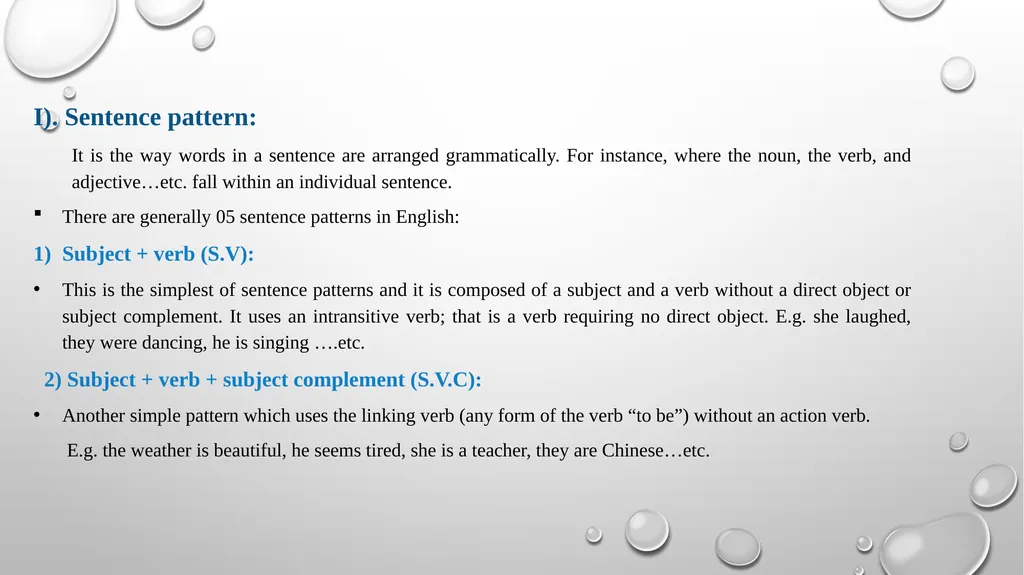
I). Sentence pattern:
It is the way words in a sentence are arranged grammatically. For instance, where the noun, the verb, and adjective…etc. fall within an individual sentence.
There are generally 05 sentence patterns in English:
Subject + verb (S.V):
This is the simplest of sentence patterns and it is composed of a subject and a verb without a direct object or subject complement. It uses an intransitive verb; that is a verb requiring no direct object. E.g. she laughed, they were dancing, he is singing ….etc.
2) Subject + verb + subject complement (S.V.C):
Another simple pattern which uses the linking verb (any form of the verb “to be”) without an action verb.
E.g. the weather is beautiful, he seems tired, she is a teacher, they are Chinese…etc.<br>
03
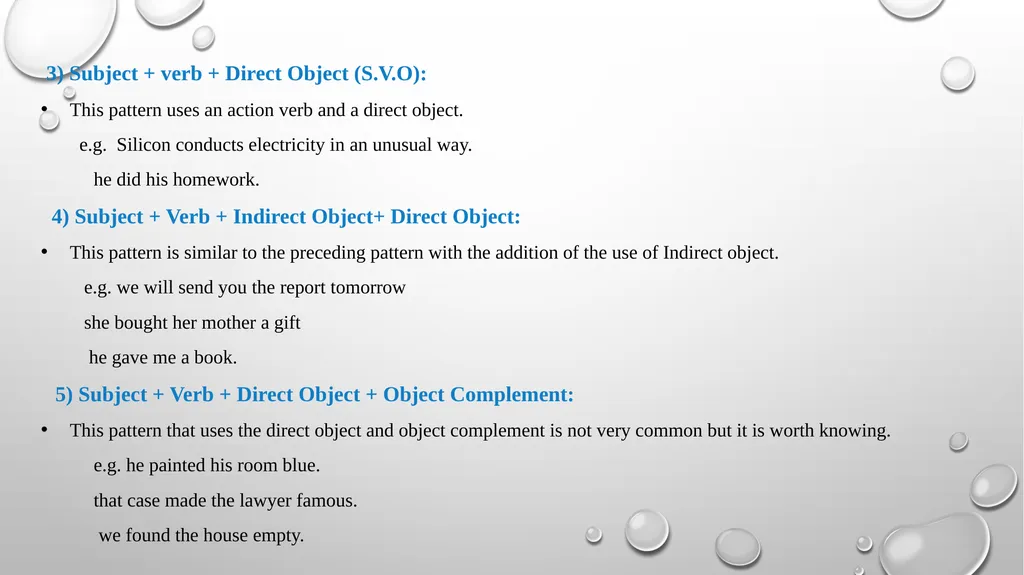
3) Subject + verb + Direct Object (S.V.O):
This pattern uses an action verb and a direct object.
e.g. Silicon conducts electricity in an unusual way.
he did his homework.
4) Subject + Verb + Indirect Object+ Direct Object:
This pattern is similar to the preceding pattern with the addition of the use of Indirect object.
e.g. we will send you the report tomorrow
she bought her mother a gift
he gave me a book.
5) Subject + Verb + Direct Object + Object Complement:
This pattern that uses the direct object and object complement is not very common but it is worth knowing.
e.g. he painted his room blue.
that case made the lawyer famous.
we found the house empty.<br>
04
II. Sentence Types<br>
05
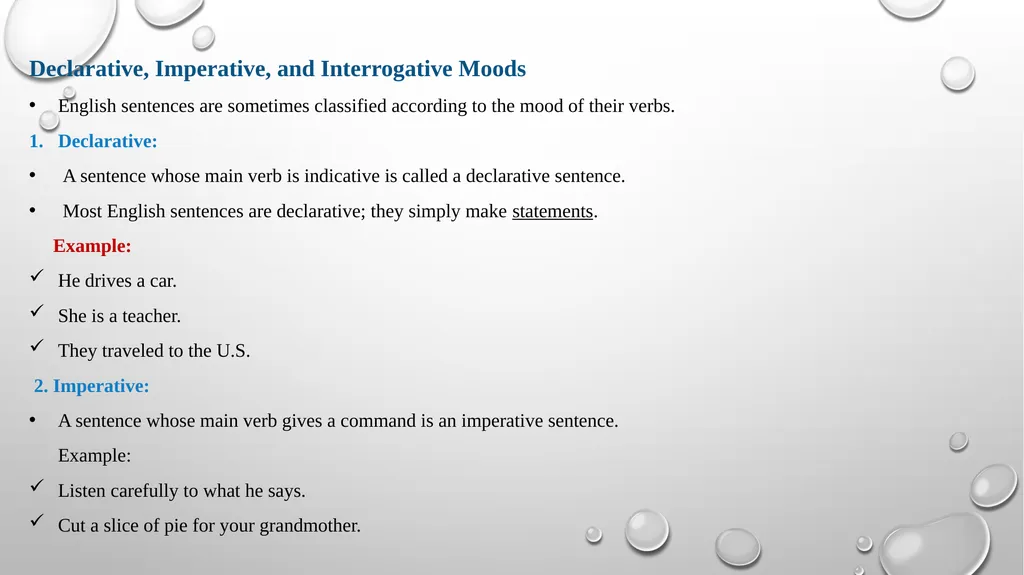
Declarative, Imperative, and Interrogative Moods
English sentences are sometimes classified according to the mood of their verbs.
Declarative:
A sentence whose main verb is indicative is called a declarative sentence.
Most English sentences are declarative; they simply make statements.
Example:
He drives a car.
She is a teacher.
They traveled to the U.S.
2. Imperative:
A sentence whose main verb gives a command is an imperative sentence.
Example:
Listen carefully to what he says.
Cut a slice of pie for your grandmother.<br>
06
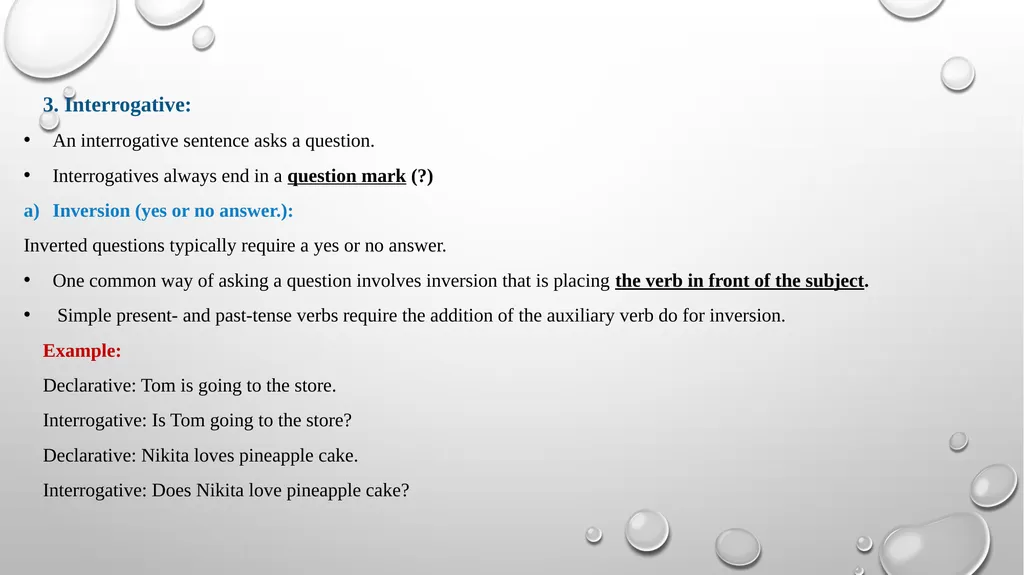
3. Interrogative:
An interrogative sentence asks a question.
Interrogatives always end in a question mark (?)
Inversion (yes or no answer.):
Inverted questions typically require a yes or no answer.
One common way of asking a question involves inversion that is placing the verb in front of the subject.
Simple present- and past-tense verbs require the addition of the auxiliary verb do for inversion.
Example:
Declarative: Tom is going to the store.
Interrogative: Is Tom going to the store?
Declarative: Nikita loves pineapple cake.
Interrogative: Does Nikita love pineapple cake?<br>
07
b) Wh- words/questions:
Another way of asking a question involves wh- words (who, whom, whose, what, which, where, why, when, and how).
The wh- word comes in front of the inverted verb.
Example:
How do you feel?
What are you making for dinner?
Why did you call him?
Where is the movie playing?
Wh-word questions require a specific piece of information as an answer.<br>
08
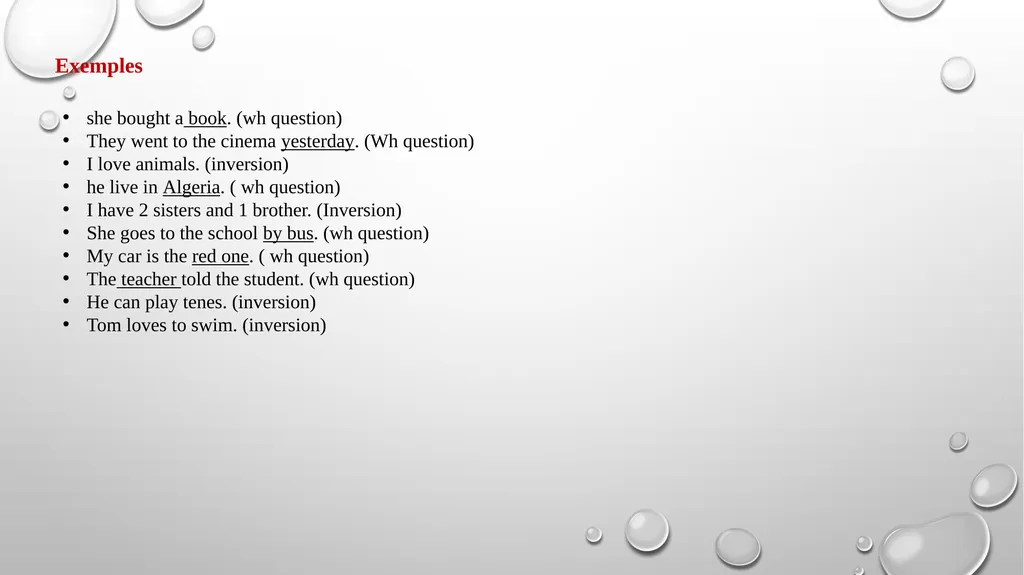
Exemples she bought a book. (wh question)
They went to the cinema yesterday. (Wh question)
I love animals. (inversion)
he live in Algeria. ( wh question)
I have 2 sisters and 1 brother. (Inversion)
She goes to the school by bus. (wh question)
My car is the red one. ( wh question)
The teacher told the student. (wh question)
He can play tenes. (inversion)
Tom loves to swim. (inversion)<br>