SEO Manager Position - Exercise https:www.sitioweb.com Case study https:www.utb.edu.co (Universidad Tecnológica de Bolívar) Objectives SEO to attract more students: this first objective is focused on explaining how we make it possible
"SEO Manager Position - Exercise" is the property of its rightful owner. Permission is granted to
download and print the materials on this website for personal, non-commercial use only, and to display it
on your personal computer provided you do not modify the materials and that you retain all copyright
notices contained in the materials. By downloading content from our website, you accept the terms of this
agreement.
Presentation Transcript
01
SEO Manager Position - Exercise https://www.sitioweb.com<br>
02
Case study https://www.utb.edu.co/ (Universidad Tecnológica de Bolívar) Objectives
SEO to attract more students: this first objective is focused on explaining how we make it possible for universities to gain better positions in Google, while simultaneously receiving more students in their undergraduate, graduate and diploma programs.
Markeging and SEO to improve positions in Webometrics and other rankings: this second objective is how we helped the university to gain positions in university rankings, through the analysis and management of the digital presence and the evaluation parameters of international rankings.<br>
03
In order to attract and enroll more students to your university or educational institute, or to enhance relevance in a university ranking, it is crucial to comprehend the intended recipients of the strategy. Therefore, analyzing the needs of individuals, their locations, and their interests becomes the foundational key to any educational marketing project. Understanding the target audience, whether students or rankings:<br>
04
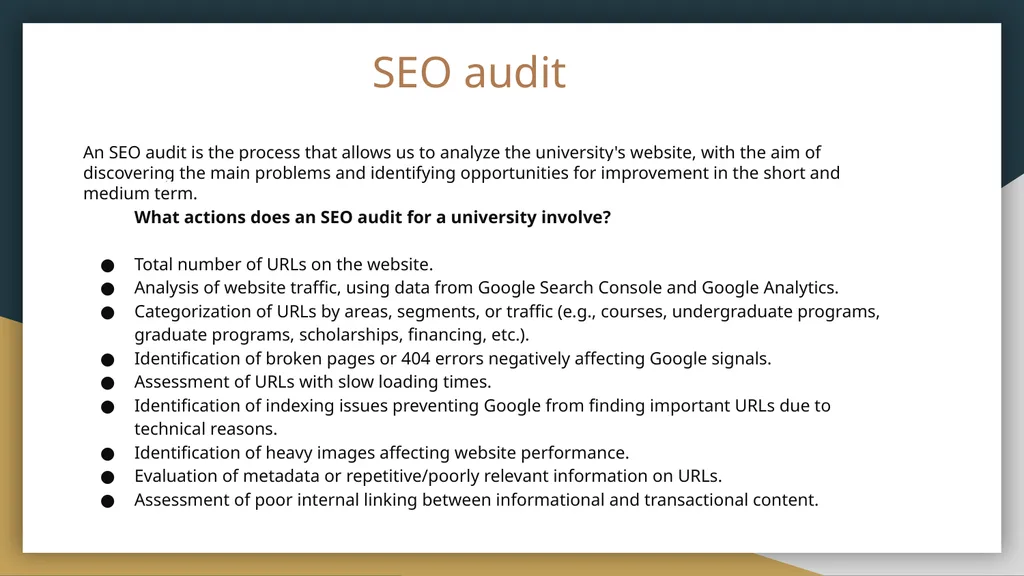
What actions does an SEO audit for a university involve?
Total number of URLs on the website.
Analysis of website traffic, using data from Google Search Console and Google Analytics.
Categorization of URLs by areas, segments, or traffic (e.g., courses, undergraduate programs, graduate programs, scholarships, financing, etc.).
Identification of broken pages or 404 errors negatively affecting Google signals.
Assessment of URLs with slow loading times.
Identification of indexing issues preventing Google from finding important URLs due to technical reasons.
Identification of heavy images affecting website performance.
Evaluation of metadata or repetitive/poorly relevant information on URLs.
Assessment of poor internal linking between informational and transactional content. SEO audit An SEO audit is the process that allows us to analyze the university's website, with the aim of discovering the main problems and identifying opportunities for improvement in the short and medium term.<br>
05
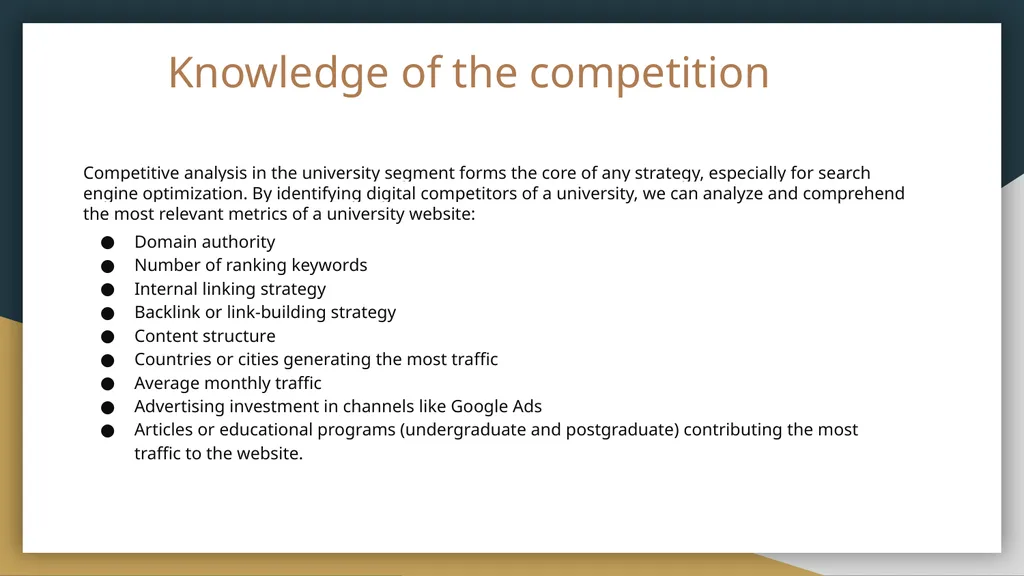
Domain authority
Number of ranking keywords
Internal linking strategy
Backlink or link-building strategy
Content structure
Countries or cities generating the most traffic
Average monthly traffic
Advertising investment in channels like Google Ads
Articles or educational programs (undergraduate and postgraduate) contributing the most traffic to the website. Knowledge of the competition Competitive analysis in the university segment forms the core of any strategy, especially for search engine optimization. By identifying digital competitors of a university, we can analyze and comprehend the most relevant metrics of a university website:<br>
06
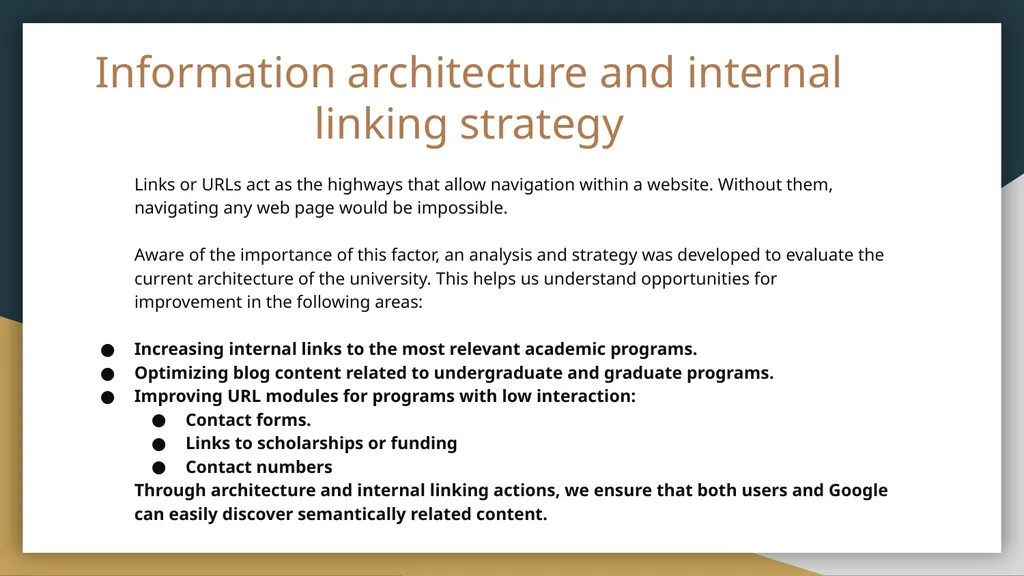
Links or URLs act as the highways that allow navigation within a website. Without them, navigating any web page would be impossible.
Aware of the importance of this factor, an analysis and strategy was developed to evaluate the current architecture of the university. This helps us understand opportunities for improvement in the following areas:
Increasing internal links to the most relevant academic programs.
Optimizing blog content related to undergraduate and graduate programs.
Improving URL modules for programs with low interaction:
Contact forms.
Links to scholarships or funding
Contact numbers
Through architecture and internal linking actions, we ensure that both users and Google can easily discover semantically related content. Information architecture and internal linking strategy<br>
07
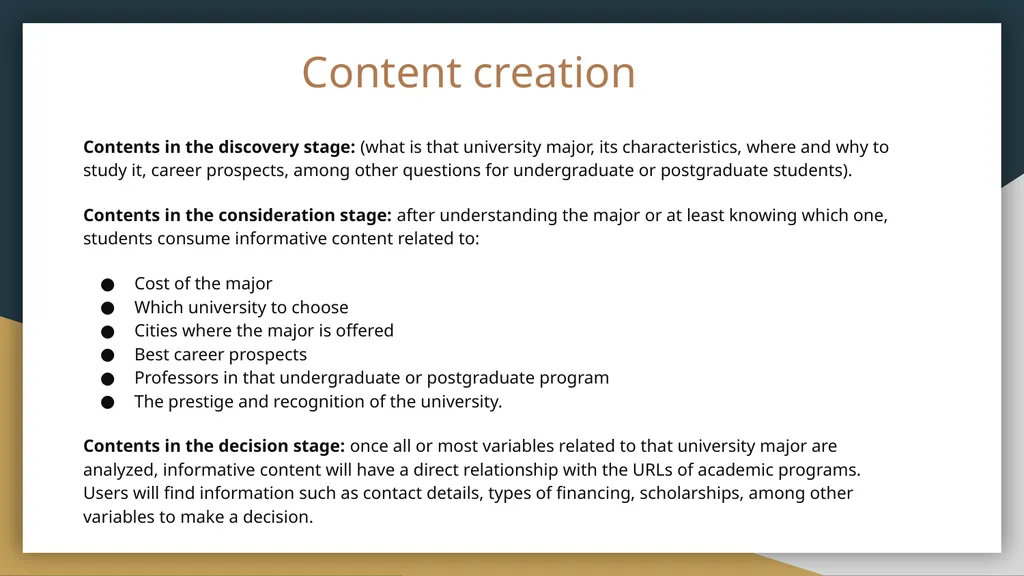
Contents in the discovery stage: (what is that university major, its characteristics, where and why to study it, career prospects, among other questions for undergraduate or postgraduate students).
Contents in the consideration stage: after understanding the major or at least knowing which one, students consume informative content related to:
Cost of the major
Which university to choose
Cities where the major is offered
Best career prospects
Professors in that undergraduate or postgraduate program
The prestige and recognition of the university.
Contents in the decision stage: once all or most variables related to that university major are analyzed, informative content will have a direct relationship with the URLs of academic programs. Users will find information such as contact details, types of financing, scholarships, among other variables to make a decision. Content creation<br>
08
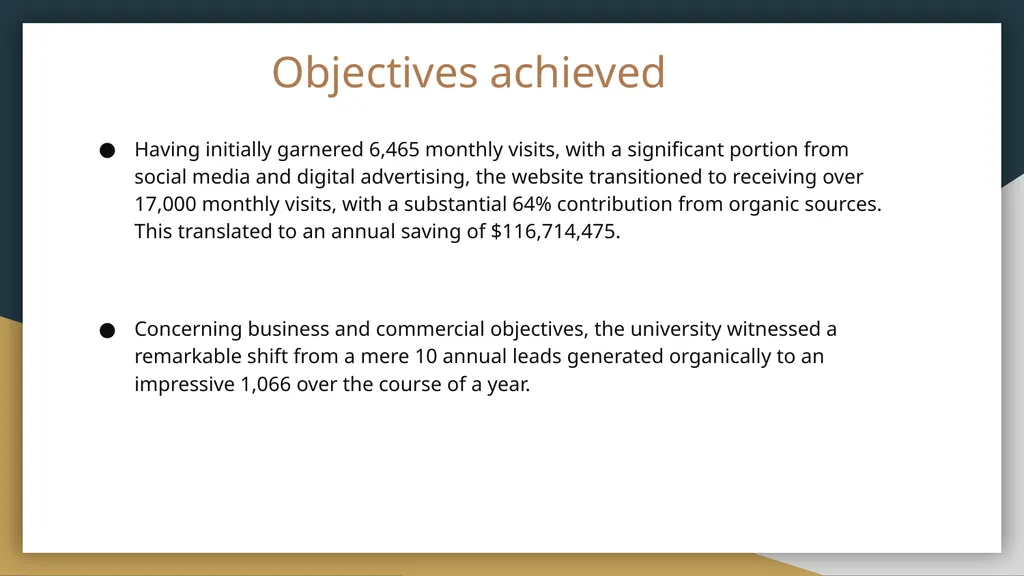
Having initially garnered 6,465 monthly visits, with a significant portion from social media and digital advertising, the website transitioned to receiving over 17,000 monthly visits, with a substantial 64% contribution from organic sources. This translated to an annual saving of $116,714,475.
Concerning business and commercial objectives, the university witnessed a remarkable shift from a mere 10 annual leads generated organically to an impressive 1,066 over the course of a year. Objectives achieved<br>
09
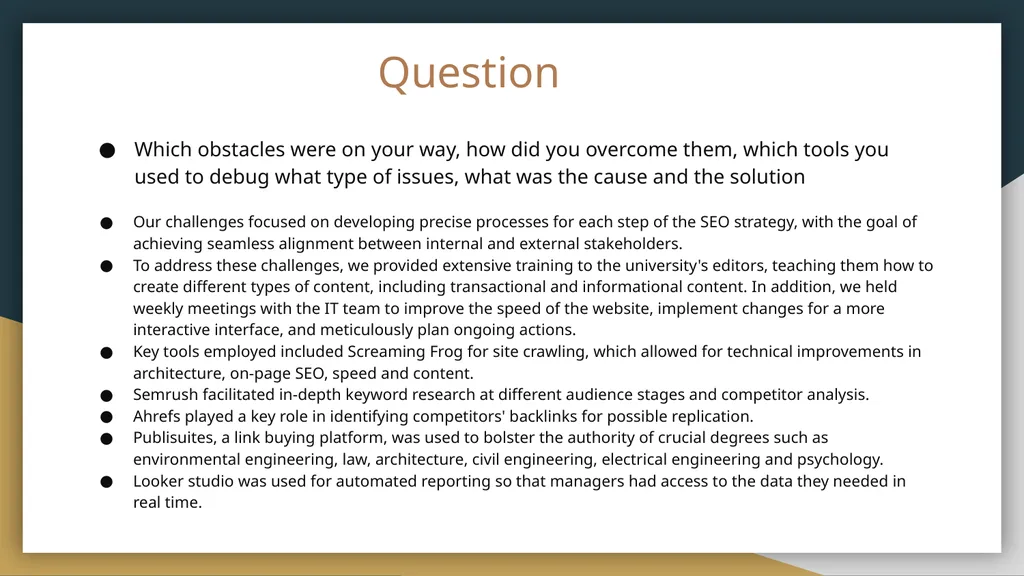
Which obstacles were on your way, how did you overcome them, which tools you used to debug what type of issues, what was the cause and the solution Question Our challenges focused on developing precise processes for each step of the SEO strategy, with the goal of achieving seamless alignment between internal and external stakeholders.
To address these challenges, we provided extensive training to the university's editors, teaching them how to create different types of content, including transactional and informational content. In addition, we held weekly meetings with the IT team to improve the speed of the website, implement changes for a more interactive interface, and meticulously plan ongoing actions.
Key tools employed included Screaming Frog for site crawling, which allowed for technical improvements in architecture, on-page SEO, speed and content.
Semrush facilitated in-depth keyword research at different audience stages and competitor analysis.
Ahrefs played a key role in identifying competitors' backlinks for possible replication.
Publisuites, a link buying platform, was used to bolster the authority of crucial degrees such as environmental engineering, law, architecture, civil engineering, electrical engineering and psychology.
Looker studio was used for automated reporting so that managers had access to the data they needed in real time.<br>