SERVICE-LEARNING AT LSU Center for Community Engagement, Learning, and Leadership Welcome! Please share who you are and why you are interested in service-learning. Definition of Service-Learning Service-learning is a credit-bearing,
Related Topics
Share
Embed code
Download this presentation From Below
"SERVICE-LEARNING AT LSU Center for Community" is the property of its rightful owner. Permission is granted to
download and print the materials on this website for personal, non-commercial use only, and to display it
on your personal computer provided you do not modify the materials and that you retain all copyright
notices contained in the materials. By downloading content from our website, you accept the terms of this
agreement.
Presentation Transcript
01
SERVICE-LEARNING AT LSU Center for Community Engagement, Learning, and Leadership<br>
02
Welcome! Please share who you are and why you are interested in service-learning.<br>
03
Definition of Service-Learning Service-learning is a credit-bearing, educational experience in which students participate in an organized service activity that meets identified community needs and reflect on the service activity in such a way as to gain further understanding of course content, a broader appreciation of the discipline, and an enhanced sense of civic responsibility. (Adapted from Robert Bringle and Julie Hatcher (1996). “Implementing Service-Learning in Higher Education,” Journal of Higher Education, 67:2)<br>
04
Definition of Service-Learning To qualify as a service-learning class, a course should include these components:
addresses an identified community (campus, local, regional, global) need
service-learning supports the attainment of one or more course objectives
demonstrates a clear connection between the service activity and the course content
involves reciprocity between course and community that has the potential to result in students' increased civic awareness and engagement
involves structured student reflection on the service experience and its relation to course goals
involves collaboration with an appropriate community partner<br>
05
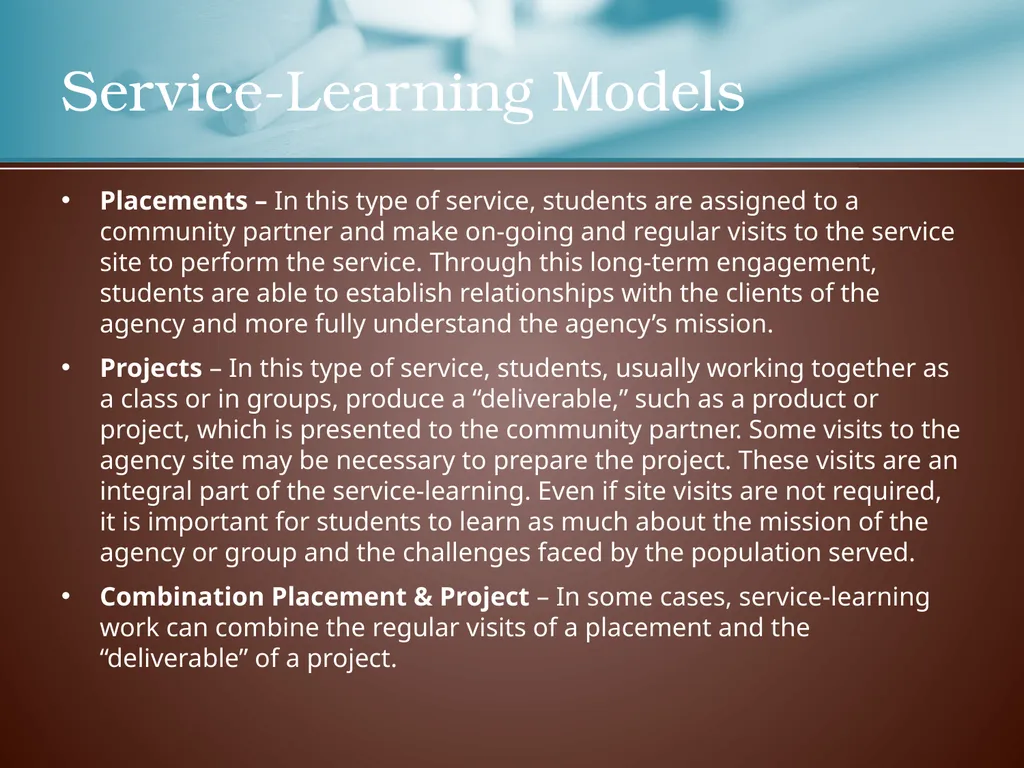
Service-Learning Models Placements – In this type of service, students are assigned to a community partner and make on-going and regular visits to the service site to perform the service. Through this long-term engagement, students are able to establish relationships with the clients of the agency and more fully understand the agency’s mission.
Projects – In this type of service, students, usually working together as a class or in groups, produce a “deliverable,” such as a product or project, which is presented to the community partner. Some visits to the agency site may be necessary to prepare the project. These visits are an integral part of the service-learning. Even if site visits are not required, it is important for students to learn as much about the mission of the agency or group and the challenges faced by the population served.
Combination Placement & Project – In some cases, service-learning work can combine the regular visits of a placement and the “deliverable” of a project.<br>
06
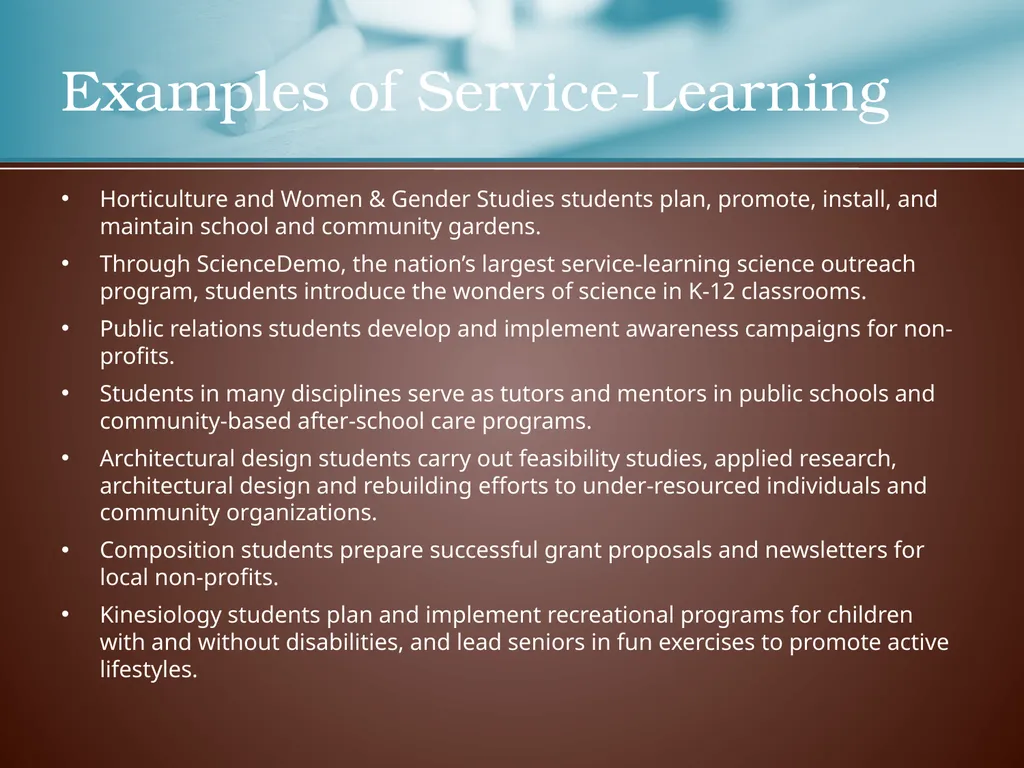
Examples of Service-Learning Horticulture and Women & Gender Studies students plan, promote, install, and maintain school and community gardens.
Through ScienceDemo, the nation’s largest service-learning science outreach program, students introduce the wonders of science in K-12 classrooms.
Public relations students develop and implement awareness campaigns for non-profits.
Students in many disciplines serve as tutors and mentors in public schools and community-based after-school care programs.
Architectural design students carry out feasibility studies, applied research, architectural design and rebuilding efforts to under-resourced individuals and community organizations.
Composition students prepare successful grant proposals and newsletters for local non-profits.
Kinesiology students plan and implement recreational programs for children with and without disabilities, and lead seniors in fun exercises to promote active lifestyles.<br>
07
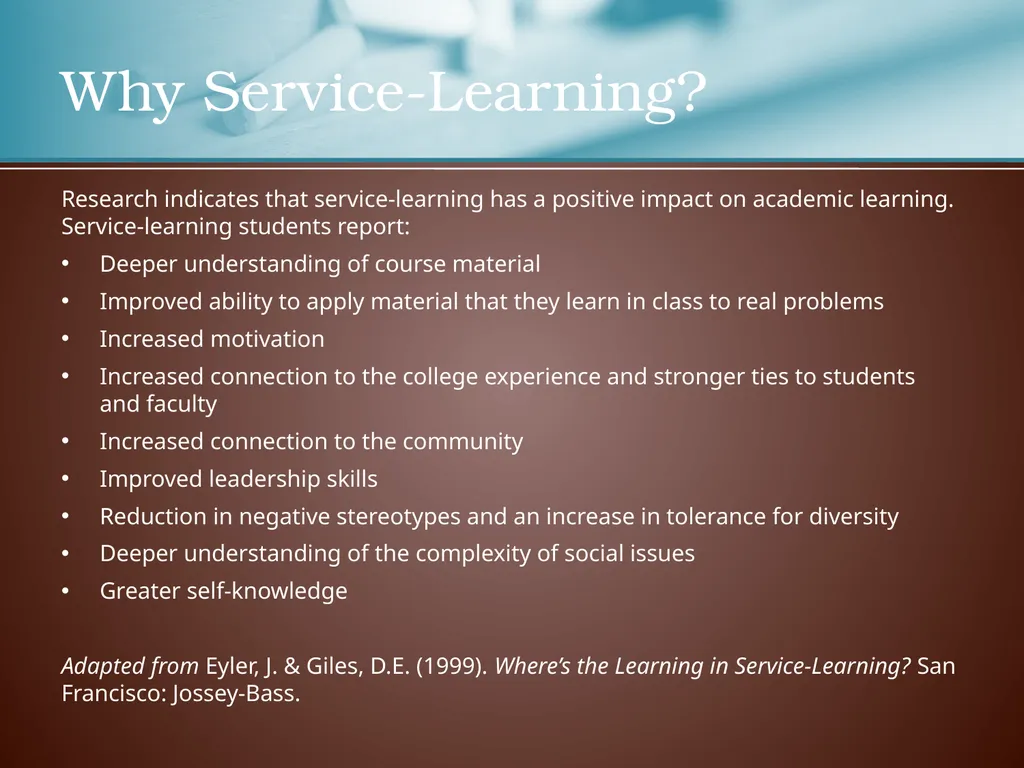
Why Service-Learning? Research indicates that service-learning has a positive impact on academic learning. Service-learning students report:
Deeper understanding of course material
Improved ability to apply material that they learn in class to real problems
Increased motivation
Increased connection to the college experience and stronger ties to students and faculty
Increased connection to the community
Improved leadership skills
Reduction in negative stereotypes and an increase in tolerance for diversity
Deeper understanding of the complexity of social issues
Greater self-knowledge
Adapted from Eyler, J. & Giles, D.E. (1999). Where’s the Learning in Service-Learning? San Francisco: Jossey-Bass.<br>
08
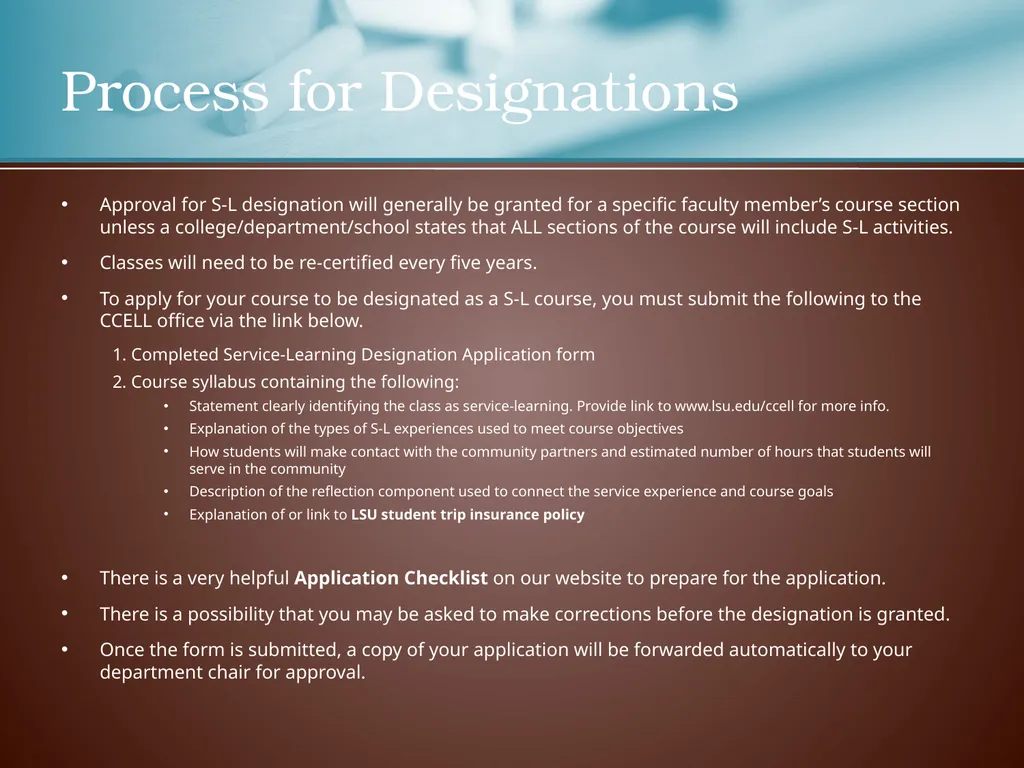
Process for Designations Approval for S-L designation will generally be granted for a specific faculty member’s course section unless a college/department/school states that ALL sections of the course will include S-L activities.
Classes will need to be re-certified every five years.
To apply for your course to be designated as a S-L course, you must submit the following to the CCELL office via the link below.
1. Completed Service-Learning Designation Application form
2. Course syllabus containing the following:
Statement clearly identifying the class as service-learning. Provide link to www.lsu.edu/ccell for more info.
Explanation of the types of S-L experiences used to meet course objectives
How students will make contact with the community partners and estimated number of hours that students will serve in the community
Description of the reflection component used to connect the service experience and course goals
Explanation of or link to LSU student trip insurance policy
There is a very helpful Application Checklist on our website to prepare for the application.
There is a possibility that you may be asked to make corrections before the designation is granted.
Once the form is submitted, a copy of your application will be forwarded automatically to your department chair for approval.<br>
09
Questions?<br>
10
Next Steps Meet individually to discuss your idea.
Develop or solidify your partnership.
Create your service-learning syllabus.
Submit for the designation.<br>