
Session 11: Selected Items of Cost Texas Workforce
KL
Published · 38 slides · 0 views

1 / 1





Description
Session 11: Selected Items of Cost Texas Workforce Commission Financial Conference July 23-25, 2025 1 Presenter Jenny Noren TWC Financial Initiatives 2 Topics this Session DOL Consultant Fee Limit and Illustration Selected Cost Item
Related Topics
Share
Embed code
Download this presentation From Below
"Session 11: Selected Items of Cost Texas Workforce" is the property of its rightful owner. Permission is granted to download and print the materials on this website for personal, non-commercial use only, and to display it on your personal computer provided you do not modify the materials and that you retain all copyright notices contained in the materials. By downloading content from our website, you accept the terms of this agreement.
Presentation Transcript
01
Session 11:
Selected Items of Cost Texas Workforce Commission Financial Conference
July 23-25, 2025 1<br>
July 23-25, 2025 1<br>
02
Presenter Jenny Noren
TWC Financial Initiatives 2<br>
TWC Financial Initiatives 2<br>
03
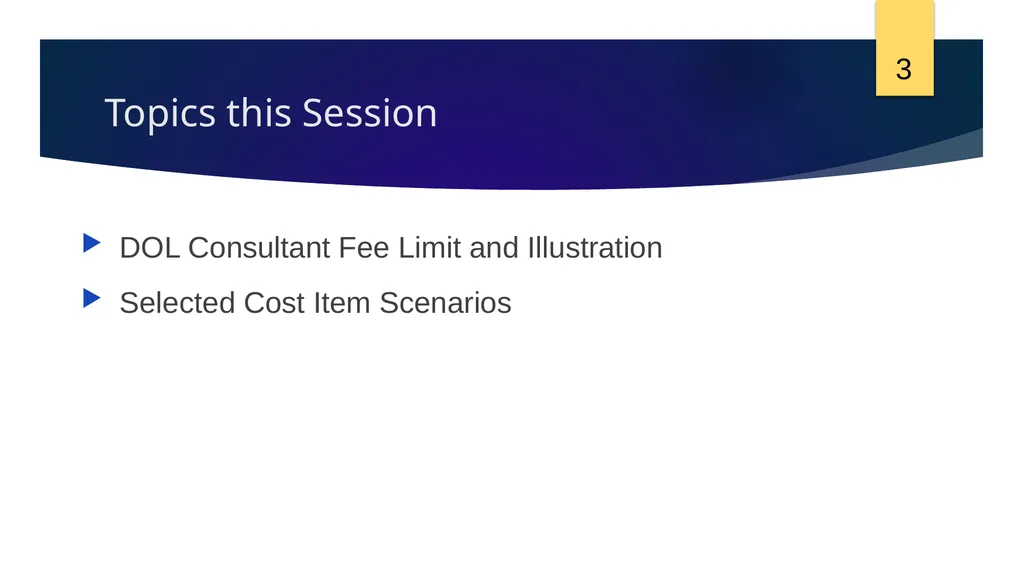
Topics this Session DOL Consultant Fee Limit and Illustration
Selected Cost Item Scenarios 3<br>
Selected Cost Item Scenarios 3<br>
04
DOL Consultant Fee Limit & Illustration 4<br>
05
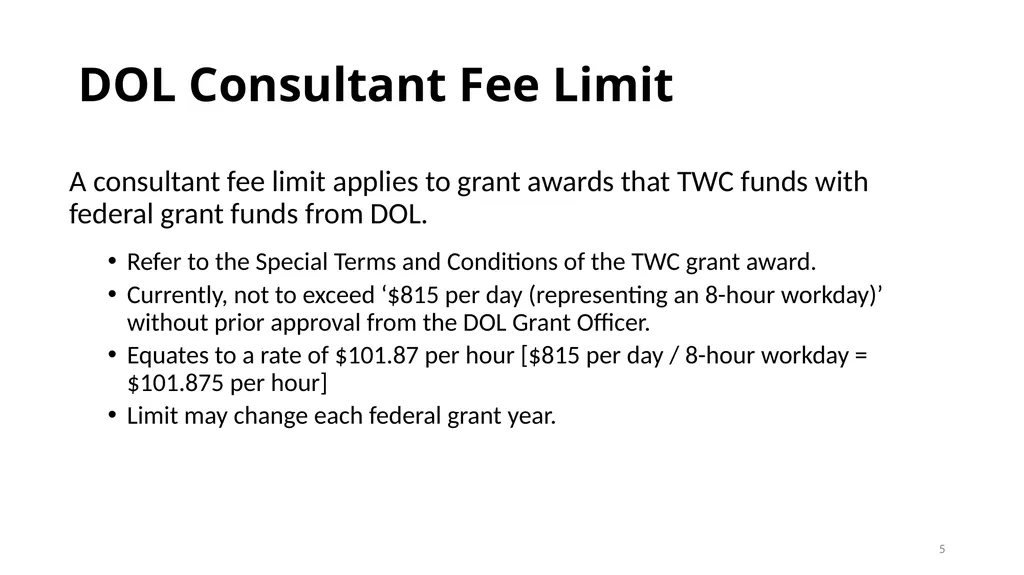
DOL Consultant Fee Limit A consultant fee limit applies to grant awards that TWC funds with federal grant funds from DOL.
Refer to the Special Terms and Conditions of the TWC grant award.
Currently, not to exceed ‘$815 per day (representing an 8-hour workday)’ without prior approval from the DOL Grant Officer.
Equates to a rate of $101.87 per hour [$815 per day / 8-hour workday = $101.875 per hour]
Limit may change each federal grant year. 5<br>
Refer to the Special Terms and Conditions of the TWC grant award.
Currently, not to exceed ‘$815 per day (representing an 8-hour workday)’ without prior approval from the DOL Grant Officer.
Equates to a rate of $101.87 per hour [$815 per day / 8-hour workday = $101.875 per hour]
Limit may change each federal grant year. 5<br>
06
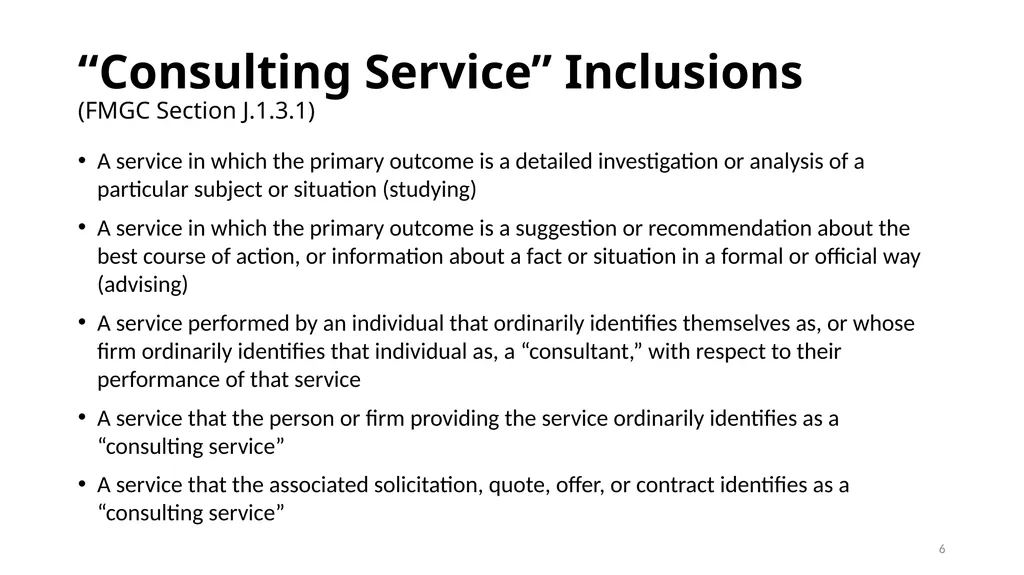
“Consulting Service” Inclusions
(FMGC Section J.1.3.1) A service in which the primary outcome is a detailed investigation or analysis of a particular subject or situation (studying)
A service in which the primary outcome is a suggestion or recommendation about the best course of action, or information about a fact or situation in a formal or official way (advising)
A service performed by an individual that ordinarily identifies themselves as, or whose firm ordinarily identifies that individual as, a “consultant,” with respect to their performance of that service
A service that the person or firm providing the service ordinarily identifies as a “consulting service”
A service that the associated solicitation, quote, offer, or contract identifies as a “consulting service” 6<br>
A service in which the primary outcome is a suggestion or recommendation about the best course of action, or information about a fact or situation in a formal or official way (advising)
A service performed by an individual that ordinarily identifies themselves as, or whose firm ordinarily identifies that individual as, a “consultant,” with respect to their performance of that service
A service that the person or firm providing the service ordinarily identifies as a “consulting service”
A service that the associated solicitation, quote, offer, or contract identifies as a “consulting service” 6<br>
07
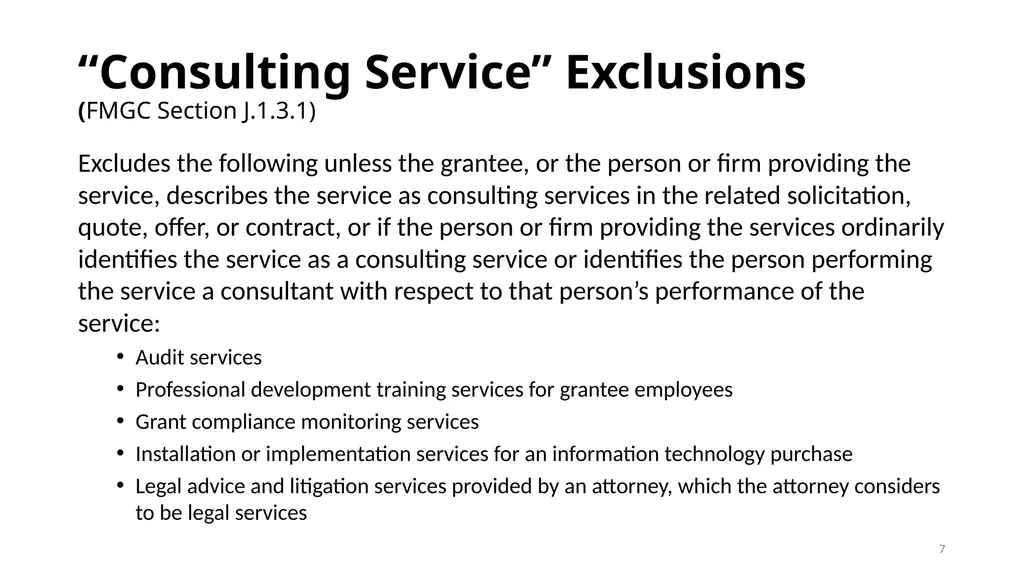
“Consulting Service” Exclusions
(FMGC Section J.1.3.1) Excludes the following unless the grantee, or the person or firm providing the service, describes the service as consulting services in the related solicitation, quote, offer, or contract, or if the person or firm providing the services ordinarily identifies the service as a consulting service or identifies the person performing the service a consultant with respect to that person’s performance of the service:
Audit services
Professional development training services for grantee employees
Grant compliance monitoring services
Installation or implementation services for an information technology purchase
Legal advice and litigation services provided by an attorney, which the attorney considers to be legal services 7<br>
Audit services
Professional development training services for grantee employees
Grant compliance monitoring services
Installation or implementation services for an information technology purchase
Legal advice and litigation services provided by an attorney, which the attorney considers to be legal services 7<br>
08
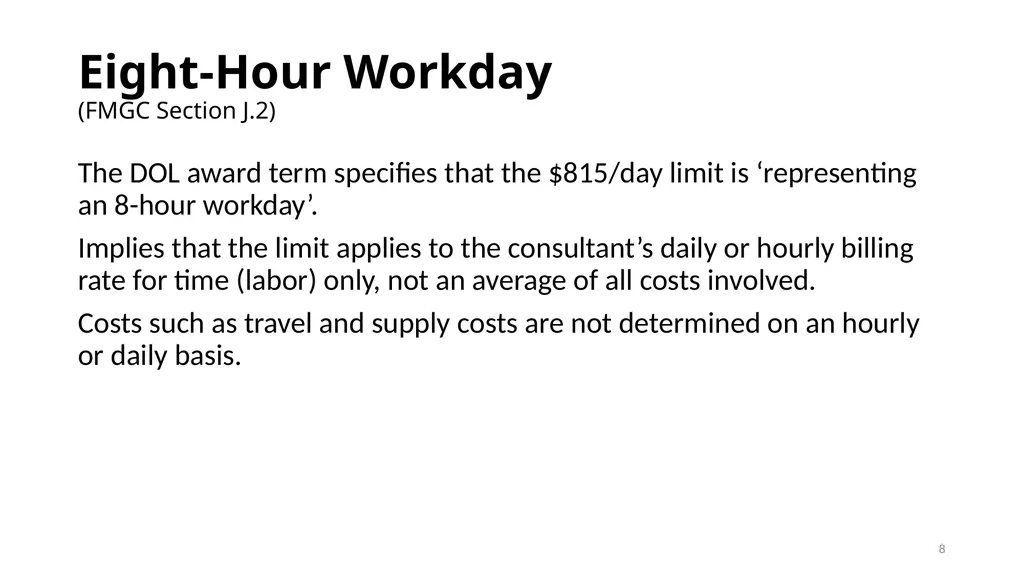
Eight-Hour Workday
(FMGC Section J.2) The DOL award term specifies that the $815/day limit is ‘representing an 8-hour workday’.
Implies that the limit applies to the consultant’s daily or hourly billing rate for time (labor) only, not an average of all costs involved.
Costs such as travel and supply costs are not determined on an hourly or daily basis. 8<br>
Implies that the limit applies to the consultant’s daily or hourly billing rate for time (labor) only, not an average of all costs involved.
Costs such as travel and supply costs are not determined on an hourly or daily basis. 8<br>
09
Pro-Rated if Funded by Multiple Awards
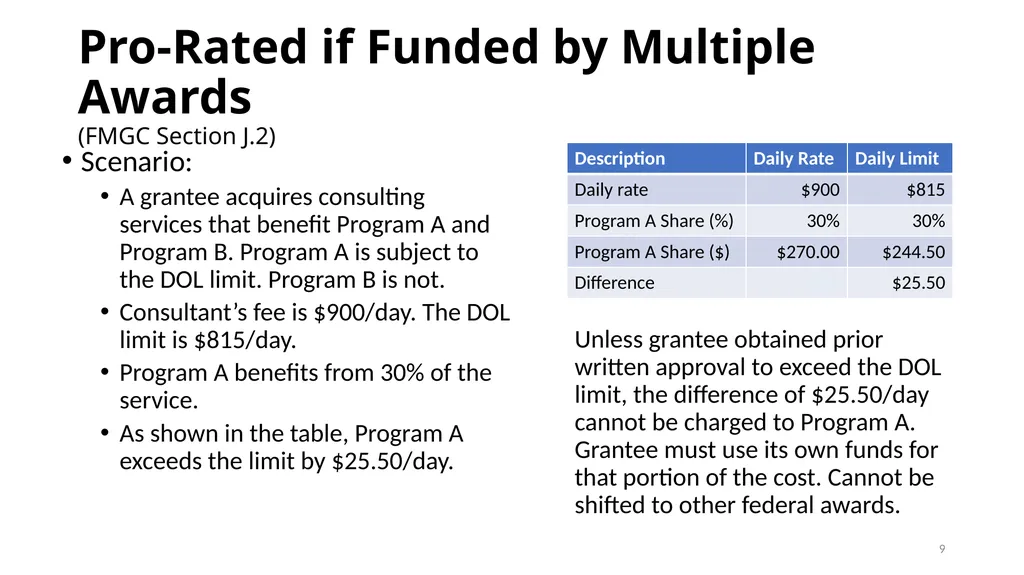
(FMGC Section J.2) Scenario:
A grantee acquires consulting services that benefit Program A and Program B. Program A is subject to the DOL limit. Program B is not.
Consultant’s fee is $900/day. The DOL limit is $815/day.
Program A benefits from 30% of the service.
As shown in the table, Program A exceeds the limit by $25.50/day. Unless grantee obtained prior written approval to exceed the DOL limit, the difference of $25.50/day cannot be charged to Program A. Grantee must use its own funds for that portion of the cost. Cannot be shifted to other federal awards. 9<br>
A grantee acquires consulting services that benefit Program A and Program B. Program A is subject to the DOL limit. Program B is not.
Consultant’s fee is $900/day. The DOL limit is $815/day.
Program A benefits from 30% of the service.
As shown in the table, Program A exceeds the limit by $25.50/day. Unless grantee obtained prior written approval to exceed the DOL limit, the difference of $25.50/day cannot be charged to Program A. Grantee must use its own funds for that portion of the cost. Cannot be shifted to other federal awards. 9<br>
10
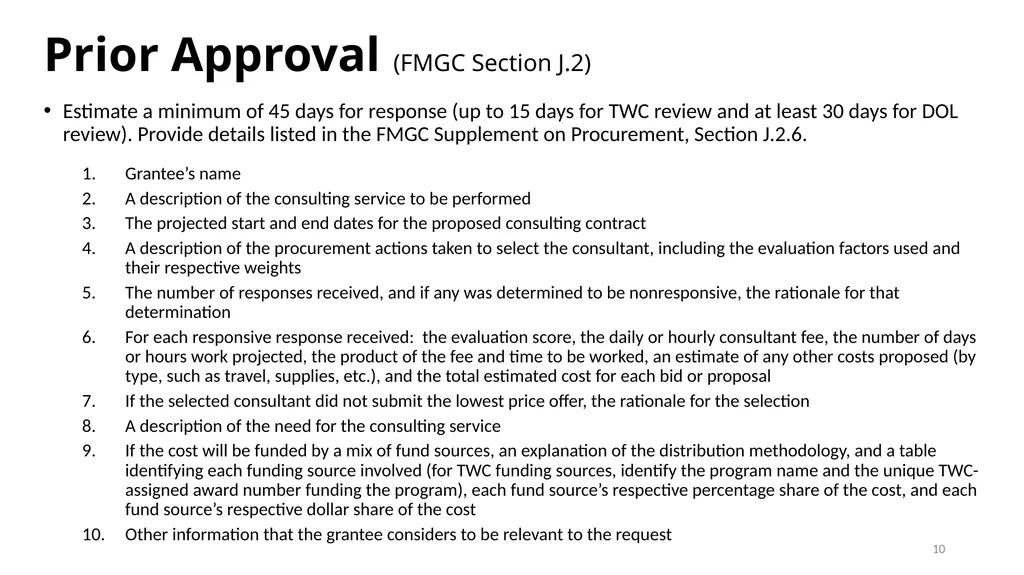
Prior Approval (FMGC Section J.2) Estimate a minimum of 45 days for response (up to 15 days for TWC review and at least 30 days for DOL review). Provide details listed in the FMGC Supplement on Procurement, Section J.2.6.
Grantee’s name
A description of the consulting service to be performed
The projected start and end dates for the proposed consulting contract
A description of the procurement actions taken to select the consultant, including the evaluation factors used and their respective weights
The number of responses received, and if any was determined to be nonresponsive, the rationale for that determination
For each responsive response received: the evaluation score, the daily or hourly consultant fee, the number of days or hours work projected, the product of the fee and time to be worked, an estimate of any other costs proposed (by type, such as travel, supplies, etc.), and the total estimated cost for each bid or proposal
If the selected consultant did not submit the lowest price offer, the rationale for the selection
A description of the need for the consulting service
If the cost will be funded by a mix of fund sources, an explanation of the distribution methodology, and a table identifying each funding source involved (for TWC funding sources, identify the program name and the unique TWC-assigned award number funding the program), each fund source’s respective percentage share of the cost, and each fund source’s respective dollar share of the cost
Other information that the grantee considers to be relevant to the request 10<br>
Grantee’s name
A description of the consulting service to be performed
The projected start and end dates for the proposed consulting contract
A description of the procurement actions taken to select the consultant, including the evaluation factors used and their respective weights
The number of responses received, and if any was determined to be nonresponsive, the rationale for that determination
For each responsive response received: the evaluation score, the daily or hourly consultant fee, the number of days or hours work projected, the product of the fee and time to be worked, an estimate of any other costs proposed (by type, such as travel, supplies, etc.), and the total estimated cost for each bid or proposal
If the selected consultant did not submit the lowest price offer, the rationale for the selection
A description of the need for the consulting service
If the cost will be funded by a mix of fund sources, an explanation of the distribution methodology, and a table identifying each funding source involved (for TWC funding sources, identify the program name and the unique TWC-assigned award number funding the program), each fund source’s respective percentage share of the cost, and each fund source’s respective dollar share of the cost
Other information that the grantee considers to be relevant to the request 10<br>
11
Selected Cost Item Scenarios 11<br>
12
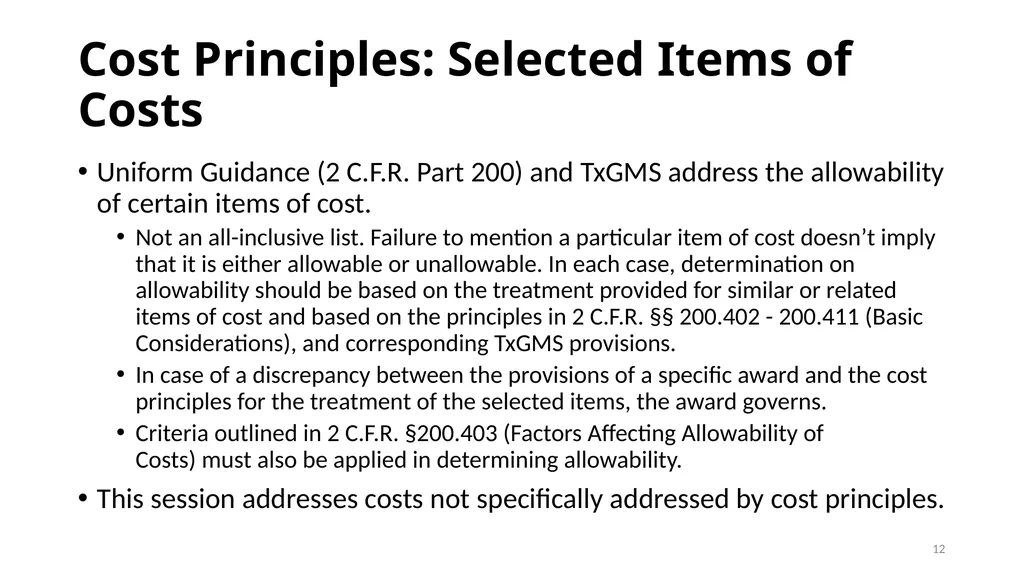
Cost Principles: Selected Items of Costs Uniform Guidance (2 C.F.R. Part 200) and TxGMS address the allowability of certain items of cost.
Not an all-inclusive list. Failure to mention a particular item of cost doesn’t imply that it is either allowable or unallowable. In each case, determination on allowability should be based on the treatment provided for similar or related items of cost and based on the principles in 2 C.F.R. §§ 200.402 - 200.411 (Basic Considerations), and corresponding TxGMS provisions.
In case of a discrepancy between the provisions of a specific award and the cost principles for the treatment of the selected items, the award governs.
Criteria outlined in 2 C.F.R. §200.403 (Factors Affecting Allowability of Costs) must also be applied in determining allowability.
This session addresses costs not specifically addressed by cost principles. 12<br>
Not an all-inclusive list. Failure to mention a particular item of cost doesn’t imply that it is either allowable or unallowable. In each case, determination on allowability should be based on the treatment provided for similar or related items of cost and based on the principles in 2 C.F.R. §§ 200.402 - 200.411 (Basic Considerations), and corresponding TxGMS provisions.
In case of a discrepancy between the provisions of a specific award and the cost principles for the treatment of the selected items, the award governs.
Criteria outlined in 2 C.F.R. §200.403 (Factors Affecting Allowability of Costs) must also be applied in determining allowability.
This session addresses costs not specifically addressed by cost principles. 12<br>
13
#1 Food & Beverage Youth Event
Board Meeting
Working Lunch
Off-site Retreat 13<br>
Board Meeting
Working Lunch
Off-site Retreat 13<br>
14
Youth Event Scenario:
Your organization organizes a one-day job readiness event for youth participants. The event starts at 8 a.m. and ends at 5 p.m. The event organizer asks you whether grant funds can be used to provide lunch to the youth.
What would you do? 14<br>
Your organization organizes a one-day job readiness event for youth participants. The event starts at 8 a.m. and ends at 5 p.m. The event organizer asks you whether grant funds can be used to provide lunch to the youth.
What would you do? 14<br>
15
Youth Event Discussion Points Must be necessary and reasonable. For example, is it necessary to provide the meal to carry out the program activity within the grant parameters? If yes, identify the circumstances that make it necessary, such as, responsibility for youth safety and whereabouts during the full-day time block, need to continue providing information through the mealtime, etc. Document rationale!!!
Per person meal cost must be reasonable. Identify the basis for the meal count in writing. Use a reasonable basis. For example, depending on when the food order must be placed, the number signed up for the event or the number at the event. May include grantee personnel in the count if it is necessary for the personnel to be at the event during the mealtime; document the rationale, such as to supervise the youth, dissemination of technical information through the mealtime, etc.
Describe the activity and/or retain a copy of the agenda to show that the purpose of the activity is to disseminate program (technical) information.
Retain attendance records. 15<br>
Per person meal cost must be reasonable. Identify the basis for the meal count in writing. Use a reasonable basis. For example, depending on when the food order must be placed, the number signed up for the event or the number at the event. May include grantee personnel in the count if it is necessary for the personnel to be at the event during the mealtime; document the rationale, such as to supervise the youth, dissemination of technical information through the mealtime, etc.
Describe the activity and/or retain a copy of the agenda to show that the purpose of the activity is to disseminate program (technical) information.
Retain attendance records. 15<br>
16
Board Meeting Scenario:
Board members for the local workforce development board hold a monthly board meeting. The members represent employers, colleges, school districts, and other entities. The monthly meetings are held in the evenings to accommodate board members’ work schedules. You are asked whether grant funds can be used to provide the board members with a meal.
What would you do? 16<br>
Board members for the local workforce development board hold a monthly board meeting. The members represent employers, colleges, school districts, and other entities. The monthly meetings are held in the evenings to accommodate board members’ work schedules. You are asked whether grant funds can be used to provide the board members with a meal.
What would you do? 16<br>
17
Board Meeting Discussion Points Must be necessary and reasonable. For example, is it necessary to schedule the meeting during a mealtime to accommodate board members’ availability to facilitate dissemination of program (technical) information to those board members? If yes, include a statement to that effect in the purchase documentation.
Per person meal cost must be reasonable. Identify the basis for the meal count in writing. Use a reasonable basis. For example, depending on when the food order must be placed, the number signed up for the meeting or the number at the meeting. May include grantee personnel in the count if it is necessary for the personnel to be at the event during the mealtime (such as to present materials, provide support during the meeting, or if the meeting outcome directly impacts their work); document the rationale.
Retain a copy of the meeting agenda and attendance records.
Document points 1-3!!! 17<br>
Per person meal cost must be reasonable. Identify the basis for the meal count in writing. Use a reasonable basis. For example, depending on when the food order must be placed, the number signed up for the meeting or the number at the meeting. May include grantee personnel in the count if it is necessary for the personnel to be at the event during the mealtime (such as to present materials, provide support during the meeting, or if the meeting outcome directly impacts their work); document the rationale.
Retain a copy of the meeting agenda and attendance records.
Document points 1-3!!! 17<br>
18
Off-site Retreat Scenario:
Your organization is holding a one-day off-site retreat for its employees. Someone suggests that you use TWC grant funds to pay for all or part of an employee luncheon.
What would you do? 18<br>
Your organization is holding a one-day off-site retreat for its employees. Someone suggests that you use TWC grant funds to pay for all or part of an employee luncheon.
What would you do? 18<br>
19
Off-Site Retreat Discussion Points Acquiring meals during normal working days is ordinarily a personal expense of each employee that cannot be paid with grant funds.
Additionally, in this scenario, there is no technical information being disseminated beyond the grantee and its employees. 19<br>
Additionally, in this scenario, there is no technical information being disseminated beyond the grantee and its employees. 19<br>
20
Working Lunch Scenario:
Your organization holds a “working lunch” staff meeting with employees working on a TWC grant award. You are asked to use TWC grant funds to pay for all or a portion of the lunch.
What would you do? 20<br>
Your organization holds a “working lunch” staff meeting with employees working on a TWC grant award. You are asked to use TWC grant funds to pay for all or a portion of the lunch.
What would you do? 20<br>
21
Working Lunch Discussion Points Acquiring meals during normal working days—for example, working lunches, planning meetings, normal operational activities, staff training, and the like—is ordinarily a personal expense of each employee that cannot be paid with grant funds.
In this scenario, there is no technical information being disseminated beyond the grantee and its employees. 21<br>
In this scenario, there is no technical information being disseminated beyond the grantee and its employees. 21<br>
22
Bottled Water – Health & Safety Scenario:
Your local city provides the tap water for the building where some of your organization offices. You are the manager at that office. Several employees work at the office with you. Program customers frequent the office. Six months ago, the municipality started issuing boil water notices at least once per month, citing plant failures due to aging infrastructure. The notices last about 24 hours each. The municipality expects the problem to persist for the foreseeable future. Last week there was a news report that cited citizen concerns and questions about drinking water safety. There’s been no official report that the water is unsafe to drink. But you are concerned.
What would you do? 22<br>
Your local city provides the tap water for the building where some of your organization offices. You are the manager at that office. Several employees work at the office with you. Program customers frequent the office. Six months ago, the municipality started issuing boil water notices at least once per month, citing plant failures due to aging infrastructure. The notices last about 24 hours each. The municipality expects the problem to persist for the foreseeable future. Last week there was a news report that cited citizen concerns and questions about drinking water safety. There’s been no official report that the water is unsafe to drink. But you are concerned.
What would you do? 22<br>
23
Bottled Water Discussion Points Any purchase of water must be necessary and reasonable.
Collect and retain evidence of the boil water notices and causes.
What are other businesses and offices in the area doing? Make notes on your observations, including how and when you made them, and the businesses noted.
Formally inquire to the municipality. Keep records of the communications, including dates, your inquiry, and the response.
Collect any other relevant information available.
Review. Decide what to do.
If you purchase water, choose an appropriate duration and procurement procedures. Include a written justification in the supporting documentation. Retain the supporting information for your decision and continue to monitor the situation, documenting as you go. 23<br>
Collect and retain evidence of the boil water notices and causes.
What are other businesses and offices in the area doing? Make notes on your observations, including how and when you made them, and the businesses noted.
Formally inquire to the municipality. Keep records of the communications, including dates, your inquiry, and the response.
Collect any other relevant information available.
Review. Decide what to do.
If you purchase water, choose an appropriate duration and procurement procedures. Include a written justification in the supporting documentation. Retain the supporting information for your decision and continue to monitor the situation, documenting as you go. 23<br>
24
#2 Clothing 24<br>
25
T-shirts for Program Participants Scenario:
Your organization received a grant award from TWC to conduct one or more camps that support Science, Technology, Engineering, and Mathematics (STEM) learning. Someone suggests purchasing camp-identifying t-shirts for the camp participants and camp counselors.
What would you do? 25<br>
Your organization received a grant award from TWC to conduct one or more camps that support Science, Technology, Engineering, and Mathematics (STEM) learning. Someone suggests purchasing camp-identifying t-shirts for the camp participants and camp counselors.
What would you do? 25<br>
26
Participant T-Shirt Discussion Points Must be necessary and reasonable. For example, are the shirts necessary to carry out the activity, such as for safety reasons to easily identify the youth (and enable youth to identify camp counselors) in a crowded location consisting of groups from your organization and others? State the rationale in the documentation.
What is the purpose of the activity that makes the shirts necessary and how does it pertain to the successful performance of the grant award?
Purchase price must be reasonable.
The number of shirts must be reasonable for the number of participants involved.
Document points 1-2!!! 26<br>
What is the purpose of the activity that makes the shirts necessary and how does it pertain to the successful performance of the grant award?
Purchase price must be reasonable.
The number of shirts must be reasonable for the number of participants involved.
Document points 1-2!!! 26<br>
27
Employee Shirts Scenario:
Someone suggests that your organization use TWC grant funds to purchase logo-embossed shirts for employees performing work under that grant award. They suggest that employees be permitted to wear the shirts in the office on any given day and at off-site events (when they attend to represent your organization).
What would you do? 27<br>
Someone suggests that your organization use TWC grant funds to purchase logo-embossed shirts for employees performing work under that grant award. They suggest that employees be permitted to wear the shirts in the office on any given day and at off-site events (when they attend to represent your organization).
What would you do? 27<br>
28
Employee Shirt Discussion Points The primary purpose must be for identification at off-site events. Items for personal use cannot be paid for with grant funds. Apparel for daily office use is generally considered a personal expense and cannot be funded with grant funds.
Justification must demonstrate why it is necessary for the performance of grant activities for employees to have identifying apparel at off-site events. Which employees attend the events? How many off-site events are attended? Describe the events. Why is it necessary that the individuals be identifiable at the events? Would a badge be a more economical alternative? Will the individuals be standing at a table that already identifies the organization?
Document rationale!!! 28<br>
Justification must demonstrate why it is necessary for the performance of grant activities for employees to have identifying apparel at off-site events. Which employees attend the events? How many off-site events are attended? Describe the events. Why is it necessary that the individuals be identifiable at the events? Would a badge be a more economical alternative? Will the individuals be standing at a table that already identifies the organization?
Document rationale!!! 28<br>
29
#3 Giveaways 29<br>
30
Scenario: Job Fair Giveaways You organize or participate in a job fair. You set up a table or booth to provide job fair attendees with information about the services that your organization provides under a grant award from TWC. Someone suggests purchasing stress balls, pens, or other items to give individuals who visit the table.
What do you do? 30<br>
What do you do? 30<br>
31
Giveaways Discussion Points
(slide 1 of 2) Federal scrutiny of giveaways has increased significantly.
“Outreach” giveaways:
Difficult to establish giveaways as being “necessary” and “reasonable” for outreach, regardless of whether the items contain any program information or information to access program services.
Unless “necessary” and “reasonable” can be established, generally falls in the category of unallowable advertising and public relations costs (2 C.F.R. § 200.421), akin to unallowable costs for “promotional items and memorabilia, including models, gifts, and souvenirs”.
The fact that businesses frequently use giveaway items to promote themselves and their products does not justify the use of giveaways as outreach items under grant programs.
Continues, next slide. 31<br>
“Outreach” giveaways:
Difficult to establish giveaways as being “necessary” and “reasonable” for outreach, regardless of whether the items contain any program information or information to access program services.
Unless “necessary” and “reasonable” can be established, generally falls in the category of unallowable advertising and public relations costs (2 C.F.R. § 200.421), akin to unallowable costs for “promotional items and memorabilia, including models, gifts, and souvenirs”.
The fact that businesses frequently use giveaway items to promote themselves and their products does not justify the use of giveaways as outreach items under grant programs.
Continues, next slide. 31<br>
32
Giveaways Discussion Points
(slide 2 of 2) Supplies sometimes get pulled into this conversation.
The mere act of making certain supplies available for participant use does not justify the cost of imprinting those items with a logo or other information. Invites scrutiny of whether the added printing cost was “necessary”.
Example: Making writing utensils and/or small notepads available for participant use while they use a resource room, or participate in a workshop, job fair, or other program-funded activity.
Example: Disposable drinking cups provided for participant use of a water dispenser made available during an activity that warrants the availability of drinking water and otherwise provides no safe drinking water options.
If the supplies are an appropriate quality for the specific use for which they are needed and the cost of the printed supplies is no different from an equivalent type and quality of supplies that is available from a supplier that you might otherwise use for which no printing option is available, consider recording that in the supporting documentation, along with documentation of the items, suppliers, and pricing that you compared.
Safest Approach: No “outreach” giveaways. Limit printing to circumstances that clearly warrant it. 32<br>
The mere act of making certain supplies available for participant use does not justify the cost of imprinting those items with a logo or other information. Invites scrutiny of whether the added printing cost was “necessary”.
Example: Making writing utensils and/or small notepads available for participant use while they use a resource room, or participate in a workshop, job fair, or other program-funded activity.
Example: Disposable drinking cups provided for participant use of a water dispenser made available during an activity that warrants the availability of drinking water and otherwise provides no safe drinking water options.
If the supplies are an appropriate quality for the specific use for which they are needed and the cost of the printed supplies is no different from an equivalent type and quality of supplies that is available from a supplier that you might otherwise use for which no printing option is available, consider recording that in the supporting documentation, along with documentation of the items, suppliers, and pricing that you compared.
Safest Approach: No “outreach” giveaways. Limit printing to circumstances that clearly warrant it. 32<br>
33
#4 Last Few Scenarios 33<br>
34
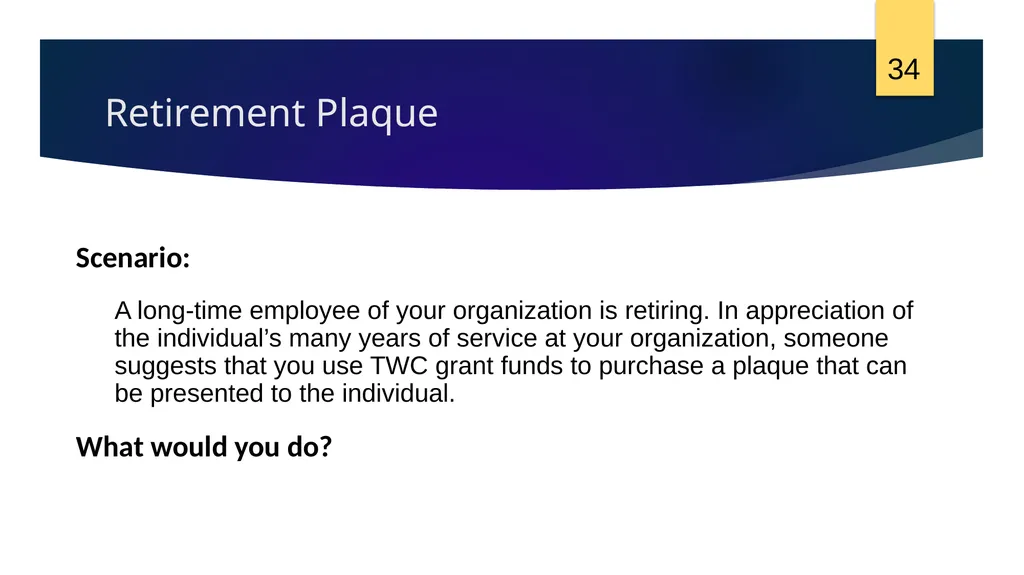
Retirement Plaque Scenario:
A long-time employee of your organization is retiring. In appreciation of the individual’s many years of service at your organization, someone suggests that you use TWC grant funds to purchase a plaque that can be presented to the individual.
What would you do? 34<br>
A long-time employee of your organization is retiring. In appreciation of the individual’s many years of service at your organization, someone suggests that you use TWC grant funds to purchase a plaque that can be presented to the individual.
What would you do? 34<br>
35
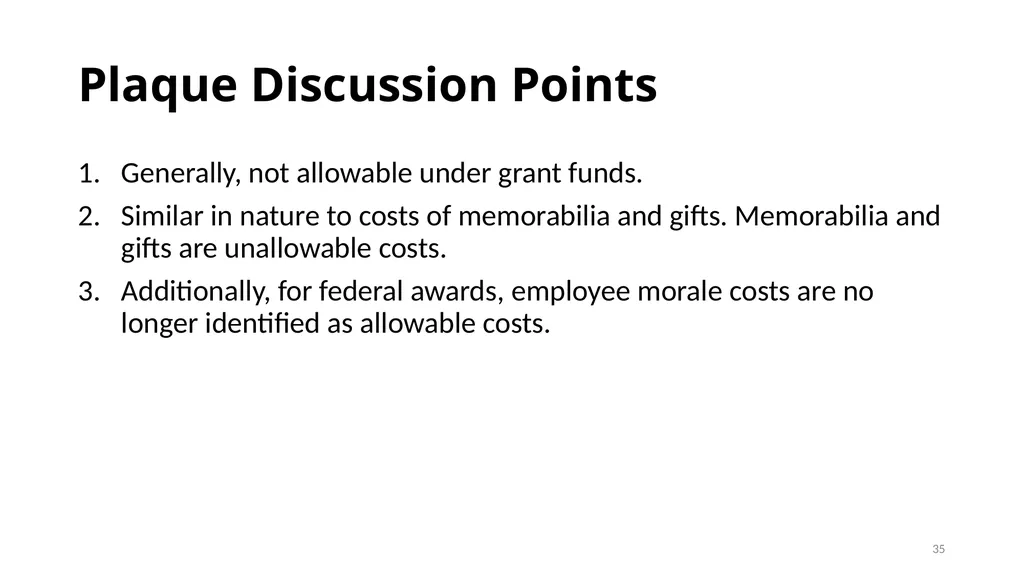
Plaque Discussion Points Generally, not allowable under grant funds.
Similar in nature to costs of memorabilia and gifts. Memorabilia and gifts are unallowable costs.
Additionally, for federal awards, employee morale costs are no longer identified as allowable costs. 35<br>
Similar in nature to costs of memorabilia and gifts. Memorabilia and gifts are unallowable costs.
Additionally, for federal awards, employee morale costs are no longer identified as allowable costs. 35<br>
36
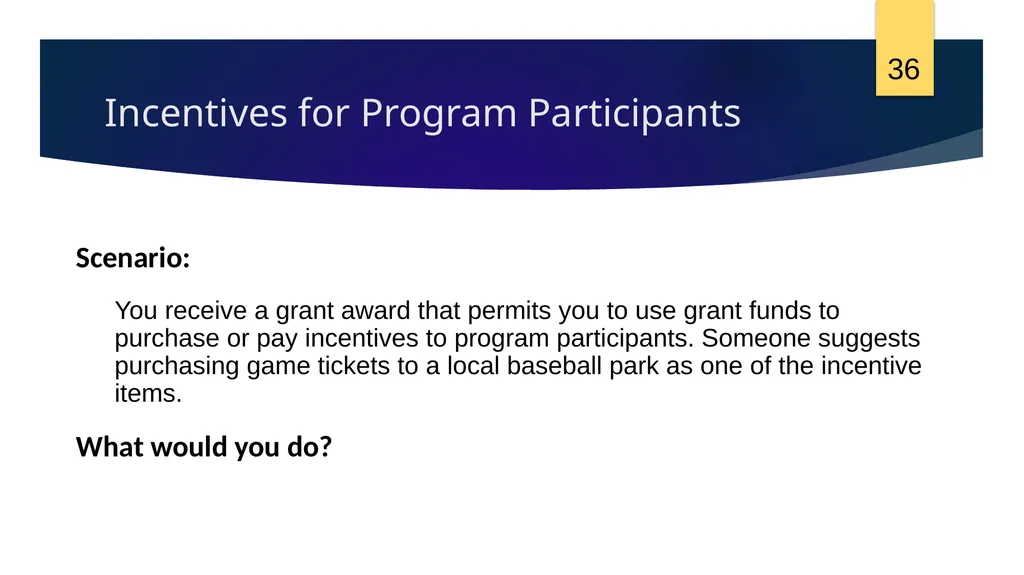
Incentives for Program Participants Scenario:
You receive a grant award that permits you to use grant funds to purchase or pay incentives to program participants. Someone suggests purchasing game tickets to a local baseball park as one of the incentive items.
What would you do? 36<br>
You receive a grant award that permits you to use grant funds to purchase or pay incentives to program participants. Someone suggests purchasing game tickets to a local baseball park as one of the incentive items.
What would you do? 36<br>
37
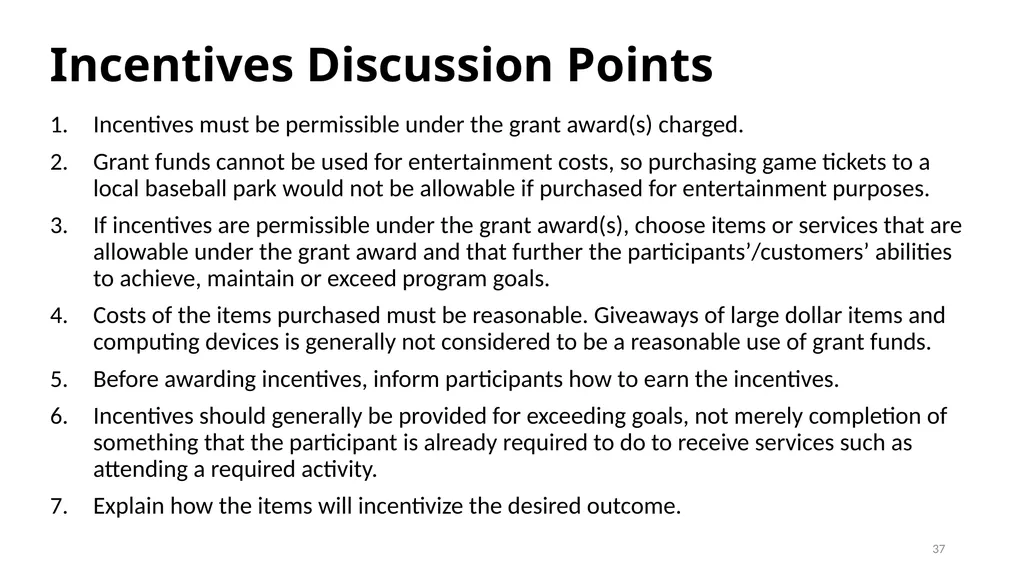
Incentives Discussion Points Incentives must be permissible under the grant award(s) charged.
Grant funds cannot be used for entertainment costs, so purchasing game tickets to a local baseball park would not be allowable if purchased for entertainment purposes.
If incentives are permissible under the grant award(s), choose items or services that are allowable under the grant award and that further the participants’/customers’ abilities to achieve, maintain or exceed program goals.
Costs of the items purchased must be reasonable. Giveaways of large dollar items and computing devices is generally not considered to be a reasonable use of grant funds.
Before awarding incentives, inform participants how to earn the incentives.
Incentives should generally be provided for exceeding goals, not merely completion of something that the participant is already required to do to receive services such as attending a required activity.
Explain how the items will incentivize the desired outcome. 37<br>
Grant funds cannot be used for entertainment costs, so purchasing game tickets to a local baseball park would not be allowable if purchased for entertainment purposes.
If incentives are permissible under the grant award(s), choose items or services that are allowable under the grant award and that further the participants’/customers’ abilities to achieve, maintain or exceed program goals.
Costs of the items purchased must be reasonable. Giveaways of large dollar items and computing devices is generally not considered to be a reasonable use of grant funds.
Before awarding incentives, inform participants how to earn the incentives.
Incentives should generally be provided for exceeding goals, not merely completion of something that the participant is already required to do to receive services such as attending a required activity.
Explain how the items will incentivize the desired outcome. 37<br>
38
Questions? For questions about this session, e-mail TWC’s Fiscal Technical Assistance mailbox at fiscal.ta@twc.texas.gov. 38<br>