Session 2: INTRINSIC VALUATION Laying the Foundation Aswath Damodaran Aswath Damodaran 1 The essence of intrinsic value In intrinsic valuation, you value an asset based upon its intrinsic characteristics. For cash flow generating
"Session 2: INTRINSIC VALUATION Laying the" is the property of its rightful owner. Permission is granted to
download and print the materials on this website for personal, non-commercial use only, and to display it
on your personal computer provided you do not modify the materials and that you retain all copyright
notices contained in the materials. By downloading content from our website, you accept the terms of this
agreement.
Presentation Transcript
01
Session 2: INTRINSIC VALUATION Laying the Foundation Aswath Damodaran ‹#› Aswath Damodaran 1<br>
02
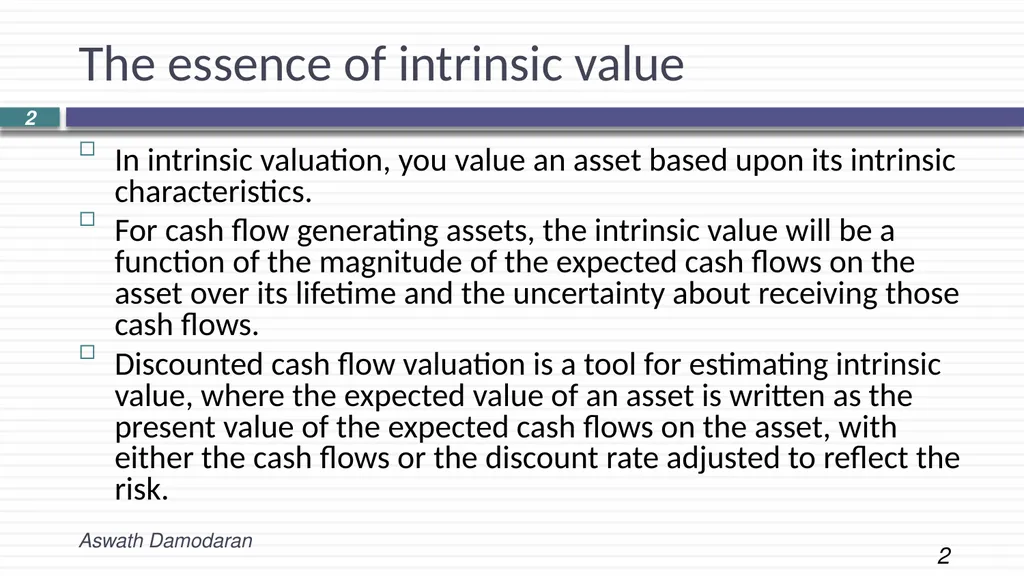
The essence of intrinsic value In intrinsic valuation, you value an asset based upon its intrinsic characteristics.
For cash flow generating assets, the intrinsic value will be a function of the magnitude of the expected cash flows on the asset over its lifetime and the uncertainty about receiving those cash flows.
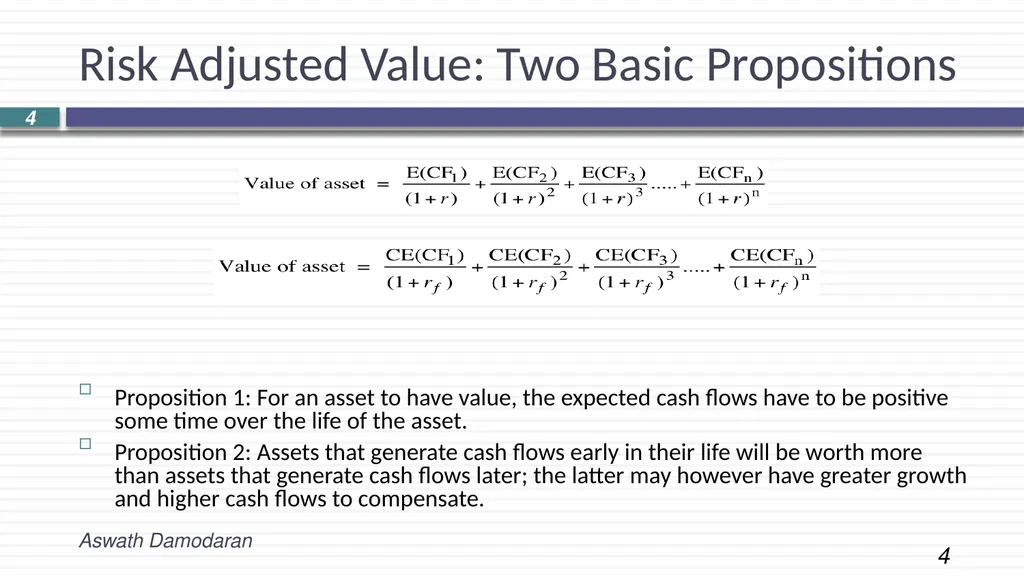
Discounted cash flow valuation is a tool for estimating intrinsic value, where the expected value of an asset is written as the present value of the expected cash flows on the asset, with either the cash flows or the discount rate adjusted to reflect the risk. Aswath Damodaran 2<br>
03
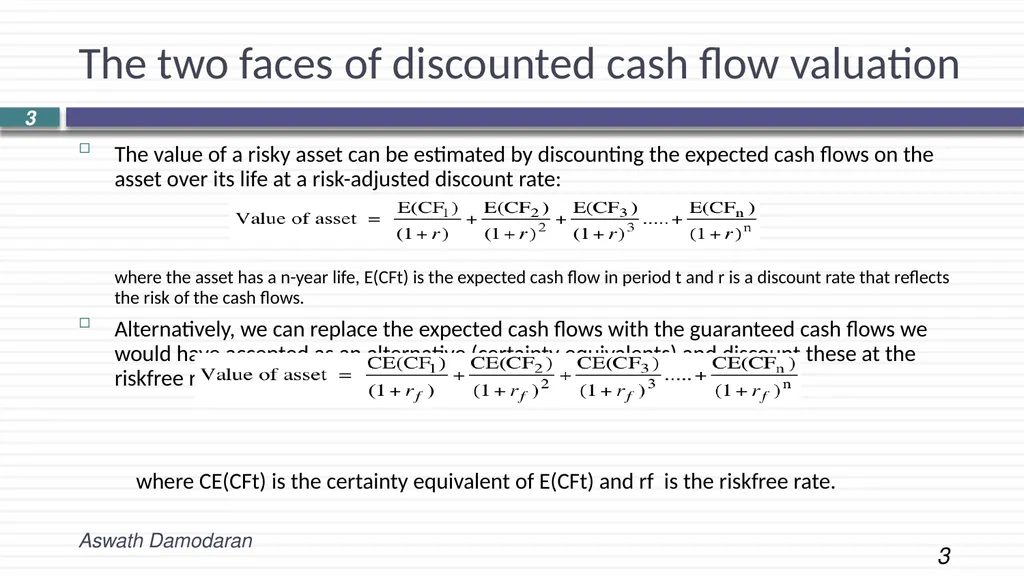
The two faces of discounted cash flow valuation The value of a risky asset can be estimated by discounting the expected cash flows on the asset over its life at a risk-adjusted discount rate:
where the asset has a n-year life, E(CFt) is the expected cash flow in period t and r is a discount rate that reflects the risk of the cash flows.
Alternatively, we can replace the expected cash flows with the guaranteed cash flows we would have accepted as an alternative (certainty equivalents) and discount these at the riskfree rate:
where CE(CFt) is the certainty equivalent of E(CFt) and rf is the riskfree rate. Aswath Damodaran 3<br>
04
Risk Adjusted Value: Two Basic Propositions Proposition 1: For an asset to have value, the expected cash flows have to be positive some time over the life of the asset.
Proposition 2: Assets that generate cash flows early in their life will be worth more than assets that generate cash flows later; the latter may however have greater growth and higher cash flows to compensate. Aswath Damodaran 4<br>
05
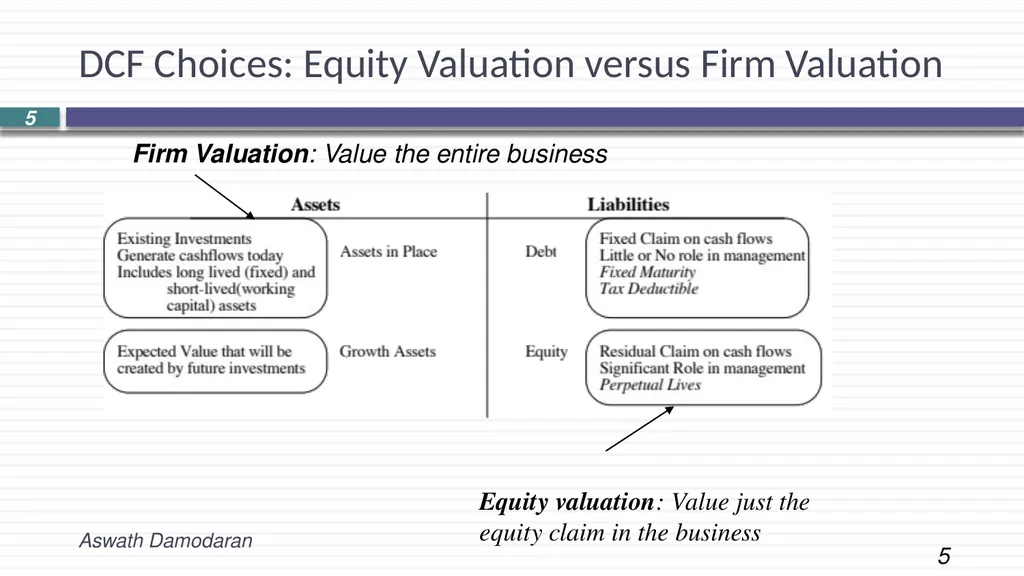
DCF Choices: Equity Valuation versus Firm Valuation Equity valuation: Value just the equity claim in the business Firm Valuation: Value the entire business Aswath Damodaran 5<br>
06
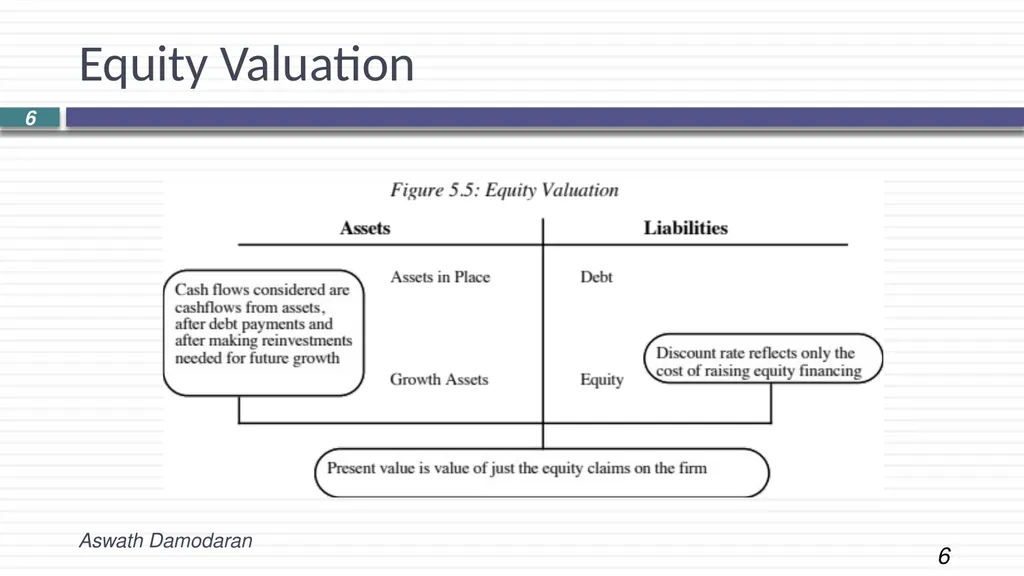
Equity Valuation Aswath Damodaran 6<br>
07
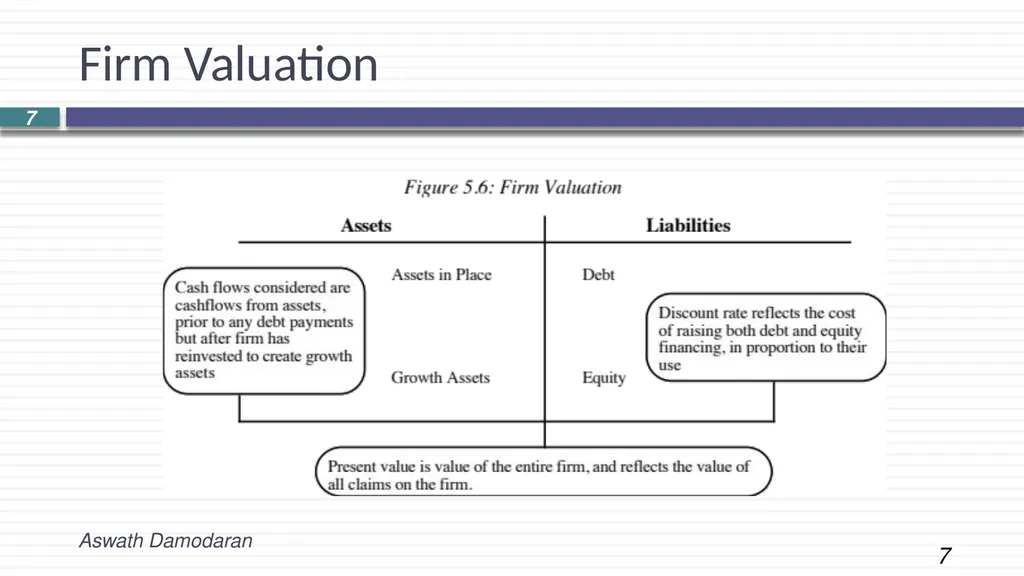
Firm Valuation Aswath Damodaran 7<br>
08
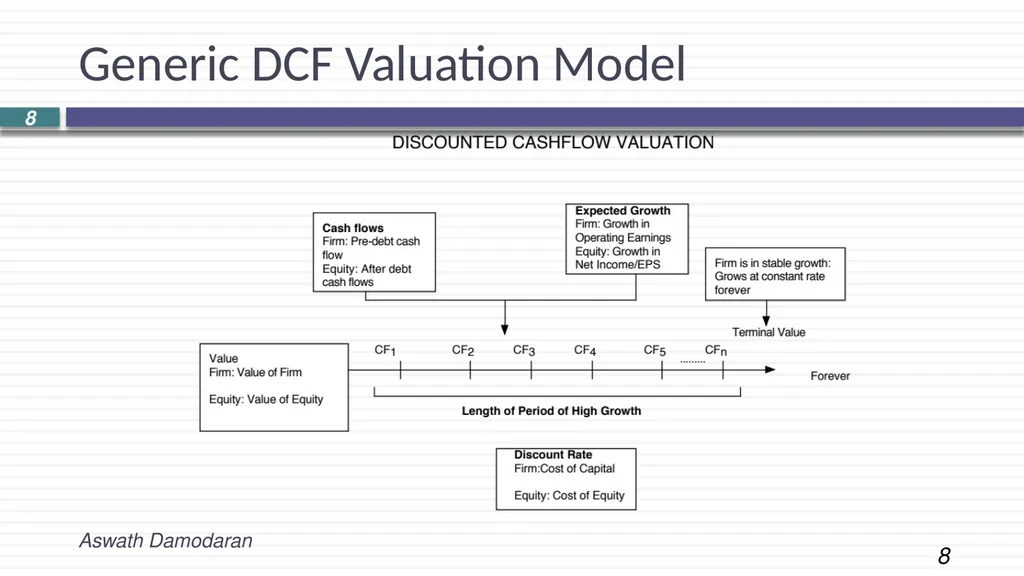
Generic DCF Valuation Model Aswath Damodaran 8<br>
09
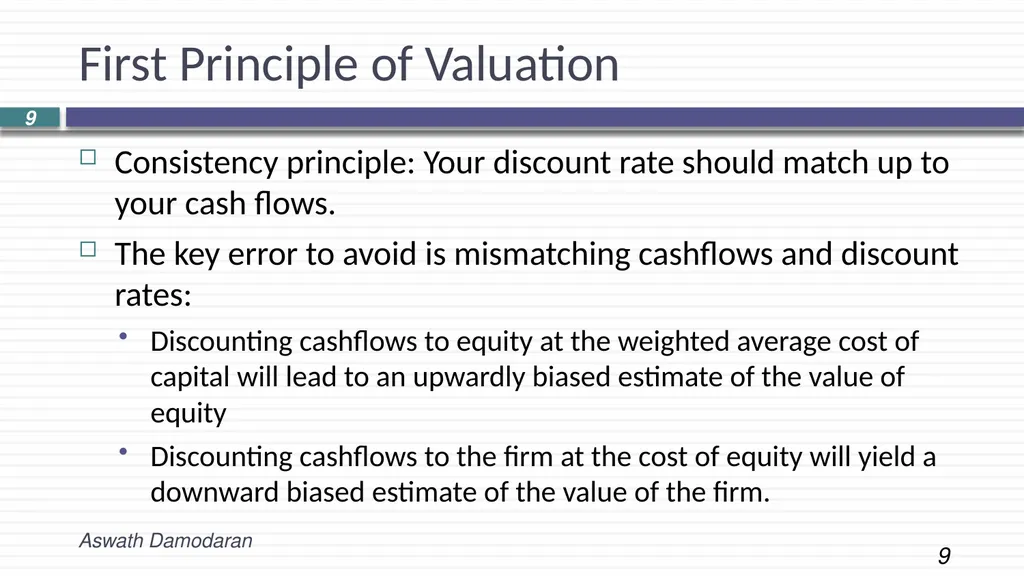
First Principle of Valuation Consistency principle: Your discount rate should match up to your cash flows.
The key error to avoid is mismatching cashflows and discount rates:
Discounting cashflows to equity at the weighted average cost of capital will lead to an upwardly biased estimate of the value of equity
Discounting cashflows to the firm at the cost of equity will yield a downward biased estimate of the value of the firm. Aswath Damodaran 9<br>