
Session 5. Resource-Based Theory Asset stock
Description: Session 5. Resource-Based Theory Asset stock accumulation and sustainability of competitive advantage Ingemar Dierickx and Karel Cool (1989) Management Science 1 BADM 545, Spring 2024 Introduction Strategy literature has focused too
Related Topics
Download Presentation
"Session 5. Resource-Based Theory Asset stock" is the property of its rightful owner. Permission is granted to download and print the materials on this website for personal, non-commercial use only, and to display it on your personal computer provided you do not modify the materials and that you retain all copyright notices contained in the materials. By downloading content from our website, you accept the terms of this agreement.
Presentation Transcript
slide1. Session 5. Resource-Based Theory
Asset stock accumulation and sustainability of competitive advantage Ingemar Dierickx and Karel Cool (1989)
Management Science 1 BADM 545, Spring 2024<br>
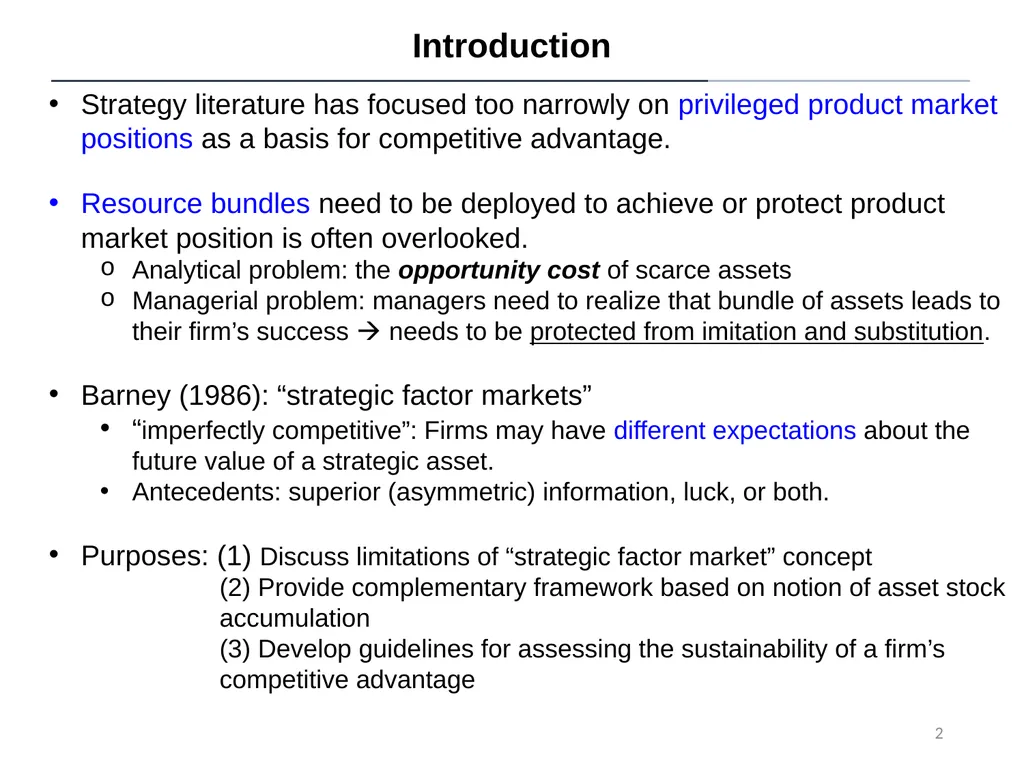
slide2. Introduction Strategy literature has focused too narrowly on privileged product market positions as a basis for competitive advantage.
Resource bundles need to be deployed to achieve or protect product market position is often overlooked.
Analytical problem: the opportunity cost of scarce assets
Managerial problem: managers need to realize that bundle of assets leads to their firm’s success needs to be protected from imitation and substitution.
Barney (1986): “strategic factor markets”
“imperfectly competitive”: Firms may have different expectations about the future value of a strategic asset.
Antecedents: superior (asymmetric) information, luck, or both.
Purposes: (1) Discuss limitations of “strategic factor market” concept
(2) Provide complementary framework based on notion of asset stock
accumulation
(3) Develop guidelines for assessing the sustainability of a firm’s
competitive advantage 2<br>
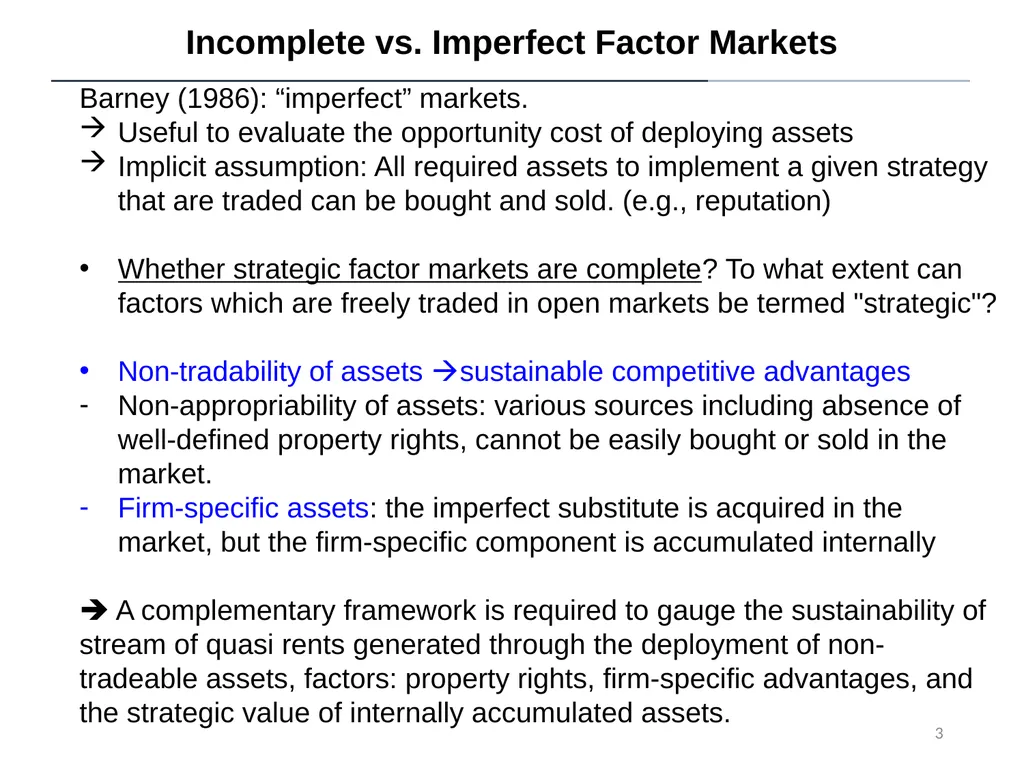
slide3. Incomplete vs. Imperfect Factor Markets Barney (1986): “imperfect” markets.
Useful to evaluate the opportunity cost of deploying assets
Implicit assumption: All required assets to implement a given strategy that are traded can be bought and sold. (e.g., reputation)
Whether strategic factor markets are complete? To what extent can factors which are freely traded in open markets be termed "strategic"?
Non-tradability of assets sustainable competitive advantages
Non-appropriability of assets: various sources including absence of well-defined property rights, cannot be easily bought or sold in the market.
Firm-specific assets: the imperfect substitute is acquired in the market, but the firm-specific component is accumulated internally
A complementary framework is required to gauge the sustainability of stream of quasi rents generated through the deployment of non-tradeable assets, factors: property rights, firm-specific advantages, and the strategic value of internally accumulated assets. 3<br>
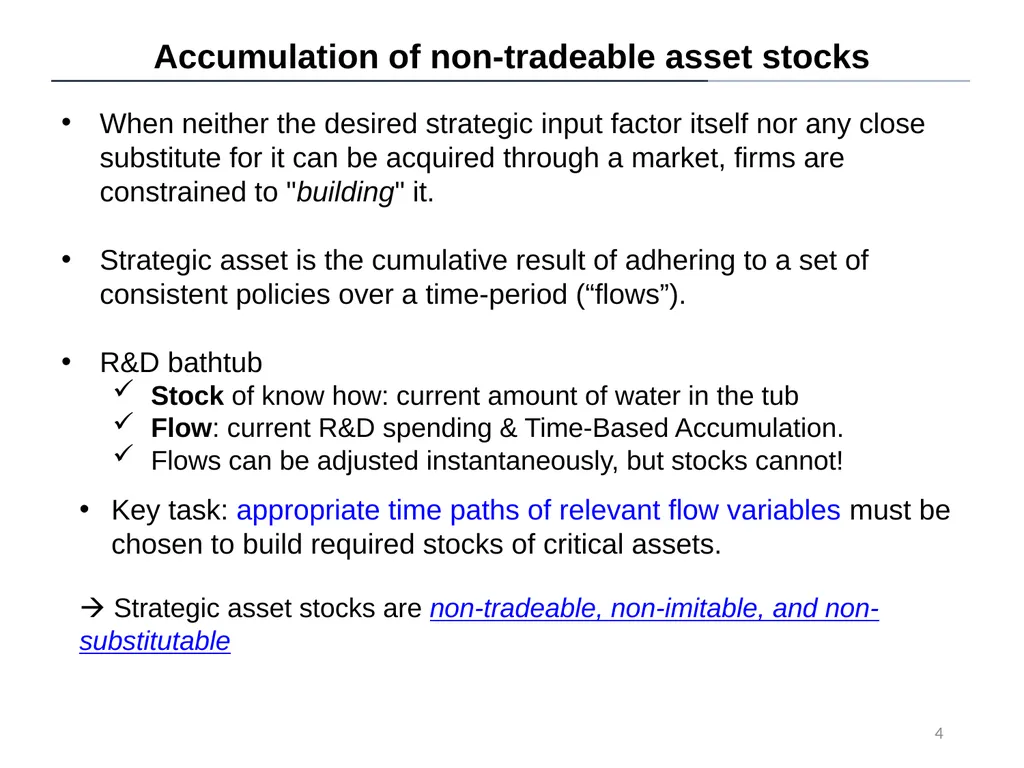
slide4. Accumulation of non-tradeable asset stocks When neither the desired strategic input factor itself nor any close substitute for it can be acquired through a market, firms are constrained to "building" it.
Strategic asset is the cumulative result of adhering to a set of consistent policies over a time-period (“flows”).
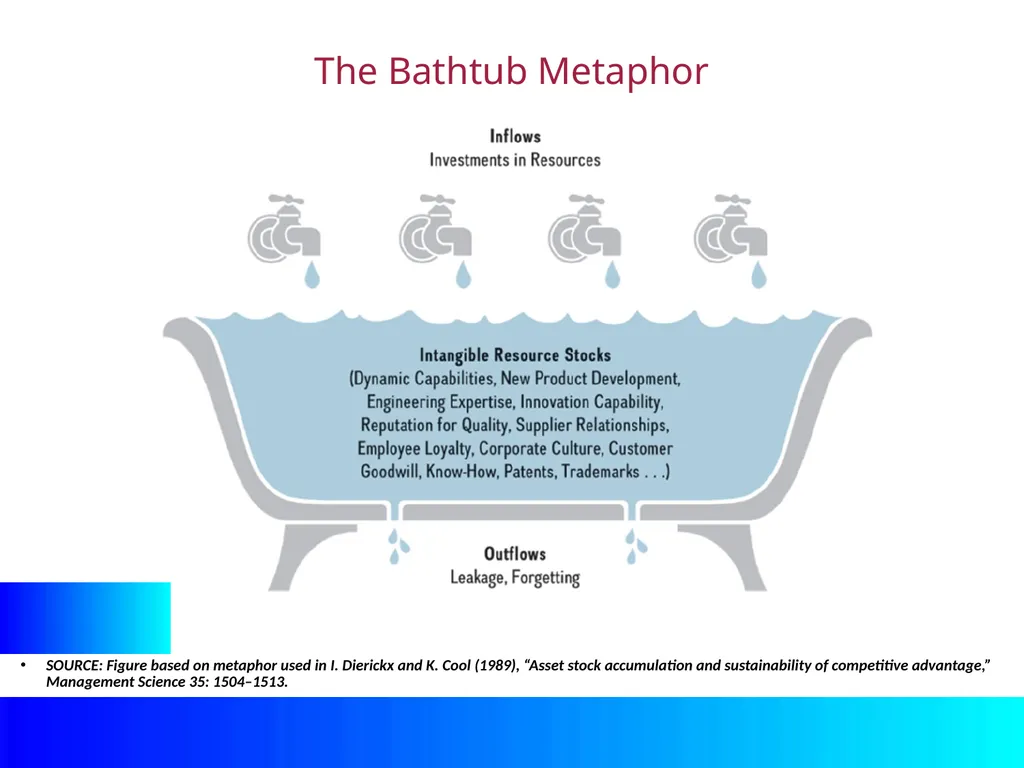
R&D bathtub
Stock of know how: current amount of water in the tub
Flow: current R&D spending & Time-Based Accumulation.
Flows can be adjusted instantaneously, but stocks cannot! 4 Key task: appropriate time paths of relevant flow variables must be chosen to build required stocks of critical assets.
Strategic asset stocks are non-tradeable, non-imitable, and non- substitutable<br>
slide5. The Bathtub Metaphor Exhibit 4.7
SOURCE: Figure based on metaphor used in I. Dierickx and K. Cool (1989), “Asset stock accumulation and sustainability of competitive advantage,” Management Science 35: 1504–1513. Access the text alternative for slide images.<br>
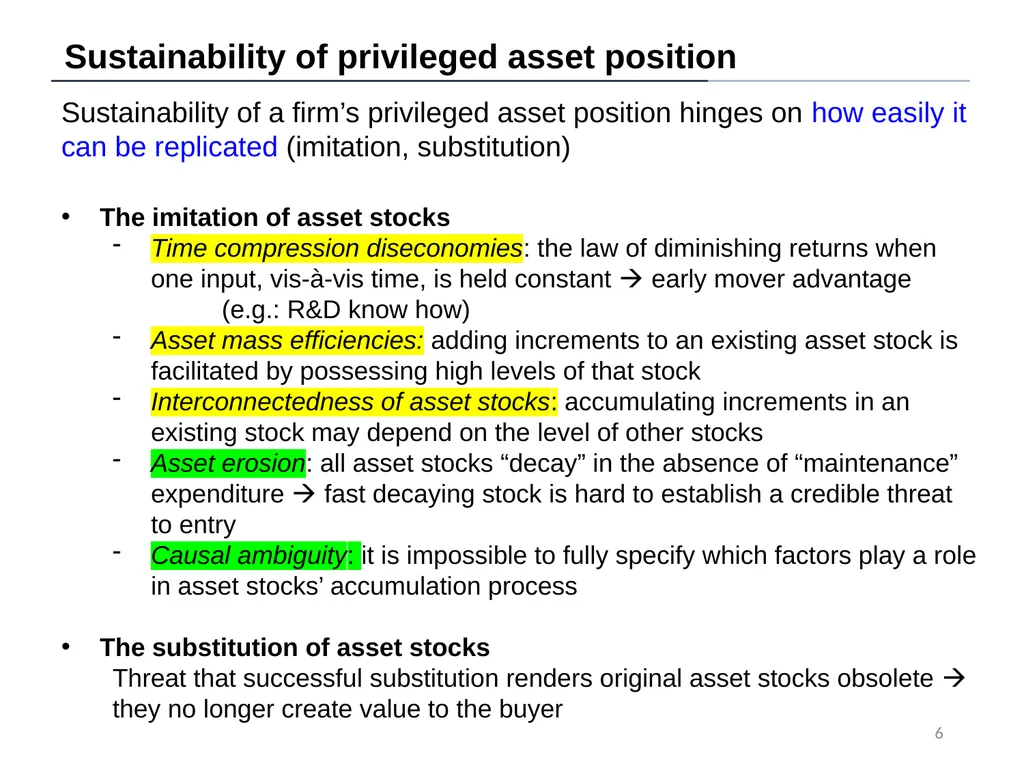
slide6. Sustainability of privileged asset position The imitation of asset stocks
Time compression diseconomies: the law of diminishing returns when one input, vis-à-vis time, is held constant early mover advantage (e.g.: R&D know how)
Asset mass efficiencies: adding increments to an existing asset stock is facilitated by possessing high levels of that stock
Interconnectedness of asset stocks: accumulating increments in an existing stock may depend on the level of other stocks
Asset erosion: all asset stocks “decay” in the absence of “maintenance” expenditure fast decaying stock is hard to establish a credible threat to entry
Causal ambiguity: it is impossible to fully specify which factors play a role in asset stocks’ accumulation process
The substitution of asset stocks
Threat that successful substitution renders original asset stocks obsolete they no longer create value to the buyer 6 Sustainability of a firm’s privileged asset position hinges on how easily it can be replicated (imitation, substitution)<br>
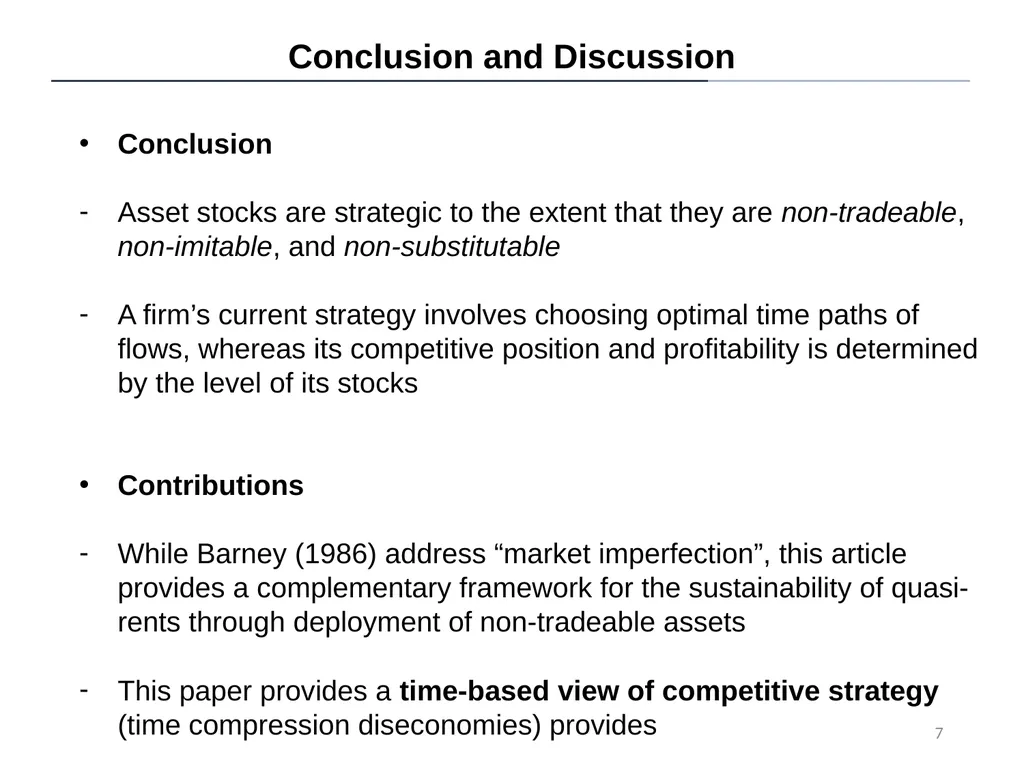
slide7. Conclusion and Discussion 7 Conclusion
Asset stocks are strategic to the extent that they are non-tradeable, non-imitable, and non-substitutable
A firm’s current strategy involves choosing optimal time paths of flows, whereas its competitive position and profitability is determined by the level of its stocks
Contributions
While Barney (1986) address “market imperfection”, this article provides a complementary framework for the sustainability of quasi- rents through deployment of non-tradeable assets
This paper provides a time-based view of competitive strategy (time compression diseconomies) provides<br>
Management Science 1 BADM 545, Spring 2024<br>
slide2. Introduction Strategy literature has focused too narrowly on privileged product market positions as a basis for competitive advantage.
Resource bundles need to be deployed to achieve or protect product market position is often overlooked.
Analytical problem: the opportunity cost of scarce assets
Managerial problem: managers need to realize that bundle of assets leads to their firm’s success needs to be protected from imitation and substitution.
Barney (1986): “strategic factor markets”
“imperfectly competitive”: Firms may have different expectations about the future value of a strategic asset.
Antecedents: superior (asymmetric) information, luck, or both.
Purposes: (1) Discuss limitations of “strategic factor market” concept
(2) Provide complementary framework based on notion of asset stock
accumulation
(3) Develop guidelines for assessing the sustainability of a firm’s
competitive advantage 2<br>
slide3. Incomplete vs. Imperfect Factor Markets Barney (1986): “imperfect” markets.
Useful to evaluate the opportunity cost of deploying assets
Implicit assumption: All required assets to implement a given strategy that are traded can be bought and sold. (e.g., reputation)
Whether strategic factor markets are complete? To what extent can factors which are freely traded in open markets be termed "strategic"?
Non-tradability of assets sustainable competitive advantages
Non-appropriability of assets: various sources including absence of well-defined property rights, cannot be easily bought or sold in the market.
Firm-specific assets: the imperfect substitute is acquired in the market, but the firm-specific component is accumulated internally
A complementary framework is required to gauge the sustainability of stream of quasi rents generated through the deployment of non-tradeable assets, factors: property rights, firm-specific advantages, and the strategic value of internally accumulated assets. 3<br>
slide4. Accumulation of non-tradeable asset stocks When neither the desired strategic input factor itself nor any close substitute for it can be acquired through a market, firms are constrained to "building" it.
Strategic asset is the cumulative result of adhering to a set of consistent policies over a time-period (“flows”).
R&D bathtub
Stock of know how: current amount of water in the tub
Flow: current R&D spending & Time-Based Accumulation.
Flows can be adjusted instantaneously, but stocks cannot! 4 Key task: appropriate time paths of relevant flow variables must be chosen to build required stocks of critical assets.
Strategic asset stocks are non-tradeable, non-imitable, and non- substitutable<br>
slide5. The Bathtub Metaphor Exhibit 4.7
SOURCE: Figure based on metaphor used in I. Dierickx and K. Cool (1989), “Asset stock accumulation and sustainability of competitive advantage,” Management Science 35: 1504–1513. Access the text alternative for slide images.<br>
slide6. Sustainability of privileged asset position The imitation of asset stocks
Time compression diseconomies: the law of diminishing returns when one input, vis-à-vis time, is held constant early mover advantage (e.g.: R&D know how)
Asset mass efficiencies: adding increments to an existing asset stock is facilitated by possessing high levels of that stock
Interconnectedness of asset stocks: accumulating increments in an existing stock may depend on the level of other stocks
Asset erosion: all asset stocks “decay” in the absence of “maintenance” expenditure fast decaying stock is hard to establish a credible threat to entry
Causal ambiguity: it is impossible to fully specify which factors play a role in asset stocks’ accumulation process
The substitution of asset stocks
Threat that successful substitution renders original asset stocks obsolete they no longer create value to the buyer 6 Sustainability of a firm’s privileged asset position hinges on how easily it can be replicated (imitation, substitution)<br>
slide7. Conclusion and Discussion 7 Conclusion
Asset stocks are strategic to the extent that they are non-tradeable, non-imitable, and non-substitutable
A firm’s current strategy involves choosing optimal time paths of flows, whereas its competitive position and profitability is determined by the level of its stocks
Contributions
While Barney (1986) address “market imperfection”, this article provides a complementary framework for the sustainability of quasi- rents through deployment of non-tradeable assets
This paper provides a time-based view of competitive strategy (time compression diseconomies) provides<br>