Session 7 Practical Intervention Part Two Stages Safe space Scripted roleplay Improvising Some ground rules Confidentiality Appropriate language Attendance Communicating with the facilitator Please be aware that we will be talking about
"Session 7 Practical Intervention Part Two Stages" is the property of its rightful owner. Permission is granted to
download and print the materials on this website for personal, non-commercial use only, and to display it
on your personal computer provided you do not modify the materials and that you retain all copyright
notices contained in the materials. By downloading content from our website, you accept the terms of this
agreement.
Presentation Transcript
01
Session 7 Practical Intervention Part Two<br>
02
Stages Safe space
Scripted roleplay
Improvising<br>
03
Some ground rules Confidentiality
Appropriate language
Attendance
Communicating with the facilitator
Please be aware that we will be talking about sensitive issues and issues that might have affected you or people you care about. If you feel uncomfortable or upset it is fine to leave the space. Facilitators will understand and are trained to help you. We will be learning and working together as a group in this programme
Some of the material we will be discussing will be sensitive and some of us will have had personal experience of the things we discuss
We will all be be respectful of personal emotions as we learn<br>
04
Students' feedback about role-play Rehearsal
"It enabled me to use my skills directly and assess their effects on other people..."
"First hand experience – to understand the difficulties in communication which are hard to get without actually doing it”
"Good chance to try out something that looks so easy but makes you realise that it is difficult and does require practice."
Feedback
"It's good to receive constructive criticism and be made aware of your behaviour"
"Group discussion afterwards (as well as individual feedback) allowing us to learn from other people's experiences too."
Different perspectives
"Positive to see things from [the other person’s] perspective”
Safety using role-play
"It puts you in a real-life situation where you can practice what you know but still it is a role-play so if you make mistakes it is okay"
Professional skills and personal development
"Good method of learning and helping people feel less nervous talking in front of others.”
"Role-play changes your perspective on subjects and can open up new avenues of thinking”
Adapted from Nestel & Tierney (2007) doi:10.1186/1472-6920-7-3<br>
05
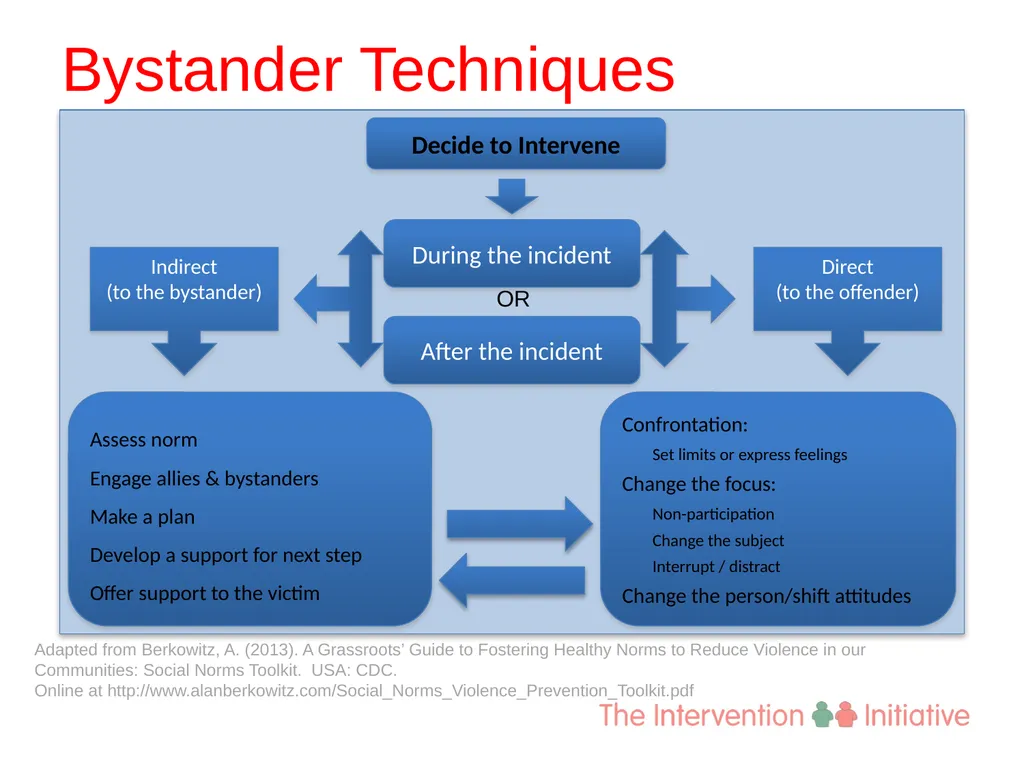
Bystander Techniques Adapted from Berkowitz, A. (2013). A Grassroots’ Guide to Fostering Healthy Norms to Reduce Violence in our Communities: Social Norms Toolkit. USA: CDC.
Online at http://www.alanberkowitz.com/Social_Norms_Violence_Prevention_Toolkit.pdf<br>
06
Techniques Using body language (communicating disapproval)
Distraction (changing the focus)
Humour
“I” statements
Encouraging empathy
Using caring and friendship as a framework
Using social norms<br>