04
NHTSA research began in 1975 in California
Three final reports published
California: 1977 (lab study only)
California: 1981 (lab/field study)
Maryland, Washington, DC, Virginia, �North Carolina: 1983 (field study only) Overview:�Development and Validation 8-4<br>
05
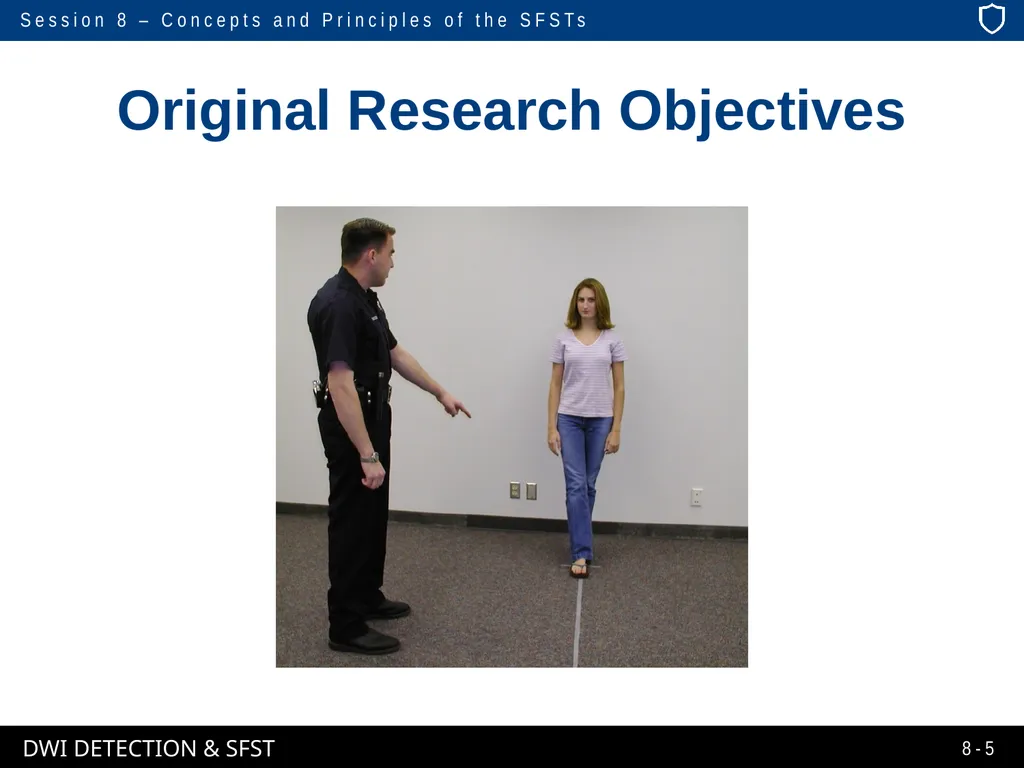
Original Research Objectives 8-5<br>
06
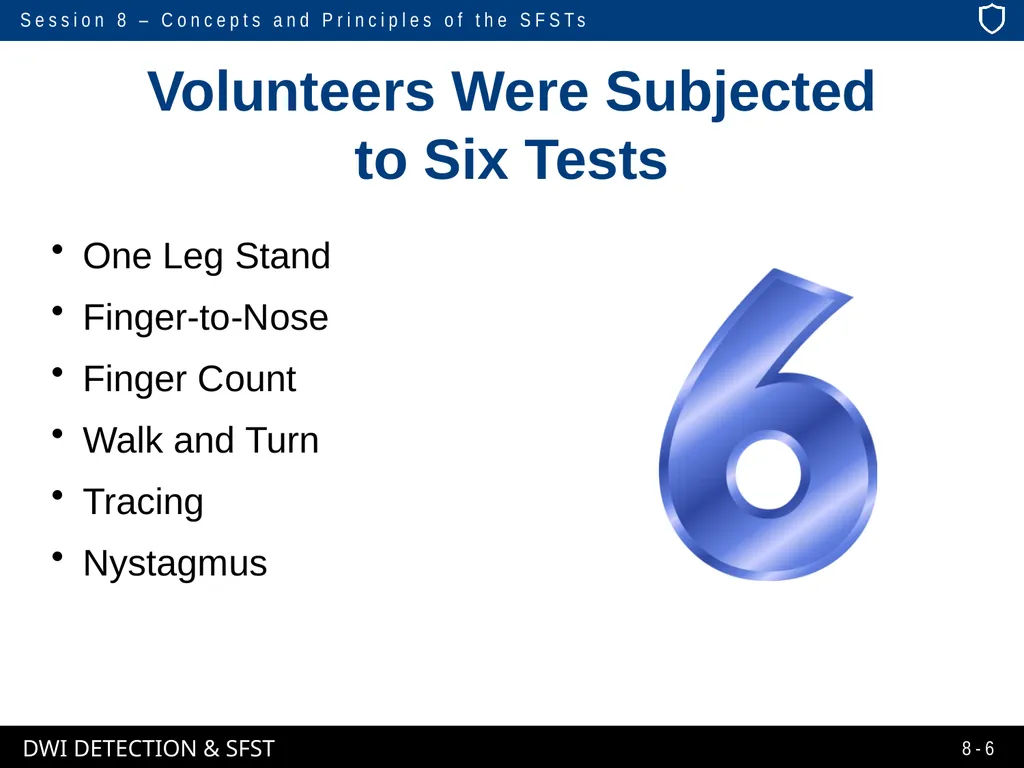
One Leg Stand
Finger-to-Nose
Finger Count
Walk and Turn
Tracing
Nystagmus Volunteers Were Subjected�to Six Tests 8-6<br>
07
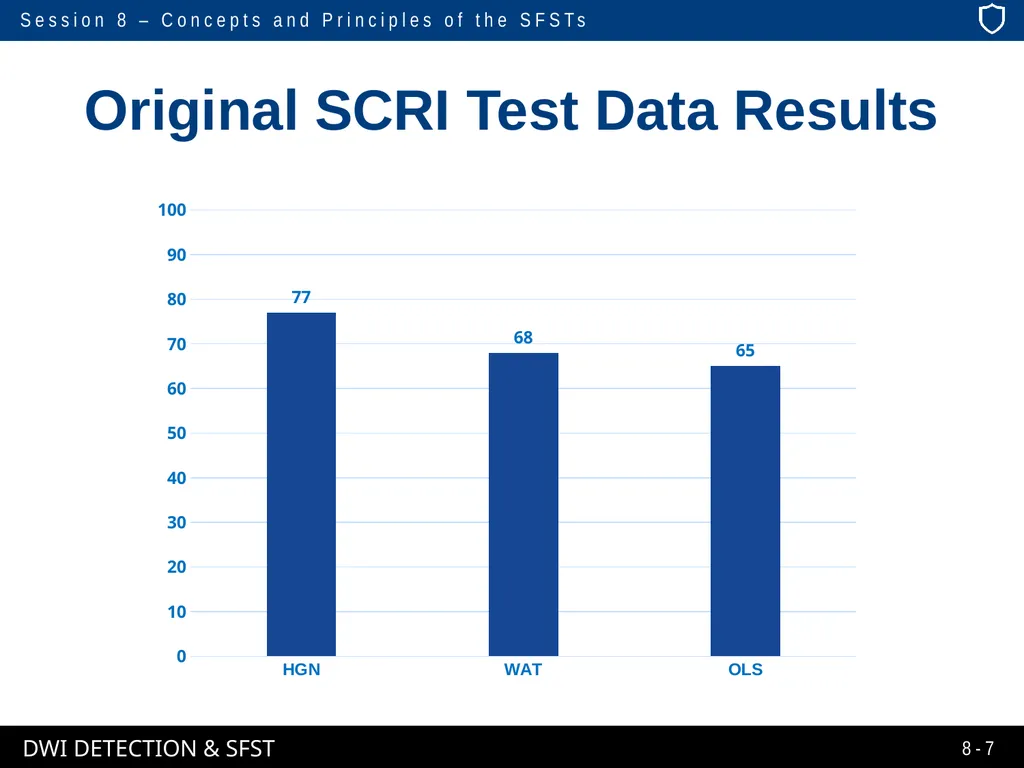
Original SCRI Test Data Results 8-7<br>
08
Standardized, practical, and effective procedures
Determine feasibility of procedures in enforcement conditions
Determine if tests discriminate in field as well as in laboratory Third Phase: Field Validation and Standardization Objectives 8-8<br>
09
Administrative Procedures
Clues
Criteria Standardized Elements 8-9<br>
10
First significant assessment of workability under actual enforcement conditions
First time completely objective clues and recording criteria had been defined for tests
Results of study validated SFSTs Importance of Large Scale �Field Validation Study 8-10<br>
11
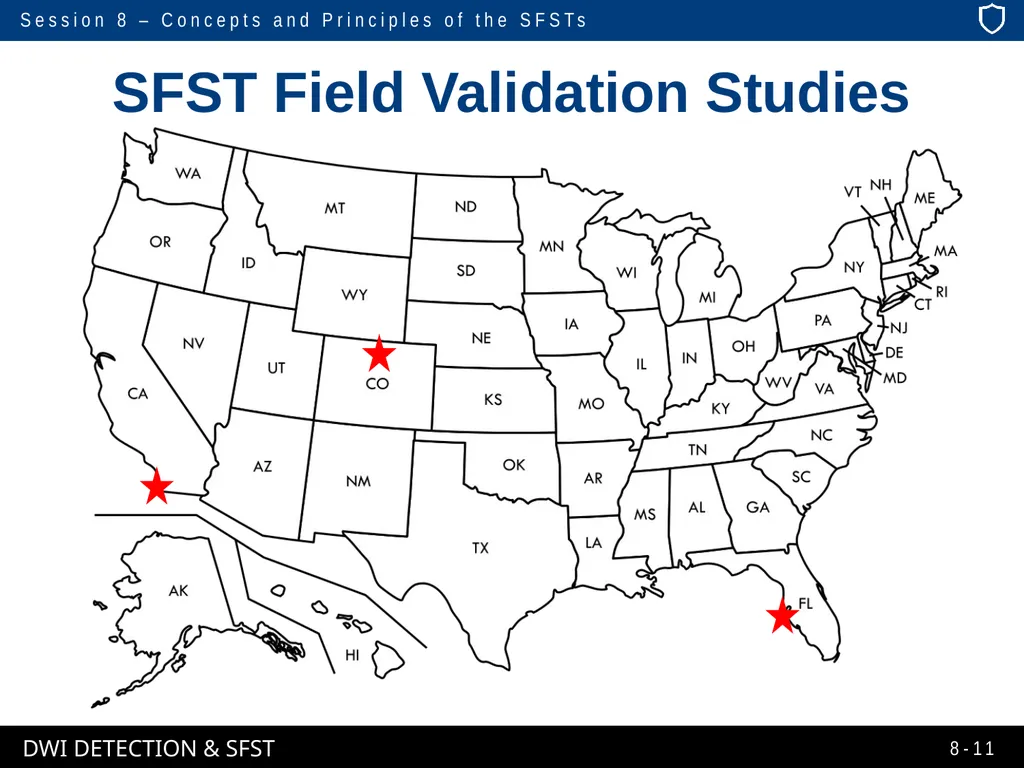
SFST Field Validation Studies 8-11<br>
12
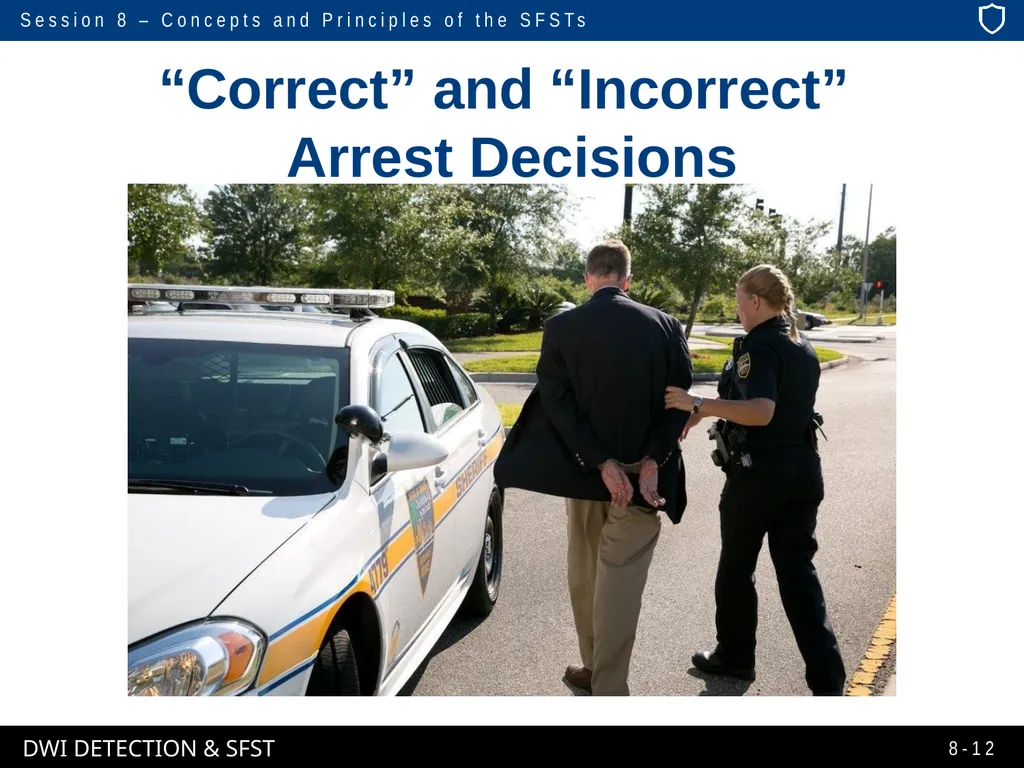
“Correct” and “Incorrect” �Arrest Decisions 8-12<br>
13
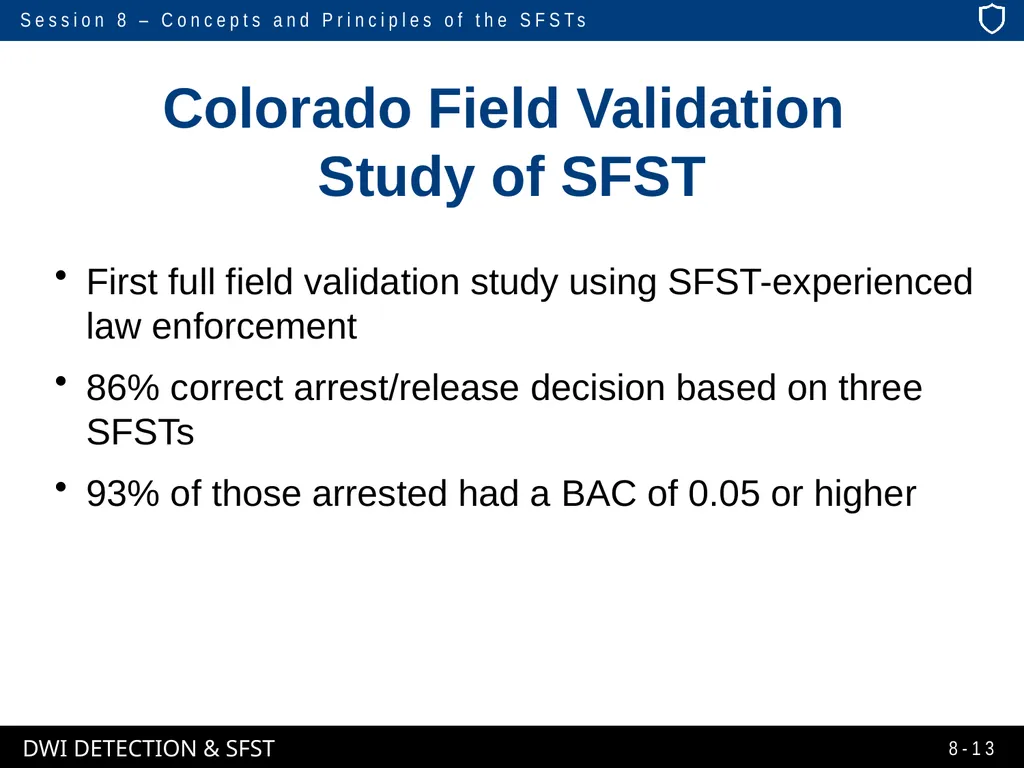
First full field validation study using SFST-experienced law enforcement
86% correct arrest/release decision based on three SFSTs
93% of those arrested had a BAC of 0.05 or higher Colorado Field Validation �Study of SFST 8-13<br>
14
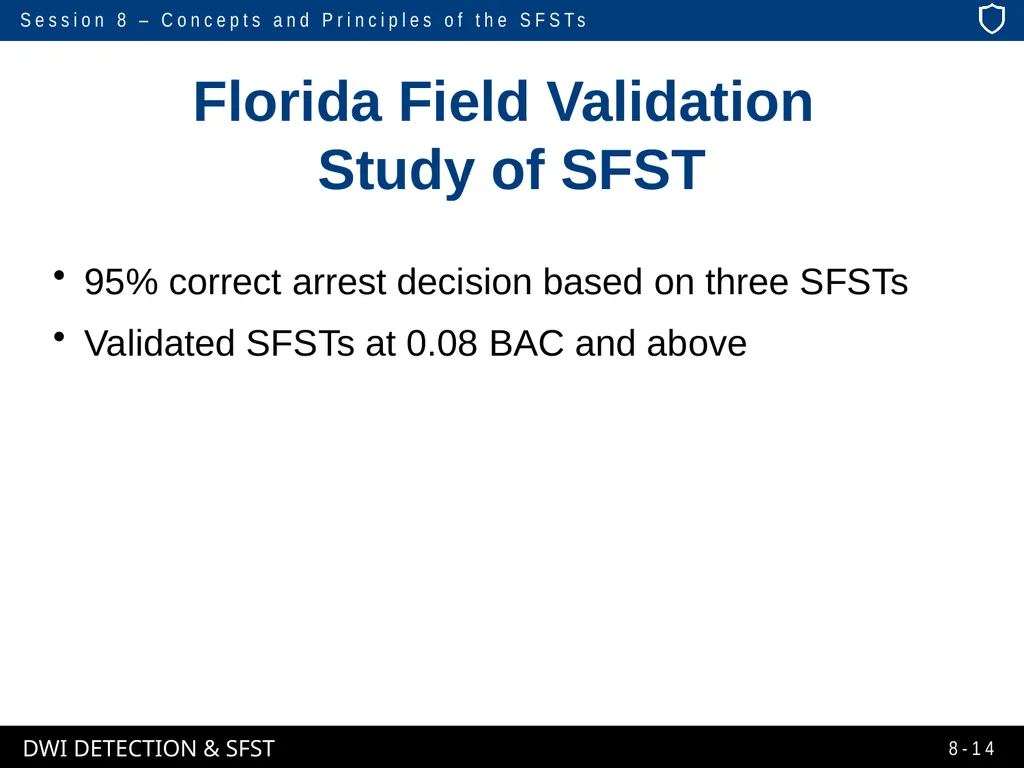
95% correct arrest decision based on three SFSTs
Validated SFSTs at 0.08 BAC and above Florida Field Validation �Study of SFST 8-14<br>
15
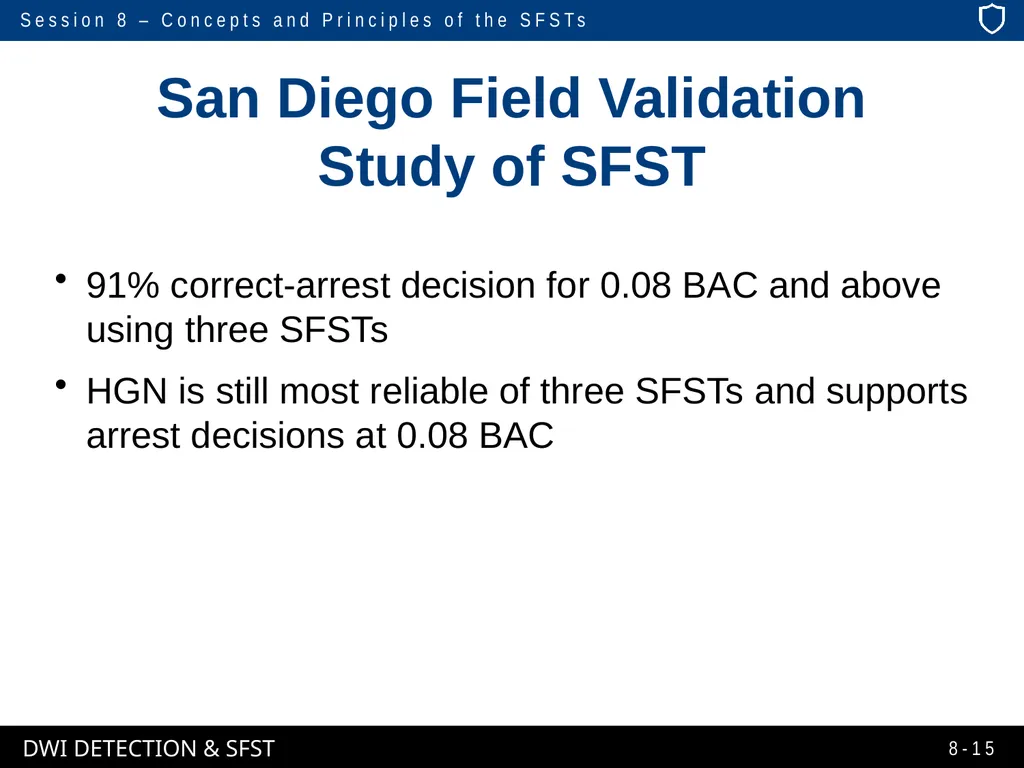
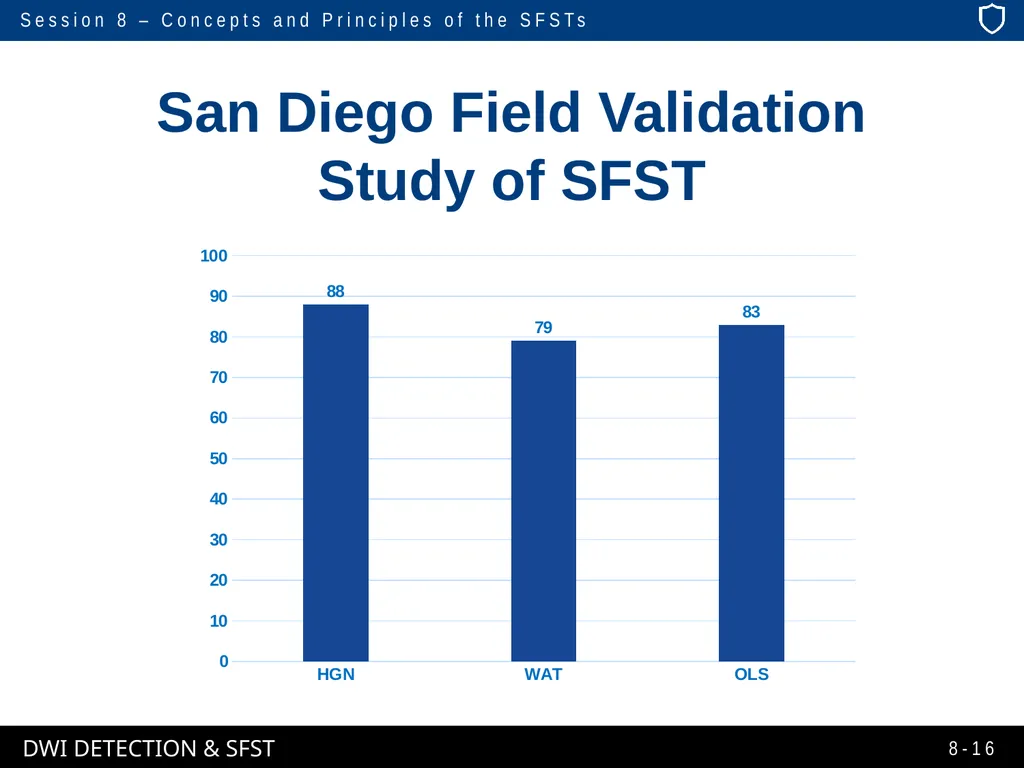
91% correct-arrest decision for 0.08 BAC and above using three SFSTs
HGN is still most reliable of three SFSTs and supports arrest decisions at 0.08 BAC San Diego Field Validation �Study of SFST 8-15<br>
16
San Diego Field Validation �Study of SFST 8-16<br>
17
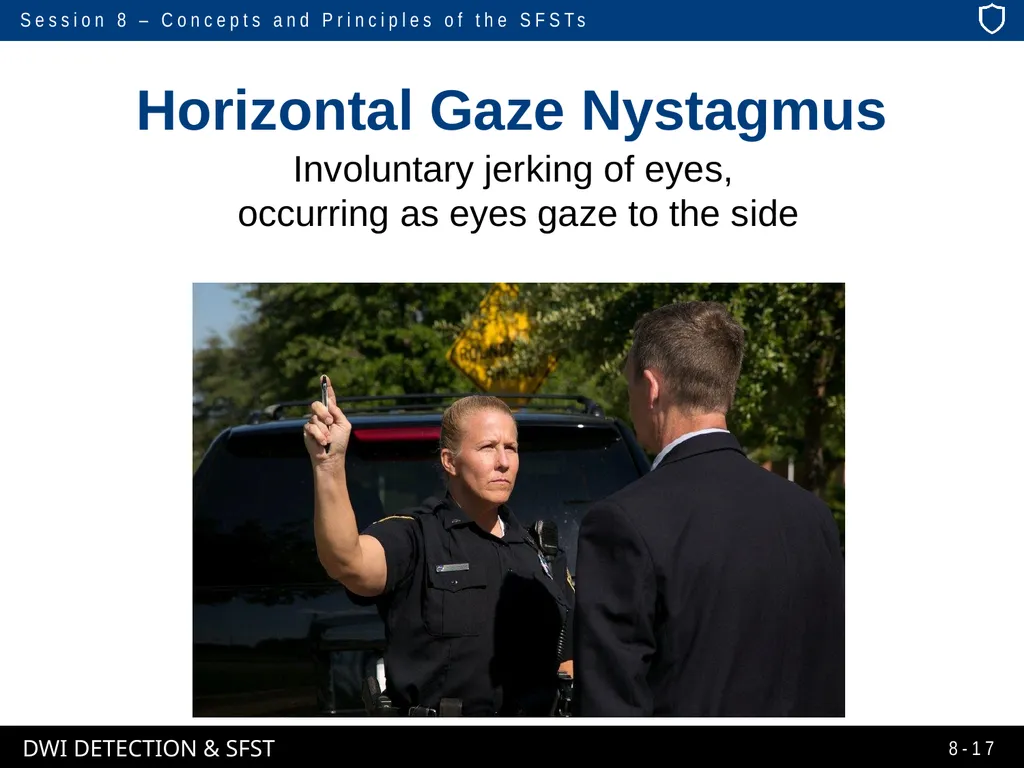
Involuntary jerking of eyes,
occurring as eyes gaze to the side Horizontal Gaze Nystagmus 8-17<br>
18
Vestibular
Neural
Pathological Disorders and Diseases Categories of Nystagmus 8-18<br>
19
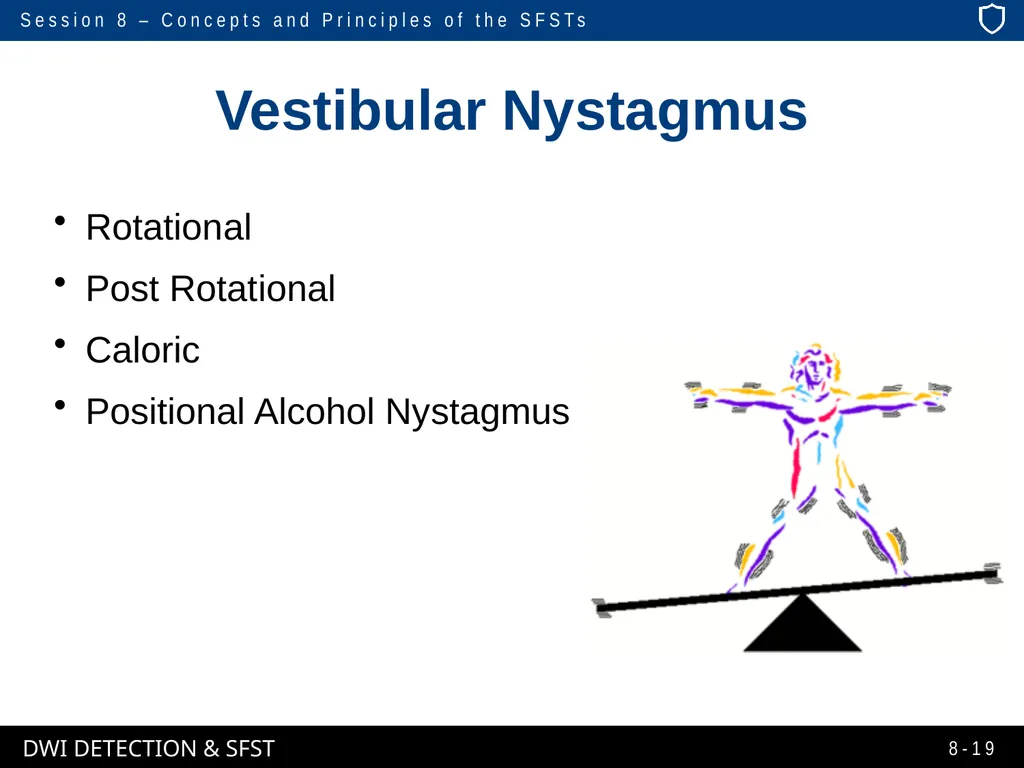
Rotational
Post Rotational
Caloric
Positional Alcohol Nystagmus Vestibular Nystagmus 8-19<br>
20
Optokinetic
Physiological
Gaze Neural Nystagmus 8-20<br>
21
Horizontal
Vertical
Resting Gaze Nystagmus 8-21<br>
22
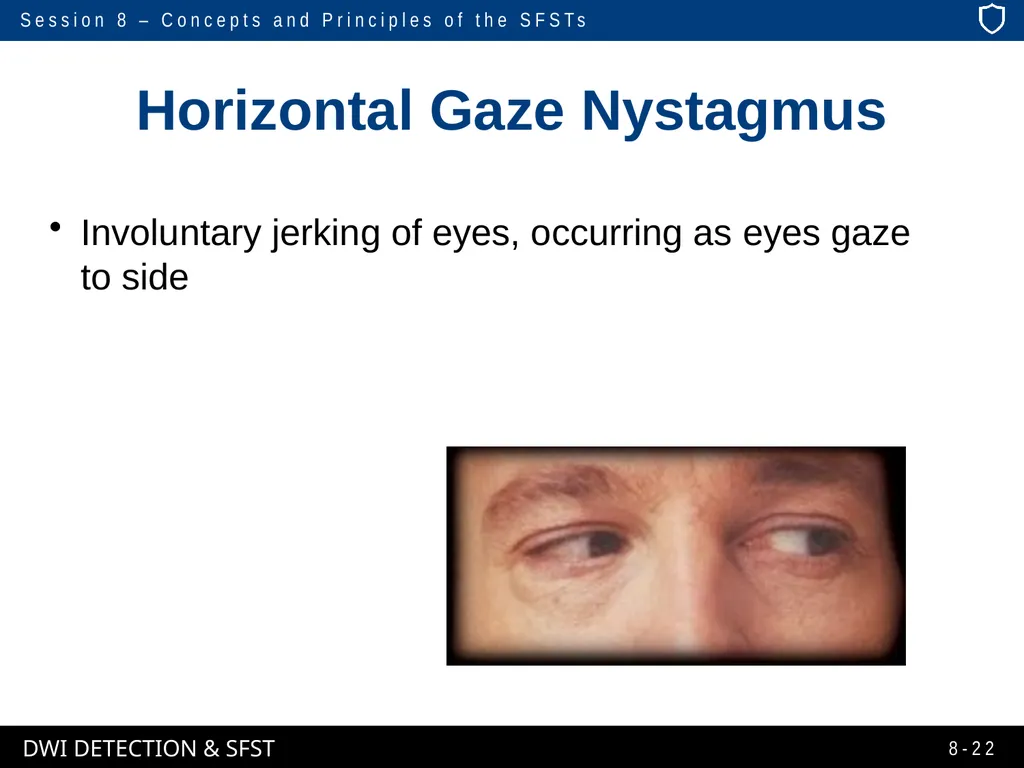
Involuntary jerking of eyes, occurring as eyes gaze �to side Horizontal Gaze Nystagmus 8-22<br>
23
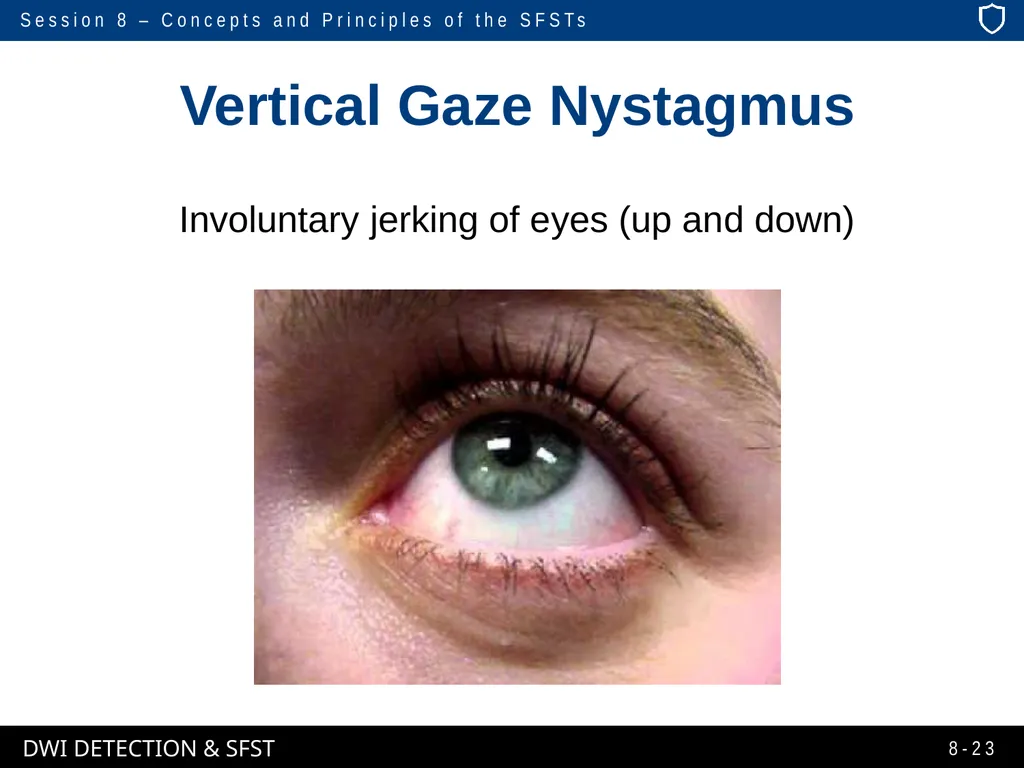
Involuntary jerking of eyes (up and down) Vertical Gaze Nystagmus 8-23<br>
24
Jerking of eyes as they look straight ahead Resting Nystagmus 8-24<br>
25
Brain tumors and other brain damage
Some inner ear diseases
Rare in the driving population Pathological Disorder Nystagmus 8-25<br>
26
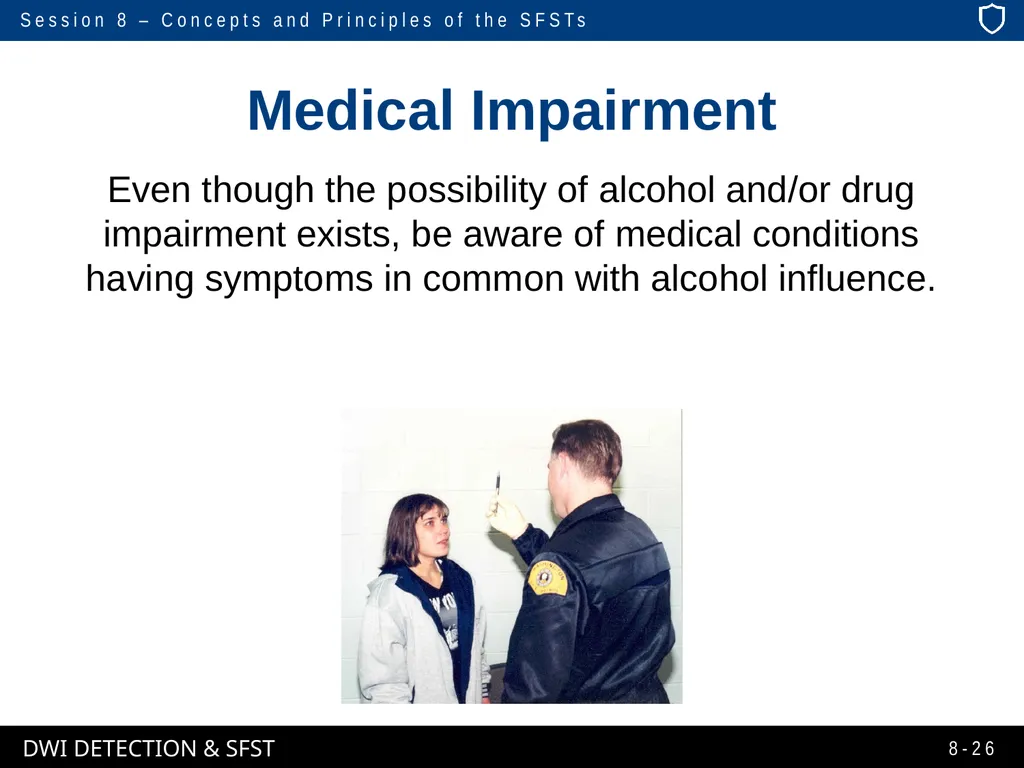
Even though the possibility of alcohol and/or drug impairment exists, be aware of medical conditions having symptoms in common with alcohol influence. Medical Impairment 8-26<br>
27
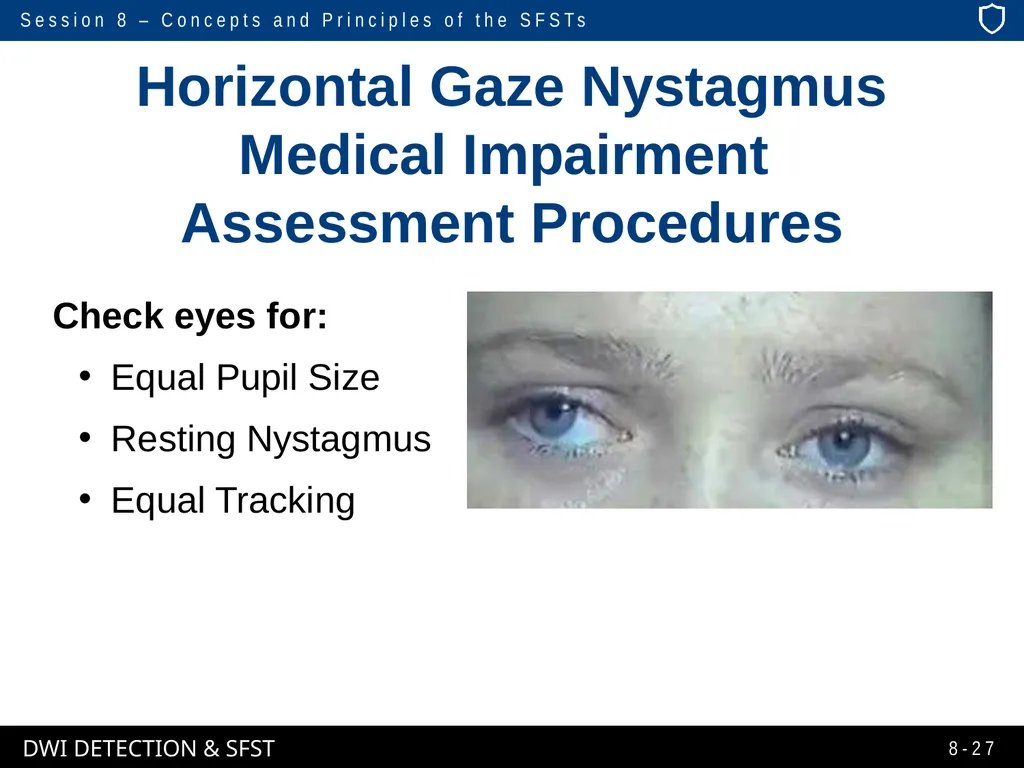
Check eyes for:
Equal Pupil Size
Resting Nystagmus
Equal Tracking Horizontal Gaze Nystagmus Medical Impairment �Assessment Procedures 8-27<br>
28
Lack of Smooth Pursuit
Distinct and Sustained Nystagmus at �Maximum Deviation
Onset of Nystagmus Prior to 45 Degrees Horizontal Gaze Nystagmus Testing: Three Clues 8-28<br>
29
Check for eyeglasses
Verbal instructions
Position stimulus (12-15 inches and slightly above eye level)
Check for Equal Pupil Size and Resting Nystagmus
Check for Equal Tracking Administrative Procedures 8-29<br>
30
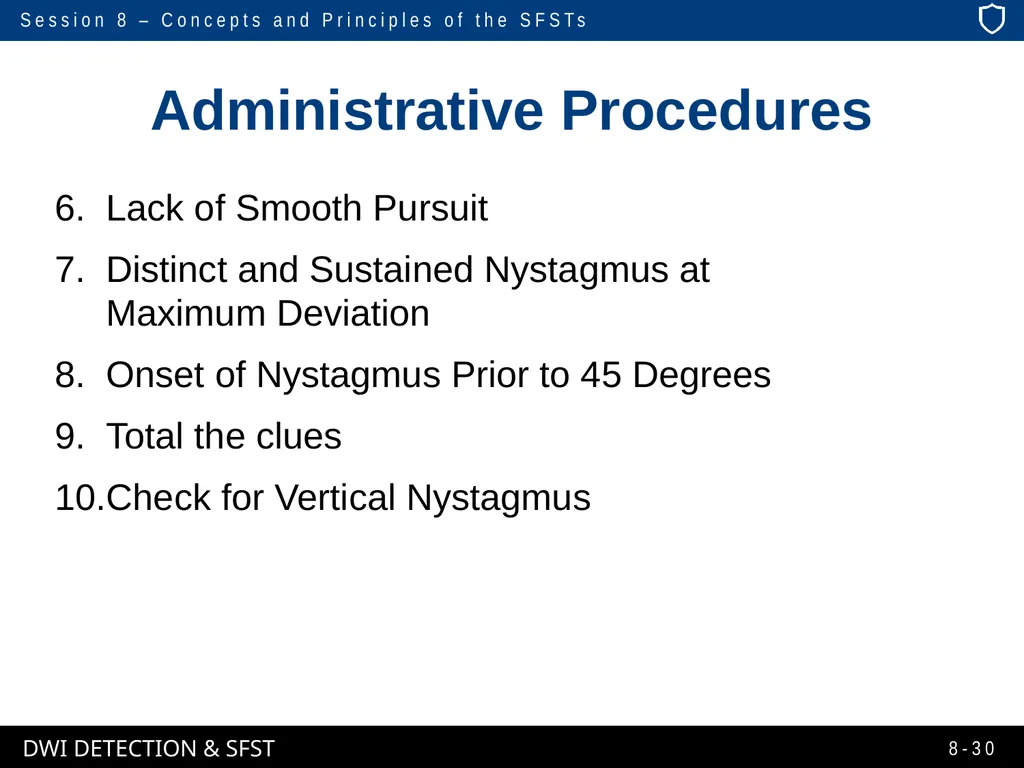
Lack of Smooth Pursuit
Distinct and Sustained Nystagmus at �Maximum Deviation
Onset of Nystagmus Prior to 45 Degrees
Total the clues
Check for Vertical Nystagmus Administrative Procedures 8-30<br>
31
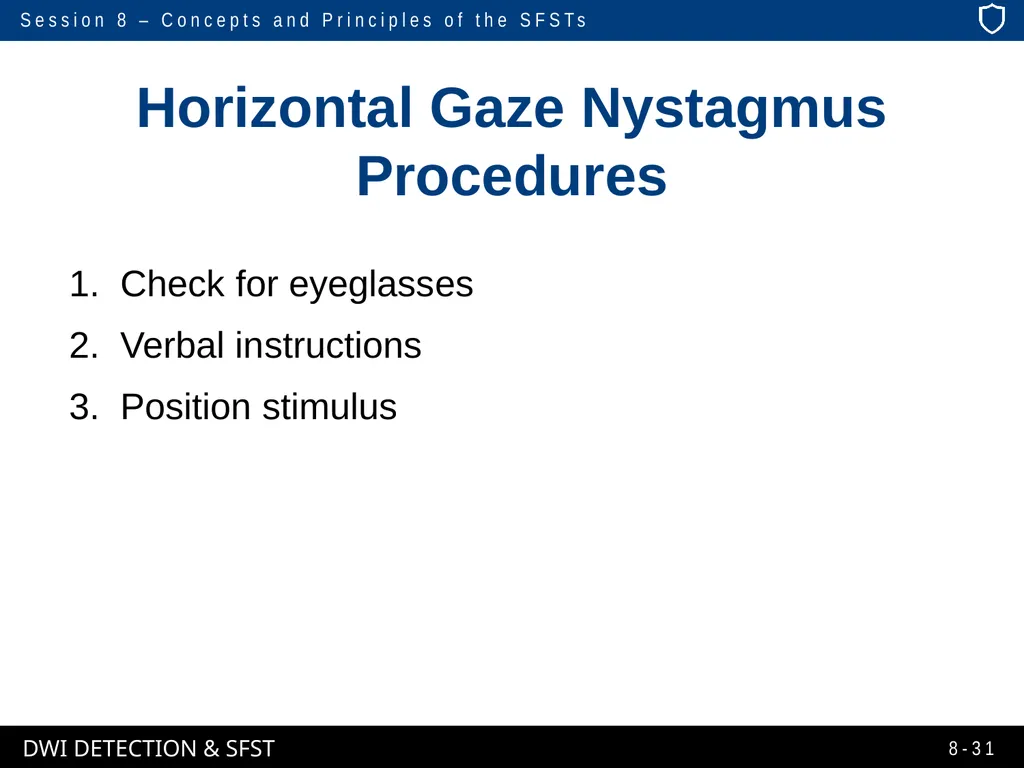
Check for eyeglasses
Verbal instructions
Position stimulus Horizontal Gaze Nystagmus Procedures 8-31<br>
32
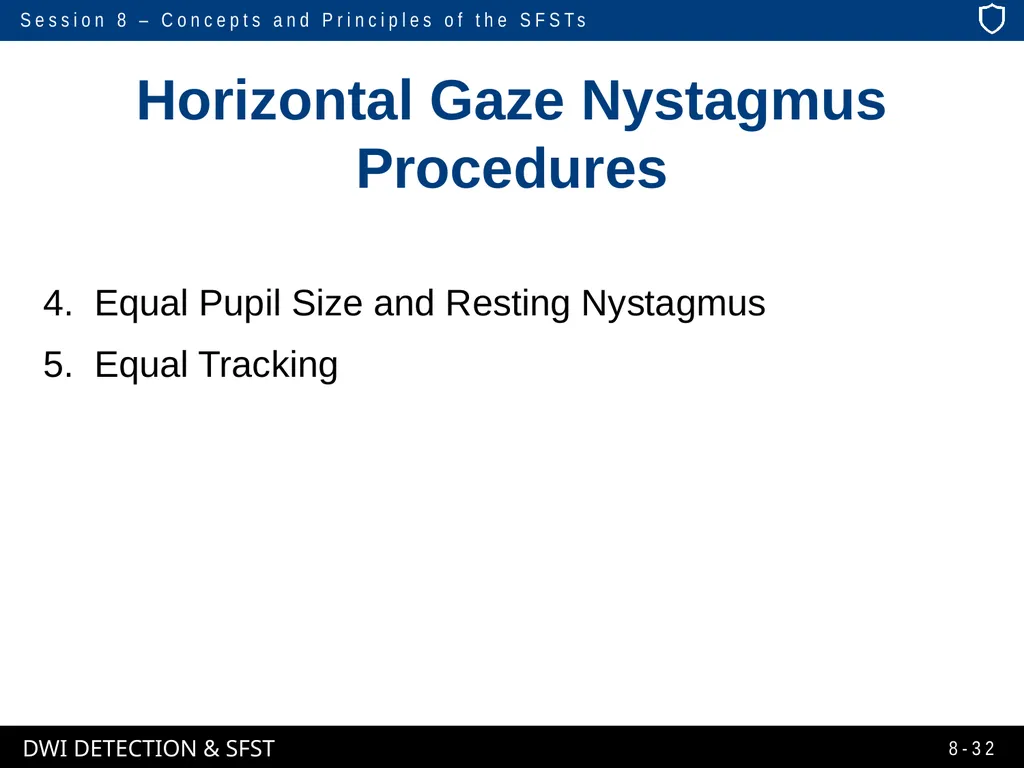
Equal Pupil Size and Resting Nystagmus
Equal Tracking Horizontal Gaze Nystagmus Procedures 8-32<br>
33
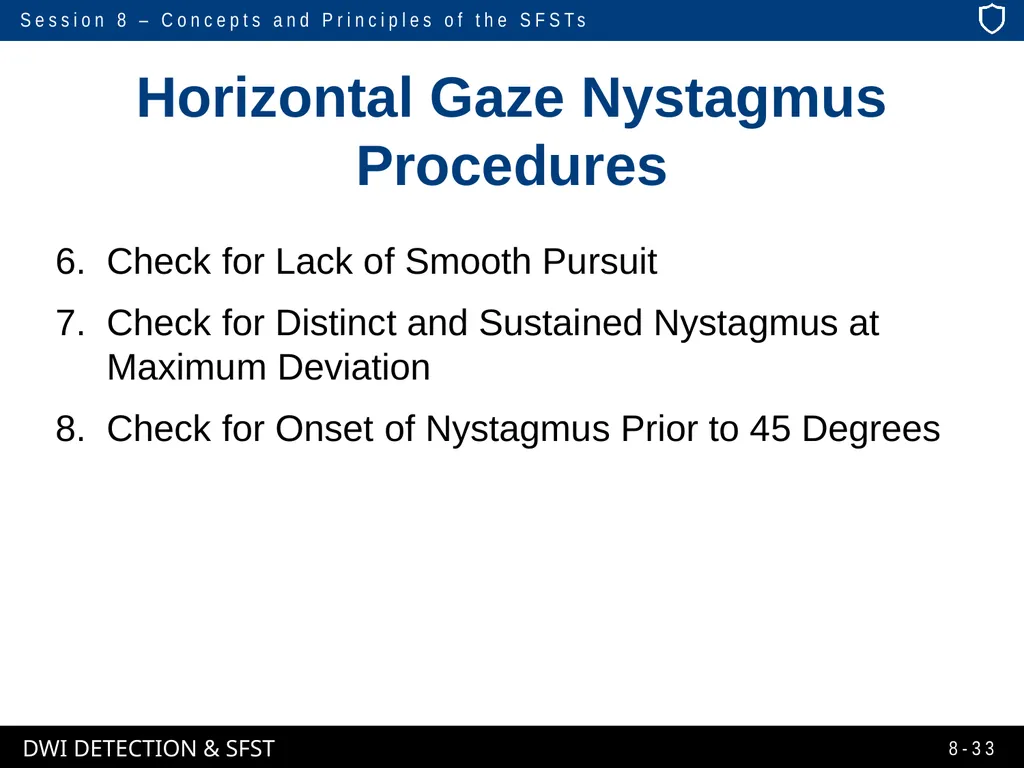
Check for Lack of Smooth Pursuit
Check for Distinct and Sustained Nystagmus at Maximum Deviation
Check for Onset of Nystagmus Prior to 45 Degrees Horizontal Gaze Nystagmus Procedures 8-33<br>
34
Total the clues
Check for Vertical Gaze Nystagmus Horizontal Gaze Nystagmus Procedures 8-34<br>
35
Look for three clues of nystagmus in each eye:
Lack of Smooth Pursuit
Distinct and Sustained Nystagmus at Maximum Deviation
Onset of Nystagmus Prior to 45 Degrees Test Interpretation 8-35<br>
36
Lack of Smooth Pursuit
Distinct and Sustained Nystagmus at Maximum Deviation
Onset of Nystagmus Prior to 45 Degrees Three Clues of Horizontal Gaze Nystagmus 8-36<br>
37
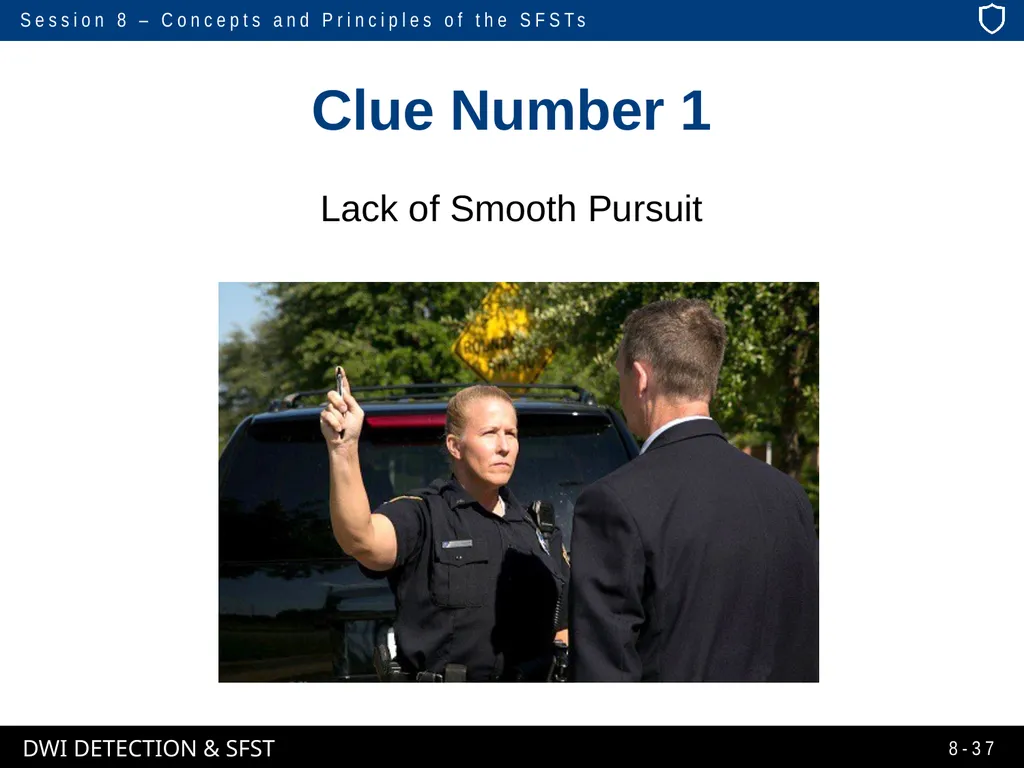
Lack of Smooth Pursuit Clue Number 1 8-37<br>
38
Lack of Smooth Pursuit Clue Number 1 8-38<br>
39
Move object steadily at a speed �that takes approximately 2 seconds �to bring the eye from center to side Mechanics of Clue Number 1 8-39<br>
40
Clue Number 2 Distinct and Sustained Nystagmus
at Maximum Deviation 8-40<br>
41
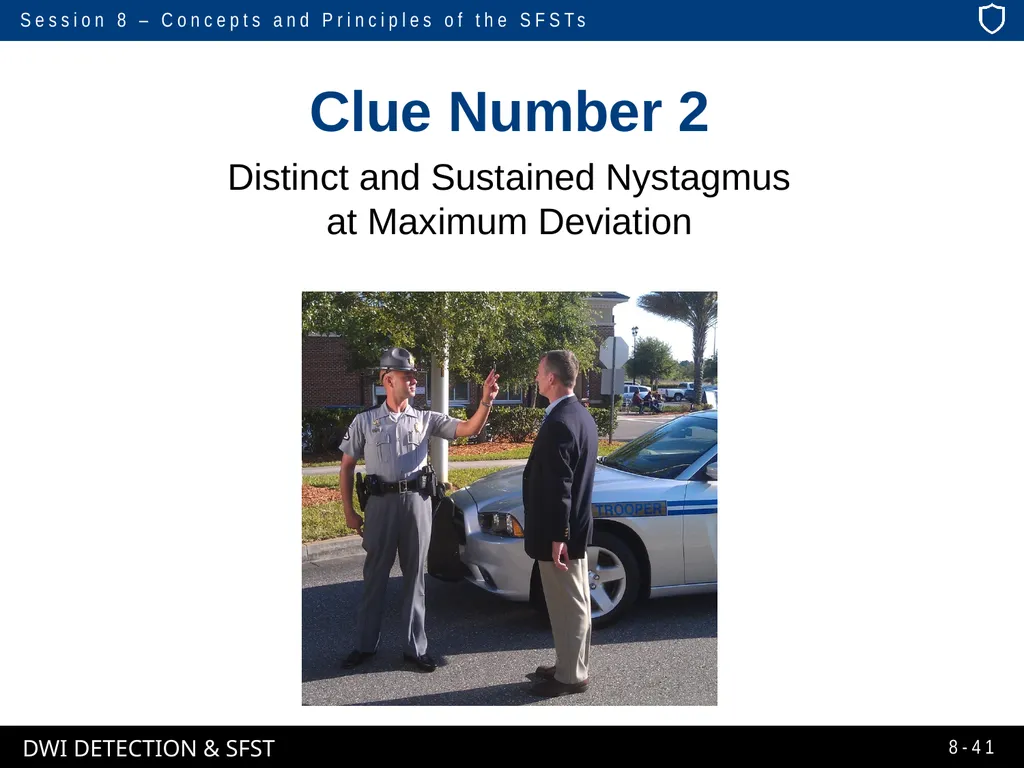
Clue Number 2 Distinct and Sustained Nystagmus
at Maximum Deviation 8-41<br>
42
Clue Number 3 Onset of Nystagmus Prior to 45 Degrees 8-42<br>
43
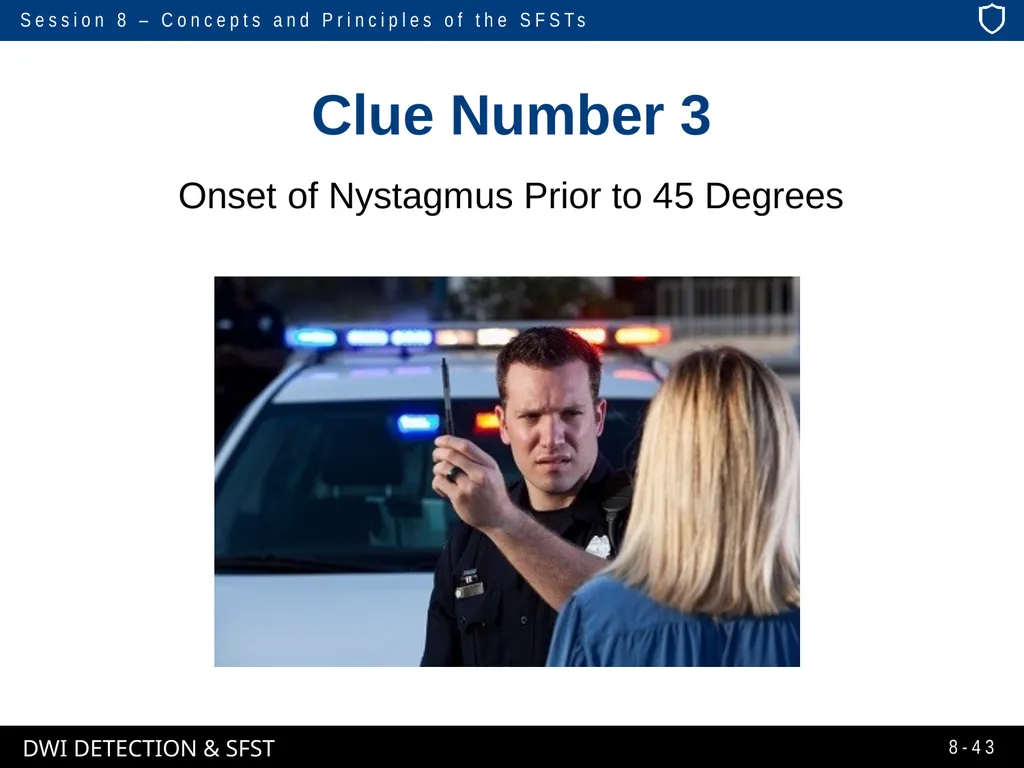
Clue Number 3 Onset of Nystagmus Prior to 45 Degrees 8-43<br>
44
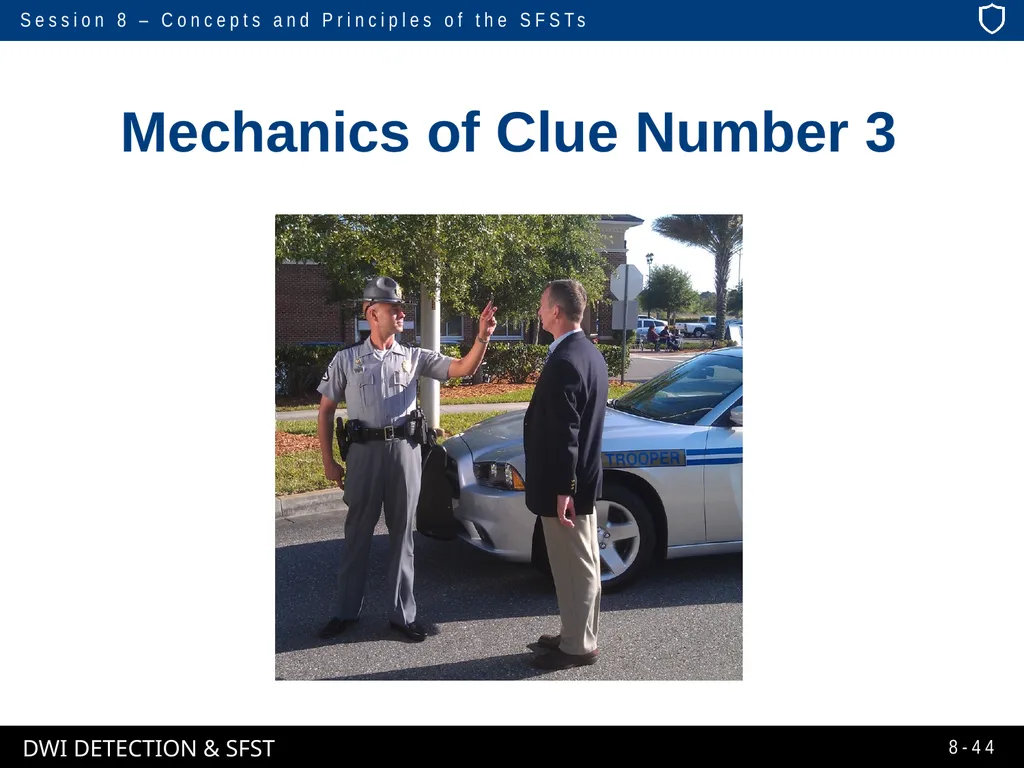
Mechanics of Clue Number 3 8-44<br>
45
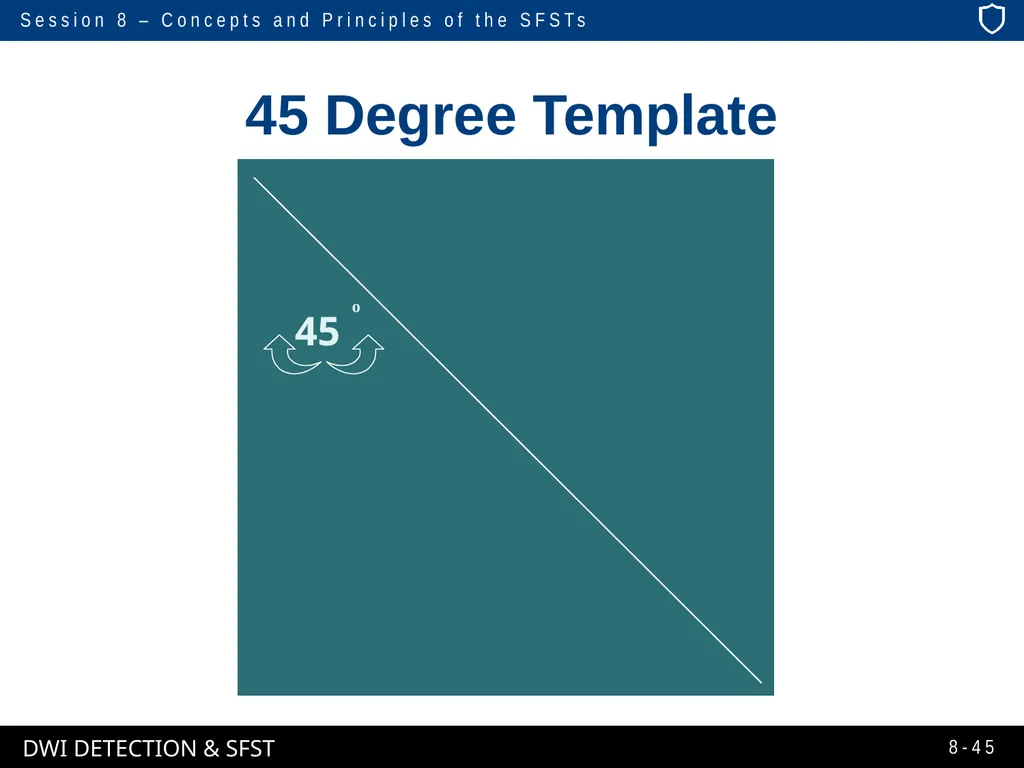
45 Degree Template 8-45<br>
46
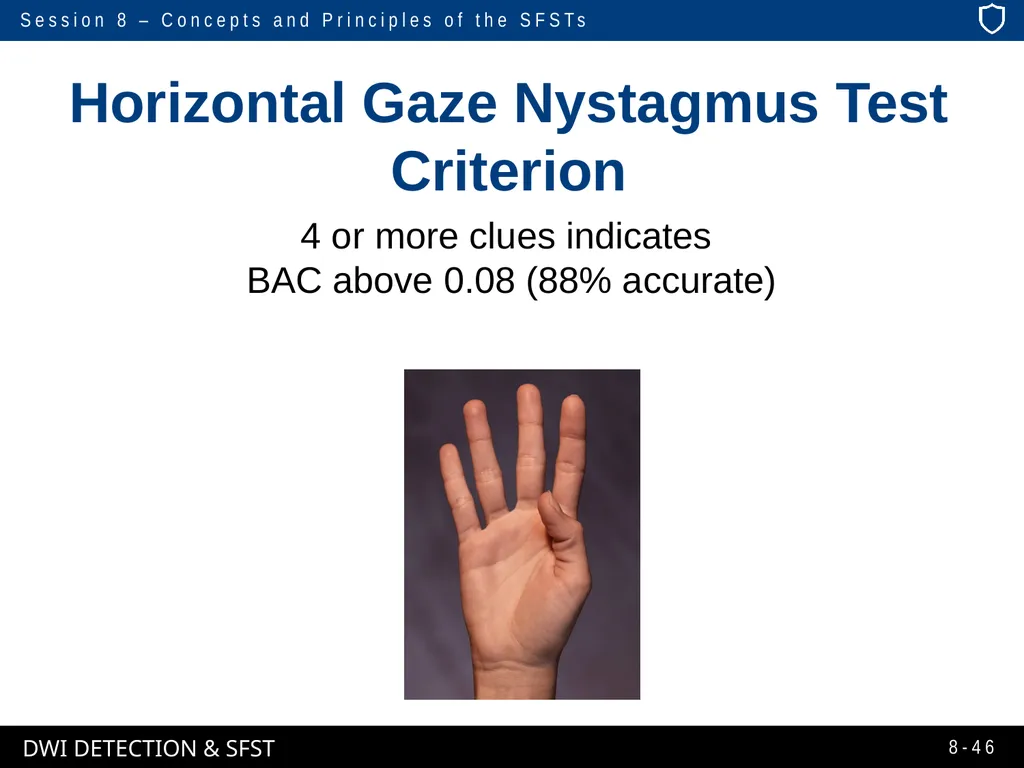
Horizontal Gaze Nystagmus Test Criterion 4 or more clues indicates
BAC above 0.08 (88% accurate) 8-46<br>
47
Administrative Procedures Check for eyeglasses
Verbal instructions
Position stimulus (12-15 inches and slightly above eye level)
Check for Equal Pupil Size and Resting Nystagmus
Check for Equal Tracking 8-47<br>
48
Administrative Procedures Lack of Smooth Pursuit
Distinct and Sustained Nystagmus as Maximum Deviation
Onset of Nystagmus Prior to 45 Degrees
Total the clues
Check for Vertical Nystagmus 8-48<br>
49
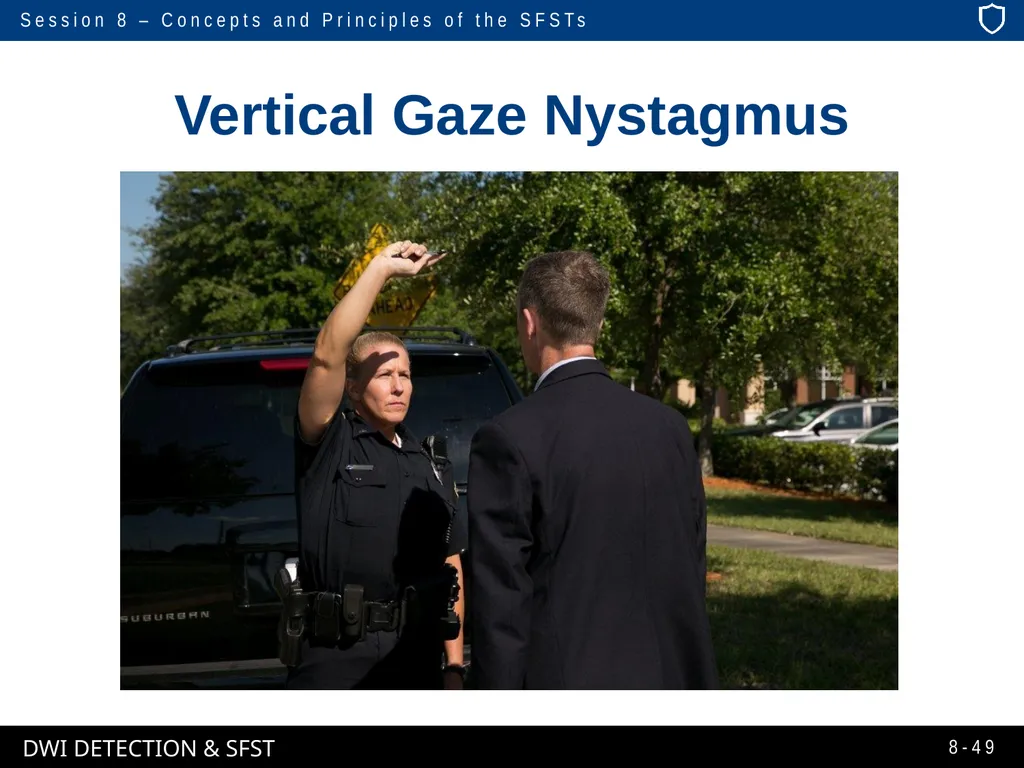
Vertical Gaze Nystagmus 8-49<br>
50
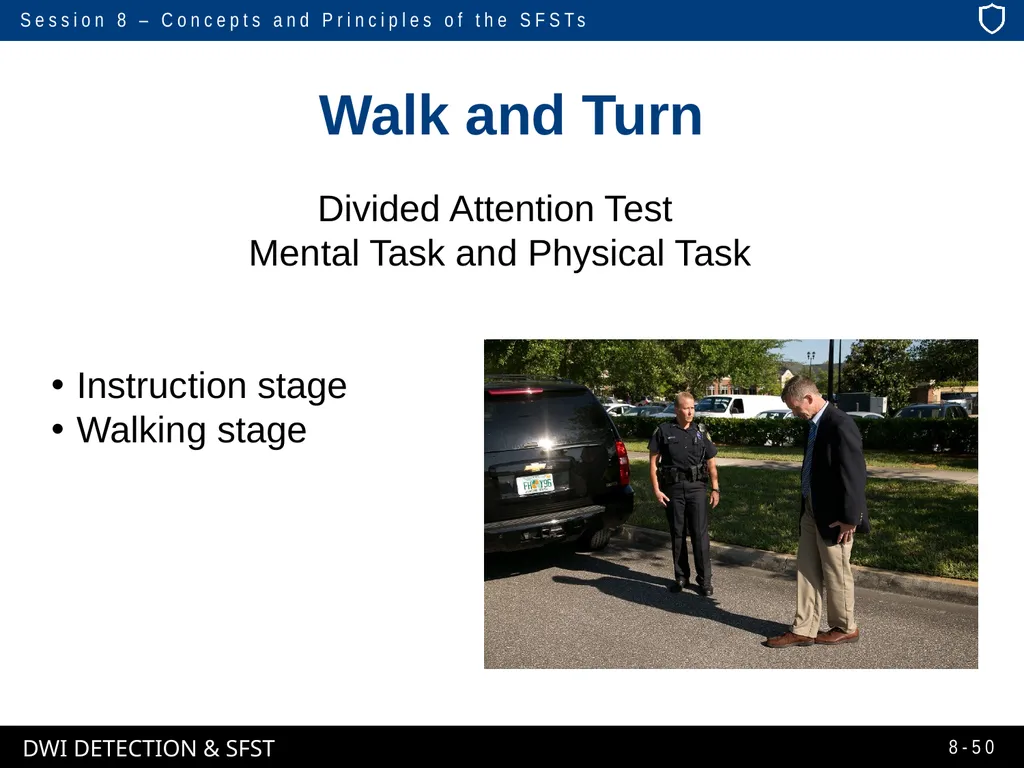
Walk and Turn Divided Attention Test
Mental Task and Physical Task
Instruction stage
Walking stage 8-50<br>
51
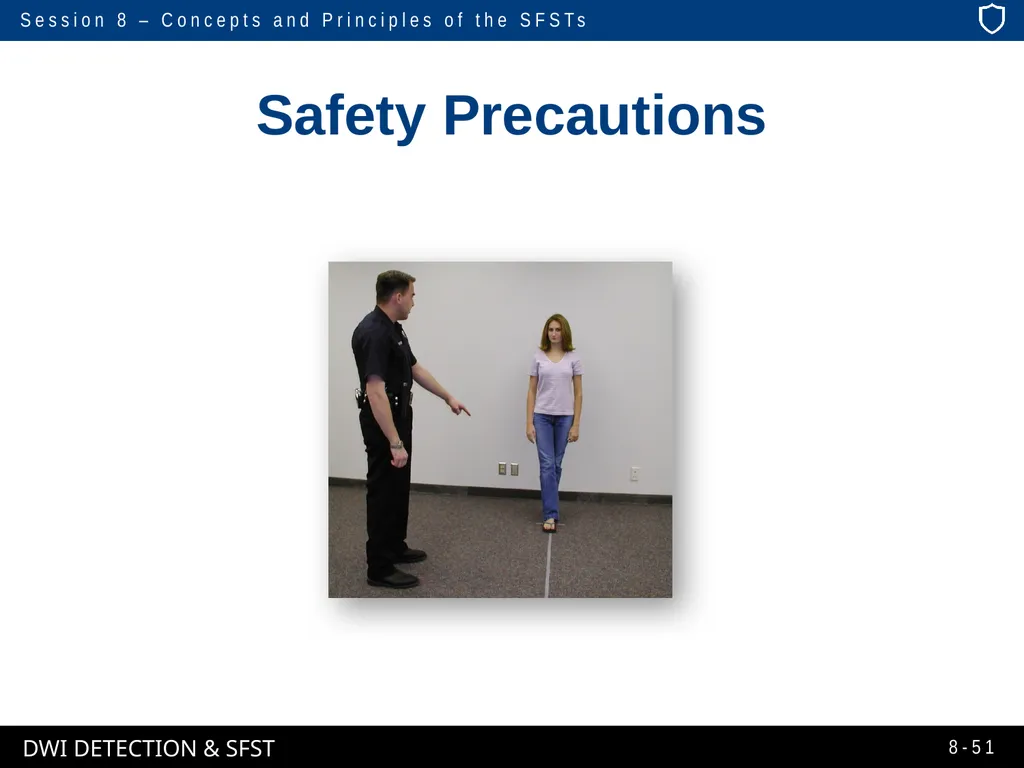
Safety Precautions 8-51<br>
52
Administrative Procedures�Instruction Stage Verbal Instructions
Assume heel-to-toe stance
Arms down at sides
Don’t start until told 8-52<br>
53
Administrative Procedures �Walking Stage 8-53 Nine heel-to-toe steps, turn, nine heel-to-toe steps
Turn procedures:
Turn around on the line
Several small steps<br>
54
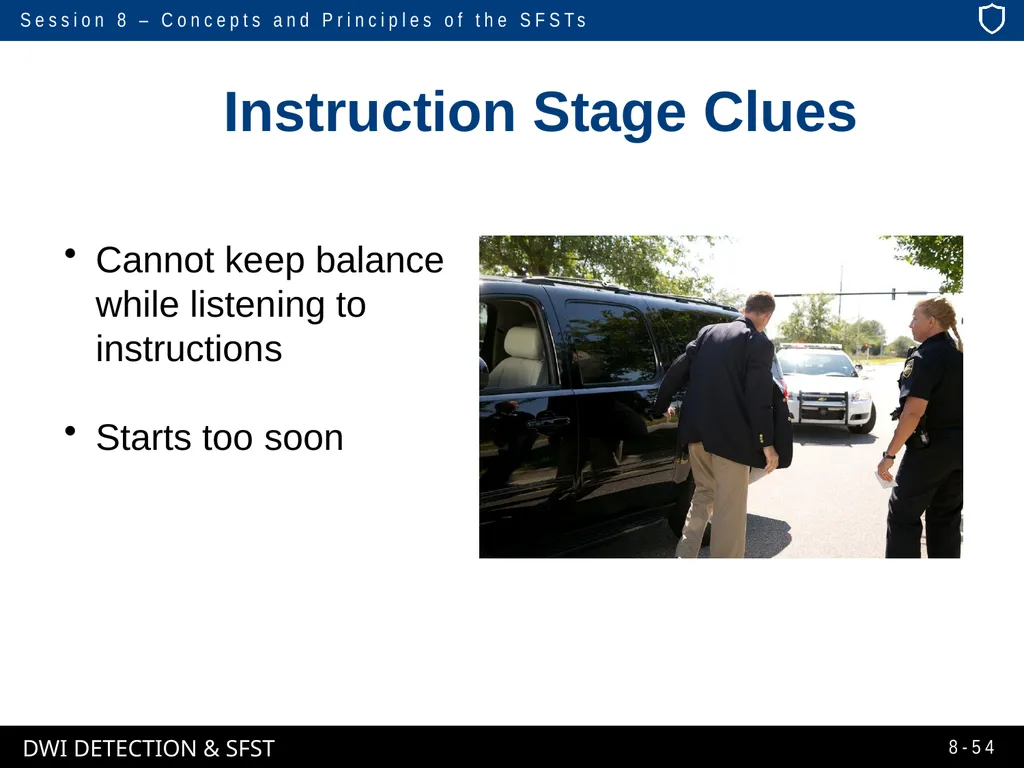
Instruction Stage Clues Cannot keep balance while listening to instructions
Starts too soon 8-54<br>
55
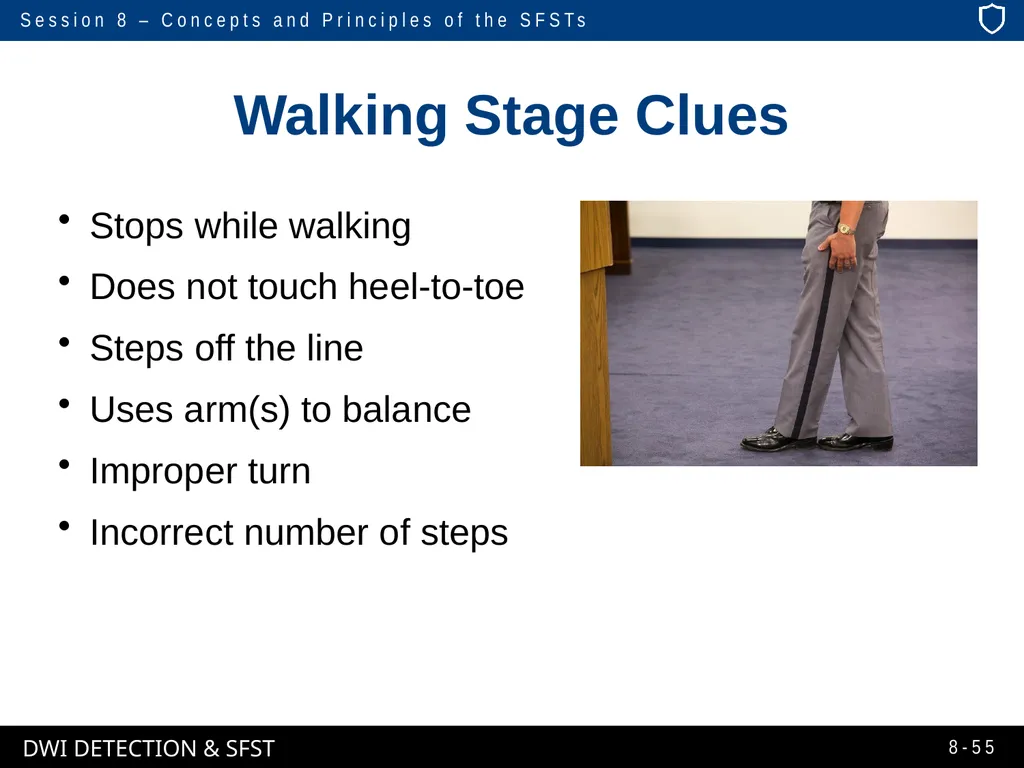
Walking Stage Clues Stops while walking
Does not touch heel-to-toe
Steps off the line
Uses arm(s) to balance
Improper turn
Incorrect number of steps 8-55<br>
56
Walk and Turn Test Clues Summary SFSTs are a tool to assist you in seeing visible signs of impairment and are not a pass/fail test. 8-56<br>
57
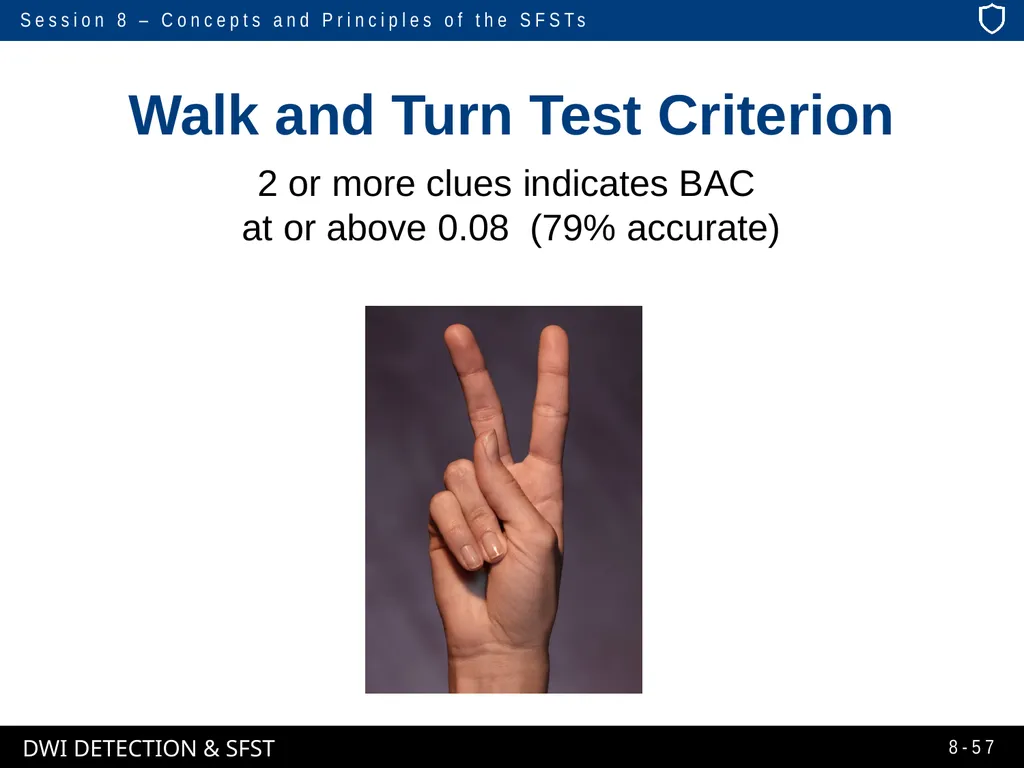
Walk and Turn Test Criterion 2 or more clues indicates BAC
at or above 0.08 (79% accurate) 8-57<br>
58
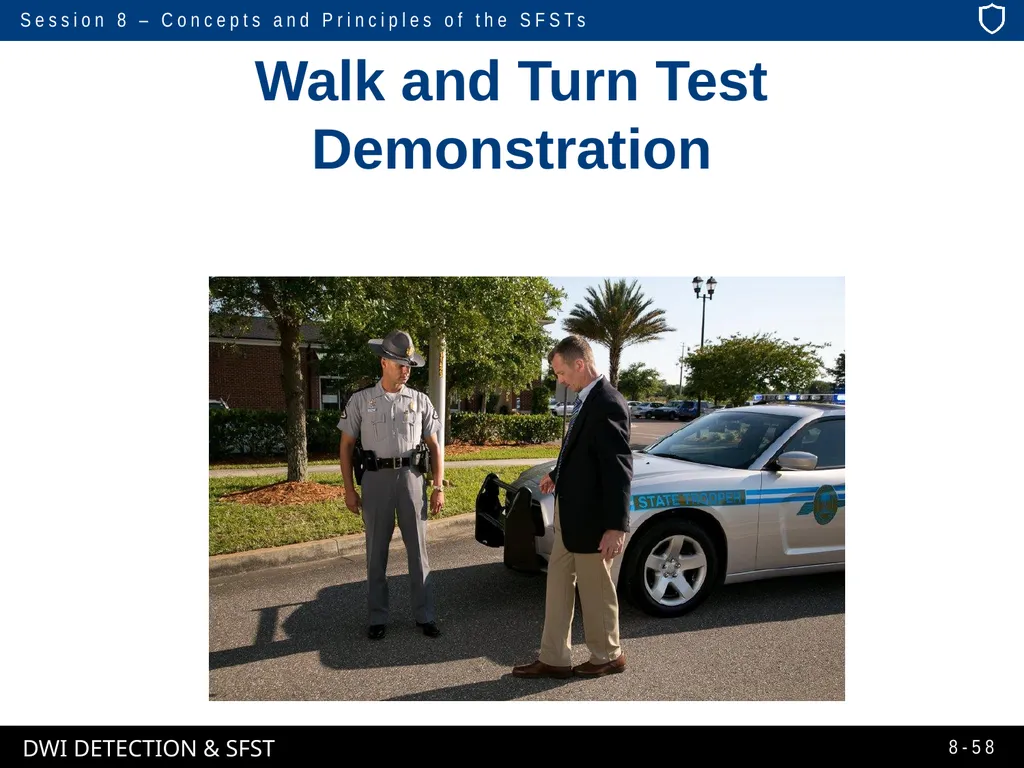
Walk and Turn Test Demonstration 8-58<br>
59
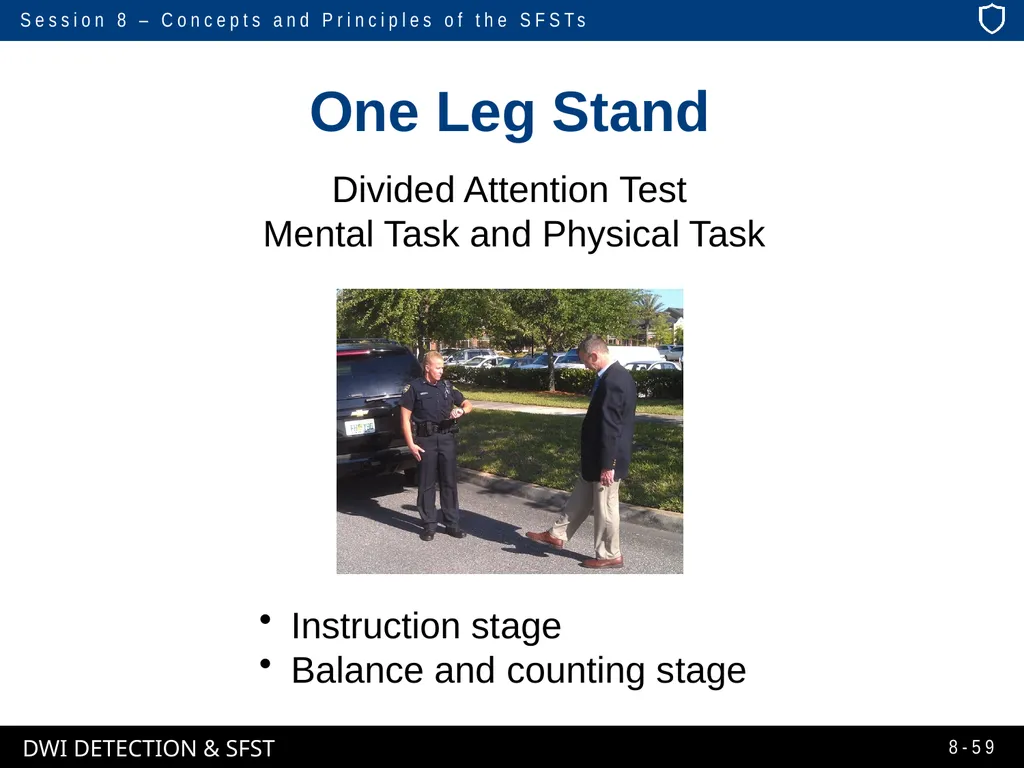
One Leg Stand Divided Attention Test
Mental Task and Physical Task 8-59 Instruction stage
Balance and counting stage<br>
60
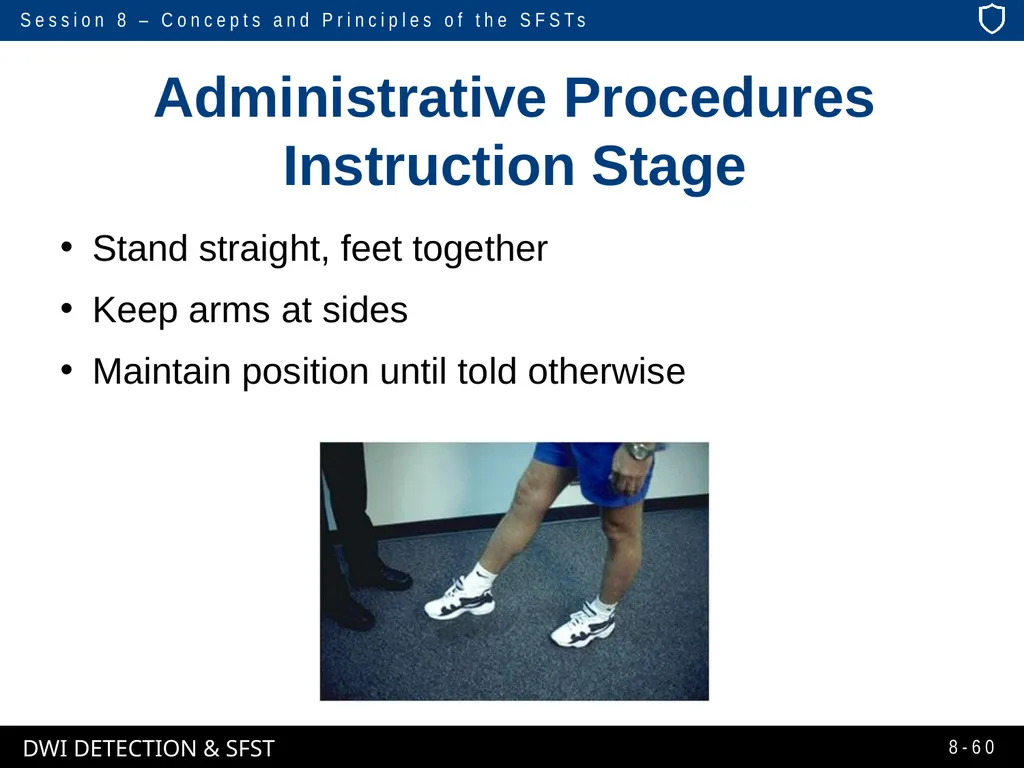
Administrative Procedures�Instruction Stage Stand straight, feet together
Keep arms at sides
Maintain position until told otherwise 8-60<br>
61
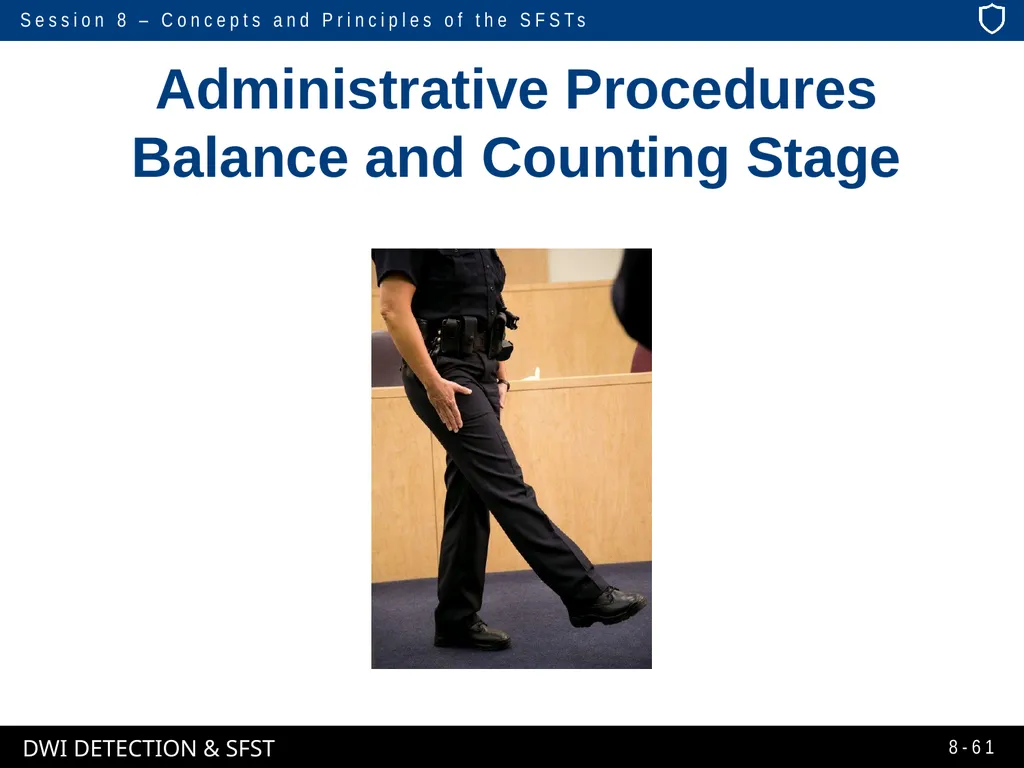
Administrative Procedures�Balance and Counting Stage 8-61<br>
62
One Leg Stand Test Clues Sways while balancing
Uses arm(s) to balance 8-62<br>
63
One Leg Stand Test Clues Hopping
Puts foot down 8-63<br>
64
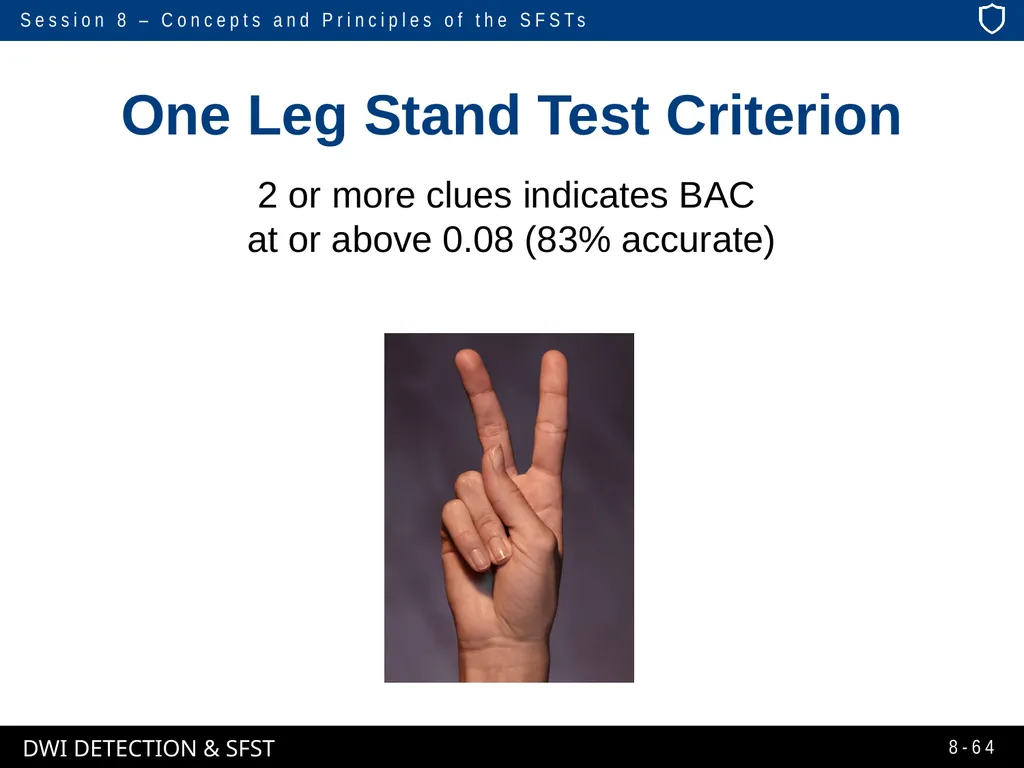
One Leg Stand Test Criterion 2 or more clues indicates BAC
at or above 0.08 (83% accurate) 8-64<br>
65
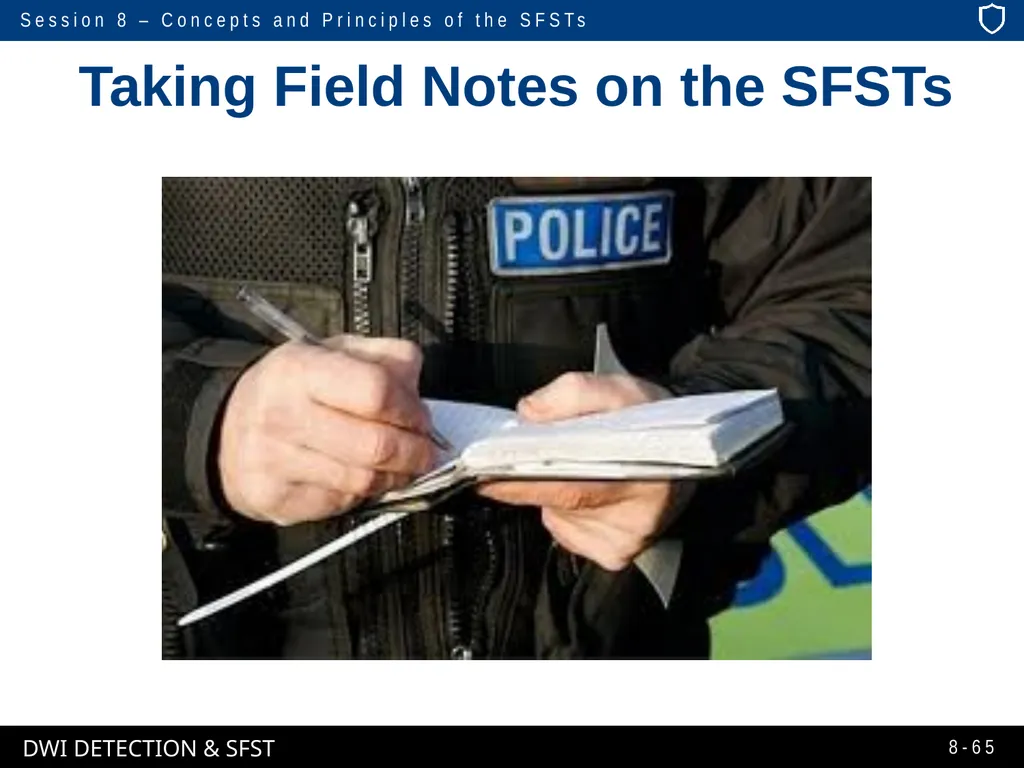
Taking Field Notes on the SFSTs 8-65<br>
66
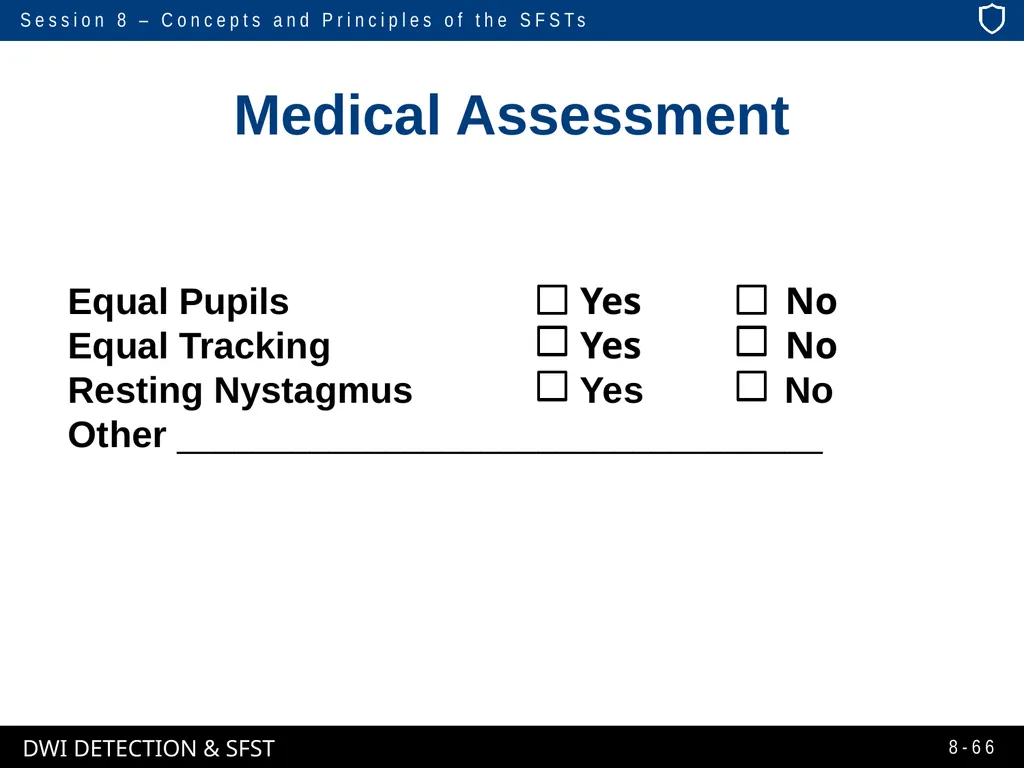
Medical Assessment 8-66 Equal Pupils Yes No
Equal Tracking Yes No
Resting Nystagmus Yes No
Other __________________________________<br>
67
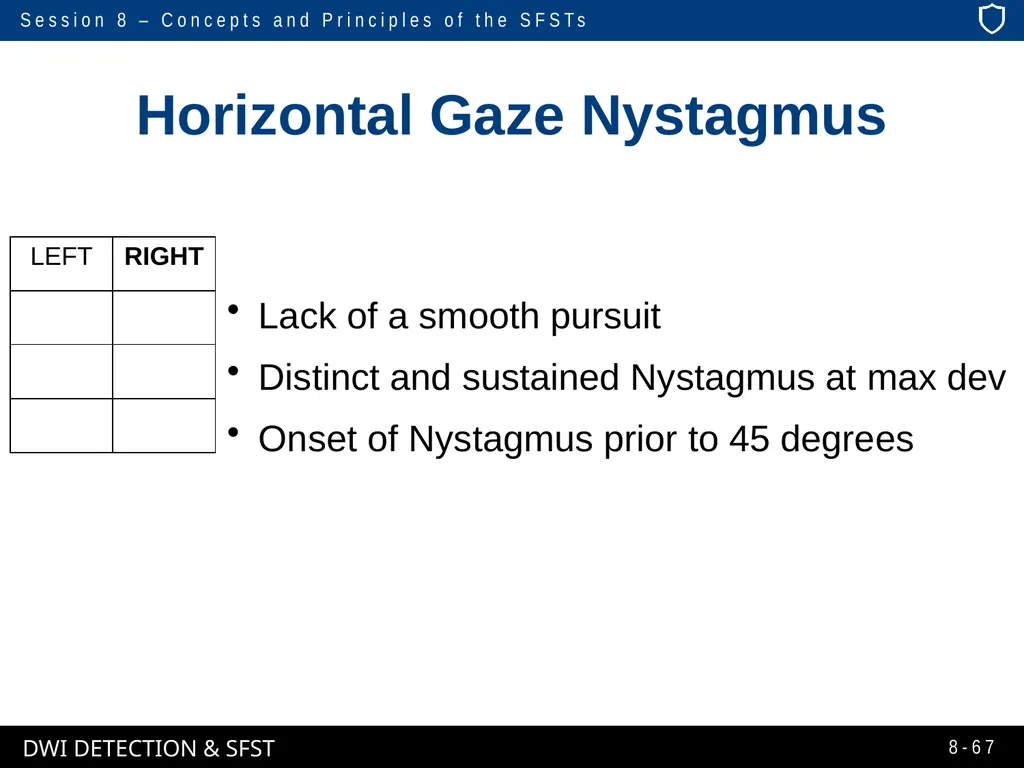
Horizontal Gaze Nystagmus Lack of a smooth pursuit
Distinct and sustained Nystagmus at max dev
Onset of Nystagmus prior to 45 degrees 8-67<br>
68
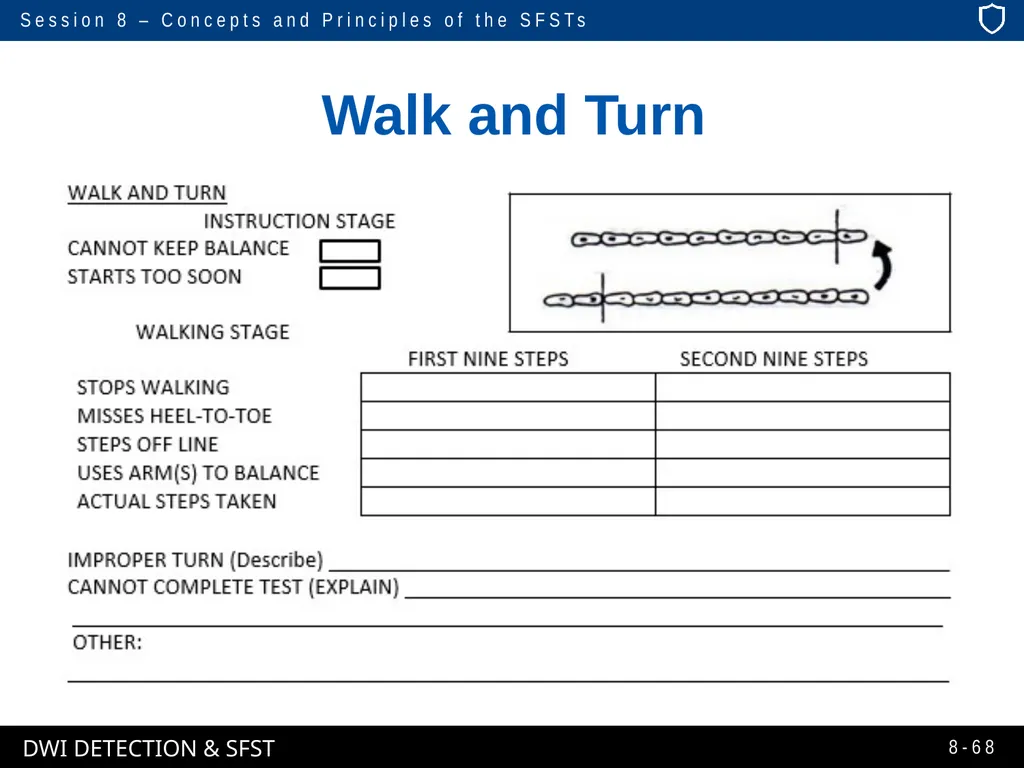
Walk and Turn 8-68<br>
69
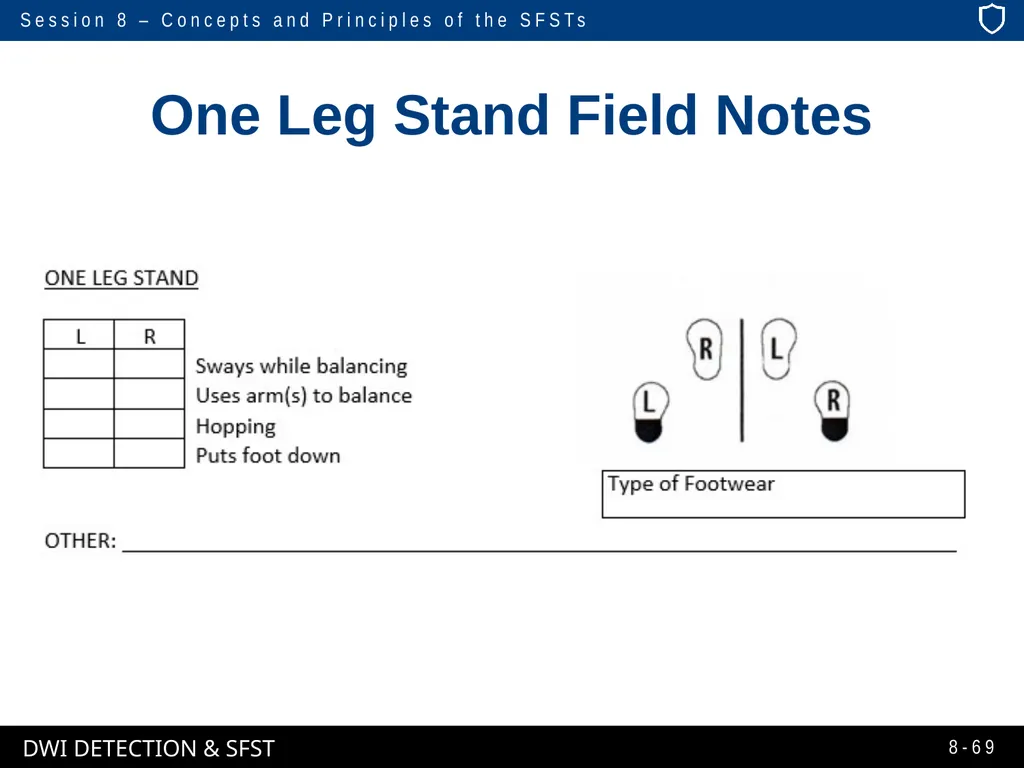
One Leg Stand Field Notes 8-69<br>
71
Test Your Knowledge WAT is an example of a _____ -attention field sobriety test.
The WAT requires a real or imaginary line, and a reasonably ______, non-slippery surface.
During the _____ stage of the WAT, the subject is required to count their steps out loud. 8-71<br>
72
Test Your Knowledge Based upon the San Diego study, the WAT test can determine whether a subject’s BAC is above or below 0.08, _____ % of the time
In the WAT test, a subject who steps off the line during the first 9 steps and once again during the second 9 steps and who uses arm(s) to balance twice during the second 9 steps has produced _____ distinct clue(s). 8-72<br>
73
Test Your Knowledge The WAT test has ____________ possible clues.
During the _____ stage of the OLS test the subject must maintain balance while standing on one foot
The OLS test requires the subject keep the foot raised for _____ seconds. 8-73<br>
74
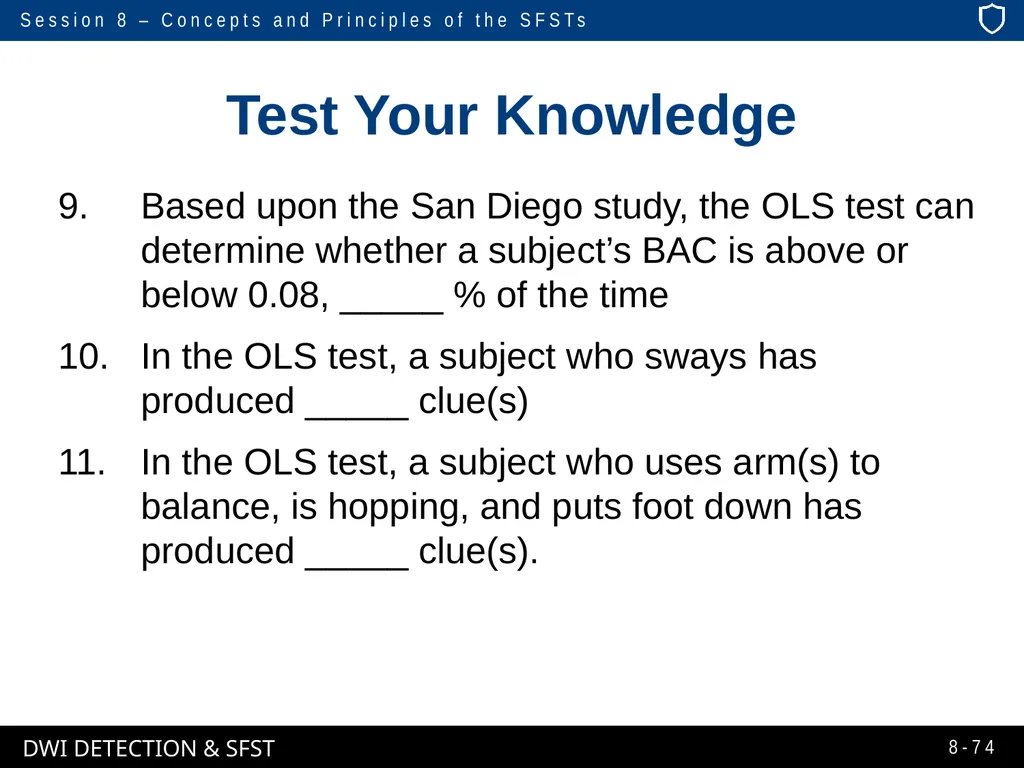
Test Your Knowledge Based upon the San Diego study, the OLS test can determine whether a subject’s BAC is above or below 0.08, _____ % of the time
In the OLS test, a subject who sways has produced _____ clue(s)
In the OLS test, a subject who uses arm(s) to balance, is hopping, and puts foot down has produced _____ clue(s). 8-74<br>
75
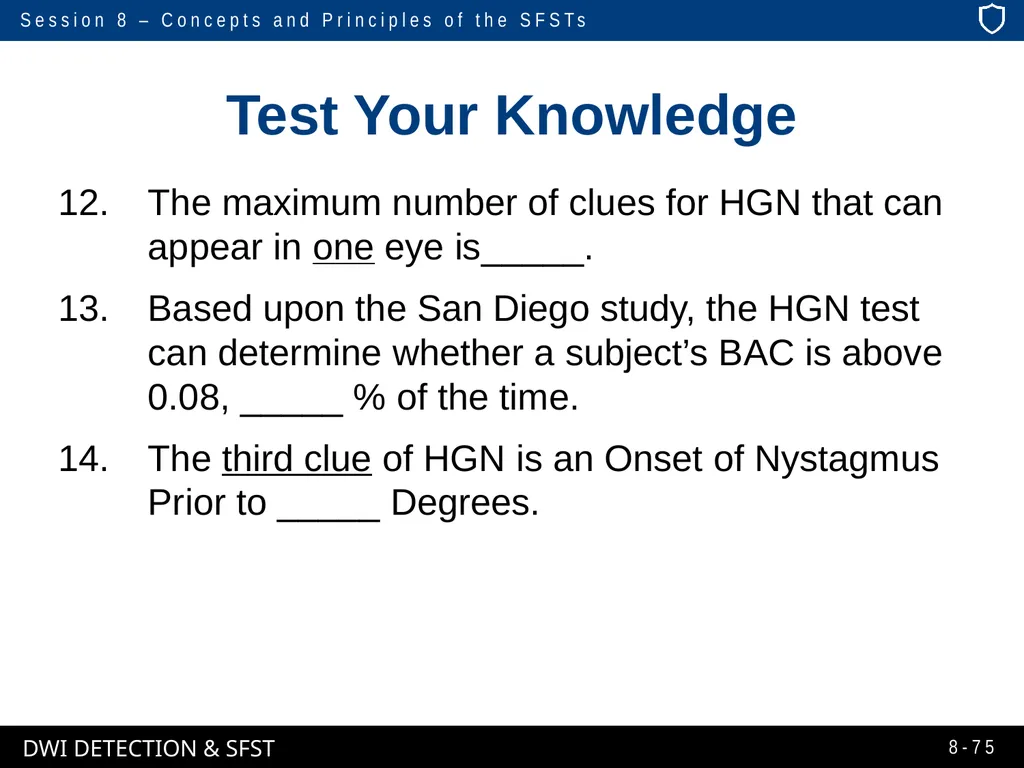
Test Your Knowledge The maximum number of clues for HGN that can appear in one eye is_____.
Based upon the San Diego study, the HGN test can determine whether a subject’s BAC is above 0.08, _____ % of the time.
The third clue of HGN is an Onset of Nystagmus Prior to _____ Degrees. 8-75<br>