
Shepherd University Green Zone Training OBJECTIVE


Description: Shepherd University Green Zone Training OBJECTIVE Participants will: Understand the expectations of a Green Zone Ally Become familiar with the military experience and emotional cycle of deployment Become familiar with the potential issues
Related Topics
Download Presentation
"Shepherd University Green Zone Training OBJECTIVE" is the property of its rightful owner. Permission is granted to download and print the materials on this website for personal, non-commercial use only, and to display it on your personal computer provided you do not modify the materials and that you retain all copyright notices contained in the materials. By downloading content from our website, you accept the terms of this agreement.
Presentation Transcript
slide1. Shepherd University Green Zone Training<br>
slide2. OBJECTIVE Participants will:
Understand the expectations of a Green Zone Ally
Become familiar with the military experience and emotional cycle of deployment
Become familiar with the potential issues facing student veterans and active service members as they transition from the military to campus
Become aware of the resources available to student veterans and active service members on our campus and off campus
Understand Shepherd University’s Veteran Demographics<br>
slide3. What is A Green Zone Ally? Staff, faculty, and students who identify themselves as:
•Someone who knows something about the issues and concerns facing student veterans
•Someone who can help students find appropriate resources
•An understanding ear
•Not expected to be experts<br>
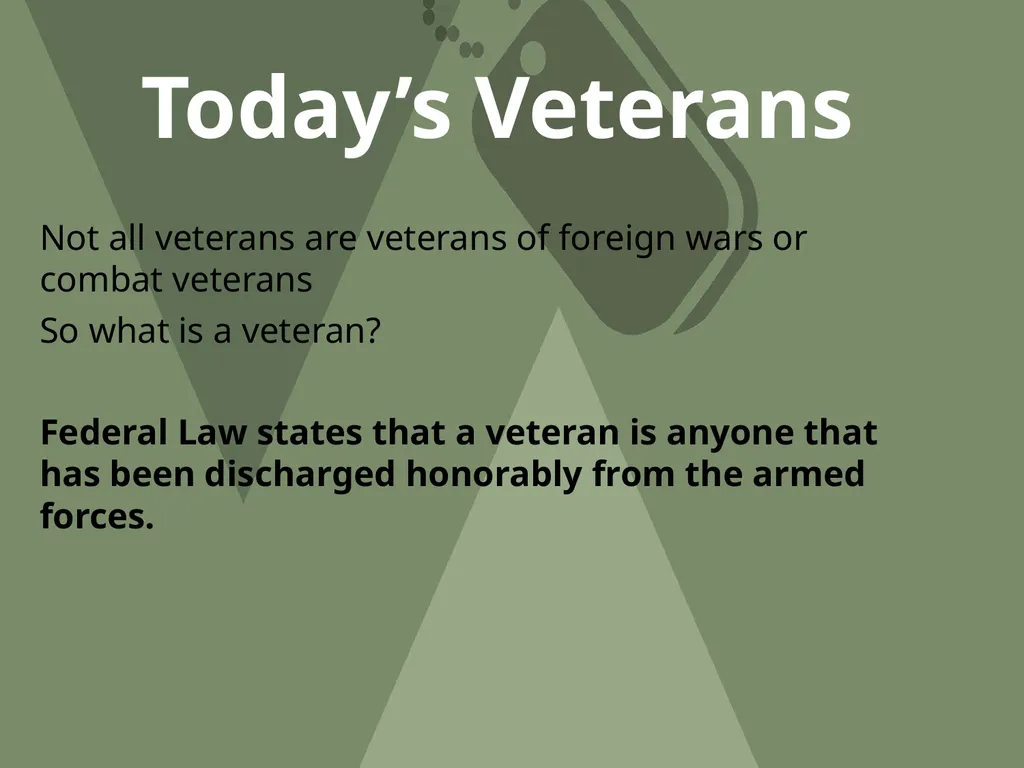
slide4. Today’s Veterans Not all veterans are veterans of foreign wars or combat veterans
So what is a veteran?
Federal Law states that a veteran is anyone that has been discharged honorably from the armed forces.<br>
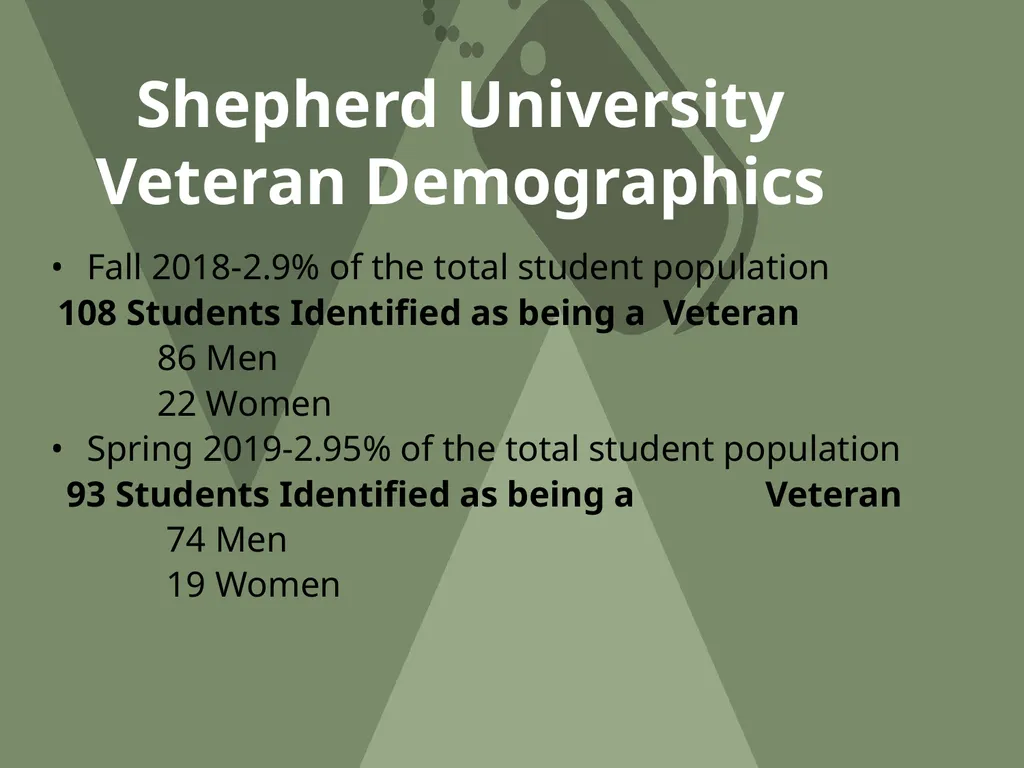
slide5. Shepherd University Veteran Demographics Fall 2018-2.9% of the total student population
108 Students Identified as being a Veteran
86 Men
22 Women
Spring 2019-2.95% of the total student population
93 Students Identified as being a Veteran
74 Men
19 Women<br>
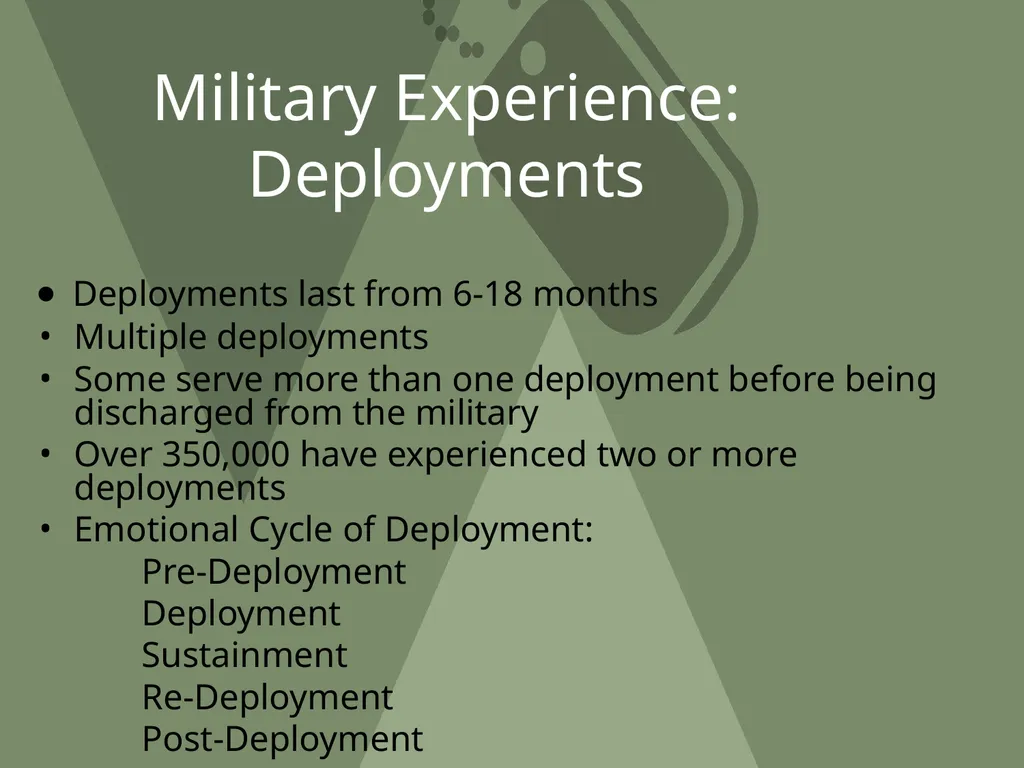
slide6. Military Experience: Deployments • Deployments last from 6-18 months
Multiple deployments
Some serve more than one deployment before being discharged from the military
Over 350,000 have experienced two or more deployments
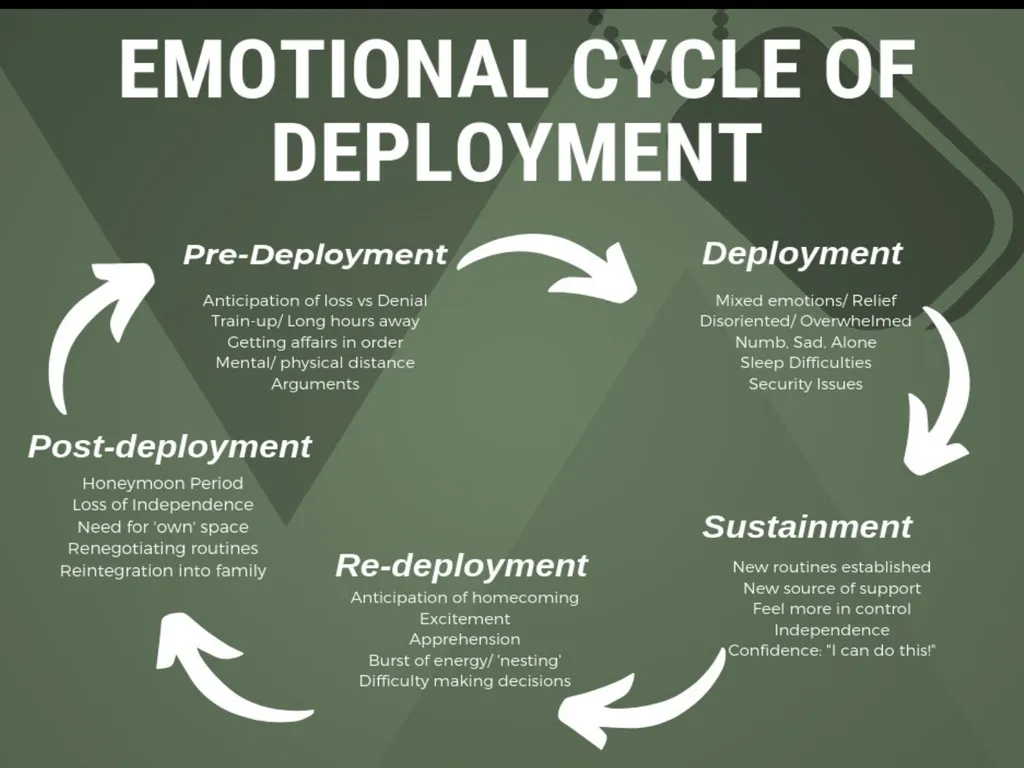
Emotional Cycle of Deployment:
Pre-Deployment
Deployment
Sustainment
Re-Deployment
Post-Deployment<br>
slide8. Family Members/Dependents Family Members or dependents also experience challenges
Birth of a child while their spouse/dependent is away
Readjusting to life without spouse<br>
slide9. Veteran Students Strengths Veterans/Active Service Members (ASMs) transitioning out of the military onto college campuses bring a unique perspective
Military training
Life experience
Established identity
A more worldly view
Skills taught in the military help students to be successful
Leadership
Motivation
Time management
Work ethic
Stress management<br>
slide10. Marketable Skills 1.Accelerated learning curve
2.Understanding of leadership
3.Ability to work on a team
4.Experiences with diversity and inclusion
5.Efficient performance under pressure
6.Respect for procedures
7.Experience with advanced technology and international trends
8.Integrity
9.Consciousness of health and safety standards
10.Triumph over adversity<br>
slide11. Transition Challenges Issues during transition MAY become barriers to success
Translating military skills into a new profession or into college credits
Adjusting to a new focus unrelated to military experience
Course articulation difficulty
Using the GI Bill
Being an older student
Freshman 24+ years old with 18 year old classmates
Living off campus
Feeling isolated from classmates
Alienation
Life experiences within the military differ significantly from most other students and faculty
Insensitivity of classmates, faculty, and others on campus in regards to discussion of war and military
Veterans/ASMs may not agree with discussions or may feel attacked when asked about their experience<br>
slide12. Transition Challenges CONT. Things to keep in mind about student veterans in the classroom:
Some MAY:
Have difficulty relating to classmates
Find loud noises disturbing
Become anxious with changes in the classroom
Have excessive absences
Have Post Traumatic Stress Disorder or Traumatic Brain Injury<br>
slide13. Students with Disabilities It is estimated that 23% to 31% of Veterans/Active Service Members of Operation Iraqi Freedom or Operation Enduring Freedom have PTSD symptoms and 20% have mild TBIs.
New disability
May not want to identify as having a disability<br>
slide14. Wounds of War Not all wounds/injuries are combat related
Not all wounds are visible
Spinal Cord Injury (SCI)
Military Sexual Trauma (MST)
Post-Traumatic Stress Disorder (PTSD)
Traumatic Brain Injury (TBI)<br>
slide15. Spinal Cord Injury (SCI) Student may have difficulty with mobility around campus<br>
slide16. Military Sexual Trauma (MST) Psychological trauma, which in the judgment of a VA mental health professional, resulted from a physical assault of a sexual nature, battery of a sexual nature, or sexual harassment which occurred while the Veteran was serving on active duty or active duty for training.
Symptoms
Strong emotions
Depression, Irritability
Trouble sleeping
Problems in relationships
“Both male and female veterans can experience MST<br>
slide17. Post-Traumatic Stress Disorder (PTSD) PTSD occurs after an individual has seen or experienced a traumatic event that involved the threat of injury or death
PTSD is experienced by some, but certainly not all Student Veterans/ASMs
Symptoms
•Repeated "reliving" of the event, which disturbs day-to-day activity
•Flashback episodes, where the event seems to be happening again and again
•Avoidance
•Emotional "numbing," or feeling as though you do not care about anything
•Arousal
•Excess awareness (hypervigilance)
MST can also contribute to PTSD<br>
slide18. PTSD in the Classroom Student MAY:
Sit in the back of the classroom
Be easily startled by noises
Be withdrawn from class discussion
Have difficulty maintaining emotional control during difficult topics
Have a service animal for support
Remember:
Although many veterans may have stressful or traumatic experiences, not all develop Post-Traumatic Stress Disorder.
Help end this assumption!<br>
slide19. Traumatic Brain Injury (TBI) A blow or jolt to the head or a penetrating head injury that disrupts the function of the brain.
Severity of injury can vary
Mild: brief change in mental status or consciousness
Severe: extended period of unconsciousness or amnesia after the injury<br>
slide20. TBI CONT. Top three causes:
Car accidents
Firearms
Falls
TBI often goes undiagnosed because symptoms may not appear until weeks later
Especially emotional or personality changes which are difficult for strangers to identify
Difficult to differentiate between TBI and PTSD because they have several overlapping symptoms<br>
slide21. TBI Symptoms Symptoms
Cognition
Motor/Sensory Disturbances
Impairments in:
Communication
Concentration/ Memory
Speed of Information Processing
Judgment
Decision-Making
Problem-Solving<br>
slide22. TBI in the Classroom Students MAY:
Have difficulty expressing themselves
Constant fidgeting and tapping pens or feet
Becoming aggressive, easily irritated, agitated, or insensitive to others in the classroom
Be withdrawn or not participating in class discussion
May need info repeated or written down<br>
slide23. Potential Classroom Scenarios A veteran may be tardy or absence from class due to a Veteran Affairs’ Hospital (VA) appointment.(Getting a VA appointment can be like winning the lottery)
A veteran may feel uncomfortable when discussing contemporary political events so foreworn them prior to a discussion occurring
Classroom disturbances and off task behavior can be very distracting for a veteran that is used to focusing on a mission
Treating a veteran like an 18 year old college student can create an uncomfortable situation for a veteran<br>
slide24. Top Ten Green Zone tips Realize veterans are nontraditional students, a special population of financially independent adults often juggling family, work, and studies.
Be aware that not all the veterans in your classroom are male. More women are serving, and are almost as likely as their male counterparts to have experienced firsthand traumas of war. One in four veteran students are women.
Veterans generally possess discipline, structure, and a strong work ethic. Remember that the military teaches team connection and completion skills.
With some awareness and sensitivity on the instructor’s part, veteran life experiences become assets, adding to the diversity of perspectives represented in classrooms. These life experiences can help both veterans and nonveterans gain a broader, more nuanced perspective on the world or class subject.
A secured classroom can provide veterans with feelings of safety. Veterans may be sensitive to triggers such as surprises, loud noises, and chaos. Be cautious about images of injury, dismemberment and death, and provide advanced warning before displaying such images.<br>
slide25. Top Ten Green Zone tips Contd. Veterans view the instructor as the leader of the classroom and typically respect decisiveness. Treat veterans as adults, as this is what they expect. Instructors should have effective classroom management policies in place.
Veterans may be reluctant to talk about their military experiences. Conversely, some may inadvertently dominate class discussions, in which cases boundaries for the nature and quantity of class participation need to be set, preferably in private, without calling the student out in front of the class. Don’t try to relate to experiences that you don’t share – if you haven’t been in combat, don’t pretend that you understand what it or its aftermath is like.
Keep the syllabus (mission) clear with specific tasks and dates. Be available for assistance and added support or referral. Veterans may not easily admit when they are struggling.
Understand that not everything in these Top Ten tips applies to every veteran. They are all unique individuals with unique needs, and we do not want to engage in false assumptions about veterans.
One example of how you can help is to use the resources provided on this page to refer veteran student to services on campus. It is helpful to confirm that you are referring correctly by making a phone call before sending the student to the referral source.<br>
slide26. Examples of Acceptable Questions to ask a Veteran What branch did you serve in?
Where were you stationed?
• How long did you serve?
• What did you do (in the Army, Navy, Marines, Coast Guard, Air Force, Guard, or Reserves)?
• Why did you choose that branch?
• Do you come from a military family?
• Did you visit any other countries?
• Where was your favorite place you lived?
• How’s your family doing?
• What do you do outside of work? Play any sports<br>
slide27. Examples of Questions to not ask a Veteran •Have you ever killed someone?
•What did it feel like to kill someone?
•Do you agree with the President or do you think we should have stayed out of (Iraq, Afghanistan)?
•Is it hard to get back to real life after being in the military?
•How could you leave your family for so long?
•What’s the worst thing that happened to you?
•Were you raped?<br>
slide28. What Green Zone allies should know Do not ask or suggest that the student veteran/ASM has a disability but inquire about their issues and concerns
Become familiar with information provided by the Student Disability Services and Campus Counseling for those who may request such services
Students may need extra help navigating the system and understanding what help is available to them
Some students may be averse to seeking help due to stigma and issues with continued military service.<br>
slide29. Shepherd University Veteran Resources Mary Beth Myers/ Student Veteran Services
Email: mwalling@shepherd.edu
Phone: 304-876-5325
Shannon Zimmerman/ GI Bill Certifying Officer
Email: szimmerm@shepherd.edu
Phone: 304-876-5463
Robert Hardin/ Shepherd University Student Veteran Organization President
Email: rhardi01@rams.shepherd.edu<br>
slide30. Veteran Resources CONT. Shepherd University has a Veteran Center located in Gardiner Hall
The Shepherd University Student Veteran Organization(SUSVO) meets in the Veteran Center on Wednesdays at 1:30 p.m.
Anyone is welcome to attend SUSVO meetings
Counseling Center located in Gardiner Hall
Ext. 5161 for appointments
Health Center located in Gardiner Hall
Ext. 5161 for appointments
Accessibility Services located in Gardiner Hall Ext. 5122 for appointments<br>
slide31. Veteran Resources CONT. Team River Runner
https://www.shepherd.edu/veterans/trr-shepherd
Veterans to Agriculture Program
https://www.shepherd.edu/veterans-to-agriculture-program/<br>
slide32. Off Campus Veteran Resources Veterans Administration Medical Center
510 Butler Ave.
Martinsburg WV 25401
304-263-0811
Martinsburg Vet Center
300 Foxcroft Ave., Suite 100A
Martinsburg, WV 25401
304-263-6776<br>
slide33. References American Foundation for Suicide Prevention. (2010). http://www.afsp.org
American Psychiatric Association. (2000). Diagnostic and statistical manual of mental disorders (4th ed., text rev.). Washington, DC: Author.
Center for Disease Control and Prevention (2009). http://www.cdc.gov
Citroën,L. (2018). What to Ask and Not Ask Military Veterans. Retrieved from: https://www.military.com/hiring-veterans/resources/what-to-ask-and-not-ask-military-veterans.html
Gewirtz, A., DeGarmo, D., Polushy, M., Khaylis, A., & Erbes, C. (2010). Post-traumatic stress symptoms among National Guard soldiers deployed to Iraq: Associations with parenting behaviors and couple adjustment. Journal of Consulting and Clinical Psychology, 78(5), 599-610.
Franklin, K. (2009). Understanding the challenges of marriage, parenting, and family life for returning veterans and military families: The Deployment Cycle and Reintegration Challenges.
Hoge, C., Castro, C., Messer, J., McGurk, D., Cotting, D., & Koffman, R. (2004). Combat duty in Iraq and Afghanistan: Mental health problems and barriers to care. New England Journal of Medicine, 35(1), 13-22.
Hoge, E.A., Austin, E.D. & Pollack, M.H. (2007). Resilience: Research evidence and conceptual considerations for posttraumatic stress disorder. Depression and Anxiety, 24, 139-152.
Howell, T. (n.d.). 5 Must Know GI Bill Facts. http://www.military.com/education/gi-bill/5-must-know-gi-bill-facts.html
Jones, K., Young, T., & Leppma, M. (2010). Mild traumatic brain injury and post traumatic stress disorder in returning Iraq and Afghanistan war veterans: Implications for assessment and diagnosis. Journal of Counseling and Development, 88(3), 372-376. 66
Kreuter, N. (2012, November 12). Veterans in the Classroom. Inside Higher Ed, Tyro Tracts.
Lawrence Jr., C. (2013). Veterans day: Top 10 reasons to hire a military veteran. ABC News. Retrieved from http://abcnews.go.com/US/veterans-day-top-10-reasons-hire-military- veteran/story?id=20814395
Mundt., J. (2009). PTSD in the new generation of combat veterans from Iraq and Afghanistan: What the non-VA clinician needs to know. Medical Educational Services Ins. Professional Development Network. Eau, WI.
Newbold, L., & Balmer, T.D. (2012, November 30). Combat to College. Presentation at the Statewide Conference on Serving Student Veterans, Edmond, OK.
Pfeffer, D. (2010). Quality Instructional Services for Veterans And Military Family Members, Webinar.<br>
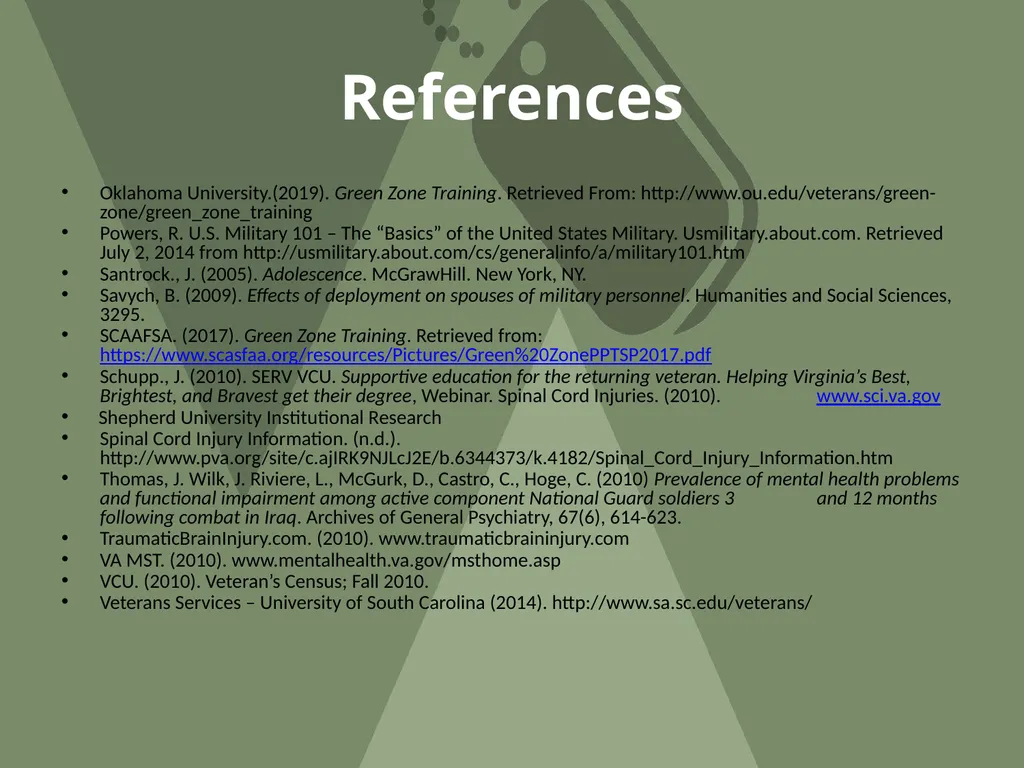
slide34. References Oklahoma University.(2019). Green Zone Training. Retrieved From: http://www.ou.edu/veterans/green-zone/green_zone_training
Powers, R. U.S. Military 101 – The “Basics” of the United States Military. Usmilitary.about.com. Retrieved July 2, 2014 from http://usmilitary.about.com/cs/generalinfo/a/military101.htm
Santrock., J. (2005). Adolescence. McGrawHill. New York, NY.
Savych, B. (2009). Effects of deployment on spouses of military personnel. Humanities and Social Sciences, 3295.
SCAAFSA. (2017). Green Zone Training. Retrieved from: https://www.scasfaa.org/resources/Pictures/Green%20ZonePPTSP2017.pdf
Schupp., J. (2010). SERV VCU. Supportive education for the returning veteran. Helping Virginia’s Best, Brightest, and Bravest get their degree, Webinar. Spinal Cord Injuries. (2010). www.sci.va.gov
Shepherd University Institutional Research
Spinal Cord Injury Information. (n.d.). http://www.pva.org/site/c.ajIRK9NJLcJ2E/b.6344373/k.4182/Spinal_Cord_Injury_Information.htm
Thomas, J. Wilk, J. Riviere, L., McGurk, D., Castro, C., Hoge, C. (2010) Prevalence of mental health problems and functional impairment among active component National Guard soldiers 3 and 12 months following combat in Iraq. Archives of General Psychiatry, 67(6), 614-623.
TraumaticBrainInjury.com. (2010). www.traumaticbraininjury.com
VA MST. (2010). www.mentalhealth.va.gov/msthome.asp
VCU. (2010). Veteran’s Census; Fall 2010.
Veterans Services – University of South Carolina (2014). http://www.sa.sc.edu/veterans/<br>
slide2. OBJECTIVE Participants will:
Understand the expectations of a Green Zone Ally
Become familiar with the military experience and emotional cycle of deployment
Become familiar with the potential issues facing student veterans and active service members as they transition from the military to campus
Become aware of the resources available to student veterans and active service members on our campus and off campus
Understand Shepherd University’s Veteran Demographics<br>
slide3. What is A Green Zone Ally? Staff, faculty, and students who identify themselves as:
•Someone who knows something about the issues and concerns facing student veterans
•Someone who can help students find appropriate resources
•An understanding ear
•Not expected to be experts<br>
slide4. Today’s Veterans Not all veterans are veterans of foreign wars or combat veterans
So what is a veteran?
Federal Law states that a veteran is anyone that has been discharged honorably from the armed forces.<br>
slide5. Shepherd University Veteran Demographics Fall 2018-2.9% of the total student population
108 Students Identified as being a Veteran
86 Men
22 Women
Spring 2019-2.95% of the total student population
93 Students Identified as being a Veteran
74 Men
19 Women<br>
slide6. Military Experience: Deployments • Deployments last from 6-18 months
Multiple deployments
Some serve more than one deployment before being discharged from the military
Over 350,000 have experienced two or more deployments
Emotional Cycle of Deployment:
Pre-Deployment
Deployment
Sustainment
Re-Deployment
Post-Deployment<br>
slide8. Family Members/Dependents Family Members or dependents also experience challenges
Birth of a child while their spouse/dependent is away
Readjusting to life without spouse<br>
slide9. Veteran Students Strengths Veterans/Active Service Members (ASMs) transitioning out of the military onto college campuses bring a unique perspective
Military training
Life experience
Established identity
A more worldly view
Skills taught in the military help students to be successful
Leadership
Motivation
Time management
Work ethic
Stress management<br>
slide10. Marketable Skills 1.Accelerated learning curve
2.Understanding of leadership
3.Ability to work on a team
4.Experiences with diversity and inclusion
5.Efficient performance under pressure
6.Respect for procedures
7.Experience with advanced technology and international trends
8.Integrity
9.Consciousness of health and safety standards
10.Triumph over adversity<br>
slide11. Transition Challenges Issues during transition MAY become barriers to success
Translating military skills into a new profession or into college credits
Adjusting to a new focus unrelated to military experience
Course articulation difficulty
Using the GI Bill
Being an older student
Freshman 24+ years old with 18 year old classmates
Living off campus
Feeling isolated from classmates
Alienation
Life experiences within the military differ significantly from most other students and faculty
Insensitivity of classmates, faculty, and others on campus in regards to discussion of war and military
Veterans/ASMs may not agree with discussions or may feel attacked when asked about their experience<br>
slide12. Transition Challenges CONT. Things to keep in mind about student veterans in the classroom:
Some MAY:
Have difficulty relating to classmates
Find loud noises disturbing
Become anxious with changes in the classroom
Have excessive absences
Have Post Traumatic Stress Disorder or Traumatic Brain Injury<br>
slide13. Students with Disabilities It is estimated that 23% to 31% of Veterans/Active Service Members of Operation Iraqi Freedom or Operation Enduring Freedom have PTSD symptoms and 20% have mild TBIs.
New disability
May not want to identify as having a disability<br>
slide14. Wounds of War Not all wounds/injuries are combat related
Not all wounds are visible
Spinal Cord Injury (SCI)
Military Sexual Trauma (MST)
Post-Traumatic Stress Disorder (PTSD)
Traumatic Brain Injury (TBI)<br>
slide15. Spinal Cord Injury (SCI) Student may have difficulty with mobility around campus<br>
slide16. Military Sexual Trauma (MST) Psychological trauma, which in the judgment of a VA mental health professional, resulted from a physical assault of a sexual nature, battery of a sexual nature, or sexual harassment which occurred while the Veteran was serving on active duty or active duty for training.
Symptoms
Strong emotions
Depression, Irritability
Trouble sleeping
Problems in relationships
“Both male and female veterans can experience MST<br>
slide17. Post-Traumatic Stress Disorder (PTSD) PTSD occurs after an individual has seen or experienced a traumatic event that involved the threat of injury or death
PTSD is experienced by some, but certainly not all Student Veterans/ASMs
Symptoms
•Repeated "reliving" of the event, which disturbs day-to-day activity
•Flashback episodes, where the event seems to be happening again and again
•Avoidance
•Emotional "numbing," or feeling as though you do not care about anything
•Arousal
•Excess awareness (hypervigilance)
MST can also contribute to PTSD<br>
slide18. PTSD in the Classroom Student MAY:
Sit in the back of the classroom
Be easily startled by noises
Be withdrawn from class discussion
Have difficulty maintaining emotional control during difficult topics
Have a service animal for support
Remember:
Although many veterans may have stressful or traumatic experiences, not all develop Post-Traumatic Stress Disorder.
Help end this assumption!<br>
slide19. Traumatic Brain Injury (TBI) A blow or jolt to the head or a penetrating head injury that disrupts the function of the brain.
Severity of injury can vary
Mild: brief change in mental status or consciousness
Severe: extended period of unconsciousness or amnesia after the injury<br>
slide20. TBI CONT. Top three causes:
Car accidents
Firearms
Falls
TBI often goes undiagnosed because symptoms may not appear until weeks later
Especially emotional or personality changes which are difficult for strangers to identify
Difficult to differentiate between TBI and PTSD because they have several overlapping symptoms<br>
slide21. TBI Symptoms Symptoms
Cognition
Motor/Sensory Disturbances
Impairments in:
Communication
Concentration/ Memory
Speed of Information Processing
Judgment
Decision-Making
Problem-Solving<br>
slide22. TBI in the Classroom Students MAY:
Have difficulty expressing themselves
Constant fidgeting and tapping pens or feet
Becoming aggressive, easily irritated, agitated, or insensitive to others in the classroom
Be withdrawn or not participating in class discussion
May need info repeated or written down<br>
slide23. Potential Classroom Scenarios A veteran may be tardy or absence from class due to a Veteran Affairs’ Hospital (VA) appointment.(Getting a VA appointment can be like winning the lottery)
A veteran may feel uncomfortable when discussing contemporary political events so foreworn them prior to a discussion occurring
Classroom disturbances and off task behavior can be very distracting for a veteran that is used to focusing on a mission
Treating a veteran like an 18 year old college student can create an uncomfortable situation for a veteran<br>
slide24. Top Ten Green Zone tips Realize veterans are nontraditional students, a special population of financially independent adults often juggling family, work, and studies.
Be aware that not all the veterans in your classroom are male. More women are serving, and are almost as likely as their male counterparts to have experienced firsthand traumas of war. One in four veteran students are women.
Veterans generally possess discipline, structure, and a strong work ethic. Remember that the military teaches team connection and completion skills.
With some awareness and sensitivity on the instructor’s part, veteran life experiences become assets, adding to the diversity of perspectives represented in classrooms. These life experiences can help both veterans and nonveterans gain a broader, more nuanced perspective on the world or class subject.
A secured classroom can provide veterans with feelings of safety. Veterans may be sensitive to triggers such as surprises, loud noises, and chaos. Be cautious about images of injury, dismemberment and death, and provide advanced warning before displaying such images.<br>
slide25. Top Ten Green Zone tips Contd. Veterans view the instructor as the leader of the classroom and typically respect decisiveness. Treat veterans as adults, as this is what they expect. Instructors should have effective classroom management policies in place.
Veterans may be reluctant to talk about their military experiences. Conversely, some may inadvertently dominate class discussions, in which cases boundaries for the nature and quantity of class participation need to be set, preferably in private, without calling the student out in front of the class. Don’t try to relate to experiences that you don’t share – if you haven’t been in combat, don’t pretend that you understand what it or its aftermath is like.
Keep the syllabus (mission) clear with specific tasks and dates. Be available for assistance and added support or referral. Veterans may not easily admit when they are struggling.
Understand that not everything in these Top Ten tips applies to every veteran. They are all unique individuals with unique needs, and we do not want to engage in false assumptions about veterans.
One example of how you can help is to use the resources provided on this page to refer veteran student to services on campus. It is helpful to confirm that you are referring correctly by making a phone call before sending the student to the referral source.<br>
slide26. Examples of Acceptable Questions to ask a Veteran What branch did you serve in?
Where were you stationed?
• How long did you serve?
• What did you do (in the Army, Navy, Marines, Coast Guard, Air Force, Guard, or Reserves)?
• Why did you choose that branch?
• Do you come from a military family?
• Did you visit any other countries?
• Where was your favorite place you lived?
• How’s your family doing?
• What do you do outside of work? Play any sports<br>
slide27. Examples of Questions to not ask a Veteran •Have you ever killed someone?
•What did it feel like to kill someone?
•Do you agree with the President or do you think we should have stayed out of (Iraq, Afghanistan)?
•Is it hard to get back to real life after being in the military?
•How could you leave your family for so long?
•What’s the worst thing that happened to you?
•Were you raped?<br>
slide28. What Green Zone allies should know Do not ask or suggest that the student veteran/ASM has a disability but inquire about their issues and concerns
Become familiar with information provided by the Student Disability Services and Campus Counseling for those who may request such services
Students may need extra help navigating the system and understanding what help is available to them
Some students may be averse to seeking help due to stigma and issues with continued military service.<br>
slide29. Shepherd University Veteran Resources Mary Beth Myers/ Student Veteran Services
Email: mwalling@shepherd.edu
Phone: 304-876-5325
Shannon Zimmerman/ GI Bill Certifying Officer
Email: szimmerm@shepherd.edu
Phone: 304-876-5463
Robert Hardin/ Shepherd University Student Veteran Organization President
Email: rhardi01@rams.shepherd.edu<br>
slide30. Veteran Resources CONT. Shepherd University has a Veteran Center located in Gardiner Hall
The Shepherd University Student Veteran Organization(SUSVO) meets in the Veteran Center on Wednesdays at 1:30 p.m.
Anyone is welcome to attend SUSVO meetings
Counseling Center located in Gardiner Hall
Ext. 5161 for appointments
Health Center located in Gardiner Hall
Ext. 5161 for appointments
Accessibility Services located in Gardiner Hall Ext. 5122 for appointments<br>
slide31. Veteran Resources CONT. Team River Runner
https://www.shepherd.edu/veterans/trr-shepherd
Veterans to Agriculture Program
https://www.shepherd.edu/veterans-to-agriculture-program/<br>
slide32. Off Campus Veteran Resources Veterans Administration Medical Center
510 Butler Ave.
Martinsburg WV 25401
304-263-0811
Martinsburg Vet Center
300 Foxcroft Ave., Suite 100A
Martinsburg, WV 25401
304-263-6776<br>
slide33. References American Foundation for Suicide Prevention. (2010). http://www.afsp.org
American Psychiatric Association. (2000). Diagnostic and statistical manual of mental disorders (4th ed., text rev.). Washington, DC: Author.
Center for Disease Control and Prevention (2009). http://www.cdc.gov
Citroën,L. (2018). What to Ask and Not Ask Military Veterans. Retrieved from: https://www.military.com/hiring-veterans/resources/what-to-ask-and-not-ask-military-veterans.html
Gewirtz, A., DeGarmo, D., Polushy, M., Khaylis, A., & Erbes, C. (2010). Post-traumatic stress symptoms among National Guard soldiers deployed to Iraq: Associations with parenting behaviors and couple adjustment. Journal of Consulting and Clinical Psychology, 78(5), 599-610.
Franklin, K. (2009). Understanding the challenges of marriage, parenting, and family life for returning veterans and military families: The Deployment Cycle and Reintegration Challenges.
Hoge, C., Castro, C., Messer, J., McGurk, D., Cotting, D., & Koffman, R. (2004). Combat duty in Iraq and Afghanistan: Mental health problems and barriers to care. New England Journal of Medicine, 35(1), 13-22.
Hoge, E.A., Austin, E.D. & Pollack, M.H. (2007). Resilience: Research evidence and conceptual considerations for posttraumatic stress disorder. Depression and Anxiety, 24, 139-152.
Howell, T. (n.d.). 5 Must Know GI Bill Facts. http://www.military.com/education/gi-bill/5-must-know-gi-bill-facts.html
Jones, K., Young, T., & Leppma, M. (2010). Mild traumatic brain injury and post traumatic stress disorder in returning Iraq and Afghanistan war veterans: Implications for assessment and diagnosis. Journal of Counseling and Development, 88(3), 372-376. 66
Kreuter, N. (2012, November 12). Veterans in the Classroom. Inside Higher Ed, Tyro Tracts.
Lawrence Jr., C. (2013). Veterans day: Top 10 reasons to hire a military veteran. ABC News. Retrieved from http://abcnews.go.com/US/veterans-day-top-10-reasons-hire-military- veteran/story?id=20814395
Mundt., J. (2009). PTSD in the new generation of combat veterans from Iraq and Afghanistan: What the non-VA clinician needs to know. Medical Educational Services Ins. Professional Development Network. Eau, WI.
Newbold, L., & Balmer, T.D. (2012, November 30). Combat to College. Presentation at the Statewide Conference on Serving Student Veterans, Edmond, OK.
Pfeffer, D. (2010). Quality Instructional Services for Veterans And Military Family Members, Webinar.<br>
slide34. References Oklahoma University.(2019). Green Zone Training. Retrieved From: http://www.ou.edu/veterans/green-zone/green_zone_training
Powers, R. U.S. Military 101 – The “Basics” of the United States Military. Usmilitary.about.com. Retrieved July 2, 2014 from http://usmilitary.about.com/cs/generalinfo/a/military101.htm
Santrock., J. (2005). Adolescence. McGrawHill. New York, NY.
Savych, B. (2009). Effects of deployment on spouses of military personnel. Humanities and Social Sciences, 3295.
SCAAFSA. (2017). Green Zone Training. Retrieved from: https://www.scasfaa.org/resources/Pictures/Green%20ZonePPTSP2017.pdf
Schupp., J. (2010). SERV VCU. Supportive education for the returning veteran. Helping Virginia’s Best, Brightest, and Bravest get their degree, Webinar. Spinal Cord Injuries. (2010). www.sci.va.gov
Shepherd University Institutional Research
Spinal Cord Injury Information. (n.d.). http://www.pva.org/site/c.ajIRK9NJLcJ2E/b.6344373/k.4182/Spinal_Cord_Injury_Information.htm
Thomas, J. Wilk, J. Riviere, L., McGurk, D., Castro, C., Hoge, C. (2010) Prevalence of mental health problems and functional impairment among active component National Guard soldiers 3 and 12 months following combat in Iraq. Archives of General Psychiatry, 67(6), 614-623.
TraumaticBrainInjury.com. (2010). www.traumaticbraininjury.com
VA MST. (2010). www.mentalhealth.va.gov/msthome.asp
VCU. (2010). Veteran’s Census; Fall 2010.
Veterans Services – University of South Carolina (2014). http://www.sa.sc.edu/veterans/<br>