
Shingles (Herpes Zoster) September 2023 Shingles
A
Published · 39 slides · 0 views

1 / 1


Description
Shingles (Herpes Zoster) September 2023 Shingles (Herpes Zoster) is an infection of the nerve the skin around it is caused by reactivation of a latent varicella zoster virus infection Shingles (Herpes Zoster) Abnormal skin sensation
Related Topics
Share
Embed code
Download this presentation From Below
"Shingles (Herpes Zoster) September 2023 Shingles" is the property of its rightful owner. Permission is granted to download and print the materials on this website for personal, non-commercial use only, and to display it on your personal computer provided you do not modify the materials and that you retain all copyright notices contained in the materials. By downloading content from our website, you accept the terms of this agreement.
Presentation Transcript
01
Shingles (Herpes Zoster)
September 2023<br>
02
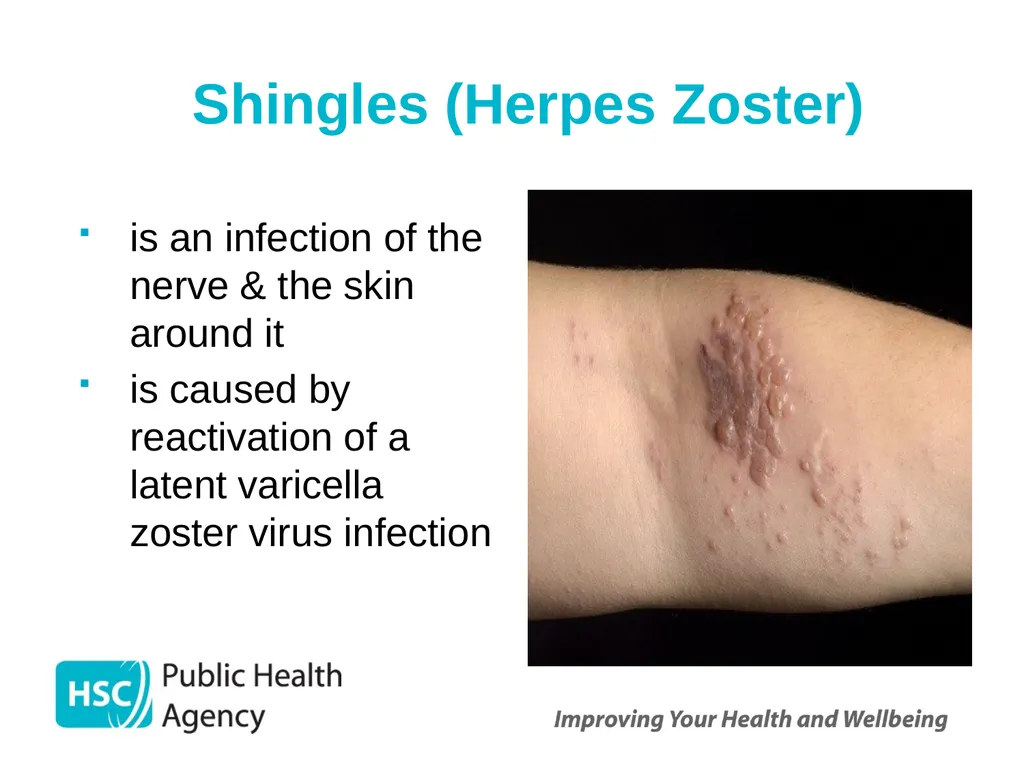
Shingles (Herpes Zoster) is an infection of the nerve & the skin around it
is caused by reactivation of a latent varicella zoster virus infection<br>
is caused by reactivation of a latent varicella zoster virus infection<br>
03
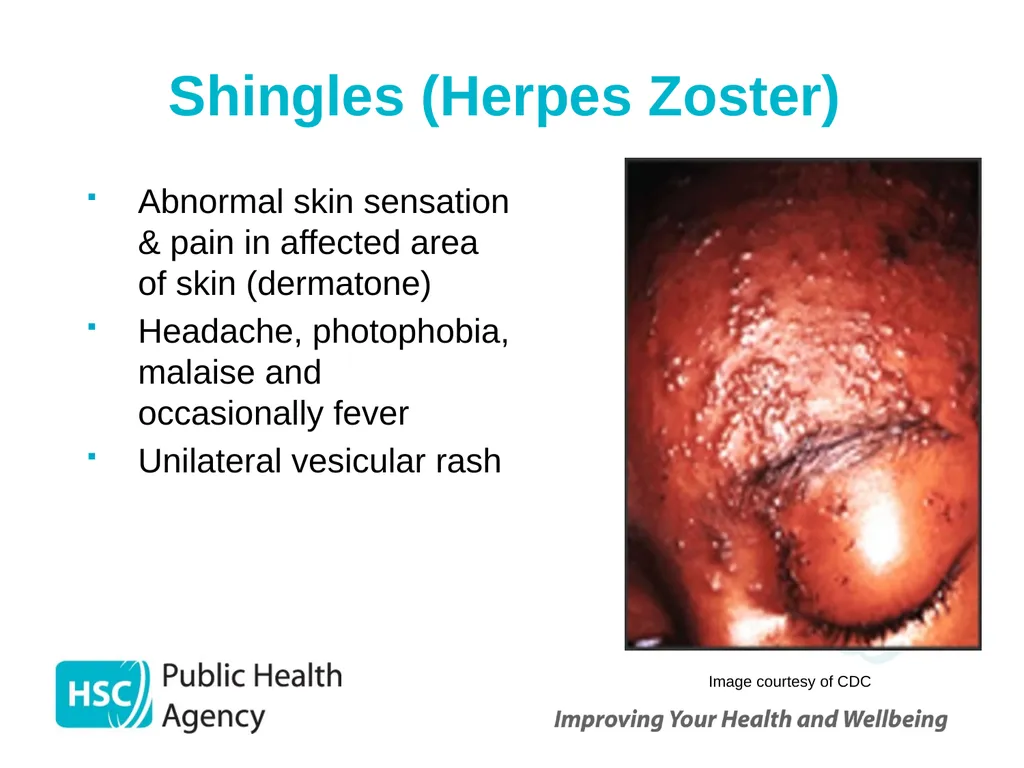
Shingles (Herpes Zoster) Abnormal skin sensation & pain in affected area of skin (dermatone)
Headache, photophobia, malaise and occasionally fever
Unilateral vesicular rash Image courtesy of CDC<br>
Headache, photophobia, malaise and occasionally fever
Unilateral vesicular rash Image courtesy of CDC<br>
04
Possible complications of shingles The most common complications are:
Secondary bacterial skin infections
Post herpetic neuralgia (PHN)
Other less common complications can include:
Ophthalmic Zoster
Peripheral motor neuropathy
Severe cases can lead to hospitalisation and death<br>
Secondary bacterial skin infections
Post herpetic neuralgia (PHN)
Other less common complications can include:
Ophthalmic Zoster
Peripheral motor neuropathy
Severe cases can lead to hospitalisation and death<br>
05
Transmission Shingles cannot be caught from someone else, whether they have chickenpox or shingles.
However, the virus can be found in the vesicles of someone with shingles and can be transmitted by direct contact with the rash, causing chickenpox in a susceptible recipient.<br>
However, the virus can be found in the vesicles of someone with shingles and can be transmitted by direct contact with the rash, causing chickenpox in a susceptible recipient.<br>
06
Why vaccinate older adults
against shingles?<br>
07
Epidemiology of shingles An estimated 50,000 cases of shingles occur in people aged over 70 years each year in England & Wales
Of these, 14,000 develop Post Herpetic Neuralgia
1,400 cases of shingles result in hospitalisation
1 in 1,000 cases of shingles are estimated to result in death
In Northern Ireland this corresponds to 900-1000 cases of shingles in people in their 70s and 250 cases of PHN each year<br>
Of these, 14,000 develop Post Herpetic Neuralgia
1,400 cases of shingles result in hospitalisation
1 in 1,000 cases of shingles are estimated to result in death
In Northern Ireland this corresponds to 900-1000 cases of shingles in people in their 70s and 250 cases of PHN each year<br>
08
Why vaccinate older adults
and those immunosuppressed against shingles? Increased risk of developing shingles
Increased risk of developing a more severe form of the disease including PHN and increased hospital admissions<br>
Increased risk of developing a more severe form of the disease including PHN and increased hospital admissions<br>
09
National programme for adults aged 60-79 The JCVI recommended that:
Shingrix should replace Zostavax® in the routine programme
should be offered at 60 years of age.
For this immunocompetent cohort:
the eligible age for immunocompetent individuals will change from 70 to 60 years of age for the routine cohort, in a phased implementation over a 10 year period
This will be completed in 2 stages during that period<br>
Shingrix should replace Zostavax® in the routine programme
should be offered at 60 years of age.
For this immunocompetent cohort:
the eligible age for immunocompetent individuals will change from 70 to 60 years of age for the routine cohort, in a phased implementation over a 10 year period
This will be completed in 2 stages during that period<br>
10
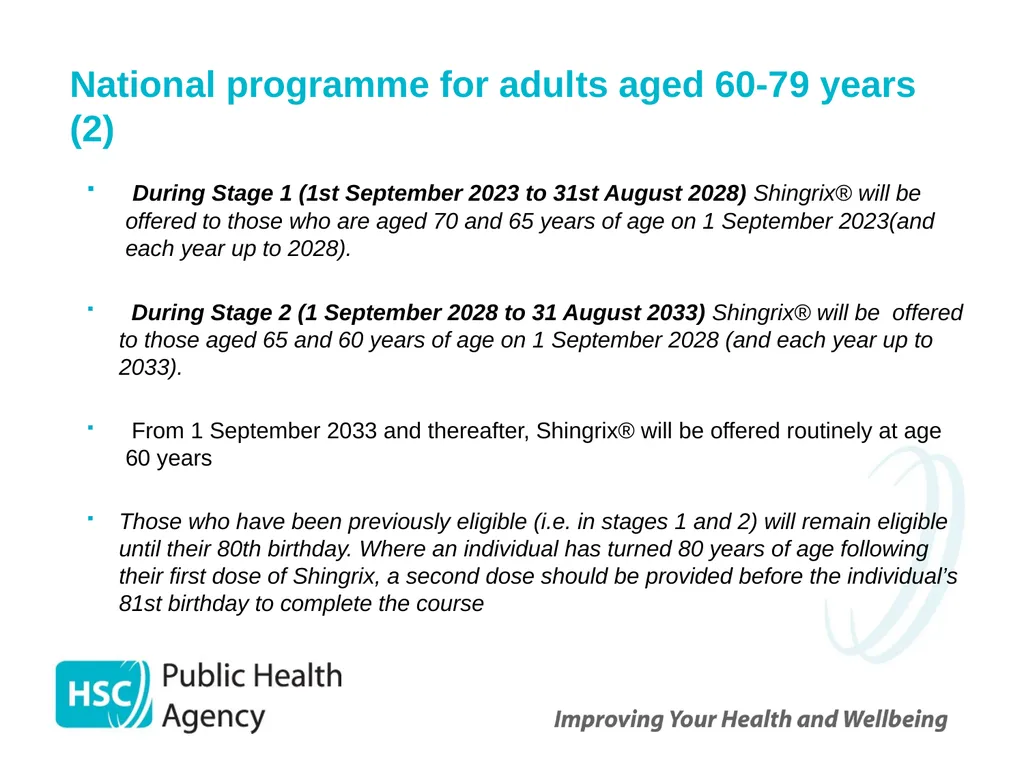
National programme for adults aged 60-79 years (2) During Stage 1 (1st September 2023 to 31st August 2028) Shingrix® will be offered to those who are aged 70 and 65 years of age on 1 September 2023(and each year up to 2028).
During Stage 2 (1 September 2028 to 31 August 2033) Shingrix® will be offered to those aged 65 and 60 years of age on 1 September 2028 (and each year up to 2033).
From 1 September 2033 and thereafter, Shingrix® will be offered routinely at age 60 years
Those who have been previously eligible (i.e. in stages 1 and 2) will remain eligible until their 80th birthday. Where an individual has turned 80 years of age following their first dose of Shingrix, a second dose should be provided before the individual’s 81st birthday to complete the course<br>
During Stage 2 (1 September 2028 to 31 August 2033) Shingrix® will be offered to those aged 65 and 60 years of age on 1 September 2028 (and each year up to 2033).
From 1 September 2033 and thereafter, Shingrix® will be offered routinely at age 60 years
Those who have been previously eligible (i.e. in stages 1 and 2) will remain eligible until their 80th birthday. Where an individual has turned 80 years of age following their first dose of Shingrix, a second dose should be provided before the individual’s 81st birthday to complete the course<br>
11
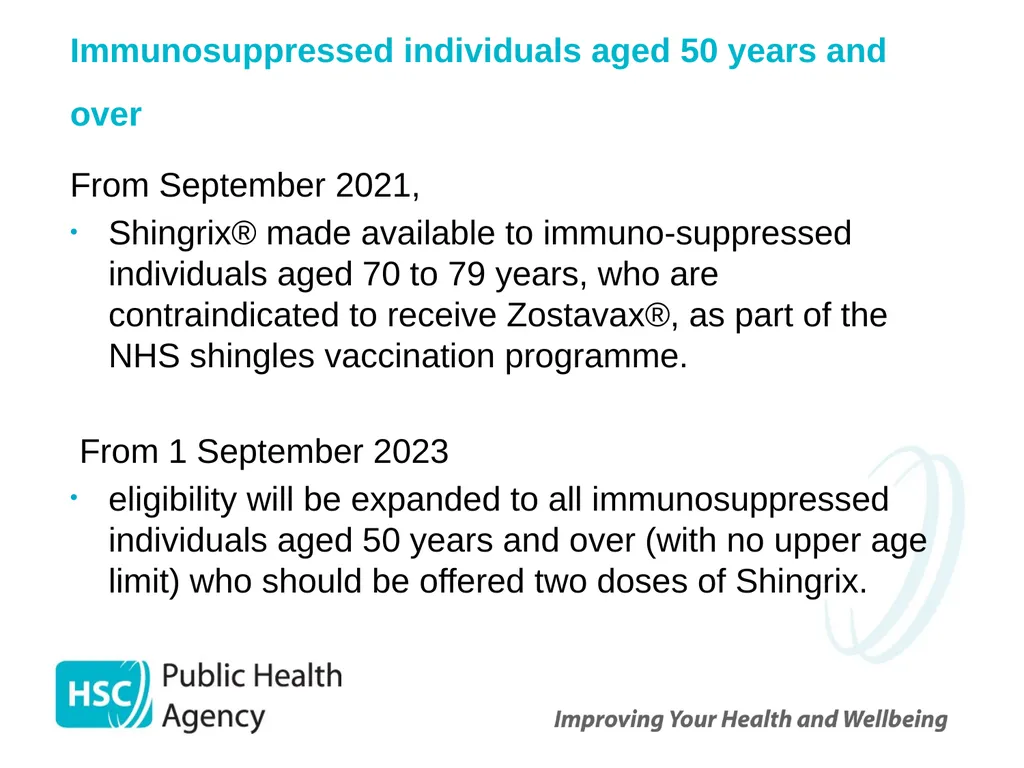
Immunosuppressed individuals aged 50 years and over From September 2021,
Shingrix® made available to immuno-suppressed individuals aged 70 to 79 years, who are contraindicated to receive Zostavax®, as part of the NHS shingles vaccination programme.
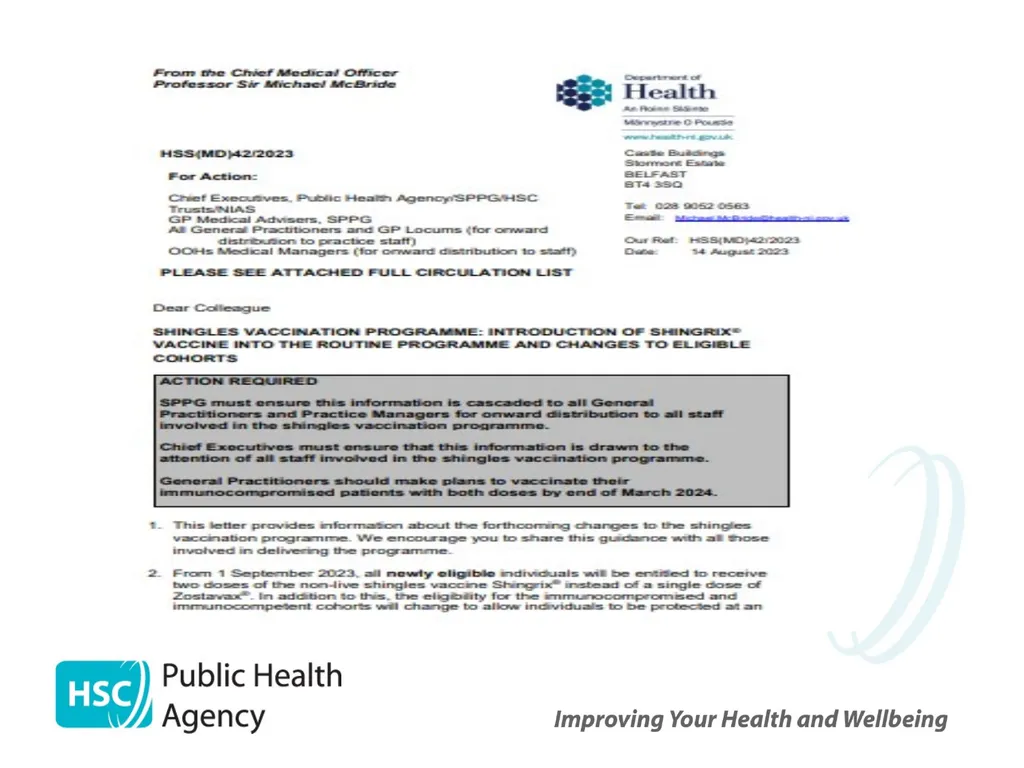
From 1 September 2023
eligibility will be expanded to all immunosuppressed individuals aged 50 years and over (with no upper age limit) who should be offered two doses of Shingrix.<br>
Shingrix® made available to immuno-suppressed individuals aged 70 to 79 years, who are contraindicated to receive Zostavax®, as part of the NHS shingles vaccination programme.
From 1 September 2023
eligibility will be expanded to all immunosuppressed individuals aged 50 years and over (with no upper age limit) who should be offered two doses of Shingrix.<br>
12
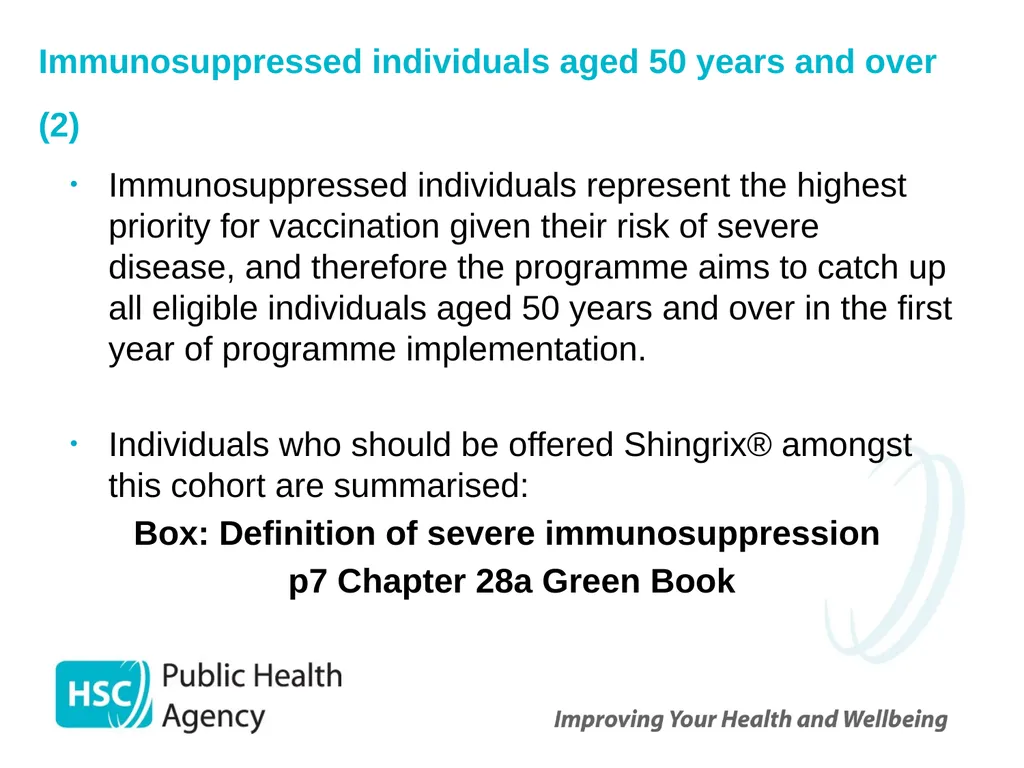
Immunosuppressed individuals aged 50 years and over (2) Immunosuppressed individuals represent the highest priority for vaccination given their risk of severe disease, and therefore the programme aims to catch up all eligible individuals aged 50 years and over in the first year of programme implementation.
Individuals who should be offered Shingrix® amongst this cohort are summarised:
Box: Definition of severe immunosuppression
p7 Chapter 28a Green Book<br>
Individuals who should be offered Shingrix® amongst this cohort are summarised:
Box: Definition of severe immunosuppression
p7 Chapter 28a Green Book<br>
13
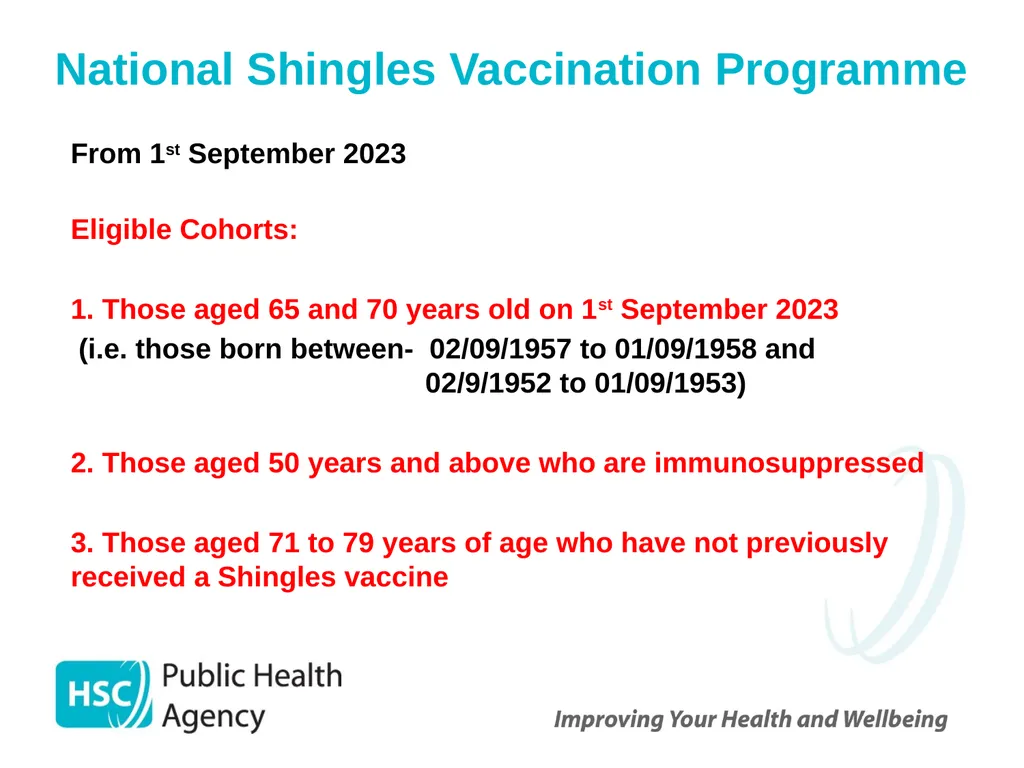
National Shingles Vaccination Programme From 1st September 2023
Eligible Cohorts:
1. Those aged 65 and 70 years old on 1st September 2023
(i.e. those born between- 02/09/1957 to 01/09/1958 and 02/9/1952 to 01/09/1953)
2. Those aged 50 years and above who are immunosuppressed
3. Those aged 71 to 79 years of age who have not previously received a Shingles vaccine<br>
Eligible Cohorts:
1. Those aged 65 and 70 years old on 1st September 2023
(i.e. those born between- 02/09/1957 to 01/09/1958 and 02/9/1952 to 01/09/1953)
2. Those aged 50 years and above who are immunosuppressed
3. Those aged 71 to 79 years of age who have not previously received a Shingles vaccine<br>
14
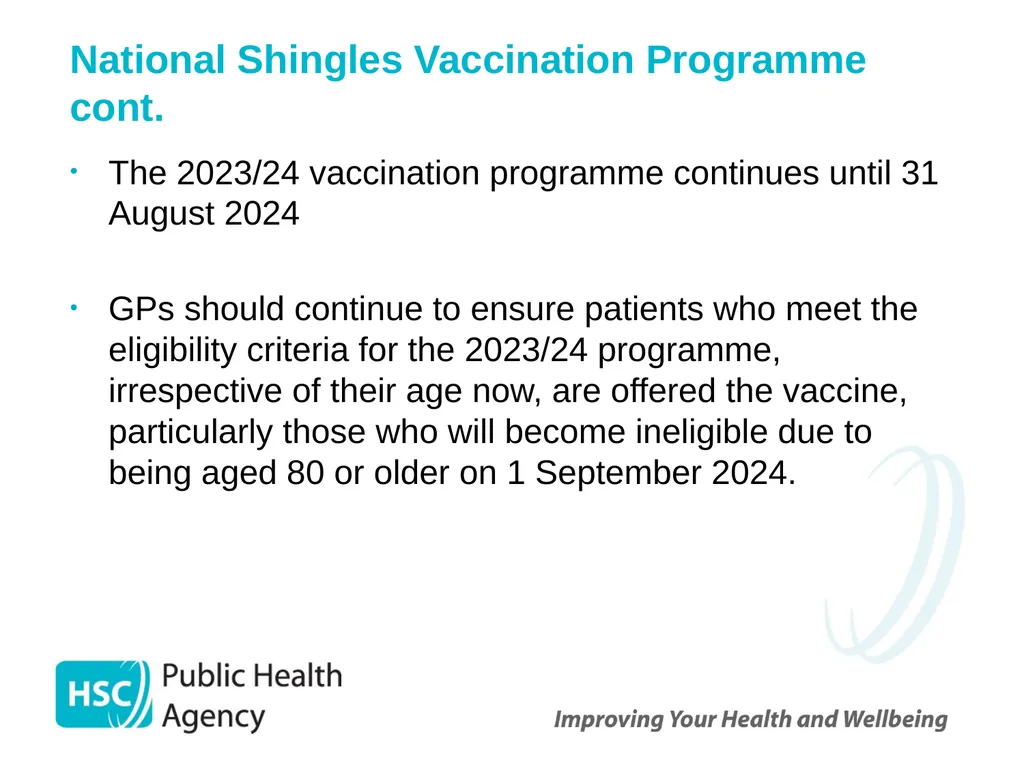
National Shingles Vaccination Programme cont. The 2023/24 vaccination programme continues until 31 August 2024
GPs should continue to ensure patients who meet the eligibility criteria for the 2023/24 programme, irrespective of their age now, are offered the vaccine, particularly those who will become ineligible due to being aged 80 or older on 1 September 2024.<br>
GPs should continue to ensure patients who meet the eligibility criteria for the 2023/24 programme, irrespective of their age now, are offered the vaccine, particularly those who will become ineligible due to being aged 80 or older on 1 September 2024.<br>
15
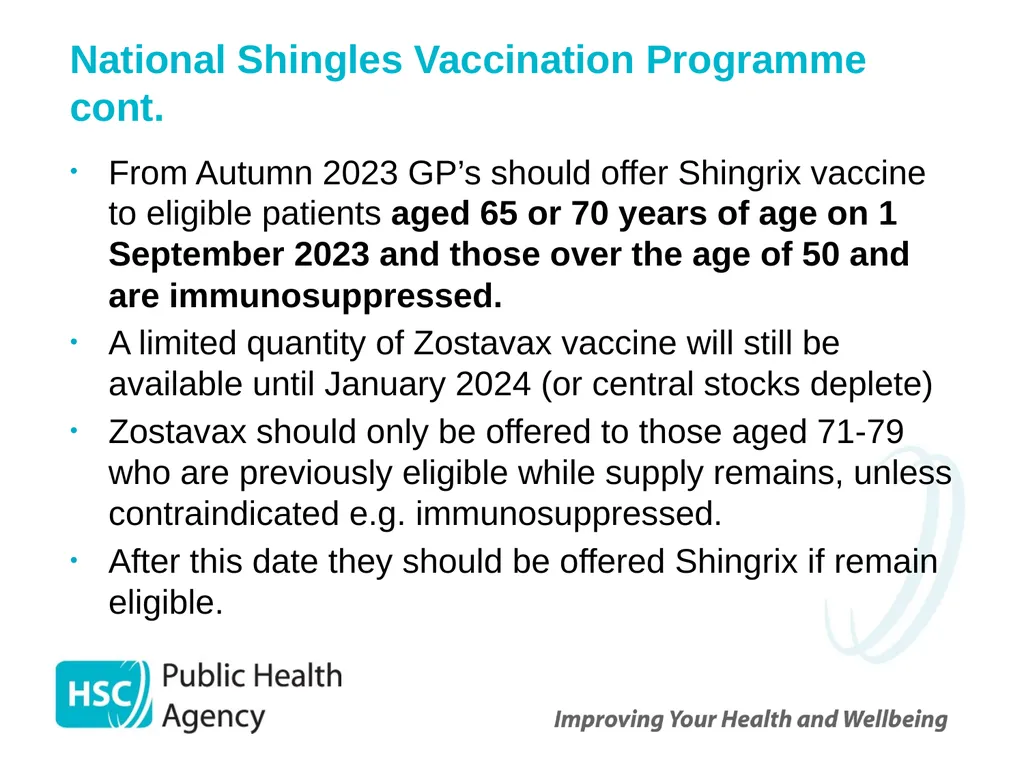
National Shingles Vaccination Programme cont. From Autumn 2023 GP’s should offer Shingrix vaccine to eligible patients aged 65 or 70 years of age on 1 September 2023 and those over the age of 50 and are immunosuppressed.
A limited quantity of Zostavax vaccine will still be available until January 2024 (or central stocks deplete)
Zostavax should only be offered to those aged 71-79 who are previously eligible while supply remains, unless contraindicated e.g. immunosuppressed.
After this date they should be offered Shingrix if remain eligible.<br>
A limited quantity of Zostavax vaccine will still be available until January 2024 (or central stocks deplete)
Zostavax should only be offered to those aged 71-79 who are previously eligible while supply remains, unless contraindicated e.g. immunosuppressed.
After this date they should be offered Shingrix if remain eligible.<br>
16
Shingles Vaccine<br>
17
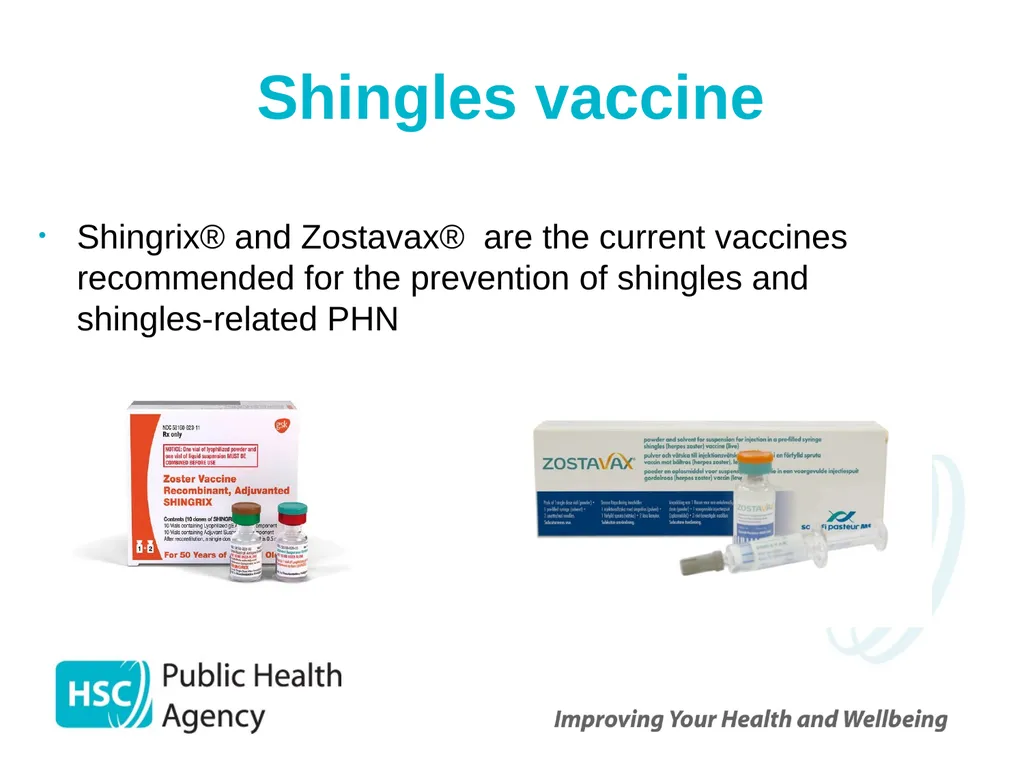
Shingles vaccine Shingrix® and Zostavax® are the current vaccines recommended for the prevention of shingles and shingles-related PHN<br>
18
Shingrix Shingrix® is a recombinant vaccine and contains varicella zoster virus glycoprotein E antigen produced by recombinant DNA technology, adjuvanted with AS01B.
Shingrix® is available as a white powder for reconstitution with diluent and is injected as a suspension. After reconstitution, the suspension is an opalescent colourless to pale brownish liquid.
Shingrix® is available in a pack size of 1 vial of powder plus 1 vial of suspension or in a pack size of 10 vials of powder plus 10 vials of suspension. The reconstituted vaccine should be inspected visually for any foreign particulate matter and/or variation of appearance. If either is observed, the vaccine should not be administered.
After reconstitution, the vaccine should be used promptly; if this is not possible, the vaccine should be stored in a refrigerator (2°C – 8°C). If not used within 6 hours it should be discarded.<br>
Shingrix® is available as a white powder for reconstitution with diluent and is injected as a suspension. After reconstitution, the suspension is an opalescent colourless to pale brownish liquid.
Shingrix® is available in a pack size of 1 vial of powder plus 1 vial of suspension or in a pack size of 10 vials of powder plus 10 vials of suspension. The reconstituted vaccine should be inspected visually for any foreign particulate matter and/or variation of appearance. If either is observed, the vaccine should not be administered.
After reconstitution, the vaccine should be used promptly; if this is not possible, the vaccine should be stored in a refrigerator (2°C – 8°C). If not used within 6 hours it should be discarded.<br>
19
Shingrix® Administration:
Adults should receive two doses of 0.5ml of Shingrix® a minimum of 2 months apart
Shingrix® should be given by intramuscular injection
Subcutaneous administration is not recommended
Shingrix® should be given with caution to individuals with thrombocytopenia or any coagulation disorder since bleeding may occur following intramuscular administration.<br>
Adults should receive two doses of 0.5ml of Shingrix® a minimum of 2 months apart
Shingrix® should be given by intramuscular injection
Subcutaneous administration is not recommended
Shingrix® should be given with caution to individuals with thrombocytopenia or any coagulation disorder since bleeding may occur following intramuscular administration.<br>
20
Shingrix Schedule- Northern Ireland Immunocompetent cohort:
Administer 2 doses, 6-12 months apart
Immunosuppressed cohort:
Administer 2 doses, 2-6 months apart<br>
Administer 2 doses, 6-12 months apart
Immunosuppressed cohort:
Administer 2 doses, 2-6 months apart<br>
21
Co-administration- Shingrix® Shingrix® can be given concomitantly with inactivated influenza vaccine
Interim data from the US on co-administration of Shingrix® with adjuvanted influenza vaccine is reassuring, therefore these 2 vaccines can be given together if required
As COVID vaccines are considered inactivated, Shingrix® vaccine can be co-administered to individuals in an eligible cohort
Where more than one vaccine is offered, patients should be informed about the likely timing of potential adverse events relating to each vaccine<br>
Interim data from the US on co-administration of Shingrix® with adjuvanted influenza vaccine is reassuring, therefore these 2 vaccines can be given together if required
As COVID vaccines are considered inactivated, Shingrix® vaccine can be co-administered to individuals in an eligible cohort
Where more than one vaccine is offered, patients should be informed about the likely timing of potential adverse events relating to each vaccine<br>
22
Contraindications- Shingrix® Shingrix® should not be administered to an individual with a confirmed anaphylactic reaction to any component of the vaccine.<br>
23
Precautions Delay if:
Acutely unwell
Individuals with shingles / PHN<br>
Acutely unwell
Individuals with shingles / PHN<br>
24
Inadvertent administration-
Shingrix® Inadvertent vaccination in individuals under 18 years of age
Shingrix® is licensed for use in individuals over 18 years of age
Most children aged >10 are likely to be immune to varicella and therefore inadvertent vaccination is highly unlikely to result in serious adverse reactions
Vaccination of varicella naïve children also unlikely to result in serious adverse reactions and should count as a valid dose of varicella vaccine
Inadvertent vaccination with Shingrix® during pregnancy
No known risk associated with giving inactivated, recombinant viral or bacterial vaccines or toxoids during pregnancy or whilst breast-feeding.
If indicated, Shingrix® can be considered in pregnancy after full discussion of the risks and benefits of vaccination with the recipient<br>
Shingrix® is licensed for use in individuals over 18 years of age
Most children aged >10 are likely to be immune to varicella and therefore inadvertent vaccination is highly unlikely to result in serious adverse reactions
Vaccination of varicella naïve children also unlikely to result in serious adverse reactions and should count as a valid dose of varicella vaccine
Inadvertent vaccination with Shingrix® during pregnancy
No known risk associated with giving inactivated, recombinant viral or bacterial vaccines or toxoids during pregnancy or whilst breast-feeding.
If indicated, Shingrix® can be considered in pregnancy after full discussion of the risks and benefits of vaccination with the recipient<br>
25
Possible adverse reactions- Shingrix® Most frequently reported side effects were:
Pain at injection site
Myalgia
Fatigue<br>
Pain at injection site
Myalgia
Fatigue<br>
26
Efficacy Shingrix:
Clinical trials of 15,411 participants: Vaccine efficacy in the 7,695 immunocompetent adults ≥ 50 years and 6,950 ≥70 years, administered with two doses of Shingrix® 2 months apart was estimated at 97.2% and 91.2% respectively
US study of adults ≥65 years, two dose vaccine effectiveness against postherpetic neuralgia was 76.0%
In immunocompetent adults ≥70, Shingrix® immunity remained high throughout 7 years following vaccination<br>
Clinical trials of 15,411 participants: Vaccine efficacy in the 7,695 immunocompetent adults ≥ 50 years and 6,950 ≥70 years, administered with two doses of Shingrix® 2 months apart was estimated at 97.2% and 91.2% respectively
US study of adults ≥65 years, two dose vaccine effectiveness against postherpetic neuralgia was 76.0%
In immunocompetent adults ≥70, Shingrix® immunity remained high throughout 7 years following vaccination<br>
27
Zostavax® Please note from September 2023, this vaccine is only available for patients previously eligible (i.e. those aged 71 -79) and only until January 2024 or when stock is depleted (whichever occurs first)
Administration:
a single dose of 0.65ml should be given I.M. unless the patient has a bleeding disorder
if more than one vaccine is given during the same visit give in separate limbs / leave 2.5 cm space between injection sites & record site of injection in patient’s notes<br>
Administration:
a single dose of 0.65ml should be given I.M. unless the patient has a bleeding disorder
if more than one vaccine is given during the same visit give in separate limbs / leave 2.5 cm space between injection sites & record site of injection in patient’s notes<br>
28
Co-administration: Zostavax® Previously, for ease of administration, Zostavax® has been given to eligible patients at the same time as their flu vaccines.
Though a 7 day gap between administration of Zostavax® and COVID-19 vaccine is preferred, where individuals attend requiring both vaccines and require rapid protection or are considered likely to be lost to follow up, co-administration may still be considered. Patients should be informed about the likely timing of potential adverse events relating to each vaccine.
The shingles vaccine should be offered all year round, rather than purely as a seasonal programme.<br>
Though a 7 day gap between administration of Zostavax® and COVID-19 vaccine is preferred, where individuals attend requiring both vaccines and require rapid protection or are considered likely to be lost to follow up, co-administration may still be considered. Patients should be informed about the likely timing of potential adverse events relating to each vaccine.
The shingles vaccine should be offered all year round, rather than purely as a seasonal programme.<br>
29
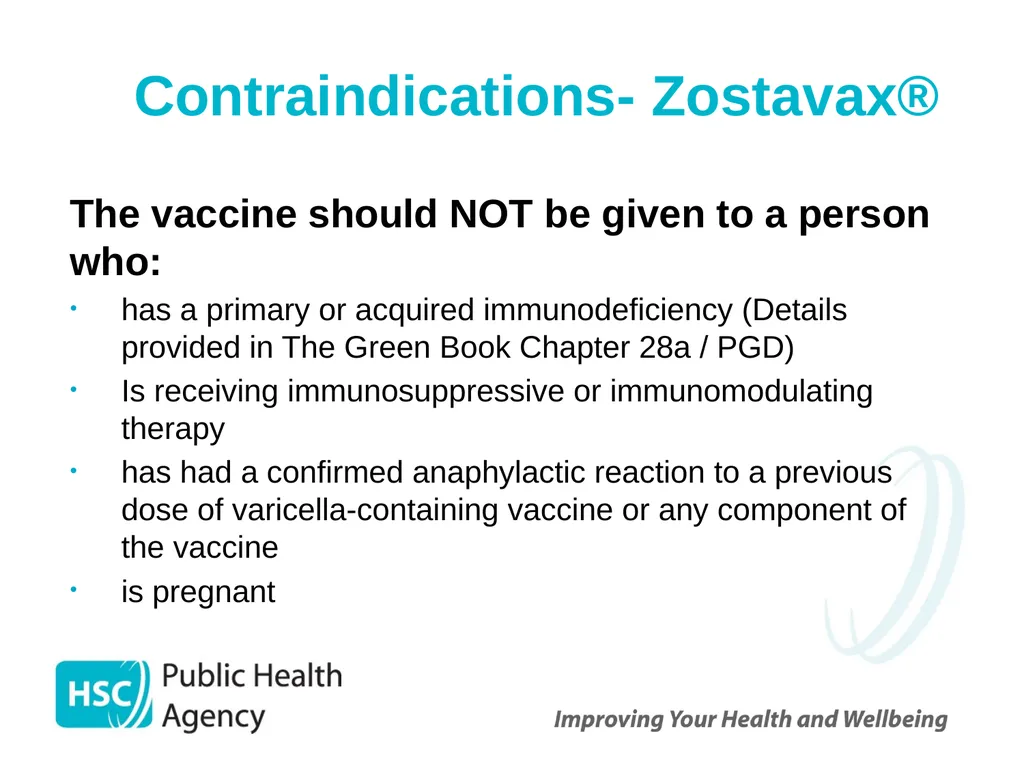
Contraindications- Zostavax® The vaccine should NOT be given to a person who:
has a primary or acquired immunodeficiency (Details provided in The Green Book Chapter 28a / PGD)
Is receiving immunosuppressive or immunomodulating therapy
has had a confirmed anaphylactic reaction to a previous dose of varicella-containing vaccine or any component of the vaccine
is pregnant<br>
has a primary or acquired immunodeficiency (Details provided in The Green Book Chapter 28a / PGD)
Is receiving immunosuppressive or immunomodulating therapy
has had a confirmed anaphylactic reaction to a previous dose of varicella-containing vaccine or any component of the vaccine
is pregnant<br>
30
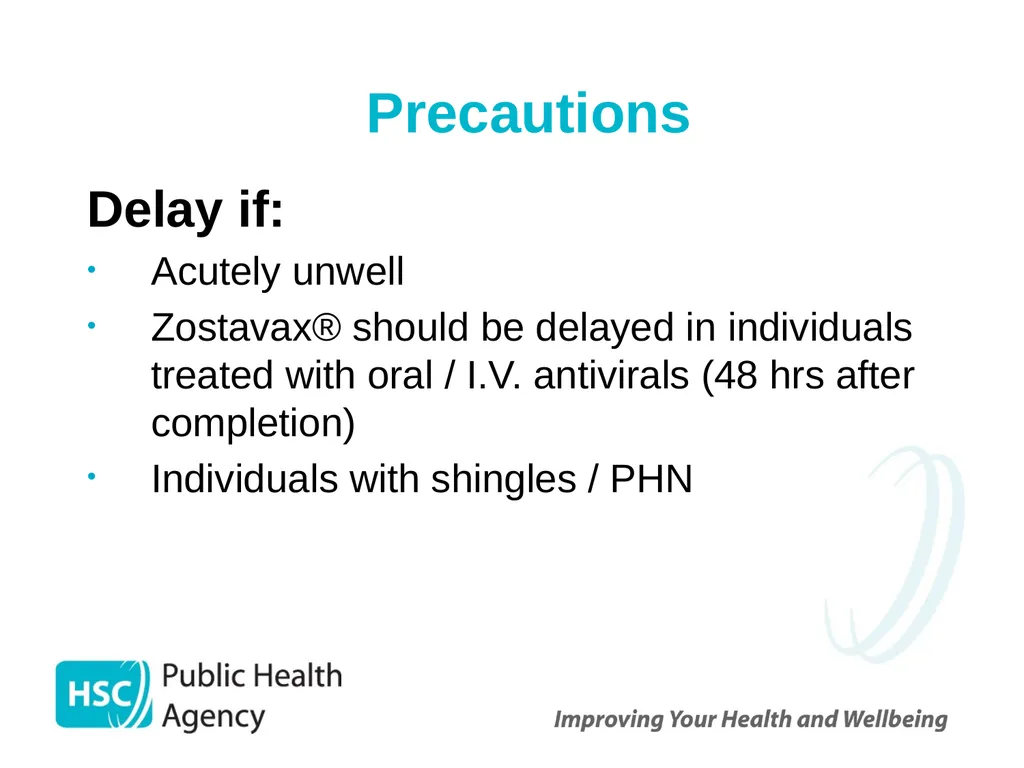
Precautions Delay if:
Acutely unwell
Zostavax® should be delayed in individuals treated with oral / I.V. antivirals (48 hrs after completion)
Individuals with shingles / PHN<br>
Acutely unwell
Zostavax® should be delayed in individuals treated with oral / I.V. antivirals (48 hrs after completion)
Individuals with shingles / PHN<br>
31
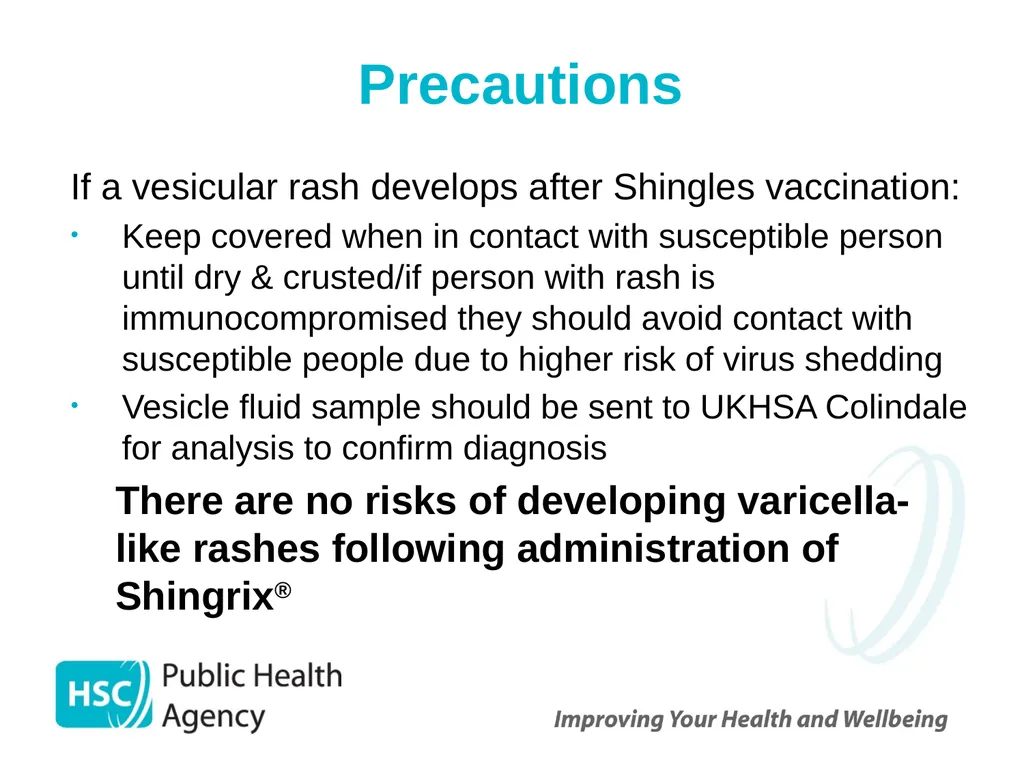
Precautions If a vesicular rash develops after Shingles vaccination:
Keep covered when in contact with susceptible person until dry & crusted/if person with rash is immunocompromised they should avoid contact with susceptible people due to higher risk of virus shedding
Vesicle fluid sample should be sent to UKHSA Colindale for analysis to confirm diagnosis
There are no risks of developing varicella-like rashes following administration of Shingrix®<br>
Keep covered when in contact with susceptible person until dry & crusted/if person with rash is immunocompromised they should avoid contact with susceptible people due to higher risk of virus shedding
Vesicle fluid sample should be sent to UKHSA Colindale for analysis to confirm diagnosis
There are no risks of developing varicella-like rashes following administration of Shingrix®<br>
32
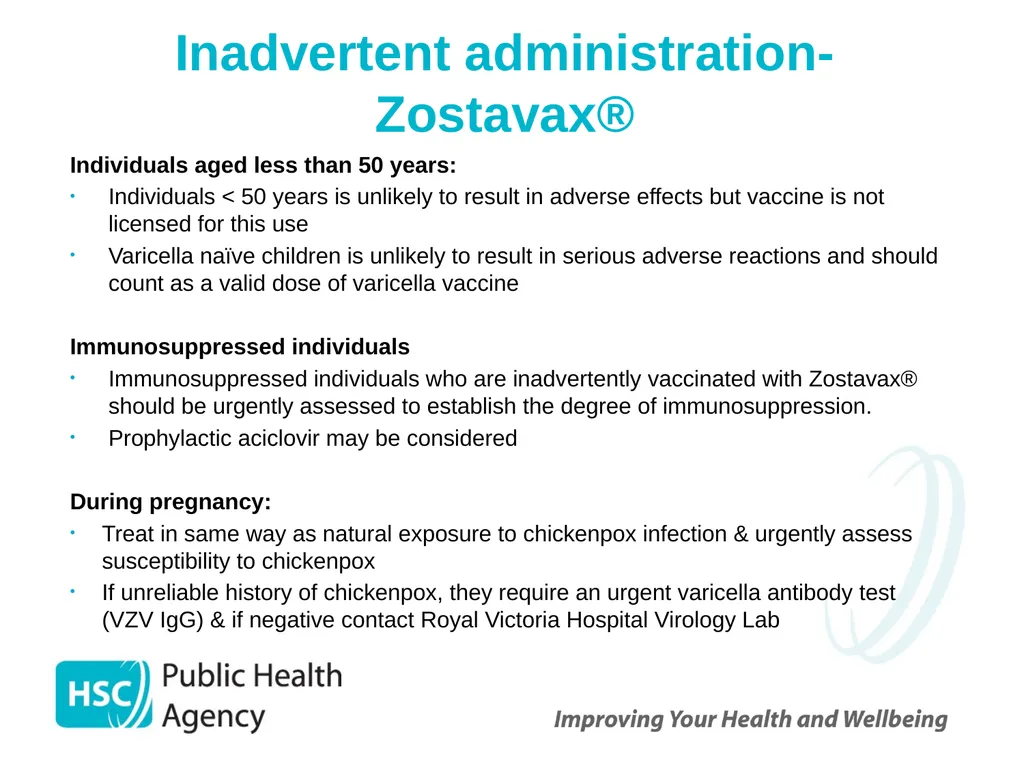
Inadvertent administration-
Zostavax® Individuals aged less than 50 years:
Individuals < 50 years is unlikely to result in adverse effects but vaccine is not licensed for this use
Varicella naïve children is unlikely to result in serious adverse reactions and should count as a valid dose of varicella vaccine
Immunosuppressed individuals
Immunosuppressed individuals who are inadvertently vaccinated with Zostavax® should be urgently assessed to establish the degree of immunosuppression.
Prophylactic aciclovir may be considered
During pregnancy:
Treat in same way as natural exposure to chickenpox infection & urgently assess susceptibility to chickenpox
If unreliable history of chickenpox, they require an urgent varicella antibody test (VZV IgG) & if negative contact Royal Victoria Hospital Virology Lab<br>
Individuals < 50 years is unlikely to result in adverse effects but vaccine is not licensed for this use
Varicella naïve children is unlikely to result in serious adverse reactions and should count as a valid dose of varicella vaccine
Immunosuppressed individuals
Immunosuppressed individuals who are inadvertently vaccinated with Zostavax® should be urgently assessed to establish the degree of immunosuppression.
Prophylactic aciclovir may be considered
During pregnancy:
Treat in same way as natural exposure to chickenpox infection & urgently assess susceptibility to chickenpox
If unreliable history of chickenpox, they require an urgent varicella antibody test (VZV IgG) & if negative contact Royal Victoria Hospital Virology Lab<br>
33
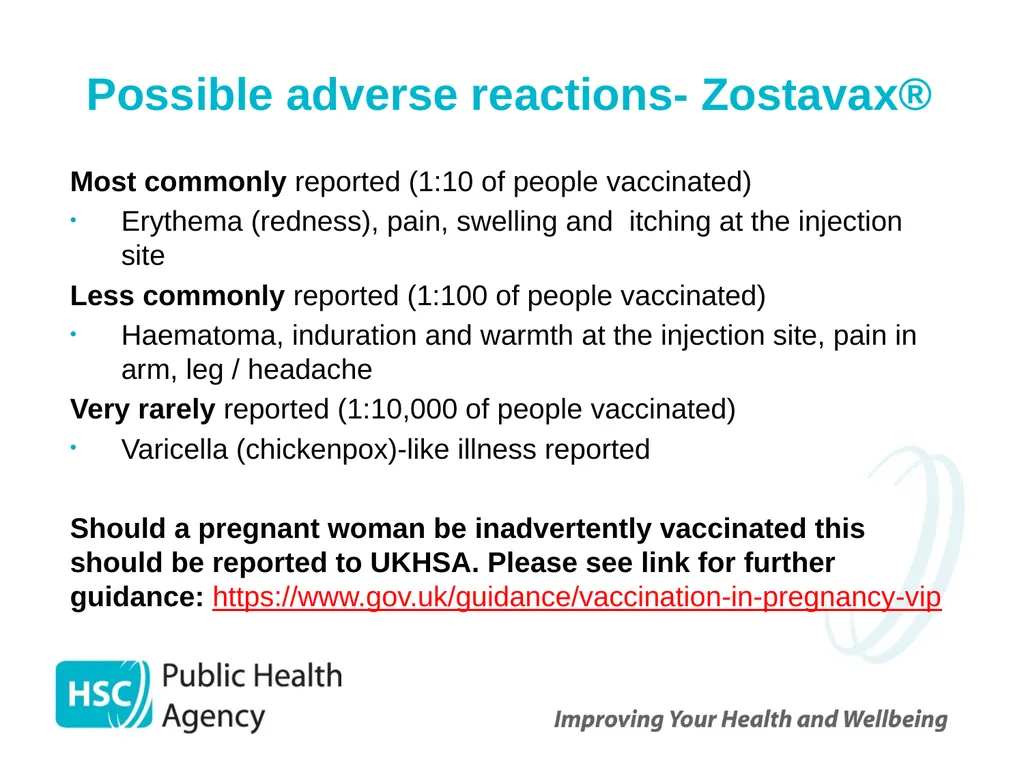
Possible adverse reactions- Zostavax® Most commonly reported (1:10 of people vaccinated)
Erythema (redness), pain, swelling and itching at the injection site
Less commonly reported (1:100 of people vaccinated)
Haematoma, induration and warmth at the injection site, pain in arm, leg / headache
Very rarely reported (1:10,000 of people vaccinated)
Varicella (chickenpox)-like illness reported
Should a pregnant woman be inadvertently vaccinated this should be reported to UKHSA. Please see link for further guidance: https://www.gov.uk/guidance/vaccination-in-pregnancy-vip<br>
Erythema (redness), pain, swelling and itching at the injection site
Less commonly reported (1:100 of people vaccinated)
Haematoma, induration and warmth at the injection site, pain in arm, leg / headache
Very rarely reported (1:10,000 of people vaccinated)
Varicella (chickenpox)-like illness reported
Should a pregnant woman be inadvertently vaccinated this should be reported to UKHSA. Please see link for further guidance: https://www.gov.uk/guidance/vaccination-in-pregnancy-vip<br>
34
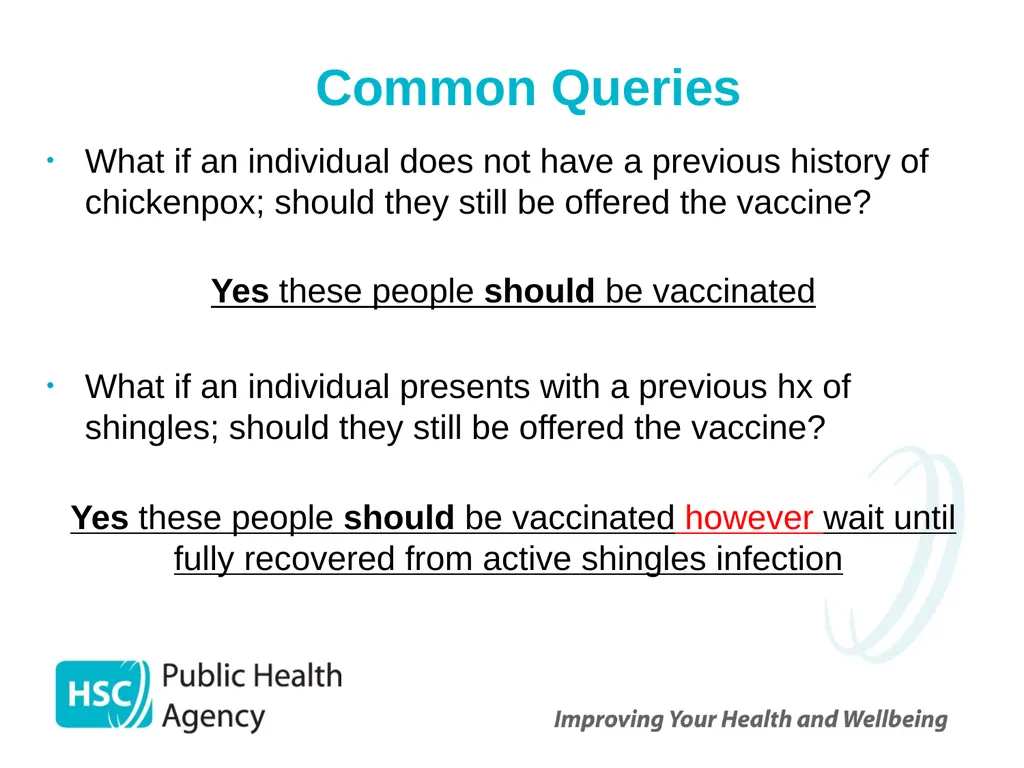
Common Queries What if an individual does not have a previous history of chickenpox; should they still be offered the vaccine?
Yes these people should be vaccinated
What if an individual presents with a previous hx of shingles; should they still be offered the vaccine?
Yes these people should be vaccinated however wait until fully recovered from active shingles infection<br>
Yes these people should be vaccinated
What if an individual presents with a previous hx of shingles; should they still be offered the vaccine?
Yes these people should be vaccinated however wait until fully recovered from active shingles infection<br>
35
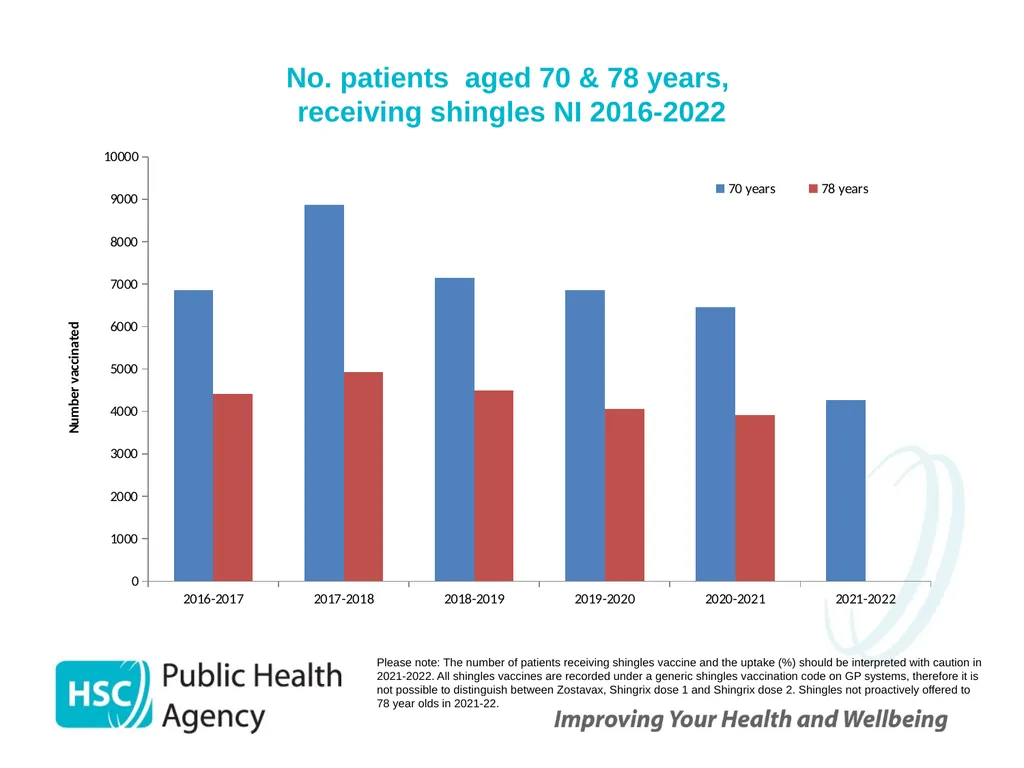
No. patients aged 70 & 78 years,
receiving shingles NI 2016-2022 Please note: The number of patients receiving shingles vaccine and the uptake (%) should be interpreted with caution in 2021-2022. All shingles vaccines are recorded under a generic shingles vaccination code on GP systems, therefore it is not possible to distinguish between Zostavax, Shingrix dose 1 and Shingrix dose 2. Shingles not proactively offered to 78 year olds in 2021-22.<br>
36
Shingles Vaccine Uptake in patients
aged 70 & 78 years, NI 2016-2022 Please note: The number of patients receiving shingles vaccine and the uptake (%) should be interpreted with caution in 2021-2022. All shingles vaccines are recorded under a generic shingles vaccination code on GP systems, therefore it is not possible to distinguish between Zostavax, Shingrix dose 1 and Shingrix dose 2. Shingles not proactively offered to 78 year olds in 2021-22.<br>
37
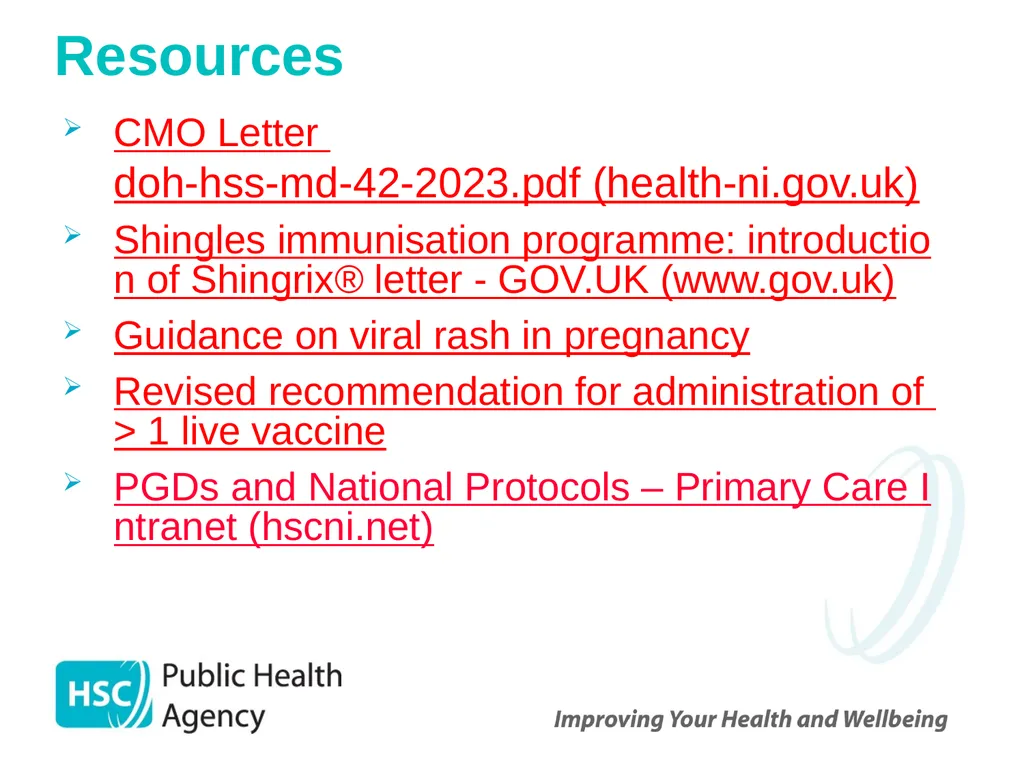
Resources CMO Letter doh-hss-md-42-2023.pdf (health-ni.gov.uk)
Shingles immunisation programme: introduction of Shingrix® letter - GOV.UK (www.gov.uk)
Guidance on viral rash in pregnancy
Revised recommendation for administration of > 1 live vaccine
PGDs and National Protocols – Primary Care Intranet (hscni.net)<br>
Shingles immunisation programme: introduction of Shingrix® letter - GOV.UK (www.gov.uk)
Guidance on viral rash in pregnancy
Revised recommendation for administration of > 1 live vaccine
PGDs and National Protocols – Primary Care Intranet (hscni.net)<br>
38
Resources (Continued) Chapter 34 The Green Book ( Varicella)
Chapter 28a The Green Book (Zoster)
Chapter 4 The Green Book (Immunisation Procedures)
Link to immunisation factsheets and patient information leaflets (including Shingles)<br>
Chapter 28a The Green Book (Zoster)
Chapter 4 The Green Book (Immunisation Procedures)
Link to immunisation factsheets and patient information leaflets (including Shingles)<br>