
Shingles June 2022 Clair Stokes Infection
AS
Published · 24 slides · 0 views
1 / 1



Description
Shingles June 2022 Clair Stokes Infection Prevention and Control What is shingles? What are the symptoms of shingles? Is shingles contagious? What does shingles look like? How long does shingles last? How common is shingles? Causes of
Related Topics
Share
Embed code
Download this presentation From Below
"Shingles June 2022 Clair Stokes Infection" is the property of its rightful owner. Permission is granted to download and print the materials on this website for personal, non-commercial use only, and to display it on your personal computer provided you do not modify the materials and that you retain all copyright notices contained in the materials. By downloading content from our website, you accept the terms of this agreement.
Presentation Transcript
01
Shingles June 2022
Clair Stokes
Infection Prevention and Control<br>
Clair Stokes
Infection Prevention and Control<br>
02
What is shingles?
What are the symptoms of shingles?
Is shingles contagious?
What does shingles look like?
How long does shingles last?
How common is shingles?
Causes of shingles
How to treat shingles
Are there any tests for shingles?
Should I see a doctor for shingles?
What if I have shingles and a poor immune system?
What complications are there from shingles?
Is there a shingles vaccination?<br>
03
What is shingles? Shingles is a painful, blistery rash in one specific area of your body. Most of us get chickenpox in our lives, usually when we are children. Shingles is a reactivation of that chickenpox virus but only in one nerve root. So instead of getting spots all over your body, as you do when you have chickenpox, you get them just in one area of your body.
It is almost always just on one side of your body, although it may go right around from front to back, following the skin the nerve affects. The affected skin hurts, and it may start to hurt before the rash appears and may keep hurting for some time after the rash has gone. You may feel generally off-colour and not yourself.<br>
It is almost always just on one side of your body, although it may go right around from front to back, following the skin the nerve affects. The affected skin hurts, and it may start to hurt before the rash appears and may keep hurting for some time after the rash has gone. You may feel generally off-colour and not yourself.<br>
04
What are the symptoms of shingles? Shingles symptoms occur in the area of skin that is supplied by the affected nerve fibres. The usual symptoms are pain and a rash. Occasionally, two or three nerves next to each other are affected.
Very rarely, shingles can cause more widespread infection, or can affect both sides of the body, but this is usually only in people with a weakened immune system.
The most commonly involved nerves are those supplying the skin on the chest or tummy (abdomen). The upper face (including an eye) is also a common site.<br>
Very rarely, shingles can cause more widespread infection, or can affect both sides of the body, but this is usually only in people with a weakened immune system.
The most commonly involved nerves are those supplying the skin on the chest or tummy (abdomen). The upper face (including an eye) is also a common site.<br>
05
Symptoms Pain
The shingles pain is a localised band of pain. It can be anywhere on your body, depending on which nerve is affected. The pain can range from mild to severe. You may have a constant dull, burning, or gnawing pain. In addition, or instead, you may have sharp and stabbing pains that come and go. The affected area of skin is usually tender.
Rash
The shingles rash typically appears 2-3 days after the pain begins. Red blotches appear that quickly develop into itchy fluid-filled blisters. The rash looks like chickenpox but only appears on the band of skin supplied by the affected nerve. New blisters may appear for up to a week. The soft tissues under and around the rash may become swollen for a while due to inflammation caused by the virus. The blisters then dry up, form scabs and gradually fade away. Slight scarring may occur where the blisters have been.<br>
The shingles pain is a localised band of pain. It can be anywhere on your body, depending on which nerve is affected. The pain can range from mild to severe. You may have a constant dull, burning, or gnawing pain. In addition, or instead, you may have sharp and stabbing pains that come and go. The affected area of skin is usually tender.
Rash
The shingles rash typically appears 2-3 days after the pain begins. Red blotches appear that quickly develop into itchy fluid-filled blisters. The rash looks like chickenpox but only appears on the band of skin supplied by the affected nerve. New blisters may appear for up to a week. The soft tissues under and around the rash may become swollen for a while due to inflammation caused by the virus. The blisters then dry up, form scabs and gradually fade away. Slight scarring may occur where the blisters have been.<br>
06
Is shingles contagious? You cannot get shingles from someone who has shingles. You can catch chickenpox from someone with shingles if you have not had chickenpox before. But most adults and older children have already had chickenpox and so are immune from catching chickenpox again.
The shingles rash is contagious (for someone else to catch chickenpox) until all the blisters (vesicles) have scabbed and are dry. If the blisters are covered with a dressing, it is unlikely that the virus will pass on to others. This is because the virus is passed on by direct contact with the blisters.<br>
The shingles rash is contagious (for someone else to catch chickenpox) until all the blisters (vesicles) have scabbed and are dry. If the blisters are covered with a dressing, it is unlikely that the virus will pass on to others. This is because the virus is passed on by direct contact with the blisters.<br>
07
Can I go to work with shingles? If you have a job, you can return to work once the blisters have dried up, or earlier if you keep the rash covered and feel well enough. Similarly children with shingles can go to school if the rash is covered by clothes and the children do not feel unwell.
Which groups to avoid if you have shingles
Pregnant women who have not had chickenpox should avoid people with shingles. Also, if you have a poor immune system (immunosuppression), you should avoid people with shingles. These general rules are to be on the safe side, as it is direct contact with the rash that usually passes on the virus.<br>
Which groups to avoid if you have shingles
Pregnant women who have not had chickenpox should avoid people with shingles. Also, if you have a poor immune system (immunosuppression), you should avoid people with shingles. These general rules are to be on the safe side, as it is direct contact with the rash that usually passes on the virus.<br>
08
Can other people catch shingles? This one is confusing! You can catch chickenpox from other people, but you can't catch shingles from other people. You only get shingles from a reactivation of your own chickenpox infection in the past.
So if you have shingles, and you come into contact with somebody else, they cannot 'catch' your shingles. But if they have never had chickenpox, it is possible that they could catch chickenpox from you. (And if you had chickenpox, and came into contact with somebody else who had never had chickenpox, they could catch chickenpox. But they couldn't 'catch' shingles from your chickenpox.)
To put it another way, no, you don't 'catch' shingles. It comes from a virus hiding out in your own body, not from someone else. But if you have shingles, you may be infectious, as it is possible for people to catch chickenpox from you.
Only people who have never had chickenpox are likely to be at risk of catching chickenpox from your shingles. People who have had chickenpox should be immune from catching it again. If the rash is in a covered area of skin, the risk of anyone with whom you are not in close contact catching chickenpox is very low.<br>
So if you have shingles, and you come into contact with somebody else, they cannot 'catch' your shingles. But if they have never had chickenpox, it is possible that they could catch chickenpox from you. (And if you had chickenpox, and came into contact with somebody else who had never had chickenpox, they could catch chickenpox. But they couldn't 'catch' shingles from your chickenpox.)
To put it another way, no, you don't 'catch' shingles. It comes from a virus hiding out in your own body, not from someone else. But if you have shingles, you may be infectious, as it is possible for people to catch chickenpox from you.
Only people who have never had chickenpox are likely to be at risk of catching chickenpox from your shingles. People who have had chickenpox should be immune from catching it again. If the rash is in a covered area of skin, the risk of anyone with whom you are not in close contact catching chickenpox is very low.<br>
09
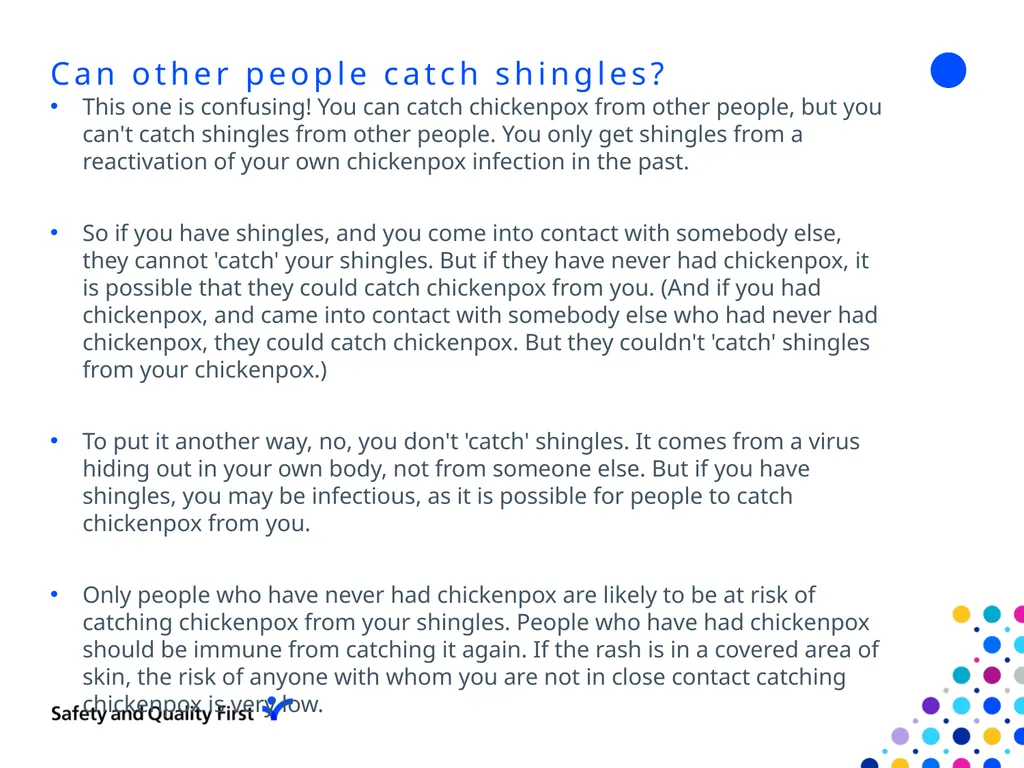
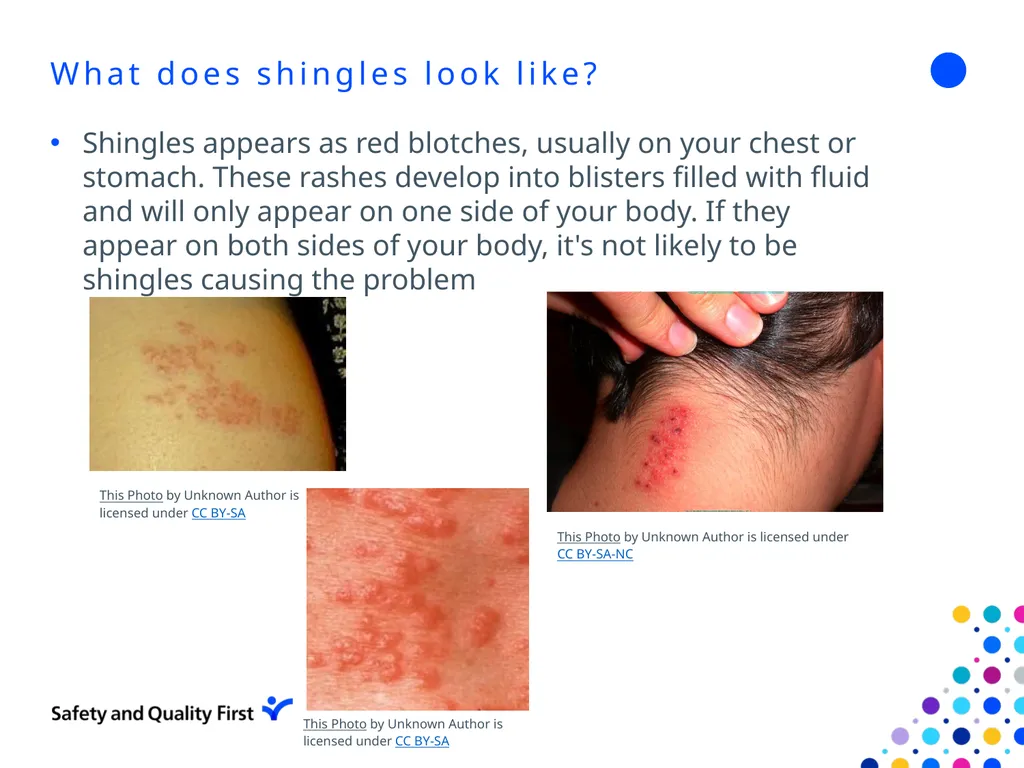
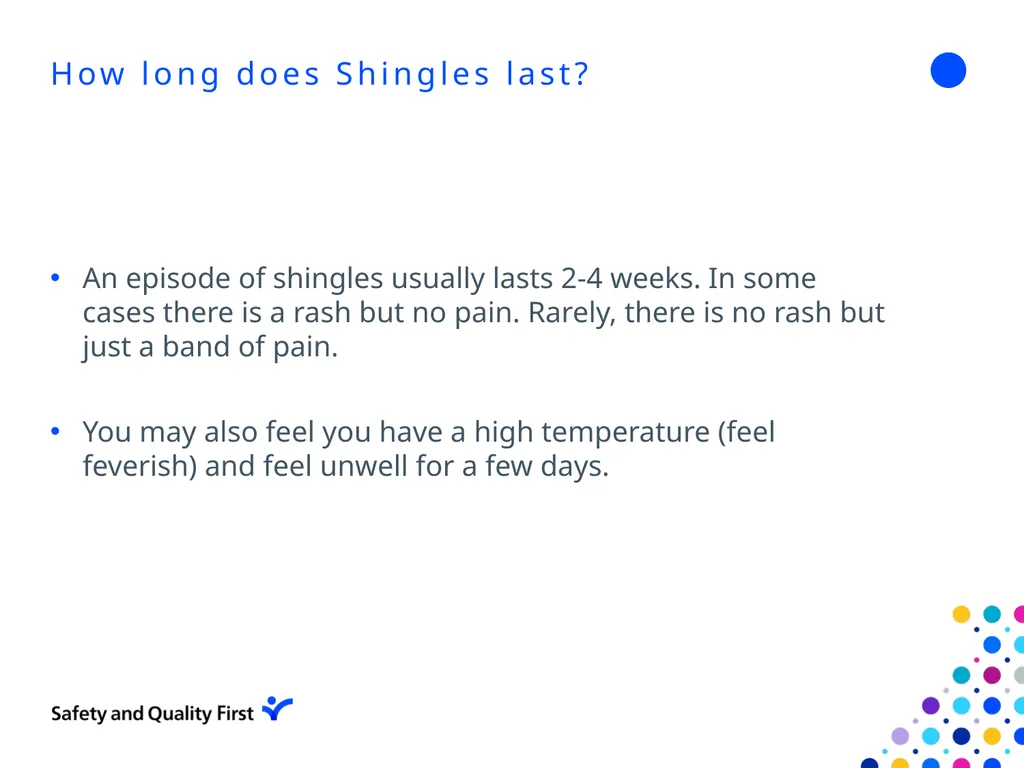
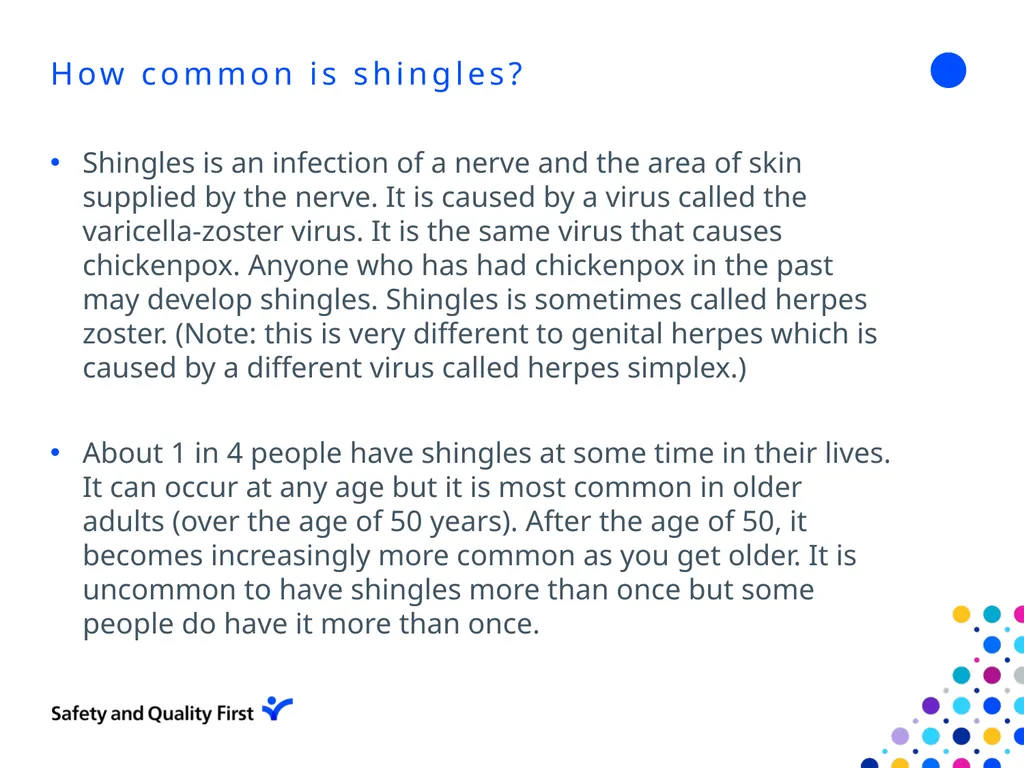
What does shingles look like? Shingles appears as red blotches, usually on your chest or stomach. These rashes develop into blisters filled with fluid and will only appear on one side of your body. If they appear on both sides of your body, it's not likely to be shingles causing the problem This Photo by Unknown Author is licensed under CC BY-SA This Photo by Unknown Author is licensed under CC BY-SA-NC This Photo by Unknown Author is licensed under CC BY-SA<br>
10
How long does Shingles last? An episode of shingles usually lasts 2-4 weeks. In some cases there is a rash but no pain. Rarely, there is no rash but just a band of pain.
You may also feel you have a high temperature (feel feverish) and feel unwell for a few days.<br>
You may also feel you have a high temperature (feel feverish) and feel unwell for a few days.<br>
11
How common is shingles? Shingles is an infection of a nerve and the area of skin supplied by the nerve. It is caused by a virus called the varicella-zoster virus. It is the same virus that causes chickenpox. Anyone who has had chickenpox in the past may develop shingles. Shingles is sometimes called herpes zoster. (Note: this is very different to genital herpes which is caused by a different virus called herpes simplex.)
About 1 in 4 people have shingles at some time in their lives. It can occur at any age but it is most common in older adults (over the age of 50 years). After the age of 50, it becomes increasingly more common as you get older. It is uncommon to have shingles more than once but some people do have it more than once.<br>
About 1 in 4 people have shingles at some time in their lives. It can occur at any age but it is most common in older adults (over the age of 50 years). After the age of 50, it becomes increasingly more common as you get older. It is uncommon to have shingles more than once but some people do have it more than once.<br>
12
Cause of shingles Most people have chickenpox at some stage (usually as a child). The virus does not completely go after you have chickenpox. Some virus particles remain inactive in the nerve roots next to your spinal cord. They do no harm there and cause no symptoms. For reasons that are not clear, the virus may begin to multiply again (reactivate). This is often years later. The reactivated virus travels along the nerve to the skin to cause shingles.
In most cases, an episode of shingles occurs for no apparent reason. Sometimes a period of stress or illness seems to trigger it. A slight ageing of the immune system may increase the risk of developing shingles and account for it being more common in older people. (The immune system keeps the virus inactive and prevents it from multiplying. A slight weakening of the immune system in older people may account for the virus reactivating and multiplying to cause shingles.)<br>
In most cases, an episode of shingles occurs for no apparent reason. Sometimes a period of stress or illness seems to trigger it. A slight ageing of the immune system may increase the risk of developing shingles and account for it being more common in older people. (The immune system keeps the virus inactive and prevents it from multiplying. A slight weakening of the immune system in older people may account for the virus reactivating and multiplying to cause shingles.)<br>
13
How to treat shingles? Two main aims of treating shingles are:
To ease any pain and discomfort during the episode of shingles.
To prevent shingles, as much as possible, complications from developing.<br>
To ease any pain and discomfort during the episode of shingles.
To prevent shingles, as much as possible, complications from developing.<br>
14
General measures to alleviate singles symptoms Loose-fitting cotton clothes are best to reduce irritating the affected area of skin.
Pain may be eased by cooling the affected area with ice cubes (wrapped in a plastic bag), wet dressings, or a cool bath.
A non-adherent dressing that covers the rash when it is blistered and raw may help to reduce pain caused by contact with clothing.
Simple creams (emollients) may be helpful if the rash is itchy. Calamine lotion can help to cool the skin and reduce mild itchiness.<br>
Pain may be eased by cooling the affected area with ice cubes (wrapped in a plastic bag), wet dressings, or a cool bath.
A non-adherent dressing that covers the rash when it is blistered and raw may help to reduce pain caused by contact with clothing.
Simple creams (emollients) may be helpful if the rash is itchy. Calamine lotion can help to cool the skin and reduce mild itchiness.<br>
15
Painkillers Painkillers - for example, paracetamol, or paracetamol combined with codeine (such as co-codamol), or anti-inflammatory painkillers (such as ibuprofen) - may give some relief for shingles. Strong painkillers (such as oxycodone and tramadol) may be needed in some cases.
Some painkillers are particularly useful for nerve pain. If the pain during an episode of shingles is severe, or if you develop postherpetic neuralgia (PHN), you may be advised to take:
An antidepressant medicine in the tricyclic group. An antidepressant is not used here to treat depression. Tricyclic antidepressants, such as amitriptyline, imipramine and nortriptyline, ease nerve pain (neuralgia) separate to their action on depression; or
An anticonvulsant medicine such as gabapentin or pregabalin. They also ease neuralgic pain separate to their action to control convulsions.
If an antidepressant or anticonvulsant is advised, you should take it regularly as prescribed. It may take up to two or more weeks for it to become fully effective to ease pain.<br>
Some painkillers are particularly useful for nerve pain. If the pain during an episode of shingles is severe, or if you develop postherpetic neuralgia (PHN), you may be advised to take:
An antidepressant medicine in the tricyclic group. An antidepressant is not used here to treat depression. Tricyclic antidepressants, such as amitriptyline, imipramine and nortriptyline, ease nerve pain (neuralgia) separate to their action on depression; or
An anticonvulsant medicine such as gabapentin or pregabalin. They also ease neuralgic pain separate to their action to control convulsions.
If an antidepressant or anticonvulsant is advised, you should take it regularly as prescribed. It may take up to two or more weeks for it to become fully effective to ease pain.<br>
16
Antiviral medicines for shingles An antiviral medicine is not a cure for shingles, it does not kill the virus but works by stopping the virus from multiplying. So, it may limit the severity of symptoms of the shingles episode.
Antiviral medicines are not advised routinely for everybody with shingles. As a general rule, the following groups of people who develop shingles will normally be advised to take an antiviral medicine:
The older you are, the more risk there is of severe shingles or complications developing and the more likely you are to benefit from treatment.
If you are of any age and have any of the following:
Shingles that affects the eye or ear.
A poorly functioning immune system
Shingles that affects any parts of the body apart from the trunk (that is, shingles affecting an arm, leg, neck, or genital area).
Moderate or severe pain.
Moderate or severe rash.
If prescribed, a course of an antiviral medicine normally lasts seven days.<br>
Antiviral medicines are not advised routinely for everybody with shingles. As a general rule, the following groups of people who develop shingles will normally be advised to take an antiviral medicine:
The older you are, the more risk there is of severe shingles or complications developing and the more likely you are to benefit from treatment.
If you are of any age and have any of the following:
Shingles that affects the eye or ear.
A poorly functioning immune system
Shingles that affects any parts of the body apart from the trunk (that is, shingles affecting an arm, leg, neck, or genital area).
Moderate or severe pain.
Moderate or severe rash.
If prescribed, a course of an antiviral medicine normally lasts seven days.<br>
17
Steroid medication for shingles Steroids help to reduce swelling (inflammation). A short course of steroid tablets (prednisolone) may be considered in addition to antiviral medication. This may help to reduce pain and speed healing of the rash. However, the use of steroids in shingles is controversial.<br>
18
Should I see a doctor? It is usually worth seeing a doctor to be certain about the diagnosis and to see if you need treatment or not. Ideally you should see a doctor as soon as possible after the rash appears.
The rash of shingles can be very painful. So even if the doctor doesn't think you need an anti-shingles medicine, they may be able to give you stronger painkillers than those you can buy over the counter from the chemist.
Shingles and pregnancy
There's no danger to you or your baby if you catch shingles while pregnant. However, you may need antiviral treatment so you should be referred to a specialist.<br>
The rash of shingles can be very painful. So even if the doctor doesn't think you need an anti-shingles medicine, they may be able to give you stronger painkillers than those you can buy over the counter from the chemist.
Shingles and pregnancy
There's no danger to you or your baby if you catch shingles while pregnant. However, you may need antiviral treatment so you should be referred to a specialist.<br>
19
What if I have shingles and a poor immune system? If you have a poor immune system (immunosuppression) and develop shingles then see your doctor straightaway. You will normally be given antiviral medication whatever your age and will be monitored for complications. People with a poor immune system include:
People on steroids
People taking anti-arthritis medications which can affect the bone marrow.
People being treated with chemotherapy or generalised radiotherapy, or who have had these treatments within the previous six months.
People who have had an organ transplant and are on immunosuppressive treatment.
People who have had a bone marrow transplant and who are still immunosuppressed<br>
People on steroids
People taking anti-arthritis medications which can affect the bone marrow.
People being treated with chemotherapy or generalised radiotherapy, or who have had these treatments within the previous six months.
People who have had an organ transplant and are on immunosuppressive treatment.
People who have had a bone marrow transplant and who are still immunosuppressed<br>
20
Complications Postherpetic neuralgia (PHN)
This is the most common complication of shingles. It is where the nerve pain (neuralgia) of shingles persists after the rash has gone. See the separate leaflet called Postherpetic Neuralgia for more details.
Skin infection
Sometimes the rash becomes infected with germs (bacteria). The surrounding skin then becomes red and tender. If this occurs you may need a course of medicines called antibiotics.
Eye problems
Shingles of the eye can cause inflammation of the front of the eye. In severe cases it can lead to inflammation of the whole of the eye which may cause vision loss.
Weakness
Sometimes the nerve affected is a motor nerve (ones which control muscles) and not a usual sensory nerve (ones for touch). This may result in a weakness (palsy) of the muscles that are supplied by the nerve.<br>
This is the most common complication of shingles. It is where the nerve pain (neuralgia) of shingles persists after the rash has gone. See the separate leaflet called Postherpetic Neuralgia for more details.
Skin infection
Sometimes the rash becomes infected with germs (bacteria). The surrounding skin then becomes red and tender. If this occurs you may need a course of medicines called antibiotics.
Eye problems
Shingles of the eye can cause inflammation of the front of the eye. In severe cases it can lead to inflammation of the whole of the eye which may cause vision loss.
Weakness
Sometimes the nerve affected is a motor nerve (ones which control muscles) and not a usual sensory nerve (ones for touch). This may result in a weakness (palsy) of the muscles that are supplied by the nerve.<br>
21
Rare complications Examples are infection of the brain by the varicella-zoster virus, or spread of the virus throughout the body. These are very serious but rare. People with a poor immune system (immunosuppression) who develop shingles have a higher than normal risk of developing rare or serious complications. (For example, people with HIV/AIDS, people on chemotherapy, etc.)<br>
22
Is there a shingles vaccination? In the UK there is a shingles vaccine immunisation programme for people aged 70 years to protect against herpes zoster. There is also a catch-up programme which offers the vaccine to anyone aged between 70 and 79 years who has previously missed out on immunisation. The vaccine is licensed for people aged over 50 years, and if you are not eligible for the vaccine on the NHS, your pharmacist may be able to provide the vaccine as a private (paid for) service.
The chickenpox vaccine is not routinely given to children in the UK but is offered to people who are in close contact with someone who is particularly vulnerable to chickenpox or its complications – e.g, people with a weakened immune system.<br>
The chickenpox vaccine is not routinely given to children in the UK but is offered to people who are in close contact with someone who is particularly vulnerable to chickenpox or its complications – e.g, people with a weakened immune system.<br>
23
Infection Prevention and Control Measures Shingles can be spread when a person comes into contact with fluid contained in the skin blisters.
The virus can be spread by direct contact with the rash or by touching any dressings, sheets or clothes soiled with discharge from the blisters.
The following measures reduce the risk of transmission:
Strict hand hygiene practices by staff
People not immune to chickenpox should not care for residents with shingles
If lesions are on face, additional precautions are required:
- Gown, gloves, surgical face mask to be used by staff
- Affected resident to be cared for in a single room
- Avoidance of mingling in group settings<br>
The virus can be spread by direct contact with the rash or by touching any dressings, sheets or clothes soiled with discharge from the blisters.
The following measures reduce the risk of transmission:
Strict hand hygiene practices by staff
People not immune to chickenpox should not care for residents with shingles
If lesions are on face, additional precautions are required:
- Gown, gloves, surgical face mask to be used by staff
- Affected resident to be cared for in a single room
- Avoidance of mingling in group settings<br>