
Short Answer Questions (SAQs) Part A:


Description: Short Answer Questions (SAQs) Part A: Multiple-choice questions (55 questions in 55 minutes) 40 of Total exam score Part B: Short-answer questions (3 questions in 40 minutes) 20 of Total exam score Required question 1: periods 3-8
Related Topics
Download Presentation
"Short Answer Questions (SAQs) Part A:" is the property of its rightful owner. Permission is granted to download and print the materials on this website for personal, non-commercial use only, and to display it on your personal computer provided you do not modify the materials and that you retain all copyright notices contained in the materials. By downloading content from our website, you accept the terms of this agreement.
Presentation Transcript
slide1. Short Answer Questions
(SAQs)<br>
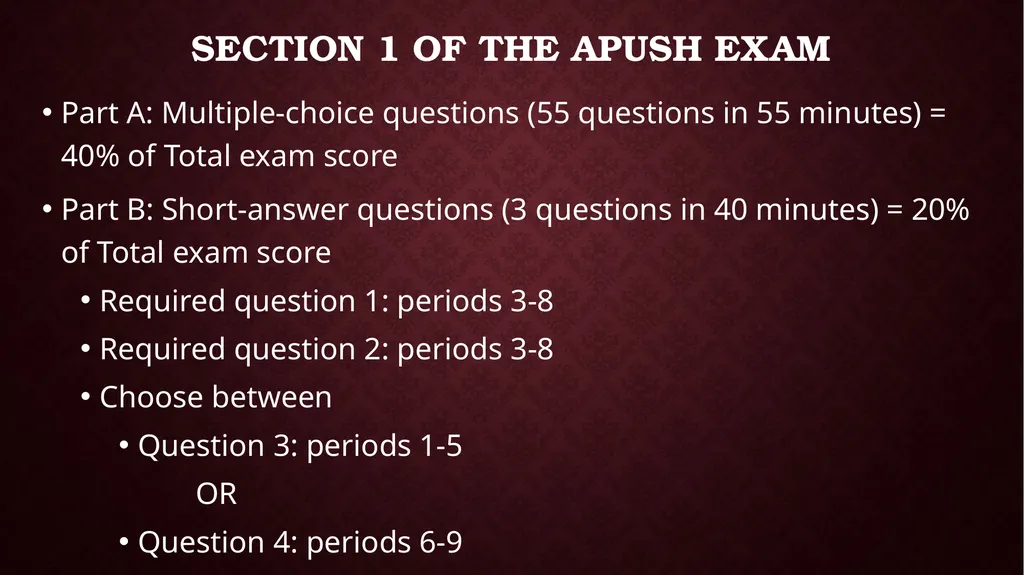
slide2. Part A: Multiple-choice questions (55 questions in 55 minutes) = 40% of Total exam score
Part B: Short-answer questions (3 questions in 40 minutes) = 20% of Total exam score
Required question 1: periods 3-8
Required question 2: periods 3-8
Choose between
Question 3: periods 1-5
OR
Question 4: periods 6-9 Section 1 of the APUSH Exam<br>
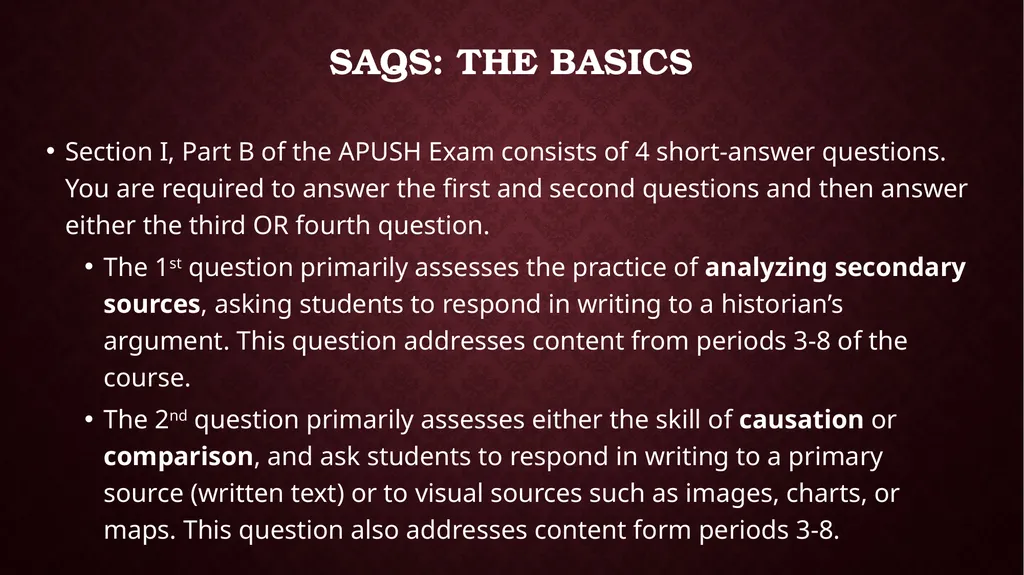
slide3. Section I, Part B of the APUSH Exam consists of 4 short-answer questions. You are required to answer the first and second questions and then answer either the third OR fourth question.
The 1st question primarily assesses the practice of analyzing secondary sources, asking students to respond in writing to a historian’s argument. This question addresses content from periods 3-8 of the course.
The 2nd question primarily assesses either the skill of causation or comparison, and ask students to respond in writing to a primary source (written text) or to visual sources such as images, charts, or maps. This question also addresses content form periods 3-8. SAQs: The Basics<br>
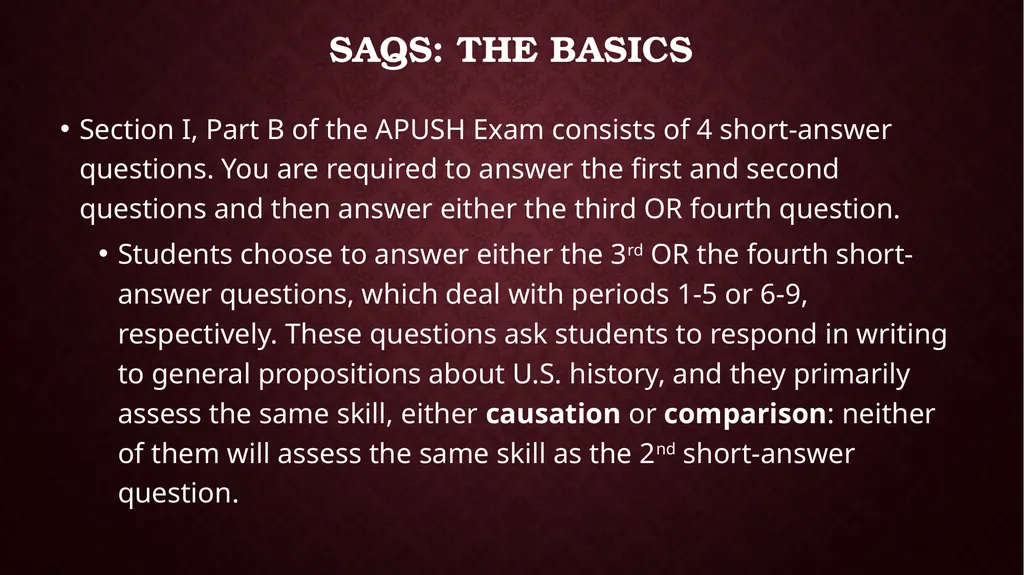
slide4. Section I, Part B of the APUSH Exam consists of 4 short-answer questions. You are required to answer the first and second questions and then answer either the third OR fourth question.
Students choose to answer either the 3rd OR the fourth short-answer questions, which deal with periods 1-5 or 6-9, respectively. These questions ask students to respond in writing to general propositions about U.S. history, and they primarily assess the same skill, either causation or comparison: neither of them will assess the same skill as the 2nd short-answer question. SAQs: The Basics<br>
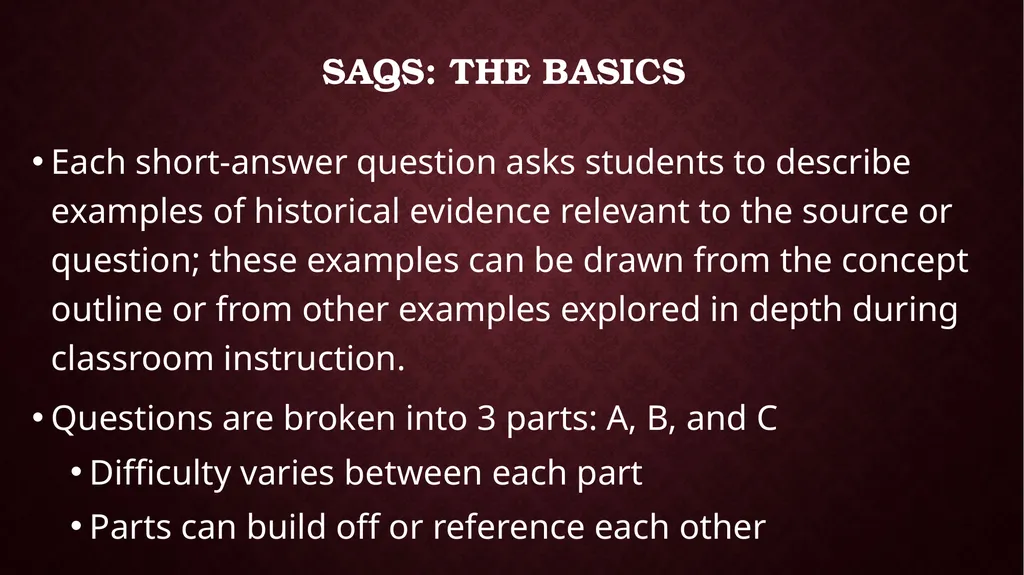
slide5. Each short-answer question asks students to describe examples of historical evidence relevant to the source or question; these examples can be drawn from the concept outline or from other examples explored in depth during classroom instruction.
Questions are broken into 3 parts: A, B, and C
Difficulty varies between each part
Parts can build off or reference each other SAQs: The Basics<br>
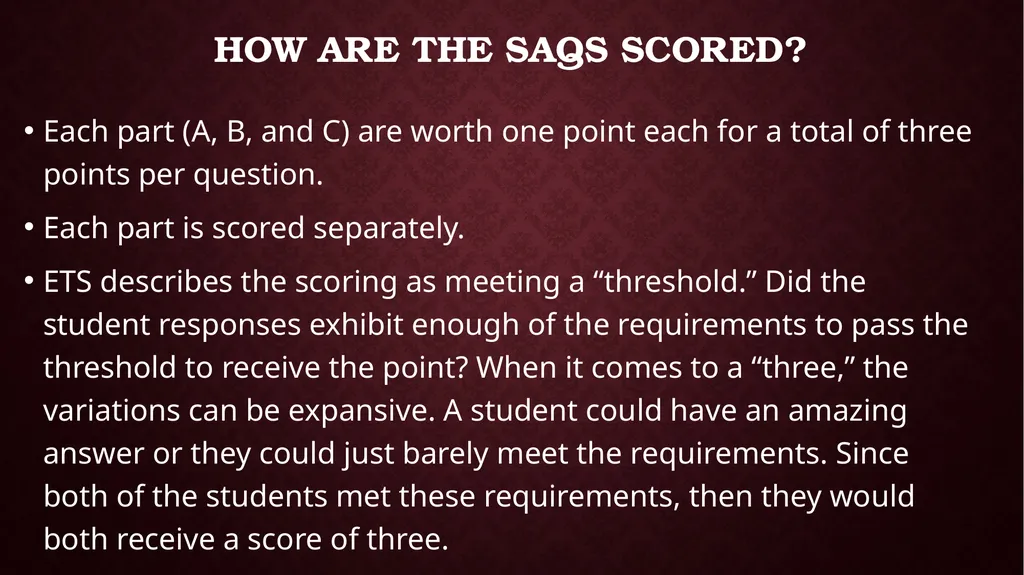
slide6. Each part (A, B, and C) are worth one point each for a total of three points per question.
Each part is scored separately.
ETS describes the scoring as meeting a “threshold.” Did the student responses exhibit enough of the requirements to pass the threshold to receive the point? When it comes to a “three,” the variations can be expansive. A student could have an amazing answer or they could just barely meet the requirements. Since both of the students met these requirements, then they would both receive a score of three. How are the SAQs scored?<br>
slide7. APE the SAQ
A Historical Writing Strategy
Adapted from John Burkowski Jr. & Dawn Clemens
Adapted and Revised PowerPoint Layout Created by Jessica Jenkins<br>
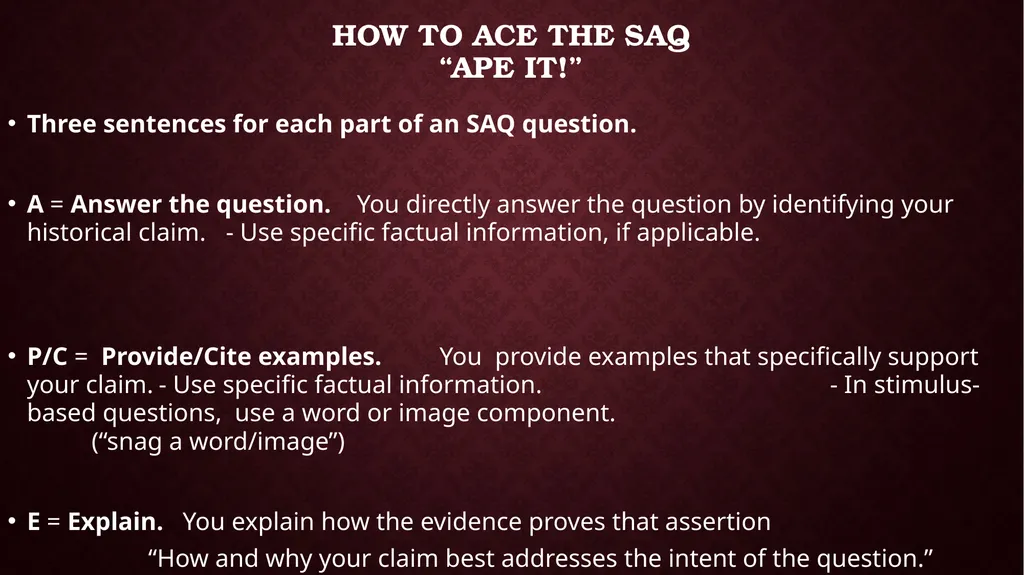
slide8. How to aCe the saq “APE IT!” Three sentences for each part of an SAQ question.
A = Answer the question. You directly answer the question by identifying your historical claim. - Use specific factual information, if applicable.
P/C = Provide/Cite examples. You provide examples that specifically support your claim. - Use specific factual information. - In stimulus-based questions, use a word or image component. (“snag a word/image”)
E = Explain. You explain how the evidence proves that assertion
“How and why your claim best addresses the intent of the question.”<br>
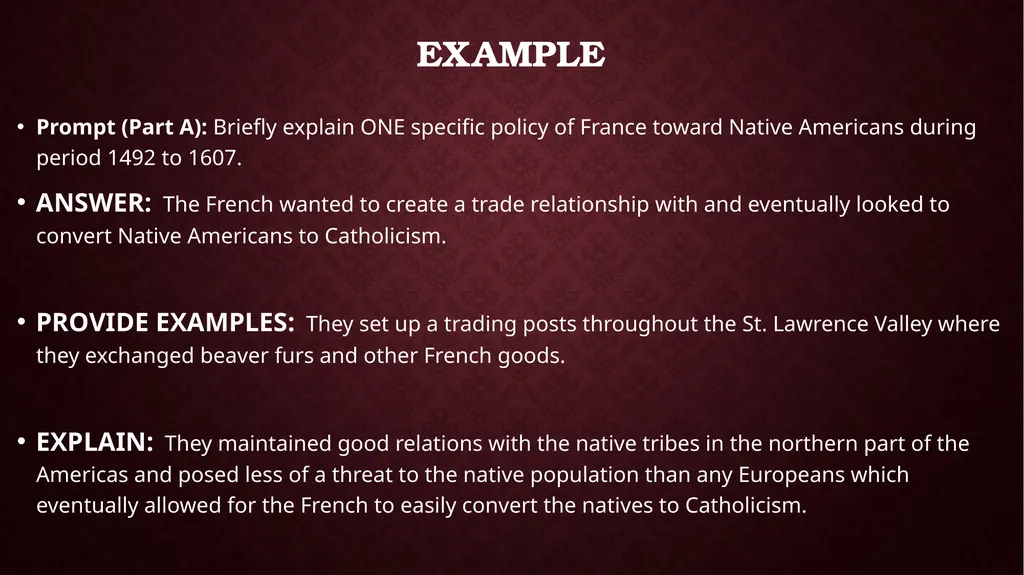
slide9. EXAMPLE Prompt (Part A): Briefly explain ONE specific policy of France toward Native Americans during period 1492 to 1607.
ANSWER: The French wanted to create a trade relationship with and eventually looked to convert Native Americans to Catholicism.
PROVIDE EXAMPLES: They set up a trading posts throughout the St. Lawrence Valley where they exchanged beaver furs and other French goods.
EXPLAIN: They maintained good relations with the native tribes in the northern part of the Americas and posed less of a threat to the native population than any Europeans which eventually allowed for the French to easily convert the natives to Catholicism.<br>
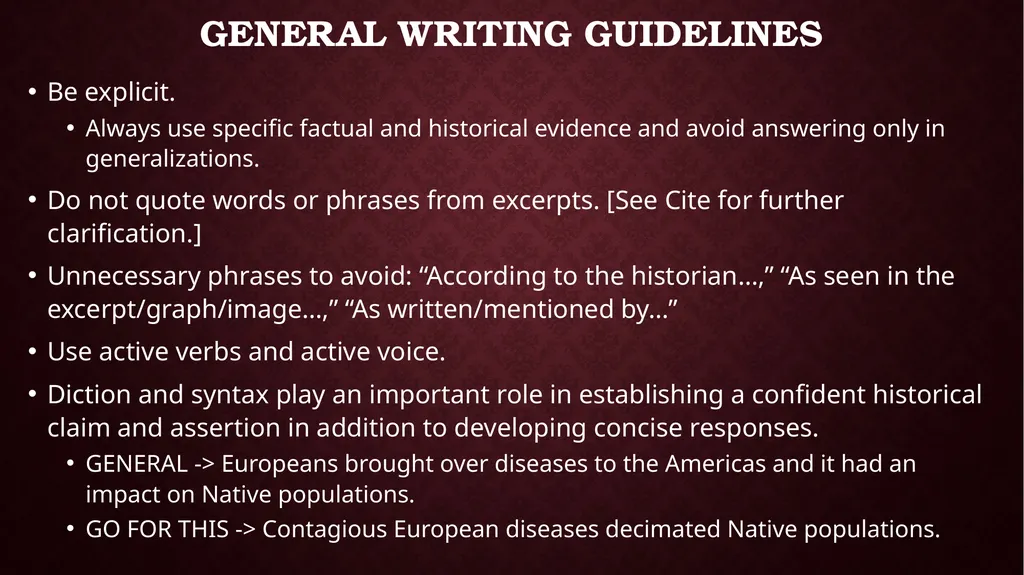
slide10. GENERAL WRITING GUIDELINES Be explicit.
Always use specific factual and historical evidence and avoid answering only in generalizations.
Do not quote words or phrases from excerpts. [See Cite for further clarification.]
Unnecessary phrases to avoid: “According to the historian…,” “As seen in the excerpt/graph/image…,” “As written/mentioned by…”
Use active verbs and active voice.
Diction and syntax play an important role in establishing a confident historical claim and assertion in addition to developing concise responses.
GENERAL -> Europeans brought over diseases to the Americas and it had an impact on Native populations.
GO FOR THIS -> Contagious European diseases decimated Native populations.<br>
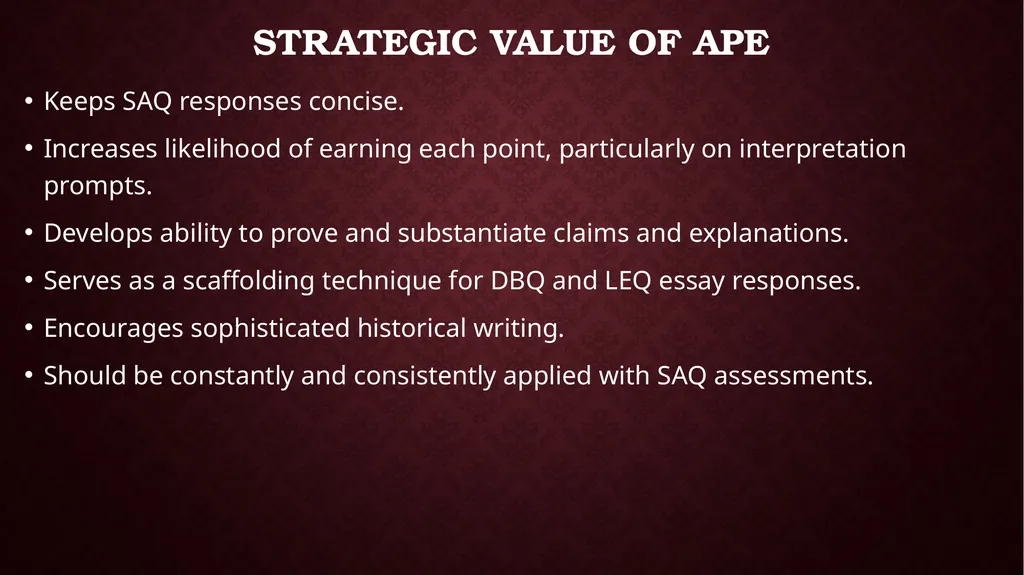
slide11. STRATEGIC VALUE of aPe Keeps SAQ responses concise.
Increases likelihood of earning each point, particularly on interpretation prompts.
Develops ability to prove and substantiate claims and explanations.
Serves as a scaffolding technique for DBQ and LEQ essay responses.
Encourages sophisticated historical writing.
Should be constantly and consistently applied with SAQ assessments.<br>
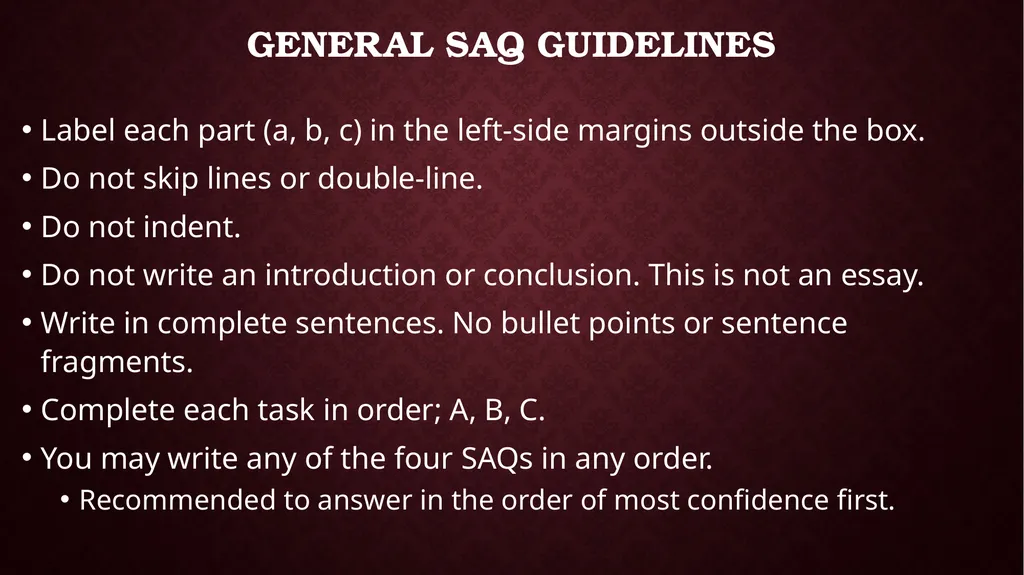
slide12. GENERAL SAQ GUIDELINES Label each part (a, b, c) in the left-side margins outside the box.
Do not skip lines or double-line.
Do not indent.
Do not write an introduction or conclusion. This is not an essay.
Write in complete sentences. No bullet points or sentence fragments.
Complete each task in order; A, B, C.
You may write any of the four SAQs in any order.
Recommended to answer in the order of most confidence first.<br>
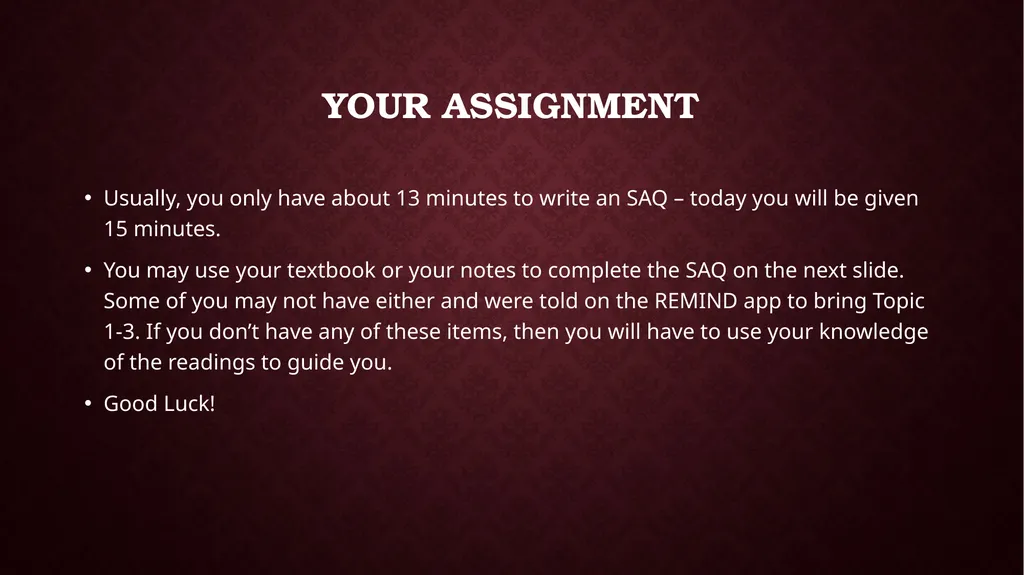
slide13. YOUR ASSIGNMENT Usually, you only have about 13 minutes to write an SAQ – today you will be given 15 minutes.
You may use your textbook or your notes to complete the SAQ on the next slide. Some of you may not have either and were told on the REMIND app to bring Topic 1-3. If you don’t have any of these items, then you will have to use your knowledge of the readings to guide you.
Good Luck!<br>
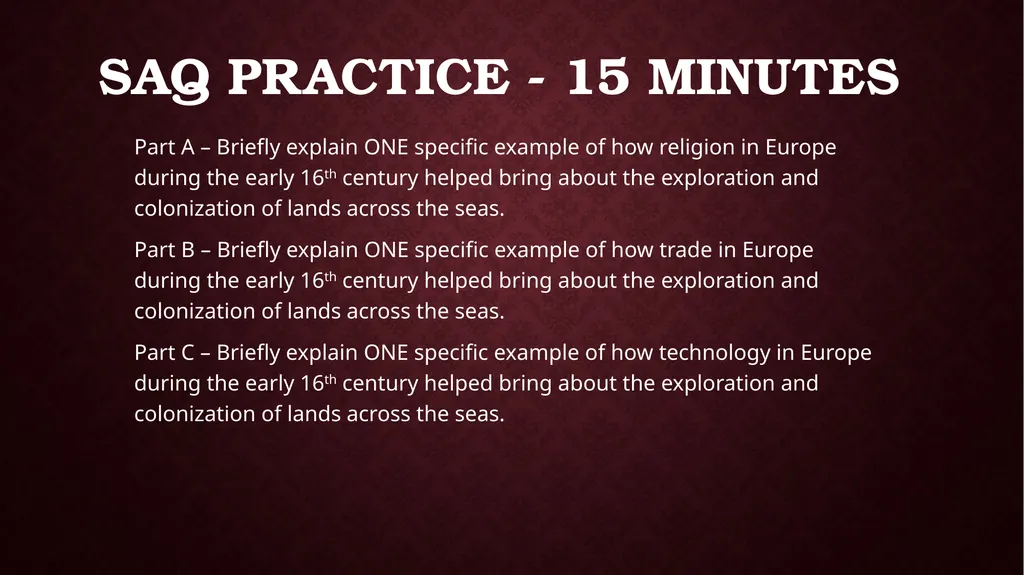
slide14. SAQ Practice - 15 minutes Part A – Briefly explain ONE specific example of how religion in Europe during the early 16th century helped bring about the exploration and colonization of lands across the seas.
Part B – Briefly explain ONE specific example of how trade in Europe during the early 16th century helped bring about the exploration and colonization of lands across the seas.
Part C – Briefly explain ONE specific example of how technology in Europe during the early 16th century helped bring about the exploration and colonization of lands across the seas.<br>
slide2. Part A: Multiple-choice questions (55 questions in 55 minutes) = 40% of Total exam score
Part B: Short-answer questions (3 questions in 40 minutes) = 20% of Total exam score
Required question 1: periods 3-8
Required question 2: periods 3-8
Choose between
Question 3: periods 1-5
OR
Question 4: periods 6-9 Section 1 of the APUSH Exam<br>
slide3. Section I, Part B of the APUSH Exam consists of 4 short-answer questions. You are required to answer the first and second questions and then answer either the third OR fourth question.
The 1st question primarily assesses the practice of analyzing secondary sources, asking students to respond in writing to a historian’s argument. This question addresses content from periods 3-8 of the course.
The 2nd question primarily assesses either the skill of causation or comparison, and ask students to respond in writing to a primary source (written text) or to visual sources such as images, charts, or maps. This question also addresses content form periods 3-8. SAQs: The Basics<br>
slide4. Section I, Part B of the APUSH Exam consists of 4 short-answer questions. You are required to answer the first and second questions and then answer either the third OR fourth question.
Students choose to answer either the 3rd OR the fourth short-answer questions, which deal with periods 1-5 or 6-9, respectively. These questions ask students to respond in writing to general propositions about U.S. history, and they primarily assess the same skill, either causation or comparison: neither of them will assess the same skill as the 2nd short-answer question. SAQs: The Basics<br>
slide5. Each short-answer question asks students to describe examples of historical evidence relevant to the source or question; these examples can be drawn from the concept outline or from other examples explored in depth during classroom instruction.
Questions are broken into 3 parts: A, B, and C
Difficulty varies between each part
Parts can build off or reference each other SAQs: The Basics<br>
slide6. Each part (A, B, and C) are worth one point each for a total of three points per question.
Each part is scored separately.
ETS describes the scoring as meeting a “threshold.” Did the student responses exhibit enough of the requirements to pass the threshold to receive the point? When it comes to a “three,” the variations can be expansive. A student could have an amazing answer or they could just barely meet the requirements. Since both of the students met these requirements, then they would both receive a score of three. How are the SAQs scored?<br>
slide7. APE the SAQ
A Historical Writing Strategy
Adapted from John Burkowski Jr. & Dawn Clemens
Adapted and Revised PowerPoint Layout Created by Jessica Jenkins<br>
slide8. How to aCe the saq “APE IT!” Three sentences for each part of an SAQ question.
A = Answer the question. You directly answer the question by identifying your historical claim. - Use specific factual information, if applicable.
P/C = Provide/Cite examples. You provide examples that specifically support your claim. - Use specific factual information. - In stimulus-based questions, use a word or image component. (“snag a word/image”)
E = Explain. You explain how the evidence proves that assertion
“How and why your claim best addresses the intent of the question.”<br>
slide9. EXAMPLE Prompt (Part A): Briefly explain ONE specific policy of France toward Native Americans during period 1492 to 1607.
ANSWER: The French wanted to create a trade relationship with and eventually looked to convert Native Americans to Catholicism.
PROVIDE EXAMPLES: They set up a trading posts throughout the St. Lawrence Valley where they exchanged beaver furs and other French goods.
EXPLAIN: They maintained good relations with the native tribes in the northern part of the Americas and posed less of a threat to the native population than any Europeans which eventually allowed for the French to easily convert the natives to Catholicism.<br>
slide10. GENERAL WRITING GUIDELINES Be explicit.
Always use specific factual and historical evidence and avoid answering only in generalizations.
Do not quote words or phrases from excerpts. [See Cite for further clarification.]
Unnecessary phrases to avoid: “According to the historian…,” “As seen in the excerpt/graph/image…,” “As written/mentioned by…”
Use active verbs and active voice.
Diction and syntax play an important role in establishing a confident historical claim and assertion in addition to developing concise responses.
GENERAL -> Europeans brought over diseases to the Americas and it had an impact on Native populations.
GO FOR THIS -> Contagious European diseases decimated Native populations.<br>
slide11. STRATEGIC VALUE of aPe Keeps SAQ responses concise.
Increases likelihood of earning each point, particularly on interpretation prompts.
Develops ability to prove and substantiate claims and explanations.
Serves as a scaffolding technique for DBQ and LEQ essay responses.
Encourages sophisticated historical writing.
Should be constantly and consistently applied with SAQ assessments.<br>
slide12. GENERAL SAQ GUIDELINES Label each part (a, b, c) in the left-side margins outside the box.
Do not skip lines or double-line.
Do not indent.
Do not write an introduction or conclusion. This is not an essay.
Write in complete sentences. No bullet points or sentence fragments.
Complete each task in order; A, B, C.
You may write any of the four SAQs in any order.
Recommended to answer in the order of most confidence first.<br>
slide13. YOUR ASSIGNMENT Usually, you only have about 13 minutes to write an SAQ – today you will be given 15 minutes.
You may use your textbook or your notes to complete the SAQ on the next slide. Some of you may not have either and were told on the REMIND app to bring Topic 1-3. If you don’t have any of these items, then you will have to use your knowledge of the readings to guide you.
Good Luck!<br>
slide14. SAQ Practice - 15 minutes Part A – Briefly explain ONE specific example of how religion in Europe during the early 16th century helped bring about the exploration and colonization of lands across the seas.
Part B – Briefly explain ONE specific example of how trade in Europe during the early 16th century helped bring about the exploration and colonization of lands across the seas.
Part C – Briefly explain ONE specific example of how technology in Europe during the early 16th century helped bring about the exploration and colonization of lands across the seas.<br>