Shot Put Discus Javelin Hammer Throw Weight Throw Officiating Throws Events Safety In The Field NEVER turn your back on the throwing circle or runway. ALWAYS watch the complete flight of an implement... NEVER take your eyes off it! BE
"Shot Put Discus Javelin Hammer Throw Weight Throw" is the property of its rightful owner. Permission is granted to
download and print the materials on this website for personal, non-commercial use only, and to display it
on your personal computer provided you do not modify the materials and that you retain all copyright
notices contained in the materials. By downloading content from our website, you accept the terms of this
agreement.
Safety In The Field NEVER turn your back on the throwing circle or runway. ALWAYS watch the complete flight of an implement... NEVER take your eyes off it! BE CAREFUL on slippery grass. NEVER return an implement by throwing or rolling it back to the circle or runway. NEVER use any part of your body to stop the implement. ALWAYS wear proper footwear.<br>
03
Safety In The Field Watch and retrieve the throw (implement) from the side and not the front. “I was wondering why the Discus got larger and larger and then it hit me.” Place the indicator stick in the ‘mark’ immediately before allowing the implement to be retrieved.<br>
04
Safety In The Field Be aware that the implement can bounce or be deflected by dry ground or surface imperfections. Also, be aware in Hammer that the wire and/or handle can whip around after the implement lands so approach cautiously.<br>
05
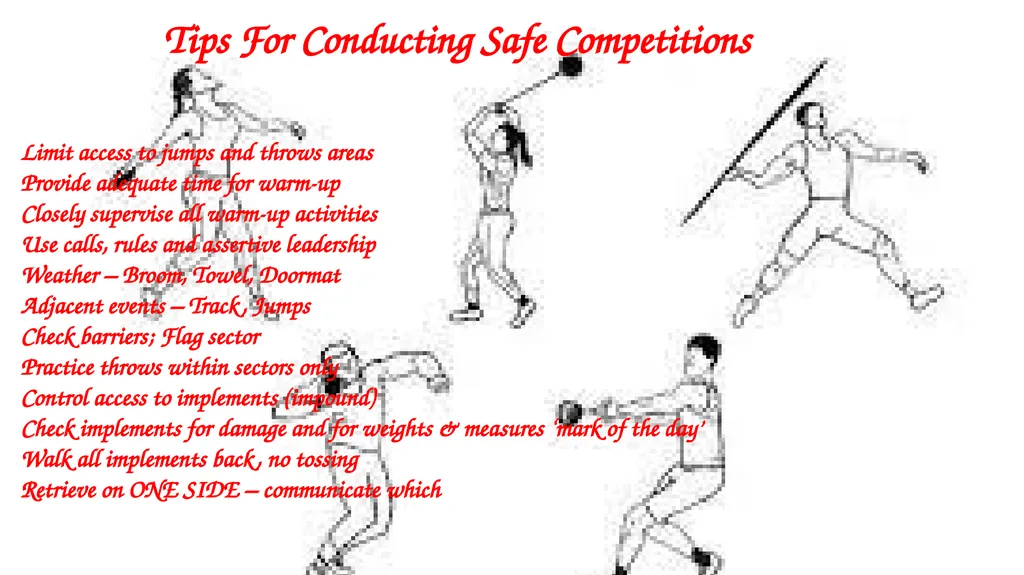
Limit access to jumps and throws areas
Provide adequate time for warm-up
Closely supervise all warm-up activities
Use calls, rules and assertive leadership
Weather – Broom, Towel, Doormat
Adjacent events – Track, Jumps
Check barriers; Flag sector
Practice throws within sectors only
Control access to implements (impound)
Check implements for damage and for weights & measures ‘mark of the day’
Walk all implements back, no tossing
Retrieve on ONE SIDE – communicate which Tips For Conducting Safe Competitions<br>
06
Officiating Duties in the Throws Measurement of throwing distances
Distance is measured from the fault point in the circle/runway to the first point of landing in the field with the zero end of the tape where the implement lands
Watch for foot faults
With throwing circles, the foot can pass over the top of the front of the circle but cannot touch the front of the circle
Watch how the athletes leave the throwing area
Implement must land before an athlete can leave the circle/runway
Athlete must leave through the back of the throwing circle
Athlete can leave at any point behind the white arc line (javelin)
Watch how the implements are thrown
Javelin - above shoulder; no end-over-end twirling
Shot - from the neck, not a baseball pitch
It will not be considered a failure if the discus or any part of the hammer strikes the cage after release<br>
07
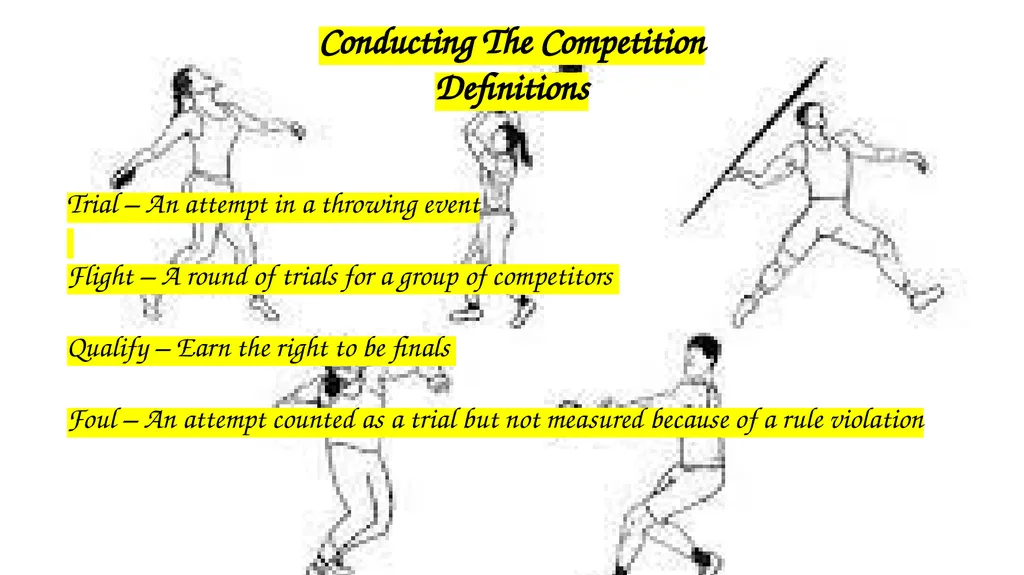
Trial – An attempt in a throwing event
Flight – A round of trials for a group of competitors
Qualify – Earn the right to be finals
Foul – An attempt counted as a trial but not measured because of a rule violation Conducting The Competition
Definitions<br>
08
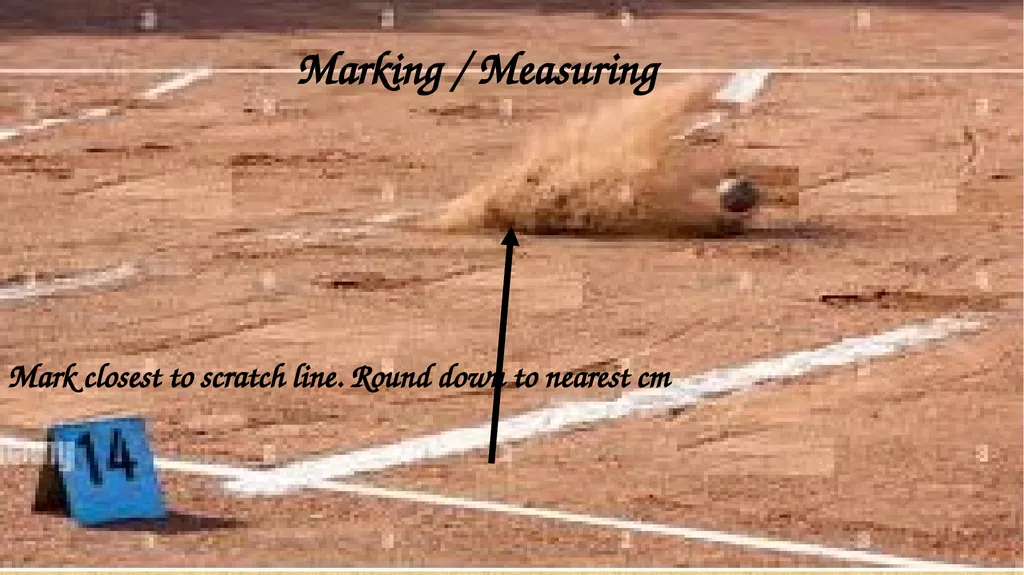
Marking / Measuring Mark closest to scratch line. Round down to nearest cm<br>
09
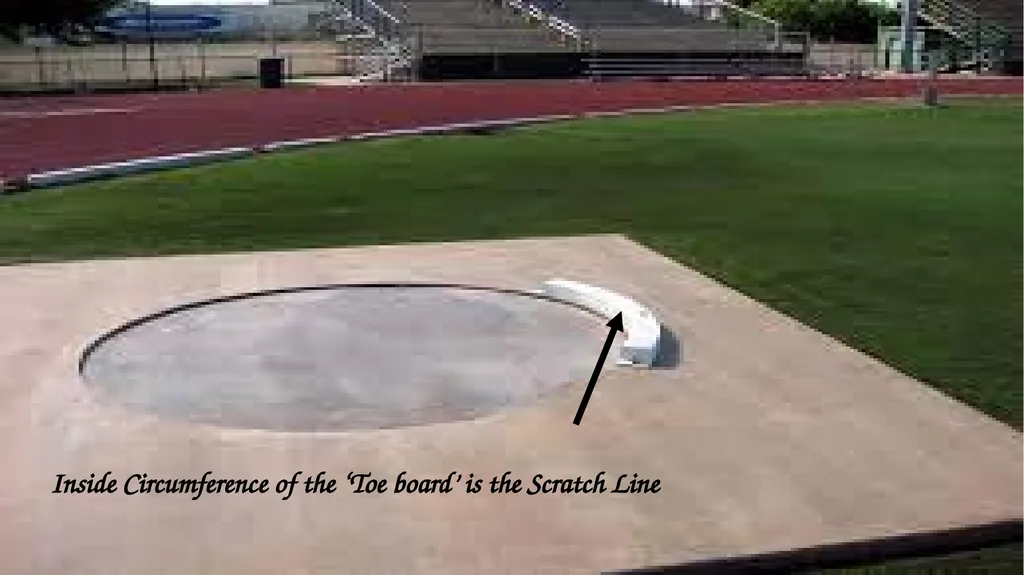
Inside Circumference of the ‘Toe board’ is the Scratch Line<br>
10
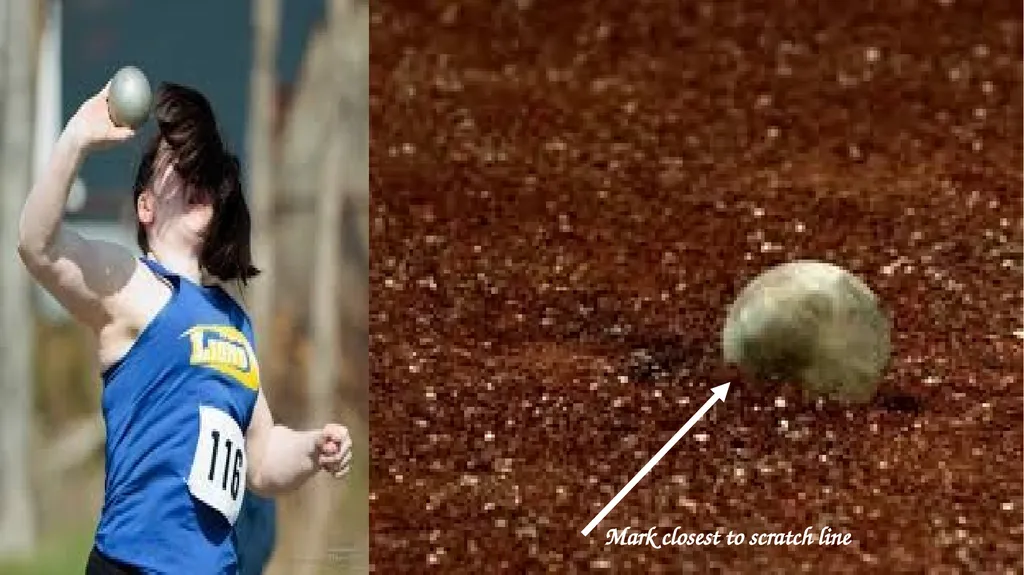
Mark closest to scratch line<br>
11
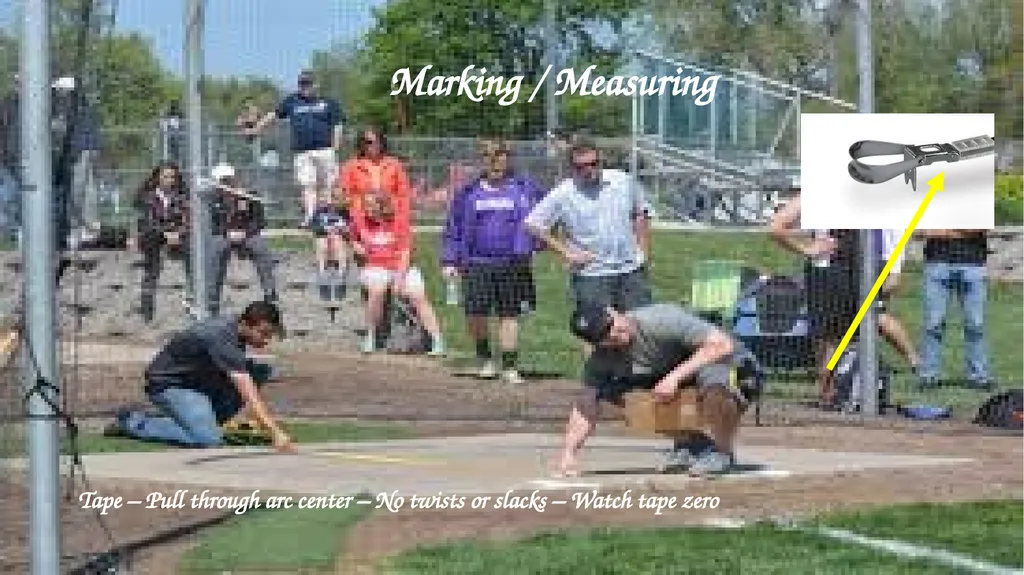
Marking / Measuring Tape – Pull through arc center – No twists or slacks – Watch tape zero<br>
12
SHOT PUT<br>
13
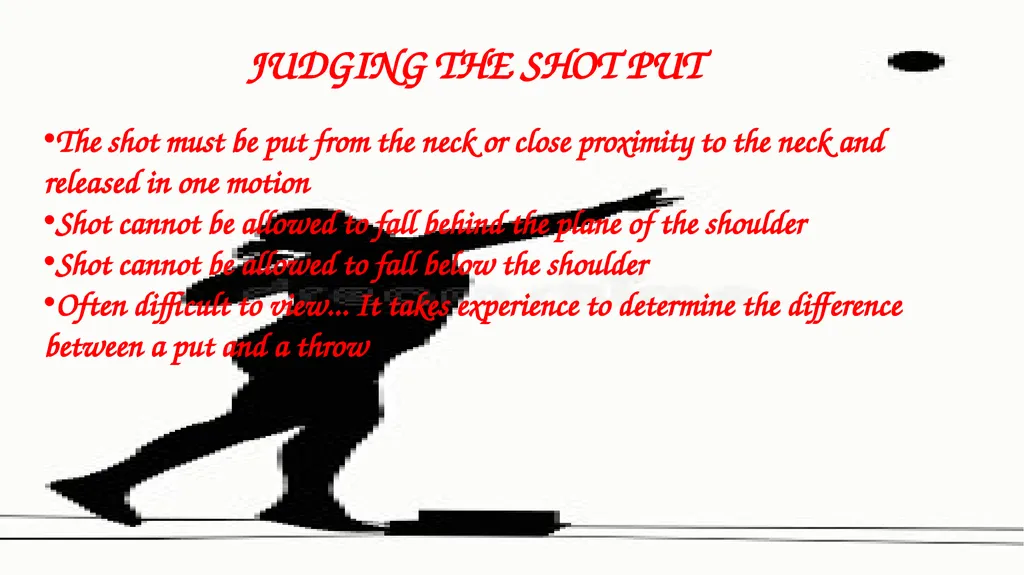
The shot must be put from the neck or close proximity to the neck and released in one motion
Shot cannot be allowed to fall behind the plane of the shoulder
Shot cannot be allowed to fall below the shoulder
Often difficult to view... It takes experience to determine the difference between a put and a throw JUDGING THE SHOT PUT<br>
14
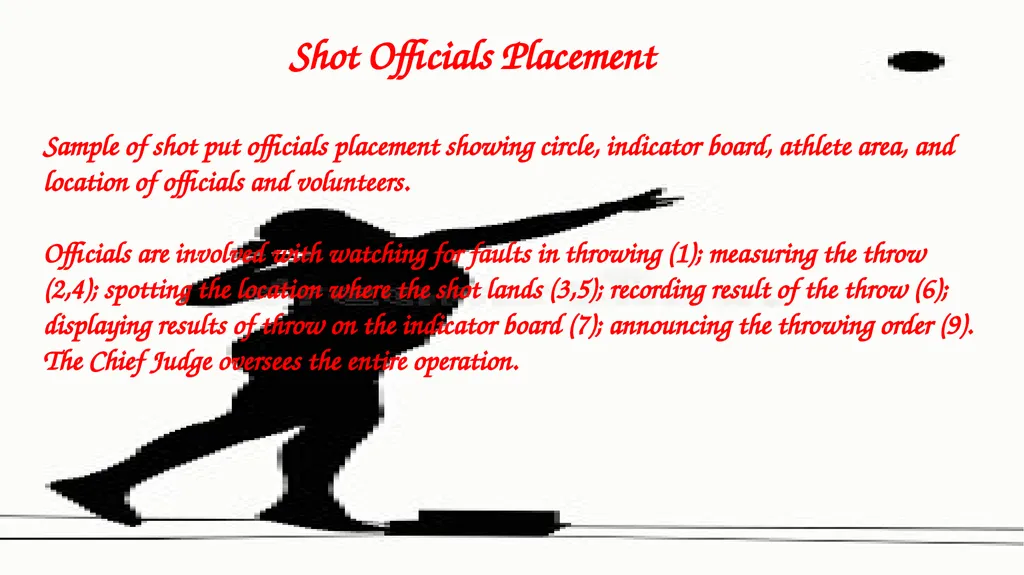
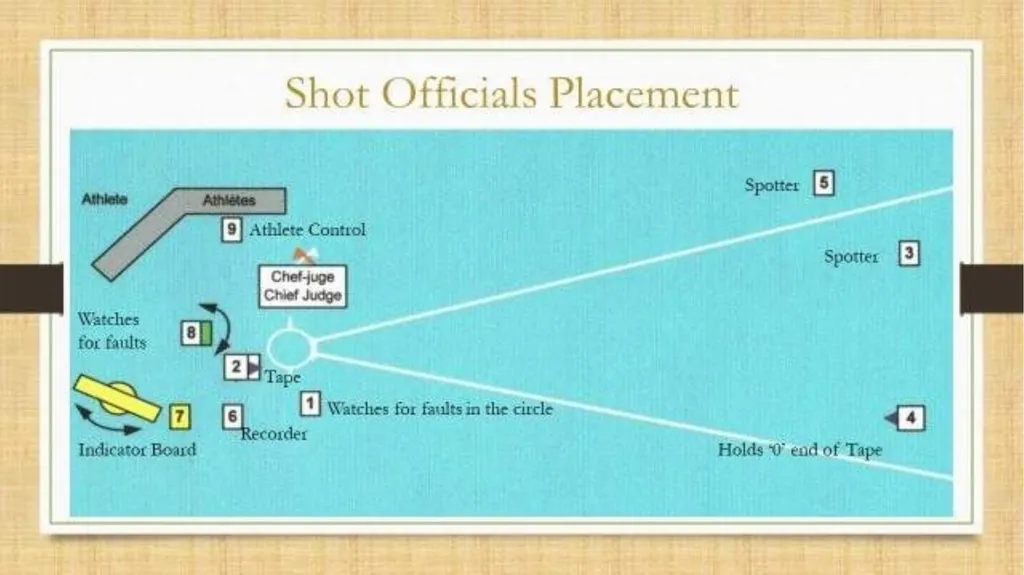
Sample of shot put officials placement showing circle, indicator board, athlete area, and location of officials and volunteers.
Officials are involved with watching for faults in throwing (1); measuring the throw (2,4); spotting the location where the shot lands (3,5); recording result of the throw (6); displaying results of throw on the indicator board (7); announcing the throwing order (9). The Chief Judge oversees the entire operation. Shot Officials Placement<br>
15
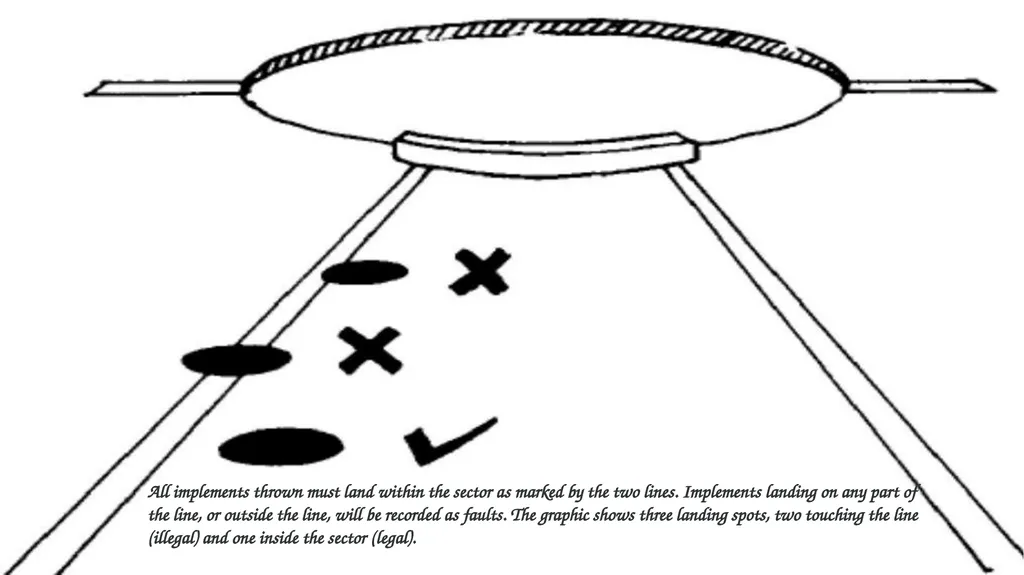
All implements thrown must land within the sector as marked by the two lines. Implements landing on any part of the line, or outside the line, will be recorded as faults. The graphic shows three landing spots, two touching the line (illegal) and one inside the sector (legal).<br>
16
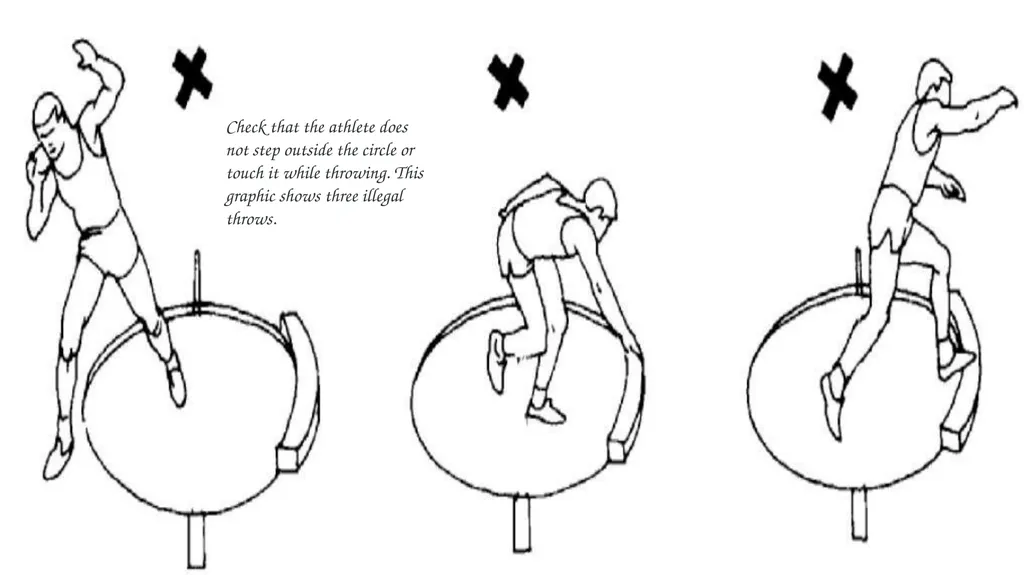
Check that the athlete does not step outside the circle or touch it while throwing. This graphic shows three illegal throws.<br>
17
DISCUS<br>
18
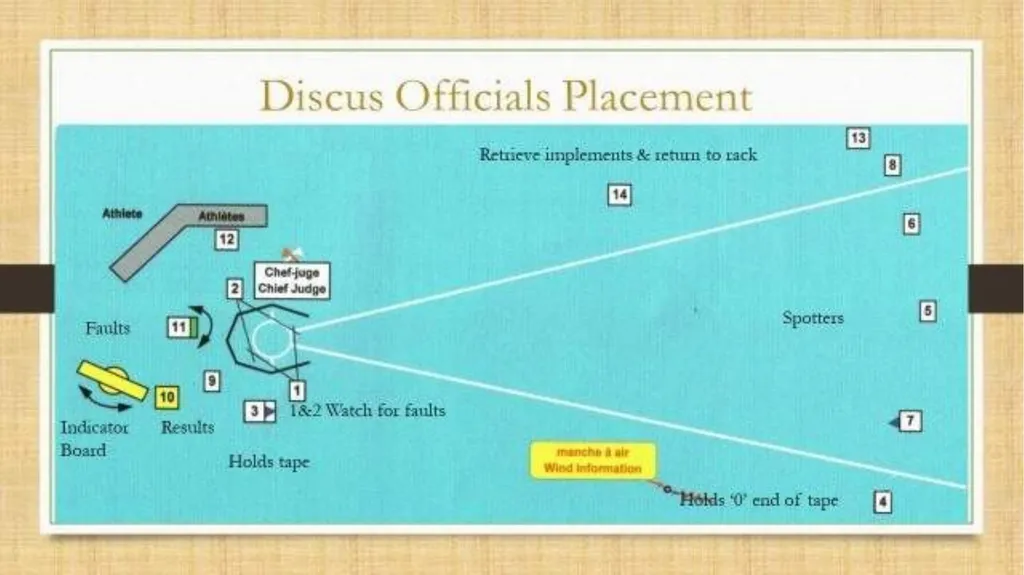
Sample of shot put officials placement showing circle, indicator board, athlete area, and location of officials and volunteers.
Officials are involved with watching for faults in throwing (1); measuring the throw (2,4); spotting the location where the shot lands (3,5); recording result of the throw (6); displaying results of throw on the indicator board (7); announcing the throwing order (9). The Chief Judge oversees the entire operation. Discus Officials Placement<br>
19
JAVELIN<br>
20
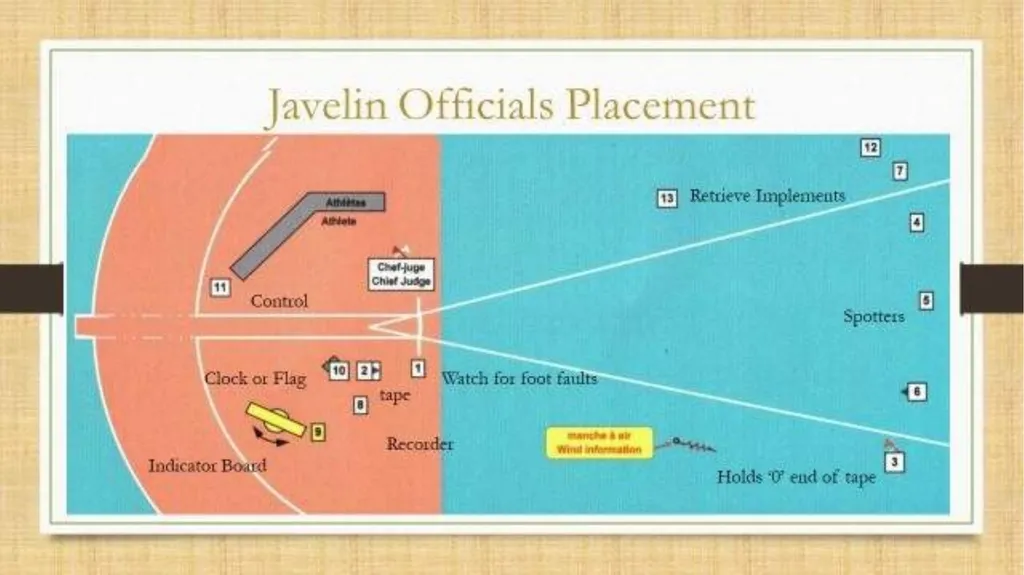
Sample of javelin officials placement showing runway, indicator board, clock, athlete area, and location of officials and volunteers. Officials are involved with watching for faults in throwing (1); measuring the throw (2,6); recording the result of the throw (8); spotting the location where the javelin lands(4,5,7,12); displaying results of the throw on the indicator board (9); announcing the throwing order (11); and retrieving the thrown javelin (13). The Chief Judge oversees the entire operation. Javelin Officials Placement<br>
21
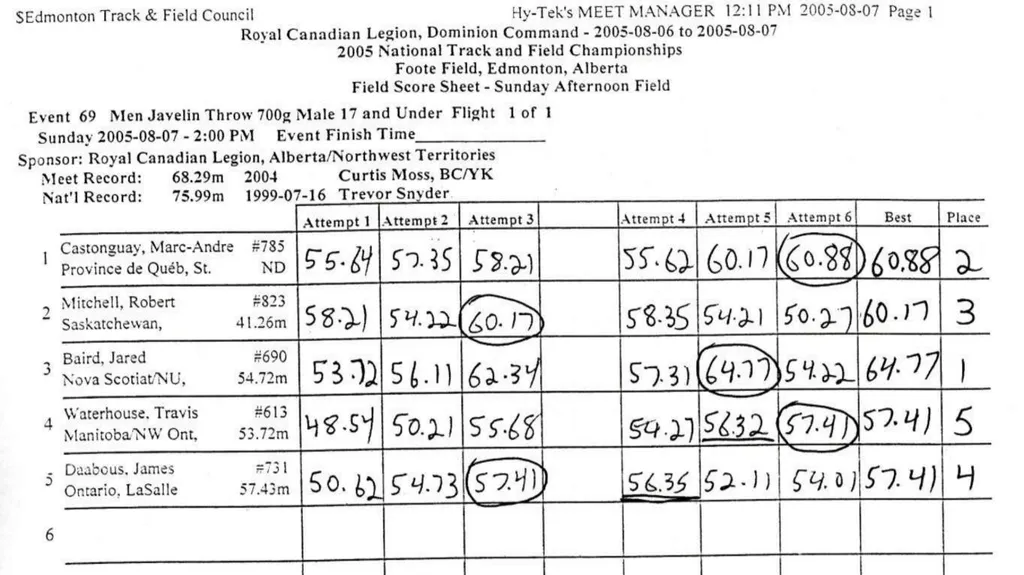
Sample of a Scoring Sheet in the Throws
The longest distance thrown, no matter when achieved, shall be considered the best throw
If there is a tie, then the next longest distance thrown breaks the tie.
In a tie, the longest distance throw is still considered the best throw.<br>
22
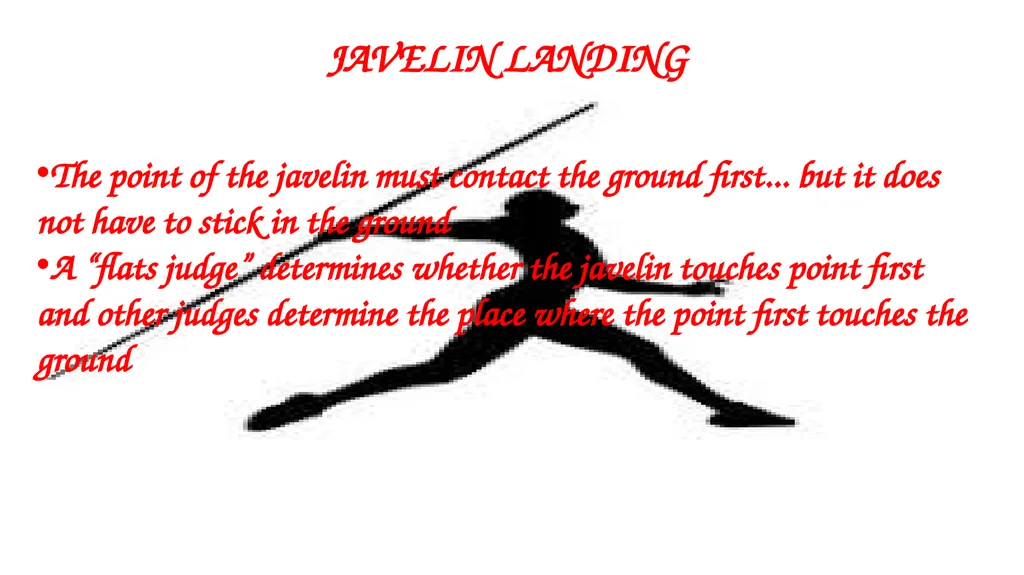
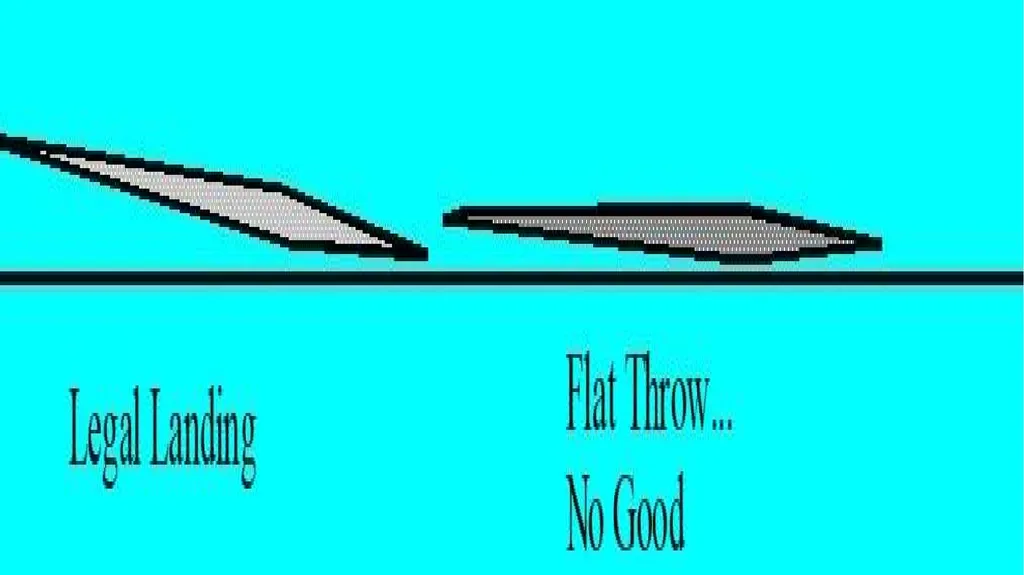
The point of the javelin must contact the ground first... but it does not have to stick in the ground
A “flats judge” determines whether the javelin touches point first and other judges determine the place where the point first touches the ground JAVELIN LANDING<br>
23
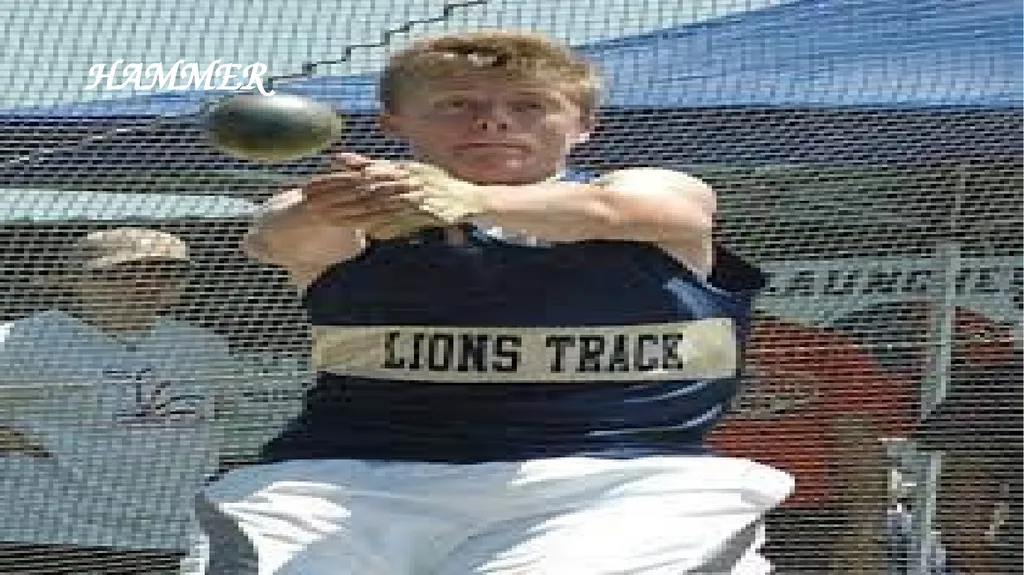
HAMMER<br>
24
Discus and Hammer Thrown From a Cage
Competitors throw from a circle within a cage
Officials remain outside the cage during the throw
Once the competitor has exited the circle legally, the measurement is made<br>
25
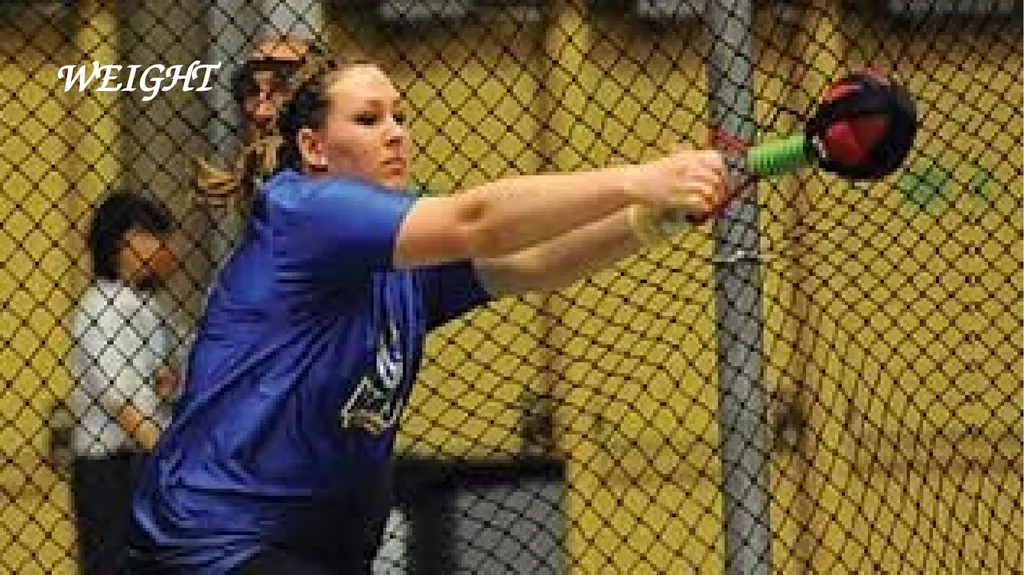
WEIGHT<br>
26
Generic Throws Rules Competitors are given three attempts
Top 8 competitors are give three additional attempts
Longest throw wins<br>