SHRI. J.A. YADAV Department of Economics P.D.V.P.

Published  . 0 views
↓ Download
SHRI. J.A. YADAV Department of Economics P.D.V.P.
1 / 1
SHRI. J.A. YADAV Department of Economics P.D.V.P. - slide 1 of 45 SHRI. J.A. YADAV Department of Economics P.D.V.P. - slide 2 of 45 SHRI. J.A. YADAV Department of Economics P.D.V.P. - slide 3 of 45 SHRI. J.A. YADAV Department of Economics P.D.V.P. - slide 4 of 45 SHRI. J.A. YADAV Department of Economics P.D.V.P. - slide 5 of 45 SHRI. J.A. YADAV Department of Economics P.D.V.P. - slide 6 of 45 SHRI. J.A. YADAV Department of Economics P.D.V.P. - slide 7 of 45 SHRI. J.A. YADAV Department of Economics P.D.V.P. - slide 8 of 45 SHRI. J.A. YADAV Department of Economics P.D.V.P. - slide 9 of 45 SHRI. J.A. YADAV Department of Economics P.D.V.P. - slide 10 of 45 SHRI. J.A. YADAV Department of Economics P.D.V.P. - slide 11 of 45 SHRI. J.A. YADAV Department of Economics P.D.V.P. - slide 12 of 45 SHRI. J.A. YADAV Department of Economics P.D.V.P. - slide 13 of 45 SHRI. J.A. YADAV Department of Economics P.D.V.P. - slide 14 of 45 SHRI. J.A. YADAV Department of Economics P.D.V.P. - slide 15 of 45 SHRI. J.A. YADAV Department of Economics P.D.V.P. - slide 16 of 45 SHRI. J.A. YADAV Department of Economics P.D.V.P. - slide 17 of 45 SHRI. J.A. YADAV Department of Economics P.D.V.P. - slide 18 of 45 SHRI. J.A. YADAV Department of Economics P.D.V.P. - slide 19 of 45 SHRI. J.A. YADAV Department of Economics P.D.V.P. - slide 20 of 45 SHRI. J.A. YADAV Department of Economics P.D.V.P. - slide 21 of 45 SHRI. J.A. YADAV Department of Economics P.D.V.P. - slide 22 of 45 SHRI. J.A. YADAV Department of Economics P.D.V.P. - slide 23 of 45 SHRI. J.A. YADAV Department of Economics P.D.V.P. - slide 24 of 45 SHRI. J.A. YADAV Department of Economics P.D.V.P. - slide 25 of 45 SHRI. J.A. YADAV Department of Economics P.D.V.P. - slide 26 of 45 SHRI. J.A. YADAV Department of Economics P.D.V.P. - slide 27 of 45 SHRI. J.A. YADAV Department of Economics P.D.V.P. - slide 28 of 45 SHRI. J.A. YADAV Department of Economics P.D.V.P. - slide 29 of 45 SHRI. J.A. YADAV Department of Economics P.D.V.P. - slide 30 of 45 SHRI. J.A. YADAV Department of Economics P.D.V.P. - slide 31 of 45 SHRI. J.A. YADAV Department of Economics P.D.V.P. - slide 32 of 45 SHRI. J.A. YADAV Department of Economics P.D.V.P. - slide 33 of 45 SHRI. J.A. YADAV Department of Economics P.D.V.P. - slide 34 of 45 SHRI. J.A. YADAV Department of Economics P.D.V.P. - slide 35 of 45 SHRI. J.A. YADAV Department of Economics P.D.V.P. - slide 36 of 45 SHRI. J.A. YADAV Department of Economics P.D.V.P. - slide 37 of 45 SHRI. J.A. YADAV Department of Economics P.D.V.P. - slide 38 of 45 SHRI. J.A. YADAV Department of Economics P.D.V.P. - slide 39 of 45 SHRI. J.A. YADAV Department of Economics P.D.V.P. - slide 40 of 45 SHRI. J.A. YADAV Department of Economics P.D.V.P. - slide 41 of 45 SHRI. J.A. YADAV Department of Economics P.D.V.P. - slide 42 of 45 SHRI. J.A. YADAV Department of Economics P.D.V.P. - slide 43 of 45 SHRI. J.A. YADAV Department of Economics P.D.V.P. - slide 44 of 45 SHRI. J.A. YADAV Department of Economics P.D.V.P. - slide 45 of 45
Description: SHRI. J.A. YADAV Department of Economics P.D.V.P. College, Tasgaon Indian Economy At a Glance Total Area of Country: 3287263 sq.km Percentage of World Area: 2.42 (7th place) Forest and Tree Cover Area: 782871 sq. km (23.81 of the total

Related Topics

Download Presentation

"SHRI. J.A. YADAV Department of Economics P.D.V.P." is the property of its rightful owner. Permission is granted to download and print the materials on this website for personal, non-commercial use only, and to display it on your personal computer provided you do not modify the materials and that you retain all copyright notices contained in the materials. By downloading content from our website, you accept the terms of this agreement.

Presentation Transcript

slide1. SHRI. J.A. YADAV
Department of Economics
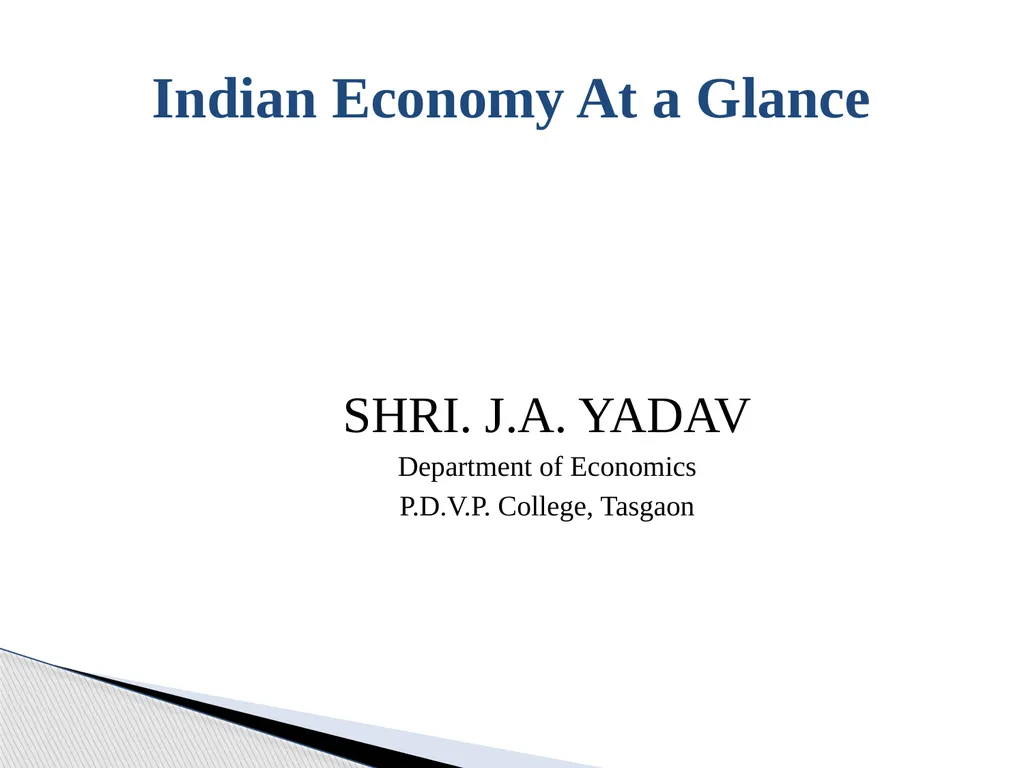
P.D.V.P. College, Tasgaon Indian Economy At a Glance<br>
slide2. Total Area of Country: 3287263 sq.km
Percentage of World Area: 2.42% (7th place)
Forest and Tree Cover Area: 782871 sq. km (23.81% of the total area)
Total Forest cover area: 692027 sq.km
Agricultural Area: 141.23 million hectares (43% of total)
Irrigated area: 40% of net sown area
Rainfed Area as % of net sown area: 55%
Largest State (Areawise) Rajasthan
Smallest State (Areawise) Goa A Few Facts<br>
slide3. Total Population (Census 2011): 121.06 cr
Decadal Growth Rate (2001-11): 17.7%
Rural population growth: 12.3%
Urban population growth: 31.8%
Percentage of World population (2011): 17.5%
Total Rural population (2011): 82.35 cr
Total Urban population (2011): 17.65 cr
Sex ratio (2011) 943
Child Sex ratio (2011): 919
State with highest Female-Male Ratio (2011): Kerla (1084) Population<br>
slide4. Density of Population (2011): 382 per sq.km
Birth Rate (2011): 21.8 per thousand population
Death Rate (2011): 7.1 per thousand population
Life expentancy (at the time of birth)66.1 yrs
Male (2002-6) 64.6 yrs
Female (2002-6) 67.7 yrs
Literacy Rate: 73%
Male: 80.9
Female: 64.6 Population (conti…)<br>
slide5. It refers to the in detailed highlights of the major and minor factors or issues being studied in public finance.
Mrs. Ursula Hicks: “The main content of public finance consist of the examination and appraisal of the methods by which governing bodies provide for the collective satisfaction of wants and secure the necessary funds to carry out their purposes.” Scope of Public Finance<br>
slide6. Public Revenue
Public Expenditure
Public Debt
Financial Administration
Fiscal Policy
Economic Stabilization Scope of Public Finance<br>
slide7. Removal of Poverty
Removal of Unemployment
Saving Investment Equilibrium
Economic Stability
Maximization of Social Welfare
Economic Development
Reduction in Economic Inequality
Provision of Collective Wants Importance /Role of Public Finance<br>
slide8. Economic Growth
Economic Stability
Economic Planning
Importance /Role of Public Finance in Developing Countries:
Capital Formation
Economic Planning
Economic Development
Reduction in Economic Inequality Importance /Role of Public Finance in Developed Countries<br>
slide9. The classical economists like Adam Smith believed in minimum state activities and taxation.
J.B.Say : “The very best of all plans of finance is to spend little and the best of all taxes is that which is least in amount”
Adam Smith and Ricardo believed that the private expenditure is ‘productive’ and the state expenditure is ‘unproductive’.
They remarked, ‘every tax is an evil’ and ‘every public expenditure is unproductive’. Principle of Maximum Social Advantage<br>
slide10. But, according to Dalton: “It is not true that every tax is an evil.”
For example, taxes on narcotic drugs, alcohol and other intoxicants reduce consumption of such commodities, which are injurious to health and good to the society.
Likewise, public expenditure is good. State expenditure on agriculture, industries public health, education, justice etc. cannot be regarded unproductive, as such expenditure increases economic and social welfare
Prof. Dalton: “It is not true that all public expenditure is good.” Expenditure on unnecessary ways is an abvious evil.” Principle of Maximum Social Advantage<br>
slide11. The principle of Maximum social advantage is the ‘Principle of Public Finance’. It is the fundamental rule, which should determine fiscal operations of the government. This principle is formulated and popularized by Dr. Dalton and Prof. Pigou. Dr. Dalton calls it as the principle of maximum social advantage and Prof. Pigou as principle of Maximum Aggregate Welfare.
The principle provides guidance to the govt. regarding public revenue and public expenditure or public finance operations so as to maximize social advantage or welfare. Principle of Maximum Social Advantage<br>
slide12. Principle say that, the government should collect revenue and spend it to maximize the welfare of the people. When govt. Imposes taxes, some disutility is created. But when it spends the money, there is some gain in utility. The government should adjust the revenue and expenditure in such a way that utility is maximized and disutility is minimized. Conti……<br>
slide13. Extent of Public Revenue and Expenditure:

With every additional unit of tax raised, the burden of sacrifice will go on increasing and the amount of benefit will go on decreasing. The government should stop at that point where the benefit derived from a unit of money spent by the government will be equal to the sacrifice imposed in raising that unit of revenue. It is the optimum point of public finance operations. They should be up to the point, where the marginal utility due to public expenditure is equal to the marginal disutility due to public expenditure is equal to the marginal disutility due to taxation or public revenue. It can be presented diagrammatically as follow Conti……<br>
slide14. Distribution of Revenue: The revenue should be so distributed by the govt. among different uses that the marginal return or benefit of satisfaction is the same for all of them. It is the principle of equi-marginal utility or maximum satisfaction applied to public finance. Suppose, the marginal utility of expenditure on agriculture is greater than on defence, the expenditure on agriculture would give greater satisfaction than defence. Hence, the revenue should be transferred from defence to agriculture till the marginal utilities in both uses are the same. Conti…..<br>
slide15. Distribution of Taxation Burden: The burden of taxation on different sources should be distributed according to the principle of least sacrifice. It should be distributed on different sources that marginal sacrifice of each source is the same. If the utility of last rupee paid by A is less than that of the last rupee paid by B, taxing of B, should reduce and that of A should increase till the marginal sacrifice of the last rupee of both A and B is the same. Conti…..<br>
slide16. There are three fundamental principles:
Public expenditure should be carried on up to the point where the marginal social benefit is equal to the marginal social sacrifice.
Public revenue should be distributed on different needs of expenditure that the marginal social benefit or return of satisfaction from each of them is equal.
The taxes should be distributed in such a way that the marginal utility of money or marginal social sacrifice paid in taxation is equal to all taxpayers. How Maximum Social Advantage is Achieved?<br>
slide17. Preservation of the Community
Improvements in Production
Improvement in Distribution
Stability and full employment
Provision of Future Tests of Social Advantage/ Parameters:<br>
slide18. It is very difficult for the govt. to balance the marginal disutility and marginal utility
The concepts of marginal social sacrifice and marginal social benefit are vague and difficult to understand
This principle cannot be applied to each and every activity of the government.
This principle cannot be applied to special welfare programme for the poor people.
The development of the backward regions or areas cannot be achieved by incurring more expenditure as per this principle. Limitations on Principle<br>
slide19. Adams: “A tax is a contribution from citizens for the support of the state.”
Seligman: “A tax is a compulsory payment from a person to the government to defray the expenses incurred in the common interests of all without reference to special benefits conferred.”
Bastable: “A tax is a compulsory contribution of the wealth of a person or body of persons for the service or the public powers.”
Dalton: “ A tax is a compulsory contribution imposed by a public authority irrespective of the exact amount of service rendered to the tax payer in return and not imposed as a penalty for any legal offence.” Taxation<br>
slide20. Tax is a compulsory contribution to the govt. from the people.
Tax evasion is a legal offence.
Tax is imposed and collected by the govt. only.
It is imposed and collected to meet the govt. expenditure.
Tax is not a penalty or fine for offence, but a contribution to the public revenue.
There is absence of the direct relationship between the tax paid and services received by the people.
It is a dominant and certain source of public revenue for the govt.
Taxes are imposed on the individuals, institutions and goods and services. Features of Tax<br>
slide21. Adam Smith:
Cannon of Equality
Cannon of Certainty
Cannon of Convenience
Cannon of Economy
Bastable:
Canon of Productivity
Canon of Elasticity
Canon of Diversity
Canon of Simplicity
Canon of Expendiency
Canon of Coordination
Canon of Neutrality Cannons of Taxation<br>
slide22. Impact of Tax
Shifting of Tax
Incidence / Burden of Tax Kinds of Taxation<br>
slide23. J.S. Mill: “A direct tax is demanded from the very person who it is intended or desired should pay it.”
Dalton: “A direct tax is a tax which really paid by the person whom it is legally imposed.”
Findlay Shirras: “A tax imposed on income and wealth of a individual is direct tax.”
For Example: Income tax, Wealth tax, Expenditure tax, Corporation tax etc. Direct Tax<br>
slide24. Economy
Equity
Civil Consciousness
Reduction in Inequality
Certainty
Elasticity
Educative value
Easy to understand
Control of Inflation
Convenience
Productive
Ability to Pay Merits/Advantages of Direct Taxes<br>
slide25. Inconvenient
Unpopular
Uneconomical
Possibility of Evasion
Uncertainty
Inequitable
Narrow Scope
Unsuitable for Underdeveloped countries
Curtails Capital Formation
Political Decision
Extravagance of Money
Inflation Demerits/Disadvantages of Direct Taxes<br>
slide26. J.S.Mill: “Indirect taxes are those which are demanded from one person in the expectation and intension that he shall identify himself at the expenses of another.”
Dalton: “An indirect tax is one which is imposed on one person but paid partly or wholly by another, owing to a consequential change in the terms of some contract or bargain between them.”
Prof. Shirras: “Indirect taxes are those which affect the income and property of persons through their consumption.” Indirect Taxes<br>
slide27. Convenient
Elastic
Evasion Impossible
Equity
Higher investment and production
Social Welfare
Progressive
Wider Coverage
Suitable to developing countires
Easy to Collect
Productive
Popular Merits/Advantages of Indirect Taxes<br>
slide28. Regressive
Uncertain
No civil consciousness
Discourage Savings
Inflation
Uneconomical
Inequitable
No direct link with the government
Unemployment
Socially Unjust Demerits/Disadvantages of Indirect Taxes<br>
slide29. Meaning: Public expenditure is the expenditure incurred by public authorities-central, state and local governments, either for the satisfaction of collective needs of the citizens or for promoting their economic and social welfare. It refers to the expences of the public authorities central, state and local governments either in protecting the citizens or in promoting their economic and social welfare. Expenditure undertaken by the government at different levels (Central, State, Local govts. ) is public expendithure Public Expenditure<br>
slide30. Increase in Government Activities
Industrial Development
Social Security Measures
Nationalisation
Development of Agriculture
Inflation
Depression
Problems of Defence Causes of increasing Public Expenditure<br>
slide31. Urbanization
Approach Towards Government
Economic Development/ Welfare State
Growth and Social Justice
Democratic Government
Economic Planning
Population Growth
Increasing International Relations Conti…….<br>
slide32. Effects on Production:
Effects upon Ability to Work, Save and Invest:
Public expenditure can increase the ability of the people to work, save and invest in many ways. Public expenditure on education, medical services, cheap housing facilities, means of transport and communication etc., will all increase the efficiency of persons to work. Effects of Public Expenditure<br>
slide33. 2. Effects on Willingness to Work, Save and Invest: As far as the willingness t work, save and invest is concerned, it depends to a great extent upon the character of public expenditure and the policy of the government. For example, old age pension, provident fund benefit, insurance against sickness and employment at state expense, provide security and safety to person and, therefore, reduce his willingness to work and save. Effects of Public Expenditure<br>
slide34. 3. Effects on Diversion of Economic Resources: Public expenditure diverts resources from private to public use in many ways, e.g. the government expenditure on defenses, police, civil administration, etc, diverts resources from private sector to public sector. It is wrong to assume that this diversion of resources from private use to government use deduces the amount of consumption of goods with the people, and reduces economic welfare of the people. Effects of Public Expenditure<br>
slide35. P.E.Taylor: “The debt is in the form of promise by the Treasury to pay to the holders of these promises a principal sun and in most instances “interest on that principal”
J. K. Mehta: “The debt or loans raised by the government for several purposes is public debt”.
Findlay Shirras: “National debt is a debt which a state owes to its subject or to the nationals of other countries” Public Debt<br>
slide36. Internal and External
Productive and Unproductive
Redeemable and Irredeemable
Short term and Long-term
Voluntary and Compulsory
Marketable and Non-marketable
Gross and Net Classification of Public Debt<br>
slide37. Individuals
Non-Banking Financial Institutions
Commercial Banks
Central Bank
External Sources – IMF, IBRD, IDA, IFC Sources of Public Debt/Borrowings<br>
slide38. To meet Budget Deficits
To meet War Expenditure
To Remedy a Depression
To Develop the Economy
Revival from Natural Calamities
Development of Public Sector
To provide Infrastructural Facilities
To provide Social Services
Economic Planning
Repayment of Debt Need for Public Debt/ Causes of Growth<br>
slide39. Effects on Consumption
Effects on Investment
Effects on Production
Effects on Distribution
Effects on National Income
Effects on Employment
Effects on Social Welfare
Effects on Resource Allocation
Effects on Liquidity
Effects on Private Sector
Effects on Money Market
Effects of External Debt Effects of Public Debt<br>
slide40. Meaning:
McGraw Hill Dictionary of Modern Economics: “Deficit financing is a practice by a government of spending more than it receives in revenue”
Prof. V.K.R.V. Rao: Deficit financing means an excess of expenditure incurred by the government over its revenue”.
Indian Planning Commission: “The term deficit financing is used to denote the direct addition to gross national expenditure through budget deficits, whether the deficits are on current revenue or of capital account”. Deficit Financing<br>
slide41. Government’s cash balance with the central bank
Loans from the Central Bank
Loans from the Commercial Banks
Issuing of New Currency Methods/Sources of Deficit Financing<br>
slide42. To Meet Financial Needs
To Meet War Expenditure
Instrument of Economic Development
Mobilization of Surplus, Idle and Unutilized Resources
Financing of Plans
To Raise Effective Demand
To Stimulate Private Investment
Migration of Productive Resources
Revival from Depression
Employment Generation Objectives of Deficit Financing<br>
slide43. Price Rise
Increase in Money Supply
Speculative Activities
Less Investment
Economic Inequality
Unfavourable Balance of Payment
Fall in Value of Money Limitations of Deficit Finance<br>
slide44. Favourable Effects:
Economic Development
Economic Planning
Employment
Profit of Central Bank
Industrial Development
Control of Trade Cycles
Revival from Natural Calamities
Utilization of the Productive Resources
Poverty Effects of Deficit Financing<br>
slide45. Unfavourable Effects:
Problem of Inflation
Excessive Expansion of the Bank Money
Adversely Affects the Economic Development
Problem of the Economic Inequality
Adverse Balance of Payment
Fall in the Value of Money
Speculative Activities
Fall in Savings and Investment Effects of Deficit Financing<br>