
Shri Neeraj Kumar Gupta Central Information


Description: Shri Neeraj Kumar Gupta Central Information Commissioner Right to Information: Concept, Framework Relevance Historical Insights First RTI law developed by Sweden in 1766 Followed after two decades by the US (1966) Norway(1970) France and
Related Topics
Download Presentation
"Shri Neeraj Kumar Gupta Central Information" is the property of its rightful owner. Permission is granted to download and print the materials on this website for personal, non-commercial use only, and to display it on your personal computer provided you do not modify the materials and that you retain all copyright notices contained in the materials. By downloading content from our website, you accept the terms of this agreement.
Presentation Transcript
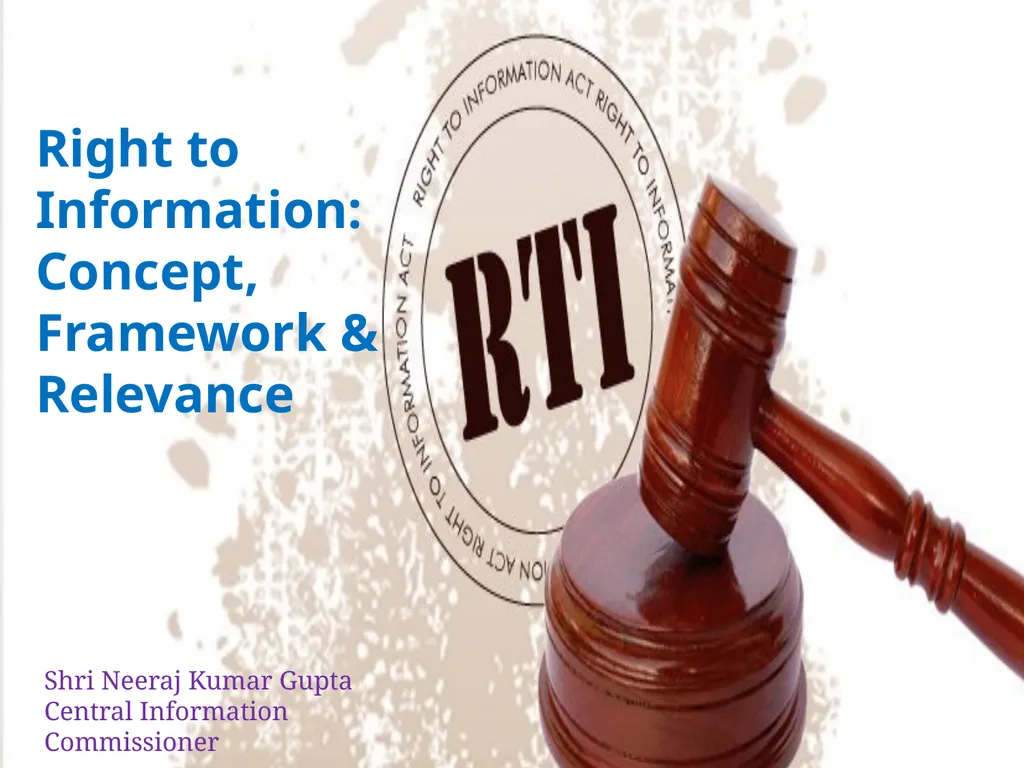
slide1. Shri Neeraj Kumar Gupta
Central Information Commissioner Right to Information: Concept, Framework & Relevance<br>
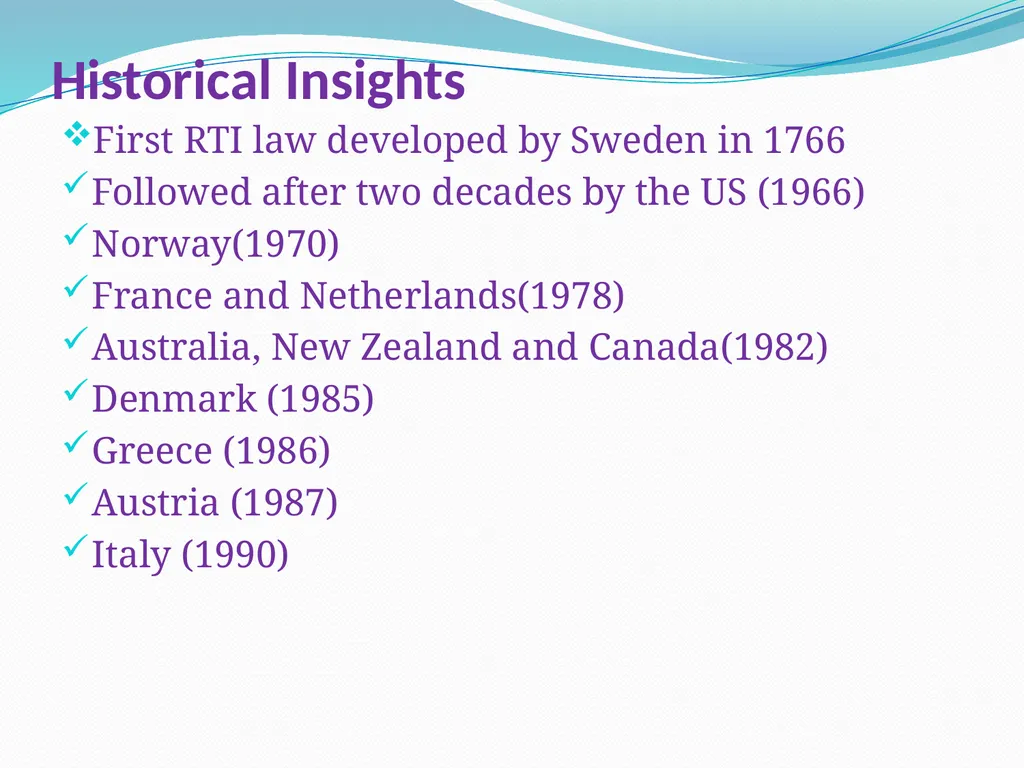
slide2. Historical Insights First RTI law developed by Sweden in 1766
Followed after two decades by the US (1966)
Norway(1970)
France and Netherlands(1978)
Australia, New Zealand and Canada(1982)
Denmark (1985)
Greece (1986)
Austria (1987)
Italy (1990)<br>
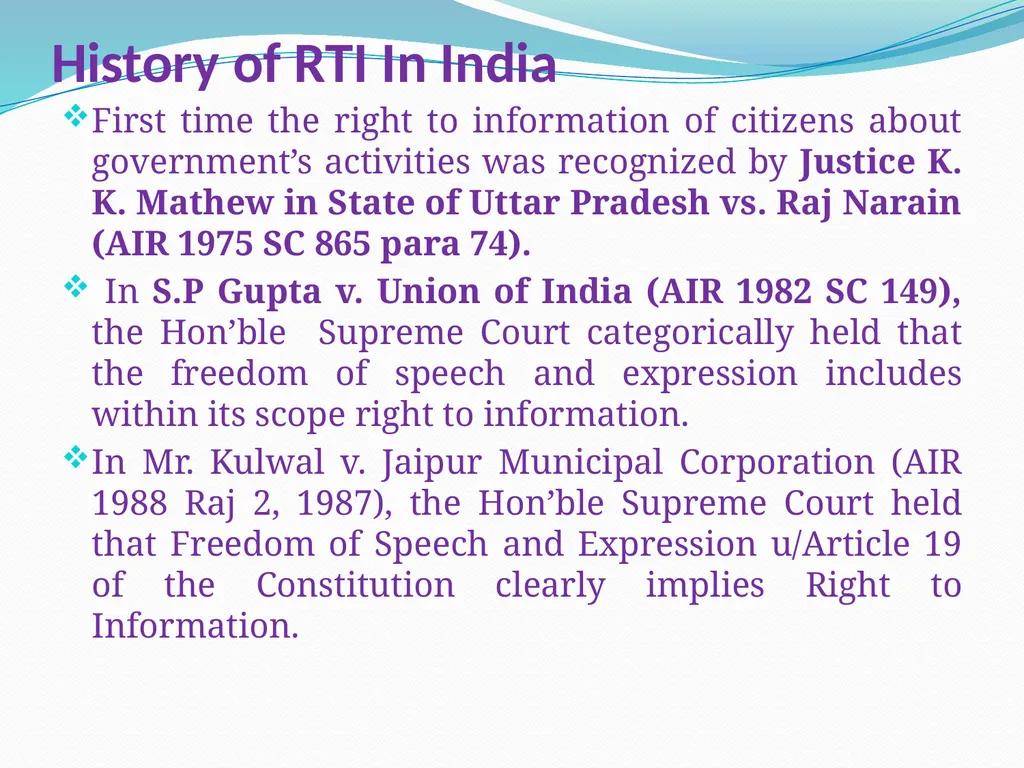
slide3. History of RTI In India First time the right to information of citizens about government’s activities was recognized by Justice K. K. Mathew in State of Uttar Pradesh vs. Raj Narain (AIR 1975 SC 865 para 74).
In S.P Gupta v. Union of India (AIR 1982 SC 149), the Hon’ble Supreme Court categorically held that the freedom of speech and expression includes within its scope right to information.
In Mr. Kulwal v. Jaipur Municipal Corporation (AIR 1988 Raj 2, 1987), the Hon’ble Supreme Court held that Freedom of Speech and Expression u/Article 19 of the Constitution clearly implies Right to Information.<br>
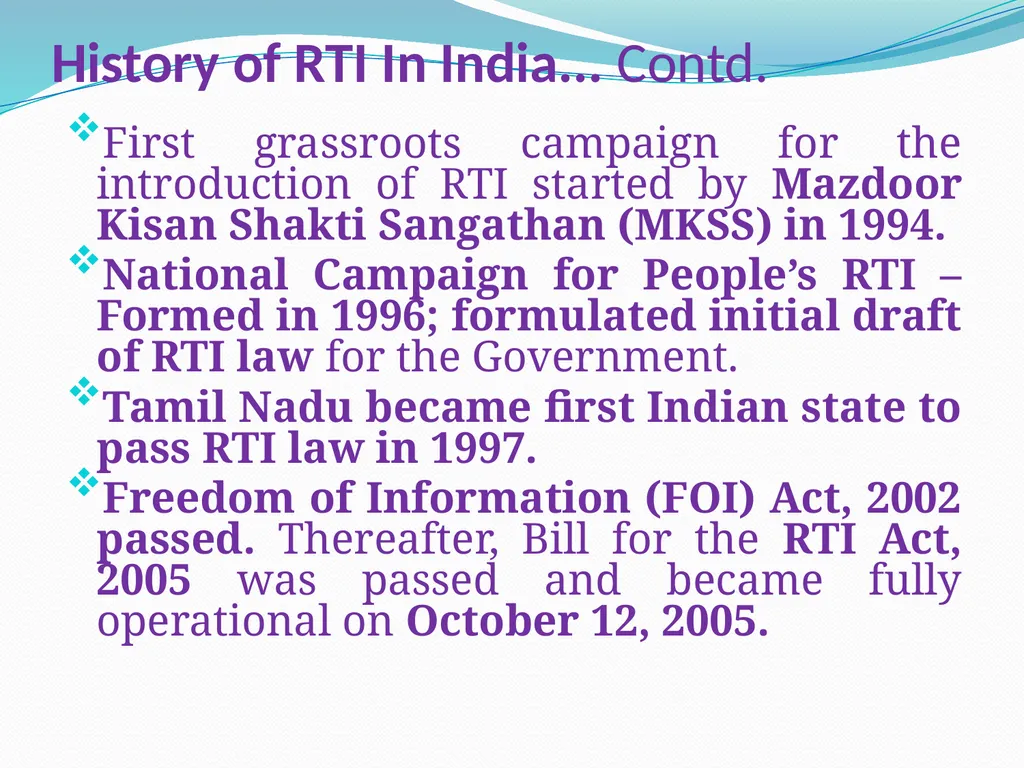
slide4. History of RTI In India... Contd. First grassroots campaign for the introduction of RTI started by Mazdoor Kisan Shakti Sangathan (MKSS) in 1994.
National Campaign for People’s RTI – Formed in 1996; formulated initial draft of RTI law for the Government.
Tamil Nadu became first Indian state to pass RTI law in 1997.
Freedom of Information (FOI) Act, 2002 passed. Thereafter, Bill for the RTI Act, 2005 was passed and became fully operational on October 12, 2005.<br>
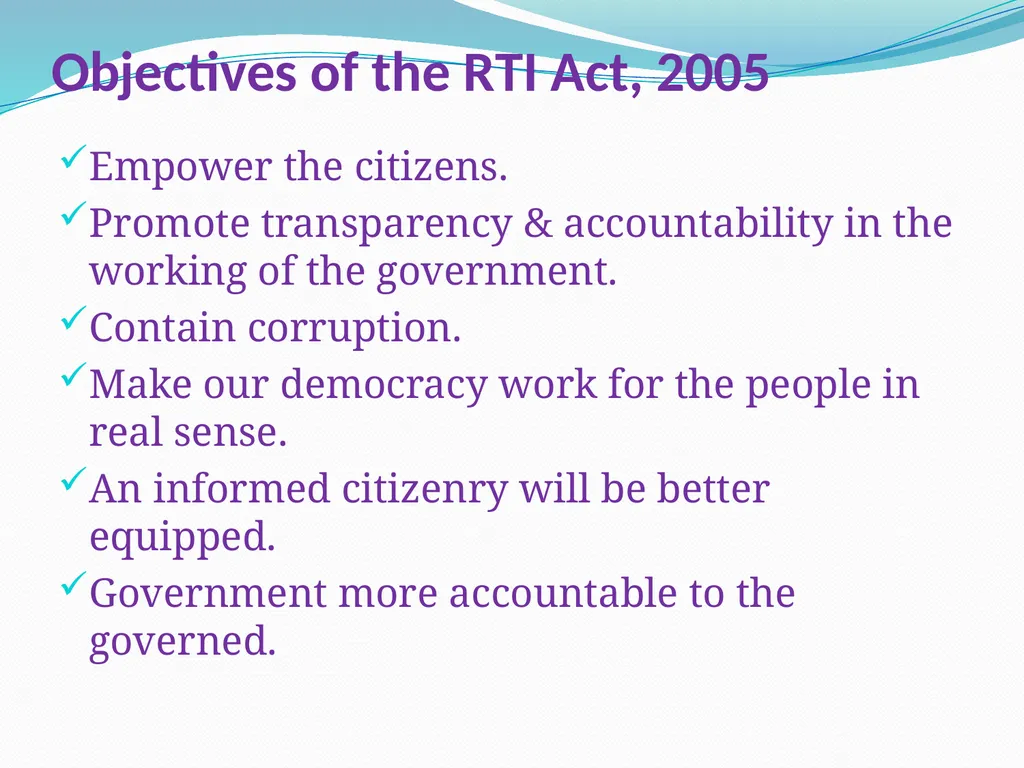
slide5. Objectives of the RTI Act, 2005 Empower the citizens.
Promote transparency & accountability in the working of the government.
Contain corruption.
Make our democracy work for the people in real sense.
An informed citizenry will be better equipped.
Government more accountable to the governed.<br>
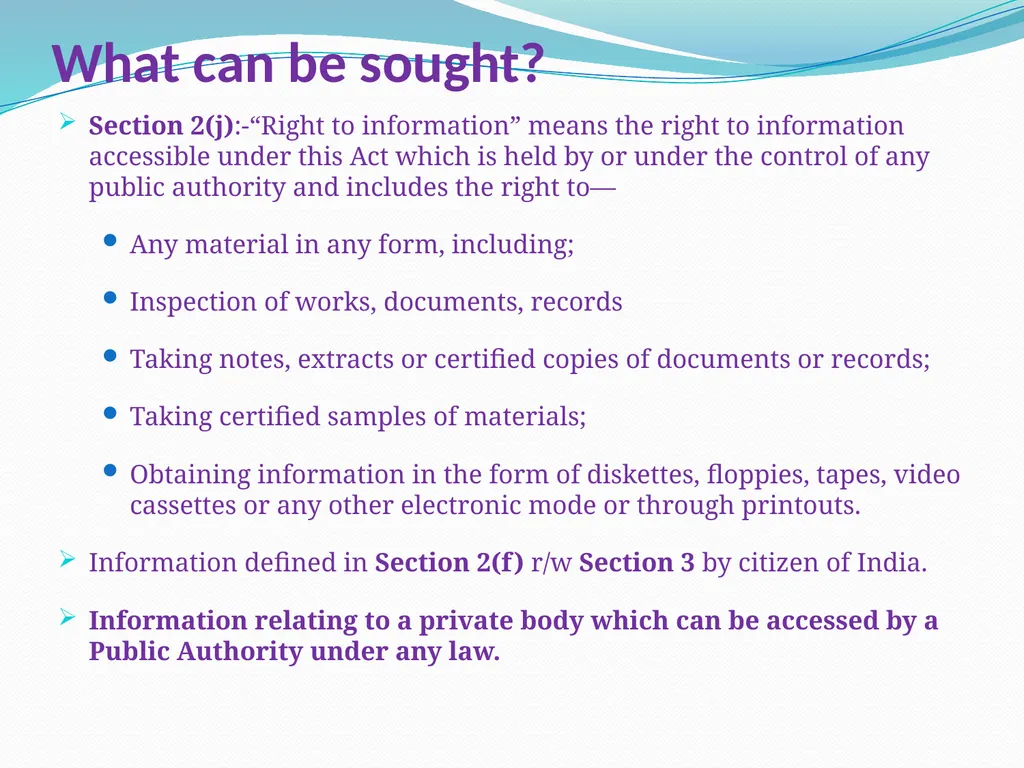
slide6. What can be sought? Section 2(j):-“Right to information” means the right to information accessible under this Act which is held by or under the control of any public authority and includes the right to—
Any material in any form, including;
Inspection of works, documents, records
Taking notes, extracts or certified copies of documents or records;
Taking certified samples of materials;
Obtaining information in the form of diskettes, floppies, tapes, video cassettes or any other electronic mode or through printouts.
Information defined in Section 2(f) r/w Section 3 by citizen of India.
Information relating to a private body which can be accessed by a Public Authority under any law.<br>
slide7. Indian Law: Provisions & Practices<br>
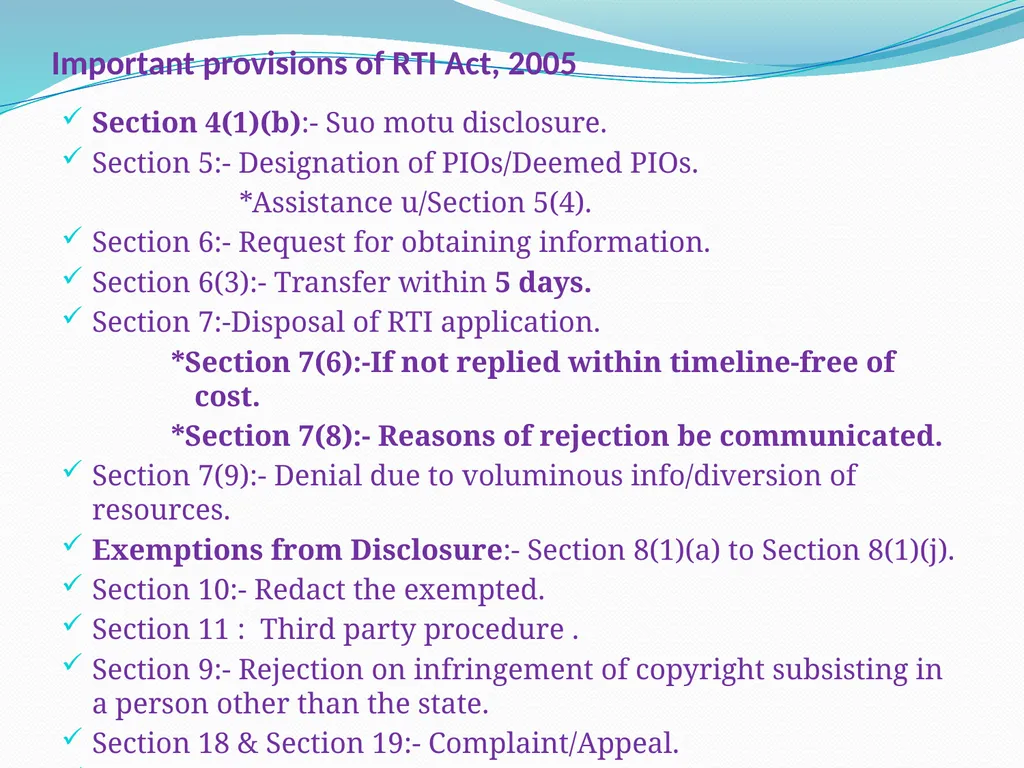
slide8. Important provisions of RTI Act, 2005 Section 4(1)(b):- Suo motu disclosure.
Section 5:- Designation of PIOs/Deemed PIOs.
*Assistance u/Section 5(4).
Section 6:- Request for obtaining information.
Section 6(3):- Transfer within 5 days.
Section 7:-Disposal of RTI application.
*Section 7(6):-If not replied within timeline-free of cost.
*Section 7(8):- Reasons of rejection be communicated.
Section 7(9):- Denial due to voluminous info/diversion of resources.
Exemptions from Disclosure:- Section 8(1)(a) to Section 8(1)(j).
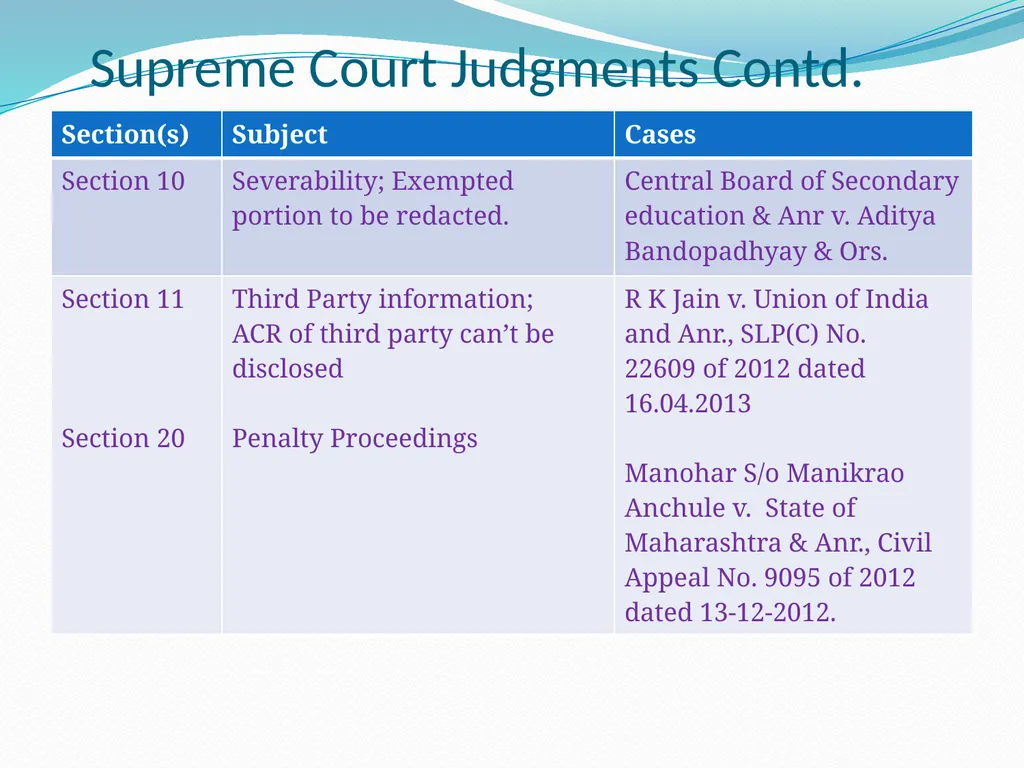
Section 10:- Redact the exempted.
Section 11 : Third party procedure .
Section 9:- Rejection on infringement of copyright subsisting in a person other than the state.
Section 18 & Section 19:- Complaint/Appeal.
Section 20:- Penalties.<br>
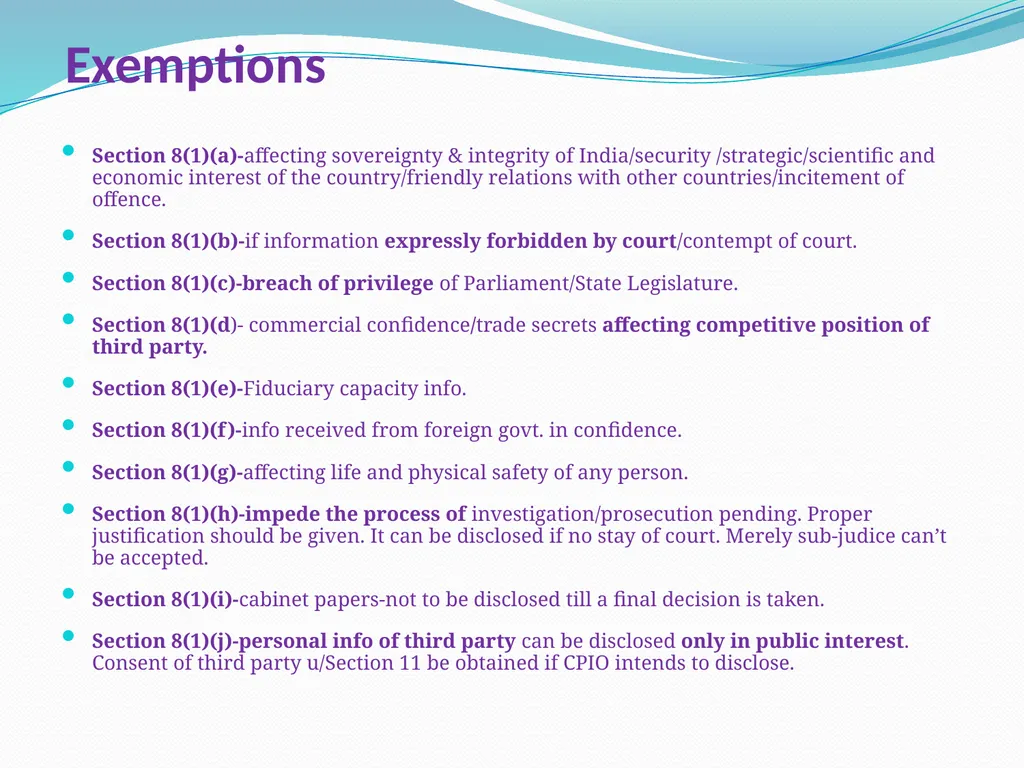
slide9. Exemptions Section 8(1)(a)-affecting sovereignty & integrity of India/security /strategic/scientific and economic interest of the country/friendly relations with other countries/incitement of offence.
Section 8(1)(b)-if information expressly forbidden by court/contempt of court.
Section 8(1)(c)-breach of privilege of Parliament/State Legislature.
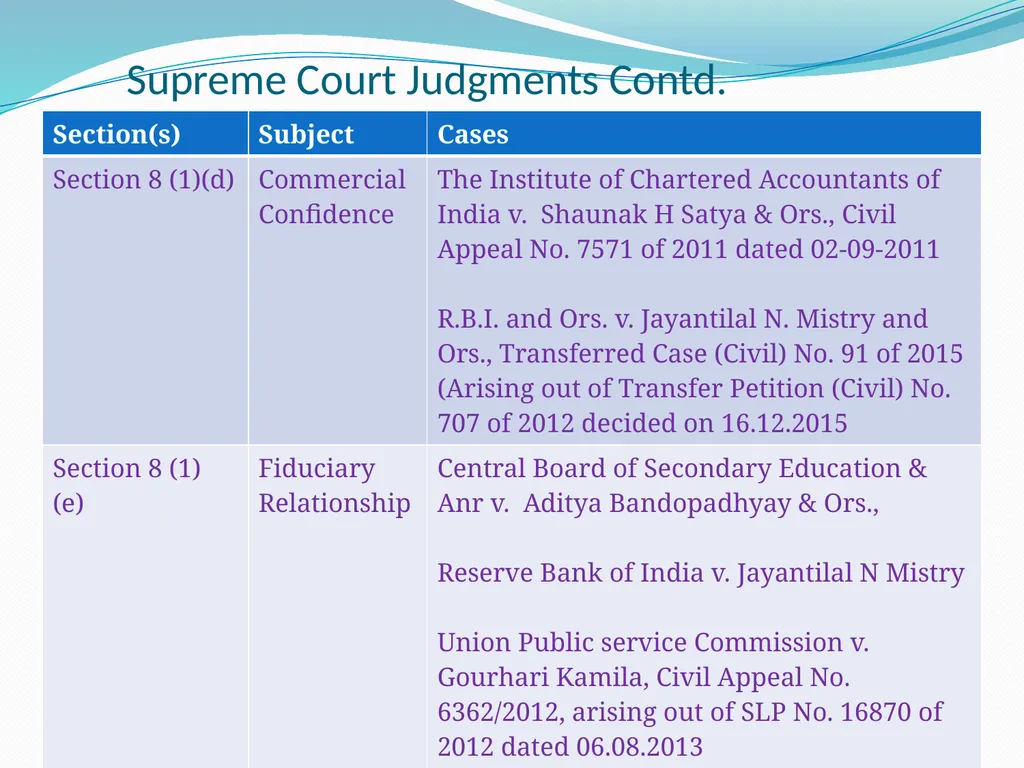
Section 8(1)(d)- commercial confidence/trade secrets affecting competitive position of third party.
Section 8(1)(e)-Fiduciary capacity info.
Section 8(1)(f)-info received from foreign govt. in confidence.
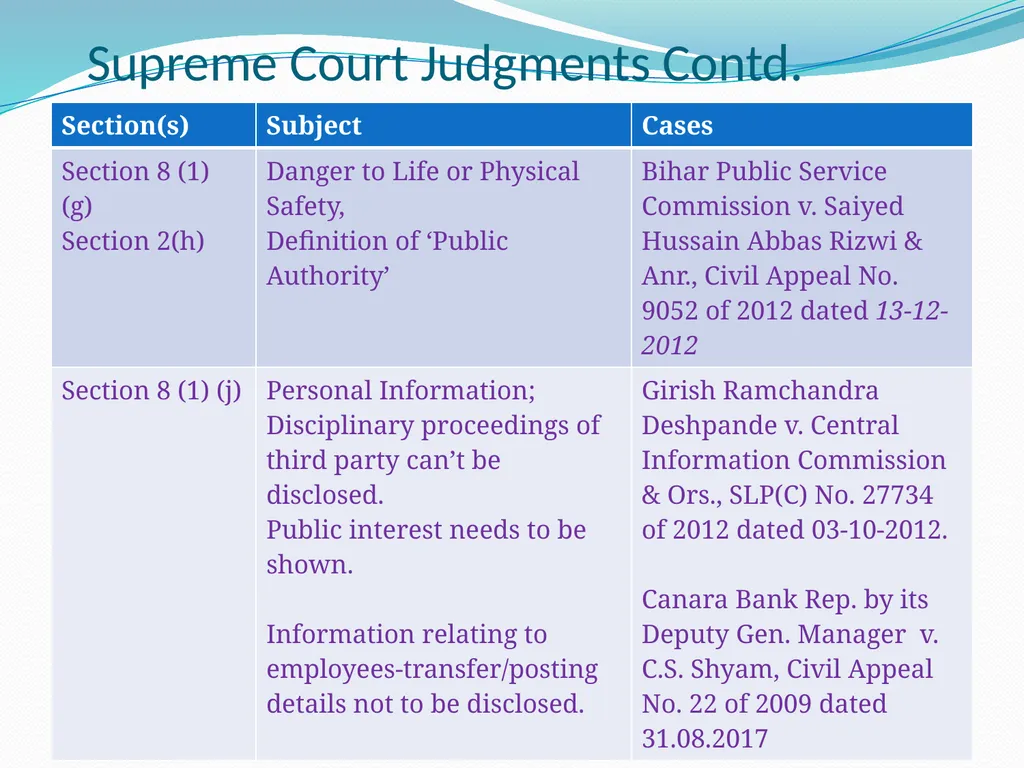
Section 8(1)(g)-affecting life and physical safety of any person.
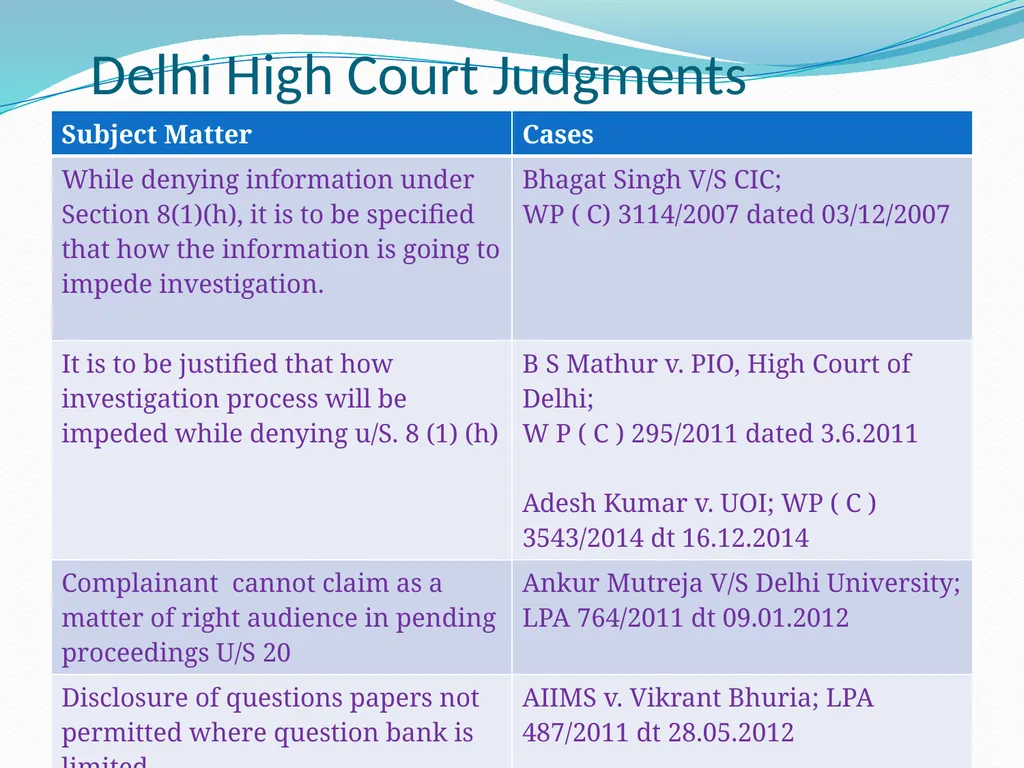
Section 8(1)(h)-impede the process of investigation/prosecution pending. Proper justification should be given. It can be disclosed if no stay of court. Merely sub-judice can’t be accepted.
Section 8(1)(i)-cabinet papers-not to be disclosed till a final decision is taken.
Section 8(1)(j)-personal info of third party can be disclosed only in public interest. Consent of third party u/Section 11 be obtained if CPIO intends to disclose.<br>
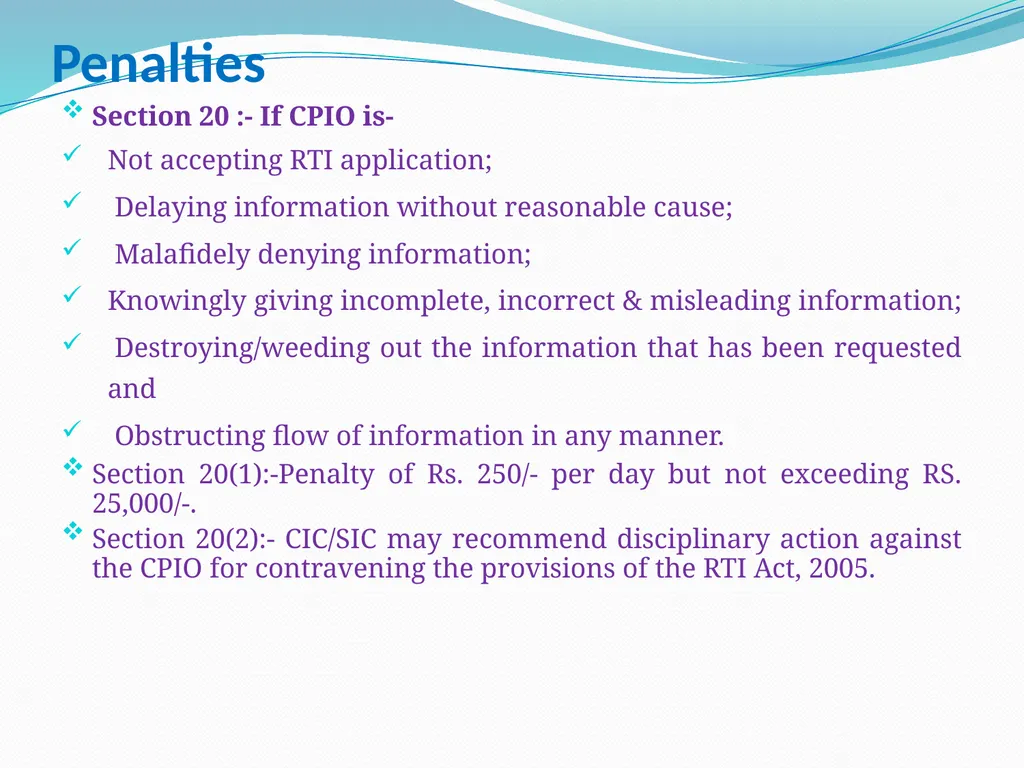
slide10. Penalties Section 20 :- If CPIO is-
Not accepting RTI application;
Delaying information without reasonable cause;
Malafidely denying information;
Knowingly giving incomplete, incorrect & misleading information;
Destroying/weeding out the information that has been requested and
Obstructing flow of information in any manner.
Section 20(1):-Penalty of Rs. 250/- per day but not exceeding RS. 25,000/-.
Section 20(2):- CIC/SIC may recommend disciplinary action against the CPIO for contravening the provisions of the RTI Act, 2005.<br>
slide11. Leveraging RTI Act For Governance Goals<br>
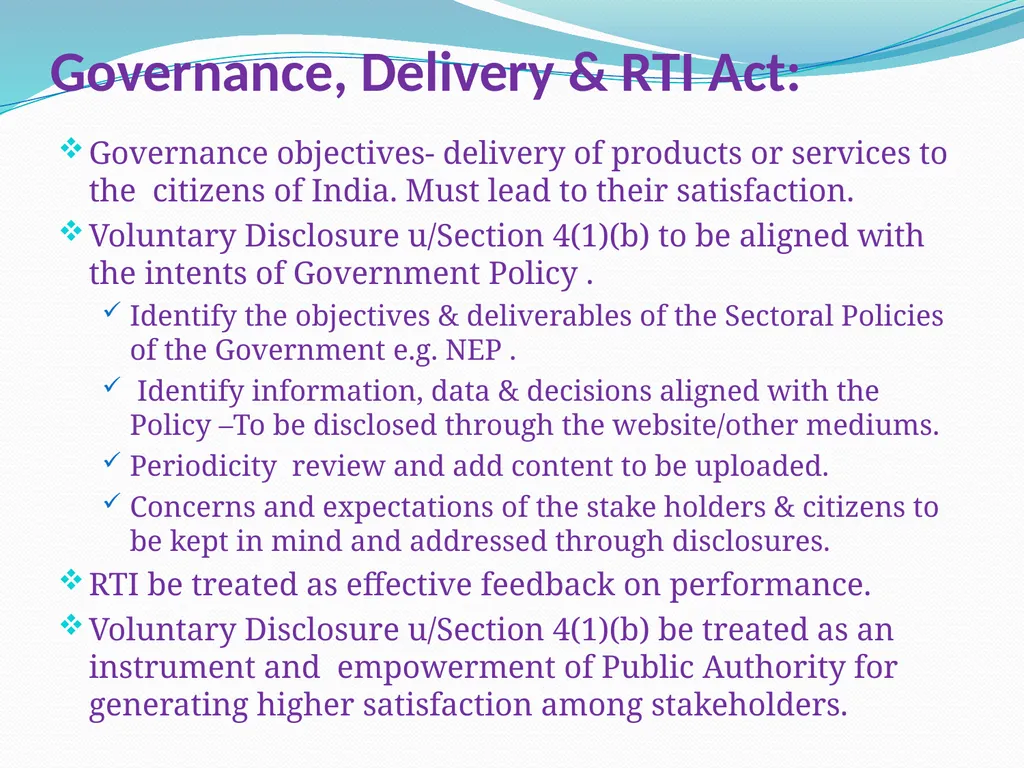
slide12. Governance, Delivery & RTI Act: Governance objectives- delivery of products or services to the citizens of India. Must lead to their satisfaction.
Voluntary Disclosure u/Section 4(1)(b) to be aligned with the intents of Government Policy .
Identify the objectives & deliverables of the Sectoral Policies of the Government e.g. NEP .
Identify information, data & decisions aligned with the Policy –To be disclosed through the website/other mediums.
Periodicity review and add content to be uploaded.
Concerns and expectations of the stake holders & citizens to be kept in mind and addressed through disclosures.
RTI be treated as effective feedback on performance.
Voluntary Disclosure u/Section 4(1)(b) be treated as an instrument and empowerment of Public Authority for generating higher satisfaction among stakeholders.<br>
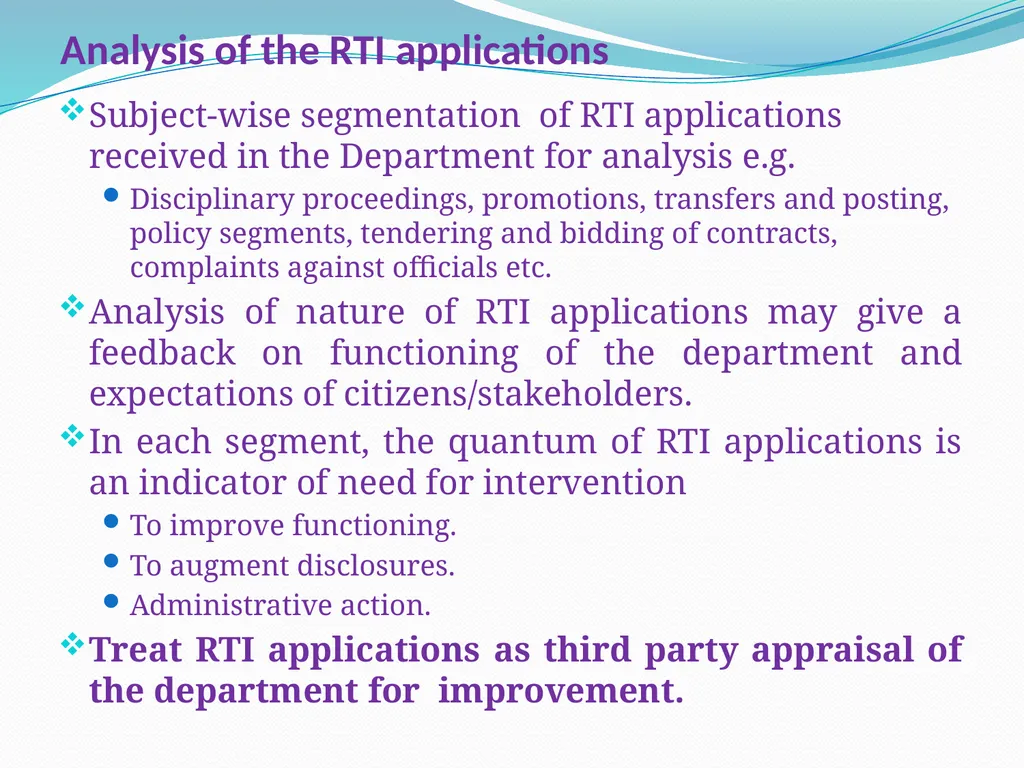
slide13. Analysis of the RTI applications Subject-wise segmentation of RTI applications received in the Department for analysis e.g.
Disciplinary proceedings, promotions, transfers and posting, policy segments, tendering and bidding of contracts, complaints against officials etc.
Analysis of nature of RTI applications may give a feedback on functioning of the department and expectations of citizens/stakeholders.
In each segment, the quantum of RTI applications is an indicator of need for intervention
To improve functioning.
To augment disclosures.
Administrative action.
Treat RTI applications as third party appraisal of the department for improvement.<br>
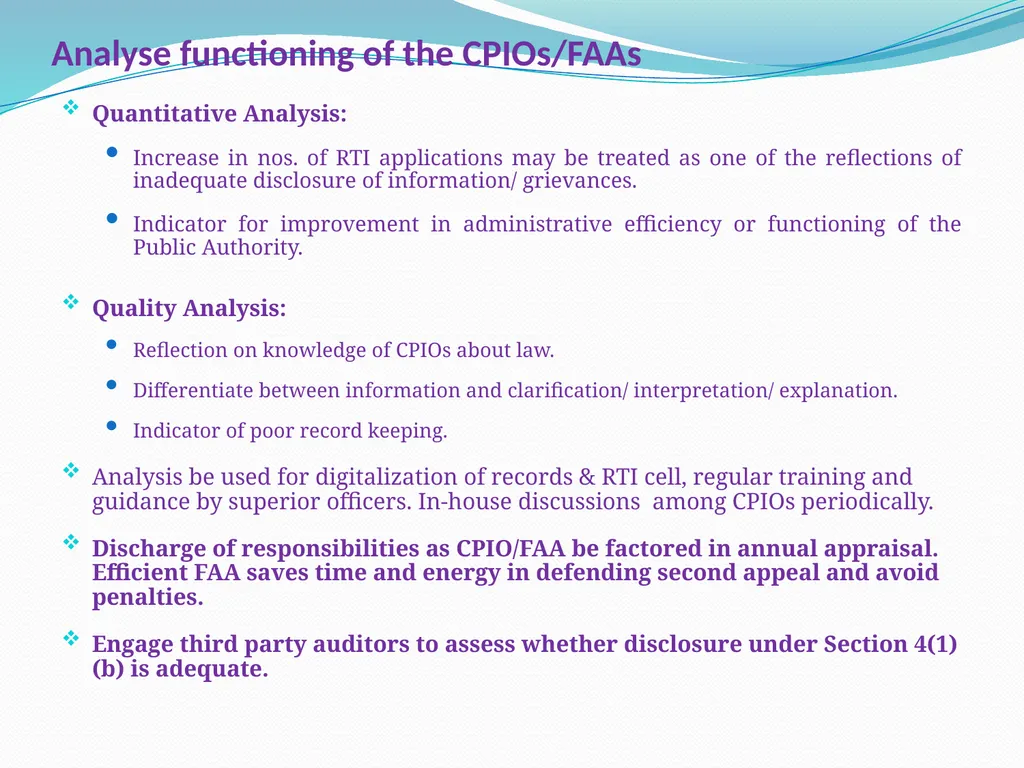
slide14. Analyse functioning of the CPIOs/FAAs Quantitative Analysis:
Increase in nos. of RTI applications may be treated as one of the reflections of inadequate disclosure of information/ grievances.
Indicator for improvement in administrative efficiency or functioning of the Public Authority.
Quality Analysis:
Reflection on knowledge of CPIOs about law.
Differentiate between information and clarification/ interpretation/ explanation.
Indicator of poor record keeping.
Analysis be used for digitalization of records & RTI cell, regular training and guidance by superior officers. In-house discussions among CPIOs periodically.
Discharge of responsibilities as CPIO/FAA be factored in annual appraisal. Efficient FAA saves time and energy in defending second appeal and avoid penalties.
Engage third party auditors to assess whether disclosure under Section 4(1)(b) is adequate.<br>
slide15. Challenges & Learnings<br>
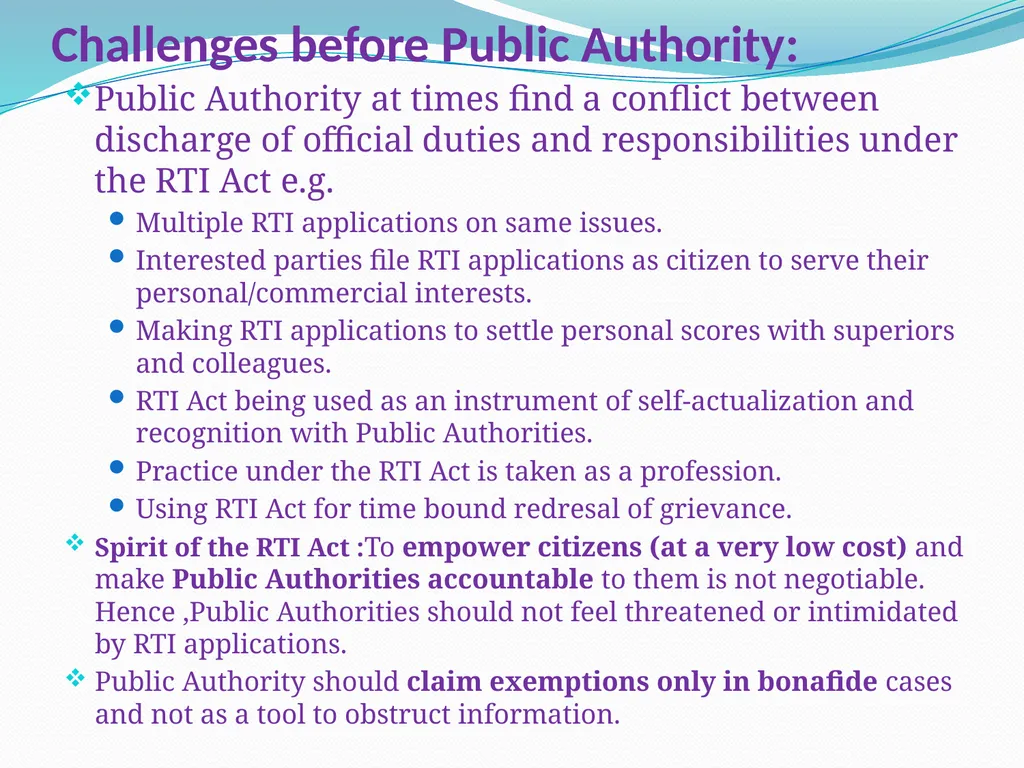
slide16. Challenges before Public Authority: Public Authority at times find a conflict between discharge of official duties and responsibilities under the RTI Act e.g.
Multiple RTI applications on same issues.
Interested parties file RTI applications as citizen to serve their personal/commercial interests.
Making RTI applications to settle personal scores with superiors and colleagues.
RTI Act being used as an instrument of self-actualization and recognition with Public Authorities.
Practice under the RTI Act is taken as a profession.
Using RTI Act for time bound redresal of grievance.
Spirit of the RTI Act :To empower citizens (at a very low cost) and make Public Authorities accountable to them is not negotiable. Hence ,Public Authorities should not feel threatened or intimidated by RTI applications.
Public Authority should claim exemptions only in bonafide cases and not as a tool to obstruct information.<br>
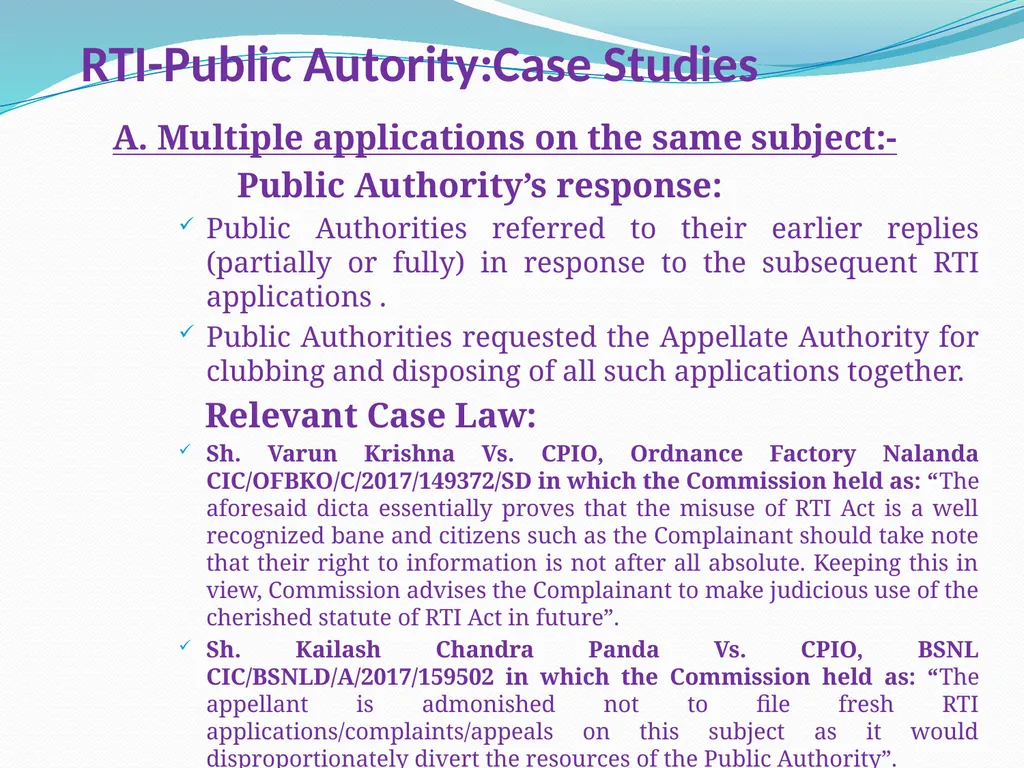
slide17. RTI-Public Autority:Case Studies A. Multiple applications on the same subject:-
Public Authority’s response:
Public Authorities referred to their earlier replies (partially or fully) in response to the subsequent RTI applications .
Public Authorities requested the Appellate Authority for clubbing and disposing of all such applications together.
Relevant Case Law:
Sh. Varun Krishna Vs. CPIO, Ordnance Factory Nalanda CIC/OFBKO/C/2017/149372/SD in which the Commission held as: “The aforesaid dicta essentially proves that the misuse of RTI Act is a well recognized bane and citizens such as the Complainant should take note that their right to information is not after all absolute. Keeping this in view, Commission advises the Complainant to make judicious use of the cherished statute of RTI Act in future”.
Sh. Kailash Chandra Panda Vs. CPIO, BSNL CIC/BSNLD/A/2017/159502 in which the Commission held as: “The appellant is admonished not to file fresh RTI applications/complaints/appeals on this subject as it would disproportionately divert the resources of the Public Authority”.<br>
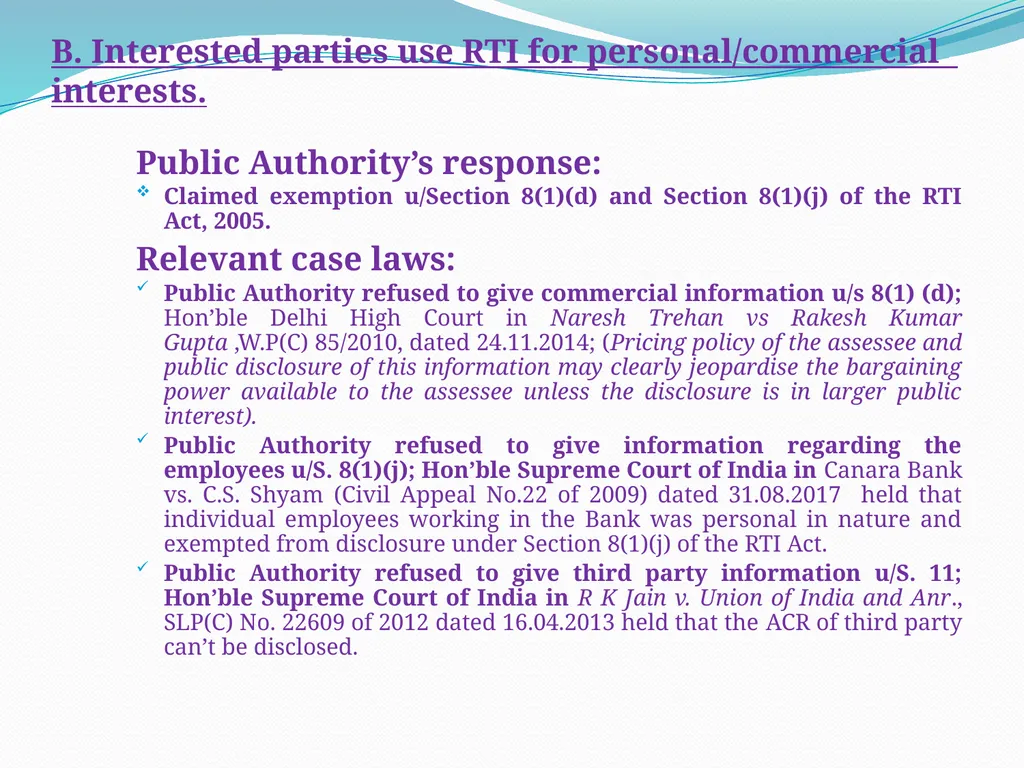
slide18. B. Interested parties use RTI for personal/commercial interests. Public Authority’s response:
Claimed exemption u/Section 8(1)(d) and Section 8(1)(j) of the RTI Act, 2005.
Relevant case laws:
Public Authority refused to give commercial information u/s 8(1) (d); Hon’ble Delhi High Court in Naresh Trehan vs Rakesh Kumar Gupta ,W.P(C) 85/2010, dated 24.11.2014; (Pricing policy of the assessee and public disclosure of this information may clearly jeopardise the bargaining power available to the assessee unless the disclosure is in larger public interest).
Public Authority refused to give information regarding the employees u/S. 8(1)(j); Hon’ble Supreme Court of India in Canara Bank vs. C.S. Shyam (Civil Appeal No.22 of 2009) dated 31.08.2017 held that individual employees working in the Bank was personal in nature and exempted from disclosure under Section 8(1)(j) of the RTI Act.
Public Authority refused to give third party information u/S. 11; Hon’ble Supreme Court of India in R K Jain v. Union of India and Anr., SLP(C) No. 22609 of 2012 dated 16.04.2013 held that the ACR of third party can’t be disclosed.<br>
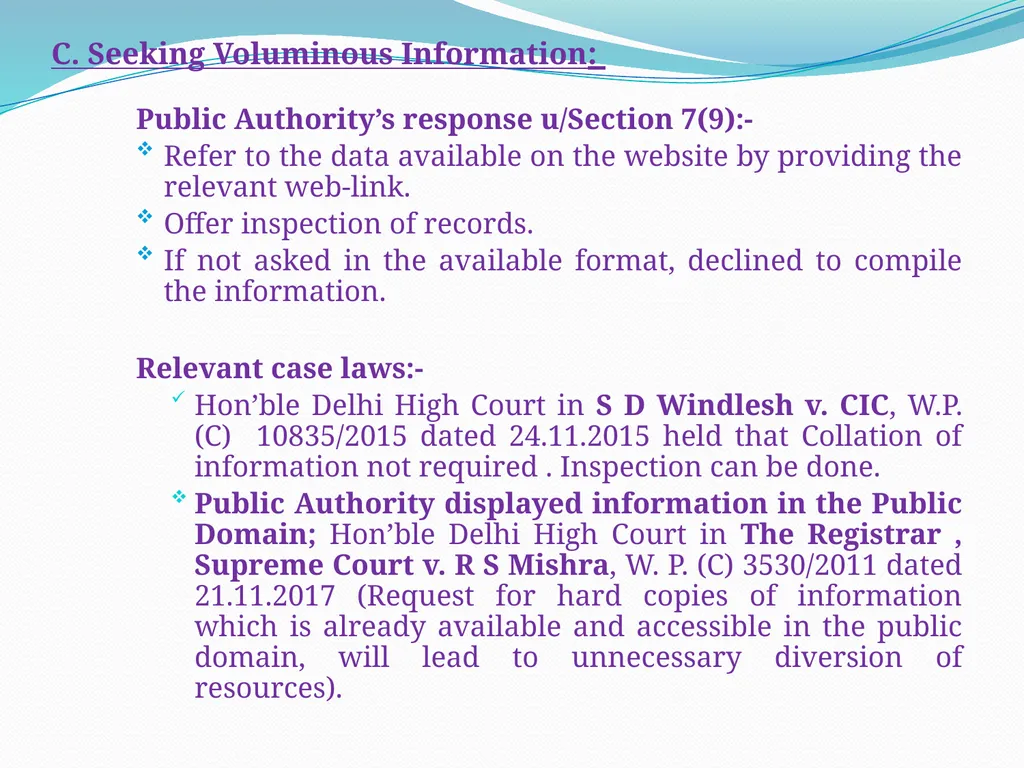
slide19. C. Seeking Voluminous Information: Public Authority’s response u/Section 7(9):-
Refer to the data available on the website by providing the relevant web-link.
Offer inspection of records.
If not asked in the available format, declined to compile the information.
Relevant case laws:-
Hon’ble Delhi High Court in S D Windlesh v. CIC, W.P.(C) 10835/2015 dated 24.11.2015 held that Collation of information not required . Inspection can be done.
Public Authority displayed information in the Public Domain; Hon’ble Delhi High Court in The Registrar , Supreme Court v. R S Mishra, W. P. (C) 3530/2011 dated 21.11.2017 (Request for hard copies of information which is already available and accessible in the public domain, will lead to unnecessary diversion of resources).<br>
slide20. Public Authority’s response:
Personal information cannot be given unless public interest .
Action Taken Report for complaints sought through the RTI application- Public Authority responded briefly indicating the Action Taken on the complaint without getting into the content of the complaint.
Relevant case laws:
Public Authority refused to give information regarding the employees u/S. 8(1)(j); Hon’ble Supreme Court of India in Canara Bank vs. C.S. Shyam (Civil Appeal No.22 of 2009) dated 31.08.2017 held that individual employees working in the Bank was personal in nature and exempted from disclosure under Section 8(1)(j) of the RTI Act.
Girish Ramchandra Deshpande vs. Central Information Commission & ors. SLP(C) No. 27734 of 2012 dated 03/10/2012 wherein it was held as under:
“13......The performance of an employee/officer in an organization is primarily a matter between the employee and the employer and normally those aspects are governed by the service rules which fall under the expression "personal information", the disclosure of which has no relationship to any public activity or public interest. D. Settling Personal Scores:<br>
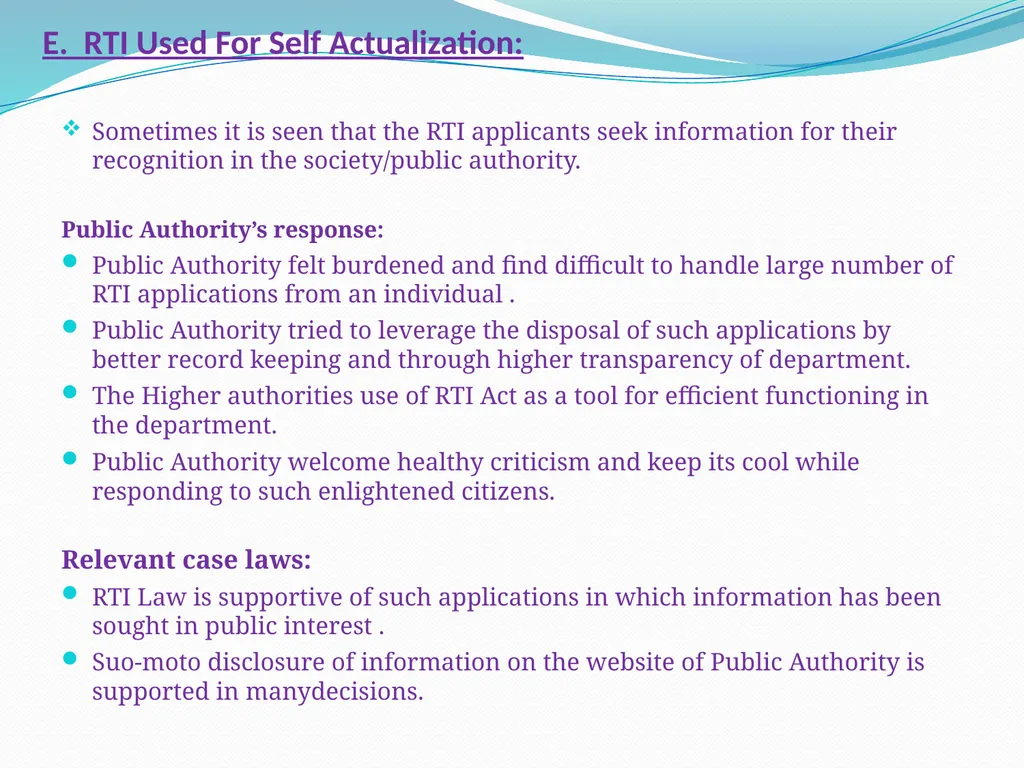
slide21. E. RTI Used For Self Actualization: Sometimes it is seen that the RTI applicants seek information for their recognition in the society/public authority.
Public Authority’s response:
Public Authority felt burdened and find difficult to handle large number of RTI applications from an individual .
Public Authority tried to leverage the disposal of such applications by better record keeping and through higher transparency of department.
The Higher authorities use of RTI Act as a tool for efficient functioning in the department.
Public Authority welcome healthy criticism and keep its cool while responding to such enlightened citizens.
Relevant case laws:
RTI Law is supportive of such applications in which information has been sought in public interest .
Suo-moto disclosure of information on the website of Public Authority is supported in manydecisions.<br>
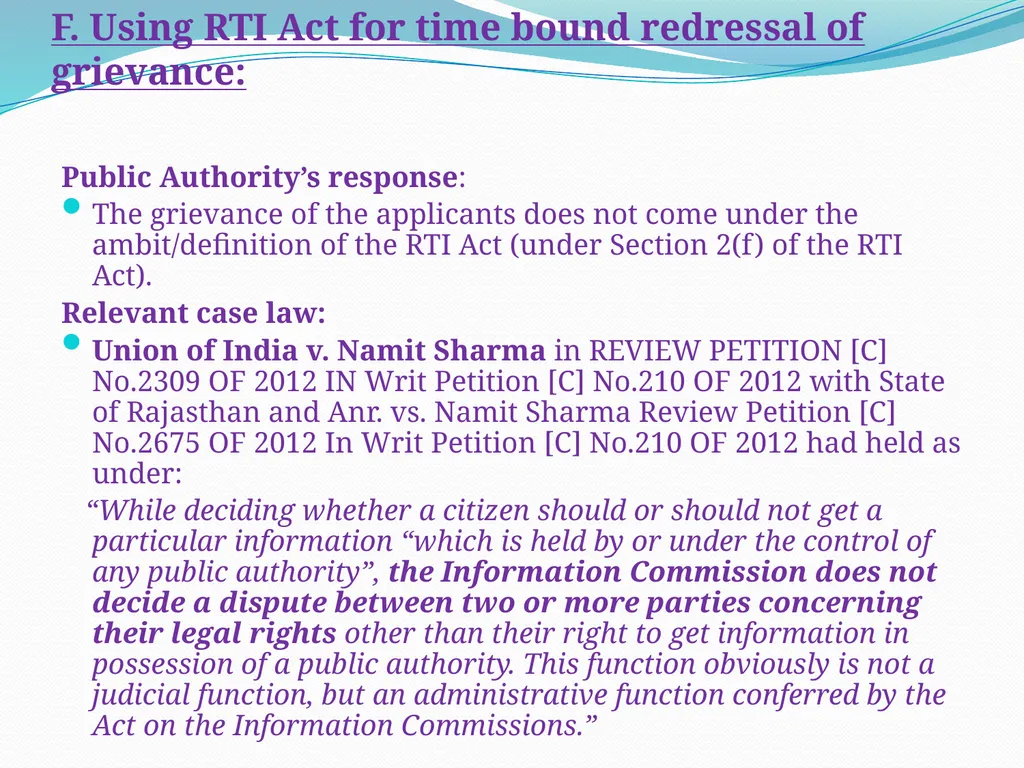
slide22. F. Using RTI Act for time bound redressal of grievance: Public Authority’s response:
The grievance of the applicants does not come under the ambit/definition of the RTI Act (under Section 2(f) of the RTI Act).
Relevant case law:
Union of India v. Namit Sharma in REVIEW PETITION [C] No.2309 OF 2012 IN Writ Petition [C] No.210 OF 2012 with State of Rajasthan and Anr. vs. Namit Sharma Review Petition [C] No.2675 OF 2012 In Writ Petition [C] No.210 OF 2012 had held as under:
“While deciding whether a citizen should or should not get a particular information “which is held by or under the control of any public authority”, the Information Commission does not decide a dispute between two or more parties concerning their legal rights other than their right to get information in possession of a public authority. This function obviously is not a judicial function, but an administrative function conferred by the Act on the Information Commissions.”<br>
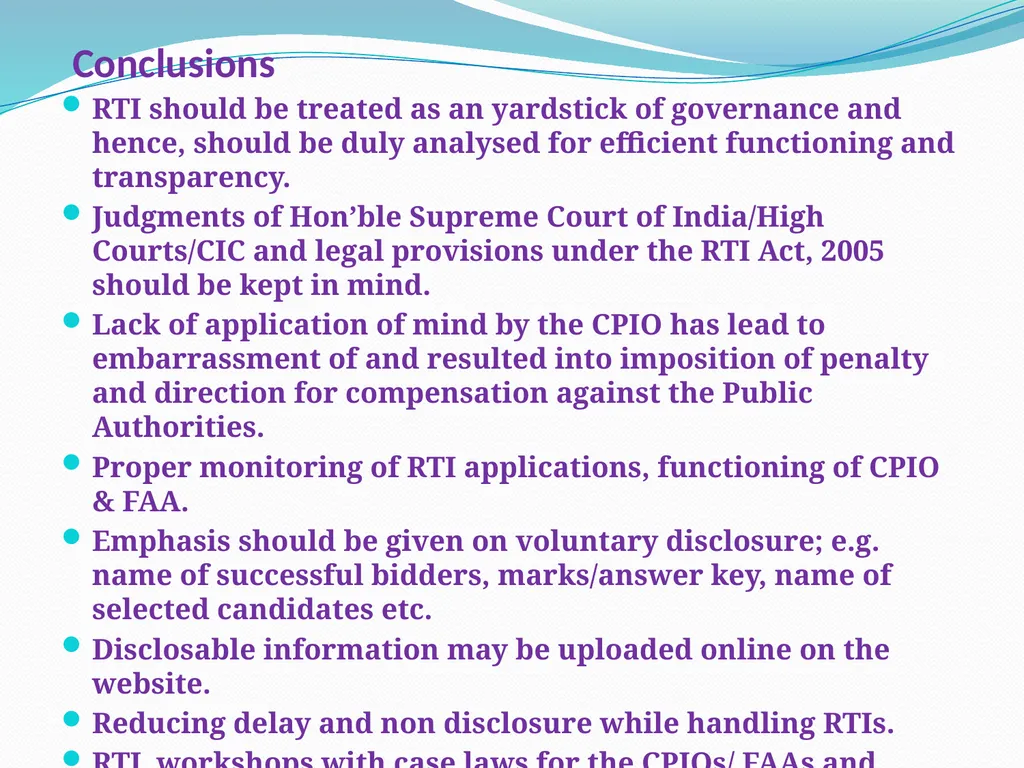
slide23. Conclusions RTI should be treated as an yardstick of governance and hence, should be duly analysed for efficient functioning and transparency.
Judgments of Hon’ble Supreme Court of India/High Courts/CIC and legal provisions under the RTI Act, 2005 should be kept in mind.
Lack of application of mind by the CPIO has lead to embarrassment of and resulted into imposition of penalty and direction for compensation against the Public Authorities.
Proper monitoring of RTI applications, functioning of CPIO & FAA.
Emphasis should be given on voluntary disclosure; e.g. name of successful bidders, marks/answer key, name of selected candidates etc.
Disclosable information may be uploaded online on the website.
Reducing delay and non disclosure while handling RTIs.
RTI workshops with case laws for the CPIOs/ FAAs and concerned staff.<br>
slide24. Thank You!!<br>
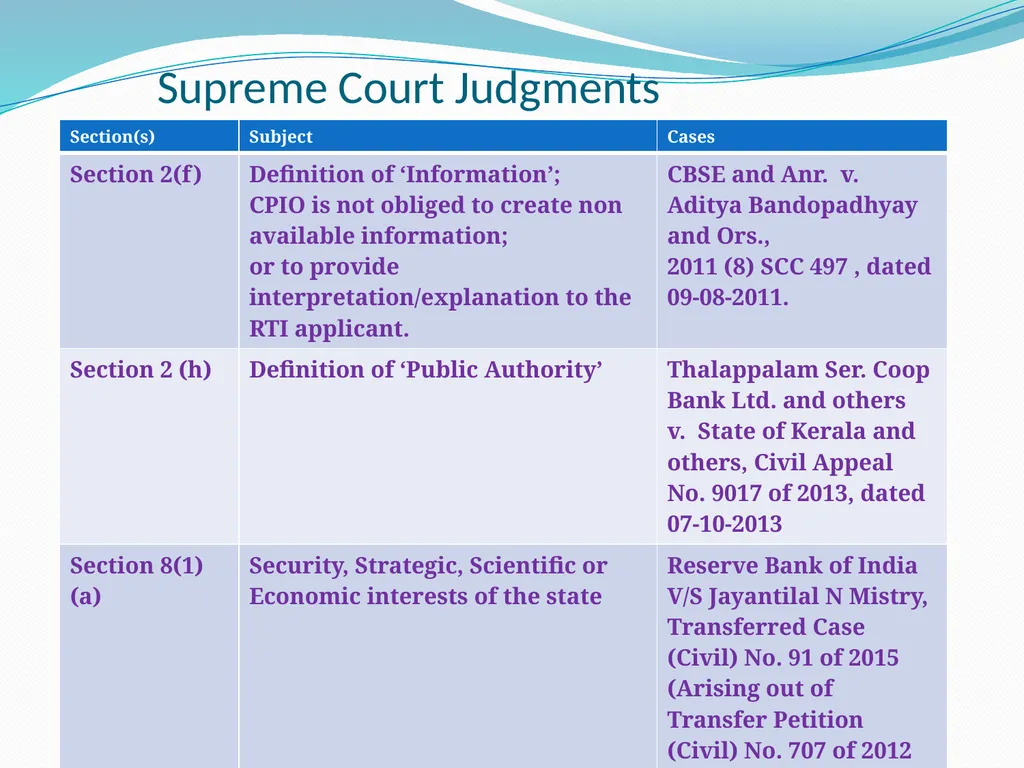
slide25. Supreme Court Judgments<br>
slide26. Supreme Court Judgments Contd.<br>
slide27. Supreme Court Judgments Contd.<br>
slide28. Supreme Court Judgments Contd.<br>
slide29. Delhi High Court Judgments<br>
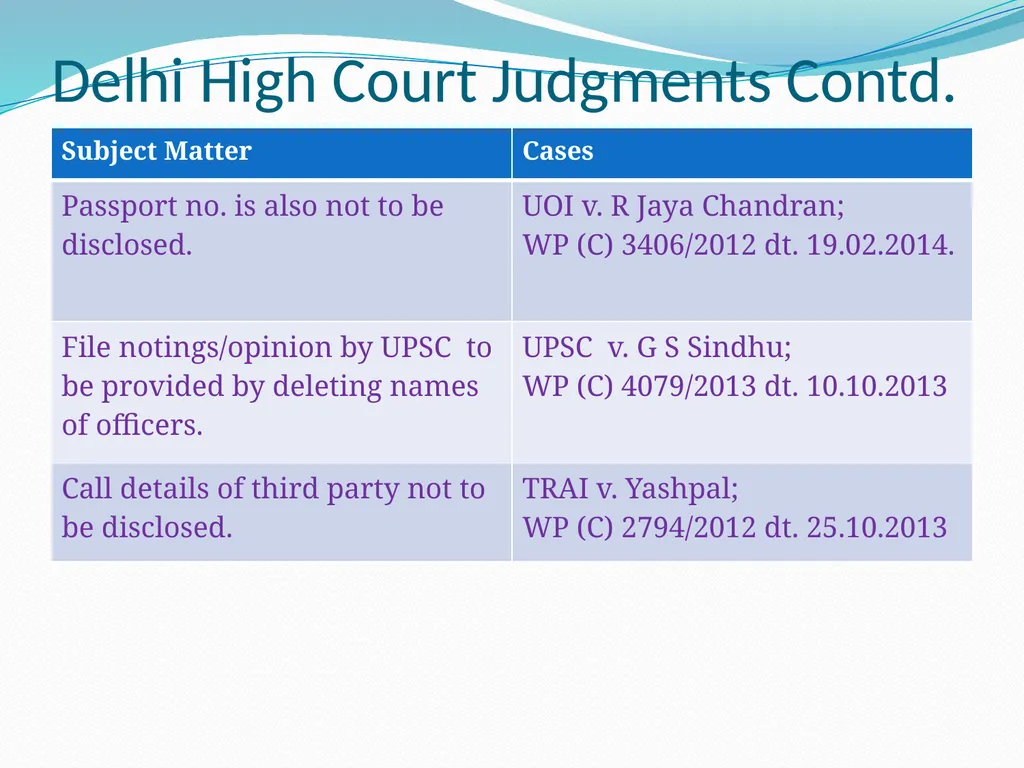
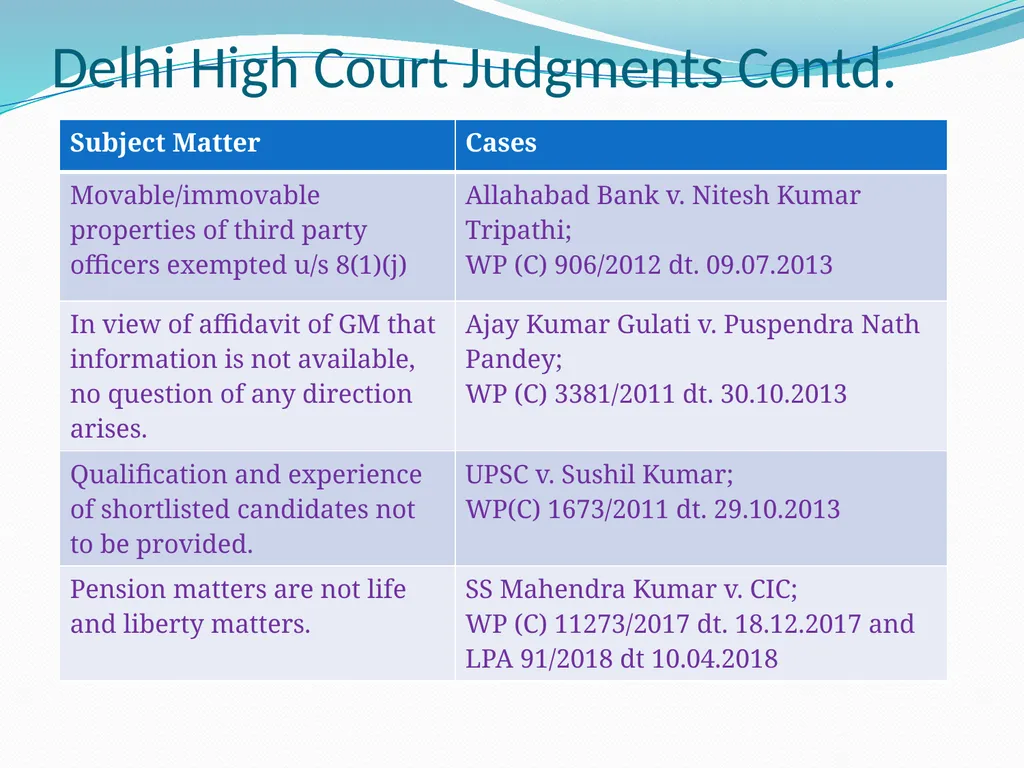
slide30. Delhi High Court Judgments Contd.<br>
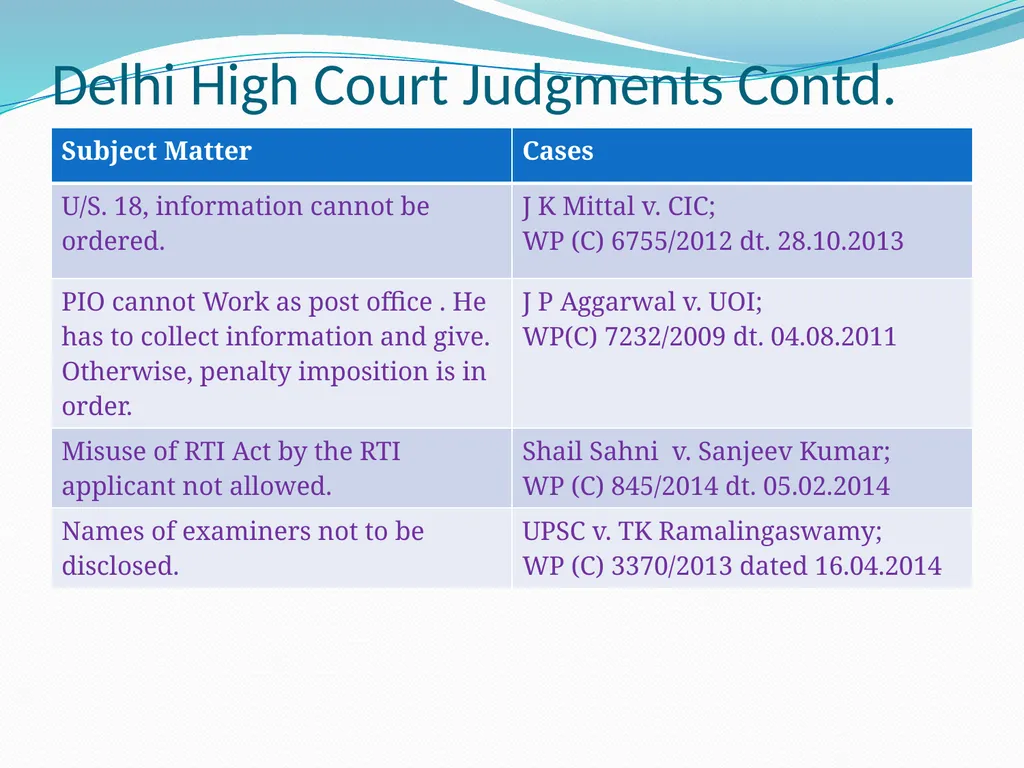
slide31. Delhi High Court Judgments Contd.<br>
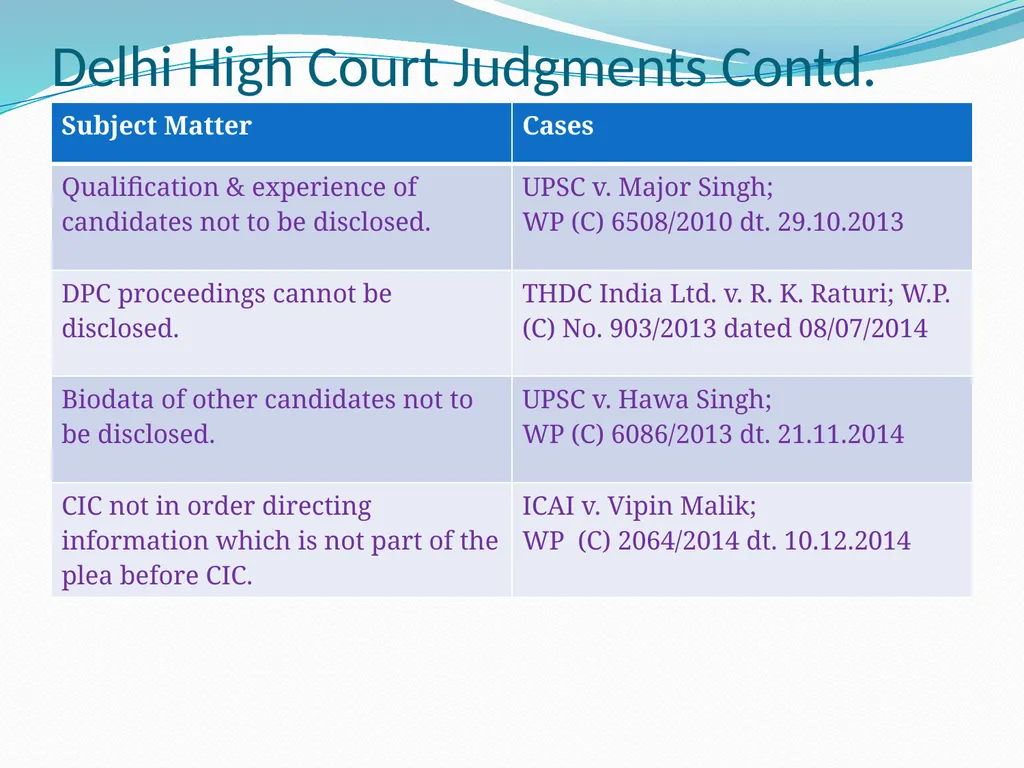
slide32. Delhi High Court Judgments Contd.<br>
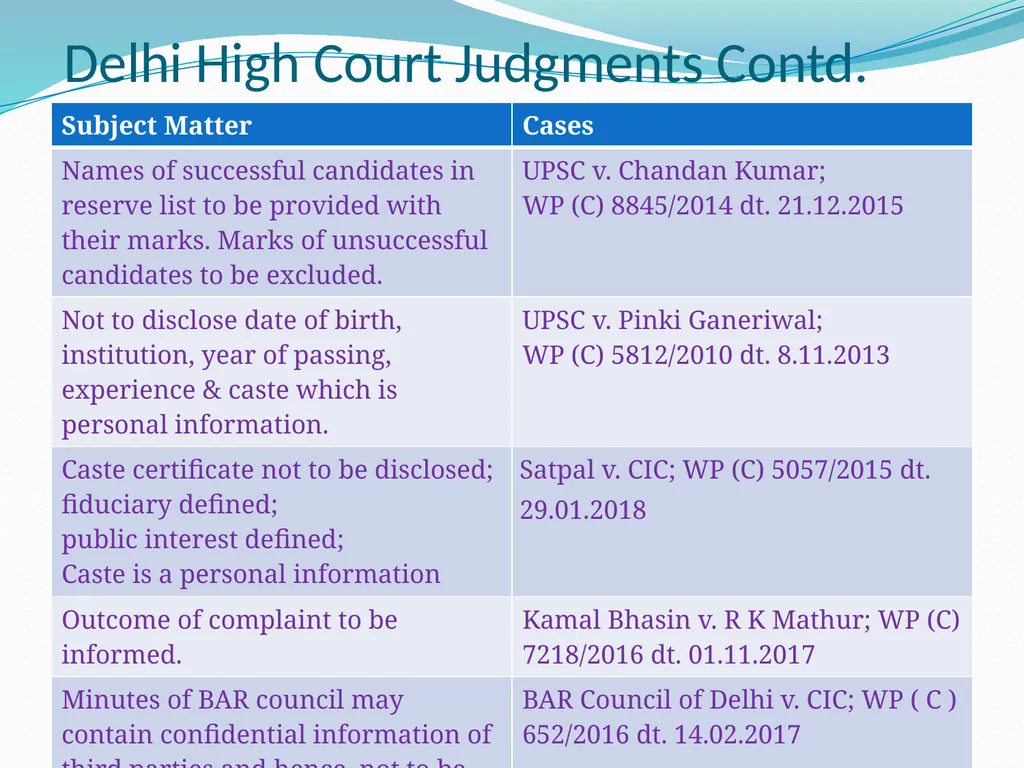
slide33. Delhi High Court Judgments Contd.<br>
slide34. Delhi High Court Judgments Contd.<br>
Central Information Commissioner Right to Information: Concept, Framework & Relevance<br>
slide2. Historical Insights First RTI law developed by Sweden in 1766
Followed after two decades by the US (1966)
Norway(1970)
France and Netherlands(1978)
Australia, New Zealand and Canada(1982)
Denmark (1985)
Greece (1986)
Austria (1987)
Italy (1990)<br>
slide3. History of RTI In India First time the right to information of citizens about government’s activities was recognized by Justice K. K. Mathew in State of Uttar Pradesh vs. Raj Narain (AIR 1975 SC 865 para 74).
In S.P Gupta v. Union of India (AIR 1982 SC 149), the Hon’ble Supreme Court categorically held that the freedom of speech and expression includes within its scope right to information.
In Mr. Kulwal v. Jaipur Municipal Corporation (AIR 1988 Raj 2, 1987), the Hon’ble Supreme Court held that Freedom of Speech and Expression u/Article 19 of the Constitution clearly implies Right to Information.<br>
slide4. History of RTI In India... Contd. First grassroots campaign for the introduction of RTI started by Mazdoor Kisan Shakti Sangathan (MKSS) in 1994.
National Campaign for People’s RTI – Formed in 1996; formulated initial draft of RTI law for the Government.
Tamil Nadu became first Indian state to pass RTI law in 1997.
Freedom of Information (FOI) Act, 2002 passed. Thereafter, Bill for the RTI Act, 2005 was passed and became fully operational on October 12, 2005.<br>
slide5. Objectives of the RTI Act, 2005 Empower the citizens.
Promote transparency & accountability in the working of the government.
Contain corruption.
Make our democracy work for the people in real sense.
An informed citizenry will be better equipped.
Government more accountable to the governed.<br>
slide6. What can be sought? Section 2(j):-“Right to information” means the right to information accessible under this Act which is held by or under the control of any public authority and includes the right to—
Any material in any form, including;
Inspection of works, documents, records
Taking notes, extracts or certified copies of documents or records;
Taking certified samples of materials;
Obtaining information in the form of diskettes, floppies, tapes, video cassettes or any other electronic mode or through printouts.
Information defined in Section 2(f) r/w Section 3 by citizen of India.
Information relating to a private body which can be accessed by a Public Authority under any law.<br>
slide7. Indian Law: Provisions & Practices<br>
slide8. Important provisions of RTI Act, 2005 Section 4(1)(b):- Suo motu disclosure.
Section 5:- Designation of PIOs/Deemed PIOs.
*Assistance u/Section 5(4).
Section 6:- Request for obtaining information.
Section 6(3):- Transfer within 5 days.
Section 7:-Disposal of RTI application.
*Section 7(6):-If not replied within timeline-free of cost.
*Section 7(8):- Reasons of rejection be communicated.
Section 7(9):- Denial due to voluminous info/diversion of resources.
Exemptions from Disclosure:- Section 8(1)(a) to Section 8(1)(j).
Section 10:- Redact the exempted.
Section 11 : Third party procedure .
Section 9:- Rejection on infringement of copyright subsisting in a person other than the state.
Section 18 & Section 19:- Complaint/Appeal.
Section 20:- Penalties.<br>
slide9. Exemptions Section 8(1)(a)-affecting sovereignty & integrity of India/security /strategic/scientific and economic interest of the country/friendly relations with other countries/incitement of offence.
Section 8(1)(b)-if information expressly forbidden by court/contempt of court.
Section 8(1)(c)-breach of privilege of Parliament/State Legislature.
Section 8(1)(d)- commercial confidence/trade secrets affecting competitive position of third party.
Section 8(1)(e)-Fiduciary capacity info.
Section 8(1)(f)-info received from foreign govt. in confidence.
Section 8(1)(g)-affecting life and physical safety of any person.
Section 8(1)(h)-impede the process of investigation/prosecution pending. Proper justification should be given. It can be disclosed if no stay of court. Merely sub-judice can’t be accepted.
Section 8(1)(i)-cabinet papers-not to be disclosed till a final decision is taken.
Section 8(1)(j)-personal info of third party can be disclosed only in public interest. Consent of third party u/Section 11 be obtained if CPIO intends to disclose.<br>
slide10. Penalties Section 20 :- If CPIO is-
Not accepting RTI application;
Delaying information without reasonable cause;
Malafidely denying information;
Knowingly giving incomplete, incorrect & misleading information;
Destroying/weeding out the information that has been requested and
Obstructing flow of information in any manner.
Section 20(1):-Penalty of Rs. 250/- per day but not exceeding RS. 25,000/-.
Section 20(2):- CIC/SIC may recommend disciplinary action against the CPIO for contravening the provisions of the RTI Act, 2005.<br>
slide11. Leveraging RTI Act For Governance Goals<br>
slide12. Governance, Delivery & RTI Act: Governance objectives- delivery of products or services to the citizens of India. Must lead to their satisfaction.
Voluntary Disclosure u/Section 4(1)(b) to be aligned with the intents of Government Policy .
Identify the objectives & deliverables of the Sectoral Policies of the Government e.g. NEP .
Identify information, data & decisions aligned with the Policy –To be disclosed through the website/other mediums.
Periodicity review and add content to be uploaded.
Concerns and expectations of the stake holders & citizens to be kept in mind and addressed through disclosures.
RTI be treated as effective feedback on performance.
Voluntary Disclosure u/Section 4(1)(b) be treated as an instrument and empowerment of Public Authority for generating higher satisfaction among stakeholders.<br>
slide13. Analysis of the RTI applications Subject-wise segmentation of RTI applications received in the Department for analysis e.g.
Disciplinary proceedings, promotions, transfers and posting, policy segments, tendering and bidding of contracts, complaints against officials etc.
Analysis of nature of RTI applications may give a feedback on functioning of the department and expectations of citizens/stakeholders.
In each segment, the quantum of RTI applications is an indicator of need for intervention
To improve functioning.
To augment disclosures.
Administrative action.
Treat RTI applications as third party appraisal of the department for improvement.<br>
slide14. Analyse functioning of the CPIOs/FAAs Quantitative Analysis:
Increase in nos. of RTI applications may be treated as one of the reflections of inadequate disclosure of information/ grievances.
Indicator for improvement in administrative efficiency or functioning of the Public Authority.
Quality Analysis:
Reflection on knowledge of CPIOs about law.
Differentiate between information and clarification/ interpretation/ explanation.
Indicator of poor record keeping.
Analysis be used for digitalization of records & RTI cell, regular training and guidance by superior officers. In-house discussions among CPIOs periodically.
Discharge of responsibilities as CPIO/FAA be factored in annual appraisal. Efficient FAA saves time and energy in defending second appeal and avoid penalties.
Engage third party auditors to assess whether disclosure under Section 4(1)(b) is adequate.<br>
slide15. Challenges & Learnings<br>
slide16. Challenges before Public Authority: Public Authority at times find a conflict between discharge of official duties and responsibilities under the RTI Act e.g.
Multiple RTI applications on same issues.
Interested parties file RTI applications as citizen to serve their personal/commercial interests.
Making RTI applications to settle personal scores with superiors and colleagues.
RTI Act being used as an instrument of self-actualization and recognition with Public Authorities.
Practice under the RTI Act is taken as a profession.
Using RTI Act for time bound redresal of grievance.
Spirit of the RTI Act :To empower citizens (at a very low cost) and make Public Authorities accountable to them is not negotiable. Hence ,Public Authorities should not feel threatened or intimidated by RTI applications.
Public Authority should claim exemptions only in bonafide cases and not as a tool to obstruct information.<br>
slide17. RTI-Public Autority:Case Studies A. Multiple applications on the same subject:-
Public Authority’s response:
Public Authorities referred to their earlier replies (partially or fully) in response to the subsequent RTI applications .
Public Authorities requested the Appellate Authority for clubbing and disposing of all such applications together.
Relevant Case Law:
Sh. Varun Krishna Vs. CPIO, Ordnance Factory Nalanda CIC/OFBKO/C/2017/149372/SD in which the Commission held as: “The aforesaid dicta essentially proves that the misuse of RTI Act is a well recognized bane and citizens such as the Complainant should take note that their right to information is not after all absolute. Keeping this in view, Commission advises the Complainant to make judicious use of the cherished statute of RTI Act in future”.
Sh. Kailash Chandra Panda Vs. CPIO, BSNL CIC/BSNLD/A/2017/159502 in which the Commission held as: “The appellant is admonished not to file fresh RTI applications/complaints/appeals on this subject as it would disproportionately divert the resources of the Public Authority”.<br>
slide18. B. Interested parties use RTI for personal/commercial interests. Public Authority’s response:
Claimed exemption u/Section 8(1)(d) and Section 8(1)(j) of the RTI Act, 2005.
Relevant case laws:
Public Authority refused to give commercial information u/s 8(1) (d); Hon’ble Delhi High Court in Naresh Trehan vs Rakesh Kumar Gupta ,W.P(C) 85/2010, dated 24.11.2014; (Pricing policy of the assessee and public disclosure of this information may clearly jeopardise the bargaining power available to the assessee unless the disclosure is in larger public interest).
Public Authority refused to give information regarding the employees u/S. 8(1)(j); Hon’ble Supreme Court of India in Canara Bank vs. C.S. Shyam (Civil Appeal No.22 of 2009) dated 31.08.2017 held that individual employees working in the Bank was personal in nature and exempted from disclosure under Section 8(1)(j) of the RTI Act.
Public Authority refused to give third party information u/S. 11; Hon’ble Supreme Court of India in R K Jain v. Union of India and Anr., SLP(C) No. 22609 of 2012 dated 16.04.2013 held that the ACR of third party can’t be disclosed.<br>
slide19. C. Seeking Voluminous Information: Public Authority’s response u/Section 7(9):-
Refer to the data available on the website by providing the relevant web-link.
Offer inspection of records.
If not asked in the available format, declined to compile the information.
Relevant case laws:-
Hon’ble Delhi High Court in S D Windlesh v. CIC, W.P.(C) 10835/2015 dated 24.11.2015 held that Collation of information not required . Inspection can be done.
Public Authority displayed information in the Public Domain; Hon’ble Delhi High Court in The Registrar , Supreme Court v. R S Mishra, W. P. (C) 3530/2011 dated 21.11.2017 (Request for hard copies of information which is already available and accessible in the public domain, will lead to unnecessary diversion of resources).<br>
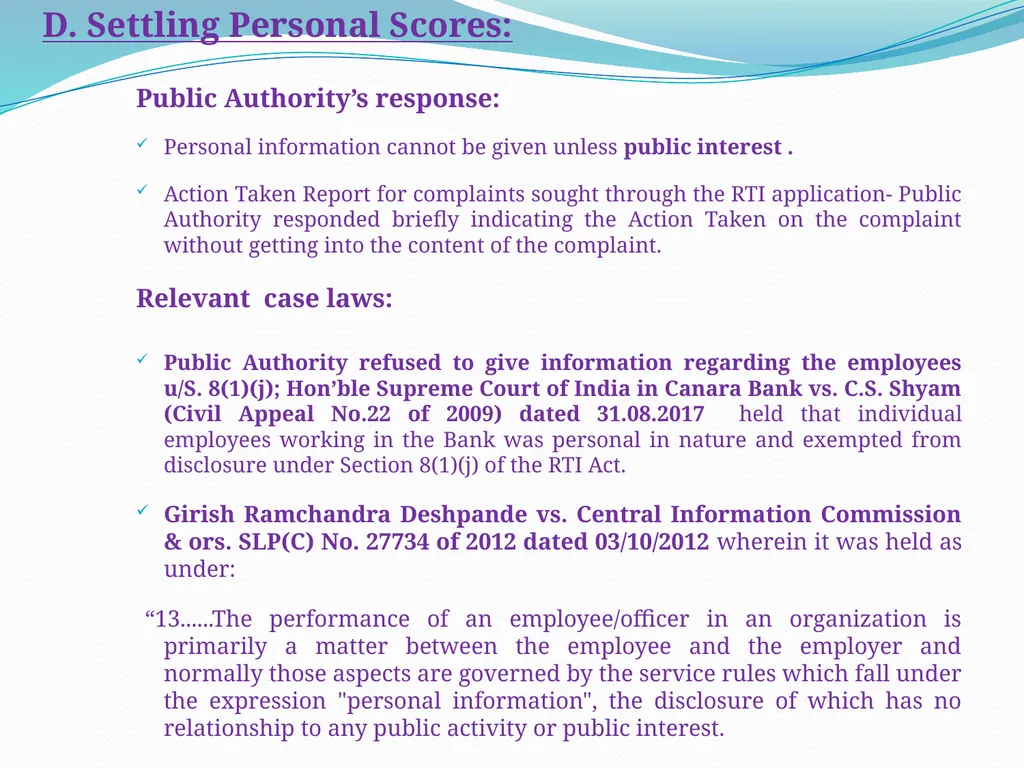
slide20. Public Authority’s response:
Personal information cannot be given unless public interest .
Action Taken Report for complaints sought through the RTI application- Public Authority responded briefly indicating the Action Taken on the complaint without getting into the content of the complaint.
Relevant case laws:
Public Authority refused to give information regarding the employees u/S. 8(1)(j); Hon’ble Supreme Court of India in Canara Bank vs. C.S. Shyam (Civil Appeal No.22 of 2009) dated 31.08.2017 held that individual employees working in the Bank was personal in nature and exempted from disclosure under Section 8(1)(j) of the RTI Act.
Girish Ramchandra Deshpande vs. Central Information Commission & ors. SLP(C) No. 27734 of 2012 dated 03/10/2012 wherein it was held as under:
“13......The performance of an employee/officer in an organization is primarily a matter between the employee and the employer and normally those aspects are governed by the service rules which fall under the expression "personal information", the disclosure of which has no relationship to any public activity or public interest. D. Settling Personal Scores:<br>
slide21. E. RTI Used For Self Actualization: Sometimes it is seen that the RTI applicants seek information for their recognition in the society/public authority.
Public Authority’s response:
Public Authority felt burdened and find difficult to handle large number of RTI applications from an individual .
Public Authority tried to leverage the disposal of such applications by better record keeping and through higher transparency of department.
The Higher authorities use of RTI Act as a tool for efficient functioning in the department.
Public Authority welcome healthy criticism and keep its cool while responding to such enlightened citizens.
Relevant case laws:
RTI Law is supportive of such applications in which information has been sought in public interest .
Suo-moto disclosure of information on the website of Public Authority is supported in manydecisions.<br>
slide22. F. Using RTI Act for time bound redressal of grievance: Public Authority’s response:
The grievance of the applicants does not come under the ambit/definition of the RTI Act (under Section 2(f) of the RTI Act).
Relevant case law:
Union of India v. Namit Sharma in REVIEW PETITION [C] No.2309 OF 2012 IN Writ Petition [C] No.210 OF 2012 with State of Rajasthan and Anr. vs. Namit Sharma Review Petition [C] No.2675 OF 2012 In Writ Petition [C] No.210 OF 2012 had held as under:
“While deciding whether a citizen should or should not get a particular information “which is held by or under the control of any public authority”, the Information Commission does not decide a dispute between two or more parties concerning their legal rights other than their right to get information in possession of a public authority. This function obviously is not a judicial function, but an administrative function conferred by the Act on the Information Commissions.”<br>
slide23. Conclusions RTI should be treated as an yardstick of governance and hence, should be duly analysed for efficient functioning and transparency.
Judgments of Hon’ble Supreme Court of India/High Courts/CIC and legal provisions under the RTI Act, 2005 should be kept in mind.
Lack of application of mind by the CPIO has lead to embarrassment of and resulted into imposition of penalty and direction for compensation against the Public Authorities.
Proper monitoring of RTI applications, functioning of CPIO & FAA.
Emphasis should be given on voluntary disclosure; e.g. name of successful bidders, marks/answer key, name of selected candidates etc.
Disclosable information may be uploaded online on the website.
Reducing delay and non disclosure while handling RTIs.
RTI workshops with case laws for the CPIOs/ FAAs and concerned staff.<br>
slide24. Thank You!!<br>
slide25. Supreme Court Judgments<br>
slide26. Supreme Court Judgments Contd.<br>
slide27. Supreme Court Judgments Contd.<br>
slide28. Supreme Court Judgments Contd.<br>
slide29. Delhi High Court Judgments<br>
slide30. Delhi High Court Judgments Contd.<br>
slide31. Delhi High Court Judgments Contd.<br>
slide32. Delhi High Court Judgments Contd.<br>
slide33. Delhi High Court Judgments Contd.<br>
slide34. Delhi High Court Judgments Contd.<br>