Simone De Beauvoir Simone de Beauvoir (19081986) was a French existentialist philosopher, feminist, and writer. She is best known for her groundbreaking book The Second Sex (1949), which laid the foundation for modern feminism. In it, she
"Simone De Beauvoir Simone de Beauvoir (1908–1986)" is the property of its rightful owner. Permission is granted to
download and print the materials on this website for personal, non-commercial use only, and to display it
on your personal computer provided you do not modify the materials and that you retain all copyright
notices contained in the materials. By downloading content from our website, you accept the terms of this
agreement.
Presentation Transcript
01
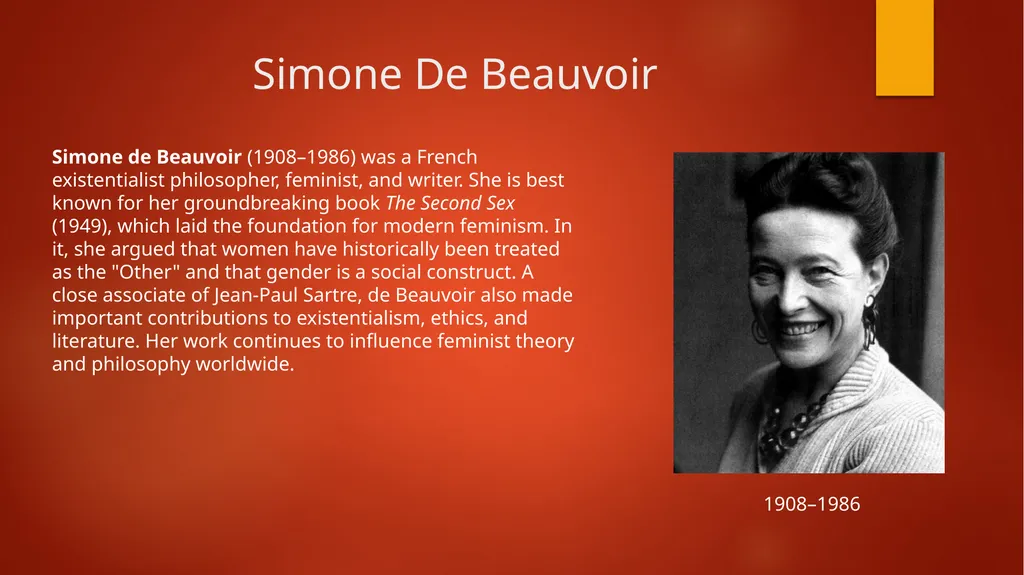
Simone De Beauvoir Simone de Beauvoir (1908–1986) was a French existentialist philosopher, feminist, and writer. She is best known for her groundbreaking book The Second Sex (1949), which laid the foundation for modern feminism. In it, she argued that women have historically been treated as the "Other" and that gender is a social construct. A close associate of Jean-Paul Sartre, de Beauvoir also made important contributions to existentialism, ethics, and literature. Her work continues to influence feminist theory and philosophy worldwide. 1908–1986<br>
02
Simone de Beauvoir’s View on Patriarchy Simone de Beauvoir, in her landmark work The Second Sex (1949), offers one of the earliest and most influential philosophical critiques of patriarchy. She argued that patriarchy is not a natural or biological order, but a social and historical construct designed to maintain male dominance and female subordination. Key Ideas:
1. "Woman as the Other"
De Beauvoir famously stated that “One is not born, but rather becomes, a woman.”
She meant that gender roles are imposed by society, not determined by biology.
In patriarchal systems, men are seen as the norm (the Self), while women are seen as “the Other”, defined only in relation to men and denied independent identity.
2. Patriarchy as a System of Oppression
She argued that patriarchy reduces women to "immanence"—confined to the private sphere (home, family), passive, and dependent.
Men, by contrast, are allowed "transcendence"—freedom to act, create, and define their lives.
Institutions like marriage, religion, and motherhood reinforce women's inferior position by making them economically and socially dependent on men.<br>
03
3. Critique of Traditional Femininity
De Beauvoir viewed many ideals of femininity (beauty, delicacy, submission) as constructed by men to keep women subordinate.
She challenged the romanticization of roles like motherhood and wifehood, arguing that they often limit women’s freedom and personal development.
4. Path to Liberation
For de Beauvoir, women’s liberation required economic independence, education, and social equality.
She urged women to reject imposed roles and assert themselves as autonomous individuals, just like men. Legacy:
Simone de Beauvoir’s work exposed how deeply patriarchy is embedded in everyday life, language, and thought. She showed that true gender equality requires more than legal rights—it demands a restructuring of cultural and social norms.
Her ideas helped launch second-wave feminism and continue to influence debates about gender, power, and identity today.<br>
04
Criticism of Simone de Beauvoir’s patriarchy 1. Eurocentrism and Class Bias
Critique: De Beauvoir's analysis mostly reflects the experiences of white, middle-class, educated Western women.
She gives little attention to the specific oppression faced by working-class women, Black women, colonized women, or non-Western cultures.
Thinkers like bell hooks criticized her for ignoring the intersection of race, class, and gender.
🗨️ "She writes about women as though we are all part of the same social group with the same interests and experiences." — bell hooks 2. Overemphasis on Existential Individualism
Critique: Some argue that de Beauvoir’s existentialist framework focuses too much on individual freedom and choice, neglecting how systemic and structural barriers limit those choices.
Her emphasis on women’s need to transcend their "immanence" (passivity) and embrace "transcendence" (active freedom) may not reflect the realities of those in deeply oppressive conditions.<br>
05
3. Negative View of Motherhood and Femininity
Critique: De Beauvoir is sometimes seen as dismissive of motherhood, domesticity, and traditional femininity, framing them as tools of patriarchal oppression.
Critics argue this risks devaluing women's choices if they find fulfillment in these roles.
Feminist thinkers like Adrienne Rich later emphasized reclaiming motherhood as a site of empowerment. 4. Lack of Intersectionality
Critique: De Beauvoir analyzes gender as a universal category, but fails to consider how race, colonialism, sexuality, and disability affect women's experiences of patriarchy.
Her idea of “woman” as a single oppressed group has been challenged by intersectional feminists, especially from the Global South and BIPOC communities. 5. Essentialism in Her Opponents
While de Beauvoir critiques biological essentialism, some critics argue that she sometimes slips into essentialist thinking herself—especially when describing the female body or experiences like menstruation, pregnancy, and aging in negative or deterministic terms.<br>
06
Conclusion: Simone de Beauvoir’s analysis of patriarchy was a groundbreaking contribution to feminist thought. She exposed how patriarchy is not a natural or eternal system but a man-made structure that defines women as the "Other" and limits their freedom. Through her existentialist lens, she argued that women must reject the roles imposed by society and strive for autonomy, equality, and self-definition.
Her work challenged deeply rooted norms about gender, and though it has been critiqued for its limitations, it remains a foundational text in understanding how patriarchy operates and how it can be resisted. De Beauvoir’s call for women to become agents of their own lives continues to inspire feminist movements around the world.<br>