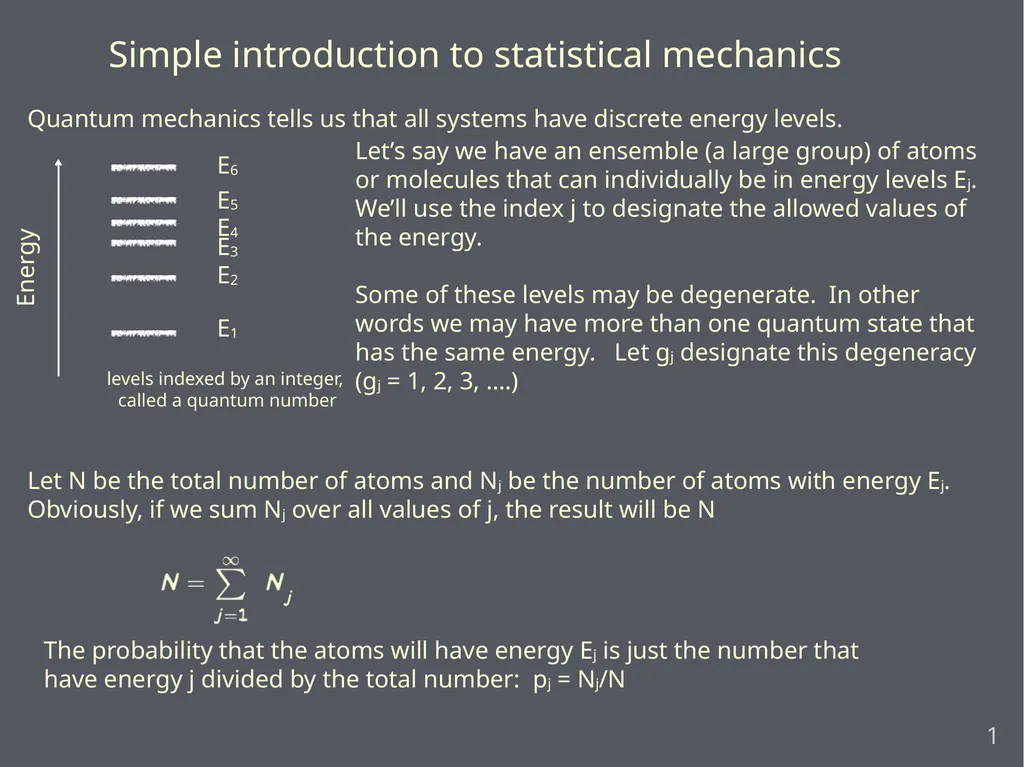
Simple introduction to statistical mechanics Quantum mechanics tells us that all systems have discrete energy levels. 1 levels indexed by an integer, called a quantum number Lets say we have an ensemble (a large group) of atoms or
"Simple introduction to statistical mechanics" is the property of its rightful owner. Permission is granted to
download and print the materials on this website for personal, non-commercial use only, and to display it
on your personal computer provided you do not modify the materials and that you retain all copyright
notices contained in the materials. By downloading content from our website, you accept the terms of this
agreement.
Presentation Transcript
01
Simple introduction to statistical mechanics
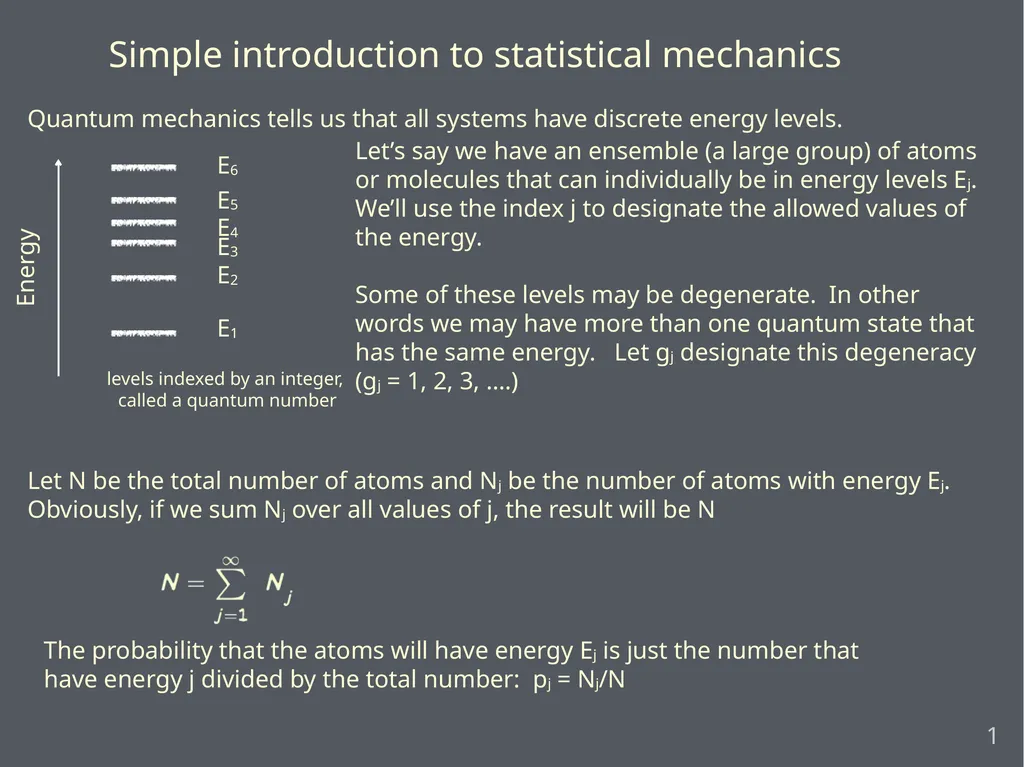
Quantum mechanics tells us that all systems have discrete energy levels. 1 levels indexed by an integer,
called a quantum number Let’s say we have an ensemble (a large group) of atoms or molecules that can individually be in energy levels Ej. We’ll use the index j to designate the allowed values of the energy.
Some of these levels may be degenerate. In other words we may have more than one quantum state that has the same energy. Let gj designate this degeneracy (gj = 1, 2, 3, ….) Let N be the total number of atoms and Nj be the number of atoms with energy Ej. Obviously, if we sum Nj over all values of j, the result will be N The probability that the atoms will have energy Ej is just the number that have energy j divided by the total number: pj = Nj/N<br>
02
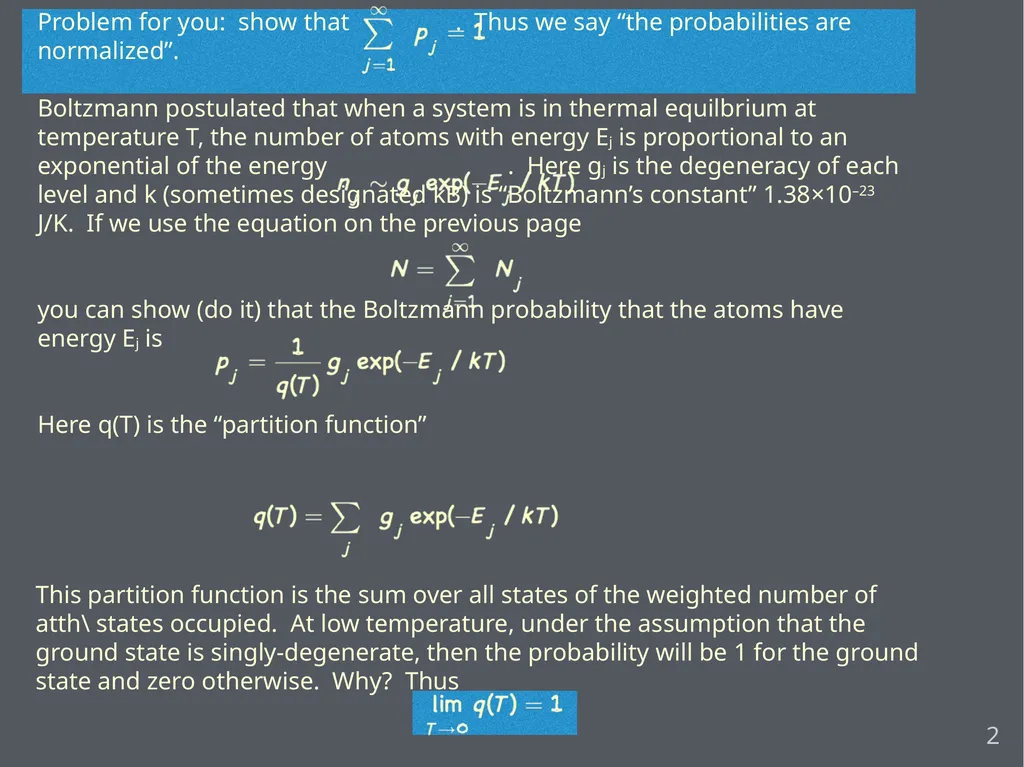
2 This partition function is the sum over all states of the weighted number of atth\ states occupied. At low temperature, under the assumption that the ground state is singly-degenerate, then the probability will be 1 for the ground state and zero otherwise. Why? Thus Problem for you: show that . Thus we say “the probabilities are normalized”.
Boltzmann postulated that when a system is in thermal equilbrium at temperature T, the number of atoms with energy Ej is proportional to an exponential of the energy . Here gj is the degeneracy of each level and k (sometimes designated kB) is “Boltzmann’s constant” 1.38×10⁻²³ J/K. If we use the equation on the previous page
you can show (do it) that the Boltzmann probability that the atoms have energy Ej is
Here q(T) is the “partition function”<br>
03
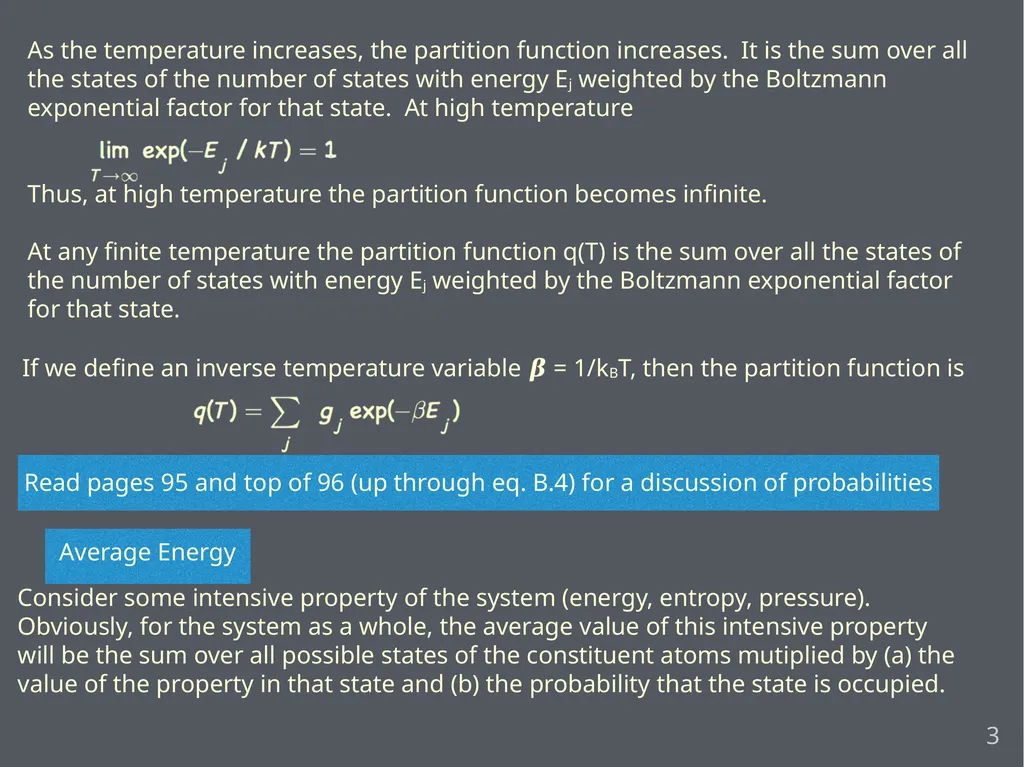
3 As the temperature increases, the partition function increases. It is the sum over all the states of the number of states with energy Ej weighted by the Boltzmann exponential factor for that state. At high temperature
Thus, at high temperature the partition function becomes infinite.
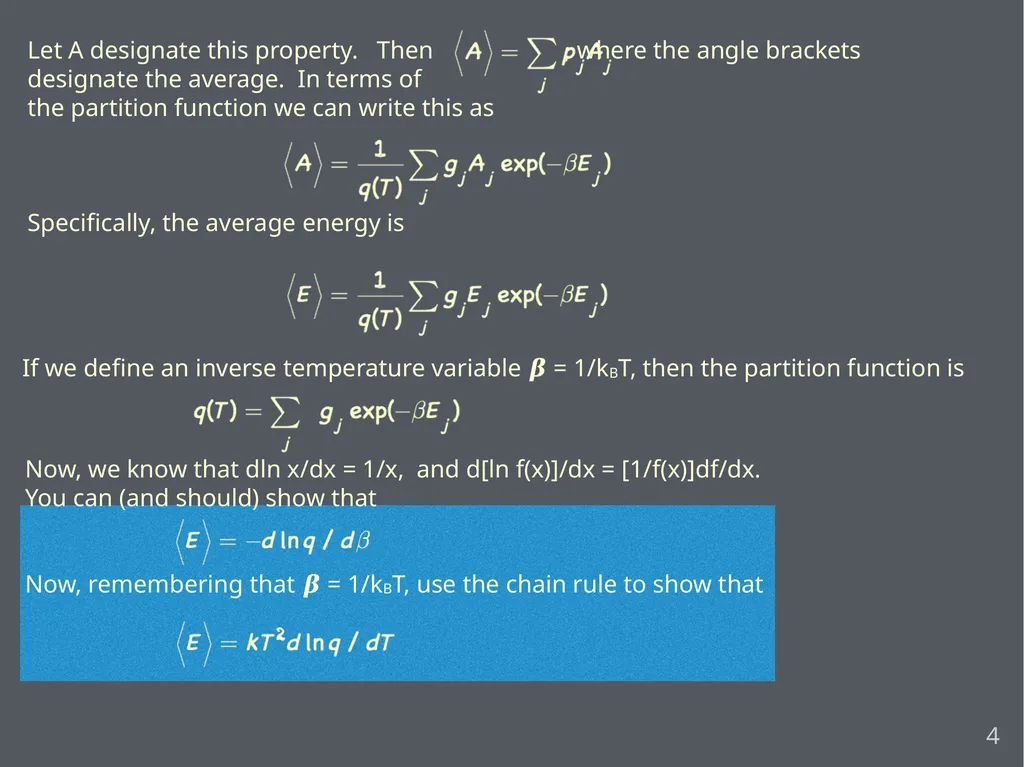
At any finite temperature the partition function q(T) is the sum over all the states of the number of states with energy Ej weighted by the Boltzmann exponential factor for that state. If we define an inverse temperature variable 𝜷 = 1/kBT, then the partition function is Consider some intensive property of the system (energy, entropy, pressure). Obviously, for the system as a whole, the average value of this intensive property will be the sum over all possible states of the constituent atoms mutiplied by (a) the value of the property in that state and (b) the probability that the state is occupied. Read pages 95 and top of 96 (up through eq. B.4) for a discussion of probabilities Average Energy<br>
04
4 Let A designate this property. Then , where the angle brackets designate the average. In terms of
the partition function we can write this as
Specifically, the average energy is If we define an inverse temperature variable 𝜷 = 1/kBT, then the partition function is Now, we know that dln x/dx = 1/x, and d[ln f(x)]/dx = [1/f(x)]df/dx.
You can (and should) show that
Now, remembering that 𝜷 = 1/kBT, use the chain rule to show that<br>
05
5 In this course we will show that many other intensive thermodynamic properties, such as the entropy, free energies (Gibbs and Helmholz), specific heat, …. can be related to the logarithm of the partition function and its derivatives.
Thus, and this is key, if we can determine the energy levels En from quantum mechanics, we can then determine the variables that control the thermodynamics of matter and materials.<br>