Simple Lattice Trapdoor Sampling from a Broad Class of Distributions Vadim Lyubashevsky and Daniel Wichs Trapdoor Sampling A t s Given: a random matrix A and vector t Find: vector s with small coefficients such that Ast Without a
Related Topics
Share
Embed code
Download this presentation From Below
"Simple Lattice Trapdoor Sampling from a Broad" is the property of its rightful owner. Permission is granted to
download and print the materials on this website for personal, non-commercial use only, and to display it
on your personal computer provided you do not modify the materials and that you retain all copyright
notices contained in the materials. By downloading content from our website, you accept the terms of this
agreement.
Presentation Transcript
01
Simple Lattice Trapdoor Sampling from a Broad Class of Distributions Vadim Lyubashevsky and Daniel Wichs<br>
02
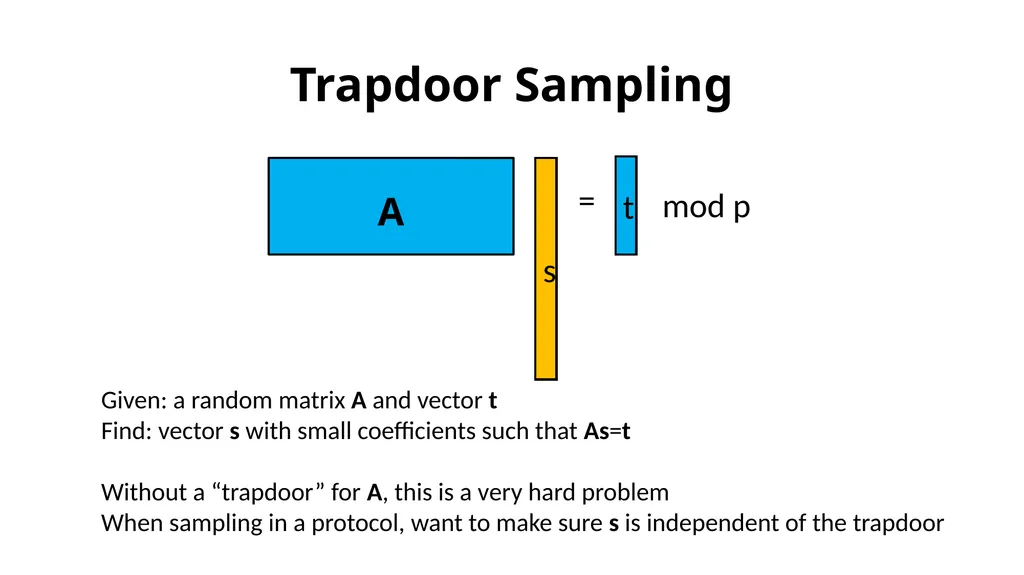
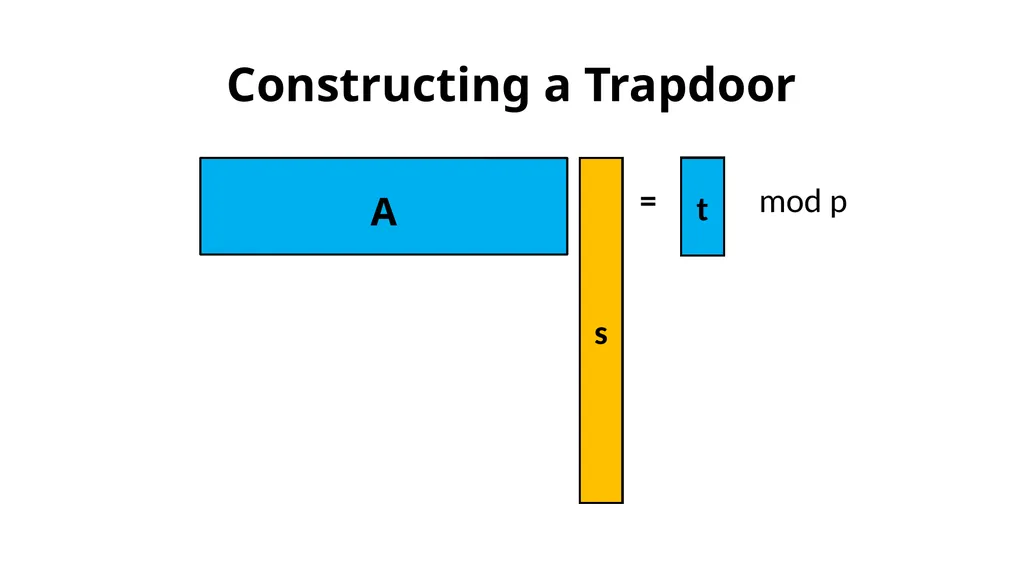
Trapdoor Sampling A t s = Given: a random matrix A and vector t
Find: vector s with small coefficients such that As=t
Without a “trapdoor” for A, this is a very hard problem
When sampling in a protocol, want to make sure s is independent of the trapdoor mod p<br>
03
Trapdoor Sampling First algorithm: Gentry, Peikert, Vaikuntanathan (2008)
Very “geometric”
The distribution of s is a discrete Gaussian
Agrawal, Boneh, Boyen (2010) + Micciancio, Peikert (2012)
More “algebraic” (you don’t even see the lattices)
Still s needs to be a discrete Gaussian
Are Gaussians “fundamental” to trapdoor sampling?<br>
04
Constructing a Trapdoor A s t = mod p<br>
05
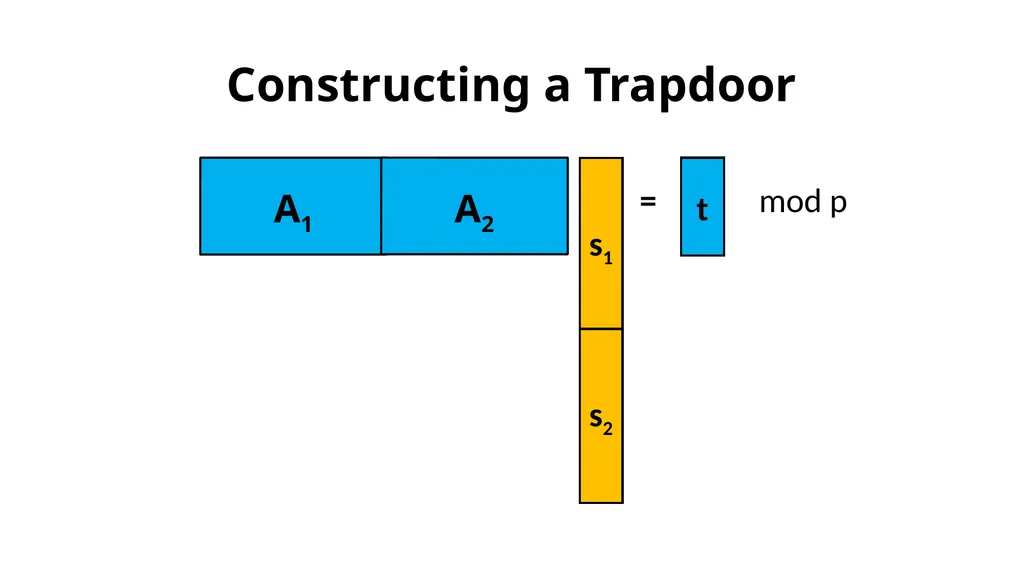
Constructing a Trapdoor A1 t s1 = mod p A2 s2<br>
06
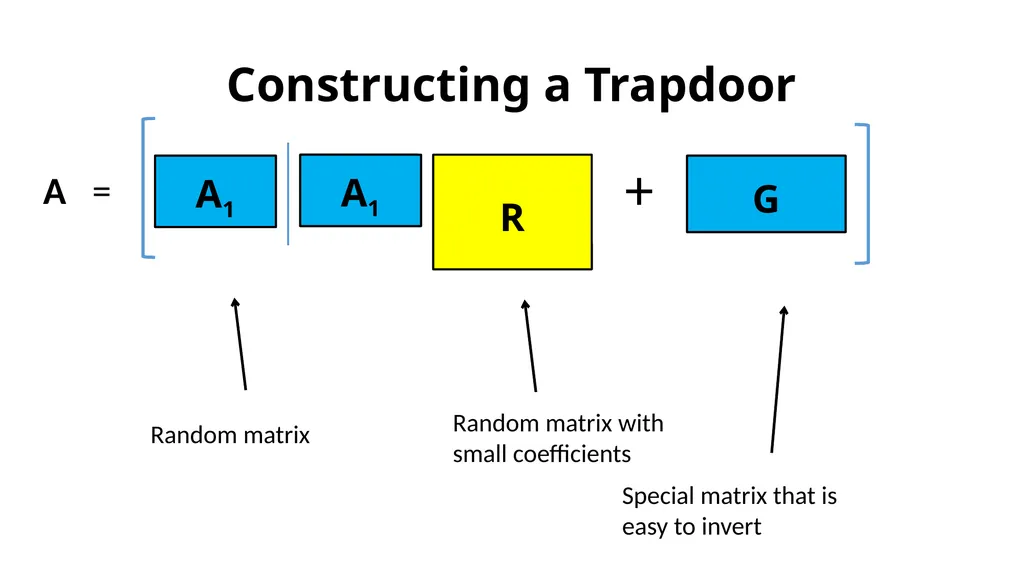
A1 R G + Random matrix Random matrix with small coefficients Special matrix that is easy to invert A1 Constructing a Trapdoor A =<br>
07
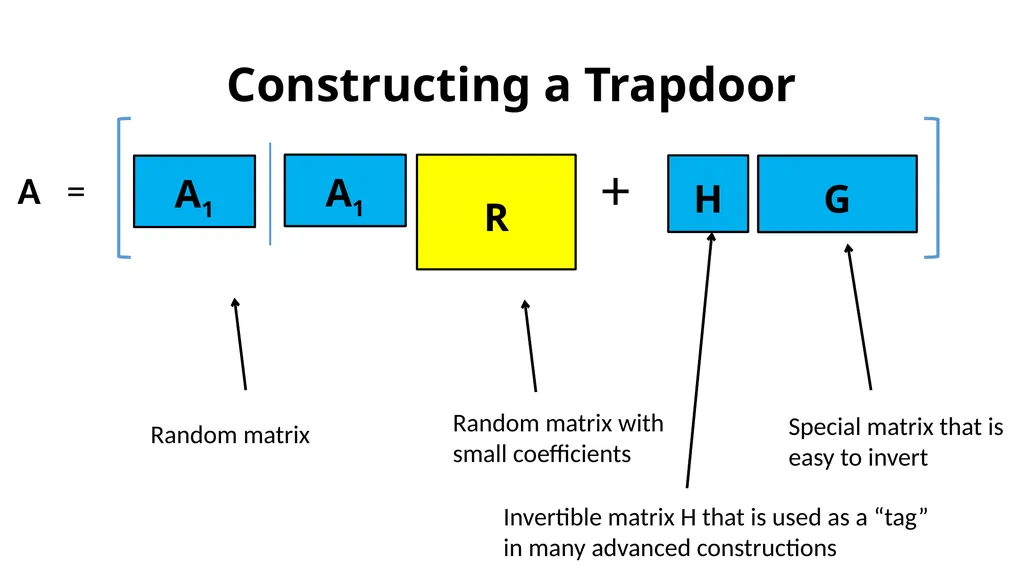
A1 R G + Random matrix Random matrix with small coefficients Special matrix that is easy to invert A1 Constructing a Trapdoor A = H Invertible matrix H that is used as a “tag”
in many advanced constructions<br>
08
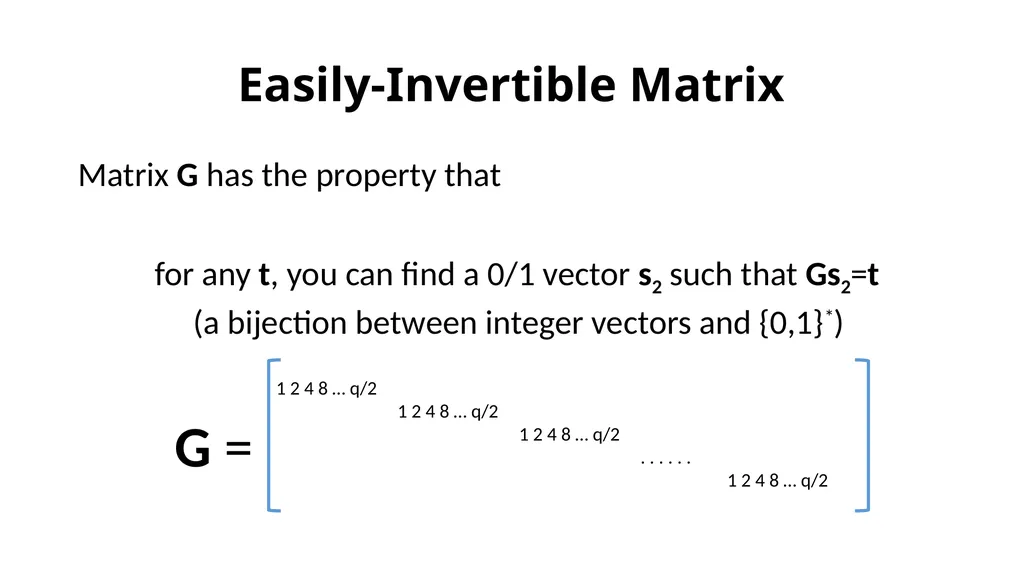
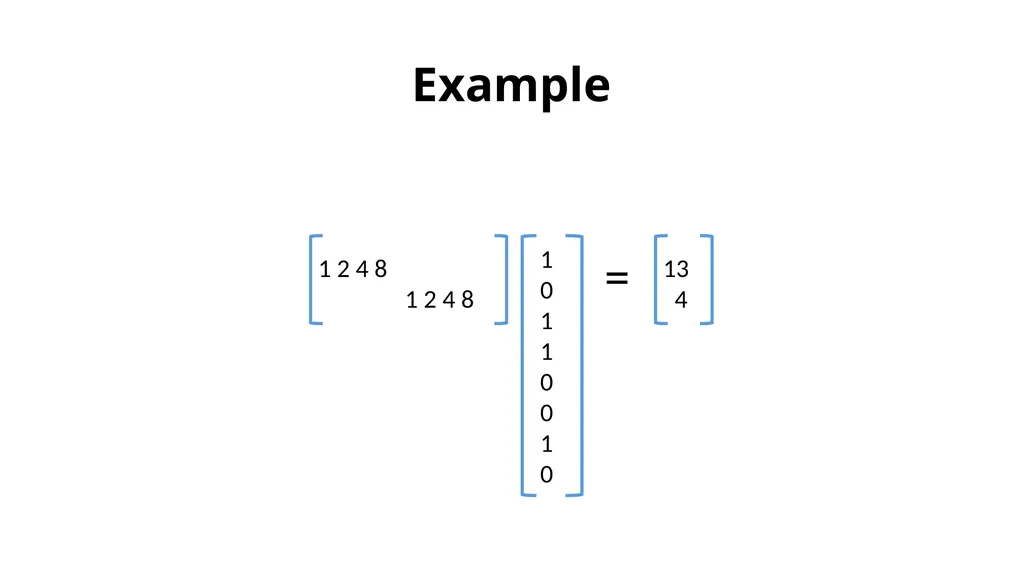
Easily-Invertible Matrix Matrix G has the property that
for any t, you can find a 0/1 vector s2 such that Gs2=t
(a bijection between integer vectors and {0,1}*) 1 2 4 8 … q/2
1 2 4 8 … q/2
1 2 4 8 … q/2
. . . . . .
1 2 4 8 … q/2 G =<br>
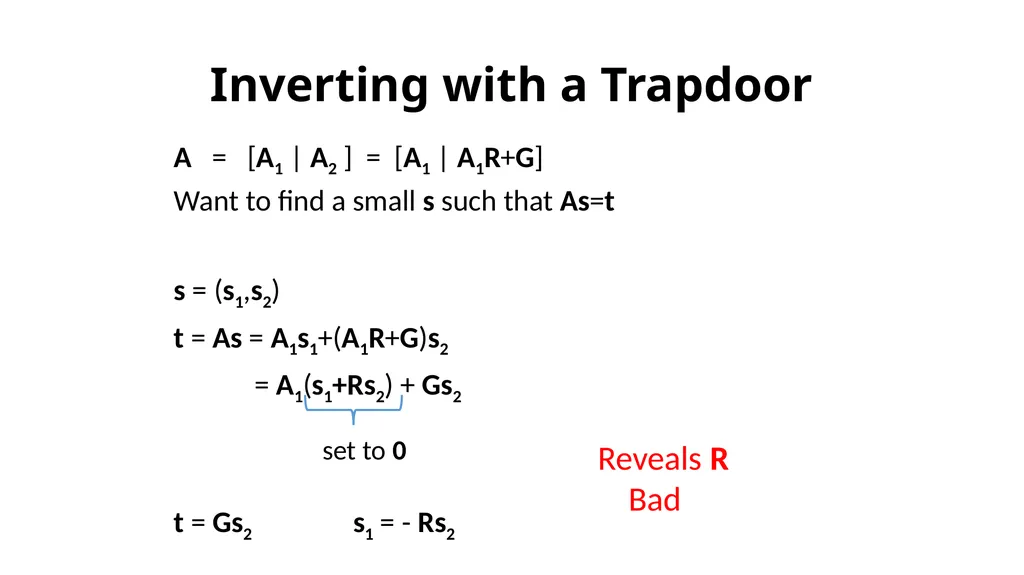
Inverting with a Trapdoor A = [A1 | A2 ] = [A1 | A1R+G]
Want to find a small s such that As=t
s = (s1,s2)
t = As = A1s1+(A1R+G)s2
= A1(s1+Rs2) + Gs2
t = Gs2 s1 = - Rs2 set to 0 Reveals R
Bad<br>
11
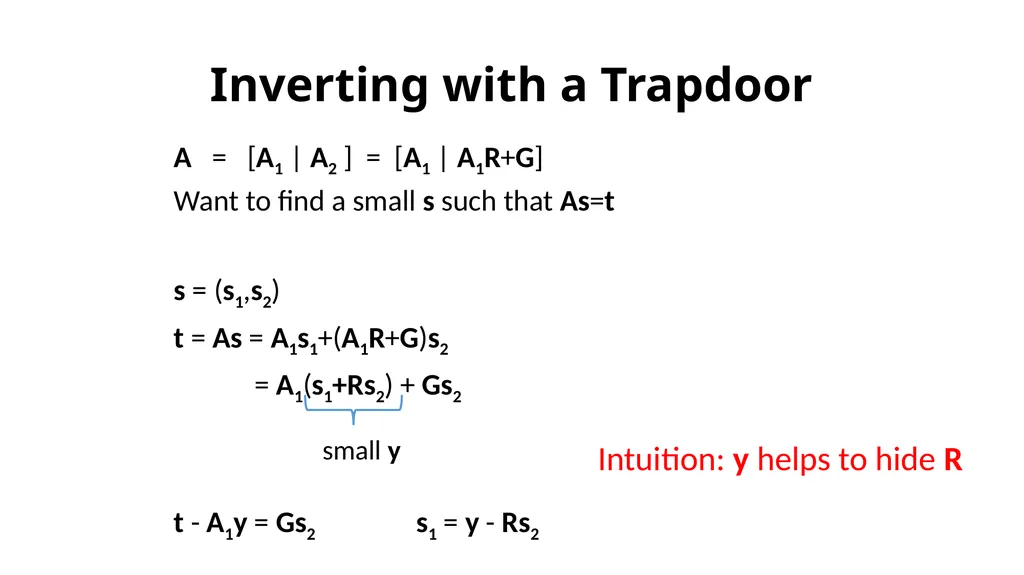
Inverting with a Trapdoor A = [A1 | A2 ] = [A1 | A1R+G]
Want to find a small s such that As=t
s = (s1,s2)
t = As = A1s1+(A1R+G)s2
= A1(s1+Rs2) + Gs2
t - A1y = Gs2 s1 = y - Rs2 small y Intuition: y helps to hide R<br>
12
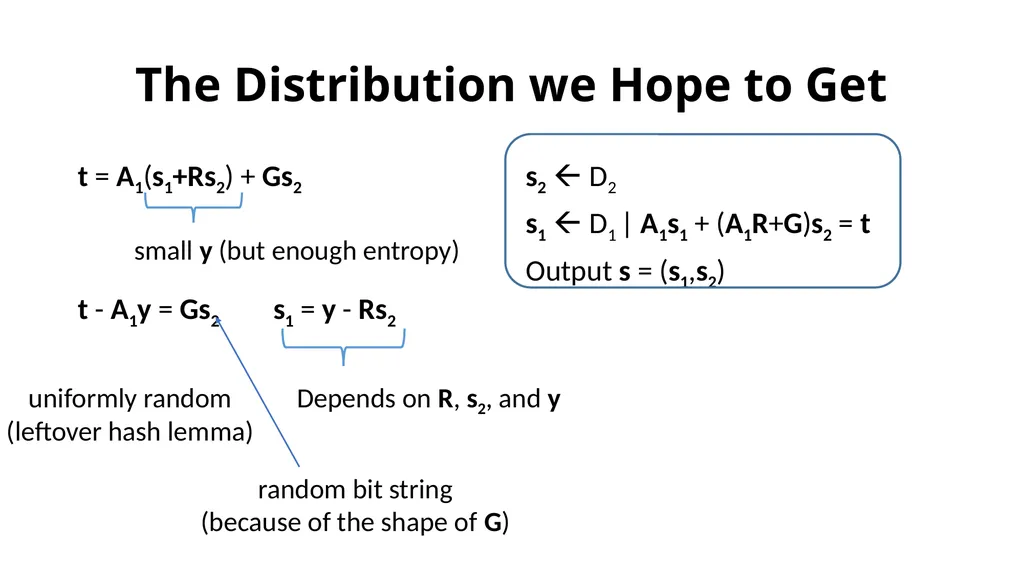
The Distribution we Hope to Get t = A1(s1+Rs2) + Gs2
t - A1y = Gs2 s1 = y - Rs2 s2 D2
s1 D1 | A1s1 + (A1R+G)s2 = t
Output s = (s1,s2) small y (but enough entropy) uniformly random
(leftover hash lemma) random bit string
(because of the shape of G) Depends on R, s2, and y<br>
13
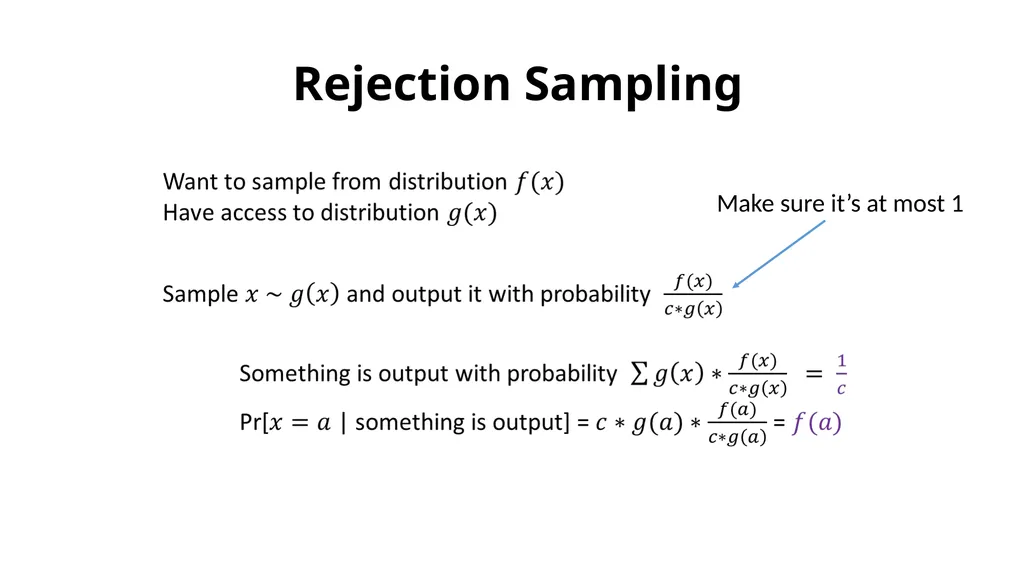
Rejection Sampling Make sure it’s at most 1<br>
14
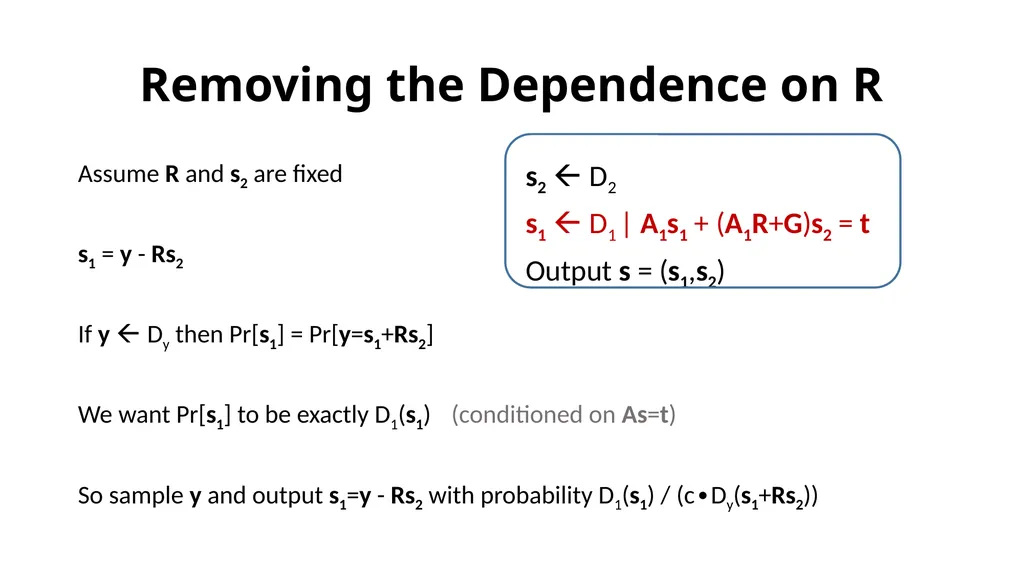
Removing the Dependence on R Assume R and s2 are fixed
s1 = y - Rs2
If y Dy then Pr[s1] = Pr[y=s1+Rs2]
We want Pr[s1] to be exactly D1(s1) (conditioned on As=t)
So sample y and output s1=y - Rs2 with probability D1(s1) / (c∙Dy(s1+Rs2)) s2 D2
s1 D1 | A1s1 + (A1R+G)s2 = t
Output s = (s1,s2)<br>
15
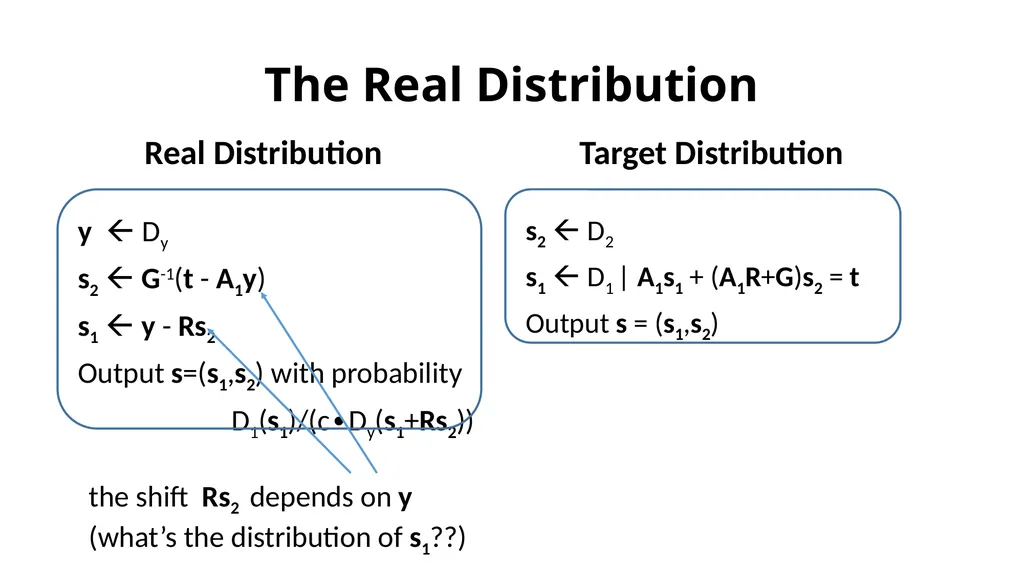
The Real Distribution y Dy
s2 G-1(t - A1y)
s1 y - Rs2
Output s=(s1,s2) with probability
D1(s1)/(c∙Dy(s1+Rs2)) s2 D2
s1 D1 | A1s1 + (A1R+G)s2 = t
Output s = (s1,s2) Real Distribution Target Distribution the shift Rs2 depends on y
(what’s the distribution of s1??)<br>
16
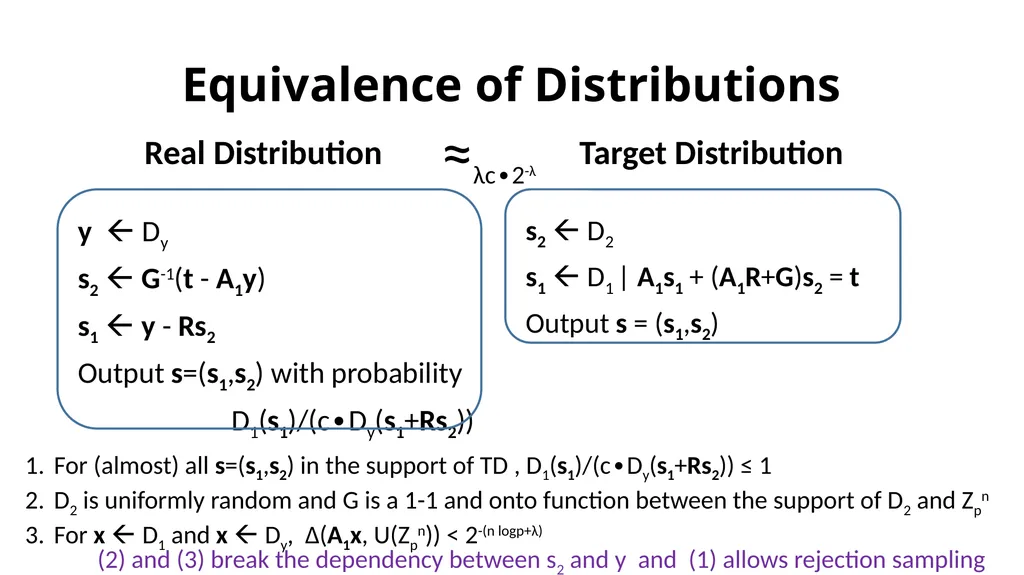
Equivalence of Distributions y Dy
s2 G-1(t - A1y)
s1 y - Rs2
Output s=(s1,s2) with probability
D1(s1)/(c∙Dy(s1+Rs2)) s2 D2
s1 D1 | A1s1 + (A1R+G)s2 = t
Output s = (s1,s2) Real Distribution Target Distribution For (almost) all s=(s1,s2) in the support of TD , D1(s1)/(c∙Dy(s1+Rs2)) ≤ 1
D2 is uniformly random and G is a 1-1 and onto function between the support of D2 and Zpn
For x D1 and x Dy, Δ(A1x, U(Zpn)) < 2-(n logp+λ) ≈ λc∙2-λ (2) and (3) break the dependency between s2 and y and (1) allows rejection sampling<br>
17
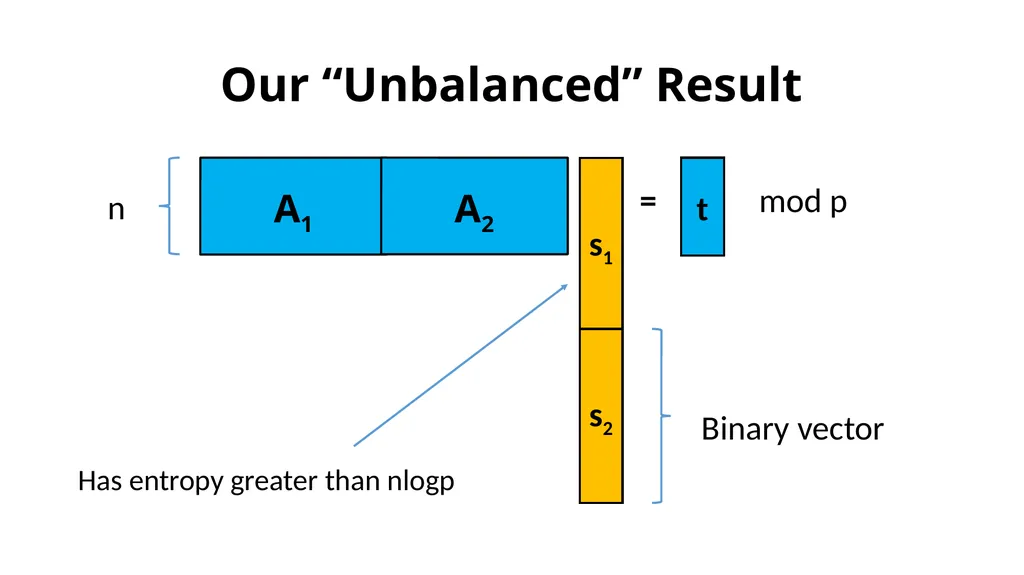
Our “Unbalanced” Result A1 t s1 = mod p A2 s2 n Has entropy greater than nlogp Binary vector<br>
18
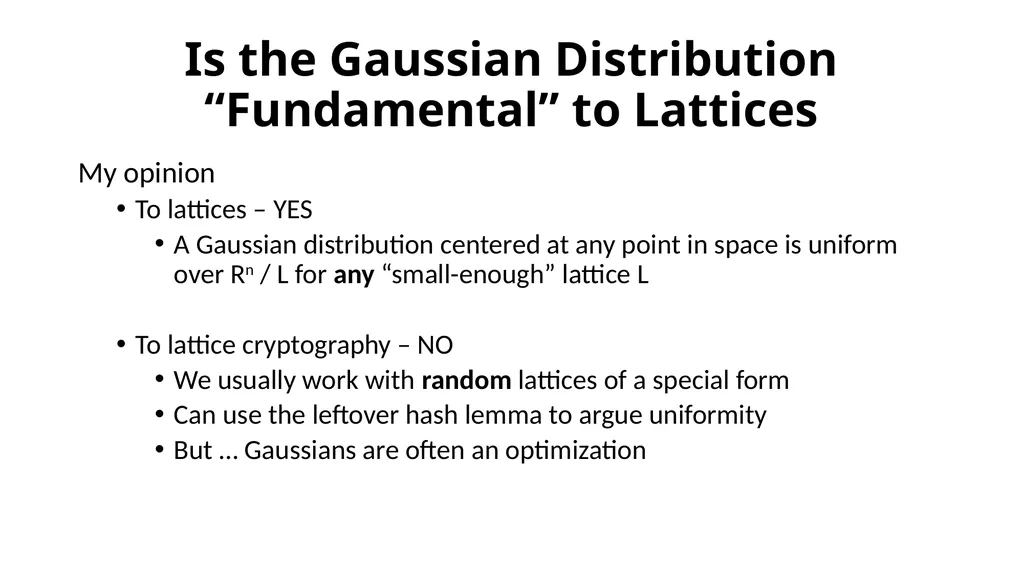
Is the Gaussian Distribution “Fundamental” to Lattices My opinion
To lattices – YES
A Gaussian distribution centered at any point in space is uniform over Rn / L for any “small-enough” lattice L
To lattice cryptography – NO
We usually work with random lattices of a special form
Can use the leftover hash lemma to argue uniformity
But … Gaussians are often an optimization<br>
19
What Distribution to use in Practice? Gaussians are often (always?) the “optimal” distribution to use for minimizing the parameters
But … Sampling Gaussians requires high(er) precision
so maybe too costly in low-power devices
Try to use the distribution that minimizes parameters
try to improve the efficiency later<br>