
Skill-Based Treatment for Severe Problem Behavior
Description: Skill-Based Treatment for Severe Problem Behavior aka My Way Roots of ABA Applied use of behavior analysis started in the 1960s Early research was largely with adults with dangerous, life-threatening behavior Lovaas Early Intensive
Related Topics
Download Presentation
"Skill-Based Treatment for Severe Problem Behavior" is the property of its rightful owner. Permission is granted to download and print the materials on this website for personal, non-commercial use only, and to display it on your personal computer provided you do not modify the materials and that you retain all copyright notices contained in the materials. By downloading content from our website, you accept the terms of this agreement.
Presentation Transcript
slide1. Skill-Based Treatment for Severe Problem Behavior
aka “My Way”<br>
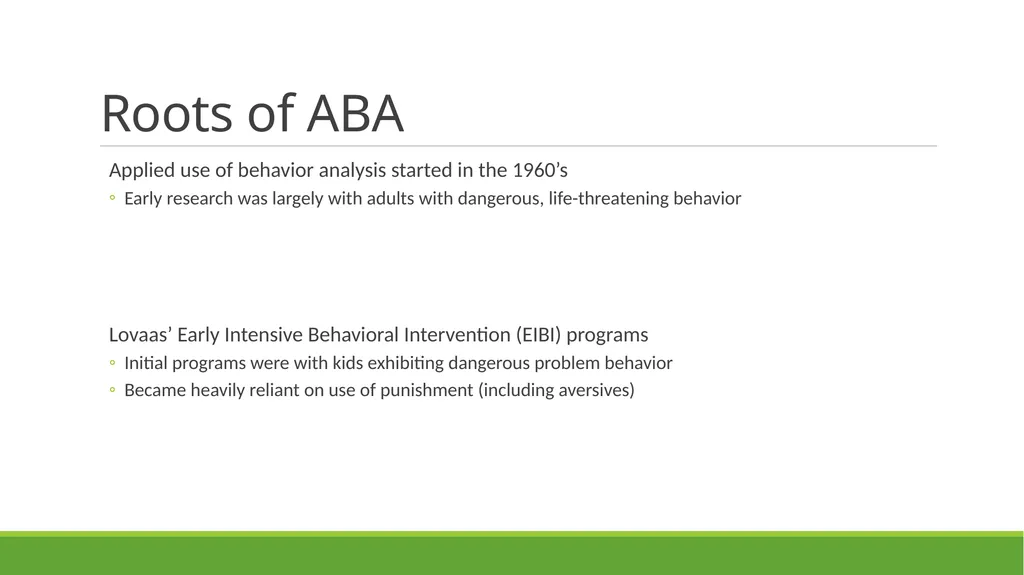
slide2. Roots of ABA Applied use of behavior analysis started in the 1960’s
Early research was largely with adults with dangerous, life-threatening behavior
Lovaas’ Early Intensive Behavioral Intervention (EIBI) programs
Initial programs were with kids exhibiting dangerous problem behavior
Became heavily reliant on use of punishment (including aversives)<br>
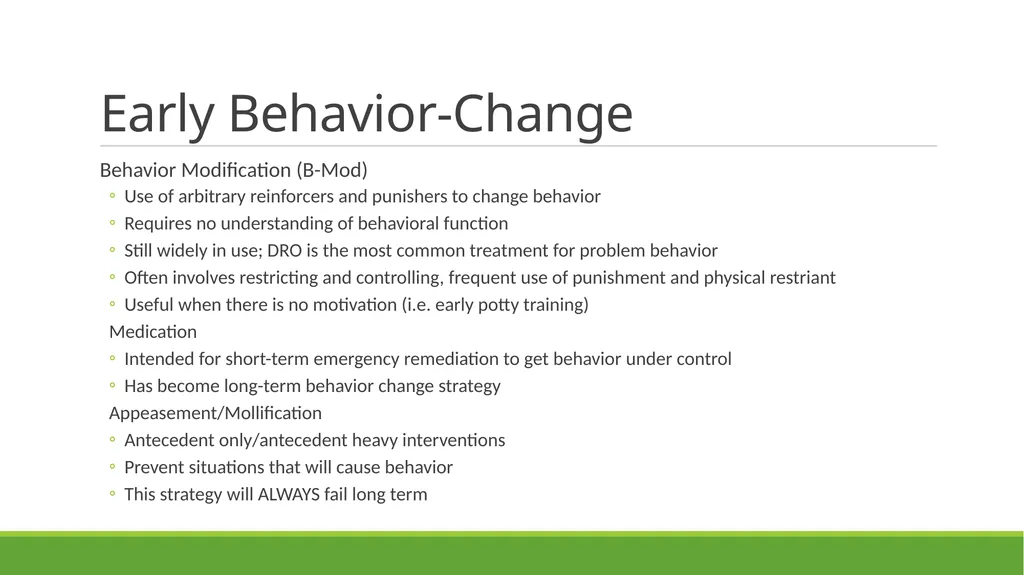
slide3. Early Behavior-Change Behavior Modification (B-Mod)
Use of arbitrary reinforcers and punishers to change behavior
Requires no understanding of behavioral function
Still widely in use; DRO is the most common treatment for problem behavior
Often involves restricting and controlling, frequent use of punishment and physical restriant
Useful when there is no motivation (i.e. early potty training)
Medication
Intended for short-term emergency remediation to get behavior under control
Has become long-term behavior change strategy
Appeasement/Mollification
Antecedent only/antecedent heavy interventions
Prevent situations that will cause behavior
This strategy will ALWAYS fail long term<br>
slide4. What is Coercion? Coercion is the control of behavior through the use of (a) punishment or the threat of punishment, or (b) negative reinforcement: the removal or avoidance of aversive stimuli
Behavioral control is not an issue; coercive control is
Coercion is everywhere in the world. Our behavior as a society is controlled through coercion by:
The physical environment (cold, heat, rain, earthquakes, fire)
Crime (locking your door, carrying mace, terrorism)
Criminal justice system (justice is synonymous with punishment)
Law enforcement (police are taught to intimidate, compel, and punish)
Family (imagination is punished out of children, abusive parents)
Education (corporal punishment, etc.)
“When people do use noncoercive techniques, they almost always do so in combination with coercion. We are astonished if offered a carrot that is not backed up by a stick.” – Murray Sidman<br>
slide5. The Fallout from Coercion “To set coercive therapists in the context of a coercive society, however, is also to point out that they are doing nothing that requires special training or competence. Saying and doing what has always been said and done, they contribute nothing new. In this instance, failing to contribute is not neutral; it is wrong. It is wrong because their science has made it possible to do more.” – Murray Sidman
Coercion leads to escape-maintained behavior
Common escape routes:
Tuning Out
Escapist literature, movies, etc.
Crisis management: putting problems on ice until the severity demands intervention; moving from crisis to crisis
“Let John Do It”: tuning out a problem long enough that someone else fixes it
Do nothing: when a wrong decision could cause catastrophe, people choose to not decide
Dropping Out
From school: tuning out -> arriving late -> faking illness -> ‘playing hookie’ -> stop showing up
From the family: going to college far away, emancipation
From religion
From society: homelessness, joining a cult
From life: suicide<br>
slide6. The Fallout from Coercion Some neuroses and mental illness may serve as defense mechanisms from coercion, including:
Phobias
Reaction formation (reacting to a situation in the opposite way to be expected)
Projection (projecting conduct onto others)
Displacement (directing inappropriate conduct towards those that don’t punish)
Regression
Obsessions and compulsions
Conversion disorders (hypochondria)
Amnesia, fugue states, multiple personality
Countercontrol
When control cannot be avoided, the victims of coercion will seek to control their controllers<br>
slide7. Punishment Punishments effects on behavior
Rapid, high magnitude reduction in behavior
Temporary continued suppression of behavior
Why do we avoid punishment?
It doesn’t teach skills
Behaviors recover from punishment
Doesn’t generalize across people or settings
Can’t be used at a low intensity (graduated exposure results in tolerance)<br>
slide8. Punishment “People who use punishment become objects of aversion themselves, feared, hated, and avoided; their very presence becomes a punishment…Anyone who uses shock becomes a shock.” – Murray Sidman
Negative side effects
Emotional and aggressive reactions
Escape and avoidance
Behavioral contrast
Modeling of undesirable behavior
Overuse due to negative reinforcement of the punishing agent’s behavior<br>
slide9. Extinction Extinction’s effects on behavior
Slow, gradual reduction in the frequency of behavior
Side Effects of extinction
Extinction burst
Response variation
Initial increase in response magnitude
Spontaneous recovery
Resurgence
Emotional outburst and aggression
Depression<br>
slide10. Equity in Intervention Fair is not equal
Special education and ABA rely on individualized treatment
We have to navigate a balance between holding children to high expectations and having reasonable expectations
In a school environment, this means some children are expected to do things that others are not
It would be unfair to hold all students to all of the same expectations
We are a school and must teach academics, but a truly educated child has skills that cover a wide range of domains
Communication/verbal behavior (requesting, following directions, answering questions, etc.)
Daily living skills (washing hands, eating with utensils, engaging in leisure skills, etc.)
Toleration skills (tolerating physical touch, the presence of other students, etc.)
We decide to teach skills based on a variety of needs (age, splintered skills, ability level, etc.)<br>
slide11. Equity in Intervention Some other factors involved in our decision-making process around expectations for our learners
Life history (abuse, trauma, etc.)
Home environment
Medical conditions
Severity of problem behavior (vocal protest vs. aggression that can cause permanent injury)
How problem behavior affects the environment (containable aggression vs. property destruction)
Our short-term goal with a student:
Training known staff on EOs
Introducing new staff and trying to generalize SR/HRE to them (JVH)<br>
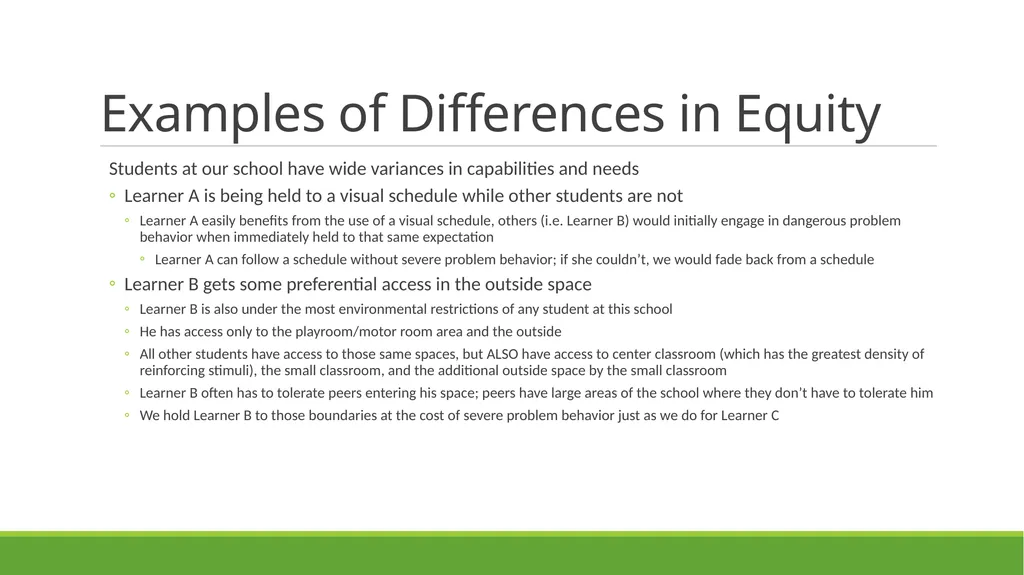
slide12. Examples of Differences in Equity Students at our school have wide variances in capabilities and needs
Learner A is being held to a visual schedule while other students are not
Learner A easily benefits from the use of a visual schedule, others (i.e. Learner B) would initially engage in dangerous problem behavior when immediately held to that same expectation
Learner A can follow a schedule without severe problem behavior; if she couldn’t, we would fade back from a schedule
Learner B gets some preferential access in the outside space
Learner B is also under the most environmental restrictions of any student at this school
He has access only to the playroom/motor room area and the outside
All other students have access to those same spaces, but ALSO have access to center classroom (which has the greatest density of reinforcing stimuli), the small classroom, and the additional outside space by the small classroom
Learner B often has to tolerate peers entering his space; peers have large areas of the school where they don’t have to tolerate him
We hold Learner B to those boundaries at the cost of severe problem behavior just as we do for Learner C<br>
slide13. How Can We Do Better? “Everybody knows how to punish; only behavior analysts are explicitly trained to use positive reinforcement. The real challenge is not to devise coercive measures for treating emergencies but to prevent those emergencies from happening.” – Murray Sidman
In the past five or so years, a group of researchers have refined better methods
Where we can make high magnitude changes in behavior
Without restricting or controlling, without manhandling, without restraining, and without punishing
Facility schools are part of the last resort for kids with severe problem behavior
Kids that have been failed by the educational and medical system
With long histories of trauma
We want Elevation to be their safe-haven
Where adults don’t control and hurt them
Where they can be with adults that prioritize their safety
And where we can help teach them how to trust people again<br>
slide14. What is SBT? “The path to a joyous lifestyle for families with autistic persons is paved with skills.” – Greg Hanley
SBT treats and eliminates severe problem behavior by building skills
Involves the teaching of:
Progressively complex communication
How to respond to disappointment
Compliance with directions<br>
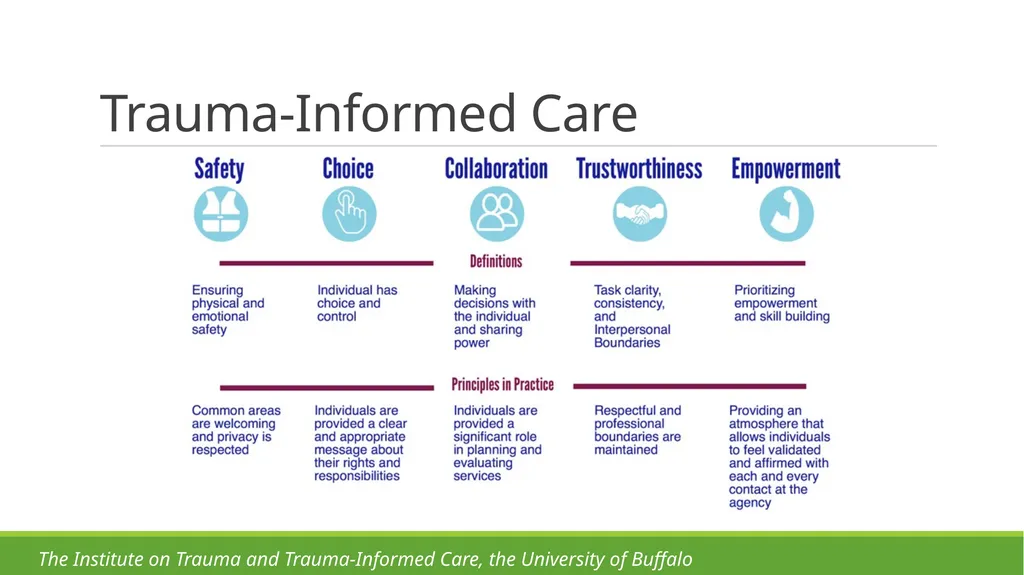
slide15. Trauma-Informed Care The Institute on Trauma and Trauma-Informed Care, the University of Buffalo (2015)<br>
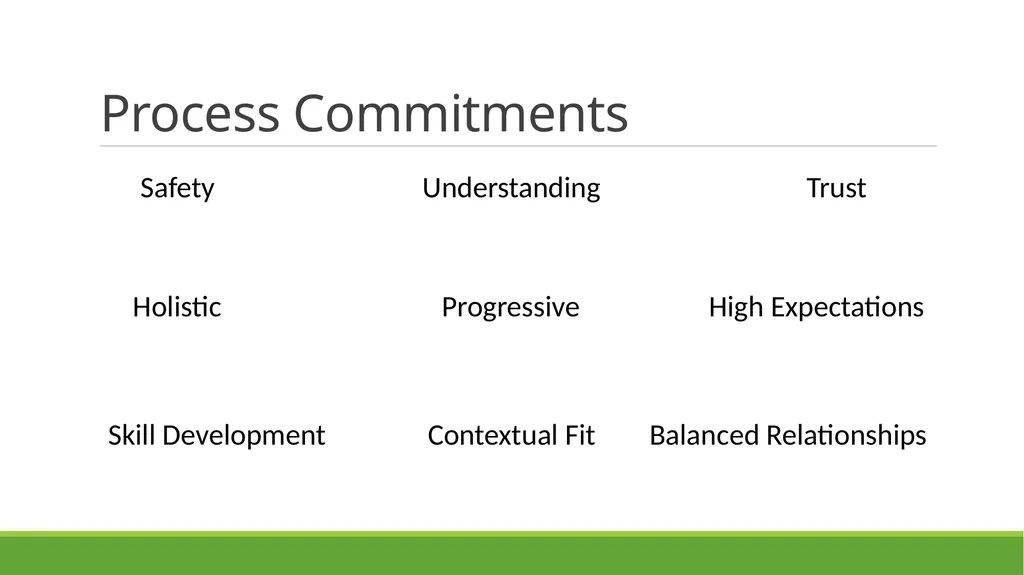
slide16. Process Commitments Safety Understanding Trust Holistic Progressive High Expectations Skill Development Contextual Fit Balanced Relationships<br>
slide17. Control of Behavior Behavior is “the portion of an organism’s interaction with its environment that involves movement of some part of the organism” (Johnston & Pennypacker, 2009).
Behaviors maintain (reinforcement) or abate (punishment) by the consequences that occur within the environment following the occurrence of the behavior<br>
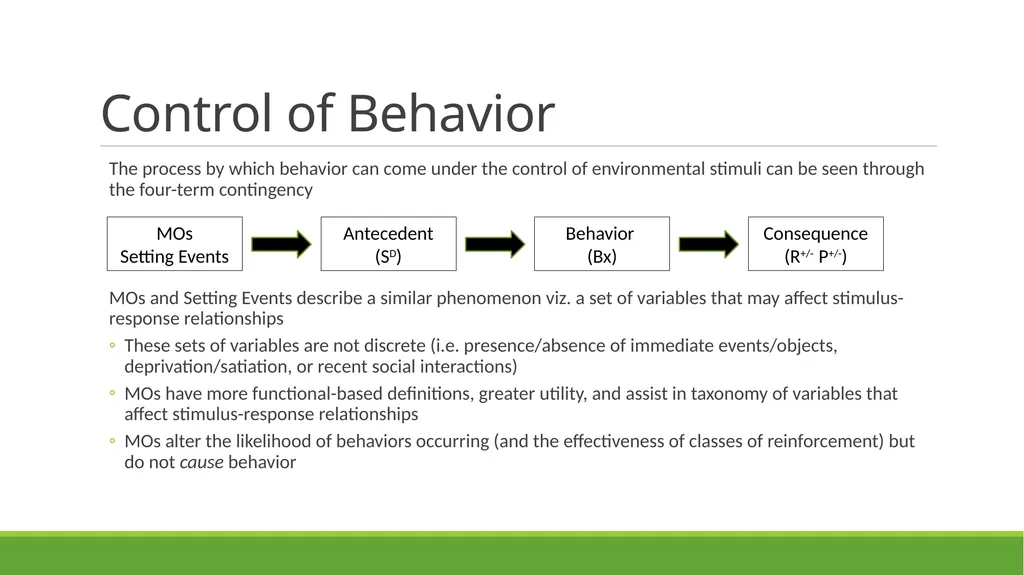
slide18. Control of Behavior The process by which behavior can come under the control of environmental stimuli can be seen through the four-term contingency
MOs and Setting Events describe a similar phenomenon viz. a set of variables that may affect stimulus-response relationships
These sets of variables are not discrete (i.e. presence/absence of immediate events/objects, deprivation/satiation, or recent social interactions)
MOs have more functional-based definitions, greater utility, and assist in taxonomy of variables that affect stimulus-response relationships
MOs alter the likelihood of behaviors occurring (and the effectiveness of classes of reinforcement) but do not cause behavior MOs
Setting Events Antecedent (SD) Behavior
(Bx) Consequence (R+/- P+/-)<br>
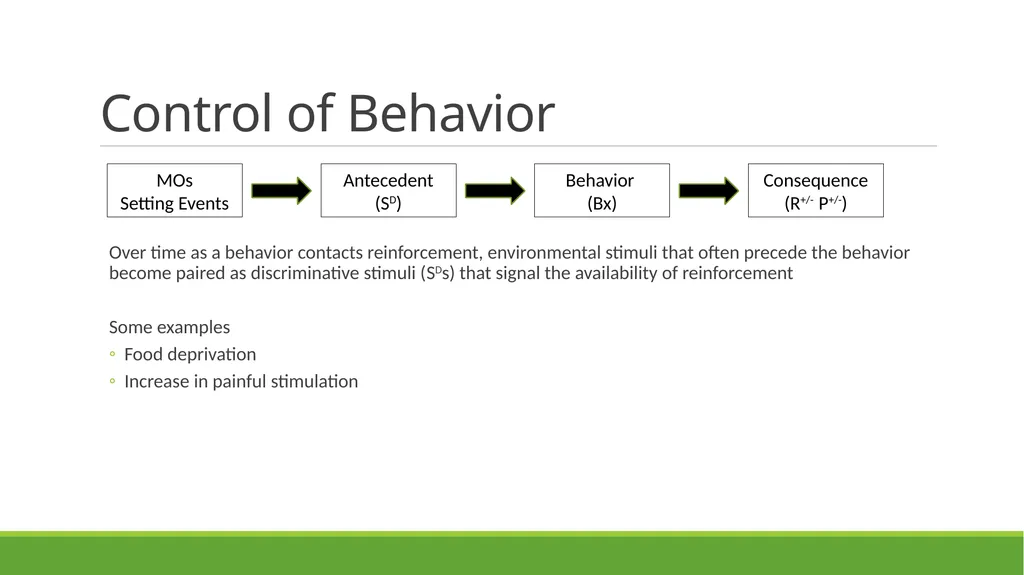
slide19. Control of Behavior Over time as a behavior contacts reinforcement, environmental stimuli that often precede the behavior become paired as discriminative stimuli (SDs) that signal the availability of reinforcement
Some examples
Food deprivation
Increase in painful stimulation MOs
Setting Events Antecedent (SD) Behavior
(Bx) Consequence (R+/- P+/-)<br>
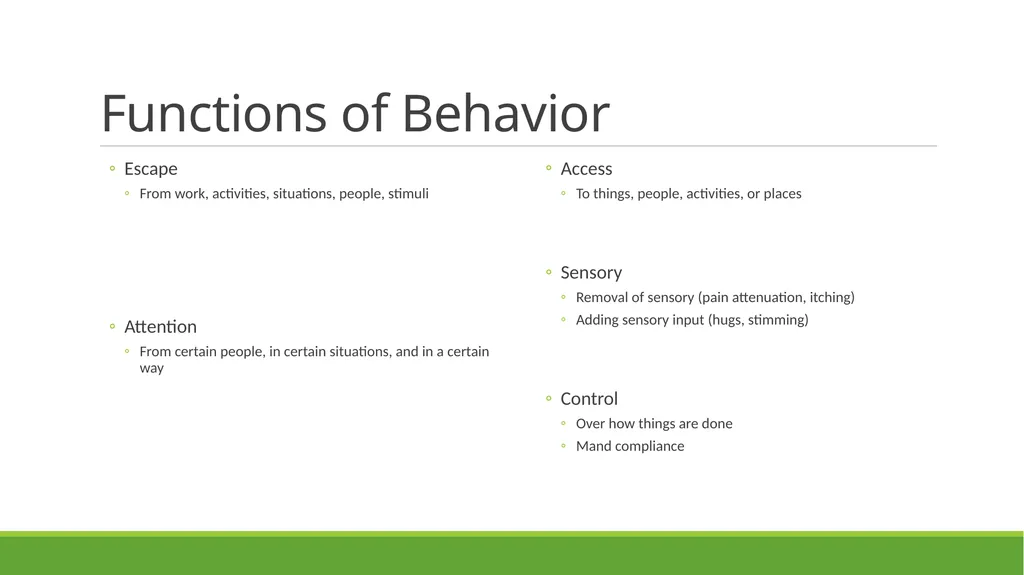
slide20. Functions of Behavior Escape
From work, activities, situations, people, stimuli
Attention
From certain people, in certain situations, and in a certain way Access
To things, people, activities, or places
Sensory
Removal of sensory (pain attenuation, itching)
Adding sensory input (hugs, stimming)
Control
Over how things are done
Mand compliance<br>
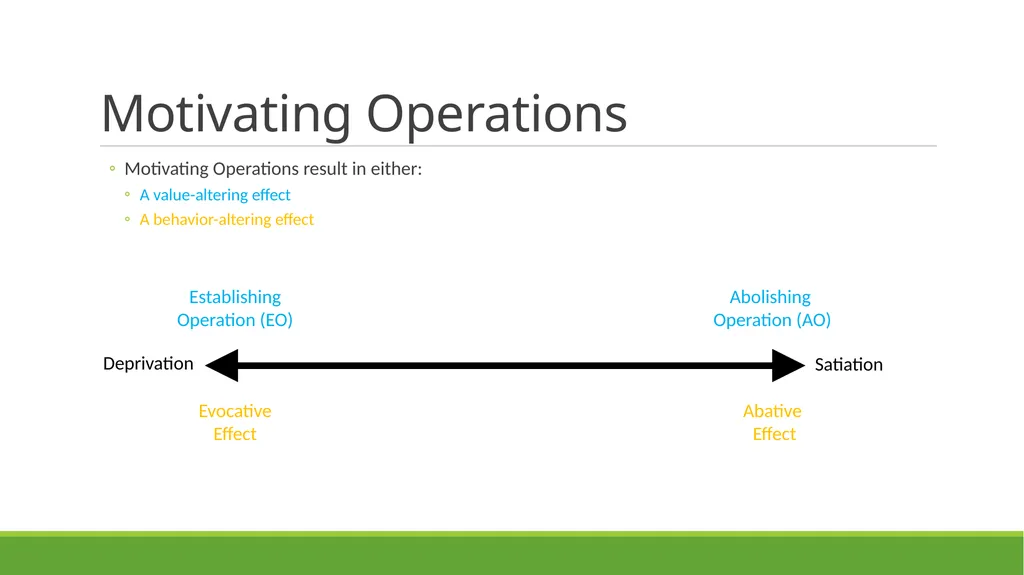
slide21. Motivating Operations Motivating Operations result in either:
A value-altering effect
A behavior-altering effect Satiation Deprivation Establishing Operation (EO) Evocative Effect Abolishing
Operation (AO) Abative
Effect<br>
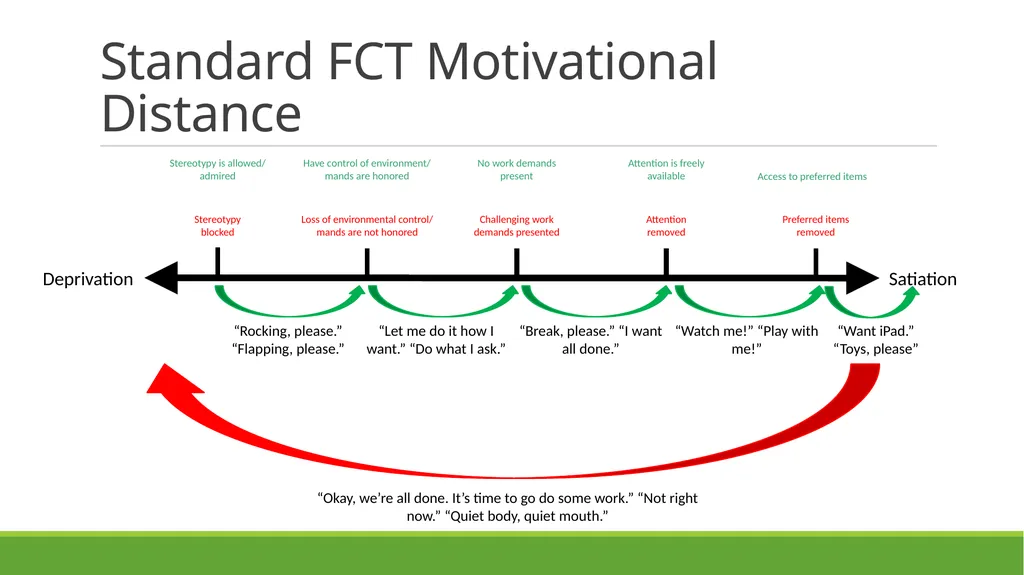
slide22. Standard FCT Motivational Distance Satiation Deprivation Preferred items removed Attention removed Challenging work demands presented Loss of environmental control/
mands are not honored Stereotypy blocked Access to preferred items Attention is freely available No work demands present Have control of environment/ mands are honored Stereotypy is allowed/
admired “Okay, we’re all done. It’s time to go do some work.” “Not right now.” “Quiet body, quiet mouth.” “Rocking, please.” “Flapping, please.” “Let me do it how I want.” “Do what I ask.” “Break, please.” “I want all done.” “Watch me!” “Play with me!” “Want iPad.” “Toys, please”<br>
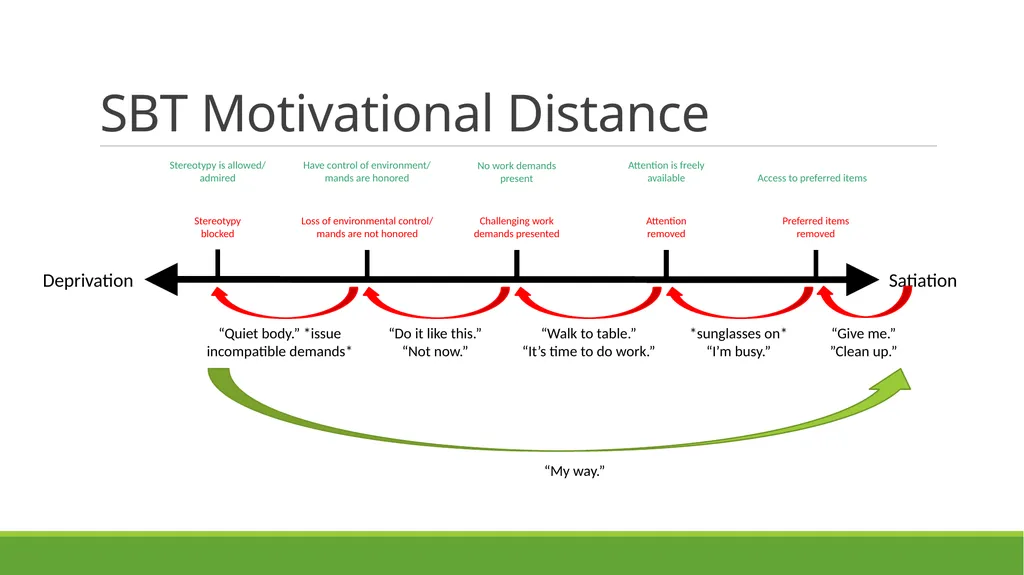
slide23. SBT Motivational Distance Satiation Deprivation Preferred items removed Attention removed Challenging work demands presented Loss of environmental control/
mands are not honored Stereotypy blocked Access to preferred items Attention is freely available No work demands present Have control of environment/ mands are honored Stereotypy is allowed/
admired “Give me.” ”Clean up.” *sunglasses on*
“I’m busy.” “Walk to table.”
“It’s time to do work.” “Do it like this.”
“Not now.” “Quiet body.” *issue incompatible demands* “My way.”<br>
slide24. Synthesis of ABCs SBT relies upon the assumption that contingencies involve synthesis
EO’s can be synthesized
Loss of tangible, diverted attention, and work demand
Behavior can be synthesized
Response class: any group of behaviors that all have the same function/accomplish the same thing
Reinforcement can be synthesized
Behavior results in escaping a demand, gaining access to a toy, and having certain forms of attention available to them<br>
slide25. Terminology FCT: Functional Communication Training
R1s: Severe, dangerous problem behavior
R2s: Non-dangerous associated problem behavior
HRE: Happy, Relaxed, and Engaged
EO: Establishing Operation
SR: Synthesized Reinforcement<br>
slide26. Terminology Continued sFCR: Simple Functional Communication Response
cFCR: Complex Functional Communication Response
TR: Tolerance Response
CAB: Contextually Appropriate Behavior
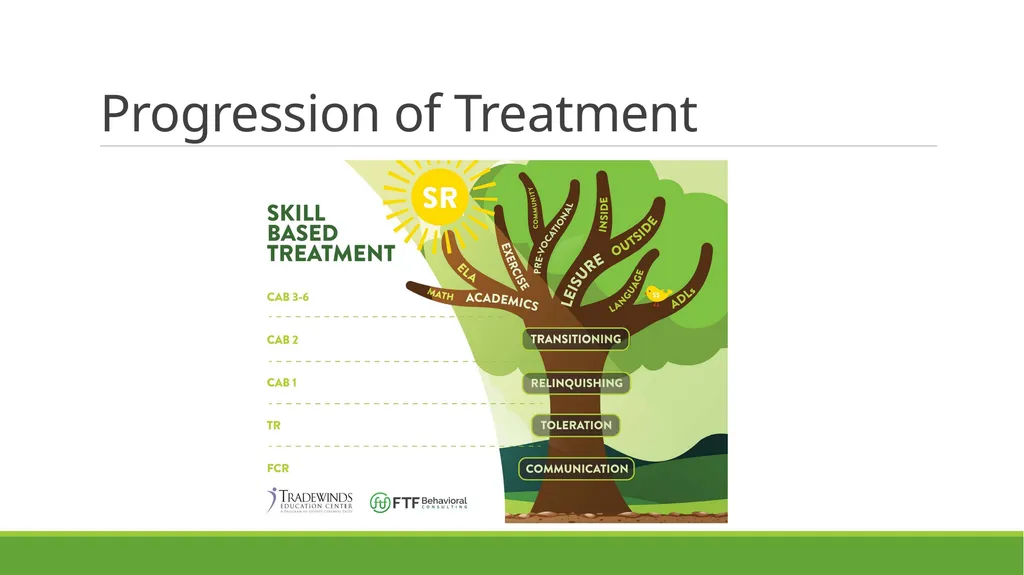
CAB1: Relinquishing reinforcers
CAB2: Transitioning to an area of high expectations<br>
slide27. What Does Synthesized Reinforcement Look Like? Unique for every learner
We will have identified what the SR contingency looks like in an analysis prior to starting the SBT
Your Behavior Should Look Like This:
Nearby and available to learner
Low and loose
Quality, personalized attention
Stop talking!
Follow the learner’s lead
Honor all reasonable requests
Allow/admire stereotypy
Program SR time for a reasonable amount of time<br>
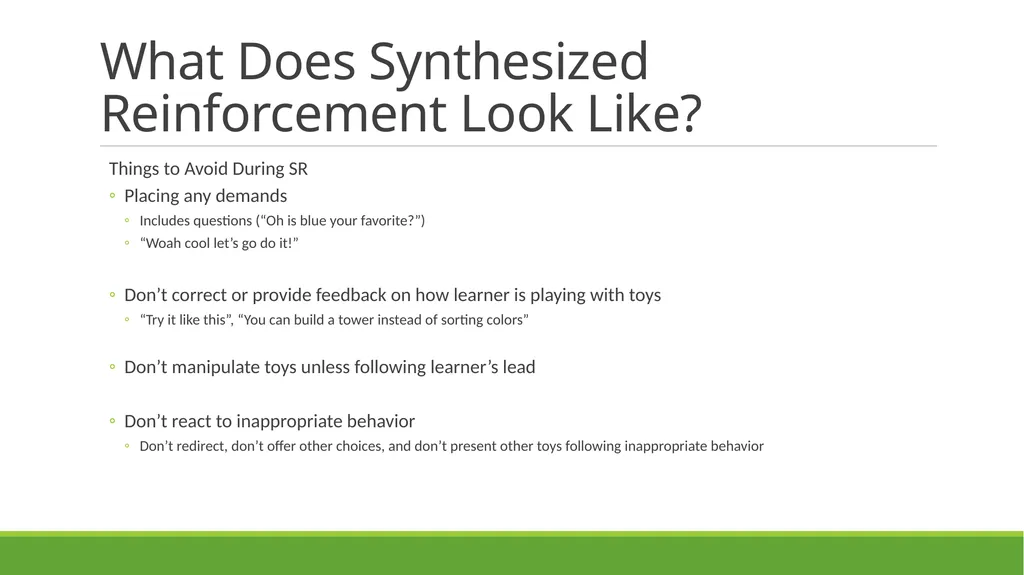
slide28. What Does Synthesized Reinforcement Look Like? Things to Avoid During SR
Placing any demands
Includes questions (“Oh is blue your favorite?”)
“Woah cool let’s go do it!”
Don’t correct or provide feedback on how learner is playing with toys
“Try it like this”, “You can build a tower instead of sorting colors”
Don’t manipulate toys unless following learner’s lead
Don’t react to inappropriate behavior
Don’t redirect, don’t offer other choices, and don’t present other toys following inappropriate behavior<br>
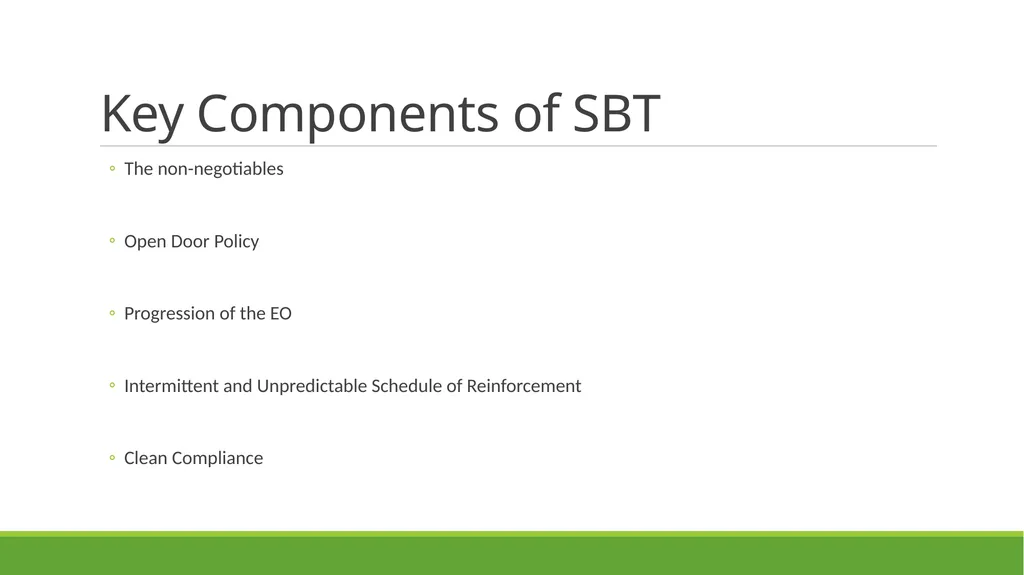
slide29. Key Components of SBT The non-negotiables Open Door Policy Progression of the EO Intermittent and Unpredictable Schedule of Reinforcement Clean Compliance<br>
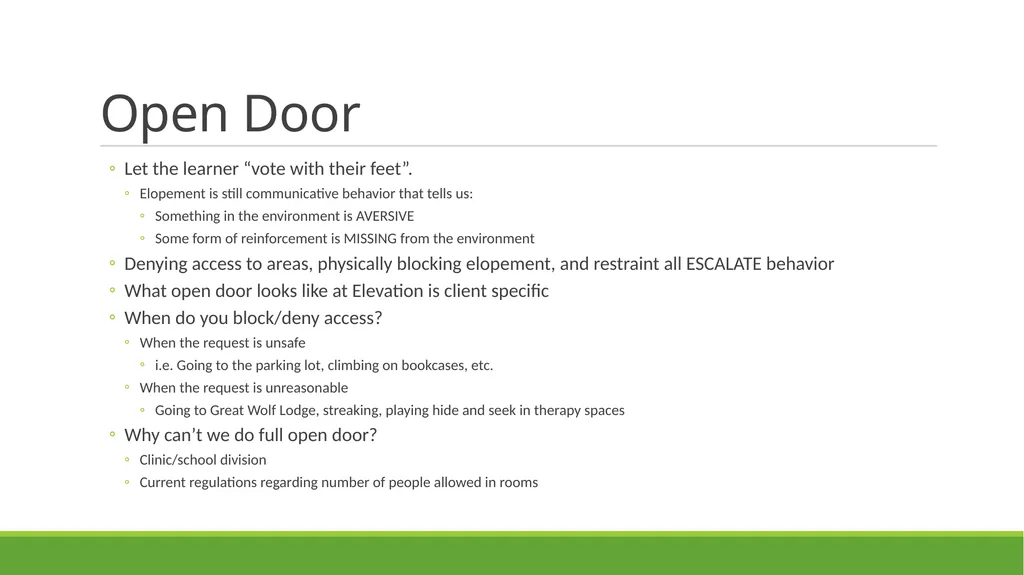
slide30. Open Door Let the learner “vote with their feet”.
Elopement is still communicative behavior that tells us:
Something in the environment is AVERSIVE
Some form of reinforcement is MISSING from the environment
Denying access to areas, physically blocking elopement, and restraint all ESCALATE behavior
What open door looks like at Elevation is client specific
When do you block/deny access?
When the request is unsafe
i.e. Going to the parking lot, climbing on bookcases, etc.
When the request is unreasonable
Going to Great Wolf Lodge, streaking, playing hide and seek in therapy spaces
Why can’t we do full open door?
Clinic/school division
Current regulations regarding number of people allowed in rooms<br>
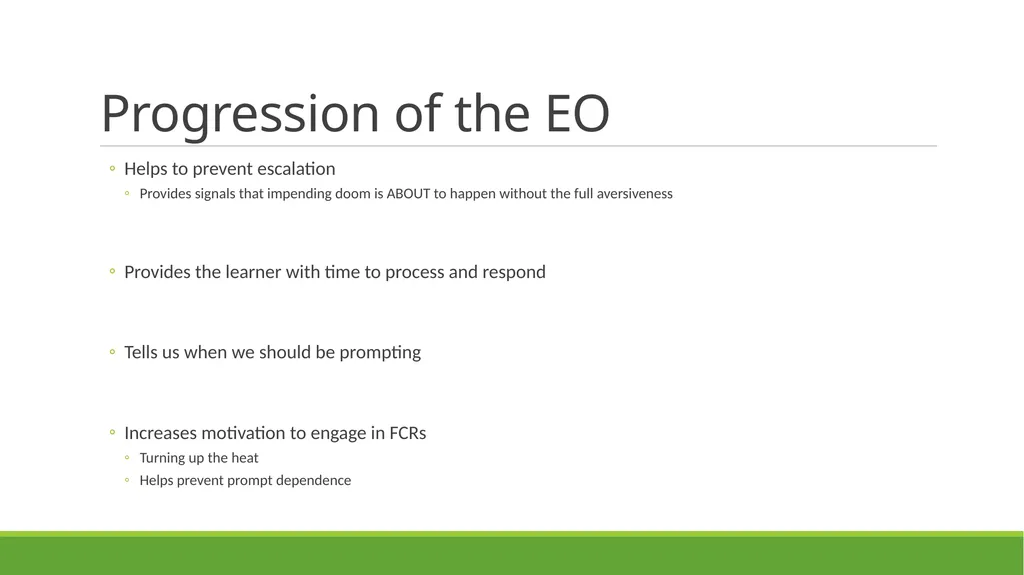
slide31. Progression of the EO Helps to prevent escalation
Provides signals that impending doom is ABOUT to happen without the full aversiveness
Provides the learner with time to process and respond
Tells us when we should be prompting
Increases motivation to engage in FCRs
Turning up the heat
Helps prevent prompt dependence<br>
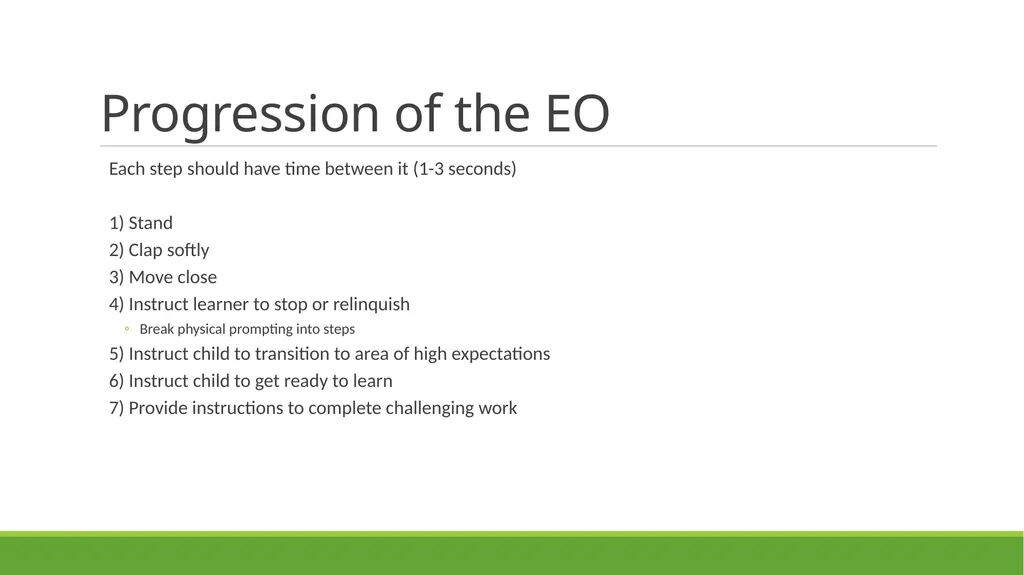
slide32. Progression of the EO Each step should have time between it (1-3 seconds)
1) Stand
2) Clap softly
3) Move close
4) Instruct learner to stop or relinquish
Break physical prompting into steps
5) Instruct child to transition to area of high expectations
6) Instruct child to get ready to learn
7) Provide instructions to complete challenging work<br>
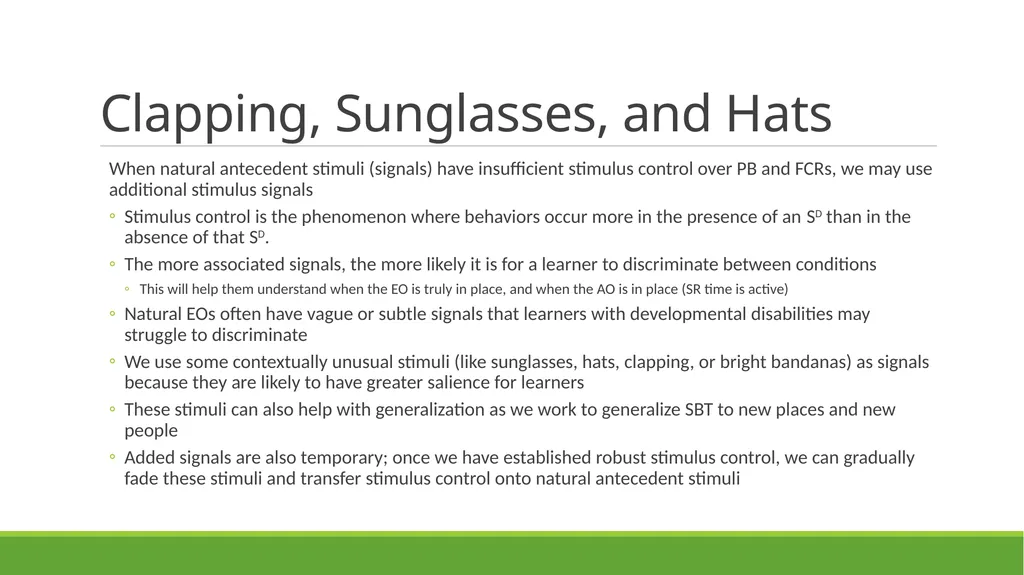
slide33. Clapping, Sunglasses, and Hats When natural antecedent stimuli (signals) have insufficient stimulus control over PB and FCRs, we may use additional stimulus signals
Stimulus control is the phenomenon where behaviors occur more in the presence of an SD than in the absence of that SD.
The more associated signals, the more likely it is for a learner to discriminate between conditions
This will help them understand when the EO is truly in place, and when the AO is in place (SR time is active)
Natural EOs often have vague or subtle signals that learners with developmental disabilities may struggle to discriminate
We use some contextually unusual stimuli (like sunglasses, hats, clapping, or bright bandanas) as signals because they are likely to have greater salience for learners
These stimuli can also help with generalization as we work to generalize SBT to new places and new people
Added signals are also temporary; once we have established robust stimulus control, we can gradually fade these stimuli and transfer stimulus control onto natural antecedent stimuli<br>
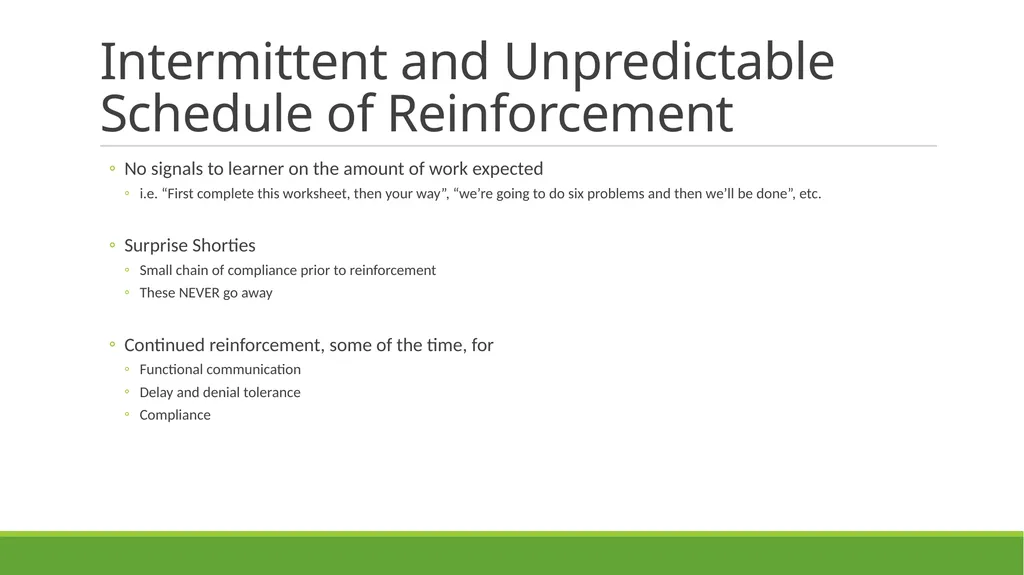
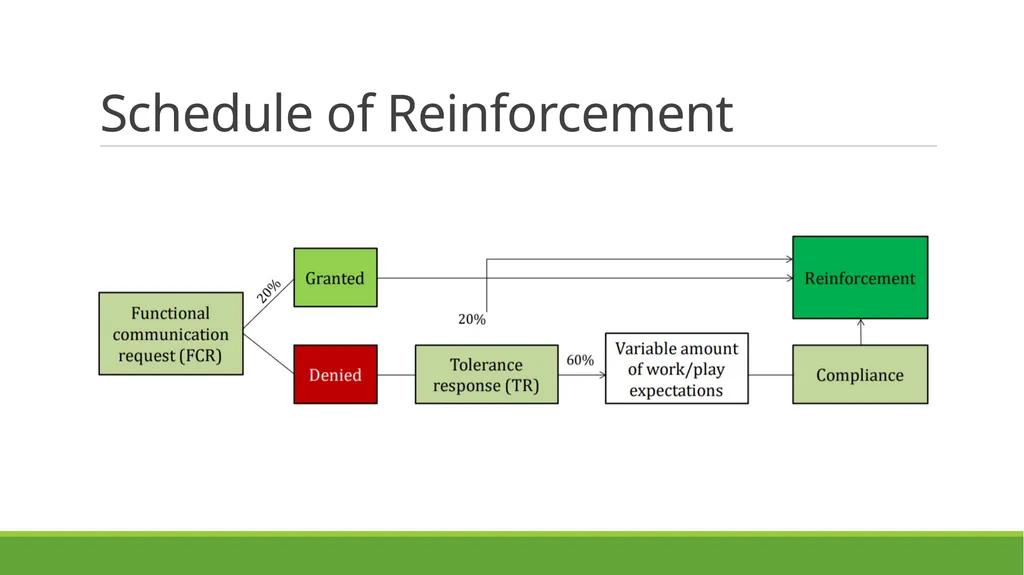
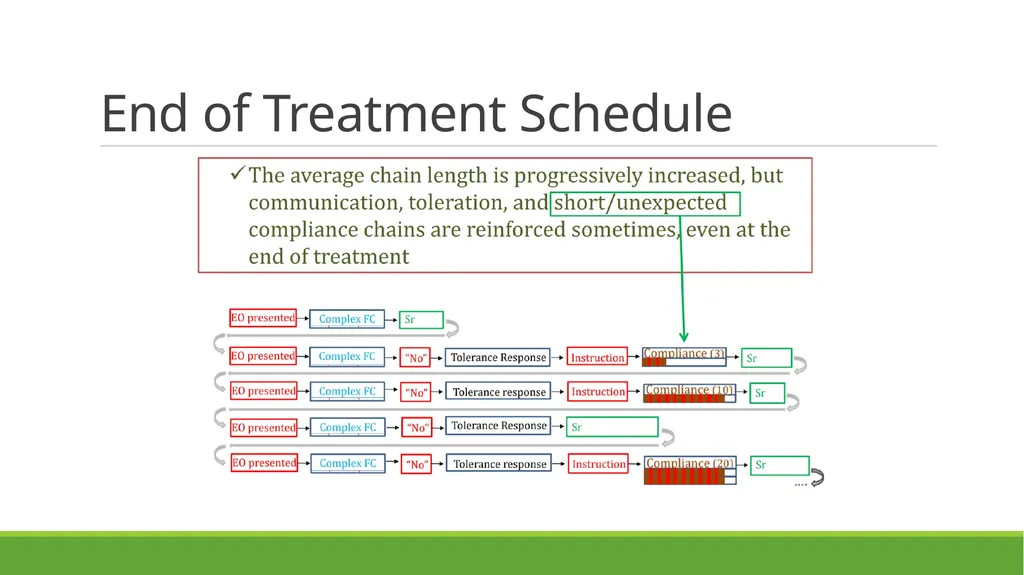
slide34. Intermittent and Unpredictable Schedule of Reinforcement No signals to learner on the amount of work expected
i.e. “First complete this worksheet, then your way”, “we’re going to do six problems and then we’ll be done”, etc.
Surprise Shorties
Small chain of compliance prior to reinforcement
These NEVER go away
Continued reinforcement, some of the time, for
Functional communication
Delay and denial tolerance
Compliance<br>
slide35. Schedule of Reinforcement<br>
slide36. End of Treatment Schedule<br>
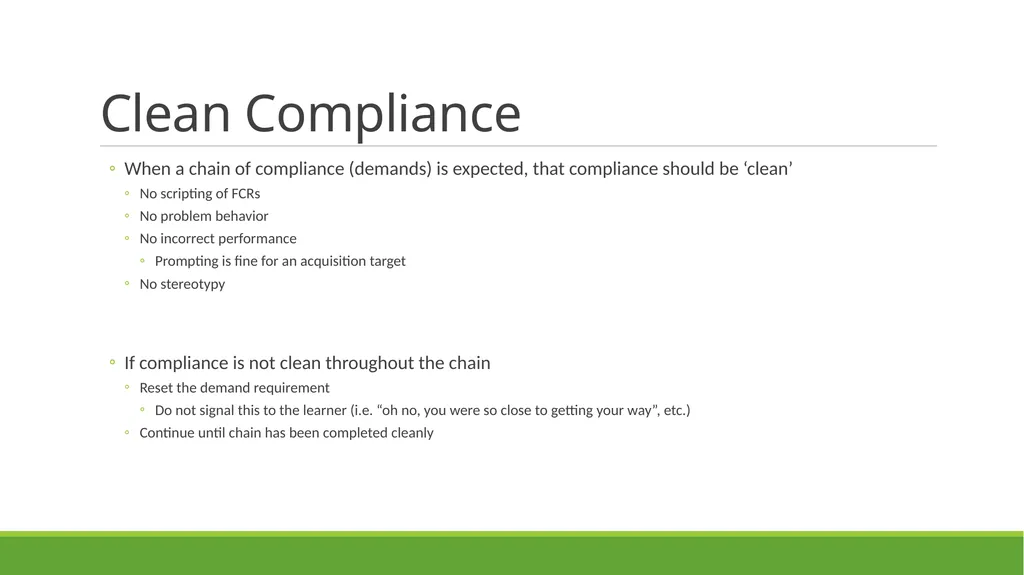
slide37. Clean Compliance When a chain of compliance (demands) is expected, that compliance should be ‘clean’
No scripting of FCRs
No problem behavior
No incorrect performance
Prompting is fine for an acquisition target
No stereotypy
If compliance is not clean throughout the chain
Reset the demand requirement
Do not signal this to the learner (i.e. “oh no, you were so close to getting your way”, etc.)
Continue until chain has been completed cleanly<br>
slide38. Break Time!<br>
slide39. Progression of Treatment<br>
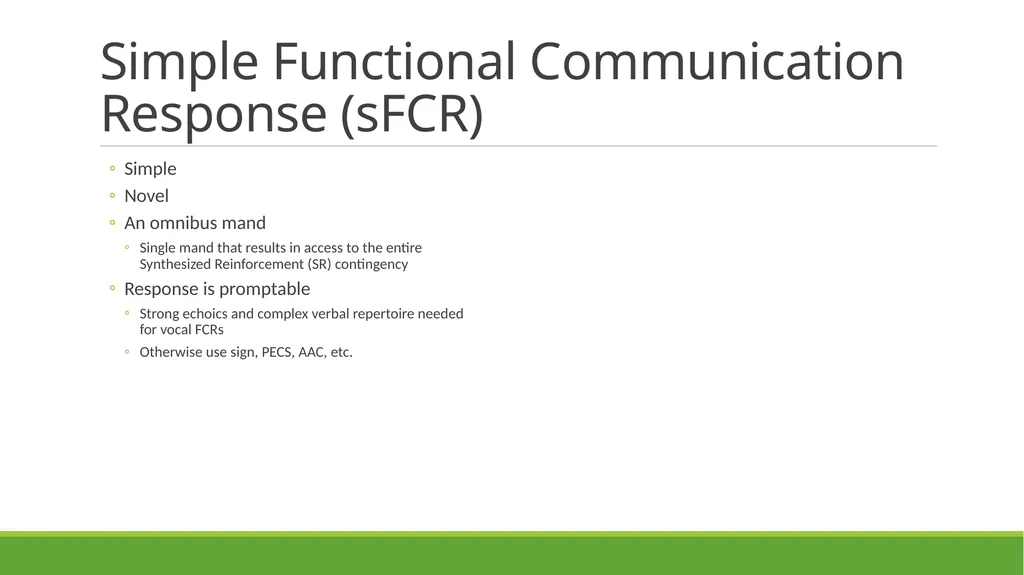
slide40. Simple Functional Communication Response (sFCR) Simple
Novel
An omnibus mand
Single mand that results in access to the entire Synthesized Reinforcement (SR) contingency
Response is promptable
Strong echoics and complex verbal repertoire needed for vocal FCRs
Otherwise use sign, PECS, AAC, etc.<br>
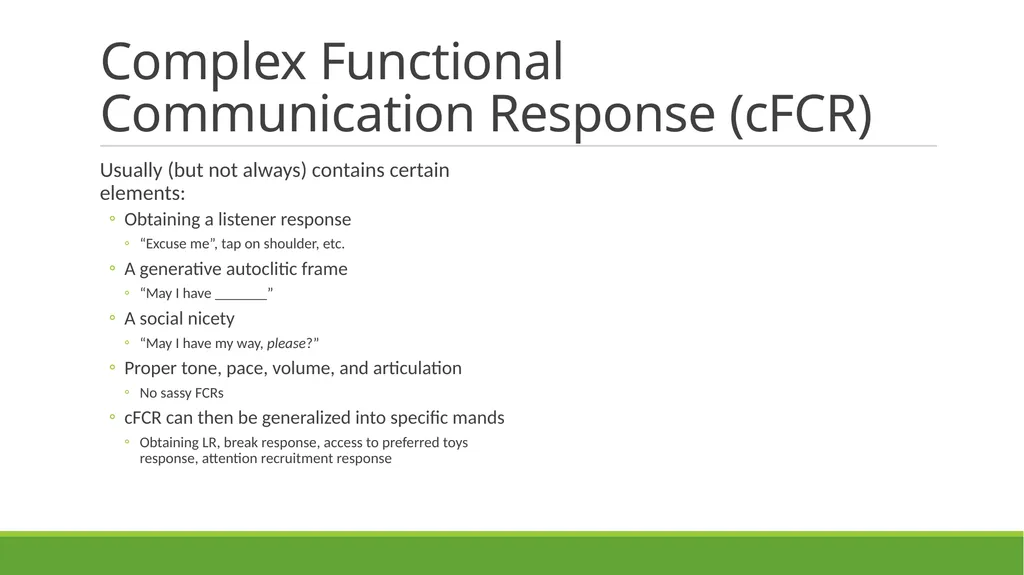
slide41. Complex Functional Communication Response (cFCR) Usually (but not always) contains certain elements:
Obtaining a listener response
“Excuse me”, tap on shoulder, etc.
A generative autoclitic frame
“May I have _______”
A social nicety
“May I have my way, please?”
Proper tone, pace, volume, and articulation
No sassy FCRs
cFCR can then be generalized into specific mands
Obtaining LR, break response, access to preferred toys response, attention recruitment response<br>
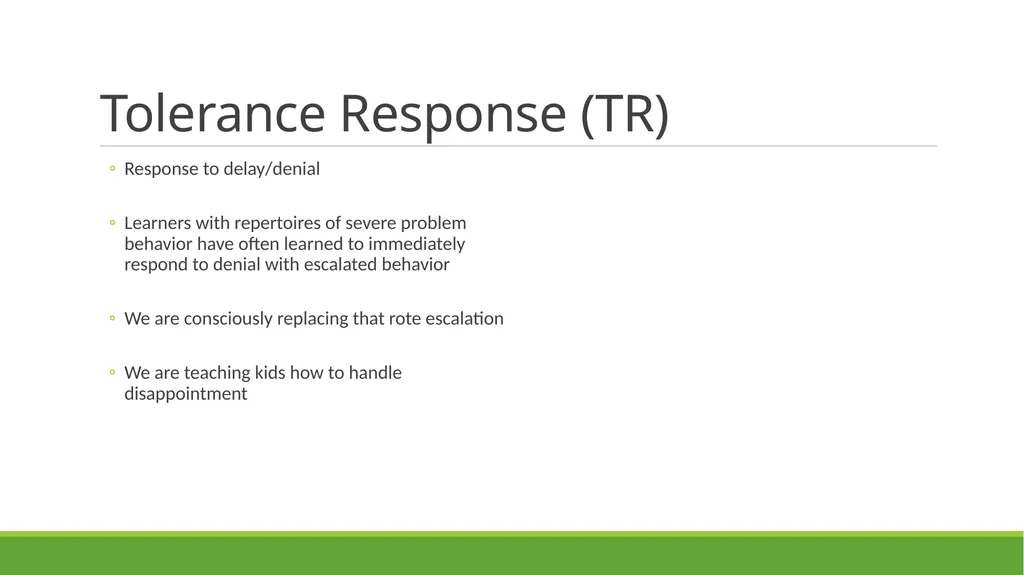
slide42. Tolerance Response (TR) Response to delay/denial
Learners with repertoires of severe problem behavior have often learned to immediately respond to denial with escalated behavior
We are consciously replacing that rote escalation
We are teaching kids how to handle disappointment<br>
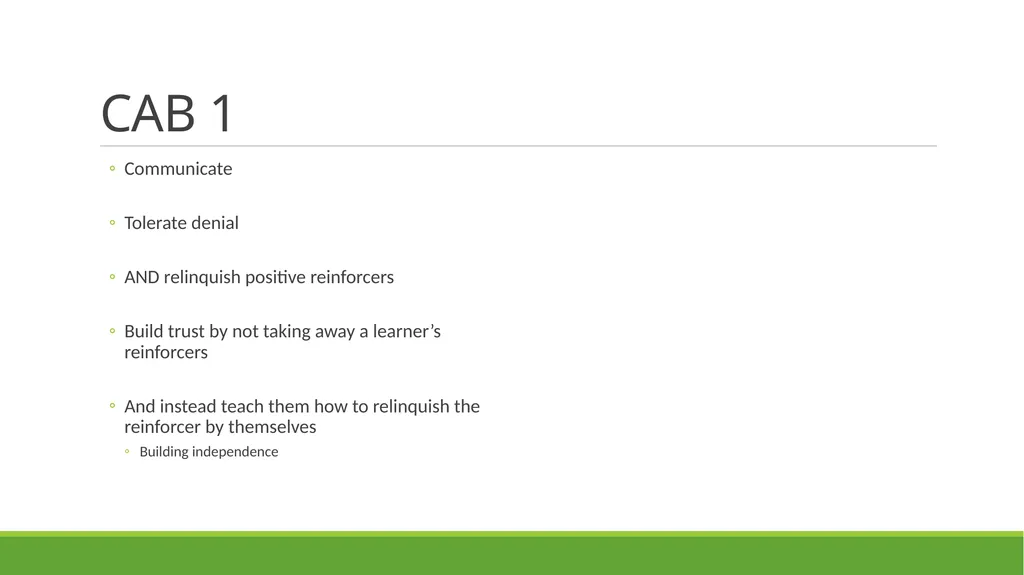
slide43. CAB 1 Communicate
Tolerate denial
AND relinquish positive reinforcers
Build trust by not taking away a learner’s reinforcers
And instead teach them how to relinquish the reinforcer by themselves
Building independence<br>
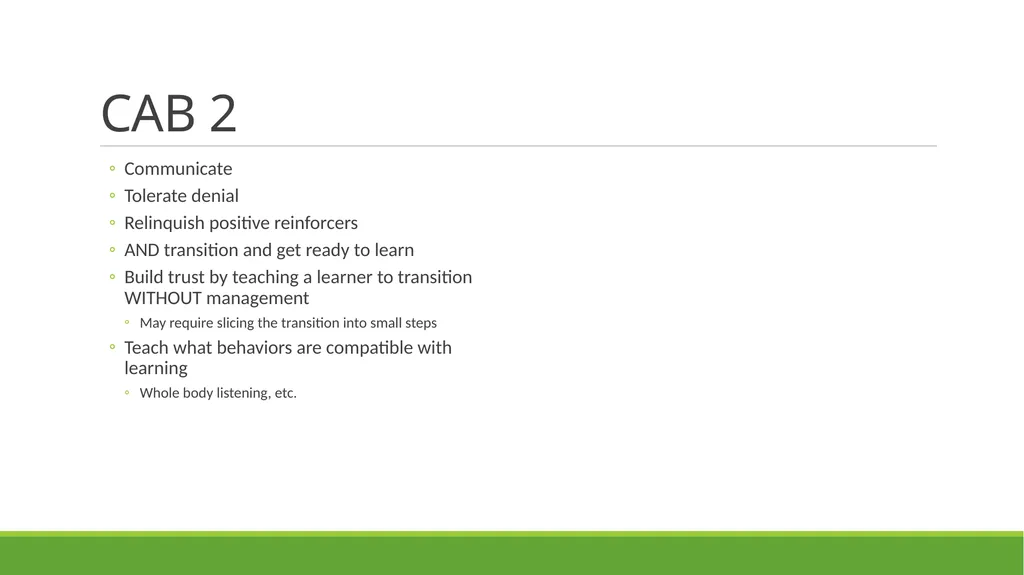
slide44. CAB 2 Communicate
Tolerate denial
Relinquish positive reinforcers
AND transition and get ready to learn
Build trust by teaching a learner to transition WITHOUT management
May require slicing the transition into small steps
Teach what behaviors are compatible with learning
Whole body listening, etc.<br>
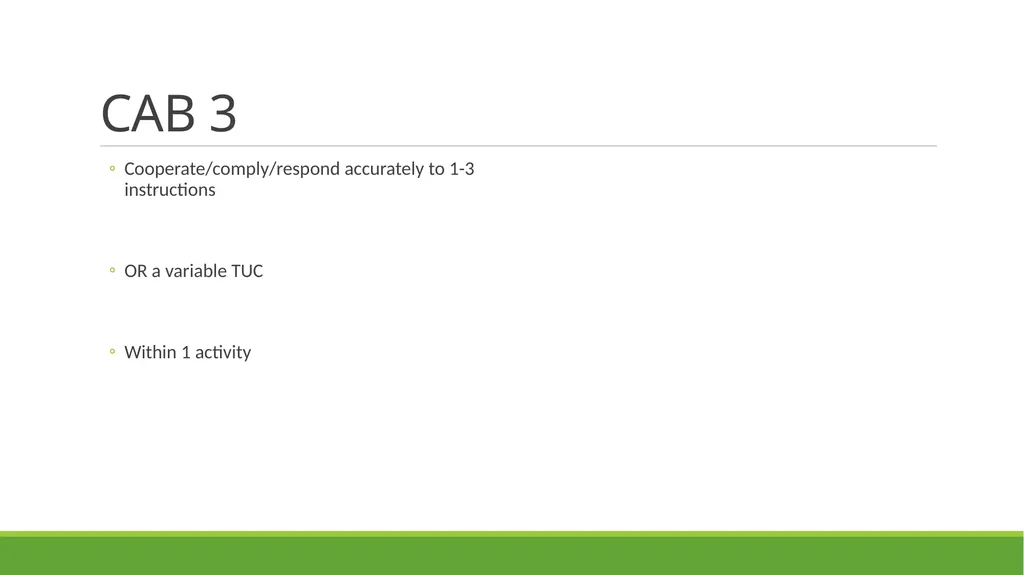
slide45. CAB 3 Cooperate/comply/respond accurately to 1-3 instructions
OR a variable TUC
Within 1 activity<br>
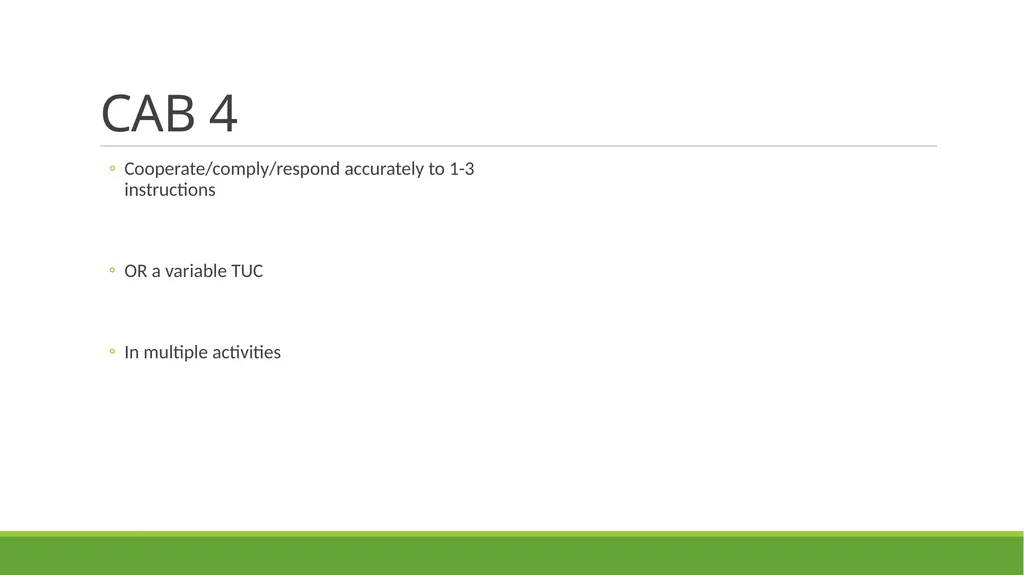
slide46. CAB 4 Cooperate/comply/respond accurately to 1-3 instructions
OR a variable TUC
In multiple activities<br>
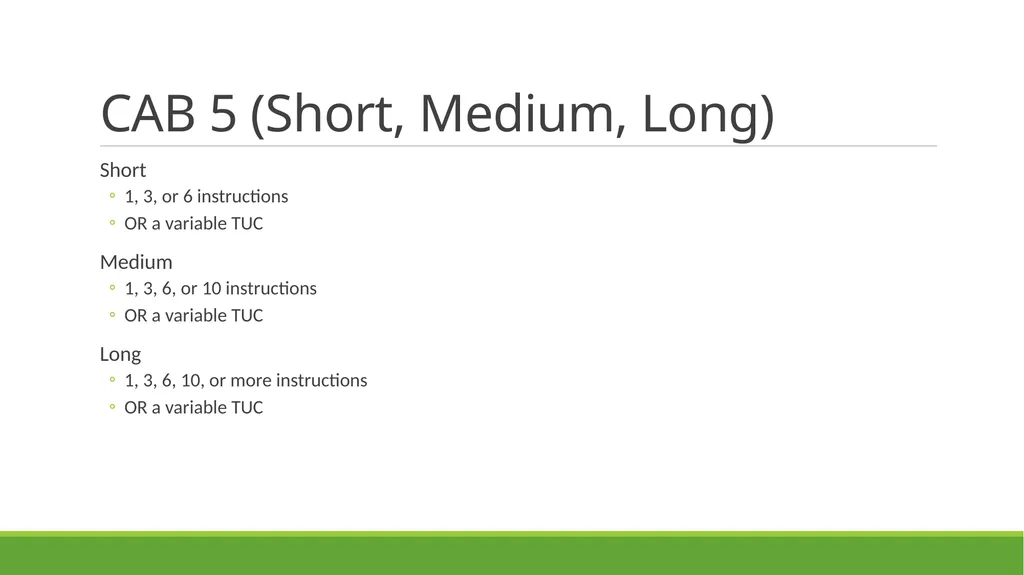
slide47. CAB 5 (Short, Medium, Long) Short
1, 3, or 6 instructions
OR a variable TUC
Medium
1, 3, 6, or 10 instructions
OR a variable TUC
Long
1, 3, 6, 10, or more instructions
OR a variable TUC<br>
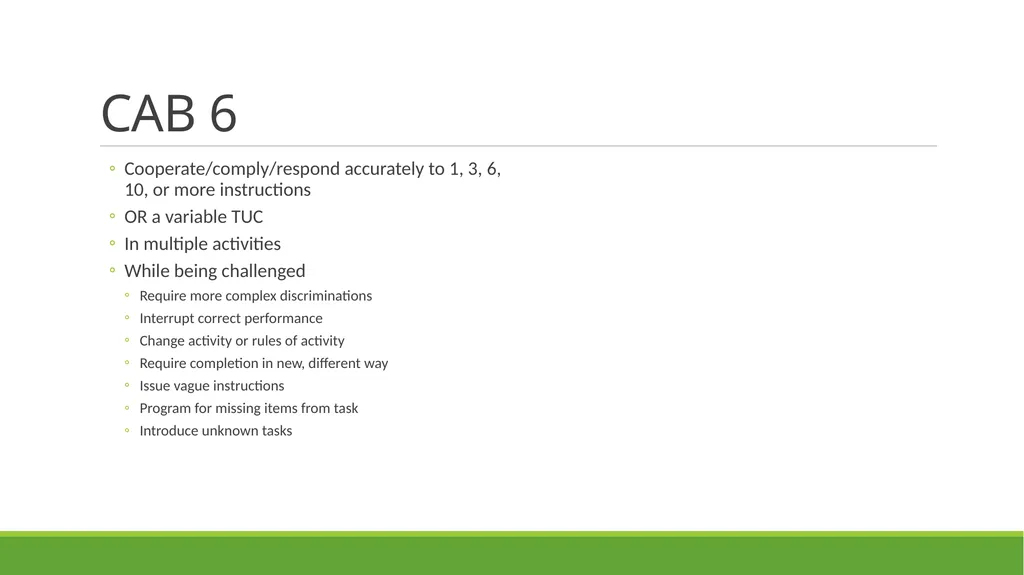
slide48. CAB 6 Cooperate/comply/respond accurately to 1, 3, 6, 10, or more instructions
OR a variable TUC
In multiple activities
While being challenged
Require more complex discriminations
Interrupt correct performance
Change activity or rules of activity
Require completion in new, different way
Issue vague instructions
Program for missing items from task
Introduce unknown tasks<br>
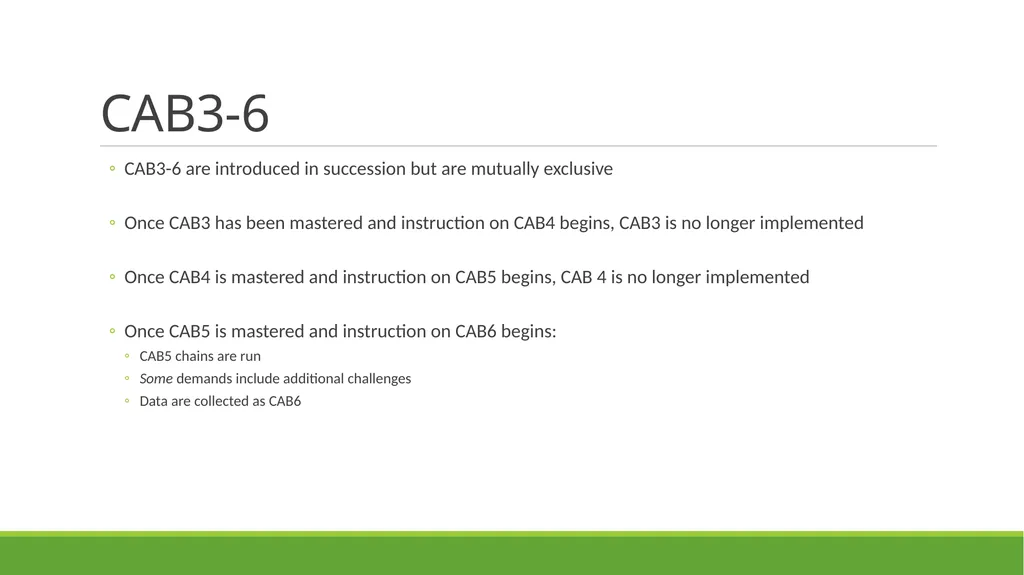
slide49. CAB3-6 CAB3-6 are introduced in succession but are mutually exclusive
Once CAB3 has been mastered and instruction on CAB4 begins, CAB3 is no longer implemented
Once CAB4 is mastered and instruction on CAB5 begins, CAB 4 is no longer implemented
Once CAB5 is mastered and instruction on CAB6 begins:
CAB5 chains are run
Some demands include additional challenges
Data are collected as CAB6<br>
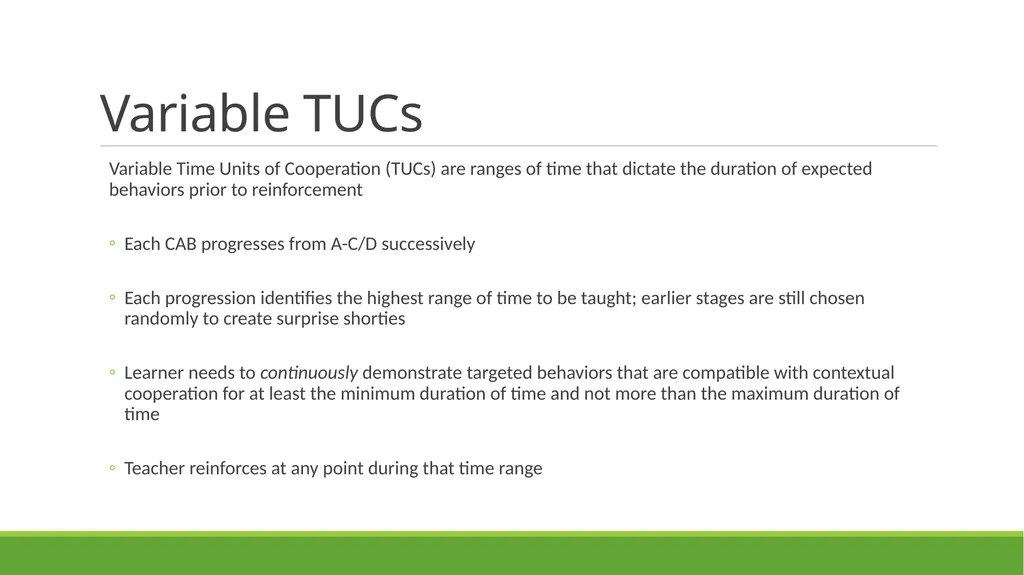
slide50. Variable TUCs Variable Time Units of Cooperation (TUCs) are ranges of time that dictate the duration of expected behaviors prior to reinforcement
Each CAB progresses from A-C/D successively
Each progression identifies the highest range of time to be taught; earlier stages are still chosen randomly to create surprise shorties
Learner needs to continuously demonstrate targeted behaviors that are compatible with contextual cooperation for at least the minimum duration of time and not more than the maximum duration of time
Teacher reinforces at any point during that time range<br>
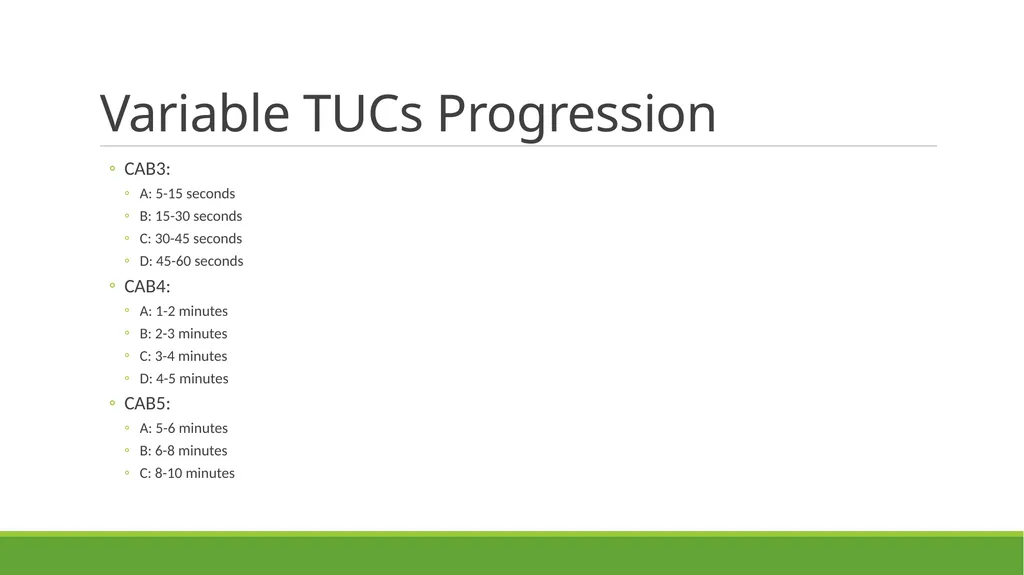
slide51. Variable TUCs Progression CAB3:
A: 5-15 seconds
B: 15-30 seconds
C: 30-45 seconds
D: 45-60 seconds
CAB4:
A: 1-2 minutes
B: 2-3 minutes
C: 3-4 minutes
D: 4-5 minutes
CAB5:
A: 5-6 minutes
B: 6-8 minutes
C: 8-10 minutes<br>
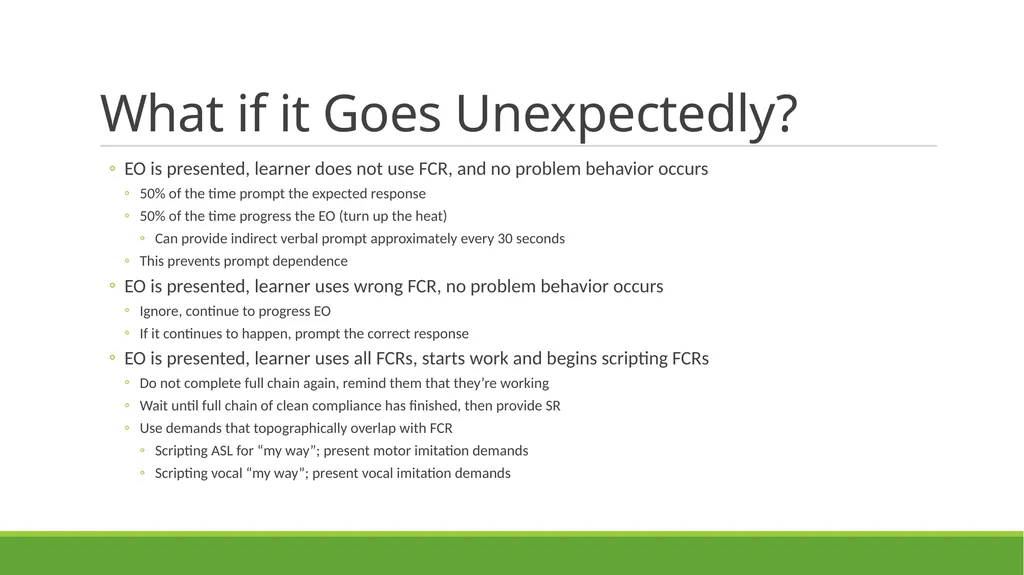
slide52. What if it Goes Unexpectedly? EO is presented, learner does not use FCR, and no problem behavior occurs
50% of the time prompt the expected response
50% of the time progress the EO (turn up the heat)
Can provide indirect verbal prompt approximately every 30 seconds
This prevents prompt dependence
EO is presented, learner uses wrong FCR, no problem behavior occurs
Ignore, continue to progress EO
If it continues to happen, prompt the correct response
EO is presented, learner uses all FCRs, starts work and begins scripting FCRs
Do not complete full chain again, remind them that they’re working
Wait until full chain of clean compliance has finished, then provide SR
Use demands that topographically overlap with FCR
Scripting ASL for “my way”; present motor imitation demands
Scripting vocal “my way”; present vocal imitation demands<br>
slide53. What if it Goes Unexpectedly?<br>
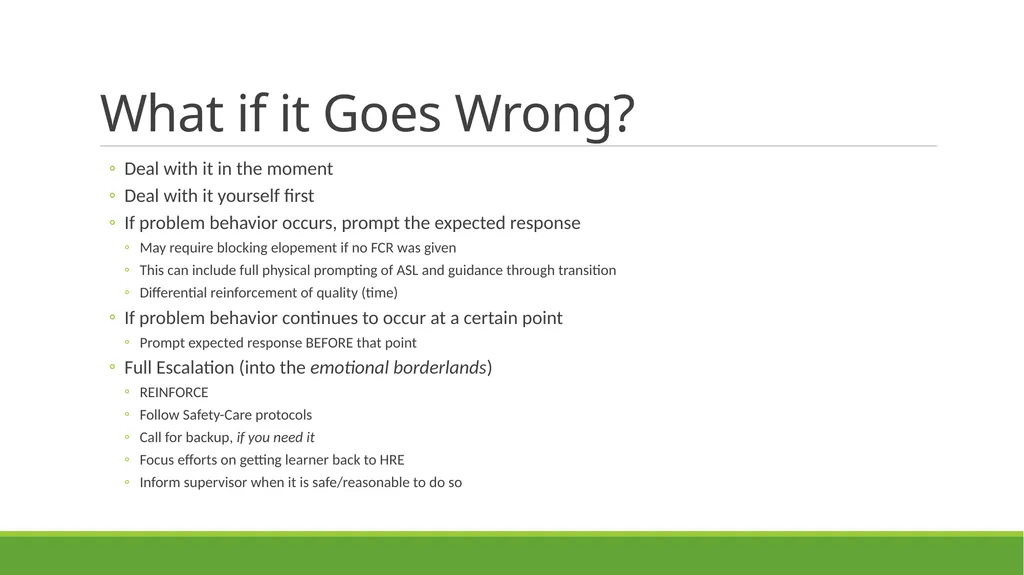
slide54. What if it Goes Wrong? Deal with it in the moment
Deal with it yourself first
If problem behavior occurs, prompt the expected response
May require blocking elopement if no FCR was given
This can include full physical prompting of ASL and guidance through transition
Differential reinforcement of quality (time)
If problem behavior continues to occur at a certain point
Prompt expected response BEFORE that point
Full Escalation (into the emotional borderlands)
REINFORCE
Follow Safety-Care protocols
Call for backup, if you need it
Focus efforts on getting learner back to HRE
Inform supervisor when it is safe/reasonable to do so<br>
slide55. What if it Goes Wrong?<br>
slide56. What if it Goes Wrong?<br>
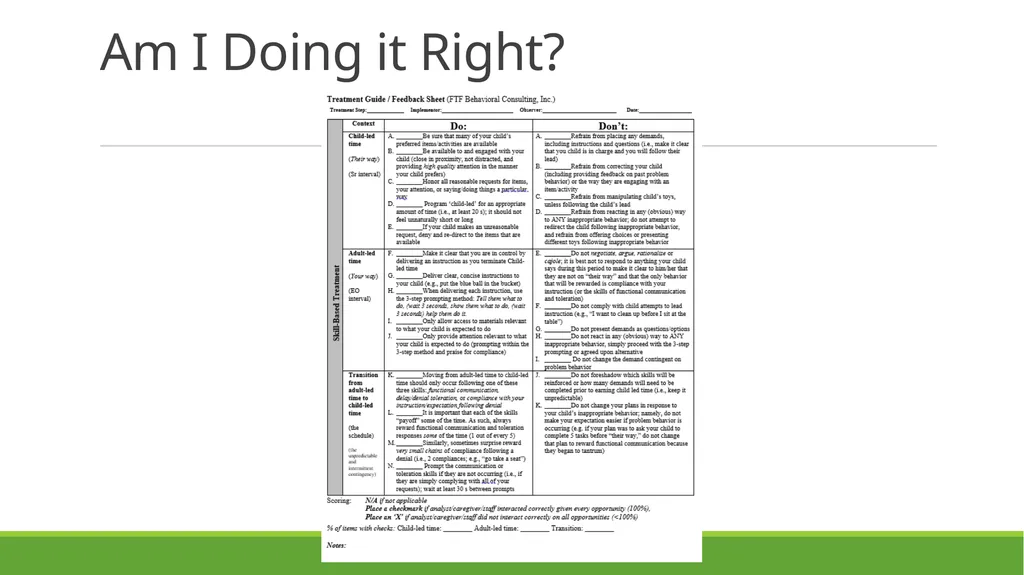
slide57. Am I Doing it Right?<br>
slide58. Progression of Our Training Focus The progress of our students slowed during the rollout of SBT
This is for a few reasons
We’re all learning this process together
SBT requires a much more precise level of analysis and instruction than old school ABA
We are learning how to do that
Some kids have thrown some curveballs and we are learning how to effectively and efficiently adjust to those needs
We saw a need to go back to basics and focus on “first things first”
This led us to decide on a targeted, triage form of training for staff
1) Train all staff on how to create effective and meaningful SR contexts
2) Cross train staff to be able to work with all students
3) Train staff on how to implement high-quality EO trials
4) Learn how to use EFL
5) Build the infrastructure necessary for an effective EFL rollout
6) Train staff on EFL<br>
slide59. Who Teaches What? Shaping of the FCRs, TR, CAB1, CAB2, and CAB3 require expert-level instruction
BCBAs, Behavior Interns, or RBT Leads
Requires in-the-moment changes to
Presentation/progression of EO
Form of prompting
Fading of prompts
CAB4-6 will be taught by RBTs with supervision and support from expert-level staff
Most procedural problems have been solved
Teaching now is a progressive chaining of responses
Teaching of new branches will be determined on client-by-client basis<br>
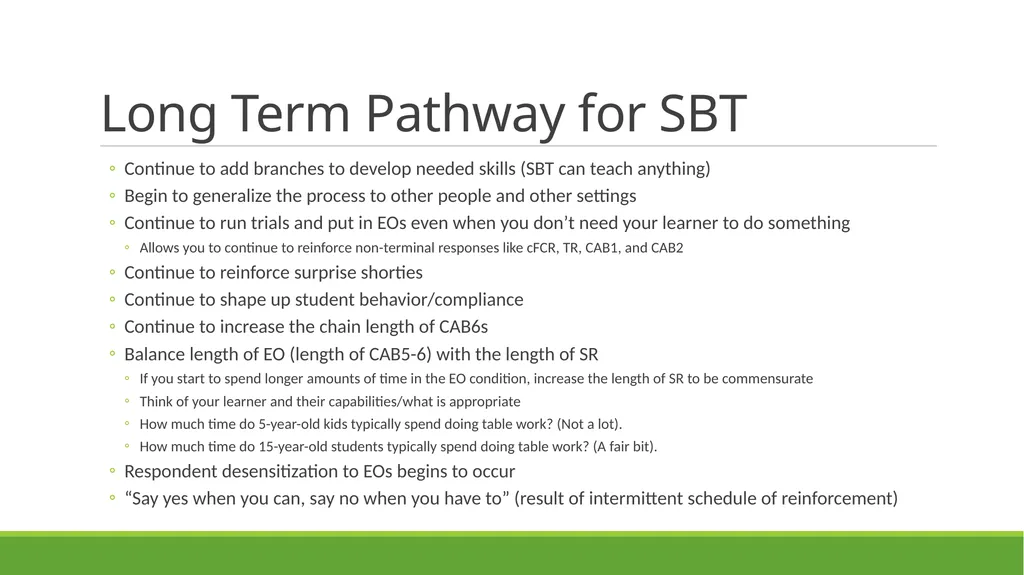
slide60. Long Term Pathway for SBT Continue to add branches to develop needed skills (SBT can teach anything)
Begin to generalize the process to other people and other settings
Continue to run trials and put in EOs even when you don’t need your learner to do something
Allows you to continue to reinforce non-terminal responses like cFCR, TR, CAB1, and CAB2
Continue to reinforce surprise shorties
Continue to shape up student behavior/compliance
Continue to increase the chain length of CAB6s
Balance length of EO (length of CAB5-6) with the length of SR
If you start to spend longer amounts of time in the EO condition, increase the length of SR to be commensurate
Think of your learner and their capabilities/what is appropriate
How much time do 5-year-old kids typically spend doing table work? (Not a lot).
How much time do 15-year-old students typically spend doing table work? (A fair bit).
Respondent desensitization to EOs begins to occur
“Say yes when you can, say no when you have to” (result of intermittent schedule of reinforcement)<br>
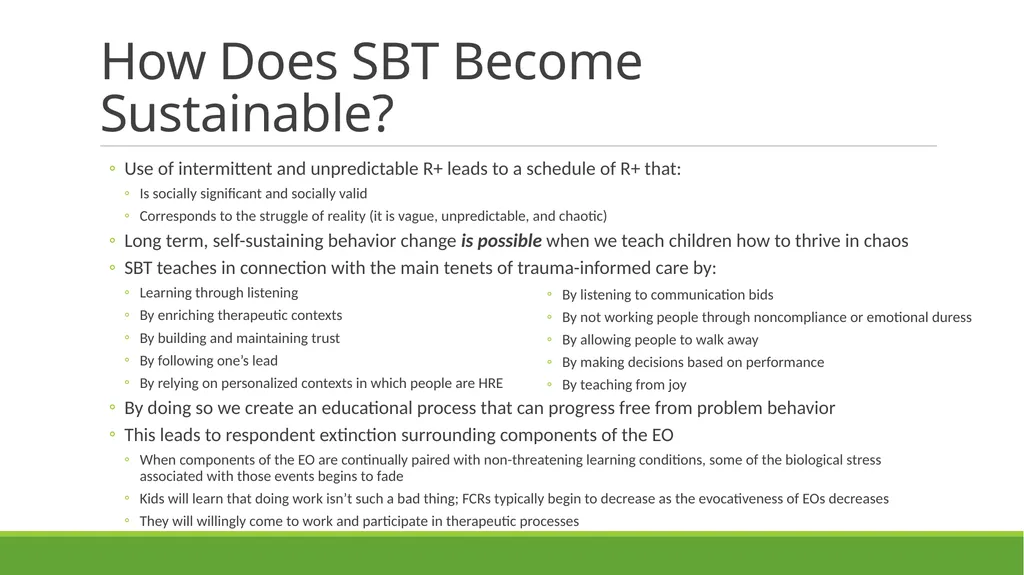
slide61. How Does SBT Become Sustainable? Use of intermittent and unpredictable R+ leads to a schedule of R+ that:
Is socially significant and socially valid
Corresponds to the struggle of reality (it is vague, unpredictable, and chaotic)
Long term, self-sustaining behavior change is possible when we teach children how to thrive in chaos
SBT teaches in connection with the main tenets of trauma-informed care by:
Learning through listening
By enriching therapeutic contexts
By building and maintaining trust
By following one’s lead
By relying on personalized contexts in which people are HRE
By doing so we create an educational process that can progress free from problem behavior
This leads to respondent extinction surrounding components of the EO
When components of the EO are continually paired with non-threatening learning conditions, some of the biological stress associated with those events begins to fade
Kids will learn that doing work isn’t such a bad thing; FCRs typically begin to decrease as the evocativeness of EOs decreases
They will willingly come to work and participate in therapeutic processes By listening to communication bids
By not working people through noncompliance or emotional duress
By allowing people to walk away
By making decisions based on performance
By teaching from joy<br>
slide62. Branch Data Sheet<br>
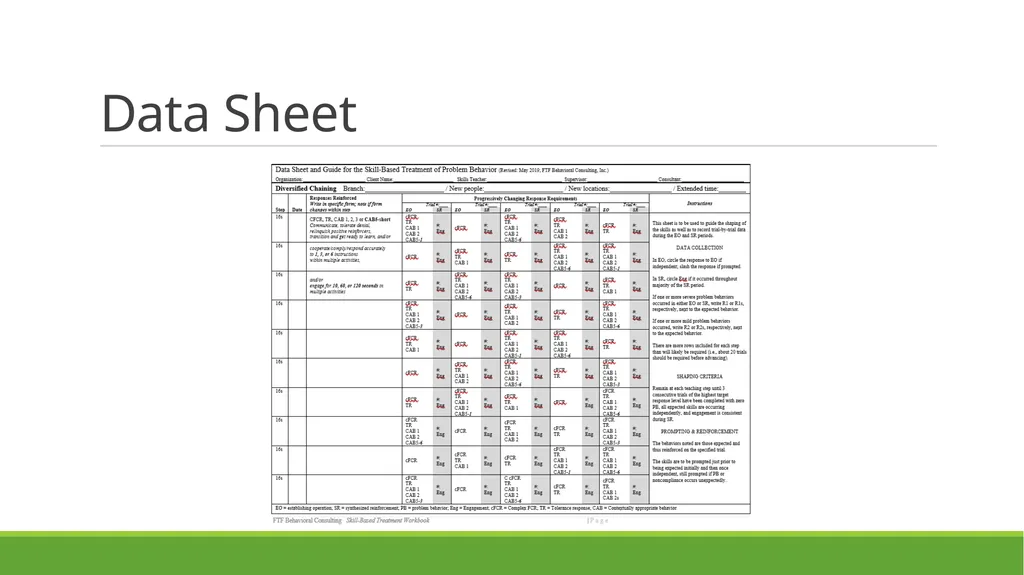
slide63. Data Sheet<br>
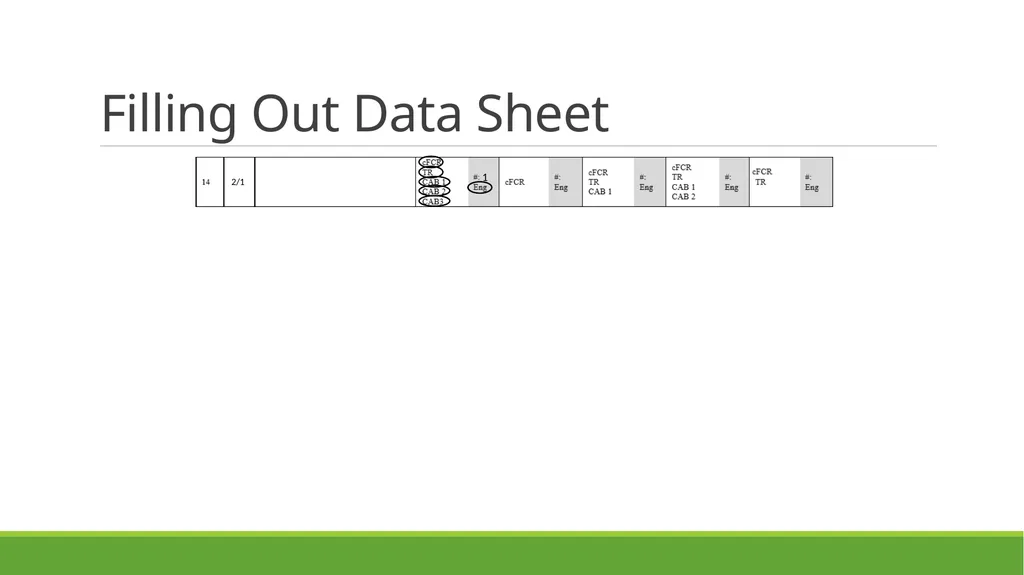
slide64. Filling Out Data Sheet 2/1 1<br>
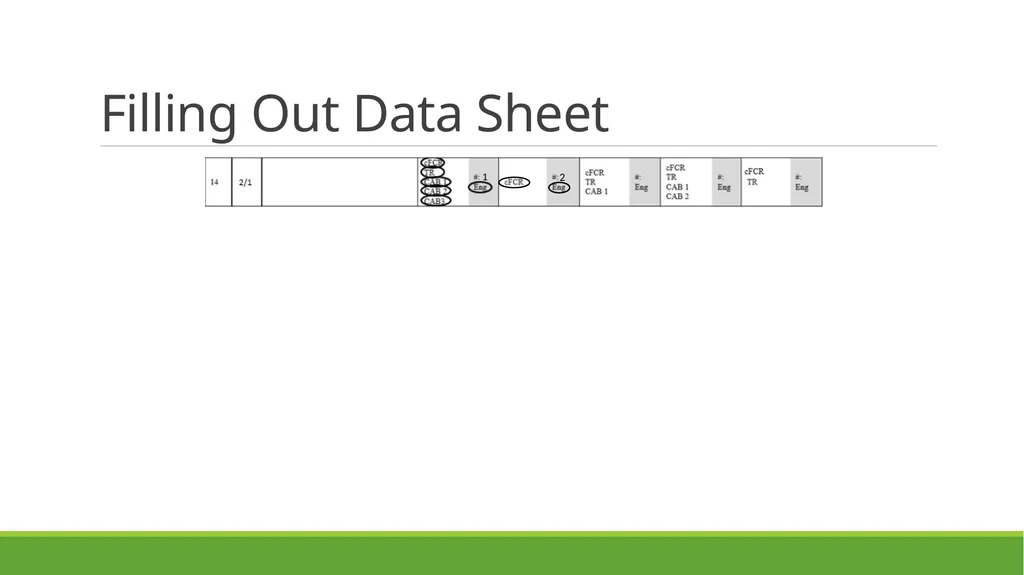
slide65. Filling Out Data Sheet 2<br>
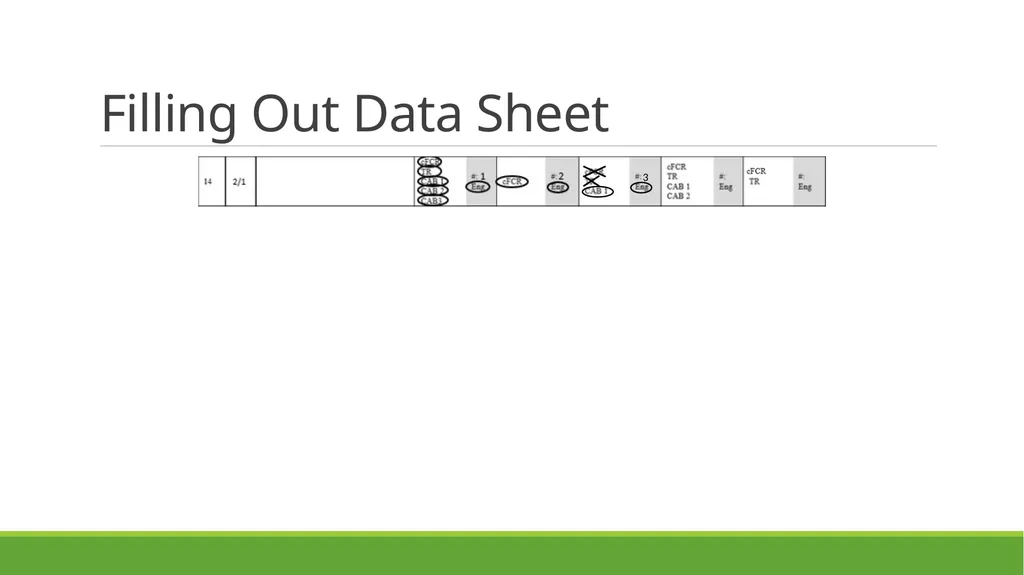
slide66. Filling Out Data Sheet 3<br>
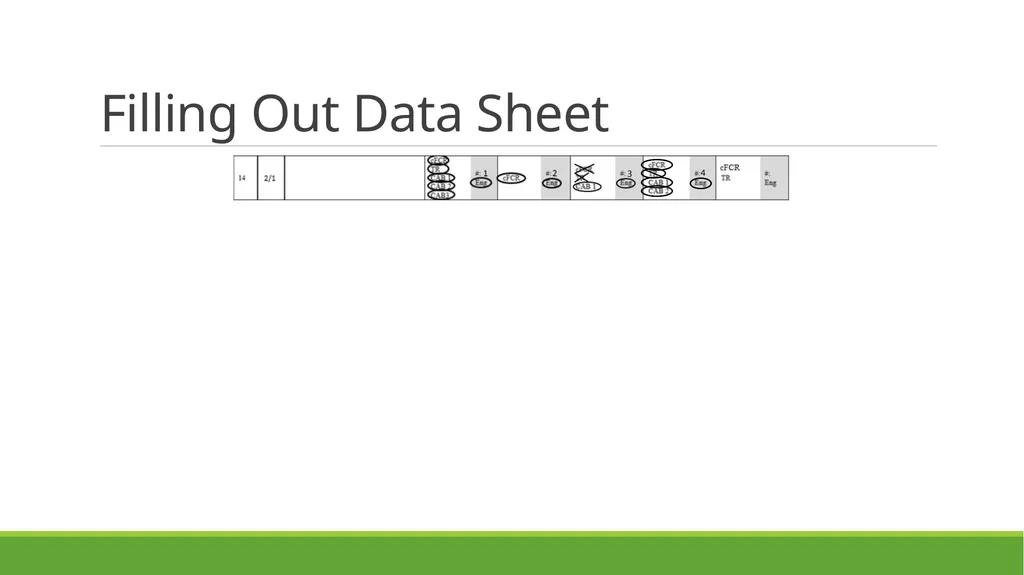
slide67. Filling Out Data Sheet 4<br>
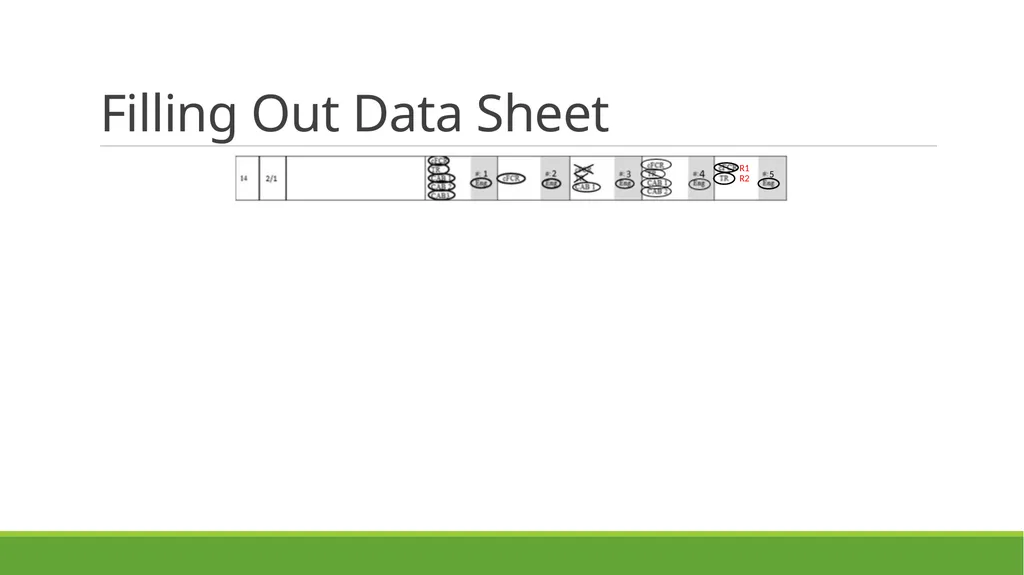
slide68. Filling Out Data Sheet 5 R1 R2<br>
slide69. Questions?<br>
slide2. Roots of ABA Applied use of behavior analysis started in the 1960’s
Early research was largely with adults with dangerous, life-threatening behavior
Lovaas’ Early Intensive Behavioral Intervention (EIBI) programs
Initial programs were with kids exhibiting dangerous problem behavior
Became heavily reliant on use of punishment (including aversives)<br>
slide3. Early Behavior-Change Behavior Modification (B-Mod)
Use of arbitrary reinforcers and punishers to change behavior
Requires no understanding of behavioral function
Still widely in use; DRO is the most common treatment for problem behavior
Often involves restricting and controlling, frequent use of punishment and physical restriant
Useful when there is no motivation (i.e. early potty training)
Medication
Intended for short-term emergency remediation to get behavior under control
Has become long-term behavior change strategy
Appeasement/Mollification
Antecedent only/antecedent heavy interventions
Prevent situations that will cause behavior
This strategy will ALWAYS fail long term<br>
slide4. What is Coercion? Coercion is the control of behavior through the use of (a) punishment or the threat of punishment, or (b) negative reinforcement: the removal or avoidance of aversive stimuli
Behavioral control is not an issue; coercive control is
Coercion is everywhere in the world. Our behavior as a society is controlled through coercion by:
The physical environment (cold, heat, rain, earthquakes, fire)
Crime (locking your door, carrying mace, terrorism)
Criminal justice system (justice is synonymous with punishment)
Law enforcement (police are taught to intimidate, compel, and punish)
Family (imagination is punished out of children, abusive parents)
Education (corporal punishment, etc.)
“When people do use noncoercive techniques, they almost always do so in combination with coercion. We are astonished if offered a carrot that is not backed up by a stick.” – Murray Sidman<br>
slide5. The Fallout from Coercion “To set coercive therapists in the context of a coercive society, however, is also to point out that they are doing nothing that requires special training or competence. Saying and doing what has always been said and done, they contribute nothing new. In this instance, failing to contribute is not neutral; it is wrong. It is wrong because their science has made it possible to do more.” – Murray Sidman
Coercion leads to escape-maintained behavior
Common escape routes:
Tuning Out
Escapist literature, movies, etc.
Crisis management: putting problems on ice until the severity demands intervention; moving from crisis to crisis
“Let John Do It”: tuning out a problem long enough that someone else fixes it
Do nothing: when a wrong decision could cause catastrophe, people choose to not decide
Dropping Out
From school: tuning out -> arriving late -> faking illness -> ‘playing hookie’ -> stop showing up
From the family: going to college far away, emancipation
From religion
From society: homelessness, joining a cult
From life: suicide<br>
slide6. The Fallout from Coercion Some neuroses and mental illness may serve as defense mechanisms from coercion, including:
Phobias
Reaction formation (reacting to a situation in the opposite way to be expected)
Projection (projecting conduct onto others)
Displacement (directing inappropriate conduct towards those that don’t punish)
Regression
Obsessions and compulsions
Conversion disorders (hypochondria)
Amnesia, fugue states, multiple personality
Countercontrol
When control cannot be avoided, the victims of coercion will seek to control their controllers<br>
slide7. Punishment Punishments effects on behavior
Rapid, high magnitude reduction in behavior
Temporary continued suppression of behavior
Why do we avoid punishment?
It doesn’t teach skills
Behaviors recover from punishment
Doesn’t generalize across people or settings
Can’t be used at a low intensity (graduated exposure results in tolerance)<br>
slide8. Punishment “People who use punishment become objects of aversion themselves, feared, hated, and avoided; their very presence becomes a punishment…Anyone who uses shock becomes a shock.” – Murray Sidman
Negative side effects
Emotional and aggressive reactions
Escape and avoidance
Behavioral contrast
Modeling of undesirable behavior
Overuse due to negative reinforcement of the punishing agent’s behavior<br>
slide9. Extinction Extinction’s effects on behavior
Slow, gradual reduction in the frequency of behavior
Side Effects of extinction
Extinction burst
Response variation
Initial increase in response magnitude
Spontaneous recovery
Resurgence
Emotional outburst and aggression
Depression<br>
slide10. Equity in Intervention Fair is not equal
Special education and ABA rely on individualized treatment
We have to navigate a balance between holding children to high expectations and having reasonable expectations
In a school environment, this means some children are expected to do things that others are not
It would be unfair to hold all students to all of the same expectations
We are a school and must teach academics, but a truly educated child has skills that cover a wide range of domains
Communication/verbal behavior (requesting, following directions, answering questions, etc.)
Daily living skills (washing hands, eating with utensils, engaging in leisure skills, etc.)
Toleration skills (tolerating physical touch, the presence of other students, etc.)
We decide to teach skills based on a variety of needs (age, splintered skills, ability level, etc.)<br>
slide11. Equity in Intervention Some other factors involved in our decision-making process around expectations for our learners
Life history (abuse, trauma, etc.)
Home environment
Medical conditions
Severity of problem behavior (vocal protest vs. aggression that can cause permanent injury)
How problem behavior affects the environment (containable aggression vs. property destruction)
Our short-term goal with a student:
Training known staff on EOs
Introducing new staff and trying to generalize SR/HRE to them (JVH)<br>
slide12. Examples of Differences in Equity Students at our school have wide variances in capabilities and needs
Learner A is being held to a visual schedule while other students are not
Learner A easily benefits from the use of a visual schedule, others (i.e. Learner B) would initially engage in dangerous problem behavior when immediately held to that same expectation
Learner A can follow a schedule without severe problem behavior; if she couldn’t, we would fade back from a schedule
Learner B gets some preferential access in the outside space
Learner B is also under the most environmental restrictions of any student at this school
He has access only to the playroom/motor room area and the outside
All other students have access to those same spaces, but ALSO have access to center classroom (which has the greatest density of reinforcing stimuli), the small classroom, and the additional outside space by the small classroom
Learner B often has to tolerate peers entering his space; peers have large areas of the school where they don’t have to tolerate him
We hold Learner B to those boundaries at the cost of severe problem behavior just as we do for Learner C<br>
slide13. How Can We Do Better? “Everybody knows how to punish; only behavior analysts are explicitly trained to use positive reinforcement. The real challenge is not to devise coercive measures for treating emergencies but to prevent those emergencies from happening.” – Murray Sidman
In the past five or so years, a group of researchers have refined better methods
Where we can make high magnitude changes in behavior
Without restricting or controlling, without manhandling, without restraining, and without punishing
Facility schools are part of the last resort for kids with severe problem behavior
Kids that have been failed by the educational and medical system
With long histories of trauma
We want Elevation to be their safe-haven
Where adults don’t control and hurt them
Where they can be with adults that prioritize their safety
And where we can help teach them how to trust people again<br>
slide14. What is SBT? “The path to a joyous lifestyle for families with autistic persons is paved with skills.” – Greg Hanley
SBT treats and eliminates severe problem behavior by building skills
Involves the teaching of:
Progressively complex communication
How to respond to disappointment
Compliance with directions<br>
slide15. Trauma-Informed Care The Institute on Trauma and Trauma-Informed Care, the University of Buffalo (2015)<br>
slide16. Process Commitments Safety Understanding Trust Holistic Progressive High Expectations Skill Development Contextual Fit Balanced Relationships<br>
slide17. Control of Behavior Behavior is “the portion of an organism’s interaction with its environment that involves movement of some part of the organism” (Johnston & Pennypacker, 2009).
Behaviors maintain (reinforcement) or abate (punishment) by the consequences that occur within the environment following the occurrence of the behavior<br>
slide18. Control of Behavior The process by which behavior can come under the control of environmental stimuli can be seen through the four-term contingency
MOs and Setting Events describe a similar phenomenon viz. a set of variables that may affect stimulus-response relationships
These sets of variables are not discrete (i.e. presence/absence of immediate events/objects, deprivation/satiation, or recent social interactions)
MOs have more functional-based definitions, greater utility, and assist in taxonomy of variables that affect stimulus-response relationships
MOs alter the likelihood of behaviors occurring (and the effectiveness of classes of reinforcement) but do not cause behavior MOs
Setting Events Antecedent (SD) Behavior
(Bx) Consequence (R+/- P+/-)<br>
slide19. Control of Behavior Over time as a behavior contacts reinforcement, environmental stimuli that often precede the behavior become paired as discriminative stimuli (SDs) that signal the availability of reinforcement
Some examples
Food deprivation
Increase in painful stimulation MOs
Setting Events Antecedent (SD) Behavior
(Bx) Consequence (R+/- P+/-)<br>
slide20. Functions of Behavior Escape
From work, activities, situations, people, stimuli
Attention
From certain people, in certain situations, and in a certain way Access
To things, people, activities, or places
Sensory
Removal of sensory (pain attenuation, itching)
Adding sensory input (hugs, stimming)
Control
Over how things are done
Mand compliance<br>
slide21. Motivating Operations Motivating Operations result in either:
A value-altering effect
A behavior-altering effect Satiation Deprivation Establishing Operation (EO) Evocative Effect Abolishing
Operation (AO) Abative
Effect<br>
slide22. Standard FCT Motivational Distance Satiation Deprivation Preferred items removed Attention removed Challenging work demands presented Loss of environmental control/
mands are not honored Stereotypy blocked Access to preferred items Attention is freely available No work demands present Have control of environment/ mands are honored Stereotypy is allowed/
admired “Okay, we’re all done. It’s time to go do some work.” “Not right now.” “Quiet body, quiet mouth.” “Rocking, please.” “Flapping, please.” “Let me do it how I want.” “Do what I ask.” “Break, please.” “I want all done.” “Watch me!” “Play with me!” “Want iPad.” “Toys, please”<br>
slide23. SBT Motivational Distance Satiation Deprivation Preferred items removed Attention removed Challenging work demands presented Loss of environmental control/
mands are not honored Stereotypy blocked Access to preferred items Attention is freely available No work demands present Have control of environment/ mands are honored Stereotypy is allowed/
admired “Give me.” ”Clean up.” *sunglasses on*
“I’m busy.” “Walk to table.”
“It’s time to do work.” “Do it like this.”
“Not now.” “Quiet body.” *issue incompatible demands* “My way.”<br>
slide24. Synthesis of ABCs SBT relies upon the assumption that contingencies involve synthesis
EO’s can be synthesized
Loss of tangible, diverted attention, and work demand
Behavior can be synthesized
Response class: any group of behaviors that all have the same function/accomplish the same thing
Reinforcement can be synthesized
Behavior results in escaping a demand, gaining access to a toy, and having certain forms of attention available to them<br>
slide25. Terminology FCT: Functional Communication Training
R1s: Severe, dangerous problem behavior
R2s: Non-dangerous associated problem behavior
HRE: Happy, Relaxed, and Engaged
EO: Establishing Operation
SR: Synthesized Reinforcement<br>
slide26. Terminology Continued sFCR: Simple Functional Communication Response
cFCR: Complex Functional Communication Response
TR: Tolerance Response
CAB: Contextually Appropriate Behavior
CAB1: Relinquishing reinforcers
CAB2: Transitioning to an area of high expectations<br>
slide27. What Does Synthesized Reinforcement Look Like? Unique for every learner
We will have identified what the SR contingency looks like in an analysis prior to starting the SBT
Your Behavior Should Look Like This:
Nearby and available to learner
Low and loose
Quality, personalized attention
Stop talking!
Follow the learner’s lead
Honor all reasonable requests
Allow/admire stereotypy
Program SR time for a reasonable amount of time<br>
slide28. What Does Synthesized Reinforcement Look Like? Things to Avoid During SR
Placing any demands
Includes questions (“Oh is blue your favorite?”)
“Woah cool let’s go do it!”
Don’t correct or provide feedback on how learner is playing with toys
“Try it like this”, “You can build a tower instead of sorting colors”
Don’t manipulate toys unless following learner’s lead
Don’t react to inappropriate behavior
Don’t redirect, don’t offer other choices, and don’t present other toys following inappropriate behavior<br>
slide29. Key Components of SBT The non-negotiables Open Door Policy Progression of the EO Intermittent and Unpredictable Schedule of Reinforcement Clean Compliance<br>
slide30. Open Door Let the learner “vote with their feet”.
Elopement is still communicative behavior that tells us:
Something in the environment is AVERSIVE
Some form of reinforcement is MISSING from the environment
Denying access to areas, physically blocking elopement, and restraint all ESCALATE behavior
What open door looks like at Elevation is client specific
When do you block/deny access?
When the request is unsafe
i.e. Going to the parking lot, climbing on bookcases, etc.
When the request is unreasonable
Going to Great Wolf Lodge, streaking, playing hide and seek in therapy spaces
Why can’t we do full open door?
Clinic/school division
Current regulations regarding number of people allowed in rooms<br>
slide31. Progression of the EO Helps to prevent escalation
Provides signals that impending doom is ABOUT to happen without the full aversiveness
Provides the learner with time to process and respond
Tells us when we should be prompting
Increases motivation to engage in FCRs
Turning up the heat
Helps prevent prompt dependence<br>
slide32. Progression of the EO Each step should have time between it (1-3 seconds)
1) Stand
2) Clap softly
3) Move close
4) Instruct learner to stop or relinquish
Break physical prompting into steps
5) Instruct child to transition to area of high expectations
6) Instruct child to get ready to learn
7) Provide instructions to complete challenging work<br>
slide33. Clapping, Sunglasses, and Hats When natural antecedent stimuli (signals) have insufficient stimulus control over PB and FCRs, we may use additional stimulus signals
Stimulus control is the phenomenon where behaviors occur more in the presence of an SD than in the absence of that SD.
The more associated signals, the more likely it is for a learner to discriminate between conditions
This will help them understand when the EO is truly in place, and when the AO is in place (SR time is active)
Natural EOs often have vague or subtle signals that learners with developmental disabilities may struggle to discriminate
We use some contextually unusual stimuli (like sunglasses, hats, clapping, or bright bandanas) as signals because they are likely to have greater salience for learners
These stimuli can also help with generalization as we work to generalize SBT to new places and new people
Added signals are also temporary; once we have established robust stimulus control, we can gradually fade these stimuli and transfer stimulus control onto natural antecedent stimuli<br>
slide34. Intermittent and Unpredictable Schedule of Reinforcement No signals to learner on the amount of work expected
i.e. “First complete this worksheet, then your way”, “we’re going to do six problems and then we’ll be done”, etc.
Surprise Shorties
Small chain of compliance prior to reinforcement
These NEVER go away
Continued reinforcement, some of the time, for
Functional communication
Delay and denial tolerance
Compliance<br>
slide35. Schedule of Reinforcement<br>
slide36. End of Treatment Schedule<br>
slide37. Clean Compliance When a chain of compliance (demands) is expected, that compliance should be ‘clean’
No scripting of FCRs
No problem behavior
No incorrect performance
Prompting is fine for an acquisition target
No stereotypy
If compliance is not clean throughout the chain
Reset the demand requirement
Do not signal this to the learner (i.e. “oh no, you were so close to getting your way”, etc.)
Continue until chain has been completed cleanly<br>
slide38. Break Time!<br>
slide39. Progression of Treatment<br>
slide40. Simple Functional Communication Response (sFCR) Simple
Novel
An omnibus mand
Single mand that results in access to the entire Synthesized Reinforcement (SR) contingency
Response is promptable
Strong echoics and complex verbal repertoire needed for vocal FCRs
Otherwise use sign, PECS, AAC, etc.<br>
slide41. Complex Functional Communication Response (cFCR) Usually (but not always) contains certain elements:
Obtaining a listener response
“Excuse me”, tap on shoulder, etc.
A generative autoclitic frame
“May I have _______”
A social nicety
“May I have my way, please?”
Proper tone, pace, volume, and articulation
No sassy FCRs
cFCR can then be generalized into specific mands
Obtaining LR, break response, access to preferred toys response, attention recruitment response<br>
slide42. Tolerance Response (TR) Response to delay/denial
Learners with repertoires of severe problem behavior have often learned to immediately respond to denial with escalated behavior
We are consciously replacing that rote escalation
We are teaching kids how to handle disappointment<br>
slide43. CAB 1 Communicate
Tolerate denial
AND relinquish positive reinforcers
Build trust by not taking away a learner’s reinforcers
And instead teach them how to relinquish the reinforcer by themselves
Building independence<br>
slide44. CAB 2 Communicate
Tolerate denial
Relinquish positive reinforcers
AND transition and get ready to learn
Build trust by teaching a learner to transition WITHOUT management
May require slicing the transition into small steps
Teach what behaviors are compatible with learning
Whole body listening, etc.<br>
slide45. CAB 3 Cooperate/comply/respond accurately to 1-3 instructions
OR a variable TUC
Within 1 activity<br>
slide46. CAB 4 Cooperate/comply/respond accurately to 1-3 instructions
OR a variable TUC
In multiple activities<br>
slide47. CAB 5 (Short, Medium, Long) Short
1, 3, or 6 instructions
OR a variable TUC
Medium
1, 3, 6, or 10 instructions
OR a variable TUC
Long
1, 3, 6, 10, or more instructions
OR a variable TUC<br>
slide48. CAB 6 Cooperate/comply/respond accurately to 1, 3, 6, 10, or more instructions
OR a variable TUC
In multiple activities
While being challenged
Require more complex discriminations
Interrupt correct performance
Change activity or rules of activity
Require completion in new, different way
Issue vague instructions
Program for missing items from task
Introduce unknown tasks<br>
slide49. CAB3-6 CAB3-6 are introduced in succession but are mutually exclusive
Once CAB3 has been mastered and instruction on CAB4 begins, CAB3 is no longer implemented
Once CAB4 is mastered and instruction on CAB5 begins, CAB 4 is no longer implemented
Once CAB5 is mastered and instruction on CAB6 begins:
CAB5 chains are run
Some demands include additional challenges
Data are collected as CAB6<br>
slide50. Variable TUCs Variable Time Units of Cooperation (TUCs) are ranges of time that dictate the duration of expected behaviors prior to reinforcement
Each CAB progresses from A-C/D successively
Each progression identifies the highest range of time to be taught; earlier stages are still chosen randomly to create surprise shorties
Learner needs to continuously demonstrate targeted behaviors that are compatible with contextual cooperation for at least the minimum duration of time and not more than the maximum duration of time
Teacher reinforces at any point during that time range<br>
slide51. Variable TUCs Progression CAB3:
A: 5-15 seconds
B: 15-30 seconds
C: 30-45 seconds
D: 45-60 seconds
CAB4:
A: 1-2 minutes
B: 2-3 minutes
C: 3-4 minutes
D: 4-5 minutes
CAB5:
A: 5-6 minutes
B: 6-8 minutes
C: 8-10 minutes<br>
slide52. What if it Goes Unexpectedly? EO is presented, learner does not use FCR, and no problem behavior occurs
50% of the time prompt the expected response
50% of the time progress the EO (turn up the heat)
Can provide indirect verbal prompt approximately every 30 seconds
This prevents prompt dependence
EO is presented, learner uses wrong FCR, no problem behavior occurs
Ignore, continue to progress EO
If it continues to happen, prompt the correct response
EO is presented, learner uses all FCRs, starts work and begins scripting FCRs
Do not complete full chain again, remind them that they’re working
Wait until full chain of clean compliance has finished, then provide SR
Use demands that topographically overlap with FCR
Scripting ASL for “my way”; present motor imitation demands
Scripting vocal “my way”; present vocal imitation demands<br>
slide53. What if it Goes Unexpectedly?<br>
slide54. What if it Goes Wrong? Deal with it in the moment
Deal with it yourself first
If problem behavior occurs, prompt the expected response
May require blocking elopement if no FCR was given
This can include full physical prompting of ASL and guidance through transition
Differential reinforcement of quality (time)
If problem behavior continues to occur at a certain point
Prompt expected response BEFORE that point
Full Escalation (into the emotional borderlands)
REINFORCE
Follow Safety-Care protocols
Call for backup, if you need it
Focus efforts on getting learner back to HRE
Inform supervisor when it is safe/reasonable to do so<br>
slide55. What if it Goes Wrong?<br>
slide56. What if it Goes Wrong?<br>
slide57. Am I Doing it Right?<br>
slide58. Progression of Our Training Focus The progress of our students slowed during the rollout of SBT
This is for a few reasons
We’re all learning this process together
SBT requires a much more precise level of analysis and instruction than old school ABA
We are learning how to do that
Some kids have thrown some curveballs and we are learning how to effectively and efficiently adjust to those needs
We saw a need to go back to basics and focus on “first things first”
This led us to decide on a targeted, triage form of training for staff
1) Train all staff on how to create effective and meaningful SR contexts
2) Cross train staff to be able to work with all students
3) Train staff on how to implement high-quality EO trials
4) Learn how to use EFL
5) Build the infrastructure necessary for an effective EFL rollout
6) Train staff on EFL<br>
slide59. Who Teaches What? Shaping of the FCRs, TR, CAB1, CAB2, and CAB3 require expert-level instruction
BCBAs, Behavior Interns, or RBT Leads
Requires in-the-moment changes to
Presentation/progression of EO
Form of prompting
Fading of prompts
CAB4-6 will be taught by RBTs with supervision and support from expert-level staff
Most procedural problems have been solved
Teaching now is a progressive chaining of responses
Teaching of new branches will be determined on client-by-client basis<br>
slide60. Long Term Pathway for SBT Continue to add branches to develop needed skills (SBT can teach anything)
Begin to generalize the process to other people and other settings
Continue to run trials and put in EOs even when you don’t need your learner to do something
Allows you to continue to reinforce non-terminal responses like cFCR, TR, CAB1, and CAB2
Continue to reinforce surprise shorties
Continue to shape up student behavior/compliance
Continue to increase the chain length of CAB6s
Balance length of EO (length of CAB5-6) with the length of SR
If you start to spend longer amounts of time in the EO condition, increase the length of SR to be commensurate
Think of your learner and their capabilities/what is appropriate
How much time do 5-year-old kids typically spend doing table work? (Not a lot).
How much time do 15-year-old students typically spend doing table work? (A fair bit).
Respondent desensitization to EOs begins to occur
“Say yes when you can, say no when you have to” (result of intermittent schedule of reinforcement)<br>
slide61. How Does SBT Become Sustainable? Use of intermittent and unpredictable R+ leads to a schedule of R+ that:
Is socially significant and socially valid
Corresponds to the struggle of reality (it is vague, unpredictable, and chaotic)
Long term, self-sustaining behavior change is possible when we teach children how to thrive in chaos
SBT teaches in connection with the main tenets of trauma-informed care by:
Learning through listening
By enriching therapeutic contexts
By building and maintaining trust
By following one’s lead
By relying on personalized contexts in which people are HRE
By doing so we create an educational process that can progress free from problem behavior
This leads to respondent extinction surrounding components of the EO
When components of the EO are continually paired with non-threatening learning conditions, some of the biological stress associated with those events begins to fade
Kids will learn that doing work isn’t such a bad thing; FCRs typically begin to decrease as the evocativeness of EOs decreases
They will willingly come to work and participate in therapeutic processes By listening to communication bids
By not working people through noncompliance or emotional duress
By allowing people to walk away
By making decisions based on performance
By teaching from joy<br>
slide62. Branch Data Sheet<br>
slide63. Data Sheet<br>
slide64. Filling Out Data Sheet 2/1 1<br>
slide65. Filling Out Data Sheet 2<br>
slide66. Filling Out Data Sheet 3<br>
slide67. Filling Out Data Sheet 4<br>
slide68. Filling Out Data Sheet 5 R1 R2<br>
slide69. Questions?<br>