
SLEEP PROBLEMS Learning Outcomes Aim To equip the
Description: SLEEP PROBLEMS Learning Outcomes Aim To equip the trainee to deal effectively with patients who complain they cannot sleep Objectives By the end of this session the trainee will Be able to define Primary and Secondary Insomnia Have
Related Topics
Download Presentation
"SLEEP PROBLEMS Learning Outcomes Aim To equip the" is the property of its rightful owner. Permission is granted to download and print the materials on this website for personal, non-commercial use only, and to display it on your personal computer provided you do not modify the materials and that you retain all copyright notices contained in the materials. By downloading content from our website, you accept the terms of this agreement.
Presentation Transcript
slide1. SLEEP PROBLEMS<br>
slide3. Learning Outcomes Aim
To equip the trainee to deal effectively with patients who complain they cannot sleep
Objectives
By the end of this session the trainee will
Be able to define Primary and Secondary Insomnia
Have considered the various causes, investigation and management of Secondary Insomnia
Be able to take a comprehensive sleep history
Have discussed the principles of “sleep hygiene”, “bed time restriction” and “stimulus control”
Have practised advising patients with a variety of sleep problems
Have discussed the pros and cons of drug treatments<br>
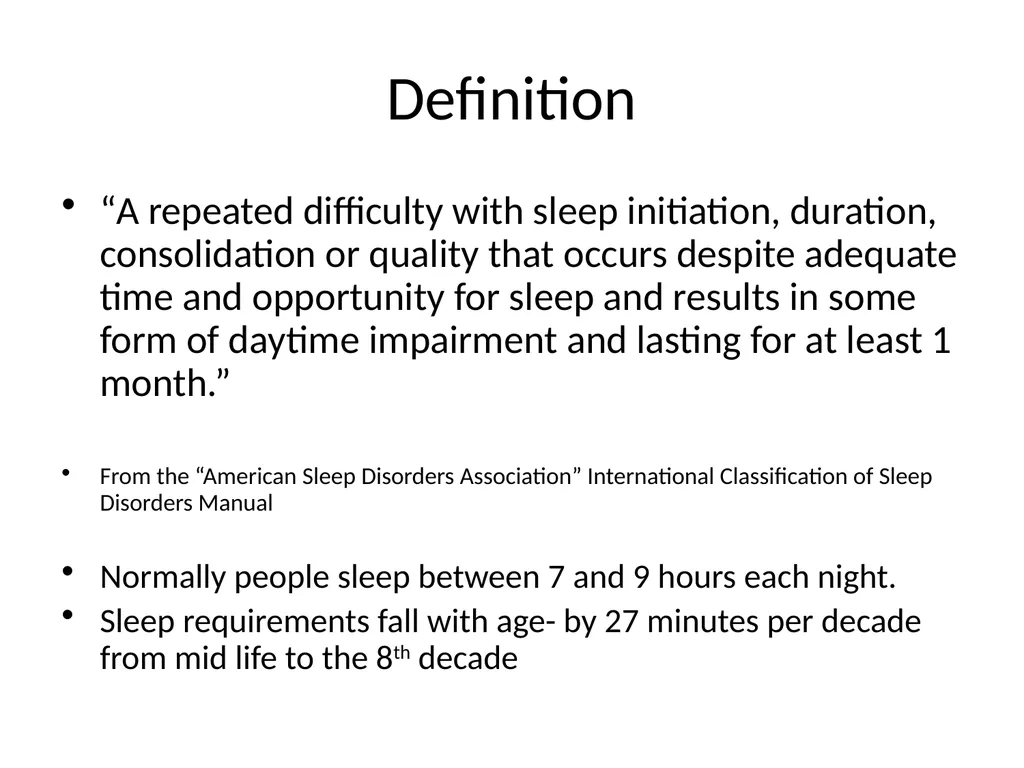
slide4. Definition “A repeated difficulty with sleep initiation, duration, consolidation or quality that occurs despite adequate time and opportunity for sleep and results in some form of daytime impairment and lasting for at least 1 month.”
From the “American Sleep Disorders Association” International Classification of Sleep Disorders Manual
Normally people sleep between 7 and 9 hours each night.
Sleep requirements fall with age- by 27 minutes per decade from mid life to the 8th decade<br>
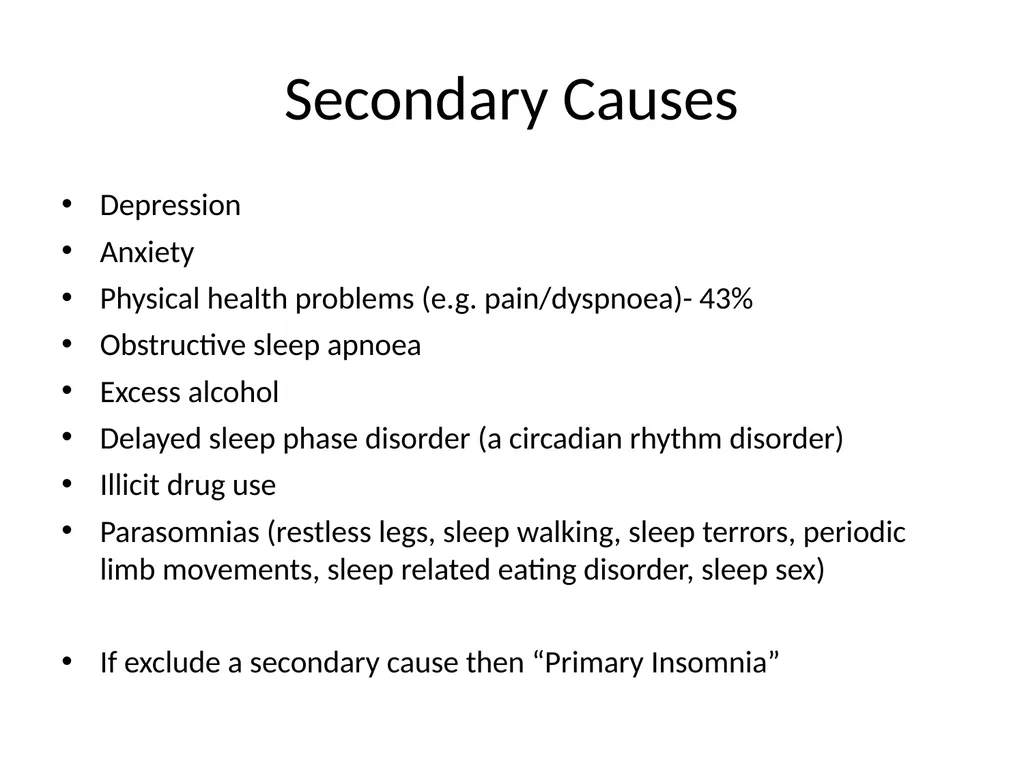
slide5. Secondary Causes Depression
Anxiety
Physical health problems (e.g. pain/dyspnoea)- 43%
Obstructive sleep apnoea
Excess alcohol
Delayed sleep phase disorder (a circadian rhythm disorder)
Illicit drug use
Parasomnias (restless legs, sleep walking, sleep terrors, periodic limb movements, sleep related eating disorder, sleep sex)
If exclude a secondary cause then “Primary Insomnia”<br>
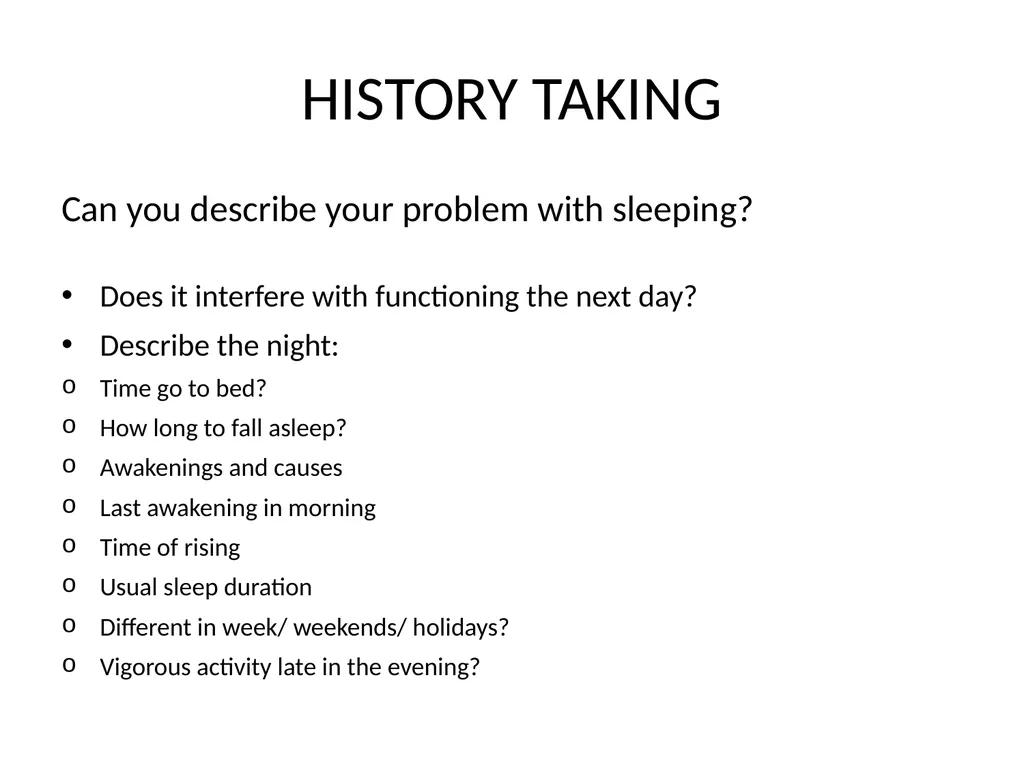
slide6. HISTORY TAKING Can you describe your problem with sleeping?
Does it interfere with functioning the next day?
Describe the night:
Time go to bed?
How long to fall asleep?
Awakenings and causes
Last awakening in morning
Time of rising
Usual sleep duration
Different in week/ weekends/ holidays?
Vigorous activity late in the evening?<br>
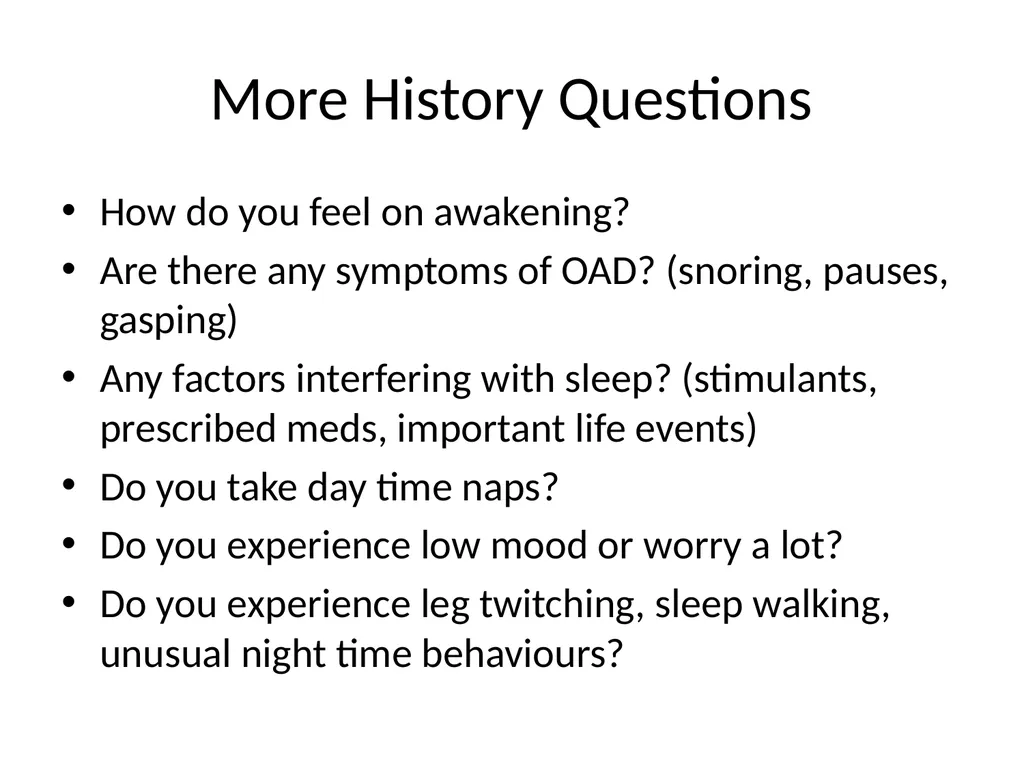
slide7. More History Questions How do you feel on awakening?
Are there any symptoms of OAD? (snoring, pauses, gasping)
Any factors interfering with sleep? (stimulants, prescribed meds, important life events)
Do you take day time naps?
Do you experience low mood or worry a lot?
Do you experience leg twitching, sleep walking, unusual night time behaviours?<br>
slide8. Investigations PHQ-9, GAD-7, CAGE (alcohol), ASSIST (alcohol, smoking and substance involvement screening test) questionnaires
Sleep diaries
Physical exam (obese/ PD)
TFTs, ferritin, FBC
Polysomnography<br>
slide10. TREATMENT Treat any underlying condition(s) if secondary insomnia
Restless legs: massage, exercise, stretching, warm baths and if fails then non-ergot dopamine antagonists
Delayed sleep phase disorder: melatonin and light boxes
Refer parasomnias
Sleep hygiene for all<br>
slide11. SLEEP HYGIENE Limit caffeine and other stimulants
Don’t go to bed until drowsy and sleepy
Don’t nap during the day
Take regular exercise but not late in the evening
Make bedroom conducive to sleep
Computers, lit clocks and co-sleepers
If not asleep within 15-20 minutes get out of bed and return only when drowsy<br>
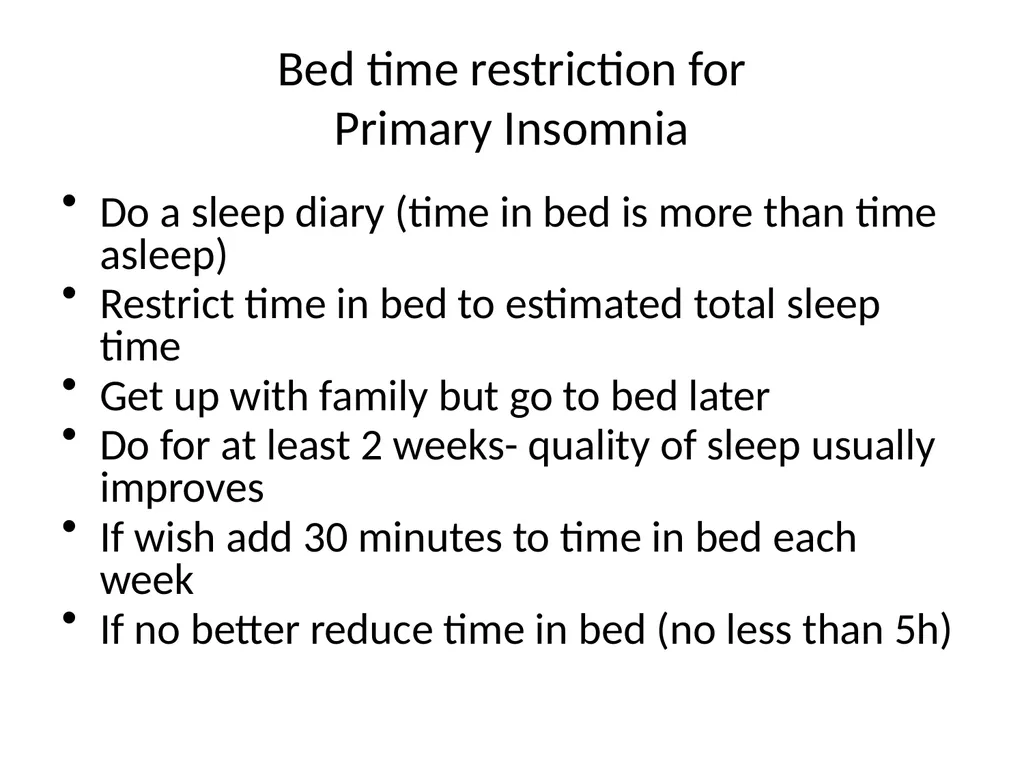
slide12. Bed time restriction for Primary Insomnia Do a sleep diary (time in bed is more than time asleep)
Restrict time in bed to estimated total sleep time
Get up with family but go to bed later
Do for at least 2 weeks- quality of sleep usually improves
If wish add 30 minutes to time in bed each week
If no better reduce time in bed (no less than 5h)<br>
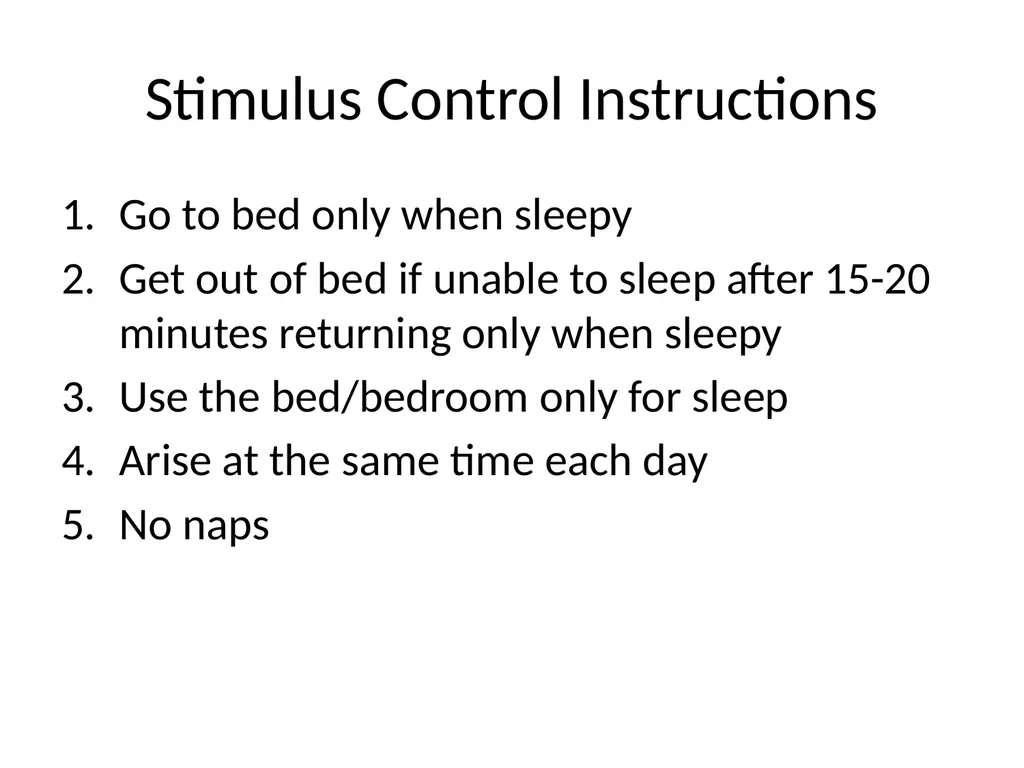
slide13. Stimulus Control Instructions Go to bed only when sleepy
Get out of bed if unable to sleep after 15-20 minutes returning only when sleepy
Use the bed/bedroom only for sleep
Arise at the same time each day
No naps<br>
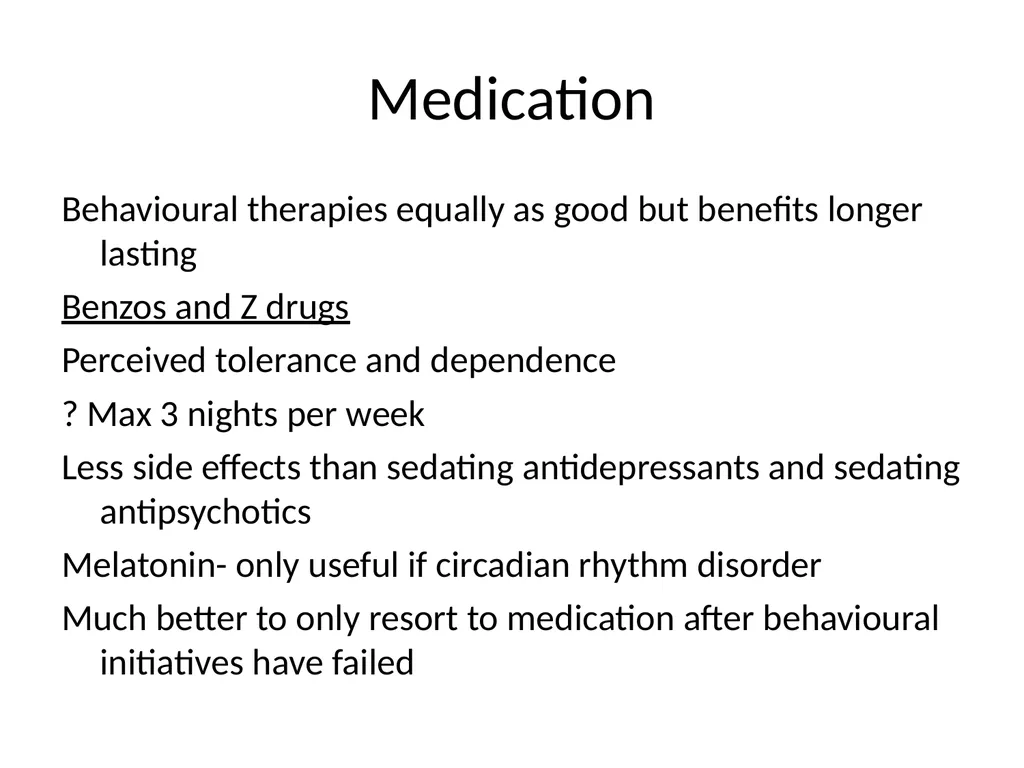
slide15. Medication Behavioural therapies equally as good but benefits longer lasting
Benzos and Z drugs
Perceived tolerance and dependence
? Max 3 nights per week
Less side effects than sedating antidepressants and sedating antipsychotics
Melatonin- only useful if circadian rhythm disorder
Much better to only resort to medication after behavioural initiatives have failed<br>
slide17. Case 1 Mr Bill Jones is a sales executive with impossible targets working 60h a week. He drinks “a couple of glasses of red wine each evening” to help him relax, but still has difficulty getting to sleep and feels exhausted until after his second cup of coffee the next morning. He smokes 20/day and his BMI is 24.
He wants a sleeping tablet.<br>
slide18. Case 2 Nurse Smith works shifts- a mixture of day and nights and has 2 young children and a husband a policeman also working shifts
She wants sleeping tablets as she struggles to get to sleep<br>
slide19. Case 3 Mr Brown is 75y old and widowed last year his children live in the south of England. His eye sight is failing him and arthritis of his hip means he cannot get out as much as he’d like. He also gets up to PU 3-4 times a night. He can’t sleep and wants help.<br>
slide20. Case 4 Jennifer Smith is 34y old and single and works in a library. She is not depressed and otherwise fit and well. She has never felt she needed much sleep but is fed up of lying in bed awake tossing and turning for around 3 hours a night.<br>
slide3. Learning Outcomes Aim
To equip the trainee to deal effectively with patients who complain they cannot sleep
Objectives
By the end of this session the trainee will
Be able to define Primary and Secondary Insomnia
Have considered the various causes, investigation and management of Secondary Insomnia
Be able to take a comprehensive sleep history
Have discussed the principles of “sleep hygiene”, “bed time restriction” and “stimulus control”
Have practised advising patients with a variety of sleep problems
Have discussed the pros and cons of drug treatments<br>
slide4. Definition “A repeated difficulty with sleep initiation, duration, consolidation or quality that occurs despite adequate time and opportunity for sleep and results in some form of daytime impairment and lasting for at least 1 month.”
From the “American Sleep Disorders Association” International Classification of Sleep Disorders Manual
Normally people sleep between 7 and 9 hours each night.
Sleep requirements fall with age- by 27 minutes per decade from mid life to the 8th decade<br>
slide5. Secondary Causes Depression
Anxiety
Physical health problems (e.g. pain/dyspnoea)- 43%
Obstructive sleep apnoea
Excess alcohol
Delayed sleep phase disorder (a circadian rhythm disorder)
Illicit drug use
Parasomnias (restless legs, sleep walking, sleep terrors, periodic limb movements, sleep related eating disorder, sleep sex)
If exclude a secondary cause then “Primary Insomnia”<br>
slide6. HISTORY TAKING Can you describe your problem with sleeping?
Does it interfere with functioning the next day?
Describe the night:
Time go to bed?
How long to fall asleep?
Awakenings and causes
Last awakening in morning
Time of rising
Usual sleep duration
Different in week/ weekends/ holidays?
Vigorous activity late in the evening?<br>
slide7. More History Questions How do you feel on awakening?
Are there any symptoms of OAD? (snoring, pauses, gasping)
Any factors interfering with sleep? (stimulants, prescribed meds, important life events)
Do you take day time naps?
Do you experience low mood or worry a lot?
Do you experience leg twitching, sleep walking, unusual night time behaviours?<br>
slide8. Investigations PHQ-9, GAD-7, CAGE (alcohol), ASSIST (alcohol, smoking and substance involvement screening test) questionnaires
Sleep diaries
Physical exam (obese/ PD)
TFTs, ferritin, FBC
Polysomnography<br>
slide10. TREATMENT Treat any underlying condition(s) if secondary insomnia
Restless legs: massage, exercise, stretching, warm baths and if fails then non-ergot dopamine antagonists
Delayed sleep phase disorder: melatonin and light boxes
Refer parasomnias
Sleep hygiene for all<br>
slide11. SLEEP HYGIENE Limit caffeine and other stimulants
Don’t go to bed until drowsy and sleepy
Don’t nap during the day
Take regular exercise but not late in the evening
Make bedroom conducive to sleep
Computers, lit clocks and co-sleepers
If not asleep within 15-20 minutes get out of bed and return only when drowsy<br>
slide12. Bed time restriction for Primary Insomnia Do a sleep diary (time in bed is more than time asleep)
Restrict time in bed to estimated total sleep time
Get up with family but go to bed later
Do for at least 2 weeks- quality of sleep usually improves
If wish add 30 minutes to time in bed each week
If no better reduce time in bed (no less than 5h)<br>
slide13. Stimulus Control Instructions Go to bed only when sleepy
Get out of bed if unable to sleep after 15-20 minutes returning only when sleepy
Use the bed/bedroom only for sleep
Arise at the same time each day
No naps<br>
slide15. Medication Behavioural therapies equally as good but benefits longer lasting
Benzos and Z drugs
Perceived tolerance and dependence
? Max 3 nights per week
Less side effects than sedating antidepressants and sedating antipsychotics
Melatonin- only useful if circadian rhythm disorder
Much better to only resort to medication after behavioural initiatives have failed<br>
slide17. Case 1 Mr Bill Jones is a sales executive with impossible targets working 60h a week. He drinks “a couple of glasses of red wine each evening” to help him relax, but still has difficulty getting to sleep and feels exhausted until after his second cup of coffee the next morning. He smokes 20/day and his BMI is 24.
He wants a sleeping tablet.<br>
slide18. Case 2 Nurse Smith works shifts- a mixture of day and nights and has 2 young children and a husband a policeman also working shifts
She wants sleeping tablets as she struggles to get to sleep<br>
slide19. Case 3 Mr Brown is 75y old and widowed last year his children live in the south of England. His eye sight is failing him and arthritis of his hip means he cannot get out as much as he’d like. He also gets up to PU 3-4 times a night. He can’t sleep and wants help.<br>
slide20. Case 4 Jennifer Smith is 34y old and single and works in a library. She is not depressed and otherwise fit and well. She has never felt she needed much sleep but is fed up of lying in bed awake tossing and turning for around 3 hours a night.<br>