
Slide Set Thirteen B: Payment Systems – Defenses
LV
Published · 12 slides · 0 views
1 / 1
Description
Slide Set Thirteen B: Payment Systems Defenses to Payment Last Time We Spoke About: Payment Systems Introduction Negotiable Instruments TypesParties Part One: Definitions Types of Negotiable Instruments Parties Negotiability Part
Related Topics
Share
Embed code
Download this presentation From Below
"Slide Set Thirteen B: Payment Systems – Defenses" is the property of its rightful owner. Permission is granted to download and print the materials on this website for personal, non-commercial use only, and to display it on your personal computer provided you do not modify the materials and that you retain all copyright notices contained in the materials. By downloading content from our website, you accept the terms of this agreement.
Presentation Transcript
01
Slide Set Thirteen B:
Payment Systems – Defenses to Payment<br>
Payment Systems – Defenses to Payment<br>
02
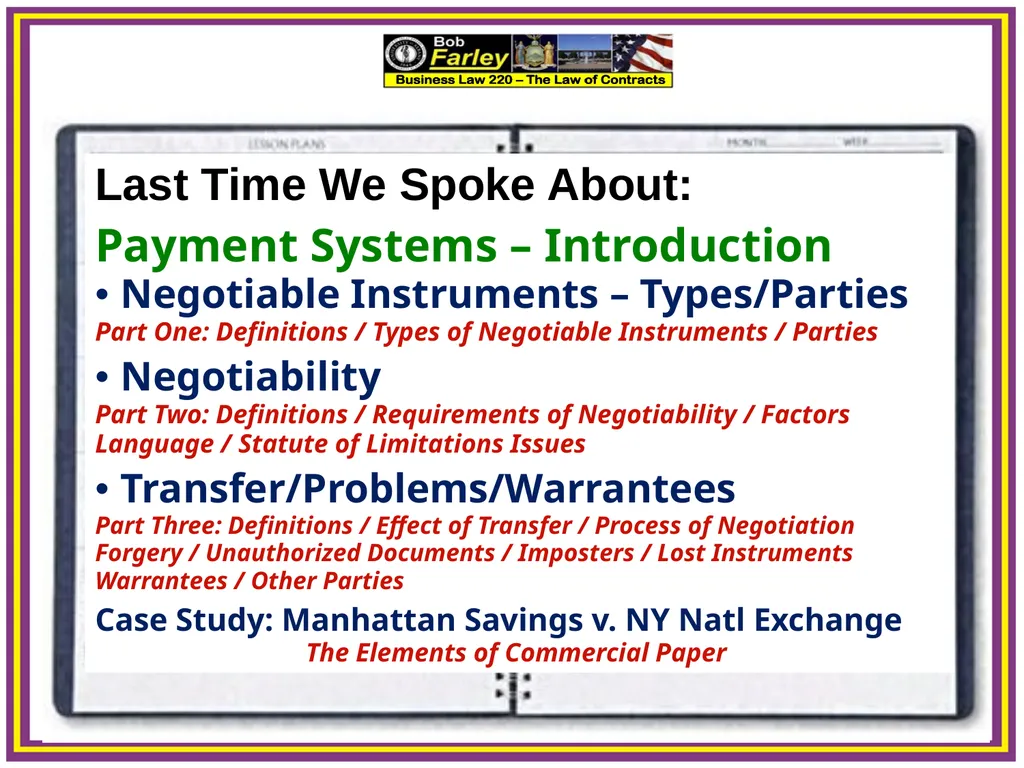
Last Time We Spoke About:
Payment Systems – Introduction
Negotiable Instruments – Types/Parties
Part One: Definitions / Types of Negotiable Instruments / Parties
Negotiability
Part Two: Definitions / Requirements of Negotiability / Factors
Language / Statute of Limitations Issues
Transfer/Problems/Warrantees
Part Three: Definitions / Effect of Transfer / Process of Negotiation
Forgery / Unauthorized Documents / Imposters / Lost Instruments Warrantees / Other Parties
Case Study: Manhattan Savings v. NY Natl Exchange
The Elements of Commercial Paper<br>
Payment Systems – Introduction
Negotiable Instruments – Types/Parties
Part One: Definitions / Types of Negotiable Instruments / Parties
Negotiability
Part Two: Definitions / Requirements of Negotiability / Factors
Language / Statute of Limitations Issues
Transfer/Problems/Warrantees
Part Three: Definitions / Effect of Transfer / Process of Negotiation
Forgery / Unauthorized Documents / Imposters / Lost Instruments Warrantees / Other Parties
Case Study: Manhattan Savings v. NY Natl Exchange
The Elements of Commercial Paper<br>
03
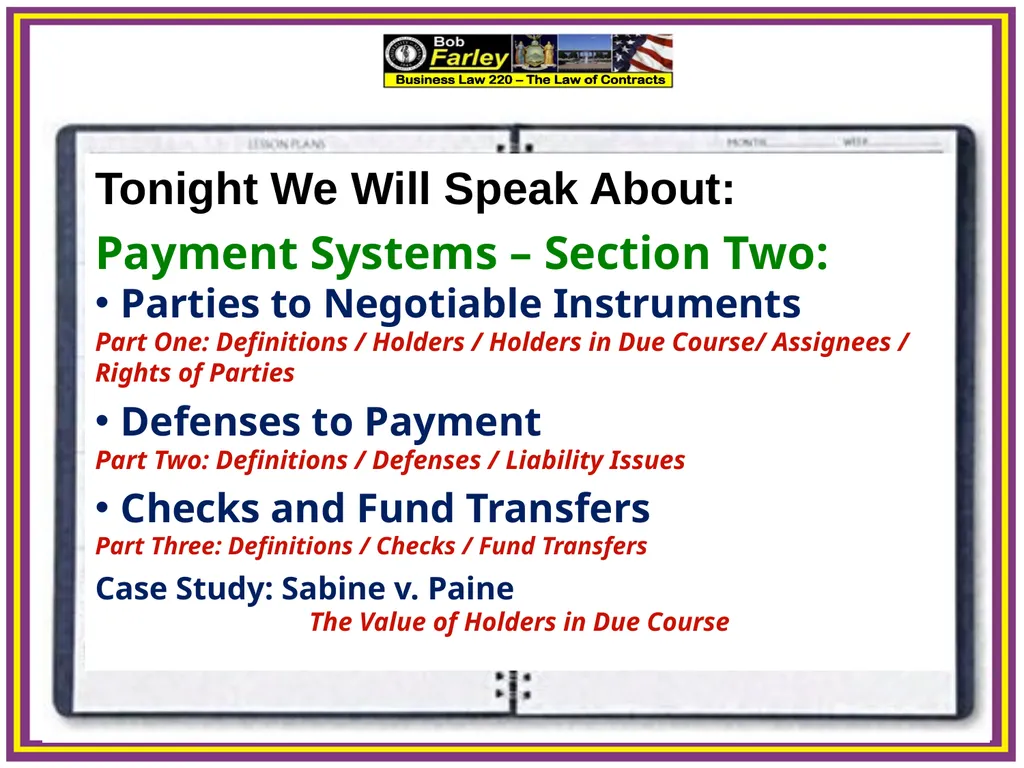
Tonight We Will Speak About:
Payment Systems – Section Two:
Parties to Negotiable Instruments
Part One: Definitions / Holders / Holders in Due Course/ Assignees / Rights of Parties
Defenses to Payment
Part Two: Definitions / Defenses / Liability Issues
Checks and Fund Transfers
Part Three: Definitions / Checks / Fund Transfers
Case Study: Sabine v. Paine
The Value of Holders in Due Course<br>
Payment Systems – Section Two:
Parties to Negotiable Instruments
Part One: Definitions / Holders / Holders in Due Course/ Assignees / Rights of Parties
Defenses to Payment
Part Two: Definitions / Defenses / Liability Issues
Checks and Fund Transfers
Part Three: Definitions / Checks / Fund Transfers
Case Study: Sabine v. Paine
The Value of Holders in Due Course<br>
04
Negotiable Instruments
Defenses to Payment
Definitions<br>
Defenses to Payment
Definitions<br>
05
Negotiable Instruments
Defenses to Payment
Definitions:
Defense Defined: Blacks Law Dictionary defines defense to mean:
“A defendant’s stated reason why the plaintiff has no valid case”
Defenses and a Holder in Due Course: One of the key reasons
for attaining the Holder in Due Course status is to be able to obtain payment
on the negotiable instrument free of any underlying problems between the original parties to the instrument. A Holder in Due Course takes an instrument free from certain types of defenses to payment. Whether a defense may be raised against a Holder in Due Course claiming under a negotiable instrument depends on the nature of the defense.
Classification of Defenses: The importance of being a Holder in Due Course is that such are not subject to certain defenses called limited defenses. Another class of defenses, universal defenses, however, may be asserted against any party, whether an assignee, an ordinary holder, or a Holder in Due Course.<br>
Defenses to Payment
Definitions:
Defense Defined: Blacks Law Dictionary defines defense to mean:
“A defendant’s stated reason why the plaintiff has no valid case”
Defenses and a Holder in Due Course: One of the key reasons
for attaining the Holder in Due Course status is to be able to obtain payment
on the negotiable instrument free of any underlying problems between the original parties to the instrument. A Holder in Due Course takes an instrument free from certain types of defenses to payment. Whether a defense may be raised against a Holder in Due Course claiming under a negotiable instrument depends on the nature of the defense.
Classification of Defenses: The importance of being a Holder in Due Course is that such are not subject to certain defenses called limited defenses. Another class of defenses, universal defenses, however, may be asserted against any party, whether an assignee, an ordinary holder, or a Holder in Due Course.<br>
06
Negotiable Instruments
Defenses to Payment
Defenses and Liability Issues<br>
Defenses to Payment
Defenses and Liability Issues<br>
07
Negotiable Instruments
Defenses to Payment
Defenses:
Ordinary Holders and Assignees:
Defenses against Assignee or Ordinary Holder: Assignees of negotiable instruments are subject to every defense raised. Similarly, a holder who does not become a Holder in Due Course is also subject to every payment defense just as though the instrument were not negotiable.
Limited Defenses Not Available against a Holder in Due Course: Holders in Due Course are not subject to any of the following defenses:
Ordinary Contract Defenses: In general terms, the defenses that could be raised in a breach of contract claim cannot be raised against a Holder in Due Course. The defenses of lack, failure, or illegality of consideration with respect to the instrument’s underlying transaction cannot be asserted against the Holder in Due Course. Misrepresentation about the goods underlying the contract is also not a defense.
Incapacity of Maker or Drawer: Ordinarily, the maker’s or drawer’s lack of capacity (except minors) may not be raised as a defense to payment to a holder in due course. Such incapacity is a defense, however, if the incapacity is at a legal level that makes the instrument a nullity.
Fraud in the Inducement: If a person is persuaded or induced to execute the instrument because of fraudulent statements, such fraud in the inducement cannot be raised against a party with Holder in Due Course status.
Miscellaneous Defenses: The limited defenses listed in the preceding three subsections are those most commonly raised against demands by Holders in Due Course for payment. The following are additional limited defenses that might be asserted: (1) prior payment or cancellation of the instrument, (2) nondelivery, (3) conditional or special-purpose delivery, (4) breach of warranty, (5) duress consisting of threats, (6) unauthorized completion, and (7) theft of a bearer instrument. Like the above, these miscellaneous defenses, however, also have a very limited effect in defending against a Holder in Due Course’s demand for payment.<br>
Defenses to Payment
Defenses:
Ordinary Holders and Assignees:
Defenses against Assignee or Ordinary Holder: Assignees of negotiable instruments are subject to every defense raised. Similarly, a holder who does not become a Holder in Due Course is also subject to every payment defense just as though the instrument were not negotiable.
Limited Defenses Not Available against a Holder in Due Course: Holders in Due Course are not subject to any of the following defenses:
Ordinary Contract Defenses: In general terms, the defenses that could be raised in a breach of contract claim cannot be raised against a Holder in Due Course. The defenses of lack, failure, or illegality of consideration with respect to the instrument’s underlying transaction cannot be asserted against the Holder in Due Course. Misrepresentation about the goods underlying the contract is also not a defense.
Incapacity of Maker or Drawer: Ordinarily, the maker’s or drawer’s lack of capacity (except minors) may not be raised as a defense to payment to a holder in due course. Such incapacity is a defense, however, if the incapacity is at a legal level that makes the instrument a nullity.
Fraud in the Inducement: If a person is persuaded or induced to execute the instrument because of fraudulent statements, such fraud in the inducement cannot be raised against a party with Holder in Due Course status.
Miscellaneous Defenses: The limited defenses listed in the preceding three subsections are those most commonly raised against demands by Holders in Due Course for payment. The following are additional limited defenses that might be asserted: (1) prior payment or cancellation of the instrument, (2) nondelivery, (3) conditional or special-purpose delivery, (4) breach of warranty, (5) duress consisting of threats, (6) unauthorized completion, and (7) theft of a bearer instrument. Like the above, these miscellaneous defenses, however, also have a very limited effect in defending against a Holder in Due Course’s demand for payment.<br>
08
Negotiable Instruments
Defenses to Payment
Defenses:
Holders in Due Course:
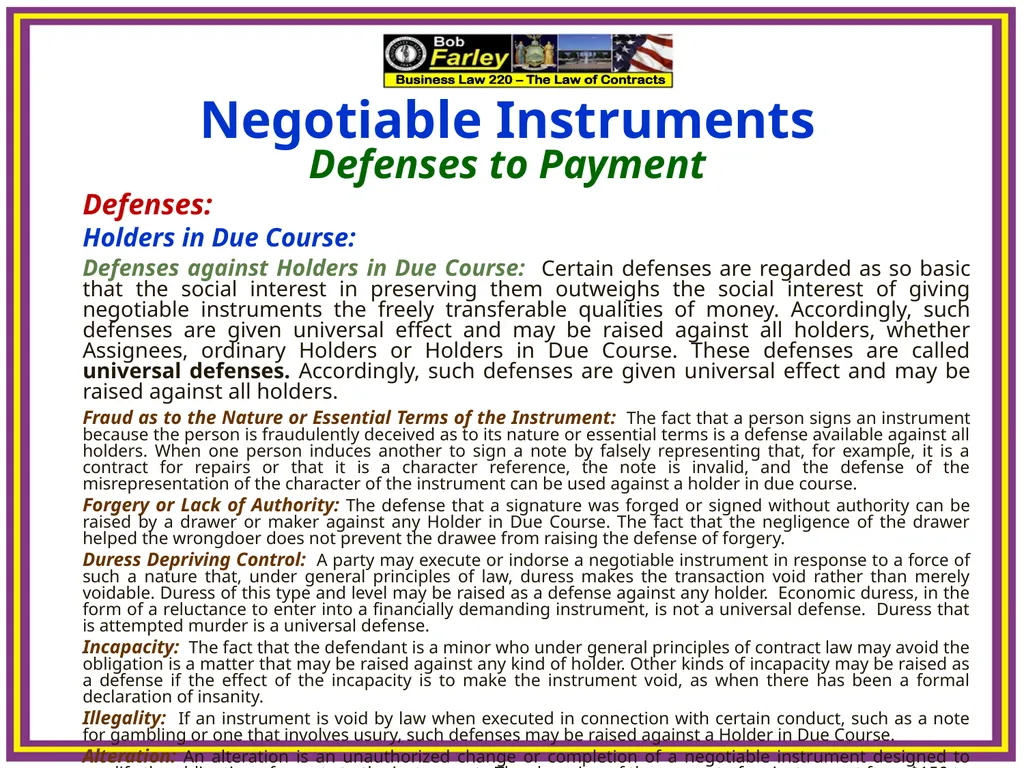
Defenses against Holders in Due Course: Certain defenses are regarded as so basic that the social interest in preserving them outweighs the social interest of giving negotiable instruments the freely transferable qualities of money. Accordingly, such defenses are given universal effect and may be raised against all holders, whether Assignees, ordinary Holders or Holders in Due Course. These defenses are called universal defenses. Accordingly, such defenses are given universal effect and may be raised against all holders.
Fraud as to the Nature or Essential Terms of the Instrument: The fact that a person signs an instrument because the person is fraudulently deceived as to its nature or essential terms is a defense available against all holders. When one person induces another to sign a note by falsely representing that, for example, it is a contract for repairs or that it is a character reference, the note is invalid, and the defense of the misrepresentation of the character of the instrument can be used against a holder in due course.
Forgery or Lack of Authority: The defense that a signature was forged or signed without authority can be raised by a drawer or maker against any Holder in Due Course. The fact that the negligence of the drawer helped the wrongdoer does not prevent the drawee from raising the defense of forgery.
Duress Depriving Control: A party may execute or indorse a negotiable instrument in response to a force of such a nature that, under general principles of law, duress makes the transaction void rather than merely voidable. Duress of this type and level may be raised as a defense against any holder. Economic duress, in the form of a reluctance to enter into a financially demanding instrument, is not a universal defense. Duress that is attempted murder is a universal defense.
Incapacity: The fact that the defendant is a minor who under general principles of contract law may avoid the obligation is a matter that may be raised against any kind of holder. Other kinds of incapacity may be raised as a defense if the effect of the incapacity is to make the instrument void, as when there has been a formal declaration of insanity.
Illegality: If an instrument is void by law when executed in connection with certain conduct, such as a note for gambling or one that involves usury, such defenses may be raised against a Holder in Due Course.
Alteration: An alteration is an unauthorized change or completion of a negotiable instrument designed to modify the obligation of a party to the instrument. The changing of the amount of an instrument from $150 to $450 is an alteration.<br>
Defenses to Payment
Defenses:
Holders in Due Course:
Defenses against Holders in Due Course: Certain defenses are regarded as so basic that the social interest in preserving them outweighs the social interest of giving negotiable instruments the freely transferable qualities of money. Accordingly, such defenses are given universal effect and may be raised against all holders, whether Assignees, ordinary Holders or Holders in Due Course. These defenses are called universal defenses. Accordingly, such defenses are given universal effect and may be raised against all holders.
Fraud as to the Nature or Essential Terms of the Instrument: The fact that a person signs an instrument because the person is fraudulently deceived as to its nature or essential terms is a defense available against all holders. When one person induces another to sign a note by falsely representing that, for example, it is a contract for repairs or that it is a character reference, the note is invalid, and the defense of the misrepresentation of the character of the instrument can be used against a holder in due course.
Forgery or Lack of Authority: The defense that a signature was forged or signed without authority can be raised by a drawer or maker against any Holder in Due Course. The fact that the negligence of the drawer helped the wrongdoer does not prevent the drawee from raising the defense of forgery.
Duress Depriving Control: A party may execute or indorse a negotiable instrument in response to a force of such a nature that, under general principles of law, duress makes the transaction void rather than merely voidable. Duress of this type and level may be raised as a defense against any holder. Economic duress, in the form of a reluctance to enter into a financially demanding instrument, is not a universal defense. Duress that is attempted murder is a universal defense.
Incapacity: The fact that the defendant is a minor who under general principles of contract law may avoid the obligation is a matter that may be raised against any kind of holder. Other kinds of incapacity may be raised as a defense if the effect of the incapacity is to make the instrument void, as when there has been a formal declaration of insanity.
Illegality: If an instrument is void by law when executed in connection with certain conduct, such as a note for gambling or one that involves usury, such defenses may be raised against a Holder in Due Course.
Alteration: An alteration is an unauthorized change or completion of a negotiable instrument designed to modify the obligation of a party to the instrument. The changing of the amount of an instrument from $150 to $450 is an alteration.<br>
09
Negotiable Instruments
Defenses to Payment
Liability Issues:
How Payment Rights Arise and Defenses Are Used:
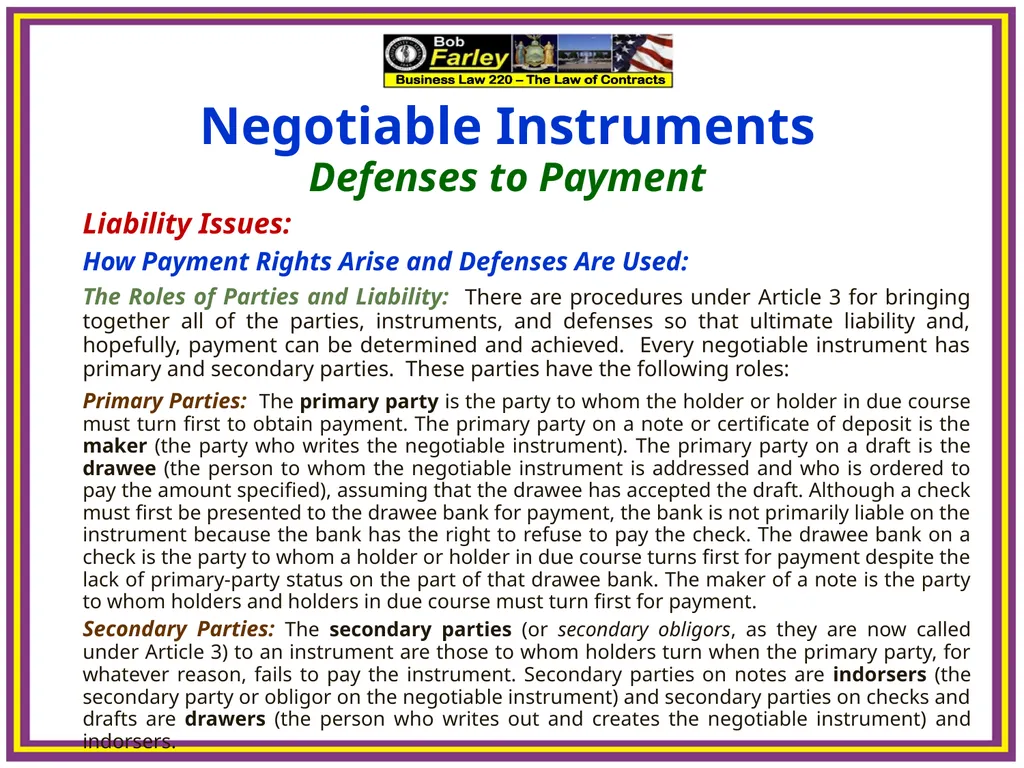
The Roles of Parties and Liability: There are procedures under Article 3 for bringing together all of the parties, instruments, and defenses so that ultimate liability and, hopefully, payment can be determined and achieved. Every negotiable instrument has primary and secondary parties. These parties have the following roles:
Primary Parties: The primary party is the party to whom the holder or holder in due course must turn first to obtain payment. The primary party on a note or certificate of deposit is the maker (the party who writes the negotiable instrument). The primary party on a draft is the drawee (the person to whom the negotiable instrument is addressed and who is ordered to pay the amount specified), assuming that the drawee has accepted the draft. Although a check must first be presented to the drawee bank for payment, the bank is not primarily liable on the instrument because the bank has the right to refuse to pay the check. The drawee bank on a check is the party to whom a holder or holder in due course turns first for payment despite the lack of primary-party status on the part of that drawee bank. The maker of a note is the party to whom holders and holders in due course must turn first for payment.
Secondary Parties: The secondary parties (or secondary obligors, as they are now called under Article 3) to an instrument are those to whom holders turn when the primary party, for whatever reason, fails to pay the instrument. Secondary parties on notes are indorsers (the secondary party or obligor on the negotiable instrument) and secondary parties on checks and drafts are drawers (the person who writes out and creates the negotiable instrument) and indorsers.<br>
Defenses to Payment
Liability Issues:
How Payment Rights Arise and Defenses Are Used:
The Roles of Parties and Liability: There are procedures under Article 3 for bringing together all of the parties, instruments, and defenses so that ultimate liability and, hopefully, payment can be determined and achieved. Every negotiable instrument has primary and secondary parties. These parties have the following roles:
Primary Parties: The primary party is the party to whom the holder or holder in due course must turn first to obtain payment. The primary party on a note or certificate of deposit is the maker (the party who writes the negotiable instrument). The primary party on a draft is the drawee (the person to whom the negotiable instrument is addressed and who is ordered to pay the amount specified), assuming that the drawee has accepted the draft. Although a check must first be presented to the drawee bank for payment, the bank is not primarily liable on the instrument because the bank has the right to refuse to pay the check. The drawee bank on a check is the party to whom a holder or holder in due course turns first for payment despite the lack of primary-party status on the part of that drawee bank. The maker of a note is the party to whom holders and holders in due course must turn first for payment.
Secondary Parties: The secondary parties (or secondary obligors, as they are now called under Article 3) to an instrument are those to whom holders turn when the primary party, for whatever reason, fails to pay the instrument. Secondary parties on notes are indorsers (the secondary party or obligor on the negotiable instrument) and secondary parties on checks and drafts are drawers (the person who writes out and creates the negotiable instrument) and indorsers.<br>
10
Negotiable Instruments
Defenses to Payment
Liability Issues:
How Payment Rights Arise and Defenses Are Used:
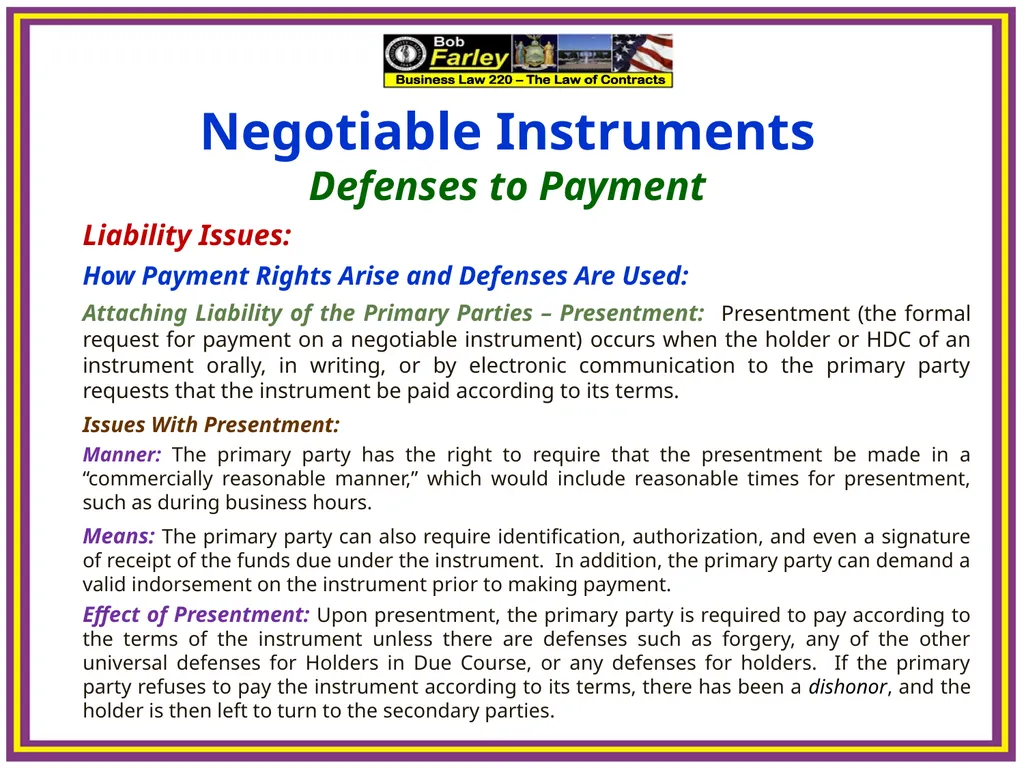
Attaching Liability of the Primary Parties – Presentment: Presentment (the formal request for payment on a negotiable instrument) occurs when the holder or HDC of an instrument orally, in writing, or by electronic communication to the primary party requests that the instrument be paid according to its terms.
Issues With Presentment:
Manner: The primary party has the right to require that the presentment be made in a “commercially reasonable manner,” which would include reasonable times for presentment, such as during business hours.
Means: The primary party can also require identification, authorization, and even a signature of receipt of the funds due under the instrument. In addition, the primary party can demand a valid indorsement on the instrument prior to making payment.
Effect of Presentment: Upon presentment, the primary party is required to pay according to the terms of the instrument unless there are defenses such as forgery, any of the other universal defenses for Holders in Due Course, or any defenses for holders. If the primary party refuses to pay the instrument according to its terms, there has been a dishonor, and the holder is then left to turn to the secondary parties.<br>
Defenses to Payment
Liability Issues:
How Payment Rights Arise and Defenses Are Used:
Attaching Liability of the Primary Parties – Presentment: Presentment (the formal request for payment on a negotiable instrument) occurs when the holder or HDC of an instrument orally, in writing, or by electronic communication to the primary party requests that the instrument be paid according to its terms.
Issues With Presentment:
Manner: The primary party has the right to require that the presentment be made in a “commercially reasonable manner,” which would include reasonable times for presentment, such as during business hours.
Means: The primary party can also require identification, authorization, and even a signature of receipt of the funds due under the instrument. In addition, the primary party can demand a valid indorsement on the instrument prior to making payment.
Effect of Presentment: Upon presentment, the primary party is required to pay according to the terms of the instrument unless there are defenses such as forgery, any of the other universal defenses for Holders in Due Course, or any defenses for holders. If the primary party refuses to pay the instrument according to its terms, there has been a dishonor, and the holder is then left to turn to the secondary parties.<br>
11
Negotiable Instruments
Defenses to Payment
Liability Issues:
How Payment Rights Arise and Defenses Are Used:
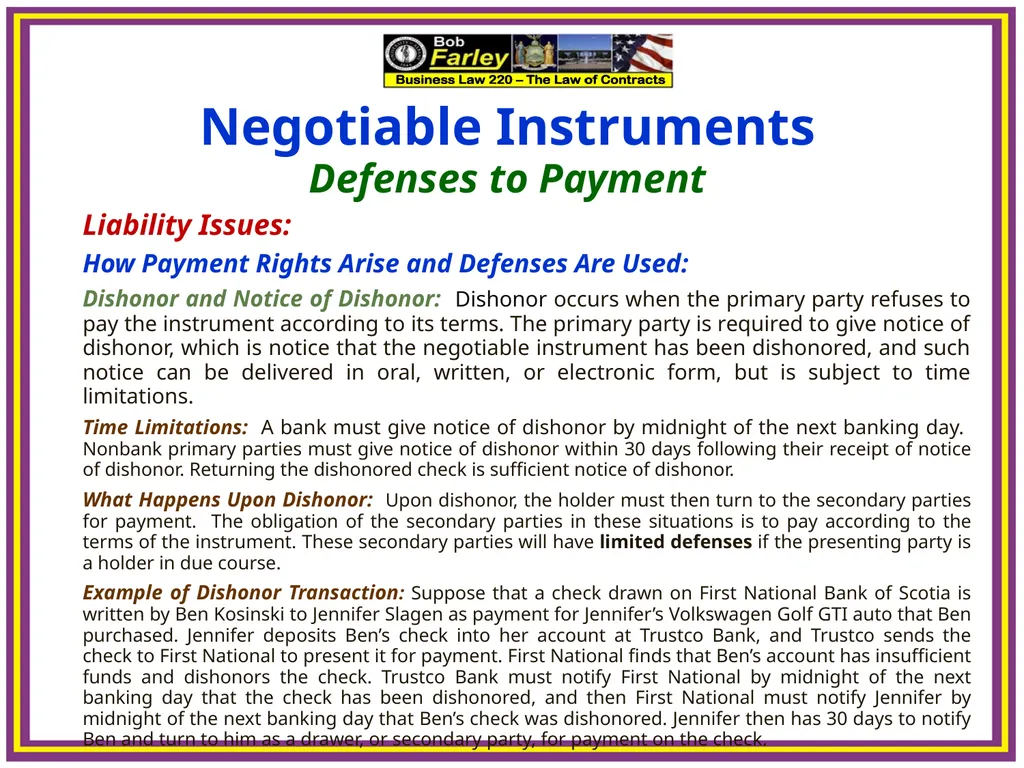
Dishonor and Notice of Dishonor: Dishonor occurs when the primary party refuses to pay the instrument according to its terms. The primary party is required to give notice of dishonor, which is notice that the negotiable instrument has been dishonored, and such notice can be delivered in oral, written, or electronic form, but is subject to time limitations.
Time Limitations: A bank must give notice of dishonor by midnight of the next banking day. Nonbank primary parties must give notice of dishonor within 30 days following their receipt of notice of dishonor. Returning the dishonored check is sufficient notice of dishonor.
What Happens Upon Dishonor: Upon dishonor, the holder must then turn to the secondary parties for payment. The obligation of the secondary parties in these situations is to pay according to the terms of the instrument. These secondary parties will have limited defenses if the presenting party is a holder in due course.
Example of Dishonor Transaction: Suppose that a check drawn on First National Bank of Scotia is written by Ben Kosinski to Jennifer Slagen as payment for Jennifer’s Volkswagen Golf GTI auto that Ben purchased. Jennifer deposits Ben’s check into her account at Trustco Bank, and Trustco sends the check to First National to present it for payment. First National finds that Ben’s account has insufficient funds and dishonors the check. Trustco Bank must notify First National by midnight of the next banking day that the check has been dishonored, and then First National must notify Jennifer by midnight of the next banking day that Ben’s check was dishonored. Jennifer then has 30 days to notify Ben and turn to him as a drawer, or secondary party, for payment on the check.<br>
Defenses to Payment
Liability Issues:
How Payment Rights Arise and Defenses Are Used:
Dishonor and Notice of Dishonor: Dishonor occurs when the primary party refuses to pay the instrument according to its terms. The primary party is required to give notice of dishonor, which is notice that the negotiable instrument has been dishonored, and such notice can be delivered in oral, written, or electronic form, but is subject to time limitations.
Time Limitations: A bank must give notice of dishonor by midnight of the next banking day. Nonbank primary parties must give notice of dishonor within 30 days following their receipt of notice of dishonor. Returning the dishonored check is sufficient notice of dishonor.
What Happens Upon Dishonor: Upon dishonor, the holder must then turn to the secondary parties for payment. The obligation of the secondary parties in these situations is to pay according to the terms of the instrument. These secondary parties will have limited defenses if the presenting party is a holder in due course.
Example of Dishonor Transaction: Suppose that a check drawn on First National Bank of Scotia is written by Ben Kosinski to Jennifer Slagen as payment for Jennifer’s Volkswagen Golf GTI auto that Ben purchased. Jennifer deposits Ben’s check into her account at Trustco Bank, and Trustco sends the check to First National to present it for payment. First National finds that Ben’s account has insufficient funds and dishonors the check. Trustco Bank must notify First National by midnight of the next banking day that the check has been dishonored, and then First National must notify Jennifer by midnight of the next banking day that Ben’s check was dishonored. Jennifer then has 30 days to notify Ben and turn to him as a drawer, or secondary party, for payment on the check.<br>
12
End of Class Thirteen B
For next time – Review Assignments as follows on the Webpage:
Lecture Slides
Selected Readings
Cases and Exercises
We are a hot bench.
Questions?<br>
For next time – Review Assignments as follows on the Webpage:
Lecture Slides
Selected Readings
Cases and Exercises
We are a hot bench.
Questions?<br>