
Small-Scale Livestock Production Raising Poultry
FD
Published · 43 slides · 0 views

1 / 1



Description
Small-Scale Livestock Production Raising Poultry for Profit This program was funded by the USDA National Institute for Food and Agriculture (NIFA) Beginning Farmer and Rancher Development Program (BFRDP) under award 2009-49400-05871. What
Related Topics
Share
Embed code
Download this presentation From Below
"Small-Scale Livestock Production Raising Poultry" is the property of its rightful owner. Permission is granted to download and print the materials on this website for personal, non-commercial use only, and to display it on your personal computer provided you do not modify the materials and that you retain all copyright notices contained in the materials. By downloading content from our website, you accept the terms of this agreement.
Presentation Transcript
01
Small-Scale Livestock Production
Raising Poultry for Profit This program was funded by the USDA National Institute for Food and Agriculture (NIFA) Beginning Farmer and Rancher Development Program (BFRDP) under award #2009-49400-05871.<br>
02
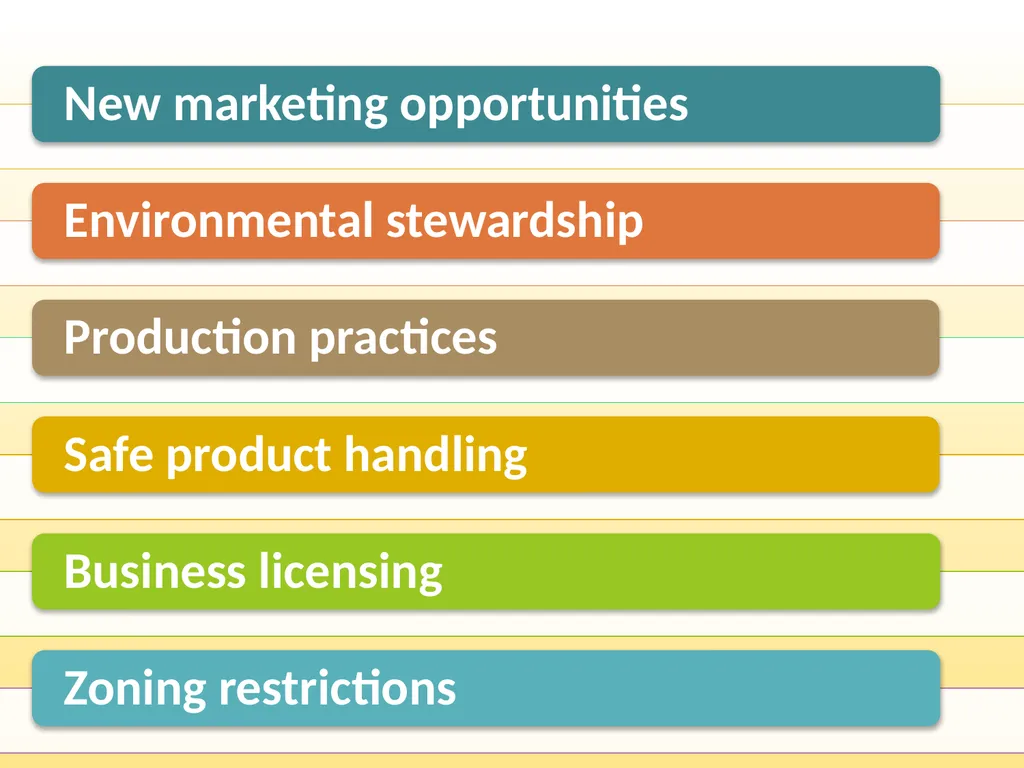
What you need to know before you get started…<br>
03
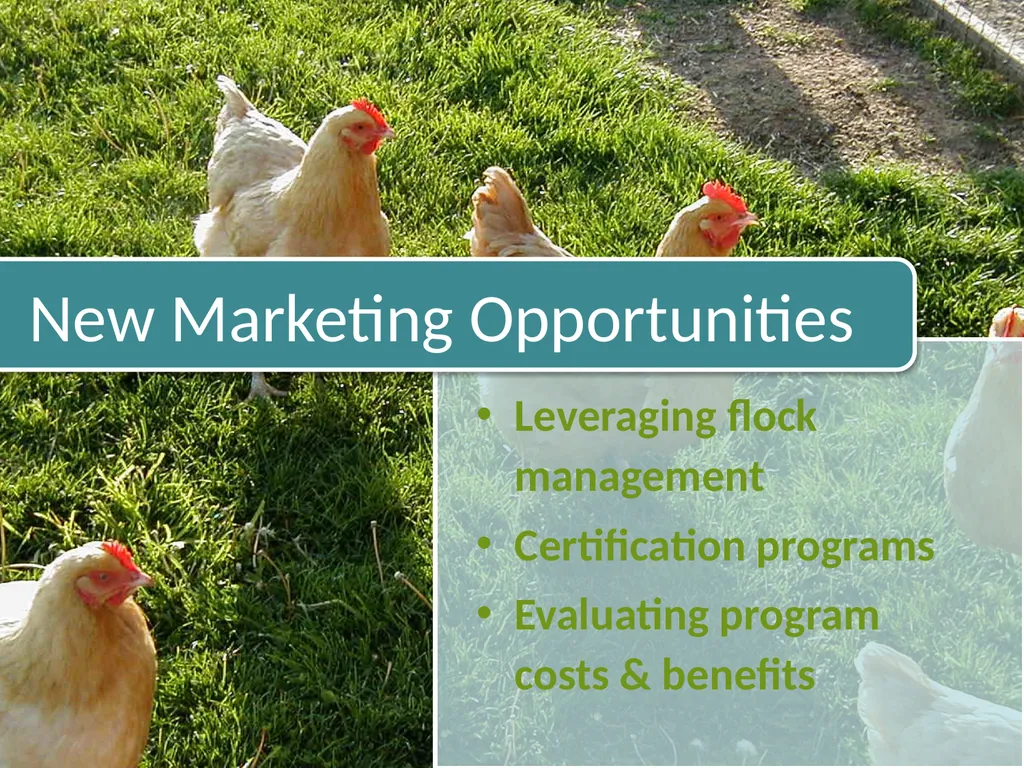
Leveraging flock management
Certification programs
Evaluating program costs & benefits New Marketing Opportunities<br>
Certification programs
Evaluating program costs & benefits New Marketing Opportunities<br>
04
Certification and Marketing Consumers are interested in how livestock are raised, handled & processed
Certification may allow you to secure a premium for product or expand market reach
Such as specialty food stores and restaurants that require that their animal products be sourced from humanely raised animals
How you manage your flock (your stewardship practices) can influence your marketing opportunities<br>
Certification may allow you to secure a premium for product or expand market reach
Such as specialty food stores and restaurants that require that their animal products be sourced from humanely raised animals
How you manage your flock (your stewardship practices) can influence your marketing opportunities<br>
05
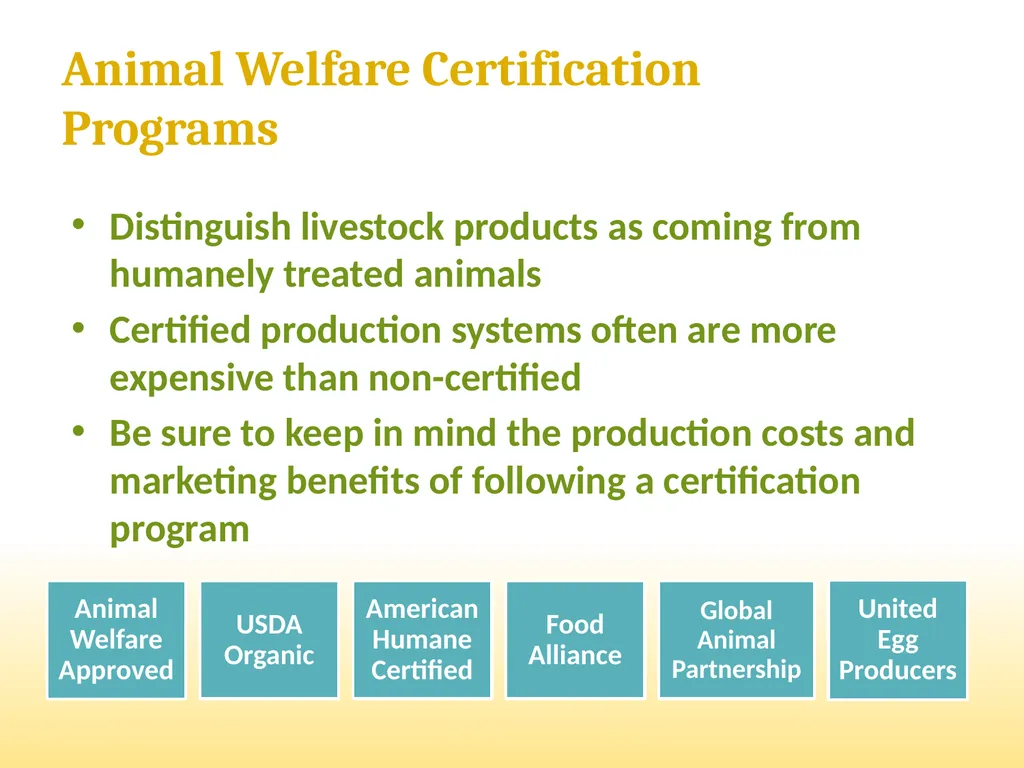
Animal Welfare Certification Programs Distinguish livestock products as coming from humanely treated animals
Certified production systems often are more expensive than non-certified
Be sure to keep in mind the production costs and marketing benefits of following a certification program<br>
Certified production systems often are more expensive than non-certified
Be sure to keep in mind the production costs and marketing benefits of following a certification program<br>
06
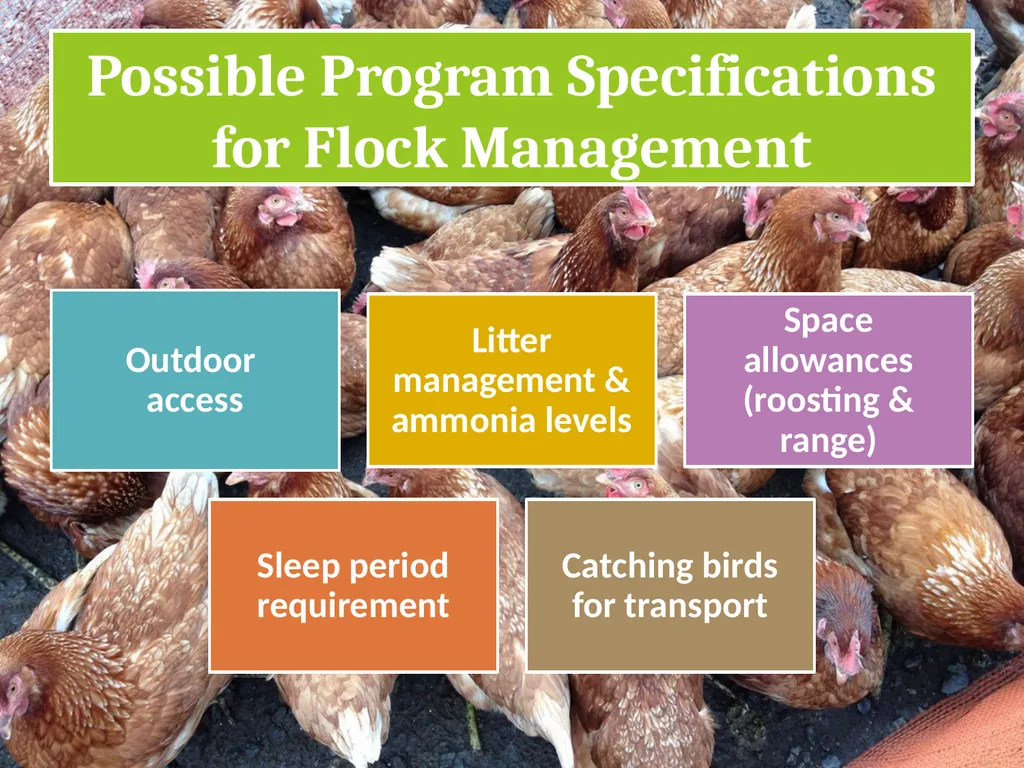
Possible Program Specifications for Flock Management<br>
07
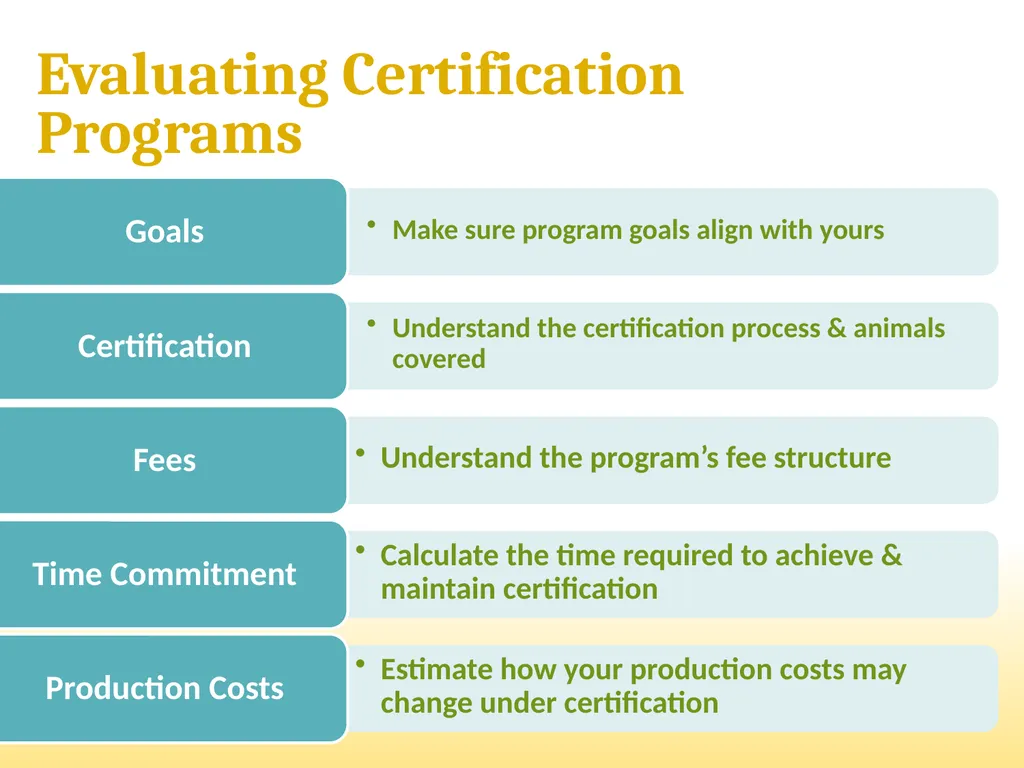
Evaluating Certification Programs<br>
08
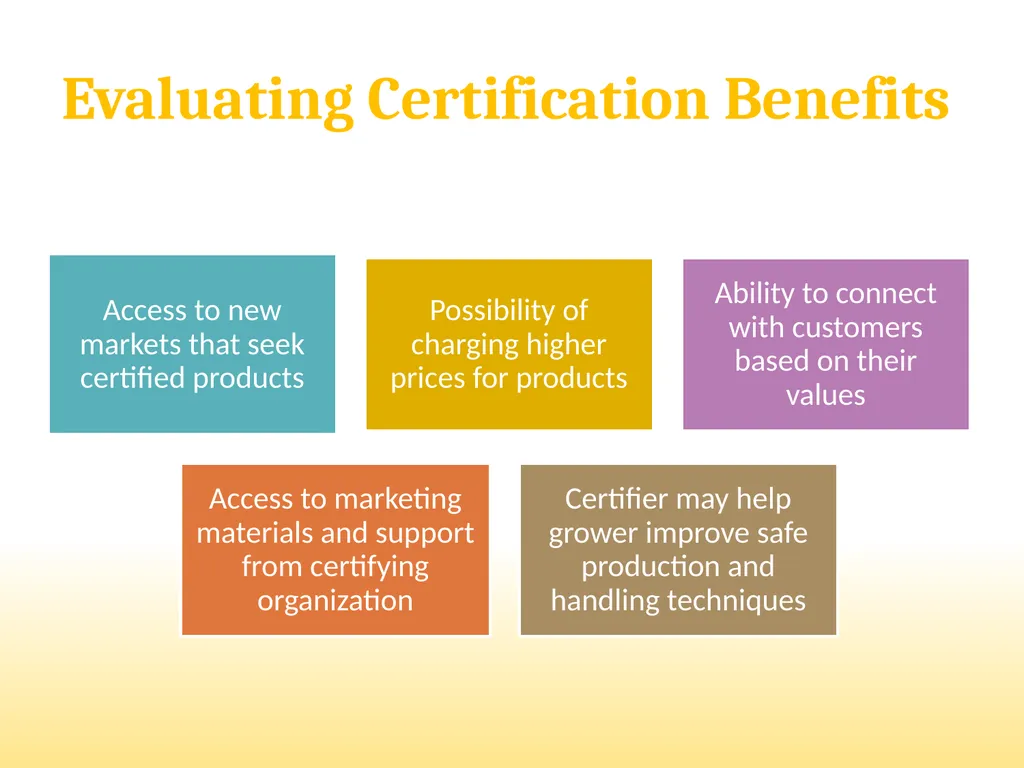
Evaluating Certification Benefits<br>
09
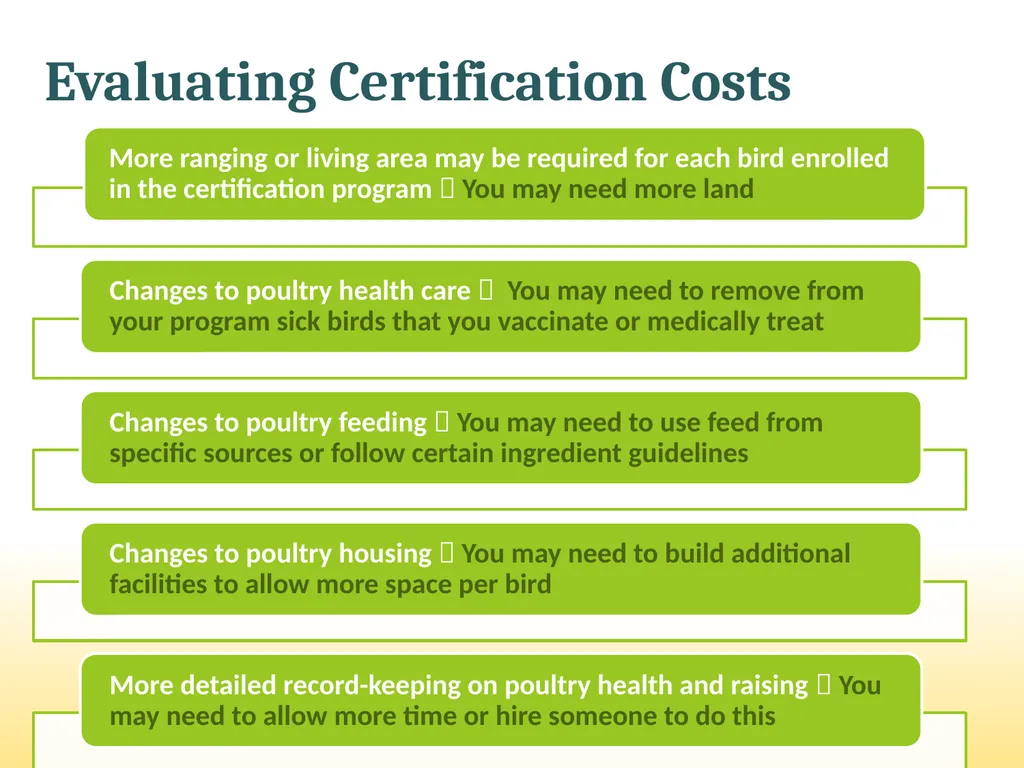
Evaluating Certification Costs<br>
10
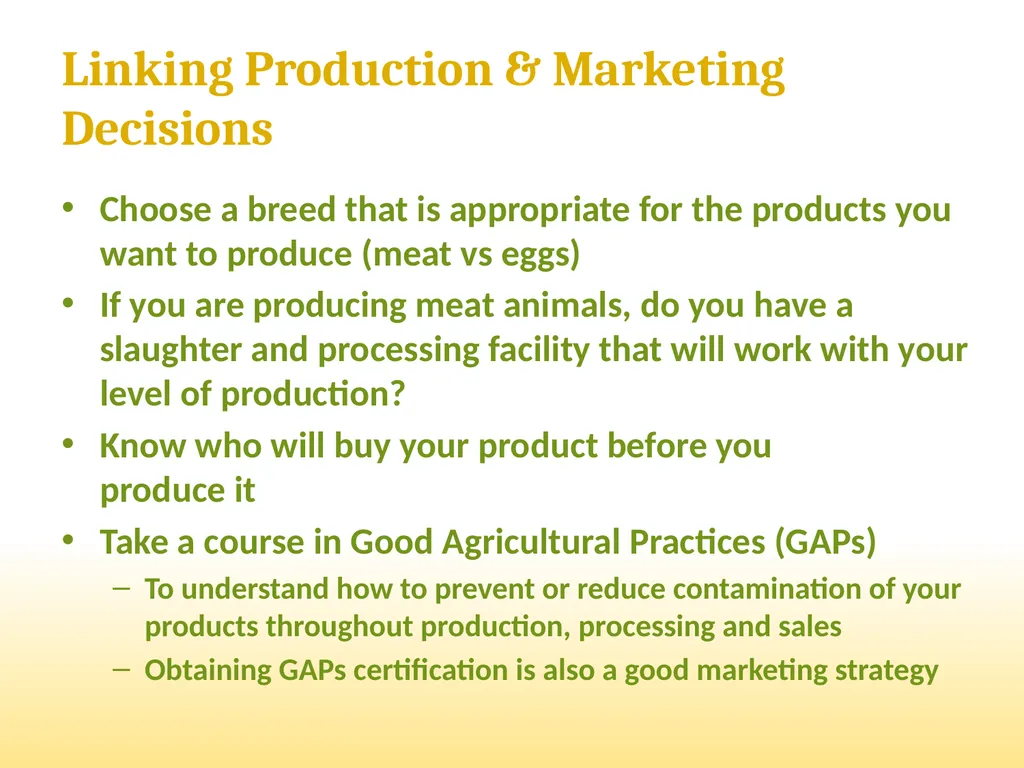
Linking Production & Marketing Decisions Choose a breed that is appropriate for the products you want to produce (meat vs eggs)
If you are producing meat animals, do you have a slaughter and processing facility that will work with your level of production?
Know who will buy your product before you produce it
Take a course in Good Agricultural Practices (GAPs)
To understand how to prevent or reduce contamination of your products throughout production, processing and sales
Obtaining GAPs certification is also a good marketing strategy<br>
If you are producing meat animals, do you have a slaughter and processing facility that will work with your level of production?
Know who will buy your product before you produce it
Take a course in Good Agricultural Practices (GAPs)
To understand how to prevent or reduce contamination of your products throughout production, processing and sales
Obtaining GAPs certification is also a good marketing strategy<br>
11
To be a good neighbor and food producer:
Manage manure properly
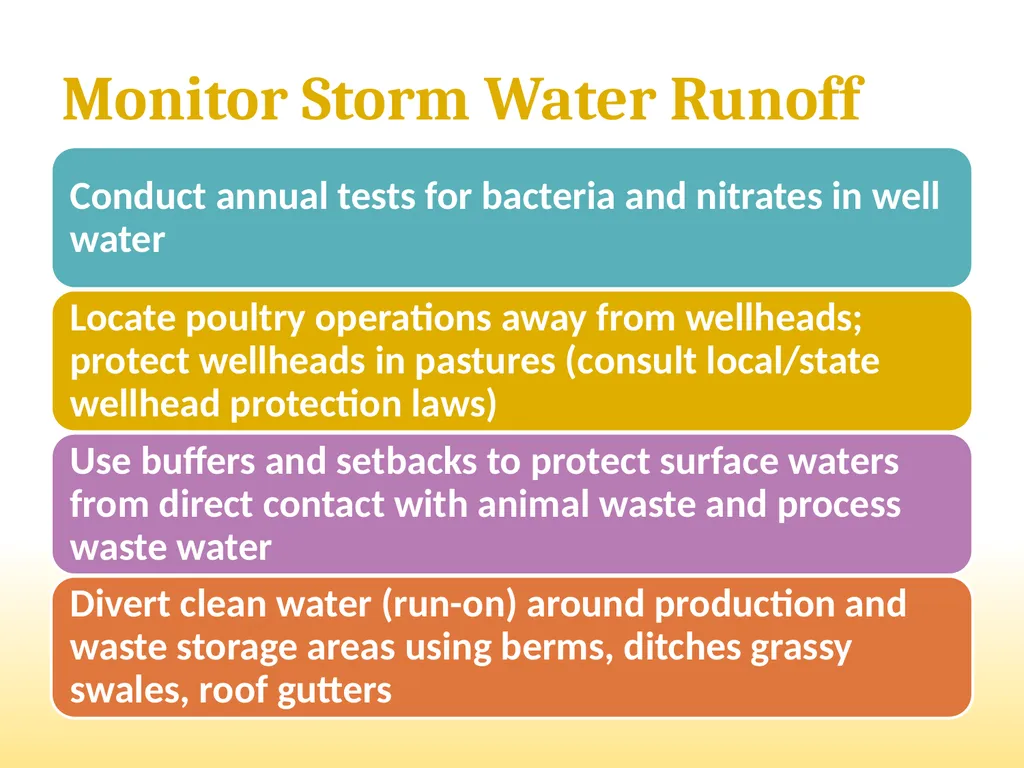
Monitor storm water runoff
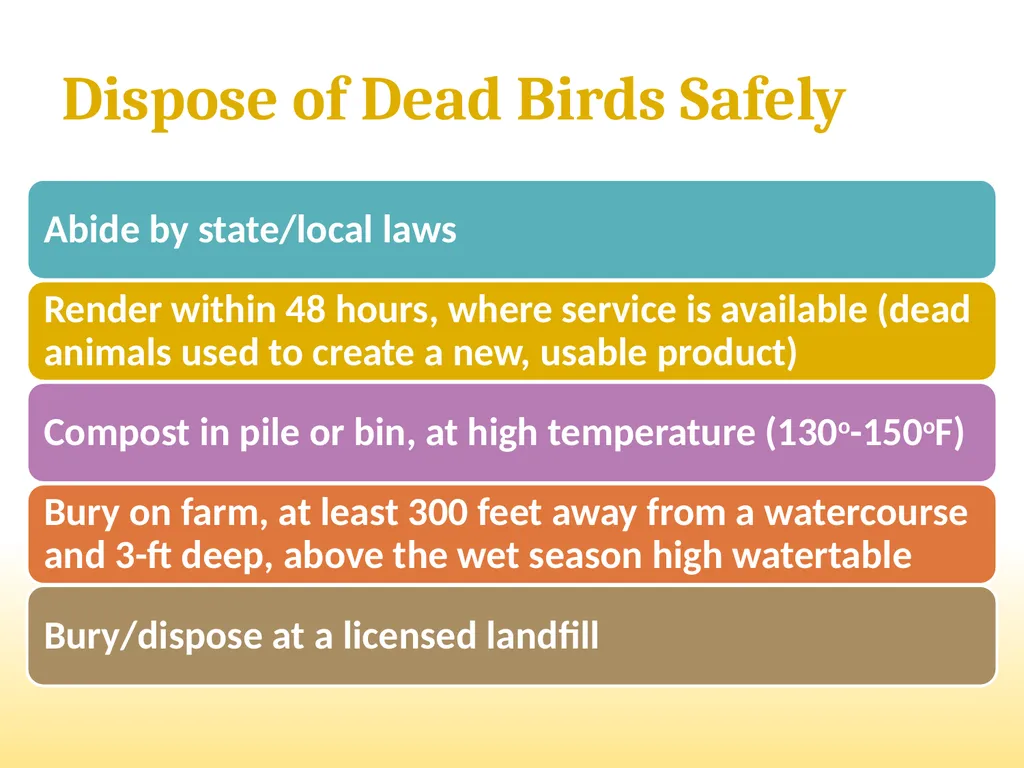
Dispose of mortalities safely Environmental Stewardship<br>
Manage manure properly
Monitor storm water runoff
Dispose of mortalities safely Environmental Stewardship<br>
12
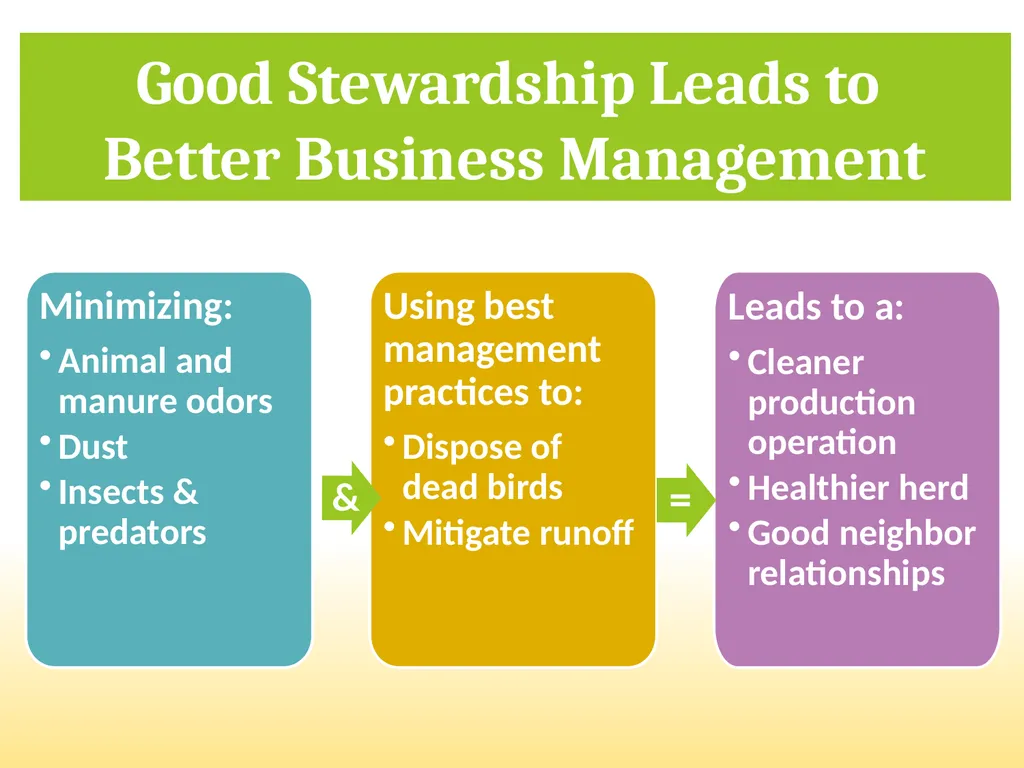
Good Stewardship Leads to
Better Business Management Minimizing:
Animal and manure odors
Dust
Insects & predators Using best management practices to:
Dispose of dead birds
Mitigate runoff Leads to a:
Cleaner production operation
Healthier herd
Good neighbor relationships & =<br>
Animal and manure odors
Dust
Insects & predators Using best management practices to:
Dispose of dead birds
Mitigate runoff Leads to a:
Cleaner production operation
Healthier herd
Good neighbor relationships & =<br>
13
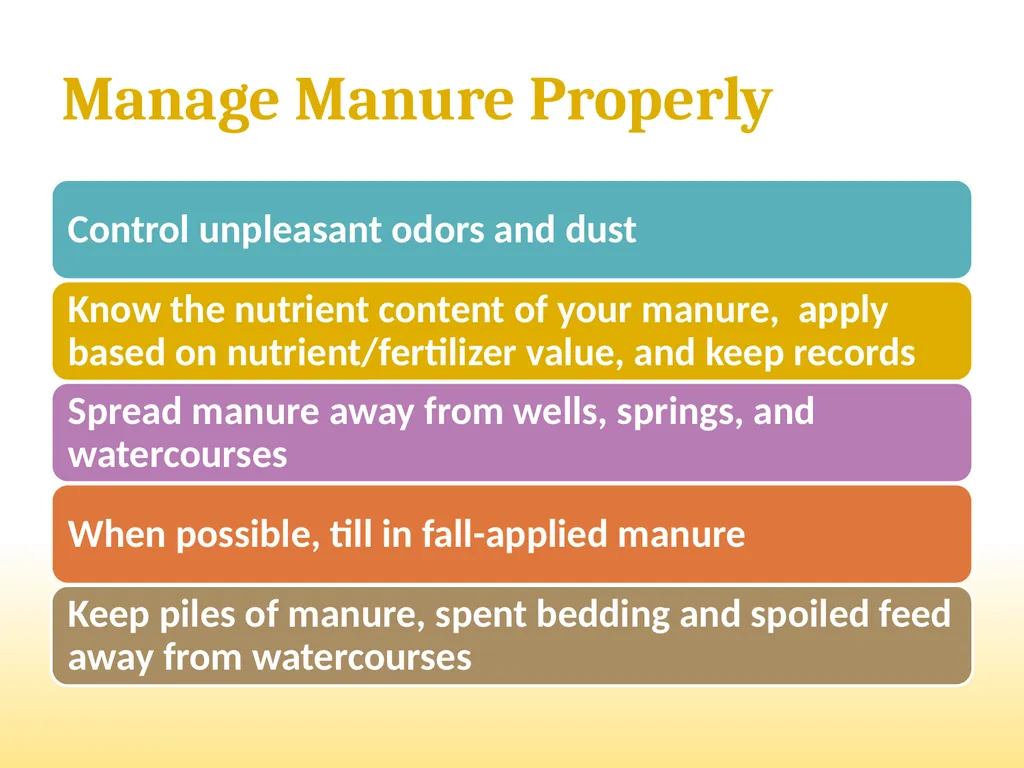
Manage Manure Properly<br>
14
Monitor Storm Water Runoff<br>
15
Dispose of Dead Birds Safely<br>
16
Maintaining a healthy flock
Managing sick birds
Growing your flock Production Practices<br>
Managing sick birds
Growing your flock Production Practices<br>
17
Animal Welfare Preventing disease among your flock involves good stewardship and management<br>
18
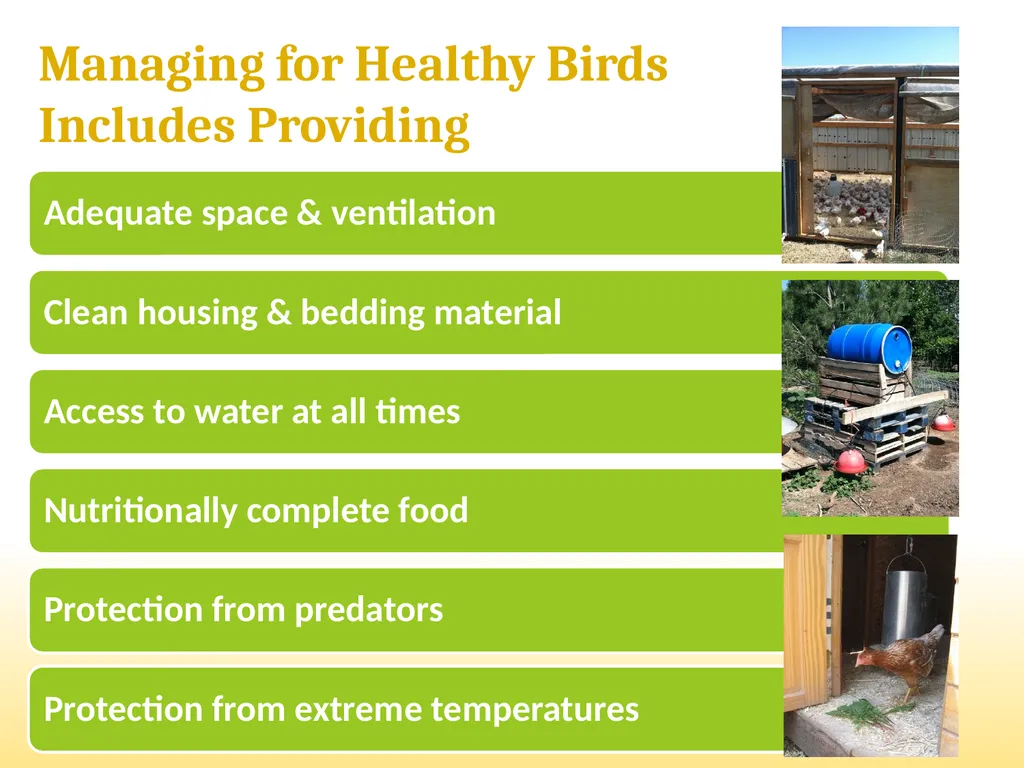
Managing for Healthy Birds Includes Providing<br>
19
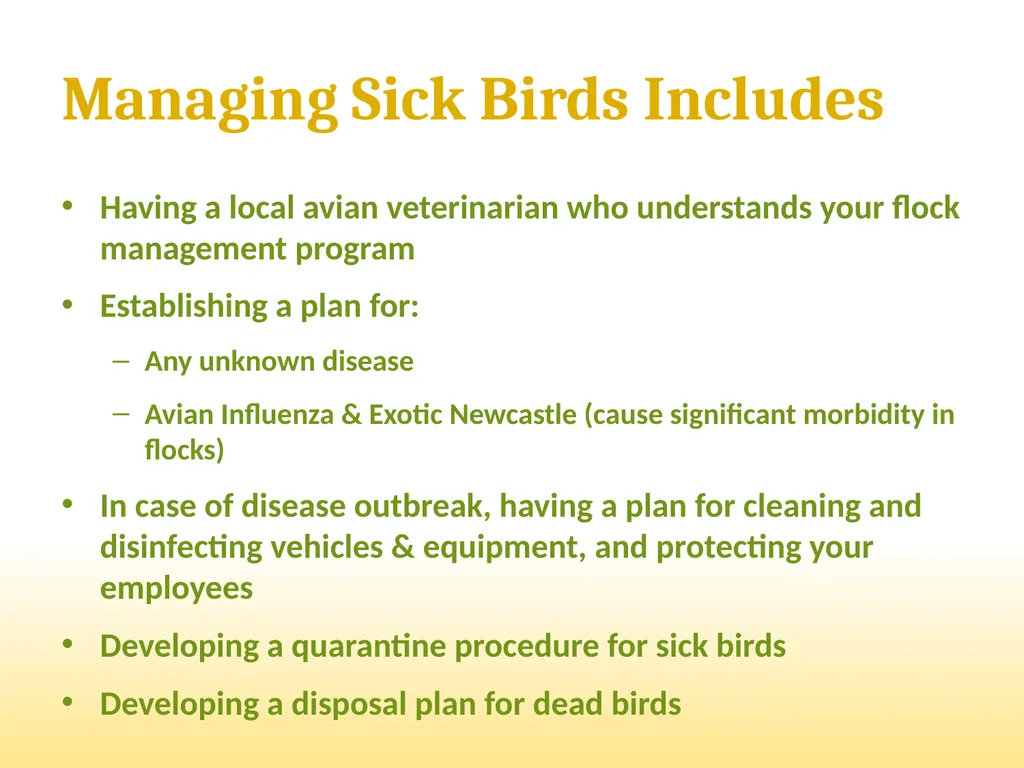
Managing Sick Birds Includes Having a local avian veterinarian who understands your flock management program
Establishing a plan for:
Any unknown disease
Avian Influenza & Exotic Newcastle (cause significant morbidity in flocks)
In case of disease outbreak, having a plan for cleaning and disinfecting vehicles & equipment, and protecting your employees
Developing a quarantine procedure for sick birds
Developing a disposal plan for dead birds<br>
Establishing a plan for:
Any unknown disease
Avian Influenza & Exotic Newcastle (cause significant morbidity in flocks)
In case of disease outbreak, having a plan for cleaning and disinfecting vehicles & equipment, and protecting your employees
Developing a quarantine procedure for sick birds
Developing a disposal plan for dead birds<br>
20
Growing Your Flock Look for hatcheries participating in Voluntary National Poultry Improvement Plan (NPIP)
Certifies that poultry breeding stock and hatcheries are free from certain diseases
Avoid poultry swaps or other unverified sources
Quarantine new birds before integrating into your flock
Keep in mind local regulations for numbers of birds allowable in your area<br>
Certifies that poultry breeding stock and hatcheries are free from certain diseases
Avoid poultry swaps or other unverified sources
Quarantine new birds before integrating into your flock
Keep in mind local regulations for numbers of birds allowable in your area<br>
21
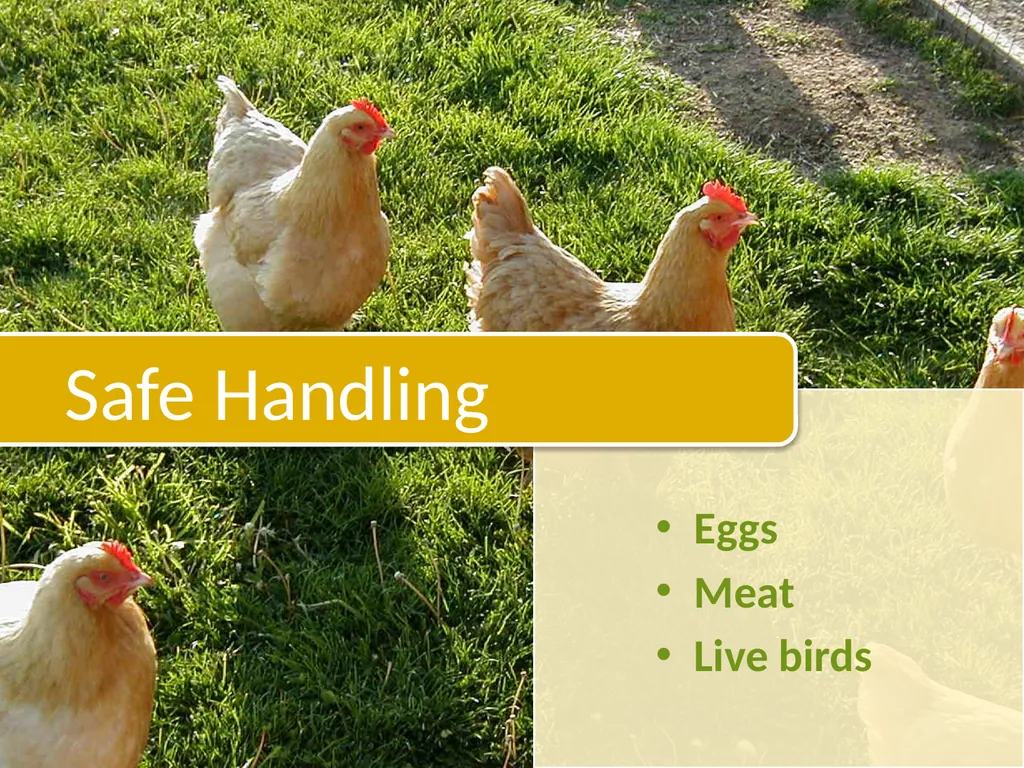
Eggs
Meat
Live birds Safe Handling<br>
Meat
Live birds Safe Handling<br>
22
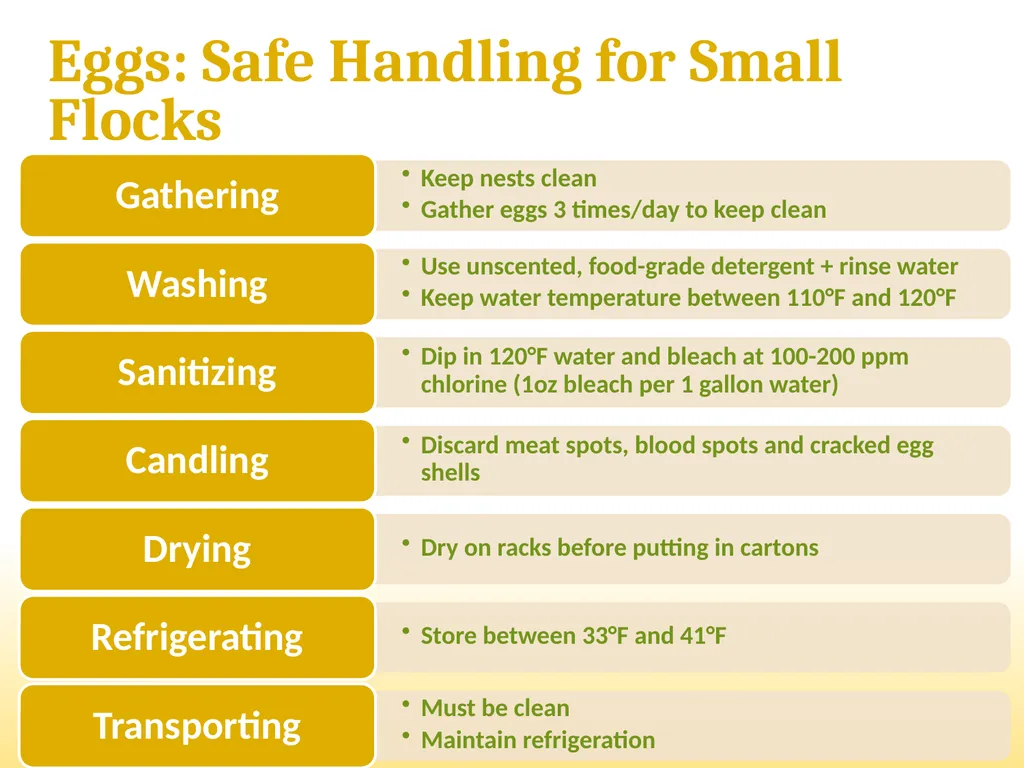
Eggs: Safe Handling for Small Flocks<br>
23
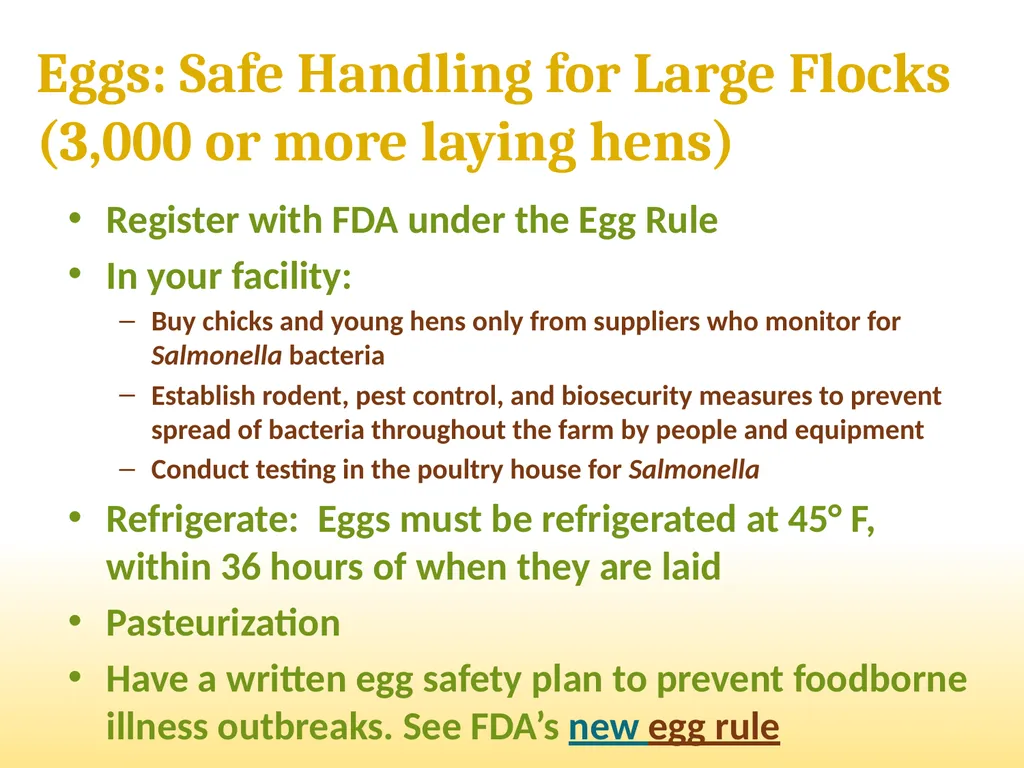
Eggs: Safe Handling for Large Flocks (3,000 or more laying hens) Register with FDA under the Egg Rule
In your facility:
Buy chicks and young hens only from suppliers who monitor for Salmonella bacteria
Establish rodent, pest control, and biosecurity measures to prevent spread of bacteria throughout the farm by people and equipment
Conduct testing in the poultry house for Salmonella
Refrigerate: Eggs must be refrigerated at 45° F, within 36 hours of when they are laid
Pasteurization
Have a written egg safety plan to prevent foodborne illness outbreaks. See FDA’s new egg rule<br>
In your facility:
Buy chicks and young hens only from suppliers who monitor for Salmonella bacteria
Establish rodent, pest control, and biosecurity measures to prevent spread of bacteria throughout the farm by people and equipment
Conduct testing in the poultry house for Salmonella
Refrigerate: Eggs must be refrigerated at 45° F, within 36 hours of when they are laid
Pasteurization
Have a written egg safety plan to prevent foodborne illness outbreaks. See FDA’s new egg rule<br>
24
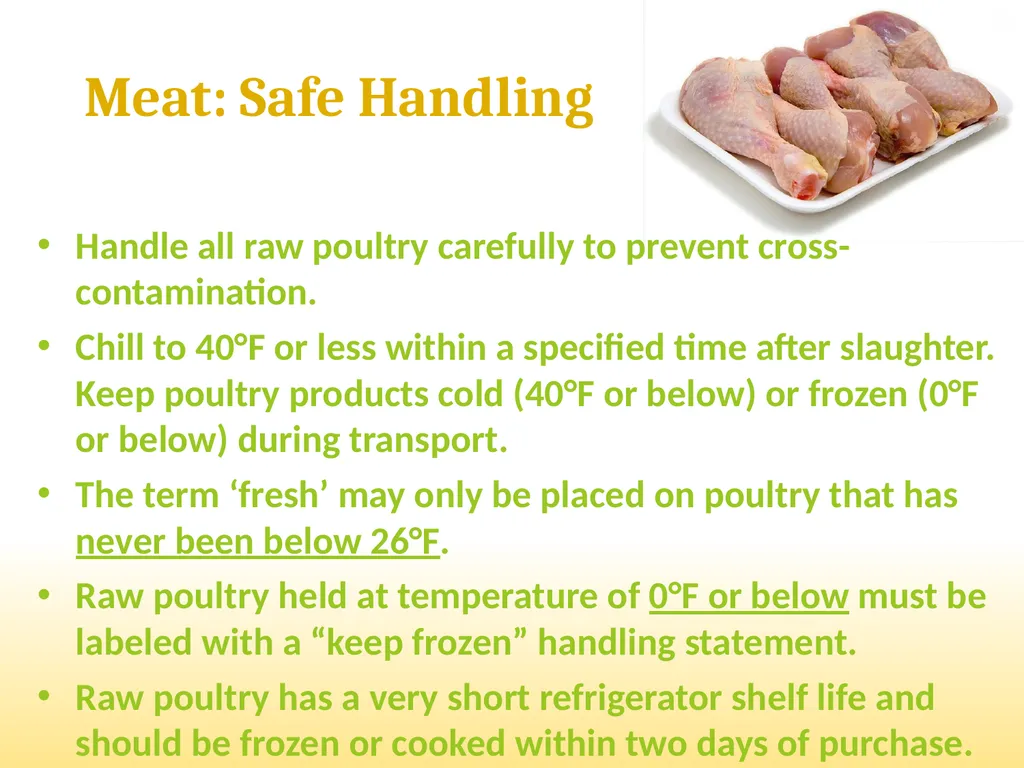
Handle all raw poultry carefully to prevent cross-contamination.
Chill to 40°F or less within a specified time after slaughter. Keep poultry products cold (40°F or below) or frozen (0°F or below) during transport.
The term ‘fresh’ may only be placed on poultry that has never been below 26°F.
Raw poultry held at temperature of 0°F or below must be labeled with a “keep frozen” handling statement.
Raw poultry has a very short refrigerator shelf life and should be frozen or cooked within two days of purchase. Meat: Safe Handling<br>
Chill to 40°F or less within a specified time after slaughter. Keep poultry products cold (40°F or below) or frozen (0°F or below) during transport.
The term ‘fresh’ may only be placed on poultry that has never been below 26°F.
Raw poultry held at temperature of 0°F or below must be labeled with a “keep frozen” handling statement.
Raw poultry has a very short refrigerator shelf life and should be frozen or cooked within two days of purchase. Meat: Safe Handling<br>
25
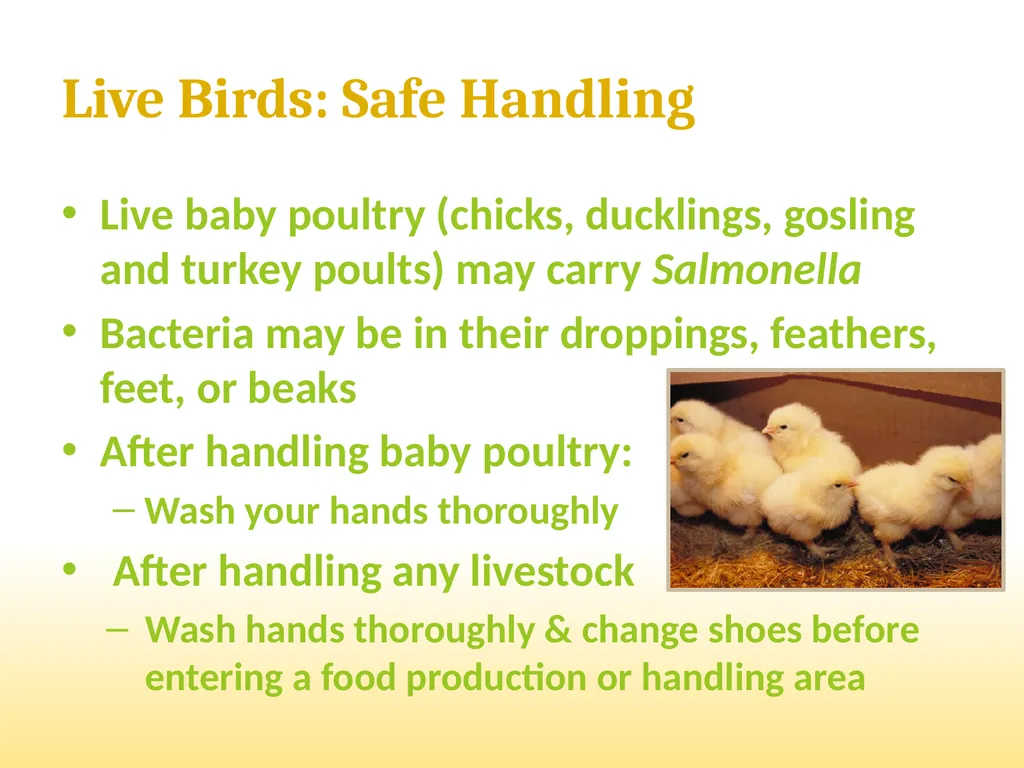
Live baby poultry (chicks, ducklings, gosling and turkey poults) may carry Salmonella
Bacteria may be in their droppings, feathers, feet, or beaks
After handling baby poultry:
Wash your hands thoroughly
After handling any livestock
Wash hands thoroughly & change shoes before entering a food production or handling area Live Birds: Safe Handling<br>
Bacteria may be in their droppings, feathers, feet, or beaks
After handling baby poultry:
Wash your hands thoroughly
After handling any livestock
Wash hands thoroughly & change shoes before entering a food production or handling area Live Birds: Safe Handling<br>
26
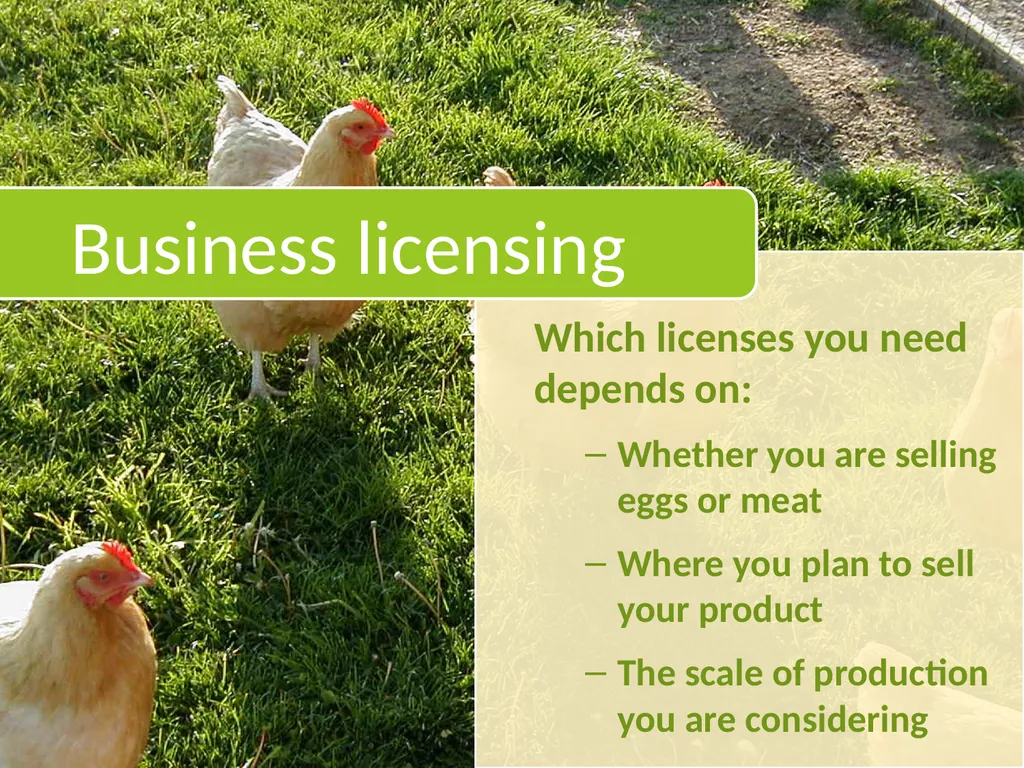
Business licensing Which licenses you need depends on:
Whether you are selling eggs or meat
Where you plan to sell your product
The scale of production you are considering<br>
Whether you are selling eggs or meat
Where you plan to sell your product
The scale of production you are considering<br>
27
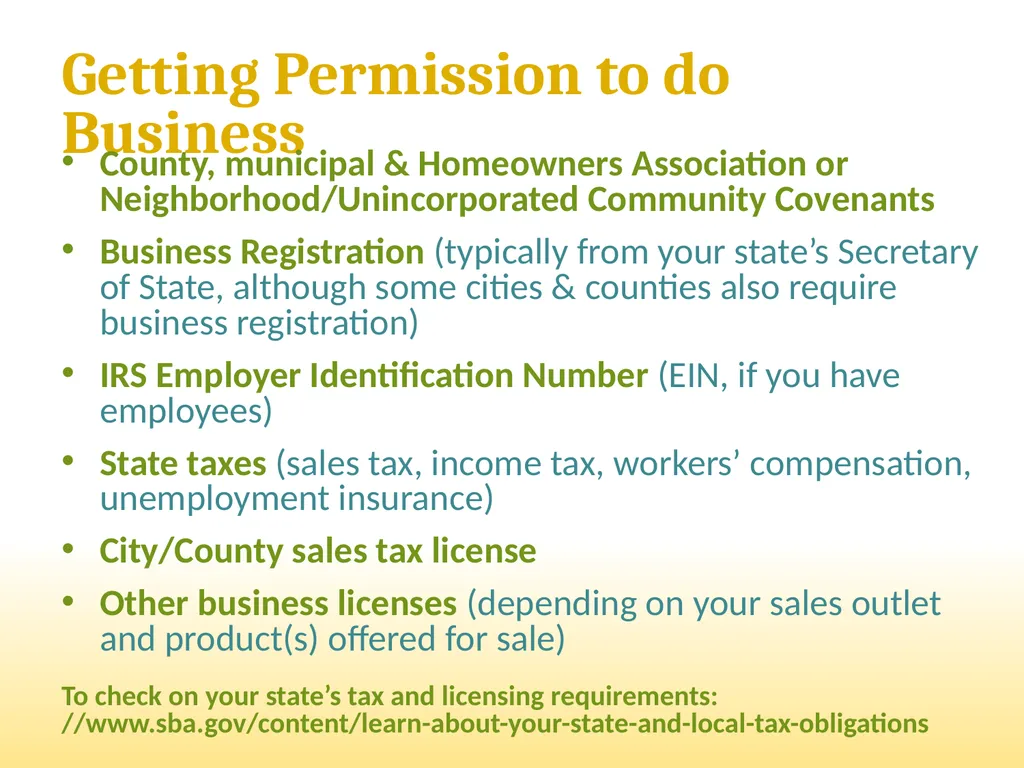
Getting Permission to do Business County, municipal & Homeowners Association or Neighborhood/Unincorporated Community Covenants
Business Registration (typically from your state’s Secretary of State, although some cities & counties also require business registration)
IRS Employer Identification Number (EIN, if you have employees)
State taxes (sales tax, income tax, workers’ compensation, unemployment insurance)
City/County sales tax license
Other business licenses (depending on your sales outlet and product(s) offered for sale)
To check on your state’s tax and licensing requirements: //www.sba.gov/content/learn-about-your-state-and-local-tax-obligations<br>
Business Registration (typically from your state’s Secretary of State, although some cities & counties also require business registration)
IRS Employer Identification Number (EIN, if you have employees)
State taxes (sales tax, income tax, workers’ compensation, unemployment insurance)
City/County sales tax license
Other business licenses (depending on your sales outlet and product(s) offered for sale)
To check on your state’s tax and licensing requirements: //www.sba.gov/content/learn-about-your-state-and-local-tax-obligations<br>
28
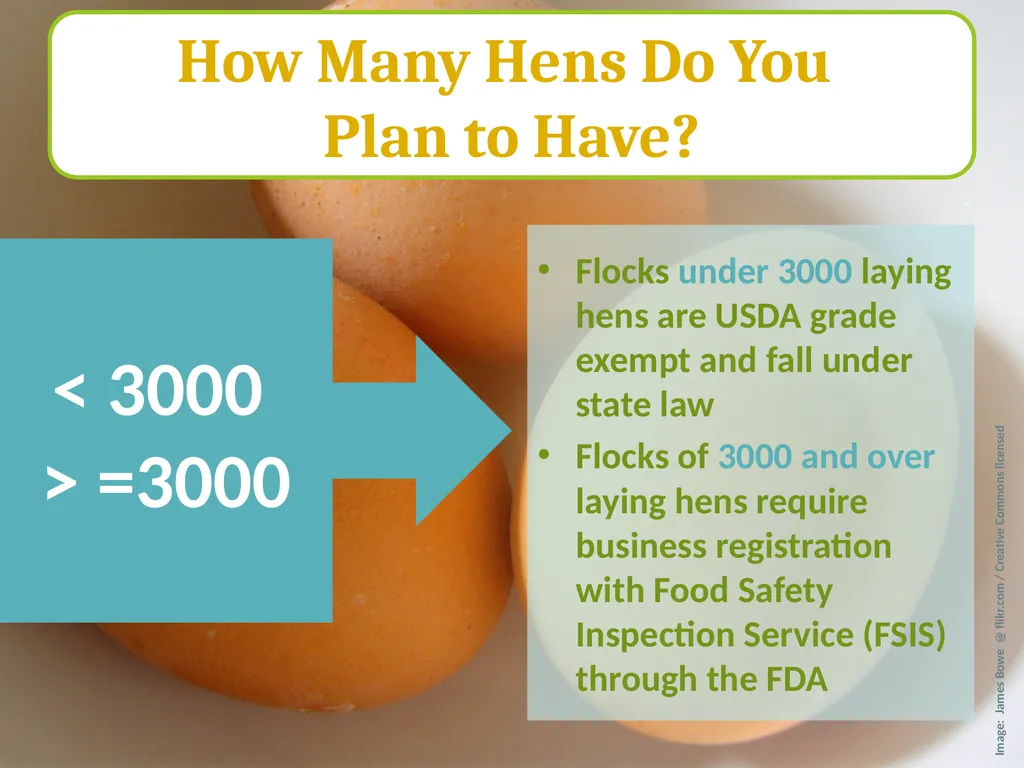
Flocks under 3000 laying hens are USDA grade exempt and fall under state law
Flocks of 3000 and over laying hens require business registration with Food Safety Inspection Service (FSIS) through the FDA < 3000
> =3000 How Many Hens Do You Plan to Have? Image: James Bowe @ flikr.com / Creative Commons licensed<br>
Flocks of 3000 and over laying hens require business registration with Food Safety Inspection Service (FSIS) through the FDA < 3000
> =3000 How Many Hens Do You Plan to Have? Image: James Bowe @ flikr.com / Creative Commons licensed<br>
29
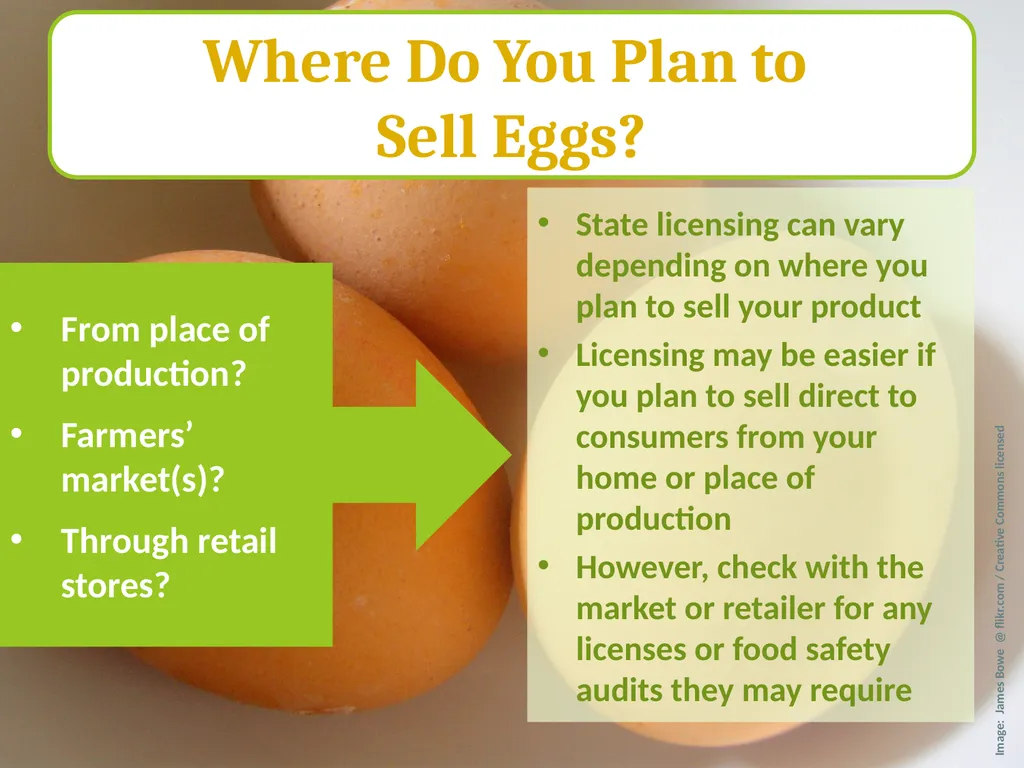
State licensing can vary depending on where you plan to sell your product
Licensing may be easier if you plan to sell direct to consumers from your home or place of production
However, check with the market or retailer for any licenses or food safety audits they may require Where Do You Plan to Sell Eggs? From place of production?
Farmers’ market(s)?
Through retail stores? Image: James Bowe @ flikr.com / Creative Commons licensed<br>
Licensing may be easier if you plan to sell direct to consumers from your home or place of production
However, check with the market or retailer for any licenses or food safety audits they may require Where Do You Plan to Sell Eggs? From place of production?
Farmers’ market(s)?
Through retail stores? Image: James Bowe @ flikr.com / Creative Commons licensed<br>
30
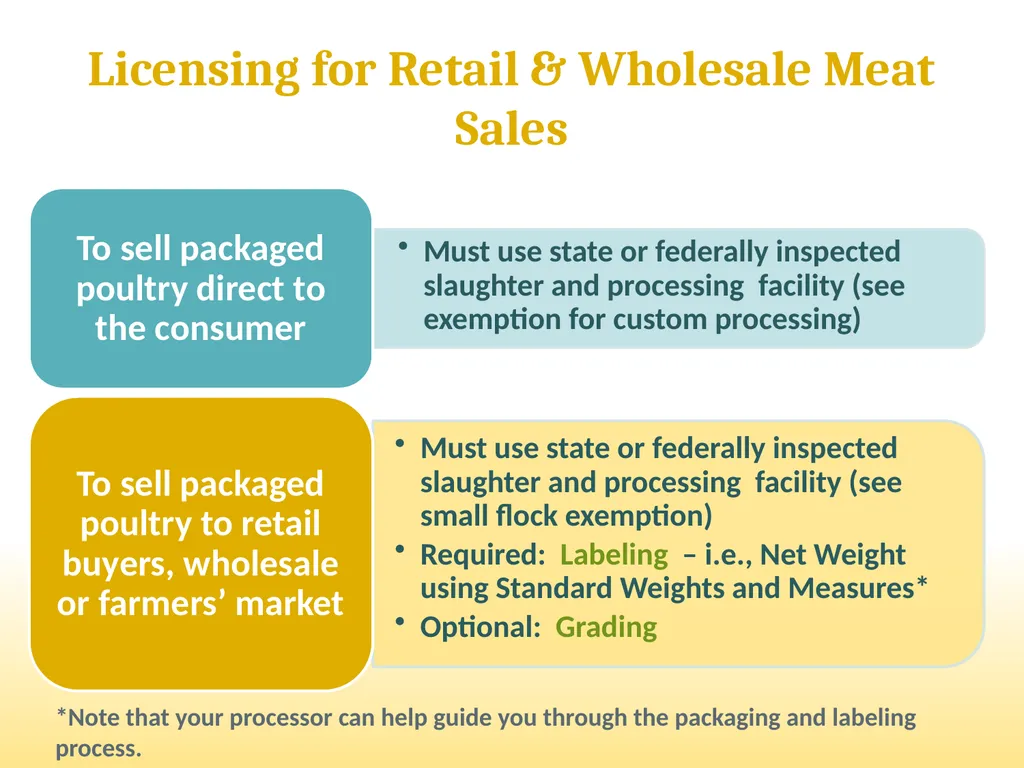
Licensing for Retail & Wholesale Meat Sales *Note that your processor can help guide you through the packaging and labeling process.<br>
31
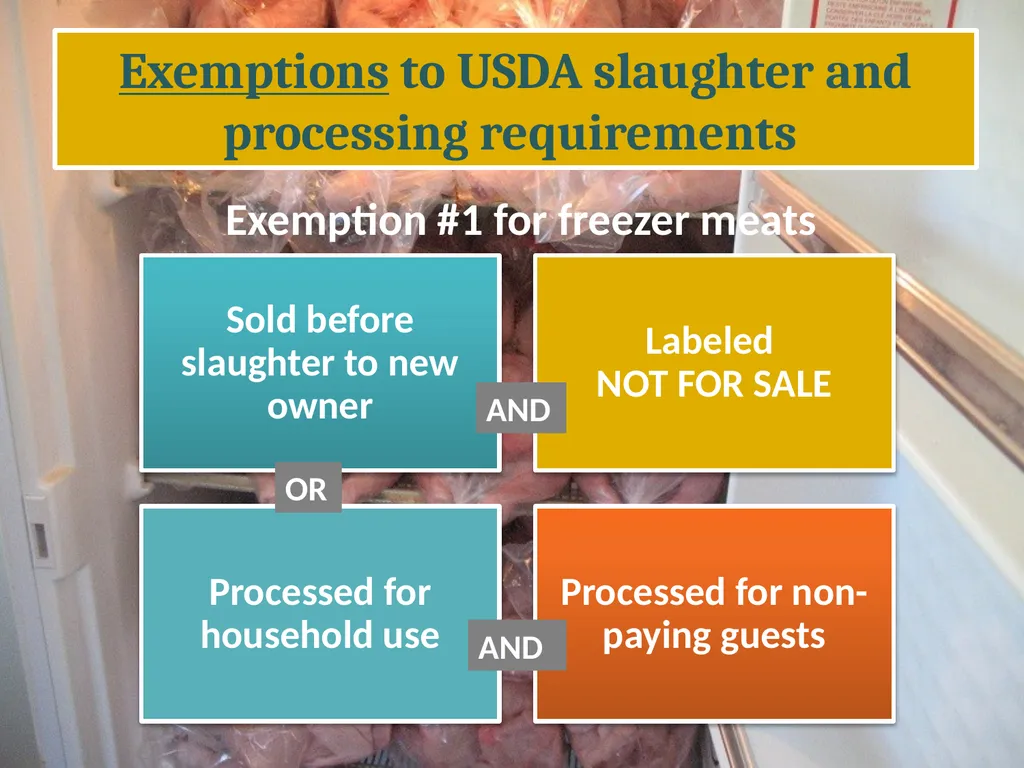
Exemptions to USDA slaughter and processing requirements Exemption #1 for freezer meats AND AND OR<br>
32
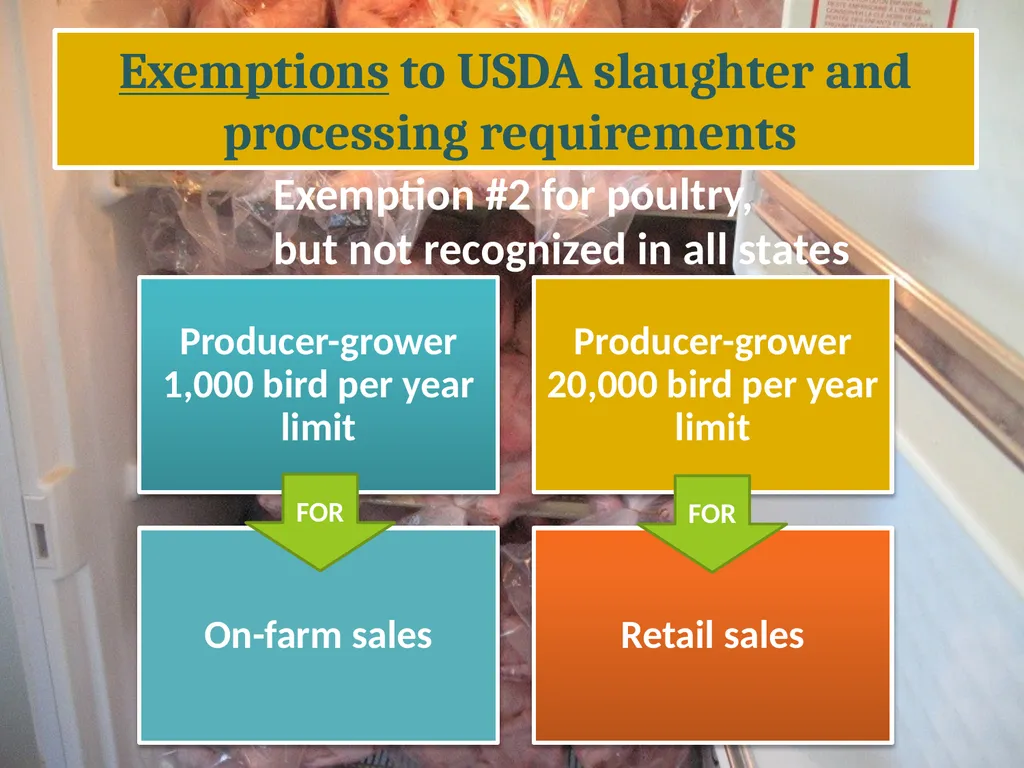
Exemptions to USDA slaughter and processing requirements Exemption #2 for poultry,
but not recognized in all states FOR FOR<br>
but not recognized in all states FOR FOR<br>
33
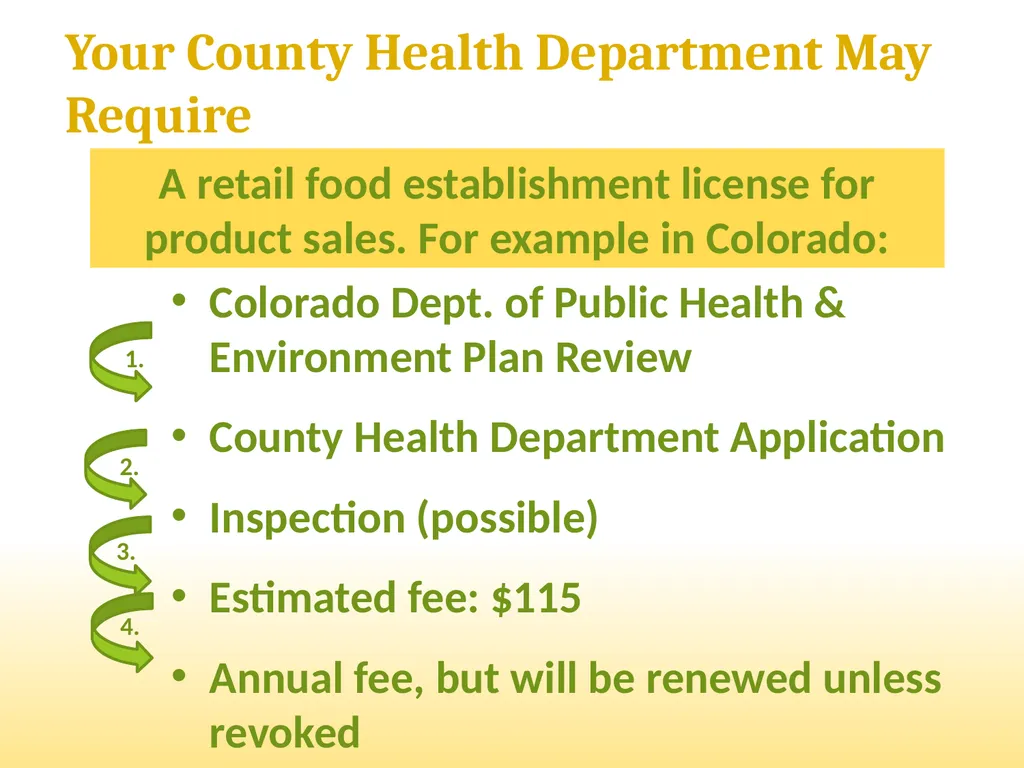
Your County Health Department May Require Colorado Dept. of Public Health & Environment Plan Review
County Health Department Application
Inspection (possible)
Estimated fee: $115
Annual fee, but will be renewed unless revoked 2. 3. 4. 1. A retail food establishment license for product sales. For example in Colorado:<br>
County Health Department Application
Inspection (possible)
Estimated fee: $115
Annual fee, but will be renewed unless revoked 2. 3. 4. 1. A retail food establishment license for product sales. For example in Colorado:<br>
34
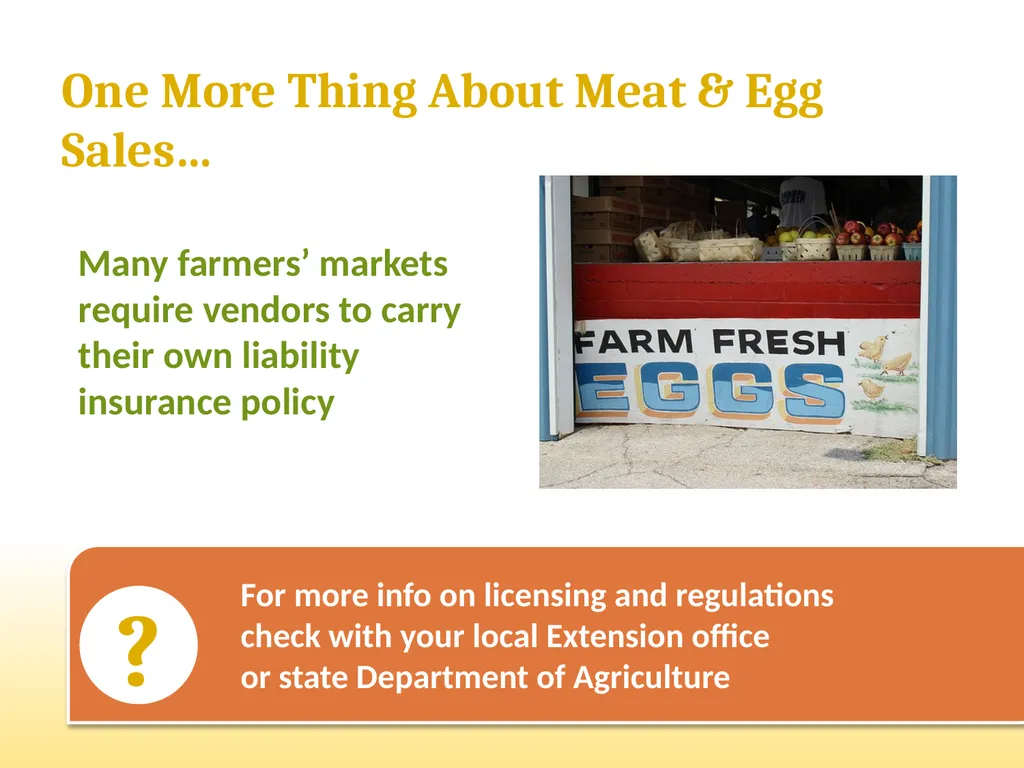
One More Thing About Meat & Egg Sales… Many farmers’ markets require vendors to carry their own liability insurance policy For more info on licensing and regulations
check with your local Extension office or state Department of Agriculture ?<br>
check with your local Extension office or state Department of Agriculture ?<br>
35
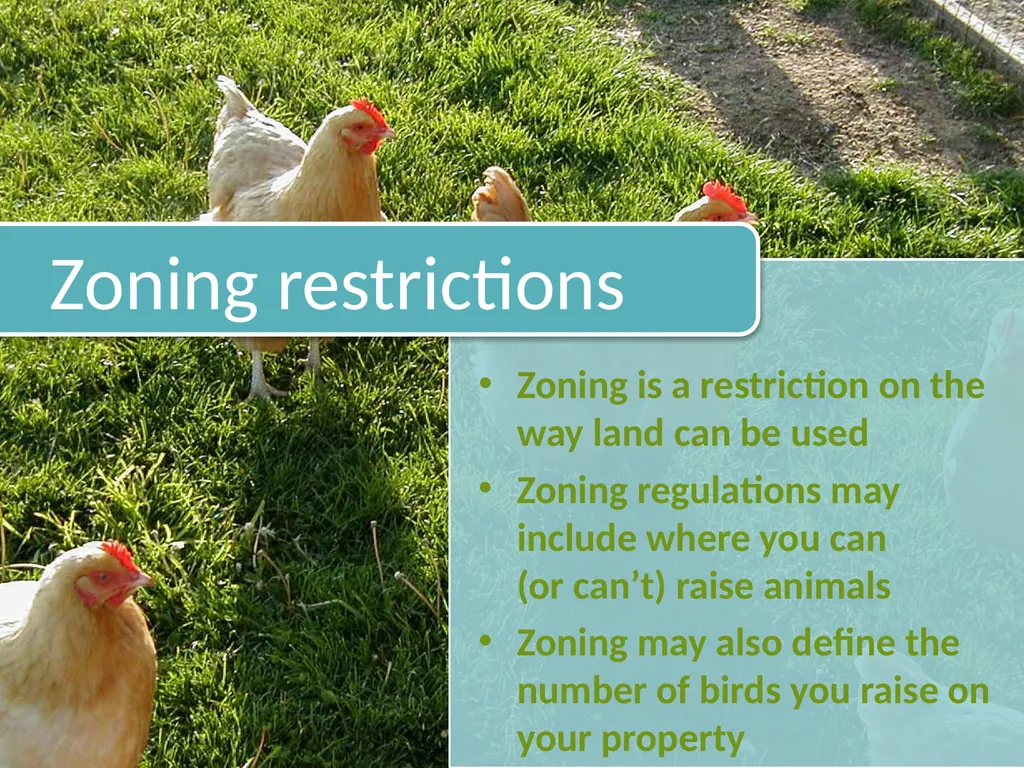
Zoning is a restriction on the way land can be used
Zoning regulations may include where you can (or can’t) raise animals
Zoning may also define the number of birds you raise on your property Zoning restrictions<br>
Zoning regulations may include where you can (or can’t) raise animals
Zoning may also define the number of birds you raise on your property Zoning restrictions<br>
36
County & Municipal Zoning Regulations Present your plans early―your local planning and zoning board may have ideas to make your business more viable or to protect your resource base
Once you are in operation, remember to consult local officials before making any changes to your business (to structures or to products you sell)<br>
Once you are in operation, remember to consult local officials before making any changes to your business (to structures or to products you sell)<br>
37
County & Municipal Zoning Regulations Livestock allowances are usually outlined in land use codes
Large livestock are typically prohibited in non-agriculturally zoned county or municipal districts
Many municipalities allow private ownership/production of a small number of fowl, although many exclude roosters and limit the density of confinement
Your Homeowners’ Association may also have restrictions on poultry Always verify the number birds legally allowed on your property before starting your business<br>
Large livestock are typically prohibited in non-agriculturally zoned county or municipal districts
Many municipalities allow private ownership/production of a small number of fowl, although many exclude roosters and limit the density of confinement
Your Homeowners’ Association may also have restrictions on poultry Always verify the number birds legally allowed on your property before starting your business<br>
38
Regulations in Districts Where Commercial Poultry Production is Permitted may Include:<br>
39
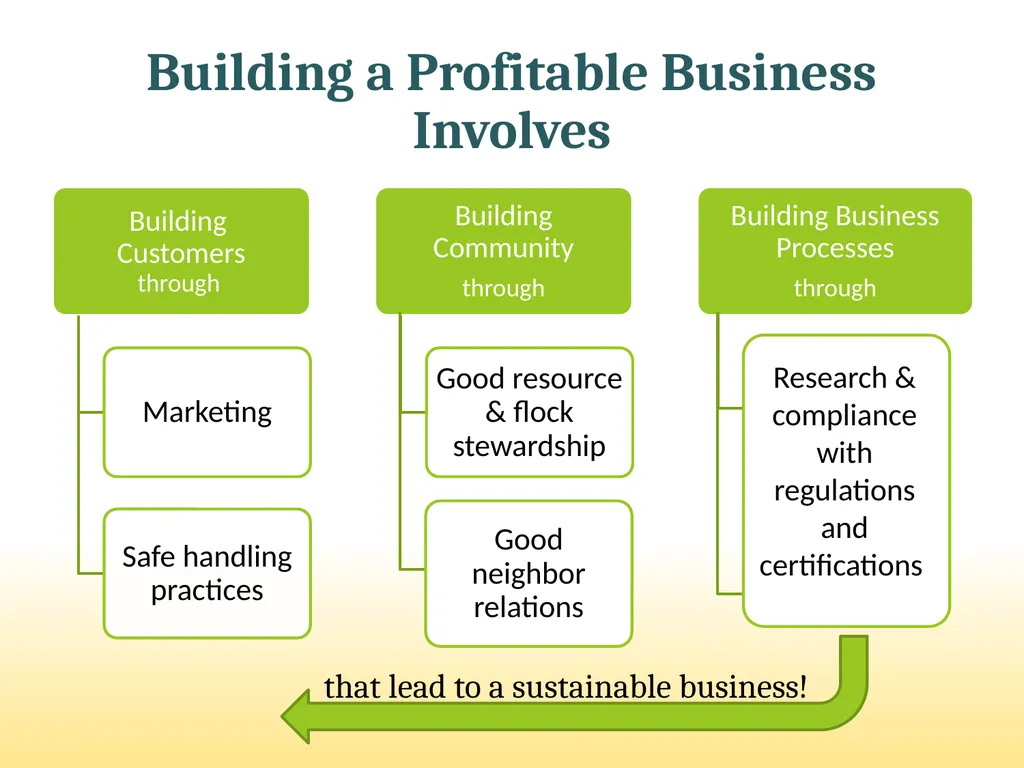
Building a Profitable Business Involves Research & compliance with regulations and certifications that lead to a sustainable business!<br>
40
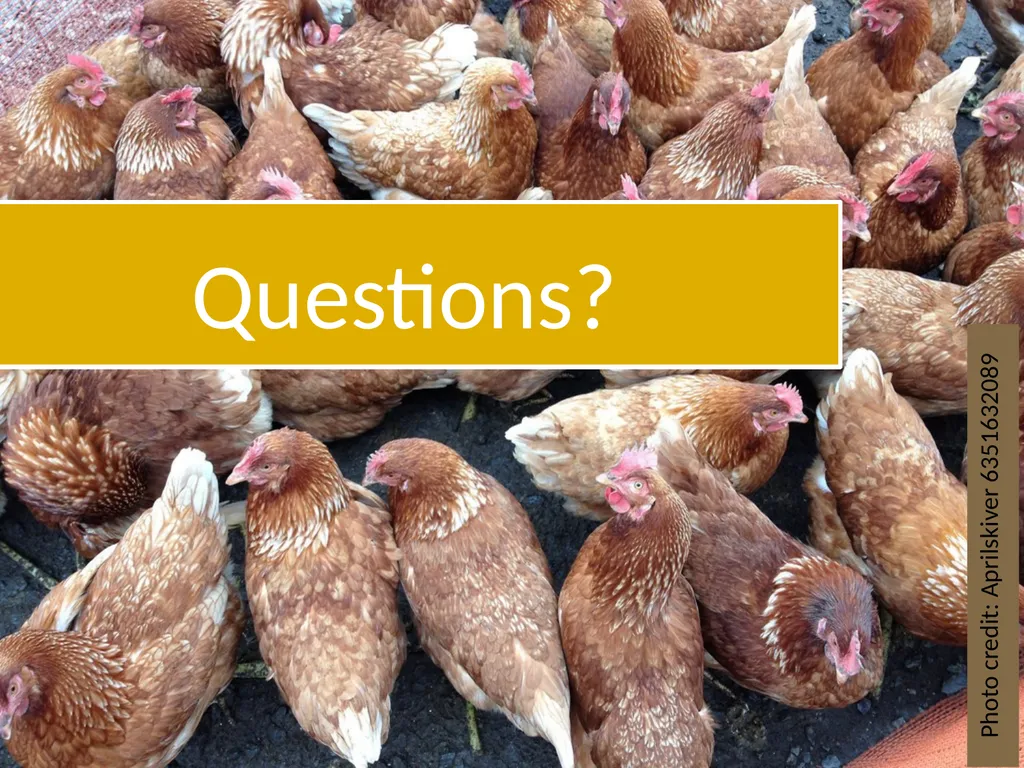
Questions? Photo credit: Aprilskiver 6351632089<br>
41
Acknowledgments Blake Angelo, Colorado State University Extension, Urban Agriculture
Dr. Jack Avens, CSU Food Science and Human Nutrition
Thomas Bass, Montana State University Extension, Livestock Environment Associate Specialist
Dr. Marisa Bunning, CSU Food Science and Human Nutrition
Emily Lockard, CSU Extension, Livestock
Dea Sloan, CSU Agricultural and Resource Economics
Martha Sullins, CSU Extension, Agriculture and Business Management
Dr. Dawn Thilmany, CSU Agricultural and Resource Economics
Heather Watts, CSU Agricultural and Resource Economics
Wendy White, Colorado Department of Agriculture
David Weiss, CSU Agricultural and Resource Economics<br>
Dr. Jack Avens, CSU Food Science and Human Nutrition
Thomas Bass, Montana State University Extension, Livestock Environment Associate Specialist
Dr. Marisa Bunning, CSU Food Science and Human Nutrition
Emily Lockard, CSU Extension, Livestock
Dea Sloan, CSU Agricultural and Resource Economics
Martha Sullins, CSU Extension, Agriculture and Business Management
Dr. Dawn Thilmany, CSU Agricultural and Resource Economics
Heather Watts, CSU Agricultural and Resource Economics
Wendy White, Colorado Department of Agriculture
David Weiss, CSU Agricultural and Resource Economics<br>
42
Photo Credits – flickr.com All photos used under the Creative Commons License Aprilskiver
6351632089 James Bowe
7177637421<br>
6351632089 James Bowe
7177637421<br>