So what? Objectives Examine quantum-resistant public key cryptosystems Monitor quantum computing progress and applicability of known quantum algorithms Biweekly seminars since 2012 Publications and presentations Journals, conferences,
"So what? Objectives Examine quantum-resistant" is the property of its rightful owner. Permission is granted to
download and print the materials on this website for personal, non-commercial use only, and to display it
on your personal computer provided you do not modify the materials and that you retain all copyright
notices contained in the materials. By downloading content from our website, you accept the terms of this
agreement.
Presentation Transcript
01
So what?<br>
02
Objectives
Examine quantum-resistant public key cryptosystems
Monitor quantum computing progress and applicability of known quantum algorithms
Biweekly seminars since 2012
Publications and presentations
Journals, conferences, workshops
Collaboration:
Hosting academic visitors
CryptoWorks 21(U. of Waterloo)
Joint Center for Quantum Information and Computer Science, University of Maryland
NIST Workshop on Cybersecurity in a Post-Quantum World
http://www.nist.gov/itl/csd/ct/post-quantum-crypto-workshop-2015.cfm The NIST PQC Project<br>
03
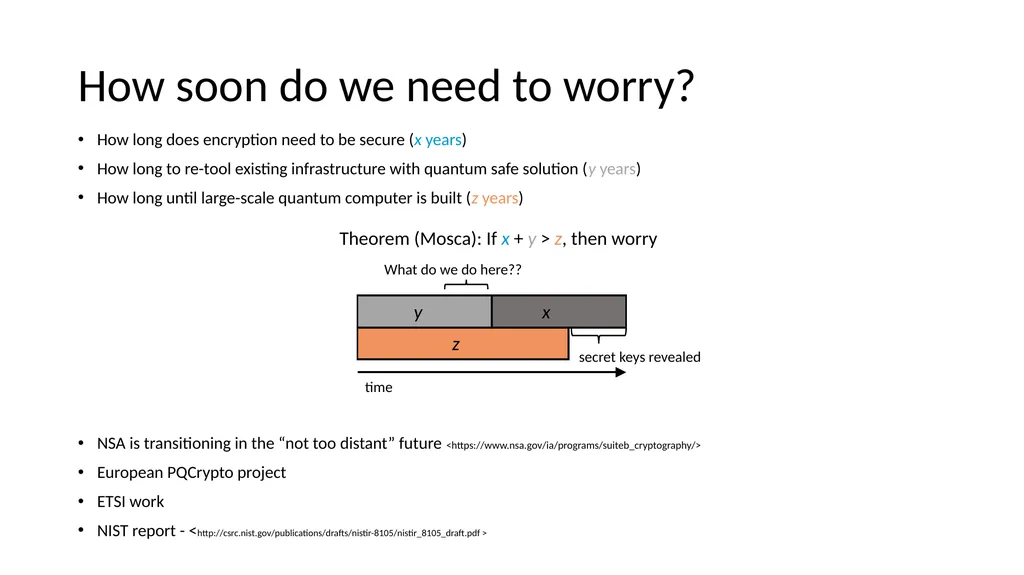
How long does encryption need to be secure (x years)
How long to re-tool existing infrastructure with quantum safe solution (y years)
How long until large-scale quantum computer is built (z years)
NSA is transitioning in the “not too distant” future <https://www.nsa.gov/ia/programs/suiteb_cryptography/>
European PQCrypto project
ETSI work
NIST report - <http://csrc.nist.gov/publications/drafts/nistir-8105/nistir_8105_draft.pdf > How soon do we need to worry?<br>
04
NIST is calling for quantum-resistant cryptographic algorithms to be considered for new public-key cryptographic standards
Digital signatures
Encryption/key-establishment
We do not expect to “pick a winner”
Ideally, several algorithms will emerge as ‘good choices’
We may pick one (or more) for standardization Call for Proposals<br>
05
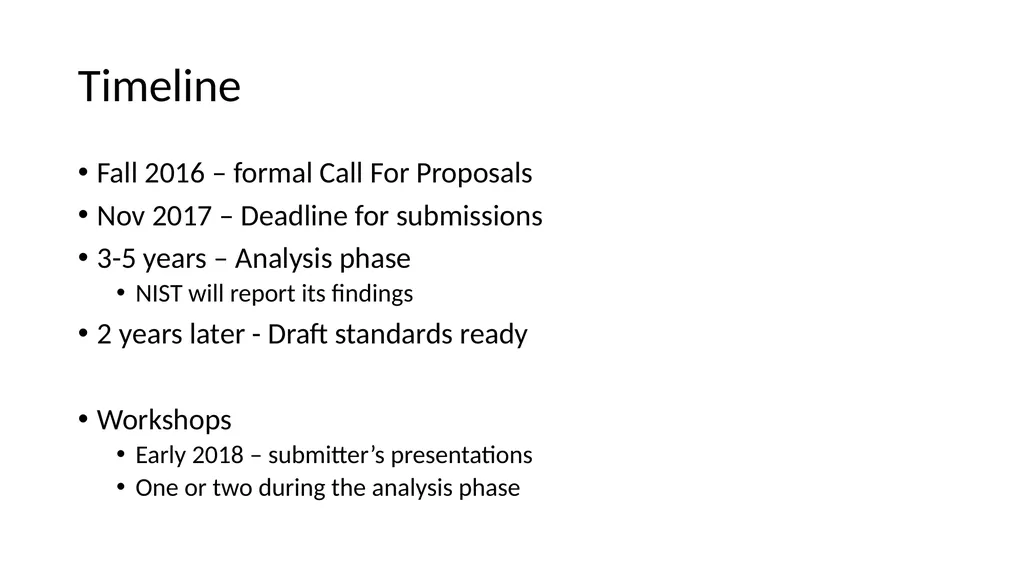
Fall 2016 – formal Call For Proposals
Nov 2017 – Deadline for submissions
3-5 years – Analysis phase
NIST will report its findings
2 years later - Draft standards ready
Workshops
Early 2018 – submitter’s presentations
One or two during the analysis phase Timeline<br>
06
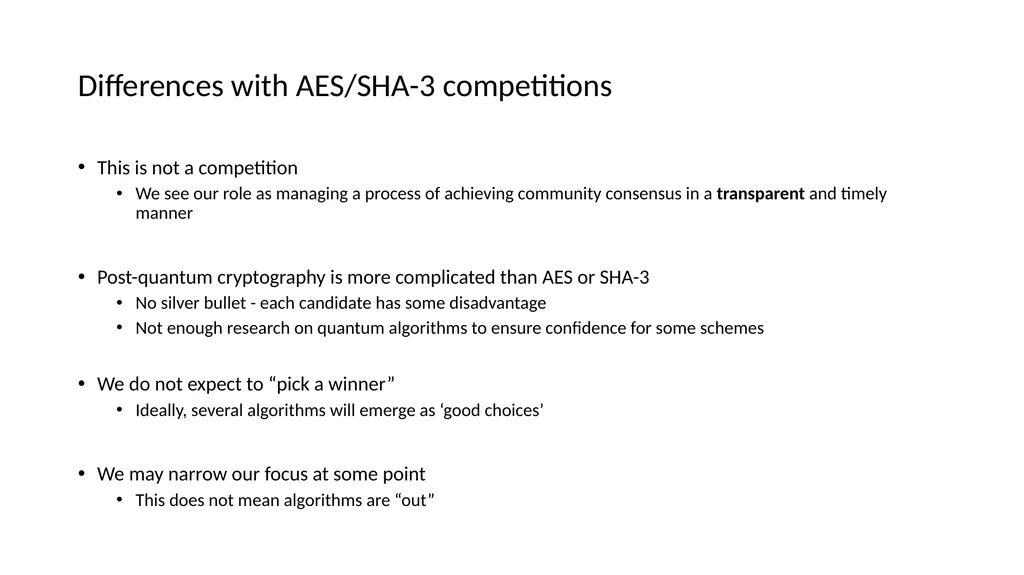
This is not a competition
We see our role as managing a process of achieving community consensus in a transparent and timely manner
Post-quantum cryptography is more complicated than AES or SHA-3
No silver bullet - each candidate has some disadvantage
Not enough research on quantum algorithms to ensure confidence for some schemes
We do not expect to “pick a winner”
Ideally, several algorithms will emerge as ‘good choices’
We may narrow our focus at some point
This does not mean algorithms are “out” Differences with AES/SHA-3 competitions<br>
07
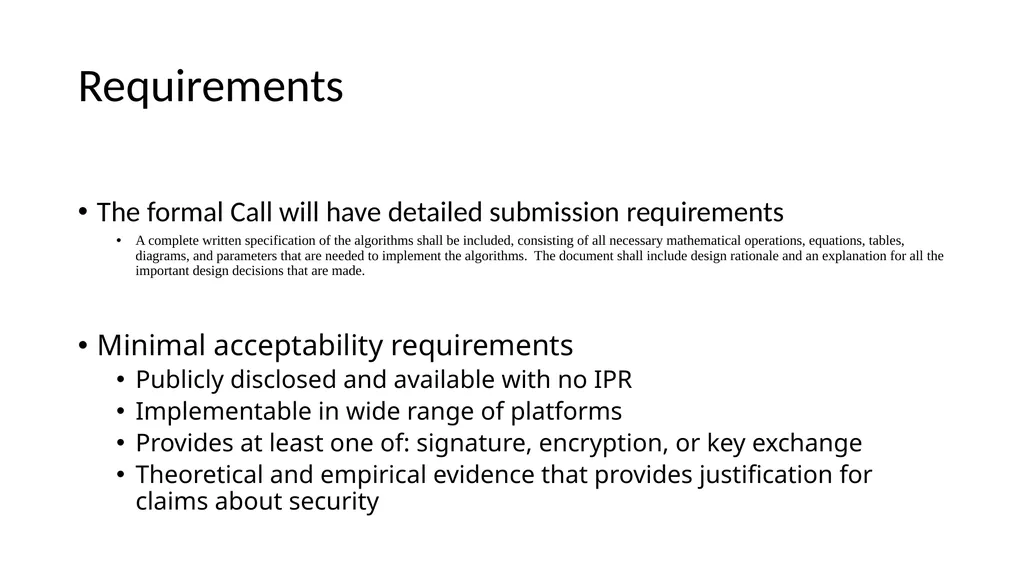
The formal Call will have detailed submission requirements
A complete written specification of the algorithms shall be included, consisting of all necessary mathematical operations, equations, tables, diagrams, and parameters that are needed to implement the algorithms. The document shall include design rationale and an explanation for all the important design decisions that are made.
Minimal acceptability requirements
Publicly disclosed and available with no IPR
Implementable in wide range of platforms
Provides at least one of: signature, encryption, or key exchange
Theoretical and empirical evidence that provides justification for claims about security Requirements<br>
08
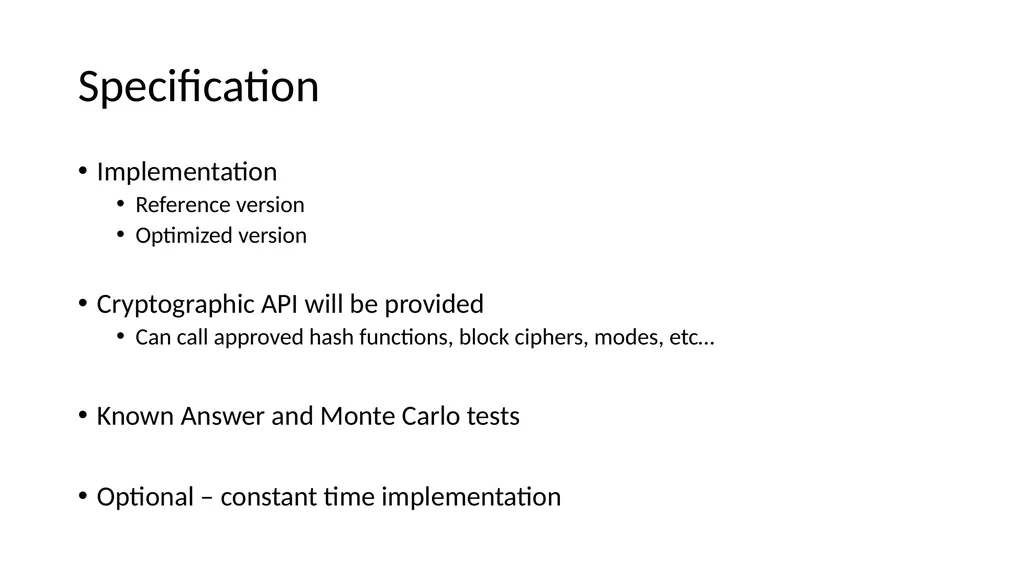
Implementation
Reference version
Optimized version
Cryptographic API will be provided
Can call approved hash functions, block ciphers, modes, etc…
Known Answer and Monte Carlo tests
Optional – constant time implementation Specification<br>
09
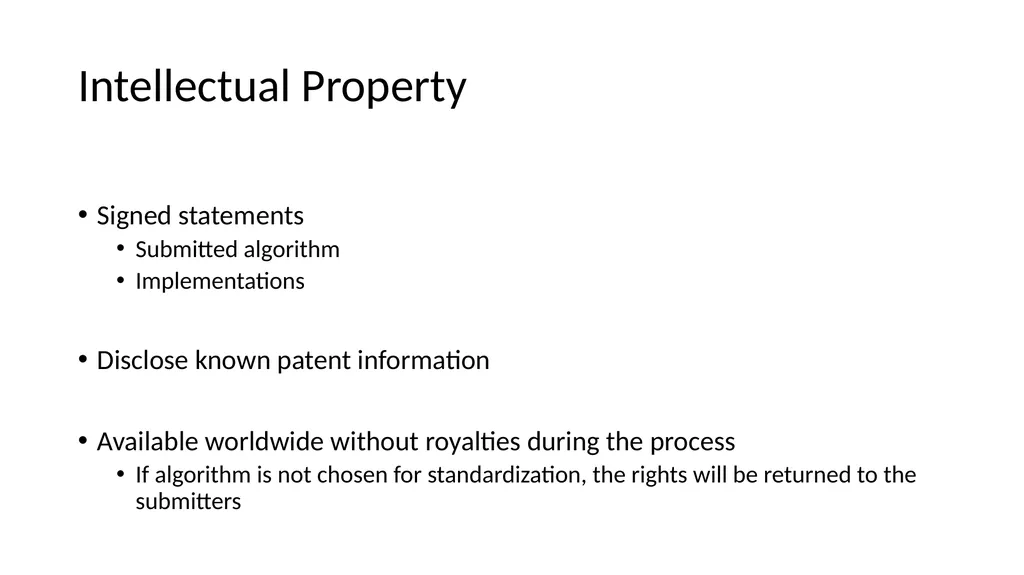
Signed statements
Submitted algorithm
Implementations
Disclose known patent information
Available worldwide without royalties during the process
If algorithm is not chosen for standardization, the rights will be returned to the submitters Intellectual Property<br>
10
To be detailed in the formal Call
Security
Cost (computation and memory)
Algorithm and implementation characteristics
Draft criteria will be open for public comment
We strongly encourage public evaluation and publication of results concerning submissions
NIST will summarize the evaluation results and report publicly Evaluation criteria<br>
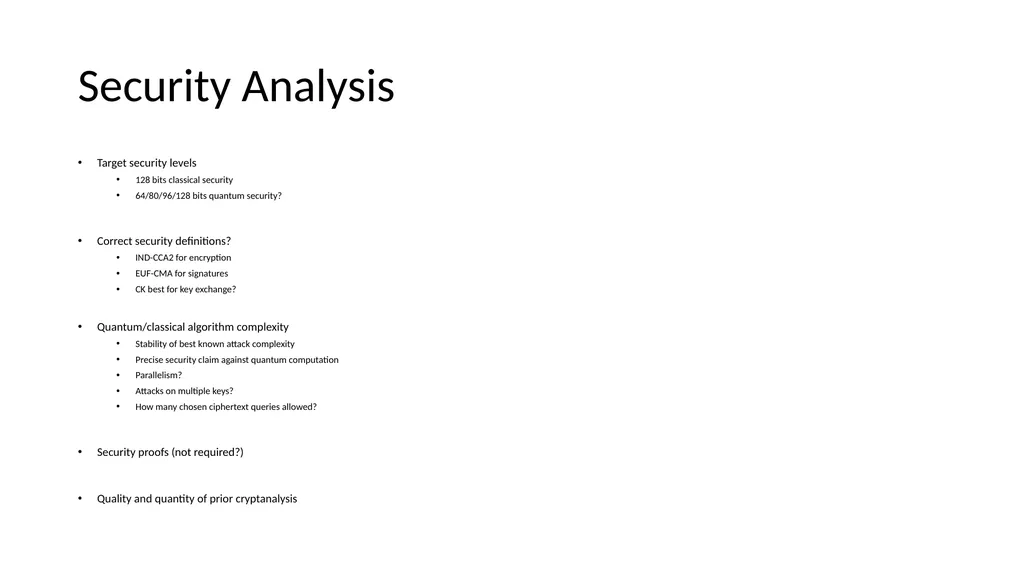
Correct security definitions?
IND-CCA2 for encryption
EUF-CMA for signatures
CK best for key exchange?
Quantum/classical algorithm complexity
Stability of best known attack complexity
Precise security claim against quantum computation
Parallelism?
Attacks on multiple keys?
How many chosen ciphertext queries allowed?
Security proofs (not required?)
Quality and quantity of prior cryptanalysis Security Analysis<br>
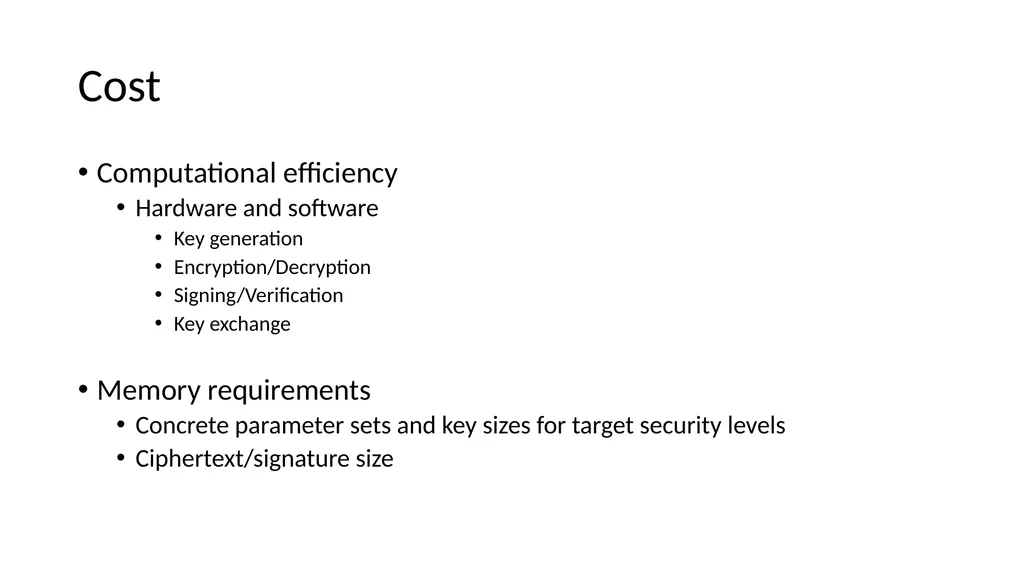
Memory requirements
Concrete parameter sets and key sizes for target security levels
Ciphertext/signature size Cost<br>
13
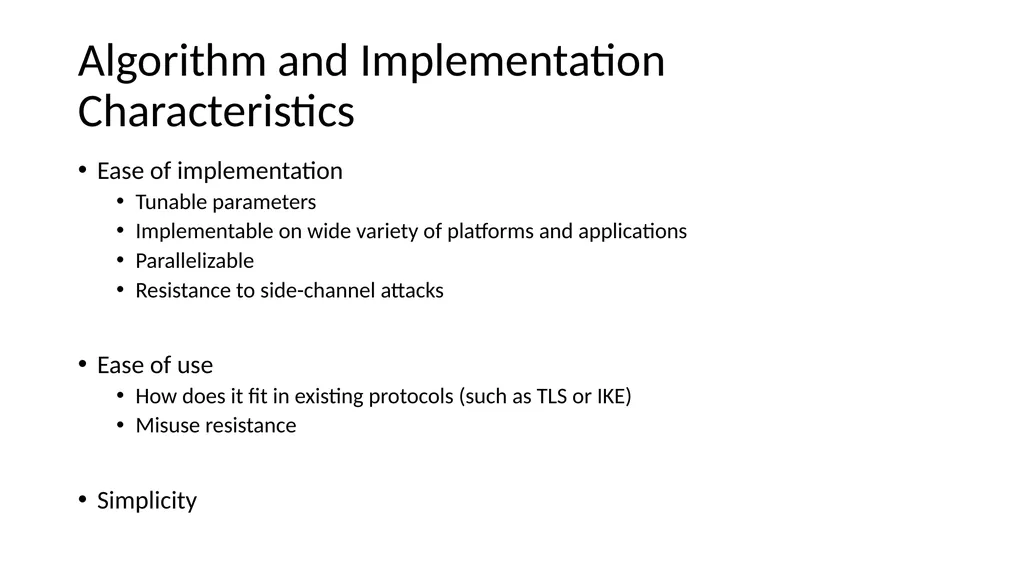
Ease of implementation
Tunable parameters
Implementable on wide variety of platforms and applications
Parallelizable
Resistance to side-channel attacks
Ease of use
How does it fit in existing protocols (such as TLS or IKE)
Misuse resistance
Simplicity Algorithm and Implementation Characteristics<br>
14
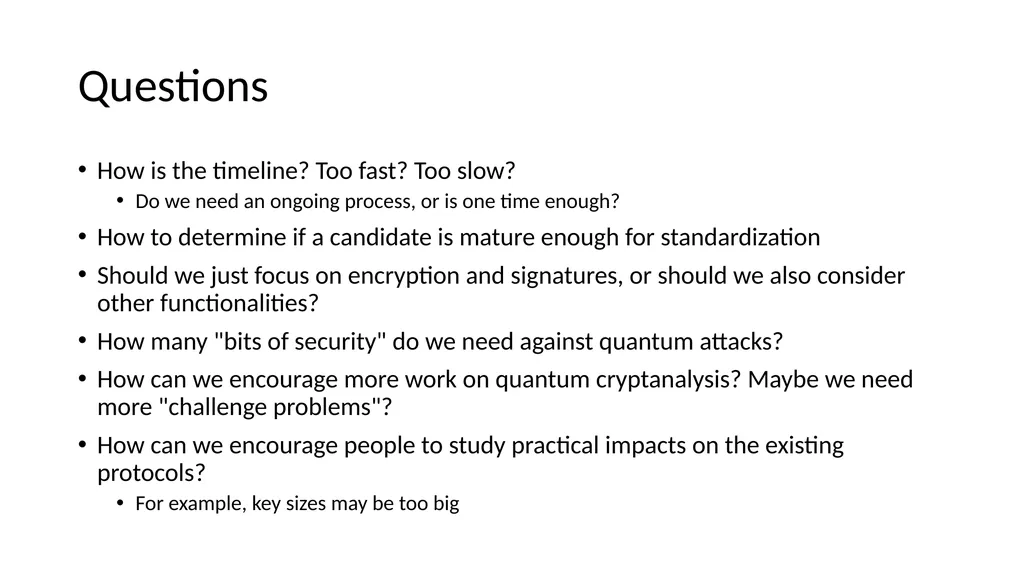
How is the timeline? Too fast? Too slow?
Do we need an ongoing process, or is one time enough?
How to determine if a candidate is mature enough for standardization
Should we just focus on encryption and signatures, or should we also consider other functionalities?
How many "bits of security" do we need against quantum attacks?
How can we encourage more work on quantum cryptanalysis? Maybe we need more "challenge problems"?
How can we encourage people to study practical impacts on the existing protocols?
For example, key sizes may be too big Questions<br>
15
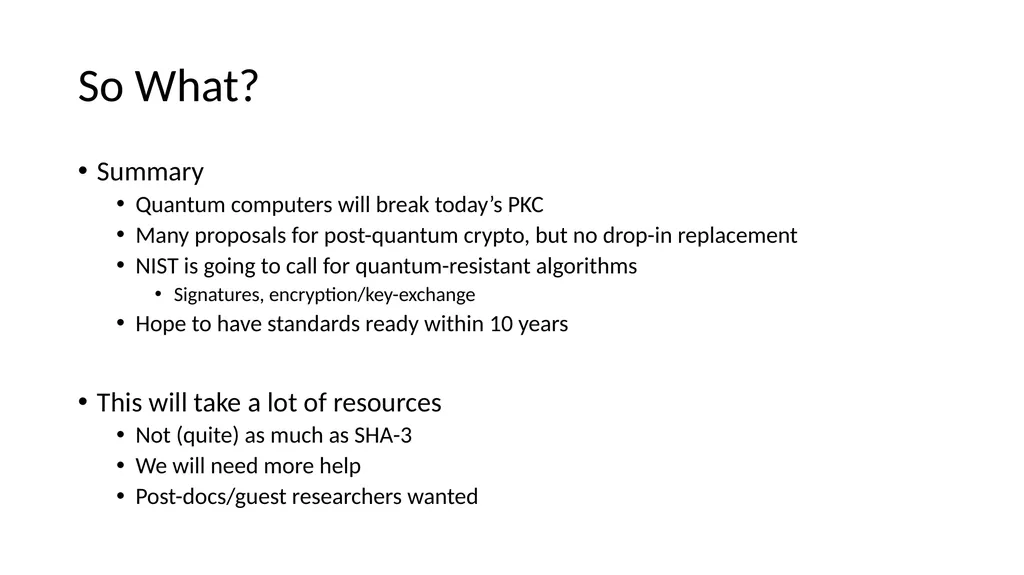
So What? Summary
Quantum computers will break today’s PKC
Many proposals for post-quantum crypto, but no drop-in replacement
NIST is going to call for quantum-resistant algorithms
Signatures, encryption/key-exchange
Hope to have standards ready within 10 years
This will take a lot of resources
Not (quite) as much as SHA-3
We will need more help
Post-docs/guest researchers wanted<br>