04
Social Responsibilities of Strategic Decision Makers Social Responsibility
proposes that a private corporation has responsibilities to society that extend beyond making a profit 3-4 Copyright © 2015 Pearson Education, Inc.<br>
05
Friedman’s Traditional View of Business Responsibility Argues against the concept of social responsibility
Primary goal of business is profit maximization not spending shareholder money for the general social interest Copyright © 2015 Pearson Education, Inc. 3-5<br>
06
Carroll’s Four Responsibilities �of Business Economic responsibilities
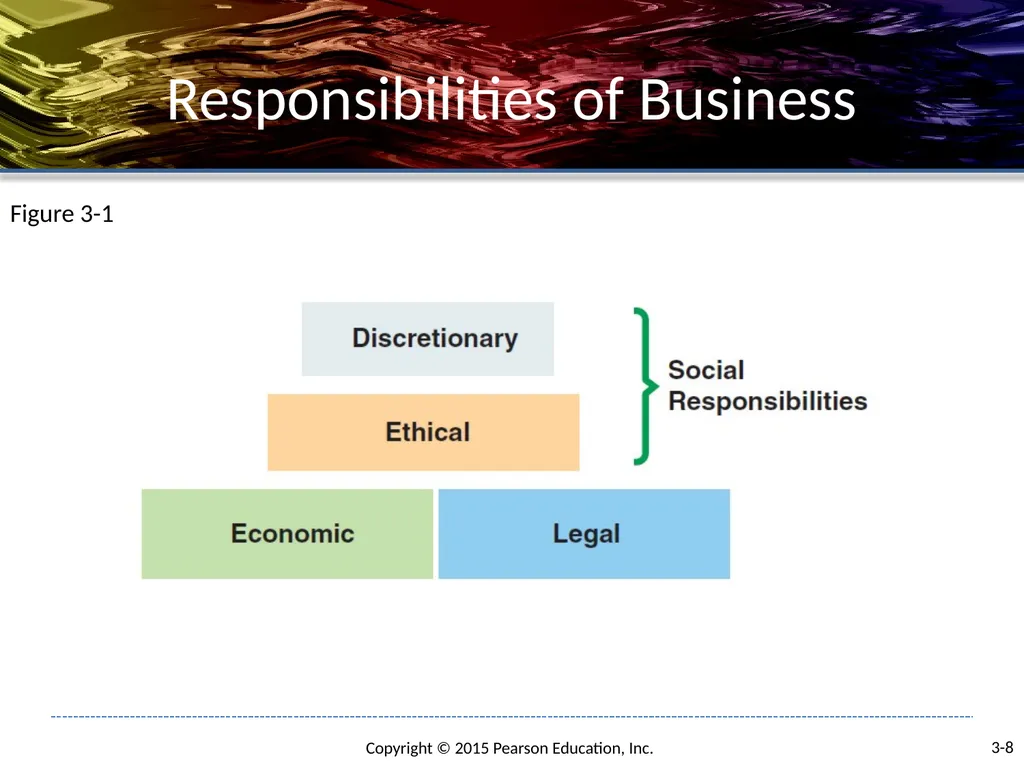
produce goods and services of value to society so that the firm may repay its creditors and increase the wealth of its shareholders
Legal responsibilities
defined by governments in laws that management is expected to obey Copyright © 2015 Pearson Education, Inc. 3-6<br>
07
Carroll’s Four Responsibilities �of Business Ethical responsibilities
follow the generally held beliefs about behavior in a society
Discretionary responsibilities
purely voluntary obligations a corporation assumes Copyright © 2015 Pearson Education, Inc. 3-7<br>
08
Responsibilities of Business Copyright © 2015 Pearson Education, Inc. 3-8 Figure 3-1<br>
09
Responsibilities of a Business Firm Social capital
the goodwill of key stakeholders, that can be used for competitive advantage
opens doors in local communities
enhances reputation with consumers Copyright © 2015 Pearson Education, Inc. 3-9<br>
10
Benefits of Being �Socially Responsible May enable firm to charge premium prices and gain brand loyalty
May help generate enduring relationships with suppliers and distributors
Can attract outstanding employees
Can utilize the goodwill of public officials for support in difficult times Copyright © 2015 Pearson Education, Inc. 3-10<br>
11
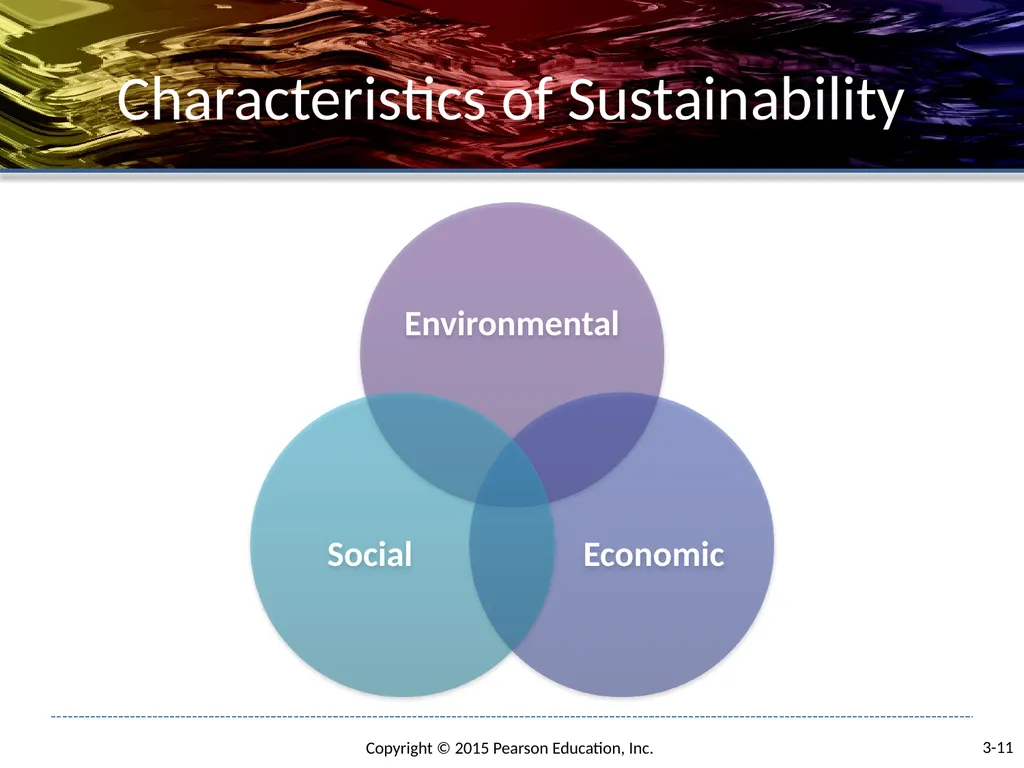
Characteristics of Sustainability Copyright © 2015 Pearson Education, Inc. 3-11<br>
12
Corporate Stakeholders Stakeholders
have an interest in the business and affect or are affected by the achievement of the firm’s objectives
Enterprise strategy
an overarching strategy that explicitly articulates the firm’s ethical relationship with its stakeholders Copyright © 2015 Pearson Education, Inc. 3-12<br>
13
Stakeholder Analysis Stakeholder analysis
the identification and evaluation of corporate stakeholders
usually done in a three-step process Copyright © 2015 Pearson Education, Inc. 3-13<br>
14
Stakeholder Analysis The first step in stakeholder analysis is to identify primary stakeholders.
Primary stakeholders
have a direct connection with the corporation and who have sufficient bargaining power to directly affect corporate activities
include customers, employees, suppliers, shareholders and creditors Copyright © 2015 Pearson Education, Inc. 3-14<br>
15
Stakeholder Analysis The second step in stakeholder analysis is to identify the secondary stakeholders.
Secondary stakeholders
have an indirect stake in the corporation but are also affected by corporate activities
include NGOs, activists, local communities, trade associations, competitors and governments Copyright © 2015 Pearson Education, Inc. 3-15<br>
16
Stakeholder Analysis The third step in stakeholder analysis is to estimate the effect on each stakeholder group from any particular strategic decision. Copyright © 2015 Pearson Education, Inc. 3-16<br>
17
Stakeholder Input Once stakeholder impacts have been identified, managers should decide whether stakeholder input should be invited into the discussion of the strategic alternatives.
A group is more likely to accept or even help implement a decision if it has some input into which alternative is chosen and how it is to be implemented. Copyright © 2015 Pearson Education, Inc. 17<br>
18
Reasons for Unethical Behavior Unaware that behavior is questionable
Lack of standards of conduct
Different cultural norms and values
Behavior-based or relationship-based governance systems
Different values between business people and stakeholders Copyright © 2015 Pearson Education, Inc. 3-18<br>
19
Moral Relativism Moral relativism
claims that morality is relative to some personal, social or cultural standard and that there is no method for deciding whether one decision is better than another Copyright © 2015 Pearson Education, Inc. 3-19<br>
20
Moral Relativism Naïve relativism
based on the belief that all moral decisions are deeply personal and that individuals have the right to run their own lives
Role relativism
based on the belief that social roles carry with them certain obligations to that role Copyright © 2015 Pearson Education, Inc. 3-20<br>
21
Moral Relativism Social group relativism
based on a belief that morality is simply a matter of following the norms of an individual’s peer group
Cultural relativism
based on the belief that morality is relative to a particular culture, society or community Copyright © 2015 Pearson Education, Inc. 3-21<br>
22
Kohlberg’s Levels of Moral Development Preconventional level
concern for one’s self
Conventional level
considerations for society’s laws and norms
Principled level
guided by an internal code of ethics Copyright © 2015 Pearson Education, Inc. 3-22<br>
23
Encouraging Ethical Behavior Code of Ethics
specifies how an organization expects its employees to behave while on the job Copyright © 2015 Pearson Education, Inc. 3-23<br>
24
Encouraging Ethical Behavior A code of ethics:
clarifies company expectations of employee conduct in various situations
makes clear that the company expects its people to recognize the ethical dimensions in decisions and action Copyright © 2015 Pearson Education, Inc. 3-24<br>
25
Encouraging Ethical Behavior Whistleblowers
employees who report illegal or unethical behavior on the part of others Copyright © 2015 Pearson Education, Inc. 3-25<br>
26
Guidelines for Ethical Behavior Ethics
the consensually accepted standards of behavior for an occupation, trade or profession
Morality
one’s rules of personal behavior based on religious or philosophical grounds
Law
the formal codes that permit or forbid certain behaviors and may or may not enforce ethics or morality Copyright © 2015 Pearson Education, Inc. 3-26<br>
27
Guidelines for Ethical Behavior Utilitarian approach
proposes that actions and plans should be judged by their consequences
Individual rights approach
proposes that human beings have certain fundamental rights that should be respected in all decisions Copyright © 2015 Pearson Education, Inc. 3-27<br>
28
Guidelines for Ethical Behavior Justice approach
decisions must be equitable, fair and impartial in the distribution of costs and benefits to individuals or groups Copyright © 2015 Pearson Education, Inc. 3-28<br>
29
Guidelines for Ethical Behavior Cavanagh’s questions to solve ethical problems:
Utility: Does it optimize the satisfactions of the stakeholders?
Rights: Does it respect the rights of the individuals involved
Justice: Is it consistent with the canons of justice? Copyright © 2015 Pearson Education, Inc. 3-29<br>
30
Guidelines for Ethical Behavior Kant’s categorical imperatives
Actions are ethical only if the person is willing for the same action to be taken by everyone who is in a similar situation.
Never treat another person simply as a means but always as an end. Copyright © 2015 Pearson Education, Inc. 3-30<br>
31
Copyright © 2015 Pearson Education, Inc. 3-31<br>