
Society Treasurer’s Training 2021 - 2022
LS
Published · 43 slides · 0 views

1 / 1


















Description
Society Treasurers Training 2021 - 2022 University of St Andrews Students Association SAF Societies Committee The University of St Andrews Students Association is a registered charity (No. SC019883) Introduction Treasurer You are
Related Topics
Share
Embed code
Download this presentation From Below
"Society Treasurer’s Training 2021 - 2022" is the property of its rightful owner. Permission is granted to download and print the materials on this website for personal, non-commercial use only, and to display it on your personal computer provided you do not modify the materials and that you retain all copyright notices contained in the materials. By downloading content from our website, you accept the terms of this agreement.
Presentation Transcript
01
Society Treasurer’s Training 2021 - 2022 University of St Andrews Students’ Association
SAF Societies Committee
The University of St Andrews Students’ Association is a registered charity (No. SC019883)<br>
SAF Societies Committee
The University of St Andrews Students’ Association is a registered charity (No. SC019883)<br>
02
Introduction<br>
03
Treasurer You are responsible for the financial management of the society.
You and your committee are liable for any misappropriation of funds and any society debts.
Pay attention to this training to avoid getting in trouble financially and legally.<br>
You and your committee are liable for any misappropriation of funds and any society debts.
Pay attention to this training to avoid getting in trouble financially and legally.<br>
04
Banking Societies should normally only have one bank account (including subcommittees and subgroups).
If you have more than one bank account, you must declare them to the Cash Office.
Email unionfinance@.
Declare them in the re-affiliation form.
If you would like to open another bank account, it must be approved by the Societies Committee.
Email socs@.<br>
If you have more than one bank account, you must declare them to the Cash Office.
Email unionfinance@.
Declare them in the re-affiliation form.
If you would like to open another bank account, it must be approved by the Societies Committee.
Email socs@.<br>
05
Banking Remove old signatures and add newly elected officers as signatories!
You should have at least 4 signatories.
Jillian Cowan (Cash Office Management Accountant)
Dave Whitton (General Manager)
At least 2 of your committee members (usually President and Treasurer)
The mandate (bank form) needs to specify that 2 signatories are required for all expenditures.
All correspondence must be addressed to the Association.
Know your cash book balance at all times and prevent bounced cheques.<br>
You should have at least 4 signatories.
Jillian Cowan (Cash Office Management Accountant)
Dave Whitton (General Manager)
At least 2 of your committee members (usually President and Treasurer)
The mandate (bank form) needs to specify that 2 signatories are required for all expenditures.
All correspondence must be addressed to the Association.
Know your cash book balance at all times and prevent bounced cheques.<br>
06
Account Keeping<br>
07
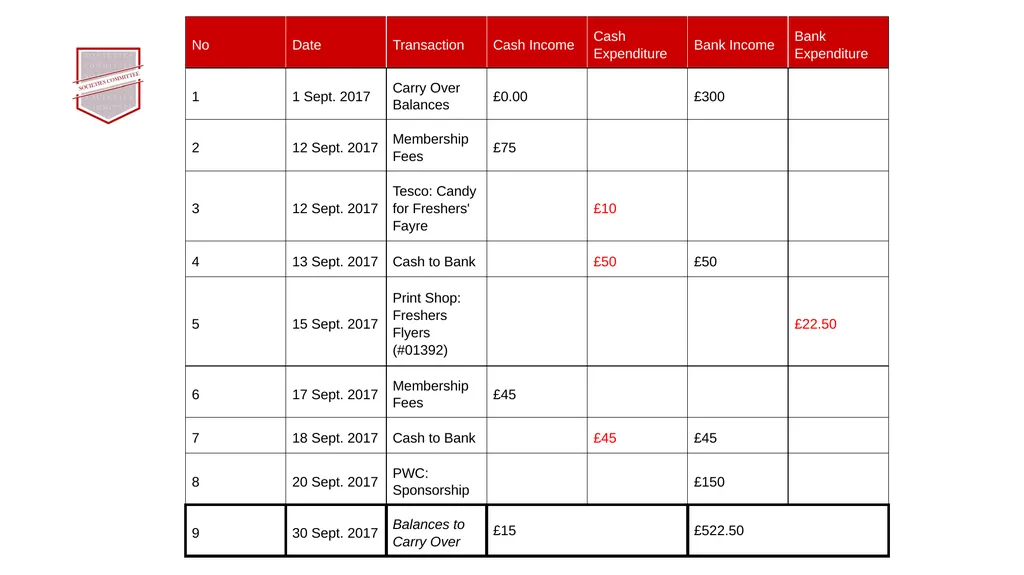
Basic Principles Single-Entry Bookkeeping
The standard method of accountancy for societies.
Income and expenditure is recorded only once in the cash book.
Cash Book
Consists of all cash receipts and payments for both society’s petty cash and bank account.
In a single-entry bookkeeping system, the cash book is the principal ledger.<br>
The standard method of accountancy for societies.
Income and expenditure is recorded only once in the cash book.
Cash Book
Consists of all cash receipts and payments for both society’s petty cash and bank account.
In a single-entry bookkeeping system, the cash book is the principal ledger.<br>
08
Records In addition to a cash book and all receipts, you must keep:
Bank statements from the last 7 years of your society.
A lockable cash box to store all cash securely.
Cheque books (store securely) and your paying-in book.<br>
Bank statements from the last 7 years of your society.
A lockable cash box to store all cash securely.
Cheque books (store securely) and your paying-in book.<br>
09
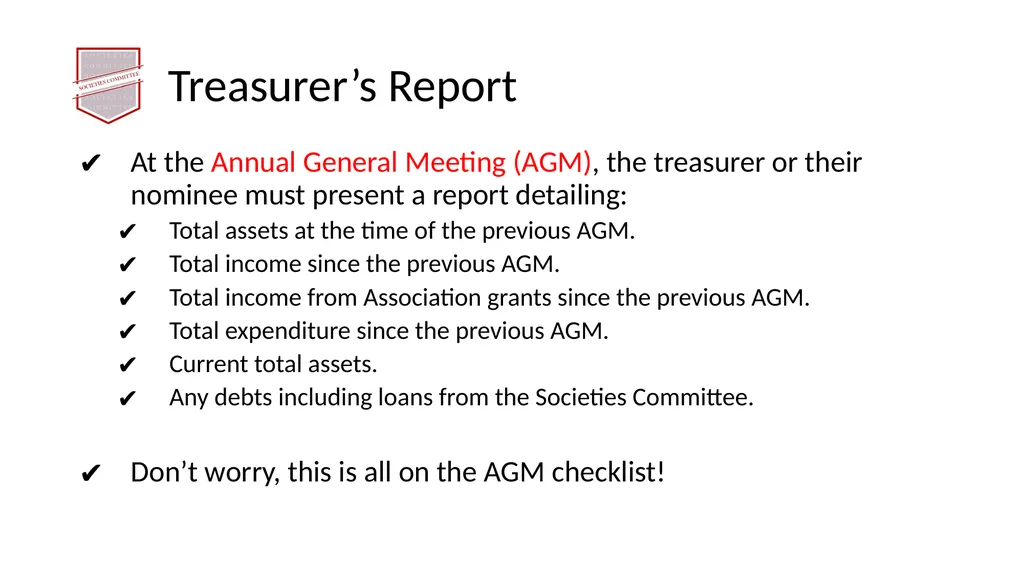
Treasurer’s Report At the Annual General Meeting (AGM), the treasurer or their nominee must present a report detailing:
Total assets at the time of the previous AGM.
Total income since the previous AGM.
Total income from Association grants since the previous AGM.
Total expenditure since the previous AGM.
Current total assets.
Any debts including loans from the Societies Committee.
Don’t worry, this is all on the AGM checklist!<br>
Total assets at the time of the previous AGM.
Total income since the previous AGM.
Total income from Association grants since the previous AGM.
Total expenditure since the previous AGM.
Current total assets.
Any debts including loans from the Societies Committee.
Don’t worry, this is all on the AGM checklist!<br>
10
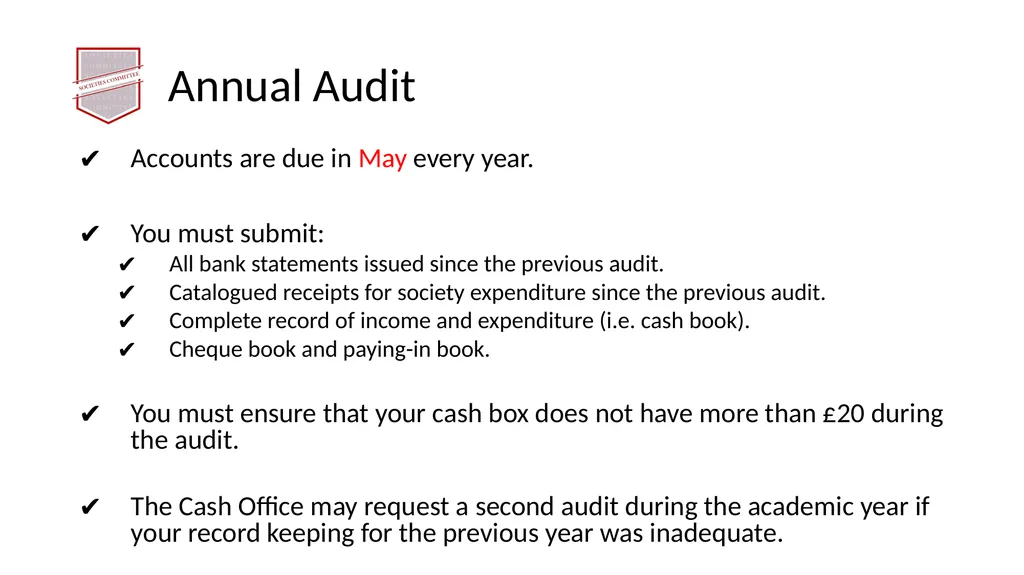
Annual Audit Accounts are due in May every year.
You must submit:
All bank statements issued since the previous audit.
Catalogued receipts for society expenditure since the previous audit.
Complete record of income and expenditure (i.e. cash book).
Cheque book and paying-in book.
You must ensure that your cash box does not have more than £20 during the audit.
The Cash Office may request a second audit during the academic year if your record keeping for the previous year was inadequate.<br>
You must submit:
All bank statements issued since the previous audit.
Catalogued receipts for society expenditure since the previous audit.
Complete record of income and expenditure (i.e. cash book).
Cheque book and paying-in book.
You must ensure that your cash box does not have more than £20 during the audit.
The Cash Office may request a second audit during the academic year if your record keeping for the previous year was inadequate.<br>
11
Financial Practices<br>
12
Permissible Use of Society Funds A society’s funds belong to and are derived from the members of the society.
A society’s funds may only be used for the benefits of the society as a whole or for the fulfilment of its aims.
No member of the Committee may derive any financial profit or gain by reason of their participation on the Committee, including favourable rates on goods or services, unless the same benefit is available to any and all members of the Society.<br>
A society’s funds may only be used for the benefits of the society as a whole or for the fulfilment of its aims.
No member of the Committee may derive any financial profit or gain by reason of their participation on the Committee, including favourable rates on goods or services, unless the same benefit is available to any and all members of the Society.<br>
13
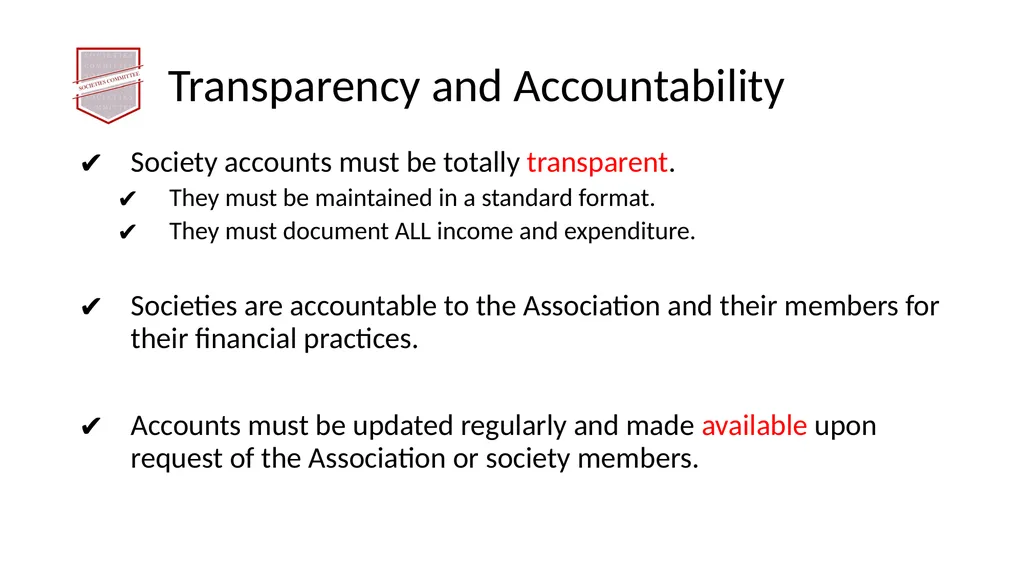
Transparency and Accountability Society accounts must be totally transparent.
They must be maintained in a standard format.
They must document ALL income and expenditure.
Societies are accountable to the Association and their members for their financial practices.
Accounts must be updated regularly and made available upon request of the Association or society members.<br>
They must be maintained in a standard format.
They must document ALL income and expenditure.
Societies are accountable to the Association and their members for their financial practices.
Accounts must be updated regularly and made available upon request of the Association or society members.<br>
14
Cash Management Cash may only be handled by those authorised to do so.
Cash boxes are insured for up to £200.
Cash outside of your box is not insured.
Never keep more than £200 in your cash box for more than 1 day.
The Cash Office can provide floats (change).
The Association can provide secure storage for your cash box overnight or weekends if the balance is more than £200.<br>
Cash boxes are insured for up to £200.
Cash outside of your box is not insured.
Never keep more than £200 in your cash box for more than 1 day.
The Cash Office can provide floats (change).
The Association can provide secure storage for your cash box overnight or weekends if the balance is more than £200.<br>
15
Reimbursements Payment should be made by cheque whenever possible because they are more trackable.
Purchases made from local businesses may be paid from petty cash.
For online purchases, you can use the Cash Office’s credit card and write a cheque to the Association.<br>
Purchases made from local businesses may be paid from petty cash.
For online purchases, you can use the Cash Office’s credit card and write a cheque to the Association.<br>
16
Fixed Assets A fixed asset is a tangible piece of property that a society does not expect to be consumed or sold within one year.
Societies must seek the permission of the Director of Student Development and Activities (dosda@) to sell or otherwise dispose of a fixed asset if purchased with Association funding.
High value assets may be insured by the union at the discretion of the Management Accountant.
Email unionfinance@.<br>
Societies must seek the permission of the Director of Student Development and Activities (dosda@) to sell or otherwise dispose of a fixed asset if purchased with Association funding.
High value assets may be insured by the union at the discretion of the Management Accountant.
Email unionfinance@.<br>
17
Charitable Donations All charitable donations MUST be processed through the University of St Andrews Charities Campaign.
Failure to do so will result in penalties.
The donation will still come from your society while also counting towards the Charities Campaign’s fundraising totals.
Speak to the Charitable Societies Coordinator (charitysocs@) for donations outside of the Campaign framework for emergency relief campaigns.
If you are a charitable society, there will be a Charitable Societies Roundtable in September.<br>
Failure to do so will result in penalties.
The donation will still come from your society while also counting towards the Charities Campaign’s fundraising totals.
Speak to the Charitable Societies Coordinator (charitysocs@) for donations outside of the Campaign framework for emergency relief campaigns.
If you are a charitable society, there will be a Charitable Societies Roundtable in September.<br>
18
Budgeting<br>
19
Budgeting Principles As a treasurer you need to protect your society’s money and oversee financial expenditure.
You should have a budget for every event to ensure they are viable.
INCOME
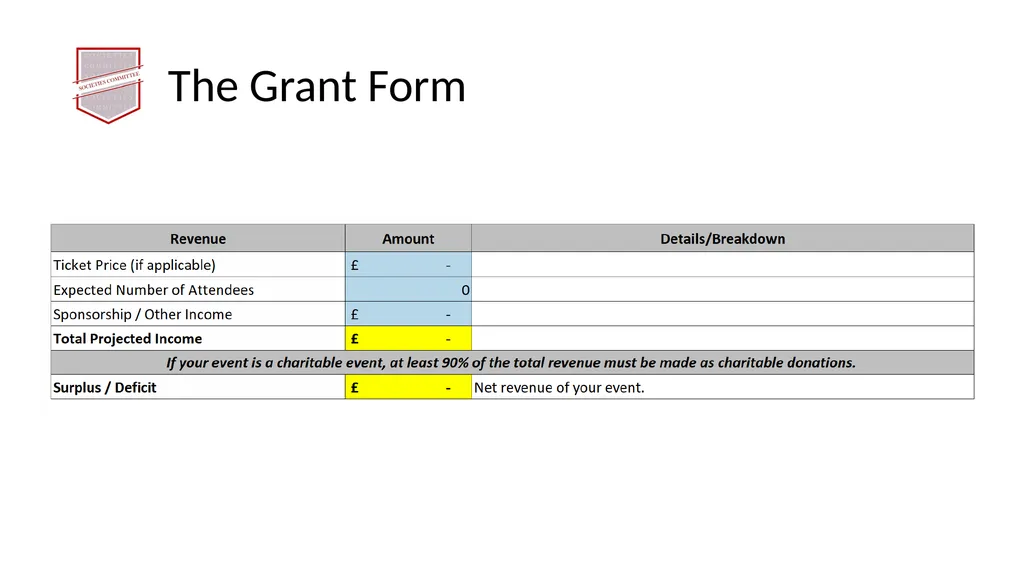
Do NOT overestimate income.
Income should be projected from past events, don’t be overly optimistic.
Ensure that any sponsorship is guaranteed and available, not just promised.
Securing cash-flow loans is not recommended. Such loans make the society dependent on the success of the event.<br>
You should have a budget for every event to ensure they are viable.
INCOME
Do NOT overestimate income.
Income should be projected from past events, don’t be overly optimistic.
Ensure that any sponsorship is guaranteed and available, not just promised.
Securing cash-flow loans is not recommended. Such loans make the society dependent on the success of the event.<br>
20
Budgeting Principles EXPENDITURE
Include ALL expenditure in your projections.
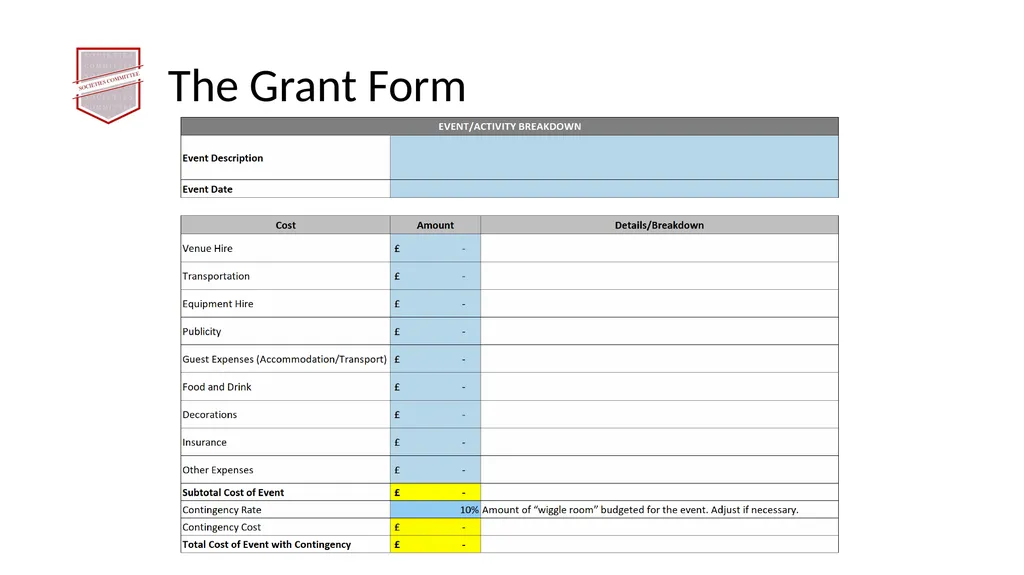
Budget for a 10% contingency overrun on ALL expenses.
Include VAT.
Assume, for the purposes of budgeting, that the society will continue to exist and operate indefinitely.
While the society may subsidise an event, it may not jeopardise the financial future of the society.<br>
Include ALL expenditure in your projections.
Budget for a 10% contingency overrun on ALL expenses.
Include VAT.
Assume, for the purposes of budgeting, that the society will continue to exist and operate indefinitely.
While the society may subsidise an event, it may not jeopardise the financial future of the society.<br>
21
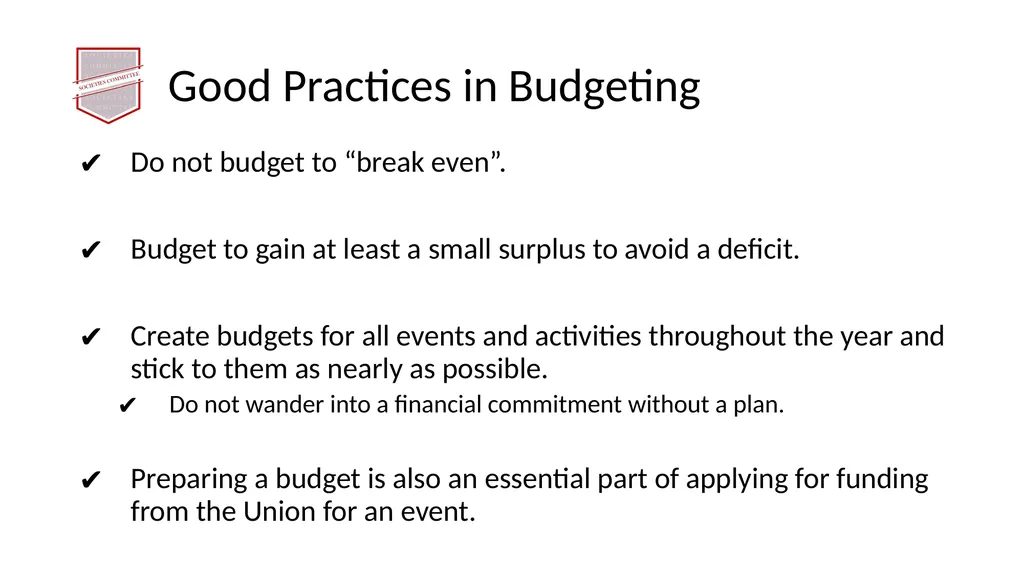
Good Practices in Budgeting Do not budget to “break even”.
Budget to gain at least a small surplus to avoid a deficit.
Create budgets for all events and activities throughout the year and stick to them as nearly as possible.
Do not wander into a financial commitment without a plan.
Preparing a budget is also an essential part of applying for funding from the Union for an event.<br>
Budget to gain at least a small surplus to avoid a deficit.
Create budgets for all events and activities throughout the year and stick to them as nearly as possible.
Do not wander into a financial commitment without a plan.
Preparing a budget is also an essential part of applying for funding from the Union for an event.<br>
22
Funding<br>
23
Sponsorship Societies can look for external funding.
This may come from:
Schools within the University.
Local businesses.
External companies and organisations.
Go to the Cash Office to review any sponsorship agreements / contracts with external companies before signing in order to ensure you get a good and fair deal!<br>
This may come from:
Schools within the University.
Local businesses.
External companies and organisations.
Go to the Cash Office to review any sponsorship agreements / contracts with external companies before signing in order to ensure you get a good and fair deal!<br>
24
Societies Committee Grants The Societies Committee has a budget of £35,000 to grant to affiliated societies.
This money comes from profit in the Union (bars, Rector’s, fayres…).
This is why when we fund an event we ask you to use Union services where possible.
We have the funds so APPLY FOR GRANTS!
https://www.yourunion.net/activities/societies/runningyoursociety/grants/<br>
This money comes from profit in the Union (bars, Rector’s, fayres…).
This is why when we fund an event we ask you to use Union services where possible.
We have the funds so APPLY FOR GRANTS!
https://www.yourunion.net/activities/societies/runningyoursociety/grants/<br>
25
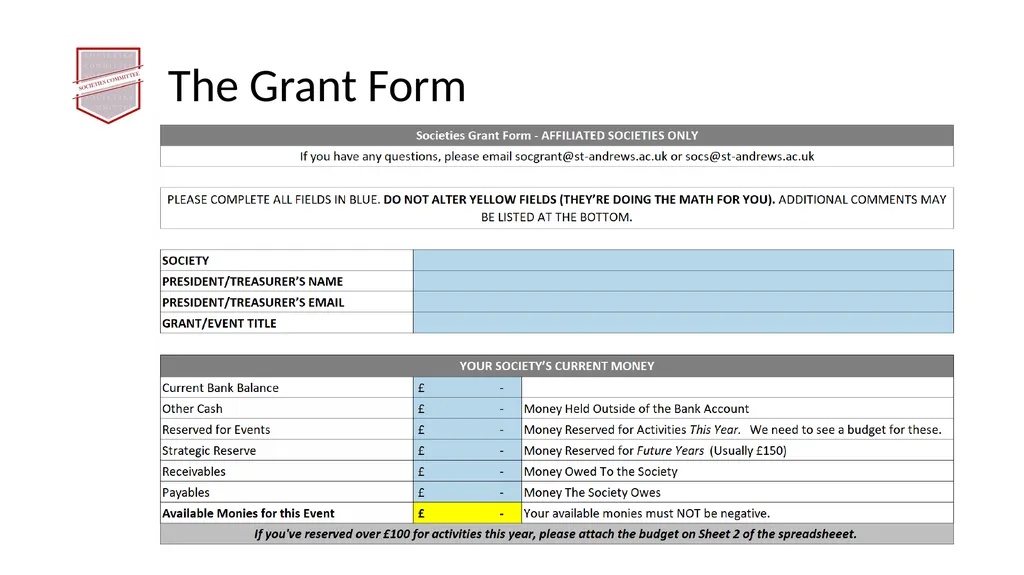
Applying for Societies Grant Download the form from the Union website.
Email the completed form to socgrant@ and go to the Societies Committee Office Hours to talk through the grant.
Send a risk assessment for your event to unionra@.
The Societies Committee reviews grants every Friday. If your grant is above £500, you might be asked to present the grant to the committee.
You will hear back within 3 days. If you get a grant, you will receive a Grant Receipt via email.
The society president or treasurer must sign off on the Grant Receipt.
To claim your grant, just present receipts and the Grant Receipt to the Cash Office.<br>
Email the completed form to socgrant@ and go to the Societies Committee Office Hours to talk through the grant.
Send a risk assessment for your event to unionra@.
The Societies Committee reviews grants every Friday. If your grant is above £500, you might be asked to present the grant to the committee.
You will hear back within 3 days. If you get a grant, you will receive a Grant Receipt via email.
The society president or treasurer must sign off on the Grant Receipt.
To claim your grant, just present receipts and the Grant Receipt to the Cash Office.<br>
26
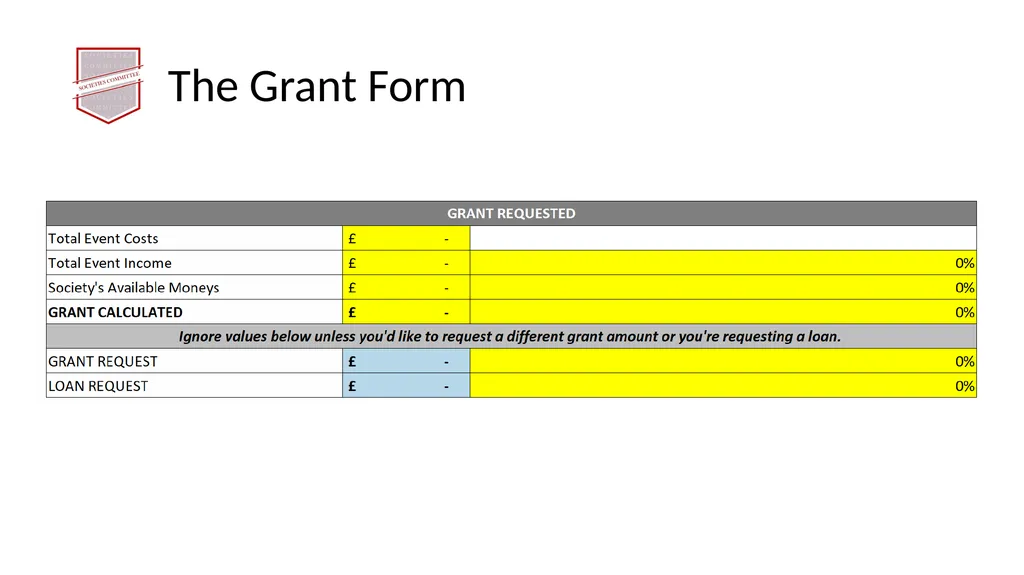
The Grant Form<br>
27
The Grant Form<br>
28
The Grant Form<br>
29
The Grant Form<br>
30
The Grant Form When writing about the merit of your society event, consider the following:
Be sure to demonstrate to the Societies Committee how the event will be valuable for your society! Town-Gown Relations
Benefit to the University
Academic Relevance
University and Students’ Association Reputation
Charitable Benefits
Cultural Enrichment
Health, Wellbeing and Welfare<br>
Be sure to demonstrate to the Societies Committee how the event will be valuable for your society! Town-Gown Relations
Benefit to the University
Academic Relevance
University and Students’ Association Reputation
Charitable Benefits
Cultural Enrichment
Health, Wellbeing and Welfare<br>
31
The Grant Receipt<br>
32
Societies Committee Loans Any society may apply for a loan to meet temporary cash flow needs.
The loan shall be interest free, provided that the loan is repaid in full by the date specified. All loans are generally to be repaid in a single instalment.
A society’s committee has to vote to authorise their treasurer to apply for a loan.
Outstanding loans have to be reported at AGMs and to new members before paying membership fees.
If a loan is not paid back, the executive committee of the society is liable for the debt and may be referred to the Association Discipline Committee.<br>
The loan shall be interest free, provided that the loan is repaid in full by the date specified. All loans are generally to be repaid in a single instalment.
A society’s committee has to vote to authorise their treasurer to apply for a loan.
Outstanding loans have to be reported at AGMs and to new members before paying membership fees.
If a loan is not paid back, the executive committee of the society is liable for the debt and may be referred to the Association Discipline Committee.<br>
33
Anti-Fraud Practices<br>
34
Anti-Fraud Principles The officers of societies have a duty to prevent fraud.
Fraud includes:
Embezzlement of society funds.
Misappropriation of society funds.
Filing grant applications based on wilfully false or misleading information.
Any deceit used to gain a dishonest advantage.
Societies must develop internal control procedures to remove the opportunity to commit fraud.
Fraud allegations are pursued and investigated internally, civilly, and criminally.<br>
Fraud includes:
Embezzlement of society funds.
Misappropriation of society funds.
Filing grant applications based on wilfully false or misleading information.
Any deceit used to gain a dishonest advantage.
Societies must develop internal control procedures to remove the opportunity to commit fraud.
Fraud allegations are pursued and investigated internally, civilly, and criminally.<br>
35
Good Practices Update your records immediately after an event or as soon as you are given a receipt.
Ensure that the appropriate officers / committee authorise and are aware of all expenditures.
Retain all financial records.
Review financial transactions frequently and ensure that all transactions appear appropriate.
Try to use cheques for payment where possible.<br>
Ensure that the appropriate officers / committee authorise and are aware of all expenditures.
Retain all financial records.
Review financial transactions frequently and ensure that all transactions appear appropriate.
Try to use cheques for payment where possible.<br>
36
Reporting Fraud IMMEDIATELY REPORT ANY SUSPICIOUS TRANSACTION OR ACTIVITY TO THE CASH OFFICE!
The Association can investigate the accounts and practices of a society to prevent fraud, but only if the matter is raised to our attention.
Allegations will be handled confidentially.<br>
The Association can investigate the accounts and practices of a society to prevent fraud, but only if the matter is raised to our attention.
Allegations will be handled confidentially.<br>
37
Email Fraud Threats Affiliated societies have been targeted for Email Fraud
The criminals pretend to be one of the exec, emailing (usually) the treasurer, demanding urgent payment to a third party. They will include a bank account and sort code
This is a real example of the type of email that societies have received;
“{treasurer’s name}, I need you to initiate a payment of £2,100 now, get back to me if you are available”
When questioned, this comes through:
“I am in a meeting now. It's a payment to a vendor for an outstanding payment for purchase, supporting document will be sent across to you before the end of the week. It has to go out now. Will send you the beneficiary details in my next email.”<br>
The criminals pretend to be one of the exec, emailing (usually) the treasurer, demanding urgent payment to a third party. They will include a bank account and sort code
This is a real example of the type of email that societies have received;
“{treasurer’s name}, I need you to initiate a payment of £2,100 now, get back to me if you are available”
When questioned, this comes through:
“I am in a meeting now. It's a payment to a vendor for an outstanding payment for purchase, supporting document will be sent across to you before the end of the week. It has to go out now. Will send you the beneficiary details in my next email.”<br>
38
Email Fraud Threats If you see this sort of request and you are unsure, wait until you can verify it – ideally face to face with the person, or over a phone number that you already have.
Only reply to known email addresses (it may look like the right address, double check).
Don’t give out extra information (only …. can deal with that, we only allow payments up to….).
Report such attempts to phishing@.<br>
Only reply to known email addresses (it may look like the right address, double check).
Don’t give out extra information (only …. can deal with that, we only allow payments up to….).
Report such attempts to phishing@.<br>
39
Summary<br>
40
Core Responsibilities Keep a cash book record, including details and proof of all expenditure and income.
Keep all bank statements for the past 7 years.
Ensure the cash box and high value assets are insured appropriately.
Check society pigeon holes for post and bank statements.
Submit accounts for annual audit.
Present on Yearly Financial report at the AGM.
Budget for all events.
Pursue sponsorship and Societies Committee grants.<br>
Keep all bank statements for the past 7 years.
Ensure the cash box and high value assets are insured appropriately.
Check society pigeon holes for post and bank statements.
Submit accounts for annual audit.
Present on Yearly Financial report at the AGM.
Budget for all events.
Pursue sponsorship and Societies Committee grants.<br>
41
Last, But Not Least Please get in contact with any questions or problems!
Director of Student Development & Activities – dosda@
Societies Officer – socs@
Grants Officer – socgrant@
Jillian Cowan – Management Accountant (Cash Office) – jc82@
Societies Committee Office Hours – Mondays 4-6pm (email socs@ to book)
APPLY FOR GRANTS!<br>
Director of Student Development & Activities – dosda@
Societies Officer – socs@
Grants Officer – socgrant@
Jillian Cowan – Management Accountant (Cash Office) – jc82@
Societies Committee Office Hours – Mondays 4-6pm (email socs@ to book)
APPLY FOR GRANTS!<br>
42
Treasurer’s Assessment<br>