
Software and Hardware in the Cloud 10-1 Learning
T
Published · 22 slides · 0 views
1 / 1
Description
Software and Hardware in the Cloud 10-1 Learning Objectives Know how firms using SaaS products can dramatically lower several costs associated with their information systems Know how SaaS vendors earn their money Be able to list the
Related Topics
Download this presentation From Below
"Software and Hardware in the Cloud 10-1 Learning" is the property of its rightful owner. Permission is granted to download and print the materials on this website for personal, non-commercial use only, and to display it on your personal computer provided you do not modify the materials and that you retain all copyright notices contained in the materials. By downloading content from our website, you accept the terms of this agreement.
Share
Embed code
Presentation Transcript
01
Software and Hardware in the Cloud 10-1<br>
02
Learning Objectives Know how firms using SaaS products can dramatically lower several costs associated with their information systems
Know how SaaS vendors earn their money
Be able to list the benefits to users that accrue from using SaaS
Be able to list the benefits to vendors from deploying SaaS
Be able to list and appreciate the risks associated with SaaS 10-2<br>
Know how SaaS vendors earn their money
Be able to list the benefits to users that accrue from using SaaS
Be able to list the benefits to vendors from deploying SaaS
Be able to list and appreciate the risks associated with SaaS 10-2<br>
03
Learning Objectives Distinguish between SaaS and hardware clouds
Provide examples of firms and uses of hardware clouds
Understand the concepts of cloud computing, cloudbursting, and black swan events
Understand the challenges and economics involved in shifting computing hardware to the cloud 10-3<br>
Provide examples of firms and uses of hardware clouds
Understand the concepts of cloud computing, cloudbursting, and black swan events
Understand the challenges and economics involved in shifting computing hardware to the cloud 10-3<br>
04
Learning Objectives Understand how cloud computing’s impact across industries is proving to be broad and significant
Know the effects of cloud computing on high-end server sales and the influence on the trend shifting from hardware sales to service
Know the effects of cloud computing on innovation and the influence on the changes in the desired skills mix and job outlook for IS workers
Know that by lowering the cost to access powerful systems and software, cloud computing can decrease barriers to entry
Understand the importance, size, and metrics of server farms 10-4<br>
Know the effects of cloud computing on high-end server sales and the influence on the trend shifting from hardware sales to service
Know the effects of cloud computing on innovation and the influence on the changes in the desired skills mix and job outlook for IS workers
Know that by lowering the cost to access powerful systems and software, cloud computing can decrease barriers to entry
Understand the importance, size, and metrics of server farms 10-4<br>
05
Learning Objectives Know what virtualization software is and its impact on cloud computing
Be able to list the benefits to a firm from using virtualization
Know the options managers have when determining how to satisfy the software needs of their companies
Know the factors that must be considered when making the make, buy, or rent decision 10-5<br>
Be able to list the benefits to a firm from using virtualization
Know the options managers have when determining how to satisfy the software needs of their companies
Know the factors that must be considered when making the make, buy, or rent decision 10-5<br>
06
Cloud Computing: Hype or Hope? Cloud computing is about replacing computing resources—either an organization’s or an individual’s hardware or software—with services provided over the Internet
Categories of cloud computing
Software as a service (SaaS)
Models often referred to as utility computing,
platform as a service (PaaS), or
Infrastructure as a service (IaaS) -This is called the Hardware Cloud 10-6<br>
Categories of cloud computing
Software as a service (SaaS)
Models often referred to as utility computing,
platform as a service (PaaS), or
Infrastructure as a service (IaaS) -This is called the Hardware Cloud 10-6<br>
07
10-7 Scalability
Infrastructure capacity allows for traffic spikes and minimizes delays.
Resiliency
Cloud providers have mirrored solutions to minimize downtime in the event of a disaster. This type of resiliency can give businesses the sustainability they need during unanticipated events.
Homogeneity:
No matter which cloud provider and architecture an organization uses, an open cloud will make it easy for them to work with other groups, even if those other groups choose different providers and architectures. Common Characteristics:<br>
Infrastructure capacity allows for traffic spikes and minimizes delays.
Resiliency
Cloud providers have mirrored solutions to minimize downtime in the event of a disaster. This type of resiliency can give businesses the sustainability they need during unanticipated events.
Homogeneity:
No matter which cloud provider and architecture an organization uses, an open cloud will make it easy for them to work with other groups, even if those other groups choose different providers and architectures. Common Characteristics:<br>
08
Basic Cloud Characteristics The “no-need-to-know” in terms of the underlying details of infrastructure, applications interface with the infrastructure via the APIs.
The “flexibility and elasticity” allows these systems to scale up and down at will
utilizing the resources of all kinds
CPU, storage, server capacity, load balancing, and databases
The “pay as much as used and needed” type of utility computing and the “always on!, anywhere and any place” type of network-based computing. 8<br>
The “flexibility and elasticity” allows these systems to scale up and down at will
utilizing the resources of all kinds
CPU, storage, server capacity, load balancing, and databases
The “pay as much as used and needed” type of utility computing and the “always on!, anywhere and any place” type of network-based computing. 8<br>
09
Cloud Computing: Hype or Hope? Private clouds: Pools of computing resources that reside inside an organization and that can be served up for specific tasks as need arrives
The evolution of cloud computing has huge implications across the industry
Financial future of hardware and software firms
Cost structure and innovativeness of adopting organizations
Skill sets likely to be most valued by employers 10-9<br>
The evolution of cloud computing has huge implications across the industry
Financial future of hardware and software firms
Cost structure and innovativeness of adopting organizations
Skill sets likely to be most valued by employers 10-9<br>
10
The Software Cloud:
Why Buy When You Can Rent? Firms using SaaS products can lower several costs associated with the software licenses, server hardware, system maintenance, and IT staff
Many SaaS firms earn money via a usage-based pricing model akin to a monthly subscription
Other SaaS firms:
Offer free services that are supported by advertising
Promote the sale of upgraded or premium versions for additional fees
Compete directly with the biggest names in software 10-10<br>
Many SaaS firms earn money via a usage-based pricing model akin to a monthly subscription
Other SaaS firms:
Offer free services that are supported by advertising
Promote the sale of upgraded or premium versions for additional fees
Compete directly with the biggest names in software 10-10<br>
11
The Software Cloud:
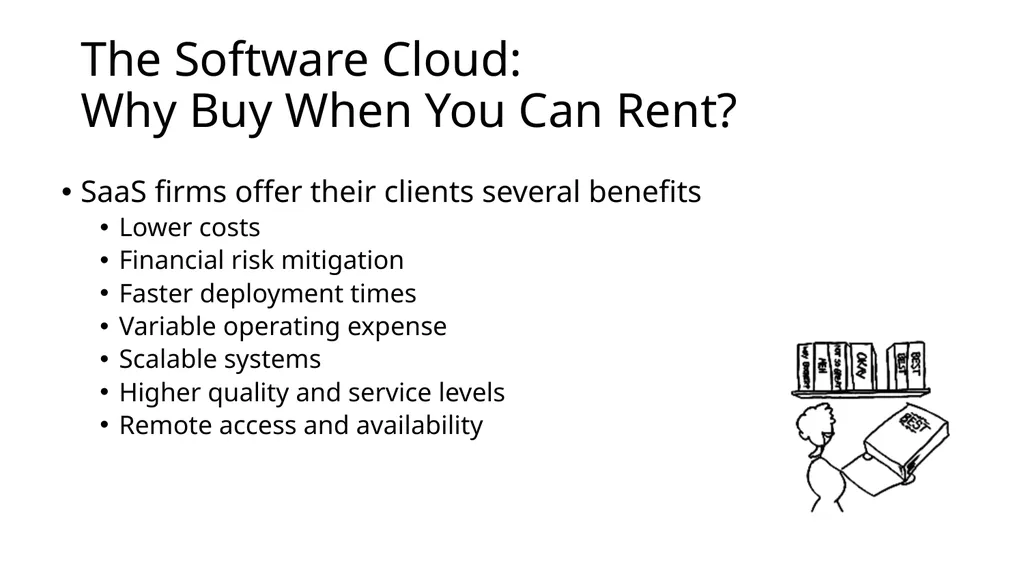
Why Buy When You Can Rent? SaaS firms offer their clients several benefits
Lower costs
Financial risk mitigation
Faster deployment times
Variable operating expense
Scalable systems
Higher quality and service levels
Remote access and availability 10-11<br>
Lower costs
Financial risk mitigation
Faster deployment times
Variable operating expense
Scalable systems
Higher quality and service levels
Remote access and availability 10-11<br>
12
The Software Cloud:
Why Buy When You Can Rent? Benefits enjoyed by SaaS providers
Limit development to a single platform
Tighter feedback loop
Ability to instantly deploy bug fixes and product enhancements
Lower distribution costs
Greater accessibility
Reducing software piracy 10-12<br>
Limit development to a single platform
Tighter feedback loop
Ability to instantly deploy bug fixes and product enhancements
Lower distribution costs
Greater accessibility
Reducing software piracy 10-12<br>
13
SaaS: Not without Risks The risks associated with SaaS
Dependence on a single vendor
Concern about the long-term viability of partner firms
Users may be forced to migrate to new versions—possibly incurring unforeseen training costs and shifts in operating procedures
Reliance on a network connection—which may be slower, less stable, and less secure
Data asset stored off-site—with the potential for security and legal concerns 10-13<br>
Dependence on a single vendor
Concern about the long-term viability of partner firms
Users may be forced to migrate to new versions—possibly incurring unforeseen training costs and shifts in operating procedures
Reliance on a network connection—which may be slower, less stable, and less secure
Data asset stored off-site—with the potential for security and legal concerns 10-13<br>
14
SaaS: Not without Risks Limited configuration, customization, and system integration options compared to packaged software or alternatives developed in house
The user interface of Web-based software is often less sophisticated and lacks the richness of most desktop alternatives
Ease of adoption may lead to pockets of unauthorized IT being used throughout an organization 10-14<br>
The user interface of Web-based software is often less sophisticated and lacks the richness of most desktop alternatives
Ease of adoption may lead to pockets of unauthorized IT being used throughout an organization 10-14<br>
15
The Hardware Cloud: IaaS (Infrastructure as a Service)- Utility Computing Hardware cloud: A cloud computing model in which a service provider makes computing resources such as hardware and storage, along with infrastructure management, available to a customer on an as-needed basis
The provider typically charges for specific resource usage rather than a flat rate
In the past, similar efforts have been described as utility computing, hosting, or time sharing
Cloud computing efforts focus on providing a virtual replacement for operational hardware like storage and backup solutions 10-15<br>
The provider typically charges for specific resource usage rather than a flat rate
In the past, similar efforts have been described as utility computing, hosting, or time sharing
Cloud computing efforts focus on providing a virtual replacement for operational hardware like storage and backup solutions 10-15<br>
16
Clouds in Action: A Snapshot of Diverse Efforts Cloudbursting: Describes the use of cloud computing to provide excess capacity during periods of spiking demand
It is a scalability solution that is usually provided as an overflow service, kicking in as needed
Black swans: Unpredicted, but highly impactful events
Scalable computing resources can help a firm deal with spiking impact from Black swan events 10-16 Google server farm<br>
It is a scalability solution that is usually provided as an overflow service, kicking in as needed
Black swans: Unpredicted, but highly impactful events
Scalable computing resources can help a firm deal with spiking impact from Black swan events 10-16 Google server farm<br>
17
Challenges Remain Hardware clouds and SaaS share similar benefits and risk
For efforts that can be custom-built and cloud-deployed, other roadblocks remain
Firms considering cloud computing need to do a thorough financial analysis, comparing the capital and other costs of owning and operating their own systems over time against the variable costs over the same period for moving portions to the cloud
Firms should enter the cloud cautiously, particularly where mission-critical systems are concerned 10-17<br>
For efforts that can be custom-built and cloud-deployed, other roadblocks remain
Firms considering cloud computing need to do a thorough financial analysis, comparing the capital and other costs of owning and operating their own systems over time against the variable costs over the same period for moving portions to the cloud
Firms should enter the cloud cautiously, particularly where mission-critical systems are concerned 10-17<br>
18
Clouds and Tech Industry Impact Cloud computing’s impact across industries is proving to be broad and significant
Cloud computing is affecting the competitive dynamics of the hardware, software, and consulting industries
The shift to cloud computing alters the margin structure for many in the computing industry 10-18<br>
Cloud computing is affecting the competitive dynamics of the hardware, software, and consulting industries
The shift to cloud computing alters the margin structure for many in the computing industry 10-18<br>
19
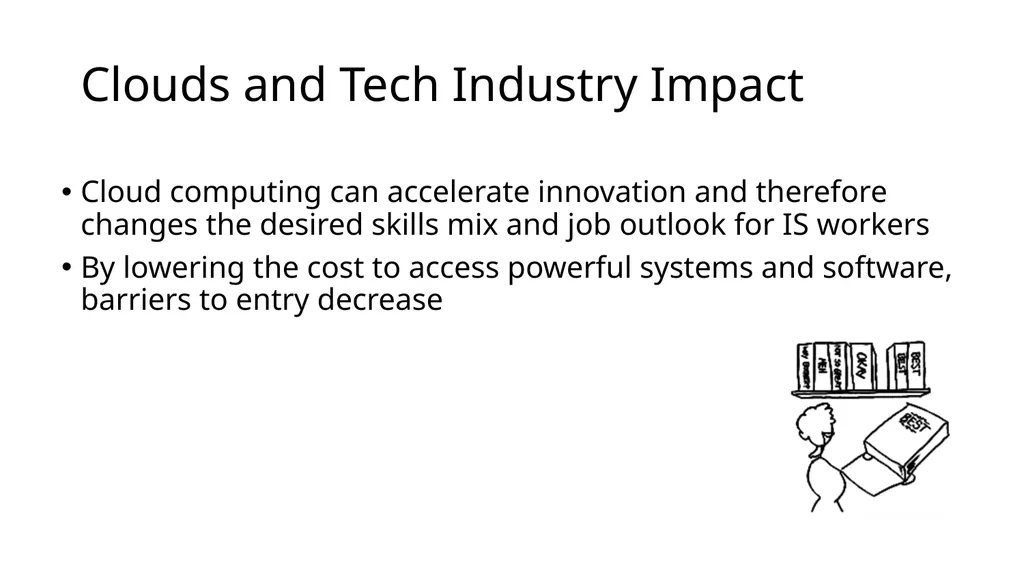
Clouds and Tech Industry Impact Cloud computing can accelerate innovation and therefore changes the desired skills mix and job outlook for IS workers
By lowering the cost to access powerful systems and software, barriers to entry decrease 10-19<br>
By lowering the cost to access powerful systems and software, barriers to entry decrease 10-19<br>
20
Clouds and Tech Industry Impact Server farms require plenty of cheap land, low cost power, ultrafast fiber-optic connections, and benefit from mild climates
Sun, Microsoft, IBM, and HP have all developed rapid-deployment server farm modules 10-20<br>
Sun, Microsoft, IBM, and HP have all developed rapid-deployment server farm modules 10-20<br>
21
Virtualization: Software That Makes One Computer Act Like Many The most important software tool in the cloud computing toolbox is virtualization
Can be used in-house to reduce an organization’s hardware needs
To create a firm’s own private cloud of scalable assets
Virtual desktops: Allows firms to scale, back up, secure, and upgrade systems far more easily than if they had to maintain each individual PC 10-21<br>
Can be used in-house to reduce an organization’s hardware needs
To create a firm’s own private cloud of scalable assets
Virtual desktops: Allows firms to scale, back up, secure, and upgrade systems far more easily than if they had to maintain each individual PC 10-21<br>
22
Make, Buy, or Rent Key variables to consider for technology decisions:
Competitive advantage
Security
Legal and compliance requirements
Skill, expertise, and available labor
Cost and time
Vendor issues 10-22<br>
Competitive advantage
Security
Legal and compliance requirements
Skill, expertise, and available labor
Cost and time
Vendor issues 10-22<br>