
Software Best Practices Christopher Lorton IDM
SB
Published · 58 slides · 0 views
1 / 1





Description
Software Best Practices Christopher Lorton IDM Software Development Team Motivation Immediate payoff Can you quickly and efficiently write correct code? Future payoff Will your software have an impact on the community at large by being
Related Topics
Share
Embed code
Download this presentation From Below
"Software Best Practices Christopher Lorton IDM" is the property of its rightful owner. Permission is granted to download and print the materials on this website for personal, non-commercial use only, and to display it on your personal computer provided you do not modify the materials and that you retain all copyright notices contained in the materials. By downloading content from our website, you accept the terms of this agreement.
Presentation Transcript
01
Software Best Practices Christopher Lorton
IDM Software Development Team<br>
02
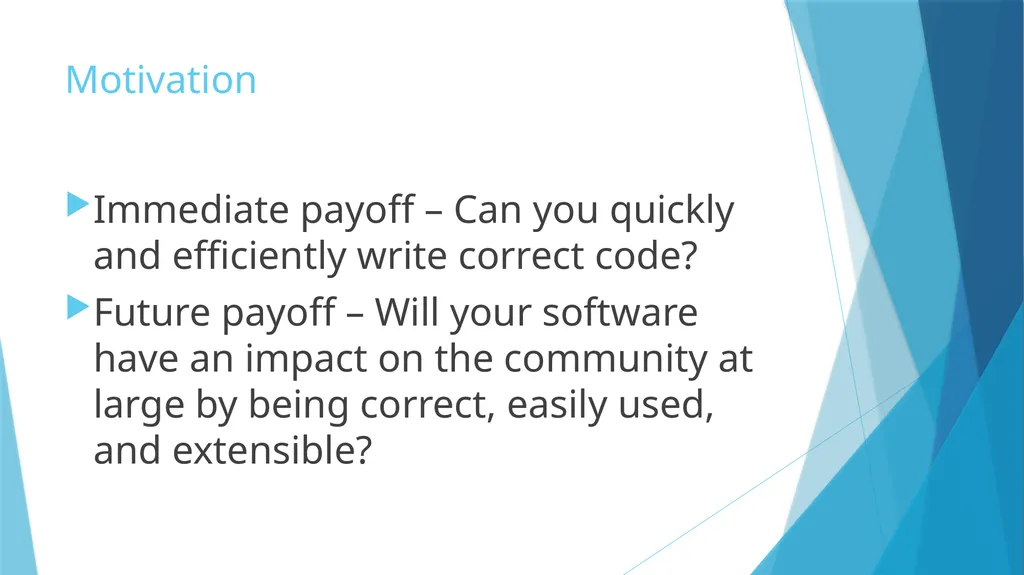
Motivation Immediate payoff – Can you quickly and efficiently write correct code?
Future payoff – Will your software have an impact on the community at large by being correct, easily used, and extensible?<br>
Future payoff – Will your software have an impact on the community at large by being correct, easily used, and extensible?<br>
03
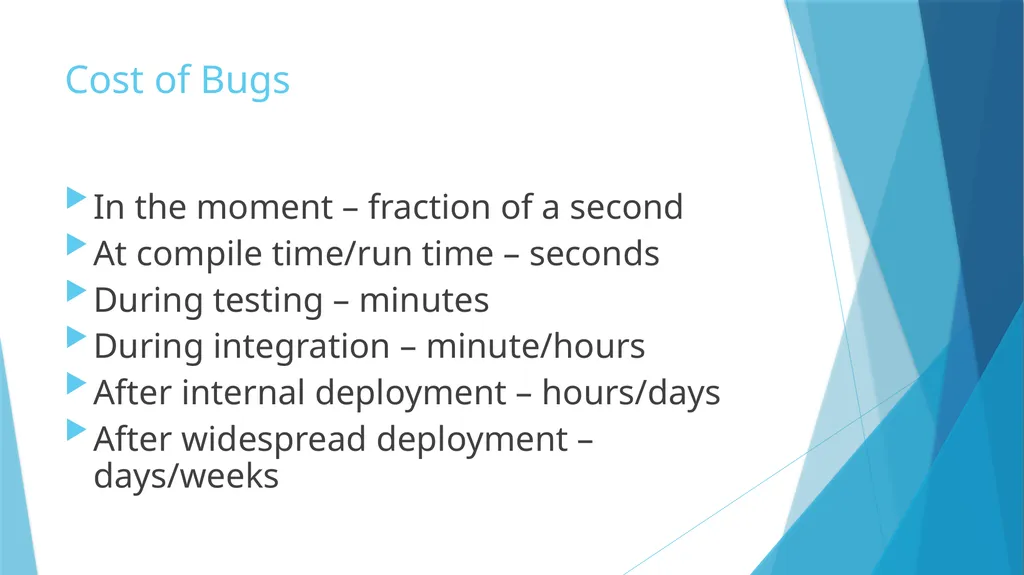
Cost of Bugs In the moment – fraction of a second
At compile time/run time – seconds
During testing – minutes
During integration – minute/hours
After internal deployment – hours/days
After widespread deployment – days/weeks<br>
At compile time/run time – seconds
During testing – minutes
During integration – minute/hours
After internal deployment – hours/days
After widespread deployment – days/weeks<br>
04
Topics Formatting
Comments
Error Checking and Handling
Component Tests
Refactoring
Source Control
Integrated Development Environments (IDEs)<br>
Comments
Error Checking and Handling
Component Tests
Refactoring
Source Control
Integrated Development Environments (IDEs)<br>
05
Perspective “Everyone knows that debugging is twice as hard as writing a program in the first place. So if you're as clever as you can be when you write it, how will you ever debug it?”
- Brian Kernighan<br>
- Brian Kernighan<br>
06
Disclaimer “don’t make the mistake of thinking that we are somehow “right” in any absolute sense. There are other schools and other masters that have just as much claim to professionalism as we.”<br>
07
Formatting wHat 1s the value of readability?<br>
08
Formatting – “…code is read much more often than it is written*. The guidelines provided here are intended to improve the readability of code…” – Robert Martin
“Readability counts.” – Python PEP 20 “The Zen of Python”
Python PEP 8 “Style Guide for Python Code”
The Go language includes “gofmt” tool to format Go code to the language standard.
*One estimate is >10:1 reading to writing.<br>
“Readability counts.” – Python PEP 20 “The Zen of Python”
Python PEP 8 “Style Guide for Python Code”
The Go language includes “gofmt” tool to format Go code to the language standard.
*One estimate is >10:1 reading to writing.<br>
09
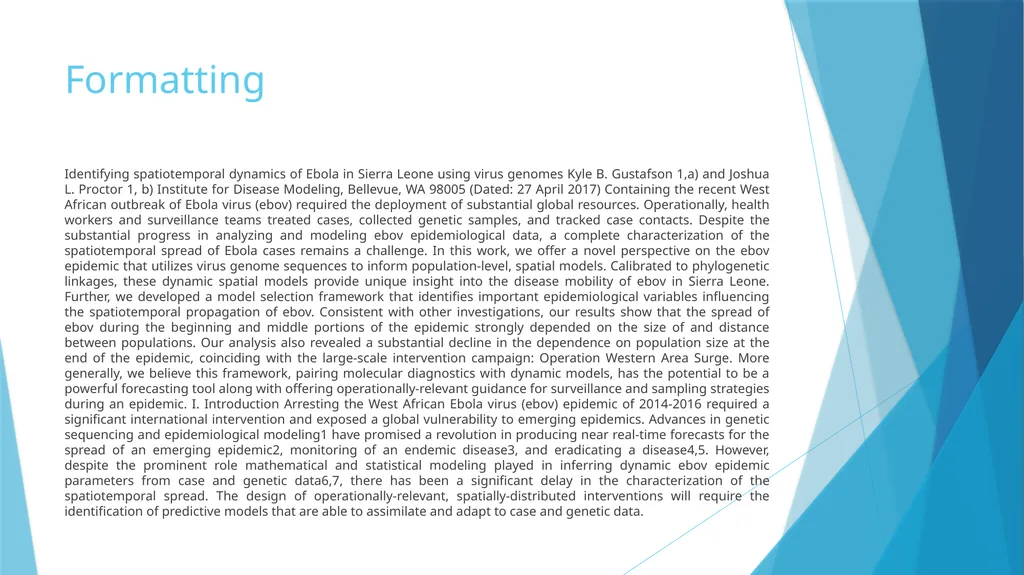
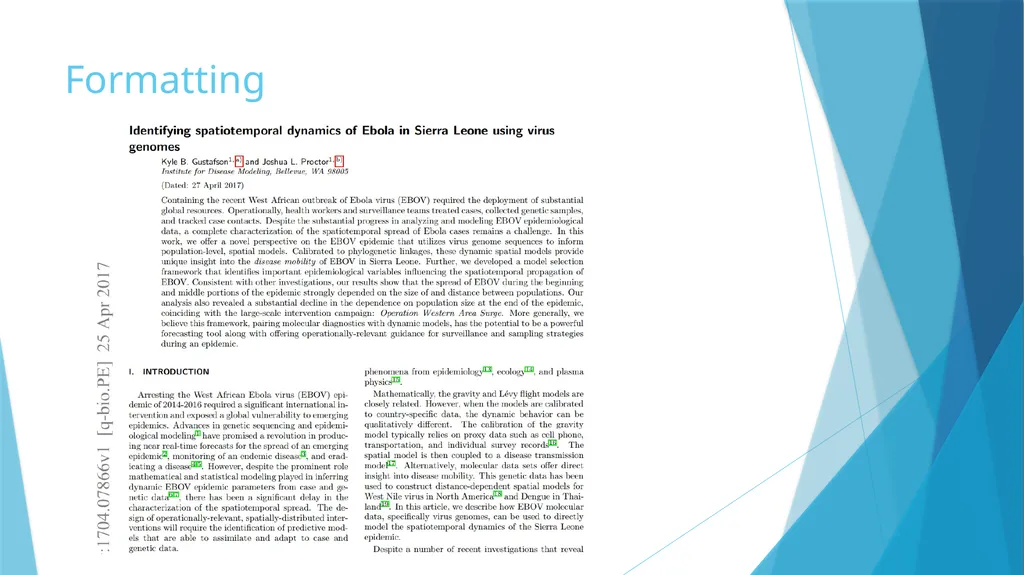
Formatting Identifying spatiotemporal dynamics of Ebola in Sierra Leone using virus genomes Kyle B. Gustafson 1,a) and Joshua L. Proctor 1, b) Institute for Disease Modeling, Bellevue, WA 98005 (Dated: 27 April 2017) Containing the recent West African outbreak of Ebola virus (ebov) required the deployment of substantial global resources. Operationally, health workers and surveillance teams treated cases, collected genetic samples, and tracked case contacts. Despite the substantial progress in analyzing and modeling ebov epidemiological data, a complete characterization of the spatiotemporal spread of Ebola cases remains a challenge. In this work, we offer a novel perspective on the ebov epidemic that utilizes virus genome sequences to inform population-level, spatial models. Calibrated to phylogenetic linkages, these dynamic spatial models provide unique insight into the disease mobility of ebov in Sierra Leone. Further, we developed a model selection framework that identifies important epidemiological variables influencing the spatiotemporal propagation of ebov. Consistent with other investigations, our results show that the spread of ebov during the beginning and middle portions of the epidemic strongly depended on the size of and distance between populations. Our analysis also revealed a substantial decline in the dependence on population size at the end of the epidemic, coinciding with the large-scale intervention campaign: Operation Western Area Surge. More generally, we believe this framework, pairing molecular diagnostics with dynamic models, has the potential to be a powerful forecasting tool along with offering operationally-relevant guidance for surveillance and sampling strategies during an epidemic. I. Introduction Arresting the West African Ebola virus (ebov) epidemic of 2014-2016 required a significant international intervention and exposed a global vulnerability to emerging epidemics. Advances in genetic sequencing and epidemiological modeling1 have promised a revolution in producing near real-time forecasts for the spread of an emerging epidemic2, monitoring of an endemic disease3, and eradicating a disease4,5. However, despite the prominent role mathematical and statistical modeling played in inferring dynamic ebov epidemic parameters from case and genetic data6,7, there has been a significant delay in the characterization of the spatiotemporal spread. The design of operationally-relevant, spatially-distributed interventions will require the identification of predictive models that are able to assimilate and adapt to case and genetic data.<br>
10
Formatting<br>
11
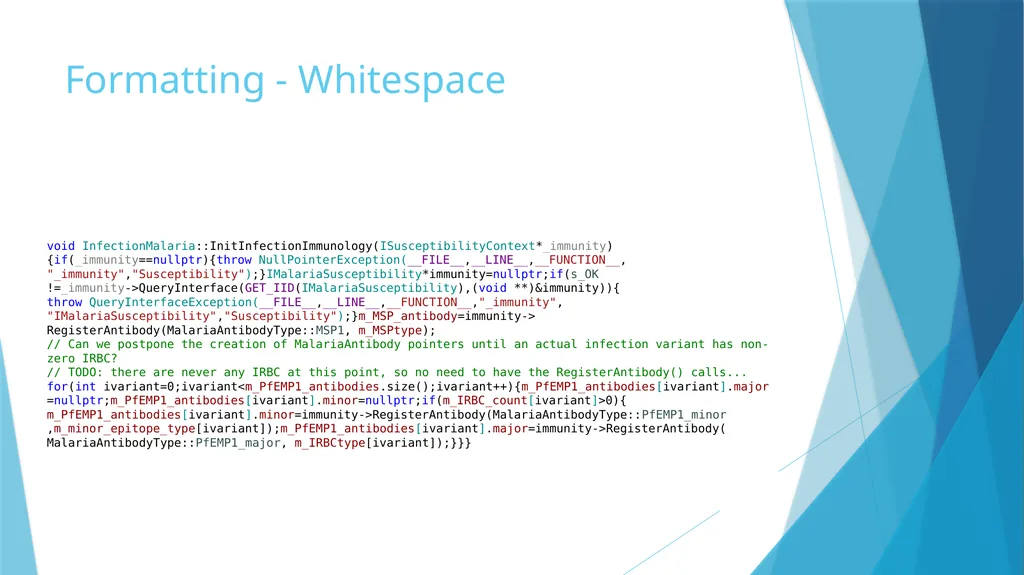
Formatting - Whitespace void InfectionMalaria::InitInfectionImmunology(ISusceptibilityContext*_immunity)
{if(_immunity==nullptr){throw NullPointerException(__FILE__,__LINE__,__FUNCTION__,
"_immunity","Susceptibility");}IMalariaSusceptibility*immunity=nullptr;if(s_OK
!=_immunity->QueryInterface(GET_IID(IMalariaSusceptibility),(void **)&immunity)){
throw QueryInterfaceException(__FILE__,__LINE__,__FUNCTION__,"_immunity",
"IMalariaSusceptibility","Susceptibility");}m_MSP_antibody=immunity->
RegisterAntibody(MalariaAntibodyType::MSP1, m_MSPtype);
// Can we postpone the creation of MalariaAntibody pointers until an actual infection variant has non-zero IRBC?
// TODO: there are never any IRBC at this point, so no need to have the RegisterAntibody() calls... for(int ivariant=0;ivariant<m_PfEMP1_antibodies.size();ivariant++){m_PfEMP1_antibodies[ivariant].major
=nullptr;m_PfEMP1_antibodies[ivariant].minor=nullptr;if(m_IRBC_count[ivariant]>0){
m_PfEMP1_antibodies[ivariant].minor=immunity->RegisterAntibody(MalariaAntibodyType::PfEMP1_minor
,m_minor_epitope_type[ivariant]);m_PfEMP1_antibodies[ivariant].major=immunity->RegisterAntibody(
MalariaAntibodyType::PfEMP1_major, m_IRBCtype[ivariant]);}}}<br>
{if(_immunity==nullptr){throw NullPointerException(__FILE__,__LINE__,__FUNCTION__,
"_immunity","Susceptibility");}IMalariaSusceptibility*immunity=nullptr;if(s_OK
!=_immunity->QueryInterface(GET_IID(IMalariaSusceptibility),(void **)&immunity)){
throw QueryInterfaceException(__FILE__,__LINE__,__FUNCTION__,"_immunity",
"IMalariaSusceptibility","Susceptibility");}m_MSP_antibody=immunity->
RegisterAntibody(MalariaAntibodyType::MSP1, m_MSPtype);
// Can we postpone the creation of MalariaAntibody pointers until an actual infection variant has non-zero IRBC?
// TODO: there are never any IRBC at this point, so no need to have the RegisterAntibody() calls... for(int ivariant=0;ivariant<m_PfEMP1_antibodies.size();ivariant++){m_PfEMP1_antibodies[ivariant].major
=nullptr;m_PfEMP1_antibodies[ivariant].minor=nullptr;if(m_IRBC_count[ivariant]>0){
m_PfEMP1_antibodies[ivariant].minor=immunity->RegisterAntibody(MalariaAntibodyType::PfEMP1_minor
,m_minor_epitope_type[ivariant]);m_PfEMP1_antibodies[ivariant].major=immunity->RegisterAntibody(
MalariaAntibodyType::PfEMP1_major, m_IRBCtype[ivariant]);}}}<br>
12
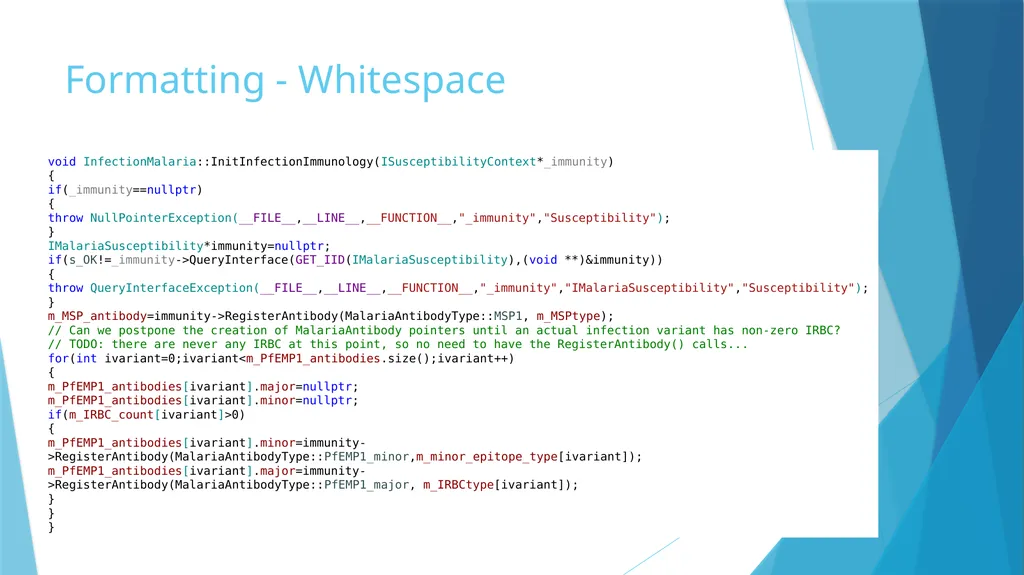
Formatting - Whitespace void InfectionMalaria::InitInfectionImmunology(ISusceptibilityContext*_immunity)
{
if(_immunity==nullptr)
{
throw NullPointerException(__FILE__,__LINE__,__FUNCTION__,"_immunity","Susceptibility");
}
IMalariaSusceptibility*immunity=nullptr;
if(s_OK!=_immunity->QueryInterface(GET_IID(IMalariaSusceptibility),(void **)&immunity))
{
throw QueryInterfaceException(__FILE__,__LINE__,__FUNCTION__,"_immunity","IMalariaSusceptibility","Susceptibility");
}
m_MSP_antibody=immunity->RegisterAntibody(MalariaAntibodyType::MSP1, m_MSPtype);
// Can we postpone the creation of MalariaAntibody pointers until an actual infection variant has non-zero IRBC?
// TODO: there are never any IRBC at this point, so no need to have the RegisterAntibody() calls... for(int ivariant=0;ivariant<m_PfEMP1_antibodies.size();ivariant++)
{
m_PfEMP1_antibodies[ivariant].major=nullptr;
m_PfEMP1_antibodies[ivariant].minor=nullptr;
if(m_IRBC_count[ivariant]>0)
{
m_PfEMP1_antibodies[ivariant].minor=immunity->RegisterAntibody(MalariaAntibodyType::PfEMP1_minor,m_minor_epitope_type[ivariant]);
m_PfEMP1_antibodies[ivariant].major=immunity->RegisterAntibody(MalariaAntibodyType::PfEMP1_major, m_IRBCtype[ivariant]);
}
}
}<br>
{
if(_immunity==nullptr)
{
throw NullPointerException(__FILE__,__LINE__,__FUNCTION__,"_immunity","Susceptibility");
}
IMalariaSusceptibility*immunity=nullptr;
if(s_OK!=_immunity->QueryInterface(GET_IID(IMalariaSusceptibility),(void **)&immunity))
{
throw QueryInterfaceException(__FILE__,__LINE__,__FUNCTION__,"_immunity","IMalariaSusceptibility","Susceptibility");
}
m_MSP_antibody=immunity->RegisterAntibody(MalariaAntibodyType::MSP1, m_MSPtype);
// Can we postpone the creation of MalariaAntibody pointers until an actual infection variant has non-zero IRBC?
// TODO: there are never any IRBC at this point, so no need to have the RegisterAntibody() calls... for(int ivariant=0;ivariant<m_PfEMP1_antibodies.size();ivariant++)
{
m_PfEMP1_antibodies[ivariant].major=nullptr;
m_PfEMP1_antibodies[ivariant].minor=nullptr;
if(m_IRBC_count[ivariant]>0)
{
m_PfEMP1_antibodies[ivariant].minor=immunity->RegisterAntibody(MalariaAntibodyType::PfEMP1_minor,m_minor_epitope_type[ivariant]);
m_PfEMP1_antibodies[ivariant].major=immunity->RegisterAntibody(MalariaAntibodyType::PfEMP1_major, m_IRBCtype[ivariant]);
}
}
}<br>
13
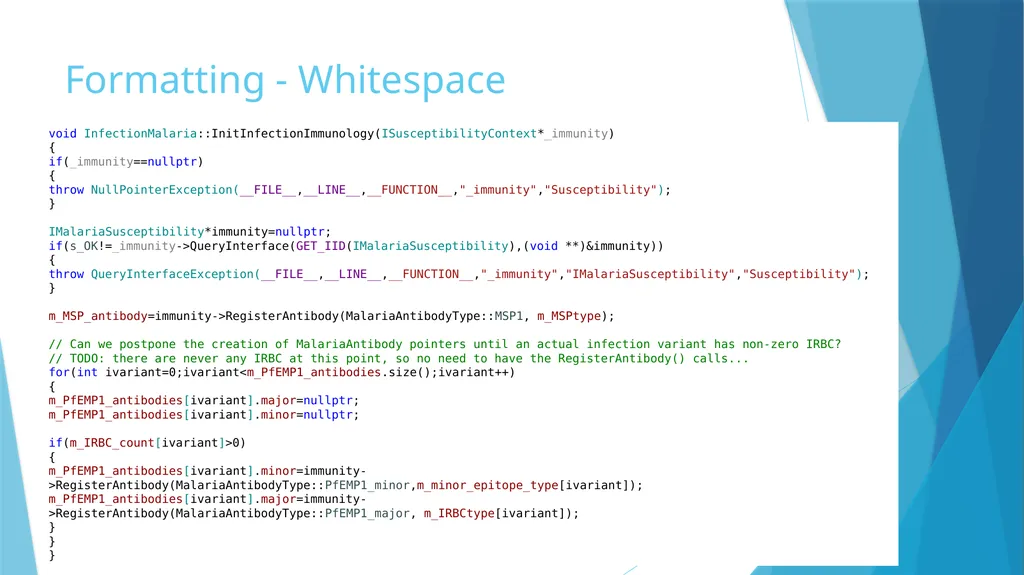
Formatting - Whitespace void InfectionMalaria::InitInfectionImmunology(ISusceptibilityContext*_immunity)
{
if(_immunity==nullptr)
{
throw NullPointerException(__FILE__,__LINE__,__FUNCTION__,"_immunity","Susceptibility");
}
IMalariaSusceptibility*immunity=nullptr;
if(s_OK!=_immunity->QueryInterface(GET_IID(IMalariaSusceptibility),(void **)&immunity))
{
throw QueryInterfaceException(__FILE__,__LINE__,__FUNCTION__,"_immunity","IMalariaSusceptibility","Susceptibility");
}
m_MSP_antibody=immunity->RegisterAntibody(MalariaAntibodyType::MSP1, m_MSPtype);
// Can we postpone the creation of MalariaAntibody pointers until an actual infection variant has non-zero IRBC?
// TODO: there are never any IRBC at this point, so no need to have the RegisterAntibody() calls... for(int ivariant=0;ivariant<m_PfEMP1_antibodies.size();ivariant++)
{
m_PfEMP1_antibodies[ivariant].major=nullptr;
m_PfEMP1_antibodies[ivariant].minor=nullptr;
if(m_IRBC_count[ivariant]>0)
{
m_PfEMP1_antibodies[ivariant].minor=immunity->RegisterAntibody(MalariaAntibodyType::PfEMP1_minor,m_minor_epitope_type[ivariant]);
m_PfEMP1_antibodies[ivariant].major=immunity->RegisterAntibody(MalariaAntibodyType::PfEMP1_major, m_IRBCtype[ivariant]);
}
}
}<br>
{
if(_immunity==nullptr)
{
throw NullPointerException(__FILE__,__LINE__,__FUNCTION__,"_immunity","Susceptibility");
}
IMalariaSusceptibility*immunity=nullptr;
if(s_OK!=_immunity->QueryInterface(GET_IID(IMalariaSusceptibility),(void **)&immunity))
{
throw QueryInterfaceException(__FILE__,__LINE__,__FUNCTION__,"_immunity","IMalariaSusceptibility","Susceptibility");
}
m_MSP_antibody=immunity->RegisterAntibody(MalariaAntibodyType::MSP1, m_MSPtype);
// Can we postpone the creation of MalariaAntibody pointers until an actual infection variant has non-zero IRBC?
// TODO: there are never any IRBC at this point, so no need to have the RegisterAntibody() calls... for(int ivariant=0;ivariant<m_PfEMP1_antibodies.size();ivariant++)
{
m_PfEMP1_antibodies[ivariant].major=nullptr;
m_PfEMP1_antibodies[ivariant].minor=nullptr;
if(m_IRBC_count[ivariant]>0)
{
m_PfEMP1_antibodies[ivariant].minor=immunity->RegisterAntibody(MalariaAntibodyType::PfEMP1_minor,m_minor_epitope_type[ivariant]);
m_PfEMP1_antibodies[ivariant].major=immunity->RegisterAntibody(MalariaAntibodyType::PfEMP1_major, m_IRBCtype[ivariant]);
}
}
}<br>
14
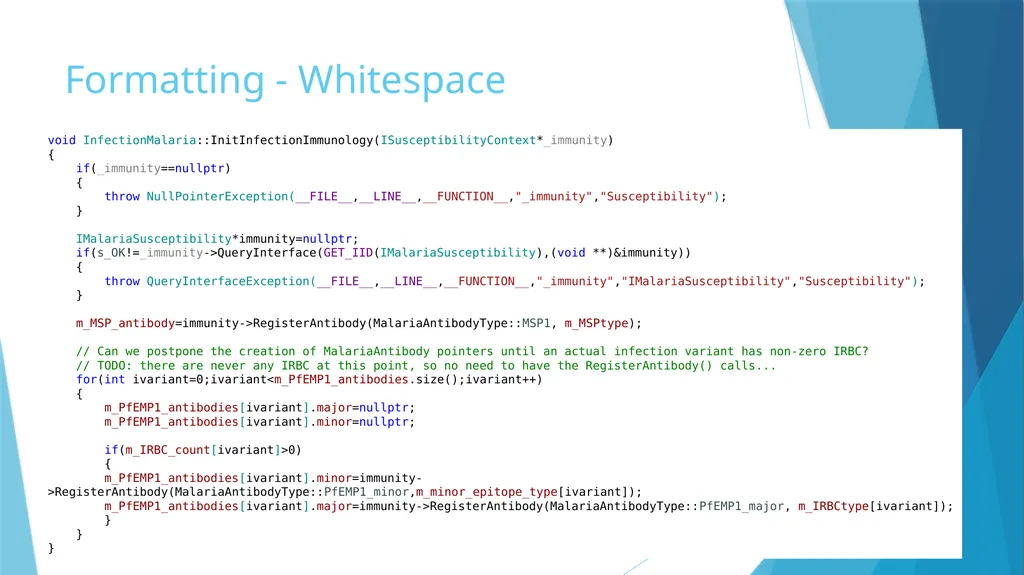
Formatting - Whitespace void InfectionMalaria::InitInfectionImmunology(ISusceptibilityContext*_immunity)
{
if(_immunity==nullptr)
{
throw NullPointerException(__FILE__,__LINE__,__FUNCTION__,"_immunity","Susceptibility");
}
IMalariaSusceptibility*immunity=nullptr;
if(s_OK!=_immunity->QueryInterface(GET_IID(IMalariaSusceptibility),(void **)&immunity))
{
throw QueryInterfaceException(__FILE__,__LINE__,__FUNCTION__,"_immunity","IMalariaSusceptibility","Susceptibility");
}
m_MSP_antibody=immunity->RegisterAntibody(MalariaAntibodyType::MSP1, m_MSPtype);
// Can we postpone the creation of MalariaAntibody pointers until an actual infection variant has non-zero IRBC?
// TODO: there are never any IRBC at this point, so no need to have the RegisterAntibody() calls... for(int ivariant=0;ivariant<m_PfEMP1_antibodies.size();ivariant++)
{
m_PfEMP1_antibodies[ivariant].major=nullptr;
m_PfEMP1_antibodies[ivariant].minor=nullptr;
if(m_IRBC_count[ivariant]>0)
{
m_PfEMP1_antibodies[ivariant].minor=immunity->RegisterAntibody(MalariaAntibodyType::PfEMP1_minor,m_minor_epitope_type[ivariant]);
m_PfEMP1_antibodies[ivariant].major=immunity->RegisterAntibody(MalariaAntibodyType::PfEMP1_major, m_IRBCtype[ivariant]);
}
}
}<br>
{
if(_immunity==nullptr)
{
throw NullPointerException(__FILE__,__LINE__,__FUNCTION__,"_immunity","Susceptibility");
}
IMalariaSusceptibility*immunity=nullptr;
if(s_OK!=_immunity->QueryInterface(GET_IID(IMalariaSusceptibility),(void **)&immunity))
{
throw QueryInterfaceException(__FILE__,__LINE__,__FUNCTION__,"_immunity","IMalariaSusceptibility","Susceptibility");
}
m_MSP_antibody=immunity->RegisterAntibody(MalariaAntibodyType::MSP1, m_MSPtype);
// Can we postpone the creation of MalariaAntibody pointers until an actual infection variant has non-zero IRBC?
// TODO: there are never any IRBC at this point, so no need to have the RegisterAntibody() calls... for(int ivariant=0;ivariant<m_PfEMP1_antibodies.size();ivariant++)
{
m_PfEMP1_antibodies[ivariant].major=nullptr;
m_PfEMP1_antibodies[ivariant].minor=nullptr;
if(m_IRBC_count[ivariant]>0)
{
m_PfEMP1_antibodies[ivariant].minor=immunity->RegisterAntibody(MalariaAntibodyType::PfEMP1_minor,m_minor_epitope_type[ivariant]);
m_PfEMP1_antibodies[ivariant].major=immunity->RegisterAntibody(MalariaAntibodyType::PfEMP1_major, m_IRBCtype[ivariant]);
}
}
}<br>
15
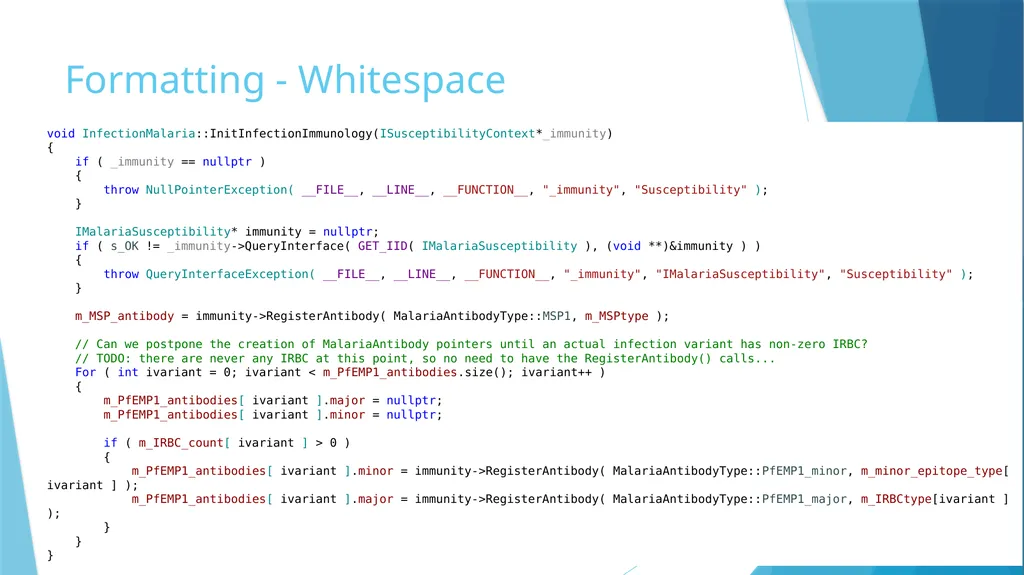
Formatting - Whitespace void InfectionMalaria::InitInfectionImmunology(ISusceptibilityContext*_immunity)
{
if ( _immunity == nullptr )
{
throw NullPointerException( __FILE__, __LINE__, __FUNCTION__, "_immunity", "Susceptibility" );
}
IMalariaSusceptibility* immunity = nullptr;
if ( s_OK != _immunity->QueryInterface( GET_IID( IMalariaSusceptibility ), (void **)&immunity ) )
{
throw QueryInterfaceException( __FILE__, __LINE__, __FUNCTION__, "_immunity", "IMalariaSusceptibility", "Susceptibility" );
}
m_MSP_antibody = immunity->RegisterAntibody( MalariaAntibodyType::MSP1, m_MSPtype );
// Can we postpone the creation of MalariaAntibody pointers until an actual infection variant has non-zero IRBC?
// TODO: there are never any IRBC at this point, so no need to have the RegisterAntibody() calls... For ( int ivariant = 0; ivariant < m_PfEMP1_antibodies.size(); ivariant++ )
{
m_PfEMP1_antibodies[ ivariant ].major = nullptr;
m_PfEMP1_antibodies[ ivariant ].minor = nullptr;
if ( m_IRBC_count[ ivariant ] > 0 )
{
m_PfEMP1_antibodies[ ivariant ].minor = immunity->RegisterAntibody( MalariaAntibodyType::PfEMP1_minor, m_minor_epitope_type[ ivariant ] );
m_PfEMP1_antibodies[ ivariant ].major = immunity->RegisterAntibody( MalariaAntibodyType::PfEMP1_major, m_IRBCtype[ivariant ] );
}
}
}<br>
{
if ( _immunity == nullptr )
{
throw NullPointerException( __FILE__, __LINE__, __FUNCTION__, "_immunity", "Susceptibility" );
}
IMalariaSusceptibility* immunity = nullptr;
if ( s_OK != _immunity->QueryInterface( GET_IID( IMalariaSusceptibility ), (void **)&immunity ) )
{
throw QueryInterfaceException( __FILE__, __LINE__, __FUNCTION__, "_immunity", "IMalariaSusceptibility", "Susceptibility" );
}
m_MSP_antibody = immunity->RegisterAntibody( MalariaAntibodyType::MSP1, m_MSPtype );
// Can we postpone the creation of MalariaAntibody pointers until an actual infection variant has non-zero IRBC?
// TODO: there are never any IRBC at this point, so no need to have the RegisterAntibody() calls... For ( int ivariant = 0; ivariant < m_PfEMP1_antibodies.size(); ivariant++ )
{
m_PfEMP1_antibodies[ ivariant ].major = nullptr;
m_PfEMP1_antibodies[ ivariant ].minor = nullptr;
if ( m_IRBC_count[ ivariant ] > 0 )
{
m_PfEMP1_antibodies[ ivariant ].minor = immunity->RegisterAntibody( MalariaAntibodyType::PfEMP1_minor, m_minor_epitope_type[ ivariant ] );
m_PfEMP1_antibodies[ ivariant ].major = immunity->RegisterAntibody( MalariaAntibodyType::PfEMP1_major, m_IRBCtype[ivariant ] );
}
}
}<br>
16
Formatting - Indentation void InfectionMalaria::InitInfectionImmunology(ISusceptibilityContext* _immunity) {
if( _immunity == nullptr ) {
throw NullPointerException( __FILE__, __LINE__, __FUNCTION__, "_immunity", "Susceptibility" );
}
IMalariaSusceptibility* immunity = nullptr;
if (s_OK != _immunity->QueryInterface(GET_IID(IMalariaSusceptibility), (void **)&immunity)) {
throw QueryInterfaceException( __FILE__, __LINE__, __FUNCTION__, "_immunity", "IMalariaSusceptibility", "Susceptibility" );
}
m_MSP_antibody = immunity->RegisterAntibody(MalariaAntibodyType::MSP1, m_MSPtype);
// Can we postpone the creation of MalariaAntibody pointers until an actual infection variant has non-zero IRBC?
// TODO: there are never any IRBC at this point, so no need to have the RegisterAntibody() calls...
for( int ivariant = 0; ivariant < m_PfEMP1_antibodies.size(); ivariant++ ) {
m_PfEMP1_antibodies[ivariant].major = nullptr;
m_PfEMP1_antibodies[ivariant].minor = nullptr;
if ( m_IRBC_count[ivariant] > 0 ) {
m_PfEMP1_antibodies[ivariant].minor = immunity->RegisterAntibody(MalariaAntibodyType::PfEMP1_minor, m_minor_epitope_type[ivariant]);
m_PfEMP1_antibodies[ivariant].major = immunity->RegisterAntibody(MalariaAntibodyType::PfEMP1_major, m_IRBCtype[ivariant]);
}
}
} void InfectionMalaria::InitInfectionImmunology(ISusceptibilityContext* _immunity)
{
if ( _immunity == nullptr ) {
throw NullPointerException( __FILE__, __LINE__, __FUNCTION__, "_immunity", "Susceptibility" );
}
IMalariaSusceptibility* immunity = nullptr;
if ( s_OK != _immunity->QueryInterface(GET_IID(IMalariaSusceptibility), (void **)&immunity) ) {
throw QueryInterfaceException( __FILE__, __LINE__, __FUNCTION__, "_immunity", "IMalariaSusceptibility", "Susceptibility" );
}
m_MSP_antibody = immunity->RegisterAntibody(MalariaAntibodyType::MSP1, m_MSPtype);
// Can we postpone the creation of MalariaAntibody pointers until an actual infection variant has non-zero IRBC?
// TODO: there are never any IRBC at this point, so no need to have the RegisterAntibody() calls...
for ( int ivariant = 0; ivariant < m_PfEMP1_antibodies.size(); ++ivariant )
{
m_PfEMP1_antibodies[ivariant].major = nullptr;
m_PfEMP1_antibodies[ivariant].minor = nullptr;
if ( m_IRBC_count[ivariant] > 0 )
{
m_PfEMP1_antibodies[ivariant].minor = immunity->RegisterAntibody(MalariaAntibodyType::PfEMP1_minor, m_minor_epitope_type[ivariant]);
m_PfEMP1_antibodies[ivariant].major = immunity->RegisterAntibody(MalariaAntibodyType::PfEMP1_major, m_IRBCtype[ivariant]);
}
}
}<br>
if( _immunity == nullptr ) {
throw NullPointerException( __FILE__, __LINE__, __FUNCTION__, "_immunity", "Susceptibility" );
}
IMalariaSusceptibility* immunity = nullptr;
if (s_OK != _immunity->QueryInterface(GET_IID(IMalariaSusceptibility), (void **)&immunity)) {
throw QueryInterfaceException( __FILE__, __LINE__, __FUNCTION__, "_immunity", "IMalariaSusceptibility", "Susceptibility" );
}
m_MSP_antibody = immunity->RegisterAntibody(MalariaAntibodyType::MSP1, m_MSPtype);
// Can we postpone the creation of MalariaAntibody pointers until an actual infection variant has non-zero IRBC?
// TODO: there are never any IRBC at this point, so no need to have the RegisterAntibody() calls...
for( int ivariant = 0; ivariant < m_PfEMP1_antibodies.size(); ivariant++ ) {
m_PfEMP1_antibodies[ivariant].major = nullptr;
m_PfEMP1_antibodies[ivariant].minor = nullptr;
if ( m_IRBC_count[ivariant] > 0 ) {
m_PfEMP1_antibodies[ivariant].minor = immunity->RegisterAntibody(MalariaAntibodyType::PfEMP1_minor, m_minor_epitope_type[ivariant]);
m_PfEMP1_antibodies[ivariant].major = immunity->RegisterAntibody(MalariaAntibodyType::PfEMP1_major, m_IRBCtype[ivariant]);
}
}
} void InfectionMalaria::InitInfectionImmunology(ISusceptibilityContext* _immunity)
{
if ( _immunity == nullptr ) {
throw NullPointerException( __FILE__, __LINE__, __FUNCTION__, "_immunity", "Susceptibility" );
}
IMalariaSusceptibility* immunity = nullptr;
if ( s_OK != _immunity->QueryInterface(GET_IID(IMalariaSusceptibility), (void **)&immunity) ) {
throw QueryInterfaceException( __FILE__, __LINE__, __FUNCTION__, "_immunity", "IMalariaSusceptibility", "Susceptibility" );
}
m_MSP_antibody = immunity->RegisterAntibody(MalariaAntibodyType::MSP1, m_MSPtype);
// Can we postpone the creation of MalariaAntibody pointers until an actual infection variant has non-zero IRBC?
// TODO: there are never any IRBC at this point, so no need to have the RegisterAntibody() calls...
for ( int ivariant = 0; ivariant < m_PfEMP1_antibodies.size(); ++ivariant )
{
m_PfEMP1_antibodies[ivariant].major = nullptr;
m_PfEMP1_antibodies[ivariant].minor = nullptr;
if ( m_IRBC_count[ivariant] > 0 )
{
m_PfEMP1_antibodies[ivariant].minor = immunity->RegisterAntibody(MalariaAntibodyType::PfEMP1_minor, m_minor_epitope_type[ivariant]);
m_PfEMP1_antibodies[ivariant].major = immunity->RegisterAntibody(MalariaAntibodyType::PfEMP1_major, m_IRBCtype[ivariant]);
}
}
}<br>
17
Comments // TODO – change “COMMENTS” to “CLARIFICATIONS”<br>
18
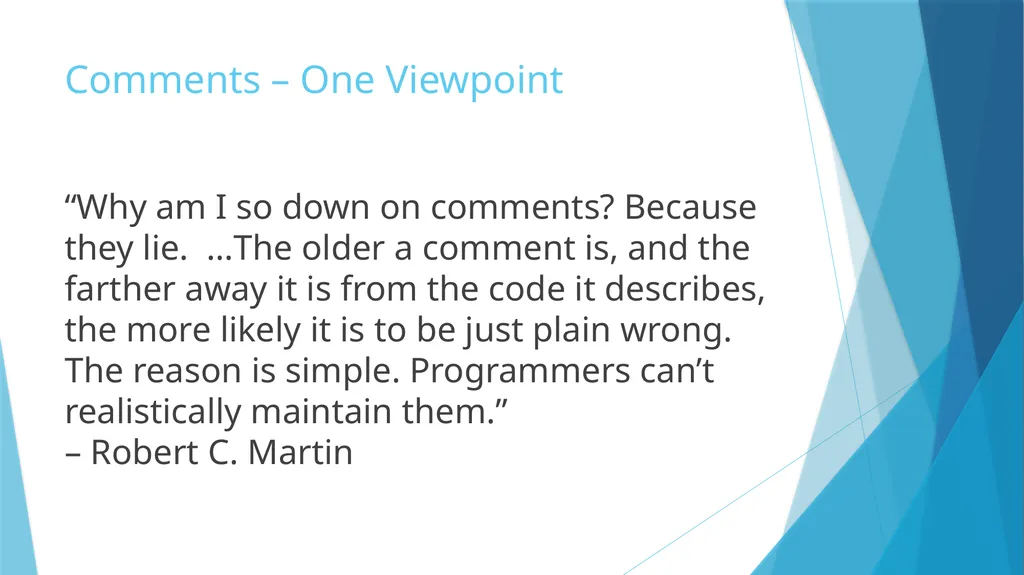
Comments – One Viewpoint “Why am I so down on comments? Because they lie. …The older a comment is, and the farther away it is from the code it describes, the more likely it is to be just plain wrong. The reason is simple. Programmers can’t realistically maintain them.”
– Robert C. Martin<br>
19
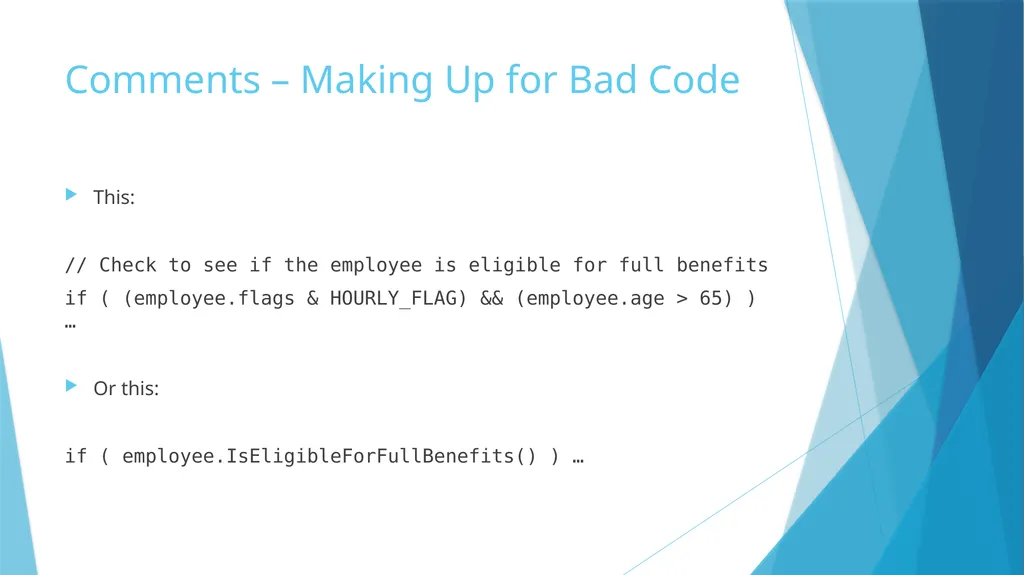
Comments – Making Up for Bad Code This:
// Check to see if the employee is eligible for full benefits
if ( (employee.flags & HOURLY_FLAG) && (employee.age > 65) ) …
Or this:
if ( employee.IsEligibleForFullBenefits() ) …<br>
// Check to see if the employee is eligible for full benefits
if ( (employee.flags & HOURLY_FLAG) && (employee.age > 65) ) …
Or this:
if ( employee.IsEligibleForFullBenefits() ) …<br>
20
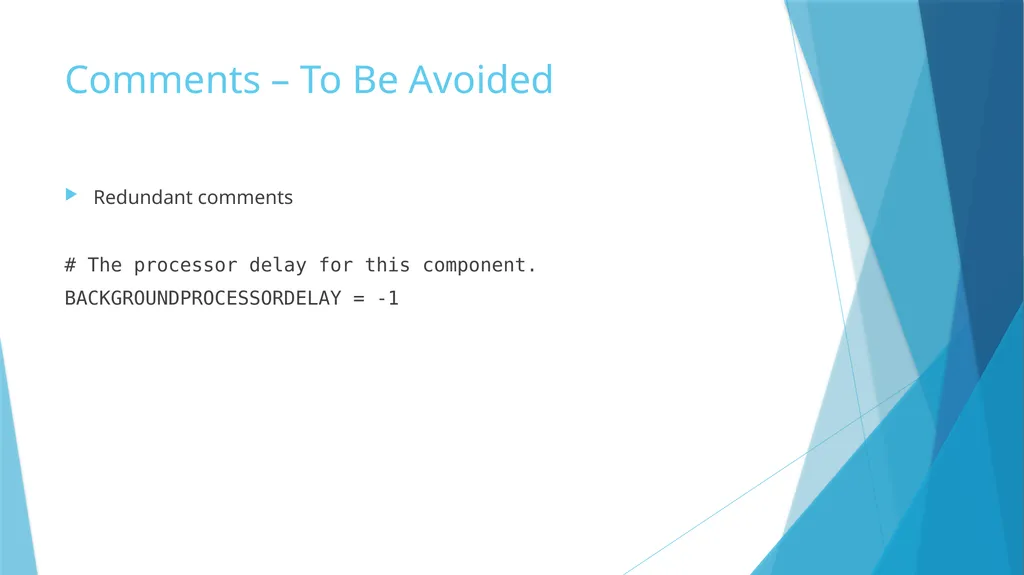
Comments – To Be Avoided Redundant comments
# The processor delay for this component.
BACKGROUNDPROCESSORDELAY = -1<br>
# The processor delay for this component.
BACKGROUNDPROCESSORDELAY = -1<br>
21
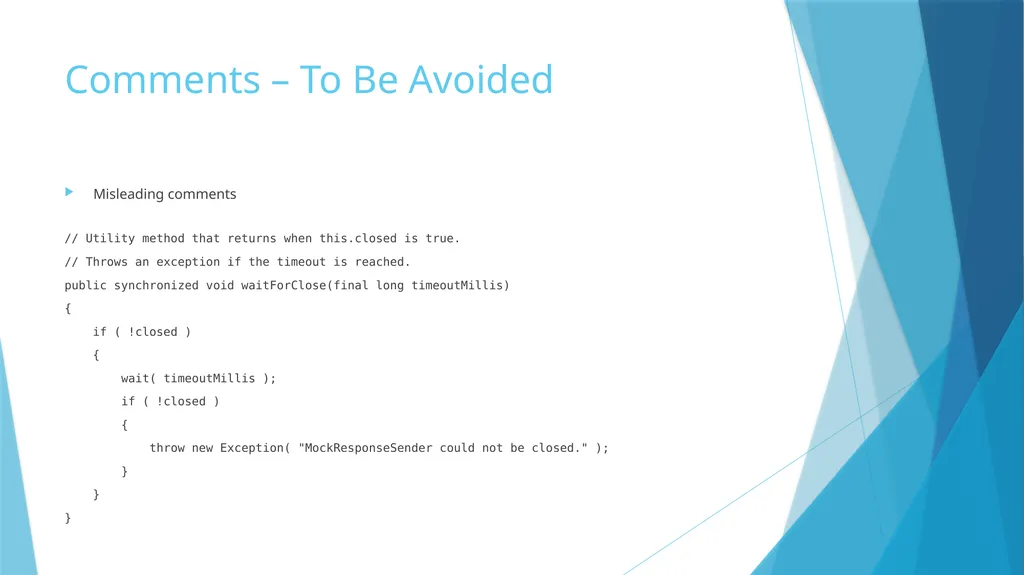
Comments – To Be Avoided Misleading comments
// Utility method that returns when this.closed is true.
// Throws an exception if the timeout is reached.
public synchronized void waitForClose(final long timeoutMillis)
{
if ( !closed )
{
wait( timeoutMillis );
if ( !closed )
{
throw new Exception( "MockResponseSender could not be closed." );
}
}
}<br>
// Utility method that returns when this.closed is true.
// Throws an exception if the timeout is reached.
public synchronized void waitForClose(final long timeoutMillis)
{
if ( !closed )
{
wait( timeoutMillis );
if ( !closed )
{
throw new Exception( "MockResponseSender could not be closed." );
}
}
}<br>
22
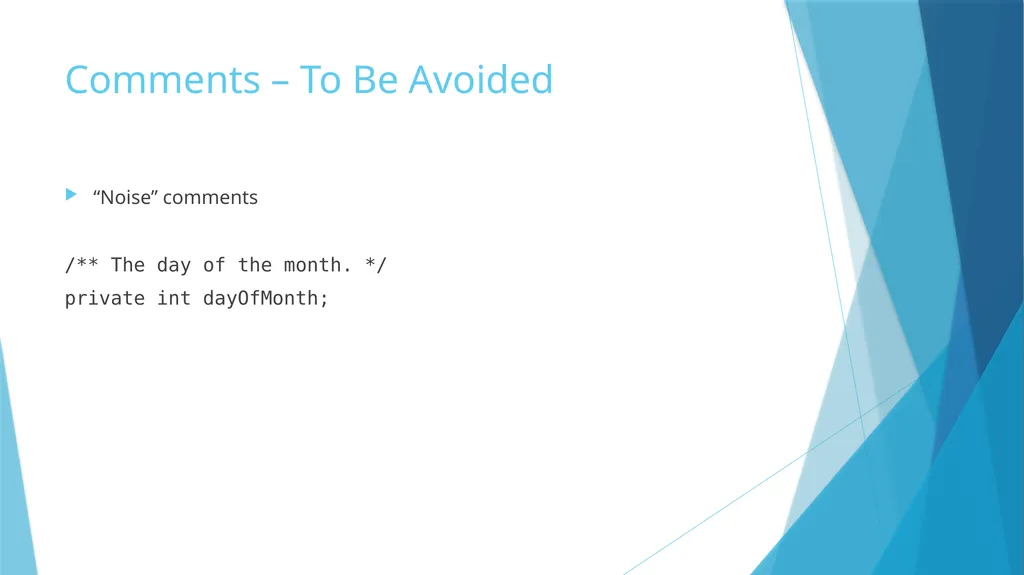
Comments – To Be Avoided “Noise” comments
/** The day of the month. */
private int dayOfMonth;<br>
/** The day of the month. */
private int dayOfMonth;<br>
23
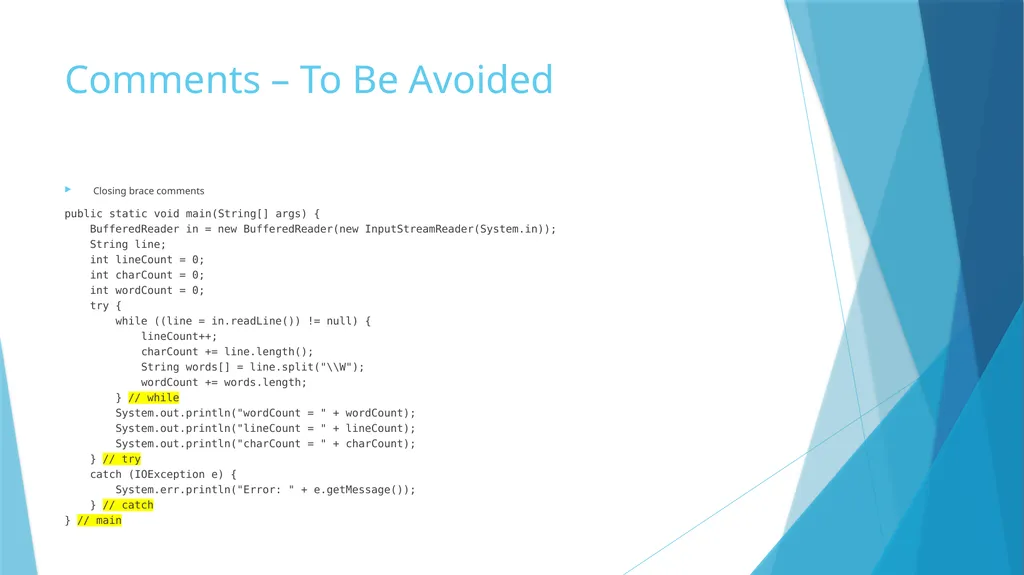
Comments – To Be Avoided Closing brace comments
public static void main(String[] args) {
BufferedReader in = new BufferedReader(new InputStreamReader(System.in));
String line;
int lineCount = 0;
int charCount = 0;
int wordCount = 0;
try {
while ((line = in.readLine()) != null) {
lineCount++;
charCount += line.length();
String words[] = line.split("\\W");
wordCount += words.length;
} // while
System.out.println("wordCount = " + wordCount);
System.out.println("lineCount = " + lineCount);
System.out.println("charCount = " + charCount);
} // try
catch (IOException e) {
System.err.println("Error: " + e.getMessage());
} // catch
} // main<br>
public static void main(String[] args) {
BufferedReader in = new BufferedReader(new InputStreamReader(System.in));
String line;
int lineCount = 0;
int charCount = 0;
int wordCount = 0;
try {
while ((line = in.readLine()) != null) {
lineCount++;
charCount += line.length();
String words[] = line.split("\\W");
wordCount += words.length;
} // while
System.out.println("wordCount = " + wordCount);
System.out.println("lineCount = " + lineCount);
System.out.println("charCount = " + charCount);
} // try
catch (IOException e) {
System.err.println("Error: " + e.getMessage());
} // catch
} // main<br>
24
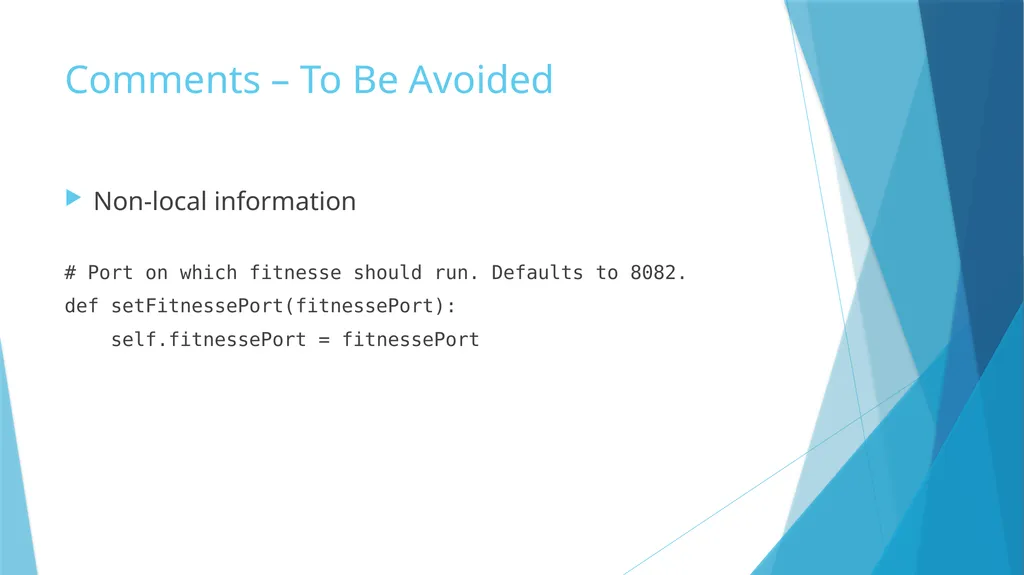
Comments – To Be Avoided Non-local information
# Port on which fitnesse should run. Defaults to 8082.
def setFitnessePort(fitnessePort):
self.fitnessePort = fitnessePort<br>
# Port on which fitnesse should run. Defaults to 8082.
def setFitnessePort(fitnessePort):
self.fitnessePort = fitnessePort<br>
25
Error Chekcing<br>
26
Error Checking – Minimum Bar Check for basic assumptions –
Does the file exist?
Is the count >=0?
Etc.
Check for return codes/status
Input validation is its own step – put it in its own sub-routine.
Error handling is its own step – put it in one place, not sprinkled throughout the code.<br>
Does the file exist?
Is the count >=0?
Etc.
Check for return codes/status
Input validation is its own step – put it in its own sub-routine.
Error handling is its own step – put it in one place, not sprinkled throughout the code.<br>
27
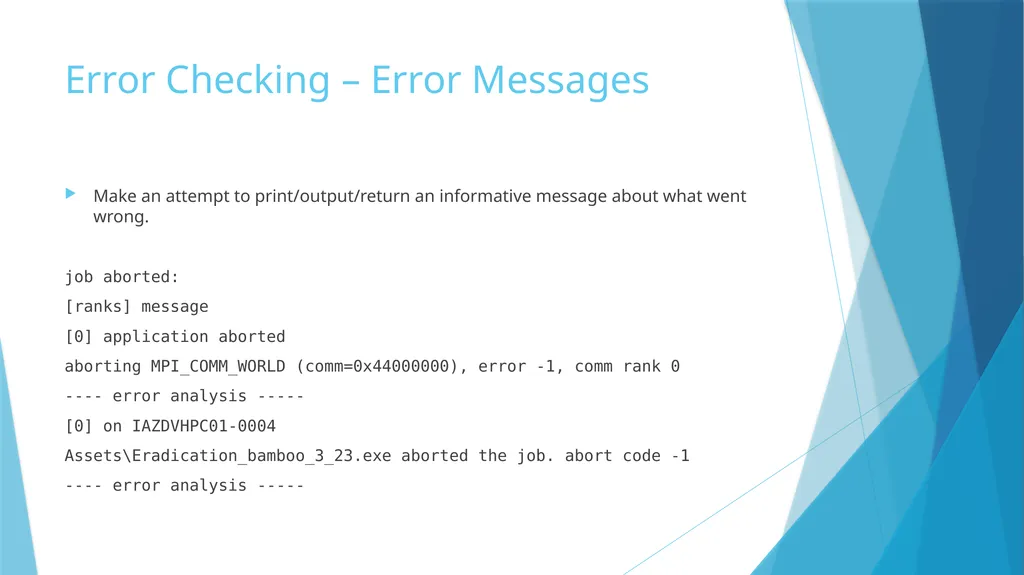
Error Checking – Error Messages Make an attempt to print/output/return an informative message about what went wrong.
job aborted:
[ranks] message
[0] application aborted
aborting MPI_COMM_WORLD (comm=0x44000000), error -1, comm rank 0
---- error analysis -----
[0] on IAZDVHPC01-0004
Assets\Eradication_bamboo_3_23.exe aborted the job. abort code -1
---- error analysis -----<br>
job aborted:
[ranks] message
[0] application aborted
aborting MPI_COMM_WORLD (comm=0x44000000), error -1, comm rank 0
---- error analysis -----
[0] on IAZDVHPC01-0004
Assets\Eradication_bamboo_3_23.exe aborted the job. abort code -1
---- error analysis -----<br>
28
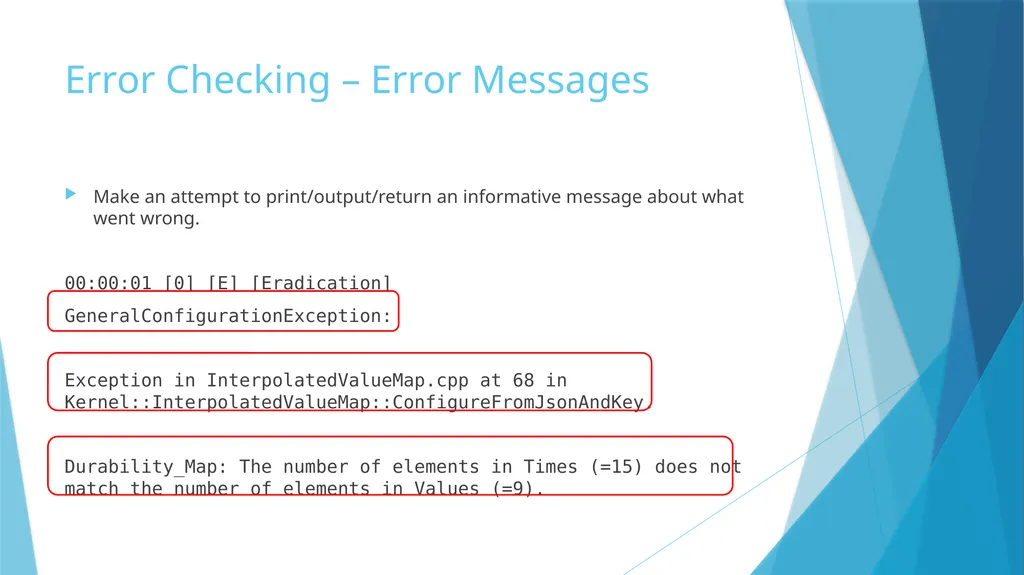
Error Checking – Error Messages Make an attempt to print/output/return an informative message about what went wrong.
00:00:01 [0] [E] [Eradication]
GeneralConfigurationException:
Exception in InterpolatedValueMap.cpp at 68 in Kernel::InterpolatedValueMap::ConfigureFromJsonAndKey.
Durability_Map: The number of elements in Times (=15) does not match the number of elements in Values (=9).<br>
00:00:01 [0] [E] [Eradication]
GeneralConfigurationException:
Exception in InterpolatedValueMap.cpp at 68 in Kernel::InterpolatedValueMap::ConfigureFromJsonAndKey.
Durability_Map: The number of elements in Times (=15) does not match the number of elements in Values (=9).<br>
29
Component Tests<br>
30
Component Tests – What’s a Component? Data file reader
Data transformation
Data extraction
Mathematical function
Database lookup
Web function call
Password validation
Data file writer
Etc.<br>
Data transformation
Data extraction
Mathematical function
Database lookup
Web function call
Password validation
Data file writer
Etc.<br>
31
Component Tests – Does It Work Q: Does your feature work?
Q: How do you know it works?
Q: How would I (or someone else) know it works?
Q: If I modify or extend your code, how will I know I didn’t break it?<br>
Q: How do you know it works?
Q: How would I (or someone else) know it works?
Q: If I modify or extend your code, how will I know I didn’t break it?<br>
32
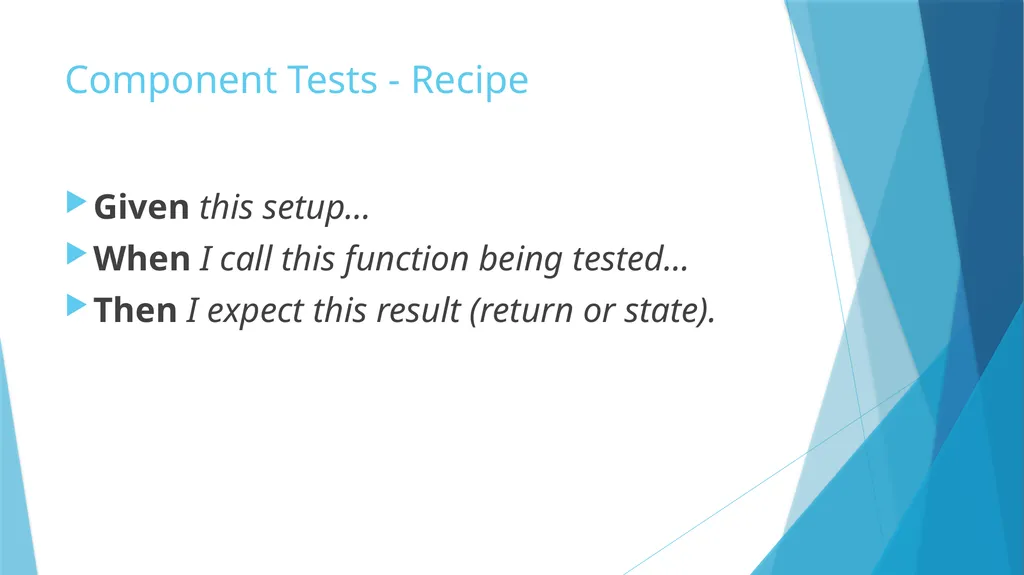
Component Tests - Recipe Given this setup…
When I call this function being tested…
Then I expect this result (return or state).<br>
When I call this function being tested…
Then I expect this result (return or state).<br>
33
Component Tests – FIRST Fast – if they don’t run quickly, people won’t run them
Independent – tests should not depend on each other
Repeatable – flaky tests aren’t helpful
Self-validating – pass or fail, users shouldn’t have to read and parse output
Timely – written along with the code being tested<br>
Independent – tests should not depend on each other
Repeatable – flaky tests aren’t helpful
Self-validating – pass or fail, users shouldn’t have to read and parse output
Timely – written along with the code being tested<br>
34
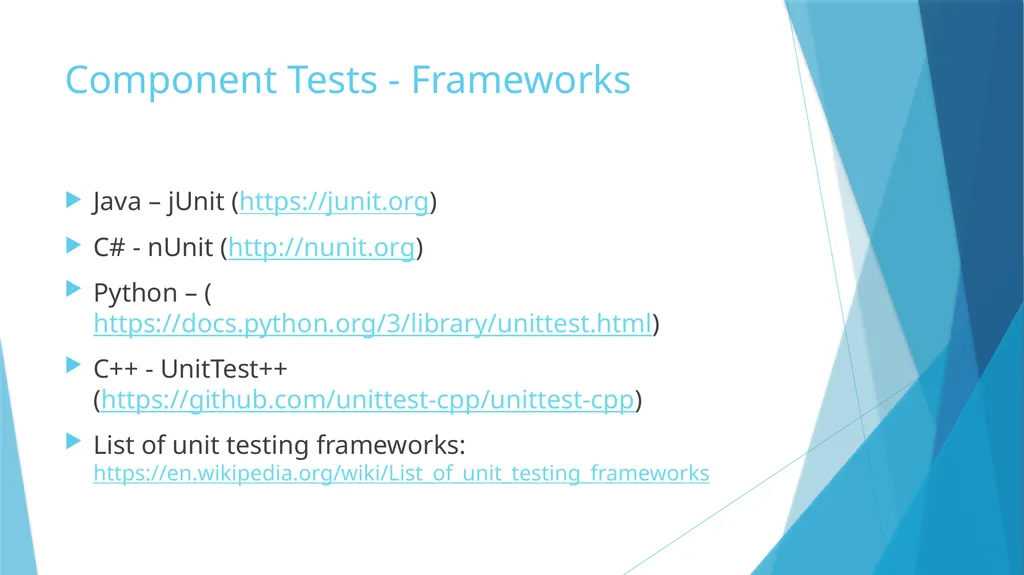
Component Tests - Frameworks Java – jUnit (https://junit.org)
C# - nUnit (http://nunit.org)
Python – (https://docs.python.org/3/library/unittest.html)
C++ - UnitTest++ (https://github.com/unittest-cpp/unittest-cpp)
List of unit testing frameworks: https://en.wikipedia.org/wiki/List_of_unit_testing_frameworks<br>
C# - nUnit (http://nunit.org)
Python – (https://docs.python.org/3/library/unittest.html)
C++ - UnitTest++ (https://github.com/unittest-cpp/unittest-cpp)
List of unit testing frameworks: https://en.wikipedia.org/wiki/List_of_unit_testing_frameworks<br>
35
Refactoring<br>
36
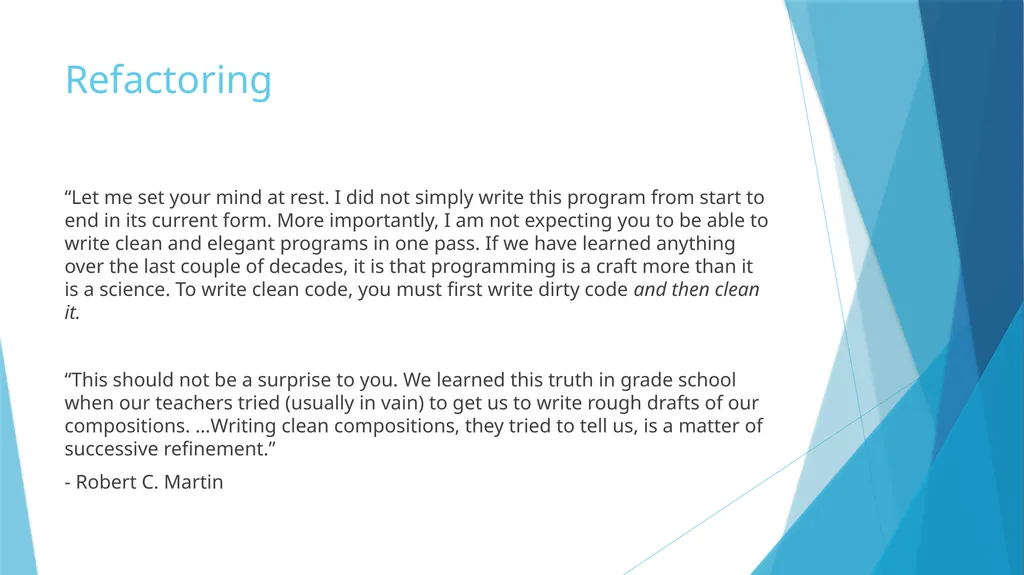
Refactoring “Let me set your mind at rest. I did not simply write this program from start to end in its current form. More importantly, I am not expecting you to be able to write clean and elegant programs in one pass. If we have learned anything over the last couple of decades, it is that programming is a craft more than it is a science. To write clean code, you must first write dirty code and then clean it.
“This should not be a surprise to you. We learned this truth in grade school when our teachers tried (usually in vain) to get us to write rough drafts of our compositions. …Writing clean compositions, they tried to tell us, is a matter of successive refinement.”
- Robert C. Martin<br>
“This should not be a surprise to you. We learned this truth in grade school when our teachers tried (usually in vain) to get us to write rough drafts of our compositions. …Writing clean compositions, they tried to tell us, is a matter of successive refinement.”
- Robert C. Martin<br>
37
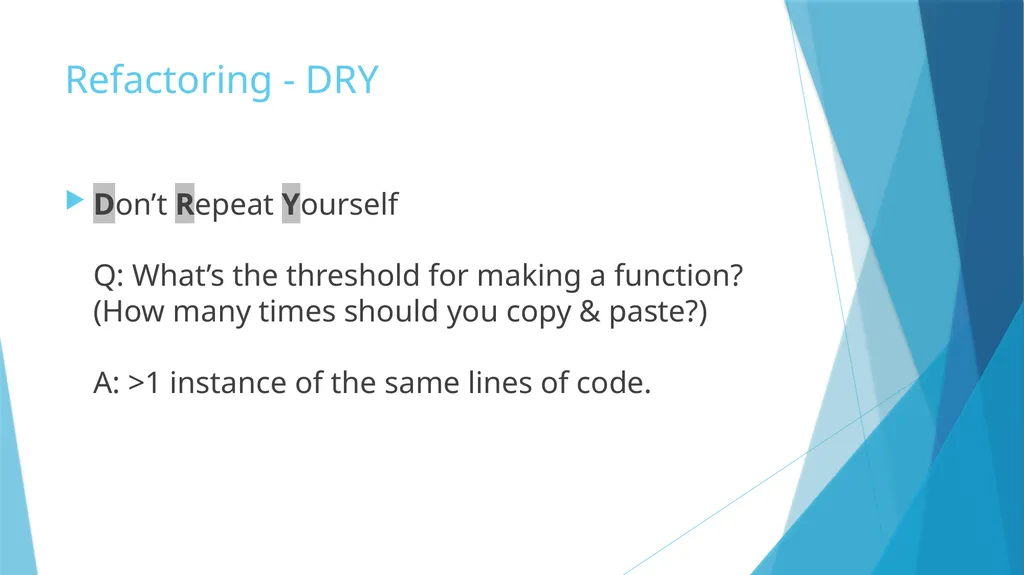
Refactoring - DRY Don’t Repeat Yourself
Q: What’s the threshold for making a function?
(How many times should you copy & paste?)
A: >1 instance of the same lines of code.<br>
38
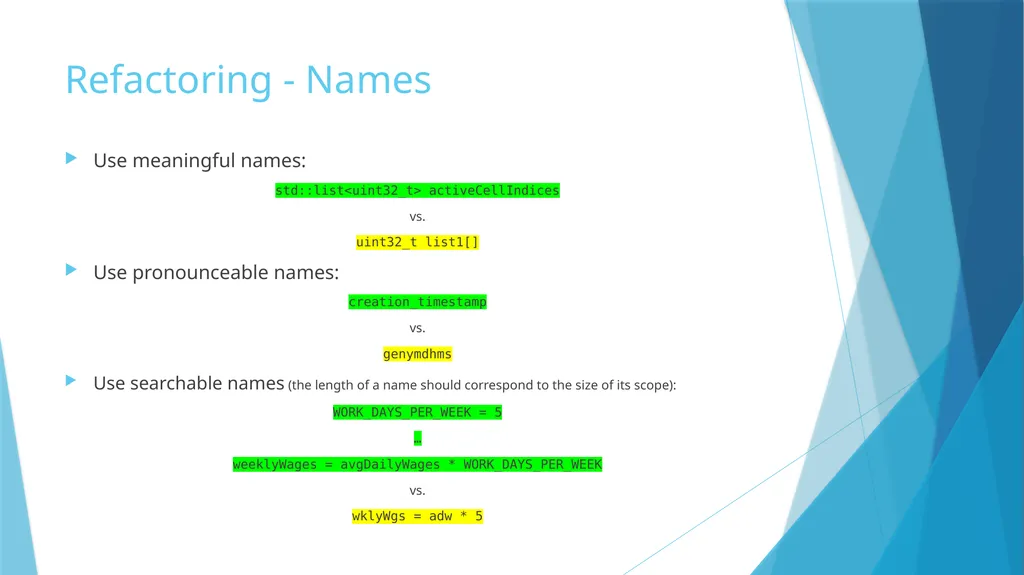
Refactoring - Names Use meaningful names:
std::list<uint32_t> activeCellIndices
vs.
uint32_t list1[]
Use pronounceable names:
creation_timestamp
vs.
genymdhms
Use searchable names (the length of a name should correspond to the size of its scope):
WORK_DAYS_PER_WEEK = 5
…
weeklyWages = avgDailyWages * WORK_DAYS_PER_WEEK
vs.
wklyWgs = adw * 5<br>
std::list<uint32_t> activeCellIndices
vs.
uint32_t list1[]
Use pronounceable names:
creation_timestamp
vs.
genymdhms
Use searchable names (the length of a name should correspond to the size of its scope):
WORK_DAYS_PER_WEEK = 5
…
weeklyWages = avgDailyWages * WORK_DAYS_PER_WEEK
vs.
wklyWgs = adw * 5<br>
39
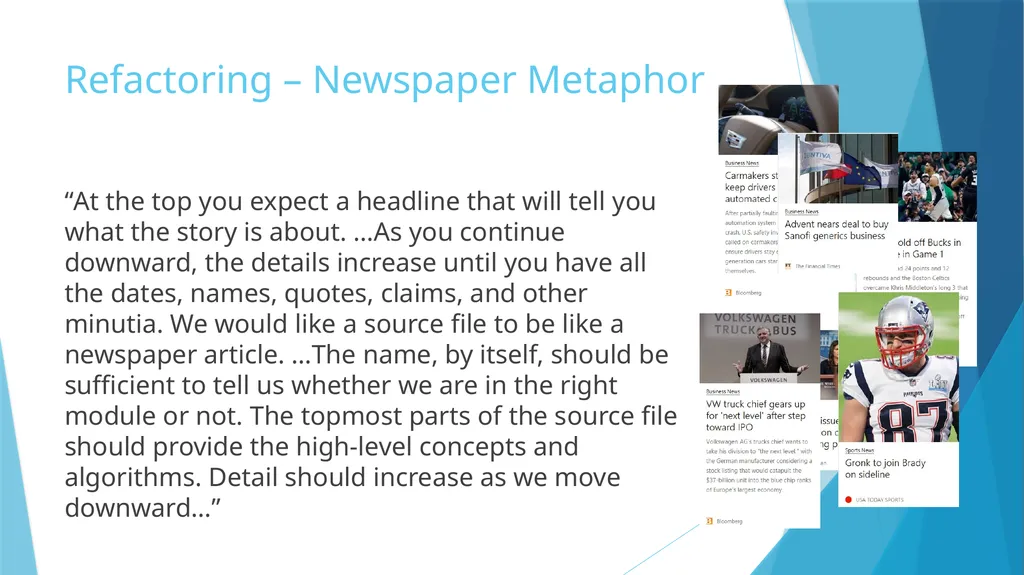
Refactoring – Newspaper Metaphor “At the top you expect a headline that will tell you what the story is about. …As you continue downward, the details increase until you have all the dates, names, quotes, claims, and other minutia. We would like a source file to be like a newspaper article. …The name, by itself, should be sufficient to tell us whether we are in the right module or not. The topmost parts of the source file should provide the high-level concepts and algorithms. Detail should increase as we move downward…”<br>
40
Refactoring – Newspaper Metaphor That Python in the Pet Store? It May Have Been Snatched from the Wild
By RACHEL NUWER, April 9, 2018
Many reptiles sold as pets are said to have been bred in captivity, and sales of those animals are legal. In fact, many — perhaps most, depending on the species — were illegally captured in the wild.
“Most conservationists are only focusing on charismatic species, but this trade is likely having a massive impact on ecosystems and populations of lesser-known animals.”
An Uncomfortable Tour
A Legal Challenge
Warning Signs
‘Mocking’ International Law<br>
By RACHEL NUWER, April 9, 2018
Many reptiles sold as pets are said to have been bred in captivity, and sales of those animals are legal. In fact, many — perhaps most, depending on the species — were illegally captured in the wild.
“Most conservationists are only focusing on charismatic species, but this trade is likely having a massive impact on ecosystems and populations of lesser-known animals.”
An Uncomfortable Tour
A Legal Challenge
Warning Signs
‘Mocking’ International Law<br>
41
Refactoring – Research Paper Metaphor Title
Abstract
Introduction
Methods
Results
Conclusion<br>
Abstract
Introduction
Methods
Results
Conclusion<br>
42
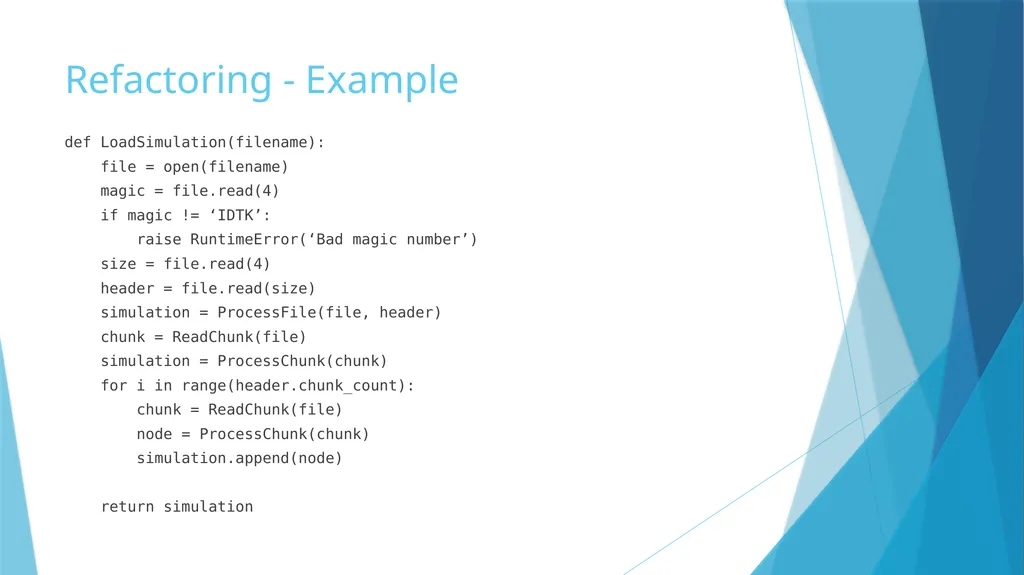
Refactoring - Example def LoadSimulation(filename):
file = open(filename)
magic = file.read(4)
if magic != ‘IDTK’:
raise RuntimeError(‘Bad magic number’)
size = file.read(4)
header = file.read(size)
simulation = ProcessFile(file, header)
chunk = ReadChunk(file)
simulation = ProcessChunk(chunk)
for i in range(header.chunk_count):
chunk = ReadChunk(file)
node = ProcessChunk(chunk)
simulation.append(node)
return simulation<br>
file = open(filename)
magic = file.read(4)
if magic != ‘IDTK’:
raise RuntimeError(‘Bad magic number’)
size = file.read(4)
header = file.read(size)
simulation = ProcessFile(file, header)
chunk = ReadChunk(file)
simulation = ProcessChunk(chunk)
for i in range(header.chunk_count):
chunk = ReadChunk(file)
node = ProcessChunk(chunk)
simulation.append(node)
return simulation<br>
43
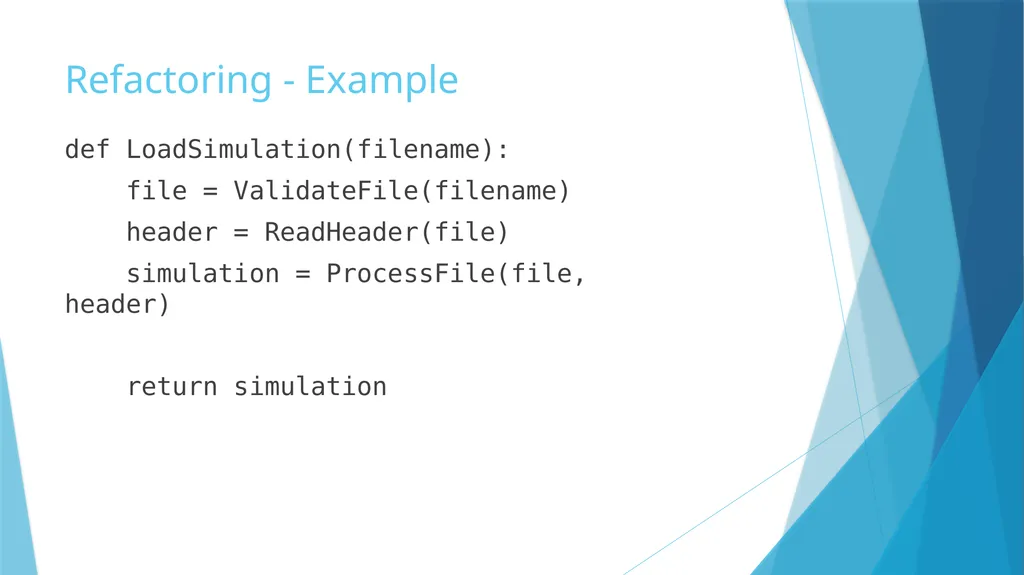
Refactoring - Example def LoadSimulation(filename):
file = ValidateFile(filename)
header = ReadHeader(file)
simulation = ProcessFile(file, header)
return simulation<br>
file = ValidateFile(filename)
header = ReadHeader(file)
simulation = ProcessFile(file, header)
return simulation<br>
44
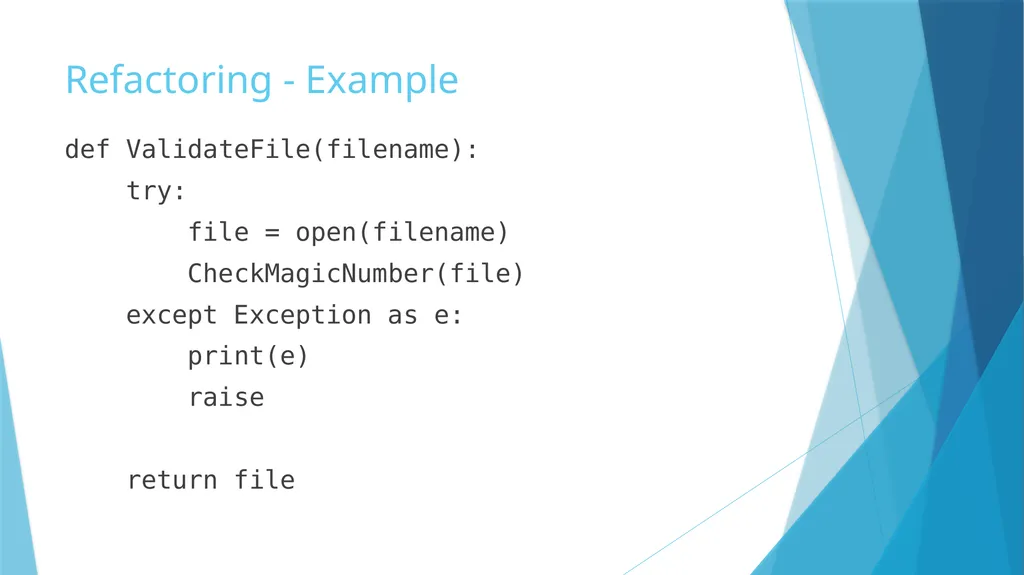
Refactoring - Example def ValidateFile(filename):
try:
file = open(filename)
CheckMagicNumber(file)
except Exception as e:
print(e)
raise
return file<br>
try:
file = open(filename)
CheckMagicNumber(file)
except Exception as e:
print(e)
raise
return file<br>
45
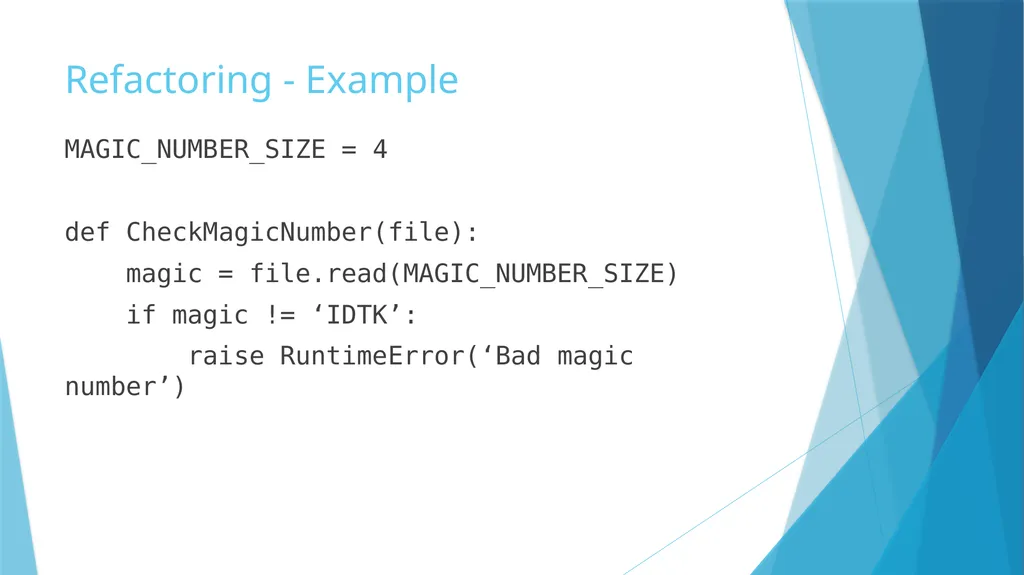
Refactoring - Example MAGIC_NUMBER_SIZE = 4
def CheckMagicNumber(file):
magic = file.read(MAGIC_NUMBER_SIZE)
if magic != ‘IDTK’:
raise RuntimeError(‘Bad magic number’)<br>
def CheckMagicNumber(file):
magic = file.read(MAGIC_NUMBER_SIZE)
if magic != ‘IDTK’:
raise RuntimeError(‘Bad magic number’)<br>
46
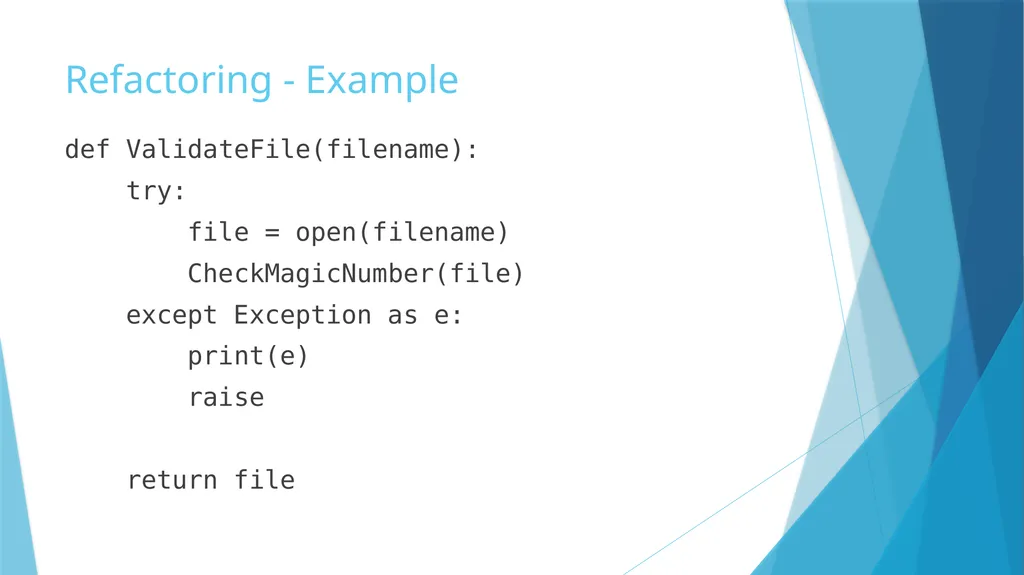
Refactoring - Example def ValidateFile(filename):
try:
file = open(filename)
CheckMagicNumber(file)
except Exception as e:
print(e)
raise
return file<br>
try:
file = open(filename)
CheckMagicNumber(file)
except Exception as e:
print(e)
raise
return file<br>
47
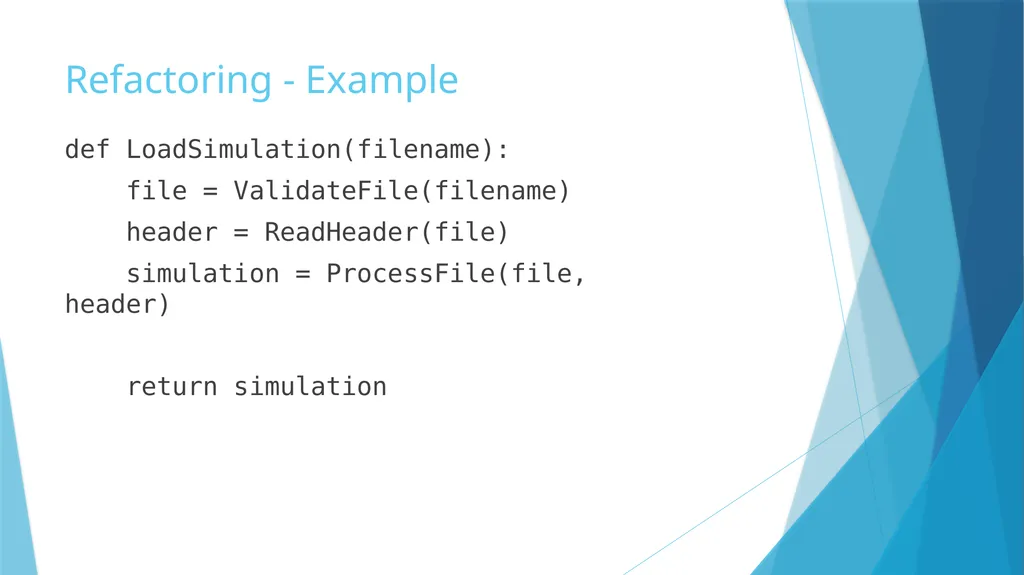
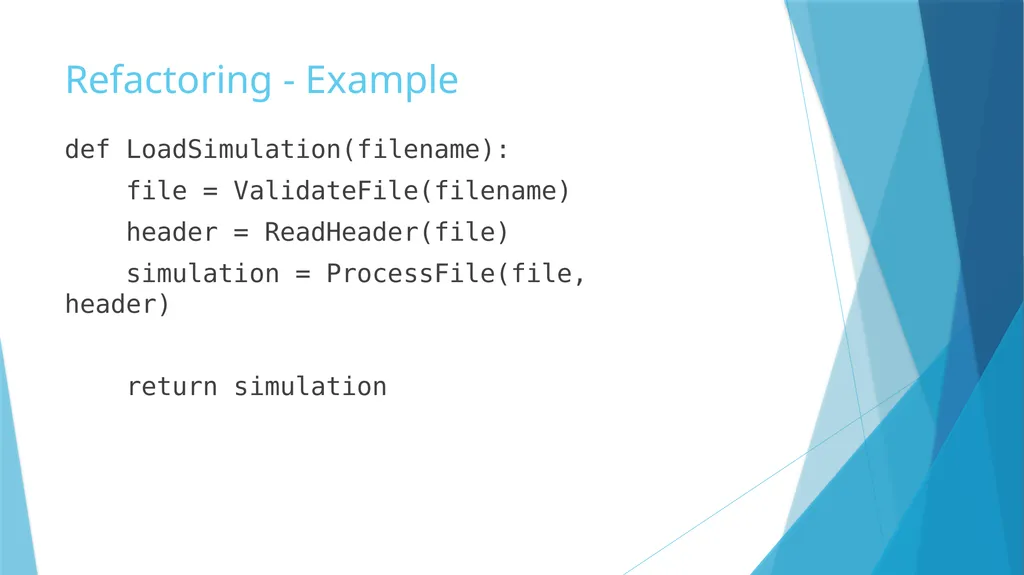
Refactoring - Example def LoadSimulation(filename):
file = ValidateFile(filename)
header = ReadHeader(file)
simulation = ProcessFile(file, header)
return simulation<br>
file = ValidateFile(filename)
header = ReadHeader(file)
simulation = ProcessFile(file, header)
return simulation<br>
48
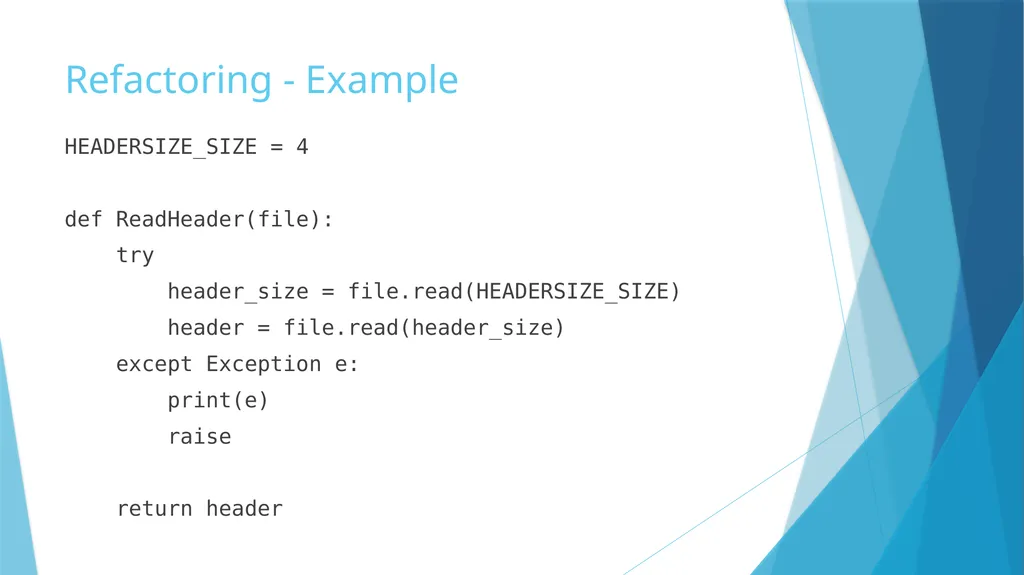
Refactoring - Example HEADERSIZE_SIZE = 4
def ReadHeader(file):
try
header_size = file.read(HEADERSIZE_SIZE)
header = file.read(header_size)
except Exception e:
print(e)
raise
return header<br>
def ReadHeader(file):
try
header_size = file.read(HEADERSIZE_SIZE)
header = file.read(header_size)
except Exception e:
print(e)
raise
return header<br>
49
Refactoring - Example def LoadSimulation(filename):
file = ValidateFile(filename)
header = ReadHeader(file)
simulation = ProcessFile(file, header)
return simulation<br>
file = ValidateFile(filename)
header = ReadHeader(file)
simulation = ProcessFile(file, header)
return simulation<br>
50
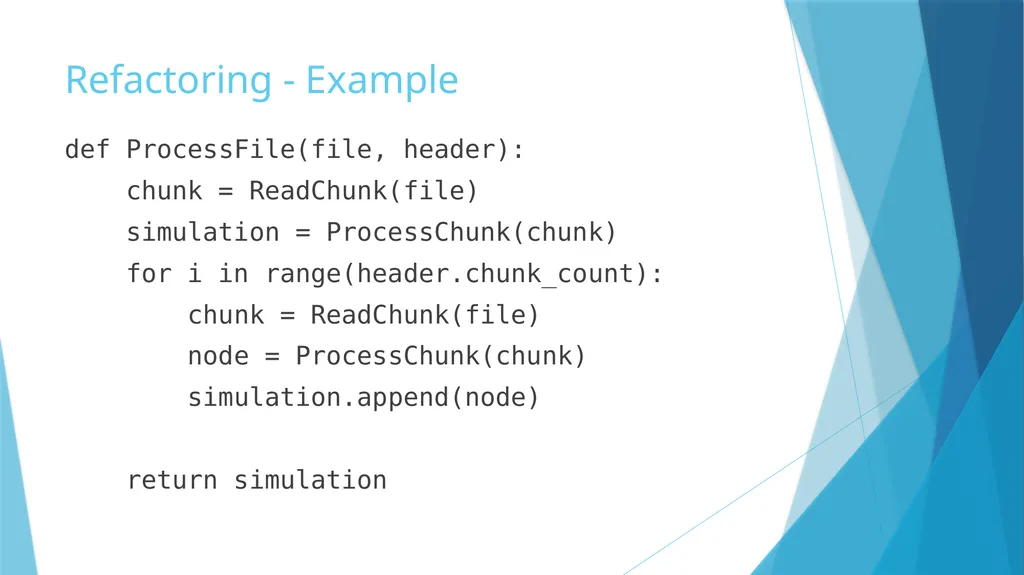
Refactoring - Example def ProcessFile(file, header):
chunk = ReadChunk(file)
simulation = ProcessChunk(chunk)
for i in range(header.chunk_count):
chunk = ReadChunk(file)
node = ProcessChunk(chunk)
simulation.append(node)
return simulation<br>
chunk = ReadChunk(file)
simulation = ProcessChunk(chunk)
for i in range(header.chunk_count):
chunk = ReadChunk(file)
node = ProcessChunk(chunk)
simulation.append(node)
return simulation<br>
51
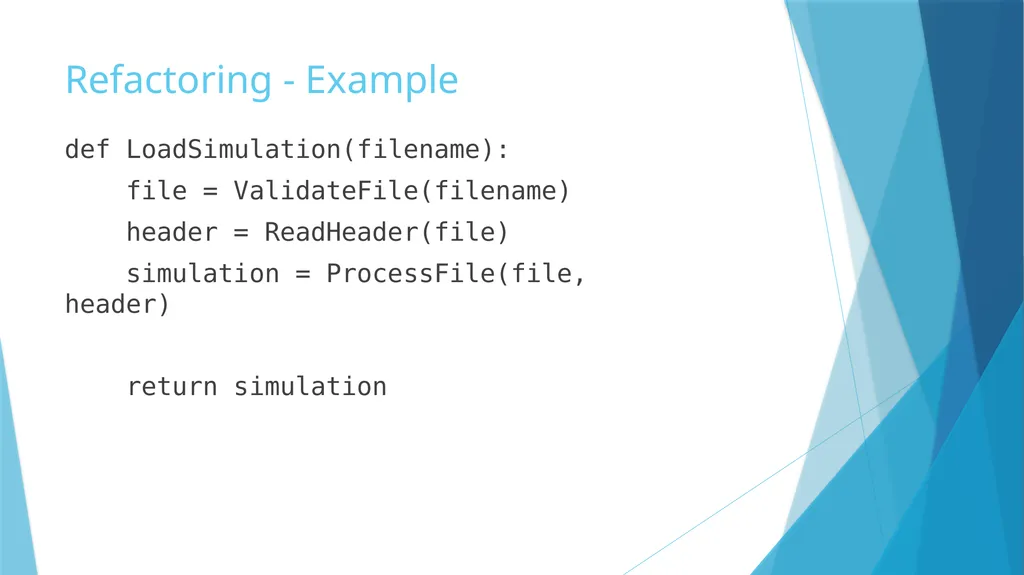
Refactoring - Example def LoadSimulation(filename):
file = ValidateFile(filename)
header = ReadHeader(file)
simulation = ProcessFile(file, header)
return simulation<br>
file = ValidateFile(filename)
header = ReadHeader(file)
simulation = ProcessFile(file, header)
return simulation<br>
52
Source Control “Source control is one of those things that seems pointless until you need it. Then you realize that you can't do without it. Unfortunately, by then it's too late. Sort of like flood insurance, except I find source control to have far greater utility.” – Rein Henrichs<br>
53
Source Control – Also Known As… Revision Control System (RCS)
Version Control System (VCS)
Source Code/Control Management (SCM)<br>
Version Control System (VCS)
Source Code/Control Management (SCM)<br>
54
Source Control – Why? It provides a place to store your source code.
It can provide a way for people to work on separate tasks in parallel, merging their efforts later.
It can provide a way for people to work together without getting in each others' way.
It provides a historical record of what you have done over time.<br>
It can provide a way for people to work on separate tasks in parallel, merging their efforts later.
It can provide a way for people to work together without getting in each others' way.
It provides a historical record of what you have done over time.<br>
55
Source Control – Functions Create repository –
Start a collection of source files and initialize the history of changes.
Commit (Add) / Update / Delete / Rename / Move – Common operations on source files, logged to the repository history.
Status / Diff / Log – What files have been modified (edited, renamed, moved, or deleted)? How are edited files different from what is in the repository? Show the history of changes to the repository.
Revert – Undo one or more changes to the repository.
Tag – Identify a state of the repository as a particular version or feature set.
Branch – Make a working copy of the repository for new or speculative work.
Merge / Resolve – Bring new, validated, or parallel work back to the main (master) branch.<br>
Commit (Add) / Update / Delete / Rename / Move – Common operations on source files, logged to the repository history.
Status / Diff / Log – What files have been modified (edited, renamed, moved, or deleted)? How are edited files different from what is in the repository? Show the history of changes to the repository.
Revert – Undo one or more changes to the repository.
Tag – Identify a state of the repository as a particular version or feature set.
Branch – Make a working copy of the repository for new or speculative work.
Merge / Resolve – Bring new, validated, or parallel work back to the main (master) branch.<br>
56
Source Control – vs. Dropbox Packaged changes – all these files were added/modified/changed at the same time to support a new feature or fix a bug
Integrity – do you have all the necessary files?
History – show me the sequence of operations on the repository
Merge / resolve – help me harmonize my changes with someone else’s
Branch – not just a duplicate folder<br>
Integrity – do you have all the necessary files?
History – show me the sequence of operations on the repository
Merge / resolve – help me harmonize my changes with someone else’s
Branch – not just a duplicate folder<br>
57
Source Control – Not Just for Source Good for just about any text file (CSV, HTML, JSON, etc.)
Okay for documents (Word, Excel, etc.)
Okay for binary files up to some size (JPEG, GIF, etc.)
Not well suited to large binary files like videos.<br>
Okay for documents (Word, Excel, etc.)
Okay for binary files up to some size (JPEG, GIF, etc.)
Not well suited to large binary files like videos.<br>
58
Source Control - References Plenty on the web:
Version Control By Example - http://ericsink.com/vcbe/html/index.html
and many, many more
Git (https://git-scm.com/)
Mercurial (https://www.mercurial-scm.org/)
Subversion (https://subversion.apache.org/)
Fossil (https://www.fossil-scm.org)<br>
Git (https://git-scm.com/)
Mercurial (https://www.mercurial-scm.org/)
Subversion (https://subversion.apache.org/)
Fossil (https://www.fossil-scm.org)<br>
59
Integrated Development Environments<br>
60
IDEs - Options Visual Studio (Windows) – multiple languages: C#, C++, Python, …
Eclipse (Cross-platform) – multiple languages: Java, C/C++, PHP, …
PyCharm (Cross-platform) – python
Some current editors are configurable to work as an IDE:
Visual Studio Code (Cross-platform) – multiple languages
Sublime Text (Cross-platform) – multiple languages
Atom (Cross-platform) – multiple languages<br>
Eclipse (Cross-platform) – multiple languages: Java, C/C++, PHP, …
PyCharm (Cross-platform) – python
Some current editors are configurable to work as an IDE:
Visual Studio Code (Cross-platform) – multiple languages
Sublime Text (Cross-platform) – multiple languages
Atom (Cross-platform) – multiple languages<br>
61
IDEs - Value Some will help with formatting:
automatically indent
flag variations from a standard
Autocomplete
Nearly all include syntax highlighting.
Renaming across files
Some include unit test framework integration
Many include source control integration<br>
Autocomplete
Nearly all include syntax highlighting.
Renaming across files
Some include unit test framework integration
Many include source control integration<br>
62
Closing Formatting – readability
Comments – identify “bad” code - understanding
Error checking/error handling – user friendly
Component tests – verify functionality for you and others
Refactoring – iterative improvement
Source Control – history and deployment
IDEs – putting your resources to use<br>
Comments – identify “bad” code - understanding
Error checking/error handling – user friendly
Component tests – verify functionality for you and others
Refactoring – iterative improvement
Source Control – history and deployment
IDEs – putting your resources to use<br>