
Software Engineering COMP 201 Lecturer: Sebastian
Description: Software Engineering COMP 201 Lecturer: Sebastian Coope Ashton Building, Room G.18 E-mail: coopesliverpool.ac.uk COMP 201 web-page: http:www.csc.liv.ac.ukcoopescomp201 Lecture 6 Requirements Engineering Processes 1 COMP201 -
Related Topics
Download Presentation
"Software Engineering COMP 201 Lecturer: Sebastian" is the property of its rightful owner. Permission is granted to download and print the materials on this website for personal, non-commercial use only, and to display it on your personal computer provided you do not modify the materials and that you retain all copyright notices contained in the materials. By downloading content from our website, you accept the terms of this agreement.
Presentation Transcript
slide1. Software Engineering
COMP 201 Lecturer: Sebastian Coope
Ashton Building, Room G.18
E-mail: coopes@liverpool.ac.uk
COMP 201 web-page:
http://www.csc.liv.ac.uk/~coopes/comp201
Lecture 6 – Requirements Engineering Processes 1 COMP201 - Software Engineering<br>
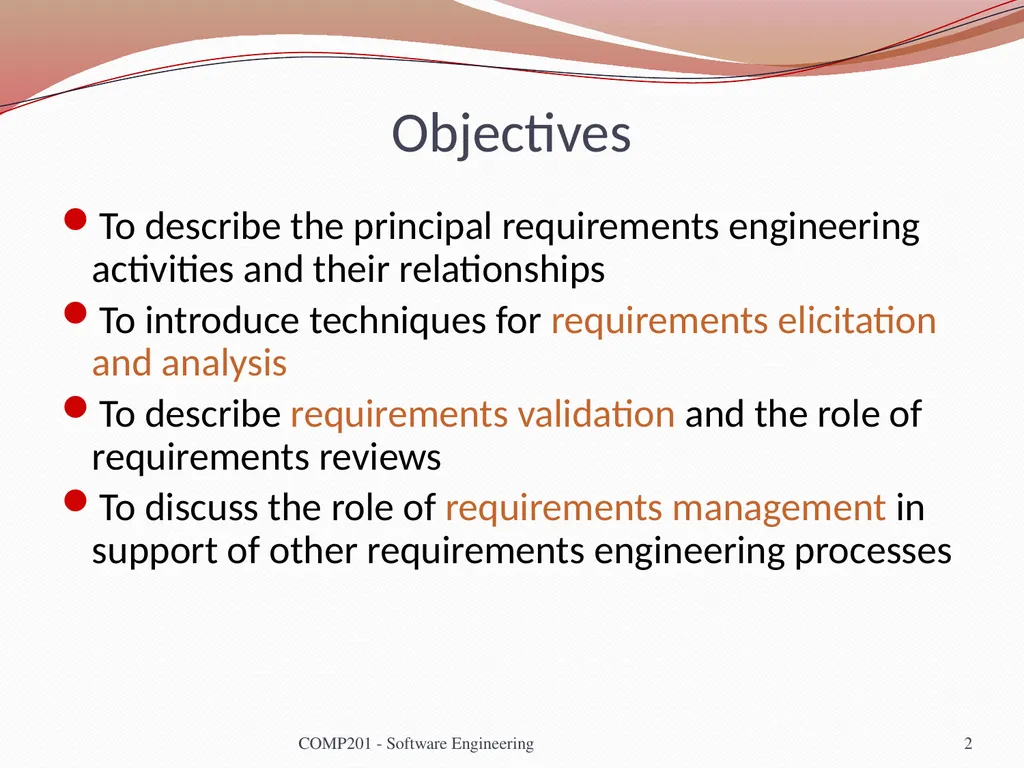
slide2. Objectives To describe the principal requirements engineering activities and their relationships
To introduce techniques for requirements elicitation and analysis
To describe requirements validation and the role of requirements reviews
To discuss the role of requirements management in support of other requirements engineering processes 2 COMP201 - Software Engineering<br>
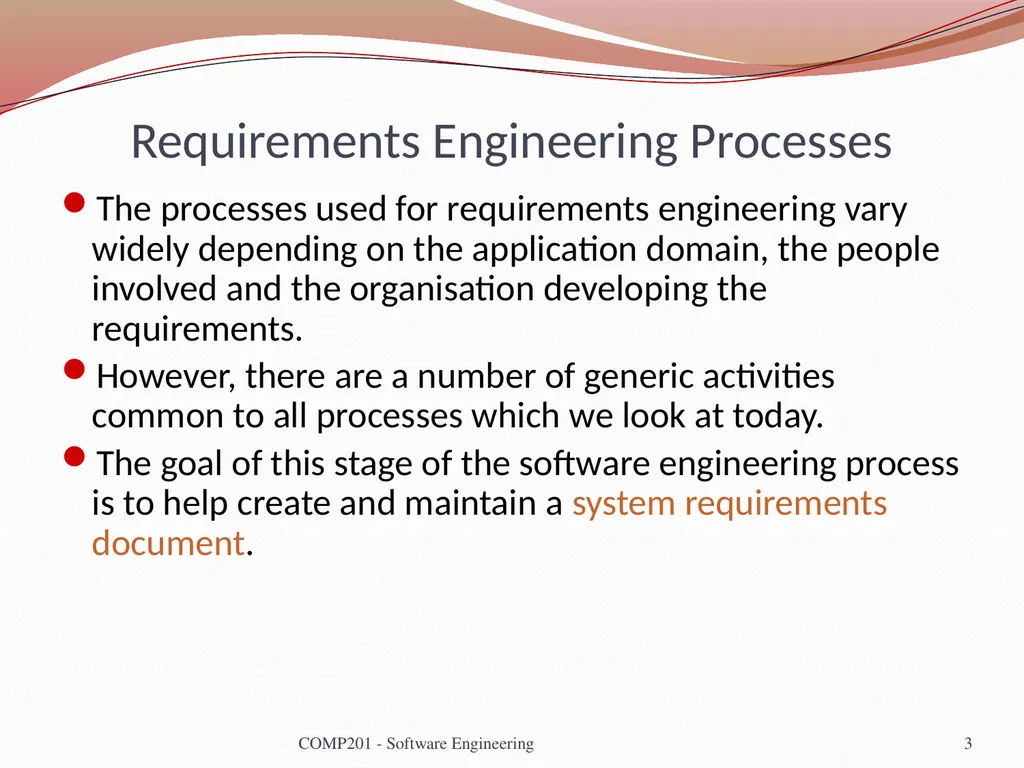
slide3. Requirements Engineering Processes The processes used for requirements engineering vary widely depending on the application domain, the people involved and the organisation developing the requirements.
However, there are a number of generic activities common to all processes which we look at today.
The goal of this stage of the software engineering process is to help create and maintain a system requirements document. 3 COMP201 - Software Engineering<br>
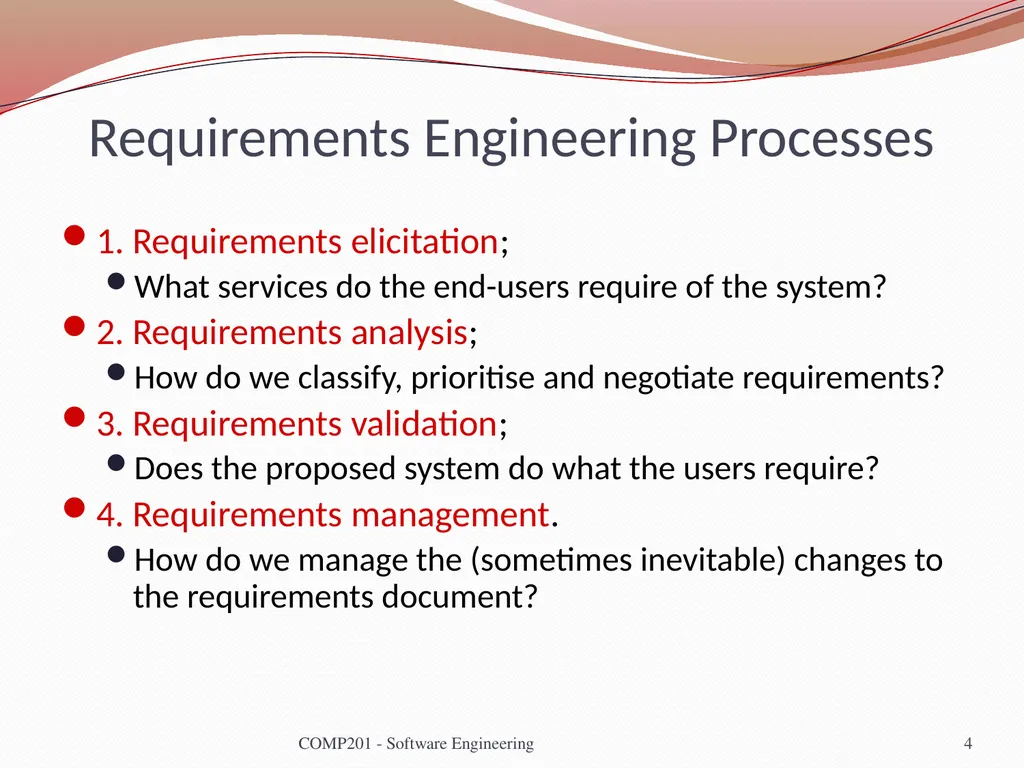
slide4. Requirements Engineering Processes 1. Requirements elicitation;
What services do the end-users require of the system?
2. Requirements analysis;
How do we classify, prioritise and negotiate requirements?
3. Requirements validation;
Does the proposed system do what the users require?
4. Requirements management.
How do we manage the (sometimes inevitable) changes to the requirements document? COMP201 - Software Engineering 4<br>
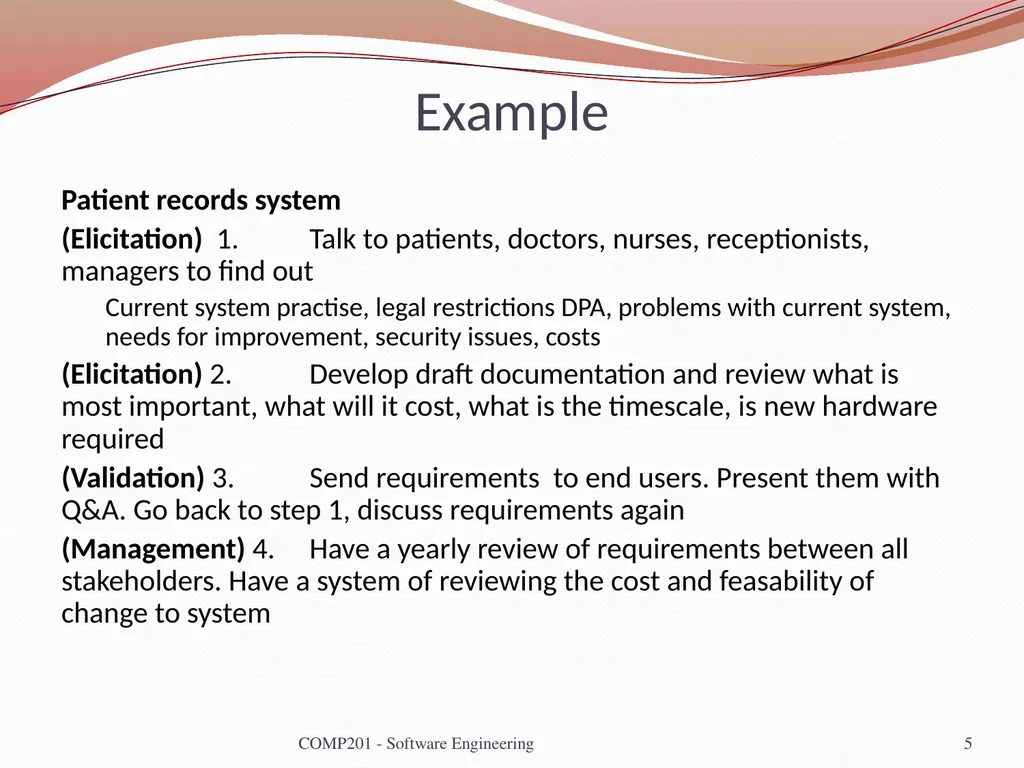
slide5. Example Patient records system
(Elicitation) 1. Talk to patients, doctors, nurses, receptionists, managers to find out
Current system practise, legal restrictions DPA, problems with current system, needs for improvement, security issues, costs
(Elicitation) 2. Develop draft documentation and review what is most important, what will it cost, what is the timescale, is new hardware required
(Validation) 3. Send requirements to end users. Present them with Q&A. Go back to step 1, discuss requirements again
(Management) 4. Have a yearly review of requirements between all stakeholders. Have a system of reviewing the cost and feasability of change to system COMP201 - Software Engineering 5<br>
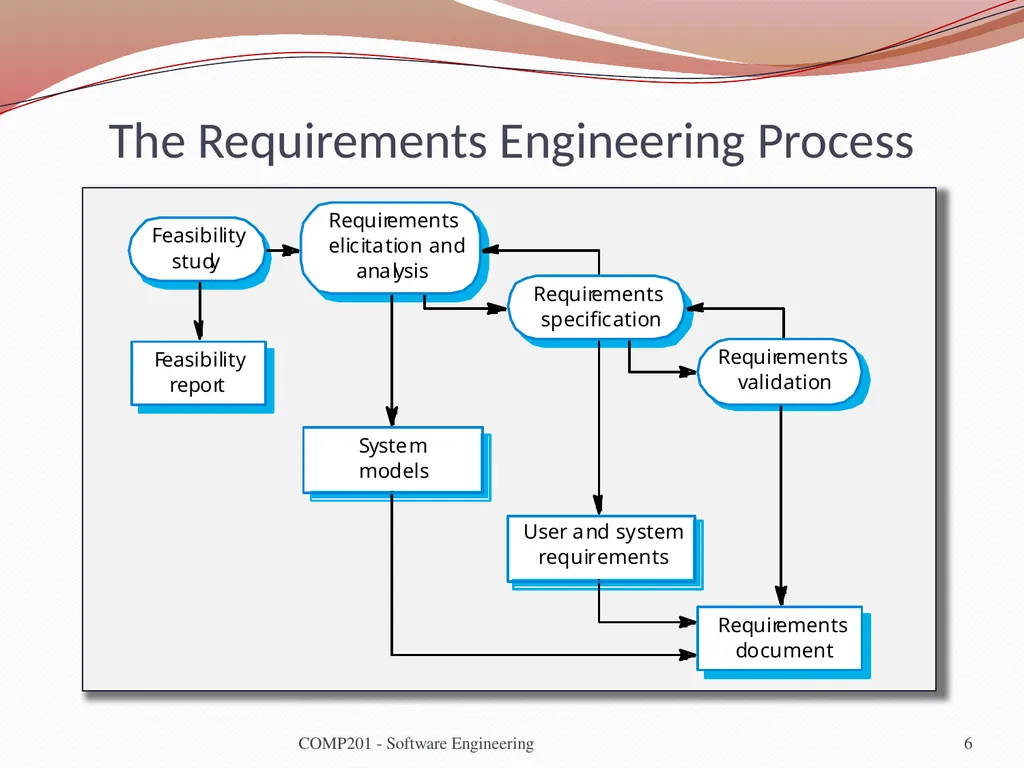
slide6. The Requirements Engineering Process 6 COMP201 - Software Engineering<br>
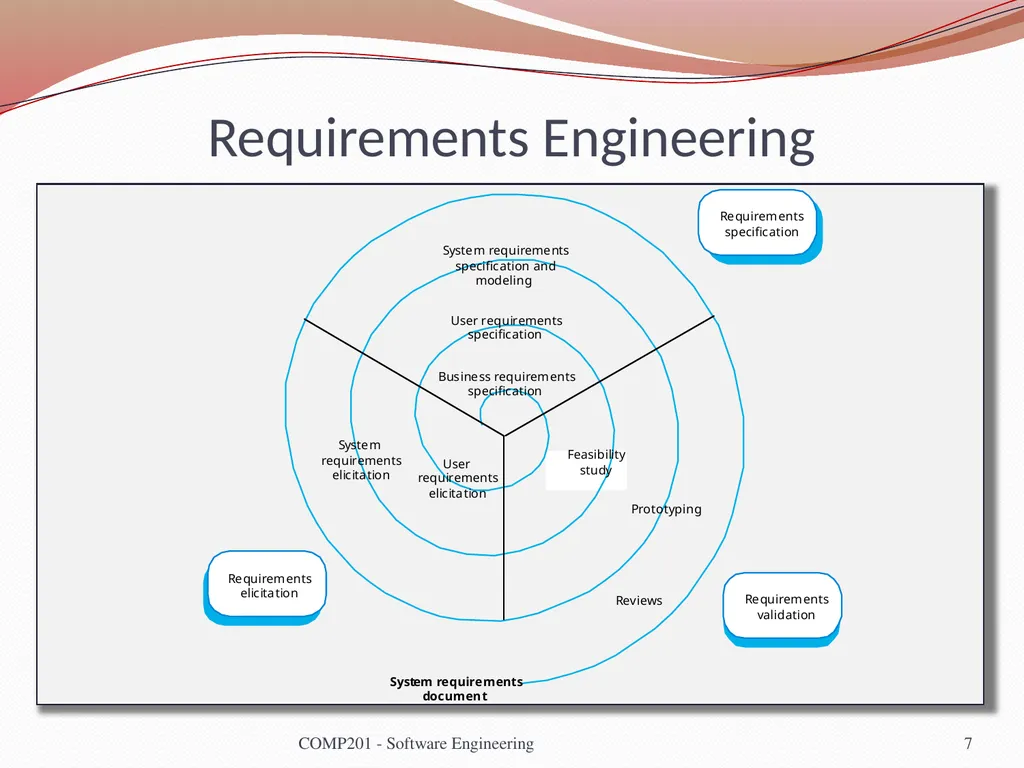
slide7. Requirements Engineering 7 COMP201 - Software Engineering<br>
slide8. Feasibility Studies A feasibility study decides whether or not the proposed system is worthwhile.
A short focused study that checks
If the system contributes to organisational objectives;
If the system can be engineered using current technology and within budget;
If the system can be integrated with other systems that are used.
Is there a simpler way of doing this (buy in software and customize) 8 COMP201 - Software Engineering<br>
slide9. Feasibility Study Implementation Based on information assessment (what is required), information collection and report writing.
Questions for people in the organisation
What if the system wasn’t implemented?
What are current process problems?
How will the proposed system help?
What will be the integration problems?
Is new technology needed? What skills?
What facilities must be supported by the proposed system? 9 COMP201 - Software Engineering<br>
slide10. Elicitation and Analysis Sometimes called requirements elicitation or requirements discovery.
Involves technical staff working with customers to find out about the application domain, the services that the system should provide and the system’s operational constraints.
May involve end-users, managers, engineers involved in maintenance, domain experts, trade unions, etc. These are called stakeholders. 10 COMP201 - Software Engineering<br>
slide11. Problems of Requirements Analysis Stakeholders don’t know what they really want.
Stakeholders express requirements in their own terms.
Different stakeholders may have conflicting requirements
Example, staff easy of use, management highest security
Patients change appointments easily, management plan staff resourcing, reduce costs
Organisational and political factors may influence the system requirements (Data protection)
The requirements change during the analysis process. New stakeholders may emerge and the business environment change. 11 COMP201 - Software Engineering<br>
slide12. Requirements Discovery Requirements discovery is the process of gathering information about the proposed and existing systems and distilling the user and system requirements from this information.
Sources of information include documentation, system stakeholders and the specifications of similar systems 12 COMP201 - Software Engineering<br>
slide13. In the real world Requirements often come from
Copying /modifying the requirements of other systems
Copying and fixing the requirements of a legacy system
Looking at what competitors do and improve on it
Prototyping
A lot of requirements are discovered by prototyping, so the initial requirements are often very thin COMP201 - Software Engineering 13<br>
slide14. Example - ATM Stakeholders Bank customers
Representatives of other banks
Bank managers
Counter staff
Database administrators
Security managers
Marketing department
Hardware and software maintenance engineers
Banking regulators 14 COMP201 - Software Engineering<br>
slide15. Viewpoints Viewpoints are a way of structuring the requirements to represent the perspectives of different stakeholders. Stakeholders may be classified under different viewpoints.
This multi-perspective analysis is important as there is no single correct way to analyse system requirements. 15 COMP201 - Software Engineering<br>
slide16. Viewpoint Identification We may identify viewpoints using
Providers and receivers of system services;
Systems that interact directly with the system being specified;
Regulations and standards;
Sources of business and non-functional requirements.
Engineers who have to develop and maintain the system;
Marketing and other business viewpoints. 16 COMP201 - Software Engineering<br>
slide17. Interviewing In formal or informal interviewing, the RE team puts questions to stakeholders about the system that they use and the system to be developed.
There are two types of interview
Closed interviews where a pre-defined set of questions are answered.
Open interviews where there is no pre-defined agenda and a range of issues are explored with stakeholders.
Ideally, interviewers should be open-minded, willing to listen to stakeholders and should not have pre-conceived ideas. 17 COMP201 - Software Engineering<br>
slide18. Ethnography In ethnography, a social scientist spends a considerable amount of time observing and analysing how people actually work.
People do not have to explain or articulate their work.
Social and organisational factors of importance may be observed.
Ethnographic studies have shown that work is usually richer and more complex than suggested by simple system models. 18 COMP201 - Software Engineering<br>
slide19. Focused Ethnography Developed in a project studying the air traffic control process
Combines ethnography with prototyping
Prototype development results in unanswered questions which focus the ethnographic analysis.
The problem with ethnography is that it studies existing practices which may have some historical basis which is no longer relevant. 19 COMP201 - Software Engineering<br>
slide20. Scope of Ethnography Requirements that are derived from the way that people actually work rather than the way in which process definitions suggest that they ought to work.
People may have “short cuts” or use their previous knowledge and experience to better perform their role which may not be evident.
As an example, an air traffic controller may switch off a conflict alert alarm detecting flight intersections. Their strategy is to ensure these planes are moved apart before problems arise and the alarms can distract them. 20 COMP201 - Software Engineering<br>
slide21. Scope of Ethnography Requirements that are derived from cooperation and awareness of other people’s activities.
People do not work in isolation and may share information and use dialogue with colleagues to inform decisions.
Using the previous scenario, air traffic controllers may use awareness of colleagues work to predict the number of aircraft entering their sector and thus require some visibility of adjacent sector. 21 COMP201 - Software Engineering<br>
slide22. Use Cases Use-Cases are a scenario based technique in the Unified Modeling Language (UML) which identify the actors in an interaction and which describe the interaction itself.
A set of use-cases should describe all possible interactions with the system.
Sequence diagrams may be used to add detail to use-cases by showing the sequence of event processing in the system (we shall study sequence diagrams later). 22 COMP201 - Software Engineering<br>
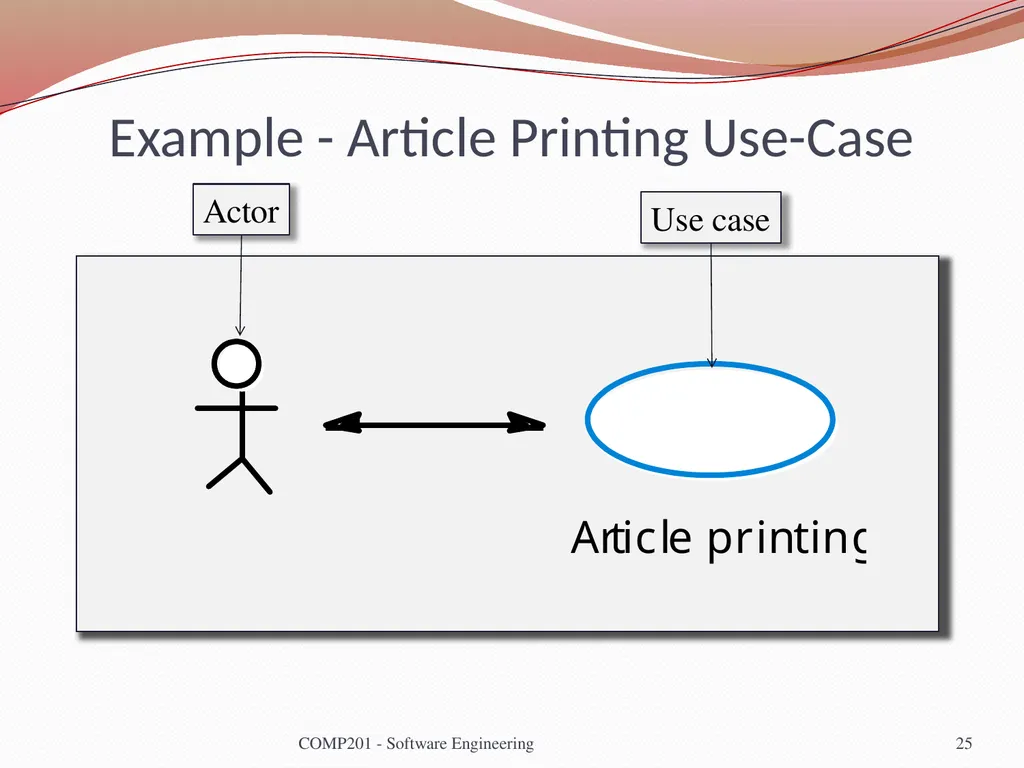
slide23. Use Cases In a use-case diagram, an actor is a user of the system (i.e. Something external to the system; can be human or non-human) acting in a particular role.
A use-case is a task which the actor needs to perform with the help of the system, e.g., find details of a book or print a copy of a receipt in a bookshop. 23 COMP201 - Software Engineering<br>
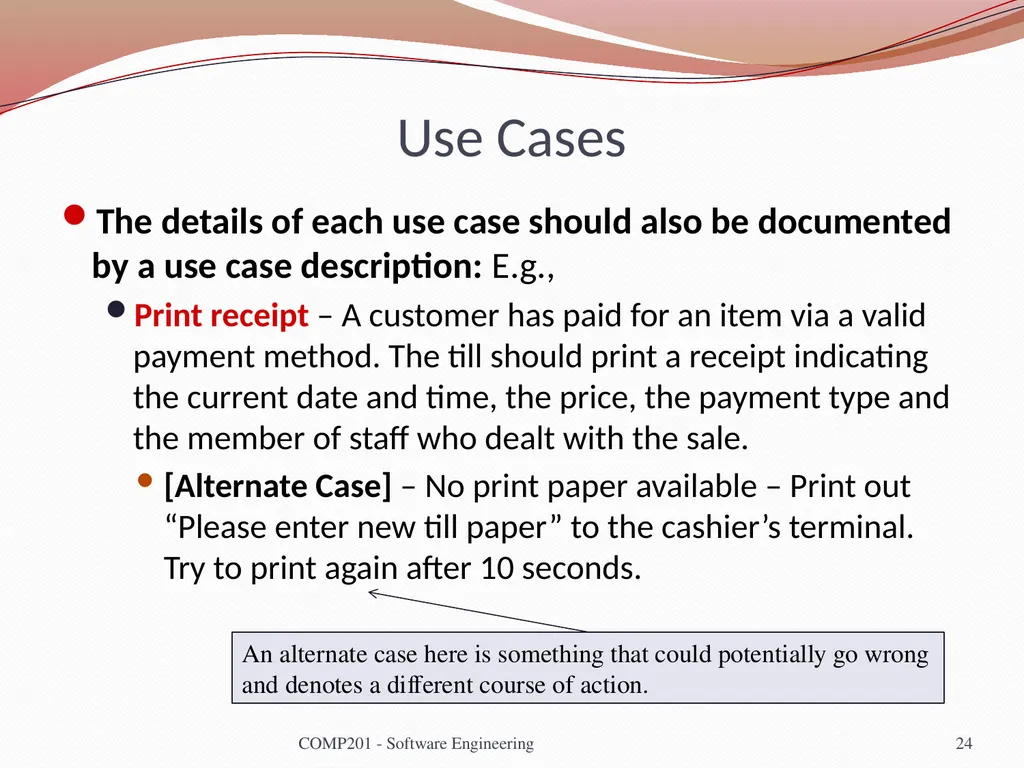
slide24. Use Cases The details of each use case should also be documented by a use case description: E.g.,
Print receipt – A customer has paid for an item via a valid payment method. The till should print a receipt indicating the current date and time, the price, the payment type and the member of staff who dealt with the sale.
[Alternate Case] – No print paper available – Print out “Please enter new till paper” to the cashier’s terminal. Try to print again after 10 seconds. COMP201 - Software Engineering 24 An alternate case here is something that could potentially go wrong and denotes a different course of action.<br>
slide25. Example - Article Printing Use-Case 25 COMP201 - Software Engineering Actor Use case<br>
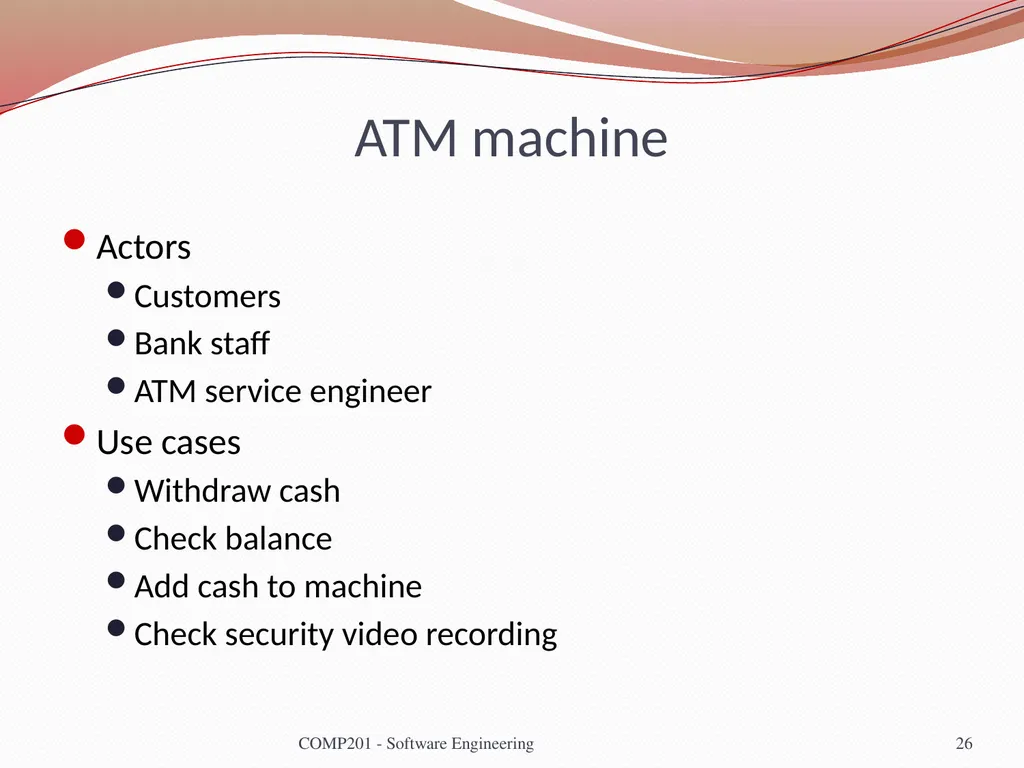
slide26. ATM machine Actors
Customers
Bank staff
ATM service engineer
Use cases
Withdraw cash
Check balance
Add cash to machine
Check security video recording COMP201 - Software Engineering 26<br>
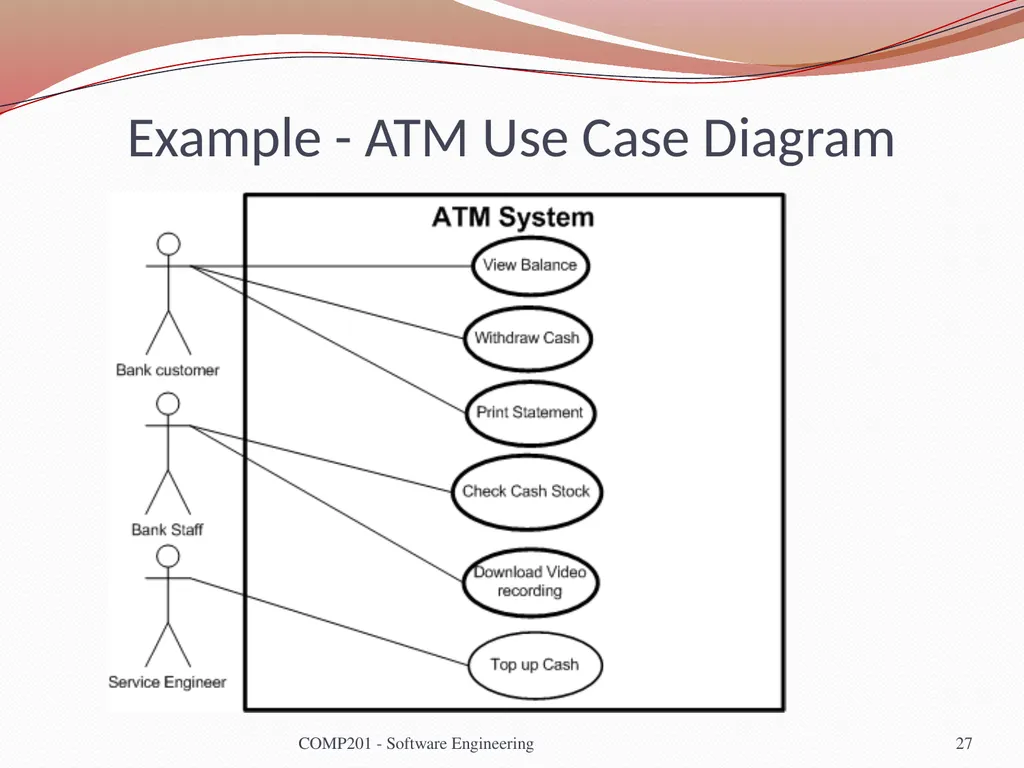
slide27. Example - ATM Use Case Diagram 27 COMP201 - Software Engineering<br>
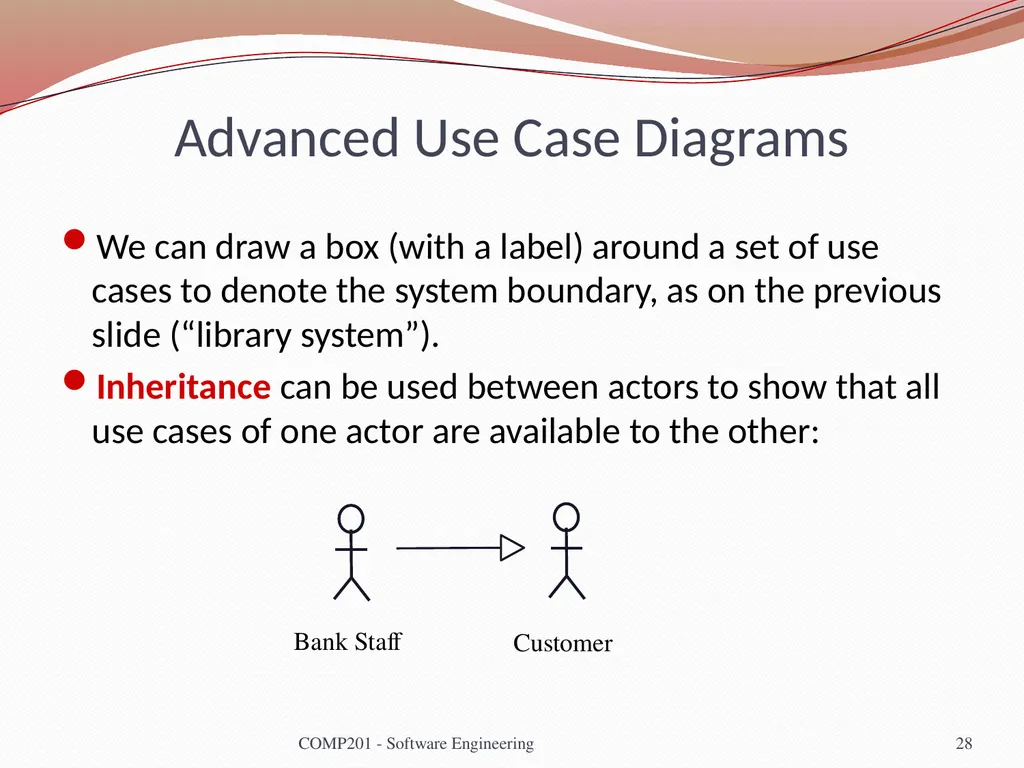
slide28. Advanced Use Case Diagrams We can draw a box (with a label) around a set of use cases to denote the system boundary, as on the previous slide (“library system”).
Inheritance can be used between actors to show that all use cases of one actor are available to the other: COMP201 - Software Engineering 28 Bank Staff Customer<br>
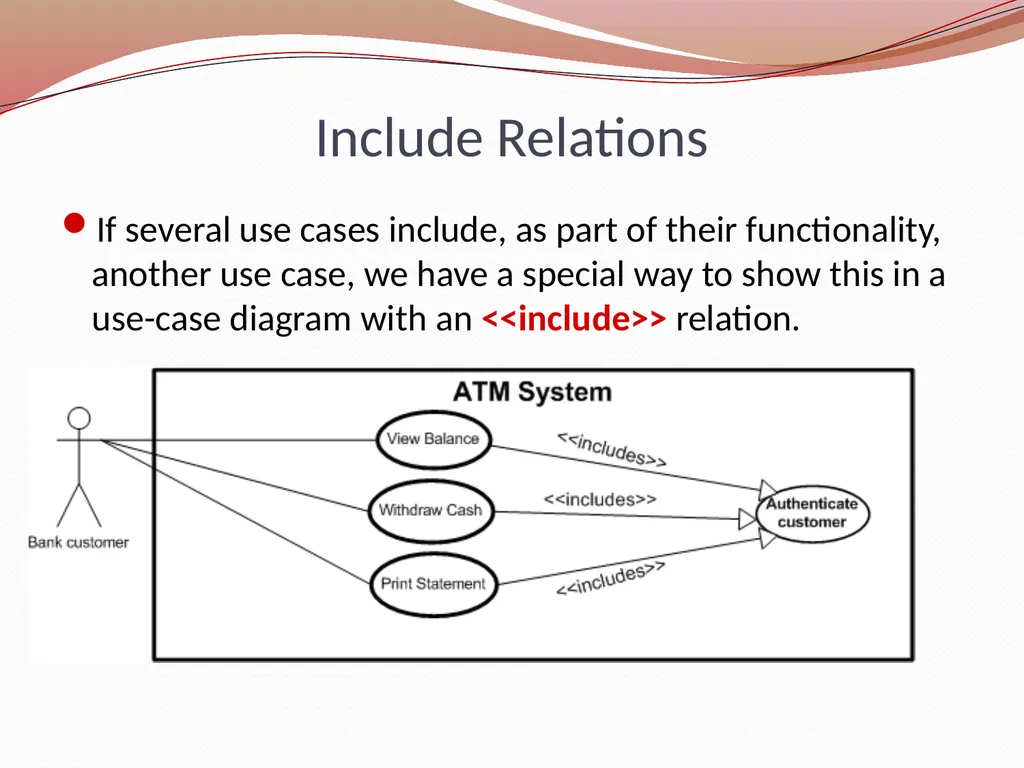
slide29. Include Relations If several use cases include, as part of their functionality, another use case, we have a special way to show this in a use-case diagram with an <<include>> relation.<br>
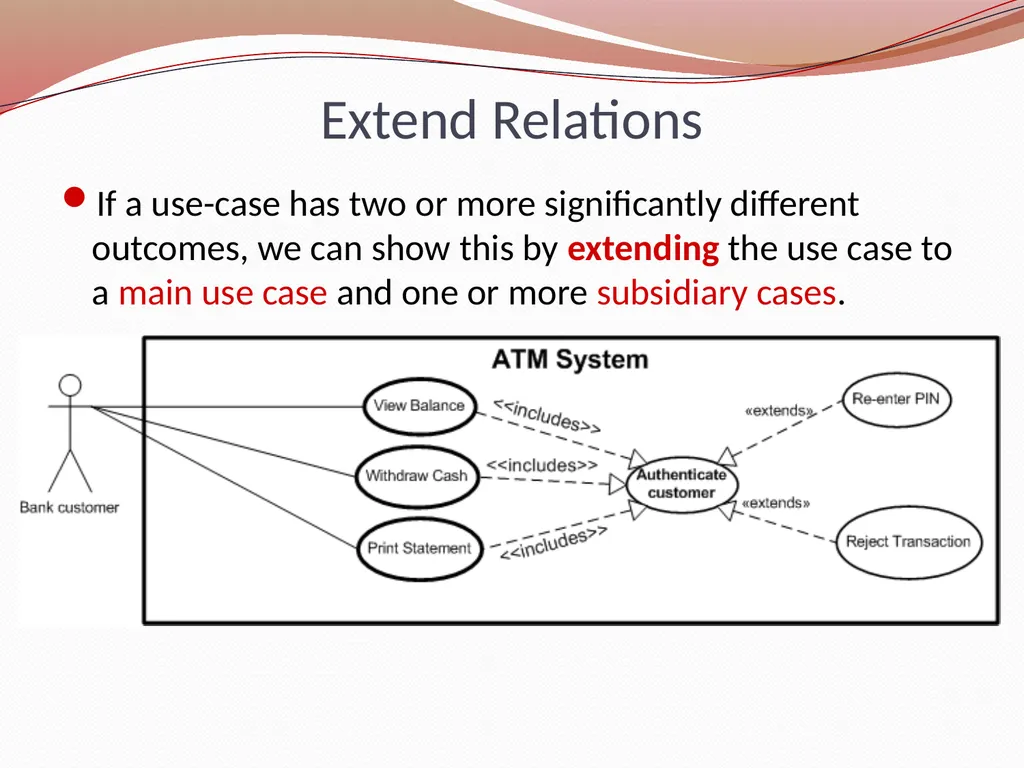
slide30. Extend Relations If a use-case has two or more significantly different outcomes, we can show this by extending the use case to a main use case and one or more subsidiary cases.<br>
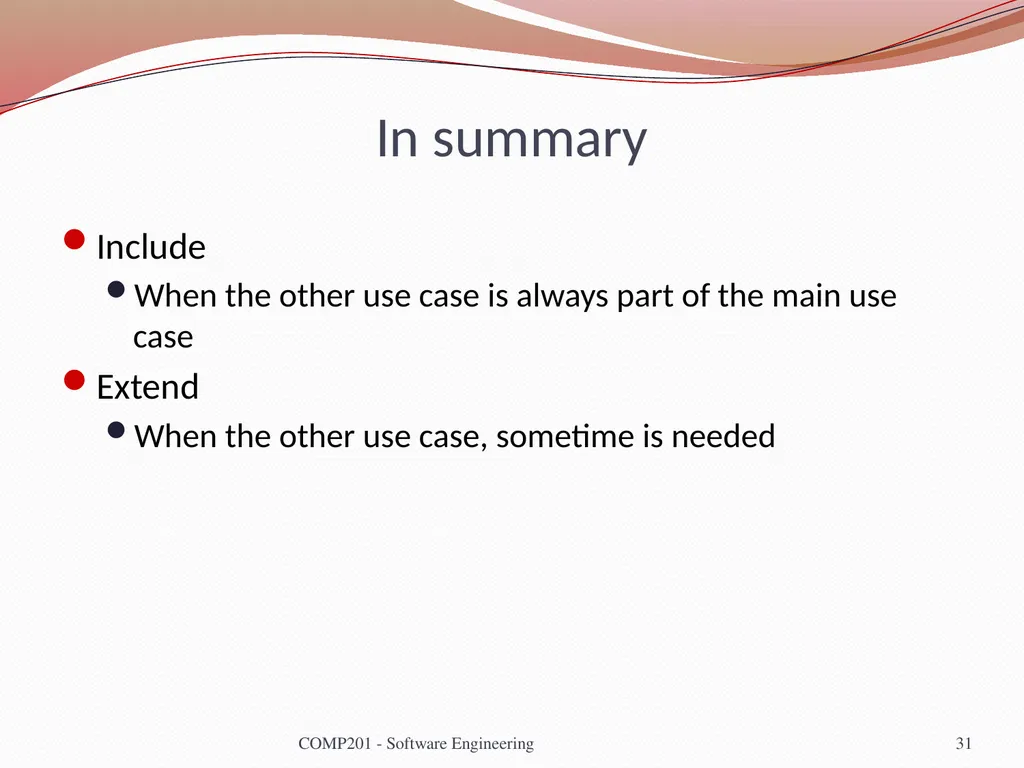
slide31. In summary Include
When the other use case is always part of the main use case
Extend
When the other use case, sometime is needed COMP201 - Software Engineering 31<br>
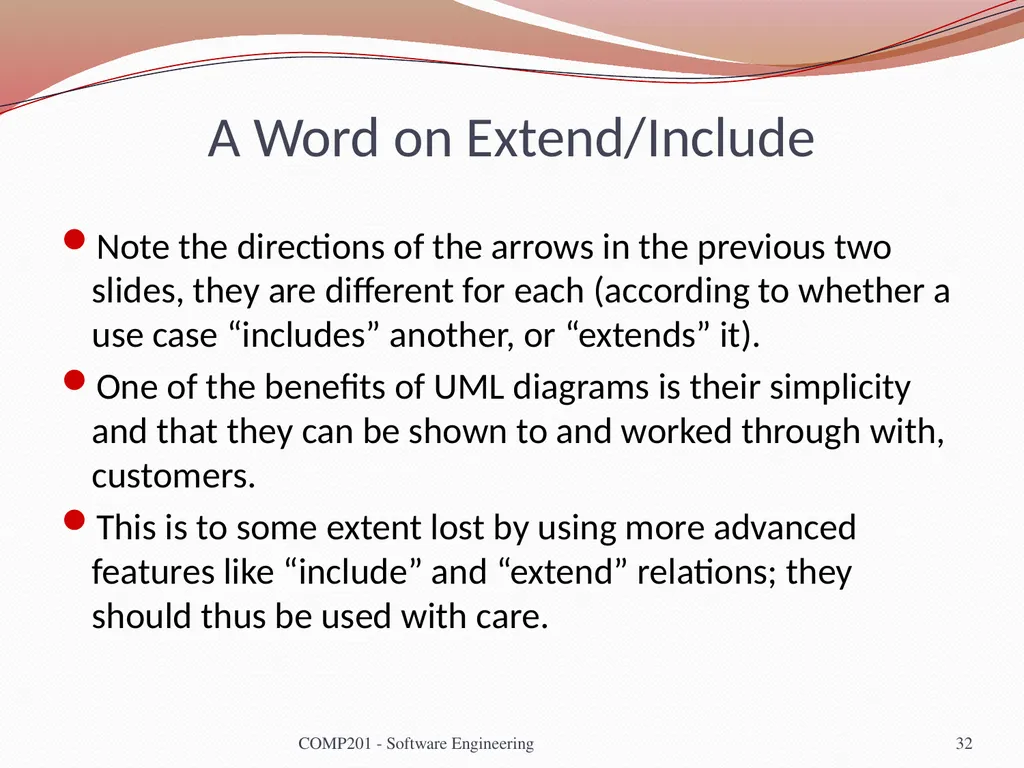
slide32. A Word on Extend/Include Note the directions of the arrows in the previous two slides, they are different for each (according to whether a use case “includes” another, or “extends” it).
One of the benefits of UML diagrams is their simplicity and that they can be shown to and worked through with, customers.
This is to some extent lost by using more advanced features like “include” and “extend” relations; they should thus be used with care. COMP201 - Software Engineering 32<br>
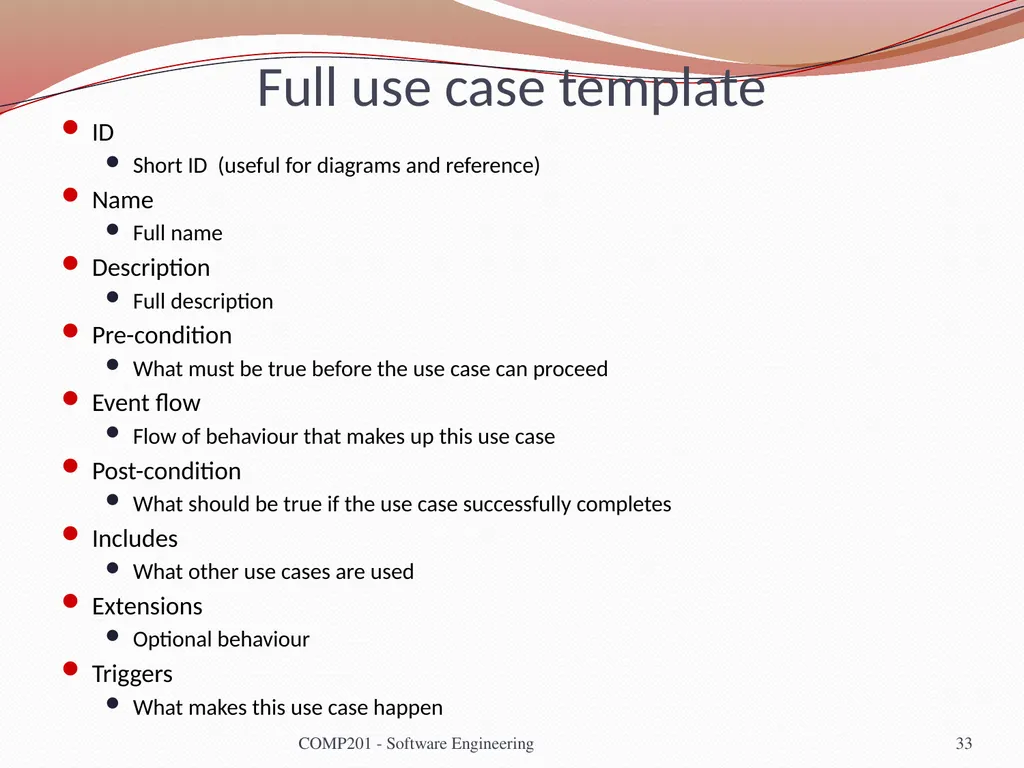
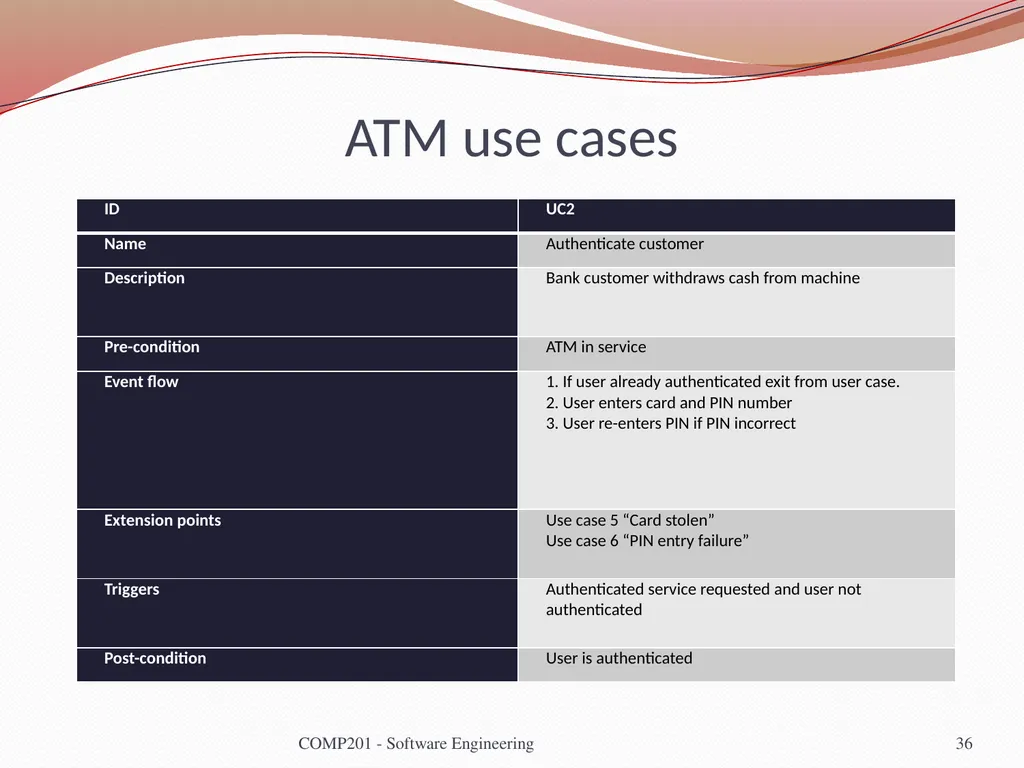
slide33. Full use case template ID
Short ID (useful for diagrams and reference)
Name
Full name
Description
Full description
Pre-condition
What must be true before the use case can proceed
Event flow
Flow of behaviour that makes up this use case
Post-condition
What should be true if the use case successfully completes
Includes
What other use cases are used
Extensions
Optional behaviour
Triggers
What makes this use case happen COMP201 - Software Engineering 33<br>
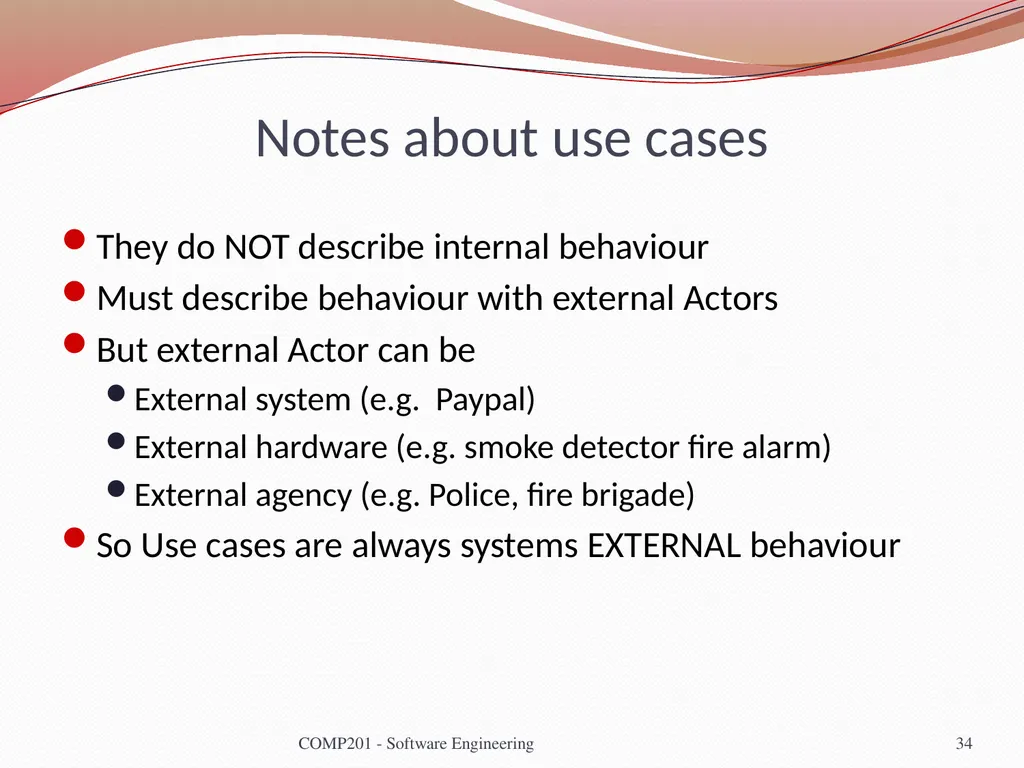
slide34. Notes about use cases They do NOT describe internal behaviour
Must describe behaviour with external Actors
But external Actor can be
External system (e.g. Paypal)
External hardware (e.g. smoke detector fire alarm)
External agency (e.g. Police, fire brigade)
So Use cases are always systems EXTERNAL behaviour COMP201 - Software Engineering 34<br>
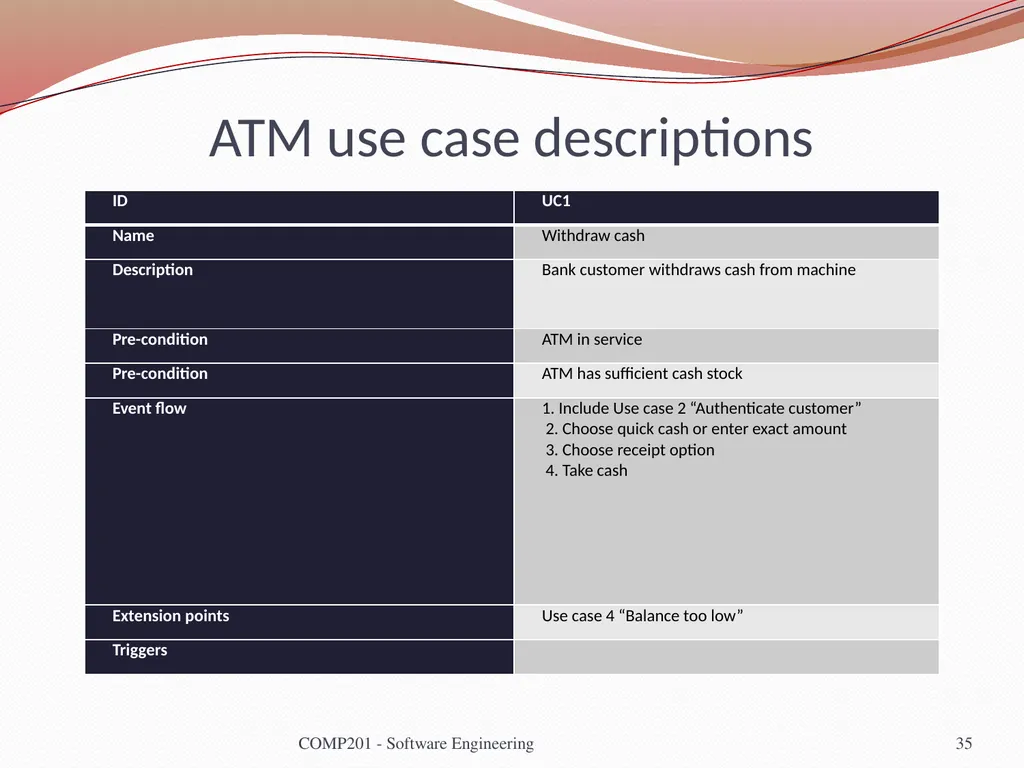
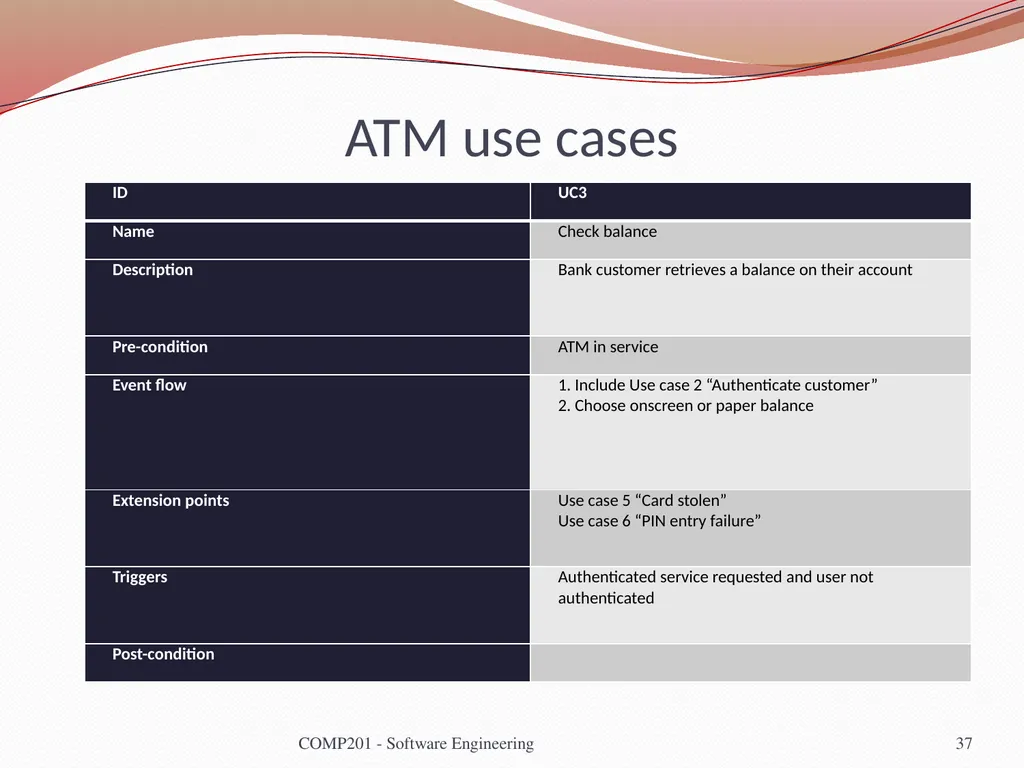
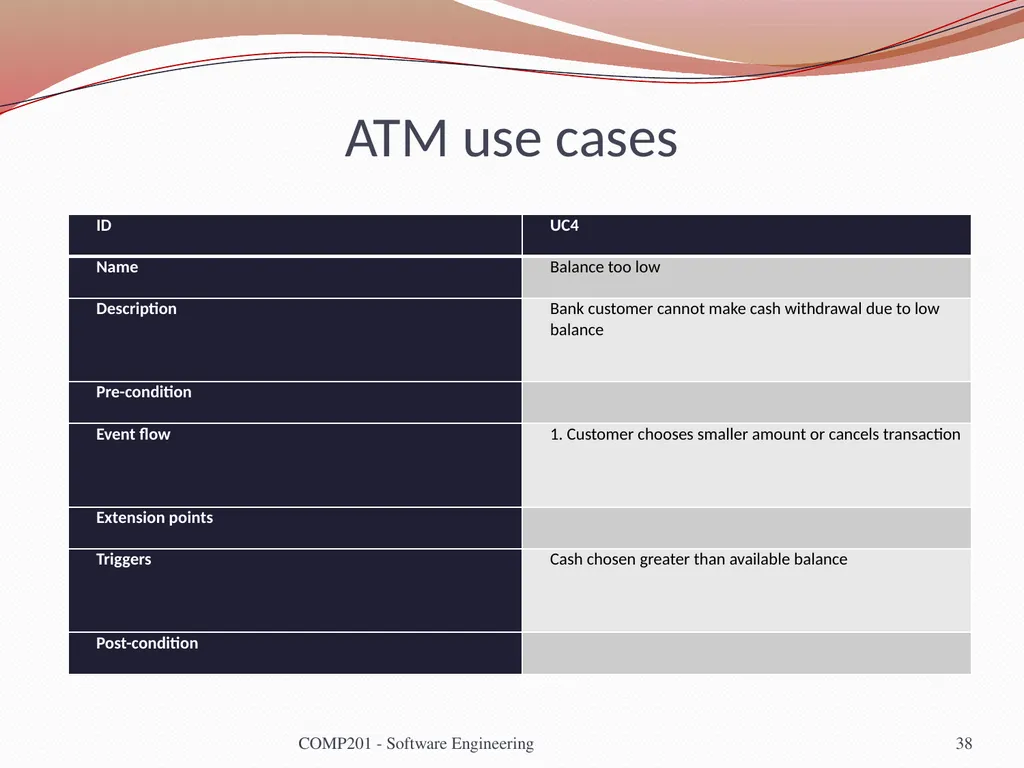
slide35. ATM use case descriptions COMP201 - Software Engineering 35<br>
slide36. ATM use cases COMP201 - Software Engineering 36<br>
slide37. ATM use cases COMP201 - Software Engineering 37<br>
slide38. ATM use cases COMP201 - Software Engineering 38<br>
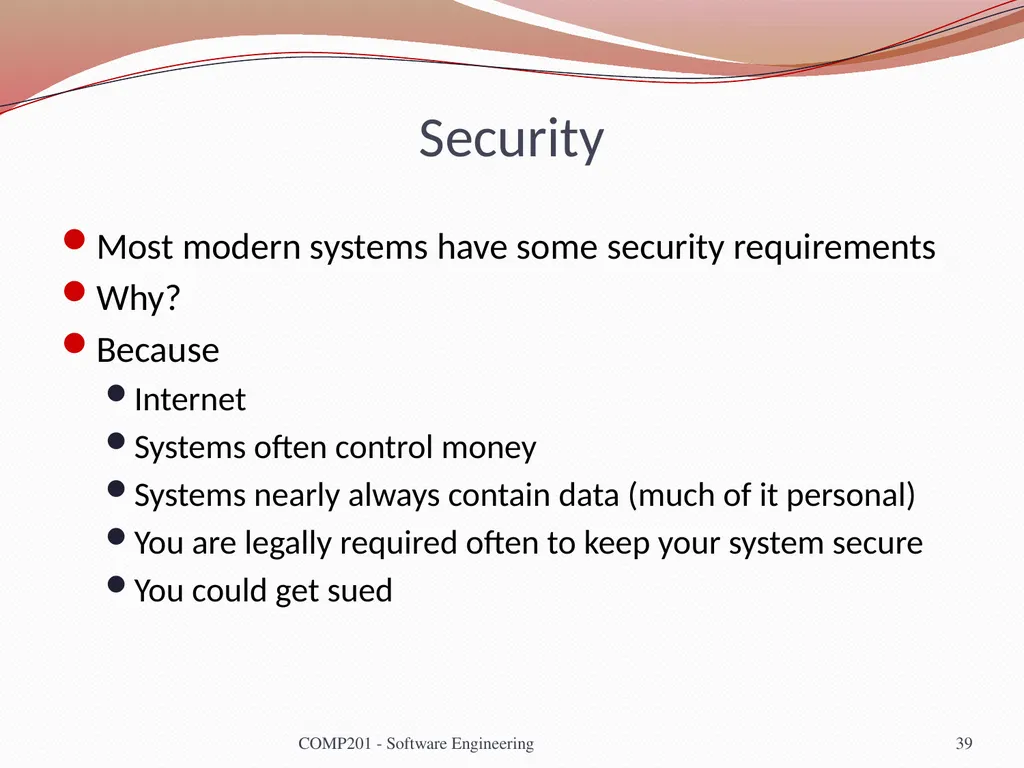
slide39. Security Most modern systems have some security requirements
Why?
Because
Internet
Systems often control money
Systems nearly always contain data (much of it personal)
You are legally required often to keep your system secure
You could get sued COMP201 - Software Engineering 39<br>
slide40. Security requirements of systems Broken down into 4 main issues
Confidentiality
Integrity
Authentication and Authorization
Non-repudiation
One auxiliary issue
Availability (Performance security) COMP201 - Software Engineering 40<br>
slide41. Confidentiality requirements Usually two main options
Encryption (hard security)
Permissions (soft security)
Data must be kept secure
In storage (final or intermediary)
On the wire or wireless link
For as long as reasonably possible COMP201 - Software Engineering 41<br>
slide42. Integrity Requirements Messages or data must not be modifiable without
Knowledge of the change
Integrity approaches
CRC Checking (no good, easy to forge check value)
Hash value over data, similar problem to CRC
Hash value over data + secret value
Key distribution problem
Hash value encrypted using asymmetric cipher
Best approach to date COMP201 - Software Engineering 42<br>
slide43. Authentication/Authorization Authentication
Who are you?
Authorization
What are you allowed to do?
Techniques
Usernames, Passwords, hardware (cards, dongles), Biometrics
Often first point of attack COMP201 - Software Engineering 43<br>
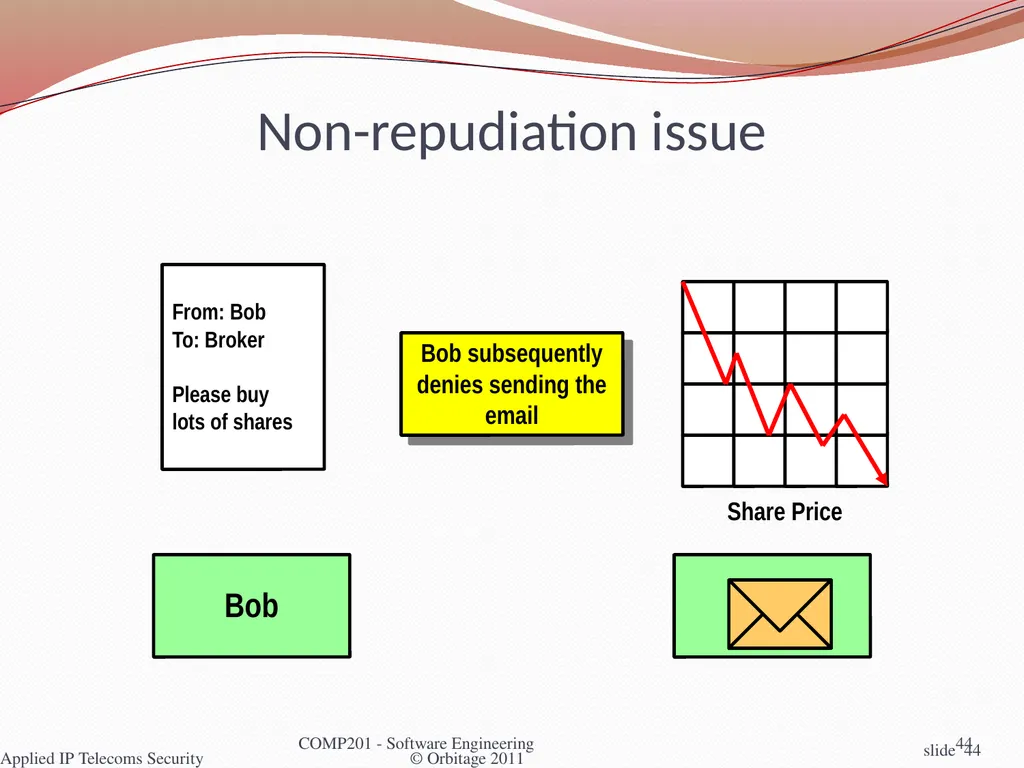
slide44. COMP201 - Software Engineering 44 Non-repudiation issue © Orbitage 2011 Applied IP Telecoms Security slide 44<br>
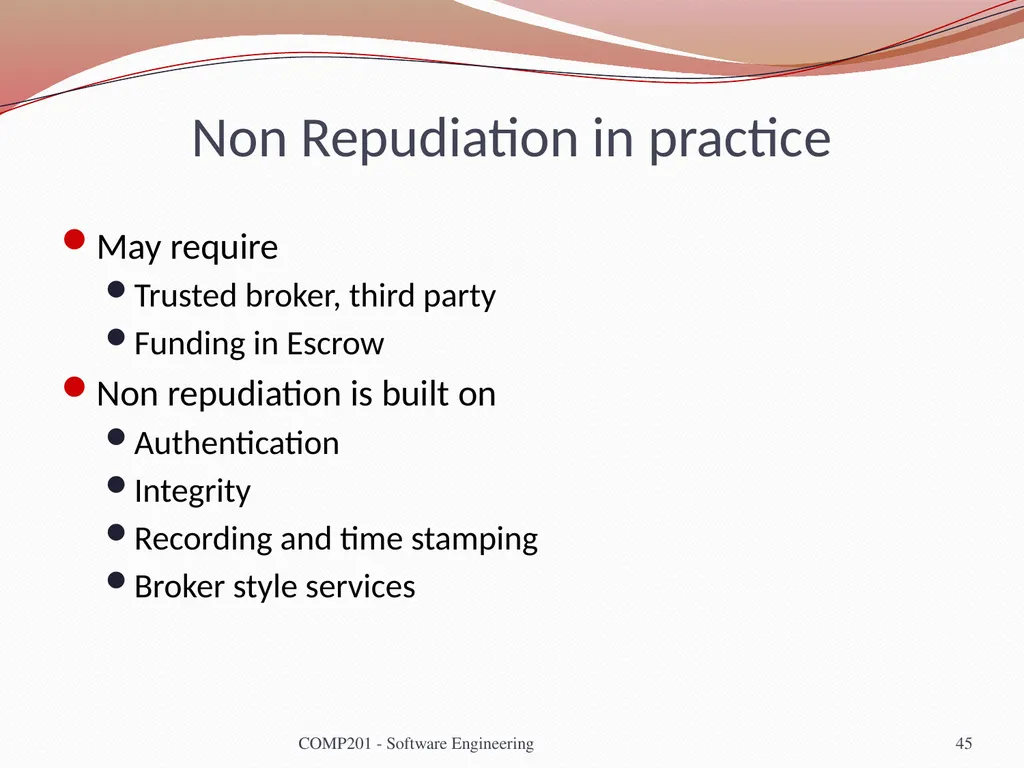
slide45. Non Repudiation in practice May require
Trusted broker, third party
Funding in Escrow
Non repudiation is built on
Authentication
Integrity
Recording and time stamping
Broker style services COMP201 - Software Engineering 45<br>
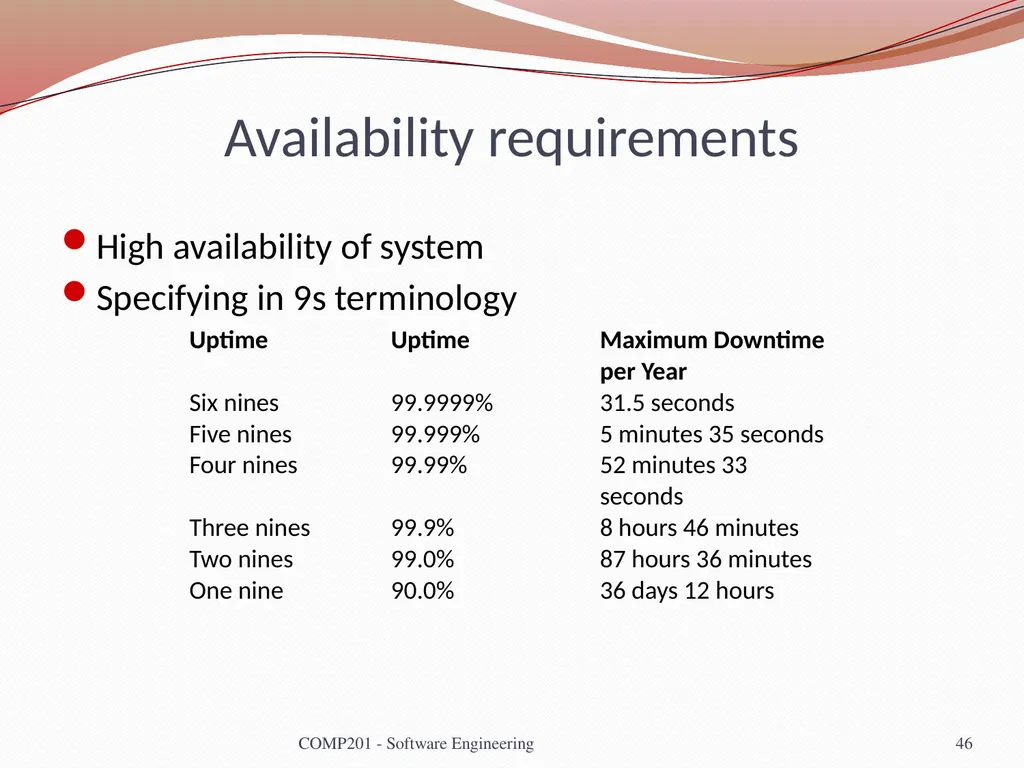
slide46. Availability requirements High availability of system
Specifying in 9s terminology COMP201 - Software Engineering 46<br>
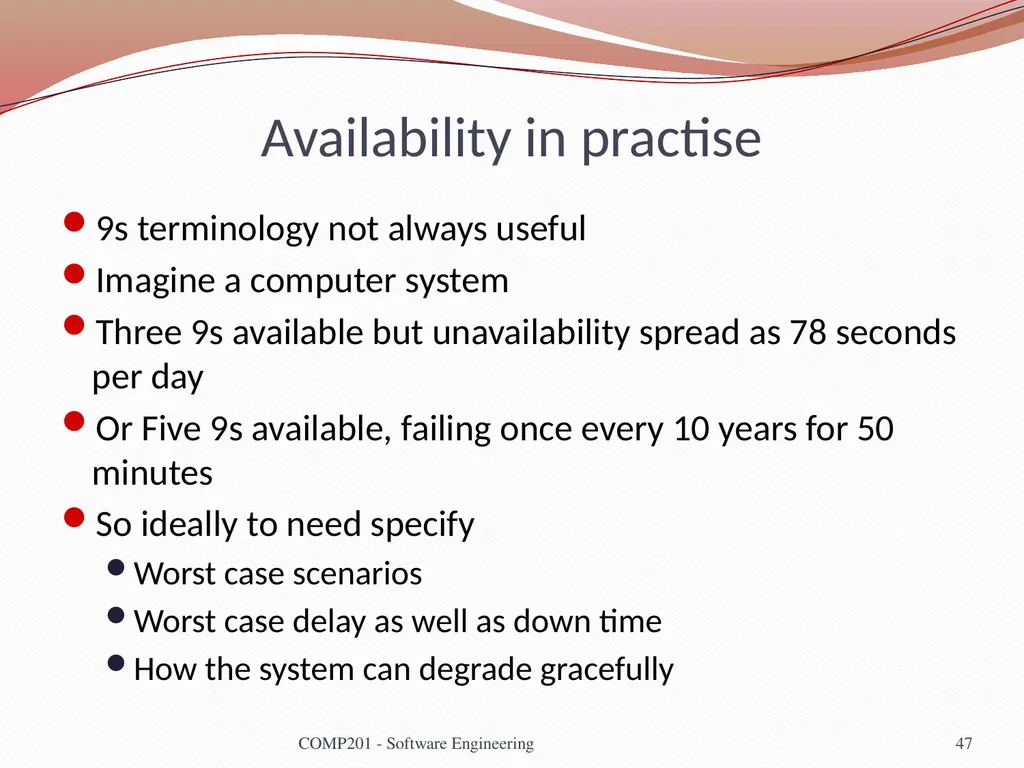
slide47. Availability in practise 9s terminology not always useful
Imagine a computer system
Three 9s available but unavailability spread as 78 seconds per day
Or Five 9s available, failing once every 10 years for 50 minutes
So ideally to need specify
Worst case scenarios
Worst case delay as well as down time
How the system can degrade gracefully COMP201 - Software Engineering 47<br>
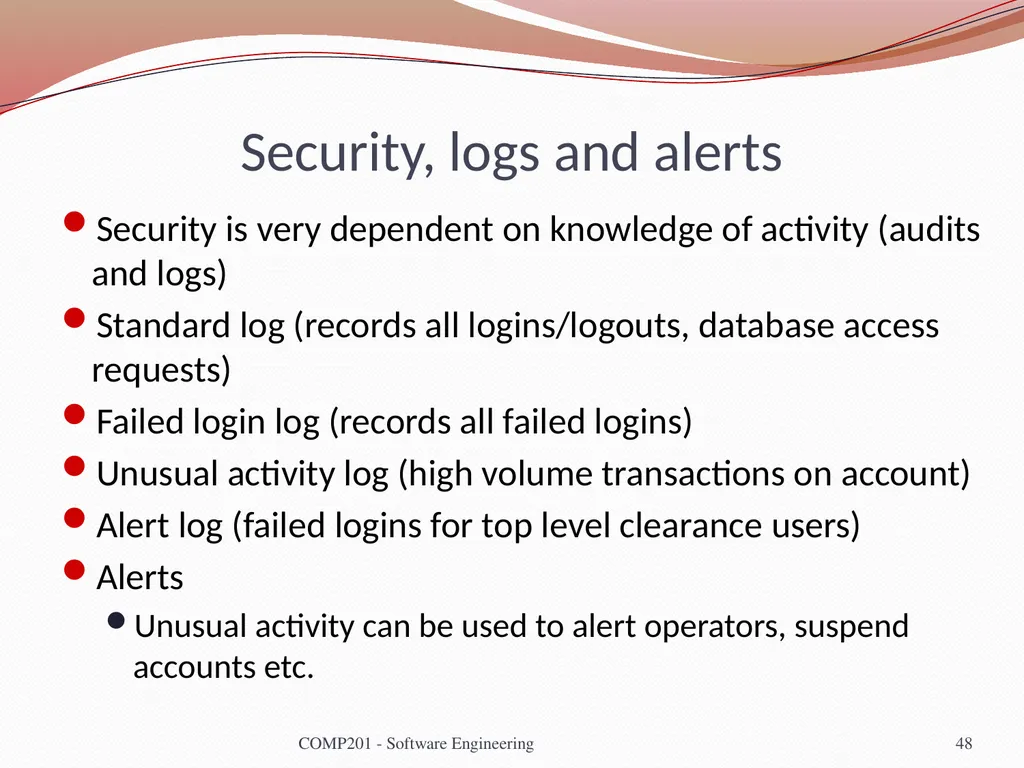
slide48. Security, logs and alerts Security is very dependent on knowledge of activity (audits and logs)
Standard log (records all logins/logouts, database access requests)
Failed login log (records all failed logins)
Unusual activity log (high volume transactions on account)
Alert log (failed logins for top level clearance users)
Alerts
Unusual activity can be used to alert operators, suspend accounts etc. COMP201 - Software Engineering 48<br>
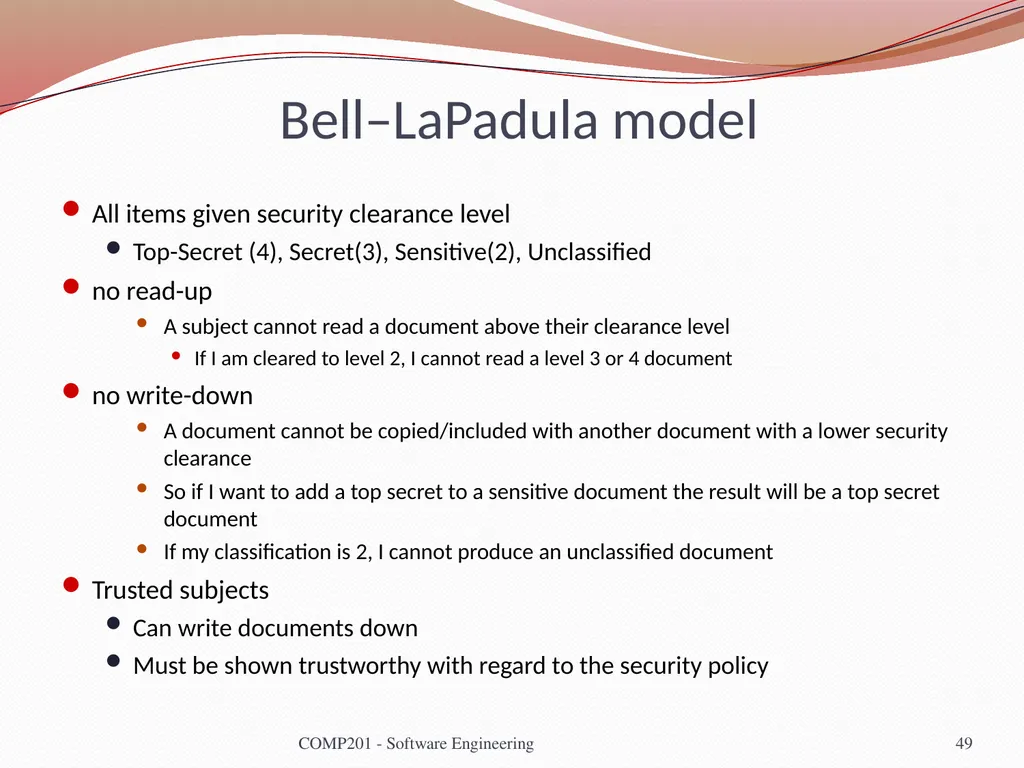
slide49. Bell–LaPadula model All items given security clearance level
Top-Secret (4), Secret(3), Sensitive(2), Unclassified
no read-up
A subject cannot read a document above their clearance level
If I am cleared to level 2, I cannot read a level 3 or 4 document
no write-down
A document cannot be copied/included with another document with a lower security clearance
So if I want to add a top secret to a sensitive document the result will be a top secret document
If my classification is 2, I cannot produce an unclassified document
Trusted subjects
Can write documents down
Must be shown trustworthy with regard to the security policy COMP201 - Software Engineering 49<br>
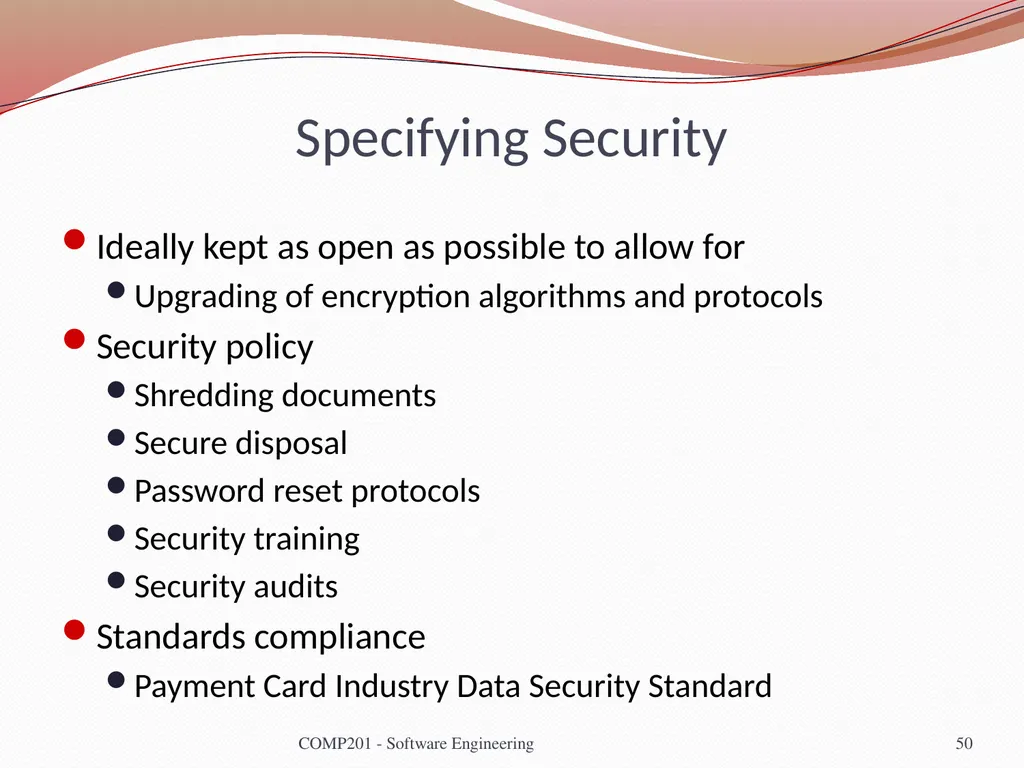
slide50. Specifying Security Ideally kept as open as possible to allow for
Upgrading of encryption algorithms and protocols
Security policy
Shredding documents
Secure disposal
Password reset protocols
Security training
Security audits
Standards compliance
Payment Card Industry Data Security Standard COMP201 - Software Engineering 50<br>
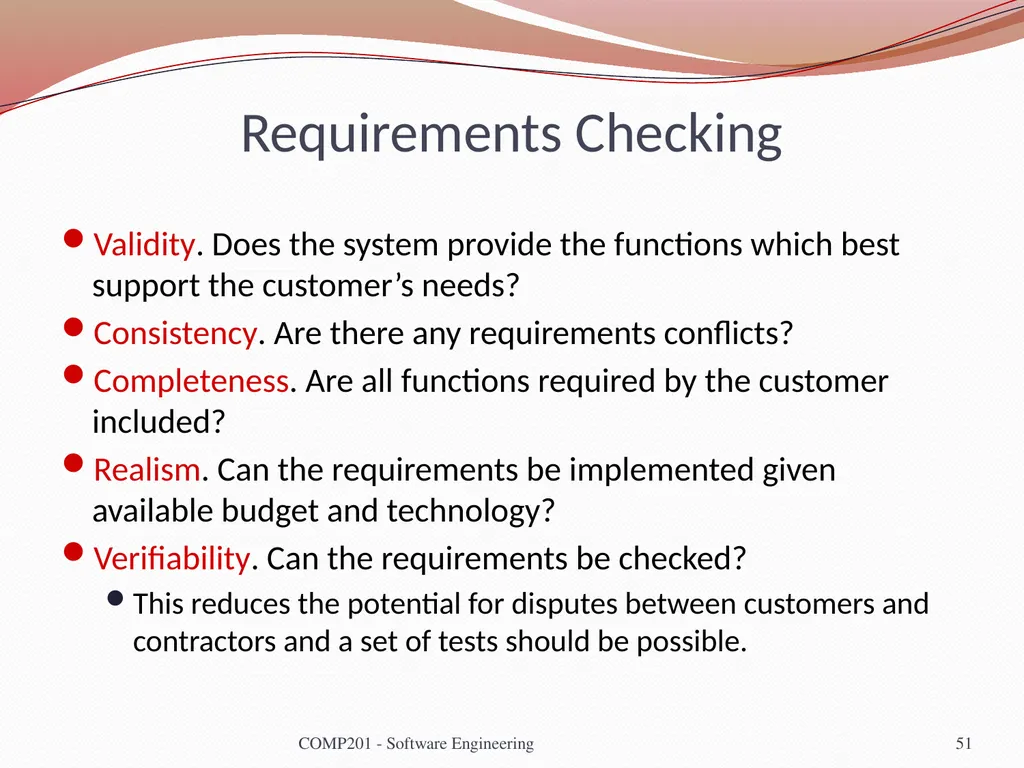
slide51. Requirements Checking Validity. Does the system provide the functions which best support the customer’s needs?
Consistency. Are there any requirements conflicts?
Completeness. Are all functions required by the customer included?
Realism. Can the requirements be implemented given available budget and technology?
Verifiability. Can the requirements be checked?
This reduces the potential for disputes between customers and contractors and a set of tests should be possible. 51 COMP201 - Software Engineering<br>
slide52. Scenarios There are effectively test cases running in a given situation
So for example:
Try and withdraw cash with stolen credit card
Try and withdraw cash but machine has low cash stock
Withdraw cash with card number 3456123245677
Etc.
Scenarios are very important as they
Show the developer by example what will happen given certain conditions
They can be used as a basis to test the software
Make things very clear and reduce ambiguity COMP201 - Software Engineering 52<br>
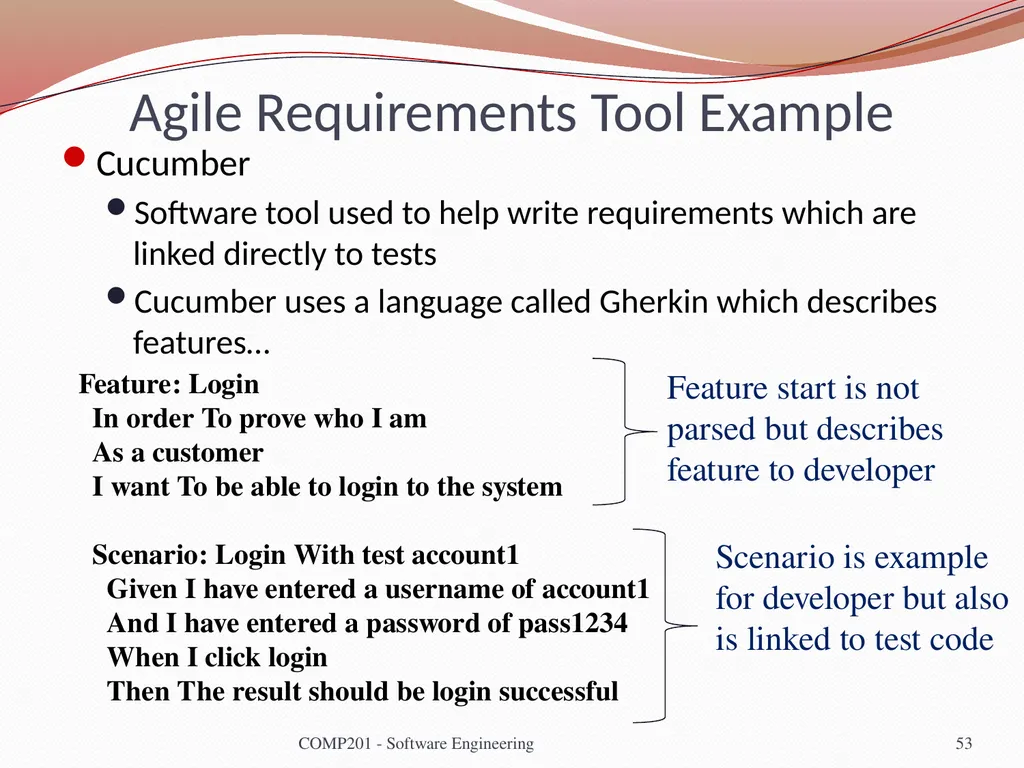
slide53. Agile Requirements Tool Example Cucumber
Software tool used to help write requirements which are linked directly to tests
Cucumber uses a language called Gherkin which describes features… COMP201 - Software Engineering 53 Feature: Login
In order To prove who I am
As a customer
I want To be able to login to the system
Scenario: Login With test account1
Given I have entered a username of account1
And I have entered a password of pass1234
When I click login
Then The result should be login successful Feature start is not
parsed but describes feature to developer Scenario is example for developer but also is linked to test code<br>
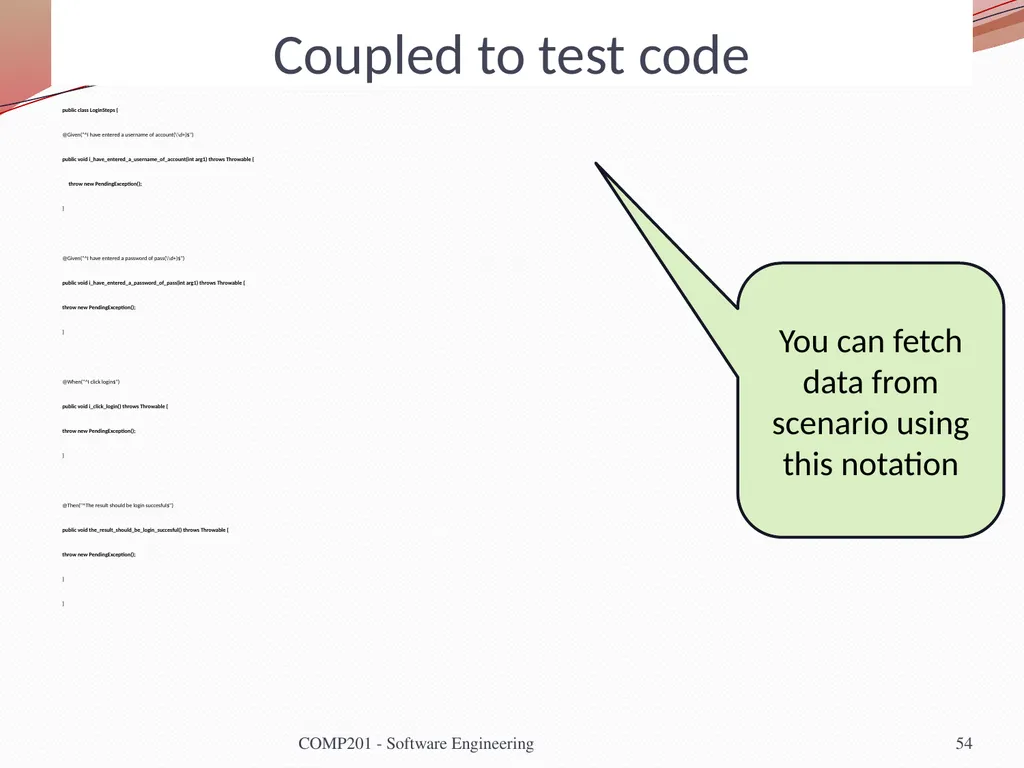
slide54. Coupled to test code public class LoginSteps {
@Given("^I have entered a username of account(\\d+)$")
public void i_have_entered_a_username_of_account(int arg1) throws Throwable {
throw new PendingException();
}
@Given("^I have entered a password of pass(\\d+)$")
public void i_have_entered_a_password_of_pass(int arg1) throws Throwable {
throw new PendingException();
}
@When("^I click login$")
public void i_click_login() throws Throwable {
throw new PendingException();
}
@Then("^The result should be login succesful$")
public void the_result_should_be_login_succesful() throws Throwable {
throw new PendingException();
}
} COMP201 - Software Engineering 54 You can fetch data from scenario using this notation<br>
slide55. Cucumber in summary Gives simple and clear notation to write specification
Analysts/test team and even customers can learn Gherkin and develop feature files
Step files are produced by development team
Test data can be changed later Without changing test code COMP201 - Software Engineering 55<br>
slide56. Lecture Key Points The requirements engineering process includes a feasibility study, requirements elicitation and analysis, requirements specification and requirements management.
The requirements elicitation and analysis stage is iterative and involves domain understanding, requirements collection, classification, structuring, prioritisation and validation.
Systems have multiple stakeholders with different requirements
Security for most systems is a core service 56 COMP201 - Software Engineering<br>
Ashton Building, Room G.18
E-mail: coopes@liverpool.ac.uk
COMP 201 web-page:
http://www.csc.liv.ac.uk/~coopes/comp201
Lecture 6 – Requirements Engineering Processes 1 COMP201 - Software Engineering<br>
slide2. Objectives To describe the principal requirements engineering activities and their relationships
To introduce techniques for requirements elicitation and analysis
To describe requirements validation and the role of requirements reviews
To discuss the role of requirements management in support of other requirements engineering processes 2 COMP201 - Software Engineering<br>
slide3. Requirements Engineering Processes The processes used for requirements engineering vary widely depending on the application domain, the people involved and the organisation developing the requirements.
However, there are a number of generic activities common to all processes which we look at today.
The goal of this stage of the software engineering process is to help create and maintain a system requirements document. 3 COMP201 - Software Engineering<br>
slide4. Requirements Engineering Processes 1. Requirements elicitation;
What services do the end-users require of the system?
2. Requirements analysis;
How do we classify, prioritise and negotiate requirements?
3. Requirements validation;
Does the proposed system do what the users require?
4. Requirements management.
How do we manage the (sometimes inevitable) changes to the requirements document? COMP201 - Software Engineering 4<br>
slide5. Example Patient records system
(Elicitation) 1. Talk to patients, doctors, nurses, receptionists, managers to find out
Current system practise, legal restrictions DPA, problems with current system, needs for improvement, security issues, costs
(Elicitation) 2. Develop draft documentation and review what is most important, what will it cost, what is the timescale, is new hardware required
(Validation) 3. Send requirements to end users. Present them with Q&A. Go back to step 1, discuss requirements again
(Management) 4. Have a yearly review of requirements between all stakeholders. Have a system of reviewing the cost and feasability of change to system COMP201 - Software Engineering 5<br>
slide6. The Requirements Engineering Process 6 COMP201 - Software Engineering<br>
slide7. Requirements Engineering 7 COMP201 - Software Engineering<br>
slide8. Feasibility Studies A feasibility study decides whether or not the proposed system is worthwhile.
A short focused study that checks
If the system contributes to organisational objectives;
If the system can be engineered using current technology and within budget;
If the system can be integrated with other systems that are used.
Is there a simpler way of doing this (buy in software and customize) 8 COMP201 - Software Engineering<br>
slide9. Feasibility Study Implementation Based on information assessment (what is required), information collection and report writing.
Questions for people in the organisation
What if the system wasn’t implemented?
What are current process problems?
How will the proposed system help?
What will be the integration problems?
Is new technology needed? What skills?
What facilities must be supported by the proposed system? 9 COMP201 - Software Engineering<br>
slide10. Elicitation and Analysis Sometimes called requirements elicitation or requirements discovery.
Involves technical staff working with customers to find out about the application domain, the services that the system should provide and the system’s operational constraints.
May involve end-users, managers, engineers involved in maintenance, domain experts, trade unions, etc. These are called stakeholders. 10 COMP201 - Software Engineering<br>
slide11. Problems of Requirements Analysis Stakeholders don’t know what they really want.
Stakeholders express requirements in their own terms.
Different stakeholders may have conflicting requirements
Example, staff easy of use, management highest security
Patients change appointments easily, management plan staff resourcing, reduce costs
Organisational and political factors may influence the system requirements (Data protection)
The requirements change during the analysis process. New stakeholders may emerge and the business environment change. 11 COMP201 - Software Engineering<br>
slide12. Requirements Discovery Requirements discovery is the process of gathering information about the proposed and existing systems and distilling the user and system requirements from this information.
Sources of information include documentation, system stakeholders and the specifications of similar systems 12 COMP201 - Software Engineering<br>
slide13. In the real world Requirements often come from
Copying /modifying the requirements of other systems
Copying and fixing the requirements of a legacy system
Looking at what competitors do and improve on it
Prototyping
A lot of requirements are discovered by prototyping, so the initial requirements are often very thin COMP201 - Software Engineering 13<br>
slide14. Example - ATM Stakeholders Bank customers
Representatives of other banks
Bank managers
Counter staff
Database administrators
Security managers
Marketing department
Hardware and software maintenance engineers
Banking regulators 14 COMP201 - Software Engineering<br>
slide15. Viewpoints Viewpoints are a way of structuring the requirements to represent the perspectives of different stakeholders. Stakeholders may be classified under different viewpoints.
This multi-perspective analysis is important as there is no single correct way to analyse system requirements. 15 COMP201 - Software Engineering<br>
slide16. Viewpoint Identification We may identify viewpoints using
Providers and receivers of system services;
Systems that interact directly with the system being specified;
Regulations and standards;
Sources of business and non-functional requirements.
Engineers who have to develop and maintain the system;
Marketing and other business viewpoints. 16 COMP201 - Software Engineering<br>
slide17. Interviewing In formal or informal interviewing, the RE team puts questions to stakeholders about the system that they use and the system to be developed.
There are two types of interview
Closed interviews where a pre-defined set of questions are answered.
Open interviews where there is no pre-defined agenda and a range of issues are explored with stakeholders.
Ideally, interviewers should be open-minded, willing to listen to stakeholders and should not have pre-conceived ideas. 17 COMP201 - Software Engineering<br>
slide18. Ethnography In ethnography, a social scientist spends a considerable amount of time observing and analysing how people actually work.
People do not have to explain or articulate their work.
Social and organisational factors of importance may be observed.
Ethnographic studies have shown that work is usually richer and more complex than suggested by simple system models. 18 COMP201 - Software Engineering<br>
slide19. Focused Ethnography Developed in a project studying the air traffic control process
Combines ethnography with prototyping
Prototype development results in unanswered questions which focus the ethnographic analysis.
The problem with ethnography is that it studies existing practices which may have some historical basis which is no longer relevant. 19 COMP201 - Software Engineering<br>
slide20. Scope of Ethnography Requirements that are derived from the way that people actually work rather than the way in which process definitions suggest that they ought to work.
People may have “short cuts” or use their previous knowledge and experience to better perform their role which may not be evident.
As an example, an air traffic controller may switch off a conflict alert alarm detecting flight intersections. Their strategy is to ensure these planes are moved apart before problems arise and the alarms can distract them. 20 COMP201 - Software Engineering<br>
slide21. Scope of Ethnography Requirements that are derived from cooperation and awareness of other people’s activities.
People do not work in isolation and may share information and use dialogue with colleagues to inform decisions.
Using the previous scenario, air traffic controllers may use awareness of colleagues work to predict the number of aircraft entering their sector and thus require some visibility of adjacent sector. 21 COMP201 - Software Engineering<br>
slide22. Use Cases Use-Cases are a scenario based technique in the Unified Modeling Language (UML) which identify the actors in an interaction and which describe the interaction itself.
A set of use-cases should describe all possible interactions with the system.
Sequence diagrams may be used to add detail to use-cases by showing the sequence of event processing in the system (we shall study sequence diagrams later). 22 COMP201 - Software Engineering<br>
slide23. Use Cases In a use-case diagram, an actor is a user of the system (i.e. Something external to the system; can be human or non-human) acting in a particular role.
A use-case is a task which the actor needs to perform with the help of the system, e.g., find details of a book or print a copy of a receipt in a bookshop. 23 COMP201 - Software Engineering<br>
slide24. Use Cases The details of each use case should also be documented by a use case description: E.g.,
Print receipt – A customer has paid for an item via a valid payment method. The till should print a receipt indicating the current date and time, the price, the payment type and the member of staff who dealt with the sale.
[Alternate Case] – No print paper available – Print out “Please enter new till paper” to the cashier’s terminal. Try to print again after 10 seconds. COMP201 - Software Engineering 24 An alternate case here is something that could potentially go wrong and denotes a different course of action.<br>
slide25. Example - Article Printing Use-Case 25 COMP201 - Software Engineering Actor Use case<br>
slide26. ATM machine Actors
Customers
Bank staff
ATM service engineer
Use cases
Withdraw cash
Check balance
Add cash to machine
Check security video recording COMP201 - Software Engineering 26<br>
slide27. Example - ATM Use Case Diagram 27 COMP201 - Software Engineering<br>
slide28. Advanced Use Case Diagrams We can draw a box (with a label) around a set of use cases to denote the system boundary, as on the previous slide (“library system”).
Inheritance can be used between actors to show that all use cases of one actor are available to the other: COMP201 - Software Engineering 28 Bank Staff Customer<br>
slide29. Include Relations If several use cases include, as part of their functionality, another use case, we have a special way to show this in a use-case diagram with an <<include>> relation.<br>
slide30. Extend Relations If a use-case has two or more significantly different outcomes, we can show this by extending the use case to a main use case and one or more subsidiary cases.<br>
slide31. In summary Include
When the other use case is always part of the main use case
Extend
When the other use case, sometime is needed COMP201 - Software Engineering 31<br>
slide32. A Word on Extend/Include Note the directions of the arrows in the previous two slides, they are different for each (according to whether a use case “includes” another, or “extends” it).
One of the benefits of UML diagrams is their simplicity and that they can be shown to and worked through with, customers.
This is to some extent lost by using more advanced features like “include” and “extend” relations; they should thus be used with care. COMP201 - Software Engineering 32<br>
slide33. Full use case template ID
Short ID (useful for diagrams and reference)
Name
Full name
Description
Full description
Pre-condition
What must be true before the use case can proceed
Event flow
Flow of behaviour that makes up this use case
Post-condition
What should be true if the use case successfully completes
Includes
What other use cases are used
Extensions
Optional behaviour
Triggers
What makes this use case happen COMP201 - Software Engineering 33<br>
slide34. Notes about use cases They do NOT describe internal behaviour
Must describe behaviour with external Actors
But external Actor can be
External system (e.g. Paypal)
External hardware (e.g. smoke detector fire alarm)
External agency (e.g. Police, fire brigade)
So Use cases are always systems EXTERNAL behaviour COMP201 - Software Engineering 34<br>
slide35. ATM use case descriptions COMP201 - Software Engineering 35<br>
slide36. ATM use cases COMP201 - Software Engineering 36<br>
slide37. ATM use cases COMP201 - Software Engineering 37<br>
slide38. ATM use cases COMP201 - Software Engineering 38<br>
slide39. Security Most modern systems have some security requirements
Why?
Because
Internet
Systems often control money
Systems nearly always contain data (much of it personal)
You are legally required often to keep your system secure
You could get sued COMP201 - Software Engineering 39<br>
slide40. Security requirements of systems Broken down into 4 main issues
Confidentiality
Integrity
Authentication and Authorization
Non-repudiation
One auxiliary issue
Availability (Performance security) COMP201 - Software Engineering 40<br>
slide41. Confidentiality requirements Usually two main options
Encryption (hard security)
Permissions (soft security)
Data must be kept secure
In storage (final or intermediary)
On the wire or wireless link
For as long as reasonably possible COMP201 - Software Engineering 41<br>
slide42. Integrity Requirements Messages or data must not be modifiable without
Knowledge of the change
Integrity approaches
CRC Checking (no good, easy to forge check value)
Hash value over data, similar problem to CRC
Hash value over data + secret value
Key distribution problem
Hash value encrypted using asymmetric cipher
Best approach to date COMP201 - Software Engineering 42<br>
slide43. Authentication/Authorization Authentication
Who are you?
Authorization
What are you allowed to do?
Techniques
Usernames, Passwords, hardware (cards, dongles), Biometrics
Often first point of attack COMP201 - Software Engineering 43<br>
slide44. COMP201 - Software Engineering 44 Non-repudiation issue © Orbitage 2011 Applied IP Telecoms Security slide 44<br>
slide45. Non Repudiation in practice May require
Trusted broker, third party
Funding in Escrow
Non repudiation is built on
Authentication
Integrity
Recording and time stamping
Broker style services COMP201 - Software Engineering 45<br>
slide46. Availability requirements High availability of system
Specifying in 9s terminology COMP201 - Software Engineering 46<br>
slide47. Availability in practise 9s terminology not always useful
Imagine a computer system
Three 9s available but unavailability spread as 78 seconds per day
Or Five 9s available, failing once every 10 years for 50 minutes
So ideally to need specify
Worst case scenarios
Worst case delay as well as down time
How the system can degrade gracefully COMP201 - Software Engineering 47<br>
slide48. Security, logs and alerts Security is very dependent on knowledge of activity (audits and logs)
Standard log (records all logins/logouts, database access requests)
Failed login log (records all failed logins)
Unusual activity log (high volume transactions on account)
Alert log (failed logins for top level clearance users)
Alerts
Unusual activity can be used to alert operators, suspend accounts etc. COMP201 - Software Engineering 48<br>
slide49. Bell–LaPadula model All items given security clearance level
Top-Secret (4), Secret(3), Sensitive(2), Unclassified
no read-up
A subject cannot read a document above their clearance level
If I am cleared to level 2, I cannot read a level 3 or 4 document
no write-down
A document cannot be copied/included with another document with a lower security clearance
So if I want to add a top secret to a sensitive document the result will be a top secret document
If my classification is 2, I cannot produce an unclassified document
Trusted subjects
Can write documents down
Must be shown trustworthy with regard to the security policy COMP201 - Software Engineering 49<br>
slide50. Specifying Security Ideally kept as open as possible to allow for
Upgrading of encryption algorithms and protocols
Security policy
Shredding documents
Secure disposal
Password reset protocols
Security training
Security audits
Standards compliance
Payment Card Industry Data Security Standard COMP201 - Software Engineering 50<br>
slide51. Requirements Checking Validity. Does the system provide the functions which best support the customer’s needs?
Consistency. Are there any requirements conflicts?
Completeness. Are all functions required by the customer included?
Realism. Can the requirements be implemented given available budget and technology?
Verifiability. Can the requirements be checked?
This reduces the potential for disputes between customers and contractors and a set of tests should be possible. 51 COMP201 - Software Engineering<br>
slide52. Scenarios There are effectively test cases running in a given situation
So for example:
Try and withdraw cash with stolen credit card
Try and withdraw cash but machine has low cash stock
Withdraw cash with card number 3456123245677
Etc.
Scenarios are very important as they
Show the developer by example what will happen given certain conditions
They can be used as a basis to test the software
Make things very clear and reduce ambiguity COMP201 - Software Engineering 52<br>
slide53. Agile Requirements Tool Example Cucumber
Software tool used to help write requirements which are linked directly to tests
Cucumber uses a language called Gherkin which describes features… COMP201 - Software Engineering 53 Feature: Login
In order To prove who I am
As a customer
I want To be able to login to the system
Scenario: Login With test account1
Given I have entered a username of account1
And I have entered a password of pass1234
When I click login
Then The result should be login successful Feature start is not
parsed but describes feature to developer Scenario is example for developer but also is linked to test code<br>
slide54. Coupled to test code public class LoginSteps {
@Given("^I have entered a username of account(\\d+)$")
public void i_have_entered_a_username_of_account(int arg1) throws Throwable {
throw new PendingException();
}
@Given("^I have entered a password of pass(\\d+)$")
public void i_have_entered_a_password_of_pass(int arg1) throws Throwable {
throw new PendingException();
}
@When("^I click login$")
public void i_click_login() throws Throwable {
throw new PendingException();
}
@Then("^The result should be login succesful$")
public void the_result_should_be_login_succesful() throws Throwable {
throw new PendingException();
}
} COMP201 - Software Engineering 54 You can fetch data from scenario using this notation<br>
slide55. Cucumber in summary Gives simple and clear notation to write specification
Analysts/test team and even customers can learn Gherkin and develop feature files
Step files are produced by development team
Test data can be changed later Without changing test code COMP201 - Software Engineering 55<br>
slide56. Lecture Key Points The requirements engineering process includes a feasibility study, requirements elicitation and analysis, requirements specification and requirements management.
The requirements elicitation and analysis stage is iterative and involves domain understanding, requirements collection, classification, structuring, prioritisation and validation.
Systems have multiple stakeholders with different requirements
Security for most systems is a core service 56 COMP201 - Software Engineering<br>