
Software TestIng White box testing 1 Glass
Description: Software TestIng White box testing 1 Glass boxwhite box testing 2 Software Testing Goal of testing finding faults in the software demonstrating that there are no faults in the software (for the test cases that has been used during testing)
Related Topics
Download Presentation
"Software TestIng White box testing 1 Glass" is the property of its rightful owner. Permission is granted to download and print the materials on this website for personal, non-commercial use only, and to display it on your personal computer provided you do not modify the materials and that you retain all copyright notices contained in the materials. By downloading content from our website, you accept the terms of this agreement.
Presentation Transcript
slide1. Software TestIng White box testing 1<br>
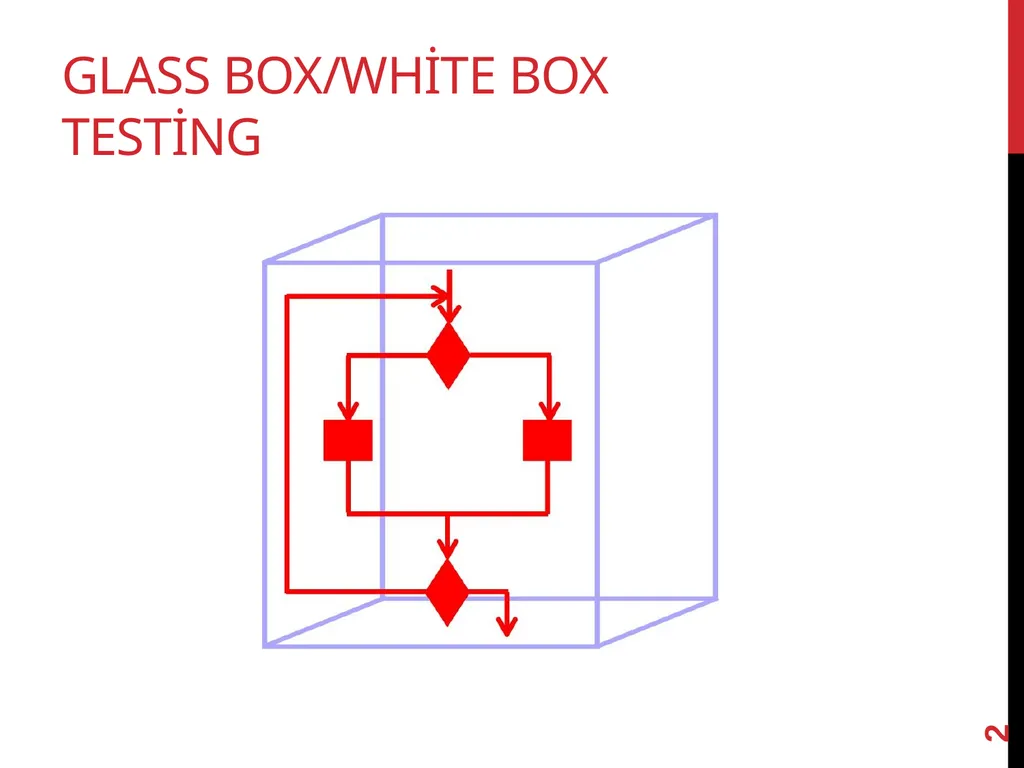
slide2. Glass box/white box testing 2<br>
slide3. Software Testing Goal of testing
finding faults in the software
demonstrating that there are no faults in the software (for the test cases that has been used during testing)
It is not possible to prove that there are no faults in the software using testing
Testing should help locate errors, not just detect their presence
a “yes/no” answer to the question “is the program correct?” is not very helpful
Testing should be repeatable
could be difficult for distributed or concurrent software
effect of the environment, uninitialized variables<br>
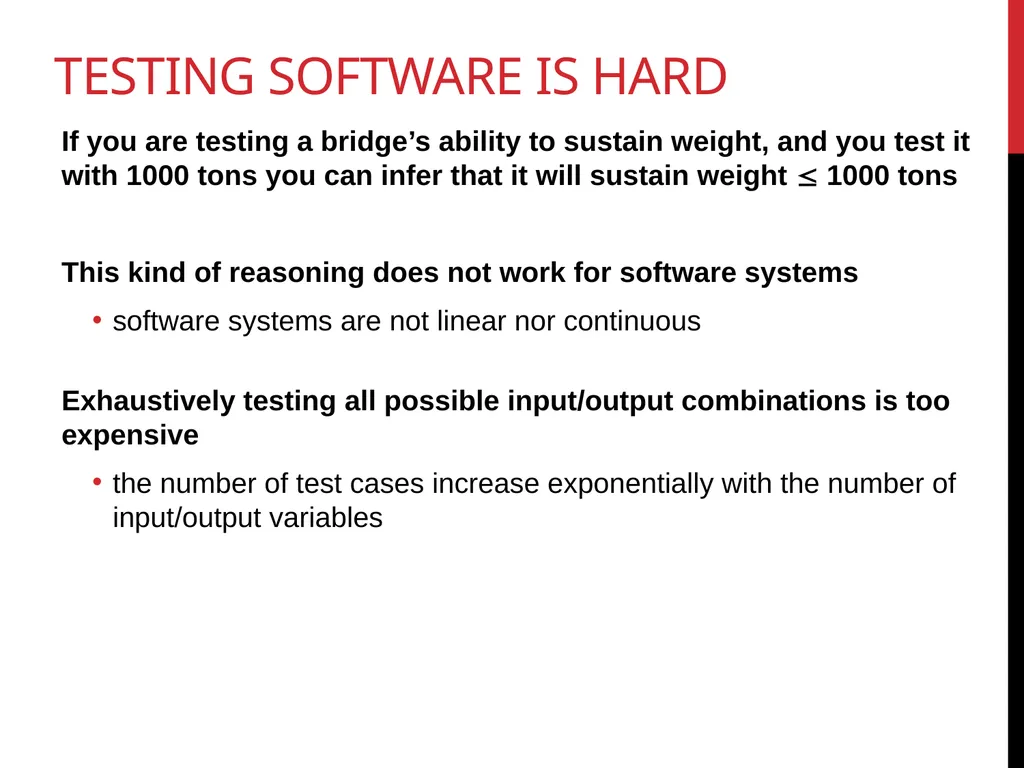
slide4. Testing Software is Hard If you are testing a bridge’s ability to sustain weight, and you test it with 1000 tons you can infer that it will sustain weight 1000 tons
This kind of reasoning does not work for software systems
software systems are not linear nor continuous
Exhaustively testing all possible input/output combinations is too expensive
the number of test cases increase exponentially with the number of input/output variables<br>
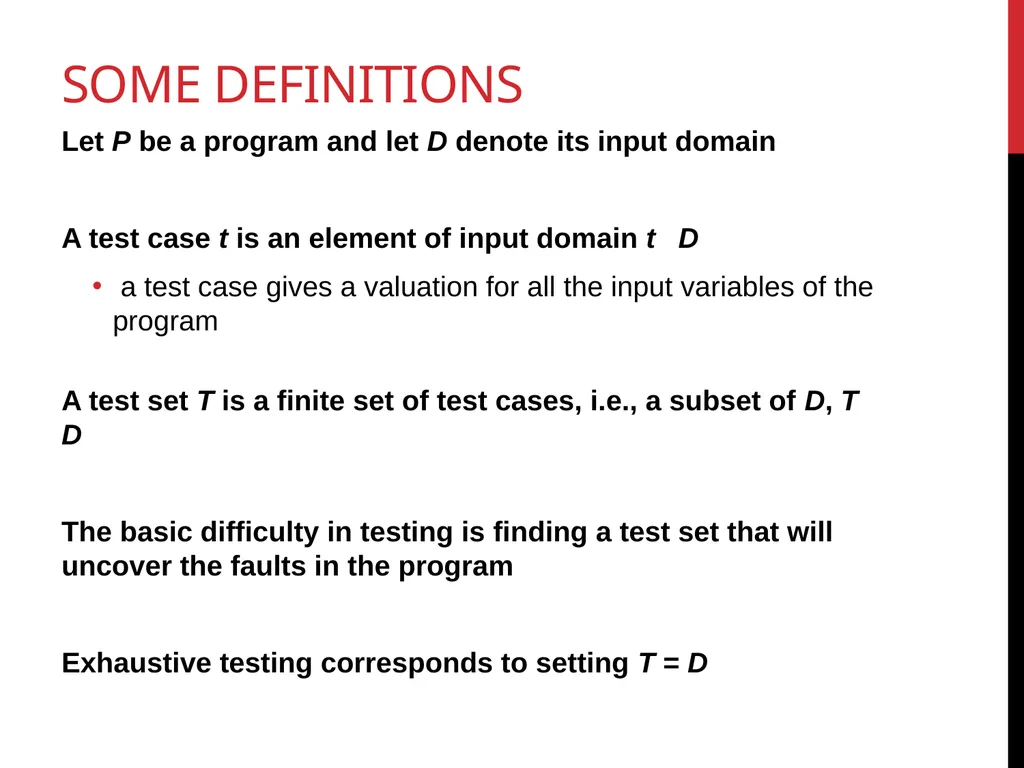
slide5. Some Definitions Let P be a program and let D denote its input domain
A test case t is an element of input domain t D
a test case gives a valuation for all the input variables of the program
A test set T is a finite set of test cases, i.e., a subset of D, T D
The basic difficulty in testing is finding a test set that will uncover the faults in the program
Exhaustive testing corresponds to setting T = D<br>
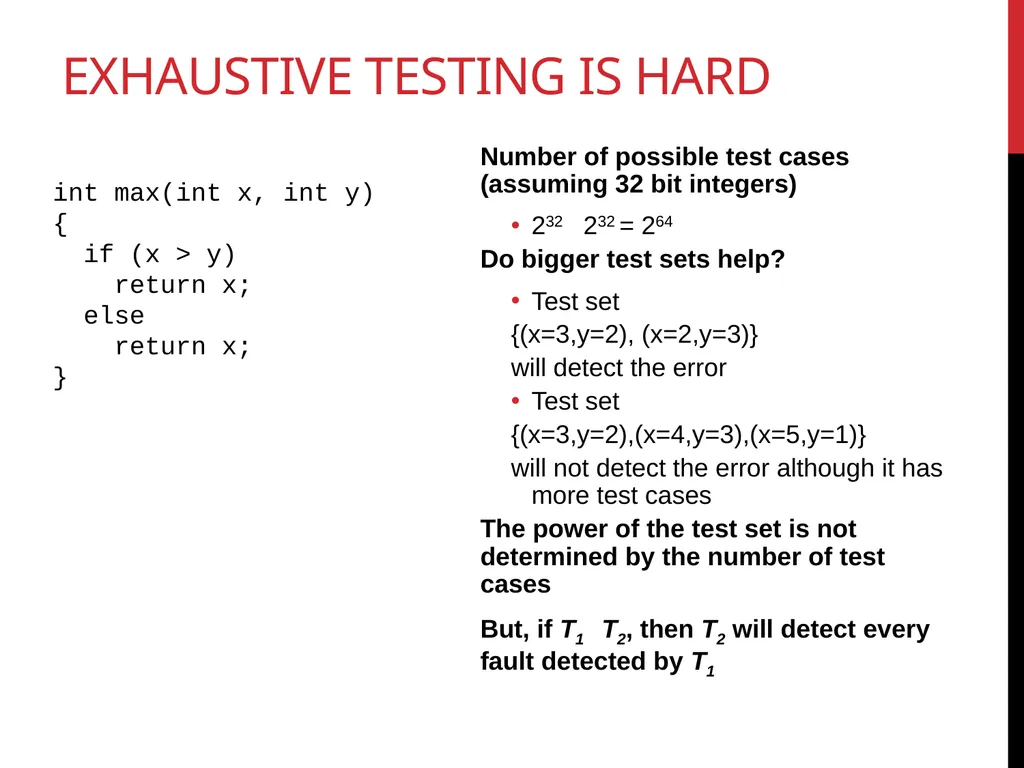
slide6. Exhaustive Testing is Hard Number of possible test cases (assuming 32 bit integers)
232 232 = 264
Do bigger test sets help?
Test set
{(x=3,y=2), (x=2,y=3)}
will detect the error
Test set
{(x=3,y=2),(x=4,y=3),(x=5,y=1)}
will not detect the error although it has more test cases
The power of the test set is not determined by the number of test cases
But, if T1 T2, then T2 will detect every fault detected by T1 int max(int x, int y)
{
if (x > y)
return x;
else
return x;
}<br>
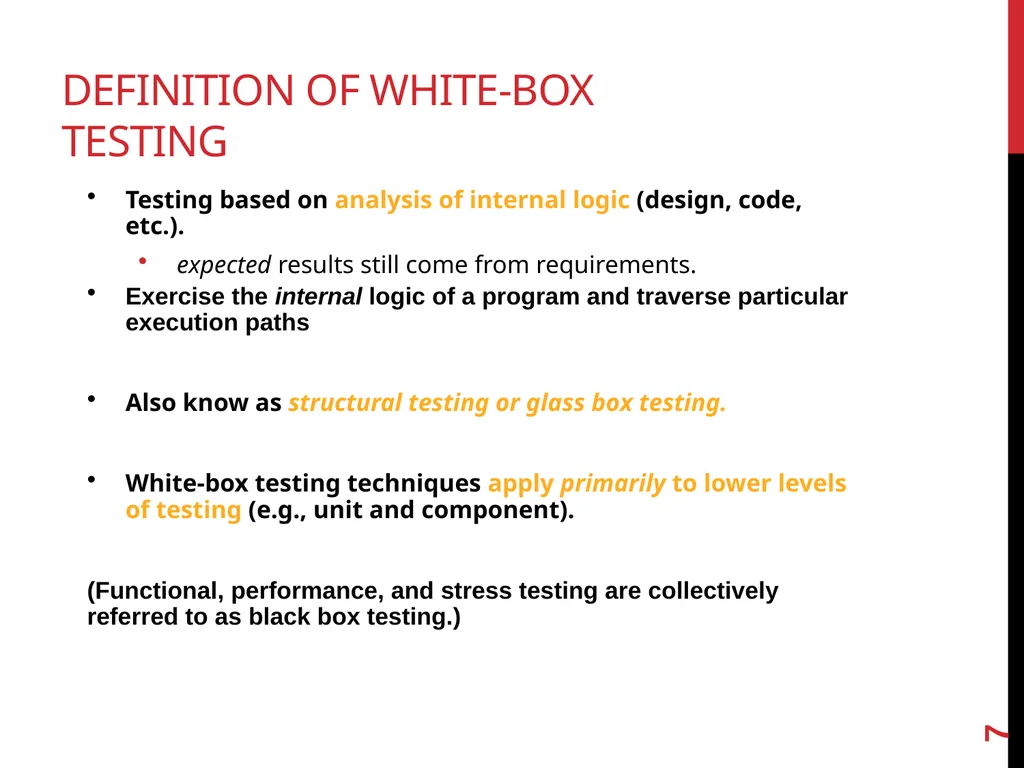
slide7. Definition of White-Box Testing Testing based on analysis of internal logic (design, code, etc.).
expected results still come from requirements.
Exercise the internal logic of a program and traverse particular execution paths
Also know as structural testing or glass box testing.
White-box testing techniques apply primarily to lower levels of testing (e.g., unit and component).
(Functional, performance, and stress testing are collectively referred to as black box testing.) 7<br>
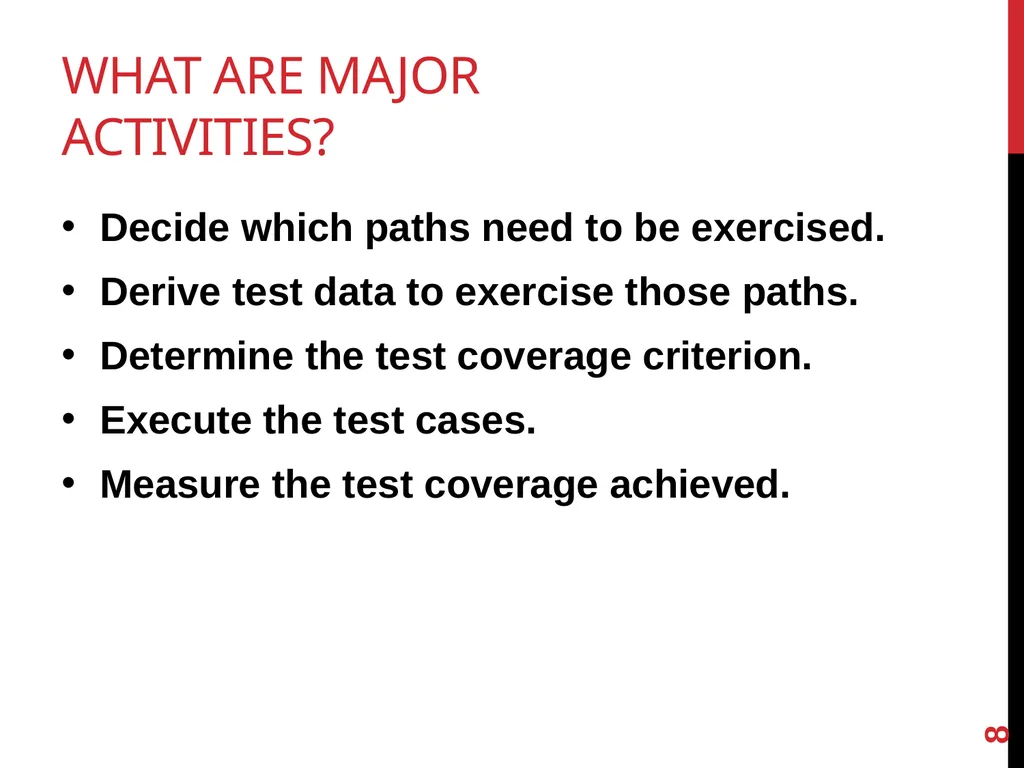
slide8. What are major activities? Decide which paths need to be exercised.
Derive test data to exercise those paths.
Determine the test coverage criterion.
Execute the test cases.
Measure the test coverage achieved. 8<br>
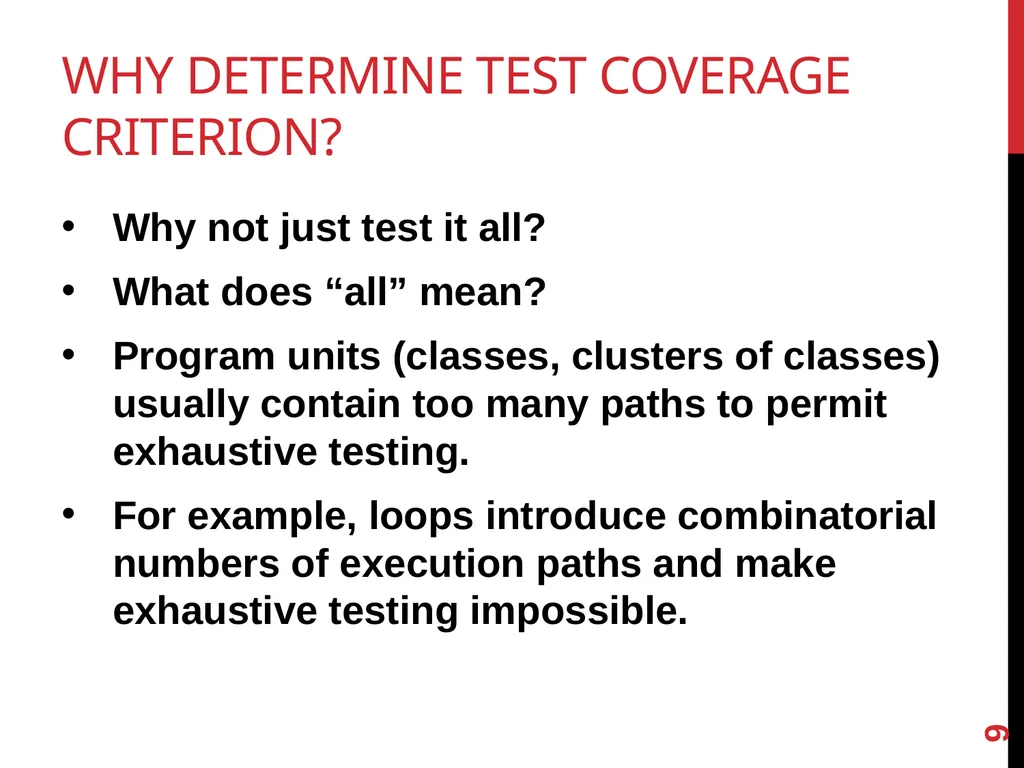
slide9. Why determine test coverage criterion? Why not just test it all?
What does “all” mean?
Program units (classes, clusters of classes) usually contain too many paths to permit exhaustive testing.
For example, loops introduce combinatorial numbers of execution paths and make exhaustive testing impossible. 9<br>
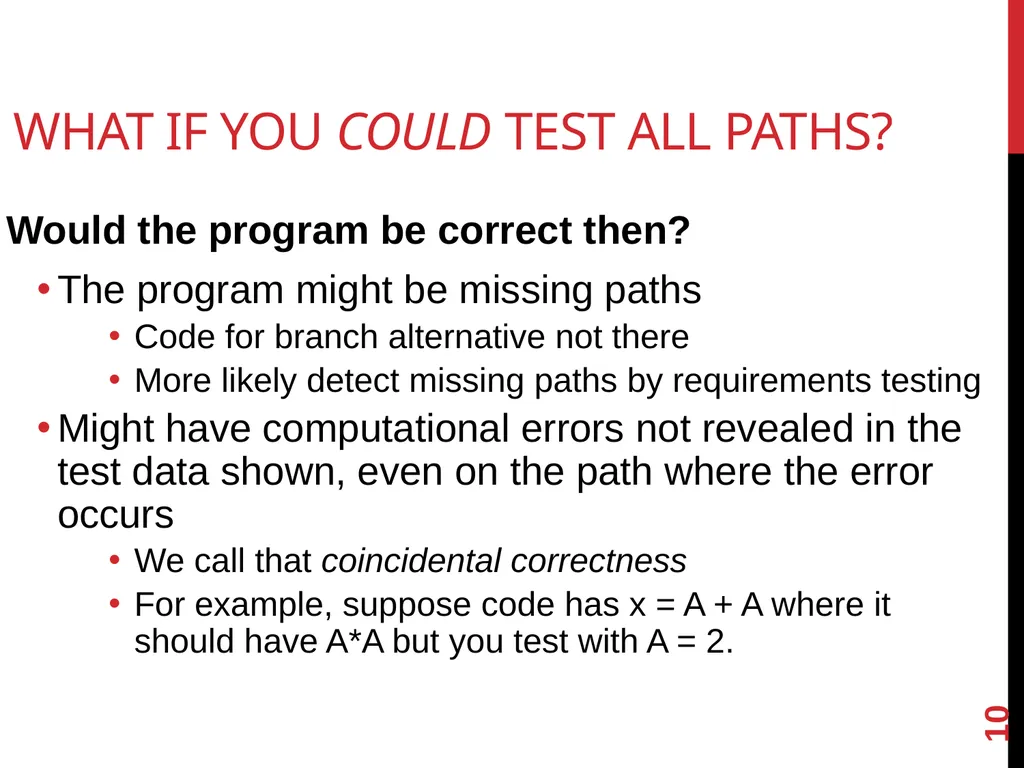
slide10. What if you could test all paths? Would the program be correct then?
The program might be missing paths
Code for branch alternative not there
More likely detect missing paths by requirements testing
Might have computational errors not revealed in the test data shown, even on the path where the error occurs
We call that coincidental correctness
For example, suppose code has x = A + A where it should have A*A but you test with A = 2. 10<br>
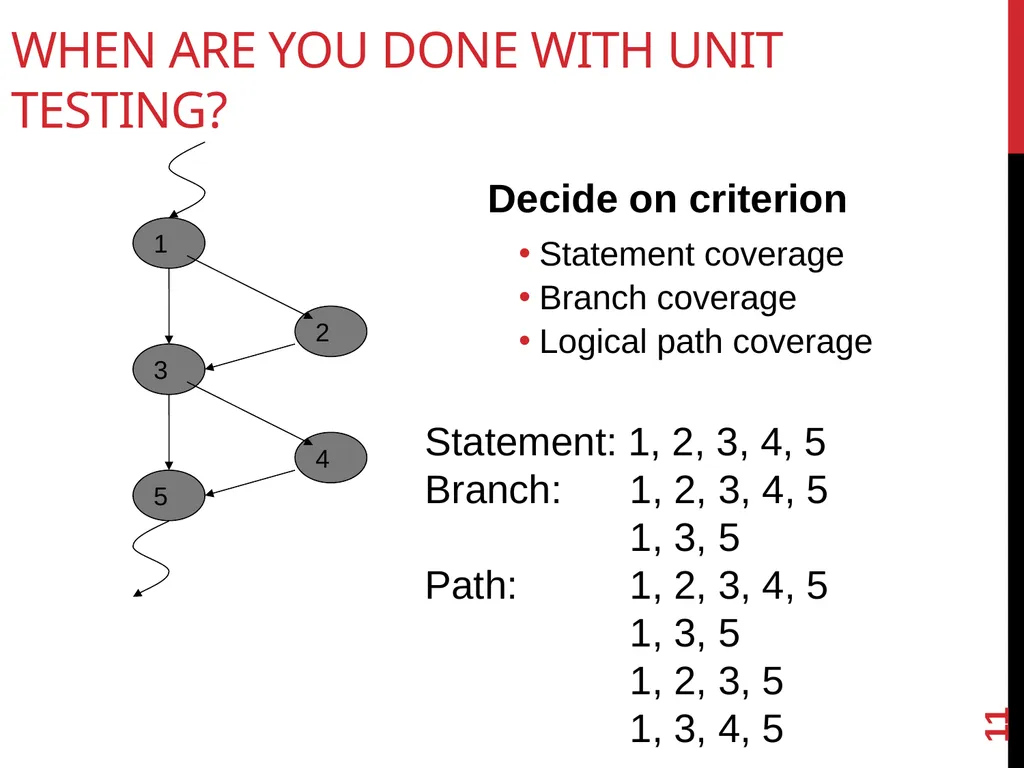
slide11. When are you done with unit testing? Decide on criterion
Statement coverage
Branch coverage
Logical path coverage 11 Statement: 1, 2, 3, 4, 5
Branch: 1, 2, 3, 4, 5
1, 3, 5
Path: 1, 2, 3, 4, 5
1, 3, 5
1, 2, 3, 5
1, 3, 4, 5<br>
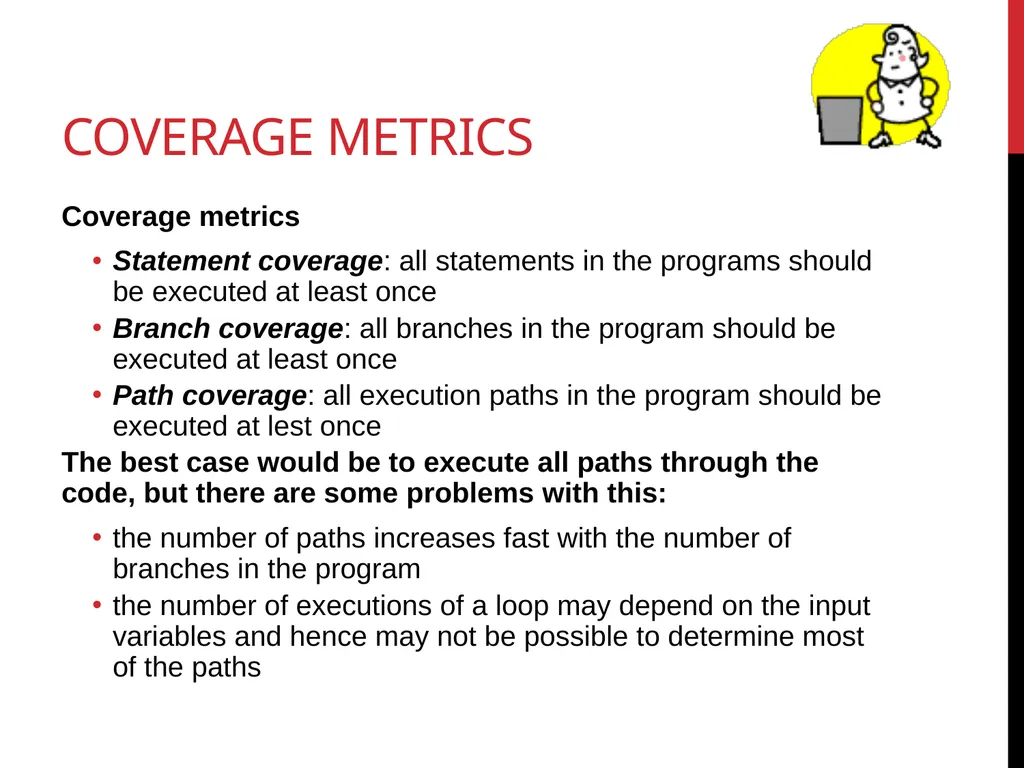
slide12. Coverage Metrics Coverage metrics
Statement coverage: all statements in the programs should be executed at least once
Branch coverage: all branches in the program should be executed at least once
Path coverage: all execution paths in the program should be executed at lest once
The best case would be to execute all paths through the code, but there are some problems with this:
the number of paths increases fast with the number of branches in the program
the number of executions of a loop may depend on the input variables and hence may not be possible to determine most of the paths<br>
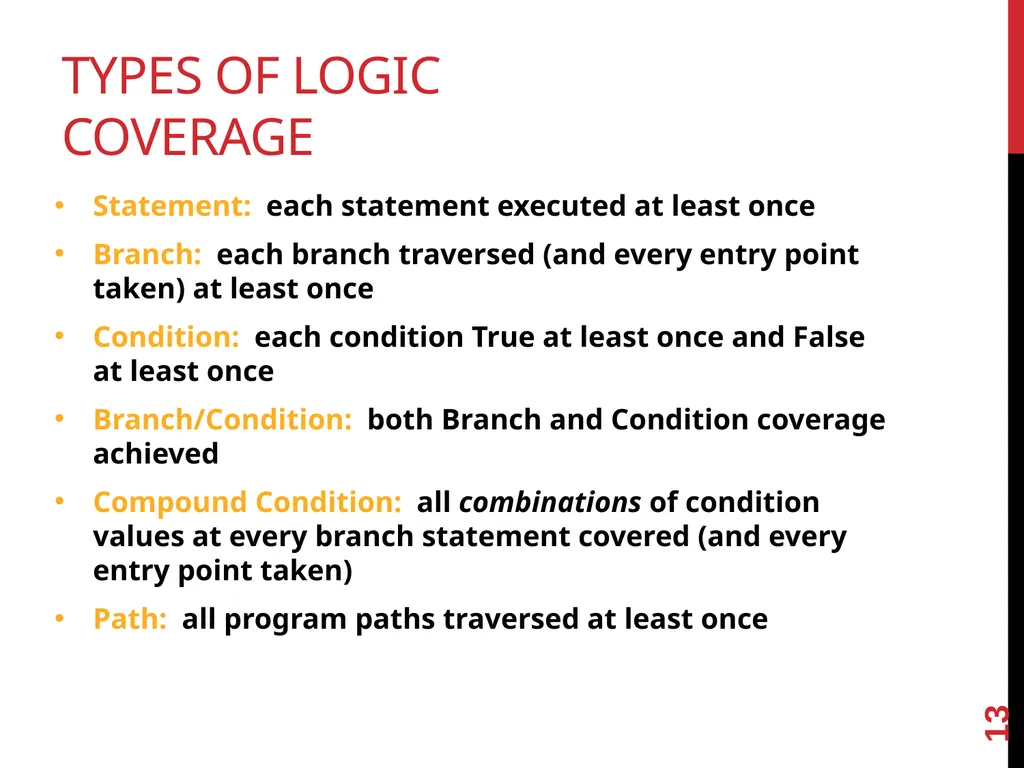
slide13. Types of Logic Coverage Statement: each statement executed at least once
Branch: each branch traversed (and every entry point taken) at least once
Condition: each condition True at least once and False at least once
Branch/Condition: both Branch and Condition coverage achieved
Compound Condition: all combinations of condition values at every branch statement covered (and every entry point taken)
Path: all program paths traversed at least once 13<br>
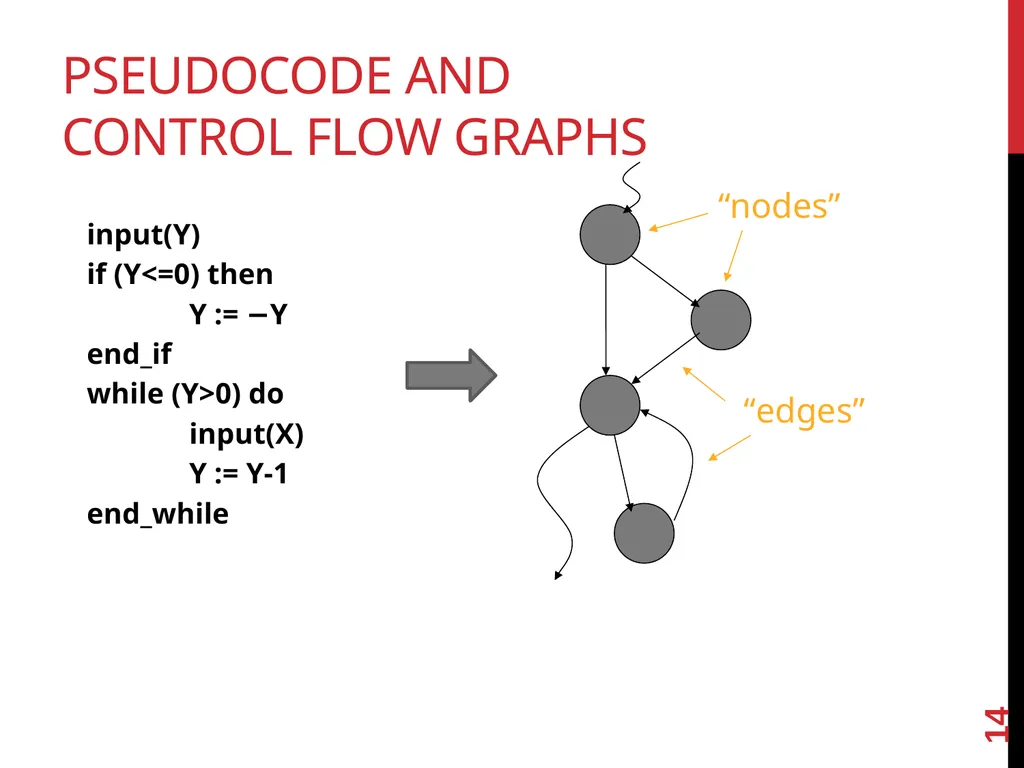
slide14. Pseudocode and Control Flow Graphs input(Y)
if (Y<=0) then
Y := −Y
end_if
while (Y>0) do
input(X)
Y := Y-1
end_while 14<br>
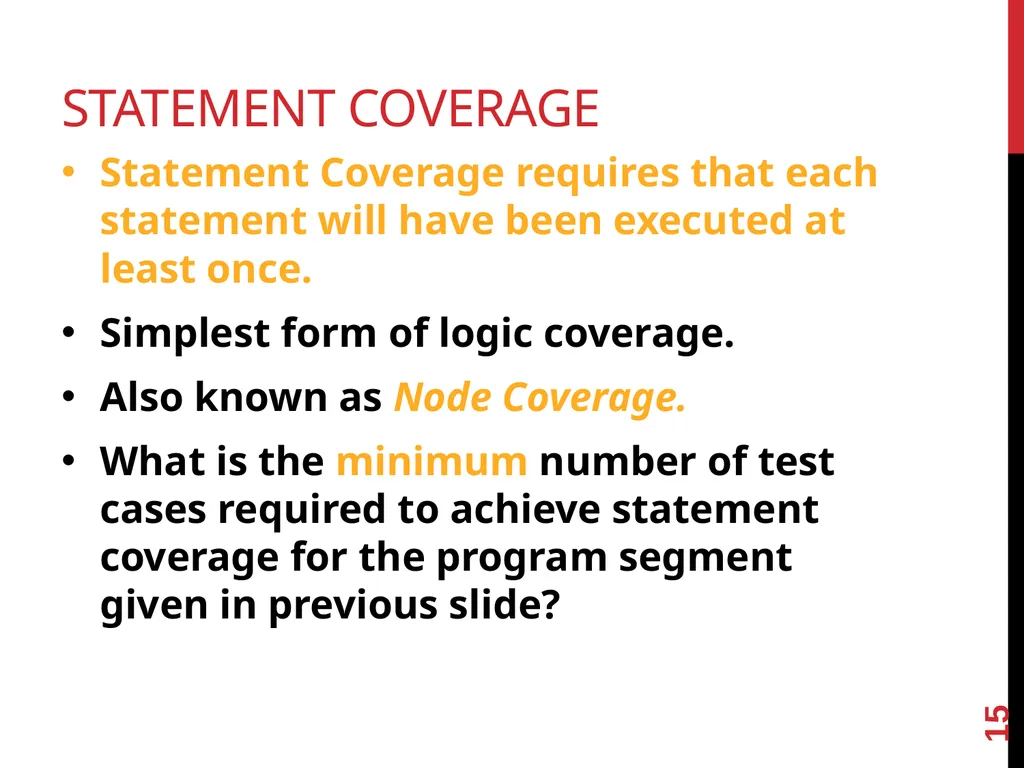
slide15. Statement Coverage Statement Coverage requires that each statement will have been executed at least once.
Simplest form of logic coverage.
Also known as Node Coverage.
What is the minimum number of test cases required to achieve statement coverage for the program segment given in previous slide? 15<br>
slide16. Statement Coverage Find a set of test cases to ensure that every statement is executed at least once<br>
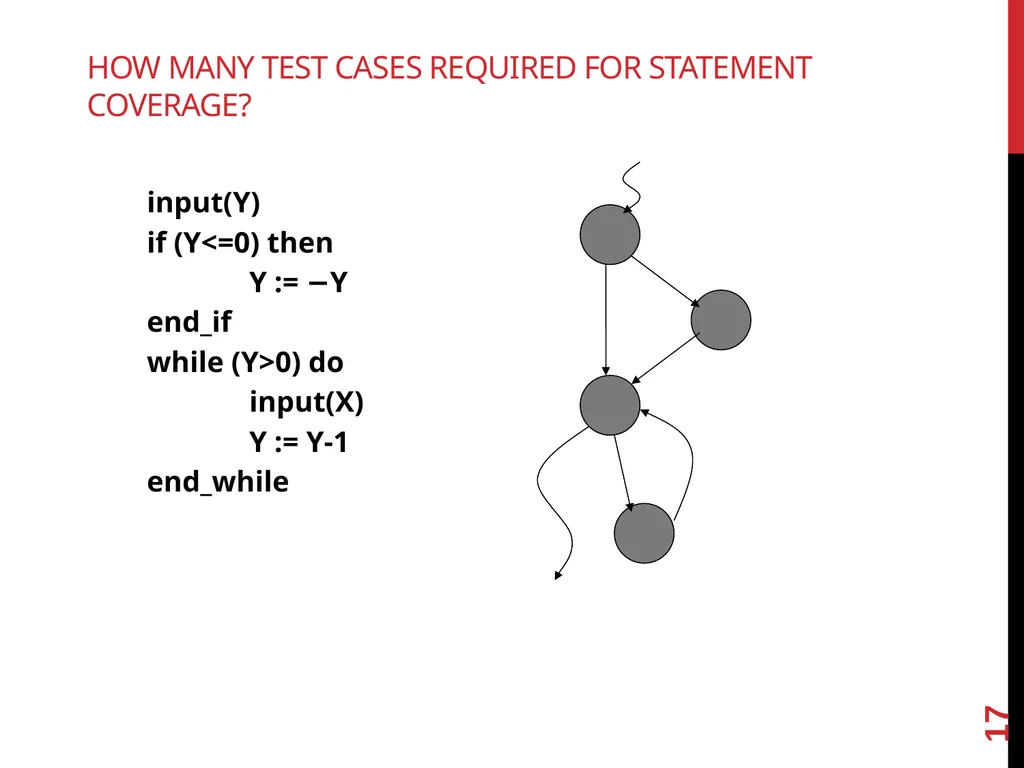
slide17. How many test cases required for Statement Coverage? input(Y)
if (Y<=0) then
Y := −Y
end_if
while (Y>0) do
input(X)
Y := Y-1
end_while 17<br>
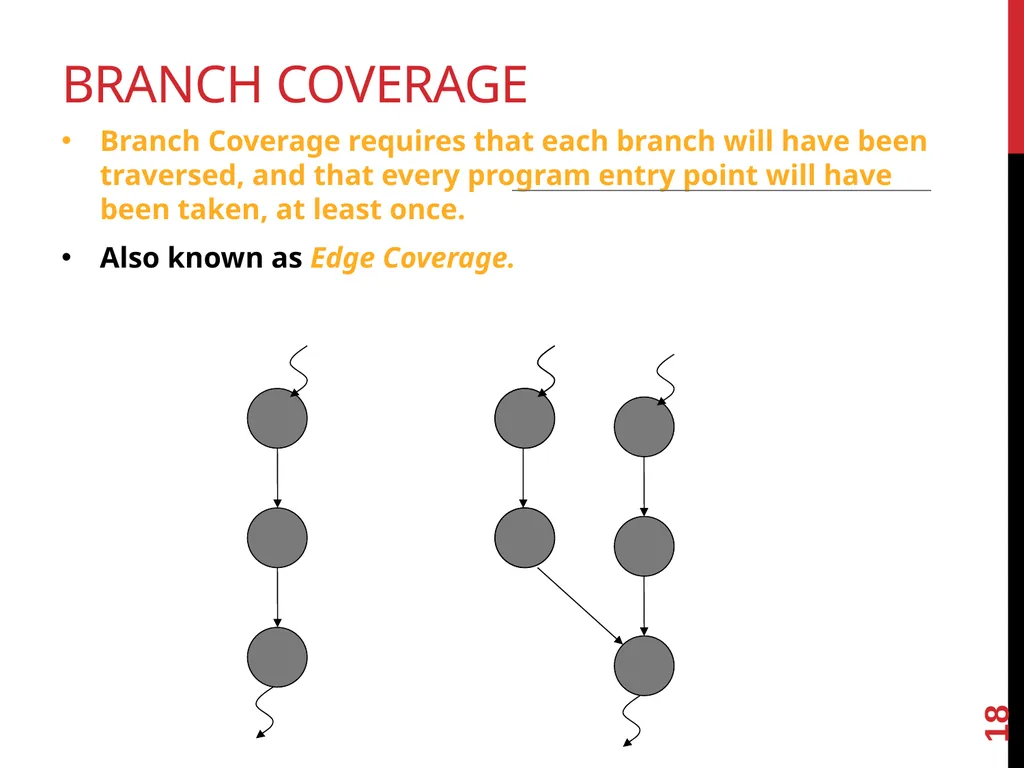
slide18. Branch Coverage Branch Coverage requires that each branch will have been traversed, and that every program entry point will have been taken, at least once.
Also known as Edge Coverage. 18<br>
slide19. Branch coverage Find a set of test cases to ensure that each branching statement is taken in each direction at least once<br>
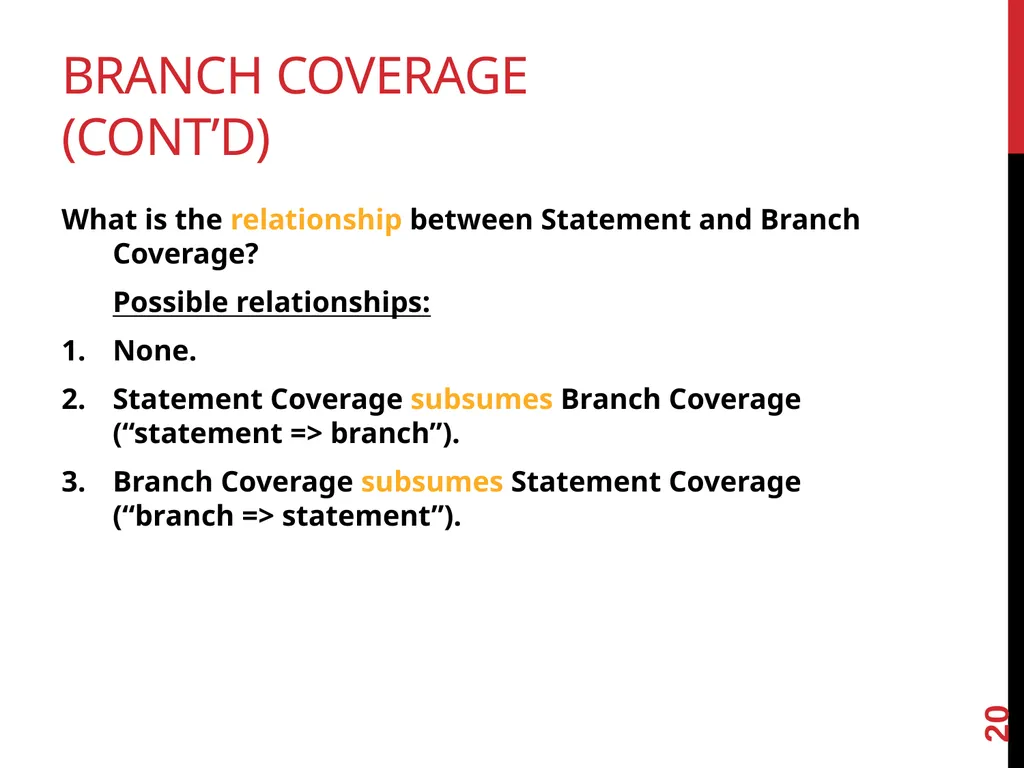
slide20. Branch Coverage (cont’d) What is the relationship between Statement and Branch Coverage?
Possible relationships:
None.
Statement Coverage subsumes Branch Coverage (“statement => branch”).
Branch Coverage subsumes Statement Coverage (“branch => statement”). 20<br>
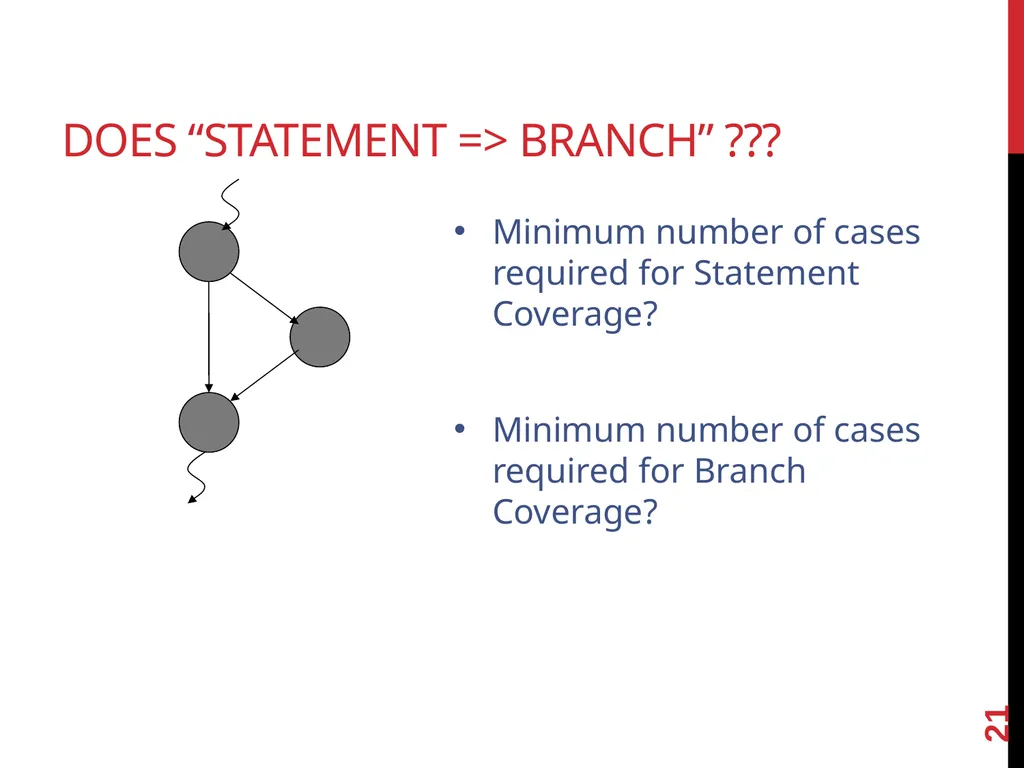
slide21. Does “statement => branch” ??? Minimum number of cases required for Statement Coverage?
Minimum number of cases required for Branch Coverage? 21<br>
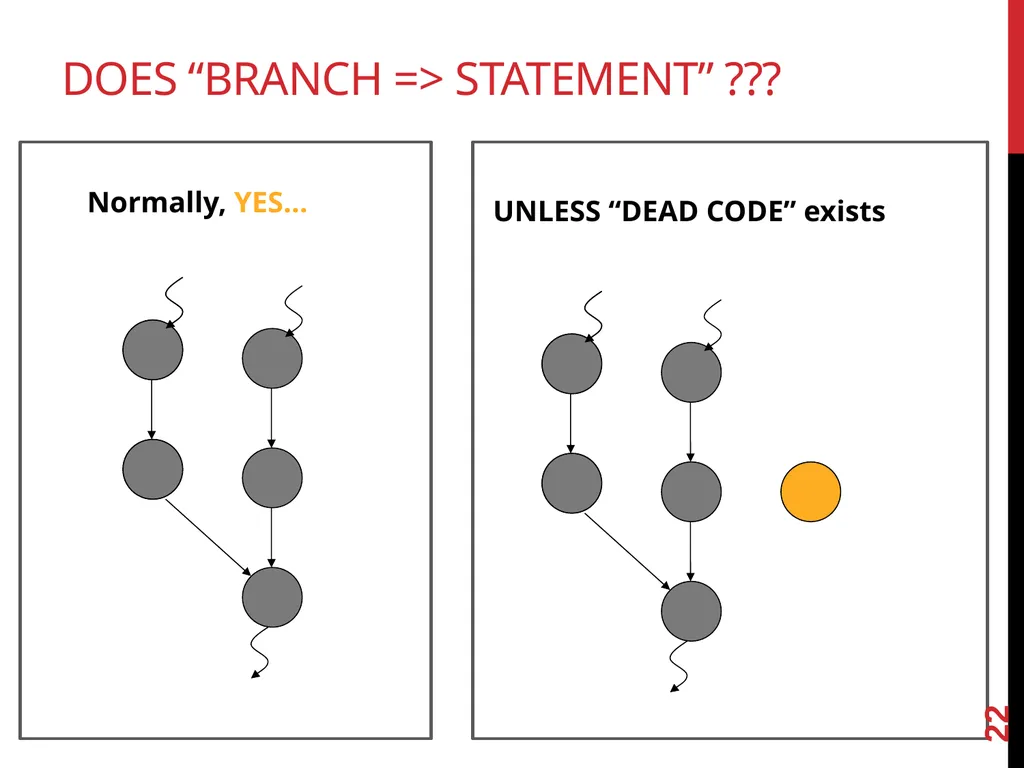
slide22. Does “branch => statement” ??? Normally, YES… UNLESS “DEAD CODE” exists 22<br>
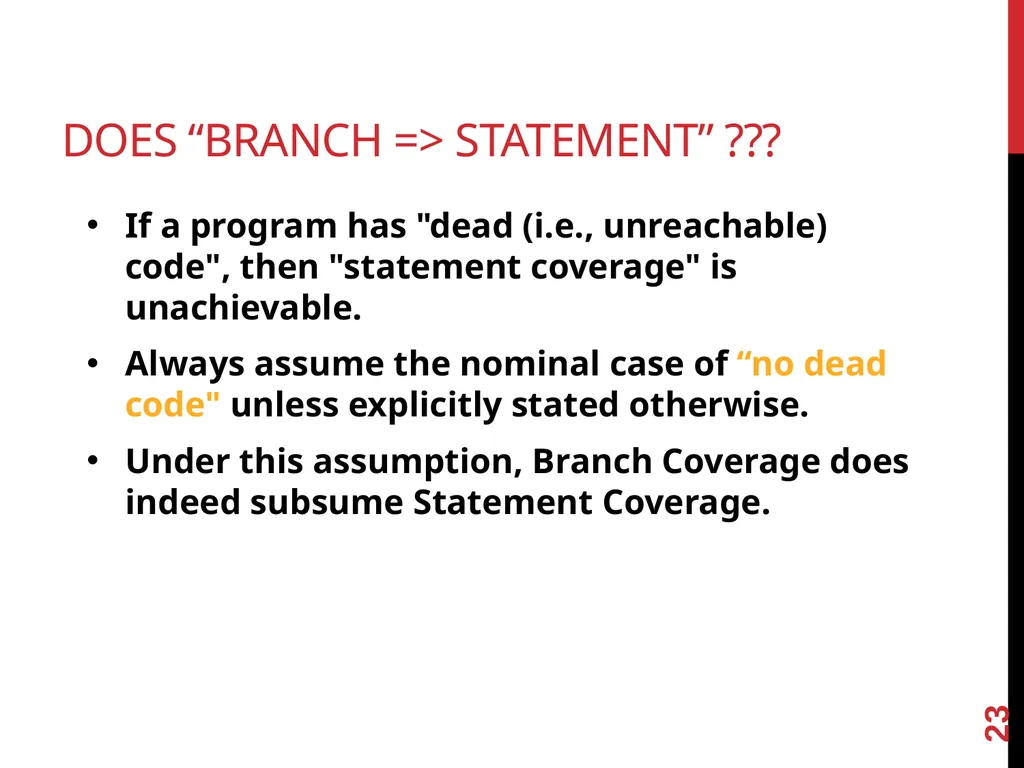
slide23. Does “branch => statement” ??? If a program has "dead (i.e., unreachable) code", then "statement coverage" is unachievable.
Always assume the nominal case of “no dead code" unless explicitly stated otherwise.
Under this assumption, Branch Coverage does indeed subsume Statement Coverage. 23<br>
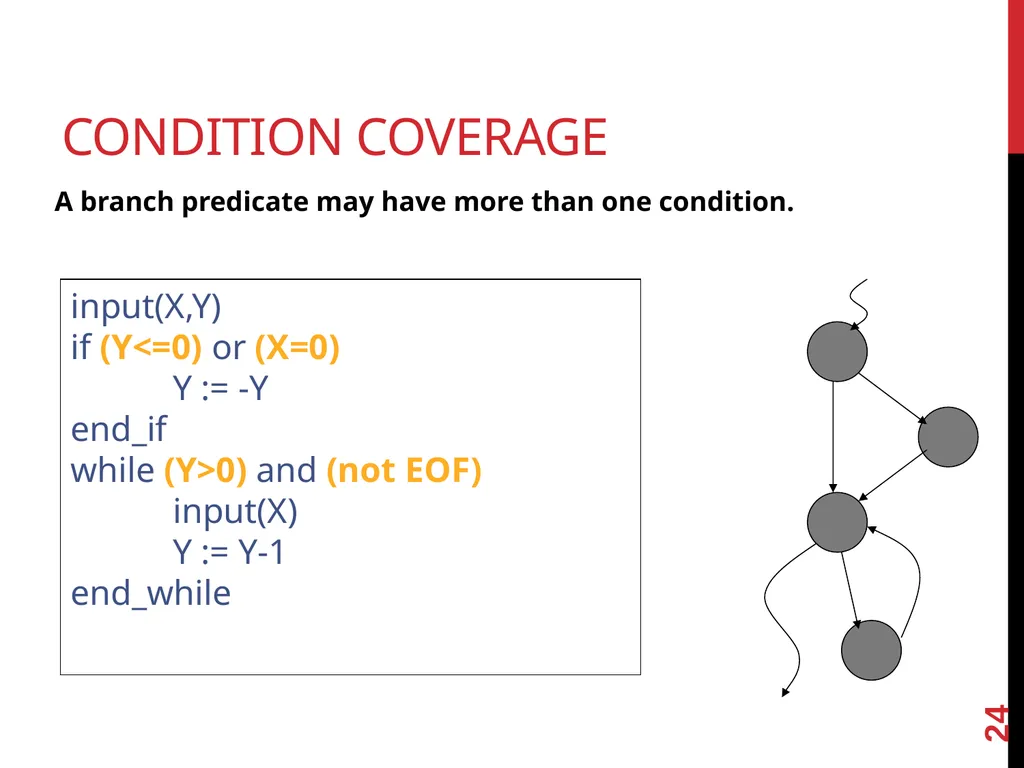
slide24. Condition Coverage A branch predicate may have more than one condition. input(X,Y)
if (Y<=0) or (X=0) then
Y := -Y
end_if
while (Y>0) and (not EOF) do
input(X)
Y := Y-1
end_while 24<br>
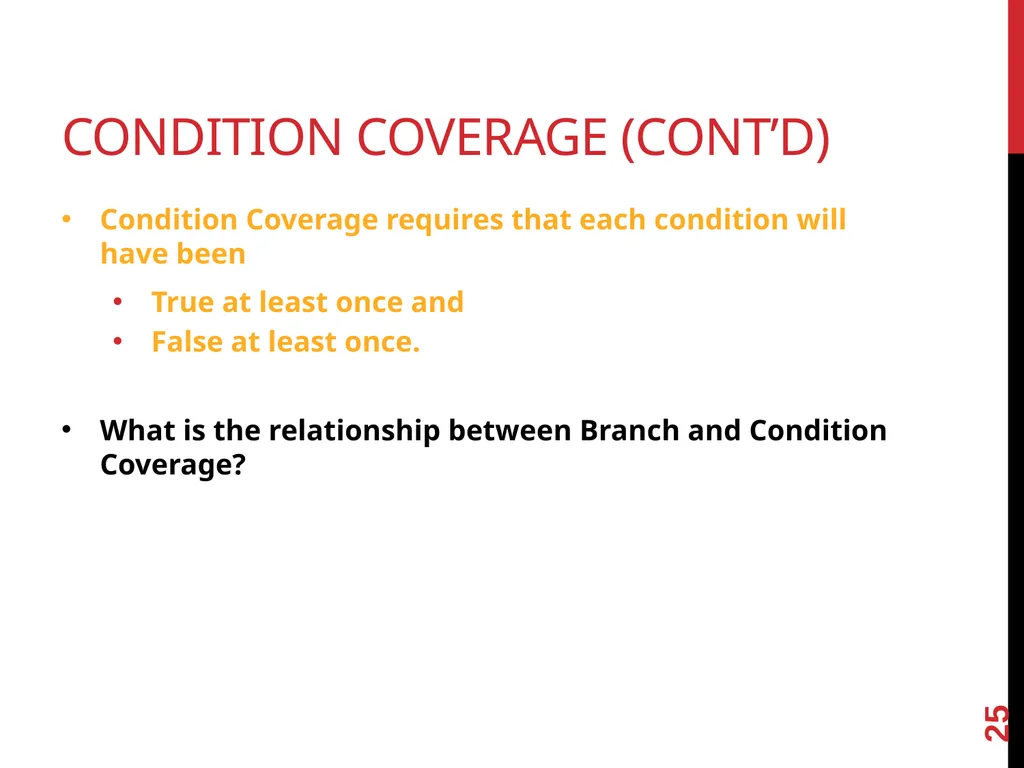
slide25. Condition Coverage (cont’d) Condition Coverage requires that each condition will have been
True at least once and
False at least once.
What is the relationship between Branch and Condition Coverage? 25<br>
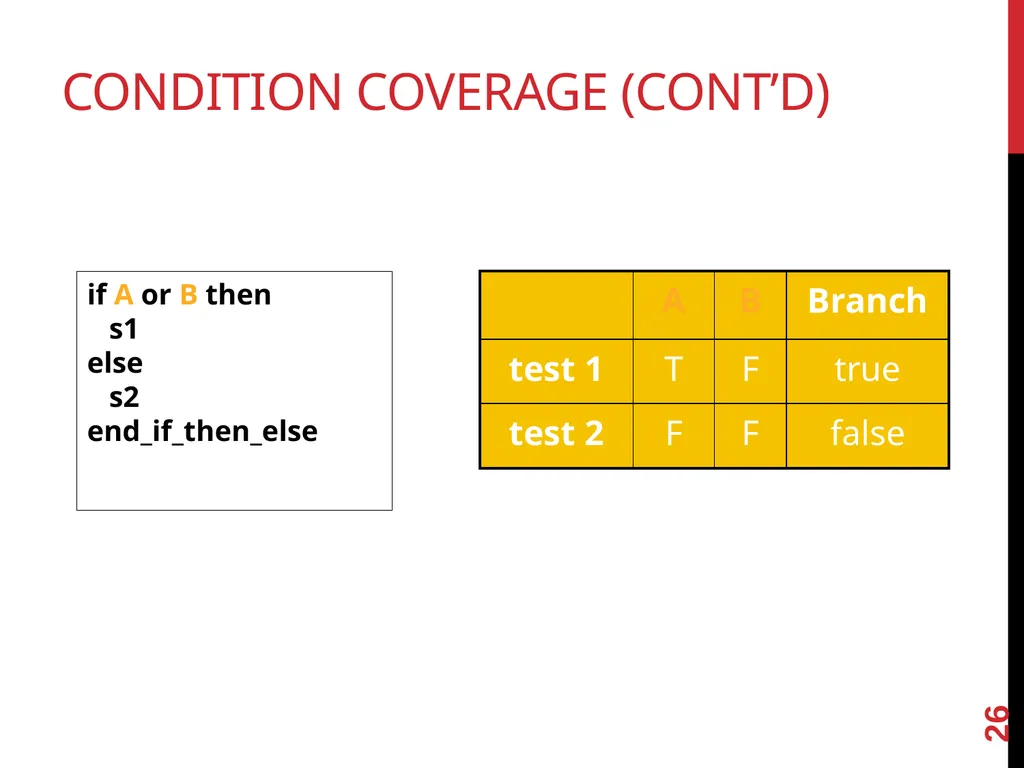
slide26. Condition Coverage (cont’d) if A or B then
s1
else
s2
end_if_then_else 26<br>
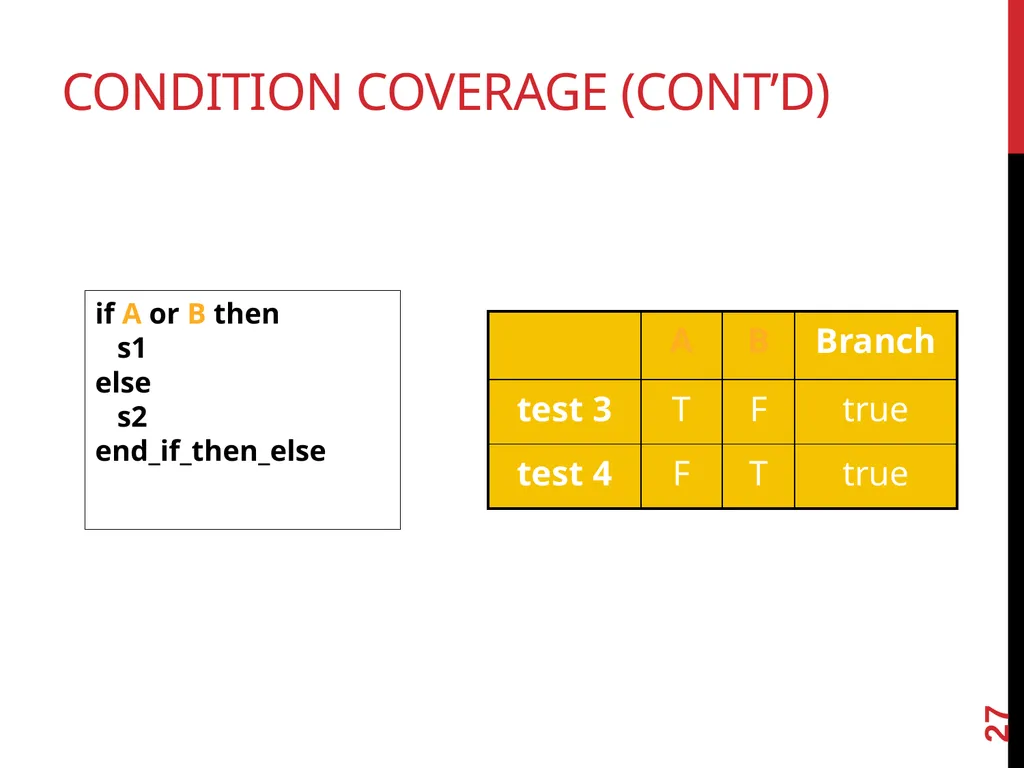
slide27. Condition Coverage (cont’d) if A or B then
s1
else
s2
end_if_then_else 27<br>
slide28. Branch/Condition Coverage Branch/Condition Coverage requires that both Branch AND Condition Coverage will have been achieved.
Branch/Condition Coverage subsumes both Branch Coverage and Condition Coverage. 28<br>
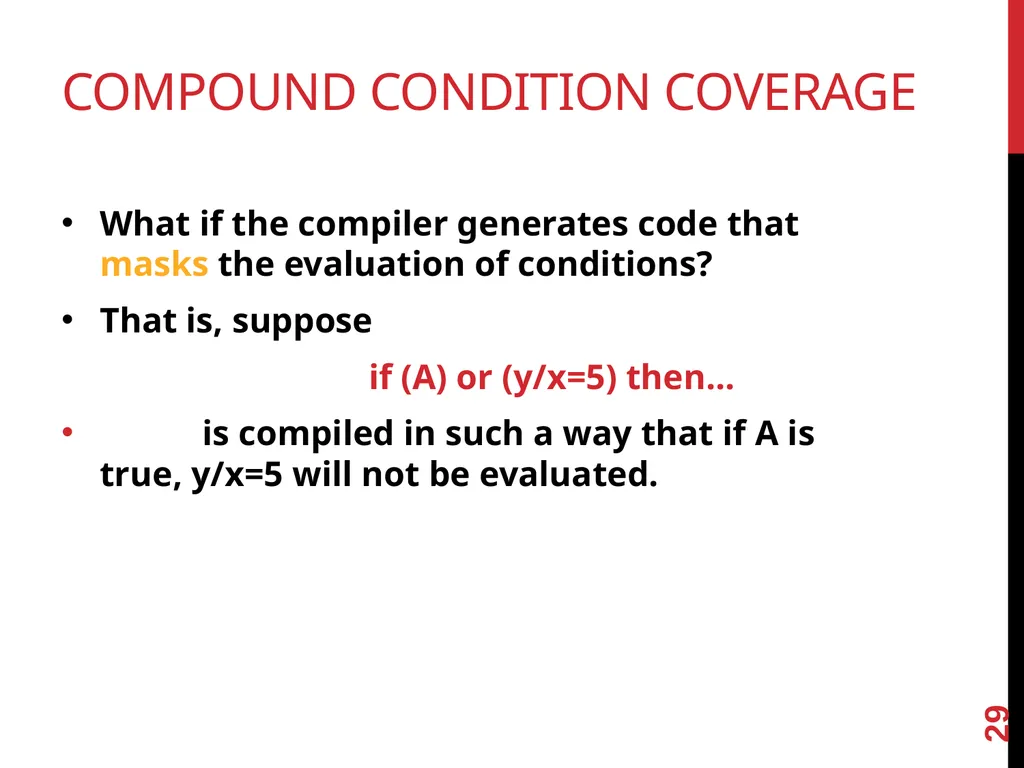
slide29. Compound Condition Coverage What if the compiler generates code that masks the evaluation of conditions?
That is, suppose
if (A) or (y/x=5) then...
is compiled in such a way that if A is true, y/x=5 will not be evaluated. 29<br>
slide30. Compound Condition Coverage (cont’d) Compound Condition Coverage requires that all combinations of condition values at every branch statement will have been covered, and that every entry point will have been taken, at least once.
Also know as Multiple Condition Coverage.
Subsumes Branch/Condition Coverage, regardless of the order in which conditions are evaluated. 30<br>
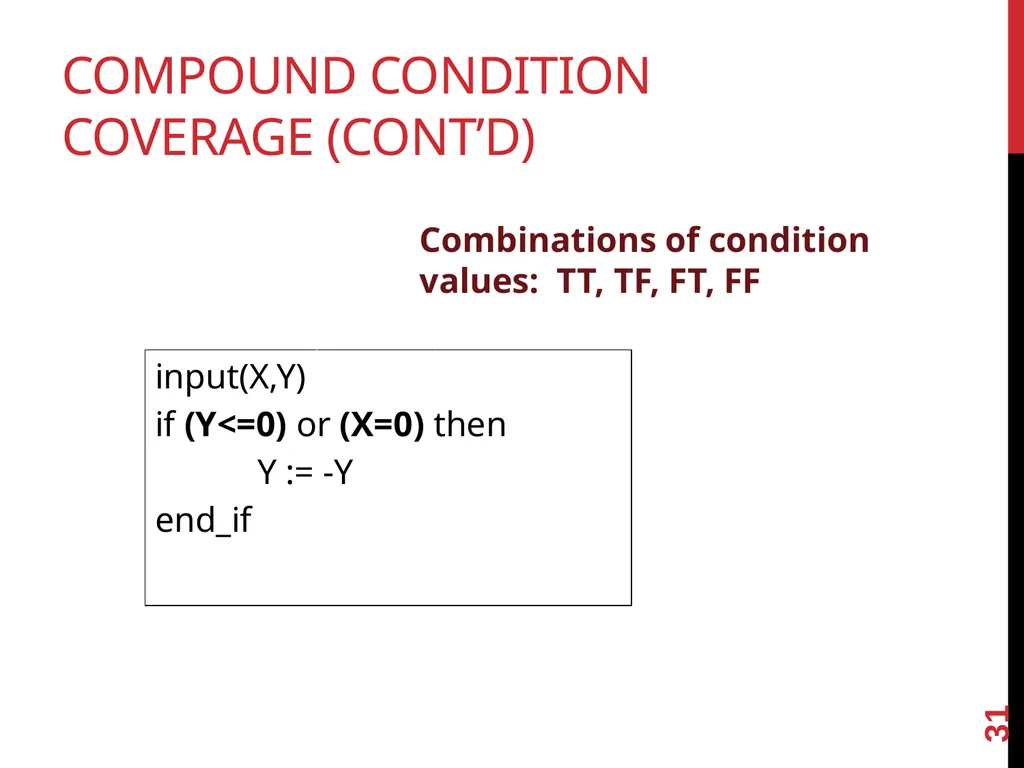
slide31. Compound Condition Coverage (cont’d) input(X,Y)
if (Y<=0) or (X=0) then
Y := -Y
end_if Combinations of condition values: TT, TF, FT, FF 31<br>
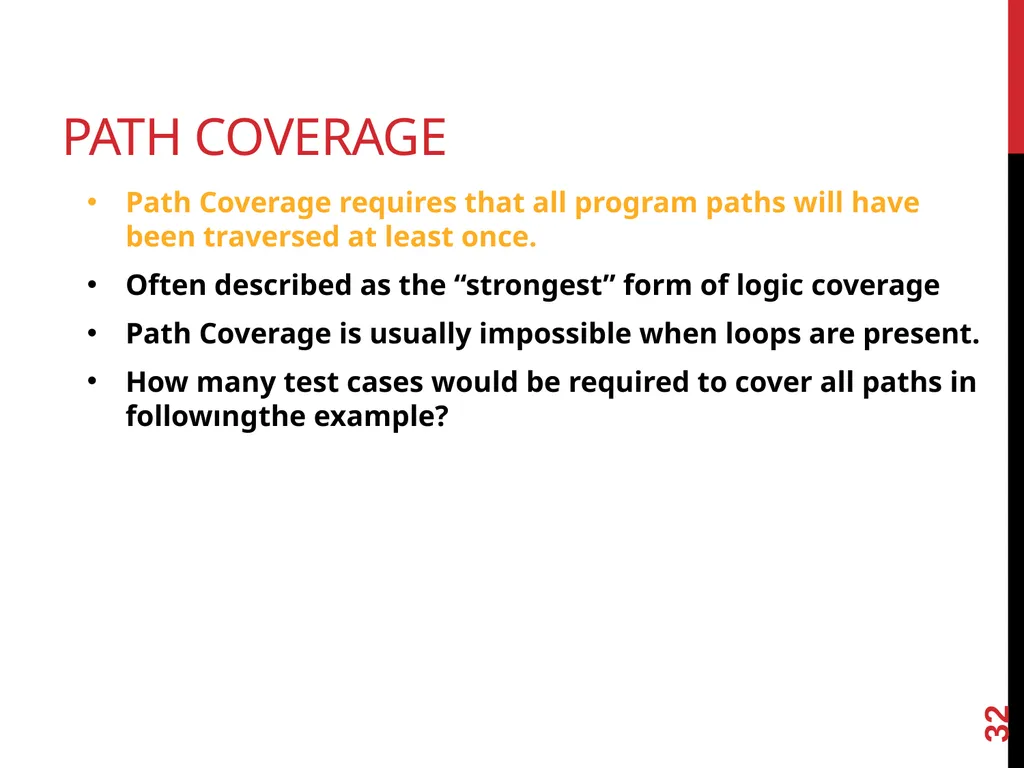
slide32. Path Coverage Path Coverage requires that all program paths will have been traversed at least once.
Often described as the “strongest” form of logic coverage
Path Coverage is usually impossible when loops are present.
How many test cases would be required to cover all paths in followıngthe example? 32<br>
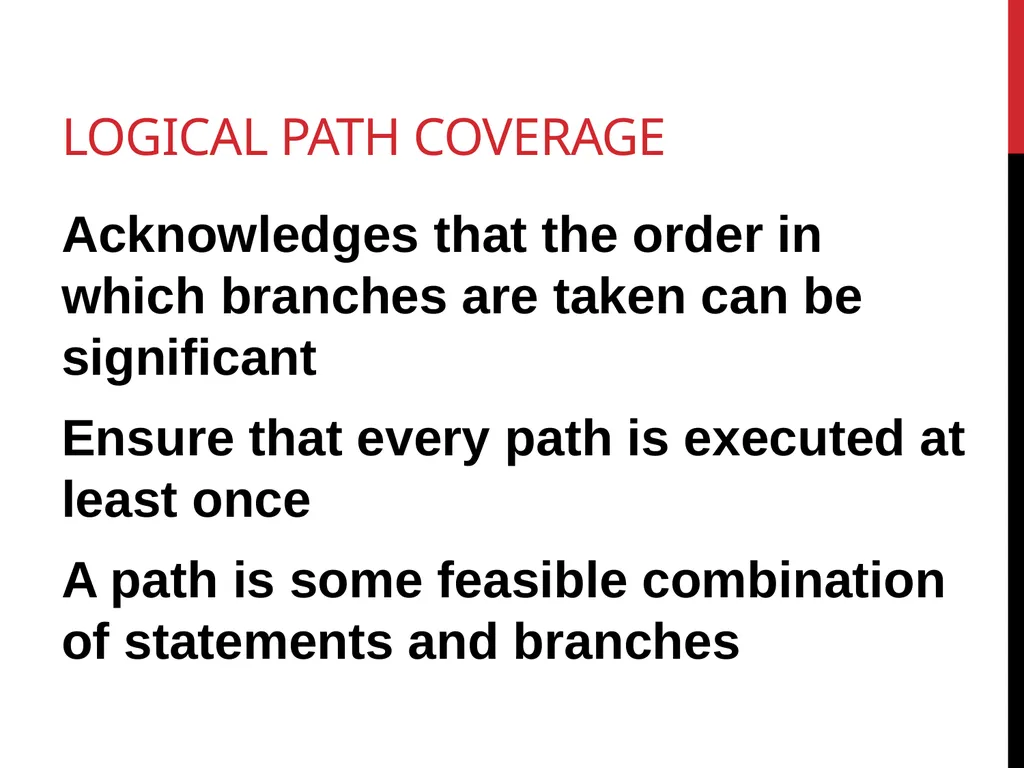
slide33. Logical Path Coverage Acknowledges that the order in which branches are taken can be significant
Ensure that every path is executed at least once
A path is some feasible combination of statements and branches<br>
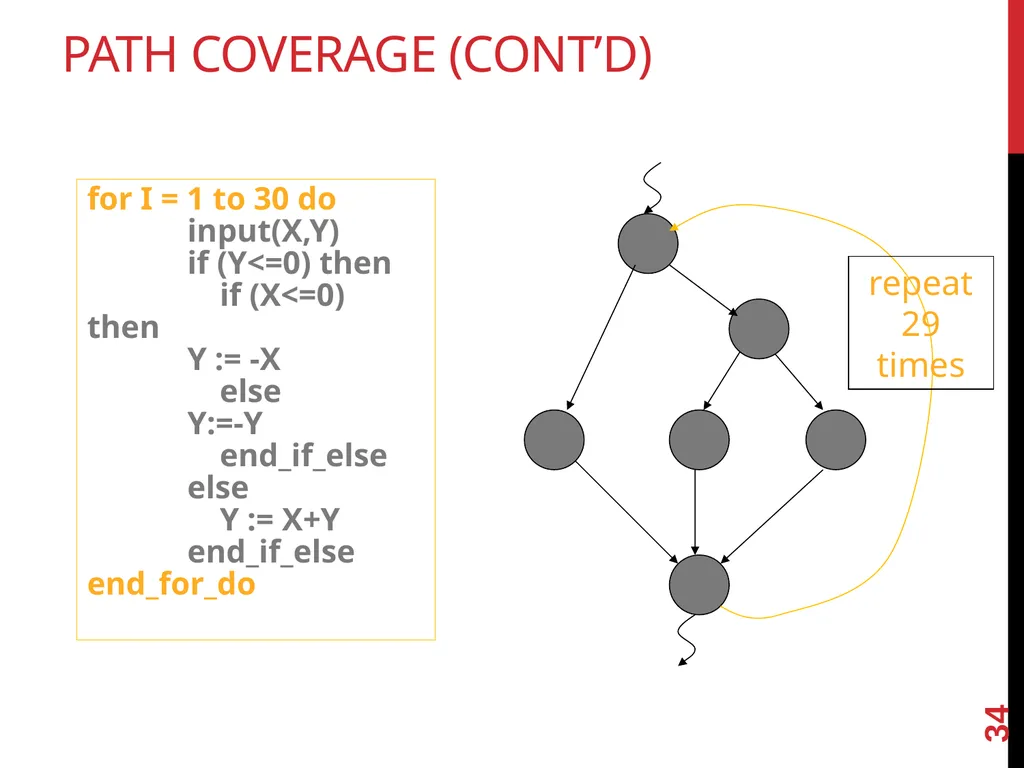
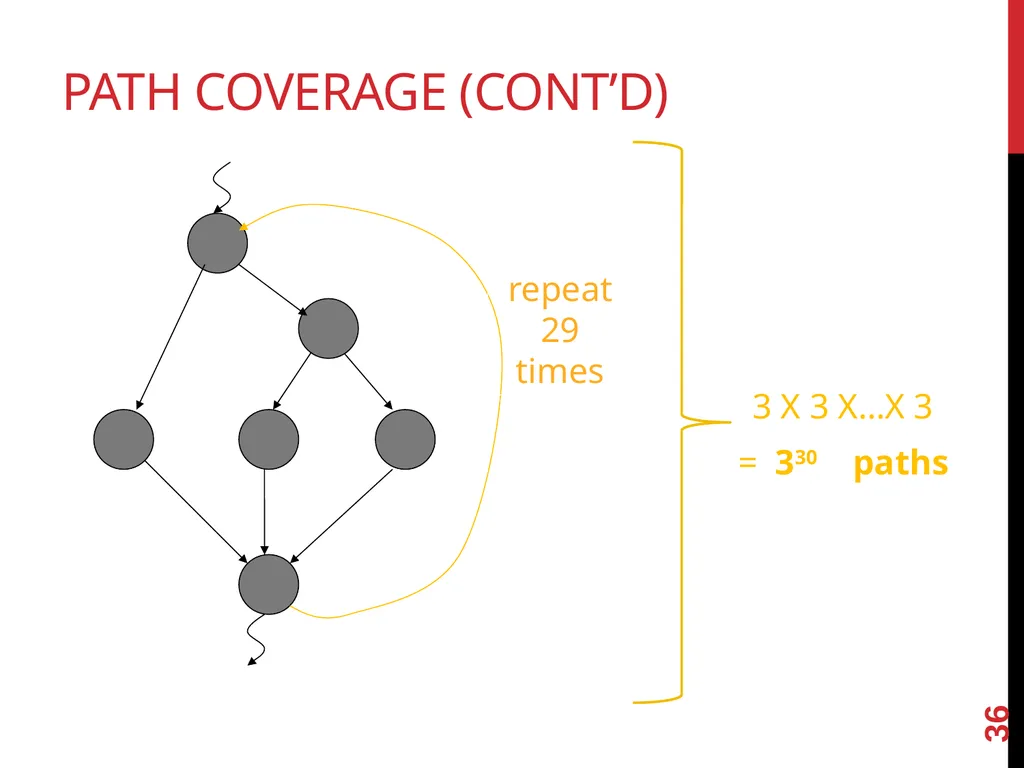
slide34. Path Coverage (cont’d) for I = 1 to 30 do
input(X,Y)
if (Y<=0) then
if (X<=0) then
Y := -X
else
Y:=-Y
end_if_else
else
Y := X+Y
end_if_else
end_for_do 34<br>
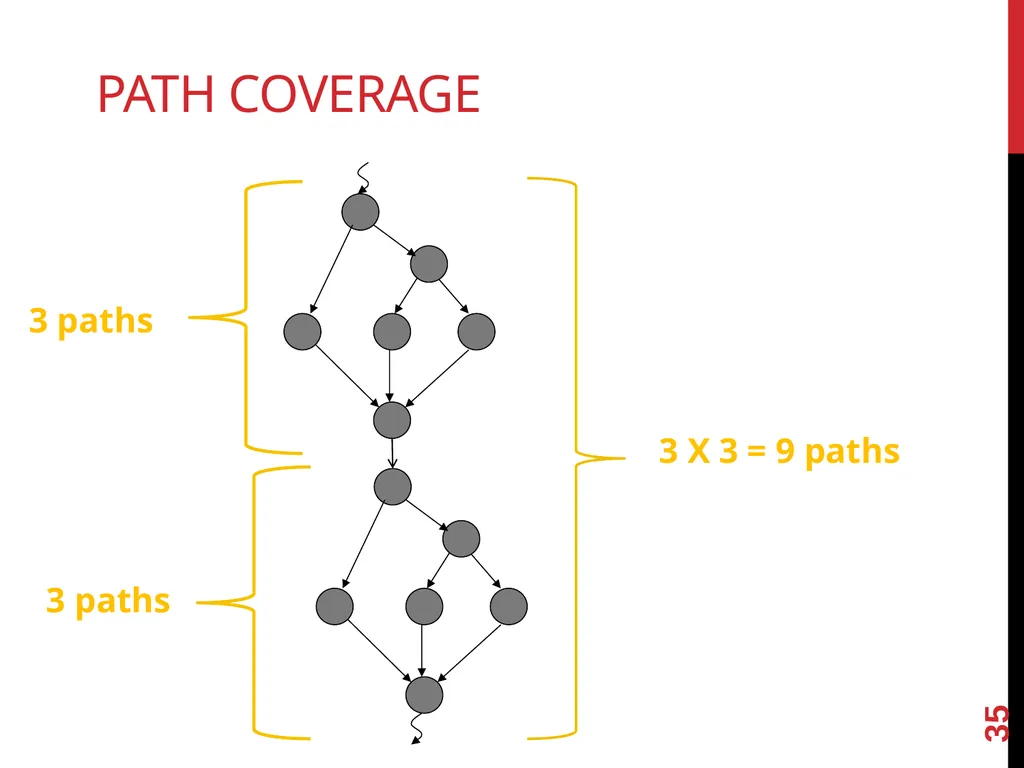
slide35. PATH COVERAGE 35 3 paths 3 paths 3 X 3 = 9 paths<br>
slide36. Path Coverage (cont’d) repeat 29 times 3 X 3 X…X 3 = 330 paths 36<br>
slide37. Path Coverage (cont’d) Various strategies have been developed for identifying useful subsets of paths for testing when Path Coverage is impractical:
Loop Coverage,
Basis Paths Coverage, and
Dataflow Coverage. 37<br>
slide38. Loop Coverage Loop Coverage requires that the body of loops be executed 0, 1, 2, t, max, and max+1 times, where possible.
Rationale:
0: Is some action taken in the body that must also be taken when the body is not executed?
1: Check lower bound on number of times body may be executed.
2: Check loop re-initialization.
t: Check typical number of iterations.
max: Check upper (valid) bound on number of times body may be executed.
max+1: If the maximum can be exceeded, what behavior results? 38<br>
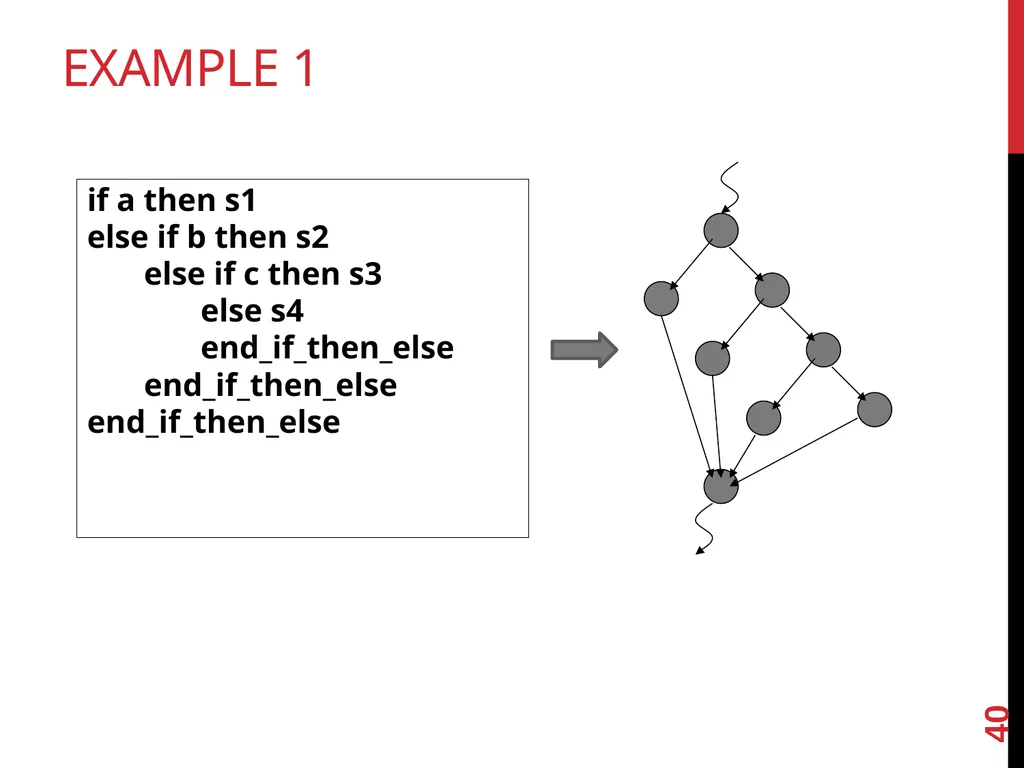
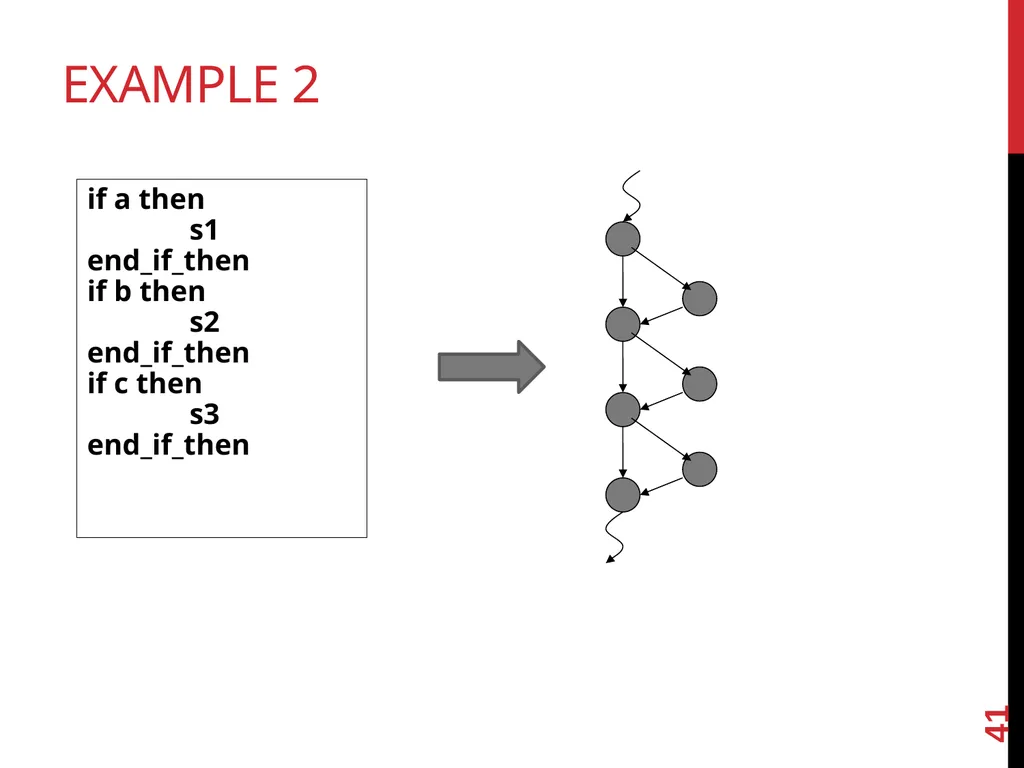
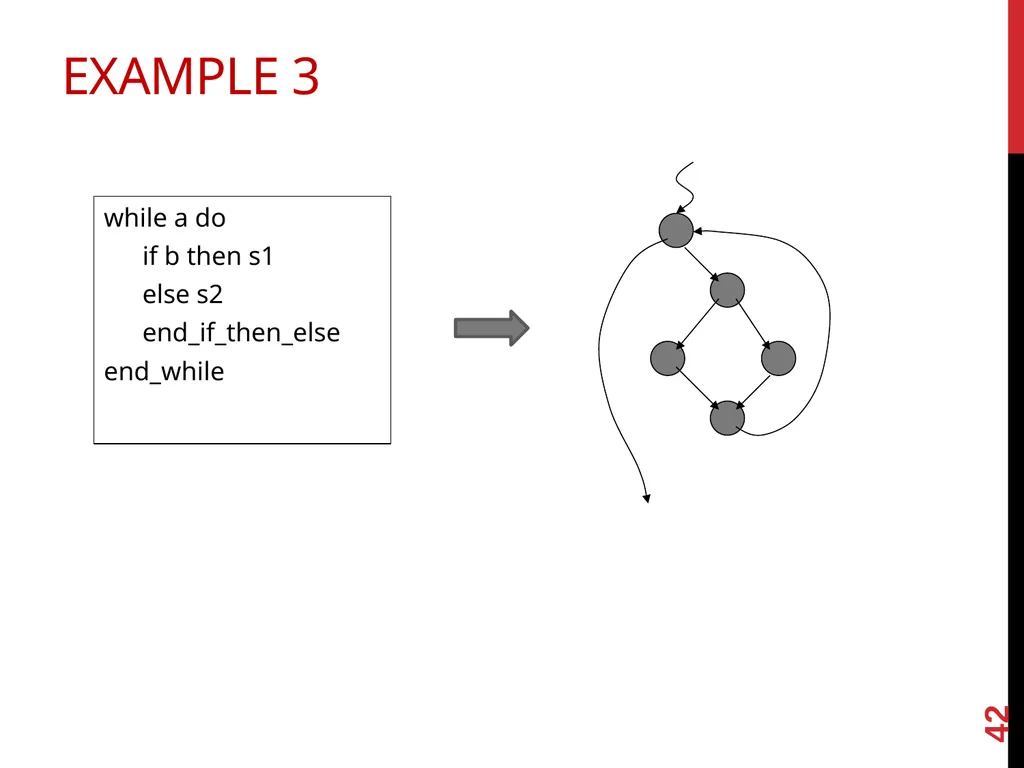
slide39. Basis Paths Coverage A coverage criterion associated with McCabe’s Structured Testing.
Based on idea of identifying a “spanning” (i.e., basis) set of paths for a program’s “path space.”
The number, C, of such paths is equal to the number of (2-way) branch statements in the program + 1.
This is also the number of enclosed regions in the program graph + 1. 39<br>
slide40. Example 1 if a then s1
else if b then s2
else if c then s3
else s4
end_if_then_else
end_if_then_else
end_if_then_else 40<br>
slide41. Example 2 if a then
s1
end_if_then
if b then
s2
end_if_then
if c then
s3
end_if_then 41<br>
slide42. Example 3 while a do
if b then s1
else s2
end_if_then_else
end_while 42<br>
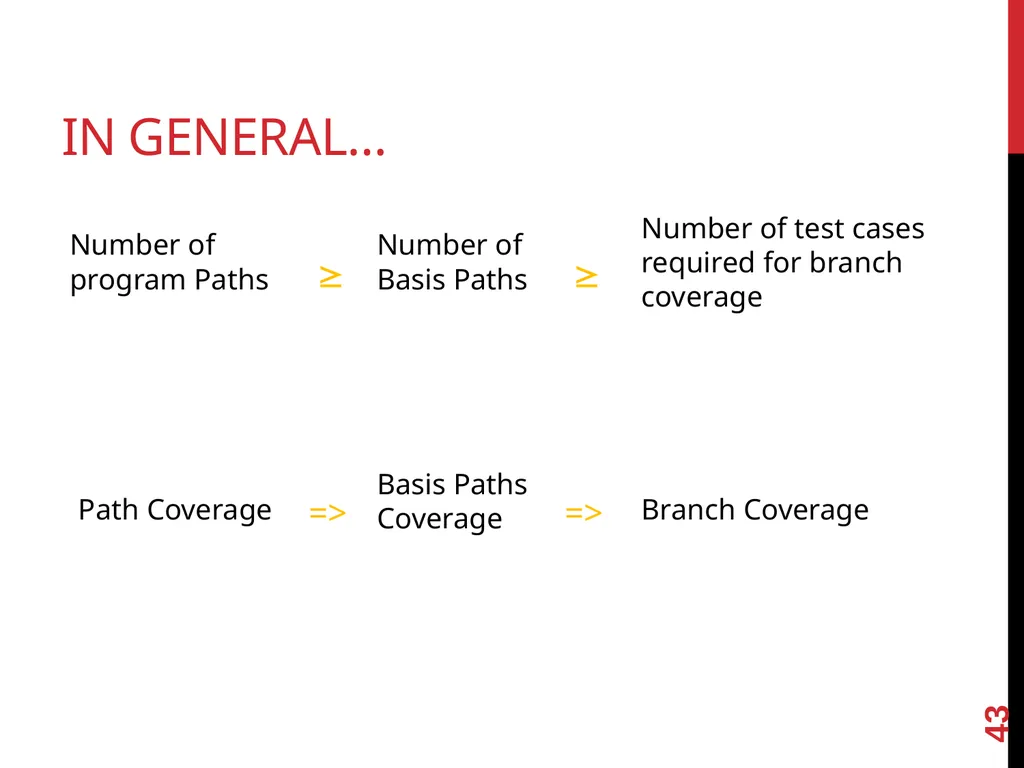
slide43. In General… Number of program Paths Number of Basis Paths Number of test cases required for branch coverage Path Coverage Basis Paths Coverage Branch Coverage => => 43<br>
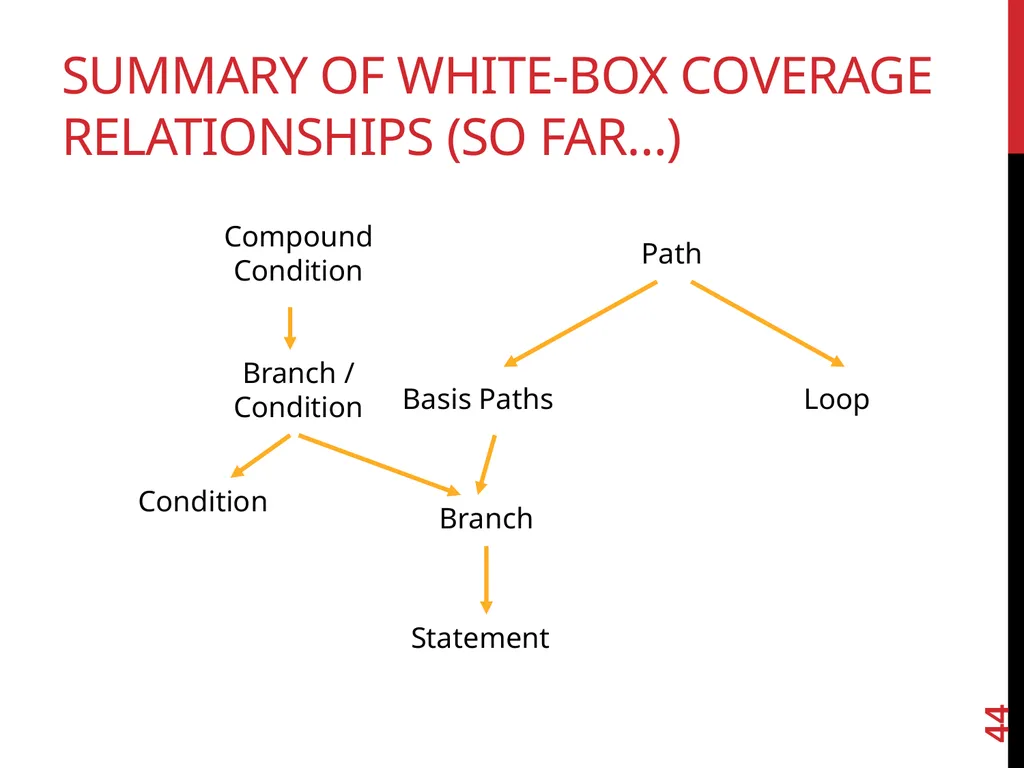
slide44. Summary of White-Box Coverage Relationships (so far…) Path Compound Condition Branch / Condition Basis Paths Loop Condition Statement Branch 44<br>
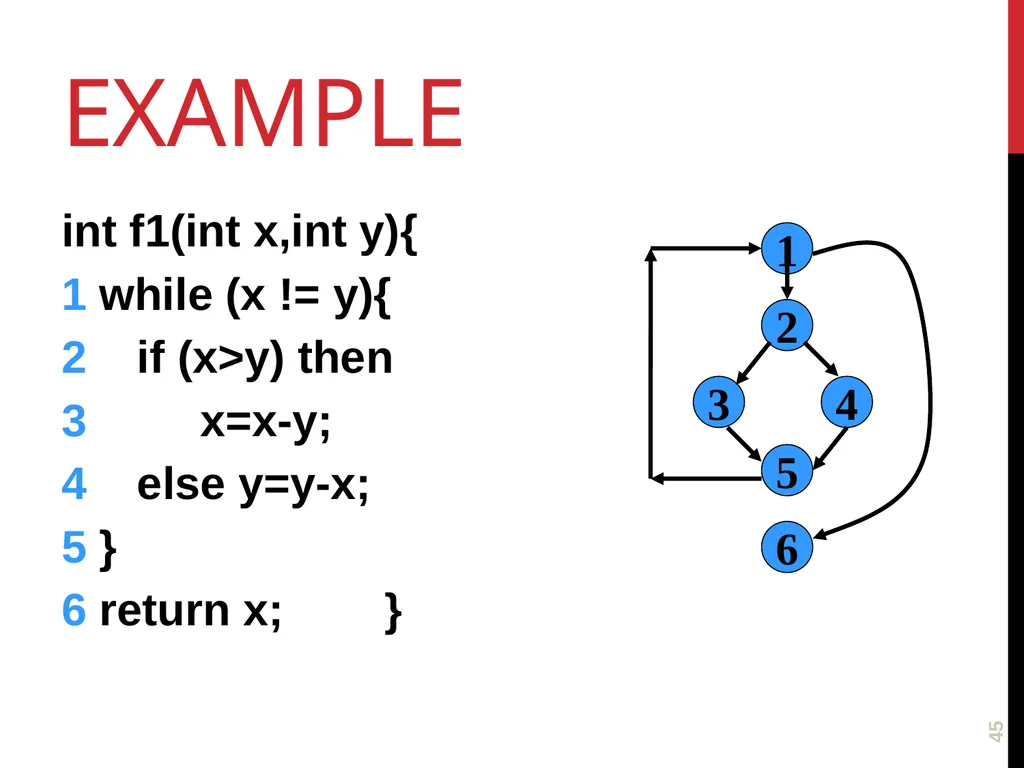
slide45. 45 Example int f1(int x,int y){
1 while (x != y){
2 if (x>y) then
3 x=x-y;
4 else y=y-x;
5 }
6 return x; } 1 2 3 4 5 6<br>
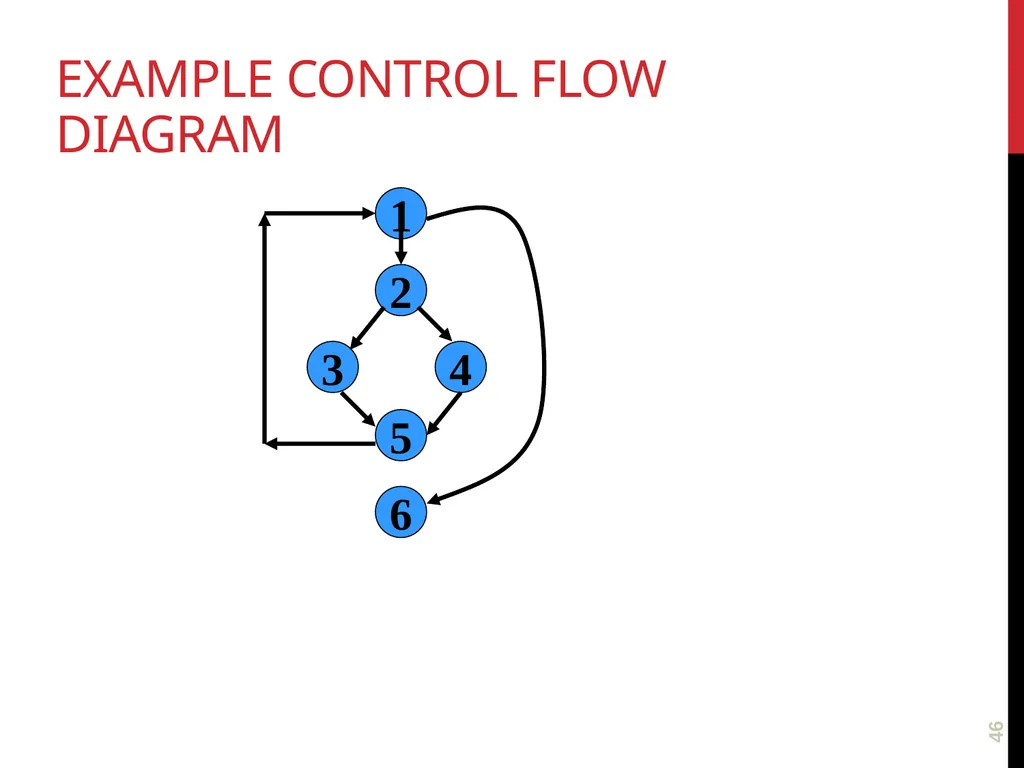
slide46. 46 Example Control Flow Diagram 1 2 3 4 5 6<br>
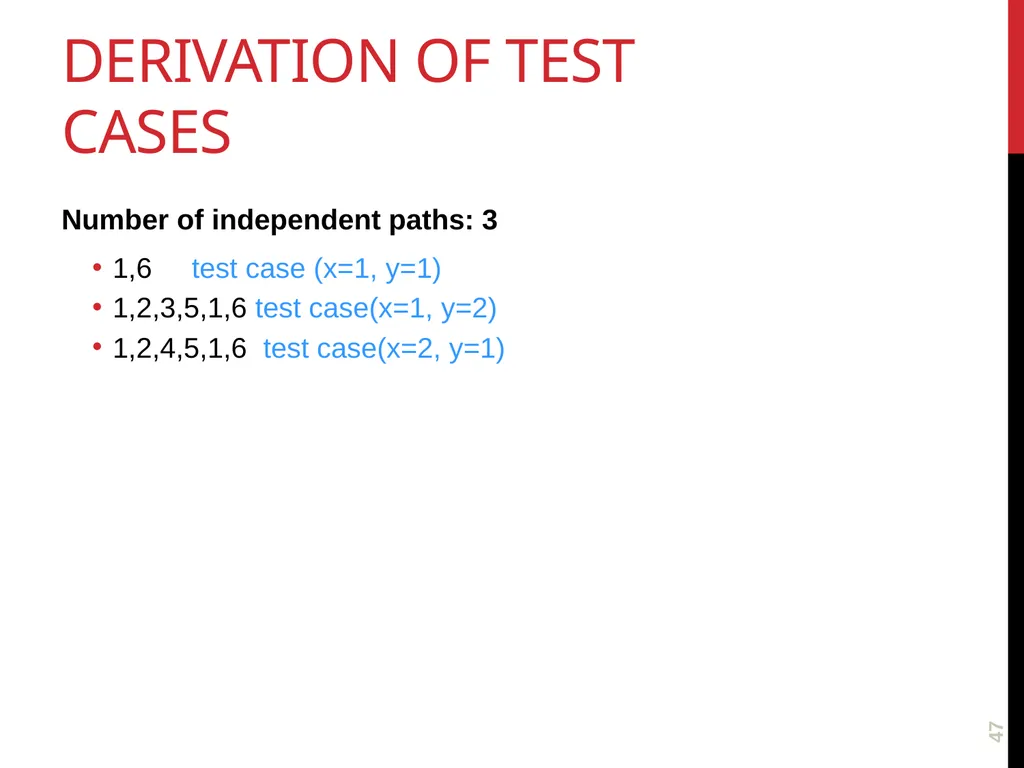
slide47. 47 Derivation of Test Cases Number of independent paths: 3
1,6 test case (x=1, y=1)
1,2,3,5,1,6 test case(x=1, y=2)
1,2,4,5,1,6 test case(x=2, y=1)<br>
slide48. 48 An interesting application of cyclomatic complexity Relationship exists between:
McCabe's metric
the number of errors existing in the code,
the time required to find and correct the errors.<br>
slide49. 49 Cyclomatic complexity Cyclomatic complexity of a program:
also indicates the psychological complexity of a program.
difficulty level of understanding the program.<br>
slide50. 50 Cyclomatic complexity From maintenance perspective,
limit cyclomatic complexity
of modules to some reasonable value.
Good software development organizations:
restrict cyclomatic complexity of functions to a maximum of ten or so.<br>
slide2. Glass box/white box testing 2<br>
slide3. Software Testing Goal of testing
finding faults in the software
demonstrating that there are no faults in the software (for the test cases that has been used during testing)
It is not possible to prove that there are no faults in the software using testing
Testing should help locate errors, not just detect their presence
a “yes/no” answer to the question “is the program correct?” is not very helpful
Testing should be repeatable
could be difficult for distributed or concurrent software
effect of the environment, uninitialized variables<br>
slide4. Testing Software is Hard If you are testing a bridge’s ability to sustain weight, and you test it with 1000 tons you can infer that it will sustain weight 1000 tons
This kind of reasoning does not work for software systems
software systems are not linear nor continuous
Exhaustively testing all possible input/output combinations is too expensive
the number of test cases increase exponentially with the number of input/output variables<br>
slide5. Some Definitions Let P be a program and let D denote its input domain
A test case t is an element of input domain t D
a test case gives a valuation for all the input variables of the program
A test set T is a finite set of test cases, i.e., a subset of D, T D
The basic difficulty in testing is finding a test set that will uncover the faults in the program
Exhaustive testing corresponds to setting T = D<br>
slide6. Exhaustive Testing is Hard Number of possible test cases (assuming 32 bit integers)
232 232 = 264
Do bigger test sets help?
Test set
{(x=3,y=2), (x=2,y=3)}
will detect the error
Test set
{(x=3,y=2),(x=4,y=3),(x=5,y=1)}
will not detect the error although it has more test cases
The power of the test set is not determined by the number of test cases
But, if T1 T2, then T2 will detect every fault detected by T1 int max(int x, int y)
{
if (x > y)
return x;
else
return x;
}<br>
slide7. Definition of White-Box Testing Testing based on analysis of internal logic (design, code, etc.).
expected results still come from requirements.
Exercise the internal logic of a program and traverse particular execution paths
Also know as structural testing or glass box testing.
White-box testing techniques apply primarily to lower levels of testing (e.g., unit and component).
(Functional, performance, and stress testing are collectively referred to as black box testing.) 7<br>
slide8. What are major activities? Decide which paths need to be exercised.
Derive test data to exercise those paths.
Determine the test coverage criterion.
Execute the test cases.
Measure the test coverage achieved. 8<br>
slide9. Why determine test coverage criterion? Why not just test it all?
What does “all” mean?
Program units (classes, clusters of classes) usually contain too many paths to permit exhaustive testing.
For example, loops introduce combinatorial numbers of execution paths and make exhaustive testing impossible. 9<br>
slide10. What if you could test all paths? Would the program be correct then?
The program might be missing paths
Code for branch alternative not there
More likely detect missing paths by requirements testing
Might have computational errors not revealed in the test data shown, even on the path where the error occurs
We call that coincidental correctness
For example, suppose code has x = A + A where it should have A*A but you test with A = 2. 10<br>
slide11. When are you done with unit testing? Decide on criterion
Statement coverage
Branch coverage
Logical path coverage 11 Statement: 1, 2, 3, 4, 5
Branch: 1, 2, 3, 4, 5
1, 3, 5
Path: 1, 2, 3, 4, 5
1, 3, 5
1, 2, 3, 5
1, 3, 4, 5<br>
slide12. Coverage Metrics Coverage metrics
Statement coverage: all statements in the programs should be executed at least once
Branch coverage: all branches in the program should be executed at least once
Path coverage: all execution paths in the program should be executed at lest once
The best case would be to execute all paths through the code, but there are some problems with this:
the number of paths increases fast with the number of branches in the program
the number of executions of a loop may depend on the input variables and hence may not be possible to determine most of the paths<br>
slide13. Types of Logic Coverage Statement: each statement executed at least once
Branch: each branch traversed (and every entry point taken) at least once
Condition: each condition True at least once and False at least once
Branch/Condition: both Branch and Condition coverage achieved
Compound Condition: all combinations of condition values at every branch statement covered (and every entry point taken)
Path: all program paths traversed at least once 13<br>
slide14. Pseudocode and Control Flow Graphs input(Y)
if (Y<=0) then
Y := −Y
end_if
while (Y>0) do
input(X)
Y := Y-1
end_while 14<br>
slide15. Statement Coverage Statement Coverage requires that each statement will have been executed at least once.
Simplest form of logic coverage.
Also known as Node Coverage.
What is the minimum number of test cases required to achieve statement coverage for the program segment given in previous slide? 15<br>
slide16. Statement Coverage Find a set of test cases to ensure that every statement is executed at least once<br>
slide17. How many test cases required for Statement Coverage? input(Y)
if (Y<=0) then
Y := −Y
end_if
while (Y>0) do
input(X)
Y := Y-1
end_while 17<br>
slide18. Branch Coverage Branch Coverage requires that each branch will have been traversed, and that every program entry point will have been taken, at least once.
Also known as Edge Coverage. 18<br>
slide19. Branch coverage Find a set of test cases to ensure that each branching statement is taken in each direction at least once<br>
slide20. Branch Coverage (cont’d) What is the relationship between Statement and Branch Coverage?
Possible relationships:
None.
Statement Coverage subsumes Branch Coverage (“statement => branch”).
Branch Coverage subsumes Statement Coverage (“branch => statement”). 20<br>
slide21. Does “statement => branch” ??? Minimum number of cases required for Statement Coverage?
Minimum number of cases required for Branch Coverage? 21<br>
slide22. Does “branch => statement” ??? Normally, YES… UNLESS “DEAD CODE” exists 22<br>
slide23. Does “branch => statement” ??? If a program has "dead (i.e., unreachable) code", then "statement coverage" is unachievable.
Always assume the nominal case of “no dead code" unless explicitly stated otherwise.
Under this assumption, Branch Coverage does indeed subsume Statement Coverage. 23<br>
slide24. Condition Coverage A branch predicate may have more than one condition. input(X,Y)
if (Y<=0) or (X=0) then
Y := -Y
end_if
while (Y>0) and (not EOF) do
input(X)
Y := Y-1
end_while 24<br>
slide25. Condition Coverage (cont’d) Condition Coverage requires that each condition will have been
True at least once and
False at least once.
What is the relationship between Branch and Condition Coverage? 25<br>
slide26. Condition Coverage (cont’d) if A or B then
s1
else
s2
end_if_then_else 26<br>
slide27. Condition Coverage (cont’d) if A or B then
s1
else
s2
end_if_then_else 27<br>
slide28. Branch/Condition Coverage Branch/Condition Coverage requires that both Branch AND Condition Coverage will have been achieved.
Branch/Condition Coverage subsumes both Branch Coverage and Condition Coverage. 28<br>
slide29. Compound Condition Coverage What if the compiler generates code that masks the evaluation of conditions?
That is, suppose
if (A) or (y/x=5) then...
is compiled in such a way that if A is true, y/x=5 will not be evaluated. 29<br>
slide30. Compound Condition Coverage (cont’d) Compound Condition Coverage requires that all combinations of condition values at every branch statement will have been covered, and that every entry point will have been taken, at least once.
Also know as Multiple Condition Coverage.
Subsumes Branch/Condition Coverage, regardless of the order in which conditions are evaluated. 30<br>
slide31. Compound Condition Coverage (cont’d) input(X,Y)
if (Y<=0) or (X=0) then
Y := -Y
end_if Combinations of condition values: TT, TF, FT, FF 31<br>
slide32. Path Coverage Path Coverage requires that all program paths will have been traversed at least once.
Often described as the “strongest” form of logic coverage
Path Coverage is usually impossible when loops are present.
How many test cases would be required to cover all paths in followıngthe example? 32<br>
slide33. Logical Path Coverage Acknowledges that the order in which branches are taken can be significant
Ensure that every path is executed at least once
A path is some feasible combination of statements and branches<br>
slide34. Path Coverage (cont’d) for I = 1 to 30 do
input(X,Y)
if (Y<=0) then
if (X<=0) then
Y := -X
else
Y:=-Y
end_if_else
else
Y := X+Y
end_if_else
end_for_do 34<br>
slide35. PATH COVERAGE 35 3 paths 3 paths 3 X 3 = 9 paths<br>
slide36. Path Coverage (cont’d) repeat 29 times 3 X 3 X…X 3 = 330 paths 36<br>
slide37. Path Coverage (cont’d) Various strategies have been developed for identifying useful subsets of paths for testing when Path Coverage is impractical:
Loop Coverage,
Basis Paths Coverage, and
Dataflow Coverage. 37<br>
slide38. Loop Coverage Loop Coverage requires that the body of loops be executed 0, 1, 2, t, max, and max+1 times, where possible.
Rationale:
0: Is some action taken in the body that must also be taken when the body is not executed?
1: Check lower bound on number of times body may be executed.
2: Check loop re-initialization.
t: Check typical number of iterations.
max: Check upper (valid) bound on number of times body may be executed.
max+1: If the maximum can be exceeded, what behavior results? 38<br>
slide39. Basis Paths Coverage A coverage criterion associated with McCabe’s Structured Testing.
Based on idea of identifying a “spanning” (i.e., basis) set of paths for a program’s “path space.”
The number, C, of such paths is equal to the number of (2-way) branch statements in the program + 1.
This is also the number of enclosed regions in the program graph + 1. 39<br>
slide40. Example 1 if a then s1
else if b then s2
else if c then s3
else s4
end_if_then_else
end_if_then_else
end_if_then_else 40<br>
slide41. Example 2 if a then
s1
end_if_then
if b then
s2
end_if_then
if c then
s3
end_if_then 41<br>
slide42. Example 3 while a do
if b then s1
else s2
end_if_then_else
end_while 42<br>
slide43. In General… Number of program Paths Number of Basis Paths Number of test cases required for branch coverage Path Coverage Basis Paths Coverage Branch Coverage => => 43<br>
slide44. Summary of White-Box Coverage Relationships (so far…) Path Compound Condition Branch / Condition Basis Paths Loop Condition Statement Branch 44<br>
slide45. 45 Example int f1(int x,int y){
1 while (x != y){
2 if (x>y) then
3 x=x-y;
4 else y=y-x;
5 }
6 return x; } 1 2 3 4 5 6<br>
slide46. 46 Example Control Flow Diagram 1 2 3 4 5 6<br>
slide47. 47 Derivation of Test Cases Number of independent paths: 3
1,6 test case (x=1, y=1)
1,2,3,5,1,6 test case(x=1, y=2)
1,2,4,5,1,6 test case(x=2, y=1)<br>
slide48. 48 An interesting application of cyclomatic complexity Relationship exists between:
McCabe's metric
the number of errors existing in the code,
the time required to find and correct the errors.<br>
slide49. 49 Cyclomatic complexity Cyclomatic complexity of a program:
also indicates the psychological complexity of a program.
difficulty level of understanding the program.<br>
slide50. 50 Cyclomatic complexity From maintenance perspective,
limit cyclomatic complexity
of modules to some reasonable value.
Good software development organizations:
restrict cyclomatic complexity of functions to a maximum of ten or so.<br>