
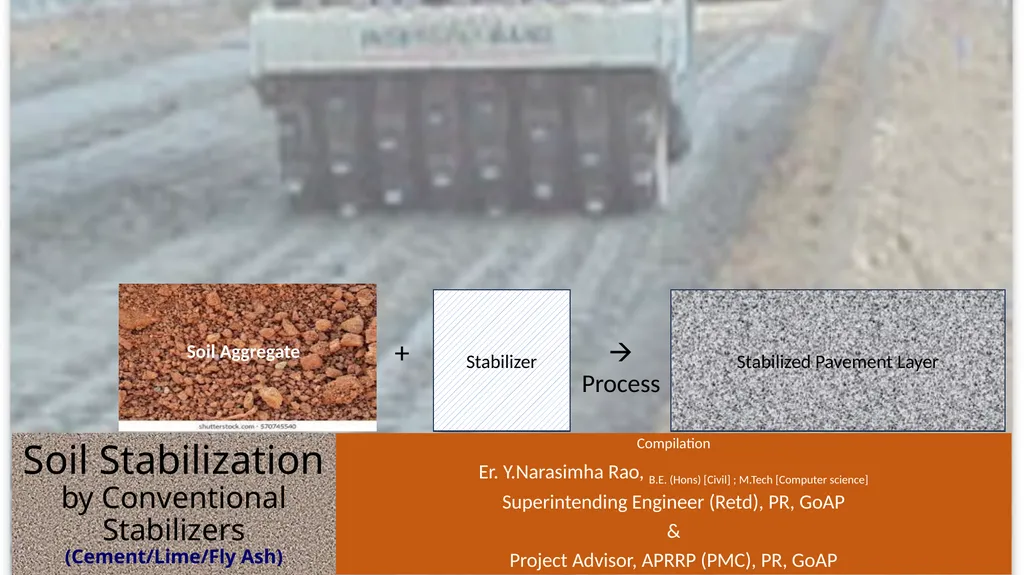
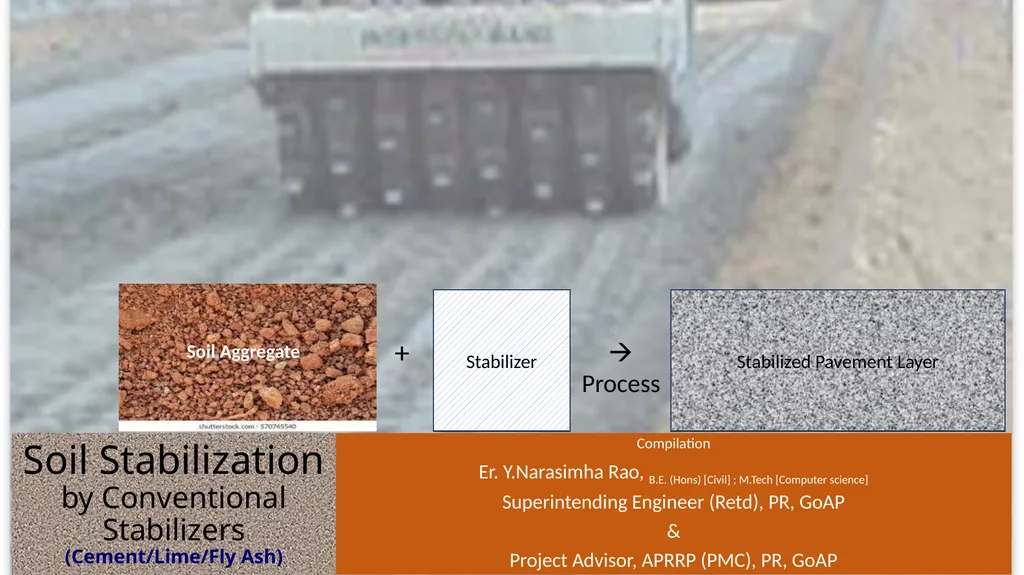
Soil Aggregate References IRC-SP-89 (2010) :
LS
Published · 28 slides · 0 views
1 / 1

Description
Soil Aggregate References IRC-SP-89 (2010) : Guidelines for Soil and Granular Material Stabilization using Cement, Lime, and Fly Ash MoRD Specifications for Rural Roads Clause 403: Lime Treated Soil for Improved SubgradeSub Base Clause
Related Topics
Share
Embed code
Download this presentation From Below
"Soil Aggregate References IRC-SP-89 (2010) :" is the property of its rightful owner. Permission is granted to download and print the materials on this website for personal, non-commercial use only, and to display it on your personal computer provided you do not modify the materials and that you retain all copyright notices contained in the materials. By downloading content from our website, you accept the terms of this agreement.
Presentation Transcript
01
Soil Aggregate<br>
02
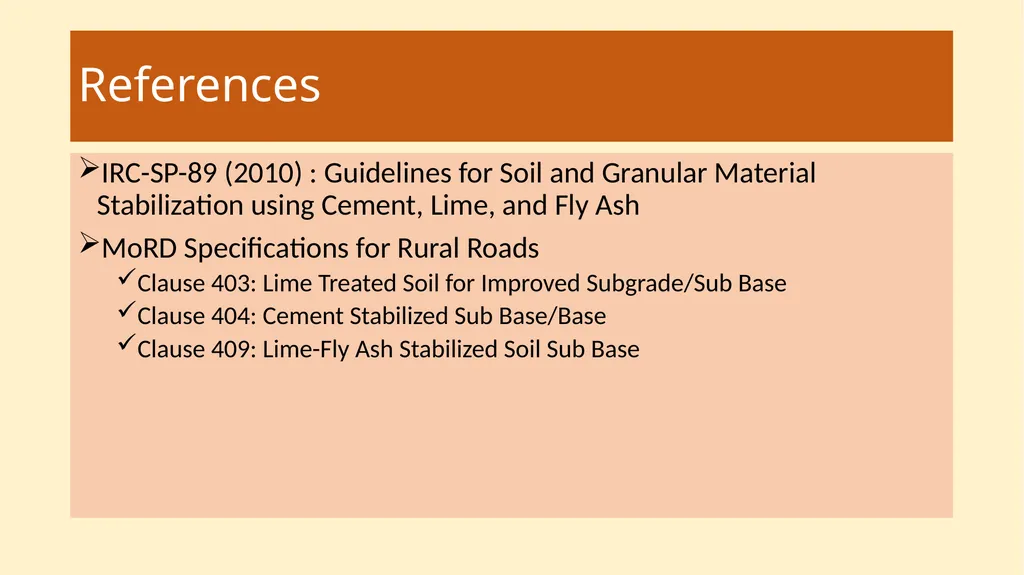
References IRC-SP-89 (2010) : Guidelines for Soil and Granular Material Stabilization using Cement, Lime, and Fly Ash
MoRD Specifications for Rural Roads
Clause 403: Lime Treated Soil for Improved Subgrade/Sub Base
Clause 404: Cement Stabilized Sub Base/Base
Clause 409: Lime-Fly Ash Stabilized Soil Sub Base<br>
MoRD Specifications for Rural Roads
Clause 403: Lime Treated Soil for Improved Subgrade/Sub Base
Clause 404: Cement Stabilized Sub Base/Base
Clause 409: Lime-Fly Ash Stabilized Soil Sub Base<br>
03
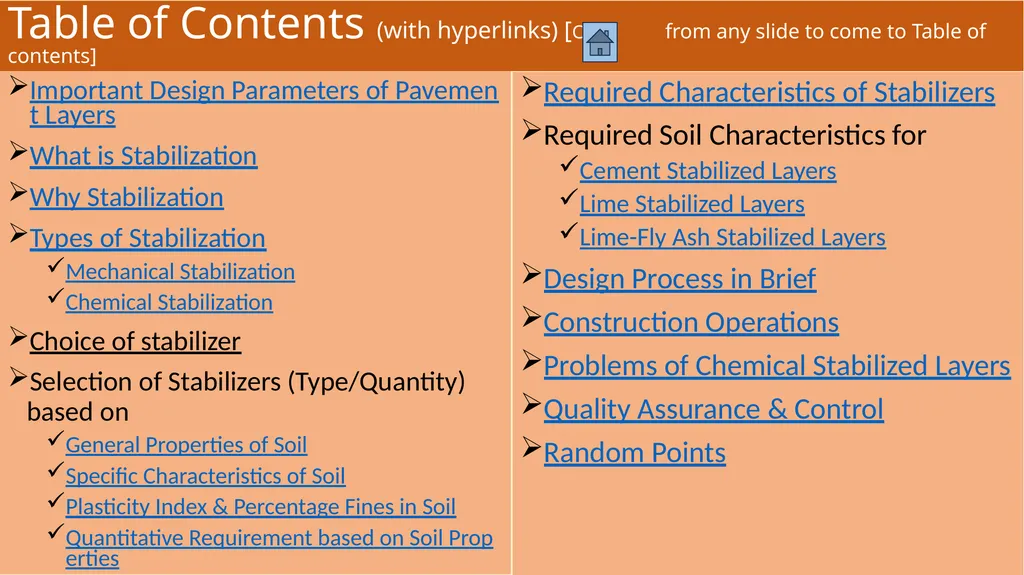
Table of Contents (with hyperlinks) [Click from any slide to come to Table of contents] Important Design Parameters of Pavement Layers
What is Stabilization
Why Stabilization
Types of Stabilization
Mechanical Stabilization
Chemical Stabilization
Choice of stabilizer
Selection of Stabilizers (Type/Quantity) based on
General Properties of Soil
Specific Characteristics of Soil
Plasticity Index & Percentage Fines in Soil
Quantitative Requirement based on Soil Properties
Two Stage Stabilization Required Characteristics of Stabilizers
Required Soil Characteristics for
Cement Stabilized Layers
Lime Stabilized Layers
Lime-Fly Ash Stabilized Layers
Design Process in Brief
Construction Operations
Problems of Chemical Stabilized Layers
Quality Assurance & Control
Random Points<br>
What is Stabilization
Why Stabilization
Types of Stabilization
Mechanical Stabilization
Chemical Stabilization
Choice of stabilizer
Selection of Stabilizers (Type/Quantity) based on
General Properties of Soil
Specific Characteristics of Soil
Plasticity Index & Percentage Fines in Soil
Quantitative Requirement based on Soil Properties
Two Stage Stabilization Required Characteristics of Stabilizers
Required Soil Characteristics for
Cement Stabilized Layers
Lime Stabilized Layers
Lime-Fly Ash Stabilized Layers
Design Process in Brief
Construction Operations
Problems of Chemical Stabilized Layers
Quality Assurance & Control
Random Points<br>
04
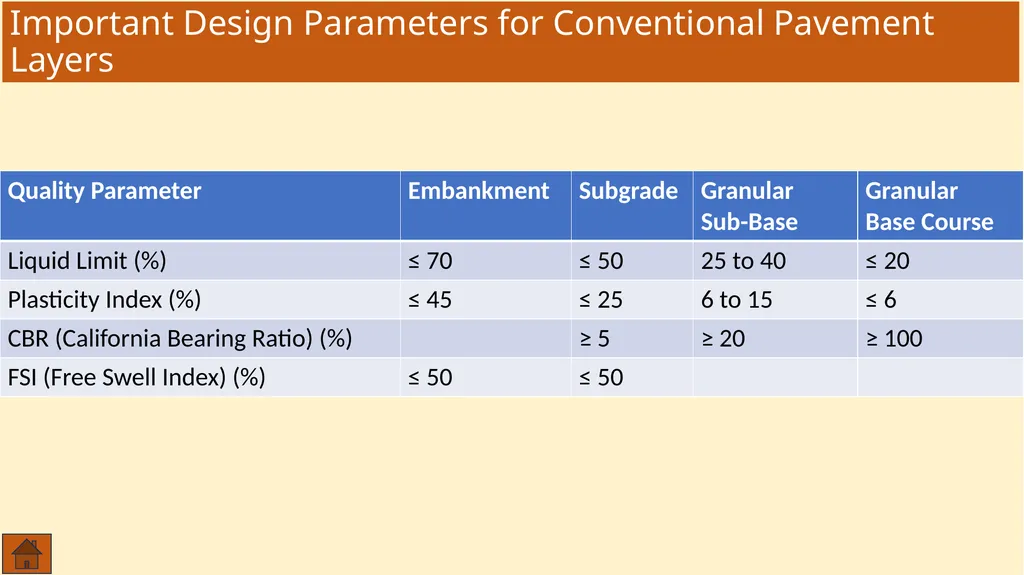
Important Design Parameters for Conventional Pavement Layers<br>
05
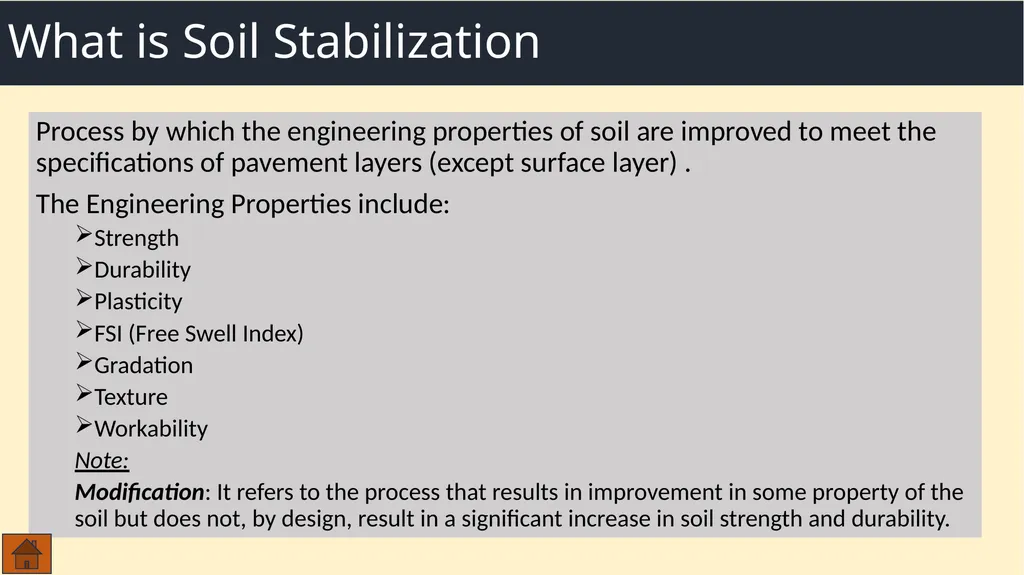
What is Soil Stabilization Process by which the engineering properties of soil are improved to meet the specifications of pavement layers (except surface layer) .
The Engineering Properties include:
Strength
Durability
Plasticity
FSI (Free Swell Index)
Gradation
Texture
Workability
Note:
Modification: It refers to the process that results in improvement in some property of the soil but does not, by design, result in a significant increase in soil strength and durability.<br>
The Engineering Properties include:
Strength
Durability
Plasticity
FSI (Free Swell Index)
Gradation
Texture
Workability
Note:
Modification: It refers to the process that results in improvement in some property of the soil but does not, by design, result in a significant increase in soil strength and durability.<br>
06
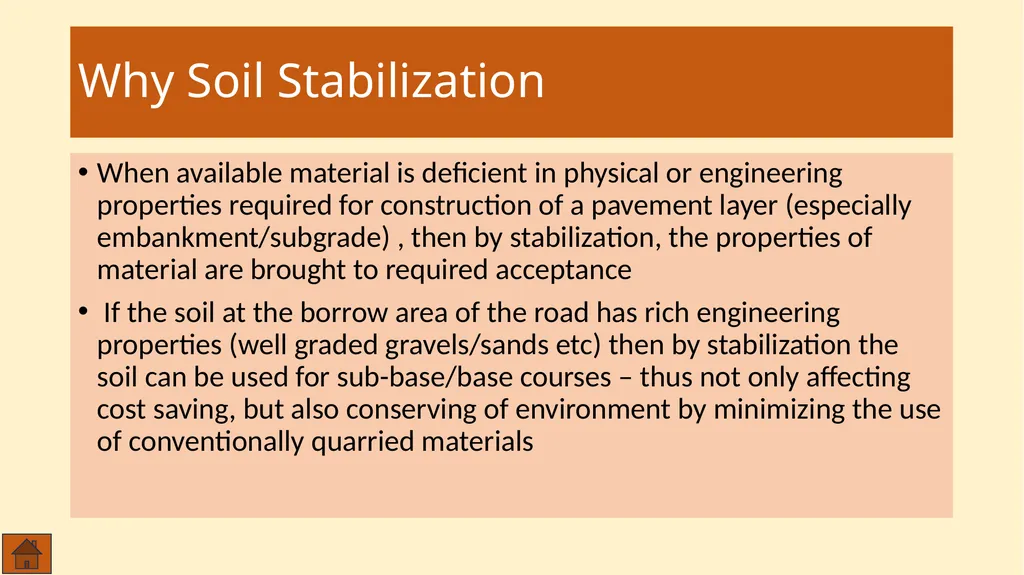
Why Soil Stabilization When available material is deficient in physical or engineering properties required for construction of a pavement layer (especially embankment/subgrade) , then by stabilization, the properties of material are brought to required acceptance
If the soil at the borrow area of the road has rich engineering properties (well graded gravels/sands etc) then by stabilization the soil can be used for sub-base/base courses – thus not only affecting cost saving, but also conserving of environment by minimizing the use of conventionally quarried materials<br>
If the soil at the borrow area of the road has rich engineering properties (well graded gravels/sands etc) then by stabilization the soil can be used for sub-base/base courses – thus not only affecting cost saving, but also conserving of environment by minimizing the use of conventionally quarried materials<br>
07
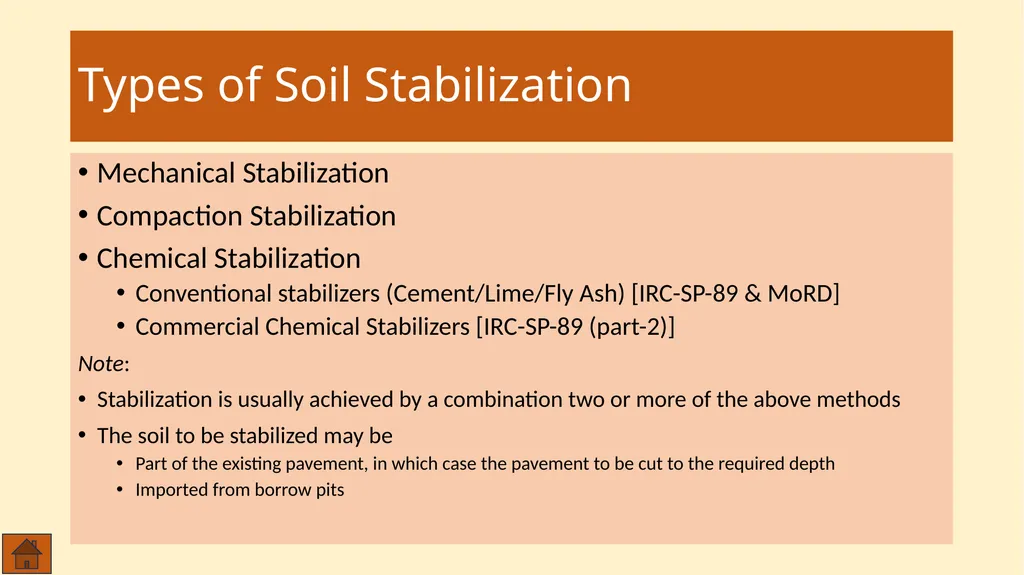
Types of Soil Stabilization Mechanical Stabilization
Compaction Stabilization
Chemical Stabilization
Conventional stabilizers (Cement/Lime/Fly Ash) [IRC-SP-89 & MoRD]
Commercial Chemical Stabilizers [IRC-SP-89 (part-2)]
Note:
Stabilization is usually achieved by a combination two or more of the above methods
The soil to be stabilized may be
Part of the existing pavement, in which case the pavement to be cut to the required depth
Imported from borrow pits<br>
Compaction Stabilization
Chemical Stabilization
Conventional stabilizers (Cement/Lime/Fly Ash) [IRC-SP-89 & MoRD]
Commercial Chemical Stabilizers [IRC-SP-89 (part-2)]
Note:
Stabilization is usually achieved by a combination two or more of the above methods
The soil to be stabilized may be
Part of the existing pavement, in which case the pavement to be cut to the required depth
Imported from borrow pits<br>
08
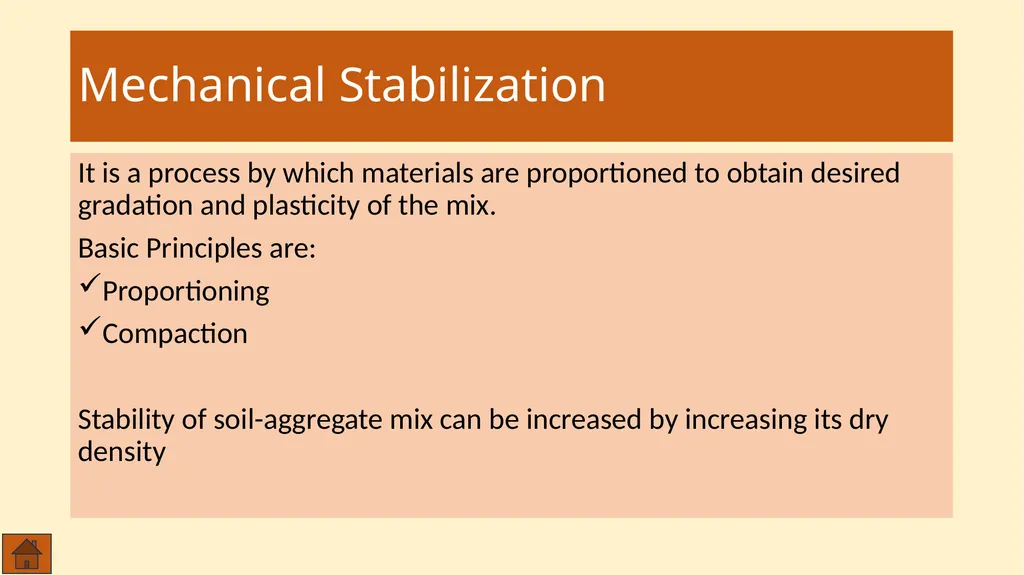
Mechanical Stabilization It is a process by which materials are proportioned to obtain desired gradation and plasticity of the mix.
Basic Principles are:
Proportioning
Compaction
Stability of soil-aggregate mix can be increased by increasing its dry density<br>
Basic Principles are:
Proportioning
Compaction
Stability of soil-aggregate mix can be increased by increasing its dry density<br>
09
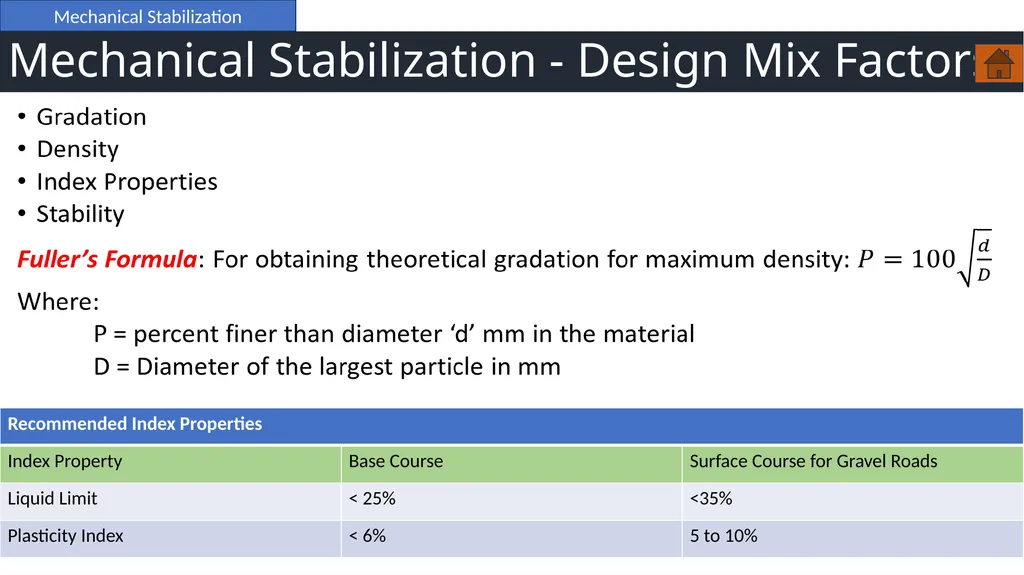
Mechanical Stabilization - Design Mix Factors Mechanical Stabilization<br>
10
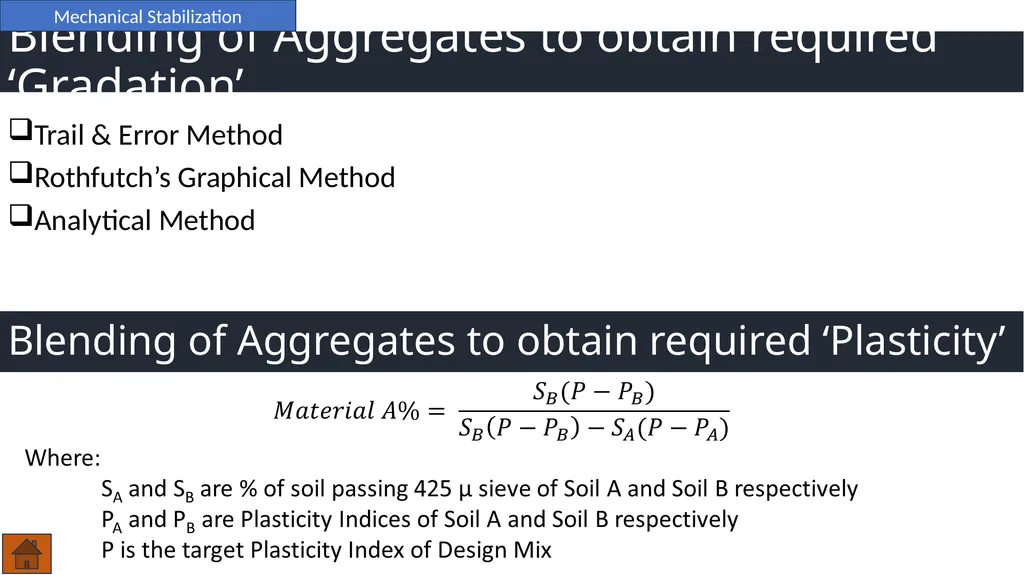
Blending of Aggregates to obtain required ‘Gradation’ Trail & Error Method
Rothfutch’s Graphical Method
Analytical Method Mechanical Stabilization Blending of Aggregates to obtain required ‘Plasticity’<br>
Rothfutch’s Graphical Method
Analytical Method Mechanical Stabilization Blending of Aggregates to obtain required ‘Plasticity’<br>
11
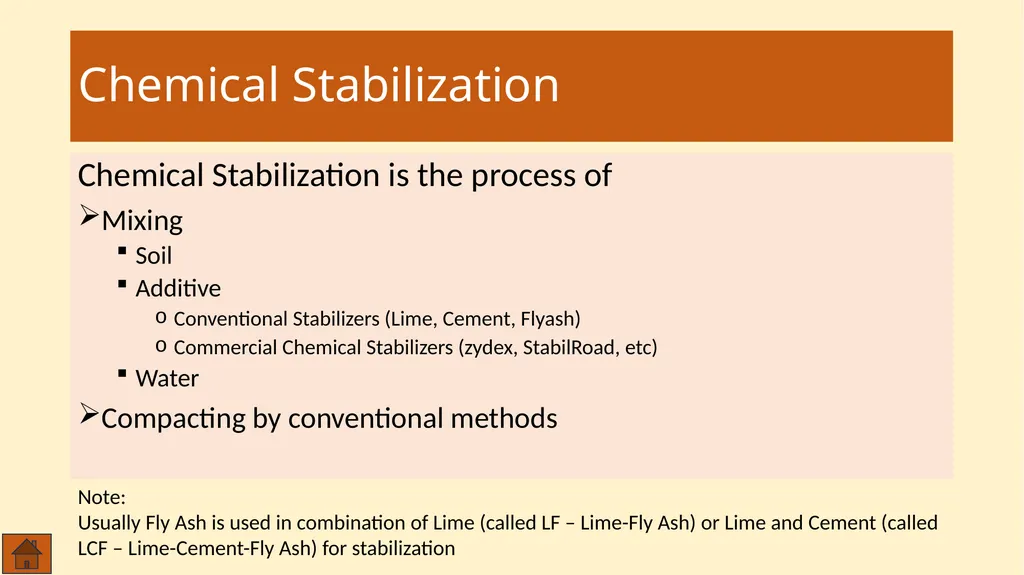
Chemical Stabilization Chemical Stabilization is the process of
Mixing
Soil
Additive
Conventional Stabilizers (Lime, Cement, Flyash)
Commercial Chemical Stabilizers (zydex, StabilRoad, etc)
Water
Compacting by conventional methods Note:
Usually Fly Ash is used in combination of Lime (called LF – Lime-Fly Ash) or Lime and Cement (called LCF – Lime-Cement-Fly Ash) for stabilization<br>
Mixing
Soil
Additive
Conventional Stabilizers (Lime, Cement, Flyash)
Commercial Chemical Stabilizers (zydex, StabilRoad, etc)
Water
Compacting by conventional methods Note:
Usually Fly Ash is used in combination of Lime (called LF – Lime-Fly Ash) or Lime and Cement (called LCF – Lime-Cement-Fly Ash) for stabilization<br>
12
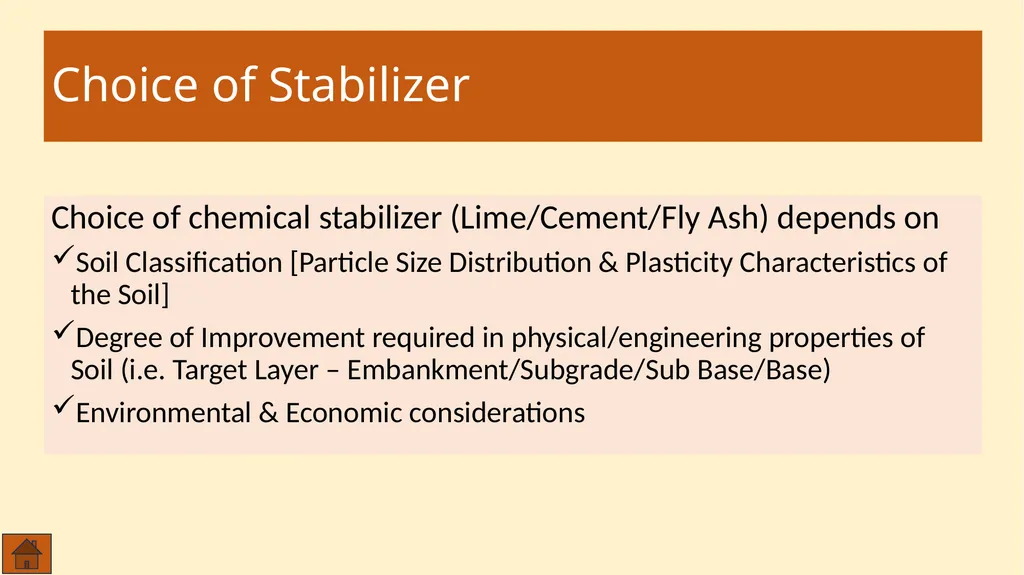
Choice of Stabilizer Choice of chemical stabilizer (Lime/Cement/Fly Ash) depends on
Soil Classification [Particle Size Distribution & Plasticity Characteristics of the Soil]
Degree of Improvement required in physical/engineering properties of Soil (i.e. Target Layer – Embankment/Subgrade/Sub Base/Base)
Environmental & Economic considerations<br>
Soil Classification [Particle Size Distribution & Plasticity Characteristics of the Soil]
Degree of Improvement required in physical/engineering properties of Soil (i.e. Target Layer – Embankment/Subgrade/Sub Base/Base)
Environmental & Economic considerations<br>
13
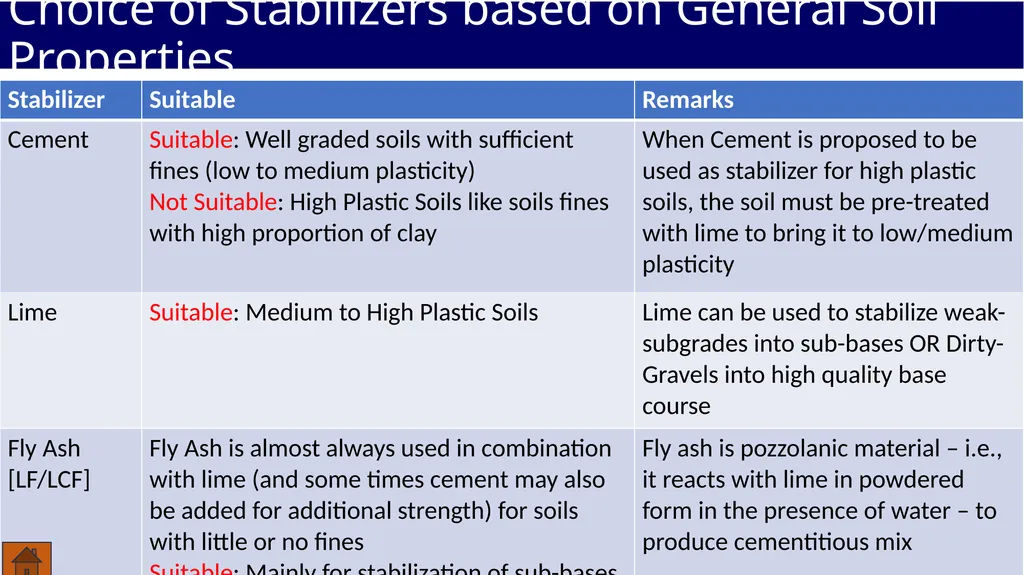
Choice of Stabilizers based on General Soil Properties<br>
14
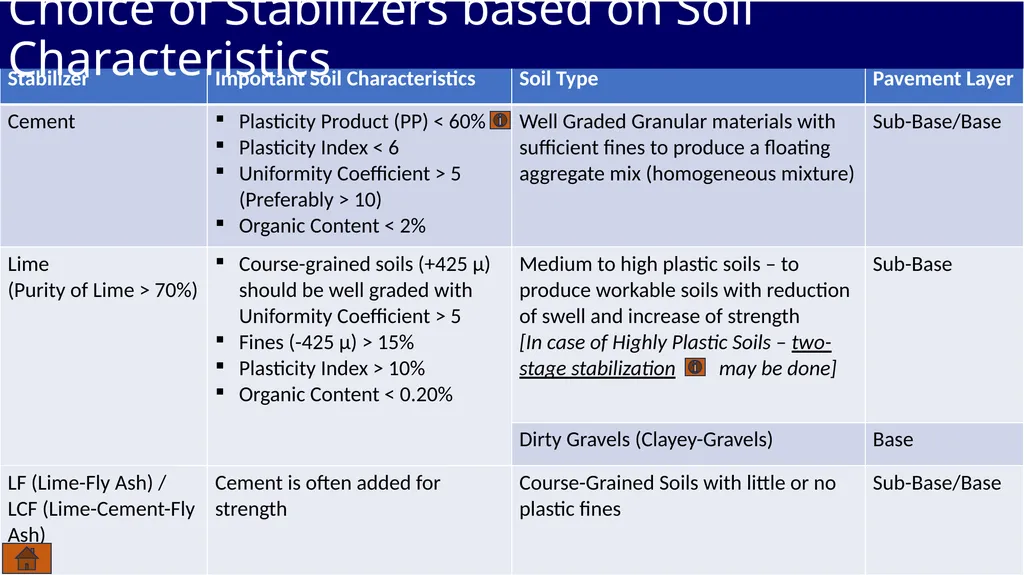
Choice of Stabilizers based on Soil Characteristics<br>
15
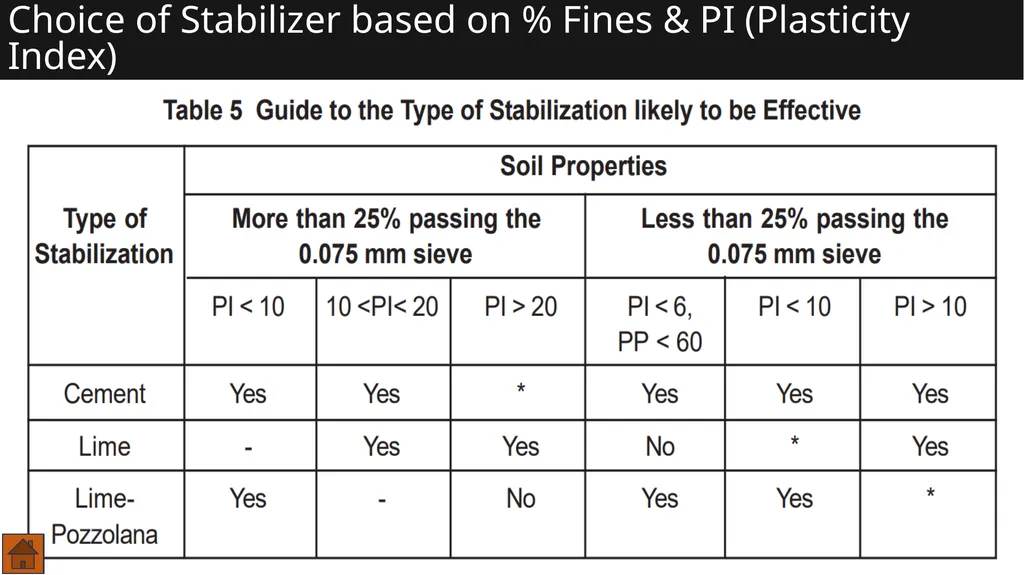
Choice of Stabilizer based on % Fines & PI (Plasticity Index)<br>
16
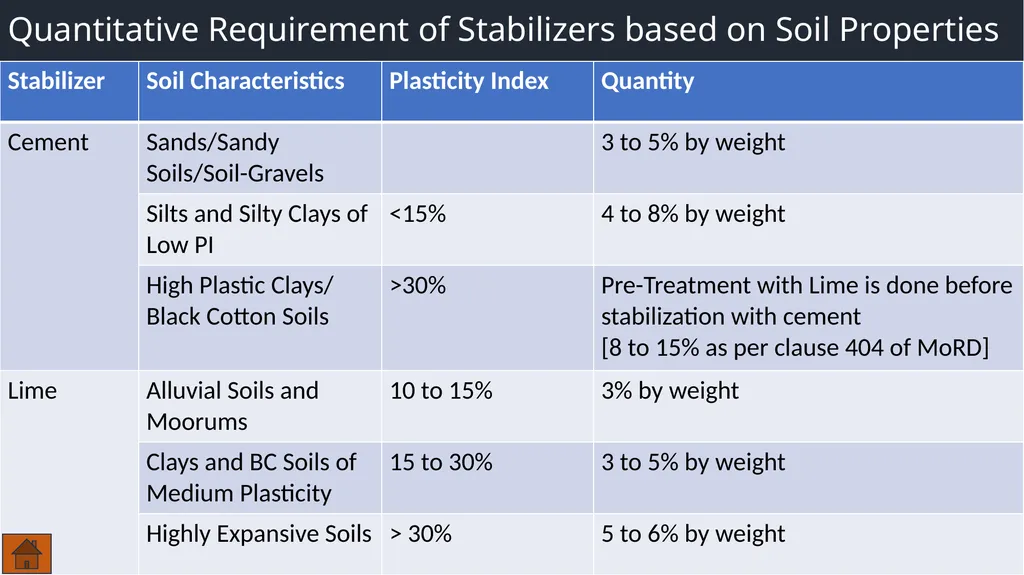
Quantitative Requirement of Stabilizers based on Soil Properties<br>
17
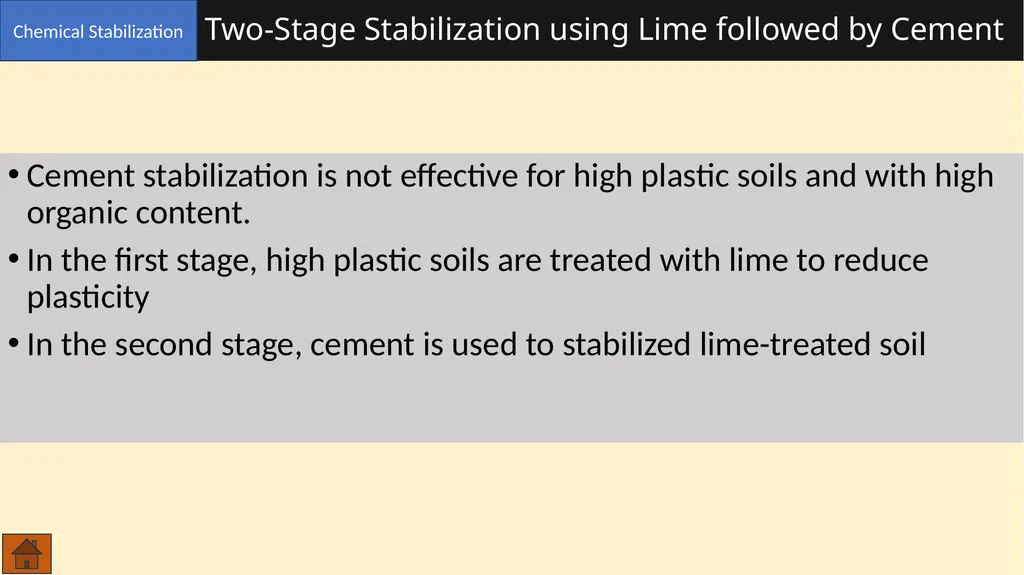
Two-Stage Stabilization using Lime followed by Cement Cement stabilization is not effective for high plastic soils and with high organic content.
In the first stage, high plastic soils are treated with lime to reduce plasticity
In the second stage, cement is used to stabilized lime-treated soil Chemical Stabilization<br>
In the first stage, high plastic soils are treated with lime to reduce plasticity
In the second stage, cement is used to stabilized lime-treated soil Chemical Stabilization<br>
18
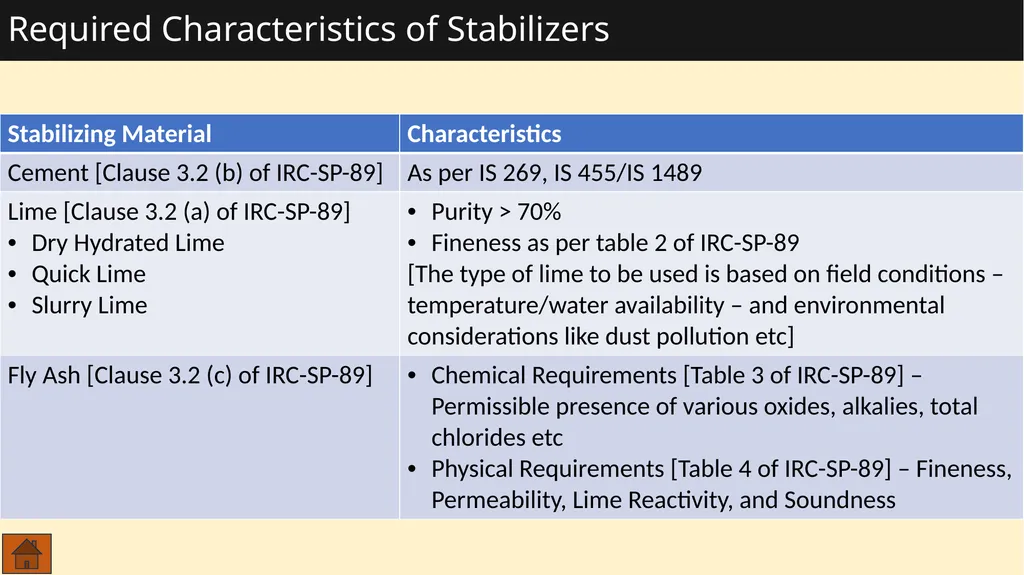
Required Characteristics of Stabilizers<br>
19
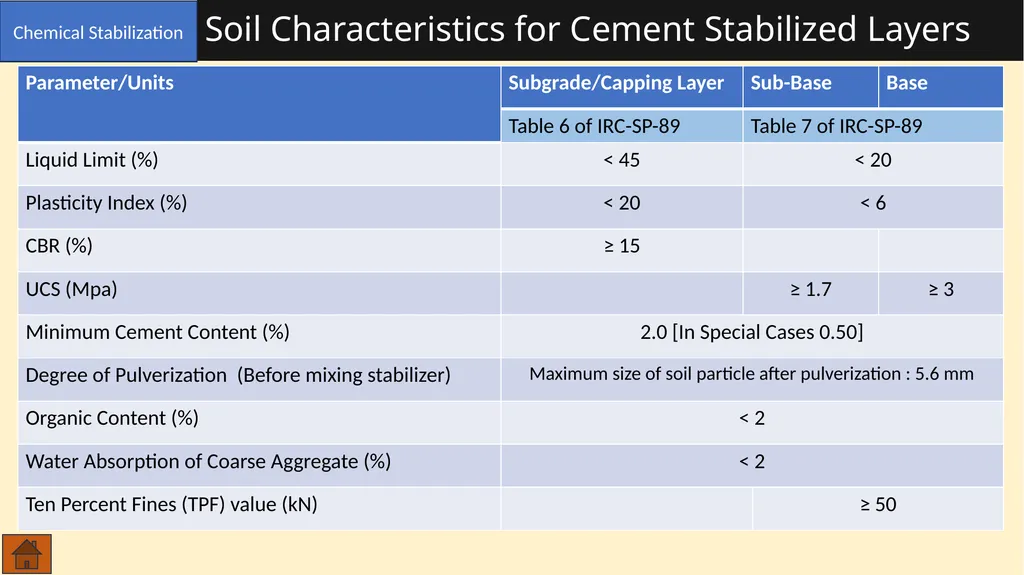
Soil Characteristics for Cement Stabilized Layers Chemical Stabilization<br>
20
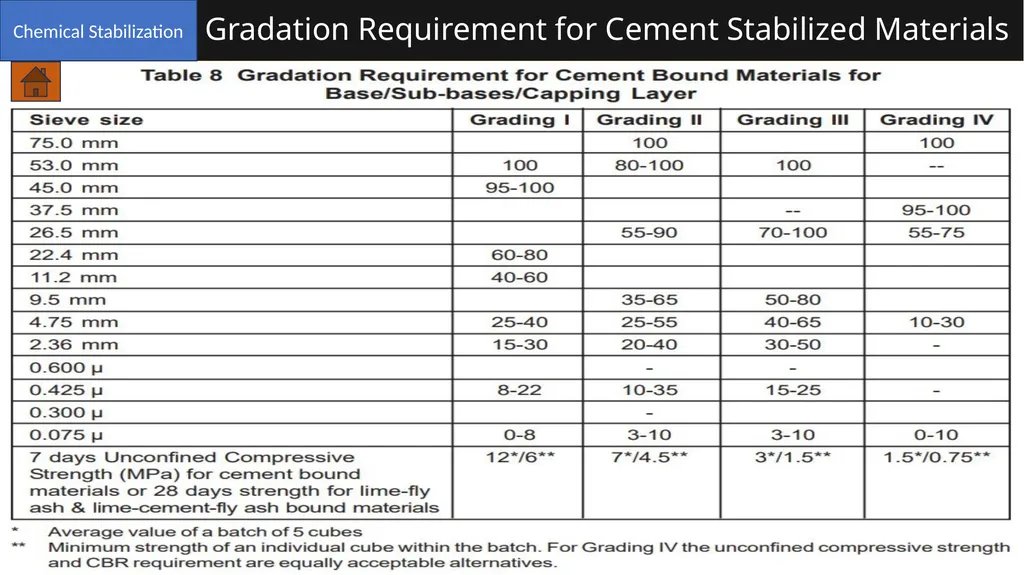
Gradation Requirement for Cement Stabilized Materials Chemical Stabilization<br>
21
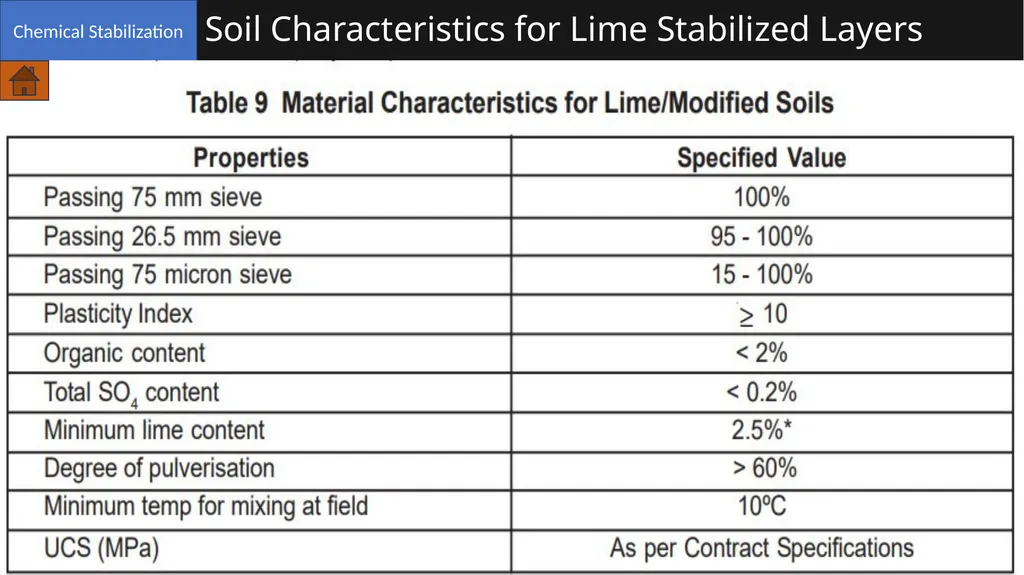
Soil Characteristics for Lime Stabilized Layers Chemical Stabilization<br>
22
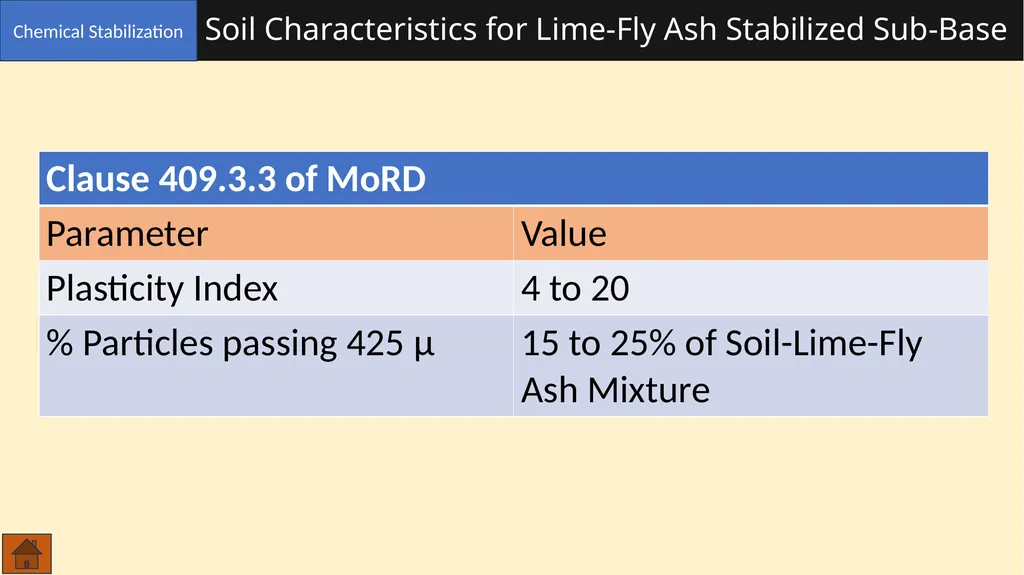
Soil Characteristics for Lime-Fly Ash Stabilized Sub-Base Chemical Stabilization<br>
23
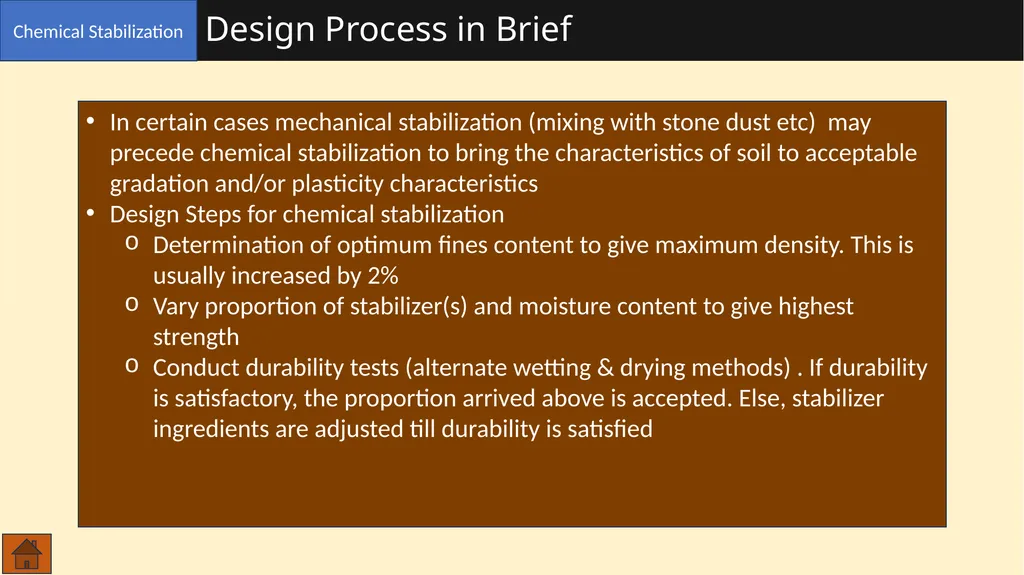
Design Process in Brief Chemical Stabilization In certain cases mechanical stabilization (mixing with stone dust etc) may precede chemical stabilization to bring the characteristics of soil to acceptable gradation and/or plasticity characteristics
Design Steps for chemical stabilization
Determination of optimum fines content to give maximum density. This is usually increased by 2%
Vary proportion of stabilizer(s) and moisture content to give highest strength
Conduct durability tests (alternate wetting & drying methods) . If durability is satisfactory, the proportion arrived above is accepted. Else, stabilizer ingredients are adjusted till durability is satisfied<br>
Design Steps for chemical stabilization
Determination of optimum fines content to give maximum density. This is usually increased by 2%
Vary proportion of stabilizer(s) and moisture content to give highest strength
Conduct durability tests (alternate wetting & drying methods) . If durability is satisfactory, the proportion arrived above is accepted. Else, stabilizer ingredients are adjusted till durability is satisfied<br>
24
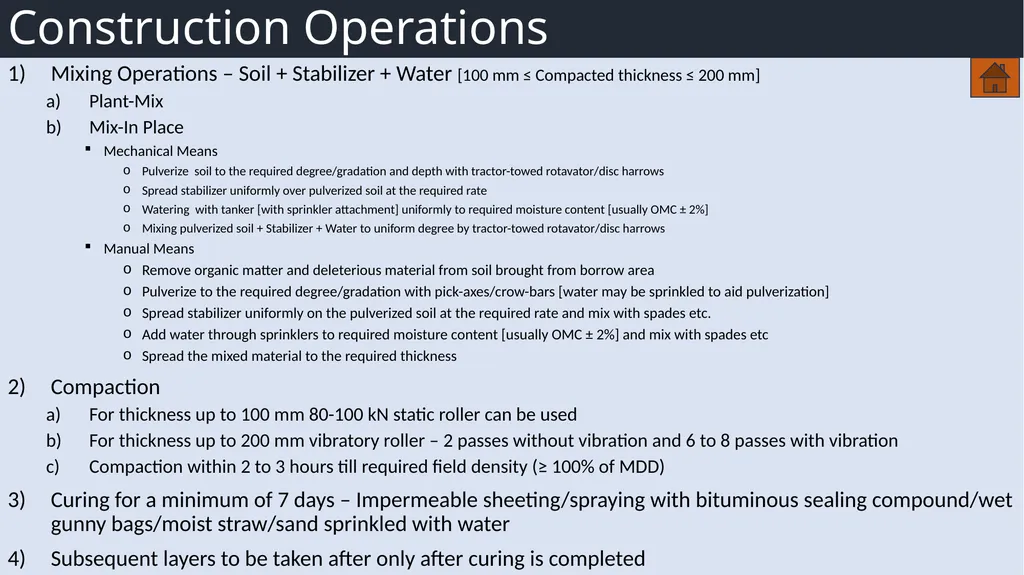
Construction Operations Mixing Operations – Soil + Stabilizer + Water [100 mm ≤ Compacted thickness ≤ 200 mm]
Plant-Mix
Mix-In Place
Mechanical Means
Pulverize soil to the required degree/gradation and depth with tractor-towed rotavator/disc harrows
Spread stabilizer uniformly over pulverized soil at the required rate
Watering with tanker [with sprinkler attachment] uniformly to required moisture content [usually OMC ± 2%]
Mixing pulverized soil + Stabilizer + Water to uniform degree by tractor-towed rotavator/disc harrows
Manual Means
Remove organic matter and deleterious material from soil brought from borrow area
Pulverize to the required degree/gradation with pick-axes/crow-bars [water may be sprinkled to aid pulverization]
Spread stabilizer uniformly on the pulverized soil at the required rate and mix with spades etc.
Add water through sprinklers to required moisture content [usually OMC ± 2%] and mix with spades etc
Spread the mixed material to the required thickness
Compaction
For thickness up to 100 mm 80-100 kN static roller can be used
For thickness up to 200 mm vibratory roller – 2 passes without vibration and 6 to 8 passes with vibration
Compaction within 2 to 3 hours till required field density (≥ 100% of MDD)
Curing for a minimum of 7 days – Impermeable sheeting/spraying with bituminous sealing compound/wet gunny bags/moist straw/sand sprinkled with water
Subsequent layers to be taken after only after curing is completed<br>
Plant-Mix
Mix-In Place
Mechanical Means
Pulverize soil to the required degree/gradation and depth with tractor-towed rotavator/disc harrows
Spread stabilizer uniformly over pulverized soil at the required rate
Watering with tanker [with sprinkler attachment] uniformly to required moisture content [usually OMC ± 2%]
Mixing pulverized soil + Stabilizer + Water to uniform degree by tractor-towed rotavator/disc harrows
Manual Means
Remove organic matter and deleterious material from soil brought from borrow area
Pulverize to the required degree/gradation with pick-axes/crow-bars [water may be sprinkled to aid pulverization]
Spread stabilizer uniformly on the pulverized soil at the required rate and mix with spades etc.
Add water through sprinklers to required moisture content [usually OMC ± 2%] and mix with spades etc
Spread the mixed material to the required thickness
Compaction
For thickness up to 100 mm 80-100 kN static roller can be used
For thickness up to 200 mm vibratory roller – 2 passes without vibration and 6 to 8 passes with vibration
Compaction within 2 to 3 hours till required field density (≥ 100% of MDD)
Curing for a minimum of 7 days – Impermeable sheeting/spraying with bituminous sealing compound/wet gunny bags/moist straw/sand sprinkled with water
Subsequent layers to be taken after only after curing is completed<br>
25
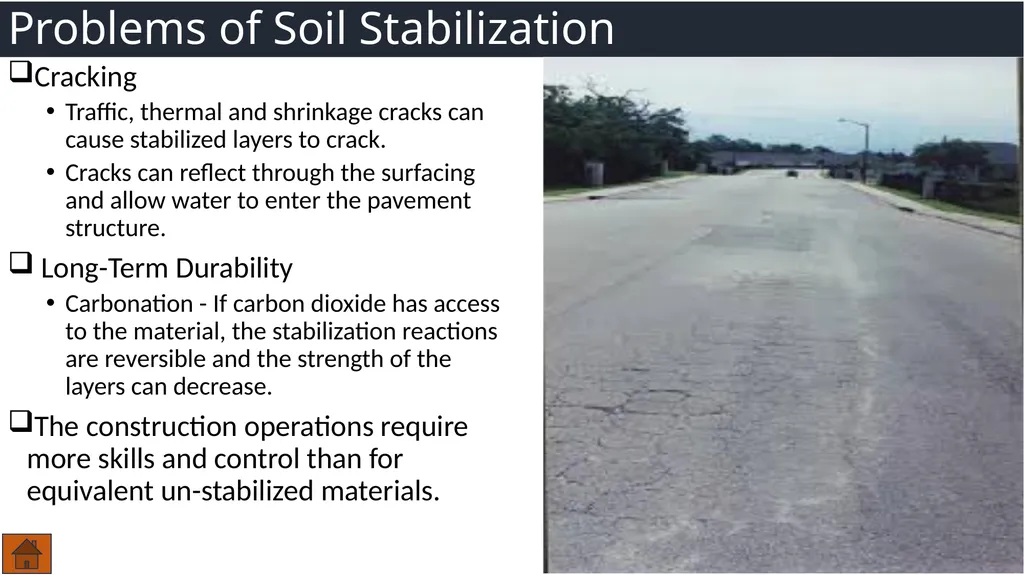
Problems of Soil Stabilization Cracking
Traffic, thermal and shrinkage cracks can cause stabilized layers to crack.
Cracks can reflect through the surfacing and allow water to enter the pavement structure.
Long-Term Durability
Carbonation - If carbon dioxide has access to the material, the stabilization reactions are reversible and the strength of the layers can decrease.
The construction operations require more skills and control than for equivalent un-stabilized materials.<br>
Traffic, thermal and shrinkage cracks can cause stabilized layers to crack.
Cracks can reflect through the surfacing and allow water to enter the pavement structure.
Long-Term Durability
Carbonation - If carbon dioxide has access to the material, the stabilization reactions are reversible and the strength of the layers can decrease.
The construction operations require more skills and control than for equivalent un-stabilized materials.<br>
26
Quality Assurance & Quality Control
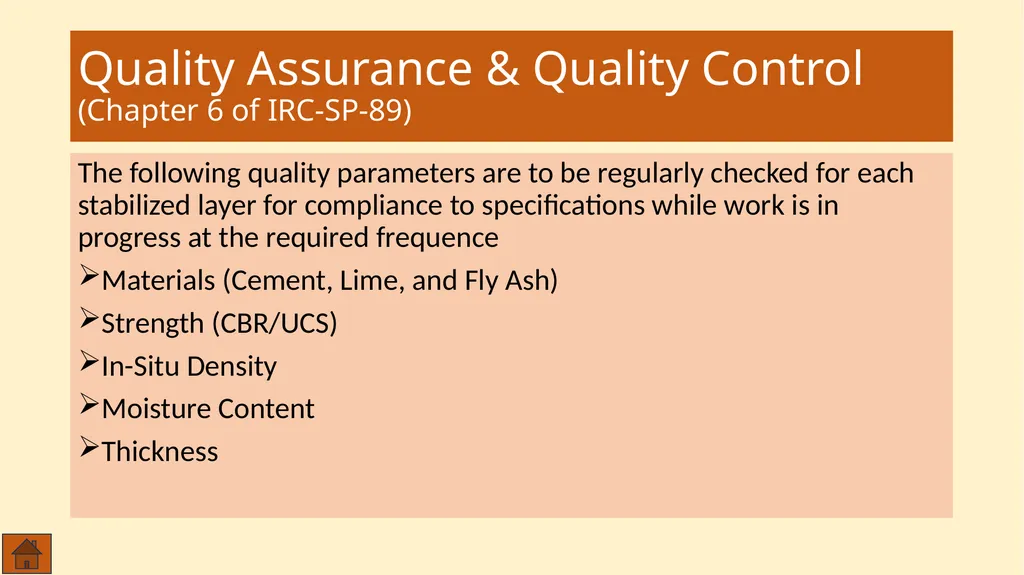
(Chapter 6 of IRC-SP-89) The following quality parameters are to be regularly checked for each stabilized layer for compliance to specifications while work is in progress at the required frequence
Materials (Cement, Lime, and Fly Ash)
Strength (CBR/UCS)
In-Situ Density
Moisture Content
Thickness<br>
Materials (Cement, Lime, and Fly Ash)
Strength (CBR/UCS)
In-Situ Density
Moisture Content
Thickness<br>
27
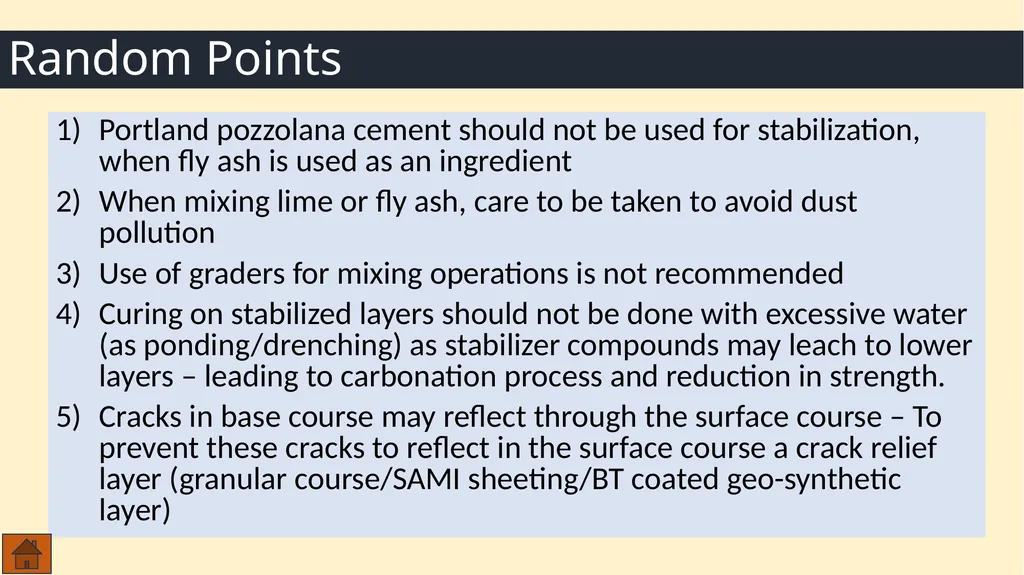
Random Points Portland pozzolana cement should not be used for stabilization, when fly ash is used as an ingredient
When mixing lime or fly ash, care to be taken to avoid dust pollution
Use of graders for mixing operations is not recommended
Curing on stabilized layers should not be done with excessive water (as ponding/drenching) as stabilizer compounds may leach to lower layers – leading to carbonation process and reduction in strength.
Cracks in base course may reflect through the surface course – To prevent these cracks to reflect in the surface course a crack relief layer (granular course/SAMI sheeting/BT coated geo-synthetic layer)<br>
When mixing lime or fly ash, care to be taken to avoid dust pollution
Use of graders for mixing operations is not recommended
Curing on stabilized layers should not be done with excessive water (as ponding/drenching) as stabilizer compounds may leach to lower layers – leading to carbonation process and reduction in strength.
Cracks in base course may reflect through the surface course – To prevent these cracks to reflect in the surface course a crack relief layer (granular course/SAMI sheeting/BT coated geo-synthetic layer)<br>
28
ThanQ<br>
29
Pulverization of Soil (Lime/Cement Stabilized Soils) Note: Before addition of stabilizer Tables 400.4/400.6 of MoRD<br>
30
Gradation of Soil (Cement Stabilization Soils) MoRD<br>