
Soil Microorganism: Bacteria Amongst the different
JO
Published · 20 slides · 0 views

1 / 1



Description
Soil Microorganism: Bacteria Amongst the different microorganisms inhabiting in the soil, bacteria are the most abundant and predominant organisms. These are primitive, prokaryotic, microscopic and unicellular microorganisms without
Related Topics
Share
Embed code
Download this presentation From Below
"Soil Microorganism: Bacteria Amongst the different" is the property of its rightful owner. Permission is granted to download and print the materials on this website for personal, non-commercial use only, and to display it on your personal computer provided you do not modify the materials and that you retain all copyright notices contained in the materials. By downloading content from our website, you accept the terms of this agreement.
Presentation Transcript
01
Soil Microorganism: Bacteria
Amongst the different microorganisms inhabiting in the soil, bacteria are the most abundant and predominant organisms. These are primitive, prokaryotic, microscopic and unicellular microorganisms without chlorophyll. Morphologically, soil bacteria are divided into three groups viz Cocci (round/spherical), (rod-shaped) and Spirilla I Spirllum (cells with long wavy chains). Bacilli are most numerous followed by Cocci and Spirilla in soil .The most common method used for isolation of soil bacteria is the "dilution plate count" method which allows the enumeration of only viable/living cells in the soil. The size of soil bacteria varies from 0.5 to 1.0 micron in diameter and 1.0 to 10.0 microns in length. They are motile with locomotory organs flagella . Bacterial population is one-half of the total microbial biomass in the soil ranging from 1,00000 to several hundred millions per gram of soil, depending upon the physical, chemical and biological conditions of the soil.<br>
Amongst the different microorganisms inhabiting in the soil, bacteria are the most abundant and predominant organisms. These are primitive, prokaryotic, microscopic and unicellular microorganisms without chlorophyll. Morphologically, soil bacteria are divided into three groups viz Cocci (round/spherical), (rod-shaped) and Spirilla I Spirllum (cells with long wavy chains). Bacilli are most numerous followed by Cocci and Spirilla in soil .The most common method used for isolation of soil bacteria is the "dilution plate count" method which allows the enumeration of only viable/living cells in the soil. The size of soil bacteria varies from 0.5 to 1.0 micron in diameter and 1.0 to 10.0 microns in length. They are motile with locomotory organs flagella . Bacterial population is one-half of the total microbial biomass in the soil ranging from 1,00000 to several hundred millions per gram of soil, depending upon the physical, chemical and biological conditions of the soil.<br>
02
Winogradsky (1925), on the basis of ecological characteristics classified soil microorganisms ingeneral and bacteria in particular into two broad categories i.e. Autochnotus (Indigenous species)and the Zymogenous (fermentative). Autochnotus bacterial population is uniform and constant in soil, since their nutrition is derived from native soil organic matter (eg. Arthrobacter and Nocardia whereas Zymogenous bacterial population in soil is low, as they require an external source of energy, eg. Pseudomonas & Bacillus.
The population of Zymogenous bacteria increases gradually when a specific substrate is added to the soil. To this category belong the cellulose decomposers, nitrogen utilizing bacteria and ammonifiers.<br>
The population of Zymogenous bacteria increases gradually when a specific substrate is added to the soil. To this category belong the cellulose decomposers, nitrogen utilizing bacteria and ammonifiers.<br>
03
As the system proposed in the Bergey's Manual of Systematic Bacteriology, most of the bacteria which are predominantly encountered in soil are taxonomically included in the three orders, Pseudomonadales, Eubacteriales and Actinomycetales of the class Schizomycetes. The most common soil bacteria belong to the genera Pseudomonas, Arthrobacter, Clostridium Achromobacter, Sarcina, Enterobacter etc. The another group of bacteria common in soils is the Myxobacteria belonging to the genera Micrococcus, Chondrococcus, Archangium, Polyangium,Cyptophaga. Bacteria are also classified on the basis of physiological activity or mode of nutrition, especially the manner in which they obtain their carbon, nitrogen, energy and other nutrient requirements.<br>
04
They are broadly divided into two groups i.e. a) Autotrophs and b) Heterotrophs
.Autotrophic bacteria are capable synthesizing their food from simple inorganic nutrients, while heterotrophic bacteria depend on pre-formed food for nutrition. All autotrophic bacteria utilize Co2 (from atmosphere) as carbon source and derive energy either from sunlight photoautotrophs, eg. Chromatrum. Chlorobium. Rhadopseudomonas or from the oxidation of simple inorganic substances present in soil (chemoautotrophs e g. Nitrobacter, Nitrosomonas, Thiaobacillus).
Majority of soil bacteria are heterotrophic in nature and derive their carbon and energy from complex organic substances/organic matter, decaying roots and plant residues. They obtain their nitrogen from nitrates and ammonia compounds (proteins) present in soil another nutrients from soil or from the decomposing organic matter. Certain bacteria also require amino acids, B- Vitamins, and other growth promoting substances also.<br>
.Autotrophic bacteria are capable synthesizing their food from simple inorganic nutrients, while heterotrophic bacteria depend on pre-formed food for nutrition. All autotrophic bacteria utilize Co2 (from atmosphere) as carbon source and derive energy either from sunlight photoautotrophs, eg. Chromatrum. Chlorobium. Rhadopseudomonas or from the oxidation of simple inorganic substances present in soil (chemoautotrophs e g. Nitrobacter, Nitrosomonas, Thiaobacillus).
Majority of soil bacteria are heterotrophic in nature and derive their carbon and energy from complex organic substances/organic matter, decaying roots and plant residues. They obtain their nitrogen from nitrates and ammonia compounds (proteins) present in soil another nutrients from soil or from the decomposing organic matter. Certain bacteria also require amino acids, B- Vitamins, and other growth promoting substances also.<br>
05
Functions / Role of Bacteria:
Bacteria bring about a number of changes and biochemical transformations in the soil and thereby directly or indirectly help in the nutrition of higher plants growing in the soil. The important transformations and processes in which soil bacteria play vital role are: decomposition of cellulose and other carbohydrates, ammonification (proteins ammonia), nitrification(ammonia-nitrites-nitrates), denitrification (release of free elemental nitrogen), biological fixation of atmospheric nitrogen (symbiotic and non-symbiotic) oxidation and reduction of sulphur and iron compounds. All these processes play a significant role in plant nutrition.<br>
Bacteria bring about a number of changes and biochemical transformations in the soil and thereby directly or indirectly help in the nutrition of higher plants growing in the soil. The important transformations and processes in which soil bacteria play vital role are: decomposition of cellulose and other carbohydrates, ammonification (proteins ammonia), nitrification(ammonia-nitrites-nitrates), denitrification (release of free elemental nitrogen), biological fixation of atmospheric nitrogen (symbiotic and non-symbiotic) oxidation and reduction of sulphur and iron compounds. All these processes play a significant role in plant nutrition.<br>
06
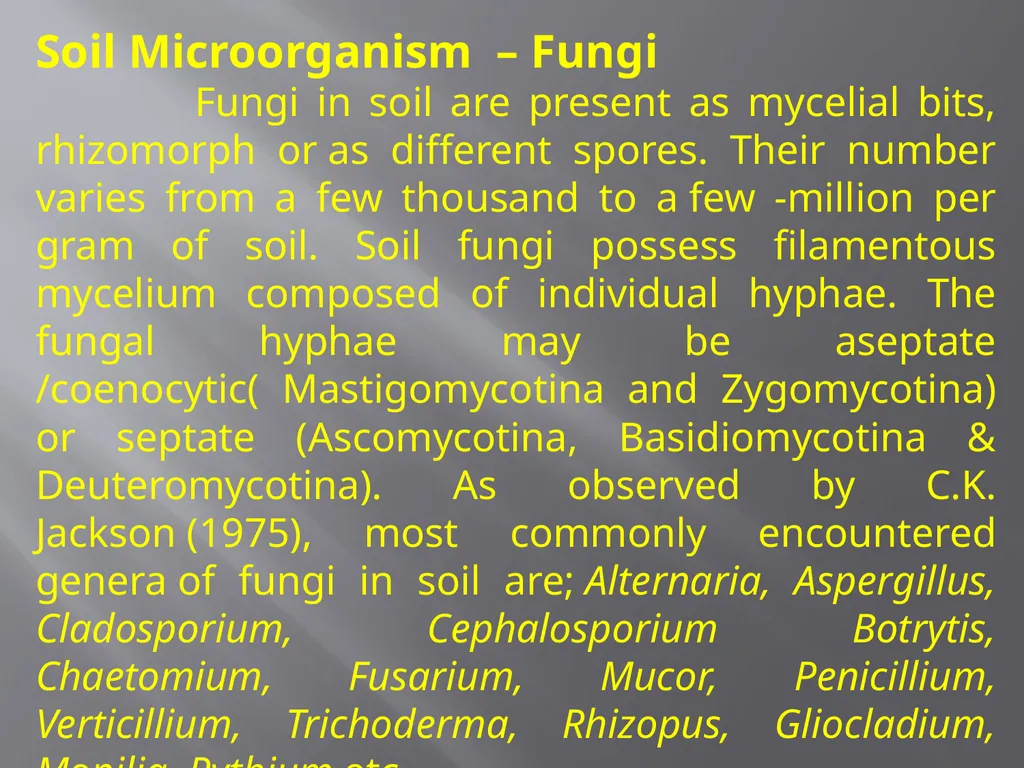
Soil Microorganism – Fungi
Fungi in soil are present as mycelial bits, rhizomorph or as different spores. Their number varies from a few thousand to a few -million per gram of soil. Soil fungi possess filamentous mycelium composed of individual hyphae. The fungal hyphae may be aseptate /coenocytic( Mastigomycotina and Zygomycotina) or septate (Ascomycotina, Basidiomycotina & Deuteromycotina). As observed by C.K. Jackson (1975), most commonly encountered genera of fungi in soil are; Alternaria, Aspergillus, Cladosporium, Cephalosporium Botrytis, Chaetomium, Fusarium, Mucor, Penicillium, Verticillium, Trichoderma, Rhizopus, Gliocladium, Monilia, Pythium,etc.<br>
Fungi in soil are present as mycelial bits, rhizomorph or as different spores. Their number varies from a few thousand to a few -million per gram of soil. Soil fungi possess filamentous mycelium composed of individual hyphae. The fungal hyphae may be aseptate /coenocytic( Mastigomycotina and Zygomycotina) or septate (Ascomycotina, Basidiomycotina & Deuteromycotina). As observed by C.K. Jackson (1975), most commonly encountered genera of fungi in soil are; Alternaria, Aspergillus, Cladosporium, Cephalosporium Botrytis, Chaetomium, Fusarium, Mucor, Penicillium, Verticillium, Trichoderma, Rhizopus, Gliocladium, Monilia, Pythium,etc.<br>
07
Most of these fungal genera belong to the subdivision Deuteromycotina / Fungi imperfect which lacks sexual mode of reproduction. As these soil fungi are aerobic and heterotrophic, they require abundant supply of oxygen and organic matter in soil. Fungi
are dominant in acid soils, because acidic environment is not conducive / suitable for the existence of either bacteria or actinomycetes. The optimum PH range for fungi lies-between 4.5 to 6.5.
They are also present in neutral and alkaline soils and some can even tolerate PH beyond 9.0<br>
are dominant in acid soils, because acidic environment is not conducive / suitable for the existence of either bacteria or actinomycetes. The optimum PH range for fungi lies-between 4.5 to 6.5.
They are also present in neutral and alkaline soils and some can even tolerate PH beyond 9.0<br>
08
Functions / Role of Fungi
1-Fungi plays significant role in soils and plant nutrition
2-They plays important role in the degradation / decomposition of cellulose, hemi cellulose, starch, pectin, lignin in the organic matter added to the soil
Lignin which is resistant to decomposition by bacteria is mainly decomposed by fungi
3-They also serve as food for bacteria.
Certain fungi belonging to sub-division Zygomycotina and Deuteromycotina are predaceous in nature and attack on protozoa &nematodes in soil and thus, maintain biological equilibrium in soil<br>
1-Fungi plays significant role in soils and plant nutrition
2-They plays important role in the degradation / decomposition of cellulose, hemi cellulose, starch, pectin, lignin in the organic matter added to the soil
Lignin which is resistant to decomposition by bacteria is mainly decomposed by fungi
3-They also serve as food for bacteria.
Certain fungi belonging to sub-division Zygomycotina and Deuteromycotina are predaceous in nature and attack on protozoa &nematodes in soil and thus, maintain biological equilibrium in soil<br>
09
6-They also plays important role in soil aggregation and in the formation of humus
7-Some soil fungi are parasitic and causes number of plant diseases such as wilts, root rots, damping-off and seedling blights eg. Pythium, Phyiophlhora, Fusarium, Verticillium etc
8-Number of soil fungi forms mycorrhiza association with the roots of higher plants symbiotic association of a fungus with the roots of a higher plant) and helps in mobilization of soil phosphorus and nitrogen eg. Glomus, Gigaspora, Aculospora, (Endomycorrhiza) and Amanita, Boletus, Entoloma, Lactarius (Ectomycorrhiza).<br>
7-Some soil fungi are parasitic and causes number of plant diseases such as wilts, root rots, damping-off and seedling blights eg. Pythium, Phyiophlhora, Fusarium, Verticillium etc
8-Number of soil fungi forms mycorrhiza association with the roots of higher plants symbiotic association of a fungus with the roots of a higher plant) and helps in mobilization of soil phosphorus and nitrogen eg. Glomus, Gigaspora, Aculospora, (Endomycorrhiza) and Amanita, Boletus, Entoloma, Lactarius (Ectomycorrhiza).<br>
10
Soil Microorganism – Actinomycetes
These are the organisms with characteristics common to both bacteria and fungi but yet possessing distinctive features to delimit them into a distinct category. In the strict taxonomic sense, actinomycetes are clubbed with bacteria the same class of Schizomycetes and confined to the order Actinomycetales. They are unicellular like bacteria, but produce a mycelium which is non-septate (coenocytic) and more slender, tike true bacteria they do not have distinct cell-wall and their cell wall is without chitin and cellulose (commonly found in the cell wall of fungi).<br>
These are the organisms with characteristics common to both bacteria and fungi but yet possessing distinctive features to delimit them into a distinct category. In the strict taxonomic sense, actinomycetes are clubbed with bacteria the same class of Schizomycetes and confined to the order Actinomycetales. They are unicellular like bacteria, but produce a mycelium which is non-septate (coenocytic) and more slender, tike true bacteria they do not have distinct cell-wall and their cell wall is without chitin and cellulose (commonly found in the cell wall of fungi).<br>
11
On culture media unlike slimy distinct colonies of true bacteria which grow quickly, actinomycetes colonies grow slowly, show powdery consistency and stick firmly to agar surface. They produce hyphae and conidia /sporangia like fungi. Certain actinomycetes whose hyphae undergo
segmentation resemble bacteria, both morphologically and physiologically. Actinomycetes are numerous and widely distributed in soil and are next to bacteria in abundance. They are widely distributed in the soil, compost etc. Plate count estimates give values ranging from 10^4 to 10^8 per gram of soil. They are sensitive to acidity / low PH (optimum PH range6.5 to 8.0) and waterlogged soil conditions.<br>
segmentation resemble bacteria, both morphologically and physiologically. Actinomycetes are numerous and widely distributed in soil and are next to bacteria in abundance. They are widely distributed in the soil, compost etc. Plate count estimates give values ranging from 10^4 to 10^8 per gram of soil. They are sensitive to acidity / low PH (optimum PH range6.5 to 8.0) and waterlogged soil conditions.<br>
12
The population of actinomycetes increases with depth of soil even up to horizon „C‟ of a soil profiler They are heterotrophic, aerobic and mesophilic (25-30 ^c) organisms and some species are commonly present in compost and manures are thermophilic growing at 55-65° c temperature (eg. Thermo atinomycetes ,Streptomyces). Actinomycetes belonging to the order of Actinomycetales are grouped under four families viz Mycobacteriaceae, Actinomycetaceae, Streptomycetaceae and Actinoplanaceae.<br>
13
Actinomycetous genera which are agriculturally and industrially important are present in only two families of Actinomycetaceae and Strepotmycetaceae. In the order of abundance in soils, the common genera of actinomycetes are Streptomyces(nearly 70%), Nocardia and Micromonospora although Actinomycetes, Actinoplanes, Micromonospora and Streptosporangium are also generally encountered.<br>
14
Functions / Role of actinomycetes:
1. Degrade/decompose all sorts of organic substances like cellulose, polysaccharides, protein fats, organic-acids etc.
2. Organic residues / substances added soil are first attacked by bacteria and fungi and later by actinomycetes, because they are slow in activity and growth than bacteria and fungi.
3. They decompose / degrade the more resistant and indecomposable organic substance/matter and produce a number of dark black to brown pigments which contribute to the dark colour of soil humus.
4. They are also responsible for subsequent further decomposition of humus (resistant material)in soil.<br>
1. Degrade/decompose all sorts of organic substances like cellulose, polysaccharides, protein fats, organic-acids etc.
2. Organic residues / substances added soil are first attacked by bacteria and fungi and later by actinomycetes, because they are slow in activity and growth than bacteria and fungi.
3. They decompose / degrade the more resistant and indecomposable organic substance/matter and produce a number of dark black to brown pigments which contribute to the dark colour of soil humus.
4. They are also responsible for subsequent further decomposition of humus (resistant material)in soil.<br>
15
5. They are responsible for earthy / musty odor / smell of freshly ploughed soils.
6.Many genera species and strains (eg. Streptomyces if actinomycetes produce/synthesize number of antibiotics like Streptomycin, Terramycin, Aureomycin etc.
7. One of the species of actinomycetes Streptomyces scabies causes disease "Potato scab" in potato.<br>
6.Many genera species and strains (eg. Streptomyces if actinomycetes produce/synthesize number of antibiotics like Streptomycin, Terramycin, Aureomycin etc.
7. One of the species of actinomycetes Streptomyces scabies causes disease "Potato scab" in potato.<br>
16
Soil Microorganism – Algae
Algae are present in most of the soils where moisture and sunlight are available. Their number in soil usually ranges from 100 to 10,000 per gram of soil. They are photoautotrophic, aerobic organisms and obtain CO2 from atmosphere and energy from sunlight and synthesize their own food. They are unicellular, filamentous or colonial. Soil algae are divided in to four main classes or phyla as follows:
1.Cyanophyta (Blue green algae)
2.Chlorophyta(Grass green algae)
3. Xanthophyta (Yellow green algae)<br>
Algae are present in most of the soils where moisture and sunlight are available. Their number in soil usually ranges from 100 to 10,000 per gram of soil. They are photoautotrophic, aerobic organisms and obtain CO2 from atmosphere and energy from sunlight and synthesize their own food. They are unicellular, filamentous or colonial. Soil algae are divided in to four main classes or phyla as follows:
1.Cyanophyta (Blue green algae)
2.Chlorophyta(Grass green algae)
3. Xanthophyta (Yellow green algae)<br>
17
4.Bacillariophyta (diatoms or golden brown algae)Out of these four classes / phyla, blue-green algae and grass-green algae are more abundant in soil. The green-grass algae and diatoms are dominant in the soils of temperate region while blue-green algae predominate in tropical soils. Green-algae prefer acid soils while blue green algae are commonly found in neutral and alkaline soils. The most common genera of green algae found in soil are: Chlorella, Chlamydomonas, Chlorococcum, Protosiphonetc. and that of diatoms are Navicula, Pinnularia. Synedra, Frangilaria.<br>
18
Blue green algae are unicellular, photoautotrophic prokaryotes containing Phycocyanin pigment in addition to chlorophyll. They do not possess flagella and do not reproduce sexually. They are common in neutral to alkaline soils. The dominant genera of BGA in soil are: Chrococcus, Phormidium, Anabaena, Aphanocapra, Oscillatoria etc. Some BGA possess specialized cells known as "Heterocyst"
which is the sites of nitrogen fixation. BGA fixes nitrogen (non-symbiotically) in puddle paddy/water logged paddy fields (20-30 kg/ha/season). There are certain BGA which possess the character of symbiotic nitrogen fixation in association with other organisms like fungi, mosses, liverworts and aquatic ferns
Azolla, eg Anabaena-Azolla association fix nitrogen symbiotically in rice fields.<br>
which is the sites of nitrogen fixation. BGA fixes nitrogen (non-symbiotically) in puddle paddy/water logged paddy fields (20-30 kg/ha/season). There are certain BGA which possess the character of symbiotic nitrogen fixation in association with other organisms like fungi, mosses, liverworts and aquatic ferns
Azolla, eg Anabaena-Azolla association fix nitrogen symbiotically in rice fields.<br>
19
Functions / role of algae or BGA:
1. Plays important role in the maintenance of soil fertility especially in tropical soils.
2. Add organic matter to soil when die and thus increase the amount of organic carbon in soil.
3. Most of soil algae (especially BGA) act as cementing agent in binding soil particles and thereby reduce/prevent soil erosion.
4. Mucilage secreted by the BGA is hygroscopic in nature and thus helps in increasing water retention capacity of soil for longer time/period.<br>
1. Plays important role in the maintenance of soil fertility especially in tropical soils.
2. Add organic matter to soil when die and thus increase the amount of organic carbon in soil.
3. Most of soil algae (especially BGA) act as cementing agent in binding soil particles and thereby reduce/prevent soil erosion.
4. Mucilage secreted by the BGA is hygroscopic in nature and thus helps in increasing water retention capacity of soil for longer time/period.<br>
20
5. Soil algae through the process of photosynthesis liberate large quantity of oxygen in the soil environment and thus facilitate the aeration in submerged soils or oxygenate the soil environment.
6. They help in checking the loss of nitrates through leaching and drainage especially in un-cropped soils.
7. They help in weathering of rocks and building up of soil structure.<br>
6. They help in checking the loss of nitrates through leaching and drainage especially in un-cropped soils.
7. They help in weathering of rocks and building up of soil structure.<br>