
Some headline stats... Over the four-week
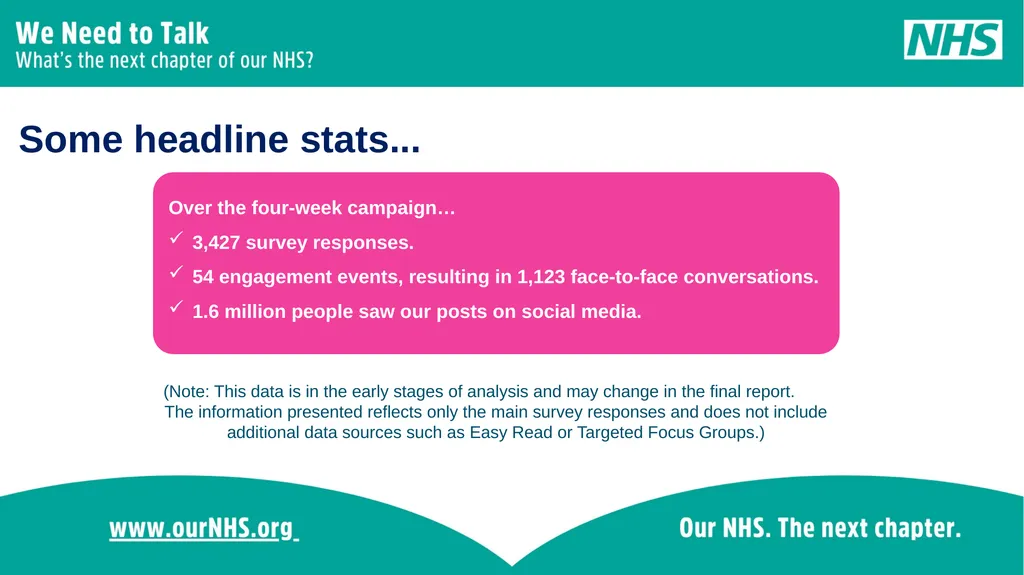

Description: Some headline stats... Over the four-week campaign 3,427 survey responses. 54 engagement events, resulting in 1,123 face-to-face conversations. 1.6 million people saw our posts on social media. (Note: This data is in the early stages of
Related Topics
Download Presentation
"Some headline stats... Over the four-week" is the property of its rightful owner. Permission is granted to download and print the materials on this website for personal, non-commercial use only, and to display it on your personal computer provided you do not modify the materials and that you retain all copyright notices contained in the materials. By downloading content from our website, you accept the terms of this agreement.
Presentation Transcript
slide2. Some headline stats... Over the four-week campaign…
3,427 survey responses.
54 engagement events, resulting in 1,123 face-to-face conversations.
1.6 million people saw our posts on social media. (Note: This data is in the early stages of analysis and may change in the final report.
The information presented reflects only the main survey responses and does not include additional data sources such as Easy Read or Targeted Focus Groups.)<br>
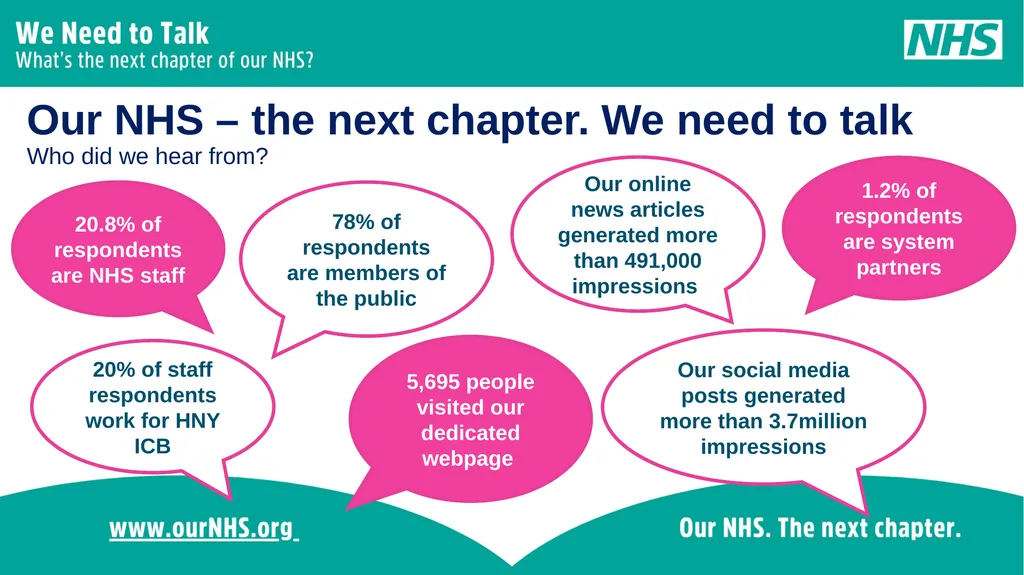
slide3. Our NHS – the next chapter. We need to talk Who did we hear from? 1.2% of respondents are system partners 20.8% of respondents are NHS staff 78% of respondents are members of the public . Our social media posts generated more than 3.7million impressions 20% of staff respondents work for HNY ICB 5,695 people visited our dedicated webpage Our online news articles generated more than 491,000 impressions<br>
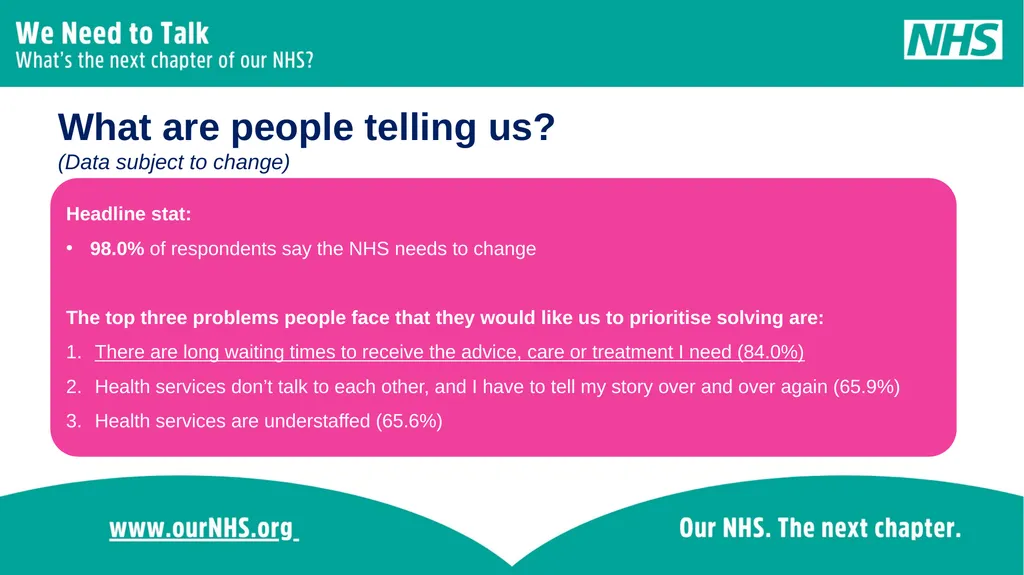
slide4. What are people telling us?
(Data subject to change) Headline stat:
98.0% of respondents say the NHS needs to change
The top three problems people face that they would like us to prioritise solving are:
There are long waiting times to receive the advice, care or treatment I need (84.0%)
Health services don’t talk to each other, and I have to tell my story over and over again (65.9%)
Health services are understaffed (65.6%)<br>
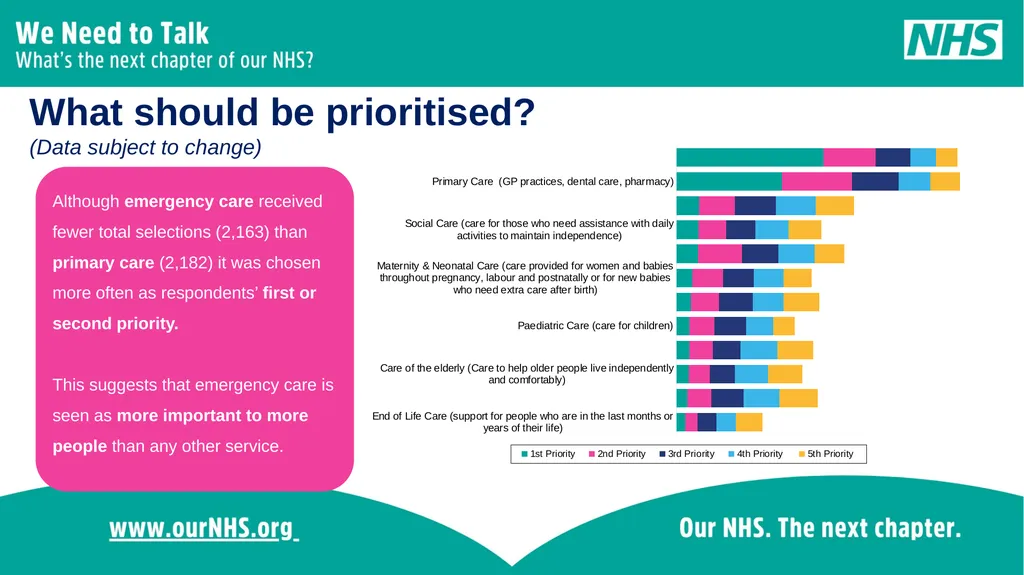
slide5. What should be prioritised?
(Data subject to change) Although emergency care received fewer total selections (2,163) than primary care (2,182) it was chosen more often as respondents’ first or second priority.
This suggests that emergency care is seen as more important to more people than any other service.<br>
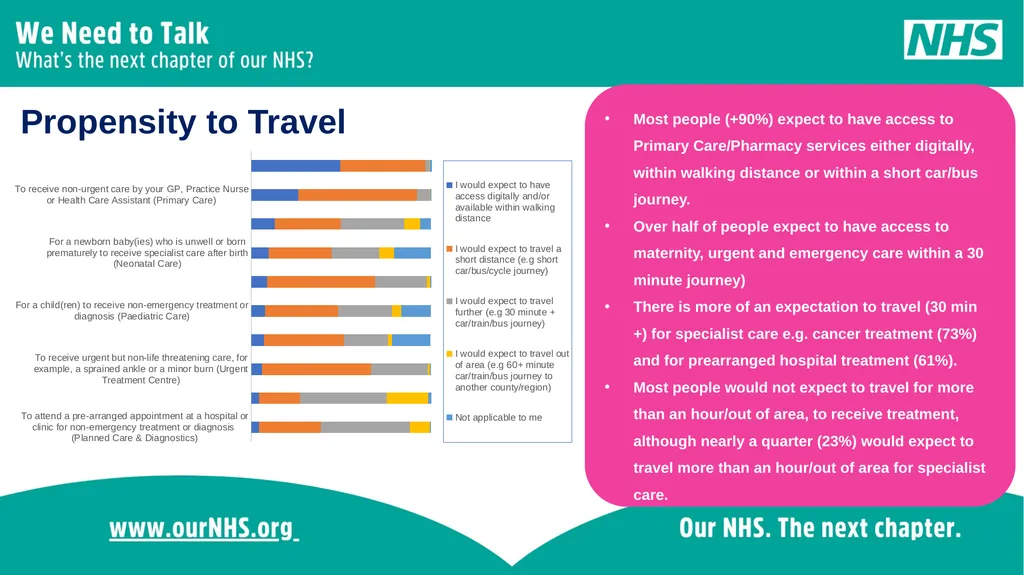
slide6. Propensity to Travel Most people (+90%) expect to have access to Primary Care/Pharmacy services either digitally, within walking distance or within a short car/bus journey.
Over half of people expect to have access to maternity, urgent and emergency care within a 30 minute journey)
There is more of an expectation to travel (30 min +) for specialist care e.g. cancer treatment (73%) and for prearranged hospital treatment (61%).
Most people would not expect to travel for more than an hour/out of area, to receive treatment, although nearly a quarter (23%) would expect to travel more than an hour/out of area for specialist care.<br>
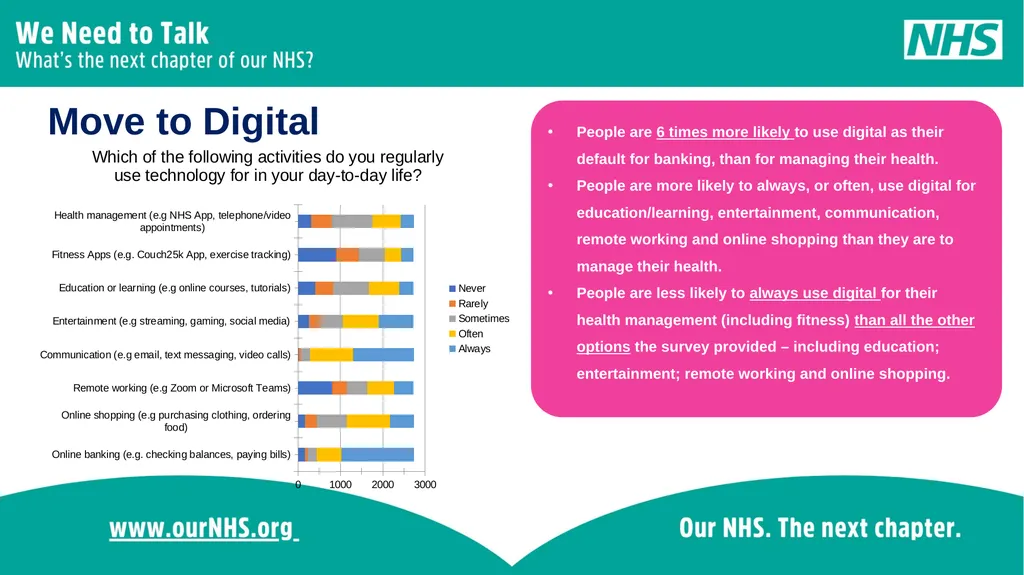
slide7. Move to Digital People are 6 times more likely to use digital as their default for banking, than for managing their health.
People are more likely to always, or often, use digital for education/learning, entertainment, communication, remote working and online shopping than they are to manage their health.
People are less likely to always use digital for their health management (including fitness) than all the other options the survey provided – including education; entertainment; remote working and online shopping.<br>
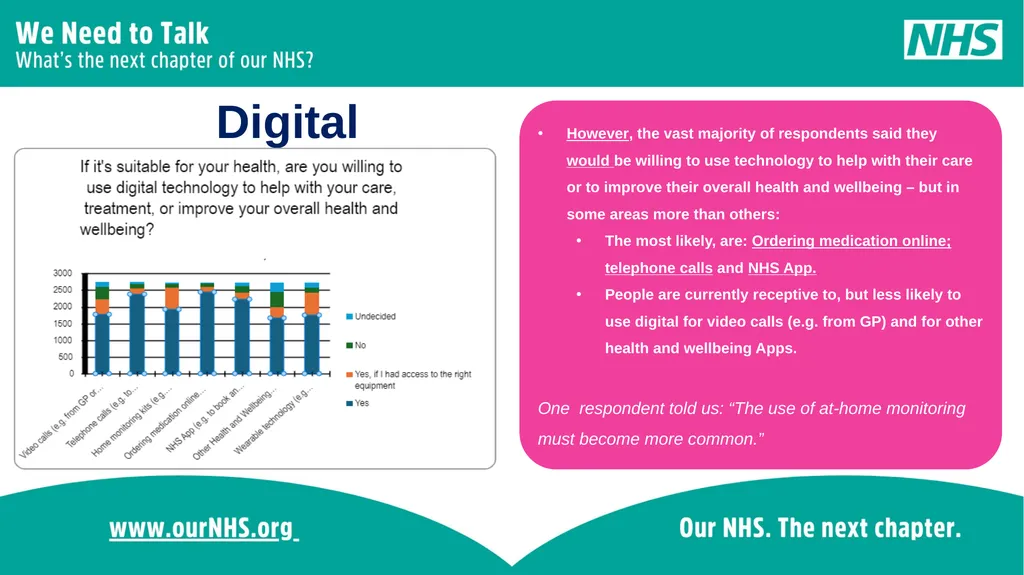
slide8. Digital However, the vast majority of respondents said they would be willing to use technology to help with their care or to improve their overall health and wellbeing – but in some areas more than others:
The most likely, are: Ordering medication online; telephone calls and NHS App.
People are currently receptive to, but less likely to use digital for video calls (e.g. from GP) and for other health and wellbeing Apps.
One respondent told us: “The use of at-home monitoring must become more common.”<br>
slide9. Prevention
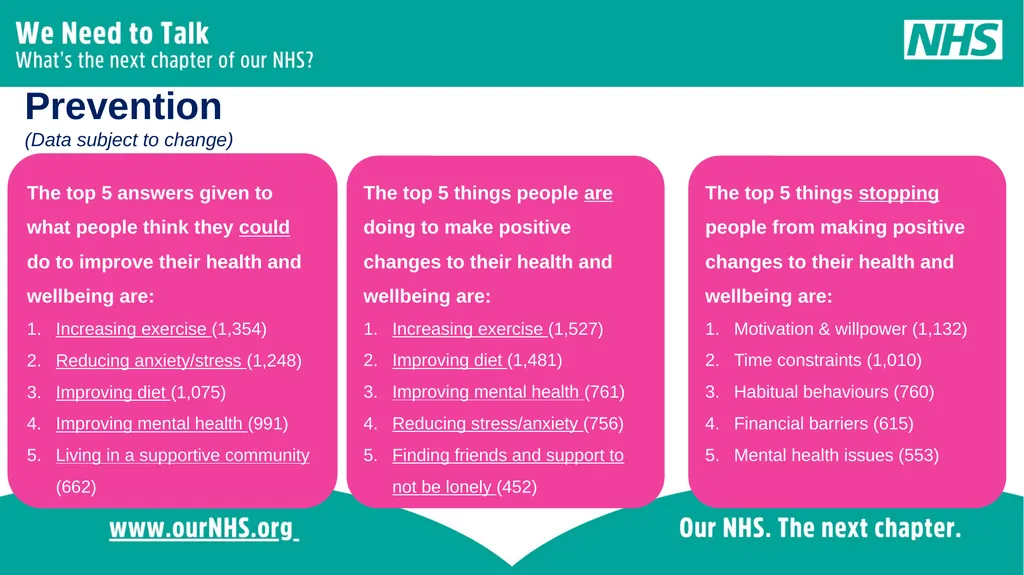
(Data subject to change) The top 5 answers given to what people think they could do to improve their health and wellbeing are:
Increasing exercise (1,354)
Reducing anxiety/stress (1,248)
Improving diet (1,075)
Improving mental health (991)
Living in a supportive community (662) The top 5 things stopping people from making positive changes to their health and wellbeing are:
Motivation & willpower (1,132)
Time constraints (1,010)
Habitual behaviours (760)
Financial barriers (615)
Mental health issues (553) The top 5 things people are doing to make positive changes to their health and wellbeing are:
Increasing exercise (1,527)
Improving diet (1,481)
Improving mental health (761)
Reducing stress/anxiety (756)
Finding friends and support to not be lonely (452)<br>
slide10. Prevention
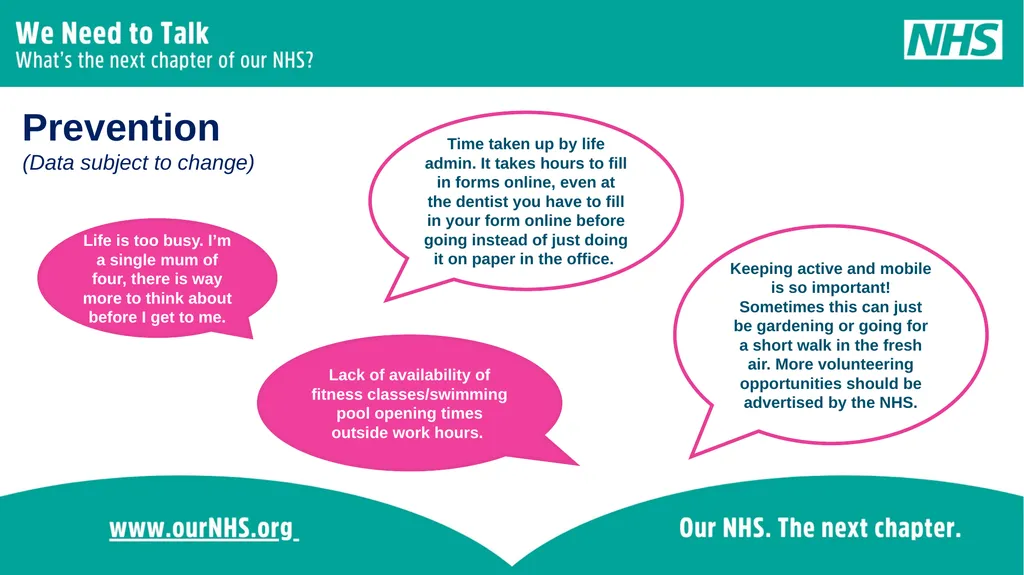
(Data subject to change) Life is too busy. I’m a single mum of four, there is way more to think about before I get to me. Time taken up by life admin. It takes hours to fill in forms online, even at the dentist you have to fill in your form online before going instead of just doing it on paper in the office. Lack of availability of fitness classes/swimming pool opening times outside work hours. Keeping active and mobile is so important! Sometimes this can just be gardening or going for a short walk in the fresh air. More volunteering opportunities should be advertised by the NHS.<br>
slide11. What is most important to people?
(Data subject to change)<br>
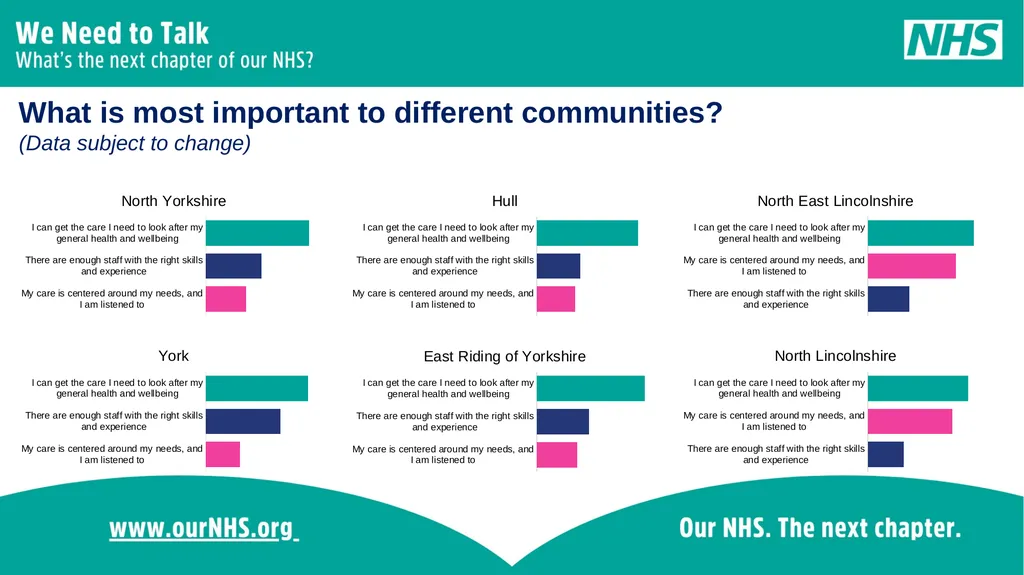
slide12. What is most important to different communities? (Data subject to change)<br>
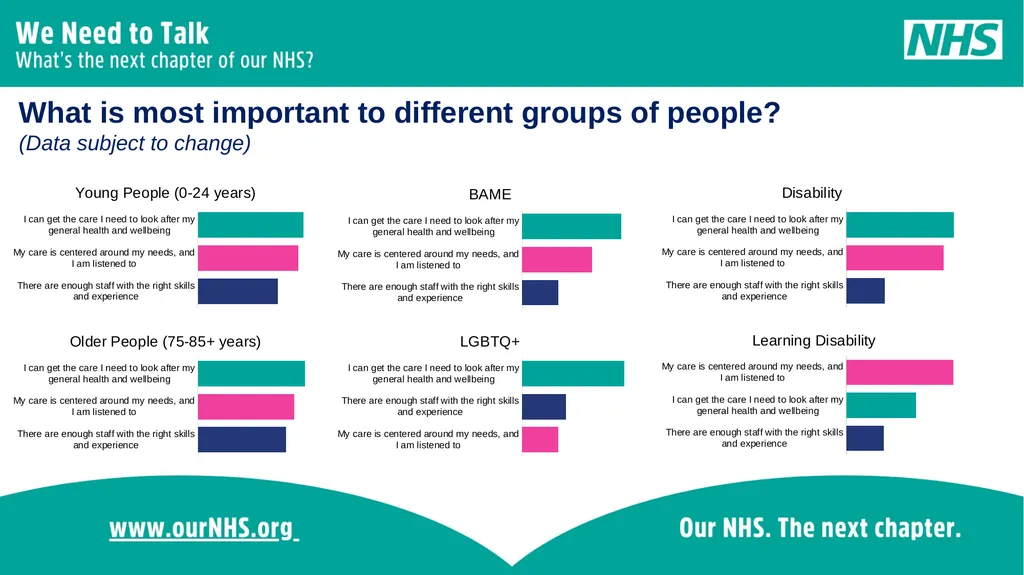
slide13. What is most important to different groups of people? (Data subject to change)<br>
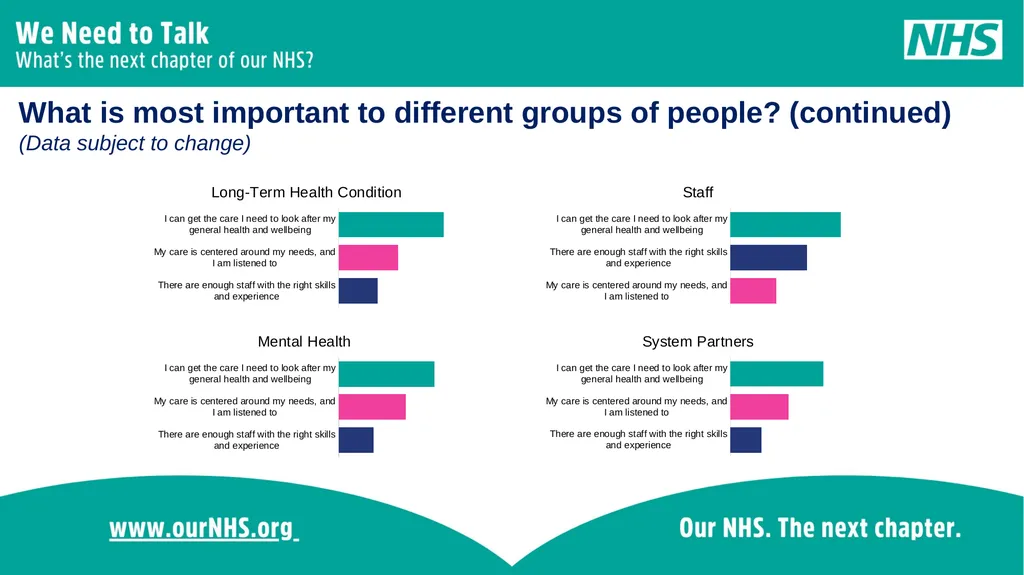
slide14. What is most important to different groups of people? (continued) (Data subject to change)<br>
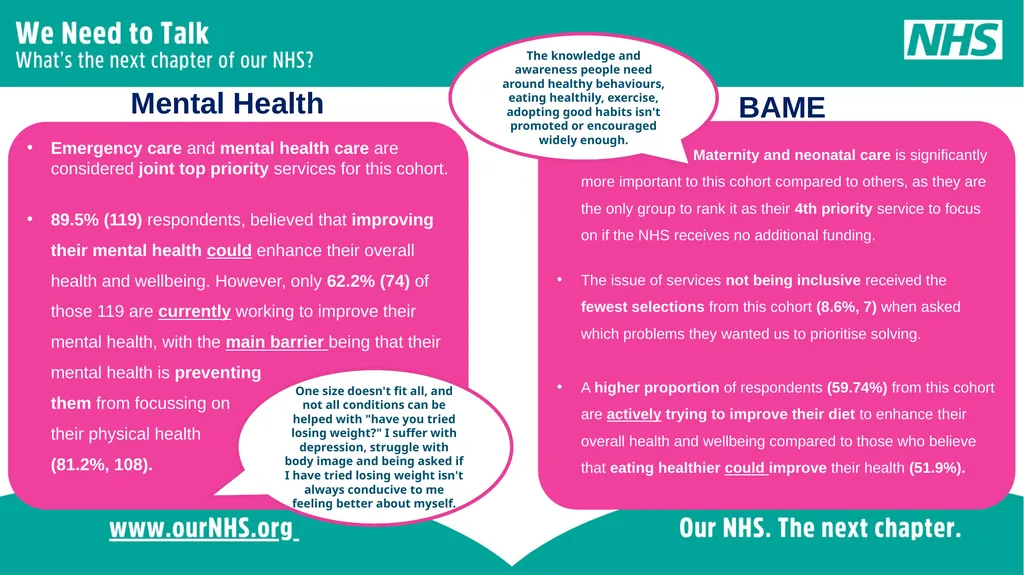
slide15. Mental Health Maternity and neonatal care is significantly more important to this cohort compared to others, as they are the only group to rank it as their 4th priority service to focus on if the NHS receives no additional funding.
The issue of services not being inclusive received the fewest selections from this cohort (8.6%, 7) when asked which problems they wanted us to prioritise solving.
A higher proportion of respondents (59.74%) from this cohort are actively trying to improve their diet to enhance their overall health and wellbeing compared to those who believe that eating healthier could improve their health (51.9%). BAME Emergency care and mental health care are considered joint top priority services for this cohort.
89.5% (119) respondents, believed that improving their mental health could enhance their overall health and wellbeing. However, only 62.2% (74) of those 119 are currently working to improve their mental health, with the main barrier being that their mental health is preventing them from focussing on their physical health (81.2%, 108). One size doesn't fit all, and not all conditions can be helped with "have you tried losing weight?" I suffer with depression, struggle with body image and being asked if I have tried losing weight isn't always conducive to me feeling better about myself. The knowledge and awareness people need around healthy behaviours, eating healthily, exercise, adopting good habits isn't promoted or encouraged widely enough.<br>
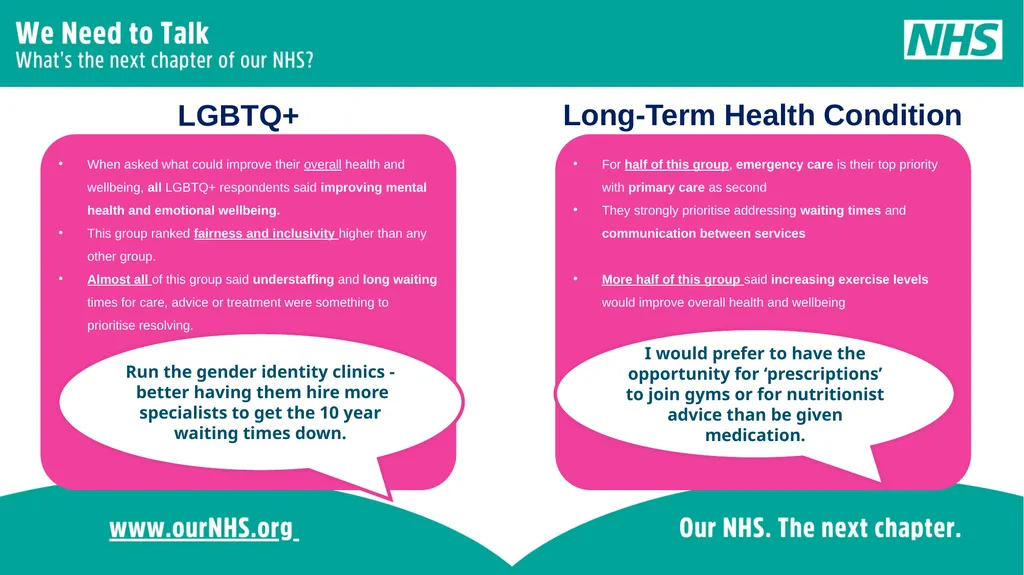
slide16. LGBTQ+ For half of this group, emergency care is their top priority with primary care as second
They strongly prioritise addressing waiting times and communication between services
More half of this group said increasing exercise levels would improve overall health and wellbeing Long-Term Health Condition When asked what could improve their overall health and wellbeing, all LGBTQ+ respondents said improving mental health and emotional wellbeing.
This group ranked fairness and inclusivity higher than any other group.
Almost all of this group said understaffing and long waiting times for care, advice or treatment were something to prioritise resolving. Run the gender identity clinics - better having them hire more specialists to get the 10 year waiting times down. I would prefer to have the opportunity for ‘prescriptions’ to join gyms or for nutritionist advice than be given medication.<br>
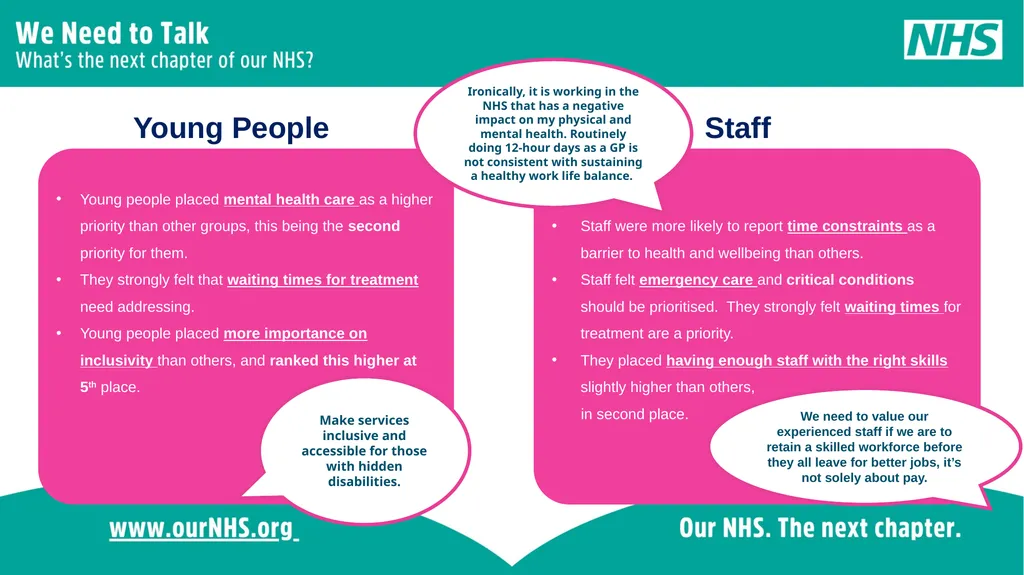
slide17. Young People Staff were more likely to report time constraints as a barrier to health and wellbeing than others.
Staff felt emergency care and critical conditions should be prioritised. They strongly felt waiting times for treatment are a priority.
They placed having enough staff with the right skills slightly higher than others,
in second place. Staff Young people placed mental health care as a higher priority than other groups, this being the second priority for them.
They strongly felt that waiting times for treatment need addressing.
Young people placed more importance on inclusivity than others, and ranked this higher at 5th place. We need to value our experienced staff if we are to retain a skilled workforce before they all leave for better jobs, it’s not solely about pay. Make services inclusive and accessible for those with hidden disabilities. Ironically, it is working in the NHS that has a negative impact on my physical and mental health. Routinely doing 12-hour days as a GP is not consistent with sustaining a healthy work life balance.<br>
slide18. Colleagues share patient stories and emerging themes gathered through face-to-face conversations….<br>
3,427 survey responses.
54 engagement events, resulting in 1,123 face-to-face conversations.
1.6 million people saw our posts on social media. (Note: This data is in the early stages of analysis and may change in the final report.
The information presented reflects only the main survey responses and does not include additional data sources such as Easy Read or Targeted Focus Groups.)<br>
slide3. Our NHS – the next chapter. We need to talk Who did we hear from? 1.2% of respondents are system partners 20.8% of respondents are NHS staff 78% of respondents are members of the public . Our social media posts generated more than 3.7million impressions 20% of staff respondents work for HNY ICB 5,695 people visited our dedicated webpage Our online news articles generated more than 491,000 impressions<br>
slide4. What are people telling us?
(Data subject to change) Headline stat:
98.0% of respondents say the NHS needs to change
The top three problems people face that they would like us to prioritise solving are:
There are long waiting times to receive the advice, care or treatment I need (84.0%)
Health services don’t talk to each other, and I have to tell my story over and over again (65.9%)
Health services are understaffed (65.6%)<br>
slide5. What should be prioritised?
(Data subject to change) Although emergency care received fewer total selections (2,163) than primary care (2,182) it was chosen more often as respondents’ first or second priority.
This suggests that emergency care is seen as more important to more people than any other service.<br>
slide6. Propensity to Travel Most people (+90%) expect to have access to Primary Care/Pharmacy services either digitally, within walking distance or within a short car/bus journey.
Over half of people expect to have access to maternity, urgent and emergency care within a 30 minute journey)
There is more of an expectation to travel (30 min +) for specialist care e.g. cancer treatment (73%) and for prearranged hospital treatment (61%).
Most people would not expect to travel for more than an hour/out of area, to receive treatment, although nearly a quarter (23%) would expect to travel more than an hour/out of area for specialist care.<br>
slide7. Move to Digital People are 6 times more likely to use digital as their default for banking, than for managing their health.
People are more likely to always, or often, use digital for education/learning, entertainment, communication, remote working and online shopping than they are to manage their health.
People are less likely to always use digital for their health management (including fitness) than all the other options the survey provided – including education; entertainment; remote working and online shopping.<br>
slide8. Digital However, the vast majority of respondents said they would be willing to use technology to help with their care or to improve their overall health and wellbeing – but in some areas more than others:
The most likely, are: Ordering medication online; telephone calls and NHS App.
People are currently receptive to, but less likely to use digital for video calls (e.g. from GP) and for other health and wellbeing Apps.
One respondent told us: “The use of at-home monitoring must become more common.”<br>
slide9. Prevention
(Data subject to change) The top 5 answers given to what people think they could do to improve their health and wellbeing are:
Increasing exercise (1,354)
Reducing anxiety/stress (1,248)
Improving diet (1,075)
Improving mental health (991)
Living in a supportive community (662) The top 5 things stopping people from making positive changes to their health and wellbeing are:
Motivation & willpower (1,132)
Time constraints (1,010)
Habitual behaviours (760)
Financial barriers (615)
Mental health issues (553) The top 5 things people are doing to make positive changes to their health and wellbeing are:
Increasing exercise (1,527)
Improving diet (1,481)
Improving mental health (761)
Reducing stress/anxiety (756)
Finding friends and support to not be lonely (452)<br>
slide10. Prevention
(Data subject to change) Life is too busy. I’m a single mum of four, there is way more to think about before I get to me. Time taken up by life admin. It takes hours to fill in forms online, even at the dentist you have to fill in your form online before going instead of just doing it on paper in the office. Lack of availability of fitness classes/swimming pool opening times outside work hours. Keeping active and mobile is so important! Sometimes this can just be gardening or going for a short walk in the fresh air. More volunteering opportunities should be advertised by the NHS.<br>
slide11. What is most important to people?
(Data subject to change)<br>
slide12. What is most important to different communities? (Data subject to change)<br>
slide13. What is most important to different groups of people? (Data subject to change)<br>
slide14. What is most important to different groups of people? (continued) (Data subject to change)<br>
slide15. Mental Health Maternity and neonatal care is significantly more important to this cohort compared to others, as they are the only group to rank it as their 4th priority service to focus on if the NHS receives no additional funding.
The issue of services not being inclusive received the fewest selections from this cohort (8.6%, 7) when asked which problems they wanted us to prioritise solving.
A higher proportion of respondents (59.74%) from this cohort are actively trying to improve their diet to enhance their overall health and wellbeing compared to those who believe that eating healthier could improve their health (51.9%). BAME Emergency care and mental health care are considered joint top priority services for this cohort.
89.5% (119) respondents, believed that improving their mental health could enhance their overall health and wellbeing. However, only 62.2% (74) of those 119 are currently working to improve their mental health, with the main barrier being that their mental health is preventing them from focussing on their physical health (81.2%, 108). One size doesn't fit all, and not all conditions can be helped with "have you tried losing weight?" I suffer with depression, struggle with body image and being asked if I have tried losing weight isn't always conducive to me feeling better about myself. The knowledge and awareness people need around healthy behaviours, eating healthily, exercise, adopting good habits isn't promoted or encouraged widely enough.<br>
slide16. LGBTQ+ For half of this group, emergency care is their top priority with primary care as second
They strongly prioritise addressing waiting times and communication between services
More half of this group said increasing exercise levels would improve overall health and wellbeing Long-Term Health Condition When asked what could improve their overall health and wellbeing, all LGBTQ+ respondents said improving mental health and emotional wellbeing.
This group ranked fairness and inclusivity higher than any other group.
Almost all of this group said understaffing and long waiting times for care, advice or treatment were something to prioritise resolving. Run the gender identity clinics - better having them hire more specialists to get the 10 year waiting times down. I would prefer to have the opportunity for ‘prescriptions’ to join gyms or for nutritionist advice than be given medication.<br>
slide17. Young People Staff were more likely to report time constraints as a barrier to health and wellbeing than others.
Staff felt emergency care and critical conditions should be prioritised. They strongly felt waiting times for treatment are a priority.
They placed having enough staff with the right skills slightly higher than others,
in second place. Staff Young people placed mental health care as a higher priority than other groups, this being the second priority for them.
They strongly felt that waiting times for treatment need addressing.
Young people placed more importance on inclusivity than others, and ranked this higher at 5th place. We need to value our experienced staff if we are to retain a skilled workforce before they all leave for better jobs, it’s not solely about pay. Make services inclusive and accessible for those with hidden disabilities. Ironically, it is working in the NHS that has a negative impact on my physical and mental health. Routinely doing 12-hour days as a GP is not consistent with sustaining a healthy work life balance.<br>
slide18. Colleagues share patient stories and emerging themes gathered through face-to-face conversations….<br>