
Space Complexity CS 154, Omer Reingold Measuring
Description: Space Complexity CS 154, Omer Reingold Measuring Space Complexity We measure space complexity by looking at the largest tape index reached during the computation Theorem: 3SAT SPACE(n) Proof: Try all possible assignments to the (at most
Related Topics
Download Presentation
"Space Complexity CS 154, Omer Reingold Measuring" is the property of its rightful owner. Permission is granted to download and print the materials on this website for personal, non-commercial use only, and to display it on your personal computer provided you do not modify the materials and that you retain all copyright notices contained in the materials. By downloading content from our website, you accept the terms of this agreement.
Presentation Transcript
slide1. Space Complexity CS 154, Omer Reingold<br>
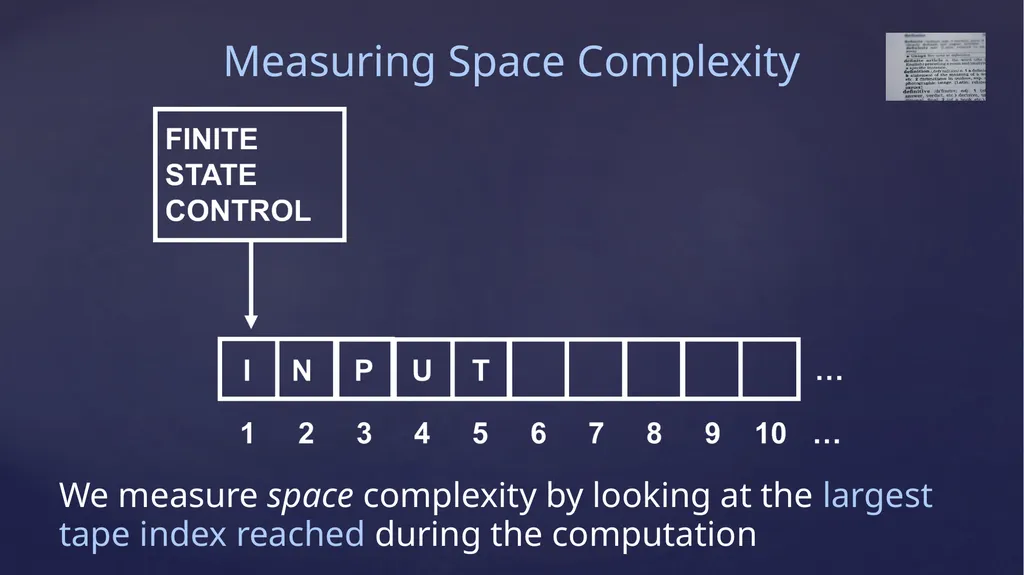
slide2. Measuring Space Complexity We measure space complexity by looking at the largest tape index reached during the computation<br>
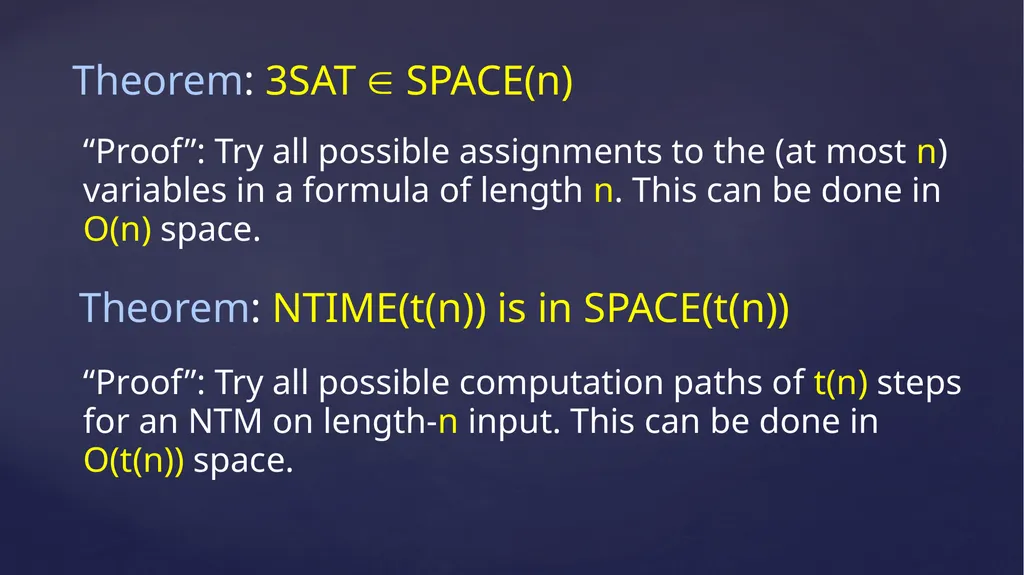
slide4. Theorem: 3SAT SPACE(n) “Proof”: Try all possible assignments to the (at most n) variables in a formula of length n. This can be done in O(n) space. Theorem: NTIME(t(n)) is in SPACE(t(n)) “Proof”: Try all possible computation paths of t(n) steps for an NTM on length-n input. This can be done in O(t(n)) space.<br>
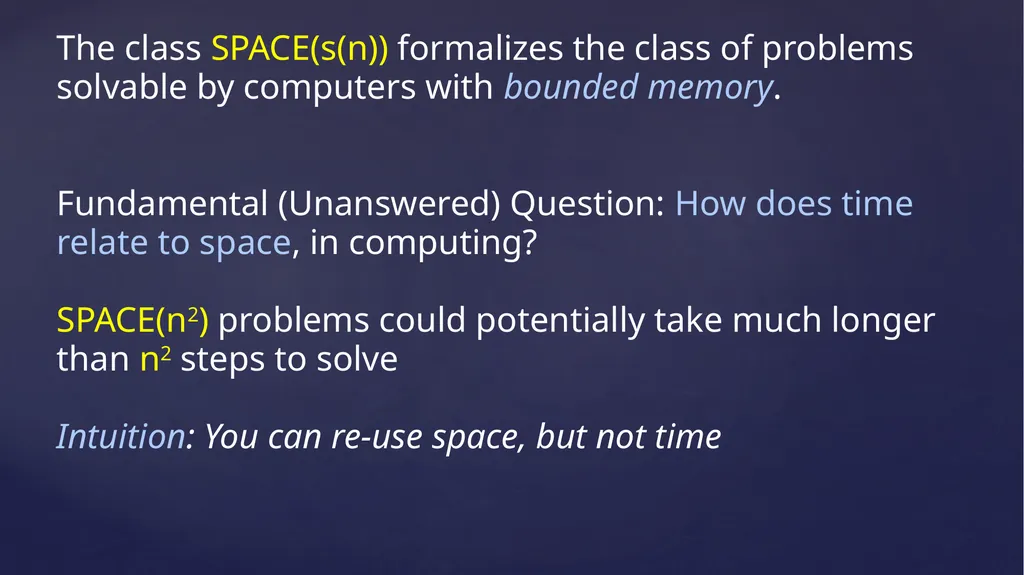
slide5. The class SPACE(s(n)) formalizes the class of problems solvable by computers with bounded memory.
Fundamental (Unanswered) Question: How does time relate to space, in computing?
SPACE(n2) problems could potentially take much longer than n2 steps to solve
Intuition: You can re-use space, but not time<br>
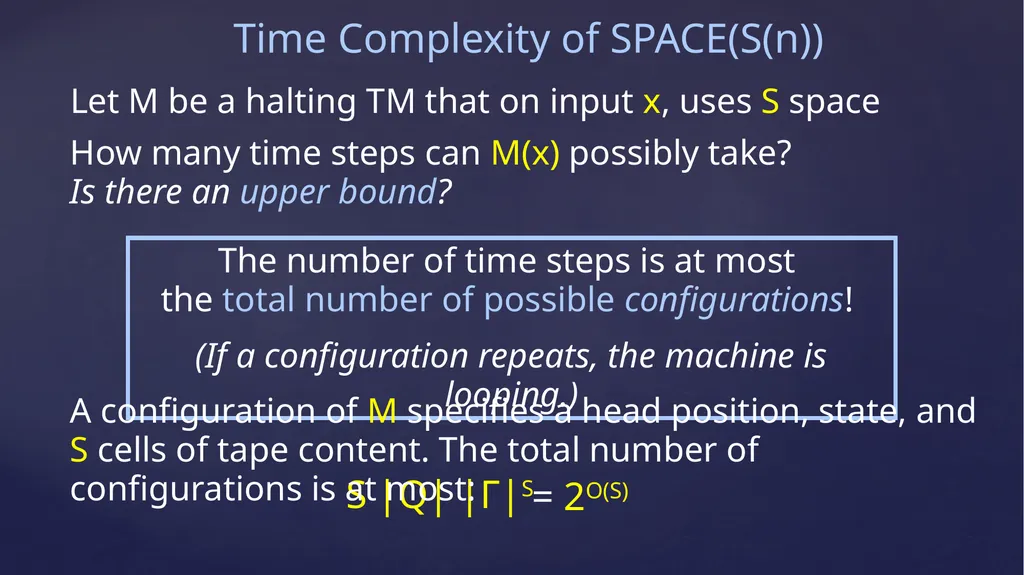
slide6. Let M be a halting TM that on input x, uses S space How many time steps can M(x) possibly take?
Is there an upper bound? The number of time steps is at most the total number of possible configurations!
(If a configuration repeats, the machine is looping.) S |Q| |Γ|S = 2O(S) A configuration of M specifies a head position, state, and S cells of tape content. The total number of configurations is at most: Time Complexity of SPACE(S(n))<br>
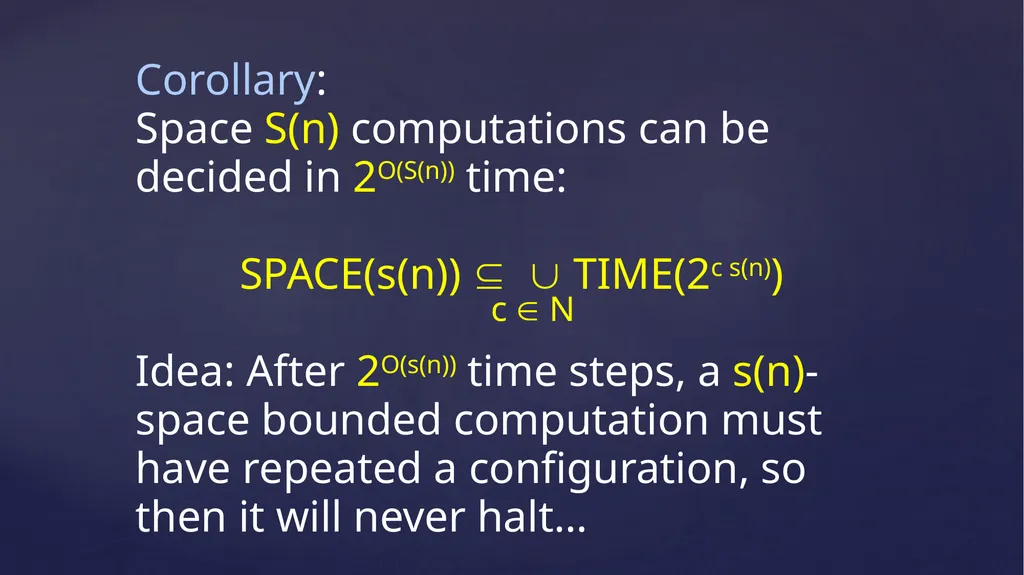
slide7. Corollary:
Space S(n) computations can be decided in 2O(S(n)) time:
SPACE(s(n)) TIME(2c s(n))
Idea: After 2O(s(n)) time steps, a s(n)-space bounded computation must have repeated a configuration, so then it will never halt… c N<br>
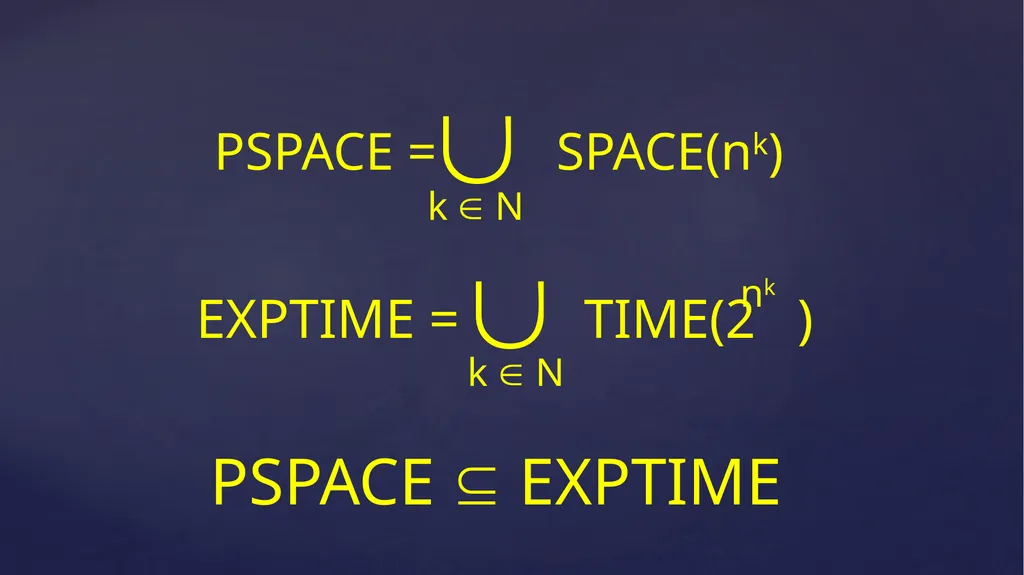
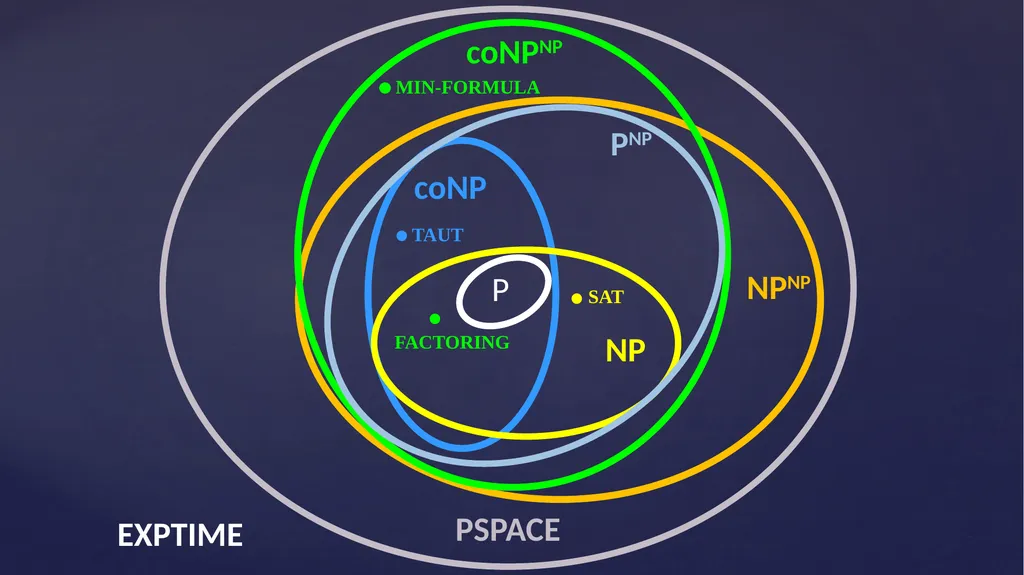
slide8. PSPACE EXPTIME<br>
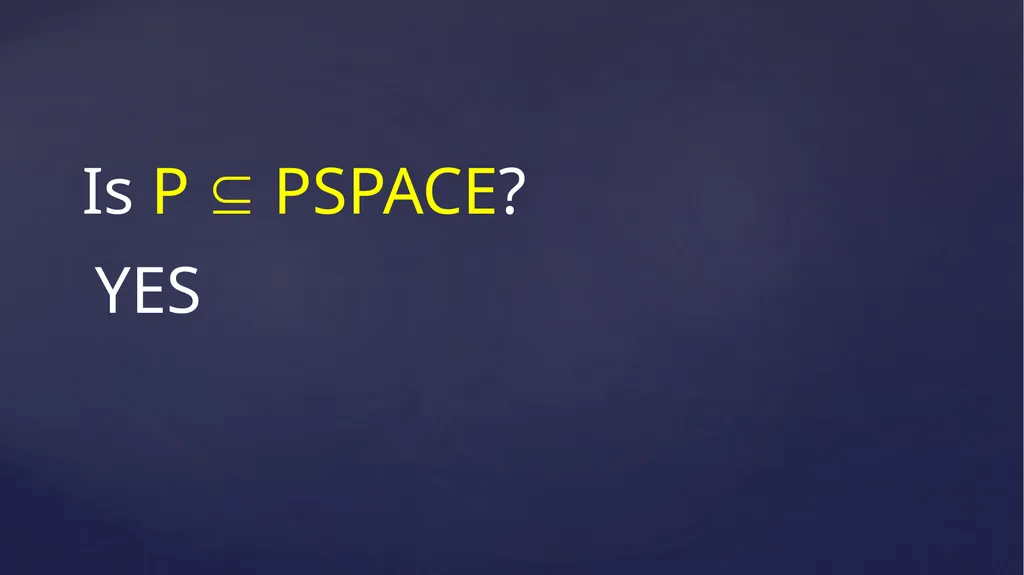
slide9. Is P PSPACE? YES<br>
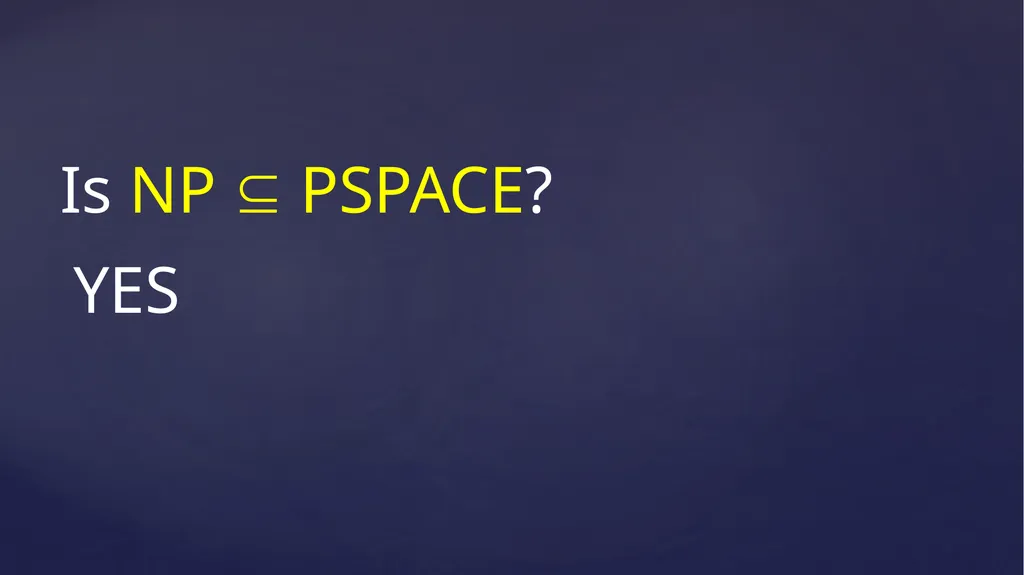
slide10. Is NP PSPACE? YES<br>
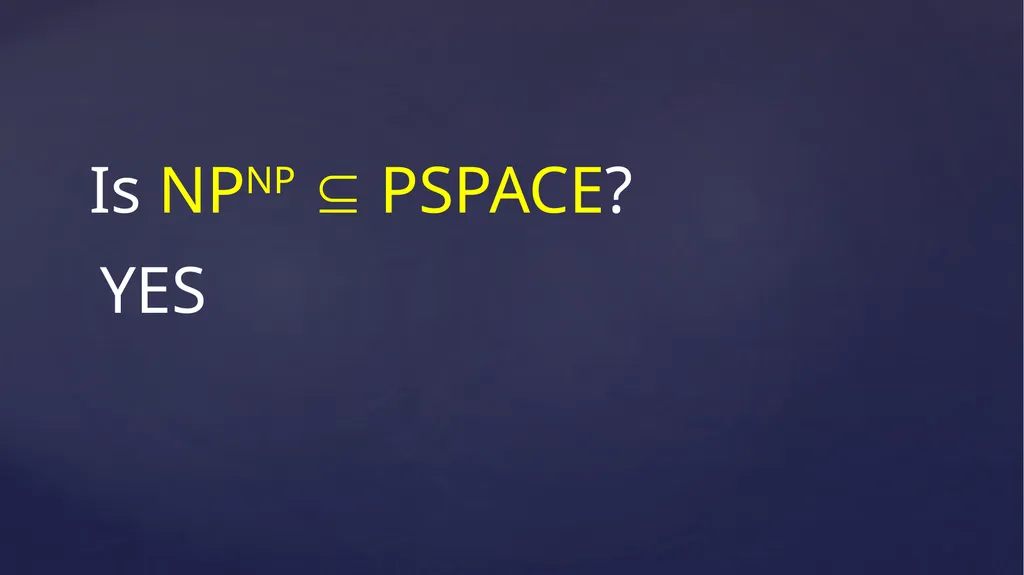
slide11. Is NPNP PSPACE? YES<br>
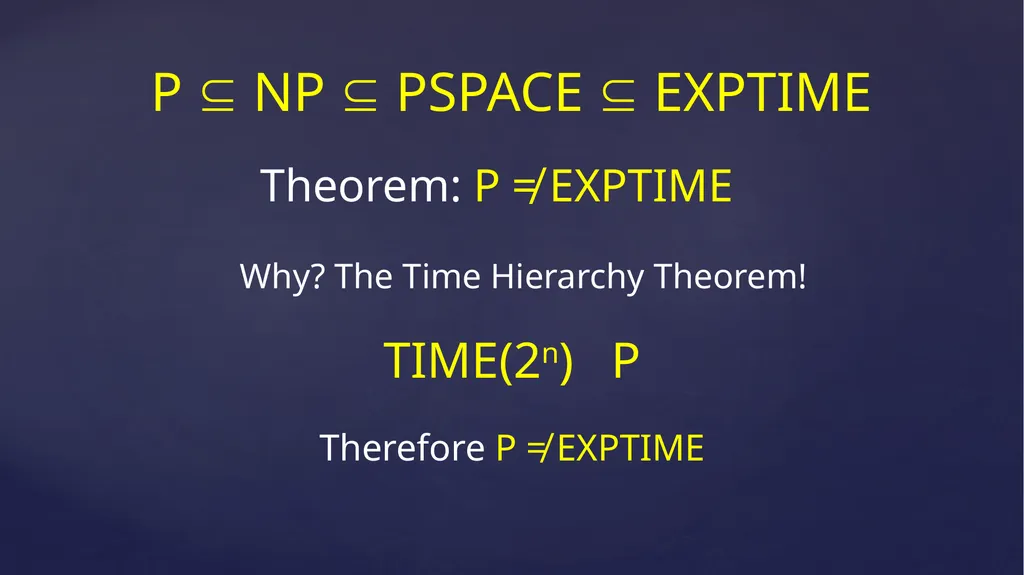
slide12. P NP PSPACE EXPTIME Theorem: P ≠ EXPTIME Why? The Time Hierarchy Theorem! TIME(2n) P
Therefore P ≠ EXPTIME<br>
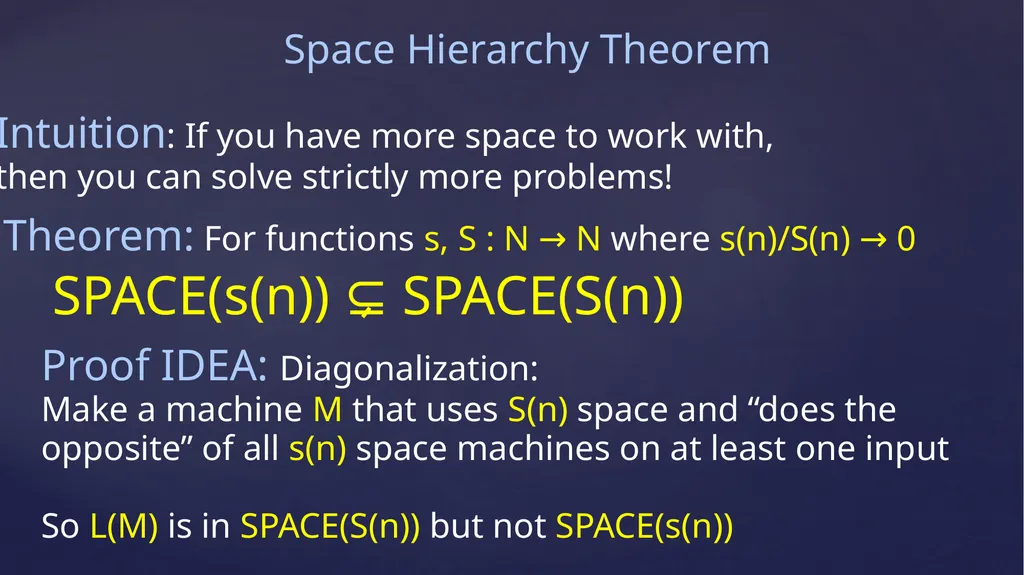
slide13. Intuition: If you have more space to work with,
then you can solve strictly more problems! Space Hierarchy Theorem Theorem: For functions s, S : N → N where s(n)/S(n) → 0 SPACE(s(n)) ⊊ SPACE(S(n)) Proof IDEA: Diagonalization: Make a machine M that uses S(n) space and “does the opposite” of all s(n) space machines on at least one input
So L(M) is in SPACE(S(n)) but not SPACE(s(n))<br>
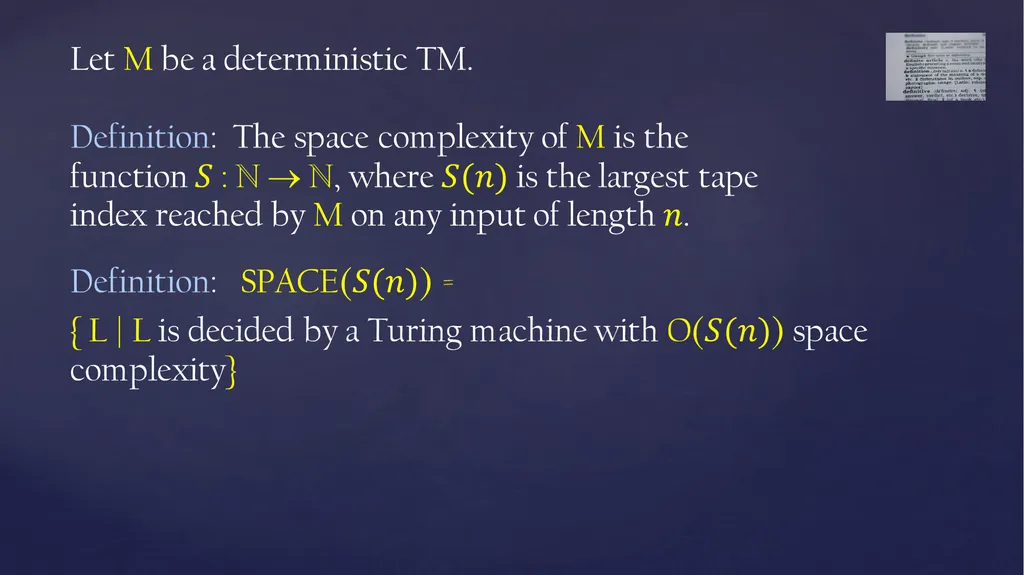
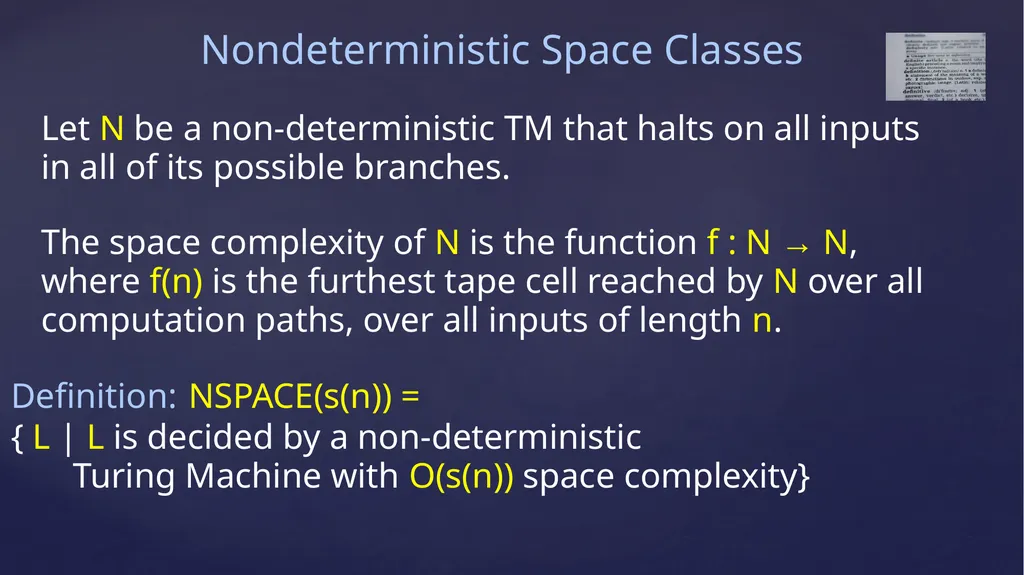
slide14. Let N be a non-deterministic TM that halts on all inputs in all of its possible branches. Nondeterministic Space Classes Definition: NSPACE(s(n)) = { L | L is decided by a non-deterministic Turing Machine with O(s(n)) space complexity} The space complexity of N is the function f : N → N, where f(n) is the furthest tape cell reached by N over all computation paths, over all inputs of length n.<br>
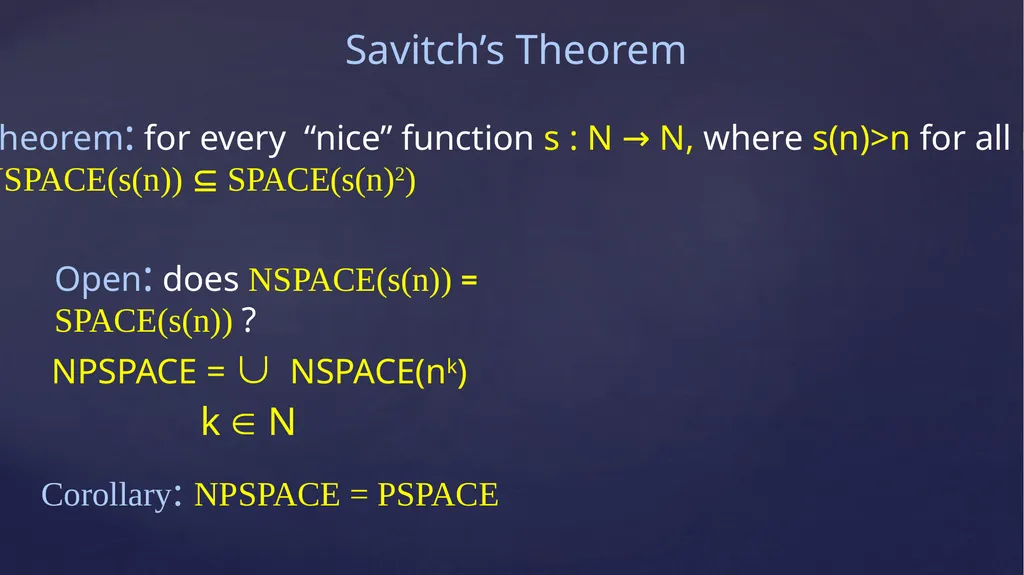
slide15. Savitch’s Theorem Theorem: for every “nice” function s : N → N, where s(n)>n for all n,
NSPACE(s(n)) SPACE(s(n)2) Corollary: NPSPACE = PSPACE Open: does NSPACE(s(n)) = SPACE(s(n)) ?<br>
slide16. P EXPTIME<br>
slide17. Parting thoughts:
More Space, more power
Relation of time and space wide open.
Polynomial-time hierarchy contained in PSPACE, which contains interesting problems (“chess” is PSPACE complete).
Non-determinism may reduce space but less dramatically.<br>
slide2. Measuring Space Complexity We measure space complexity by looking at the largest tape index reached during the computation<br>
slide4. Theorem: 3SAT SPACE(n) “Proof”: Try all possible assignments to the (at most n) variables in a formula of length n. This can be done in O(n) space. Theorem: NTIME(t(n)) is in SPACE(t(n)) “Proof”: Try all possible computation paths of t(n) steps for an NTM on length-n input. This can be done in O(t(n)) space.<br>
slide5. The class SPACE(s(n)) formalizes the class of problems solvable by computers with bounded memory.
Fundamental (Unanswered) Question: How does time relate to space, in computing?
SPACE(n2) problems could potentially take much longer than n2 steps to solve
Intuition: You can re-use space, but not time<br>
slide6. Let M be a halting TM that on input x, uses S space How many time steps can M(x) possibly take?
Is there an upper bound? The number of time steps is at most the total number of possible configurations!
(If a configuration repeats, the machine is looping.) S |Q| |Γ|S = 2O(S) A configuration of M specifies a head position, state, and S cells of tape content. The total number of configurations is at most: Time Complexity of SPACE(S(n))<br>
slide7. Corollary:
Space S(n) computations can be decided in 2O(S(n)) time:
SPACE(s(n)) TIME(2c s(n))
Idea: After 2O(s(n)) time steps, a s(n)-space bounded computation must have repeated a configuration, so then it will never halt… c N<br>
slide8. PSPACE EXPTIME<br>
slide9. Is P PSPACE? YES<br>
slide10. Is NP PSPACE? YES<br>
slide11. Is NPNP PSPACE? YES<br>
slide12. P NP PSPACE EXPTIME Theorem: P ≠ EXPTIME Why? The Time Hierarchy Theorem! TIME(2n) P
Therefore P ≠ EXPTIME<br>
slide13. Intuition: If you have more space to work with,
then you can solve strictly more problems! Space Hierarchy Theorem Theorem: For functions s, S : N → N where s(n)/S(n) → 0 SPACE(s(n)) ⊊ SPACE(S(n)) Proof IDEA: Diagonalization: Make a machine M that uses S(n) space and “does the opposite” of all s(n) space machines on at least one input
So L(M) is in SPACE(S(n)) but not SPACE(s(n))<br>
slide14. Let N be a non-deterministic TM that halts on all inputs in all of its possible branches. Nondeterministic Space Classes Definition: NSPACE(s(n)) = { L | L is decided by a non-deterministic Turing Machine with O(s(n)) space complexity} The space complexity of N is the function f : N → N, where f(n) is the furthest tape cell reached by N over all computation paths, over all inputs of length n.<br>
slide15. Savitch’s Theorem Theorem: for every “nice” function s : N → N, where s(n)>n for all n,
NSPACE(s(n)) SPACE(s(n)2) Corollary: NPSPACE = PSPACE Open: does NSPACE(s(n)) = SPACE(s(n)) ?<br>
slide16. P EXPTIME<br>
slide17. Parting thoughts:
More Space, more power
Relation of time and space wide open.
Polynomial-time hierarchy contained in PSPACE, which contains interesting problems (“chess” is PSPACE complete).
Non-determinism may reduce space but less dramatically.<br>