Spanner: Google’s Globally-Distributed Database
Description: Spanner: Googles Globally-Distributed Database Wilson Hsieh representing a host of authors OSDI 2012 What is Spanner? Distributed multiversion database General-purpose transactions (ACID) SQL query language Schematized tables
Related Topics
Download Presentation
"Spanner: Google’s Globally-Distributed Database" is the property of its rightful owner. Permission is granted to download and print the materials on this website for personal, non-commercial use only, and to display it on your personal computer provided you do not modify the materials and that you retain all copyright notices contained in the materials. By downloading content from our website, you accept the terms of this agreement.
Presentation Transcript
slide1. Spanner: Google’sGlobally-Distributed Database Wilson Hsieh
representing a host of authors
OSDI 2012<br>
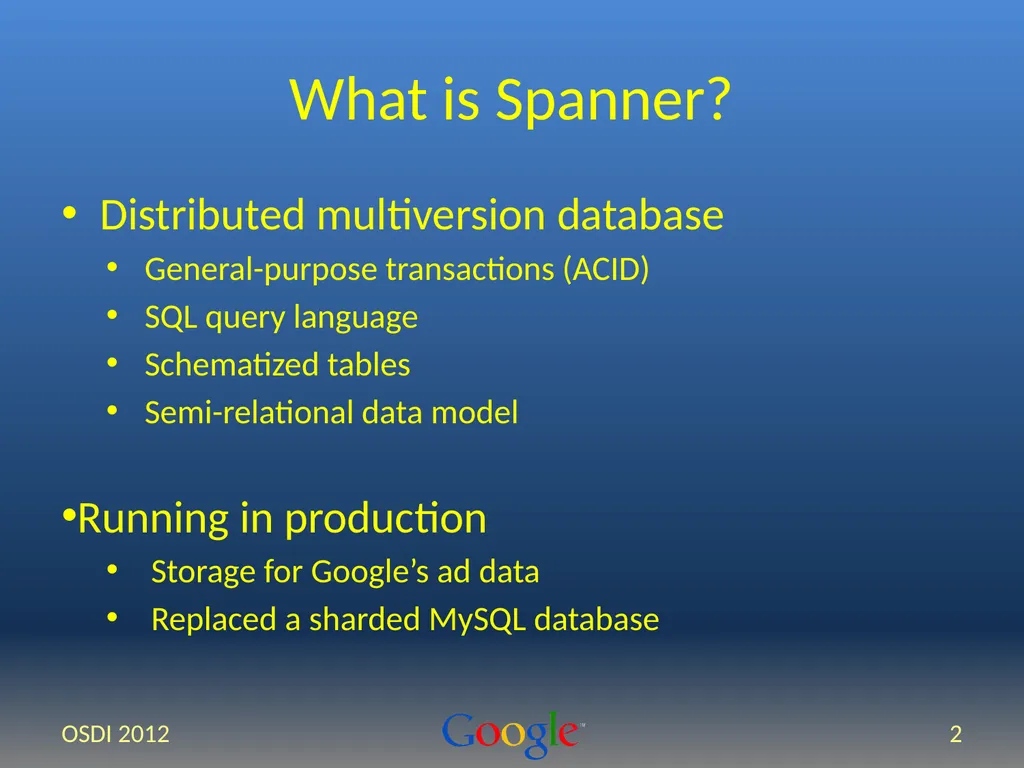
slide2. What is Spanner? Distributed multiversion database
General-purpose transactions (ACID)
SQL query language
Schematized tables
Semi-relational data model
Running in production
Storage for Google’s ad data
Replaced a sharded MySQL database OSDI 2012 2<br>
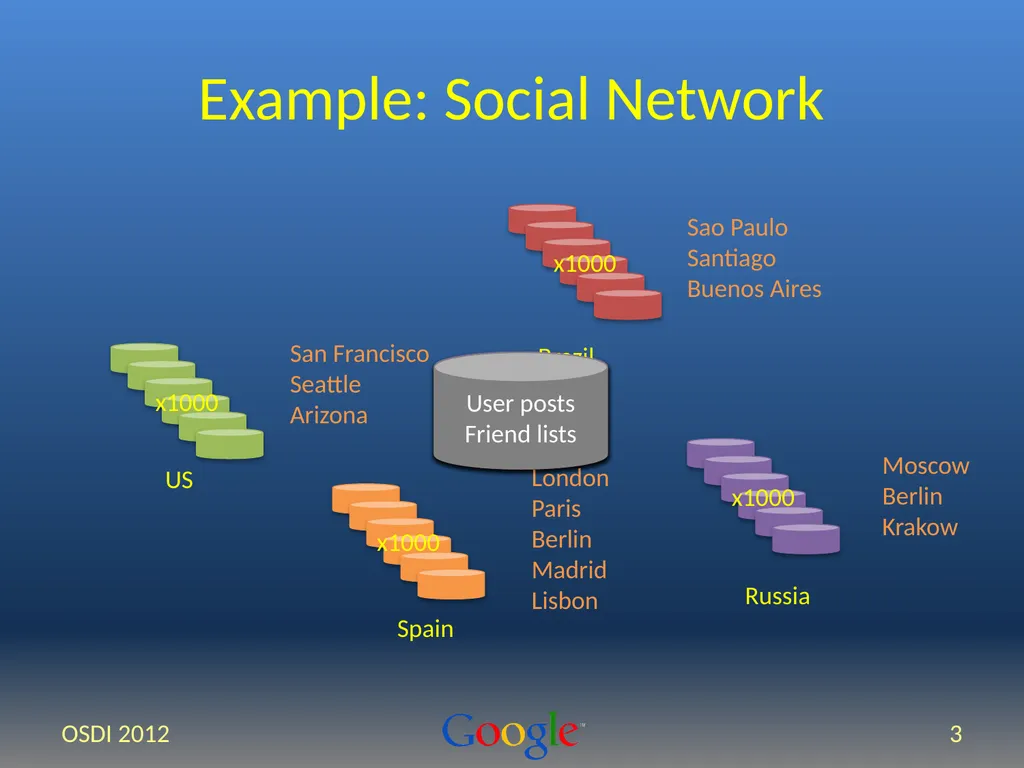
slide3. Example: Social Network OSDI 2012 User posts
Friend lists User posts
Friend lists US Brazil Russia Spain San Francisco
Seattle
Arizona Sao Paulo
Santiago
Buenos Aires Moscow
Berlin
Krakow London
Paris
Berlin
Madrid
Lisbon User posts
Friend lists 3<br>
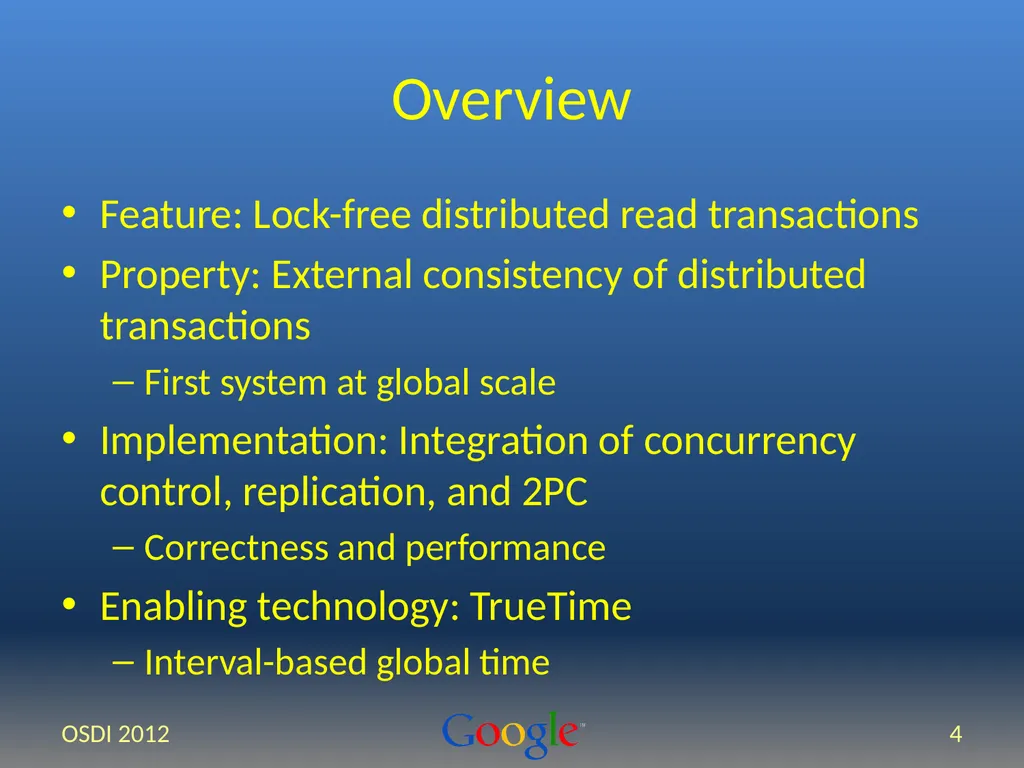
slide4. Overview Feature: Lock-free distributed read transactions
Property: External consistency of distributed transactions
First system at global scale
Implementation: Integration of concurrency control, replication, and 2PC
Correctness and performance
Enabling technology: TrueTime
Interval-based global time OSDI 2012 4<br>
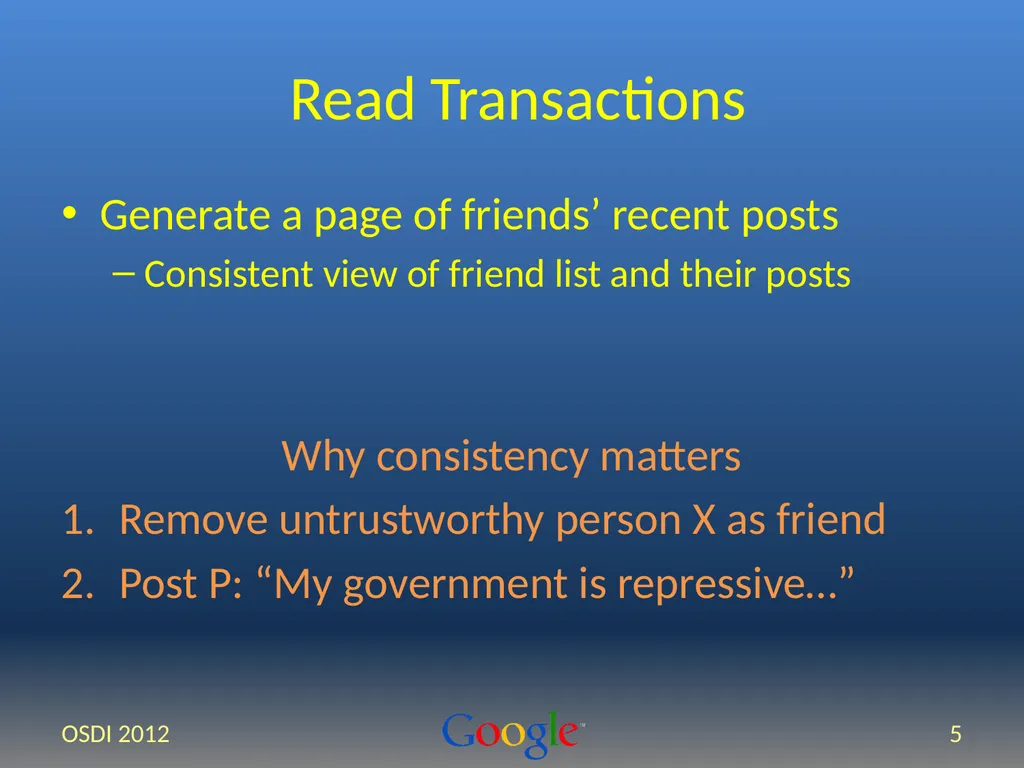
slide5. Read Transactions Generate a page of friends’ recent posts
Consistent view of friend list and their posts OSDI 2012 Why consistency matters
Remove untrustworthy person X as friend
Post P: “My government is repressive…” 5<br>
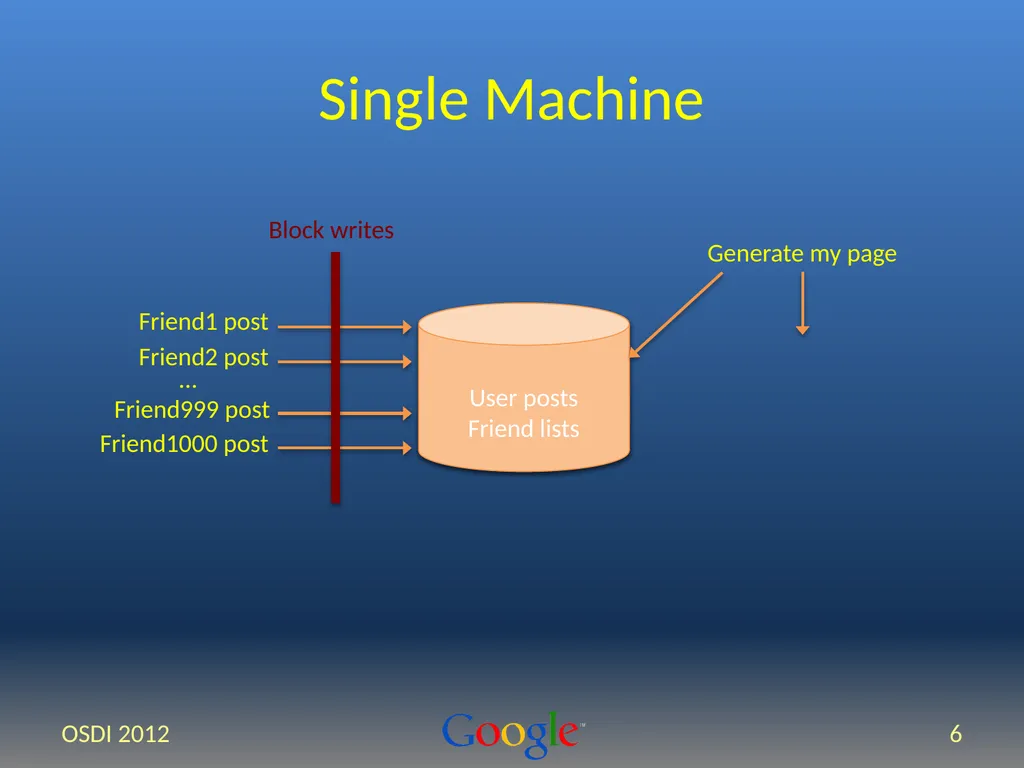
slide6. User posts
Friend lists User posts
Friend lists Single Machine Friend2 post Generate my page Friend1 post Friend1000 post Friend999 post Block writes OSDI 2012 … 6<br>
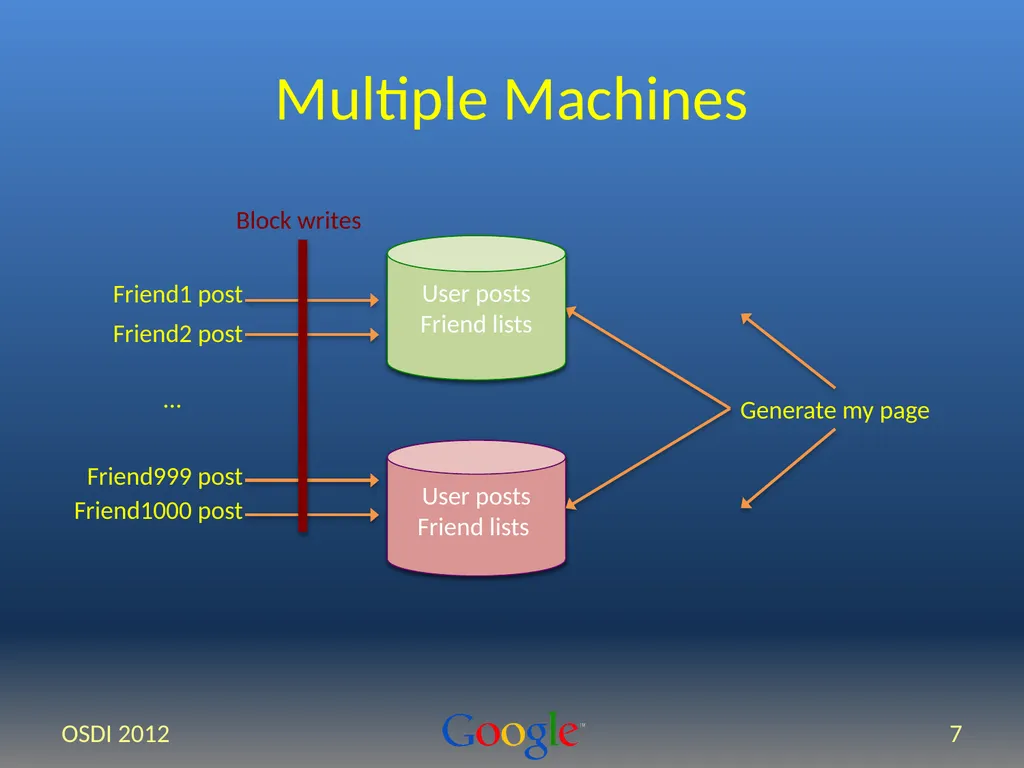
slide7. User posts
Friend lists User posts
Friend lists Multiple Machines User posts
Friend lists Generate my page Friend2 post Friend1 post Friend1000 post Friend999 post User posts
Friend lists Block writes OSDI 2012 … 7<br>
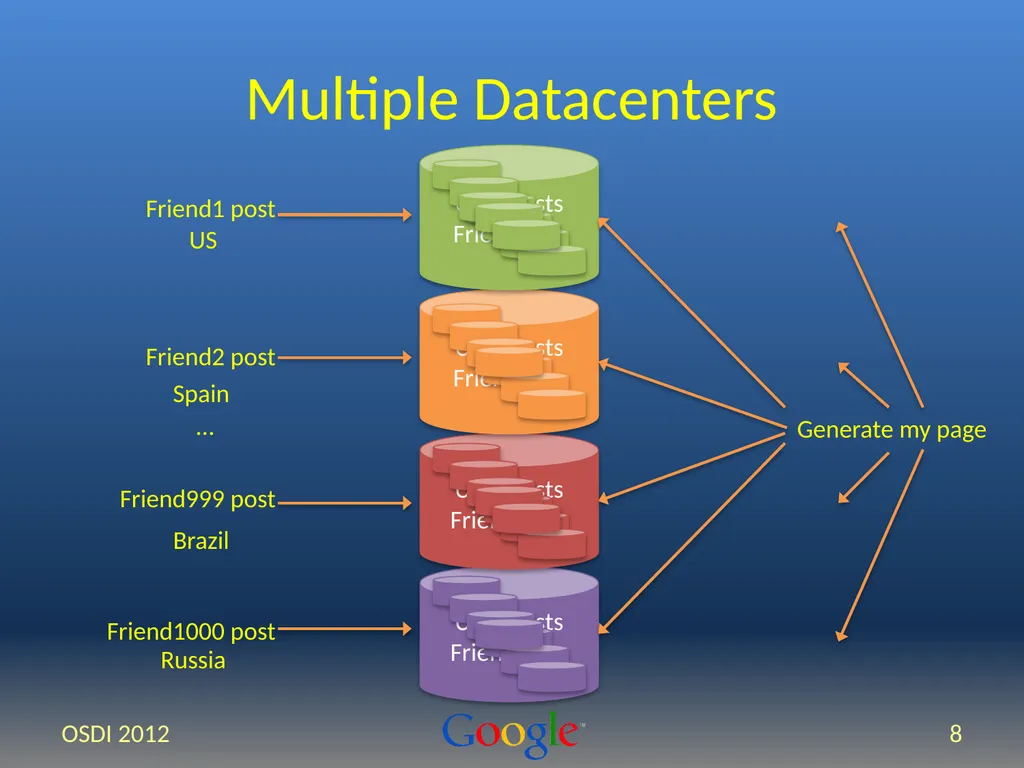
slide8. User posts
Friend lists User posts
Friend lists Multiple Datacenters User posts
Friend lists Generate my page Friend2 post Friend1 post Friend1000 post Friend999 post OSDI 2012 … US Spain Russia Brazil 8<br>
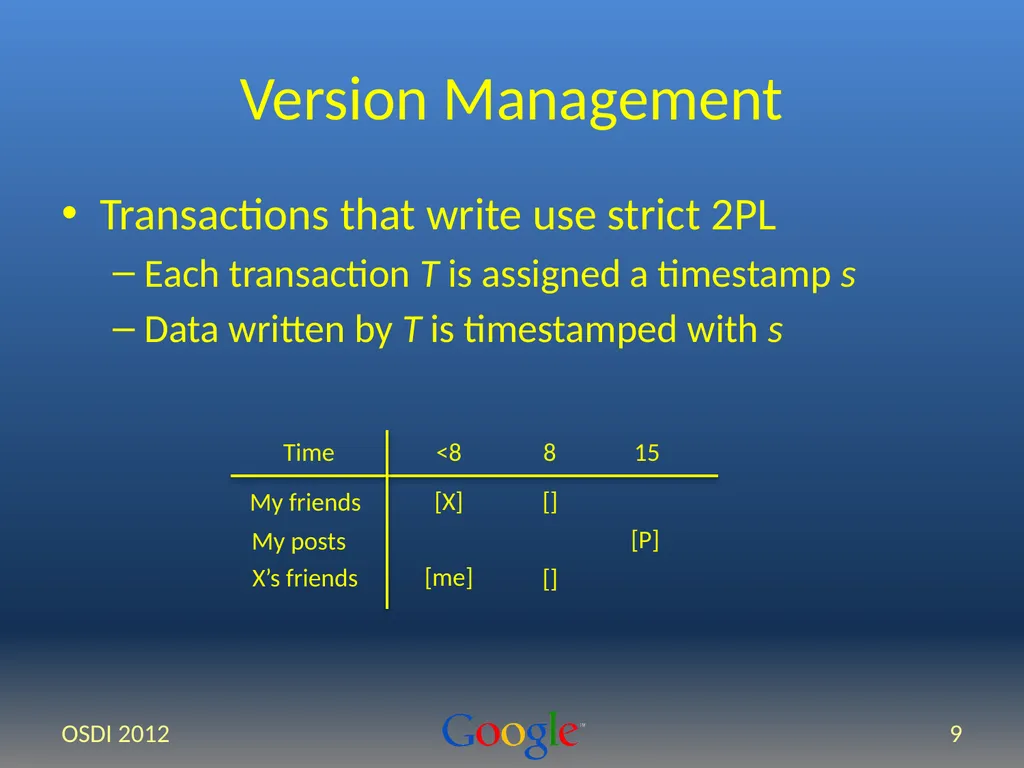
slide9. Version Management Transactions that write use strict 2PL
Each transaction T is assigned a timestamp s
Data written by T is timestamped with s OSDI 2012 9 Time 8 <8 [X] [me] 15 [P] My friends My posts X’s friends [] []<br>
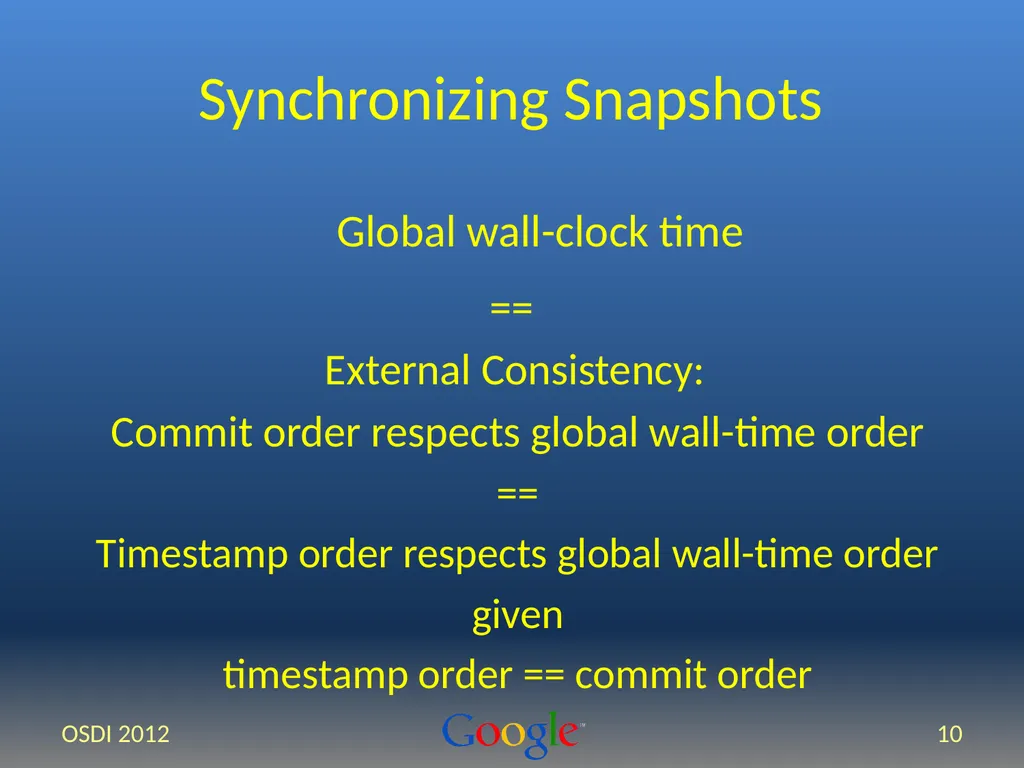
slide10. Synchronizing Snapshots ==
External Consistency:
Commit order respects global wall-time order OSDI 2012 10 ==
Timestamp order respects global wall-time order
given
timestamp order == commit order Global wall-clock time<br>
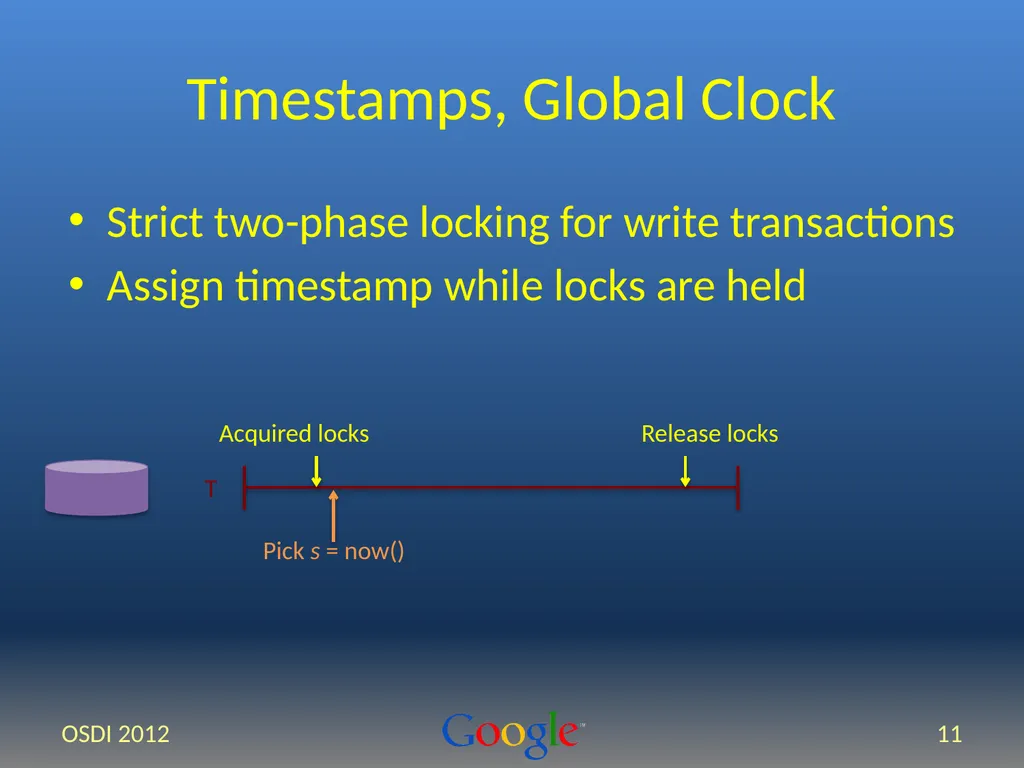
slide11. Timestamps, Global Clock Strict two-phase locking for write transactions
Assign timestamp while locks are held T Pick s = now() Acquired locks Release locks OSDI 2012 11<br>
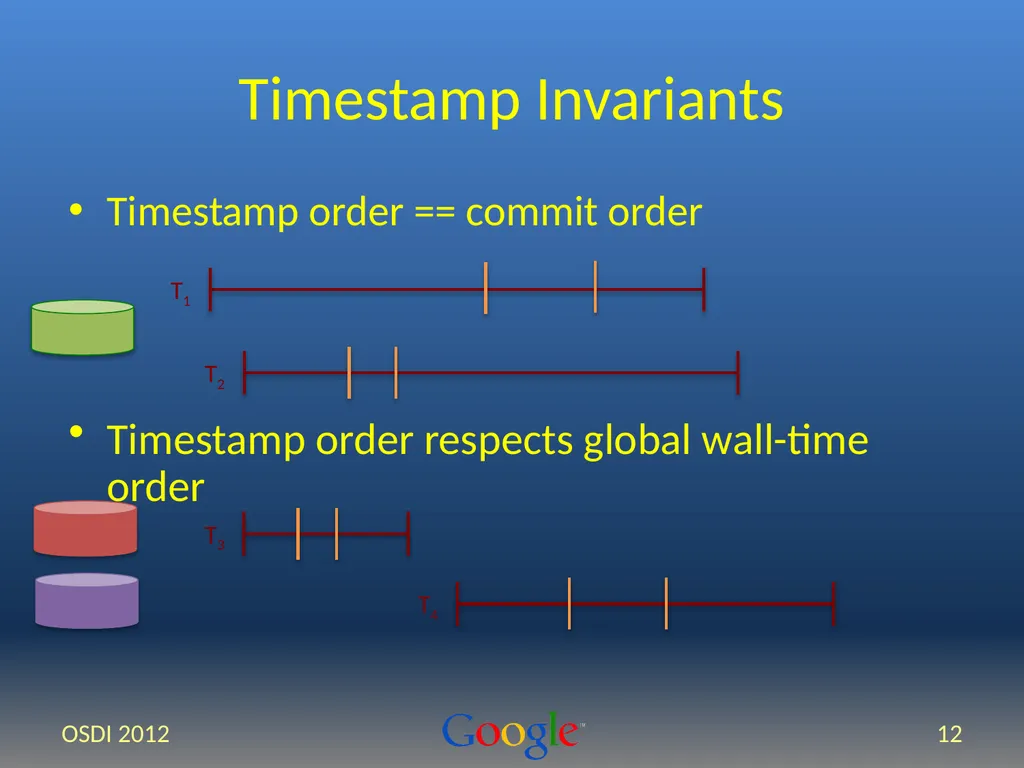
slide12. Timestamp Invariants OSDI 2012 12 Timestamp order == commit order Timestamp order respects global wall-time order T2 T3 T4 T1<br>
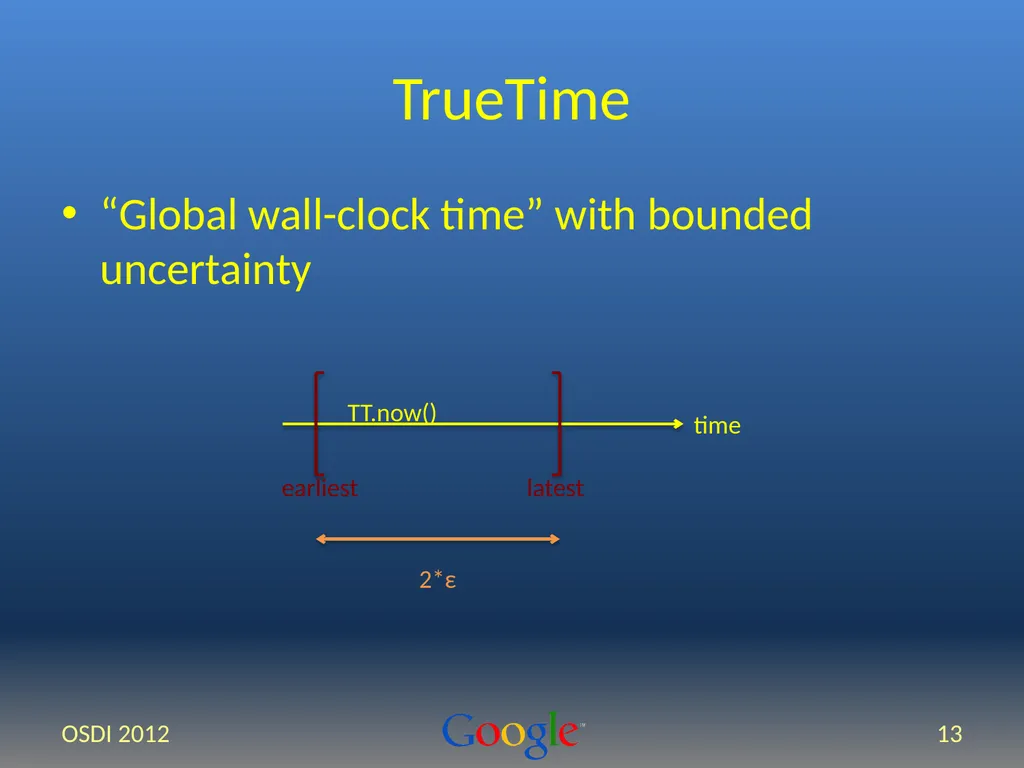
slide13. TrueTime “Global wall-clock time” with bounded uncertainty time earliest latest TT.now() 2*ε OSDI 2012 13<br>
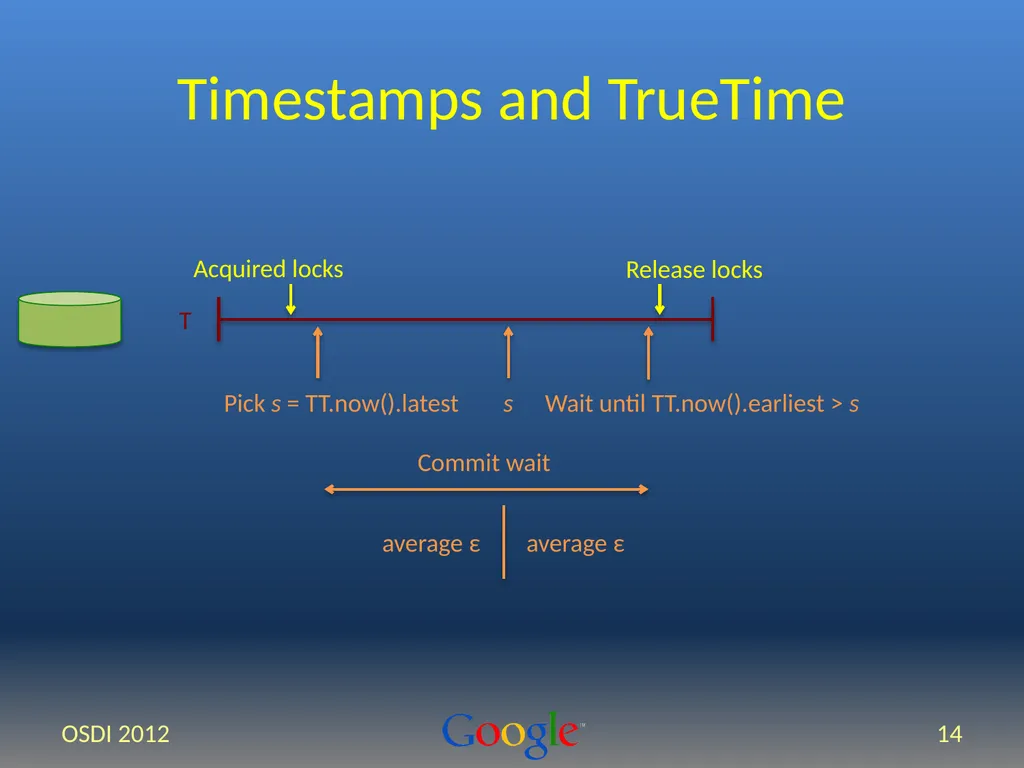
slide14. Timestamps and TrueTime T Pick s = TT.now().latest Acquired locks Release locks Wait until TT.now().earliest > s s OSDI 2012 average ε Commit wait average ε 14<br>
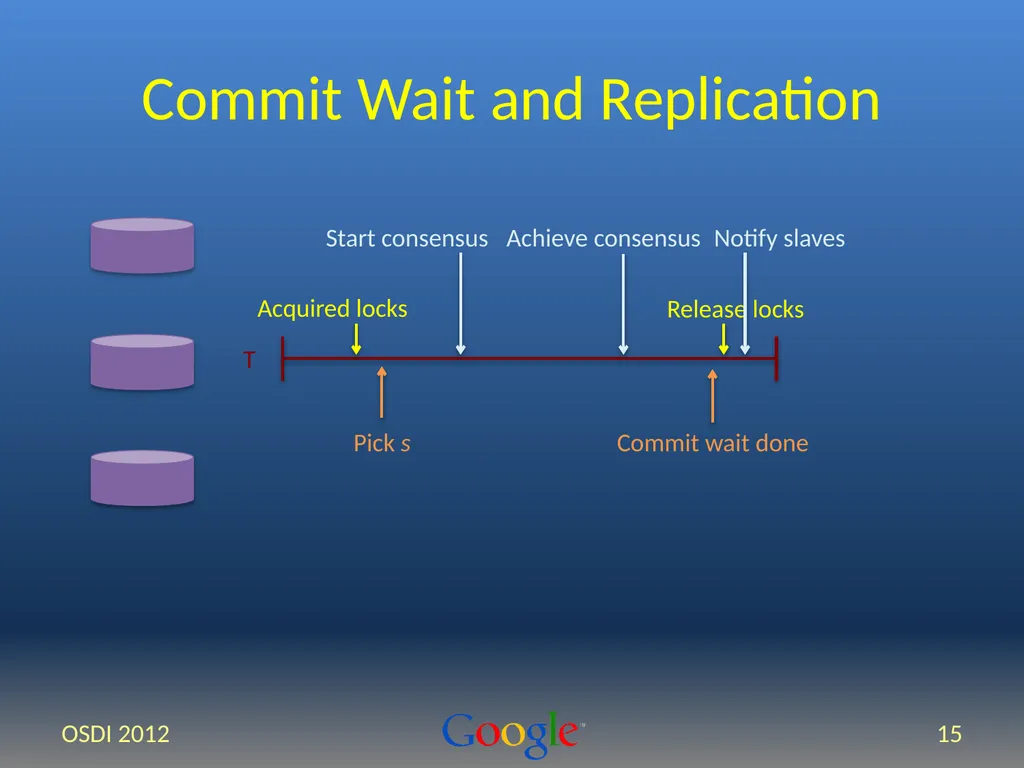
slide15. Commit Wait and Replication OSDI 2012 T Acquired locks Release locks Start consensus Notify slaves Commit wait done Pick s 15 Achieve consensus<br>
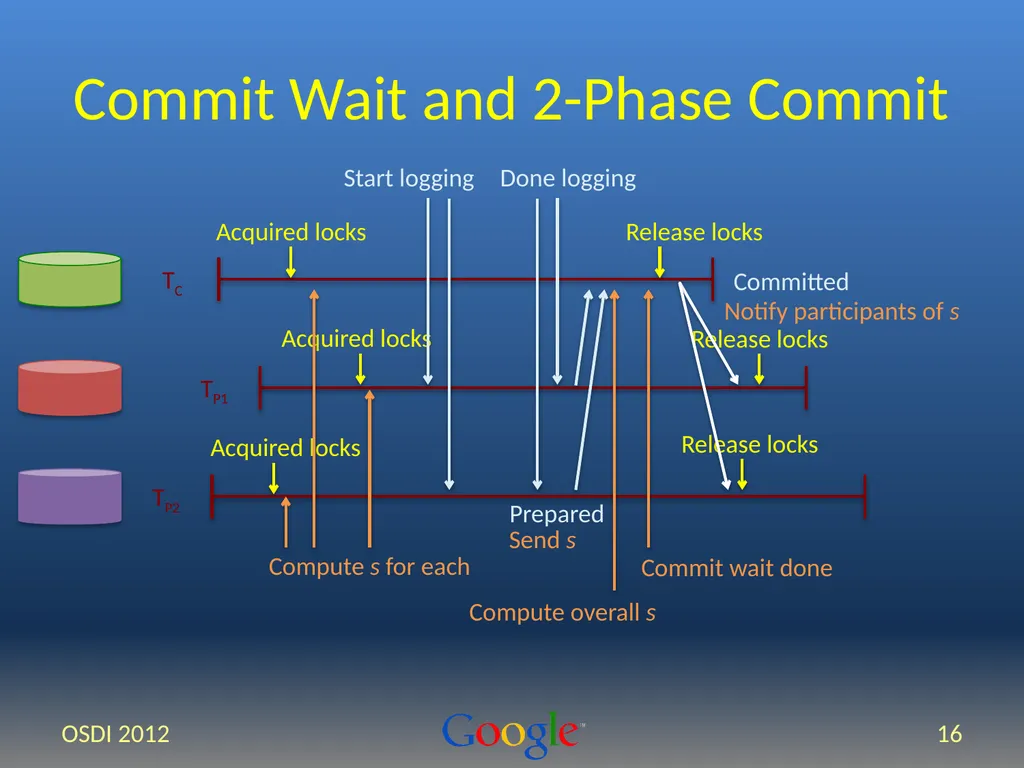
slide16. Commit Wait and 2-Phase Commit OSDI 2012 TC Acquired locks Release locks TP1 Acquired locks Release locks TP2 Acquired locks Release locks Notify participants of s Commit wait done Compute s for each 16 Start logging Done logging Prepared Compute overall s Committed Send s<br>
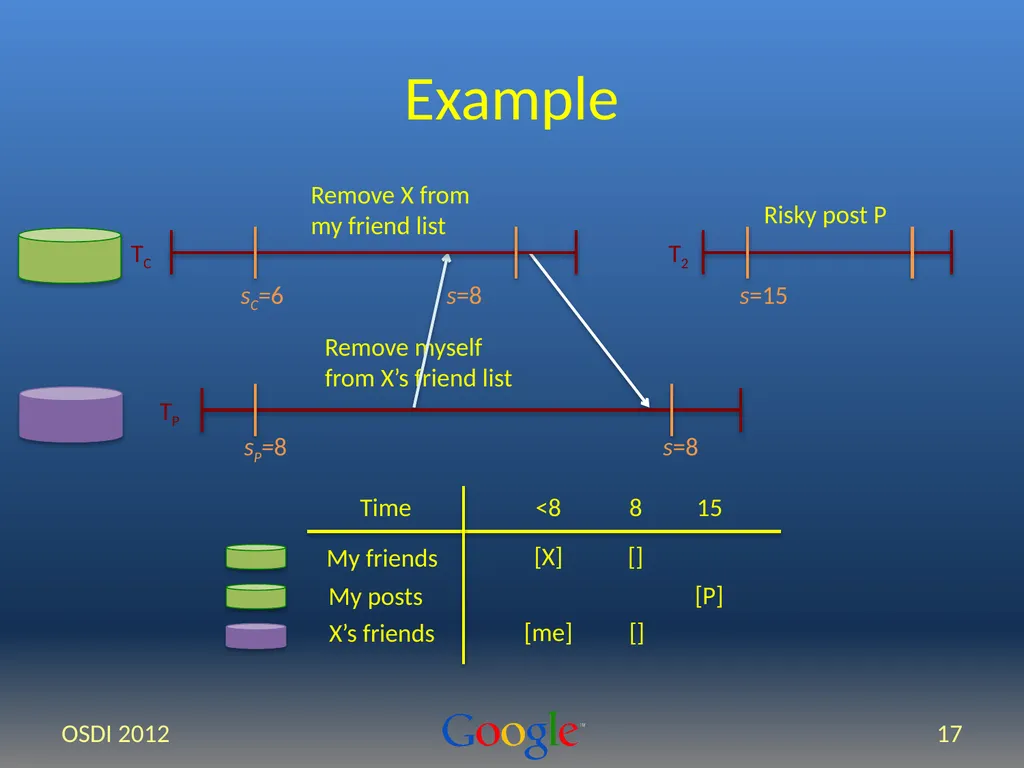
slide17. Example OSDI 2012 17 TP Remove X from my friend list Remove myself from X’s friend list sC=6 sP=8 s=8 s=15 Risky post P s=8 Time <8 [X] [me] 15 TC T2 [P] My friends My posts X’s friends 8 [] []<br>
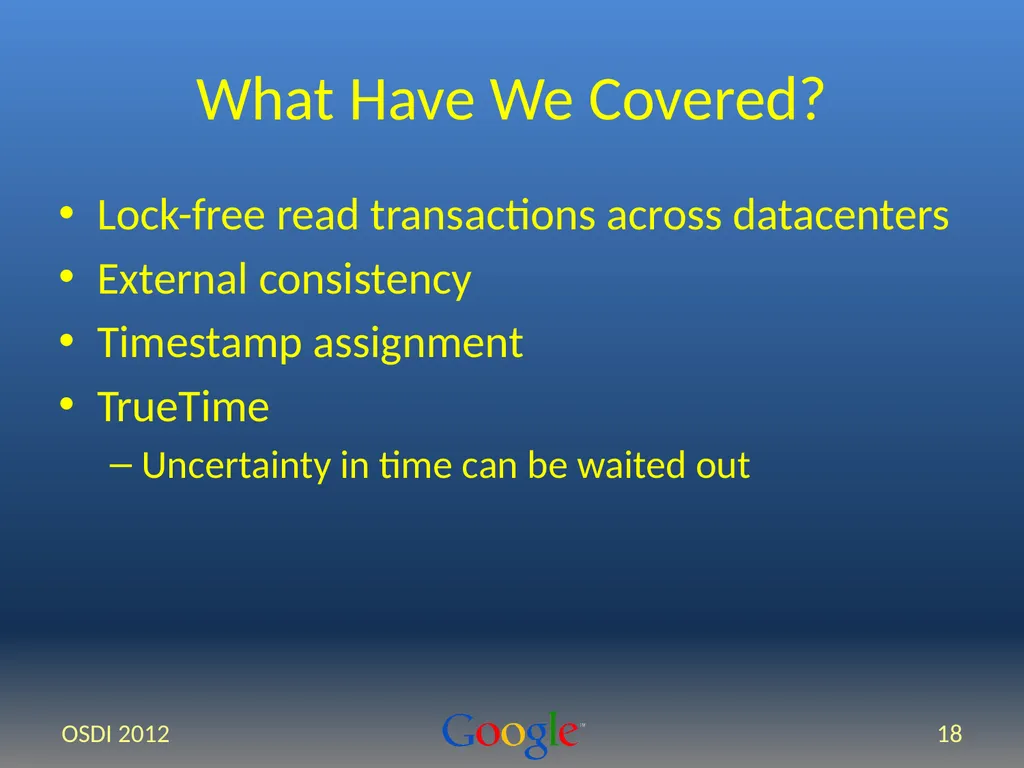
slide18. What Have We Covered? Lock-free read transactions across datacenters
External consistency
Timestamp assignment
TrueTime
Uncertainty in time can be waited out OSDI 2012 18<br>
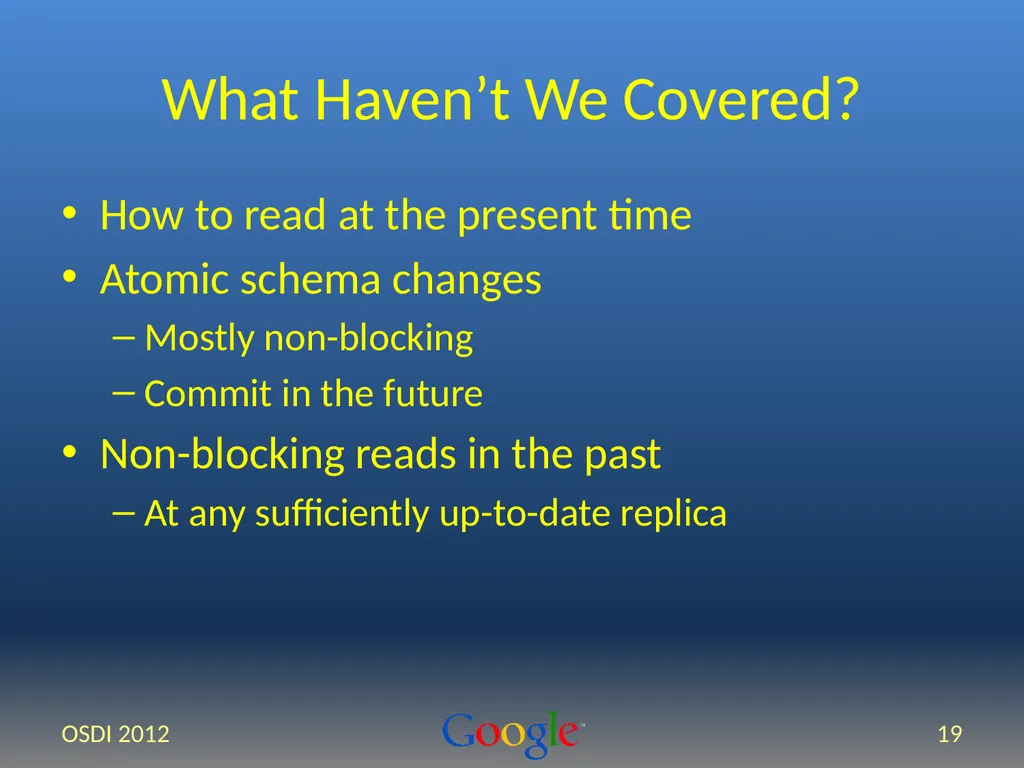
slide19. What Haven’t We Covered? How to read at the present time
Atomic schema changes
Mostly non-blocking
Commit in the future
Non-blocking reads in the past
At any sufficiently up-to-date replica OSDI 2012 19<br>
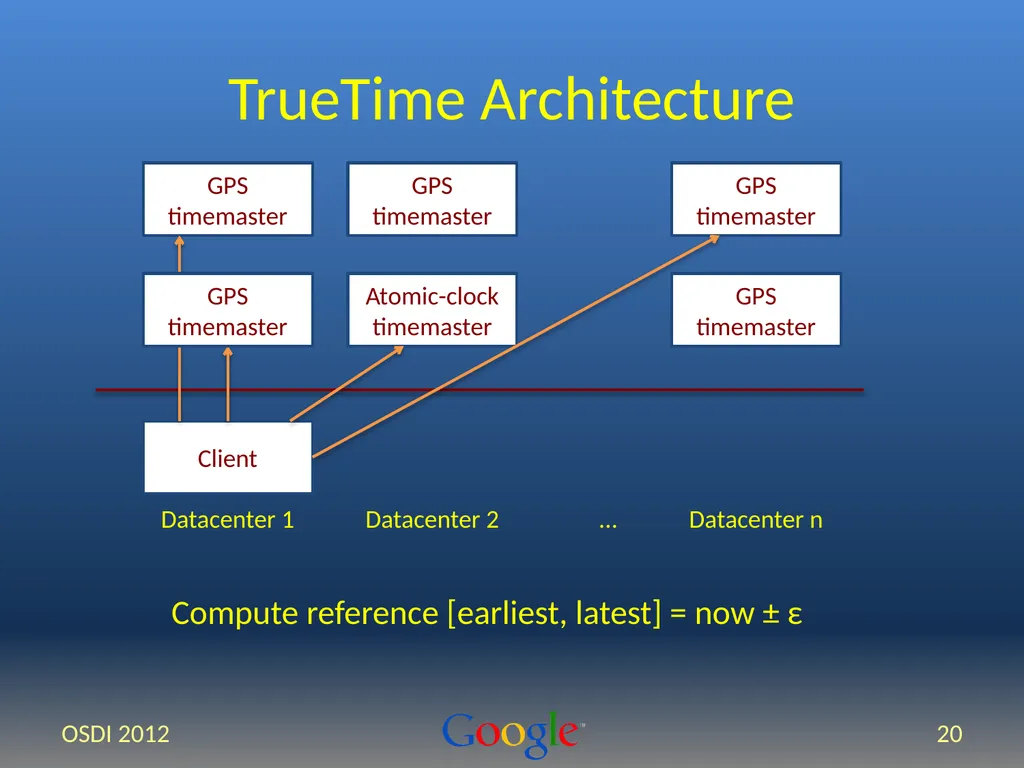
slide20. TrueTime Architecture Datacenter 1 Datacenter n … Datacenter 2 GPS timemaster GPS timemaster GPS timemaster Atomic-clock timemaster GPS timemaster Client OSDI 2012 20 GPS timemaster Compute reference [earliest, latest] = now ± ε<br>
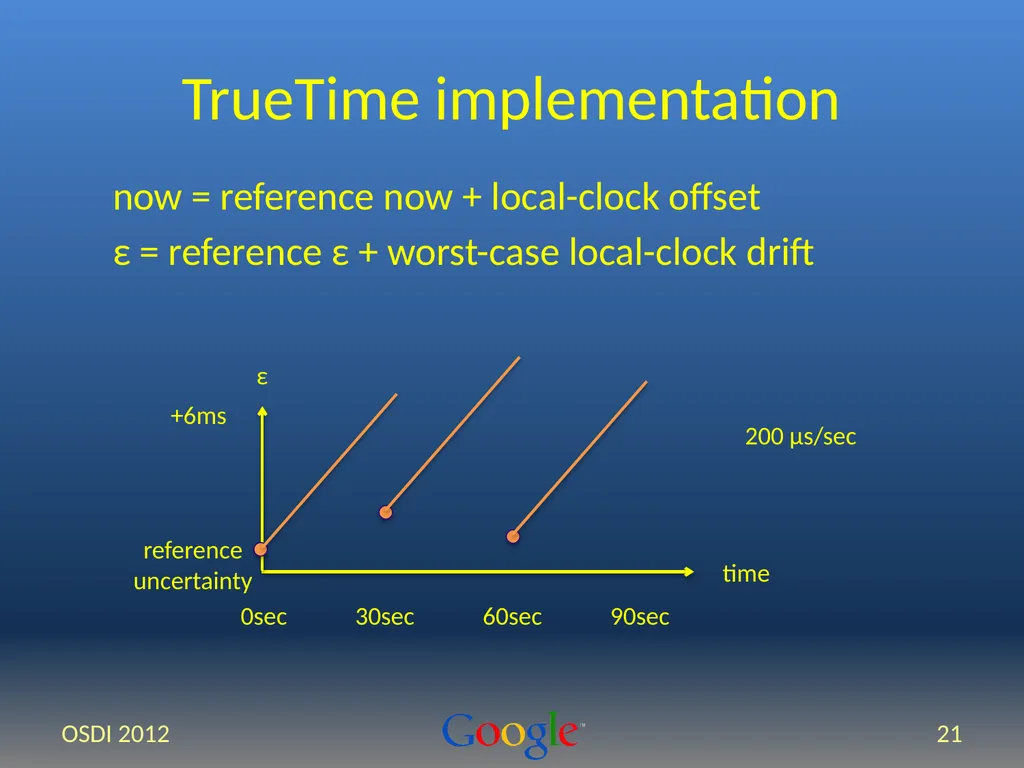
slide21. TrueTime implementation time ε 0sec 30sec 60sec 90sec +6ms now = reference now + local-clock offset
ε = reference ε + worst-case local-clock drift reference
uncertainty OSDI 2012 21 200 μs/sec<br>
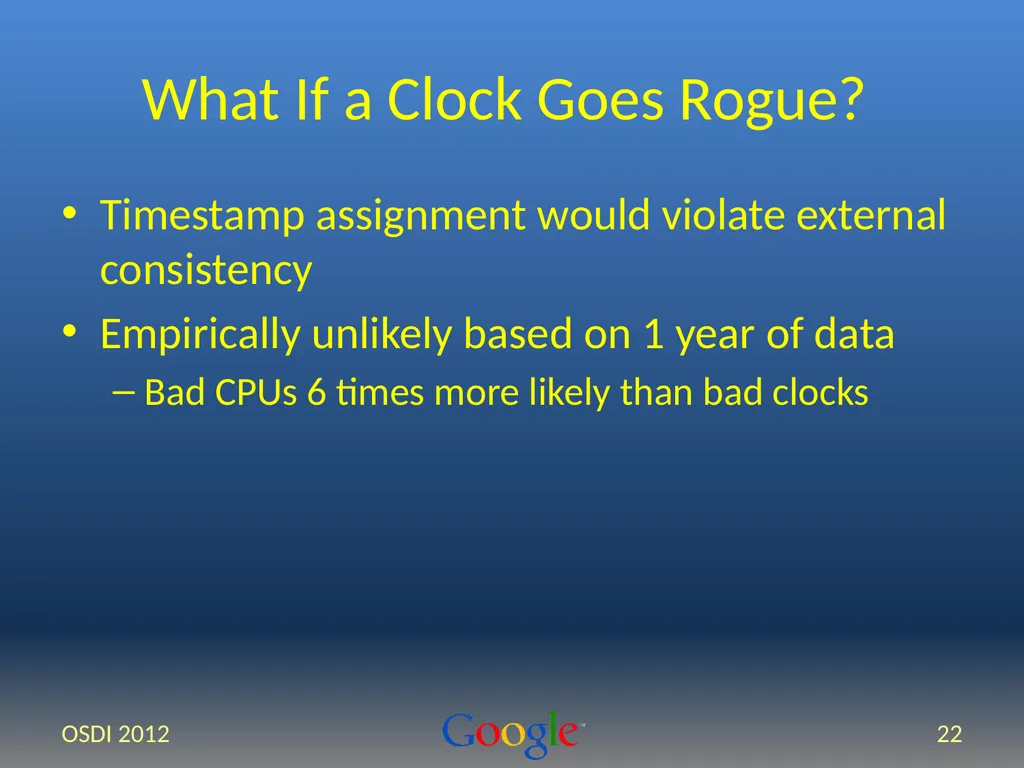
slide22. What If a Clock Goes Rogue? Timestamp assignment would violate external consistency
Empirically unlikely based on 1 year of data
Bad CPUs 6 times more likely than bad clocks OSDI 2012 22<br>
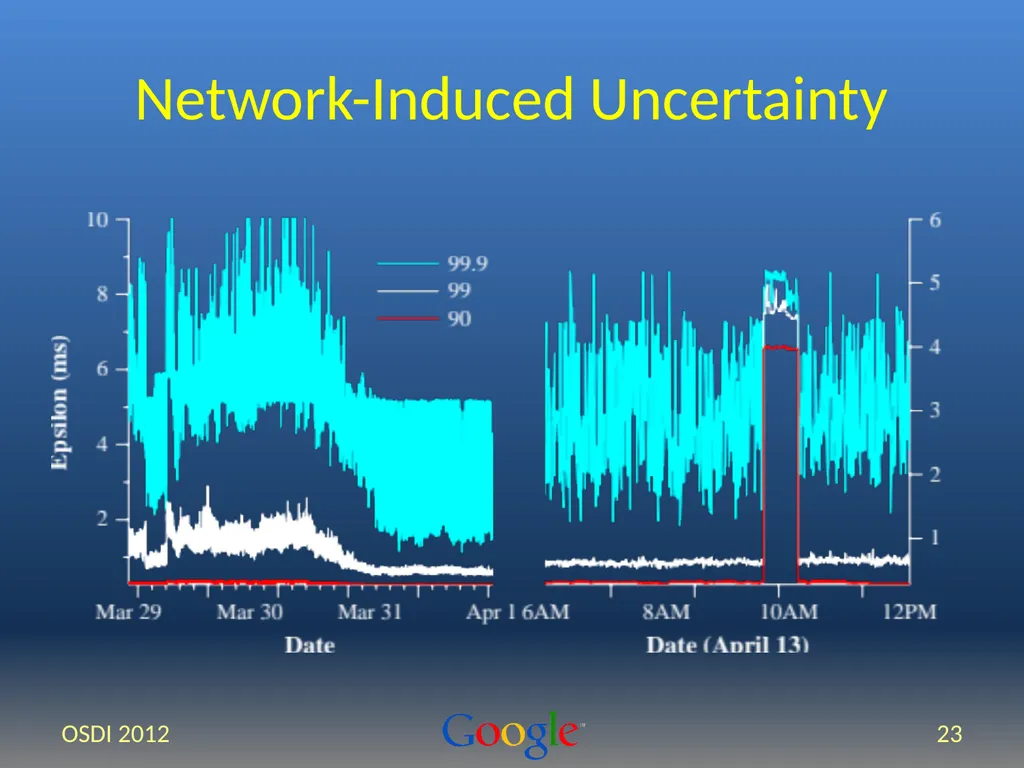
slide23. Network-Induced Uncertainty OSDI 2012 23<br>
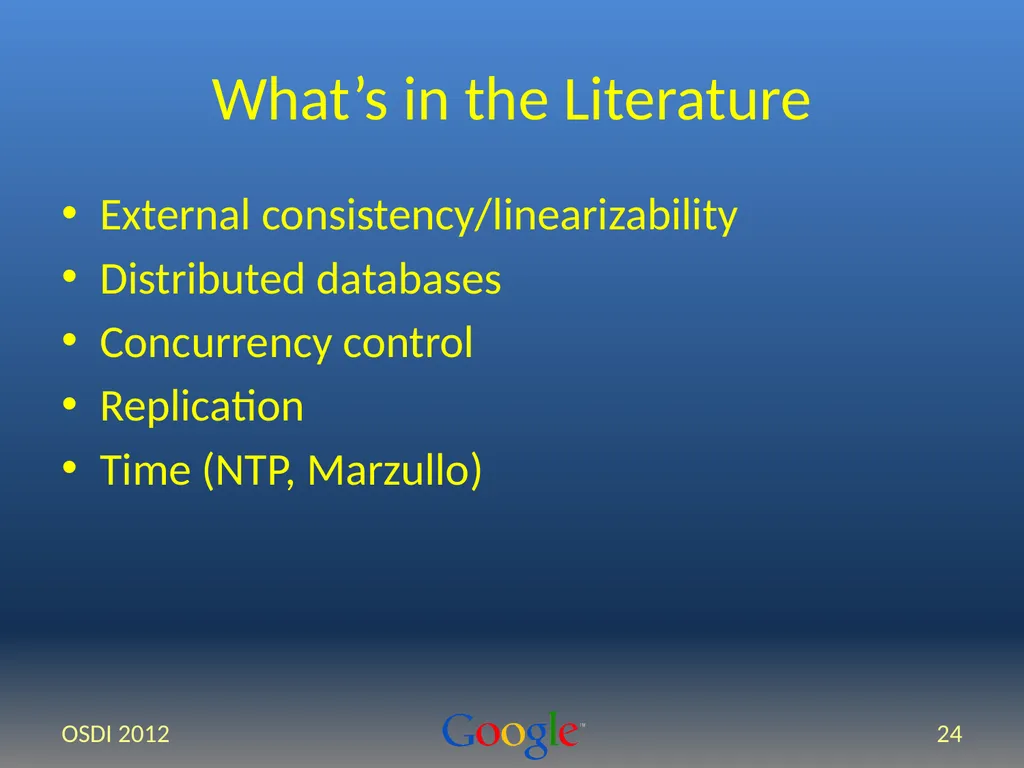
slide24. What’s in the Literature External consistency/linearizability
Distributed databases
Concurrency control
Replication
Time (NTP, Marzullo) OSDI 2012 24<br>
slide25. Future Work Improving TrueTime
Lower ε < 1 ms
Building out database features
Finish implementing basic features
Efficiently support rich query patterns OSDI 2012 25<br>
slide26. Conclusions Reify clock uncertainty in time APIs
Known unknowns are better than unknown unknowns
Rethink algorithms to make use of uncertainty
Stronger semantics are achievable
Greater scale != weaker semantics OSDI 2012 26<br>
slide27. Thanks To the Spanner team and customers
To our shepherd and reviewers
To lots of Googlers for feedback
To you for listening!

Questions? OSDI 2012 27<br>
representing a host of authors
OSDI 2012<br>
slide2. What is Spanner? Distributed multiversion database
General-purpose transactions (ACID)
SQL query language
Schematized tables
Semi-relational data model
Running in production
Storage for Google’s ad data
Replaced a sharded MySQL database OSDI 2012 2<br>
slide3. Example: Social Network OSDI 2012 User posts
Friend lists User posts
Friend lists US Brazil Russia Spain San Francisco
Seattle
Arizona Sao Paulo
Santiago
Buenos Aires Moscow
Berlin
Krakow London
Paris
Berlin
Madrid
Lisbon User posts
Friend lists 3<br>
slide4. Overview Feature: Lock-free distributed read transactions
Property: External consistency of distributed transactions
First system at global scale
Implementation: Integration of concurrency control, replication, and 2PC
Correctness and performance
Enabling technology: TrueTime
Interval-based global time OSDI 2012 4<br>
slide5. Read Transactions Generate a page of friends’ recent posts
Consistent view of friend list and their posts OSDI 2012 Why consistency matters
Remove untrustworthy person X as friend
Post P: “My government is repressive…” 5<br>
slide6. User posts
Friend lists User posts
Friend lists Single Machine Friend2 post Generate my page Friend1 post Friend1000 post Friend999 post Block writes OSDI 2012 … 6<br>
slide7. User posts
Friend lists User posts
Friend lists Multiple Machines User posts
Friend lists Generate my page Friend2 post Friend1 post Friend1000 post Friend999 post User posts
Friend lists Block writes OSDI 2012 … 7<br>
slide8. User posts
Friend lists User posts
Friend lists Multiple Datacenters User posts
Friend lists Generate my page Friend2 post Friend1 post Friend1000 post Friend999 post OSDI 2012 … US Spain Russia Brazil 8<br>
slide9. Version Management Transactions that write use strict 2PL
Each transaction T is assigned a timestamp s
Data written by T is timestamped with s OSDI 2012 9 Time 8 <8 [X] [me] 15 [P] My friends My posts X’s friends [] []<br>
slide10. Synchronizing Snapshots ==
External Consistency:
Commit order respects global wall-time order OSDI 2012 10 ==
Timestamp order respects global wall-time order
given
timestamp order == commit order Global wall-clock time<br>
slide11. Timestamps, Global Clock Strict two-phase locking for write transactions
Assign timestamp while locks are held T Pick s = now() Acquired locks Release locks OSDI 2012 11<br>
slide12. Timestamp Invariants OSDI 2012 12 Timestamp order == commit order Timestamp order respects global wall-time order T2 T3 T4 T1<br>
slide13. TrueTime “Global wall-clock time” with bounded uncertainty time earliest latest TT.now() 2*ε OSDI 2012 13<br>
slide14. Timestamps and TrueTime T Pick s = TT.now().latest Acquired locks Release locks Wait until TT.now().earliest > s s OSDI 2012 average ε Commit wait average ε 14<br>
slide15. Commit Wait and Replication OSDI 2012 T Acquired locks Release locks Start consensus Notify slaves Commit wait done Pick s 15 Achieve consensus<br>
slide16. Commit Wait and 2-Phase Commit OSDI 2012 TC Acquired locks Release locks TP1 Acquired locks Release locks TP2 Acquired locks Release locks Notify participants of s Commit wait done Compute s for each 16 Start logging Done logging Prepared Compute overall s Committed Send s<br>
slide17. Example OSDI 2012 17 TP Remove X from my friend list Remove myself from X’s friend list sC=6 sP=8 s=8 s=15 Risky post P s=8 Time <8 [X] [me] 15 TC T2 [P] My friends My posts X’s friends 8 [] []<br>
slide18. What Have We Covered? Lock-free read transactions across datacenters
External consistency
Timestamp assignment
TrueTime
Uncertainty in time can be waited out OSDI 2012 18<br>
slide19. What Haven’t We Covered? How to read at the present time
Atomic schema changes
Mostly non-blocking
Commit in the future
Non-blocking reads in the past
At any sufficiently up-to-date replica OSDI 2012 19<br>
slide20. TrueTime Architecture Datacenter 1 Datacenter n … Datacenter 2 GPS timemaster GPS timemaster GPS timemaster Atomic-clock timemaster GPS timemaster Client OSDI 2012 20 GPS timemaster Compute reference [earliest, latest] = now ± ε<br>
slide21. TrueTime implementation time ε 0sec 30sec 60sec 90sec +6ms now = reference now + local-clock offset
ε = reference ε + worst-case local-clock drift reference
uncertainty OSDI 2012 21 200 μs/sec<br>
slide22. What If a Clock Goes Rogue? Timestamp assignment would violate external consistency
Empirically unlikely based on 1 year of data
Bad CPUs 6 times more likely than bad clocks OSDI 2012 22<br>
slide23. Network-Induced Uncertainty OSDI 2012 23<br>
slide24. What’s in the Literature External consistency/linearizability
Distributed databases
Concurrency control
Replication
Time (NTP, Marzullo) OSDI 2012 24<br>
slide25. Future Work Improving TrueTime
Lower ε < 1 ms
Building out database features
Finish implementing basic features
Efficiently support rich query patterns OSDI 2012 25<br>
slide26. Conclusions Reify clock uncertainty in time APIs
Known unknowns are better than unknown unknowns
Rethink algorithms to make use of uncertainty
Stronger semantics are achievable
Greater scale != weaker semantics OSDI 2012 26<br>
slide27. Thanks To the Spanner team and customers
To our shepherd and reviewers
To lots of Googlers for feedback
To you for listening!
Questions? OSDI 2012 27<br>