
Special Group for Independent Practitioners:
TA
Published · 31 slides · 0 views
1 / 1
Description
Special Group for Independent Practitioners: Scoping Review Findings Research Analysis Team 2024 Approach The BPS Research Evaluation Team were approached by the Special Group for Independent Practitioners (SGIP), to undertake a scoping
Related Topics
Download this presentation From Below
"Special Group for Independent Practitioners:" is the property of its rightful owner. Permission is granted to download and print the materials on this website for personal, non-commercial use only, and to display it on your personal computer provided you do not modify the materials and that you retain all copyright notices contained in the materials. By downloading content from our website, you accept the terms of this agreement.
Share
Embed code
Presentation Transcript
01
Special Group for Independent Practitioners:
Scoping Review Findings Research & Analysis Team
2024<br>
Scoping Review Findings Research & Analysis Team
2024<br>
02
Approach
The BPS Research & Evaluation Team were approached by the Special Group for Independent Practitioners (SGIP), to undertake a scoping exercise to understand the following:
What other professional bodies are offering for independent practitioners compared with the BPS – a ‘gap’ analysis
How easy/difficult is it to find resources for independent practitioners elsewhere, and how this compares with the BPS
Information on the number of independent practitioners both inside and outside of the BPS<br>
The BPS Research & Evaluation Team were approached by the Special Group for Independent Practitioners (SGIP), to undertake a scoping exercise to understand the following:
What other professional bodies are offering for independent practitioners compared with the BPS – a ‘gap’ analysis
How easy/difficult is it to find resources for independent practitioners elsewhere, and how this compares with the BPS
Information on the number of independent practitioners both inside and outside of the BPS<br>
03
Similar Membership Organisations
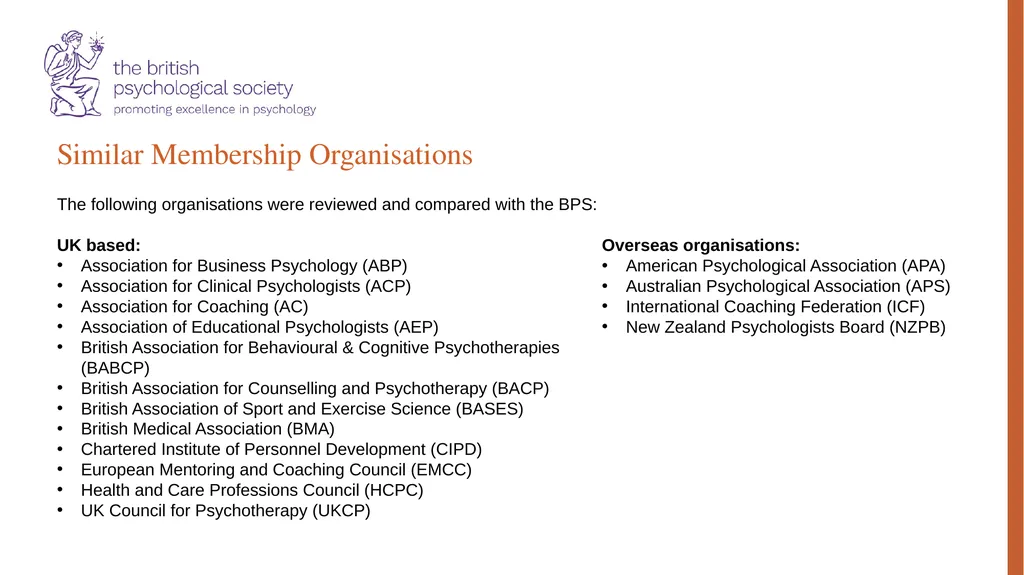
The following organisations were reviewed and compared with the BPS:
UK based:
Association for Business Psychology (ABP)
Association for Clinical Psychologists (ACP)
Association for Coaching (AC)
Association of Educational Psychologists (AEP)
British Association for Behavioural & Cognitive Psychotherapies (BABCP)
British Association for Counselling and Psychotherapy (BACP)
British Association of Sport and Exercise Science (BASES)
British Medical Association (BMA)
Chartered Institute of Personnel Development (CIPD)
European Mentoring and Coaching Council (EMCC)
Health and Care Professions Council (HCPC)
UK Council for Psychotherapy (UKCP) Overseas organisations:
American Psychological Association (APA)
Australian Psychological Association (APS)
International Coaching Federation (ICF)
New Zealand Psychologists Board (NZPB)<br>
The following organisations were reviewed and compared with the BPS:
UK based:
Association for Business Psychology (ABP)
Association for Clinical Psychologists (ACP)
Association for Coaching (AC)
Association of Educational Psychologists (AEP)
British Association for Behavioural & Cognitive Psychotherapies (BABCP)
British Association for Counselling and Psychotherapy (BACP)
British Association of Sport and Exercise Science (BASES)
British Medical Association (BMA)
Chartered Institute of Personnel Development (CIPD)
European Mentoring and Coaching Council (EMCC)
Health and Care Professions Council (HCPC)
UK Council for Psychotherapy (UKCP) Overseas organisations:
American Psychological Association (APA)
Australian Psychological Association (APS)
International Coaching Federation (ICF)
New Zealand Psychologists Board (NZPB)<br>
04
UK based organisations<br>
05
BPS
Background: Their ‘Special Group for Independent Practitioners’ exists specifically for IPs, with the purpose of being a truly cross-divisional/ domain body to support, represent, advocate for and promote the advancement of the interests of the growing body of IPs within the BPS.
What resources do they offer IPs? Advice, guidance and support; Peer Practice Hubs; CPD workshops, webinars (four core areas); dedicated email list, acting as a discussion group; cashflow template; opportunity to engage with or be involved with committee; e-newsletter.
What topics do the resources cover and in what format? Topics include pricing (Competition Law), providing effective therapy via video, setting up safely in IP (insurance, supervision, payment, safeguarding, fees, policies), webinar topics include marketing, social media, setting up, and growing and closing an IP business. The resources are presented digitally (webinars), via BPS’ website.
What is the cost to access these resources? £10 per year full membership, £5 per year affiliate membership.
How do they advertise their offering? SGIP webpage on the BPS website, dedicated to the network, plus member e-newsletter.
How easy/difficult was it to find their offering? It is not obvious from BPS' homepage that the SGIP exists. If you know it exists and/or are exploring BPS' member network offering, it is easier to find information on SGIP. Via the ‘Networks & communities' section of the website, the special groups, including SGIP, are easily found. Via the search function on the website, by entering 'independent practitioner’, some resources and the group can be found. On the SGIP webpage itself, there is a clear tab labelled ‘resources’. The SGIP would be better advertised if featured on BPS' homepage. However, other member networks are likely to also want this, ultimately competing for space.
Additional Comments: BPS are the only professional body to define what an IP is – The term Psychologist in IP encompasses all Chartered and, where appropriate, HCPC registered members of the BPS who 1) provide psychological services across a full range of applied psychology, 2) work in any context of practice, 3) operate as either self-employed, Director of their own Ltd company, a Business Partner, or a member of a Cooperative whereby psychological services are their main form of employment, and 4) follow necessary code of conducts/guidelines. Website: Special Group for Independent Practitioners | BPS<br>
Background: Their ‘Special Group for Independent Practitioners’ exists specifically for IPs, with the purpose of being a truly cross-divisional/ domain body to support, represent, advocate for and promote the advancement of the interests of the growing body of IPs within the BPS.
What resources do they offer IPs? Advice, guidance and support; Peer Practice Hubs; CPD workshops, webinars (four core areas); dedicated email list, acting as a discussion group; cashflow template; opportunity to engage with or be involved with committee; e-newsletter.
What topics do the resources cover and in what format? Topics include pricing (Competition Law), providing effective therapy via video, setting up safely in IP (insurance, supervision, payment, safeguarding, fees, policies), webinar topics include marketing, social media, setting up, and growing and closing an IP business. The resources are presented digitally (webinars), via BPS’ website.
What is the cost to access these resources? £10 per year full membership, £5 per year affiliate membership.
How do they advertise their offering? SGIP webpage on the BPS website, dedicated to the network, plus member e-newsletter.
How easy/difficult was it to find their offering? It is not obvious from BPS' homepage that the SGIP exists. If you know it exists and/or are exploring BPS' member network offering, it is easier to find information on SGIP. Via the ‘Networks & communities' section of the website, the special groups, including SGIP, are easily found. Via the search function on the website, by entering 'independent practitioner’, some resources and the group can be found. On the SGIP webpage itself, there is a clear tab labelled ‘resources’. The SGIP would be better advertised if featured on BPS' homepage. However, other member networks are likely to also want this, ultimately competing for space.
Additional Comments: BPS are the only professional body to define what an IP is – The term Psychologist in IP encompasses all Chartered and, where appropriate, HCPC registered members of the BPS who 1) provide psychological services across a full range of applied psychology, 2) work in any context of practice, 3) operate as either self-employed, Director of their own Ltd company, a Business Partner, or a member of a Cooperative whereby psychological services are their main form of employment, and 4) follow necessary code of conducts/guidelines. Website: Special Group for Independent Practitioners | BPS<br>
06
Association for Business Psychology (ABP)
Website: Member Benefits - ABP
Background: The ABP aspires to be the home and voice of business psychology for those who have an interest in and respect for psychology at work. The ABP are a community of practitioners, not just specifically IPs.
What resources do they offer IPs? Networking opportunities with ‘an eclectic mix of highly experienced IPs’ and other members. However, it is not clear on their website what specific resources are available for IPs. There is not a specific section for IPs on the website, nor a search function to find specifics.
What topics do the resources cover and in what format? N/A
What is the cost to access these resources? Unknown
How do they advertise their offering? N/A
How easy/difficult was it to find their offering? Apart from a mention of the networking offering (not specific to IPs), not able to find any IP specific information. There is not a search function to dig in more detail on the website.<br>
Website: Member Benefits - ABP
Background: The ABP aspires to be the home and voice of business psychology for those who have an interest in and respect for psychology at work. The ABP are a community of practitioners, not just specifically IPs.
What resources do they offer IPs? Networking opportunities with ‘an eclectic mix of highly experienced IPs’ and other members. However, it is not clear on their website what specific resources are available for IPs. There is not a specific section for IPs on the website, nor a search function to find specifics.
What topics do the resources cover and in what format? N/A
What is the cost to access these resources? Unknown
How do they advertise their offering? N/A
How easy/difficult was it to find their offering? Apart from a mention of the networking offering (not specific to IPs), not able to find any IP specific information. There is not a search function to dig in more detail on the website.<br>
07
Association for Clinical Psychologists (ACP)
Background: The ACP reference themselves as a national voice for clinical psychologists who seek to promote the profession and its members. Their ‘Independent Practice Network’ exists specifically for IPs, with the purpose of providing support and collaboration, in addition to inspiration and guidance for those in independent practice or aspiring to be.
What resources do they offer IPs? An opportunity to be actively engaged in steering/contributing to the work of the network, led by an Advisory Group of IPs, in addition to webinar(s), such as ‘setting up in independent practice’ (this is the only webinar that appears to be specifically designed for IPs).
What topics do the resources cover and in what format? The ‘setting up in independent practice’ webinar includes five topic areas: picking your specialism; creating and protecting your brand; understanding the laws you need to comply with and the legal paperwork you need to put in place; fees; and building your network. The resources are presented digitally (webinar), later available as a recording.
What is the cost to access these resources? £30 to access the webinar on ‘setting up in independent practice’. It is not clear if it costs extra to join their specific Member Network for IPs – presumably, this is included in the overall ACP membership fee.
How do they advertise their offering? Website page dedicated to the network. The Network don’t appear to have their specific social media pages but advertise their offering through the wider ACP-UK platforms like their LinkedIn.
How easy/difficult was it to find their offering? Via the 'Member Networks' section of the website, 'The Independent Practitioner Network' is easily found, though the Network webpage does not directly link to any resources. It is clear on the main ‘Member Networks’ page who the lead for this network is and their contact email. Via the search function on the website, by entering 'independent practitioner', the webinar offering can be found, as well as on the ‘Past events and webinars’ section of their website. Website: The Independent Practice Network<br>
Background: The ACP reference themselves as a national voice for clinical psychologists who seek to promote the profession and its members. Their ‘Independent Practice Network’ exists specifically for IPs, with the purpose of providing support and collaboration, in addition to inspiration and guidance for those in independent practice or aspiring to be.
What resources do they offer IPs? An opportunity to be actively engaged in steering/contributing to the work of the network, led by an Advisory Group of IPs, in addition to webinar(s), such as ‘setting up in independent practice’ (this is the only webinar that appears to be specifically designed for IPs).
What topics do the resources cover and in what format? The ‘setting up in independent practice’ webinar includes five topic areas: picking your specialism; creating and protecting your brand; understanding the laws you need to comply with and the legal paperwork you need to put in place; fees; and building your network. The resources are presented digitally (webinar), later available as a recording.
What is the cost to access these resources? £30 to access the webinar on ‘setting up in independent practice’. It is not clear if it costs extra to join their specific Member Network for IPs – presumably, this is included in the overall ACP membership fee.
How do they advertise their offering? Website page dedicated to the network. The Network don’t appear to have their specific social media pages but advertise their offering through the wider ACP-UK platforms like their LinkedIn.
How easy/difficult was it to find their offering? Via the 'Member Networks' section of the website, 'The Independent Practitioner Network' is easily found, though the Network webpage does not directly link to any resources. It is clear on the main ‘Member Networks’ page who the lead for this network is and their contact email. Via the search function on the website, by entering 'independent practitioner', the webinar offering can be found, as well as on the ‘Past events and webinars’ section of their website. Website: The Independent Practice Network<br>
08
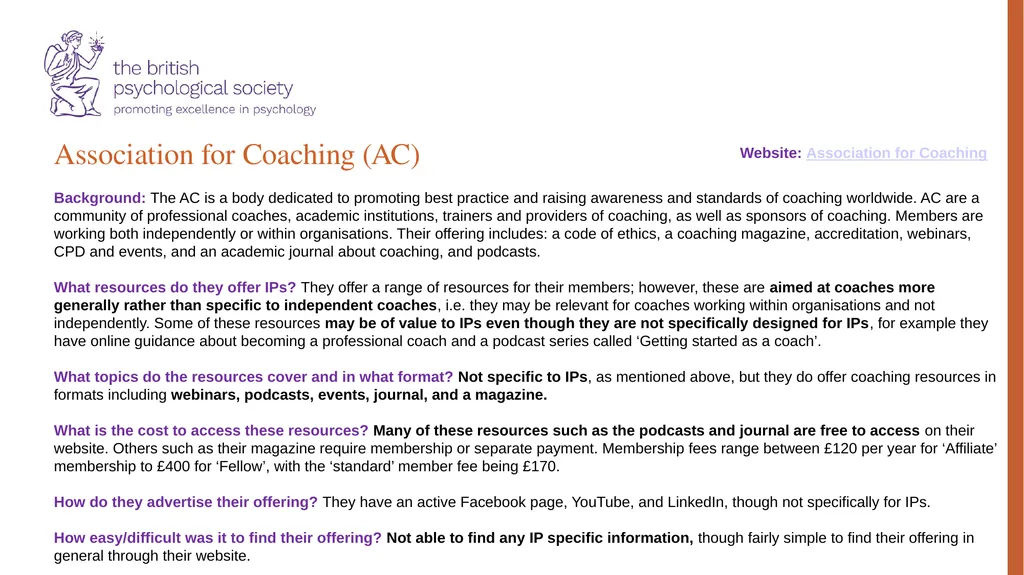
Association for Coaching (AC)
Background: The AC is a body dedicated to promoting best practice and raising awareness and standards of coaching worldwide. AC are a community of professional coaches, academic institutions, trainers and providers of coaching, as well as sponsors of coaching. Members are working both independently or within organisations. Their offering includes: a code of ethics, a coaching magazine, accreditation, webinars, CPD and events, and an academic journal about coaching, and podcasts.
What resources do they offer IPs? They offer a range of resources for their members; however, these are aimed at coaches more generally rather than specific to independent coaches, i.e. they may be relevant for coaches working within organisations and not independently. Some of these resources may be of value to IPs even though they are not specifically designed for IPs, for example they have online guidance about becoming a professional coach and a podcast series called ‘Getting started as a coach’.
What topics do the resources cover and in what format? Not specific to IPs, as mentioned above, but they do offer coaching resources in formats including webinars, podcasts, events, journal, and a magazine.
What is the cost to access these resources? Many of these resources such as the podcasts and journal are free to access on their website. Others such as their magazine require membership or separate payment. Membership fees range between £120 per year for ‘Affiliate’ membership to £400 for ‘Fellow’, with the ‘standard’ member fee being £170.
How do they advertise their offering? They have an active Facebook page, YouTube, and LinkedIn, though not specifically for IPs.
How easy/difficult was it to find their offering? Not able to find any IP specific information, though fairly simple to find their offering in general through their website. Website: Association for Coaching<br>
Background: The AC is a body dedicated to promoting best practice and raising awareness and standards of coaching worldwide. AC are a community of professional coaches, academic institutions, trainers and providers of coaching, as well as sponsors of coaching. Members are working both independently or within organisations. Their offering includes: a code of ethics, a coaching magazine, accreditation, webinars, CPD and events, and an academic journal about coaching, and podcasts.
What resources do they offer IPs? They offer a range of resources for their members; however, these are aimed at coaches more generally rather than specific to independent coaches, i.e. they may be relevant for coaches working within organisations and not independently. Some of these resources may be of value to IPs even though they are not specifically designed for IPs, for example they have online guidance about becoming a professional coach and a podcast series called ‘Getting started as a coach’.
What topics do the resources cover and in what format? Not specific to IPs, as mentioned above, but they do offer coaching resources in formats including webinars, podcasts, events, journal, and a magazine.
What is the cost to access these resources? Many of these resources such as the podcasts and journal are free to access on their website. Others such as their magazine require membership or separate payment. Membership fees range between £120 per year for ‘Affiliate’ membership to £400 for ‘Fellow’, with the ‘standard’ member fee being £170.
How do they advertise their offering? They have an active Facebook page, YouTube, and LinkedIn, though not specifically for IPs.
How easy/difficult was it to find their offering? Not able to find any IP specific information, though fairly simple to find their offering in general through their website. Website: Association for Coaching<br>
09
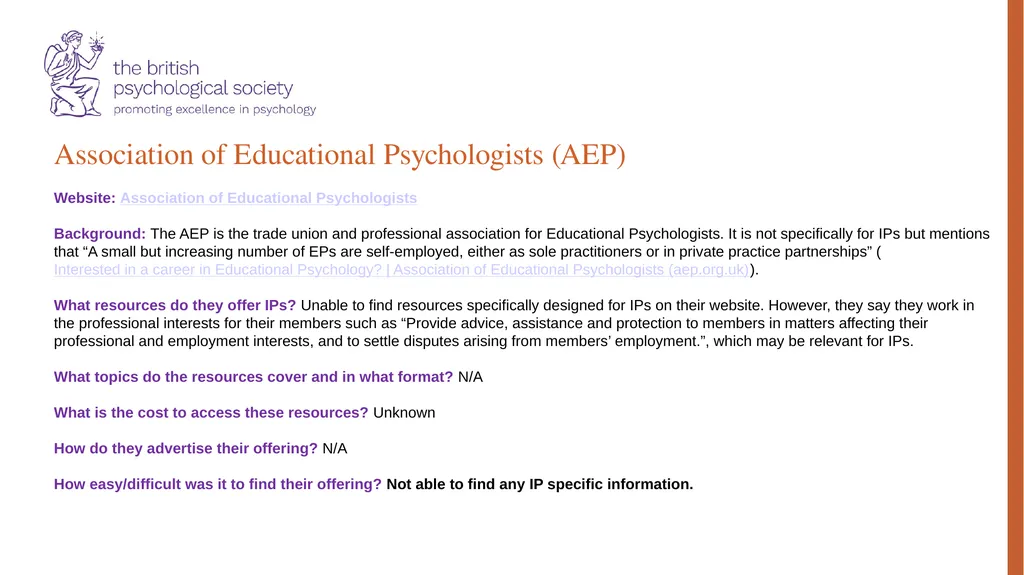
Association of Educational Psychologists (AEP)
Website: Association of Educational Psychologists
Background: The AEP is the trade union and professional association for Educational Psychologists. It is not specifically for IPs but mentions that “A small but increasing number of EPs are self-employed, either as sole practitioners or in private practice partnerships” (Interested in a career in Educational Psychology? | Association of Educational Psychologists (aep.org.uk)).
What resources do they offer IPs? Unable to find resources specifically designed for IPs on their website. However, they say they work in the professional interests for their members such as “Provide advice, assistance and protection to members in matters affecting their professional and employment interests, and to settle disputes arising from members’ employment.”, which may be relevant for IPs.
What topics do the resources cover and in what format? N/A
What is the cost to access these resources? Unknown
How do they advertise their offering? N/A
How easy/difficult was it to find their offering? Not able to find any IP specific information.<br>
Website: Association of Educational Psychologists
Background: The AEP is the trade union and professional association for Educational Psychologists. It is not specifically for IPs but mentions that “A small but increasing number of EPs are self-employed, either as sole practitioners or in private practice partnerships” (Interested in a career in Educational Psychology? | Association of Educational Psychologists (aep.org.uk)).
What resources do they offer IPs? Unable to find resources specifically designed for IPs on their website. However, they say they work in the professional interests for their members such as “Provide advice, assistance and protection to members in matters affecting their professional and employment interests, and to settle disputes arising from members’ employment.”, which may be relevant for IPs.
What topics do the resources cover and in what format? N/A
What is the cost to access these resources? Unknown
How do they advertise their offering? N/A
How easy/difficult was it to find their offering? Not able to find any IP specific information.<br>
10
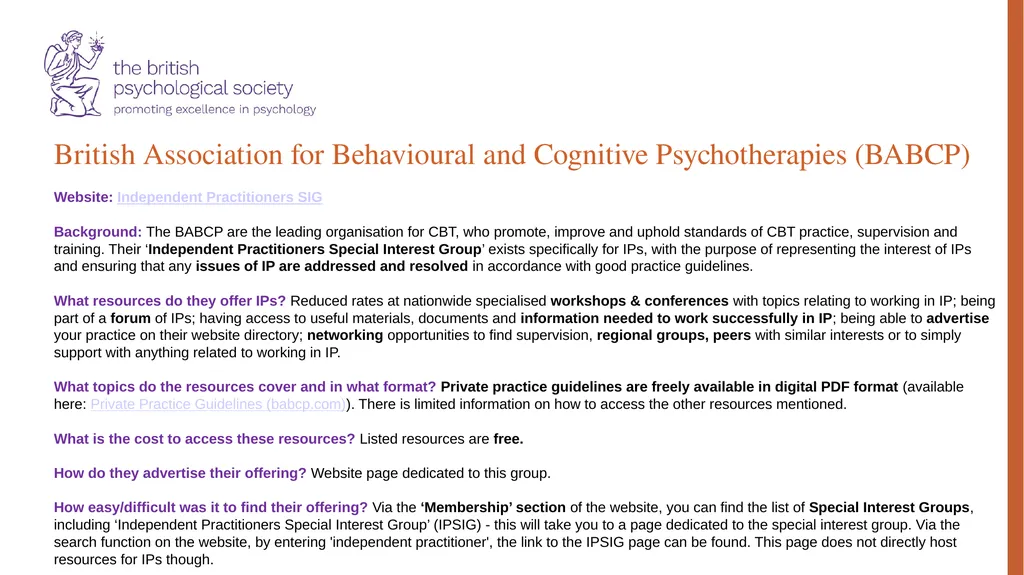
British Association for Behavioural and Cognitive Psychotherapies (BABCP)
Website: Independent Practitioners SIG
Background: The BABCP are the leading organisation for CBT, who promote, improve and uphold standards of CBT practice, supervision and training. Their ‘Independent Practitioners Special Interest Group’ exists specifically for IPs, with the purpose of representing the interest of IPs and ensuring that any issues of IP are addressed and resolved in accordance with good practice guidelines.
What resources do they offer IPs? Reduced rates at nationwide specialised workshops & conferences with topics relating to working in IP; being part of a forum of IPs; having access to useful materials, documents and information needed to work successfully in IP; being able to advertise your practice on their website directory; networking opportunities to find supervision, regional groups, peers with similar interests or to simply support with anything related to working in IP.
What topics do the resources cover and in what format? Private practice guidelines are freely available in digital PDF format (available here: Private Practice Guidelines (babcp.com)). There is limited information on how to access the other resources mentioned.
What is the cost to access these resources? Listed resources are free.
How do they advertise their offering? Website page dedicated to this group.
How easy/difficult was it to find their offering? Via the ‘Membership’ section of the website, you can find the list of Special Interest Groups, including ‘Independent Practitioners Special Interest Group’ (IPSIG) - this will take you to a page dedicated to the special interest group. Via the search function on the website, by entering 'independent practitioner', the link to the IPSIG page can be found. This page does not directly host resources for IPs though.<br>
Website: Independent Practitioners SIG
Background: The BABCP are the leading organisation for CBT, who promote, improve and uphold standards of CBT practice, supervision and training. Their ‘Independent Practitioners Special Interest Group’ exists specifically for IPs, with the purpose of representing the interest of IPs and ensuring that any issues of IP are addressed and resolved in accordance with good practice guidelines.
What resources do they offer IPs? Reduced rates at nationwide specialised workshops & conferences with topics relating to working in IP; being part of a forum of IPs; having access to useful materials, documents and information needed to work successfully in IP; being able to advertise your practice on their website directory; networking opportunities to find supervision, regional groups, peers with similar interests or to simply support with anything related to working in IP.
What topics do the resources cover and in what format? Private practice guidelines are freely available in digital PDF format (available here: Private Practice Guidelines (babcp.com)). There is limited information on how to access the other resources mentioned.
What is the cost to access these resources? Listed resources are free.
How do they advertise their offering? Website page dedicated to this group.
How easy/difficult was it to find their offering? Via the ‘Membership’ section of the website, you can find the list of Special Interest Groups, including ‘Independent Practitioners Special Interest Group’ (IPSIG) - this will take you to a page dedicated to the special interest group. Via the search function on the website, by entering 'independent practitioner', the link to the IPSIG page can be found. This page does not directly host resources for IPs though.<br>
11
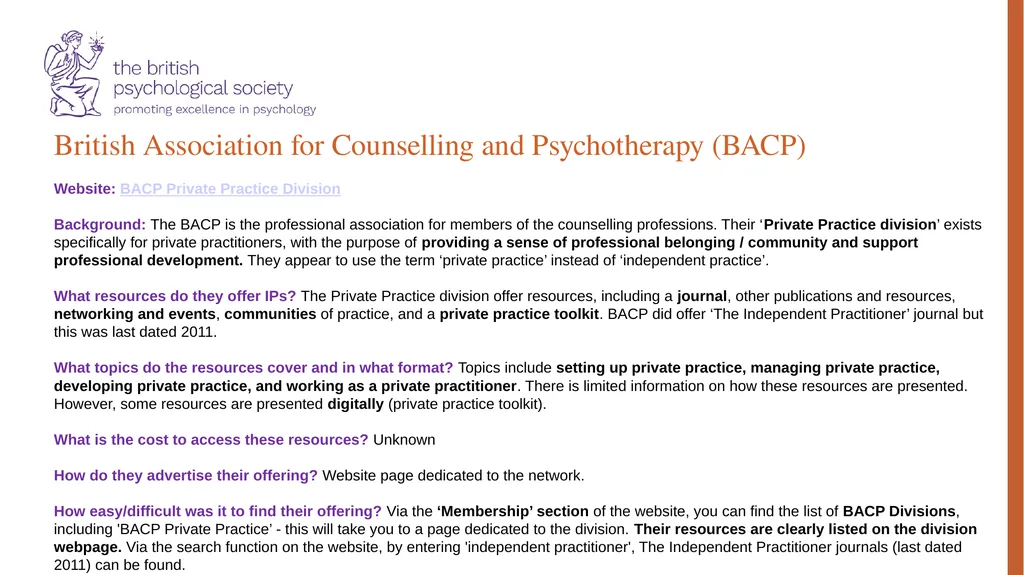
British Association for Counselling and Psychotherapy (BACP)
Website: BACP Private Practice Division
Background: The BACP is the professional association for members of the counselling professions. Their ‘Private Practice division’ exists specifically for private practitioners, with the purpose of providing a sense of professional belonging / community and support professional development. They appear to use the term ‘private practice’ instead of ‘independent practice’.
What resources do they offer IPs? The Private Practice division offer resources, including a journal, other publications and resources, networking and events, communities of practice, and a private practice toolkit. BACP did offer ‘The Independent Practitioner’ journal but this was last dated 2011.
What topics do the resources cover and in what format? Topics include setting up private practice, managing private practice, developing private practice, and working as a private practitioner. There is limited information on how these resources are presented. However, some resources are presented digitally (private practice toolkit).
What is the cost to access these resources? Unknown
How do they advertise their offering? Website page dedicated to the network.
How easy/difficult was it to find their offering? Via the ‘Membership’ section of the website, you can find the list of BACP Divisions, including 'BACP Private Practice’ - this will take you to a page dedicated to the division. Their resources are clearly listed on the division webpage. Via the search function on the website, by entering 'independent practitioner', The Independent Practitioner journals (last dated 2011) can be found.<br>
Website: BACP Private Practice Division
Background: The BACP is the professional association for members of the counselling professions. Their ‘Private Practice division’ exists specifically for private practitioners, with the purpose of providing a sense of professional belonging / community and support professional development. They appear to use the term ‘private practice’ instead of ‘independent practice’.
What resources do they offer IPs? The Private Practice division offer resources, including a journal, other publications and resources, networking and events, communities of practice, and a private practice toolkit. BACP did offer ‘The Independent Practitioner’ journal but this was last dated 2011.
What topics do the resources cover and in what format? Topics include setting up private practice, managing private practice, developing private practice, and working as a private practitioner. There is limited information on how these resources are presented. However, some resources are presented digitally (private practice toolkit).
What is the cost to access these resources? Unknown
How do they advertise their offering? Website page dedicated to the network.
How easy/difficult was it to find their offering? Via the ‘Membership’ section of the website, you can find the list of BACP Divisions, including 'BACP Private Practice’ - this will take you to a page dedicated to the division. Their resources are clearly listed on the division webpage. Via the search function on the website, by entering 'independent practitioner', The Independent Practitioner journals (last dated 2011) can be found.<br>
12
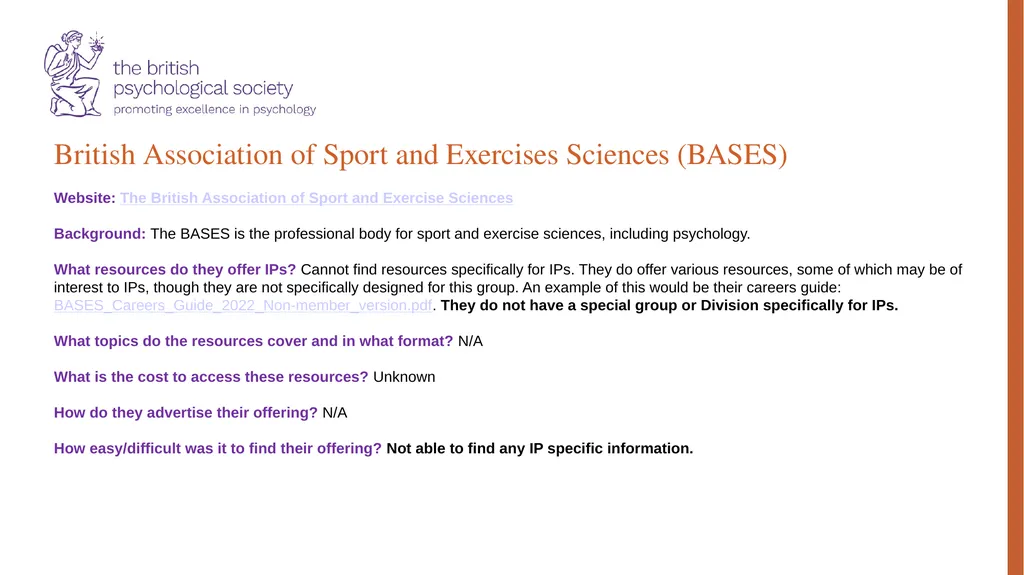
British Association of Sport and Exercises Sciences (BASES)
Website: The British Association of Sport and Exercise Sciences
Background: The BASES is the professional body for sport and exercise sciences, including psychology.
What resources do they offer IPs? Cannot find resources specifically for IPs. They do offer various resources, some of which may be of interest to IPs, though they are not specifically designed for this group. An example of this would be their careers guide: BASES_Careers_Guide_2022_Non-member_version.pdf. They do not have a special group or Division specifically for IPs.
What topics do the resources cover and in what format? N/A
What is the cost to access these resources? Unknown
How do they advertise their offering? N/A
How easy/difficult was it to find their offering? Not able to find any IP specific information.<br>
Website: The British Association of Sport and Exercise Sciences
Background: The BASES is the professional body for sport and exercise sciences, including psychology.
What resources do they offer IPs? Cannot find resources specifically for IPs. They do offer various resources, some of which may be of interest to IPs, though they are not specifically designed for this group. An example of this would be their careers guide: BASES_Careers_Guide_2022_Non-member_version.pdf. They do not have a special group or Division specifically for IPs.
What topics do the resources cover and in what format? N/A
What is the cost to access these resources? Unknown
How do they advertise their offering? N/A
How easy/difficult was it to find their offering? Not able to find any IP specific information.<br>
13
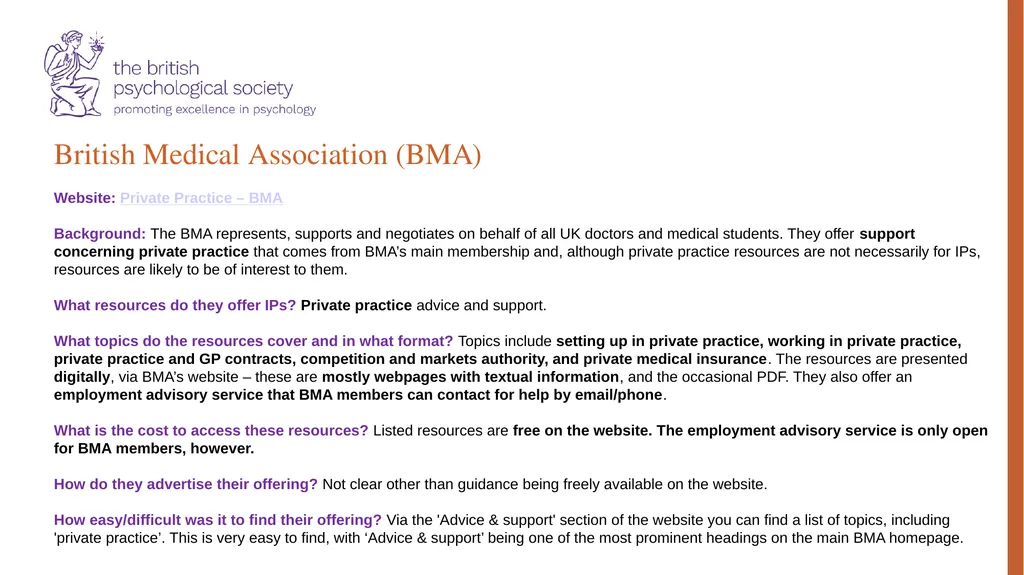
British Medical Association (BMA)
Website: Private Practice – BMA
Background: The BMA represents, supports and negotiates on behalf of all UK doctors and medical students. They offer support concerning private practice that comes from BMA’s main membership and, although private practice resources are not necessarily for IPs, resources are likely to be of interest to them.
What resources do they offer IPs? Private practice advice and support.
What topics do the resources cover and in what format? Topics include setting up in private practice, working in private practice, private practice and GP contracts, competition and markets authority, and private medical insurance. The resources are presented digitally, via BMA’s website – these are mostly webpages with textual information, and the occasional PDF. They also offer an employment advisory service that BMA members can contact for help by email/phone.
What is the cost to access these resources? Listed resources are free on the website. The employment advisory service is only open for BMA members, however.
How do they advertise their offering? Not clear other than guidance being freely available on the website.
How easy/difficult was it to find their offering? Via the 'Advice & support' section of the website you can find a list of topics, including 'private practice’. This is very easy to find, with ‘Advice & support’ being one of the most prominent headings on the main BMA homepage.<br>
Website: Private Practice – BMA
Background: The BMA represents, supports and negotiates on behalf of all UK doctors and medical students. They offer support concerning private practice that comes from BMA’s main membership and, although private practice resources are not necessarily for IPs, resources are likely to be of interest to them.
What resources do they offer IPs? Private practice advice and support.
What topics do the resources cover and in what format? Topics include setting up in private practice, working in private practice, private practice and GP contracts, competition and markets authority, and private medical insurance. The resources are presented digitally, via BMA’s website – these are mostly webpages with textual information, and the occasional PDF. They also offer an employment advisory service that BMA members can contact for help by email/phone.
What is the cost to access these resources? Listed resources are free on the website. The employment advisory service is only open for BMA members, however.
How do they advertise their offering? Not clear other than guidance being freely available on the website.
How easy/difficult was it to find their offering? Via the 'Advice & support' section of the website you can find a list of topics, including 'private practice’. This is very easy to find, with ‘Advice & support’ being one of the most prominent headings on the main BMA homepage.<br>
14
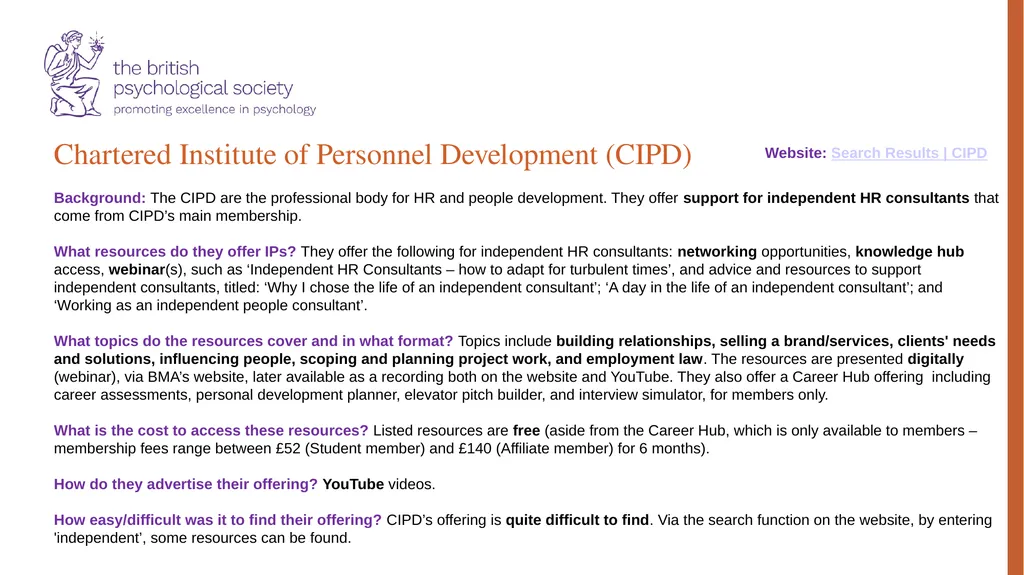
Chartered Institute of Personnel Development (CIPD)
Background: The CIPD are the professional body for HR and people development. They offer support for independent HR consultants that come from CIPD’s main membership.
What resources do they offer IPs? They offer the following for independent HR consultants: networking opportunities, knowledge hub access, webinar(s), such as ‘Independent HR Consultants – how to adapt for turbulent times’, and advice and resources to support independent consultants, titled: ‘Why I chose the life of an independent consultant’; ‘A day in the life of an independent consultant’; and ‘Working as an independent people consultant’.
What topics do the resources cover and in what format? Topics include building relationships, selling a brand/services, clients' needs and solutions, influencing people, scoping and planning project work, and employment law. The resources are presented digitally (webinar), via BMA’s website, later available as a recording both on the website and YouTube. They also offer a Career Hub offering including career assessments, personal development planner, elevator pitch builder, and interview simulator, for members only.
What is the cost to access these resources? Listed resources are free (aside from the Career Hub, which is only available to members – membership fees range between £52 (Student member) and £140 (Affiliate member) for 6 months).
How do they advertise their offering? YouTube videos.
How easy/difficult was it to find their offering? CIPD’s offering is quite difficult to find. Via the search function on the website, by entering 'independent’, some resources can be found. Website: Search Results | CIPD<br>
Background: The CIPD are the professional body for HR and people development. They offer support for independent HR consultants that come from CIPD’s main membership.
What resources do they offer IPs? They offer the following for independent HR consultants: networking opportunities, knowledge hub access, webinar(s), such as ‘Independent HR Consultants – how to adapt for turbulent times’, and advice and resources to support independent consultants, titled: ‘Why I chose the life of an independent consultant’; ‘A day in the life of an independent consultant’; and ‘Working as an independent people consultant’.
What topics do the resources cover and in what format? Topics include building relationships, selling a brand/services, clients' needs and solutions, influencing people, scoping and planning project work, and employment law. The resources are presented digitally (webinar), via BMA’s website, later available as a recording both on the website and YouTube. They also offer a Career Hub offering including career assessments, personal development planner, elevator pitch builder, and interview simulator, for members only.
What is the cost to access these resources? Listed resources are free (aside from the Career Hub, which is only available to members – membership fees range between £52 (Student member) and £140 (Affiliate member) for 6 months).
How do they advertise their offering? YouTube videos.
How easy/difficult was it to find their offering? CIPD’s offering is quite difficult to find. Via the search function on the website, by entering 'independent’, some resources can be found. Website: Search Results | CIPD<br>
15
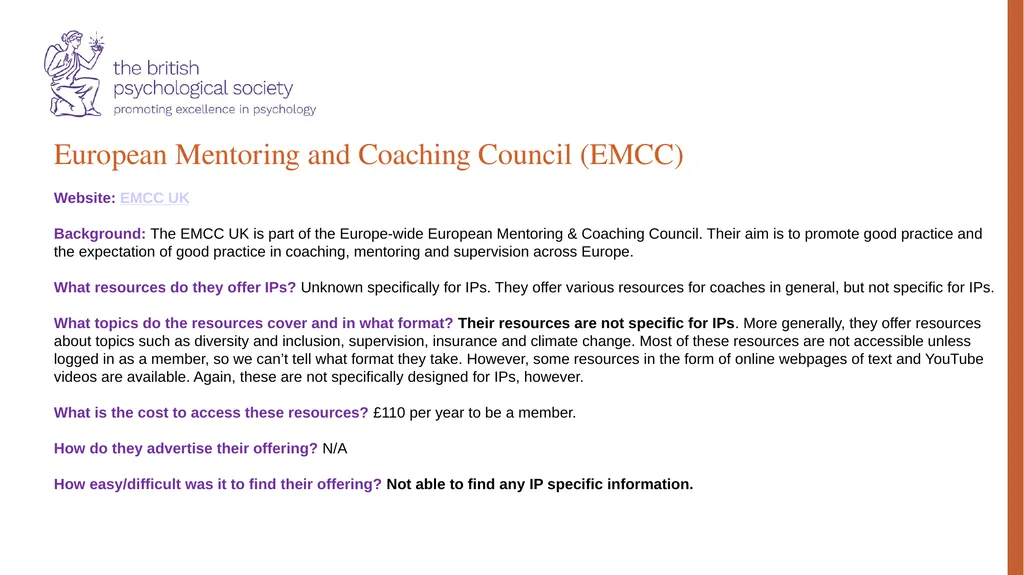
European Mentoring and Coaching Council (EMCC)
Website: EMCC UK
Background: The EMCC UK is part of the Europe-wide European Mentoring & Coaching Council. Their aim is to promote good practice and the expectation of good practice in coaching, mentoring and supervision across Europe.
What resources do they offer IPs? Unknown specifically for IPs. They offer various resources for coaches in general, but not specific for IPs.
What topics do the resources cover and in what format? Their resources are not specific for IPs. More generally, they offer resources about topics such as diversity and inclusion, supervision, insurance and climate change. Most of these resources are not accessible unless logged in as a member, so we can’t tell what format they take. However, some resources in the form of online webpages of text and YouTube videos are available. Again, these are not specifically designed for IPs, however.
What is the cost to access these resources? £110 per year to be a member.
How do they advertise their offering? N/A
How easy/difficult was it to find their offering? Not able to find any IP specific information.<br>
Website: EMCC UK
Background: The EMCC UK is part of the Europe-wide European Mentoring & Coaching Council. Their aim is to promote good practice and the expectation of good practice in coaching, mentoring and supervision across Europe.
What resources do they offer IPs? Unknown specifically for IPs. They offer various resources for coaches in general, but not specific for IPs.
What topics do the resources cover and in what format? Their resources are not specific for IPs. More generally, they offer resources about topics such as diversity and inclusion, supervision, insurance and climate change. Most of these resources are not accessible unless logged in as a member, so we can’t tell what format they take. However, some resources in the form of online webpages of text and YouTube videos are available. Again, these are not specifically designed for IPs, however.
What is the cost to access these resources? £110 per year to be a member.
How do they advertise their offering? N/A
How easy/difficult was it to find their offering? Not able to find any IP specific information.<br>
16
Health and Care Professions Council (HCPC)
Website: Site Search | HCPC
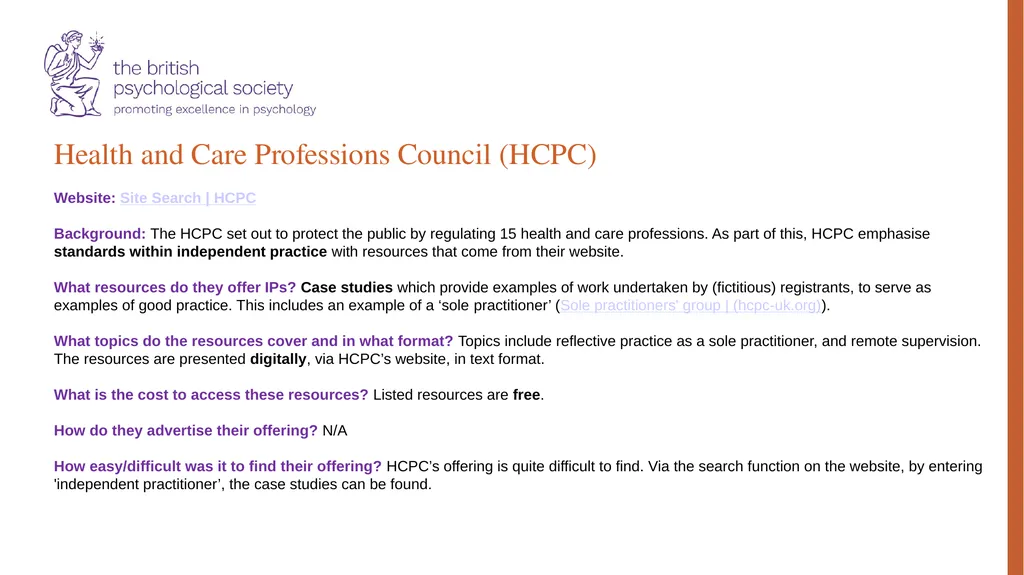
Background: The HCPC set out to protect the public by regulating 15 health and care professions. As part of this, HCPC emphasise standards within independent practice with resources that come from their website.
What resources do they offer IPs? Case studies which provide examples of work undertaken by (fictitious) registrants, to serve as examples of good practice. This includes an example of a ‘sole practitioner’ (Sole practitioners' group | (hcpc-uk.org)).
What topics do the resources cover and in what format? Topics include reflective practice as a sole practitioner, and remote supervision.
The resources are presented digitally, via HCPC’s website, in text format.
What is the cost to access these resources? Listed resources are free.
How do they advertise their offering? N/A
How easy/difficult was it to find their offering? HCPC’s offering is quite difficult to find. Via the search function on the website, by entering 'independent practitioner’, the case studies can be found.<br>
Website: Site Search | HCPC
Background: The HCPC set out to protect the public by regulating 15 health and care professions. As part of this, HCPC emphasise standards within independent practice with resources that come from their website.
What resources do they offer IPs? Case studies which provide examples of work undertaken by (fictitious) registrants, to serve as examples of good practice. This includes an example of a ‘sole practitioner’ (Sole practitioners' group | (hcpc-uk.org)).
What topics do the resources cover and in what format? Topics include reflective practice as a sole practitioner, and remote supervision.
The resources are presented digitally, via HCPC’s website, in text format.
What is the cost to access these resources? Listed resources are free.
How do they advertise their offering? N/A
How easy/difficult was it to find their offering? HCPC’s offering is quite difficult to find. Via the search function on the website, by entering 'independent practitioner’, the case studies can be found.<br>
17
UK Council for Psychotherapy (UKCP)
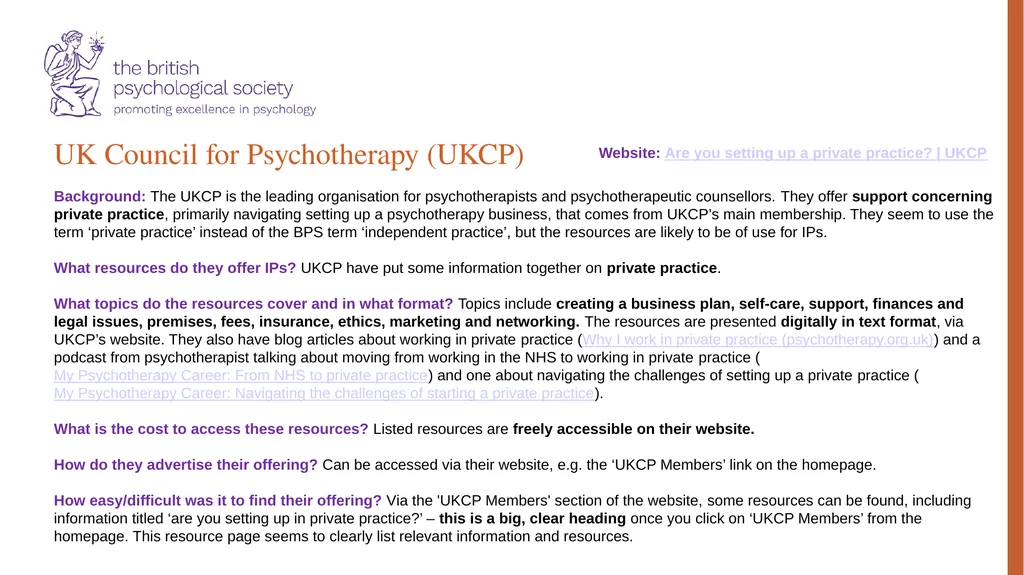
Background: The UKCP is the leading organisation for psychotherapists and psychotherapeutic counsellors. They offer support concerning private practice, primarily navigating setting up a psychotherapy business, that comes from UKCP’s main membership. They seem to use the term ‘private practice’ instead of the BPS term ‘independent practice’, but the resources are likely to be of use for IPs.
What resources do they offer IPs? UKCP have put some information together on private practice.
What topics do the resources cover and in what format? Topics include creating a business plan, self-care, support, finances and legal issues, premises, fees, insurance, ethics, marketing and networking. The resources are presented digitally in text format, via UKCP’s website. They also have blog articles about working in private practice (Why I work in private practice (psychotherapy.org.uk)) and a podcast from psychotherapist talking about moving from working in the NHS to working in private practice (My Psychotherapy Career: From NHS to private practice) and one about navigating the challenges of setting up a private practice (My Psychotherapy Career: Navigating the challenges of starting a private practice).
What is the cost to access these resources? Listed resources are freely accessible on their website.
How do they advertise their offering? Can be accessed via their website, e.g. the ‘UKCP Members’ link on the homepage.
How easy/difficult was it to find their offering? Via the 'UKCP Members' section of the website, some resources can be found, including information titled ‘are you setting up in private practice?’ – this is a big, clear heading once you click on ‘UKCP Members’ from the homepage. This resource page seems to clearly list relevant information and resources. Website: Are you setting up a private practice? | UKCP<br>
Background: The UKCP is the leading organisation for psychotherapists and psychotherapeutic counsellors. They offer support concerning private practice, primarily navigating setting up a psychotherapy business, that comes from UKCP’s main membership. They seem to use the term ‘private practice’ instead of the BPS term ‘independent practice’, but the resources are likely to be of use for IPs.
What resources do they offer IPs? UKCP have put some information together on private practice.
What topics do the resources cover and in what format? Topics include creating a business plan, self-care, support, finances and legal issues, premises, fees, insurance, ethics, marketing and networking. The resources are presented digitally in text format, via UKCP’s website. They also have blog articles about working in private practice (Why I work in private practice (psychotherapy.org.uk)) and a podcast from psychotherapist talking about moving from working in the NHS to working in private practice (My Psychotherapy Career: From NHS to private practice) and one about navigating the challenges of setting up a private practice (My Psychotherapy Career: Navigating the challenges of starting a private practice).
What is the cost to access these resources? Listed resources are freely accessible on their website.
How do they advertise their offering? Can be accessed via their website, e.g. the ‘UKCP Members’ link on the homepage.
How easy/difficult was it to find their offering? Via the 'UKCP Members' section of the website, some resources can be found, including information titled ‘are you setting up in private practice?’ – this is a big, clear heading once you click on ‘UKCP Members’ from the homepage. This resource page seems to clearly list relevant information and resources. Website: Are you setting up a private practice? | UKCP<br>
18
Overseas organisations<br>
19
American Psychological Association (APA)
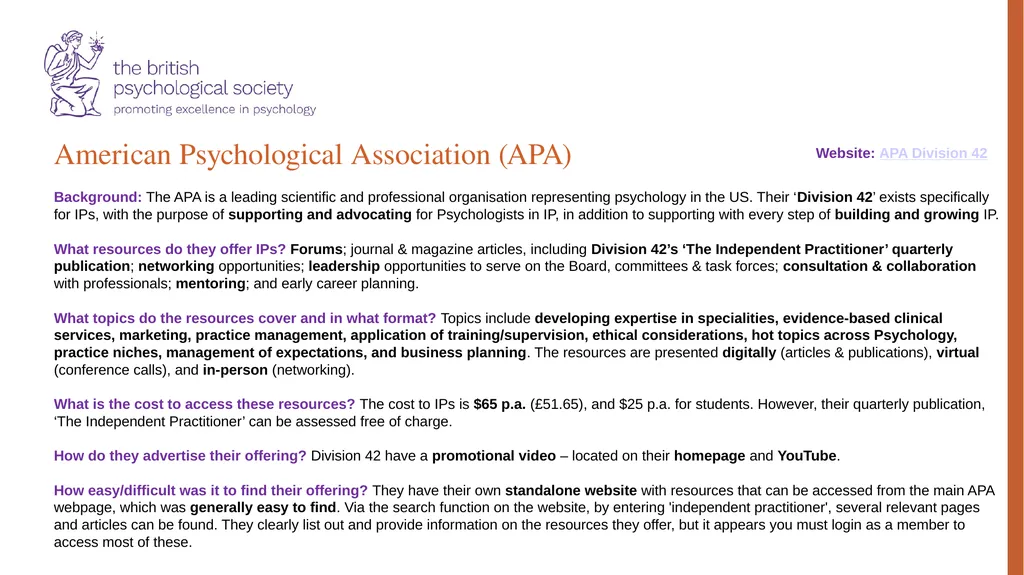
Background: The APA is a leading scientific and professional organisation representing psychology in the US. Their ‘Division 42’ exists specifically for IPs, with the purpose of supporting and advocating for Psychologists in IP, in addition to supporting with every step of building and growing IP.
What resources do they offer IPs? Forums; journal & magazine articles, including Division 42’s ‘The Independent Practitioner’ quarterly publication; networking opportunities; leadership opportunities to serve on the Board, committees & task forces; consultation & collaboration with professionals; mentoring; and early career planning.
What topics do the resources cover and in what format? Topics include developing expertise in specialities, evidence-based clinical services, marketing, practice management, application of training/supervision, ethical considerations, hot topics across Psychology, practice niches, management of expectations, and business planning. The resources are presented digitally (articles & publications), virtual (conference calls), and in-person (networking).
What is the cost to access these resources? The cost to IPs is $65 p.a. (£51.65), and $25 p.a. for students. However, their quarterly publication, ‘The Independent Practitioner’ can be assessed free of charge.
How do they advertise their offering? Division 42 have a promotional video – located on their homepage and YouTube.
How easy/difficult was it to find their offering? They have their own standalone website with resources that can be accessed from the main APA webpage, which was generally easy to find. Via the search function on the website, by entering 'independent practitioner', several relevant pages and articles can be found. They clearly list out and provide information on the resources they offer, but it appears you must login as a member to access most of these. Website: APA Division 42<br>
Background: The APA is a leading scientific and professional organisation representing psychology in the US. Their ‘Division 42’ exists specifically for IPs, with the purpose of supporting and advocating for Psychologists in IP, in addition to supporting with every step of building and growing IP.
What resources do they offer IPs? Forums; journal & magazine articles, including Division 42’s ‘The Independent Practitioner’ quarterly publication; networking opportunities; leadership opportunities to serve on the Board, committees & task forces; consultation & collaboration with professionals; mentoring; and early career planning.
What topics do the resources cover and in what format? Topics include developing expertise in specialities, evidence-based clinical services, marketing, practice management, application of training/supervision, ethical considerations, hot topics across Psychology, practice niches, management of expectations, and business planning. The resources are presented digitally (articles & publications), virtual (conference calls), and in-person (networking).
What is the cost to access these resources? The cost to IPs is $65 p.a. (£51.65), and $25 p.a. for students. However, their quarterly publication, ‘The Independent Practitioner’ can be assessed free of charge.
How do they advertise their offering? Division 42 have a promotional video – located on their homepage and YouTube.
How easy/difficult was it to find their offering? They have their own standalone website with resources that can be accessed from the main APA webpage, which was generally easy to find. Via the search function on the website, by entering 'independent practitioner', several relevant pages and articles can be found. They clearly list out and provide information on the resources they offer, but it appears you must login as a member to access most of these. Website: APA Division 42<br>
20
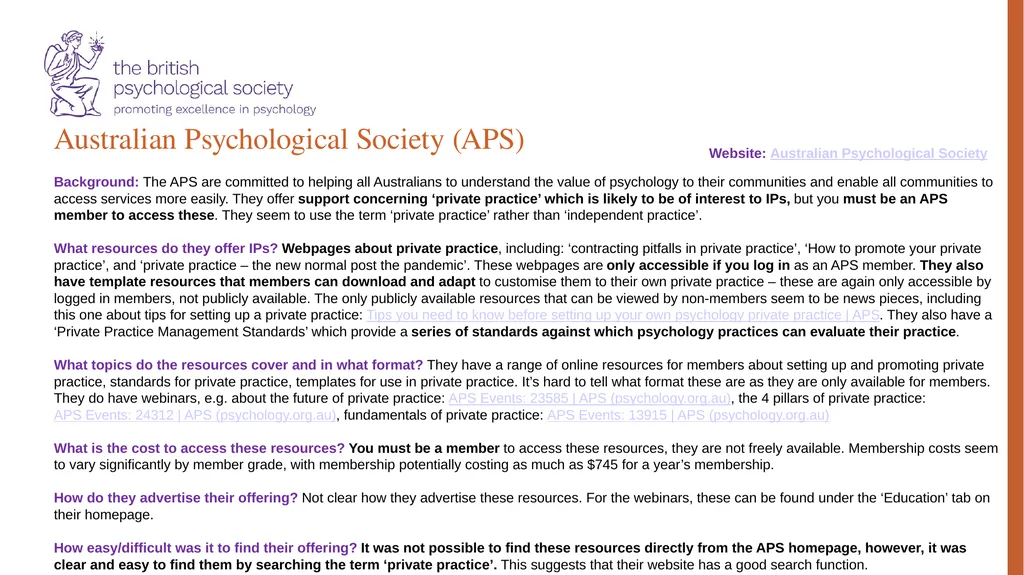
Australian Psychological Society (APS)
Background: The APS are committed to helping all Australians to understand the value of psychology to their communities and enable all communities to access services more easily. They offer support concerning ‘private practice’ which is likely to be of interest to IPs, but you must be an APS member to access these. They seem to use the term ‘private practice’ rather than ‘independent practice’.
What resources do they offer IPs? Webpages about private practice, including: ‘contracting pitfalls in private practice’, ‘How to promote your private practice’, and ‘private practice – the new normal post the pandemic’. These webpages are only accessible if you log in as an APS member. They also have template resources that members can download and adapt to customise them to their own private practice – these are again only accessible by logged in members, not publicly available. The only publicly available resources that can be viewed by non-members seem to be news pieces, including this one about tips for setting up a private practice: Tips you need to know before setting up your own psychology private practice | APS. They also have a ‘Private Practice Management Standards’ which provide a series of standards against which psychology practices can evaluate their practice.
What topics do the resources cover and in what format? They have a range of online resources for members about setting up and promoting private practice, standards for private practice, templates for use in private practice. It’s hard to tell what format these are as they are only available for members. They do have webinars, e.g. about the future of private practice: APS Events: 23585 | APS (psychology.org.au), the 4 pillars of private practice: APS Events: 24312 | APS (psychology.org.au), fundamentals of private practice: APS Events: 13915 | APS (psychology.org.au)
What is the cost to access these resources? You must be a member to access these resources, they are not freely available. Membership costs seem to vary significantly by member grade, with membership potentially costing as much as $745 for a year’s membership.
How do they advertise their offering? Not clear how they advertise these resources. For the webinars, these can be found under the ‘Education’ tab on their homepage.
How easy/difficult was it to find their offering? It was not possible to find these resources directly from the APS homepage, however, it was clear and easy to find them by searching the term ‘private practice’. This suggests that their website has a good search function. Website: Australian Psychological Society<br>
Background: The APS are committed to helping all Australians to understand the value of psychology to their communities and enable all communities to access services more easily. They offer support concerning ‘private practice’ which is likely to be of interest to IPs, but you must be an APS member to access these. They seem to use the term ‘private practice’ rather than ‘independent practice’.
What resources do they offer IPs? Webpages about private practice, including: ‘contracting pitfalls in private practice’, ‘How to promote your private practice’, and ‘private practice – the new normal post the pandemic’. These webpages are only accessible if you log in as an APS member. They also have template resources that members can download and adapt to customise them to their own private practice – these are again only accessible by logged in members, not publicly available. The only publicly available resources that can be viewed by non-members seem to be news pieces, including this one about tips for setting up a private practice: Tips you need to know before setting up your own psychology private practice | APS. They also have a ‘Private Practice Management Standards’ which provide a series of standards against which psychology practices can evaluate their practice.
What topics do the resources cover and in what format? They have a range of online resources for members about setting up and promoting private practice, standards for private practice, templates for use in private practice. It’s hard to tell what format these are as they are only available for members. They do have webinars, e.g. about the future of private practice: APS Events: 23585 | APS (psychology.org.au), the 4 pillars of private practice: APS Events: 24312 | APS (psychology.org.au), fundamentals of private practice: APS Events: 13915 | APS (psychology.org.au)
What is the cost to access these resources? You must be a member to access these resources, they are not freely available. Membership costs seem to vary significantly by member grade, with membership potentially costing as much as $745 for a year’s membership.
How do they advertise their offering? Not clear how they advertise these resources. For the webinars, these can be found under the ‘Education’ tab on their homepage.
How easy/difficult was it to find their offering? It was not possible to find these resources directly from the APS homepage, however, it was clear and easy to find them by searching the term ‘private practice’. This suggests that their website has a good search function. Website: Australian Psychological Society<br>
21
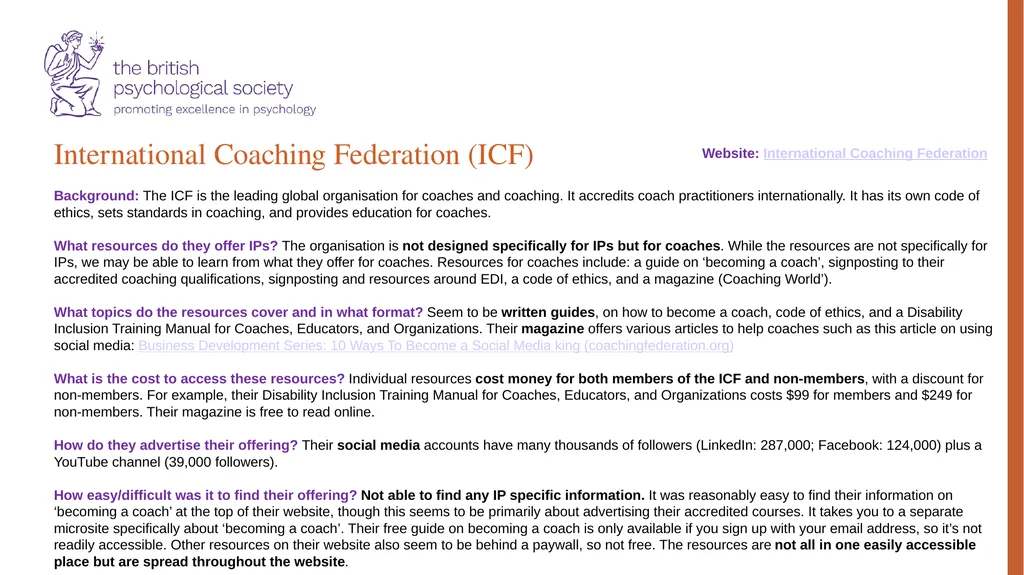
International Coaching Federation (ICF)
Background: The ICF is the leading global organisation for coaches and coaching. It accredits coach practitioners internationally. It has its own code of ethics, sets standards in coaching, and provides education for coaches.
What resources do they offer IPs? The organisation is not designed specifically for IPs but for coaches. While the resources are not specifically for IPs, we may be able to learn from what they offer for coaches. Resources for coaches include: a guide on ‘becoming a coach’, signposting to their accredited coaching qualifications, signposting and resources around EDI, a code of ethics, and a magazine (Coaching World’).
What topics do the resources cover and in what format? Seem to be written guides, on how to become a coach, code of ethics, and a Disability Inclusion Training Manual for Coaches, Educators, and Organizations. Their magazine offers various articles to help coaches such as this article on using social media: Business Development Series: 10 Ways To Become a Social Media king (coachingfederation.org)
What is the cost to access these resources? Individual resources cost money for both members of the ICF and non-members, with a discount for non-members. For example, their Disability Inclusion Training Manual for Coaches, Educators, and Organizations costs $99 for members and $249 for non-members. Their magazine is free to read online.
How do they advertise their offering? Their social media accounts have many thousands of followers (LinkedIn: 287,000; Facebook: 124,000) plus a YouTube channel (39,000 followers).
How easy/difficult was it to find their offering? Not able to find any IP specific information. It was reasonably easy to find their information on ‘becoming a coach’ at the top of their website, though this seems to be primarily about advertising their accredited courses. It takes you to a separate microsite specifically about ‘becoming a coach’. Their free guide on becoming a coach is only available if you sign up with your email address, so it’s not readily accessible. Other resources on their website also seem to be behind a paywall, so not free. The resources are not all in one easily accessible place but are spread throughout the website. Website: International Coaching Federation<br>
Background: The ICF is the leading global organisation for coaches and coaching. It accredits coach practitioners internationally. It has its own code of ethics, sets standards in coaching, and provides education for coaches.
What resources do they offer IPs? The organisation is not designed specifically for IPs but for coaches. While the resources are not specifically for IPs, we may be able to learn from what they offer for coaches. Resources for coaches include: a guide on ‘becoming a coach’, signposting to their accredited coaching qualifications, signposting and resources around EDI, a code of ethics, and a magazine (Coaching World’).
What topics do the resources cover and in what format? Seem to be written guides, on how to become a coach, code of ethics, and a Disability Inclusion Training Manual for Coaches, Educators, and Organizations. Their magazine offers various articles to help coaches such as this article on using social media: Business Development Series: 10 Ways To Become a Social Media king (coachingfederation.org)
What is the cost to access these resources? Individual resources cost money for both members of the ICF and non-members, with a discount for non-members. For example, their Disability Inclusion Training Manual for Coaches, Educators, and Organizations costs $99 for members and $249 for non-members. Their magazine is free to read online.
How do they advertise their offering? Their social media accounts have many thousands of followers (LinkedIn: 287,000; Facebook: 124,000) plus a YouTube channel (39,000 followers).
How easy/difficult was it to find their offering? Not able to find any IP specific information. It was reasonably easy to find their information on ‘becoming a coach’ at the top of their website, though this seems to be primarily about advertising their accredited courses. It takes you to a separate microsite specifically about ‘becoming a coach’. Their free guide on becoming a coach is only available if you sign up with your email address, so it’s not readily accessible. Other resources on their website also seem to be behind a paywall, so not free. The resources are not all in one easily accessible place but are spread throughout the website. Website: International Coaching Federation<br>
22
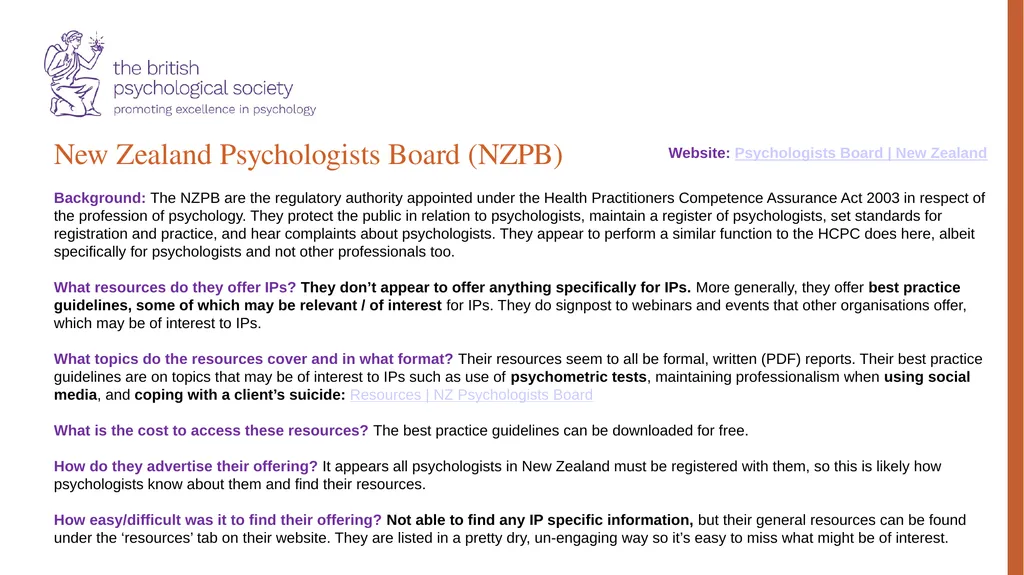
New Zealand Psychologists Board (NZPB)
Background: The NZPB are the regulatory authority appointed under the Health Practitioners Competence Assurance Act 2003 in respect of the profession of psychology. They protect the public in relation to psychologists, maintain a register of psychologists, set standards for registration and practice, and hear complaints about psychologists. They appear to perform a similar function to the HCPC does here, albeit specifically for psychologists and not other professionals too.
What resources do they offer IPs? They don’t appear to offer anything specifically for IPs. More generally, they offer best practice guidelines, some of which may be relevant / of interest for IPs. They do signpost to webinars and events that other organisations offer, which may be of interest to IPs.
What topics do the resources cover and in what format? Their resources seem to all be formal, written (PDF) reports. Their best practice guidelines are on topics that may be of interest to IPs such as use of psychometric tests, maintaining professionalism when using social media, and coping with a client’s suicide: Resources | NZ Psychologists Board
What is the cost to access these resources? The best practice guidelines can be downloaded for free.
How do they advertise their offering? It appears all psychologists in New Zealand must be registered with them, so this is likely how psychologists know about them and find their resources.
How easy/difficult was it to find their offering? Not able to find any IP specific information, but their general resources can be found under the ‘resources’ tab on their website. They are listed in a pretty dry, un-engaging way so it’s easy to miss what might be of interest. Website: Psychologists Board | New Zealand<br>
Background: The NZPB are the regulatory authority appointed under the Health Practitioners Competence Assurance Act 2003 in respect of the profession of psychology. They protect the public in relation to psychologists, maintain a register of psychologists, set standards for registration and practice, and hear complaints about psychologists. They appear to perform a similar function to the HCPC does here, albeit specifically for psychologists and not other professionals too.
What resources do they offer IPs? They don’t appear to offer anything specifically for IPs. More generally, they offer best practice guidelines, some of which may be relevant / of interest for IPs. They do signpost to webinars and events that other organisations offer, which may be of interest to IPs.
What topics do the resources cover and in what format? Their resources seem to all be formal, written (PDF) reports. Their best practice guidelines are on topics that may be of interest to IPs such as use of psychometric tests, maintaining professionalism when using social media, and coping with a client’s suicide: Resources | NZ Psychologists Board
What is the cost to access these resources? The best practice guidelines can be downloaded for free.
How do they advertise their offering? It appears all psychologists in New Zealand must be registered with them, so this is likely how psychologists know about them and find their resources.
How easy/difficult was it to find their offering? Not able to find any IP specific information, but their general resources can be found under the ‘resources’ tab on their website. They are listed in a pretty dry, un-engaging way so it’s easy to miss what might be of interest. Website: Psychologists Board | New Zealand<br>
23
IPs inside and outside the BPS<br>
24
IPs inside of the BPS – what we know from our member database
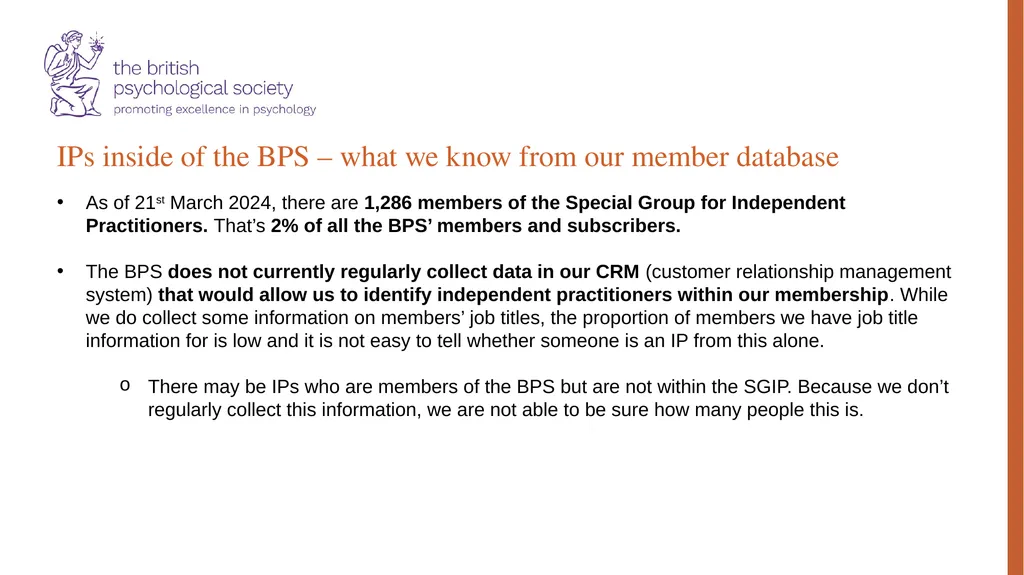
As of 21st March 2024, there are 1,286 members of the Special Group for Independent Practitioners. That’s 2% of all the BPS’ members and subscribers.
The BPS does not currently regularly collect data in our CRM (customer relationship management system) that would allow us to identify independent practitioners within our membership. While we do collect some information on members’ job titles, the proportion of members we have job title information for is low and it is not easy to tell whether someone is an IP from this alone.
There may be IPs who are members of the BPS but are not within the SGIP. Because we don’t regularly collect this information, we are not able to be sure how many people this is.<br>
As of 21st March 2024, there are 1,286 members of the Special Group for Independent Practitioners. That’s 2% of all the BPS’ members and subscribers.
The BPS does not currently regularly collect data in our CRM (customer relationship management system) that would allow us to identify independent practitioners within our membership. While we do collect some information on members’ job titles, the proportion of members we have job title information for is low and it is not easy to tell whether someone is an IP from this alone.
There may be IPs who are members of the BPS but are not within the SGIP. Because we don’t regularly collect this information, we are not able to be sure how many people this is.<br>
25
IPs inside of the BPS – insights from the 2015 IP survey
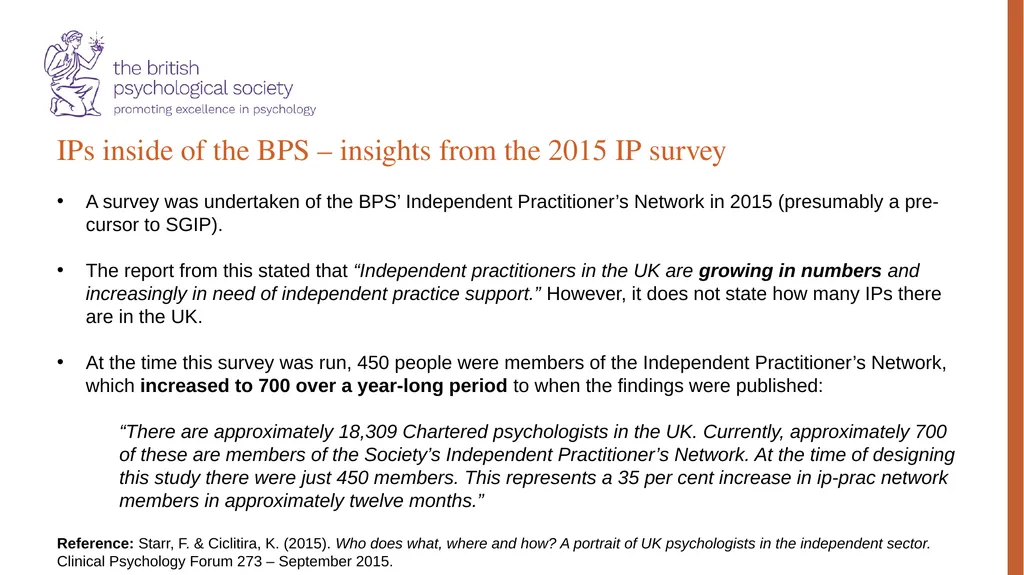
A survey was undertaken of the BPS’ Independent Practitioner’s Network in 2015 (presumably a pre-cursor to SGIP).
The report from this stated that “Independent practitioners in the UK are growing in numbers and increasingly in need of independent practice support.” However, it does not state how many IPs there are in the UK.
At the time this survey was run, 450 people were members of the Independent Practitioner’s Network, which increased to 700 over a year-long period to when the findings were published:
“There are approximately 18,309 Chartered psychologists in the UK. Currently, approximately 700 of these are members of the Society’s Independent Practitioner’s Network. At the time of designing this study there were just 450 members. This represents a 35 per cent increase in ip-prac network members in approximately twelve months.”
Reference: Starr, F. & Ciclitira, K. (2015). Who does what, where and how? A portrait of UK psychologists in the independent sector. Clinical Psychology Forum 273 – September 2015.<br>
A survey was undertaken of the BPS’ Independent Practitioner’s Network in 2015 (presumably a pre-cursor to SGIP).
The report from this stated that “Independent practitioners in the UK are growing in numbers and increasingly in need of independent practice support.” However, it does not state how many IPs there are in the UK.
At the time this survey was run, 450 people were members of the Independent Practitioner’s Network, which increased to 700 over a year-long period to when the findings were published:
“There are approximately 18,309 Chartered psychologists in the UK. Currently, approximately 700 of these are members of the Society’s Independent Practitioner’s Network. At the time of designing this study there were just 450 members. This represents a 35 per cent increase in ip-prac network members in approximately twelve months.”
Reference: Starr, F. & Ciclitira, K. (2015). Who does what, where and how? A portrait of UK psychologists in the independent sector. Clinical Psychology Forum 273 – September 2015.<br>
26
IPs inside of the BPS – findings from the 2019 workforce survey
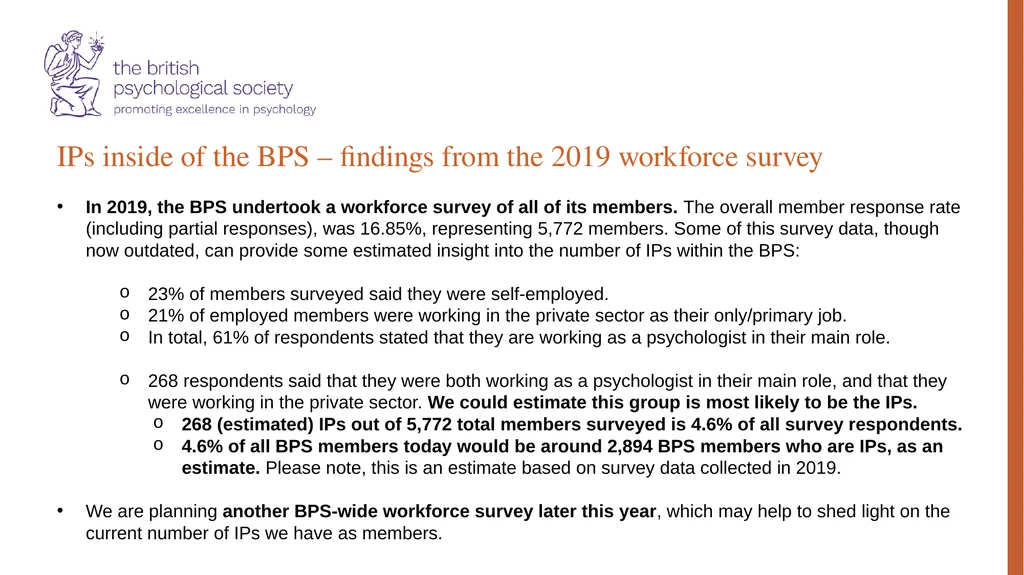
In 2019, the BPS undertook a workforce survey of all of its members. The overall member response rate (including partial responses), was 16.85%, representing 5,772 members. Some of this survey data, though now outdated, can provide some estimated insight into the number of IPs within the BPS:
23% of members surveyed said they were self-employed.
21% of employed members were working in the private sector as their only/primary job.
In total, 61% of respondents stated that they are working as a psychologist in their main role.
268 respondents said that they were both working as a psychologist in their main role, and that they were working in the private sector. We could estimate this group is most likely to be the IPs.
268 (estimated) IPs out of 5,772 total members surveyed is 4.6% of all survey respondents.
4.6% of all BPS members today would be around 2,894 BPS members who are IPs, as an estimate. Please note, this is an estimate based on survey data collected in 2019.
We are planning another BPS-wide workforce survey later this year, which may help to shed light on the current number of IPs we have as members.<br>
In 2019, the BPS undertook a workforce survey of all of its members. The overall member response rate (including partial responses), was 16.85%, representing 5,772 members. Some of this survey data, though now outdated, can provide some estimated insight into the number of IPs within the BPS:
23% of members surveyed said they were self-employed.
21% of employed members were working in the private sector as their only/primary job.
In total, 61% of respondents stated that they are working as a psychologist in their main role.
268 respondents said that they were both working as a psychologist in their main role, and that they were working in the private sector. We could estimate this group is most likely to be the IPs.
268 (estimated) IPs out of 5,772 total members surveyed is 4.6% of all survey respondents.
4.6% of all BPS members today would be around 2,894 BPS members who are IPs, as an estimate. Please note, this is an estimate based on survey data collected in 2019.
We are planning another BPS-wide workforce survey later this year, which may help to shed light on the current number of IPs we have as members.<br>
27
IPs outside of the BPS
We also looked at external sources to try and understand the number of IPs in the UK. This included resources from the HCPC, ONS, and the House of Commons library.
We were unable to find data to the level of detail necessary to identify IPs nationally.<br>
We also looked at external sources to try and understand the number of IPs in the UK. This included resources from the HCPC, ONS, and the House of Commons library.
We were unable to find data to the level of detail necessary to identify IPs nationally.<br>
28
Summary and Recommendations<br>
29
Summary and Recommendations
A total of 5 professional bodies reviewed, including the BPS (SGIP), have a dedicated arm for those in independent/private practice, such as a member network (ACP, APA, BABCP, BACP).
BPS’ SGIP is 1 of 5 professional bodies that offer support specifically for IPs (ACP, APA, BABCP, HCPC). Another 5 professional bodies offer support for both private practitioners (APS, BACP, BMA, UKCP) and independent consultants (CIPD). The remaining 7 professional bodies offer no or very limited support specifically for IPs.
SGIP has a good offering of resources for those in independent/private practice, which is on par with BABCP’s and BACP’s offerings. It also is the only organisation that clearly defines ‘Independent Practitioner’. SGIP seems to offer more than all other professional bodies, apart from the APA, which has the most extensive IP offering, though most of its resources aren’t freely available unless you are a member.
APA’s Division 42 advertises their offer to include three main things that the SGIP do not: journal and magazine articles, including a quarterly publication; consultation and collaboration opportunities; and mentoring.
SGIP could consider offering a more interactive membership, offering consultation, collaboration and/or mentoring, between members of the network, in turn boosting networking opportunities.
This may explain why APA charges the most for their resources at $65 / £51.65 pa. The only other professional body for IPs that clearly advertises a fee is BPS’ SGIP, but at a much lower rate of £10.
APA and CIPD are the only bodies with resources for IPs which advertise on a platform that is not their own website; YouTube in both cases. Other bodies (not specifically for IPs) also have social media such as LinkedIn and Facebook groups.
SGIP could explore new ways of promoting their network and it’s offering, such as via YouTube videos, and a LinkedIn group.<br>
A total of 5 professional bodies reviewed, including the BPS (SGIP), have a dedicated arm for those in independent/private practice, such as a member network (ACP, APA, BABCP, BACP).
BPS’ SGIP is 1 of 5 professional bodies that offer support specifically for IPs (ACP, APA, BABCP, HCPC). Another 5 professional bodies offer support for both private practitioners (APS, BACP, BMA, UKCP) and independent consultants (CIPD). The remaining 7 professional bodies offer no or very limited support specifically for IPs.
SGIP has a good offering of resources for those in independent/private practice, which is on par with BABCP’s and BACP’s offerings. It also is the only organisation that clearly defines ‘Independent Practitioner’. SGIP seems to offer more than all other professional bodies, apart from the APA, which has the most extensive IP offering, though most of its resources aren’t freely available unless you are a member.
APA’s Division 42 advertises their offer to include three main things that the SGIP do not: journal and magazine articles, including a quarterly publication; consultation and collaboration opportunities; and mentoring.
SGIP could consider offering a more interactive membership, offering consultation, collaboration and/or mentoring, between members of the network, in turn boosting networking opportunities.
This may explain why APA charges the most for their resources at $65 / £51.65 pa. The only other professional body for IPs that clearly advertises a fee is BPS’ SGIP, but at a much lower rate of £10.
APA and CIPD are the only bodies with resources for IPs which advertise on a platform that is not their own website; YouTube in both cases. Other bodies (not specifically for IPs) also have social media such as LinkedIn and Facebook groups.
SGIP could explore new ways of promoting their network and it’s offering, such as via YouTube videos, and a LinkedIn group.<br>
30
Summary and Recommendations
Across the board, resources are predominately digital in format and found on the professional bodies’ respective websites. Some of these were in text format designed for you to read (e.g. the HCPC’s case study on being a sole practitioner) while others are more interactive like webinars, peer groups, and podcasts.
Topic areas of resources for IPs/private practitioners were commonly around how to get started in independent practice, how to conduct marketing and social media, and legal guidance.
Some of the clearest websites with resources for IPs that were easiest to access were from BACP and UKCP. Others like the APA and APS say what resources you can access but you must join as a member to access them.
Some of the resources we found that the SGIP may want to consider emulating or signposting to include:
Templates that IPs can download from the website and use – SGIP already has a costing template, but there may be others that would be useful for IPs. For example, the Australian Psychological Society offers templates for private practitioners, such as on client treatment, client session notes, biopsychosocial assessment, and record keeping.
Case study examples of particular scenarios showing good (or poor) practice in how to respond as an IP.
Additional guidance on issues that IPs might face; for example, the New Zealand Psychologists’ Board offers guidance on coping with a client’s suicide, and using psychometric tests.
Additional networking opportunities, for example BABCP offers regional peer groups.<br>
Across the board, resources are predominately digital in format and found on the professional bodies’ respective websites. Some of these were in text format designed for you to read (e.g. the HCPC’s case study on being a sole practitioner) while others are more interactive like webinars, peer groups, and podcasts.
Topic areas of resources for IPs/private practitioners were commonly around how to get started in independent practice, how to conduct marketing and social media, and legal guidance.
Some of the clearest websites with resources for IPs that were easiest to access were from BACP and UKCP. Others like the APA and APS say what resources you can access but you must join as a member to access them.
Some of the resources we found that the SGIP may want to consider emulating or signposting to include:
Templates that IPs can download from the website and use – SGIP already has a costing template, but there may be others that would be useful for IPs. For example, the Australian Psychological Society offers templates for private practitioners, such as on client treatment, client session notes, biopsychosocial assessment, and record keeping.
Case study examples of particular scenarios showing good (or poor) practice in how to respond as an IP.
Additional guidance on issues that IPs might face; for example, the New Zealand Psychologists’ Board offers guidance on coping with a client’s suicide, and using psychometric tests.
Additional networking opportunities, for example BABCP offers regional peer groups.<br>
31
Summary and Recommendations
The BPS does not regularly collect information on how many IPs are within its membership, so it is not possible to say how many BPS members are IPs.
We are planning on conducting a membership wide workforce survey later in 2024 that should shed light on this.
The last BPS member workforce survey took place in 2019. It did not specifically ask how many members are IPs, however, 4.6% of survey respondents were working as a psychologist in their main role and were working in the private sector. Extrapolating that to the wider BPS membership today, that would equate to an estimated 2,894 BPS members who are IPs.
Please note there are some big caveats to this estimate, for example, the survey data was from 2019, and did not directly ask ‘are you an independent practitioner?’.
We looked at external sources such as ONS and HCPC data to try and work out how many IPs are working in the UK more generally – unfortunately, we were not able to find anything that provided this level of detail.<br>
The BPS does not regularly collect information on how many IPs are within its membership, so it is not possible to say how many BPS members are IPs.
We are planning on conducting a membership wide workforce survey later in 2024 that should shed light on this.
The last BPS member workforce survey took place in 2019. It did not specifically ask how many members are IPs, however, 4.6% of survey respondents were working as a psychologist in their main role and were working in the private sector. Extrapolating that to the wider BPS membership today, that would equate to an estimated 2,894 BPS members who are IPs.
Please note there are some big caveats to this estimate, for example, the survey data was from 2019, and did not directly ask ‘are you an independent practitioner?’.
We looked at external sources such as ONS and HCPC data to try and work out how many IPs are working in the UK more generally – unfortunately, we were not able to find anything that provided this level of detail.<br>