
Specialty Pharmacy and Biosimilars Created by the
LO
Published · 32 slides · 0 views

1 / 1



Description
Specialty Pharmacy and Biosimilars Created by the School of Pharmacy Relations Committee for AMCP Updated: January 2020 Part 1: Specialty Pharmacy Objectives Obtain an understanding of specialty pharmaceuticals Understand the challenges of
Related Topics
Share
Embed code
Download this presentation From Below
"Specialty Pharmacy and Biosimilars Created by the" is the property of its rightful owner. Permission is granted to download and print the materials on this website for personal, non-commercial use only, and to display it on your personal computer provided you do not modify the materials and that you retain all copyright notices contained in the materials. By downloading content from our website, you accept the terms of this agreement.
Presentation Transcript
01
Specialty Pharmacy
and Biosimilars Created by the School of Pharmacy Relations Committee for AMCP
Updated: January 2020<br>
Updated: January 2020<br>
02
Part 1:
Specialty Pharmacy<br>
03
Objectives Obtain an understanding of specialty pharmaceuticals
Understand the challenges of specialty pharmaceuticals for managed care companies
Describe the value that specialty products bring to the market<br>
Understand the challenges of specialty pharmaceuticals for managed care companies
Describe the value that specialty products bring to the market<br>
04
Definition of Specialty Pharmaceuticals Lack of universal definition
“Biologic, biological, biopharmaceutical, biotech”
Can include high cost injectable, infused product, oral agent or inhaled medication
May require close supervision, monitoring and handling requirements
Medicare’s Part D definition for specialty: any drug for which the negotiated monthly price is $600 or more
Can be administered at home, MD office, infusion center or outpatient hospital<br>
“Biologic, biological, biopharmaceutical, biotech”
Can include high cost injectable, infused product, oral agent or inhaled medication
May require close supervision, monitoring and handling requirements
Medicare’s Part D definition for specialty: any drug for which the negotiated monthly price is $600 or more
Can be administered at home, MD office, infusion center or outpatient hospital<br>
05
Impact of Specialty Products Specialty drugs have been the fastest growing segment of drug spend under the pharmacy benefit
PBM Prime Therapeutics LLC reported that in 2013, specialty drugs expenses amount to 33.4% of total (pharmacy and medical) drug costs. If current trends continue, it will represent more than 50% by 2018.1
According to PhRMA, there are currently over 7,000 new medications in the biopharmaceutical pipeline
1 Prime Therapeutics LLC. 2013 drug trend insights. Available at: https://www.primetherapeutics.com/PDF/specialtydtr2013/index.html.
Accessed January 2, 2014.<br>
PBM Prime Therapeutics LLC reported that in 2013, specialty drugs expenses amount to 33.4% of total (pharmacy and medical) drug costs. If current trends continue, it will represent more than 50% by 2018.1
According to PhRMA, there are currently over 7,000 new medications in the biopharmaceutical pipeline
1 Prime Therapeutics LLC. 2013 drug trend insights. Available at: https://www.primetherapeutics.com/PDF/specialtydtr2013/index.html.
Accessed January 2, 2014.<br>
06
Specialty Pharmacy Programs May include prior authorizations to ensure clinically appropriate and cost-effective use of treatments when certain criteria is met
Incorporate evidence-based guidelines, dosing and discontinuation guidance, and monitoring
Many specialty pharmacy providers have disease state management programs specific for conditions that are commonly treated with specialty pharmaceuticals<br>
Incorporate evidence-based guidelines, dosing and discontinuation guidance, and monitoring
Many specialty pharmacy providers have disease state management programs specific for conditions that are commonly treated with specialty pharmaceuticals<br>
07
Specialty Pharmacy Providers Specialty pharmacy is often a subset of retail pharmacy in managed care
Payers often contract specifically with specialty pharmacies to provide specialty pharmaceutical services to their members
Many payers own their own specialty pharmacy
Cigna / Express Scripts – Cigna Specialty Pharmacy / Accredo
Humana – Humana Specialty Pharmacy
Caremark / Aetna – CVS Specialty Pharmacy / Aetna Specialty Pharmacy<br>
Payers often contract specifically with specialty pharmacies to provide specialty pharmaceutical services to their members
Many payers own their own specialty pharmacy
Cigna / Express Scripts – Cigna Specialty Pharmacy / Accredo
Humana – Humana Specialty Pharmacy
Caremark / Aetna – CVS Specialty Pharmacy / Aetna Specialty Pharmacy<br>
08
Components of Specialty Programs Refill reminders
Delivery coordination
Insurance verification
Clinical interventions
Patient education
Adherence counseling
Psychosocial assessment
Patient assistance programs
Integrated nursing staff<br>
Delivery coordination
Insurance verification
Clinical interventions
Patient education
Adherence counseling
Psychosocial assessment
Patient assistance programs
Integrated nursing staff<br>
09
Commonly Targeted Disease States Pulmonary arterial hypertension
Multiple sclerosis
Hepatitis C
Rheumatoid arthritis
Psoriasis
RSV
Oncology Blood disorders
Cystic fibrosis
Crohn’s disease
Ulcerative Colitis
Growth hormone deficiency
Hemophilia
HIV/AIDS
Infertility<br>
Multiple sclerosis
Hepatitis C
Rheumatoid arthritis
Psoriasis
RSV
Oncology Blood disorders
Cystic fibrosis
Crohn’s disease
Ulcerative Colitis
Growth hormone deficiency
Hemophilia
HIV/AIDS
Infertility<br>
10
Challenges in MCOs Billing systems- integration of medical and pharmacy claims
Utilization management
Drug coding- NDC vs. J code
Benefit design and patient cost share
Debbie Stern and Debi Reissman, “Specialty Pharmacy Cost Management Strategies of Private Health Care Payers,” Journal of Managed Care Pharmacy, November/December 2006. http://www.amcp.org/data/jmcp/Nov-Dec06JMCP1.pdf
Accessed February 3, 2010<br>
Utilization management
Drug coding- NDC vs. J code
Benefit design and patient cost share
Debbie Stern and Debi Reissman, “Specialty Pharmacy Cost Management Strategies of Private Health Care Payers,” Journal of Managed Care Pharmacy, November/December 2006. http://www.amcp.org/data/jmcp/Nov-Dec06JMCP1.pdf
Accessed February 3, 2010<br>
11
Benefit Designs Cause of much confusion
Medical benefit vs. pharmacy benefit
Each MCO can design and deliver their own product and services
Has led to additional formulary tiers
Tier 4, Tier 5 and Tier 6 for example
Traditionally associated with higher co-pays or co-insurances
Many plans are moving towards new benefit designs for specialty drugs and therapies, including a “specialty formulary”<br>
Medical benefit vs. pharmacy benefit
Each MCO can design and deliver their own product and services
Has led to additional formulary tiers
Tier 4, Tier 5 and Tier 6 for example
Traditionally associated with higher co-pays or co-insurances
Many plans are moving towards new benefit designs for specialty drugs and therapies, including a “specialty formulary”<br>
12
Impact on Patients Specialty expenditures per member increased by 11.1% from 2004 to 2008 (in a 8 million member commercial plan)
Potential impact of shifting costs to patients with specialty drugs:
Inability or refusal to pay for medications leading to decreased compliance
Compliance issues may impact medical expenses and hospital costs<br>
Potential impact of shifting costs to patients with specialty drugs:
Inability or refusal to pay for medications leading to decreased compliance
Compliance issues may impact medical expenses and hospital costs<br>
13
Monitoring for Adverse Reactions Prescription drug safety is key with specialty pharmaceuticals
Problems arise when a drug offers significant therapeutic benefits but also carries challenging health or safety risks
FDA Mandated Risk Evaluation and Mitigation Strategy (REMS)
Many biologics and new therapies are subject to REMS
Includes patient registries, ongoing patient monitoring, and certification for prescribers and pharmacies
Specialty pharmacies have a high level of patient and physician interaction and specially trained therapy teams to assist with meeting these requirements<br>
Problems arise when a drug offers significant therapeutic benefits but also carries challenging health or safety risks
FDA Mandated Risk Evaluation and Mitigation Strategy (REMS)
Many biologics and new therapies are subject to REMS
Includes patient registries, ongoing patient monitoring, and certification for prescribers and pharmacies
Specialty pharmacies have a high level of patient and physician interaction and specially trained therapy teams to assist with meeting these requirements<br>
14
Summary Specialty pharmacy is a growing part of the pharmacy industry
Specialty pharmacy providers continue to develop programs and value-added services to better manage patients
Payers continue to develop new strategies to manage the high costs of these drugs
Patients are often affected by the variance in coverage and cost shares<br>
Specialty pharmacy providers continue to develop programs and value-added services to better manage patients
Payers continue to develop new strategies to manage the high costs of these drugs
Patients are often affected by the variance in coverage and cost shares<br>
15
References Prime Therapeutics LLC. 2011 drug trend insights. 8/11. Available at: http://www.primetherapeutics.com/PDF/2011PrimeDrugTrendInsights.pdf. Accessed September 14,2011.
Debbie Stern and Debi Reissman, “Specialty Pharmacy Cost Management Strategies of Private Health Care Payers,” Journal of Managed Care Pharmacy, November/December 2006. http://www.amcp.org/data/jmcp/Nov-Dec06JMCP1.pdf. Accessed February 3, 2010.
Gleason PP, Starner CI, Gunderson BW, Schafer JA, Sarran HS. Association of Prescription Abandonment with Cost Share for High-Cost Specialty Pharmacy Medications. Journal of Managed Care Pharmacy 2009;15(8)648-58. Specialty pharmacy's role in REMS, FDA's new drug safety program. Formulary. 2009;44:300–308.
FMCP Specialty Pharmacy Initiative: Phase I Discovery & U.S. Environmental Scan. October 2009. www.fmcpnet.org. Accessed February 1, 2010.
The Biopharmaceutical Industry: Creating Research, Progress and Hope. http://www.phrma.org/about/biopharmaceutical_sector. Accessed February 1, 2015.<br>
Debbie Stern and Debi Reissman, “Specialty Pharmacy Cost Management Strategies of Private Health Care Payers,” Journal of Managed Care Pharmacy, November/December 2006. http://www.amcp.org/data/jmcp/Nov-Dec06JMCP1.pdf. Accessed February 3, 2010.
Gleason PP, Starner CI, Gunderson BW, Schafer JA, Sarran HS. Association of Prescription Abandonment with Cost Share for High-Cost Specialty Pharmacy Medications. Journal of Managed Care Pharmacy 2009;15(8)648-58. Specialty pharmacy's role in REMS, FDA's new drug safety program. Formulary. 2009;44:300–308.
FMCP Specialty Pharmacy Initiative: Phase I Discovery & U.S. Environmental Scan. October 2009. www.fmcpnet.org. Accessed February 1, 2010.
The Biopharmaceutical Industry: Creating Research, Progress and Hope. http://www.phrma.org/about/biopharmaceutical_sector. Accessed February 1, 2015.<br>
16
Part 2:
Biosimilars<br>
17
Biologics Price Competition and Innovation Act (BPCIA) Established in 2009 to create an abbreviated licensure pathway for biological products that are demonstrated to be “biosimilar” to or “interchangeable” with an FDA-licensed biological product.<br>
18
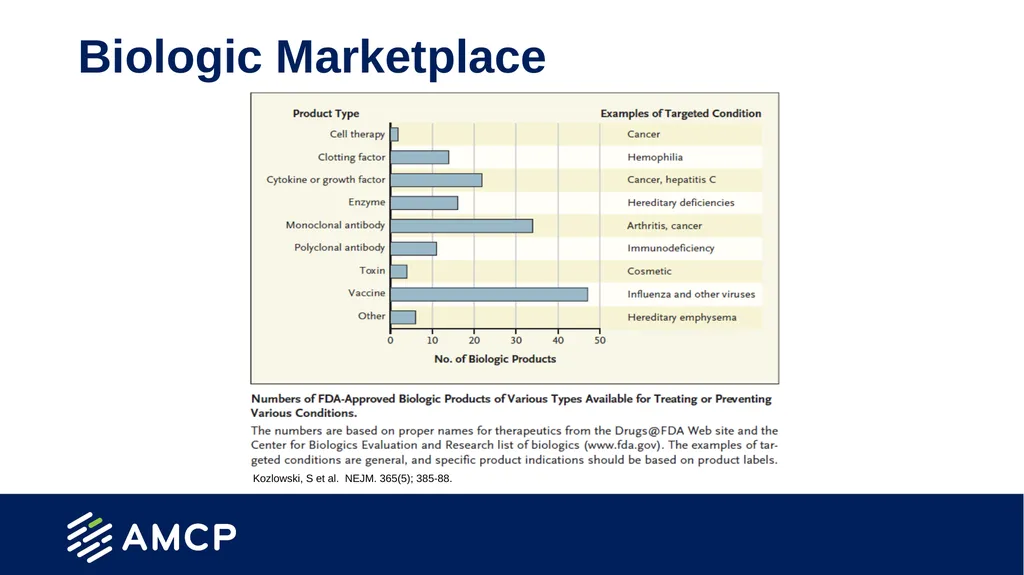
Biologic Marketplace Kozlowski, S et al. NEJM. 365(5); 385-88.<br>
19
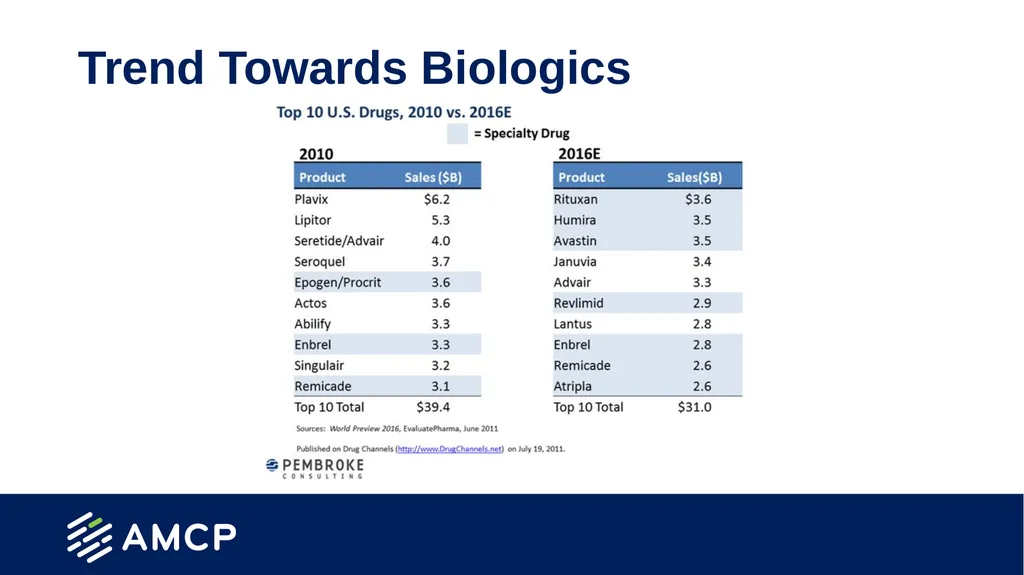
Trend Towards Biologics<br>
20
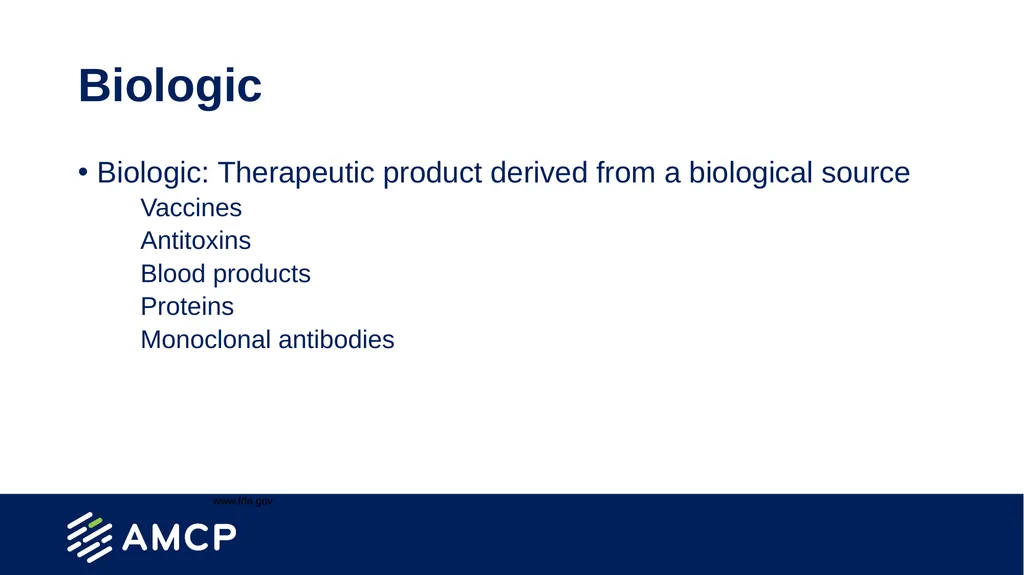
Biologic Biologic: Therapeutic product derived from a biological source
Vaccines
Antitoxins
Blood products
Proteins
Monoclonal antibodies www.fda.gov<br>
Vaccines
Antitoxins
Blood products
Proteins
Monoclonal antibodies www.fda.gov<br>
21
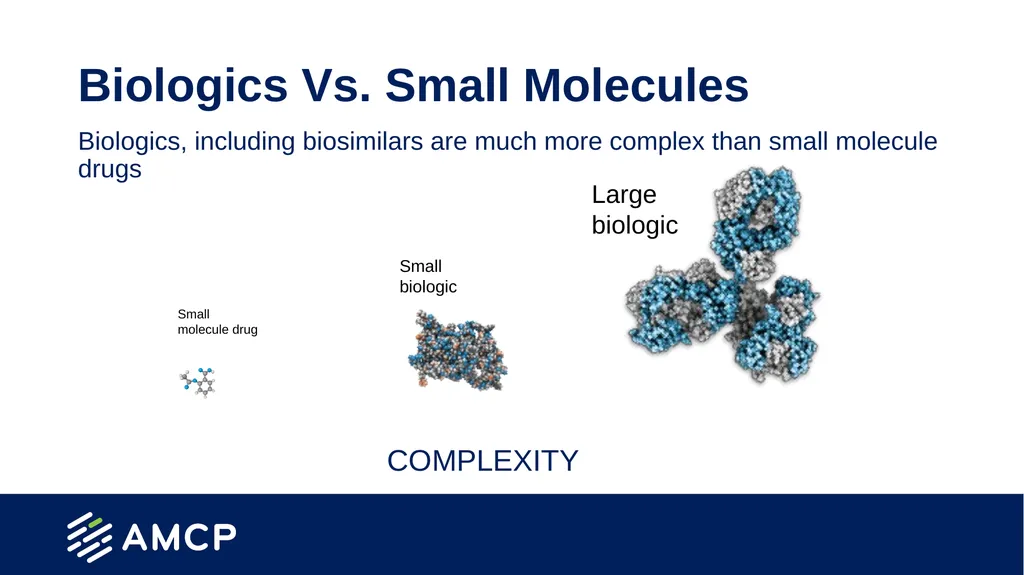
Biologics Vs. Small Molecules Biologics, including biosimilars are much more complex than small molecule drugs<br>
22
Biosimilar Biosimilar
Highly similar to the U.S. licensed reference biological product notwithstanding minor differences in clinically inactive components
No clinically meaningful differences from the reverence product in terms of safety, purity, and potency www.fda.gov<br>
Highly similar to the U.S. licensed reference biological product notwithstanding minor differences in clinically inactive components
No clinically meaningful differences from the reverence product in terms of safety, purity, and potency www.fda.gov<br>
23
Interchangeable Interchangeable
Biosimilar to the U.S. licensed reference product
Expected to produce the same clinical result to the reference product in any given patient
If a product is indicated for multiple administrations, then the product must be able to be alternated with the reference product without any loss of efficacy or change in risk of adverse events
May be substituted at the pharmacy level without the intervention of a healthcare provider www.fda.gov<br>
Biosimilar to the U.S. licensed reference product
Expected to produce the same clinical result to the reference product in any given patient
If a product is indicated for multiple administrations, then the product must be able to be alternated with the reference product without any loss of efficacy or change in risk of adverse events
May be substituted at the pharmacy level without the intervention of a healthcare provider www.fda.gov<br>
24
Biosimilar 351(k) Application In order to be granted biosimilar status by the FDA, the biological product must show clinical data derived from:
Analytical studies that demonstrate that the biological product is highly similar to the reference product notwithstanding minor differences in clinically inactive components;
Animal studies (including the assessment of toxicity); and
A clinical study or studies (including the assessment of immunogenicity and pharmacokinetics or pharmacodynamics) that are sufficient to demonstrate safety, purity, and potency in one or more appropriate conditions of use for which the reference product is licensed and intended to be used and for which licensure is sought for the biological product. http://www.fda.gov/downloads/Drugs/GuidanceComplianceRegulatoryInformation/Guidances/UCM291128.pdf<br>
Analytical studies that demonstrate that the biological product is highly similar to the reference product notwithstanding minor differences in clinically inactive components;
Animal studies (including the assessment of toxicity); and
A clinical study or studies (including the assessment of immunogenicity and pharmacokinetics or pharmacodynamics) that are sufficient to demonstrate safety, purity, and potency in one or more appropriate conditions of use for which the reference product is licensed and intended to be used and for which licensure is sought for the biological product. http://www.fda.gov/downloads/Drugs/GuidanceComplianceRegulatoryInformation/Guidances/UCM291128.pdf<br>
25
Biosimilar 351(k) Application Stepwise Approach:
Extensive structural and functional characterization of both products
Animal data if contains pertinent information not able to be obtained from humans (e.g. toxicity)
Human Pharmacokinetic studies
Human Pharmacodynamic studies
Compare clinical immunogenicity
If inconsistencies exist, consider clinical trial with appropriate safety and efficacy measures http://www.fda.gov/downloads/Drugs/GuidanceComplianceRegulatoryInformation/Guidances/UCM291128.pdf<br>
Extensive structural and functional characterization of both products
Animal data if contains pertinent information not able to be obtained from humans (e.g. toxicity)
Human Pharmacokinetic studies
Human Pharmacodynamic studies
Compare clinical immunogenicity
If inconsistencies exist, consider clinical trial with appropriate safety and efficacy measures http://www.fda.gov/downloads/Drugs/GuidanceComplianceRegulatoryInformation/Guidances/UCM291128.pdf<br>
26
FDA Purple Book First published September 9, 2014
Lists biological products, including any biosimilar and interchangeable biological products licensed by the FDA under the Public Health Service Act (PHS Act)
Includes the date a biological product was licensed under 351(a) of the PHS Act and whether the FDA evaluated the biological product for reference product exclusivity under section 351(k)(7)
Shows if the FDA has determined a product to be biosimilar or interchangeable with an already licensed FDA reference biological product
Biosimilar and interchangeable products are listed under the reference product<br>
Lists biological products, including any biosimilar and interchangeable biological products licensed by the FDA under the Public Health Service Act (PHS Act)
Includes the date a biological product was licensed under 351(a) of the PHS Act and whether the FDA evaluated the biological product for reference product exclusivity under section 351(k)(7)
Shows if the FDA has determined a product to be biosimilar or interchangeable with an already licensed FDA reference biological product
Biosimilar and interchangeable products are listed under the reference product<br>
27
Biosimilar: Filgrastim First application under the new biosimilar pathway brought to an FDA advisory committee
On January 7th, 2015, the FDA Oncologic Drugs Advisory Committee unanimously voted that Sandoz’s EP2006 (Zarxio) should be licensed as biosimilar to the reference product, Neupogen
Includes all 5 indications for which Neupogen is approved
Zarxio (filgrastim-sndz) was approved March 6, 2015 as a biosimilar, not an interchangeable
Route of administration, indications and side effects are the same as Neupogen
Launched September 3, 2015
15 percent wholesale list price discount<br>
On January 7th, 2015, the FDA Oncologic Drugs Advisory Committee unanimously voted that Sandoz’s EP2006 (Zarxio) should be licensed as biosimilar to the reference product, Neupogen
Includes all 5 indications for which Neupogen is approved
Zarxio (filgrastim-sndz) was approved March 6, 2015 as a biosimilar, not an interchangeable
Route of administration, indications and side effects are the same as Neupogen
Launched September 3, 2015
15 percent wholesale list price discount<br>
28
Biosimilar Naming Nonproprietary Naming of Biological Products Guidance finalized January, 2017
Per FDA Guidance biosimilars receive a nonproprietary name consisting of a common core plus a unique FDA-approved suffix composed of four lowercase letters
For example, for products sharing the core name replicamab, those proper names may be displayed as:
-replicamab-cznm
-replicamab-hixf
The proposed suffix should:
Be unique
Be devoid of meaning
Be four lowercase letters of which at least three are distinct
Be nonproprietary
Be attached to the core name with a hyphen
Be free of legal barriers that would restrict its usage www.fda.gov<br>
Per FDA Guidance biosimilars receive a nonproprietary name consisting of a common core plus a unique FDA-approved suffix composed of four lowercase letters
For example, for products sharing the core name replicamab, those proper names may be displayed as:
-replicamab-cznm
-replicamab-hixf
The proposed suffix should:
Be unique
Be devoid of meaning
Be four lowercase letters of which at least three are distinct
Be nonproprietary
Be attached to the core name with a hyphen
Be free of legal barriers that would restrict its usage www.fda.gov<br>
29
Outstanding Questions How much will the addition of biosimilars lower costs to the health care system?
Will increased access to biologics lead to better health outcomes overall?
How will managed care organizations manage these agents?<br>
Will increased access to biologics lead to better health outcomes overall?
How will managed care organizations manage these agents?<br>
30
References Information for Healthcare Professionals (Biosimilars). http://www.fda.gov/Drugs/DevelopmentApprovalProcess/HowDrugsareDevelopedandApproved/ApprovalApplications/TherapeuticBiologicApplications/Biosimilars/ucm241719.htm. Accessed February 1st, 2015.
"Biosimilars," Health Affairs, October 10, 2013. Accessed February 1st, 2015.
Purple Book. http://www.fda.gov/Drugs/DevelopmentApprovalProcess/HowDrugsareDevelopedandApproved/ApprovalApplications/TherapeuticBiologicApplications/Biosimilars/ucm411418.htm. Accessed February 1st, 2015.
Kate Traynor. FDA Advisers Recommend Approval of Biosimilar Filgrastim. http://www.ashp.org/menu/news/pharmacynews/newsarticle.aspx?id=4163. January 26th, 2015. Accessed February 1st, 2015.<br>
"Biosimilars," Health Affairs, October 10, 2013. Accessed February 1st, 2015.
Purple Book. http://www.fda.gov/Drugs/DevelopmentApprovalProcess/HowDrugsareDevelopedandApproved/ApprovalApplications/TherapeuticBiologicApplications/Biosimilars/ucm411418.htm. Accessed February 1st, 2015.
Kate Traynor. FDA Advisers Recommend Approval of Biosimilar Filgrastim. http://www.ashp.org/menu/news/pharmacynews/newsarticle.aspx?id=4163. January 26th, 2015. Accessed February 1st, 2015.<br>
31
Thank you to AMCP member Jorge Farias for updating this presentation for 2016.<br>
32
To improve patient health by ensuring access to
high-quality, cost-effective medications and other therapies. Mission & Vision<br>
high-quality, cost-effective medications and other therapies. Mission & Vision<br>