01
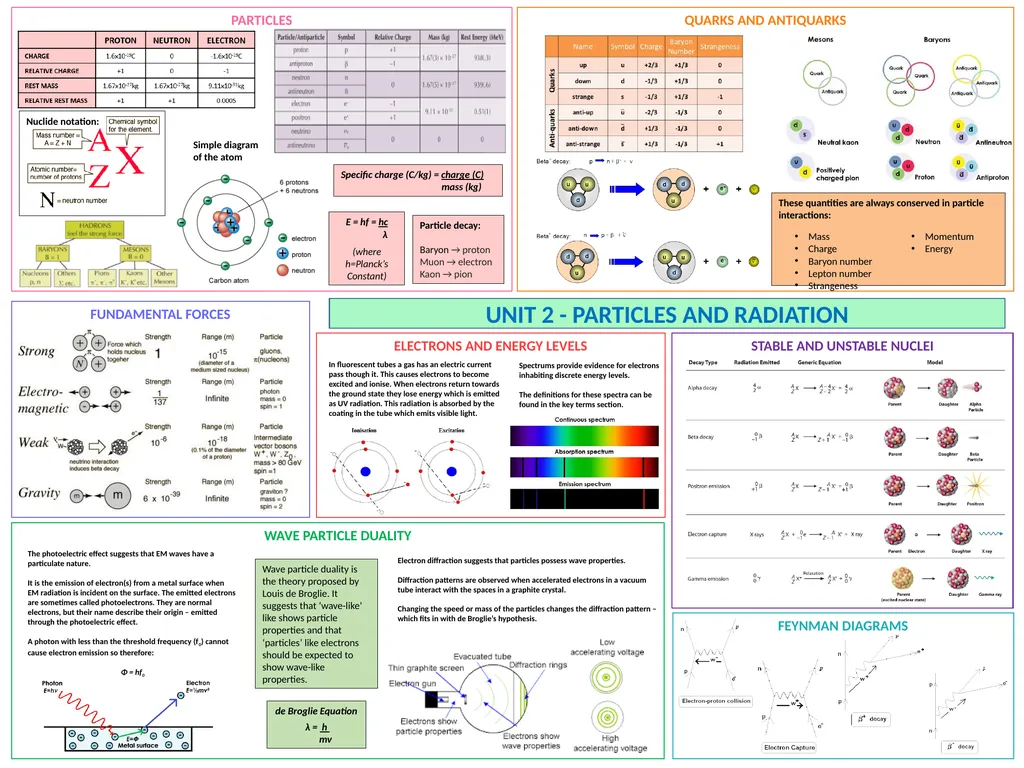
Specific charge (C/kg) = charge (C)
mass (kg) PARTICLES Nuclide notation: STABLE AND UNSTABLE NUCLEI E = hf = hc
λ
(where h=Planck’s Constant) FUNDAMENTAL FORCES QUARKS AND ANTIQUARKS The photoelectric effect suggests that EM waves have a particulate nature.
It is the emission of electron(s) from a metal surface when EM radiation is incident on the surface. The emitted electrons are sometimes called photoelectrons. They are normal electrons, but their name describe their origin – emitted through the photoelectric effect.
A photon with less than the threshold frequency (f0) cannot cause electron emission so therefore:
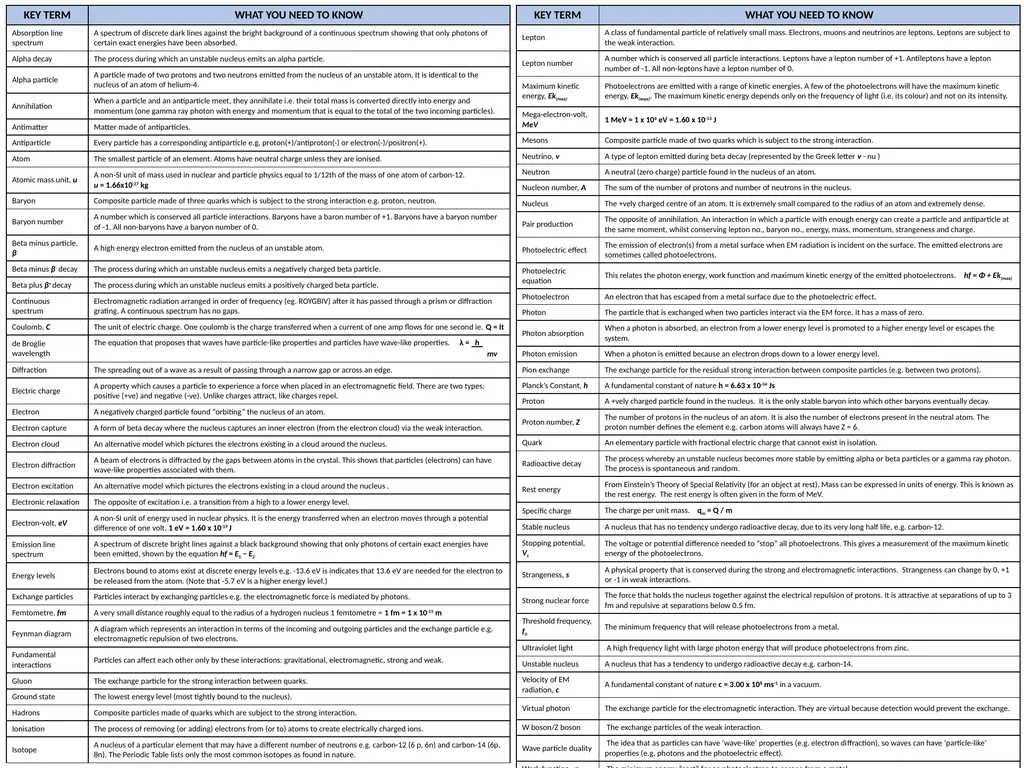
Φ = hf0 In fluorescent tubes a gas has an electric current pass though it. This causes electrons to become excited and ionise. When electrons return towards the ground state they lose energy which is emitted as UV radiation. This radiation is absorbed by the coating in the tube which emits visible light. WAVE PARTICLE DUALITY Electron diffraction suggests that particles possess wave properties.
Diffraction patterns are observed when accelerated electrons in a vacuum tube interact with the spaces in a graphite crystal.
Changing the speed or mass of the particles changes the diffraction pattern – which fits in with de Broglie’s hypothesis. de Broglie Equation
λ = h
mv Wave particle duality is the theory proposed by Louis de Broglie. It suggests that ‘wave-like’ like shows particle properties and that ‘particles’ like electrons should be expected to show wave-like properties. FEYNMAN DIAGRAMS UNIT 2 - PARTICLES AND RADIATION Spectrums provide evidence for electrons inhabiting discrete energy levels.
The definitions for these spectra can be found in the key terms section. ELECTRONS AND ENERGY LEVELS Simple diagram of the atom These quantities are always conserved in particle interactions: Particle decay:
Baryon → proton
Muon → electron
Kaon → pion Mass
Charge
Baryon number
Lepton number
Strangeness
Momentum
Energy<br>