
Spring 2024 District Test and District Technology


Description: Spring 2024 District Test and District Technology Coordinator Training: New Jersey Student Learning Assessments (NJSLA) and New Jersey Graduation Proficiency Assessment (NJGPA) New Jersey Department of Education (NJDOE) Division of Teaching
Related Topics
Download Presentation
"Spring 2024 District Test and District Technology" is the property of its rightful owner. Permission is granted to download and print the materials on this website for personal, non-commercial use only, and to display it on your personal computer provided you do not modify the materials and that you retain all copyright notices contained in the materials. By downloading content from our website, you accept the terms of this agreement.
Presentation Transcript
slide1. Spring 2024 District Test and District Technology Coordinator Training:
New Jersey Student Learning Assessments (NJSLA) and
New Jersey Graduation Proficiency Assessment (NJGPA) New Jersey Department of Education (NJDOE)
Division of Teaching and Learning Services
Office of Assessments<br>
slide2. Your Contribution and Impact Turn-key training is a vital component to ensuring that students are supported through the assessment process and data is secure and accurate.
District Test Coordinators (DTCs) are responsible for ensuring that all local education agencies (LEA's) and school personnel involved in the administration of New Jersey state assessment programs have been trained.
State assessment coordinators are available to support districts in ensuring the statewide assessment program is implemented with fidelity.
Thank you for your tireless efforts and leadership in supporting New Jersey's students! 2<br>
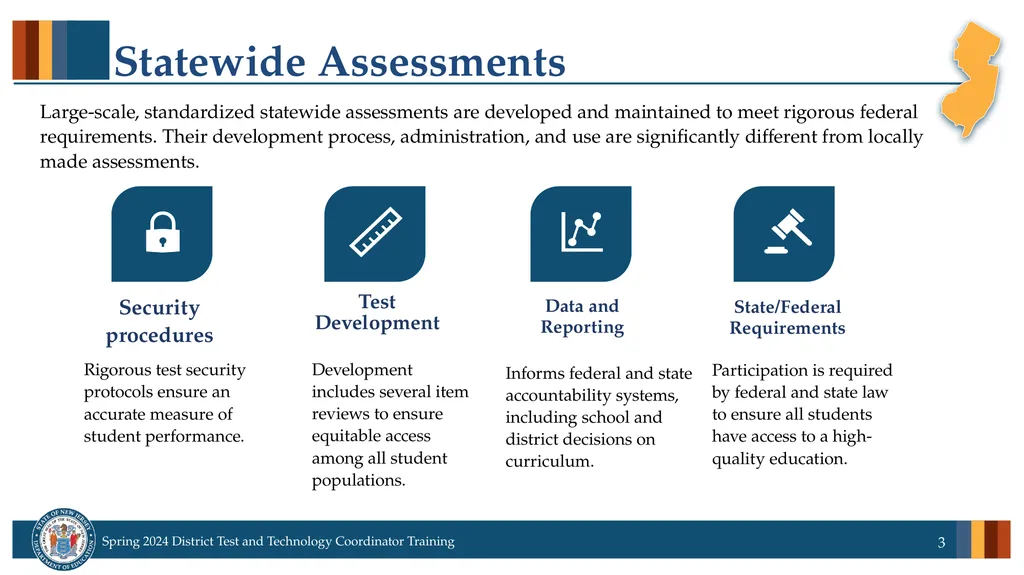
slide3. Statewide Assessments Large-scale, standardized statewide assessments are developed and maintained to meet rigorous federal requirements. Their development process, administration, and use are significantly different from locally made assessments. Security procedures Rigorous test security protocols ensure an accurate measure of student performance. Test Development Development includes several item reviews to ensure equitable access among all student populations. Data and Reporting Informs federal and state accountability systems, including school and district decisions on curriculum. State/Federal Requirements Participation is required by federal and state law to ensure all students have access to a high-quality education. 3<br>
slide4. NJDOE Contact Information When contacting the appropriate grade-level coordinator:
Please include your name and phone number, along with the extension.
Do not include any student personally identifiable information (PII) - only provide the PAN session name and the last 4 digits of the state student identifier (SSID).
Do not send the same email to multiple coordinators. 4<br>
slide5. Vendor Support Contact NJSLA and NJGPA Customer Support: 888-705-9416 Press “1” for assistance with Live Testing.
Press ”2” for assistance with ELA, Mathematics and/or Science.
Press ”3” for assistance with user ID/password for PearsonAccessnext (PAN). 5<br>
slide6. Additional NJDOE Contacts Annual Progress Targets, and Student Accountability
Office of Performance Management
performancemanagement@doe.nj.gov
Multilingual Learners, Title III, Bilingual Education
Office of Supplemental Educational Programs
Phone Number: 609-376-9080
ML@doe.nj.gov
School Performance Reports
Office of Performance Management
reportcard@doe.nj.gov
Students with Disabilities
Office of Special Education
Phone Number: 609-376-9060
OSEinfo@doe.nj.gov 6<br>
slide7. Graduation Assessment Requirement<br>
slide8. NJGPA Overview (1 of 3) Statute requires the state graduation proficiency assessment to be administered to all grade 11 students (N.J.S.A. 18A:7C-6).
NJGPA is designed to measure the extent to which students are graduation ready in English Language Arts (ELA) and Mathematics.
The ELA component is aligned to the grade 10 standards.
The Mathematics component is aligned to Algebra I and Geometry standards.
Graduation readiness is reported separately for each content component. 8<br>
slide9. NJGPA Overview (2 of 3) Students who take but do not meet the minimum required score on each component of the assessment will have the opportunity to receive additional supports and may take the following steps:
Retake the ELA and/or mathematics components of the NJGPA in the following summer or fall;
Meet a designated cut score from the menu of substitute competency tests; or
Complete a portfolio appeal. 9<br>
slide10. NJGPA Overview (3 of 3) Students currently in grade 11 (class of 2025) must take the NJGPA during the spring 2024 administration to satisfy the state graduation assessment requirement.
Students currently in grade 12 who have not yet taken one or both components of the NJGPA and who are expected to graduate in the class of 2024 (by August 31, 2024) must take the necessary component(s) of NJGPA during the spring 2024 administration.
Students may not access second or third pathway scores until after both components of NJGPA have been taken.
Only students who meet the eligibility criteria for the Dynamic Learning Maps (DLM) may be identified as exempt from taking NJGPA. 10<br>
slide11. Graduation Assessment Requirement Classes of 2024 and 2025 (1 of 6) On May 3, 2023, the New Jersey State Board of Education approved the proficiency level cut score for the ELA and mathematics components of the NJGPA, as well as the menu of substitute competency tests and aligned cut scores.
The requirements for the classes of 2024 and 2025 are available on the Graduation Assessment Requirements webpage. 11<br>
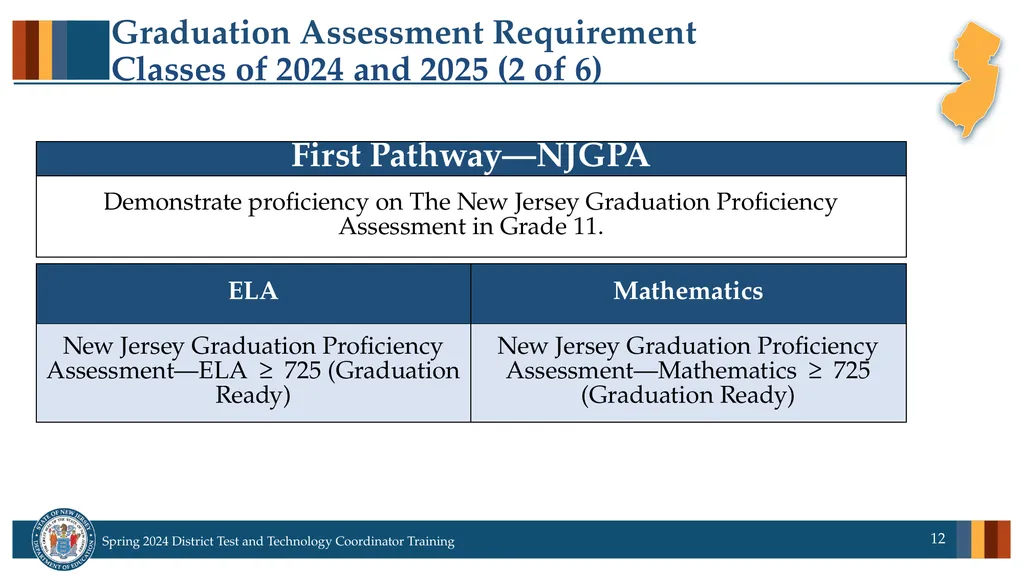
slide12. Graduation Assessment Requirement Classes of 2024 and 2025 (2 of 6) 12<br>
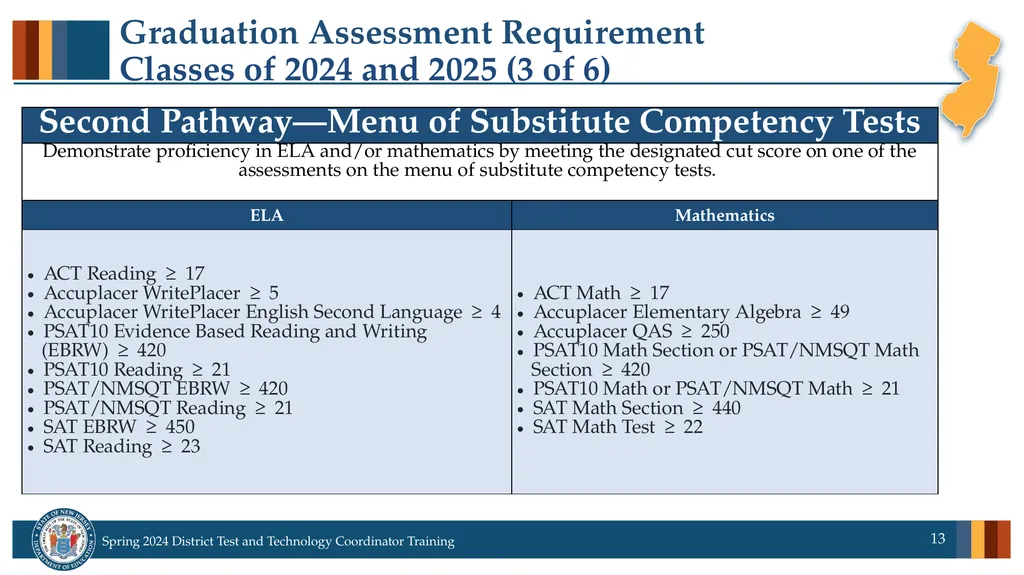
slide13. Graduation Assessment Requirement Classes of 2024 and 2025 (3 of 6) 13<br>
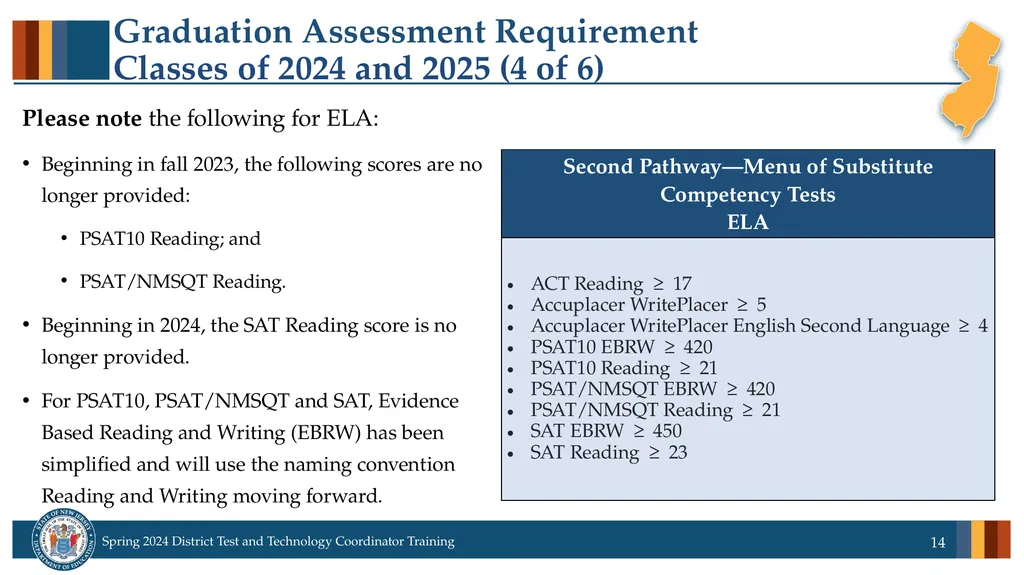
slide14. Graduation Assessment Requirement Classes of 2024 and 2025 (4 of 6) Please note the following for ELA:
Beginning in fall 2023, the following scores are no longer provided:
PSAT10 Reading; and
PSAT/NMSQT Reading.
Beginning in 2024, the SAT Reading score is no longer provided.
For PSAT10, PSAT/NMSQT and SAT, Evidence Based Reading and Writing (EBRW) has been simplified and will use the naming convention Reading and Writing moving forward. 14<br>
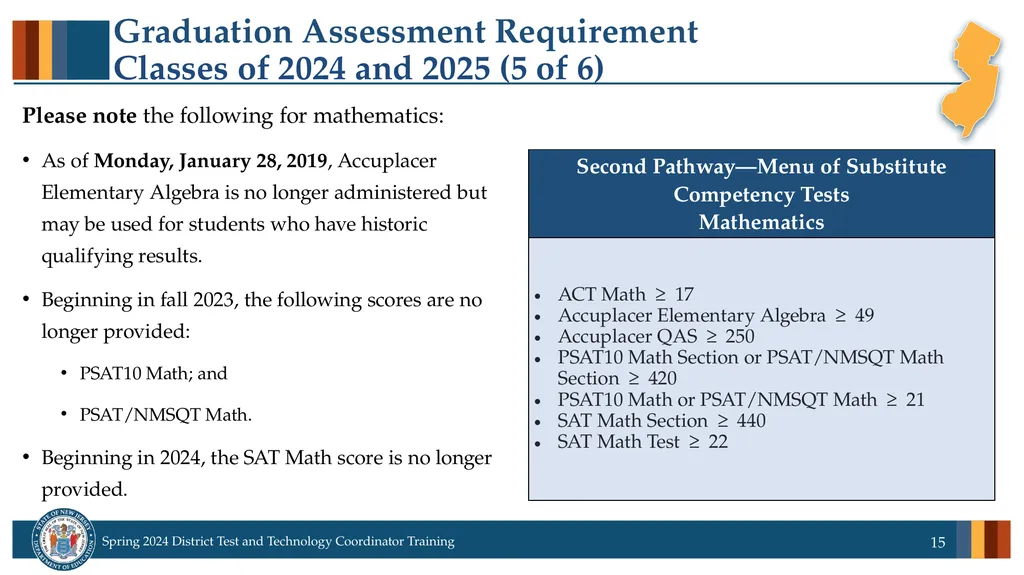
slide15. Graduation Assessment Requirement Classes of 2024 and 2025 (5 of 6) Please note the following for mathematics:
As of Monday, January 28, 2019, Accuplacer Elementary Algebra is no longer administered but may be used for students who have historic qualifying results.
Beginning in fall 2023, the following scores are no longer provided:
PSAT10 Math; and
PSAT/NMSQT Math.
Beginning in 2024, the SAT Math score is no longer provided. 15<br>
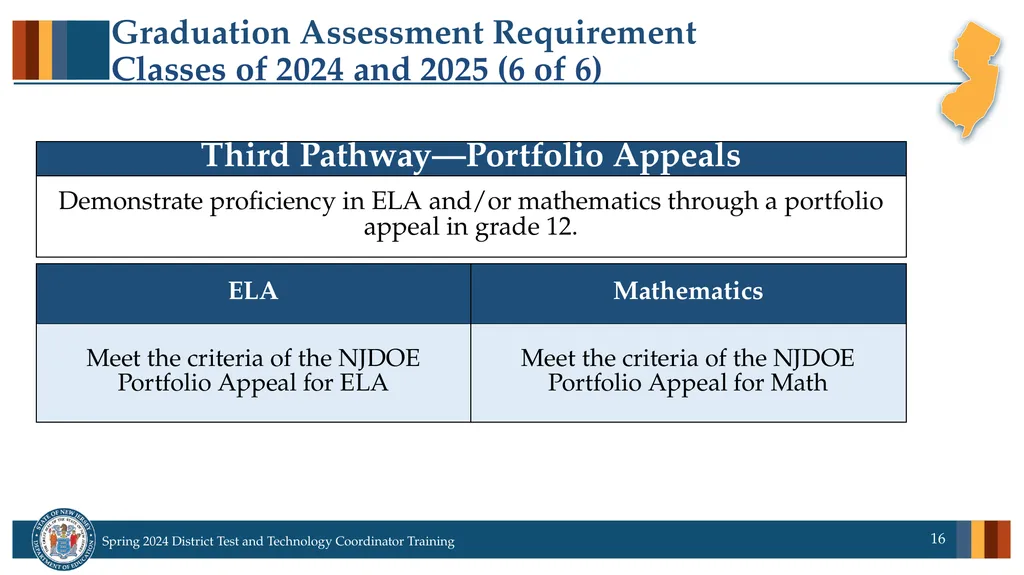
slide16. Graduation Assessment Requirement Classes of 2024 and 2025 (6 of 6) 16<br>
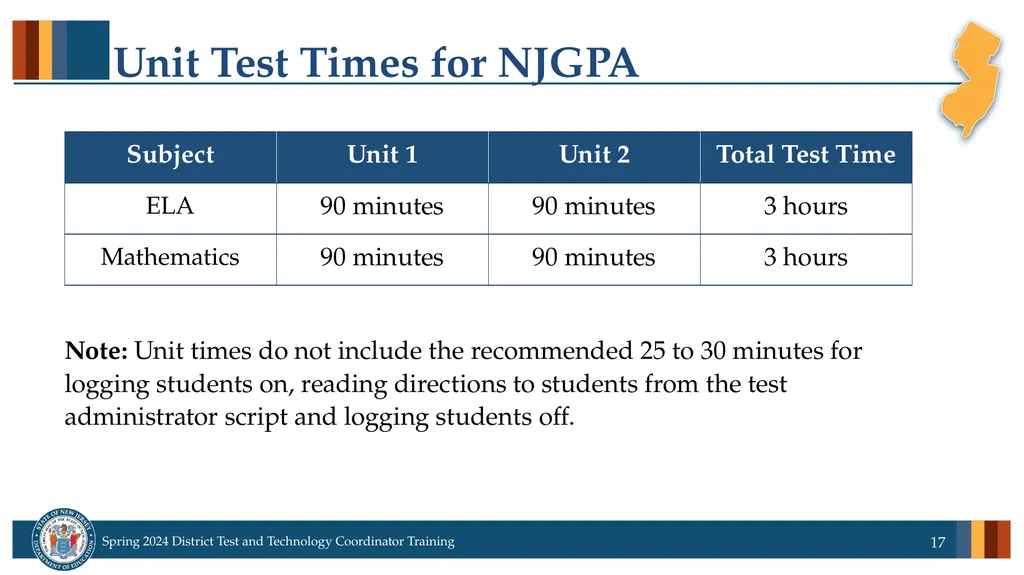
slide17. Unit Test Times for NJGPA Note: Unit times do not include the recommended 25 to 30 minutes for logging students on, reading directions to students from the test administrator script and logging students off. 17<br>
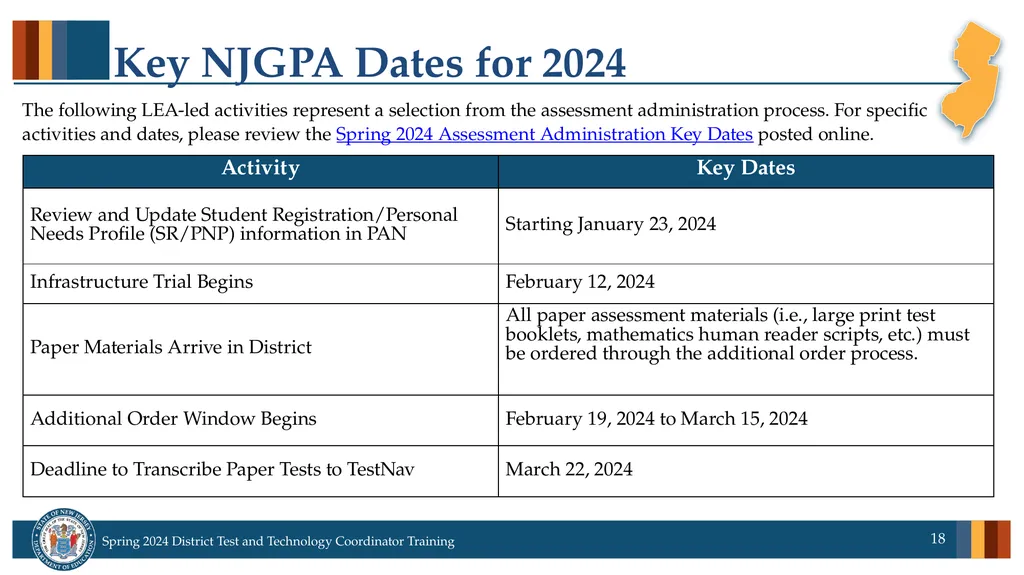
slide18. Key NJGPA Dates for 2024 The following LEA-led activities represent a selection from the assessment administration process. For specific activities and dates, please review the Spring 2024 Assessment Administration Key Dates posted online. 18<br>
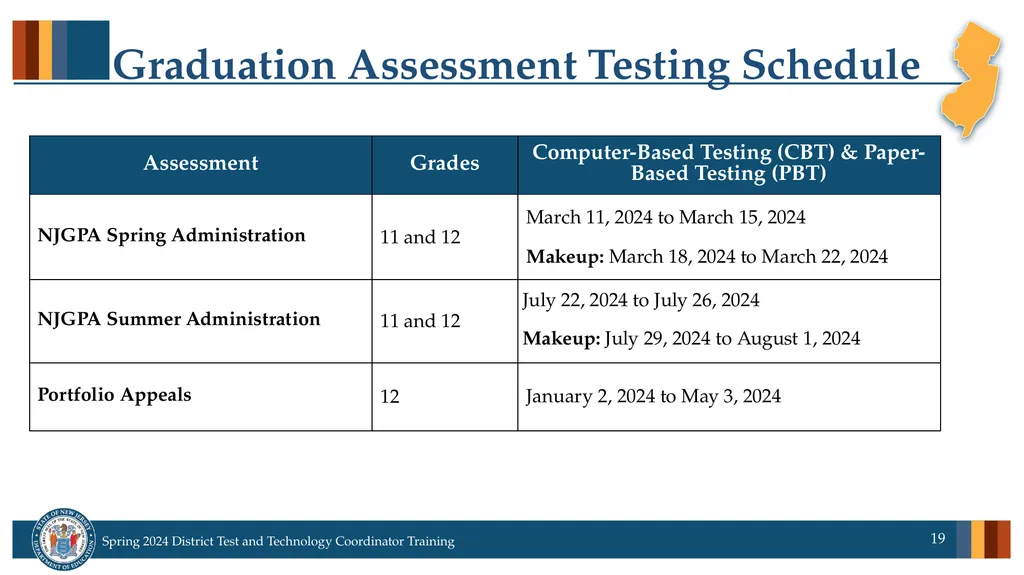
slide19. Graduation Assessment Testing Schedule 19<br>
slide20. Federal Accountability Updates<br>
slide21. Adjusted Rules for Calculating the Academic Achievement Indicator for High School Mathematics In response to the federal Performance Review, the NJDOE has adjusted its rules for calculating the academic achievement indicator for mathematics. Under the Every Student Succeeds Act (ESSA), all students must test at least once in high school and the academic achievement indicator must measure participation and proficiency based on the required high school assessment.
Participation and proficiency calculations are no longer based on students taking end-of-course mathematics assessments in grades 9 and 10, regardless of which assessment was taken (Algebra I, Geometry, or Algebra II).
Under the adjusted rules, all high school students taking Algebra I, regardless of grade level, or who qualify for an approved exception, will be included in the calculation.
Please note these changes are to comply with federal accountability rules; the NJGPA is administered to comply with state law and cannot be used for federal accountability purposes. 21<br>
slide22. ESSA Required High School Mathematics Assessment To meet ESSA requirements, all students must take the Algebra I state assessment in high school with the following exceptions:
Students who take the DLM mathematics assessment in high school.
Students who took the Algebra I state assessment in middle school.
Students who have not taken both Geometry and Algebra II in middle school must take either Geometry or Algebra II in high school.
Students who take Algebra I or Geometry in grade 6 are required to take both the Mathematics Grade 6 and the corresponding end-of-course assessment (Algebra I or Geometry) as 6th graders; the end-of-course assessment results will be used to meet the ESSA high school mathematics requirements when the student enters grade 9.
Students who do not take Algebra I, or qualify for one of the exceptions listed, will be counted as non-participants in participation calculations as grade 12 students.
Note: If LEAs have unique scenarios where students would complete all three high school mathematics courses in middle school but started taking high school mathematics courses after grade 6, they should contact the Office of Assessments to establish a plan that ensures students will meet the federal testing requirement. 22<br>
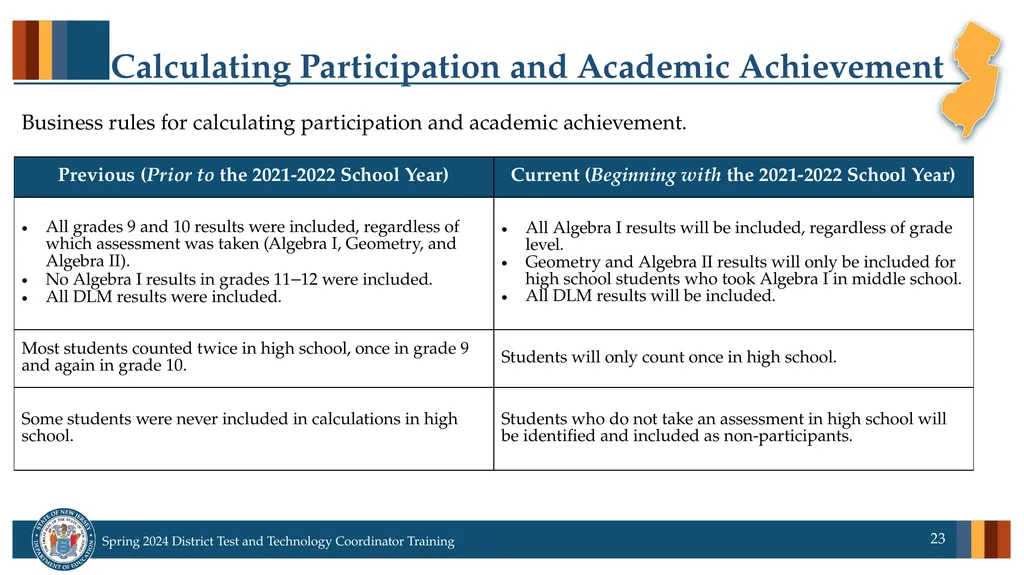
slide23. Calculating Participation and Academic Achievement Business rules for calculating participation and academic achievement. 23<br>
slide24. Grade 12 Non-Participants To ensure that all students are included once in high school:
The NJDOE will continue to count students who register for Algebra I and do not take the assessment, as non-participants in the year that they register for the assessment.
The NJDOE will annually review all grade 12 students to ensure that they have taken Algebra I or qualify for an approved exception (see previous slides) in high school.
The NJDOE will use the information submitted by districts at the end of the school year in the NJ SMART SID Management "FederalHSMathTestingReq" field, along with historical assessment and course data, to identify grade 12 students who have not met the federal high school testing requirement for mathematics.
Grade 12 students who have been identified as not having met the federal high school testing requirement and who have not previously been included as a non-participant will be included in the denominator of the participation calculation. 24<br>
slide25. Scheduling<br>
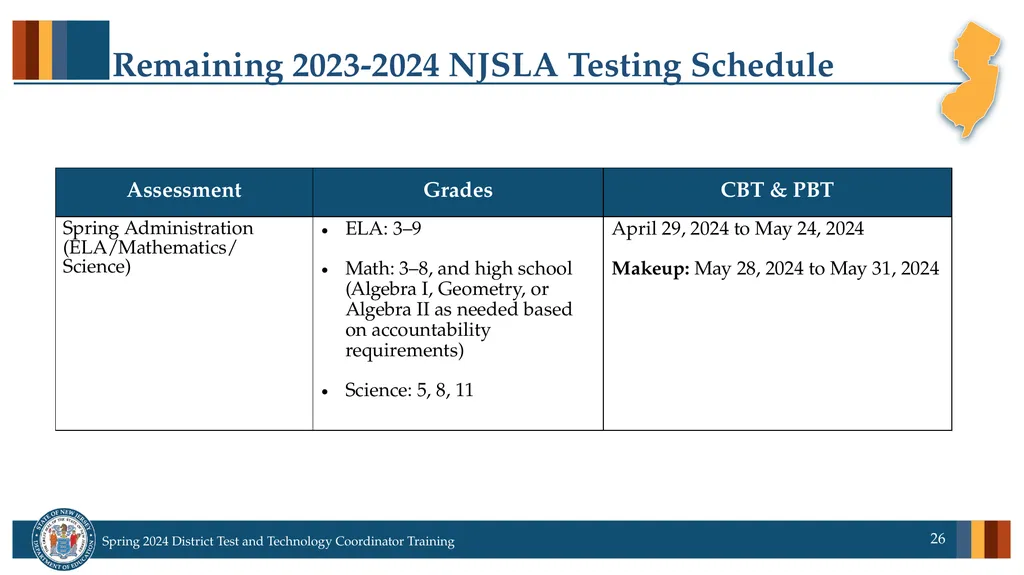
slide26. Remaining 2023-2024 NJSLA Testing Schedule 26<br>
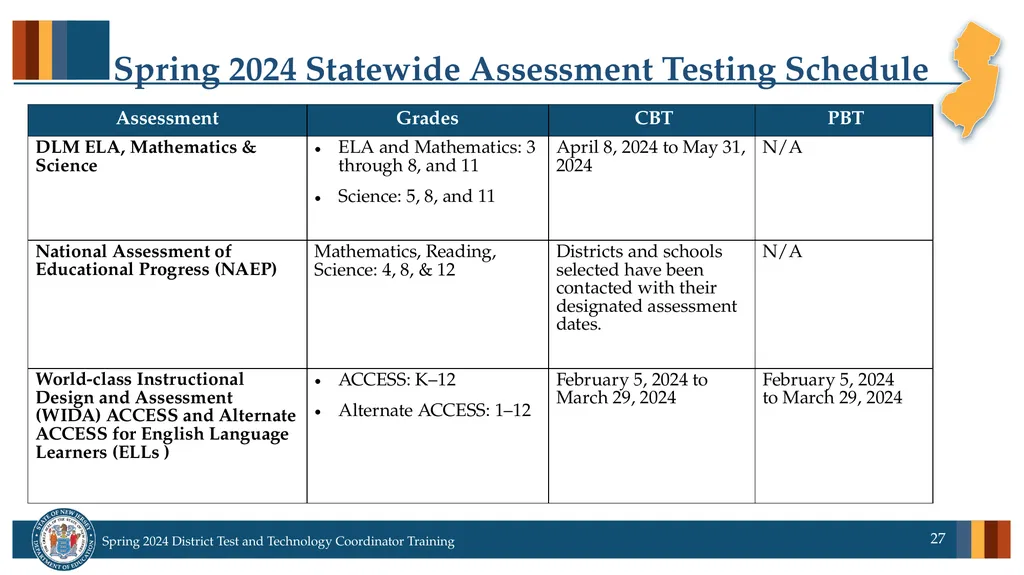
slide27. Spring 2024 Statewide Assessment Testing Schedule 27<br>
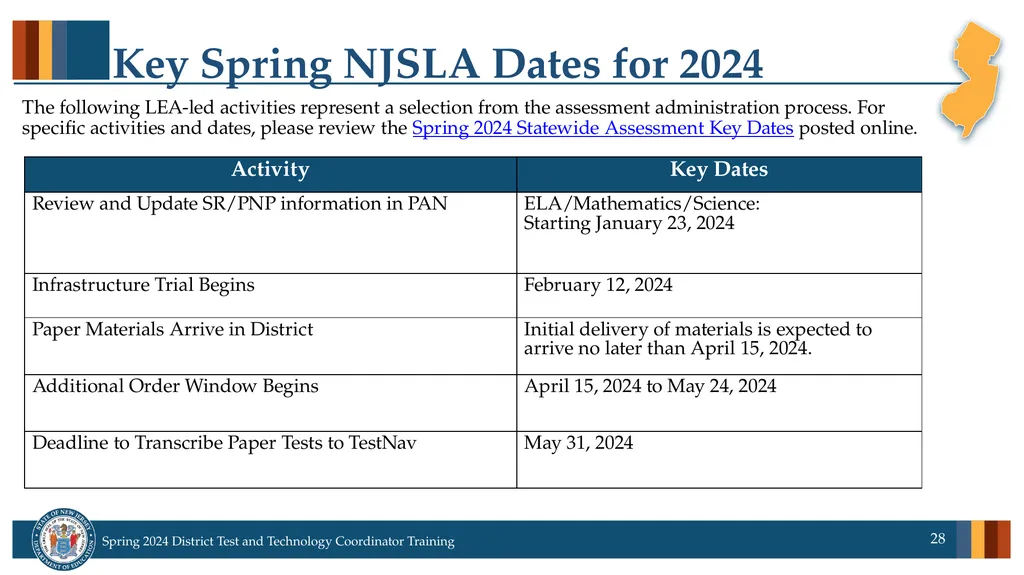
slide28. Key Spring NJSLA Dates for 2024 The following LEA-led activities represent a selection from the assessment administration process. For specific activities and dates, please review the Spring 2024 Statewide Assessment Key Dates posted online. 28<br>
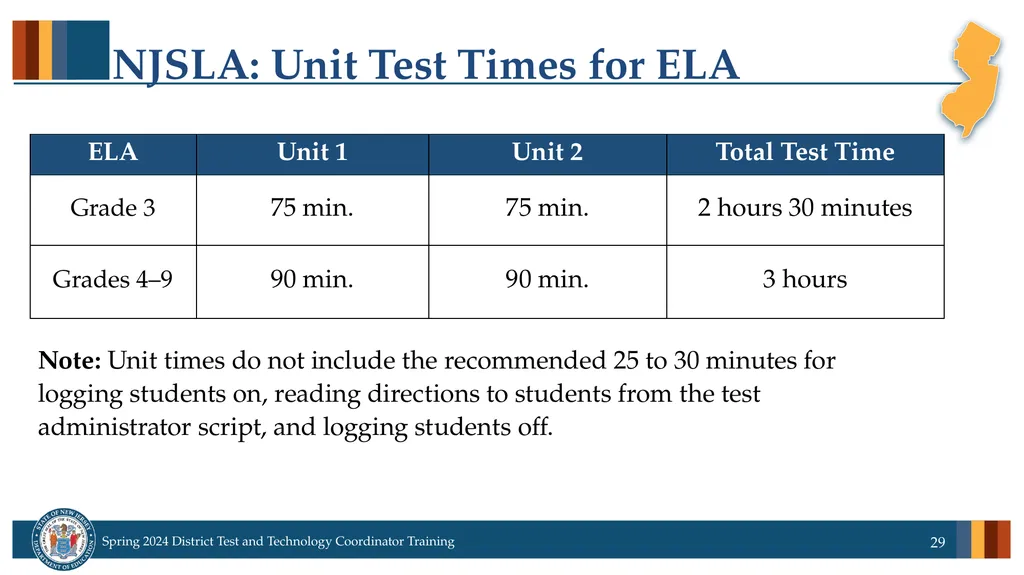
slide29. NJSLA: Unit Test Times for ELA Note: Unit times do not include the recommended 25 to 30 minutes for logging students on, reading directions to students from the test administrator script, and logging students off. 29<br>
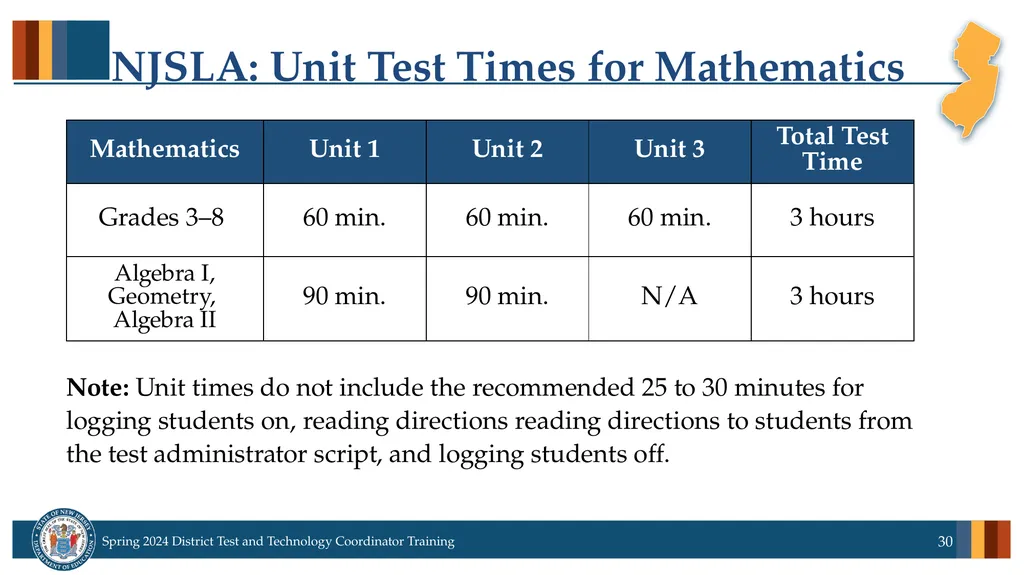
slide30. NJSLA: Unit Test Times for Mathematics Note: Unit times do not include the recommended 25 to 30 minutes for logging students on, reading directions reading directions to students from the test administrator script, and logging students off. 30<br>
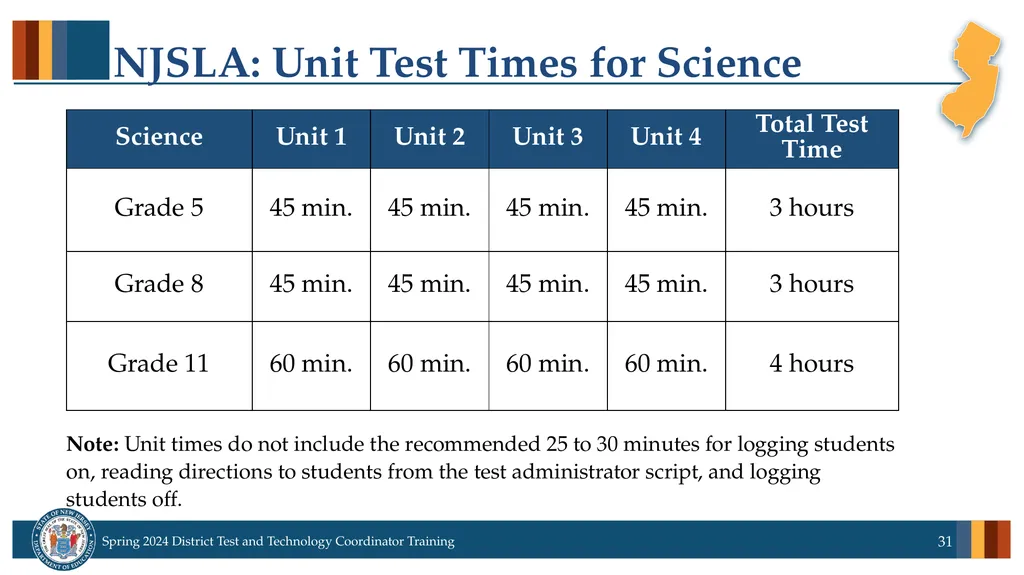
slide31. NJSLA: Unit Test Times for Science Note: Unit times do not include the recommended 25 to 30 minutes for logging students on, reading directions to students from the test administrator script, and logging students off. 31<br>
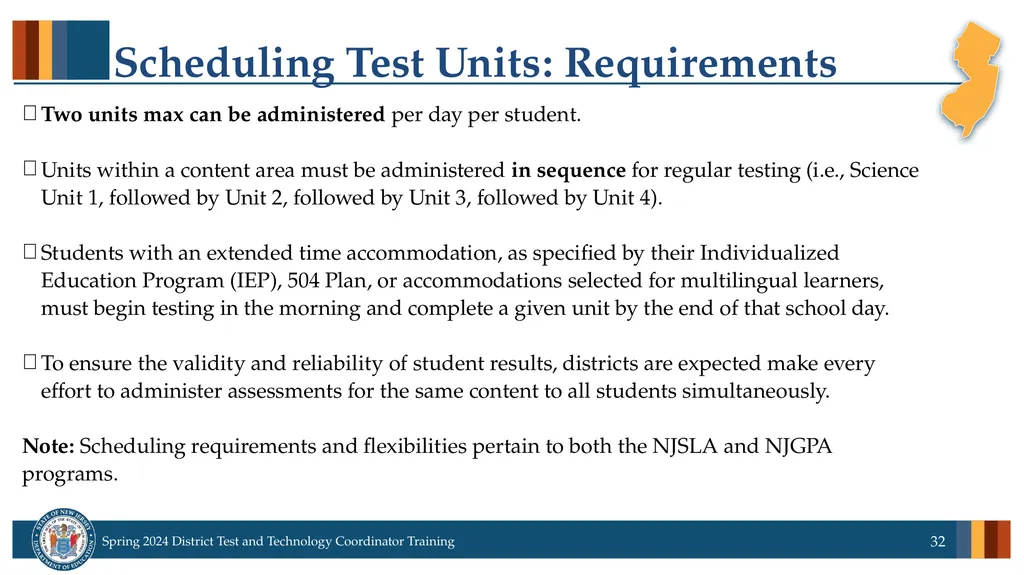
slide32. Scheduling Test Units: Requirements Two units max can be administered per day per student.
Units within a content area must be administered in sequence for regular testing (i.e., Science Unit 1, followed by Unit 2, followed by Unit 3, followed by Unit 4).
Students with an extended time accommodation, as specified by their Individualized Education Program (IEP), 504 Plan, or accommodations selected for multilingual learners, must begin testing in the morning and complete a given unit by the end of that school day.
To ensure the validity and reliability of student results, districts are expected make every effort to administer assessments for the same content to all students simultaneously.
Note: Scheduling requirements and flexibilities pertain to both the NJSLA and NJGPA programs. 32<br>
slide33. Scheduling Test Units: Flexibilities Testing may be scheduled for any school day during the testing window.
Absent students can resume testing with their assigned group and be assigned to make-up sessions for units missed.
No special order is required for administration by grade or content area (mathematics followed by ELA or ELA followed by science, etc.).
Back-to-back units are permitted; students must have a supervised break between units.
Multiple groups of students can be scheduled in a single day (AM Group 1 takes two units; PM Group 2 takes two units, etc.).
If necessary, grades may be combined for the same content area if unit test times and read aloud test directions are the same. 33<br>
slide34. Emergency Closing and Scheduling Problems Delayed Opening or Anticipated Early Release:
Proceed with testing only if there is adequate time to complete the unit(s).
If testing is cancelled for the day:
Reschedule the cancelled unit by either pushing the entire schedule forward or rescheduling the cancelled units for make-up testing.
Complete an Irregularity Report (IR) form.
Upload the IR to PAN.
Email the upload confirmation number to the NJDOE appropriate state assessment coordinator (see Contacts slide). 34<br>
slide35. Incomplete, Interrupted, Early Release or Power Outage Problems If students are unable to complete a started unit, the following steps must be taken: The Test Administrator (TA) must:
Document the time remaining on the clock at the time of interruption.
Guide students to log out of TestNav on the testing devices.
Confirm that no students display as actively testing in PAN.
Lock all unlocked units in PAN.
Secure all testing devices, and secure test materials according to district’s security plan. The DTC must:
Reschedule the incomplete unit for next available day.
Complete IR.
Upload the IR to PAN.
Email the upload confirmation number to the appropriate state assessment coordinator. 35<br>
slide36. Testing Requirements<br>
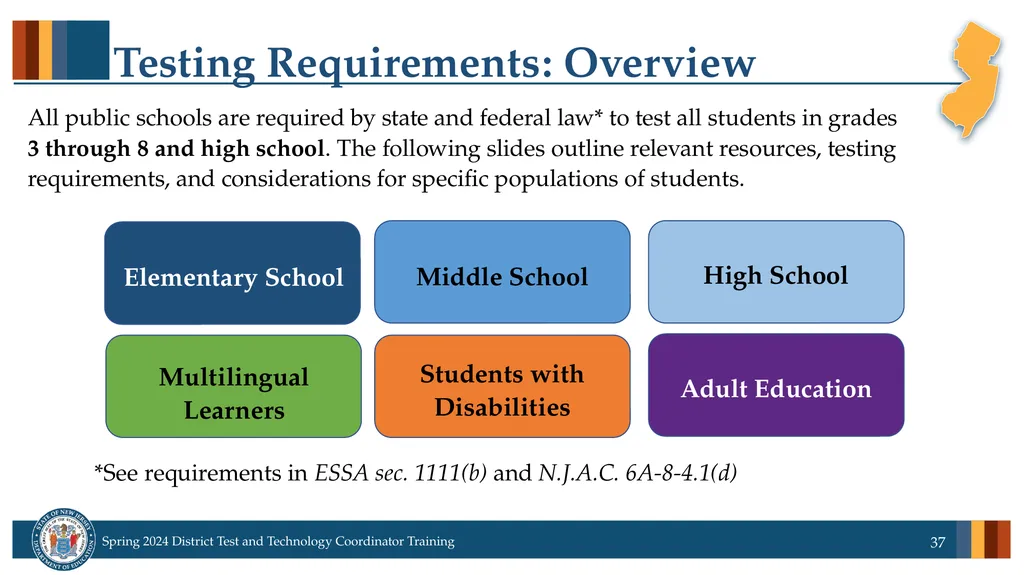
slide37. Testing Requirements: Overview All public schools are required by state and federal law* to test all students in grades 3 through 8 and high school. The following slides outline relevant resources, testing requirements, and considerations for specific populations of students. Elementary School Middle School High School Multilingual Learners Students with Disabilities Adult Education *See requirements in ESSA sec. 1111(b) and N.J.A.C. 6A-8-4.1(d) 37<br>
slide38. Who Must Test: Helpful Resources The following resources should be referenced in tandem with the information provided in this section of the presentation:
Test Coordinator Manual (TCM) (Section 1.3 Who Must Test) available on the New Jersey Assessments Resource Center under Educator Resources > Test Administration Resources.
State Assessment Registration Submission FAQ on the NJ SMART Resources and Trainings site under Documents for Download > State Assessment Registration Submission. 38<br>
slide39. Who Must Test: Grades 3 through 5 All students in grades 3 through 5 are expected to participate in statewide assessments for ELA and mathematics based on their current grade level enrollment, not on the level of instruction received during the academic school year.
Students in grade 5 must take the grade 5 science assessment.
Elementary students with disabilities, except those with the most significant intellectual disabilities who qualify for the DLM, must participate in the NJSLA. Elementary School 39<br>
slide40. Who Must Test: Grades 6 through 8 (1 of 3) All students in grades 6 through 8 are expected to participate in statewide assessments for ELA and mathematics based on their current grade level enrollment, not on the level of instruction received during the academic school year.
The only exception is for students in grades 6 through 8 who are taking any of the high school mathematics courses (i.e., Algebra I, Geometry, Algebra II).
Students in grade 6 who are enrolled in Algebra I or Geometry are expected to take both the NJSLA Mathematics Grade 6 assessment and the corresponding NJSLA high school end-of-course assessment (Algebra I or Geometry).
Students in grades 7 and 8 enrolled in a one-year Algebra I, Geometry or Algebra II course must take the end-of-course assessment (i.e., Algebra I, Geometry, or Algebra II) that matches their mathematics course enrollment instead of their grade-level mathematics assessment. Middle School 40<br>
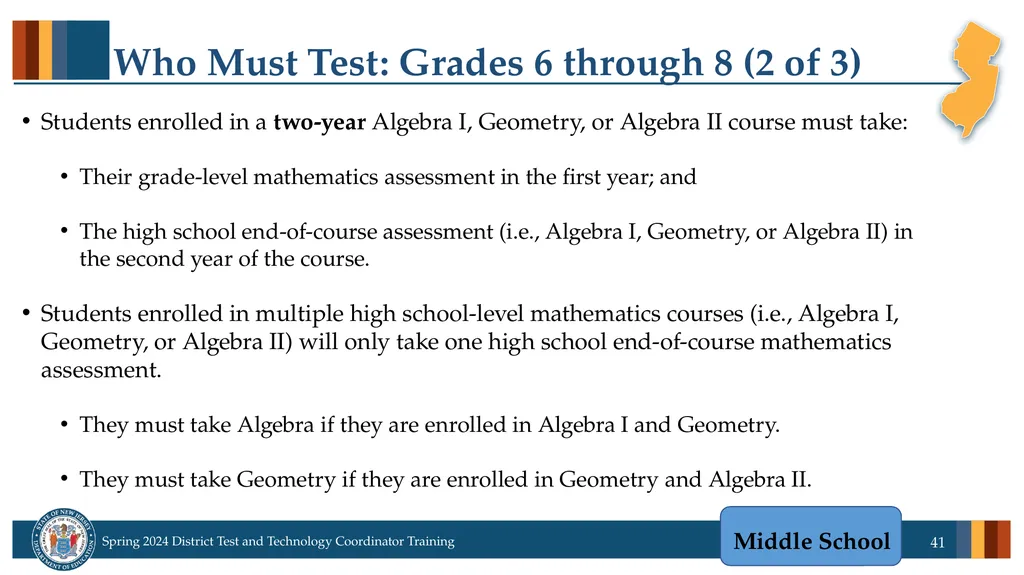
slide41. Who Must Test: Grades 6 through 8 (2 of 3) Students enrolled in a two-year Algebra I, Geometry, or Algebra II course must take:
Their grade-level mathematics assessment in the first year; and
The high school end-of-course assessment (i.e., Algebra I, Geometry, or Algebra II) in the second year of the course.
Students enrolled in multiple high school-level mathematics courses (i.e., Algebra I, Geometry, or Algebra II) will only take one high school end-of-course mathematics assessment.
They must take Algebra if they are enrolled in Algebra I and Geometry.
They must take Geometry if they are enrolled in Geometry and Algebra II. Middle School 41<br>
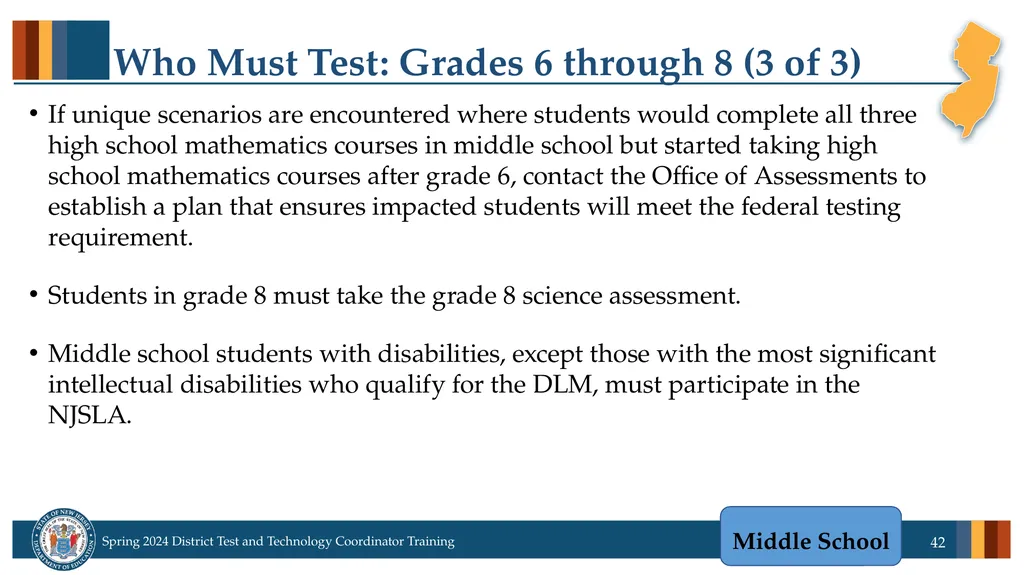
slide42. Who Must Test: Grades 6 through 8 (3 of 3) If unique scenarios are encountered where students would complete all three high school mathematics courses in middle school but started taking high school mathematics courses after grade 6, contact the Office of Assessments to establish a plan that ensures impacted students will meet the federal testing requirement.
Students in grade 8 must take the grade 8 science assessment.
Middle school students with disabilities, except those with the most significant intellectual disabilities who qualify for the DLM, must participate in the NJSLA. Middle School 42<br>
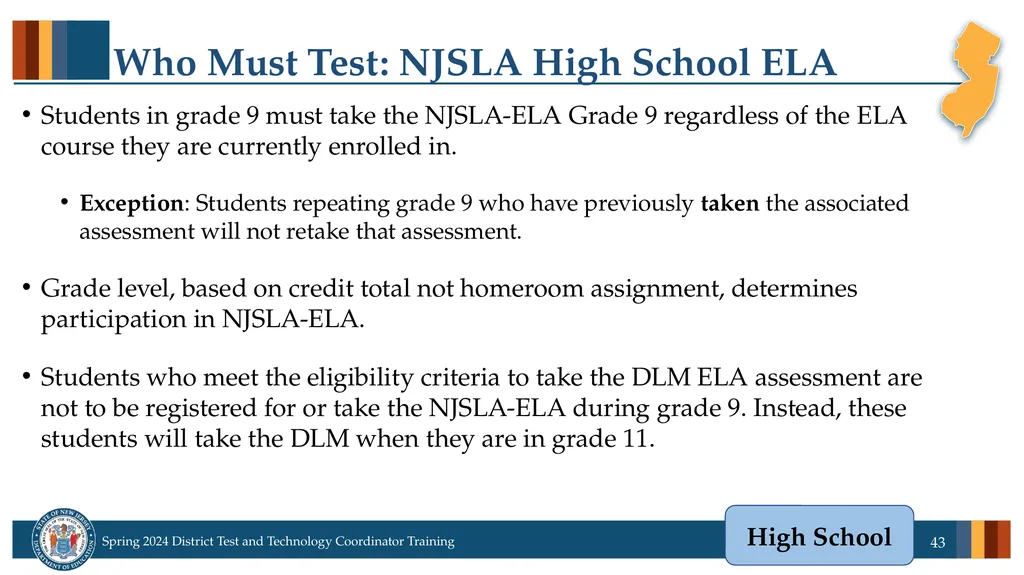
slide43. Who Must Test: NJSLA High School ELA Students in grade 9 must take the NJSLA-ELA Grade 9 regardless of the ELA course they are currently enrolled in.
Exception: Students repeating grade 9 who have previously taken the associated assessment will not retake that assessment.
Grade level, based on credit total not homeroom assignment, determines participation in NJSLA-ELA.
Students who meet the eligibility criteria to take the DLM ELA assessment are not to be registered for or take the NJSLA-ELA during grade 9. Instead, these students will take the DLM when they are in grade 11. High School 43<br>
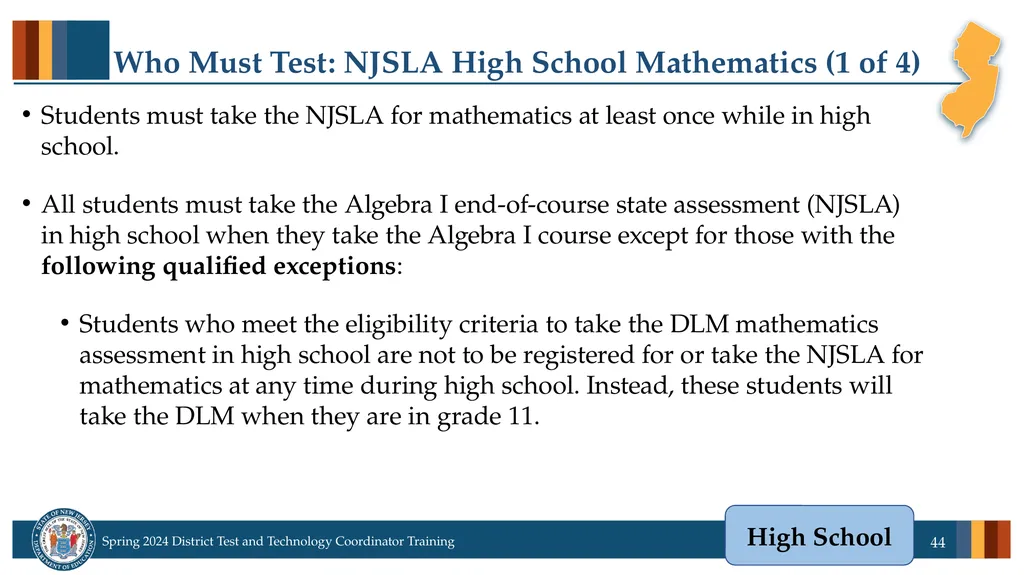
slide44. Who Must Test: NJSLA High School Mathematics (1 of 4) Students must take the NJSLA for mathematics at least once while in high school.
All students must take the Algebra I end-of-course state assessment (NJSLA) in high school when they take the Algebra I course except for those with the following qualified exceptions:
Students who meet the eligibility criteria to take the DLM mathematics assessment in high school are not to be registered for or take the NJSLA for mathematics at any time during high school. Instead, these students will take the DLM when they are in grade 11. High School 44<br>
slide45. Who Must Test: NJSLA High School Mathematics (2 of 4) All students must take the Algebra I end-of-course state assessment (NJSLA) in high school when they take the Algebra I course except for those with the following qualified exceptions (continued):
Students who took the Algebra I NJSLA in middle school must take Geometry or Algebra II, whichever they take first in high school unless they previously took the Geometry or Algebra II assessment while in middle school.
Note: Students who took the Algebra I NJSLA and the Mathematics Grade 6 NJSLA in grade 6 and who completed the entire tested high school mathematics course sequence prior to entering high school will not take an NJSLA for mathematics at any point in high school. The historic Algebra I NJSLA results from grade 6 will be used to meet federal testing requirements for high school mathematics. High School 45<br>
slide46. Who Must Test: NJSLA High School Mathematics (3 of 4) The following must also be considered when determining which high school end-of-course mathematics assessment a student must take:
Any high school mathematic assessment (i.e., Algebra I, Geometry, or Algebra II) that a student took in middle school will not count for the federal testing requirement if the student takes the same assessment again while in high school. Students must take a more advanced assessment in high school to meet the federal testing requirement.
Students enrolled in year one of a two-year Algebra I course, (or a two-year Geometry or Algebra II course if they took Algebra I in middle school) will take the associated high school NJSLA in the second year of the two-year course. High School 46<br>
slide47. Who Must Test: NJSLA High School Mathematics (4 of 4) The following information should also be noted:
Students enrolled in multiple high school-level mathematics courses (Algebra I, Geometry, or Algebra II) are only required to take one high school end-of-course mathematics assessment.
If Algebra I is one of the courses, then students must take Algebra I NJSLA.
If Algebra I was taken in middle school, then students should take Geometry NJSLA.
Most students will take their federally required high school mathematics assessment in grade 9 when they take Algebra I (or Geometry or Algebra II if Algebra I was taken in middle school).
If, after reviewing all available resources, you are unable to determine which assessment a student should take and when, contact the appropriate state coordinator for assistance. High School 47<br>
slide48. Who Must Test: NJSLA High School Science High school students are required to participate in the statewide science assessment in grade 11.
This requirement is determined by credit total, not homeroom assignment.
Example: A student who has attained enough credits to be considered a grade 11 grade student, but has a grade 10 homeroom, would take the science assessment.
Example: A student who has attained enough credits to be considered a grade 12 student, but has a grade 11 homeroom, would not take the science assessment. High School 48<br>
slide49. Who Must Test: Multilingual Learners (1 of 2) All multilingual learners (ML) must take the New Jersey state assessments.
Newly arrived MLs, who enrolled for the first time in a US school after June 1, 2023, may utilize the one-time exemption for the ELA portion of the NJSLA or NJGPA during the 2023-2024 school year. MLs are required to participate in the statewide assessments for mathematics and science.
The one-time ELA exemption is only afforded to students who:
Have met the criteria to be identified as MLs (e.g., eligible for multilingual language services); and
Enrolled for the first time in a US school after June 1 of the prior school. Multilingual Learners 49<br>
slide50. Who Must Test: Multilingual Learners (2 of 2) Note: MLs who utilize the one-time ELA exemption for NJGPA must take the ELA component of NJGPA during a future administration in order to meet the state graduation assessment requirement and gain access to the second and/or third pathway.
MLs enrolled in English as a Second Language (ESL) (beginner, intermediate, or advanced level) must take the ELA assessment associated with their grade level (based on credit total) and not the level of the ESL course. Multilingual Learners 50<br>
slide51. Who Must Test: Students with Disabilities All students, including students with disabilities, are administered statewide assessments.
Most students with disabilities will take the NJSLA and NJGPA with appropriate accommodations and accessibility features.
Students with significant intellectual disabilities who meet specific criteria will be administered the DLM assessments.
Students with disabilities whose IEPs specify an alternative way to demonstrate proficiencies, will continue to follow the graduation assessment requirement set forth in their IEPs.
IEP teams should reserve the exemption of the statewide graduation assessment requirement for students with significant intellectual disabilities and for students with disabilities who have made repeated unsuccessful attempts to meet the statewide graduation assessment requirement through the available pathways, including the portfolio appeals process.
Questions about IEP components concerning the graduation assessment requirement should be directed to the Office of Special Education at oseinfo@doe.nj.gov. Students with Disabilities 51<br>
slide52. Alternate Assessment Eligibility-DLM (1 of 2) Only those students who have a significant intellectual disability should participate in the DLM assessments. This population of students is approximately one percent of students with disabilities. The vast majority of students with disabilities will take the NJSLA with appropriate accommodations. The IEP team will determine which of the NJSLA accommodations the student will receive and document this in the IEP.
Under ESSA, only one percent of the student testing population can take the alternate assessment (DLM).
Anticipated performance on the general education assessment or behavior concerns during testing are not valid reasons for having a student participate in the alternate assessment.
Review the updated DLM Participation Guidelines for further information.
Multilingual learners who take the DLM are eligible to take the WIDA Alternate ACCESS assessment.
Students in grades K through 12 who are identified as multilingual learners with significant intellectual disabilities as reflected in their IEPs and meet or will be eligible to meet New Jersey’s criteria for participation in the Dynamic Learning Maps (DLM) assessment should participate in the WIDA Alternate ACCESS assessment.
Please visit the NJ DLM Webpage for additional resources. Students with Disabilities 52<br>
slide53. Alternate Assessment Eligibility-DLM (2 of 2) Districts that anticipate more than one percent of the LEA’s student testing population taking the DLM assessment can request a waiver.
Review of waiver requests from previous years demonstrated that some LEAs have more than five percent of students taking the alternate assessment.
ESSA requires the NJDOE to conduct activities in LEAs that exceed the one percent cap. This could consist of file review, interviews and technical assistance.
Note – Beginning with the spring 2024 administration, the Accountability District and Accountability School fields in KITE will be mandatory. It is the responsibility of each LEA who administers DLM to ensure the data in these fields is accurate and updated prior to May 29, 2024. Students with Disabilities 53<br>
slide54. Who Must Test: Adult High School Students Adult high school students enrolled in a currently assessed course (Algebra I, Geometry, Algebra II) are not required to take the associated statewide assessment.
Adult high school students who passed any historical statewide assessment will have their passing scores banked and counted toward their graduation testing requirement. These students will not take the current state assessments.
Adult high school students who took, but did not pass, any historical statewide assessments must rely on the alternative pathways or the portfolio appeals process to meet the graduation assessment requirement for that content. Adult Education 54<br>
slide55. Homebound Students, Bedside Instruction, and Non-Testing Out-of-District Placements LEAs are required to test students receiving homebound or bedside instruction, as well as students in an out-of-district placement.
For example, this includes students receiving educational services at placements covered under the Naples Act.
Students should be tested during the hours they normally receive instruction.
Any accommodation(s) specified for state assessments should be in alignment with those routinely used by students during classroom instruction and locally-administered assessments. 55<br>
slide56. Homebound Students, Bedside Instruction, and Non-Testing Out-of-District Placements: TA Requirements TA Qualifications and Requirements
Licensed professional employed by the district
Trained by the DTC or School Test Coordinator (STC)
Signs appropriate chain of custody forms and test security agreement
Maintains test security at all times
Has access to Technology Coordinator and STC for support and guidance
Returns all secure testing materials to the STC or DTC as soon as possible after testing is completed Guidance for administering assessments to homebound, bedside, and non-testing Out-of-District placement students can be found on the New Jersey Assessments Resource Center under > Educator Resources > Test Admiration Resources > Testing Resources. 56<br>
slide57. Testing Site Requirements (1 of 2) Students must be:
Well-spaced with ample surface area.
Provided assigned seating.
Provided good lighting and ventilation.
TAs must:
Use clock and chart to display time remaining.
Never leave students unattended.
Always supervise students including during restroom breaks.
DTCs and STCs must:
Ensure hallways are monitored to keep testing rooms undisturbed.
Post “Testing Do Not Disturb” signs on testing room doors. 57<br>
slide58. Testing Site Requirements (2 of 2) The following behaviors and materials are not permitted in testing rooms:
Coats, backpacks, or purses.
Instructional displays.
Buzzers, bells, or non-emergency announcements or interruptions during testing.
Cell phones, MP3 players or any unauthorized electronics.
Food or beverages (except if permitted by IEP or 504 plan).
Note: This list is not exhaustive. 58<br>
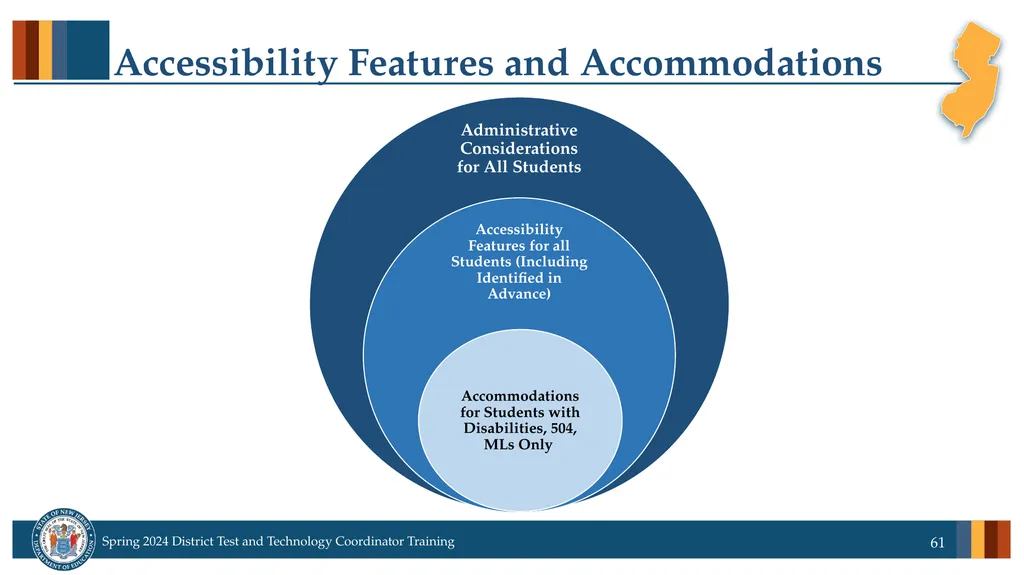
slide59. Accessibility Features and Accommodations<br>
slide60. Accessibility Features: Overview The purpose of administrative considerations, accessibility features, and accommodations is to remove barriers to accessing the assessment content for all participating students.
These features do not provide advantages to student performance; they enable students with specific needs to access the assessment content to demonstrate their proficiency.
Some features are readily available for student use, and some must be identified in advance and enabled in a student's SR/PNP data file.
Use student data and set planning meetings with teachers and special education support staff to ensure students receive the supports they need. 60<br>
slide61. Accessibility Features and Accommodations 61<br>
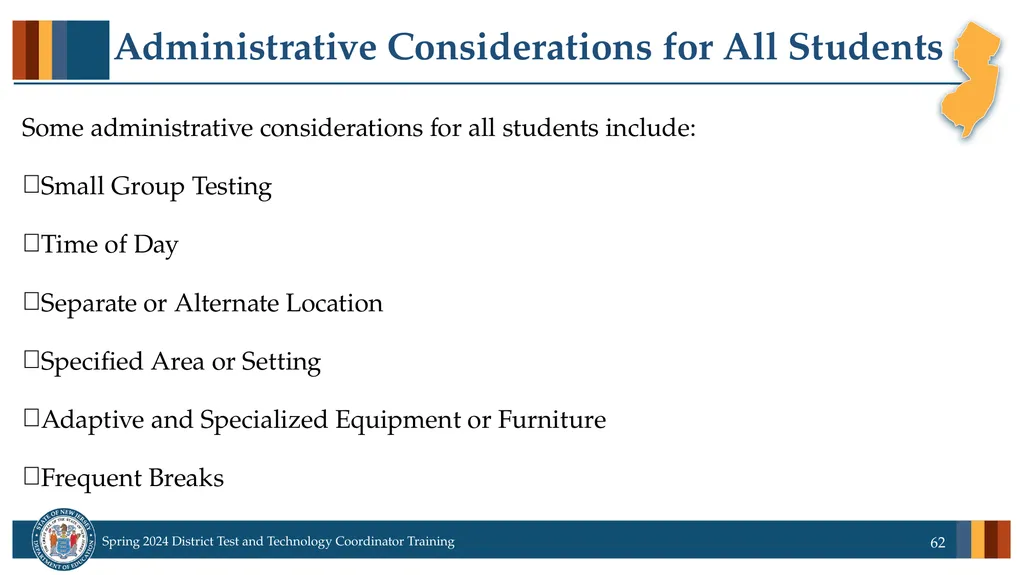
slide62. Administrative Considerations for All Students Some administrative considerations for all students include:
Small Group Testing
Time of Day
Separate or Alternate Location
Specified Area or Setting
Adaptive and Specialized Equipment or Furniture
Frequent Breaks 62<br>
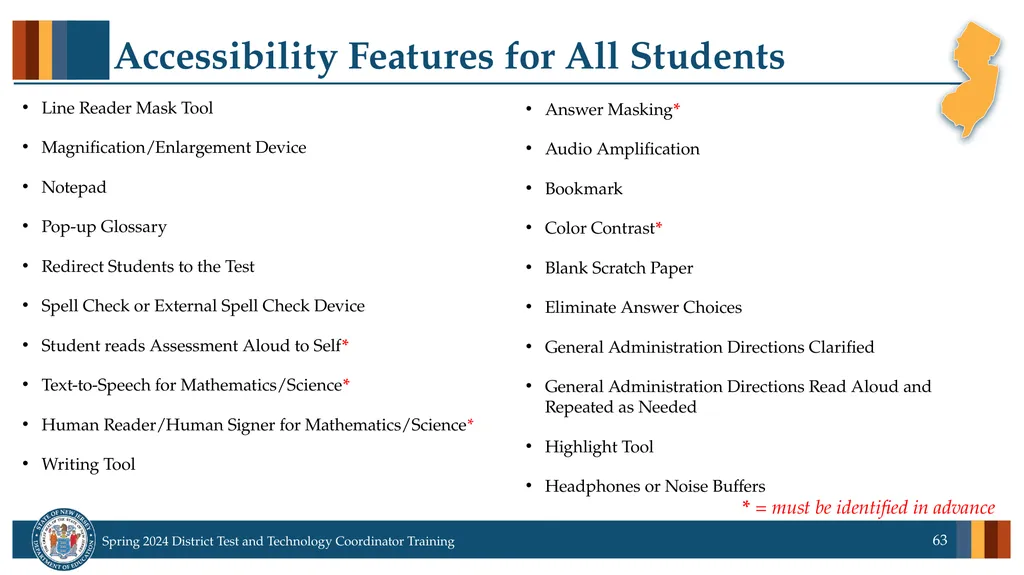
slide63. Accessibility Features for All Students Line Reader Mask Tool
Magnification/Enlargement Device
Notepad
Pop-up Glossary
Redirect Students to the Test
Spell Check or External Spell Check Device
Student reads Assessment Aloud to Self*
Text-to-Speech for Mathematics/Science*
Human Reader/Human Signer for Mathematics/Science*
Writing Tool Answer Masking*
Audio Amplification
Bookmark
Color Contrast*
Blank Scratch Paper
Eliminate Answer Choices
General Administration Directions Clarified
General Administration Directions Read Aloud and Repeated as Needed
Highlight Tool
Headphones or Noise Buffers * = must be identified in advance 63<br>
slide64. Accommodations for Students with Disabilities IEP or Section 504 Plan teams are responsible for making all accommodation decisions.
Accommodations must be documented in an approved IEP or 504 plan.
Students should have prior experience using the accommodation routinely during classroom instruction and on locally-administered assessments. 64<br>
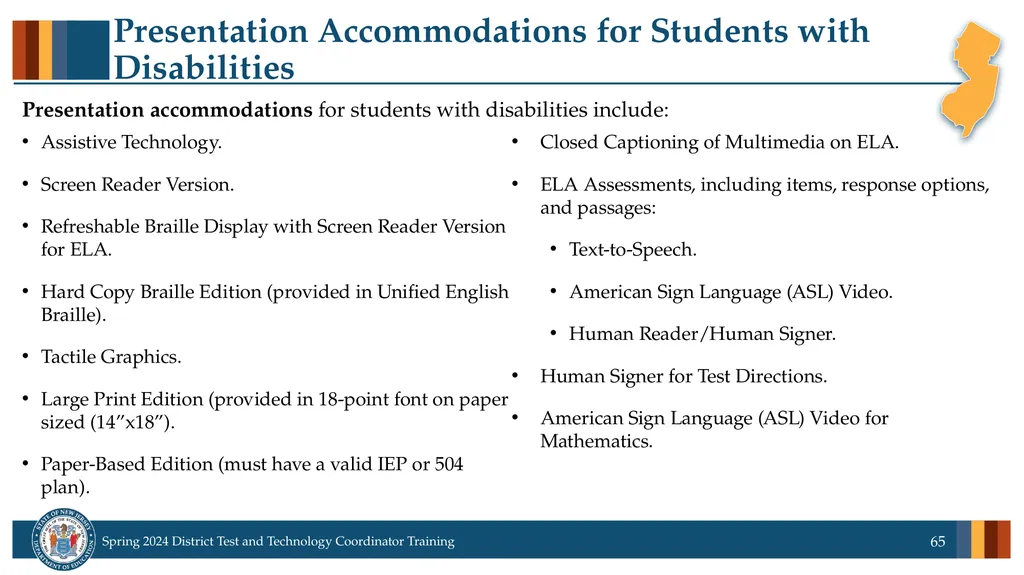
slide65. Presentation Accommodations for Students with Disabilities Presentation accommodations for students with disabilities include: Assistive Technology.
Screen Reader Version.
Refreshable Braille Display with Screen Reader Version for ELA.
Hard Copy Braille Edition (provided in Unified English Braille).
Tactile Graphics.
Large Print Edition (provided in 18-point font on paper sized (14”x18”).
Paper-Based Edition (must have a valid IEP or 504 plan).
Closed Captioning of Multimedia on ELA.
ELA Assessments, including items, response options, and passages:
Text-to-Speech.
American Sign Language (ASL) Video.
Human Reader/Human Signer.
Human Signer for Test Directions.
American Sign Language (ASL) Video for Mathematics. 65<br>
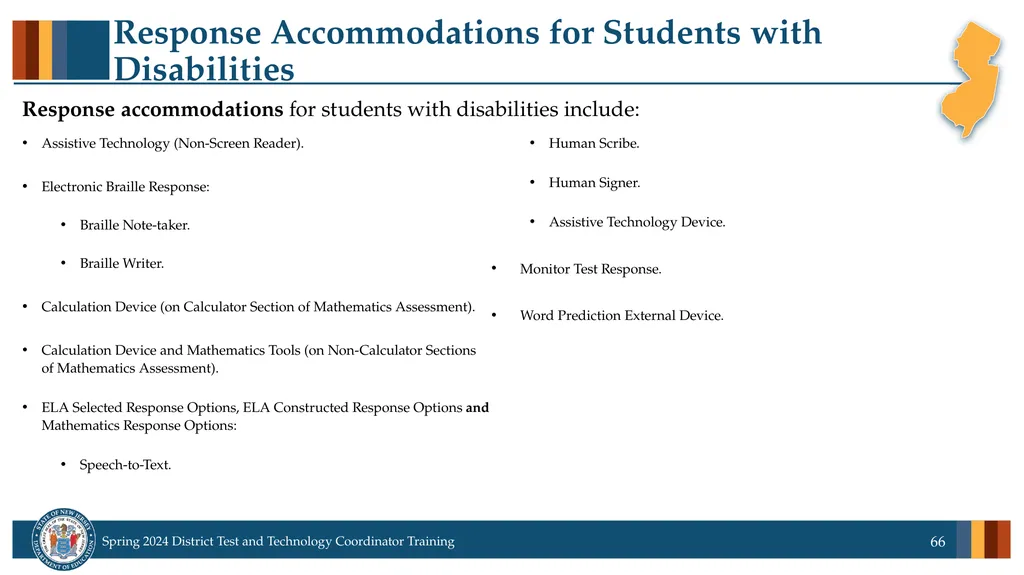
slide66. Response Accommodations for Students with Disabilities Response accommodations for students with disabilities include: Assistive Technology (Non-Screen Reader).
Electronic Braille Response:
Braille Note-taker.
Braille Writer.
Calculation Device (on Calculator Section of Mathematics Assessment).
Calculation Device and Mathematics Tools (on Non-Calculator Sections of Mathematics Assessment).
ELA Selected Response Options, ELA Constructed Response Options and Mathematics Response Options:
Speech-to-Text.
Human Scribe.
Human Signer.
Assistive Technology Device.
Monitor Test Response.
Word Prediction External Device. 66<br>
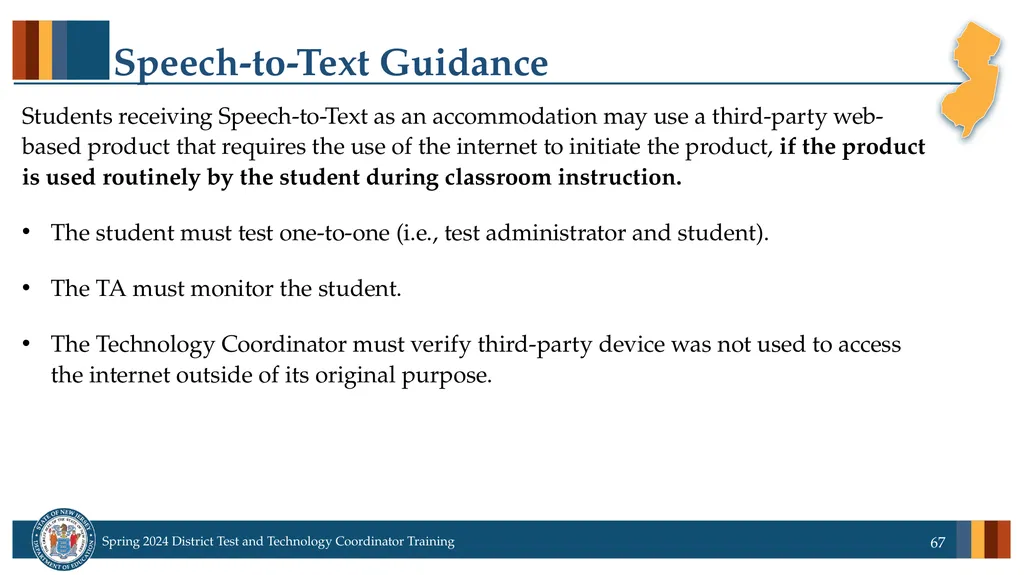
slide67. Speech-to-Text Guidance Students receiving Speech-to-Text as an accommodation may use a third-party web-based product that requires the use of the internet to initiate the product, if the product is used routinely by the student during classroom instruction.
The student must test one-to-one (i.e., test administrator and student).
The TA must monitor the student.
The Technology Coordinator must verify third-party device was not used to access the internet outside of its original purpose. 67<br>
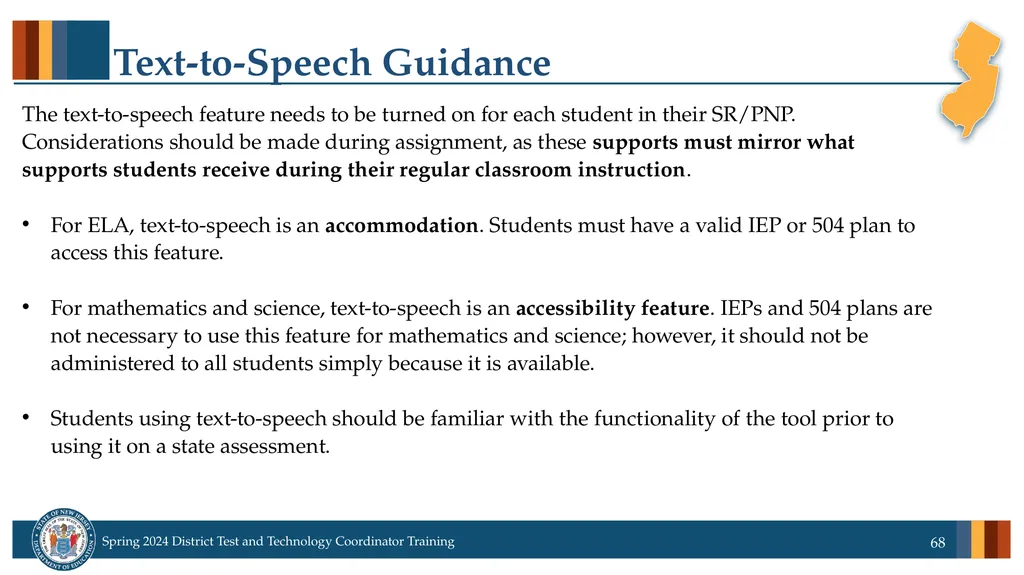
slide68. Text-to-Speech Guidance The text-to-speech feature needs to be turned on for each student in their SR/PNP. Considerations should be made during assignment, as these supports must mirror what supports students receive during their regular classroom instruction.
For ELA, text-to-speech is an accommodation. Students must have a valid IEP or 504 plan to access this feature.
For mathematics and science, text-to-speech is an accessibility feature. IEPs and 504 plans are not necessary to use this feature for mathematics and science; however, it should not be administered to all students simply because it is available.
Students using text-to-speech should be familiar with the functionality of the tool prior to using it on a state assessment. 68<br>
slide69. Deaf and Hard of Hearing Guidance NJDOE has created a guidance document for districts to use for students who require Bluetooth technology for Cochlear Implants or Hearing Aids.
LEAs are required to fully comply with the guidance in the document.
The guidance document is located under New Jersey Assessments Resource Center > Educator Resources > Test Administrator Resources > Forms. 69<br>
slide70. Timing and Scheduling Accommodation for Students with Disabilities Students receiving the extended time accommodation:
Must have a valid IEP or 504 plan.
Have until the end of the school day to complete a single test unit administered during the prescribed testing window.
Should be tested in a separate setting to minimize distractions to other students.
Must be scheduled for testing in the morning to allow adequate time to complete a test unit. 70<br>
slide71. Accommodations for Multilingual Learners: Overview ML teams are responsible for making all accommodation decisions.
Accommodations for multilingual learners must be documented.
Students should have prior experience using the accommodation routinely during classroom instruction and locally-administered assessments.
Newly arrived MLs, in grades 3 through 9, who are enrolled for the first time in United States schools after June 1 of the prior school year, may use the one-time ELA exemption for NJSLA and NJGPA. However, these students must take the mathematics and science portion of our statewide assessments.
Students classified as MLs whose parent/legal guardian has refused language support services are eligible to receive ML testing accommodations as deemed appropriate. 71<br>
slide72. Accommodations for Multilingual Learners Accommodations for MLs include: Extended Time.
Word-to-Word Dictionary (English/Native Language).
Mathematics Response Speech-to-Text or Human Scribe.
General Administration Directions Read Aloud and Repeated in Student’s Native Language*.
General Administration Directions Clarified as Needed in Student’s Native Language.
Online Transadaptation of the Mathematics Assessment in Spanish.
Paper-Based Edition of Mathematics Assessment in Spanish.
Large Print Edition of the Mathematics Assessment in Spanish.
Text-to-Speech or Human Reader for the Mathematics Assessment in Spanish. *Read aloud directions are available in the following languages: Arabic, Bengali, Chinese, Mandarin, Gujarati, Haitian Creole, Korean, Portuguese, Russian, Spanish, Urdu. 72<br>
slide73. Multilingual Learner Web-Based Translation Guidance NJDOE has created a guidance document for LEAs to use for MLs who require translated read aloud test directions in their native language while taking the ELA, math, and science assessments. The guidance document may only be used when there is no test administrator available to provide the read aloud test directions to the student in their spoken native language. No test items may be translated.
LEAs are required to fully comply with the guidance in the document.
LEAs must upload the completed guidance document to PAN and send the support request number to the appropriate state assessment coordinator.
The guidance document is located under New Jersey Assessments Resource Center > Educator Resources > Test Administration Resources > Forms. 73<br>
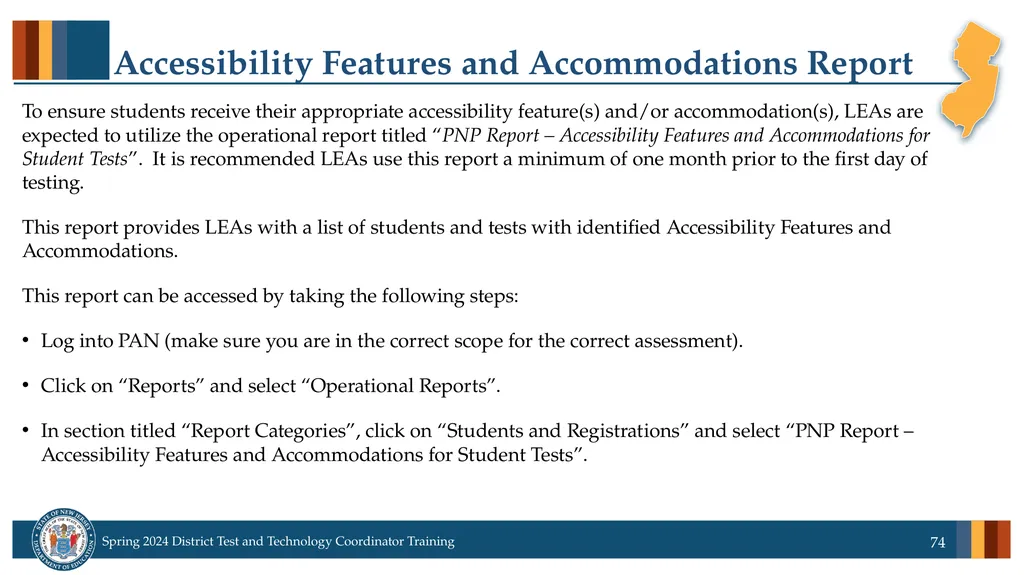
slide74. Accessibility Features and Accommodations Report To ensure students receive their appropriate accessibility feature(s) and/or accommodation(s), LEAs are expected to utilize the operational report titled “PNP Report – Accessibility Features and Accommodations for Student Tests”. It is recommended LEAs use this report a minimum of one month prior to the first day of testing.
This report provides LEAs with a list of students and tests with identified Accessibility Features and Accommodations.
This report can be accessed by taking the following steps:
Log into PAN (make sure you are in the correct scope for the correct assessment).
Click on “Reports” and select “Operational Reports”.
In section titled “Report Categories”, click on “Students and Registrations” and select “PNP Report – Accessibility Features and Accommodations for Student Tests”. 74<br>
slide75. Calculators, Mathematics Reference Sheets, Mathematics Tools, and Periodic Table<br>
slide76. Calculators: Preparation (1 of 2) Calculators are permitted only on the “Calculator Section” of mathematics units.
CBT:
A calculator is automatically provided within the TestNav platform during Calculator Sections.
Students must have prior experience with the TestNav-provided calculator. Practice tests and tutorials are available via the New Jersey Assessment Resource Center.
For PBT, handheld calculators must be used.
All handheld calculators must meet grade/course specific calculator requirements.
For science testing, the grade-appropriate calculator is permitted on all units. The calculator policy is located under the New Jersey Assessment Resource Center > Educator Resources > Test Administration Resources > Testing Resources. 76<br>
slide77. Calculators: Preparation (2 of 2) If handheld calculators will be used, they should be distributed and collected as specified in the TCM, the Test Administrator Manual (TAM) and/or Test Administrator Script(s).
LEAs may provide CBT students with appropriate handheld calculators as necessary.
Note: The distribution of handheld calculators are not a requirement but a LEA option. TestNav offers a grade specific calculator, if needed, for testing.
Students may use their own calculator, provided it meets all calculator policy requirements.
Examiners must have extra calculators available if handheld calculators are required by a student’s IEP or 504 plan.
Remove instructional manuals and function reference sheets of handheld calculators before testing.
Calculator memories must be cleared by resetting the calculator to its default settings before and after each testing session. 77<br>
slide78. Calculators: Specifications by Grade 78 For Grades 3 through 5 mathematics students:
Students may not use calculators unless they have an IEP or 504 calculator accommodation.
Students with a calculator accommodation will use a four-function calculator.
Grade 5 science students will utilize a four-function calculator.
Grades 6 and 7 mathematics students will utilize a four-function calculator with square root and percentage functions.
Grade 8 mathematics/science students will utilize a scientific calculator.
Students taking Algebra I, Geometry, Algebra II, and grade 11 science will utilize a graphing calculator.
Only students with an IEP or 504 plan are permitted to use a lower-level version of their specified calculator.
These students must be provided with both the grade/course specified calculator (handheld or TestNav), and an additional handheld lower-level calculator.<br>
slide79. Calculators: Restrictions The following are not permitted for use during mathematics or science testing:
Calculator apps on a computing device (tablet, smartphone, etc.).
Calculators with QWERTY keyboards.
Calculators with built-in Computer Algebra Systems (CAS).
The sharing of calculators by students. 79<br>
slide80. Mathematics Reference Sheets Mathematics Reference Sheets are based on the state’s standards for mathematics.
Mathematics Reference Sheets are required for NJGPA and NJSLA for grades 5-8, Algebra I, Geometry, and Algebra II.
For online test takers, the Mathematics Reference Sheets are provided online in TestNav.
Mathematics Reference Sheets are available, for print, under the New Jersey Assessment Resource Center > Educator Resources > Test Administration Resources > Testing Resources. 80<br>
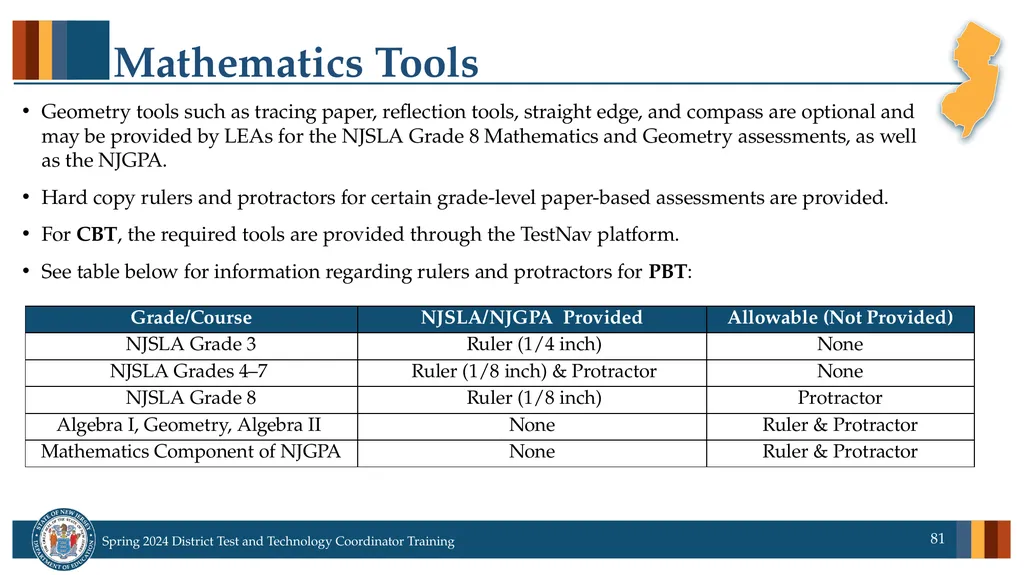
slide81. Mathematics Tools Geometry tools such as tracing paper, reflection tools, straight edge, and compass are optional and may be provided by LEAs for the NJSLA Grade 8 Mathematics and Geometry assessments, as well as the NJGPA.
Hard copy rulers and protractors for certain grade-level paper-based assessments are provided.
For CBT, the required tools are provided through the TestNav platform.
See table below for information regarding rulers and protractors for PBT: 81<br>
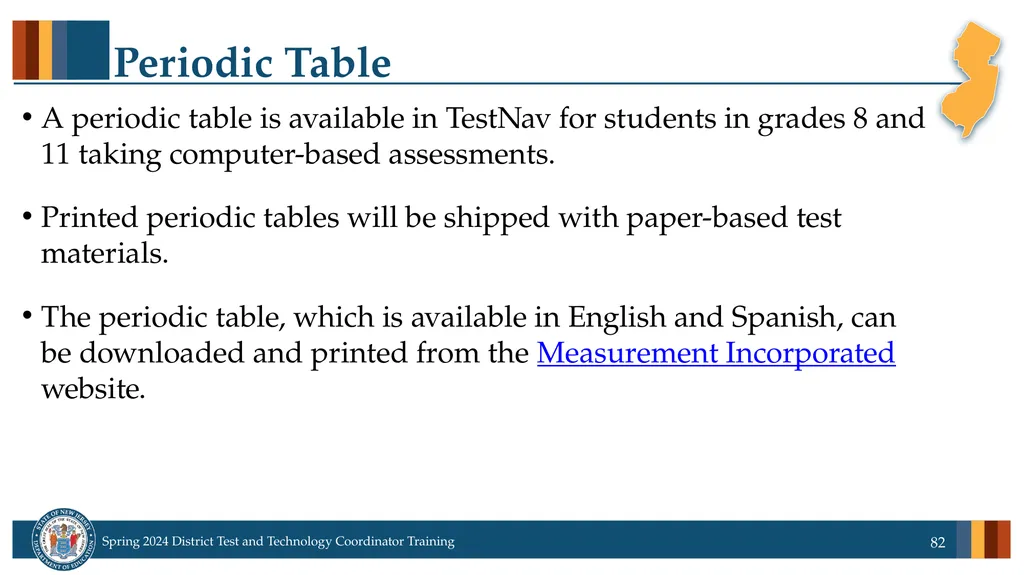
slide82. Periodic Table A periodic table is available in TestNav for students in grades 8 and 11 taking computer-based assessments.
Printed periodic tables will be shipped with paper-based test materials.
The periodic table, which is available in English and Spanish, can be downloaded and printed from the Measurement Incorporated website. 82<br>
slide83. Test and Information Security<br>
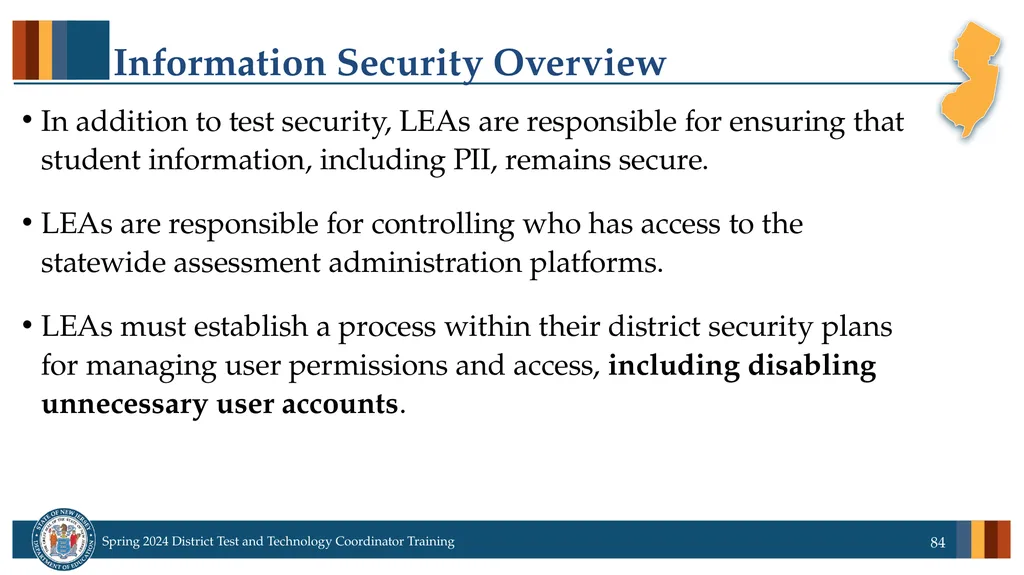
slide84. Information Security Overview In addition to test security, LEAs are responsible for ensuring that student information, including PII, remains secure.
LEAs are responsible for controlling who has access to the statewide assessment administration platforms.
LEAs must establish a process within their district security plans for managing user permissions and access, including disabling unnecessary user accounts. 84<br>
slide85. Information Security: Account Management LEAs are responsible for controlling who has access to PAN and at what level.
User accounts must be reviewed regularly to ensure that those who need access have it and those who do not need access do not.
Inactive accounts are automatically set to expire annually on December 31 of each year.
LEAs should regularly review the PAN User Role Matrix to ensure that permissions are assigned correctly. 85<br>
slide86. Information Security: PII PII is defined as information that can be used to distinguish or trace an individual’s identity either directly or indirectly through linkages with other information.
Examples of PII include a combination of a student’s first name, last name, date of birth, gender, or race.
When communicating with the Office of Assessments via email, only the PAN session name and the last four digits of the SSID should be provided.
Data files and screenshots containing PII should never be transmitted to the Office of Assessments via email.
When additional student information is required, a state assessment coordinator will arrange for communicating such information via secure methods. 86<br>
slide87. Information Security: Handling Student Information Security forms that are required to be transmitted to the Office of Assessments must be uploaded directly to PAN.
Once the form is uploaded, email the support request confirmation number (provided upon successful upload) to the appropriate state assessment coordinator. Include administration (i.e., NJSLA or NJGPA) and content area in the subject line. The body of the email should include a brief description of the scenario and if immediate action is necessary.
If you need to send sensitive information via email, contact a state assessment coordinator to establish encrypted communications. When sending this request, do not include PII until the state assessment coordinator has responded with further instructions. 87<br>
slide88. Test Security Overview Test security is a critical component of New Jersey’s Statewide Assessment Program.
The security protocols outlined in this presentation, and in the TCM and TAM are intended to ensure that students have a fair and standardized opportunity to demonstrate their proficiency on statewide assessments.
LEAs are required to incorporate the security protocols outlined in this training into their own district security plans and provide security training to all staff members who will participate in the administration of statewide assessments.
The implementation of these security protocols by your school LEA is mandatory and will support our efforts to deliver a high-quality assessment and experience for all students. 88<br>
slide89. Test Security Security is a district responsibility per N.J.A.C. 6A:8-4.1 (e).
Reproduction or transmittal of test items, passages, or other secure items or materials is prohibited.
All LEA and school personnel must be informed of security procedures prior to test administration.
Please refer to Section 2.0 of the Test Coordinator Manual for more information. 89<br>
slide90. Training Staff Turnkey Training by the DTC is required for all staff involved in testing.
LEAs are strongly encouraged to hold a special training for accommodated testing (i.e., Scribes, Small Group Testing, One on One, English Language Learners, etc.)
Responsibilities of STCs, Technology Coordinators, TAs and proctors must be clearly delineated.
Only TAs may handle secure test materials.
Proctors (one per 25 students) can handle non-secure materials only.
All staff involved in testing must sign the Security Agreement.
See training guidelines within the Sample District Security Plan on the New Jersey Assessment Resource Center under Educator Resources > Test Administration Resources > Training Materials. 90<br>
slide91. District Security Plan A District Security Plan must address, but is not limited to, the following: Mandatory turnkey training.
Management of user permissions and access.
Locked storage of secure testing materials.
Delivery problems.
Technology problems.
Missing secure testing materials.
Reporting breaches and testing irregularities.
Damaged or contaminated testing materials.
Incident response chain of command.
Disruptive or sick students.
Fire or emergency procedures.
Inclement weather. 91<br>
slide92. Test Security Requirements: Unauthorized Electronic Devices LEAs must have a written policy prohibiting unauthorized devices in any testing room any time before, during or after testing. This policy must also include:
LEA-approved sanctions for violations and parental notification procedures.
Procedures for handling cell phones and other devices each day prior to testing, in accordance with LEA policies.
Procedures to have all violations immediately reported up the chain of command.
Contacting the appropriate state assessment coordinator immediately upon discovering an issue with the use of an unauthorized electronic device during testing.
Parents, students and staff should be notified of the device ban policy and district-approved sanctions well in advance of testing. 92<br>
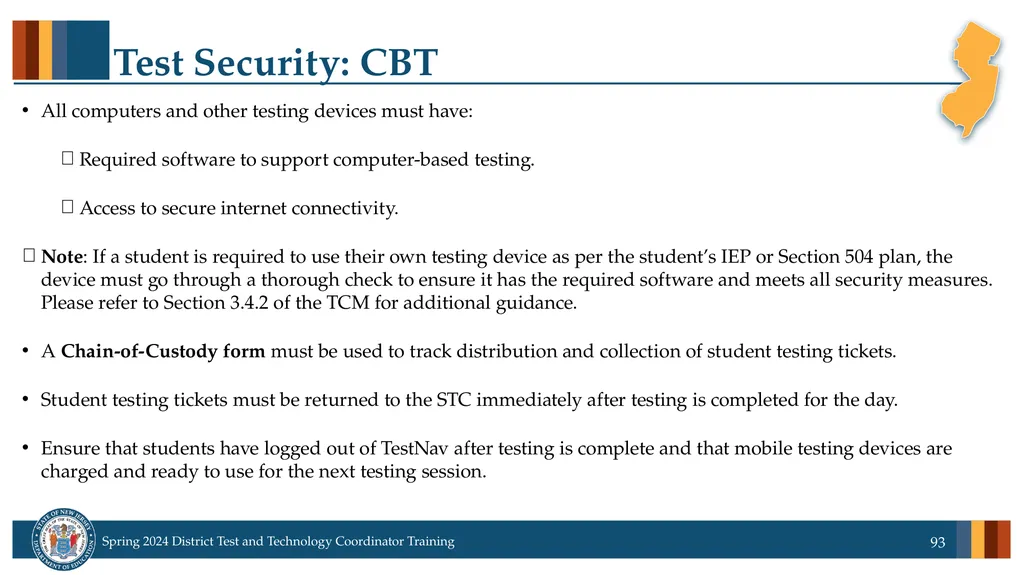
slide93. Test Security: CBT All computers and other testing devices must have:
Required software to support computer-based testing.
Access to secure internet connectivity.
Note: If a student is required to use their own testing device as per the student’s IEP or Section 504 plan, the device must go through a thorough check to ensure it has the required software and meets all security measures. Please refer to Section 3.4.2 of the TCM for additional guidance.
A Chain-of-Custody form must be used to track distribution and collection of student testing tickets.
Student testing tickets must be returned to the STC immediately after testing is completed for the day.
Ensure that students have logged out of TestNav after testing is complete and that mobile testing devices are charged and ready to use for the next testing session. 93<br>
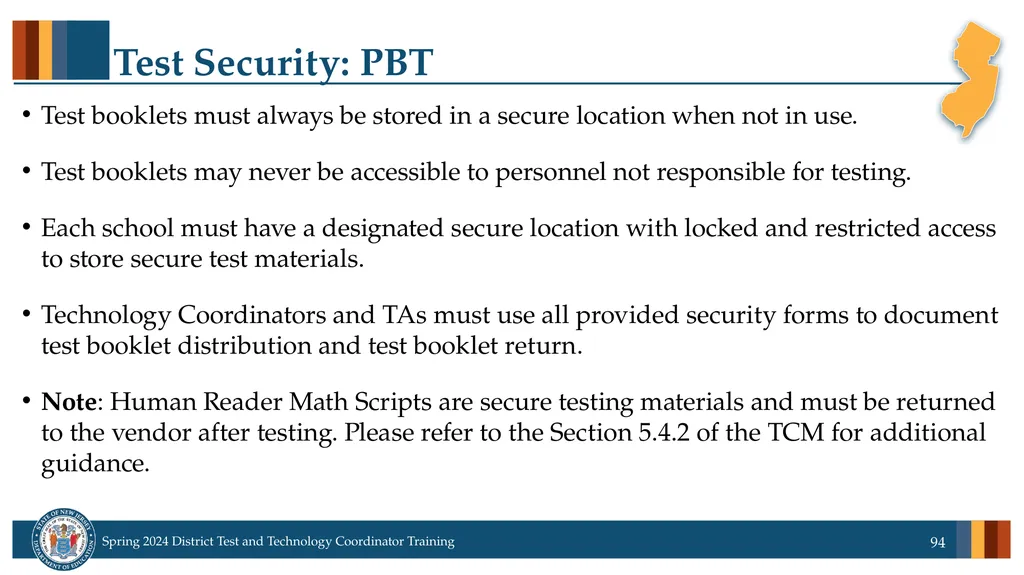
slide94. Test Security: PBT Test booklets must always be stored in a secure location when not in use.
Test booklets may never be accessible to personnel not responsible for testing.
Each school must have a designated secure location with locked and restricted access to store secure test materials.
Technology Coordinators and TAs must use all provided security forms to document test booklet distribution and test booklet return.
Note: Human Reader Math Scripts are secure testing materials and must be returned to the vendor after testing. Please refer to the Section 5.4.2 of the TCM for additional guidance. 94<br>
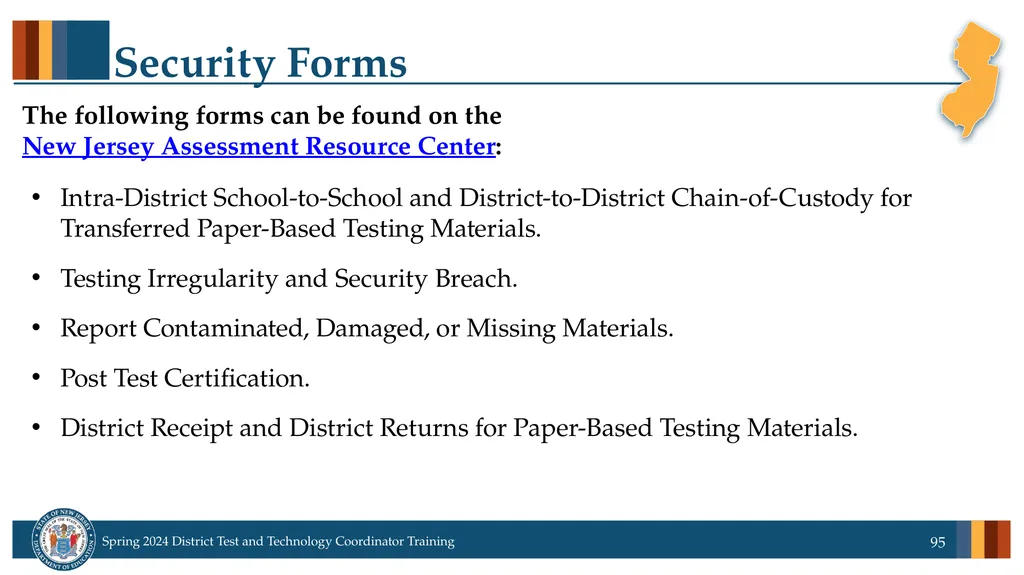
slide95. Security Forms The following forms can be found on the New Jersey Assessment Resource Center:
Intra-District School-to-School and District-to-District Chain-of-Custody for Transferred Paper-Based Testing Materials.
Testing Irregularity and Security Breach.
Report Contaminated, Damaged, or Missing Materials.
Post Test Certification.
District Receipt and District Returns for Paper-Based Testing Materials. 95<br>
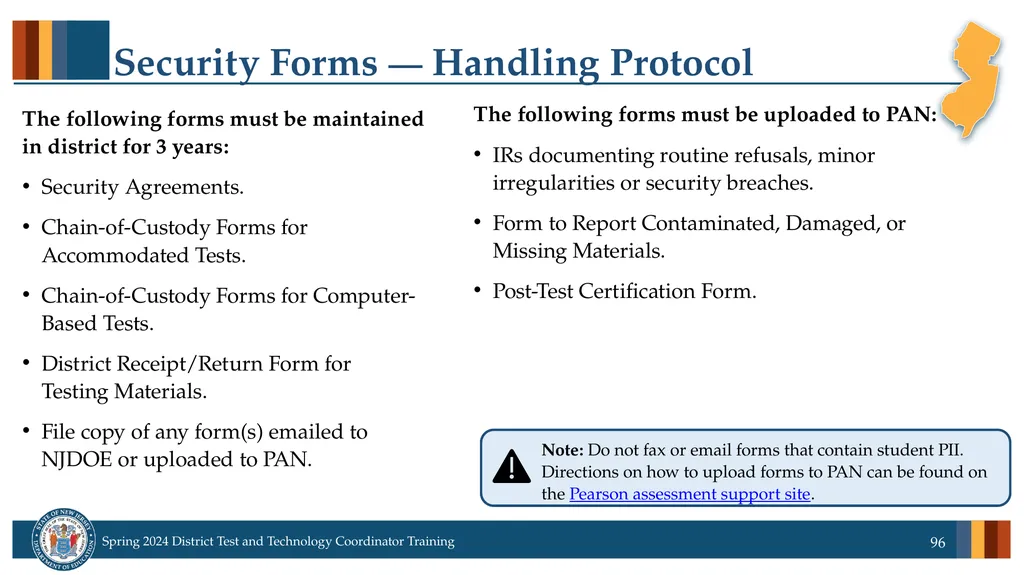
slide96. Security Forms — Handling Protocol The following forms must be maintained in district for 3 years:
Security Agreements.
Chain-of-Custody Forms for Accommodated Tests.
Chain-of-Custody Forms for Computer-Based Tests.
District Receipt/Return Form for Testing Materials.
File copy of any form(s) emailed to NJDOE or uploaded to PAN. The following forms must be uploaded to PAN:
IRs documenting routine refusals, minor irregularities or security breaches.
Form to Report Contaminated, Damaged, or Missing Materials.
Post-Test Certification Form. Note: Do not fax or email forms that contain student PII. Directions on how to upload forms to PAN can be found on the Pearson assessment support site. 96<br>
slide97. Security Agreement Upon completion of annual mandatory district turnkey training, the following staff involved in state testing must sign a new Security Agreement to document that they have been sufficiently trained:
District Test Coordinators.
School Test Coordinators.
District Technology Coordinators (including those contracted to provide technology services).
School Technology Coordinators (including those contracted to provide technology services).
Test Administrators.
Proctors. Download the Security Agreement form at the New Jersey Assessment Resource Center. Note: Schools must maintain the original signed versions of the Security Agreements for three years. 97<br>
slide98. Reporting Contaminated, Missing, and Damaged Materials The following steps must be taken in the event of contaminated, missing and damaged materials:
The STC must report any incident to the DTC immediately.
The DTC must then email the appropriate state assessment coordinator immediately after receiving notice from the STC.
The DTC must upload form to PAN within five school days and provide NJDOE with support request confirmation number. Be sure to upload to appropriate assessment administration scope within PAN (ELA/Mathematics or Science). 98<br>
slide99. Reporting Testing Irregularities and Security Breaches Below are some examples that require DTC's to contact our office immediately for resolution prior to uploading the irregularity report:
Sick student (i.e., student who started but did not finish the due to illness or family emergency)
Accessibility features and accommodations provided in error or was not provided
Student is in possession of an unauthorized electronic device
Below are some examples that require DTC's to immediately contact Pearson for technical assistance:
Test item not functioning
Technology issues (i.e., student device not recording responses, device powering off, etc.)
Students should not be allowed to exit the testing environment until instructed to do so by the Office of Assessments. 99<br>
slide100. Not-Tested Codes and Void Codes Not Tested codes are to be used when a student has never logged into TestNav:
Reason code 1—Absent
Reason code 2—Medical Emergency
Reason code 3—Other (refusal)
Void codes are to be used when a student has logged into TestNav but did not complete testing:
Void code 1—Student Cheating
Void code 2—Security Breach
Void code 3—Other (refusal, wrong form, off-grade level, off-course, accommodation/ accessibility feature provided or not provided in error)
Note: When a student starts a test but does not complete it due to being absent for make-up testing, that test cannot be voided. Instead, the student’s test must be submitted by marking it complete. 100<br>
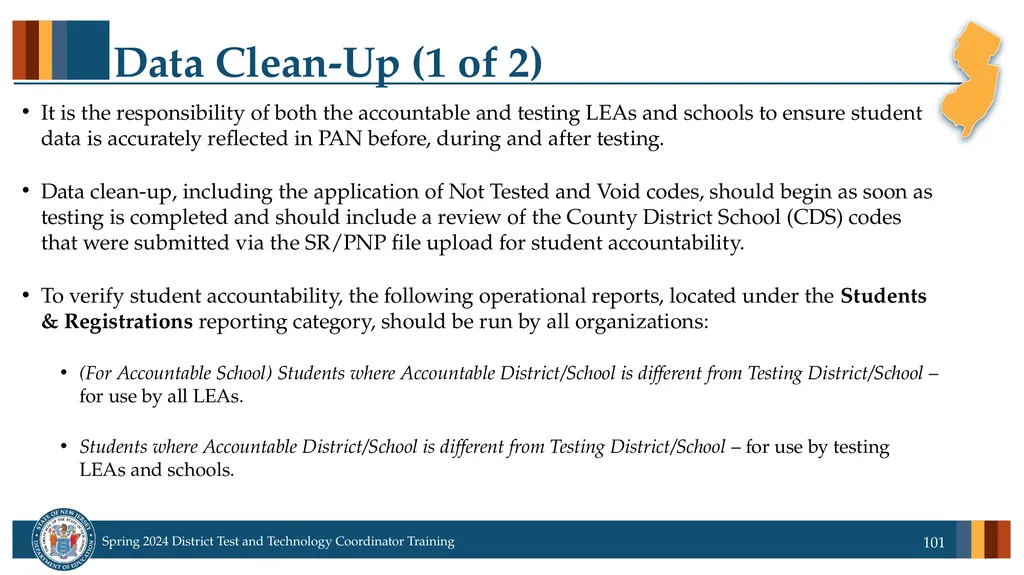
slide101. Data Clean-Up (1 of 2) It is the responsibility of both the accountable and testing LEAs and schools to ensure student data is accurately reflected in PAN before, during and after testing.
Data clean-up, including the application of Not Tested and Void codes, should begin as soon as testing is completed and should include a review of the County District School (CDS) codes that were submitted via the SR/PNP file upload for student accountability.
To verify student accountability, the following operational reports, located under the Students & Registrations reporting category, should be run by all organizations:
(For Accountable School) Students where Accountable District/School is different from Testing District/School – for use by all LEAs.
Students where Accountable District/School is different from Testing District/School – for use by testing LEAs and schools. 101<br>
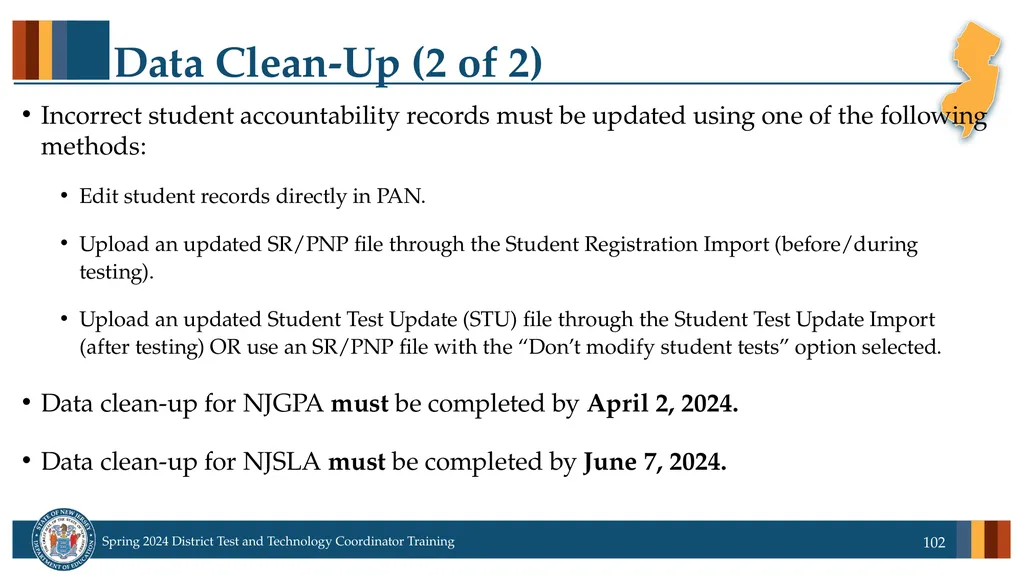
slide102. Data Clean-Up (2 of 2) Incorrect student accountability records must be updated using one of the following methods:
Edit student records directly in PAN.
Upload an updated SR/PNP file through the Student Registration Import (before/during testing).
Upload an updated Student Test Update (STU) file through the Student Test Update Import (after testing) OR use an SR/PNP file with the “Don’t modify student tests” option selected.
Data clean-up for NJGPA must be completed by April 2, 2024.
Data clean-up for NJSLA must be completed by June 7, 2024. 102<br>
slide103. Student Registration<br>
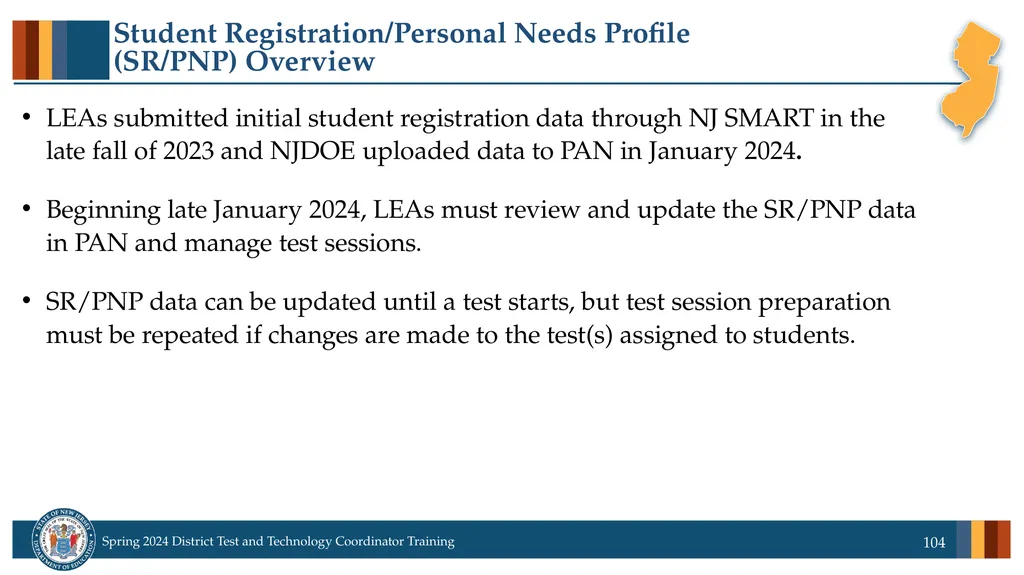
slide104. Student Registration/Personal Needs Profile (SR/PNP) Overview LEAs submitted initial student registration data through NJ SMART in the late fall of 2023 and NJDOE uploaded data to PAN in January 2024.
Beginning late January 2024, LEAs must review and update the SR/PNP data in PAN and manage test sessions.
SR/PNP data can be updated until a test starts, but test session preparation must be repeated if changes are made to the test(s) assigned to students. 104<br>
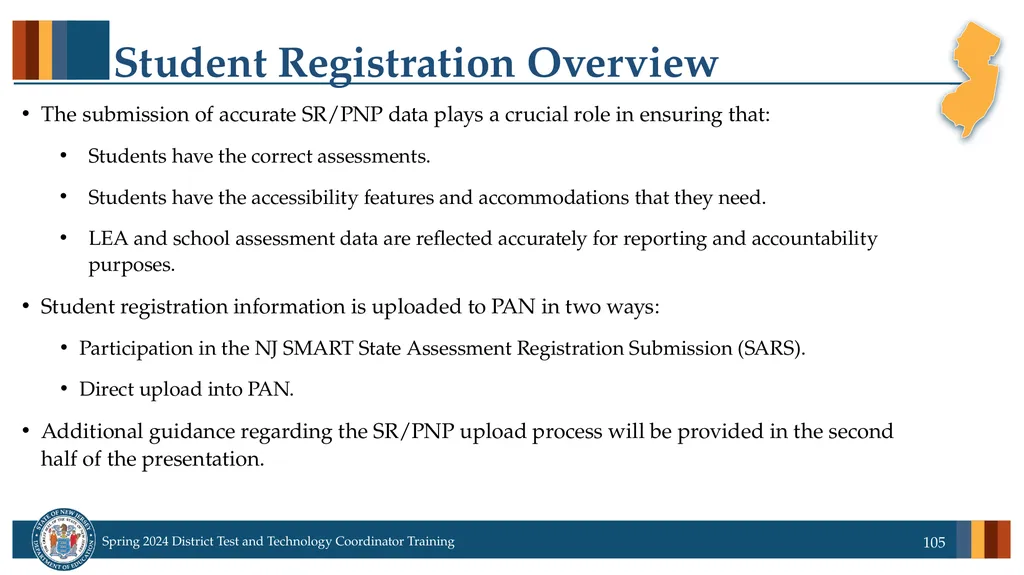
slide105. Student Registration Overview The submission of accurate SR/PNP data plays a crucial role in ensuring that:
Students have the correct assessments.
Students have the accessibility features and accommodations that they need.
LEA and school assessment data are reflected accurately for reporting and accountability purposes.
Student registration information is uploaded to PAN in two ways:
Participation in the NJ SMART State Assessment Registration Submission (SARS).
Direct upload into PAN.
Additional guidance regarding the SR/PNP upload process will be provided in the second half of the presentation. 105<br>
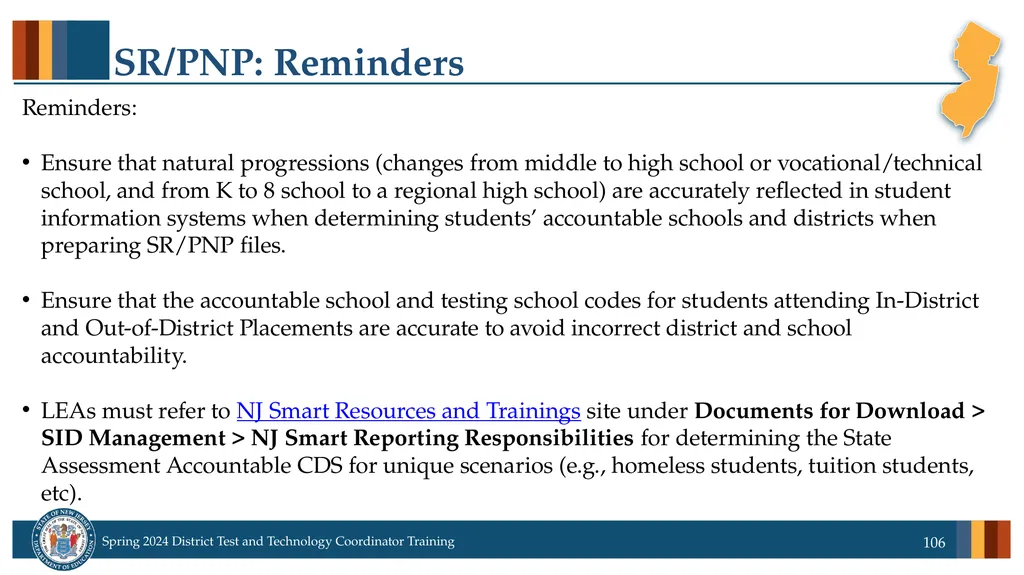
slide106. SR/PNP: Reminders Reminders:
Ensure that natural progressions (changes from middle to high school or vocational/technical school, and from K to 8 school to a regional high school) are accurately reflected in student information systems when determining students’ accountable schools and districts when preparing SR/PNP files.
Ensure that the accountable school and testing school codes for students attending In-District and Out-of-District Placements are accurate to avoid incorrect district and school accountability.
LEAs must refer to NJ Smart Resources and Trainings site under Documents for Download > SID Management > NJ Smart Reporting Responsibilities for determining the State Assessment Accountable CDS for unique scenarios (e.g., homeless students, tuition students, etc). 106<br>
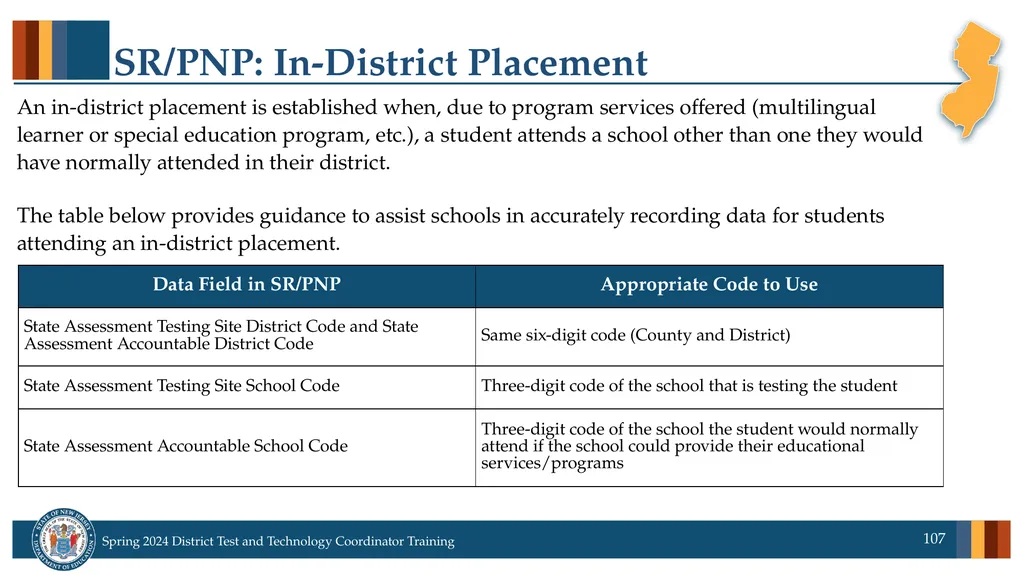
slide107. SR/PNP: In-District Placement An in-district placement is established when, due to program services offered (multilingual learner or special education program, etc.), a student attends a school other than one they would have normally attended in their district.
The table below provides guidance to assist schools in accurately recording data for students attending an in-district placement. 107<br>
slide108. SR/PNP: Out of District Placement An out-of-district placement is established when a student attends a facility for programs/ services not offered in their district (i.e., approved private, public receiving, or special services commission). Approved Private Schools for Students with Disabilities (APSSDs) cannot be accountable districts or schools.
The table below provides guidance to assist schools in accurately recording data for students attending an out-of-district placement. 108<br>
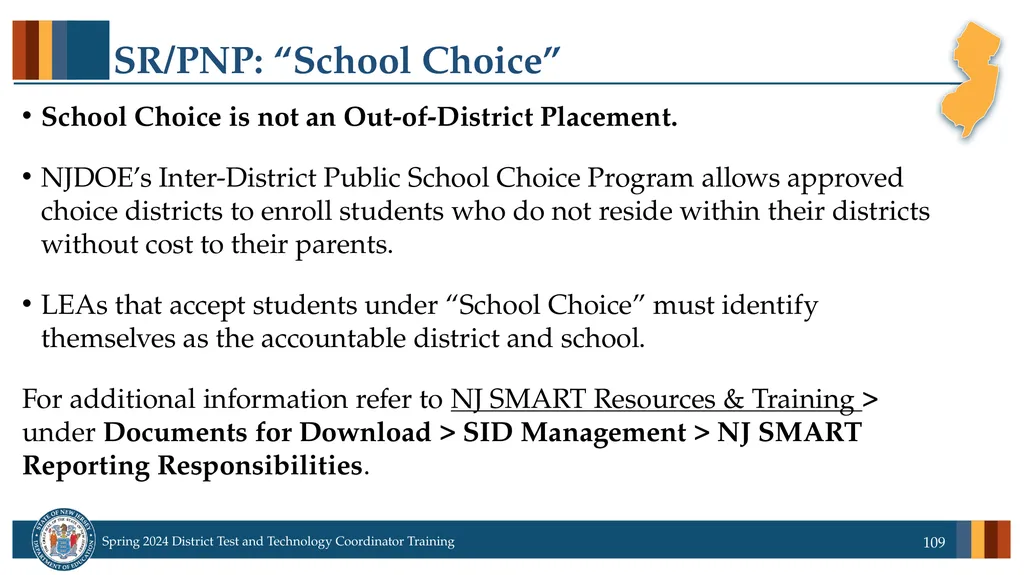
slide109. SR/PNP: “School Choice” School Choice is not an Out-of-District Placement.
NJDOE’s Inter-District Public School Choice Program allows approved choice districts to enroll students who do not reside within their districts without cost to their parents.
LEAs that accept students under “School Choice” must identify themselves as the accountable district and school.
For additional information refer to NJ SMART Resources & Training > under Documents for Download > SID Management > NJ SMART Reporting Responsibilities. 109<br>
slide110. SR/PNP: Charter and Vocational Schools Students attending a charter school or full-time vocational technical school, regardless of the school’s location, are not considered Out-of-District or In-District Placements.
Charter schools and full-time vocational technical schools are the accountable district and school.
The resident school district is accountable for shared-time vocational-technical students.
For additional information refer to NJ SMART Resources & Training > under Documents for Download > SID Management > NJ SMART Reporting Responsibilities. 110<br>
slide111. Transferring Student Records The Transfer Student Guidance for Computer-based Tests (CBT) is a tool in PAN that allows authorized users to transfer student assessment data between districts to manage student transfers. The DTC of the new LEA will use this feature to request the transfer, and the DTC of the former LEA will use this feature to approve or reject the transfer request.
If a new student enters your LEA after initial SR/PNP upload, please refer to page 2 of the Transfer Student CBT Guidance document.
If a student leaves your LEA after initial SR/PNP upload, please refer to page 10 of the Transfer Student CBT Guidance document.
If a student leaves your LEA before testing begins, you should unregister, unassign all tests, and unenroll the student from your organization.
Do not request a Work Transfer for any student who has completed all testing in their previous LEA and has moved into your LEA. Please contact the student’s previous testing organization to confirm. 111<br>
slide112. Test Booklets and Other Materials<br>
slide113. Handling of PBTs Effective from the Spring 2023 Administration:
LEAs administering the secure paper version (i.e., regular paper, Braille, or Large Print) of the NJSLA or NJGPA are no longer required to transcribe student responses directly into the accompanying answer document for vendor scoring.
Students must record their responses directly in the test booklet.
LEAs are required to establish a “Transcription” test session and transcribe student responses directly to TestNav.
Please refer to the guidance document on creating "Transcription" test sessions located on the New Jersey Assessments Resource Center > under Test Administration Resources > Testing Resources. 113<br>
slide114. Initial Materials Shipment For the NJGPA, there is no initial delivery of test materials. All materials needed for administering and returning paper test materials must be ordered directly through PAN under Setup > Orders & Shipment Tracking.
For the NJSLA, your initial shipment will arrive in district based on the data submitted in the Student Registration/Personal Needs Profile upload. If additional materials are needed, they must be ordered directly through PAN under Setup > Orders & Shipment Tracking.
Only users with the DTC role can order additional materials
Secure paper materials will be shipped in pre-packaged individual kits. No overages will be included
All materials will be delivered directly to central office. Pro Tip: Save your box for returns. 114<br>
slide115. Initial Materials Shipment: District Box Color-coded Pearson/Measurement Incorporated Non-Scorable Return Labels (one each per 25 students)
UPS Ground Return Labels (Pearson – ELA/Mathematics) or FedEx Return Labels (MI – Science) (one per 25 students)
Return Instructions sheet
Shipping carrier return instructions Pro Tip: Save your box for returns. 115<br>
slide116. Initial Materials Shipment: School Box Roster
Packing List and Chain of Custody forms
Student Test Kits
Large Print Kits, Braille Kits, Spanish Kits, Read Aloud Kits
Human Reader Scripts
TCMs and TAMs will be available online
Reminder: LEAs that will need Screen Reader and Tactile graphics must place an order via the Additional order window. Please see the additional order window timeframe for NJGPA and NJSLA. Pro Tip: Save your box for returns. 116<br>
slide117. Test Materials (1 of 3) PBT materials
Complete individual kits consisting of test booklet, Mathematic Reference Sheet, and/or Periodic Table, as appropriate
Note: An additional regular print test booklet will be included in the Braille Test Kit as well as a Human Reader Mathematic Script.
CBT materials
Student Testing Tickets 117<br>
slide118. Test Materials (2 of 3) Headphones or ear buds:
Required for ELA for all students.
Required for mathematics/science if student is receiving text-to-speech.
Headphones may be used as noise buffers (accessibility feature) or as a testing accommodation, if needed.
Headsets with microphones must be used by students who will use speech-to-text testing accommodation.
Other Materials:
Blank Scratch Paper – graph, lined, or unlined paper.
Pencils – wooden No. 2 with erasers.
Periodic Table for science.
More information on calculators and mathematics tools is on the New Jersey Assessment Resource Center. 118<br>
slide119. Test Materials (3 of 3) Approved external devices may not access the internet nor store/save information unless authorized by NJDOE. Guidance for the use of third-party assistive technology is available on the New Jersey Assessment Resource Center under > Educator Resources > Test Administration Resources > Forms.
Timing device.
Flip chart or board.
“Testing Do Not Disturb” signs (see Appendix C in the TAM). 119<br>
slide120. Auditing Test Materials (1 of 2) Upon receipt of test materials, DTC must (please refer to Section 3.6 in the TCM for additional guidance):
Remove the packing list, Chain of Custody form and Test Coordinator Kit from Box 1.
Inventory materials immediately to verify that all materials have been included and are not damaged or missing.
Count each secure paper-based test kit without opening it. Do not open shrink wrapping until two school days before testing.
Secure materials in locked storage with limited access.
Note: When transferring secure materials to the STCs, both the DTC and STC are expected to initial the District Chain-of Custody Form for Initial Shipment. Record the date and time of the transfer as well.
Order additional materials, if necessary.
Keep the shipping boxes to return Non-Scorable materials to Pearson (ELA/Mathematics) or Measurement Incorporated (NJSLA-Science) after testing is completed. You must ensure that these shipments are sent to the appropriate vendor.
Report any contaminated, damaged, or missing materials using the District Return Form. Also, please contact the NJSLA/NJGPA support helpline immediately regarding any missing/damaged materials: 888-705-9416 (follow phone prompts). 120<br>
slide121. Auditing Test Materials (2 of 2) Only users with the DTC roles can order additional test materials.
Do not submit additional orders prior to verifying initial shipment of test materials.
Please allow three to five business days to receive materials after NJDOE reviews and approves the additional order.
All orders are shipped to your LEA’s central office. 121<br>
slide122. Preparing Secure Test Materials for Return (1 of 2) The DTC receives materials from the STC and completes all necessary chain of custody forms.
For ELA and mathematics, non-scorable test booklets must be packaged in the boxes in which they were delivered – do not overfill.
For science, use the provided FedEx Packs or boxes for non-scorable test booklets– do not overfill.
Place one return shipping label on the top of each box.
The sequence of boxes is indicated on each return shipping label. 122<br>
slide123. Preparing Secure Test Materials for Return (2 of 2) Pickups must be scheduled at least 24 hours in advance and no later than one week after the completion of testing.
Contact UPS at 1-800-823-7459 to schedule pickup of ELA and mathematics test materials for return to Pearson.
Contact FedEx at 1-800-GoFedEx (1-800-463-3339) to schedule pickup of science test materials for return to Measurement Incorporated. Tell UPS or FedEx you are calling about a pickup request using Pearson or Measurement Incorporated’s return service (as applicable). UPS and FedEx customer service are available 24/7.
Once pickup is confirmed, keep a record of the confirmation numbers you receive from UPS or FedEx. 123<br>
slide124. Secure Test Materials to be Returned (ELA/Mathematics/Science) All test booklets must be returned.
For mathematics, human reader scripts.
Reminder: All student responses recorded in the test booklet must be transcribed into TestNav for scoring. Please refer to the guidance document on creating Transcription test session located on the New Jersey Assessments Resource Center under > Test Administration Resources > Testing Resources.
Districts are required to follow the directions for transcribing student test responses found in Appendix C of the Accessibility Features and Accommodation (AF&A) Manual. 124<br>
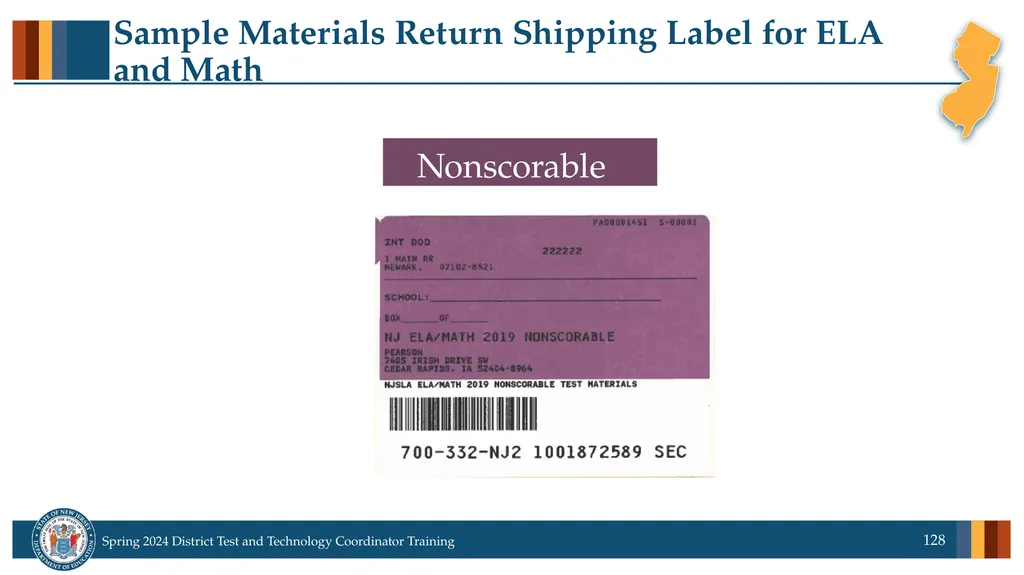
slide125. Packaging Non-Scorable ELA/Mathematics Secure Test Materials to Pearson Place a single non-scorable materials return shipping label on top of each box and return to the appropriate vendor.
Count the total number of non-scorable boxes.
On the line that reads “BOX _ OF _” fill in the sequence of non-scorable boxes being returned.
Do not write anything else on the labels.
Refer to the TCM for science procedures, which differ marginally. 125<br>
slide126. Packaging Secure NJSLA-Science Test Materials for Return to Measurement Incorporated Package all test booklets in the boxes.
If you are a DTC with more than one school, you do not need to use separate boxes for each school.
Place one non-scorable return label on the side of each box.
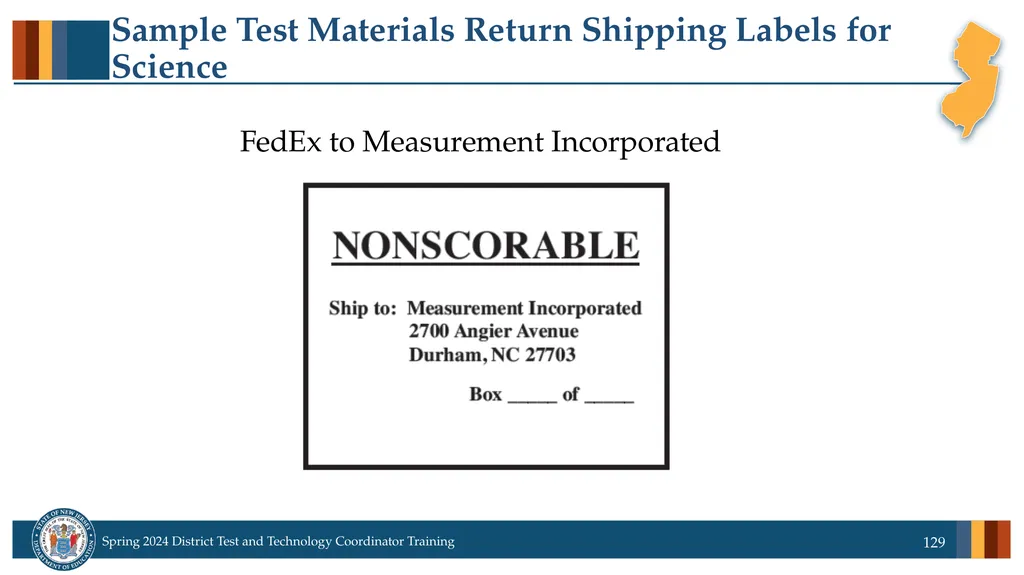
On the line that reads “BOX _ OF _” fill in the sequence of boxes being returned.
Do not write anything else on the labels.
All materials are returned together to the appropriate vendor. All boxes should be numbered 1 through XX sequentially and returned in a single shipment.
Place one FedEx Return Shipping label on the top of each box, covering the previous shipping label (May also remove or mark out the previous shipping label). 126<br>
slide127. Packaging Secure Test Materials to Return For the NJGPA - All secure test booklets, used or unused, must be returned to the appropriate vendor no later than April 2, 2024.
For the NJSLA - All secure test booklets, used or unused, must be returned to the appropriate vendor no later than June 7, 2024.
Reminder: LEAs are no longer required to transcribe student responses into an answer document. LEAs must now transcribe all student responses directly into TestNav. LEAs are required to create "Transcription” test sessions. 127<br>
slide128. Sample Materials Return Shipping Label for ELA and Math Nonscorable 128<br>
slide129. Sample Test Materials Return Shipping Labels for Science FedEx to Measurement Incorporated 129<br>
slide130. Helpful Hints (1 of 4) Below are a few helpful hints to remember regarding preparation for delivery of the Human Reader testing support:
Human Reader scripts are only available for math and must be returned to vendor.
Proctor tickets are necessary for ELA and science.
When creating a Human Reader test session, please check the box titled “Proctor Read Aloud” in the "Create/Edit Session" screen for any/all applicable subject areas. 130<br>
slide131. Helpful Hints (2 of 4) Remember the following for PBT:
Students who will record their responses directly into their test booklet must have their responses transcribed into TestNav.
Appendix C in the AF&A Manual must be followed for any student who will participate in paper-based testing via a scribe.
Students who will use a braille note taker, braille writer or any assistive technology device to record their responses must have their responses transcribed into their test booklet; afterwards, the responses from the test booklet must be transcribed into TestNav. 131<br>
slide132. Helpful Hints (3 of 4) Transcription Test Session Guidance:
LEAs must create "Transcription" test sessions for students taking the PBT and transcribe all responses into TestNav. LEAs that return secure paper test materials to the vendor before transcribing student responses into TestNav will be assessed with a fee of $500, per content area and per student, for scoring.
Paper tests required by an IEP or 504 Plan, including students with a temporary 504 Plan taking a paper assessment due to a temporary medical situation requiring homebound instruction, must have the Alternate Representation - Paper Test field recorded. Alternate Representation – Paper Test field is not applicable to small number of students taking a paper assessment not required by an IEP or 504 Plan. 132<br>
slide133. Helpful Hints (4 of 4) The following scenarios are examples of potential errors associated with transcription test sessions and/or paper-based testing that must be addressed:
Student test record indicates PBT; however, paper test materials were not ordered.
Student test record indicates PBT; however, the tests were not assigned to a session configured for Transcription.
Student test record appears in a transcription test session; however, paper test materials are not recorded in the SR/PNP.
Paper test materials were ordered but do not have transcription sessions setup.
Transcription sessions were setup, but paper test materials were not ordered. 133<br>
slide134. Thank You! nj.gov/education/assessment/ Assessment@doe.nj.gov Follow Us! Facebook: @njdeptofed Twitter: @NewJerseyDOE Instagram: @NewJerseyDoe 134<br>
Division of Teaching and Learning Services
Office of Assessments<br>
slide2. Your Contribution and Impact Turn-key training is a vital component to ensuring that students are supported through the assessment process and data is secure and accurate.
District Test Coordinators (DTCs) are responsible for ensuring that all local education agencies (LEA's) and school personnel involved in the administration of New Jersey state assessment programs have been trained.
State assessment coordinators are available to support districts in ensuring the statewide assessment program is implemented with fidelity.
Thank you for your tireless efforts and leadership in supporting New Jersey's students! 2<br>
slide3. Statewide Assessments Large-scale, standardized statewide assessments are developed and maintained to meet rigorous federal requirements. Their development process, administration, and use are significantly different from locally made assessments. Security procedures Rigorous test security protocols ensure an accurate measure of student performance. Test Development Development includes several item reviews to ensure equitable access among all student populations. Data and Reporting Informs federal and state accountability systems, including school and district decisions on curriculum. State/Federal Requirements Participation is required by federal and state law to ensure all students have access to a high-quality education. 3<br>
slide4. NJDOE Contact Information When contacting the appropriate grade-level coordinator:
Please include your name and phone number, along with the extension.
Do not include any student personally identifiable information (PII) - only provide the PAN session name and the last 4 digits of the state student identifier (SSID).
Do not send the same email to multiple coordinators. 4<br>
slide5. Vendor Support Contact NJSLA and NJGPA Customer Support: 888-705-9416 Press “1” for assistance with Live Testing.
Press ”2” for assistance with ELA, Mathematics and/or Science.
Press ”3” for assistance with user ID/password for PearsonAccessnext (PAN). 5<br>
slide6. Additional NJDOE Contacts Annual Progress Targets, and Student Accountability
Office of Performance Management
performancemanagement@doe.nj.gov
Multilingual Learners, Title III, Bilingual Education
Office of Supplemental Educational Programs
Phone Number: 609-376-9080
ML@doe.nj.gov
School Performance Reports
Office of Performance Management
reportcard@doe.nj.gov
Students with Disabilities
Office of Special Education
Phone Number: 609-376-9060
OSEinfo@doe.nj.gov 6<br>
slide7. Graduation Assessment Requirement<br>
slide8. NJGPA Overview (1 of 3) Statute requires the state graduation proficiency assessment to be administered to all grade 11 students (N.J.S.A. 18A:7C-6).
NJGPA is designed to measure the extent to which students are graduation ready in English Language Arts (ELA) and Mathematics.
The ELA component is aligned to the grade 10 standards.
The Mathematics component is aligned to Algebra I and Geometry standards.
Graduation readiness is reported separately for each content component. 8<br>
slide9. NJGPA Overview (2 of 3) Students who take but do not meet the minimum required score on each component of the assessment will have the opportunity to receive additional supports and may take the following steps:
Retake the ELA and/or mathematics components of the NJGPA in the following summer or fall;
Meet a designated cut score from the menu of substitute competency tests; or
Complete a portfolio appeal. 9<br>
slide10. NJGPA Overview (3 of 3) Students currently in grade 11 (class of 2025) must take the NJGPA during the spring 2024 administration to satisfy the state graduation assessment requirement.
Students currently in grade 12 who have not yet taken one or both components of the NJGPA and who are expected to graduate in the class of 2024 (by August 31, 2024) must take the necessary component(s) of NJGPA during the spring 2024 administration.
Students may not access second or third pathway scores until after both components of NJGPA have been taken.
Only students who meet the eligibility criteria for the Dynamic Learning Maps (DLM) may be identified as exempt from taking NJGPA. 10<br>
slide11. Graduation Assessment Requirement Classes of 2024 and 2025 (1 of 6) On May 3, 2023, the New Jersey State Board of Education approved the proficiency level cut score for the ELA and mathematics components of the NJGPA, as well as the menu of substitute competency tests and aligned cut scores.
The requirements for the classes of 2024 and 2025 are available on the Graduation Assessment Requirements webpage. 11<br>
slide12. Graduation Assessment Requirement Classes of 2024 and 2025 (2 of 6) 12<br>
slide13. Graduation Assessment Requirement Classes of 2024 and 2025 (3 of 6) 13<br>
slide14. Graduation Assessment Requirement Classes of 2024 and 2025 (4 of 6) Please note the following for ELA:
Beginning in fall 2023, the following scores are no longer provided:
PSAT10 Reading; and
PSAT/NMSQT Reading.
Beginning in 2024, the SAT Reading score is no longer provided.
For PSAT10, PSAT/NMSQT and SAT, Evidence Based Reading and Writing (EBRW) has been simplified and will use the naming convention Reading and Writing moving forward. 14<br>
slide15. Graduation Assessment Requirement Classes of 2024 and 2025 (5 of 6) Please note the following for mathematics:
As of Monday, January 28, 2019, Accuplacer Elementary Algebra is no longer administered but may be used for students who have historic qualifying results.
Beginning in fall 2023, the following scores are no longer provided:
PSAT10 Math; and
PSAT/NMSQT Math.
Beginning in 2024, the SAT Math score is no longer provided. 15<br>
slide16. Graduation Assessment Requirement Classes of 2024 and 2025 (6 of 6) 16<br>
slide17. Unit Test Times for NJGPA Note: Unit times do not include the recommended 25 to 30 minutes for logging students on, reading directions to students from the test administrator script and logging students off. 17<br>
slide18. Key NJGPA Dates for 2024 The following LEA-led activities represent a selection from the assessment administration process. For specific activities and dates, please review the Spring 2024 Assessment Administration Key Dates posted online. 18<br>
slide19. Graduation Assessment Testing Schedule 19<br>
slide20. Federal Accountability Updates<br>
slide21. Adjusted Rules for Calculating the Academic Achievement Indicator for High School Mathematics In response to the federal Performance Review, the NJDOE has adjusted its rules for calculating the academic achievement indicator for mathematics. Under the Every Student Succeeds Act (ESSA), all students must test at least once in high school and the academic achievement indicator must measure participation and proficiency based on the required high school assessment.
Participation and proficiency calculations are no longer based on students taking end-of-course mathematics assessments in grades 9 and 10, regardless of which assessment was taken (Algebra I, Geometry, or Algebra II).
Under the adjusted rules, all high school students taking Algebra I, regardless of grade level, or who qualify for an approved exception, will be included in the calculation.
Please note these changes are to comply with federal accountability rules; the NJGPA is administered to comply with state law and cannot be used for federal accountability purposes. 21<br>
slide22. ESSA Required High School Mathematics Assessment To meet ESSA requirements, all students must take the Algebra I state assessment in high school with the following exceptions:
Students who take the DLM mathematics assessment in high school.
Students who took the Algebra I state assessment in middle school.
Students who have not taken both Geometry and Algebra II in middle school must take either Geometry or Algebra II in high school.
Students who take Algebra I or Geometry in grade 6 are required to take both the Mathematics Grade 6 and the corresponding end-of-course assessment (Algebra I or Geometry) as 6th graders; the end-of-course assessment results will be used to meet the ESSA high school mathematics requirements when the student enters grade 9.
Students who do not take Algebra I, or qualify for one of the exceptions listed, will be counted as non-participants in participation calculations as grade 12 students.
Note: If LEAs have unique scenarios where students would complete all three high school mathematics courses in middle school but started taking high school mathematics courses after grade 6, they should contact the Office of Assessments to establish a plan that ensures students will meet the federal testing requirement. 22<br>
slide23. Calculating Participation and Academic Achievement Business rules for calculating participation and academic achievement. 23<br>
slide24. Grade 12 Non-Participants To ensure that all students are included once in high school:
The NJDOE will continue to count students who register for Algebra I and do not take the assessment, as non-participants in the year that they register for the assessment.
The NJDOE will annually review all grade 12 students to ensure that they have taken Algebra I or qualify for an approved exception (see previous slides) in high school.
The NJDOE will use the information submitted by districts at the end of the school year in the NJ SMART SID Management "FederalHSMathTestingReq" field, along with historical assessment and course data, to identify grade 12 students who have not met the federal high school testing requirement for mathematics.
Grade 12 students who have been identified as not having met the federal high school testing requirement and who have not previously been included as a non-participant will be included in the denominator of the participation calculation. 24<br>
slide25. Scheduling<br>
slide26. Remaining 2023-2024 NJSLA Testing Schedule 26<br>
slide27. Spring 2024 Statewide Assessment Testing Schedule 27<br>
slide28. Key Spring NJSLA Dates for 2024 The following LEA-led activities represent a selection from the assessment administration process. For specific activities and dates, please review the Spring 2024 Statewide Assessment Key Dates posted online. 28<br>
slide29. NJSLA: Unit Test Times for ELA Note: Unit times do not include the recommended 25 to 30 minutes for logging students on, reading directions to students from the test administrator script, and logging students off. 29<br>
slide30. NJSLA: Unit Test Times for Mathematics Note: Unit times do not include the recommended 25 to 30 minutes for logging students on, reading directions reading directions to students from the test administrator script, and logging students off. 30<br>
slide31. NJSLA: Unit Test Times for Science Note: Unit times do not include the recommended 25 to 30 minutes for logging students on, reading directions to students from the test administrator script, and logging students off. 31<br>
slide32. Scheduling Test Units: Requirements Two units max can be administered per day per student.
Units within a content area must be administered in sequence for regular testing (i.e., Science Unit 1, followed by Unit 2, followed by Unit 3, followed by Unit 4).
Students with an extended time accommodation, as specified by their Individualized Education Program (IEP), 504 Plan, or accommodations selected for multilingual learners, must begin testing in the morning and complete a given unit by the end of that school day.
To ensure the validity and reliability of student results, districts are expected make every effort to administer assessments for the same content to all students simultaneously.
Note: Scheduling requirements and flexibilities pertain to both the NJSLA and NJGPA programs. 32<br>
slide33. Scheduling Test Units: Flexibilities Testing may be scheduled for any school day during the testing window.
Absent students can resume testing with their assigned group and be assigned to make-up sessions for units missed.
No special order is required for administration by grade or content area (mathematics followed by ELA or ELA followed by science, etc.).
Back-to-back units are permitted; students must have a supervised break between units.
Multiple groups of students can be scheduled in a single day (AM Group 1 takes two units; PM Group 2 takes two units, etc.).
If necessary, grades may be combined for the same content area if unit test times and read aloud test directions are the same. 33<br>
slide34. Emergency Closing and Scheduling Problems Delayed Opening or Anticipated Early Release:
Proceed with testing only if there is adequate time to complete the unit(s).
If testing is cancelled for the day:
Reschedule the cancelled unit by either pushing the entire schedule forward or rescheduling the cancelled units for make-up testing.
Complete an Irregularity Report (IR) form.
Upload the IR to PAN.
Email the upload confirmation number to the NJDOE appropriate state assessment coordinator (see Contacts slide). 34<br>
slide35. Incomplete, Interrupted, Early Release or Power Outage Problems If students are unable to complete a started unit, the following steps must be taken: The Test Administrator (TA) must:
Document the time remaining on the clock at the time of interruption.
Guide students to log out of TestNav on the testing devices.
Confirm that no students display as actively testing in PAN.
Lock all unlocked units in PAN.
Secure all testing devices, and secure test materials according to district’s security plan. The DTC must:
Reschedule the incomplete unit for next available day.
Complete IR.
Upload the IR to PAN.
Email the upload confirmation number to the appropriate state assessment coordinator. 35<br>
slide36. Testing Requirements<br>
slide37. Testing Requirements: Overview All public schools are required by state and federal law* to test all students in grades 3 through 8 and high school. The following slides outline relevant resources, testing requirements, and considerations for specific populations of students. Elementary School Middle School High School Multilingual Learners Students with Disabilities Adult Education *See requirements in ESSA sec. 1111(b) and N.J.A.C. 6A-8-4.1(d) 37<br>
slide38. Who Must Test: Helpful Resources The following resources should be referenced in tandem with the information provided in this section of the presentation:
Test Coordinator Manual (TCM) (Section 1.3 Who Must Test) available on the New Jersey Assessments Resource Center under Educator Resources > Test Administration Resources.
State Assessment Registration Submission FAQ on the NJ SMART Resources and Trainings site under Documents for Download > State Assessment Registration Submission. 38<br>
slide39. Who Must Test: Grades 3 through 5 All students in grades 3 through 5 are expected to participate in statewide assessments for ELA and mathematics based on their current grade level enrollment, not on the level of instruction received during the academic school year.
Students in grade 5 must take the grade 5 science assessment.
Elementary students with disabilities, except those with the most significant intellectual disabilities who qualify for the DLM, must participate in the NJSLA. Elementary School 39<br>
slide40. Who Must Test: Grades 6 through 8 (1 of 3) All students in grades 6 through 8 are expected to participate in statewide assessments for ELA and mathematics based on their current grade level enrollment, not on the level of instruction received during the academic school year.
The only exception is for students in grades 6 through 8 who are taking any of the high school mathematics courses (i.e., Algebra I, Geometry, Algebra II).
Students in grade 6 who are enrolled in Algebra I or Geometry are expected to take both the NJSLA Mathematics Grade 6 assessment and the corresponding NJSLA high school end-of-course assessment (Algebra I or Geometry).
Students in grades 7 and 8 enrolled in a one-year Algebra I, Geometry or Algebra II course must take the end-of-course assessment (i.e., Algebra I, Geometry, or Algebra II) that matches their mathematics course enrollment instead of their grade-level mathematics assessment. Middle School 40<br>
slide41. Who Must Test: Grades 6 through 8 (2 of 3) Students enrolled in a two-year Algebra I, Geometry, or Algebra II course must take:
Their grade-level mathematics assessment in the first year; and
The high school end-of-course assessment (i.e., Algebra I, Geometry, or Algebra II) in the second year of the course.
Students enrolled in multiple high school-level mathematics courses (i.e., Algebra I, Geometry, or Algebra II) will only take one high school end-of-course mathematics assessment.
They must take Algebra if they are enrolled in Algebra I and Geometry.
They must take Geometry if they are enrolled in Geometry and Algebra II. Middle School 41<br>
slide42. Who Must Test: Grades 6 through 8 (3 of 3) If unique scenarios are encountered where students would complete all three high school mathematics courses in middle school but started taking high school mathematics courses after grade 6, contact the Office of Assessments to establish a plan that ensures impacted students will meet the federal testing requirement.
Students in grade 8 must take the grade 8 science assessment.
Middle school students with disabilities, except those with the most significant intellectual disabilities who qualify for the DLM, must participate in the NJSLA. Middle School 42<br>
slide43. Who Must Test: NJSLA High School ELA Students in grade 9 must take the NJSLA-ELA Grade 9 regardless of the ELA course they are currently enrolled in.
Exception: Students repeating grade 9 who have previously taken the associated assessment will not retake that assessment.
Grade level, based on credit total not homeroom assignment, determines participation in NJSLA-ELA.
Students who meet the eligibility criteria to take the DLM ELA assessment are not to be registered for or take the NJSLA-ELA during grade 9. Instead, these students will take the DLM when they are in grade 11. High School 43<br>
slide44. Who Must Test: NJSLA High School Mathematics (1 of 4) Students must take the NJSLA for mathematics at least once while in high school.
All students must take the Algebra I end-of-course state assessment (NJSLA) in high school when they take the Algebra I course except for those with the following qualified exceptions:
Students who meet the eligibility criteria to take the DLM mathematics assessment in high school are not to be registered for or take the NJSLA for mathematics at any time during high school. Instead, these students will take the DLM when they are in grade 11. High School 44<br>
slide45. Who Must Test: NJSLA High School Mathematics (2 of 4) All students must take the Algebra I end-of-course state assessment (NJSLA) in high school when they take the Algebra I course except for those with the following qualified exceptions (continued):
Students who took the Algebra I NJSLA in middle school must take Geometry or Algebra II, whichever they take first in high school unless they previously took the Geometry or Algebra II assessment while in middle school.
Note: Students who took the Algebra I NJSLA and the Mathematics Grade 6 NJSLA in grade 6 and who completed the entire tested high school mathematics course sequence prior to entering high school will not take an NJSLA for mathematics at any point in high school. The historic Algebra I NJSLA results from grade 6 will be used to meet federal testing requirements for high school mathematics. High School 45<br>
slide46. Who Must Test: NJSLA High School Mathematics (3 of 4) The following must also be considered when determining which high school end-of-course mathematics assessment a student must take:
Any high school mathematic assessment (i.e., Algebra I, Geometry, or Algebra II) that a student took in middle school will not count for the federal testing requirement if the student takes the same assessment again while in high school. Students must take a more advanced assessment in high school to meet the federal testing requirement.
Students enrolled in year one of a two-year Algebra I course, (or a two-year Geometry or Algebra II course if they took Algebra I in middle school) will take the associated high school NJSLA in the second year of the two-year course. High School 46<br>
slide47. Who Must Test: NJSLA High School Mathematics (4 of 4) The following information should also be noted:
Students enrolled in multiple high school-level mathematics courses (Algebra I, Geometry, or Algebra II) are only required to take one high school end-of-course mathematics assessment.
If Algebra I is one of the courses, then students must take Algebra I NJSLA.
If Algebra I was taken in middle school, then students should take Geometry NJSLA.
Most students will take their federally required high school mathematics assessment in grade 9 when they take Algebra I (or Geometry or Algebra II if Algebra I was taken in middle school).
If, after reviewing all available resources, you are unable to determine which assessment a student should take and when, contact the appropriate state coordinator for assistance. High School 47<br>
slide48. Who Must Test: NJSLA High School Science High school students are required to participate in the statewide science assessment in grade 11.
This requirement is determined by credit total, not homeroom assignment.
Example: A student who has attained enough credits to be considered a grade 11 grade student, but has a grade 10 homeroom, would take the science assessment.
Example: A student who has attained enough credits to be considered a grade 12 student, but has a grade 11 homeroom, would not take the science assessment. High School 48<br>
slide49. Who Must Test: Multilingual Learners (1 of 2) All multilingual learners (ML) must take the New Jersey state assessments.
Newly arrived MLs, who enrolled for the first time in a US school after June 1, 2023, may utilize the one-time exemption for the ELA portion of the NJSLA or NJGPA during the 2023-2024 school year. MLs are required to participate in the statewide assessments for mathematics and science.
The one-time ELA exemption is only afforded to students who:
Have met the criteria to be identified as MLs (e.g., eligible for multilingual language services); and
Enrolled for the first time in a US school after June 1 of the prior school. Multilingual Learners 49<br>
slide50. Who Must Test: Multilingual Learners (2 of 2) Note: MLs who utilize the one-time ELA exemption for NJGPA must take the ELA component of NJGPA during a future administration in order to meet the state graduation assessment requirement and gain access to the second and/or third pathway.
MLs enrolled in English as a Second Language (ESL) (beginner, intermediate, or advanced level) must take the ELA assessment associated with their grade level (based on credit total) and not the level of the ESL course. Multilingual Learners 50<br>
slide51. Who Must Test: Students with Disabilities All students, including students with disabilities, are administered statewide assessments.
Most students with disabilities will take the NJSLA and NJGPA with appropriate accommodations and accessibility features.
Students with significant intellectual disabilities who meet specific criteria will be administered the DLM assessments.
Students with disabilities whose IEPs specify an alternative way to demonstrate proficiencies, will continue to follow the graduation assessment requirement set forth in their IEPs.
IEP teams should reserve the exemption of the statewide graduation assessment requirement for students with significant intellectual disabilities and for students with disabilities who have made repeated unsuccessful attempts to meet the statewide graduation assessment requirement through the available pathways, including the portfolio appeals process.
Questions about IEP components concerning the graduation assessment requirement should be directed to the Office of Special Education at oseinfo@doe.nj.gov. Students with Disabilities 51<br>
slide52. Alternate Assessment Eligibility-DLM (1 of 2) Only those students who have a significant intellectual disability should participate in the DLM assessments. This population of students is approximately one percent of students with disabilities. The vast majority of students with disabilities will take the NJSLA with appropriate accommodations. The IEP team will determine which of the NJSLA accommodations the student will receive and document this in the IEP.
Under ESSA, only one percent of the student testing population can take the alternate assessment (DLM).
Anticipated performance on the general education assessment or behavior concerns during testing are not valid reasons for having a student participate in the alternate assessment.
Review the updated DLM Participation Guidelines for further information.
Multilingual learners who take the DLM are eligible to take the WIDA Alternate ACCESS assessment.
Students in grades K through 12 who are identified as multilingual learners with significant intellectual disabilities as reflected in their IEPs and meet or will be eligible to meet New Jersey’s criteria for participation in the Dynamic Learning Maps (DLM) assessment should participate in the WIDA Alternate ACCESS assessment.
Please visit the NJ DLM Webpage for additional resources. Students with Disabilities 52<br>
slide53. Alternate Assessment Eligibility-DLM (2 of 2) Districts that anticipate more than one percent of the LEA’s student testing population taking the DLM assessment can request a waiver.
Review of waiver requests from previous years demonstrated that some LEAs have more than five percent of students taking the alternate assessment.
ESSA requires the NJDOE to conduct activities in LEAs that exceed the one percent cap. This could consist of file review, interviews and technical assistance.
Note – Beginning with the spring 2024 administration, the Accountability District and Accountability School fields in KITE will be mandatory. It is the responsibility of each LEA who administers DLM to ensure the data in these fields is accurate and updated prior to May 29, 2024. Students with Disabilities 53<br>
slide54. Who Must Test: Adult High School Students Adult high school students enrolled in a currently assessed course (Algebra I, Geometry, Algebra II) are not required to take the associated statewide assessment.
Adult high school students who passed any historical statewide assessment will have their passing scores banked and counted toward their graduation testing requirement. These students will not take the current state assessments.
Adult high school students who took, but did not pass, any historical statewide assessments must rely on the alternative pathways or the portfolio appeals process to meet the graduation assessment requirement for that content. Adult Education 54<br>
slide55. Homebound Students, Bedside Instruction, and Non-Testing Out-of-District Placements LEAs are required to test students receiving homebound or bedside instruction, as well as students in an out-of-district placement.
For example, this includes students receiving educational services at placements covered under the Naples Act.
Students should be tested during the hours they normally receive instruction.
Any accommodation(s) specified for state assessments should be in alignment with those routinely used by students during classroom instruction and locally-administered assessments. 55<br>
slide56. Homebound Students, Bedside Instruction, and Non-Testing Out-of-District Placements: TA Requirements TA Qualifications and Requirements
Licensed professional employed by the district
Trained by the DTC or School Test Coordinator (STC)
Signs appropriate chain of custody forms and test security agreement
Maintains test security at all times
Has access to Technology Coordinator and STC for support and guidance
Returns all secure testing materials to the STC or DTC as soon as possible after testing is completed Guidance for administering assessments to homebound, bedside, and non-testing Out-of-District placement students can be found on the New Jersey Assessments Resource Center under > Educator Resources > Test Admiration Resources > Testing Resources. 56<br>
slide57. Testing Site Requirements (1 of 2) Students must be:
Well-spaced with ample surface area.
Provided assigned seating.
Provided good lighting and ventilation.
TAs must:
Use clock and chart to display time remaining.
Never leave students unattended.
Always supervise students including during restroom breaks.
DTCs and STCs must:
Ensure hallways are monitored to keep testing rooms undisturbed.
Post “Testing Do Not Disturb” signs on testing room doors. 57<br>
slide58. Testing Site Requirements (2 of 2) The following behaviors and materials are not permitted in testing rooms:
Coats, backpacks, or purses.
Instructional displays.
Buzzers, bells, or non-emergency announcements or interruptions during testing.
Cell phones, MP3 players or any unauthorized electronics.
Food or beverages (except if permitted by IEP or 504 plan).
Note: This list is not exhaustive. 58<br>
slide59. Accessibility Features and Accommodations<br>
slide60. Accessibility Features: Overview The purpose of administrative considerations, accessibility features, and accommodations is to remove barriers to accessing the assessment content for all participating students.
These features do not provide advantages to student performance; they enable students with specific needs to access the assessment content to demonstrate their proficiency.
Some features are readily available for student use, and some must be identified in advance and enabled in a student's SR/PNP data file.
Use student data and set planning meetings with teachers and special education support staff to ensure students receive the supports they need. 60<br>
slide61. Accessibility Features and Accommodations 61<br>
slide62. Administrative Considerations for All Students Some administrative considerations for all students include:
Small Group Testing
Time of Day
Separate or Alternate Location
Specified Area or Setting
Adaptive and Specialized Equipment or Furniture
Frequent Breaks 62<br>
slide63. Accessibility Features for All Students Line Reader Mask Tool
Magnification/Enlargement Device
Notepad
Pop-up Glossary
Redirect Students to the Test
Spell Check or External Spell Check Device
Student reads Assessment Aloud to Self*
Text-to-Speech for Mathematics/Science*
Human Reader/Human Signer for Mathematics/Science*
Writing Tool Answer Masking*
Audio Amplification
Bookmark
Color Contrast*
Blank Scratch Paper
Eliminate Answer Choices
General Administration Directions Clarified
General Administration Directions Read Aloud and Repeated as Needed
Highlight Tool
Headphones or Noise Buffers * = must be identified in advance 63<br>
slide64. Accommodations for Students with Disabilities IEP or Section 504 Plan teams are responsible for making all accommodation decisions.
Accommodations must be documented in an approved IEP or 504 plan.
Students should have prior experience using the accommodation routinely during classroom instruction and on locally-administered assessments. 64<br>
slide65. Presentation Accommodations for Students with Disabilities Presentation accommodations for students with disabilities include: Assistive Technology.
Screen Reader Version.
Refreshable Braille Display with Screen Reader Version for ELA.
Hard Copy Braille Edition (provided in Unified English Braille).
Tactile Graphics.
Large Print Edition (provided in 18-point font on paper sized (14”x18”).
Paper-Based Edition (must have a valid IEP or 504 plan).
Closed Captioning of Multimedia on ELA.
ELA Assessments, including items, response options, and passages:
Text-to-Speech.
American Sign Language (ASL) Video.
Human Reader/Human Signer.
Human Signer for Test Directions.
American Sign Language (ASL) Video for Mathematics. 65<br>
slide66. Response Accommodations for Students with Disabilities Response accommodations for students with disabilities include: Assistive Technology (Non-Screen Reader).
Electronic Braille Response:
Braille Note-taker.
Braille Writer.
Calculation Device (on Calculator Section of Mathematics Assessment).
Calculation Device and Mathematics Tools (on Non-Calculator Sections of Mathematics Assessment).
ELA Selected Response Options, ELA Constructed Response Options and Mathematics Response Options:
Speech-to-Text.
Human Scribe.
Human Signer.
Assistive Technology Device.
Monitor Test Response.
Word Prediction External Device. 66<br>
slide67. Speech-to-Text Guidance Students receiving Speech-to-Text as an accommodation may use a third-party web-based product that requires the use of the internet to initiate the product, if the product is used routinely by the student during classroom instruction.
The student must test one-to-one (i.e., test administrator and student).
The TA must monitor the student.
The Technology Coordinator must verify third-party device was not used to access the internet outside of its original purpose. 67<br>
slide68. Text-to-Speech Guidance The text-to-speech feature needs to be turned on for each student in their SR/PNP. Considerations should be made during assignment, as these supports must mirror what supports students receive during their regular classroom instruction.
For ELA, text-to-speech is an accommodation. Students must have a valid IEP or 504 plan to access this feature.
For mathematics and science, text-to-speech is an accessibility feature. IEPs and 504 plans are not necessary to use this feature for mathematics and science; however, it should not be administered to all students simply because it is available.
Students using text-to-speech should be familiar with the functionality of the tool prior to using it on a state assessment. 68<br>
slide69. Deaf and Hard of Hearing Guidance NJDOE has created a guidance document for districts to use for students who require Bluetooth technology for Cochlear Implants or Hearing Aids.
LEAs are required to fully comply with the guidance in the document.
The guidance document is located under New Jersey Assessments Resource Center > Educator Resources > Test Administrator Resources > Forms. 69<br>
slide70. Timing and Scheduling Accommodation for Students with Disabilities Students receiving the extended time accommodation:
Must have a valid IEP or 504 plan.
Have until the end of the school day to complete a single test unit administered during the prescribed testing window.
Should be tested in a separate setting to minimize distractions to other students.
Must be scheduled for testing in the morning to allow adequate time to complete a test unit. 70<br>
slide71. Accommodations for Multilingual Learners: Overview ML teams are responsible for making all accommodation decisions.
Accommodations for multilingual learners must be documented.
Students should have prior experience using the accommodation routinely during classroom instruction and locally-administered assessments.
Newly arrived MLs, in grades 3 through 9, who are enrolled for the first time in United States schools after June 1 of the prior school year, may use the one-time ELA exemption for NJSLA and NJGPA. However, these students must take the mathematics and science portion of our statewide assessments.
Students classified as MLs whose parent/legal guardian has refused language support services are eligible to receive ML testing accommodations as deemed appropriate. 71<br>
slide72. Accommodations for Multilingual Learners Accommodations for MLs include: Extended Time.
Word-to-Word Dictionary (English/Native Language).
Mathematics Response Speech-to-Text or Human Scribe.
General Administration Directions Read Aloud and Repeated in Student’s Native Language*.
General Administration Directions Clarified as Needed in Student’s Native Language.
Online Transadaptation of the Mathematics Assessment in Spanish.
Paper-Based Edition of Mathematics Assessment in Spanish.
Large Print Edition of the Mathematics Assessment in Spanish.
Text-to-Speech or Human Reader for the Mathematics Assessment in Spanish. *Read aloud directions are available in the following languages: Arabic, Bengali, Chinese, Mandarin, Gujarati, Haitian Creole, Korean, Portuguese, Russian, Spanish, Urdu. 72<br>
slide73. Multilingual Learner Web-Based Translation Guidance NJDOE has created a guidance document for LEAs to use for MLs who require translated read aloud test directions in their native language while taking the ELA, math, and science assessments. The guidance document may only be used when there is no test administrator available to provide the read aloud test directions to the student in their spoken native language. No test items may be translated.
LEAs are required to fully comply with the guidance in the document.
LEAs must upload the completed guidance document to PAN and send the support request number to the appropriate state assessment coordinator.
The guidance document is located under New Jersey Assessments Resource Center > Educator Resources > Test Administration Resources > Forms. 73<br>
slide74. Accessibility Features and Accommodations Report To ensure students receive their appropriate accessibility feature(s) and/or accommodation(s), LEAs are expected to utilize the operational report titled “PNP Report – Accessibility Features and Accommodations for Student Tests”. It is recommended LEAs use this report a minimum of one month prior to the first day of testing.
This report provides LEAs with a list of students and tests with identified Accessibility Features and Accommodations.
This report can be accessed by taking the following steps:
Log into PAN (make sure you are in the correct scope for the correct assessment).
Click on “Reports” and select “Operational Reports”.
In section titled “Report Categories”, click on “Students and Registrations” and select “PNP Report – Accessibility Features and Accommodations for Student Tests”. 74<br>
slide75. Calculators, Mathematics Reference Sheets, Mathematics Tools, and Periodic Table<br>
slide76. Calculators: Preparation (1 of 2) Calculators are permitted only on the “Calculator Section” of mathematics units.
CBT:
A calculator is automatically provided within the TestNav platform during Calculator Sections.
Students must have prior experience with the TestNav-provided calculator. Practice tests and tutorials are available via the New Jersey Assessment Resource Center.
For PBT, handheld calculators must be used.
All handheld calculators must meet grade/course specific calculator requirements.
For science testing, the grade-appropriate calculator is permitted on all units. The calculator policy is located under the New Jersey Assessment Resource Center > Educator Resources > Test Administration Resources > Testing Resources. 76<br>
slide77. Calculators: Preparation (2 of 2) If handheld calculators will be used, they should be distributed and collected as specified in the TCM, the Test Administrator Manual (TAM) and/or Test Administrator Script(s).
LEAs may provide CBT students with appropriate handheld calculators as necessary.
Note: The distribution of handheld calculators are not a requirement but a LEA option. TestNav offers a grade specific calculator, if needed, for testing.
Students may use their own calculator, provided it meets all calculator policy requirements.
Examiners must have extra calculators available if handheld calculators are required by a student’s IEP or 504 plan.
Remove instructional manuals and function reference sheets of handheld calculators before testing.
Calculator memories must be cleared by resetting the calculator to its default settings before and after each testing session. 77<br>
slide78. Calculators: Specifications by Grade 78 For Grades 3 through 5 mathematics students:
Students may not use calculators unless they have an IEP or 504 calculator accommodation.
Students with a calculator accommodation will use a four-function calculator.
Grade 5 science students will utilize a four-function calculator.
Grades 6 and 7 mathematics students will utilize a four-function calculator with square root and percentage functions.
Grade 8 mathematics/science students will utilize a scientific calculator.
Students taking Algebra I, Geometry, Algebra II, and grade 11 science will utilize a graphing calculator.
Only students with an IEP or 504 plan are permitted to use a lower-level version of their specified calculator.
These students must be provided with both the grade/course specified calculator (handheld or TestNav), and an additional handheld lower-level calculator.<br>
slide79. Calculators: Restrictions The following are not permitted for use during mathematics or science testing:
Calculator apps on a computing device (tablet, smartphone, etc.).
Calculators with QWERTY keyboards.
Calculators with built-in Computer Algebra Systems (CAS).
The sharing of calculators by students. 79<br>
slide80. Mathematics Reference Sheets Mathematics Reference Sheets are based on the state’s standards for mathematics.
Mathematics Reference Sheets are required for NJGPA and NJSLA for grades 5-8, Algebra I, Geometry, and Algebra II.
For online test takers, the Mathematics Reference Sheets are provided online in TestNav.
Mathematics Reference Sheets are available, for print, under the New Jersey Assessment Resource Center > Educator Resources > Test Administration Resources > Testing Resources. 80<br>
slide81. Mathematics Tools Geometry tools such as tracing paper, reflection tools, straight edge, and compass are optional and may be provided by LEAs for the NJSLA Grade 8 Mathematics and Geometry assessments, as well as the NJGPA.
Hard copy rulers and protractors for certain grade-level paper-based assessments are provided.
For CBT, the required tools are provided through the TestNav platform.
See table below for information regarding rulers and protractors for PBT: 81<br>
slide82. Periodic Table A periodic table is available in TestNav for students in grades 8 and 11 taking computer-based assessments.
Printed periodic tables will be shipped with paper-based test materials.
The periodic table, which is available in English and Spanish, can be downloaded and printed from the Measurement Incorporated website. 82<br>
slide83. Test and Information Security<br>
slide84. Information Security Overview In addition to test security, LEAs are responsible for ensuring that student information, including PII, remains secure.
LEAs are responsible for controlling who has access to the statewide assessment administration platforms.
LEAs must establish a process within their district security plans for managing user permissions and access, including disabling unnecessary user accounts. 84<br>
slide85. Information Security: Account Management LEAs are responsible for controlling who has access to PAN and at what level.
User accounts must be reviewed regularly to ensure that those who need access have it and those who do not need access do not.
Inactive accounts are automatically set to expire annually on December 31 of each year.
LEAs should regularly review the PAN User Role Matrix to ensure that permissions are assigned correctly. 85<br>
slide86. Information Security: PII PII is defined as information that can be used to distinguish or trace an individual’s identity either directly or indirectly through linkages with other information.
Examples of PII include a combination of a student’s first name, last name, date of birth, gender, or race.
When communicating with the Office of Assessments via email, only the PAN session name and the last four digits of the SSID should be provided.
Data files and screenshots containing PII should never be transmitted to the Office of Assessments via email.
When additional student information is required, a state assessment coordinator will arrange for communicating such information via secure methods. 86<br>
slide87. Information Security: Handling Student Information Security forms that are required to be transmitted to the Office of Assessments must be uploaded directly to PAN.
Once the form is uploaded, email the support request confirmation number (provided upon successful upload) to the appropriate state assessment coordinator. Include administration (i.e., NJSLA or NJGPA) and content area in the subject line. The body of the email should include a brief description of the scenario and if immediate action is necessary.
If you need to send sensitive information via email, contact a state assessment coordinator to establish encrypted communications. When sending this request, do not include PII until the state assessment coordinator has responded with further instructions. 87<br>
slide88. Test Security Overview Test security is a critical component of New Jersey’s Statewide Assessment Program.
The security protocols outlined in this presentation, and in the TCM and TAM are intended to ensure that students have a fair and standardized opportunity to demonstrate their proficiency on statewide assessments.
LEAs are required to incorporate the security protocols outlined in this training into their own district security plans and provide security training to all staff members who will participate in the administration of statewide assessments.
The implementation of these security protocols by your school LEA is mandatory and will support our efforts to deliver a high-quality assessment and experience for all students. 88<br>
slide89. Test Security Security is a district responsibility per N.J.A.C. 6A:8-4.1 (e).
Reproduction or transmittal of test items, passages, or other secure items or materials is prohibited.
All LEA and school personnel must be informed of security procedures prior to test administration.
Please refer to Section 2.0 of the Test Coordinator Manual for more information. 89<br>
slide90. Training Staff Turnkey Training by the DTC is required for all staff involved in testing.
LEAs are strongly encouraged to hold a special training for accommodated testing (i.e., Scribes, Small Group Testing, One on One, English Language Learners, etc.)
Responsibilities of STCs, Technology Coordinators, TAs and proctors must be clearly delineated.
Only TAs may handle secure test materials.
Proctors (one per 25 students) can handle non-secure materials only.
All staff involved in testing must sign the Security Agreement.
See training guidelines within the Sample District Security Plan on the New Jersey Assessment Resource Center under Educator Resources > Test Administration Resources > Training Materials. 90<br>
slide91. District Security Plan A District Security Plan must address, but is not limited to, the following: Mandatory turnkey training.
Management of user permissions and access.
Locked storage of secure testing materials.
Delivery problems.
Technology problems.
Missing secure testing materials.
Reporting breaches and testing irregularities.
Damaged or contaminated testing materials.
Incident response chain of command.
Disruptive or sick students.
Fire or emergency procedures.
Inclement weather. 91<br>
slide92. Test Security Requirements: Unauthorized Electronic Devices LEAs must have a written policy prohibiting unauthorized devices in any testing room any time before, during or after testing. This policy must also include:
LEA-approved sanctions for violations and parental notification procedures.
Procedures for handling cell phones and other devices each day prior to testing, in accordance with LEA policies.
Procedures to have all violations immediately reported up the chain of command.
Contacting the appropriate state assessment coordinator immediately upon discovering an issue with the use of an unauthorized electronic device during testing.
Parents, students and staff should be notified of the device ban policy and district-approved sanctions well in advance of testing. 92<br>
slide93. Test Security: CBT All computers and other testing devices must have:
Required software to support computer-based testing.
Access to secure internet connectivity.
Note: If a student is required to use their own testing device as per the student’s IEP or Section 504 plan, the device must go through a thorough check to ensure it has the required software and meets all security measures. Please refer to Section 3.4.2 of the TCM for additional guidance.
A Chain-of-Custody form must be used to track distribution and collection of student testing tickets.
Student testing tickets must be returned to the STC immediately after testing is completed for the day.
Ensure that students have logged out of TestNav after testing is complete and that mobile testing devices are charged and ready to use for the next testing session. 93<br>
slide94. Test Security: PBT Test booklets must always be stored in a secure location when not in use.
Test booklets may never be accessible to personnel not responsible for testing.
Each school must have a designated secure location with locked and restricted access to store secure test materials.
Technology Coordinators and TAs must use all provided security forms to document test booklet distribution and test booklet return.
Note: Human Reader Math Scripts are secure testing materials and must be returned to the vendor after testing. Please refer to the Section 5.4.2 of the TCM for additional guidance. 94<br>
slide95. Security Forms The following forms can be found on the New Jersey Assessment Resource Center:
Intra-District School-to-School and District-to-District Chain-of-Custody for Transferred Paper-Based Testing Materials.
Testing Irregularity and Security Breach.
Report Contaminated, Damaged, or Missing Materials.
Post Test Certification.
District Receipt and District Returns for Paper-Based Testing Materials. 95<br>
slide96. Security Forms — Handling Protocol The following forms must be maintained in district for 3 years:
Security Agreements.
Chain-of-Custody Forms for Accommodated Tests.
Chain-of-Custody Forms for Computer-Based Tests.
District Receipt/Return Form for Testing Materials.
File copy of any form(s) emailed to NJDOE or uploaded to PAN. The following forms must be uploaded to PAN:
IRs documenting routine refusals, minor irregularities or security breaches.
Form to Report Contaminated, Damaged, or Missing Materials.
Post-Test Certification Form. Note: Do not fax or email forms that contain student PII. Directions on how to upload forms to PAN can be found on the Pearson assessment support site. 96<br>
slide97. Security Agreement Upon completion of annual mandatory district turnkey training, the following staff involved in state testing must sign a new Security Agreement to document that they have been sufficiently trained:
District Test Coordinators.
School Test Coordinators.
District Technology Coordinators (including those contracted to provide technology services).
School Technology Coordinators (including those contracted to provide technology services).
Test Administrators.
Proctors. Download the Security Agreement form at the New Jersey Assessment Resource Center. Note: Schools must maintain the original signed versions of the Security Agreements for three years. 97<br>
slide98. Reporting Contaminated, Missing, and Damaged Materials The following steps must be taken in the event of contaminated, missing and damaged materials:
The STC must report any incident to the DTC immediately.
The DTC must then email the appropriate state assessment coordinator immediately after receiving notice from the STC.
The DTC must upload form to PAN within five school days and provide NJDOE with support request confirmation number. Be sure to upload to appropriate assessment administration scope within PAN (ELA/Mathematics or Science). 98<br>
slide99. Reporting Testing Irregularities and Security Breaches Below are some examples that require DTC's to contact our office immediately for resolution prior to uploading the irregularity report:
Sick student (i.e., student who started but did not finish the due to illness or family emergency)
Accessibility features and accommodations provided in error or was not provided
Student is in possession of an unauthorized electronic device
Below are some examples that require DTC's to immediately contact Pearson for technical assistance:
Test item not functioning
Technology issues (i.e., student device not recording responses, device powering off, etc.)
Students should not be allowed to exit the testing environment until instructed to do so by the Office of Assessments. 99<br>
slide100. Not-Tested Codes and Void Codes Not Tested codes are to be used when a student has never logged into TestNav:
Reason code 1—Absent
Reason code 2—Medical Emergency
Reason code 3—Other (refusal)
Void codes are to be used when a student has logged into TestNav but did not complete testing:
Void code 1—Student Cheating
Void code 2—Security Breach
Void code 3—Other (refusal, wrong form, off-grade level, off-course, accommodation/ accessibility feature provided or not provided in error)
Note: When a student starts a test but does not complete it due to being absent for make-up testing, that test cannot be voided. Instead, the student’s test must be submitted by marking it complete. 100<br>
slide101. Data Clean-Up (1 of 2) It is the responsibility of both the accountable and testing LEAs and schools to ensure student data is accurately reflected in PAN before, during and after testing.
Data clean-up, including the application of Not Tested and Void codes, should begin as soon as testing is completed and should include a review of the County District School (CDS) codes that were submitted via the SR/PNP file upload for student accountability.
To verify student accountability, the following operational reports, located under the Students & Registrations reporting category, should be run by all organizations:
(For Accountable School) Students where Accountable District/School is different from Testing District/School – for use by all LEAs.
Students where Accountable District/School is different from Testing District/School – for use by testing LEAs and schools. 101<br>
slide102. Data Clean-Up (2 of 2) Incorrect student accountability records must be updated using one of the following methods:
Edit student records directly in PAN.
Upload an updated SR/PNP file through the Student Registration Import (before/during testing).
Upload an updated Student Test Update (STU) file through the Student Test Update Import (after testing) OR use an SR/PNP file with the “Don’t modify student tests” option selected.
Data clean-up for NJGPA must be completed by April 2, 2024.
Data clean-up for NJSLA must be completed by June 7, 2024. 102<br>
slide103. Student Registration<br>
slide104. Student Registration/Personal Needs Profile (SR/PNP) Overview LEAs submitted initial student registration data through NJ SMART in the late fall of 2023 and NJDOE uploaded data to PAN in January 2024.
Beginning late January 2024, LEAs must review and update the SR/PNP data in PAN and manage test sessions.
SR/PNP data can be updated until a test starts, but test session preparation must be repeated if changes are made to the test(s) assigned to students. 104<br>
slide105. Student Registration Overview The submission of accurate SR/PNP data plays a crucial role in ensuring that:
Students have the correct assessments.
Students have the accessibility features and accommodations that they need.
LEA and school assessment data are reflected accurately for reporting and accountability purposes.
Student registration information is uploaded to PAN in two ways:
Participation in the NJ SMART State Assessment Registration Submission (SARS).
Direct upload into PAN.
Additional guidance regarding the SR/PNP upload process will be provided in the second half of the presentation. 105<br>
slide106. SR/PNP: Reminders Reminders:
Ensure that natural progressions (changes from middle to high school or vocational/technical school, and from K to 8 school to a regional high school) are accurately reflected in student information systems when determining students’ accountable schools and districts when preparing SR/PNP files.
Ensure that the accountable school and testing school codes for students attending In-District and Out-of-District Placements are accurate to avoid incorrect district and school accountability.
LEAs must refer to NJ Smart Resources and Trainings site under Documents for Download > SID Management > NJ Smart Reporting Responsibilities for determining the State Assessment Accountable CDS for unique scenarios (e.g., homeless students, tuition students, etc). 106<br>
slide107. SR/PNP: In-District Placement An in-district placement is established when, due to program services offered (multilingual learner or special education program, etc.), a student attends a school other than one they would have normally attended in their district.
The table below provides guidance to assist schools in accurately recording data for students attending an in-district placement. 107<br>
slide108. SR/PNP: Out of District Placement An out-of-district placement is established when a student attends a facility for programs/ services not offered in their district (i.e., approved private, public receiving, or special services commission). Approved Private Schools for Students with Disabilities (APSSDs) cannot be accountable districts or schools.
The table below provides guidance to assist schools in accurately recording data for students attending an out-of-district placement. 108<br>
slide109. SR/PNP: “School Choice” School Choice is not an Out-of-District Placement.
NJDOE’s Inter-District Public School Choice Program allows approved choice districts to enroll students who do not reside within their districts without cost to their parents.
LEAs that accept students under “School Choice” must identify themselves as the accountable district and school.
For additional information refer to NJ SMART Resources & Training > under Documents for Download > SID Management > NJ SMART Reporting Responsibilities. 109<br>
slide110. SR/PNP: Charter and Vocational Schools Students attending a charter school or full-time vocational technical school, regardless of the school’s location, are not considered Out-of-District or In-District Placements.
Charter schools and full-time vocational technical schools are the accountable district and school.
The resident school district is accountable for shared-time vocational-technical students.
For additional information refer to NJ SMART Resources & Training > under Documents for Download > SID Management > NJ SMART Reporting Responsibilities. 110<br>
slide111. Transferring Student Records The Transfer Student Guidance for Computer-based Tests (CBT) is a tool in PAN that allows authorized users to transfer student assessment data between districts to manage student transfers. The DTC of the new LEA will use this feature to request the transfer, and the DTC of the former LEA will use this feature to approve or reject the transfer request.
If a new student enters your LEA after initial SR/PNP upload, please refer to page 2 of the Transfer Student CBT Guidance document.
If a student leaves your LEA after initial SR/PNP upload, please refer to page 10 of the Transfer Student CBT Guidance document.
If a student leaves your LEA before testing begins, you should unregister, unassign all tests, and unenroll the student from your organization.
Do not request a Work Transfer for any student who has completed all testing in their previous LEA and has moved into your LEA. Please contact the student’s previous testing organization to confirm. 111<br>
slide112. Test Booklets and Other Materials<br>
slide113. Handling of PBTs Effective from the Spring 2023 Administration:
LEAs administering the secure paper version (i.e., regular paper, Braille, or Large Print) of the NJSLA or NJGPA are no longer required to transcribe student responses directly into the accompanying answer document for vendor scoring.
Students must record their responses directly in the test booklet.
LEAs are required to establish a “Transcription” test session and transcribe student responses directly to TestNav.
Please refer to the guidance document on creating "Transcription" test sessions located on the New Jersey Assessments Resource Center > under Test Administration Resources > Testing Resources. 113<br>
slide114. Initial Materials Shipment For the NJGPA, there is no initial delivery of test materials. All materials needed for administering and returning paper test materials must be ordered directly through PAN under Setup > Orders & Shipment Tracking.
For the NJSLA, your initial shipment will arrive in district based on the data submitted in the Student Registration/Personal Needs Profile upload. If additional materials are needed, they must be ordered directly through PAN under Setup > Orders & Shipment Tracking.
Only users with the DTC role can order additional materials
Secure paper materials will be shipped in pre-packaged individual kits. No overages will be included
All materials will be delivered directly to central office. Pro Tip: Save your box for returns. 114<br>
slide115. Initial Materials Shipment: District Box Color-coded Pearson/Measurement Incorporated Non-Scorable Return Labels (one each per 25 students)
UPS Ground Return Labels (Pearson – ELA/Mathematics) or FedEx Return Labels (MI – Science) (one per 25 students)
Return Instructions sheet
Shipping carrier return instructions Pro Tip: Save your box for returns. 115<br>
slide116. Initial Materials Shipment: School Box Roster
Packing List and Chain of Custody forms
Student Test Kits
Large Print Kits, Braille Kits, Spanish Kits, Read Aloud Kits
Human Reader Scripts
TCMs and TAMs will be available online
Reminder: LEAs that will need Screen Reader and Tactile graphics must place an order via the Additional order window. Please see the additional order window timeframe for NJGPA and NJSLA. Pro Tip: Save your box for returns. 116<br>
slide117. Test Materials (1 of 3) PBT materials
Complete individual kits consisting of test booklet, Mathematic Reference Sheet, and/or Periodic Table, as appropriate
Note: An additional regular print test booklet will be included in the Braille Test Kit as well as a Human Reader Mathematic Script.
CBT materials
Student Testing Tickets 117<br>
slide118. Test Materials (2 of 3) Headphones or ear buds:
Required for ELA for all students.
Required for mathematics/science if student is receiving text-to-speech.
Headphones may be used as noise buffers (accessibility feature) or as a testing accommodation, if needed.
Headsets with microphones must be used by students who will use speech-to-text testing accommodation.
Other Materials:
Blank Scratch Paper – graph, lined, or unlined paper.
Pencils – wooden No. 2 with erasers.
Periodic Table for science.
More information on calculators and mathematics tools is on the New Jersey Assessment Resource Center. 118<br>
slide119. Test Materials (3 of 3) Approved external devices may not access the internet nor store/save information unless authorized by NJDOE. Guidance for the use of third-party assistive technology is available on the New Jersey Assessment Resource Center under > Educator Resources > Test Administration Resources > Forms.
Timing device.
Flip chart or board.
“Testing Do Not Disturb” signs (see Appendix C in the TAM). 119<br>
slide120. Auditing Test Materials (1 of 2) Upon receipt of test materials, DTC must (please refer to Section 3.6 in the TCM for additional guidance):
Remove the packing list, Chain of Custody form and Test Coordinator Kit from Box 1.
Inventory materials immediately to verify that all materials have been included and are not damaged or missing.
Count each secure paper-based test kit without opening it. Do not open shrink wrapping until two school days before testing.
Secure materials in locked storage with limited access.
Note: When transferring secure materials to the STCs, both the DTC and STC are expected to initial the District Chain-of Custody Form for Initial Shipment. Record the date and time of the transfer as well.
Order additional materials, if necessary.
Keep the shipping boxes to return Non-Scorable materials to Pearson (ELA/Mathematics) or Measurement Incorporated (NJSLA-Science) after testing is completed. You must ensure that these shipments are sent to the appropriate vendor.
Report any contaminated, damaged, or missing materials using the District Return Form. Also, please contact the NJSLA/NJGPA support helpline immediately regarding any missing/damaged materials: 888-705-9416 (follow phone prompts). 120<br>
slide121. Auditing Test Materials (2 of 2) Only users with the DTC roles can order additional test materials.
Do not submit additional orders prior to verifying initial shipment of test materials.
Please allow three to five business days to receive materials after NJDOE reviews and approves the additional order.
All orders are shipped to your LEA’s central office. 121<br>
slide122. Preparing Secure Test Materials for Return (1 of 2) The DTC receives materials from the STC and completes all necessary chain of custody forms.
For ELA and mathematics, non-scorable test booklets must be packaged in the boxes in which they were delivered – do not overfill.
For science, use the provided FedEx Packs or boxes for non-scorable test booklets– do not overfill.
Place one return shipping label on the top of each box.
The sequence of boxes is indicated on each return shipping label. 122<br>
slide123. Preparing Secure Test Materials for Return (2 of 2) Pickups must be scheduled at least 24 hours in advance and no later than one week after the completion of testing.
Contact UPS at 1-800-823-7459 to schedule pickup of ELA and mathematics test materials for return to Pearson.
Contact FedEx at 1-800-GoFedEx (1-800-463-3339) to schedule pickup of science test materials for return to Measurement Incorporated. Tell UPS or FedEx you are calling about a pickup request using Pearson or Measurement Incorporated’s return service (as applicable). UPS and FedEx customer service are available 24/7.
Once pickup is confirmed, keep a record of the confirmation numbers you receive from UPS or FedEx. 123<br>
slide124. Secure Test Materials to be Returned (ELA/Mathematics/Science) All test booklets must be returned.
For mathematics, human reader scripts.
Reminder: All student responses recorded in the test booklet must be transcribed into TestNav for scoring. Please refer to the guidance document on creating Transcription test session located on the New Jersey Assessments Resource Center under > Test Administration Resources > Testing Resources.
Districts are required to follow the directions for transcribing student test responses found in Appendix C of the Accessibility Features and Accommodation (AF&A) Manual. 124<br>
slide125. Packaging Non-Scorable ELA/Mathematics Secure Test Materials to Pearson Place a single non-scorable materials return shipping label on top of each box and return to the appropriate vendor.
Count the total number of non-scorable boxes.
On the line that reads “BOX _ OF _” fill in the sequence of non-scorable boxes being returned.
Do not write anything else on the labels.
Refer to the TCM for science procedures, which differ marginally. 125<br>
slide126. Packaging Secure NJSLA-Science Test Materials for Return to Measurement Incorporated Package all test booklets in the boxes.
If you are a DTC with more than one school, you do not need to use separate boxes for each school.
Place one non-scorable return label on the side of each box.
On the line that reads “BOX _ OF _” fill in the sequence of boxes being returned.
Do not write anything else on the labels.
All materials are returned together to the appropriate vendor. All boxes should be numbered 1 through XX sequentially and returned in a single shipment.
Place one FedEx Return Shipping label on the top of each box, covering the previous shipping label (May also remove or mark out the previous shipping label). 126<br>
slide127. Packaging Secure Test Materials to Return For the NJGPA - All secure test booklets, used or unused, must be returned to the appropriate vendor no later than April 2, 2024.
For the NJSLA - All secure test booklets, used or unused, must be returned to the appropriate vendor no later than June 7, 2024.
Reminder: LEAs are no longer required to transcribe student responses into an answer document. LEAs must now transcribe all student responses directly into TestNav. LEAs are required to create "Transcription” test sessions. 127<br>
slide128. Sample Materials Return Shipping Label for ELA and Math Nonscorable 128<br>
slide129. Sample Test Materials Return Shipping Labels for Science FedEx to Measurement Incorporated 129<br>
slide130. Helpful Hints (1 of 4) Below are a few helpful hints to remember regarding preparation for delivery of the Human Reader testing support:
Human Reader scripts are only available for math and must be returned to vendor.
Proctor tickets are necessary for ELA and science.
When creating a Human Reader test session, please check the box titled “Proctor Read Aloud” in the "Create/Edit Session" screen for any/all applicable subject areas. 130<br>
slide131. Helpful Hints (2 of 4) Remember the following for PBT:
Students who will record their responses directly into their test booklet must have their responses transcribed into TestNav.
Appendix C in the AF&A Manual must be followed for any student who will participate in paper-based testing via a scribe.
Students who will use a braille note taker, braille writer or any assistive technology device to record their responses must have their responses transcribed into their test booklet; afterwards, the responses from the test booklet must be transcribed into TestNav. 131<br>
slide132. Helpful Hints (3 of 4) Transcription Test Session Guidance:
LEAs must create "Transcription" test sessions for students taking the PBT and transcribe all responses into TestNav. LEAs that return secure paper test materials to the vendor before transcribing student responses into TestNav will be assessed with a fee of $500, per content area and per student, for scoring.
Paper tests required by an IEP or 504 Plan, including students with a temporary 504 Plan taking a paper assessment due to a temporary medical situation requiring homebound instruction, must have the Alternate Representation - Paper Test field recorded. Alternate Representation – Paper Test field is not applicable to small number of students taking a paper assessment not required by an IEP or 504 Plan. 132<br>
slide133. Helpful Hints (4 of 4) The following scenarios are examples of potential errors associated with transcription test sessions and/or paper-based testing that must be addressed:
Student test record indicates PBT; however, paper test materials were not ordered.
Student test record indicates PBT; however, the tests were not assigned to a session configured for Transcription.
Student test record appears in a transcription test session; however, paper test materials are not recorded in the SR/PNP.
Paper test materials were ordered but do not have transcription sessions setup.
Transcription sessions were setup, but paper test materials were not ordered. 133<br>
slide134. Thank You! nj.gov/education/assessment/ Assessment@doe.nj.gov Follow Us! Facebook: @njdeptofed Twitter: @NewJerseyDOE Instagram: @NewJerseyDoe 134<br>