
Sreoshi Sarkar, Nitika Goendi, Saurabh Kumar
YM
Published · 34 slides · 0 views

1 / 1



Description
Sreoshi Sarkar, Nitika Goendi, Saurabh Kumar Deloitte Consulting 2nd TechTalk on Employee Benefits- ACTUARIAL VALUATIONS UNDER US-GAAP October 31, 2020 1700 - 1830 IST Polling Question 1 www.actuariesindia.org How would you rate your
Related Topics
Share
Embed code
Download this presentation From Below
"Sreoshi Sarkar, Nitika Goendi, Saurabh Kumar" is the property of its rightful owner. Permission is granted to download and print the materials on this website for personal, non-commercial use only, and to display it on your personal computer provided you do not modify the materials and that you retain all copyright notices contained in the materials. By downloading content from our website, you accept the terms of this agreement.
Presentation Transcript
01
Sreoshi Sarkar, Nitika Goendi, Saurabh Kumar
Deloitte Consulting 2nd TechTalk on Employee Benefits- ACTUARIAL VALUATIONS UNDER US-GAAP
October 31, 2020
1700 - 1830 IST<br>
Deloitte Consulting 2nd TechTalk on Employee Benefits- ACTUARIAL VALUATIONS UNDER US-GAAP
October 31, 2020
1700 - 1830 IST<br>
02
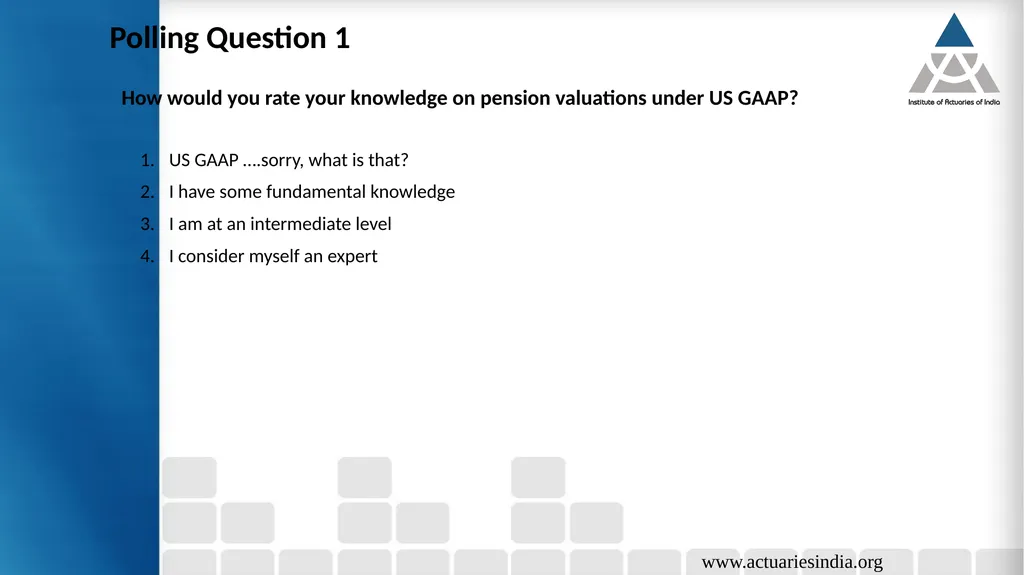
Polling Question 1 www.actuariesindia.org How would you rate your knowledge on pension valuations under US GAAP?
US GAAP ….sorry, what is that?
I have some fundamental knowledge
I am at an intermediate level
I consider myself an expert<br>
US GAAP ….sorry, what is that?
I have some fundamental knowledge
I am at an intermediate level
I consider myself an expert<br>
03
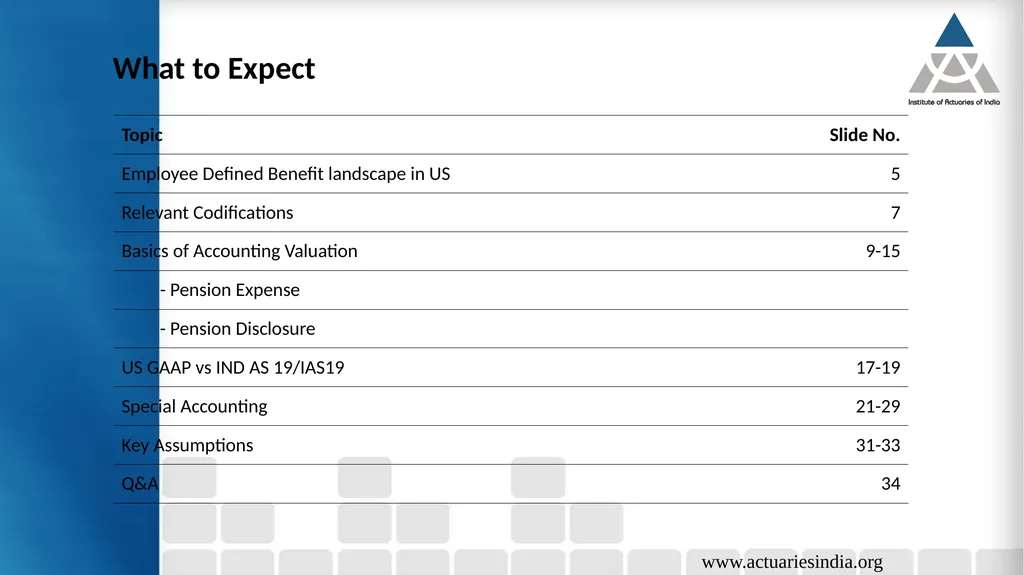
What to Expect www.actuariesindia.org<br>
04
Employee Defined Benefit landscape in US www.actuariesindia.org<br>
05
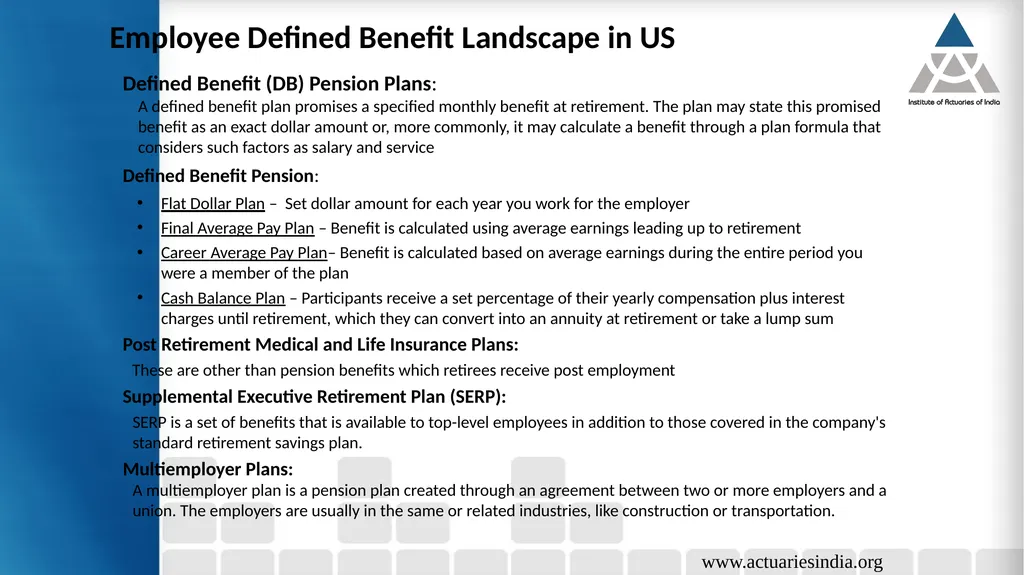
Employee Defined Benefit Landscape in US www.actuariesindia.org Defined Benefit (DB) Pension Plans:
A defined benefit plan promises a specified monthly benefit at retirement. The plan may state this promised benefit as an exact dollar amount or, more commonly, it may calculate a benefit through a plan formula that considers such factors as salary and service
Defined Benefit Pension:
Flat Dollar Plan – Set dollar amount for each year you work for the employer
Final Average Pay Plan – Benefit is calculated using average earnings leading up to retirement
Career Average Pay Plan– Benefit is calculated based on average earnings during the entire period you were a member of the plan
Cash Balance Plan – Participants receive a set percentage of their yearly compensation plus interest charges until retirement, which they can convert into an annuity at retirement or take a lump sum
Post Retirement Medical and Life Insurance Plans:
These are other than pension benefits which retirees receive post employment
Supplemental Executive Retirement Plan (SERP):
SERP is a set of benefits that is available to top-level employees in addition to those covered in the company's standard retirement savings plan.
Multiemployer Plans:
A multiemployer plan is a pension plan created through an agreement between two or more employers and a union. The employers are usually in the same or related industries, like construction or transportation.<br>
A defined benefit plan promises a specified monthly benefit at retirement. The plan may state this promised benefit as an exact dollar amount or, more commonly, it may calculate a benefit through a plan formula that considers such factors as salary and service
Defined Benefit Pension:
Flat Dollar Plan – Set dollar amount for each year you work for the employer
Final Average Pay Plan – Benefit is calculated using average earnings leading up to retirement
Career Average Pay Plan– Benefit is calculated based on average earnings during the entire period you were a member of the plan
Cash Balance Plan – Participants receive a set percentage of their yearly compensation plus interest charges until retirement, which they can convert into an annuity at retirement or take a lump sum
Post Retirement Medical and Life Insurance Plans:
These are other than pension benefits which retirees receive post employment
Supplemental Executive Retirement Plan (SERP):
SERP is a set of benefits that is available to top-level employees in addition to those covered in the company's standard retirement savings plan.
Multiemployer Plans:
A multiemployer plan is a pension plan created through an agreement between two or more employers and a union. The employers are usually in the same or related industries, like construction or transportation.<br>
06
Relevant Codifications www.actuariesindia.org<br>
07
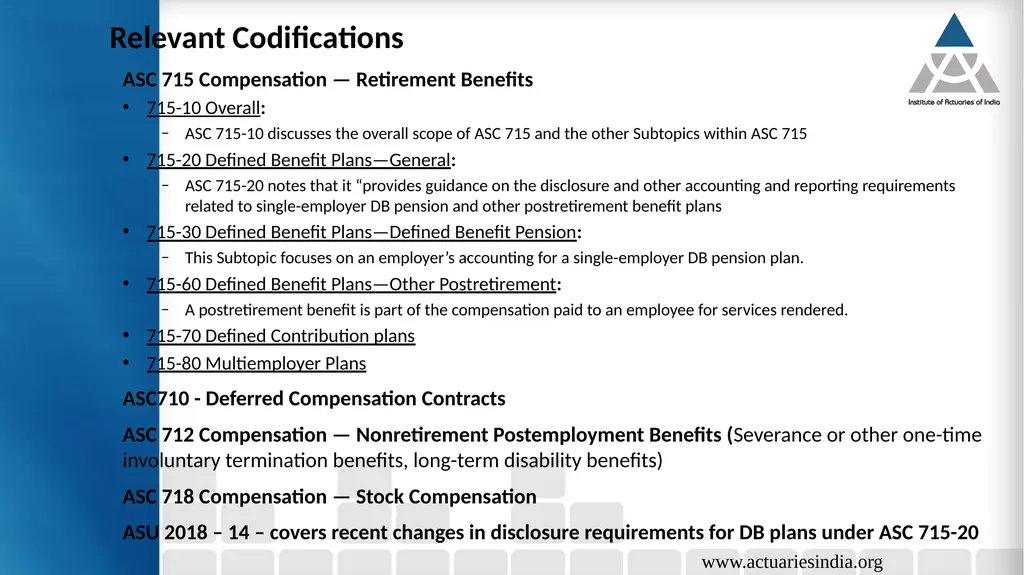
Relevant Codifications www.actuariesindia.org ASC 715 Compensation — Retirement Benefits
715-10 Overall:
ASC 715-10 discusses the overall scope of ASC 715 and the other Subtopics within ASC 715
715-20 Defined Benefit Plans—General:
ASC 715-20 notes that it “provides guidance on the disclosure and other accounting and reporting requirements related to single-employer DB pension and other postretirement benefit plans
715-30 Defined Benefit Plans—Defined Benefit Pension:
This Subtopic focuses on an employer’s accounting for a single-employer DB pension plan.
715-60 Defined Benefit Plans—Other Postretirement:
A postretirement benefit is part of the compensation paid to an employee for services rendered.
715-70 Defined Contribution plans
715-80 Multiemployer Plans
ASC710 - Deferred Compensation Contracts
ASC 712 Compensation — Nonretirement Postemployment Benefits (Severance or other one-time involuntary termination benefits, long-term disability benefits)
ASC 718 Compensation — Stock Compensation
ASU 2018 – 14 – covers recent changes in disclosure requirements for DB plans under ASC 715-20<br>
715-10 Overall:
ASC 715-10 discusses the overall scope of ASC 715 and the other Subtopics within ASC 715
715-20 Defined Benefit Plans—General:
ASC 715-20 notes that it “provides guidance on the disclosure and other accounting and reporting requirements related to single-employer DB pension and other postretirement benefit plans
715-30 Defined Benefit Plans—Defined Benefit Pension:
This Subtopic focuses on an employer’s accounting for a single-employer DB pension plan.
715-60 Defined Benefit Plans—Other Postretirement:
A postretirement benefit is part of the compensation paid to an employee for services rendered.
715-70 Defined Contribution plans
715-80 Multiemployer Plans
ASC710 - Deferred Compensation Contracts
ASC 712 Compensation — Nonretirement Postemployment Benefits (Severance or other one-time involuntary termination benefits, long-term disability benefits)
ASC 718 Compensation — Stock Compensation
ASU 2018 – 14 – covers recent changes in disclosure requirements for DB plans under ASC 715-20<br>
08
Basics of Accounting Valuation www.actuariesindia.org<br>
09
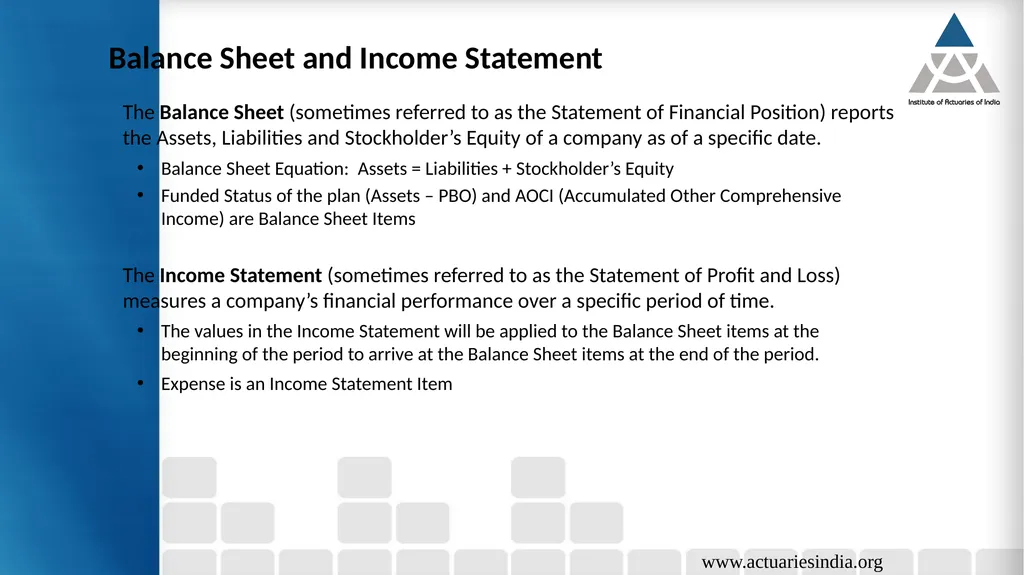
Balance Sheet and Income Statement www.actuariesindia.org The Balance Sheet (sometimes referred to as the Statement of Financial Position) reports the Assets, Liabilities and Stockholder’s Equity of a company as of a specific date.
Balance Sheet Equation: Assets = Liabilities + Stockholder’s Equity
Funded Status of the plan (Assets – PBO) and AOCI (Accumulated Other Comprehensive Income) are Balance Sheet Items
The Income Statement (sometimes referred to as the Statement of Profit and Loss) measures a company’s financial performance over a specific period of time.
The values in the Income Statement will be applied to the Balance Sheet items at the beginning of the period to arrive at the Balance Sheet items at the end of the period.
Expense is an Income Statement Item<br>
Balance Sheet Equation: Assets = Liabilities + Stockholder’s Equity
Funded Status of the plan (Assets – PBO) and AOCI (Accumulated Other Comprehensive Income) are Balance Sheet Items
The Income Statement (sometimes referred to as the Statement of Profit and Loss) measures a company’s financial performance over a specific period of time.
The values in the Income Statement will be applied to the Balance Sheet items at the beginning of the period to arrive at the Balance Sheet items at the end of the period.
Expense is an Income Statement Item<br>
10
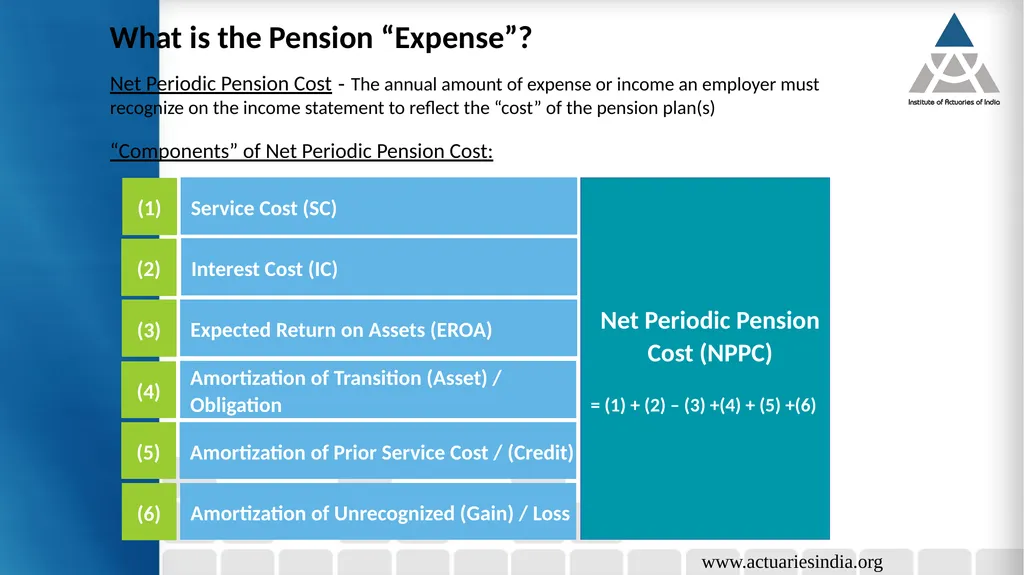
What is the Pension “Expense”? www.actuariesindia.org (1) Service Cost (SC) Net Periodic Pension Cost (NPPC)
= (1) + (2) – (3) +(4) + (5) +(6) Net Periodic Pension Cost - The annual amount of expense or income an employer must recognize on the income statement to reflect the “cost” of the pension plan(s) “Components” of Net Periodic Pension Cost:<br>
= (1) + (2) – (3) +(4) + (5) +(6) Net Periodic Pension Cost - The annual amount of expense or income an employer must recognize on the income statement to reflect the “cost” of the pension plan(s) “Components” of Net Periodic Pension Cost:<br>
11
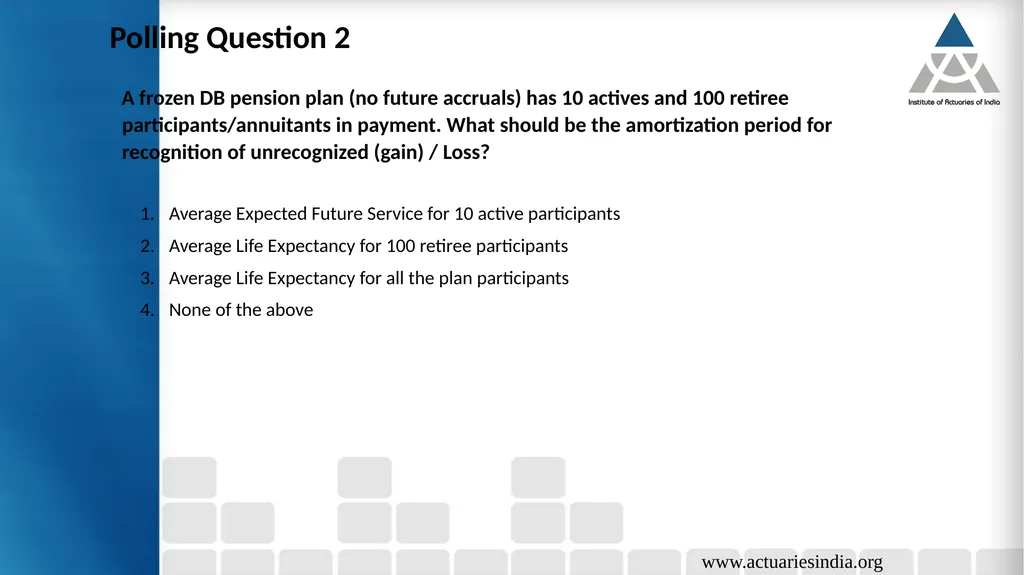
Polling Question 2 www.actuariesindia.org A frozen DB pension plan (no future accruals) has 10 actives and 100 retiree participants/annuitants in payment. What should be the amortization period for recognition of unrecognized (gain) / Loss?
Average Expected Future Service for 10 active participants
Average Life Expectancy for 100 retiree participants
Average Life Expectancy for all the plan participants
None of the above<br>
Average Expected Future Service for 10 active participants
Average Life Expectancy for 100 retiree participants
Average Life Expectancy for all the plan participants
None of the above<br>
12
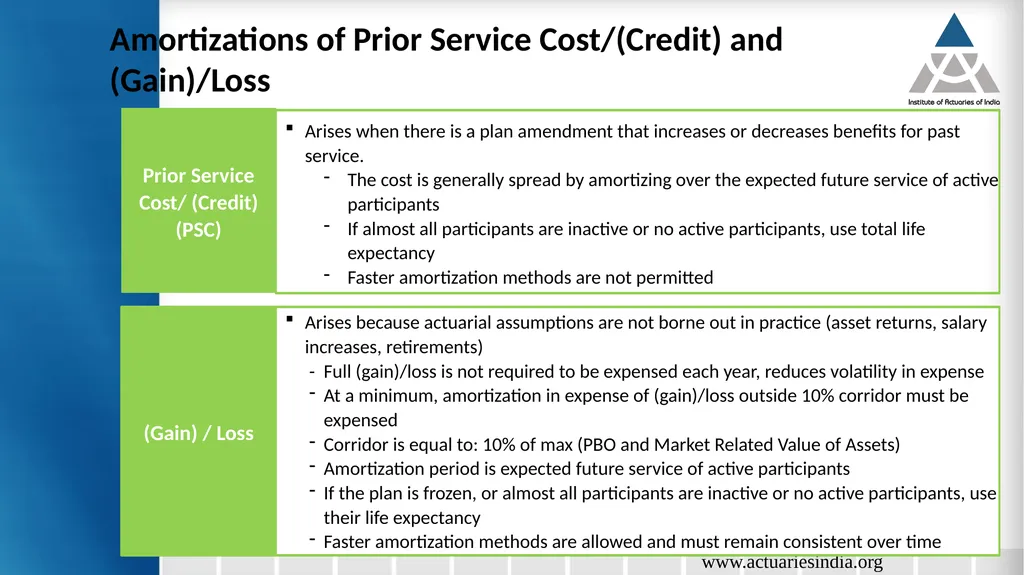
Amortizations of Prior Service Cost/(Credit) and (Gain)/Loss www.actuariesindia.org<br>
13
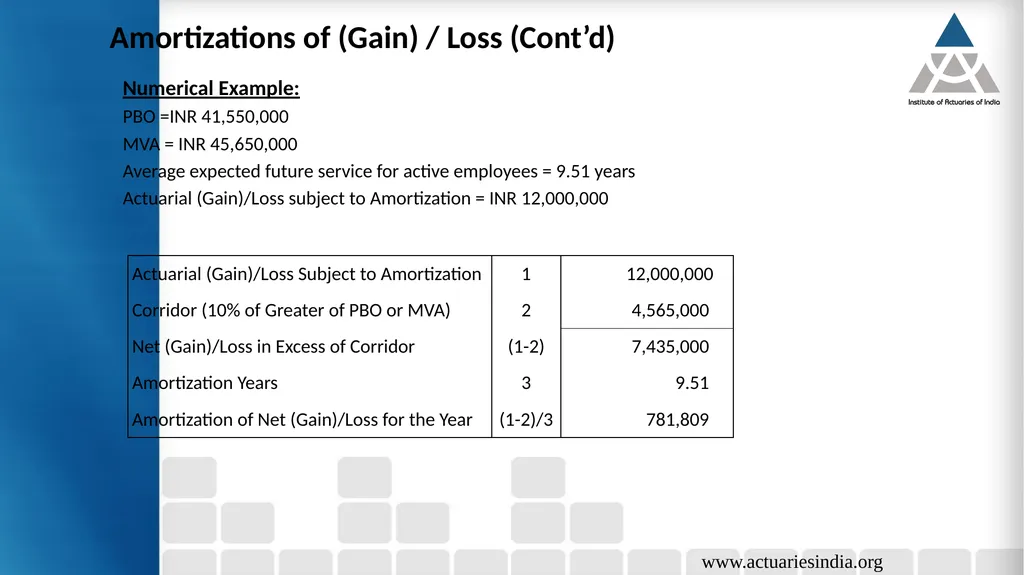
Amortizations of (Gain) / Loss (Cont’d) www.actuariesindia.org Numerical Example:
PBO =INR 41,550,000
MVA = INR 45,650,000
Average expected future service for active employees = 9.51 years
Actuarial (Gain)/Loss subject to Amortization = INR 12,000,000<br>
PBO =INR 41,550,000
MVA = INR 45,650,000
Average expected future service for active employees = 9.51 years
Actuarial (Gain)/Loss subject to Amortization = INR 12,000,000<br>
14
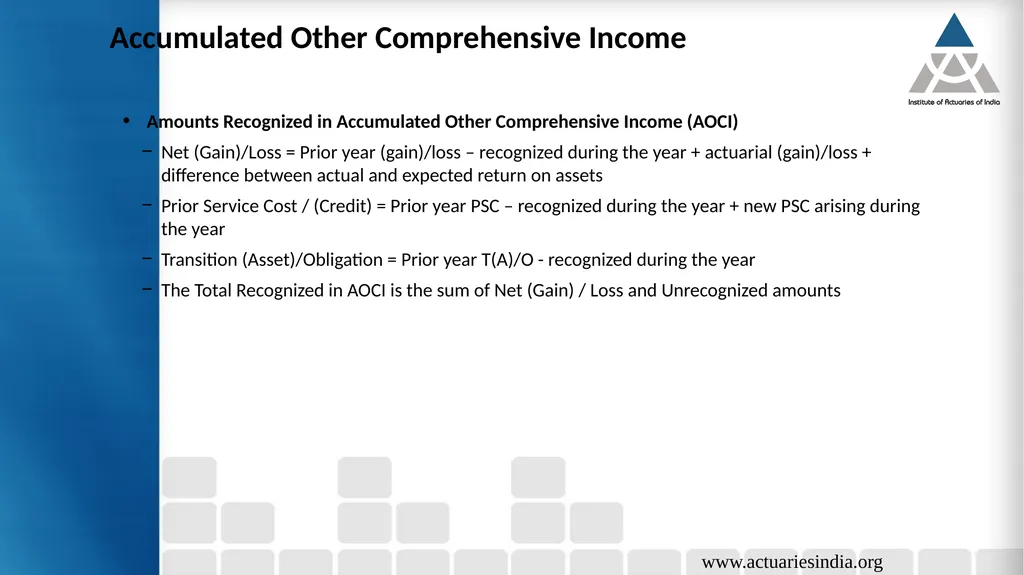
Accumulated Other Comprehensive Income www.actuariesindia.org Amounts Recognized in Accumulated Other Comprehensive Income (AOCI)
Net (Gain)/Loss = Prior year (gain)/loss – recognized during the year + actuarial (gain)/loss + difference between actual and expected return on assets
Prior Service Cost / (Credit) = Prior year PSC – recognized during the year + new PSC arising during the year
Transition (Asset)/Obligation = Prior year T(A)/O - recognized during the year
The Total Recognized in AOCI is the sum of Net (Gain) / Loss and Unrecognized amounts<br>
Net (Gain)/Loss = Prior year (gain)/loss – recognized during the year + actuarial (gain)/loss + difference between actual and expected return on assets
Prior Service Cost / (Credit) = Prior year PSC – recognized during the year + new PSC arising during the year
Transition (Asset)/Obligation = Prior year T(A)/O - recognized during the year
The Total Recognized in AOCI is the sum of Net (Gain) / Loss and Unrecognized amounts<br>
15
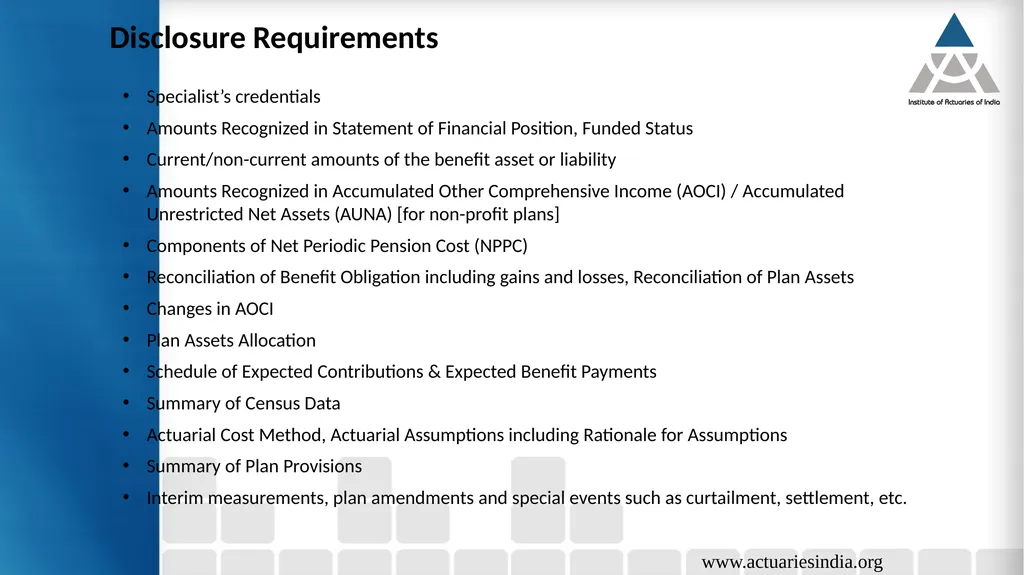
Disclosure Requirements www.actuariesindia.org Specialist’s credentials
Amounts Recognized in Statement of Financial Position, Funded Status
Current/non-current amounts of the benefit asset or liability
Amounts Recognized in Accumulated Other Comprehensive Income (AOCI) / Accumulated Unrestricted Net Assets (AUNA) [for non-profit plans]
Components of Net Periodic Pension Cost (NPPC)
Reconciliation of Benefit Obligation including gains and losses, Reconciliation of Plan Assets
Changes in AOCI
Plan Assets Allocation
Schedule of Expected Contributions & Expected Benefit Payments
Summary of Census Data
Actuarial Cost Method, Actuarial Assumptions including Rationale for Assumptions
Summary of Plan Provisions
Interim measurements, plan amendments and special events such as curtailment, settlement, etc.<br>
Amounts Recognized in Statement of Financial Position, Funded Status
Current/non-current amounts of the benefit asset or liability
Amounts Recognized in Accumulated Other Comprehensive Income (AOCI) / Accumulated Unrestricted Net Assets (AUNA) [for non-profit plans]
Components of Net Periodic Pension Cost (NPPC)
Reconciliation of Benefit Obligation including gains and losses, Reconciliation of Plan Assets
Changes in AOCI
Plan Assets Allocation
Schedule of Expected Contributions & Expected Benefit Payments
Summary of Census Data
Actuarial Cost Method, Actuarial Assumptions including Rationale for Assumptions
Summary of Plan Provisions
Interim measurements, plan amendments and special events such as curtailment, settlement, etc.<br>
16
US GAAP vs IND AS 19/IAS 19 www.actuariesindia.org<br>
17
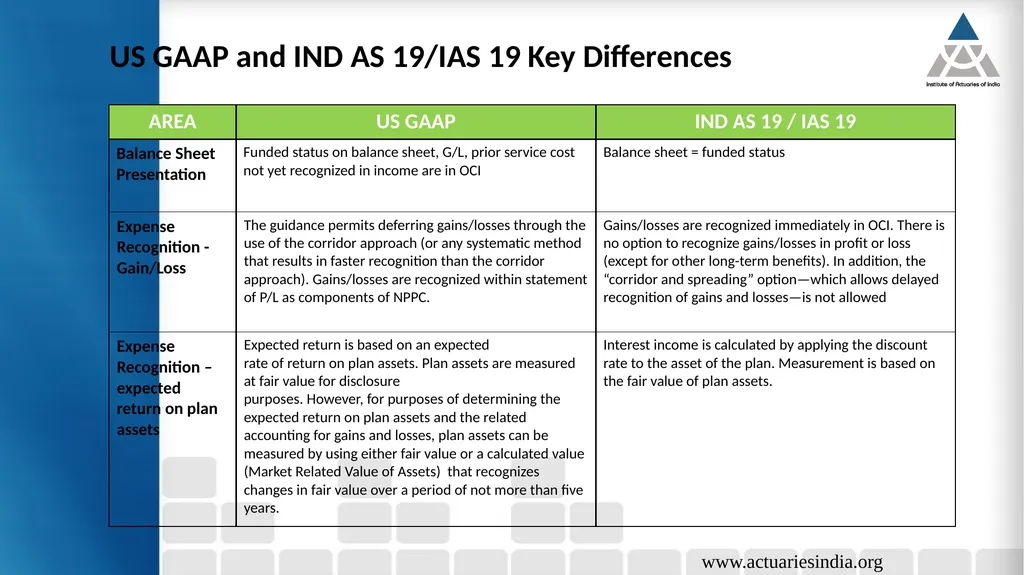
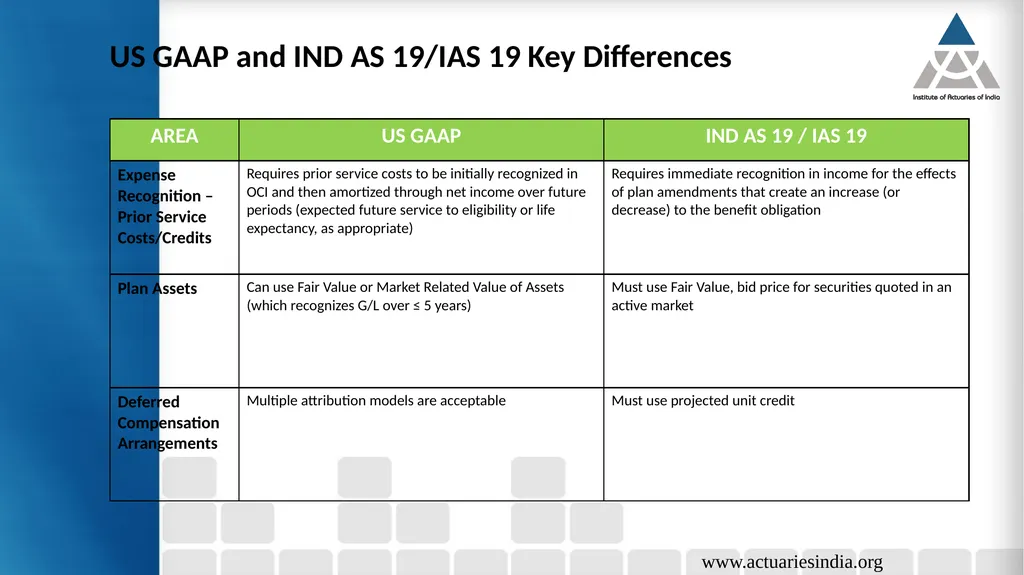
www.actuariesindia.org US GAAP and IND AS 19/IAS 19 Key Differences<br>
18
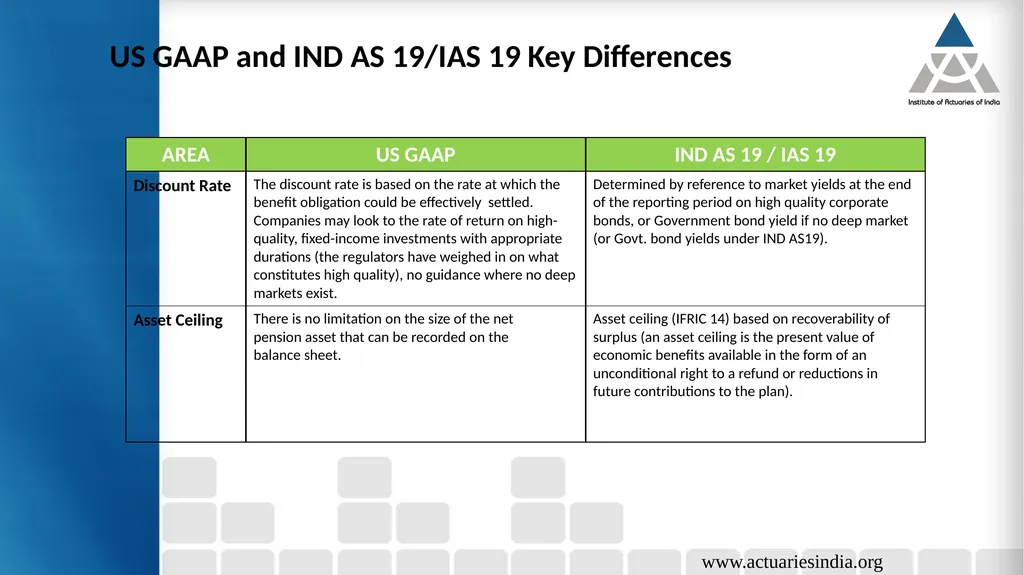
www.actuariesindia.org US GAAP and IND AS 19/IAS 19 Key Differences<br>
19
www.actuariesindia.org US GAAP and IND AS 19/IAS 19 Key Differences<br>
20
Special Accounting www.actuariesindia.org<br>
21
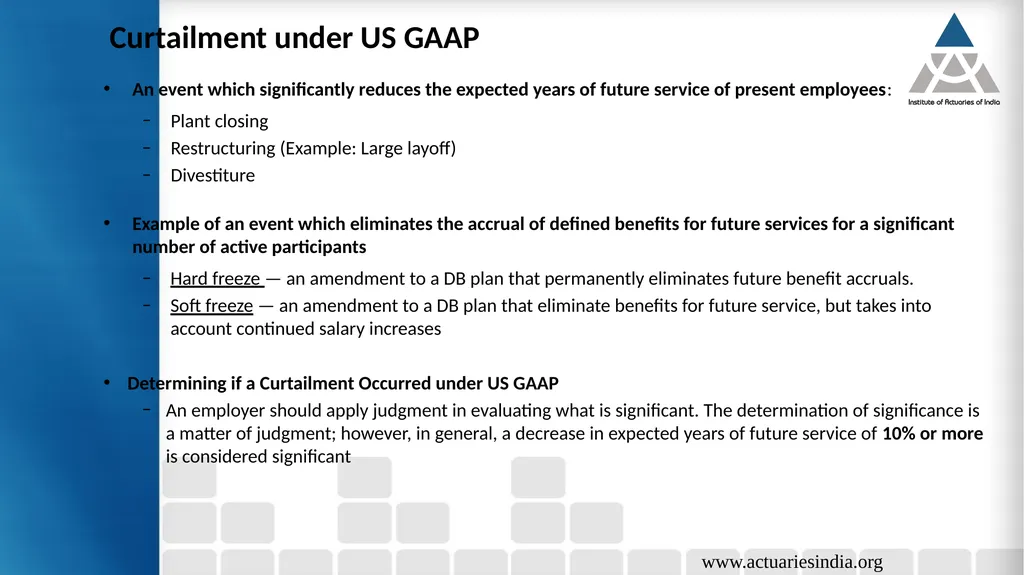
Curtailment under US GAAP www.actuariesindia.org An event which significantly reduces the expected years of future service of present employees:
Plant closing
Restructuring (Example: Large layoff)
Divestiture
Example of an event which eliminates the accrual of defined benefits for future services for a significant number of active participants
Hard freeze — an amendment to a DB plan that permanently eliminates future benefit accruals.
Soft freeze — an amendment to a DB plan that eliminate benefits for future service, but takes into account continued salary increases
Determining if a Curtailment Occurred under US GAAP
An employer should apply judgment in evaluating what is significant. The determination of significance is a matter of judgment; however, in general, a decrease in expected years of future service of 10% or more is considered significant<br>
Plant closing
Restructuring (Example: Large layoff)
Divestiture
Example of an event which eliminates the accrual of defined benefits for future services for a significant number of active participants
Hard freeze — an amendment to a DB plan that permanently eliminates future benefit accruals.
Soft freeze — an amendment to a DB plan that eliminate benefits for future service, but takes into account continued salary increases
Determining if a Curtailment Occurred under US GAAP
An employer should apply judgment in evaluating what is significant. The determination of significance is a matter of judgment; however, in general, a decrease in expected years of future service of 10% or more is considered significant<br>
22
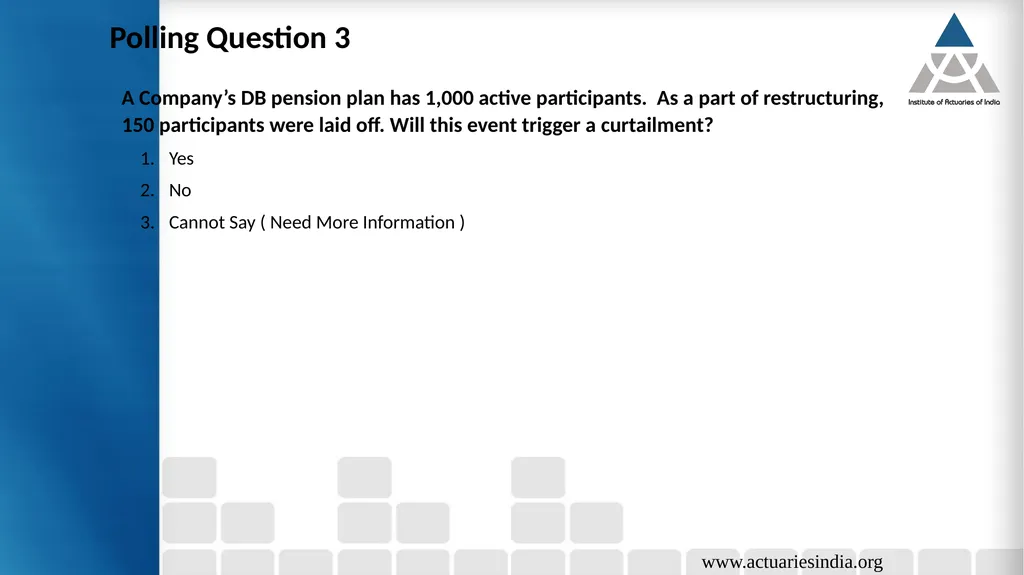
Polling Question 3 www.actuariesindia.org A Company’s DB pension plan has 1,000 active participants. As a part of restructuring, 150 participants were laid off. Will this event trigger a curtailment?
Yes
No
Cannot Say ( Need More Information )<br>
Yes
No
Cannot Say ( Need More Information )<br>
23
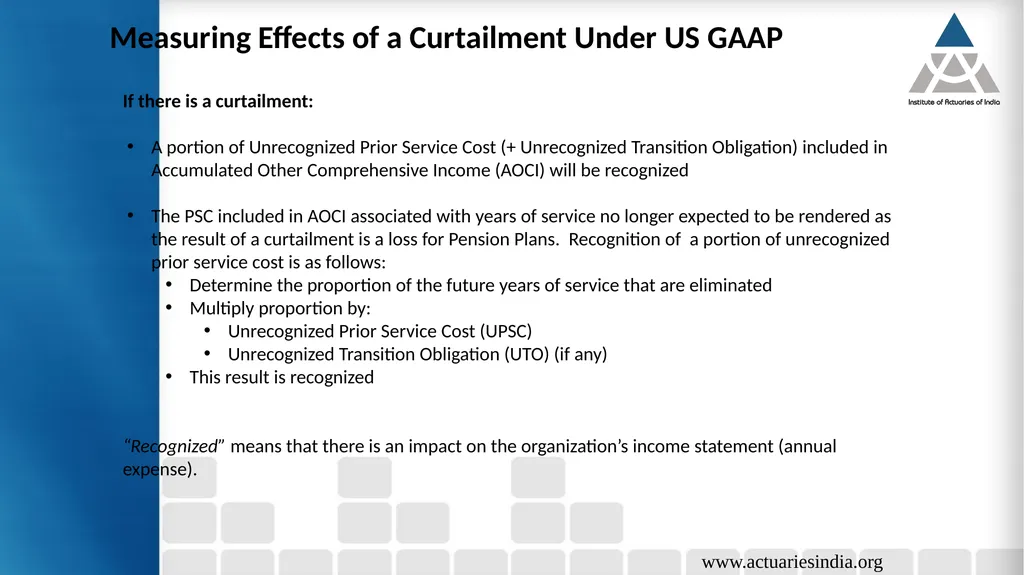
Measuring Effects of a Curtailment Under US GAAP www.actuariesindia.org If there is a curtailment:
A portion of Unrecognized Prior Service Cost (+ Unrecognized Transition Obligation) included in Accumulated Other Comprehensive Income (AOCI) will be recognized
The PSC included in AOCI associated with years of service no longer expected to be rendered as the result of a curtailment is a loss for Pension Plans. Recognition of a portion of unrecognized prior service cost is as follows:
Determine the proportion of the future years of service that are eliminated
Multiply proportion by:
Unrecognized Prior Service Cost (UPSC)
Unrecognized Transition Obligation (UTO) (if any)
This result is recognized
“Recognized” means that there is an impact on the organization’s income statement (annual expense).<br>
A portion of Unrecognized Prior Service Cost (+ Unrecognized Transition Obligation) included in Accumulated Other Comprehensive Income (AOCI) will be recognized
The PSC included in AOCI associated with years of service no longer expected to be rendered as the result of a curtailment is a loss for Pension Plans. Recognition of a portion of unrecognized prior service cost is as follows:
Determine the proportion of the future years of service that are eliminated
Multiply proportion by:
Unrecognized Prior Service Cost (UPSC)
Unrecognized Transition Obligation (UTO) (if any)
This result is recognized
“Recognized” means that there is an impact on the organization’s income statement (annual expense).<br>
24
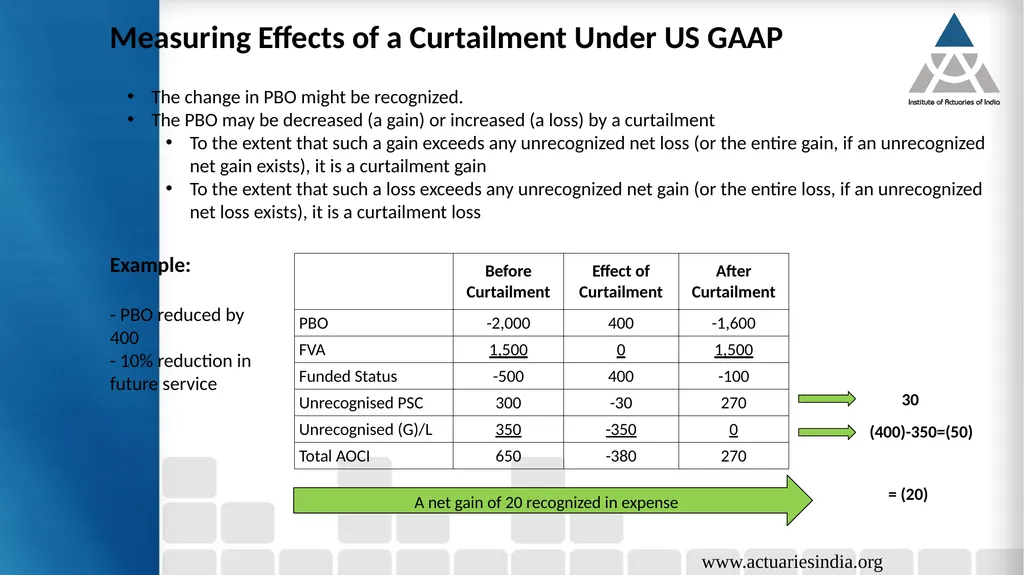
Measuring Effects of a Curtailment Under US GAAP www.actuariesindia.org The change in PBO might be recognized.
The PBO may be decreased (a gain) or increased (a loss) by a curtailment
To the extent that such a gain exceeds any unrecognized net loss (or the entire gain, if an unrecognized net gain exists), it is a curtailment gain
To the extent that such a loss exceeds any unrecognized net gain (or the entire loss, if an unrecognized net loss exists), it is a curtailment loss Example:
- PBO reduced by 400
- 10% reduction in future service 30 (400)-350=(50) = (20) A net gain of 20 recognized in expense<br>
The PBO may be decreased (a gain) or increased (a loss) by a curtailment
To the extent that such a gain exceeds any unrecognized net loss (or the entire gain, if an unrecognized net gain exists), it is a curtailment gain
To the extent that such a loss exceeds any unrecognized net gain (or the entire loss, if an unrecognized net loss exists), it is a curtailment loss Example:
- PBO reduced by 400
- 10% reduction in future service 30 (400)-350=(50) = (20) A net gain of 20 recognized in expense<br>
25
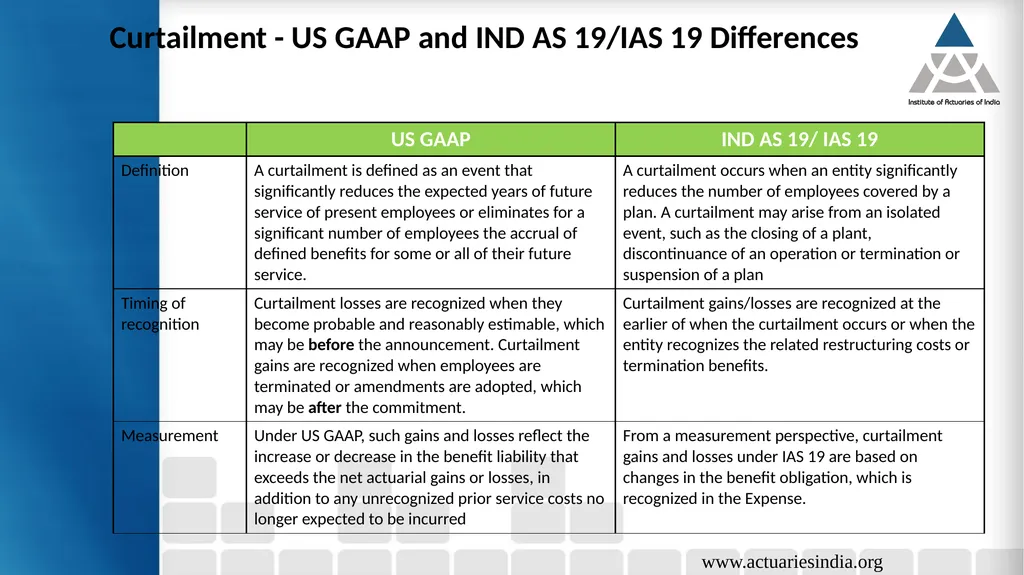
Curtailment - US GAAP and IND AS 19/IAS 19 Differences www.actuariesindia.org<br>
26
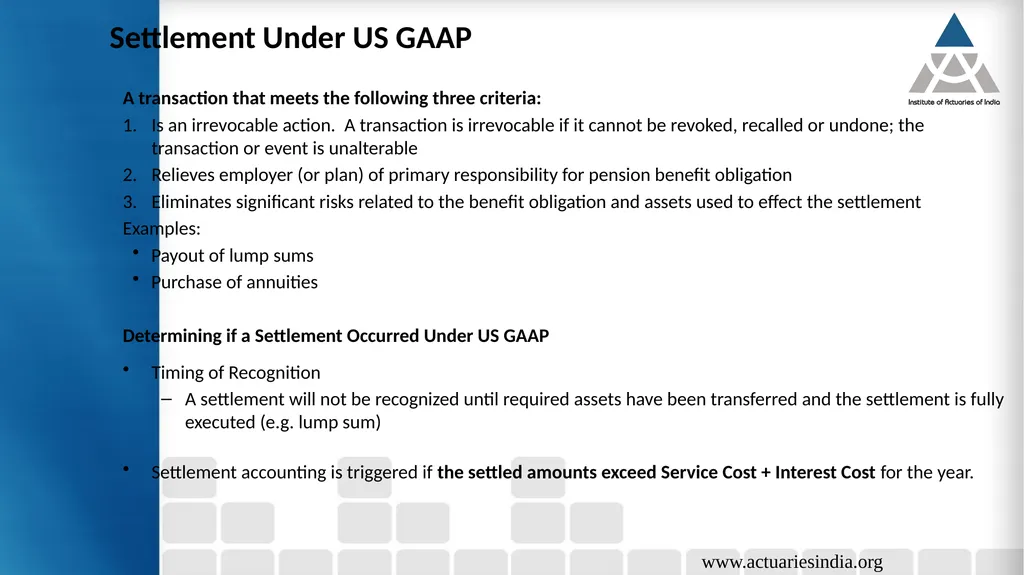
Settlement Under US GAAP www.actuariesindia.org A transaction that meets the following three criteria:
Is an irrevocable action. A transaction is irrevocable if it cannot be revoked, recalled or undone; the transaction or event is unalterable
Relieves employer (or plan) of primary responsibility for pension benefit obligation
Eliminates significant risks related to the benefit obligation and assets used to effect the settlement
Examples:
Payout of lump sums
Purchase of annuities
Determining if a Settlement Occurred Under US GAAP
Timing of Recognition
A settlement will not be recognized until required assets have been transferred and the settlement is fully executed (e.g. lump sum)
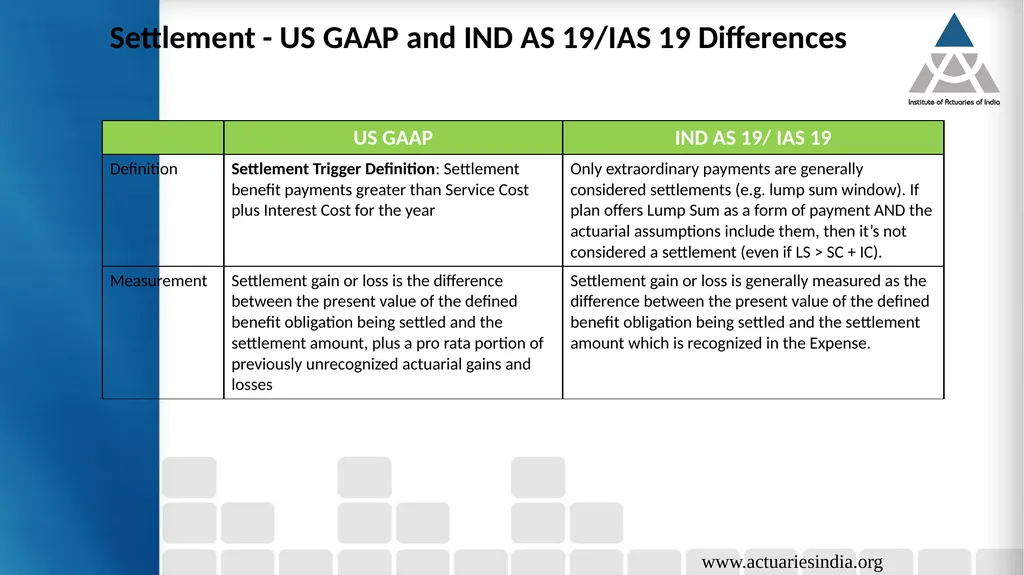
Settlement accounting is triggered if the settled amounts exceed Service Cost + Interest Cost for the year.<br>
Is an irrevocable action. A transaction is irrevocable if it cannot be revoked, recalled or undone; the transaction or event is unalterable
Relieves employer (or plan) of primary responsibility for pension benefit obligation
Eliminates significant risks related to the benefit obligation and assets used to effect the settlement
Examples:
Payout of lump sums
Purchase of annuities
Determining if a Settlement Occurred Under US GAAP
Timing of Recognition
A settlement will not be recognized until required assets have been transferred and the settlement is fully executed (e.g. lump sum)
Settlement accounting is triggered if the settled amounts exceed Service Cost + Interest Cost for the year.<br>
27
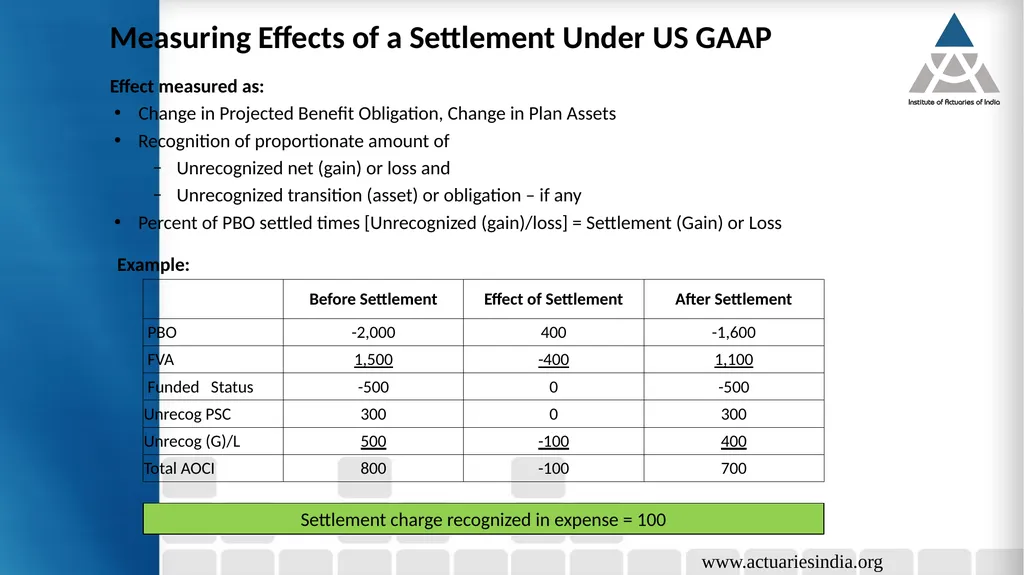
Measuring Effects of a Settlement Under US GAAP www.actuariesindia.org Effect measured as:
Change in Projected Benefit Obligation, Change in Plan Assets
Recognition of proportionate amount of
Unrecognized net (gain) or loss and
Unrecognized transition (asset) or obligation – if any
Percent of PBO settled times [Unrecognized (gain)/loss] = Settlement (Gain) or Loss Example: Settlement charge recognized in expense = 100<br>
Change in Projected Benefit Obligation, Change in Plan Assets
Recognition of proportionate amount of
Unrecognized net (gain) or loss and
Unrecognized transition (asset) or obligation – if any
Percent of PBO settled times [Unrecognized (gain)/loss] = Settlement (Gain) or Loss Example: Settlement charge recognized in expense = 100<br>
28
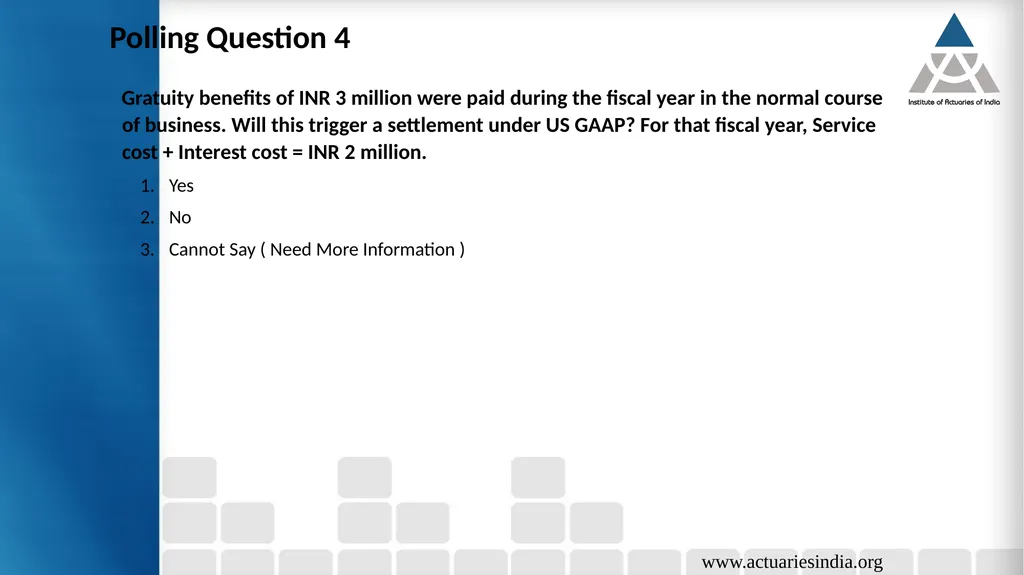
Polling Question 4 www.actuariesindia.org Gratuity benefits of INR 3 million were paid during the fiscal year in the normal course of business. Will this trigger a settlement under US GAAP? For that fiscal year, Service cost + Interest cost = INR 2 million.
Yes
No
Cannot Say ( Need More Information )<br>
Yes
No
Cannot Say ( Need More Information )<br>
29
Settlement - US GAAP and IND AS 19/IAS 19 Differences www.actuariesindia.org<br>
30
Key Assumptions www.actuariesindia.org<br>
31
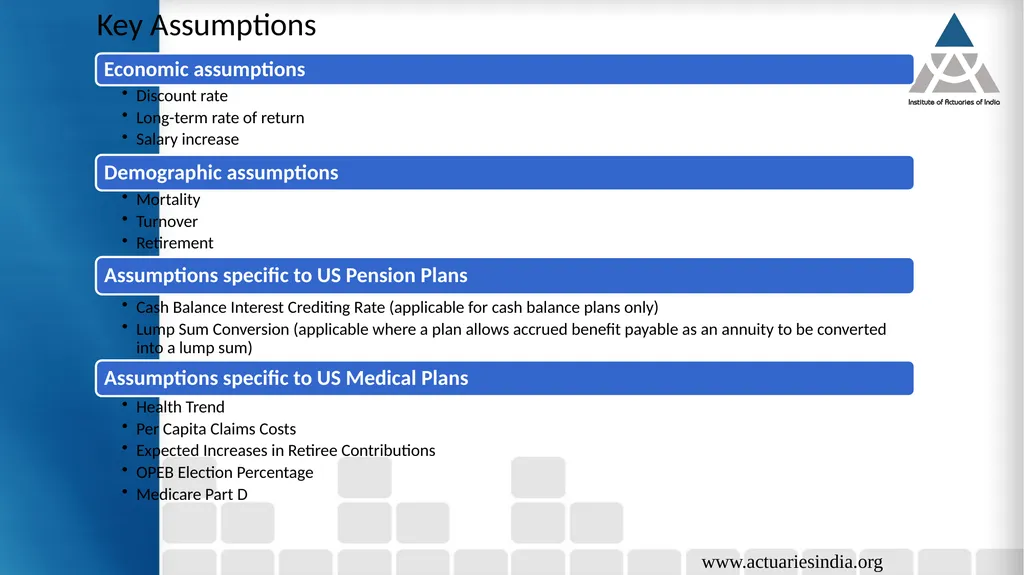
www.actuariesindia.org Key Assumptions Health Trend
Per Capita Claims Costs
Expected Increases in Retiree Contributions
OPEB Election Percentage
Medicare Part D<br>
Per Capita Claims Costs
Expected Increases in Retiree Contributions
OPEB Election Percentage
Medicare Part D<br>
32
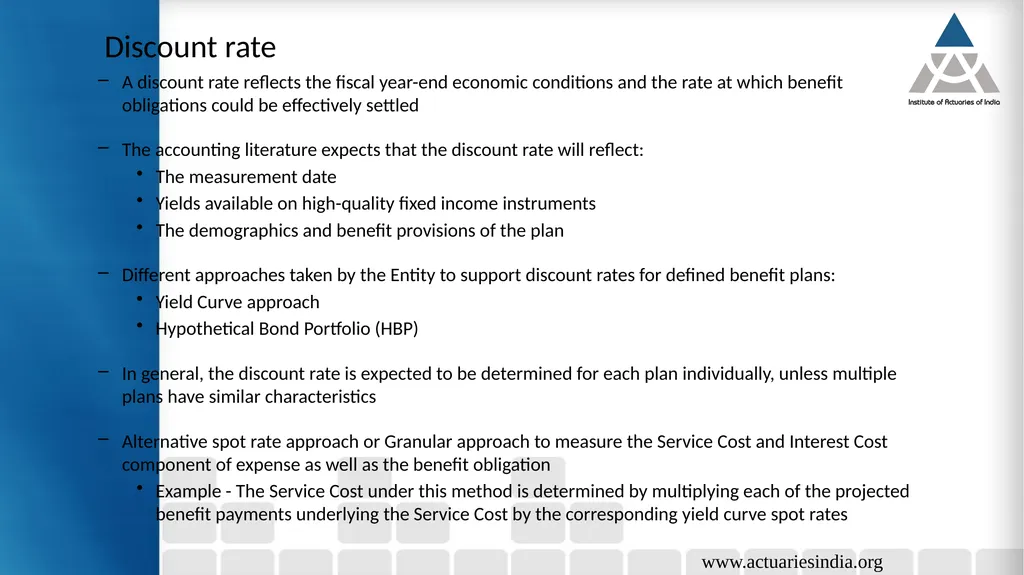
www.actuariesindia.org Discount rate A discount rate reflects the fiscal year-end economic conditions and the rate at which benefit obligations could be effectively settled
The accounting literature expects that the discount rate will reflect:
The measurement date
Yields available on high-quality fixed income instruments
The demographics and benefit provisions of the plan
Different approaches taken by the Entity to support discount rates for defined benefit plans:
Yield Curve approach
Hypothetical Bond Portfolio (HBP)
In general, the discount rate is expected to be determined for each plan individually, unless multiple plans have similar characteristics
Alternative spot rate approach or Granular approach to measure the Service Cost and Interest Cost component of expense as well as the benefit obligation
Example - The Service Cost under this method is determined by multiplying each of the projected benefit payments underlying the Service Cost by the corresponding yield curve spot rates<br>
The accounting literature expects that the discount rate will reflect:
The measurement date
Yields available on high-quality fixed income instruments
The demographics and benefit provisions of the plan
Different approaches taken by the Entity to support discount rates for defined benefit plans:
Yield Curve approach
Hypothetical Bond Portfolio (HBP)
In general, the discount rate is expected to be determined for each plan individually, unless multiple plans have similar characteristics
Alternative spot rate approach or Granular approach to measure the Service Cost and Interest Cost component of expense as well as the benefit obligation
Example - The Service Cost under this method is determined by multiplying each of the projected benefit payments underlying the Service Cost by the corresponding yield curve spot rates<br>
33
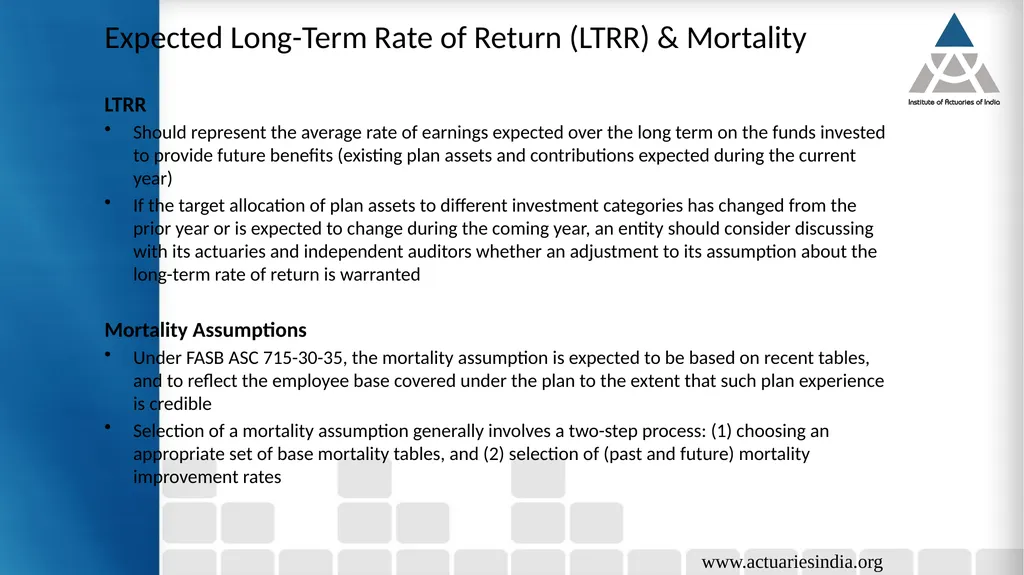
www.actuariesindia.org Expected Long-Term Rate of Return (LTRR) & Mortality LTRR
Should represent the average rate of earnings expected over the long term on the funds invested to provide future benefits (existing plan assets and contributions expected during the current year)
If the target allocation of plan assets to different investment categories has changed from the prior year or is expected to change during the coming year, an entity should consider discussing with its actuaries and independent auditors whether an adjustment to its assumption about the long-term rate of return is warranted
Mortality Assumptions
Under FASB ASC 715-30-35, the mortality assumption is expected to be based on recent tables, and to reflect the employee base covered under the plan to the extent that such plan experience is credible
Selection of a mortality assumption generally involves a two-step process: (1) choosing an appropriate set of base mortality tables, and (2) selection of (past and future) mortality improvement rates<br>
Should represent the average rate of earnings expected over the long term on the funds invested to provide future benefits (existing plan assets and contributions expected during the current year)
If the target allocation of plan assets to different investment categories has changed from the prior year or is expected to change during the coming year, an entity should consider discussing with its actuaries and independent auditors whether an adjustment to its assumption about the long-term rate of return is warranted
Mortality Assumptions
Under FASB ASC 715-30-35, the mortality assumption is expected to be based on recent tables, and to reflect the employee base covered under the plan to the extent that such plan experience is credible
Selection of a mortality assumption generally involves a two-step process: (1) choosing an appropriate set of base mortality tables, and (2) selection of (past and future) mortality improvement rates<br>
34
www.actuariesindia.org Any questions ?<br>