SRI SARAVAJNA COLLEGE OF EDUCATION Subject :
Description: SRI SARAVAJNA COLLEGE OF EDUCATION Subject : Development and Management of school education Topic : Directorate of State Education Research and Training After establishing NCERT Union Government rightly thought to establish similar bodies
Related Topics
Download Presentation
"SRI SARAVAJNA COLLEGE OF EDUCATION Subject :" is the property of its rightful owner. Permission is granted to download and print the materials on this website for personal, non-commercial use only, and to display it on your personal computer provided you do not modify the materials and that you retain all copyright notices contained in the materials. By downloading content from our website, you accept the terms of this agreement.
Presentation Transcript
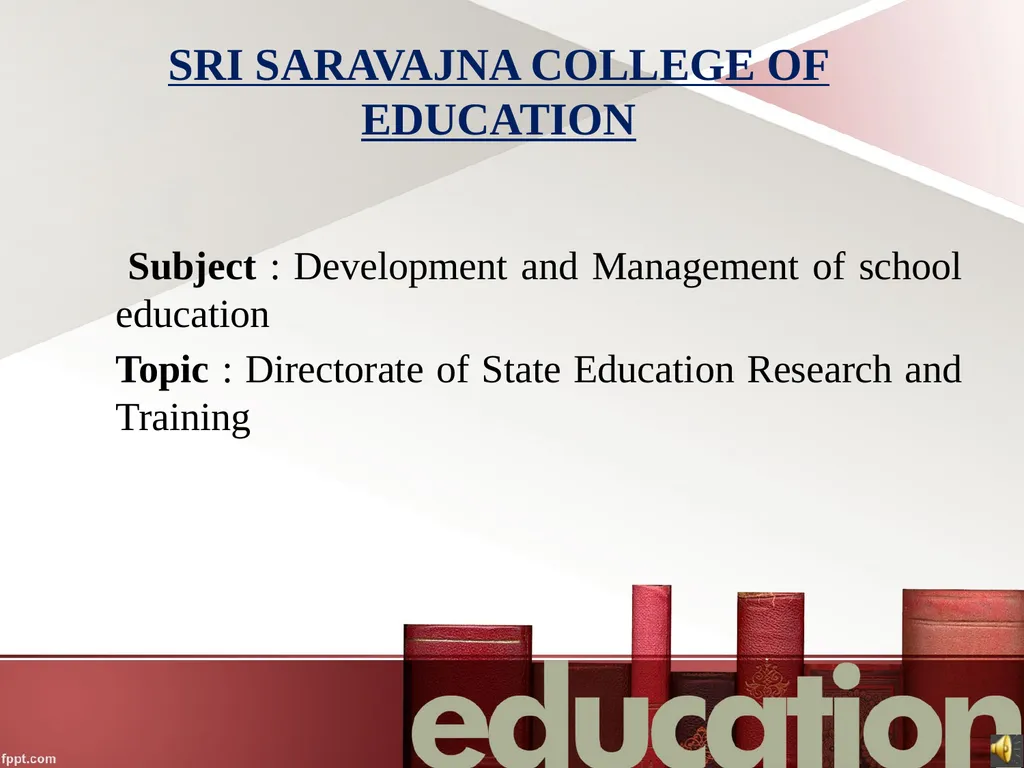
slide1. SRI SARAVAJNA COLLEGE OF EDUCATION Subject : Development and Management of school education
Topic : Directorate of State Education Research and Training<br>
slide2. After establishing NCERT Union Government rightly thought to establish similar bodies at state level .<br>
slide3. Introduction
The Department of State Educational Research and Training, popularly known as DSERT is the academic wing of the Department of Public Instruction.
It aims at providing academic leadership in school education as well as improving the quality of education provided in primary and secondary schools in the state.
The DSERT was formed as a small academic unit of the Department of Public Instruction.
It was then known as the State Institute of Education (SIE), and it originally started functioning from the northern district town of Dharwad in 1964.
This unit was later shifted to Bangalore and the other academic units of the department of public instruction – State Institute of Science (SIS), State Educational Evaluation Unit (SEEU) and Educational Vocational Guidance Bureau (EVG), were merged in 1975 to form a single monolithic Department of State Educational Research and Training.<br>
slide4. I. Structure of DSERT :
The DSERT is headed by a departmental officer of the rank of a Director of Public Instruction.
The Director is assisted by Joint Director in all his academic and administrative duties.
Apart from Joint Director, 2 Deputy Directors and 14 Senior Assistant Directors along with their staff function from various sections of DSERT.
CTEs, Govt. TTIs, Aided D.Ed Colleges and DIETs, -- District Institutes of Education & Training, functioning under DSERT are situated across the state carry forward the objectives and activities of DSERT to massive teacher community.
DSERT is under the administrative control of Commissioner of Public Instructions and Secretariat of Primary and Secondary Education Department.<br>
slide5. II Objectives & Activities of DSERT :
Enhancing the quality of education in primary and secondary schools in the state.
Management of teacher education in the state (both pre service and in service education) both at the elementary education and secondary education levels
Management of Government Colleges of teacher education, District Institutes of Education and Training and other Government teacher training institutions.
Promoting Science Education in the state.
Designing and implementing in service teacher training courses in content, pedagogy, innovative methods like theatre in education, use of low cost and no cost teaching learning materials in schools, etc.
Making Satellite based training programmes.
Encouraging the talent of the students through scholarships
Having found the teaching needs of High School teachers, enhancing the teaching skills of teachers
Accelerating the learning abilities of the students studying in Govt. Schools.
Bringing about a better change in educational quality of Teacher Training Institutes.
Through Art Research Center of DSERT, organizing the exhibitions / seminars to student – teacher community of High Schools on Applications of Art, New Explorations of Art and Action Research.
Usage of technology in education.<br>
slide6. Wings of Directorate of State Education Research & Training State Institute of Education-1964;
State Institute of Science – 1964-65;
State Education Evaluation Unit;
Educational and vocational guidance unit;
Educational technological cell;
Audio visual education unit and
Text book wing.<br>
slide7. IV. Sections of DSERT
Education Technology Cell
Technology Assisted learning Programme (TALP)
IT@SCHOOLS IN KARNATAKA
Tele Education Programme
Edusat
State Institute of Science (SIS)
State Educational Evaluation Unit (SEEU)
National Talent Search Examination (NTSE)
National Means Cum Merit Scholarship (NMMS)
National Population Education Programme (NPEP)
Rashtreeya madhyamika Skikshana Abhiyaan (RMSA)
Teacher Education (TE)
Review of D.Ed Cirriculam
Sarva Shikshana Abhiyaan (SSA)<br>
slide8. Teacher Education Unit
This unit is an charge of Administration of Teacher Education in Education in State and headed by an officer of the rank of Deputy Director of Public Instruction. This unit head is assisted by two junior class I officers of the rank of senior Assistant Directors. This unit looks after the DIETs and CTEs and all other pre service teacher training institutions. The unit also liases with the NCTE, NCERT, NIEPA and CAC for academic and administrative matters.
2. State Education Evaluation Unit (SEEU)
Main Objective of this unit is to improve the quality of school education and professional development of teachers. This unit is in charge of all the activities formerly conducted by State Institute of Education –Educational Vocational Guidance Unit . The various activities are Publication of Children’s Literature , Conduct of National Talent Search Examination (NTSE) , Population education , Adolescent education , Life skills and health awareness etc.<br>
slide9. State Institute of Science (SIS)
The main purpose of this unit is to augment the standard of teaching and learning of science and mathematics at school level, to develop scientific attitudes among teachers and students in daily life.
The institute has established and supervised 224 science centers in the state . The unit also prepares and circulates appropriate teaching learning support materials for all schools.
Education Technology Cell
There are three officers of the rank of senior assistant Directors, one officer looks after the Mahiti Sindhu program and Computer Education, and second officer looks after the training programs done through the teleconferencing Keli Kali and Bandani radio programs, the third officer looks after edusat and other technological assisted programs.<br>
slide10. SSA Training Cell
SSA had entrusted the responsibility of conducting teacher training programs of all elementary teachers in the state, to
DSERT under SSA every Primary school teacher in the state is to be given quality training for a minimum of 20 days in a year.
Adolescent Education Cell
The adolescent Education cell has been constituted in DSERT in 2005-06 with the primary objective of creating awareness among both teachers and adolescent children about development of life skills to protect themselves from HIV infections or AIDS disease, avoid risky situation drug abuse and practice responsible behaviour.<br>
slide11. Directorate of Textbook is in charge of curriculum development,
preparation, production and distribution of textbooks for standard
1 to 10.
The Directorate also prepare syllabus and text books for special
courses in D.Ed , physical education ,music, dance, drama, SUPW.
Policy Planning Unit
It was established in 2002-03, in collaboration with Azim Premji Foundation (ADF) with
a mandate to support the department of public instruction in building capacities for
planning, programming and innovation in education sector.
PPU has also taken out evaluation of departmental programs. The following studies have
been taken up by PPU.<br>
slide12. Function of Directorate of State Education Research and Training (DSERT) Maintaining and improving quality of education in primary and secondary schools in the state,
Management of teacher education in the state (both pre service and in service education) both at the elementary education and secondary education levels,
Management of Government Colleges of teacher education, District Institutes of Education and Training and other Government teacher training institution
Preparation and revision of curriculum for various courses coming under school education,<br>
slide13. Preparation, production and distribution of teachers’ hand Books, resource materials, training manuals for –
(i) Standards I to X, (ii) Diploma in Education Course, (iii) Special Courses like Music, Dance, Drama, Drawing & Painting, Sanskrit, Commerce, SUPW, etc.,
Promoting Science Education in the state.Â
Procurement and supply of Teaching Learning Materials (TLMs) and resource books to schools,
Designing and implementing in service teacher training courses in content, pedagogy, innovative methods like theatre in education, use of low cost and no cost teaching learning materials in schools, etc.,<br>
slide14. Reference
https://ncert.nic.in/
https://www.education.gov.in/en
http://dsert.kar.nic.in/index.asp<br>
slide15. THANK YOU<br>
Topic : Directorate of State Education Research and Training<br>
slide2. After establishing NCERT Union Government rightly thought to establish similar bodies at state level .<br>
slide3. Introduction
The Department of State Educational Research and Training, popularly known as DSERT is the academic wing of the Department of Public Instruction.
It aims at providing academic leadership in school education as well as improving the quality of education provided in primary and secondary schools in the state.
The DSERT was formed as a small academic unit of the Department of Public Instruction.
It was then known as the State Institute of Education (SIE), and it originally started functioning from the northern district town of Dharwad in 1964.
This unit was later shifted to Bangalore and the other academic units of the department of public instruction – State Institute of Science (SIS), State Educational Evaluation Unit (SEEU) and Educational Vocational Guidance Bureau (EVG), were merged in 1975 to form a single monolithic Department of State Educational Research and Training.<br>
slide4. I. Structure of DSERT :
The DSERT is headed by a departmental officer of the rank of a Director of Public Instruction.
The Director is assisted by Joint Director in all his academic and administrative duties.
Apart from Joint Director, 2 Deputy Directors and 14 Senior Assistant Directors along with their staff function from various sections of DSERT.
CTEs, Govt. TTIs, Aided D.Ed Colleges and DIETs, -- District Institutes of Education & Training, functioning under DSERT are situated across the state carry forward the objectives and activities of DSERT to massive teacher community.
DSERT is under the administrative control of Commissioner of Public Instructions and Secretariat of Primary and Secondary Education Department.<br>
slide5. II Objectives & Activities of DSERT :
Enhancing the quality of education in primary and secondary schools in the state.
Management of teacher education in the state (both pre service and in service education) both at the elementary education and secondary education levels
Management of Government Colleges of teacher education, District Institutes of Education and Training and other Government teacher training institutions.
Promoting Science Education in the state.
Designing and implementing in service teacher training courses in content, pedagogy, innovative methods like theatre in education, use of low cost and no cost teaching learning materials in schools, etc.
Making Satellite based training programmes.
Encouraging the talent of the students through scholarships
Having found the teaching needs of High School teachers, enhancing the teaching skills of teachers
Accelerating the learning abilities of the students studying in Govt. Schools.
Bringing about a better change in educational quality of Teacher Training Institutes.
Through Art Research Center of DSERT, organizing the exhibitions / seminars to student – teacher community of High Schools on Applications of Art, New Explorations of Art and Action Research.
Usage of technology in education.<br>
slide6. Wings of Directorate of State Education Research & Training State Institute of Education-1964;
State Institute of Science – 1964-65;
State Education Evaluation Unit;
Educational and vocational guidance unit;
Educational technological cell;
Audio visual education unit and
Text book wing.<br>
slide7. IV. Sections of DSERT
Education Technology Cell
Technology Assisted learning Programme (TALP)
IT@SCHOOLS IN KARNATAKA
Tele Education Programme
Edusat
State Institute of Science (SIS)
State Educational Evaluation Unit (SEEU)
National Talent Search Examination (NTSE)
National Means Cum Merit Scholarship (NMMS)
National Population Education Programme (NPEP)
Rashtreeya madhyamika Skikshana Abhiyaan (RMSA)
Teacher Education (TE)
Review of D.Ed Cirriculam
Sarva Shikshana Abhiyaan (SSA)<br>
slide8. Teacher Education Unit
This unit is an charge of Administration of Teacher Education in Education in State and headed by an officer of the rank of Deputy Director of Public Instruction. This unit head is assisted by two junior class I officers of the rank of senior Assistant Directors. This unit looks after the DIETs and CTEs and all other pre service teacher training institutions. The unit also liases with the NCTE, NCERT, NIEPA and CAC for academic and administrative matters.
2. State Education Evaluation Unit (SEEU)
Main Objective of this unit is to improve the quality of school education and professional development of teachers. This unit is in charge of all the activities formerly conducted by State Institute of Education –Educational Vocational Guidance Unit . The various activities are Publication of Children’s Literature , Conduct of National Talent Search Examination (NTSE) , Population education , Adolescent education , Life skills and health awareness etc.<br>
slide9. State Institute of Science (SIS)
The main purpose of this unit is to augment the standard of teaching and learning of science and mathematics at school level, to develop scientific attitudes among teachers and students in daily life.
The institute has established and supervised 224 science centers in the state . The unit also prepares and circulates appropriate teaching learning support materials for all schools.
Education Technology Cell
There are three officers of the rank of senior assistant Directors, one officer looks after the Mahiti Sindhu program and Computer Education, and second officer looks after the training programs done through the teleconferencing Keli Kali and Bandani radio programs, the third officer looks after edusat and other technological assisted programs.<br>
slide10. SSA Training Cell
SSA had entrusted the responsibility of conducting teacher training programs of all elementary teachers in the state, to
DSERT under SSA every Primary school teacher in the state is to be given quality training for a minimum of 20 days in a year.
Adolescent Education Cell
The adolescent Education cell has been constituted in DSERT in 2005-06 with the primary objective of creating awareness among both teachers and adolescent children about development of life skills to protect themselves from HIV infections or AIDS disease, avoid risky situation drug abuse and practice responsible behaviour.<br>
slide11. Directorate of Textbook is in charge of curriculum development,
preparation, production and distribution of textbooks for standard
1 to 10.
The Directorate also prepare syllabus and text books for special
courses in D.Ed , physical education ,music, dance, drama, SUPW.
Policy Planning Unit
It was established in 2002-03, in collaboration with Azim Premji Foundation (ADF) with
a mandate to support the department of public instruction in building capacities for
planning, programming and innovation in education sector.
PPU has also taken out evaluation of departmental programs. The following studies have
been taken up by PPU.<br>
slide12. Function of Directorate of State Education Research and Training (DSERT) Maintaining and improving quality of education in primary and secondary schools in the state,
Management of teacher education in the state (both pre service and in service education) both at the elementary education and secondary education levels,
Management of Government Colleges of teacher education, District Institutes of Education and Training and other Government teacher training institution
Preparation and revision of curriculum for various courses coming under school education,<br>
slide13. Preparation, production and distribution of teachers’ hand Books, resource materials, training manuals for –
(i) Standards I to X, (ii) Diploma in Education Course, (iii) Special Courses like Music, Dance, Drama, Drawing & Painting, Sanskrit, Commerce, SUPW, etc.,
Promoting Science Education in the state.Â
Procurement and supply of Teaching Learning Materials (TLMs) and resource books to schools,
Designing and implementing in service teacher training courses in content, pedagogy, innovative methods like theatre in education, use of low cost and no cost teaching learning materials in schools, etc.,<br>
slide14. Reference
https://ncert.nic.in/
https://www.education.gov.in/en
http://dsert.kar.nic.in/index.asp<br>
slide15. THANK YOU<br>