
St George Flame CCS 005 – Certified Case Study
MS
Published · 26 slides · 0 views
1 / 1




Description
St George Flame CCS 005 Certified Case Study August 2014 Confidentiality Our clients industries are extremely competitive. The confidentiality of companies plans and data is obviously critical. ICG will protect the confidentiality of
Related Topics
Share
Embed code
Download this presentation From Below
"St George Flame CCS 005 – Certified Case Study" is the property of its rightful owner. Permission is granted to download and print the materials on this website for personal, non-commercial use only, and to display it on your personal computer provided you do not modify the materials and that you retain all copyright notices contained in the materials. By downloading content from our website, you accept the terms of this agreement.
Presentation Transcript
01
St George Flame
CCS 005 – Certified Case Study August 2014<br>
02
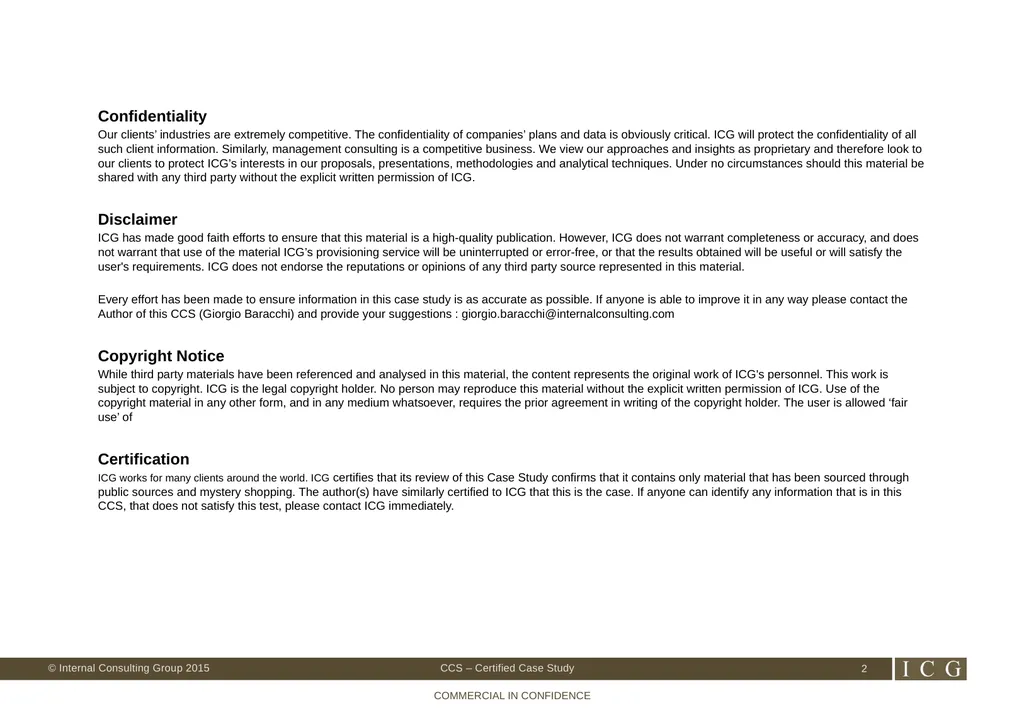
Confidentiality
Our clients’ industries are extremely competitive. The confidentiality of companies’ plans and data is obviously critical. ICG will protect the confidentiality of all such client information. Similarly, management consulting is a competitive business. We view our approaches and insights as proprietary and therefore look to our clients to protect ICG’s interests in our proposals, presentations, methodologies and analytical techniques. Under no circumstances should this material be shared with any third party without the explicit written permission of ICG.
Disclaimer
ICG has made good faith efforts to ensure that this material is a high-quality publication. However, ICG does not warrant completeness or accuracy, and does not warrant that use of the material ICG’s provisioning service will be uninterrupted or error-free, or that the results obtained will be useful or will satisfy the user's requirements. ICG does not endorse the reputations or opinions of any third party source represented in this material.
Every effort has been made to ensure information in this case study is as accurate as possible. If anyone is able to improve it in any way please contact the Author of this CCS (Giorgio Baracchi) and provide your suggestions : giorgio.baracchi@internalconsulting.com
Copyright Notice
While third party materials have been referenced and analysed in this material, the content represents the original work of ICG's personnel. This work is subject to copyright. ICG is the legal copyright holder. No person may reproduce this material without the explicit written permission of ICG. Use of the copyright material in any other form, and in any medium whatsoever, requires the prior agreement in writing of the copyright holder. The user is allowed ‘fair use’ of
Certification
ICG works for many clients around the world. ICG certifies that its review of this Case Study confirms that it contains only material that has been sourced through public sources and mystery shopping. The author(s) have similarly certified to ICG that this is the case. If anyone can identify any information that is in this CCS, that does not satisfy this test, please contact ICG immediately. 2<br>
03
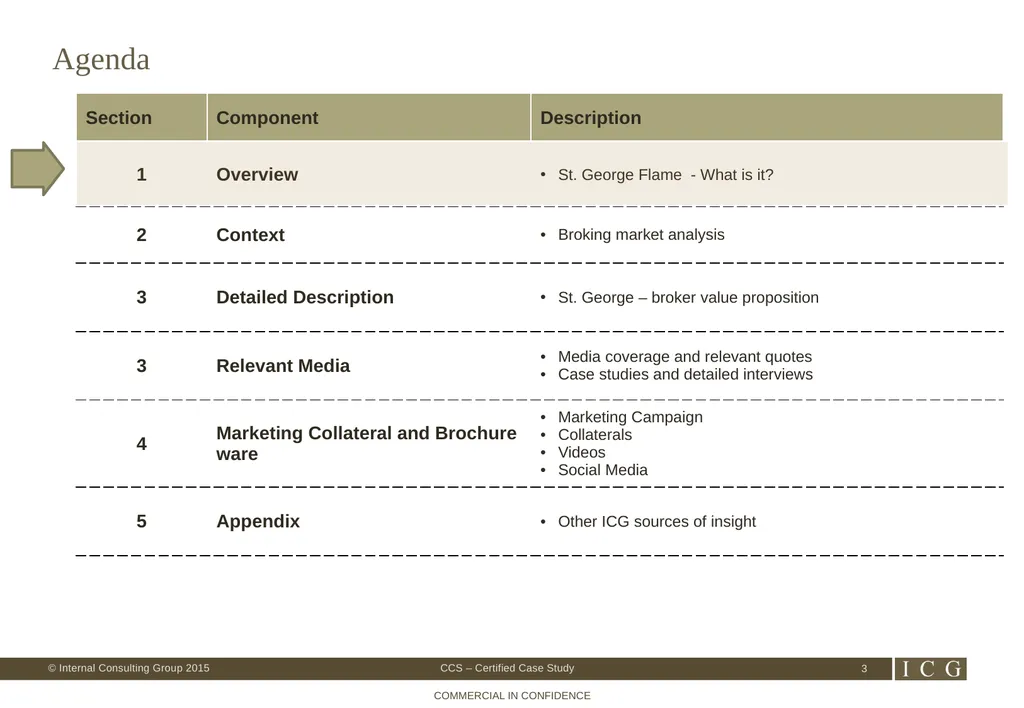
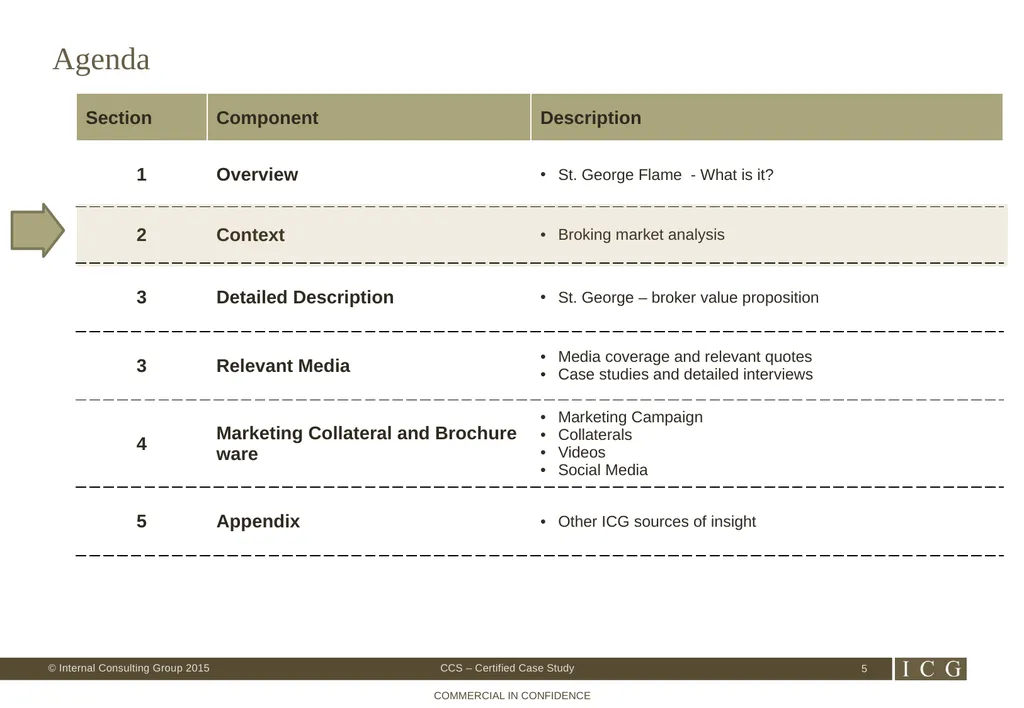
Agenda 3<br>
04
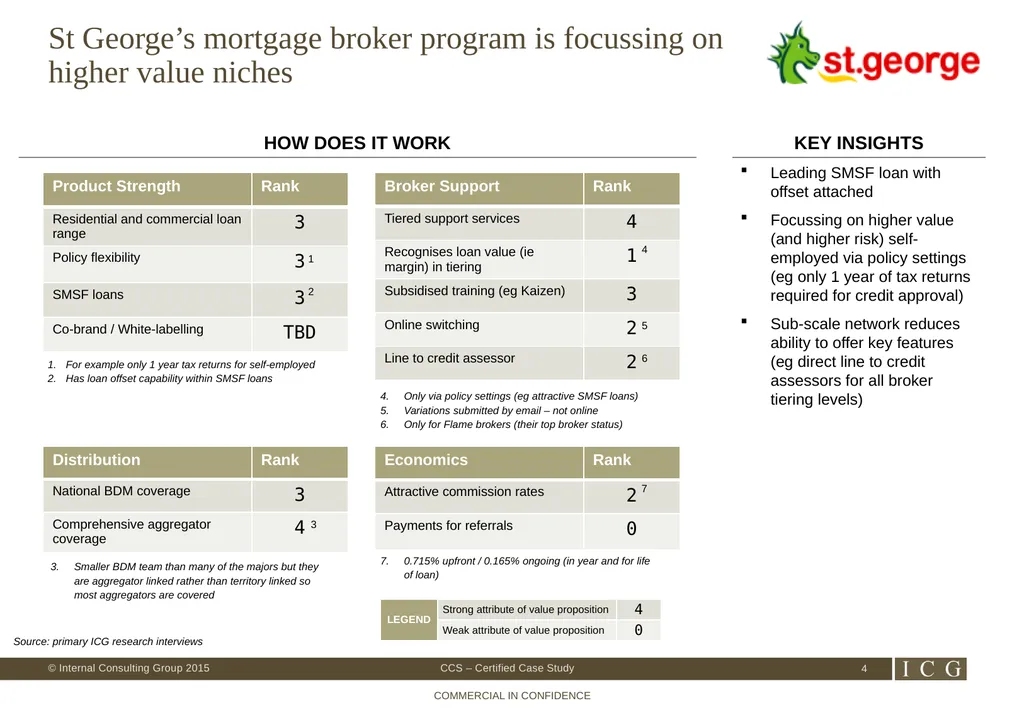
How does it work Key insights Leading SMSF loan with offset attached
Focussing on higher value (and higher risk) self-employed via policy settings (eg only 1 year of tax returns required for credit approval)
Sub-scale network reduces ability to offer key features (eg direct line to credit assessors for all broker tiering levels) Source: primary ICG research interviews 4 St George’s mortgage broker program is focussing on higher value niches For example only 1 year tax returns for self-employed
Has loan offset capability within SMSF loans 0.715% upfront / 0.165% ongoing (in year and for life of loan) 7 Only via policy settings (eg attractive SMSF loans)
Variations submitted by email – not online
Only for Flame brokers (their top broker status) 6 5 Smaller BDM team than many of the majors but they are aggregator linked rather than territory linked so most aggregators are covered 3 2 1 4<br>
05
Agenda 5<br>
06
Mortgage brokers have created a compelling value proposition for customers 6 Providing Choice 3rd Party Value Proposition Marketing Information Collection Initial Contact Application Loan
Establishment Servicing
and Retention Reassesses the loan and potential for loan churn every few years Information available on multiple products from multiple lenders
Unbiased representation of information
Provides Home Loan education Recommends multiple loan products
Still possible to purchase the complimentary products that I need Conduct interviews at home or office – a Broker spends time to understand my needs
Helps to identify a range of suitable options and discuss these options with me Submits multiple applications simultaneously to improve my chances of quick approval
Gives me access to more money
Are more flexible with their lending criteria
Typically offers me approval within 24 hours and follow-up with a letter of offer in 48 hours
Provides a solution if I’m ‘credit challenged’
Deals with the Bank for me; they’ll fight for me as my representative Communicates that the Brokers represent an alternative to existing lenders and that they provide objective service
Communicates that Brokers work for me and not the bank; they present themselves as ‘my advocate’ Aims to develop strong personal relationships during the follow-up on servicing to reduce churn (“lifetime customer”)
Provides me with referrals to IFAs and other members of their network e.g. accountants Is doing the work for me
Conveys the impression of wanting to help and make the loan possible Completes the documents and ensures that everything is correctly filled in
Conveys a competent impression
Is ‘on my side”; nothing is too hard Chases the financial institution for me
On average 2-4 meetings post preliminary approval and numerous phone calls up until and including the loan establishment stage Understands my needs and matches my needs to a style of product and then to a number of lender product options
Helps me to understand each of the products – make it simple for me; reduce confusion Getting Approval Providing Service Source: secondary research, ICG, broker interviews<br>
07
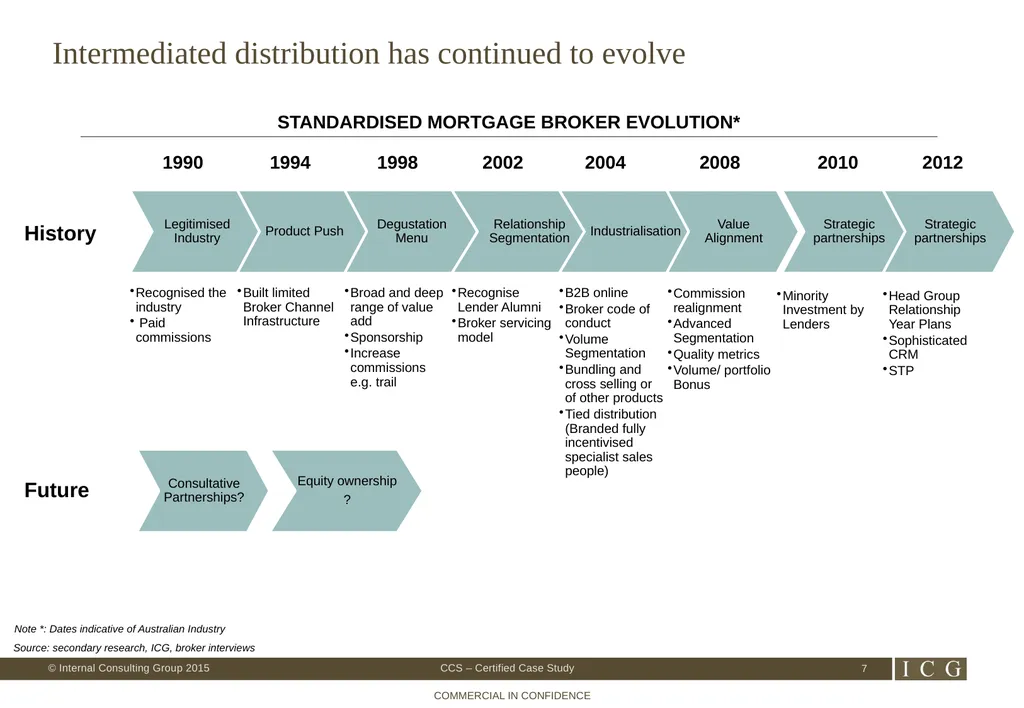
Intermediated distribution has continued to evolve 7 Legitimised Industry Recognised the industry
Paid commissions Product Push Built limited Broker Channel Infrastructure Degustation Menu Broad and deep range of value add
Sponsorship
Increase commissions e.g. trail Relationship Segmentation Industrialisation B2B online
Broker code of conduct
Volume Segmentation
Bundling and cross selling or of other products
Tied distribution (Branded fully incentivised specialist sales people) Value Alignment Strategic partnerships Consultative Partnerships? Equity ownership
? Recognise Lender Alumni
Broker servicing model 2002 2004 2008 Commission realignment
Advanced Segmentation
Quality metrics
Volume/ portfolio Bonus 1990 1994 1998 2010 Head Group Relationship Year Plans
Sophisticated CRM
STP Future History Strategic partnerships 2012 Minority Investment by Lenders Source: secondary research, ICG, broker interviews STANDARDISED MORTGAGE BROKER EVOLUTION* Note *: Dates indicative of Australian Industry<br>
08
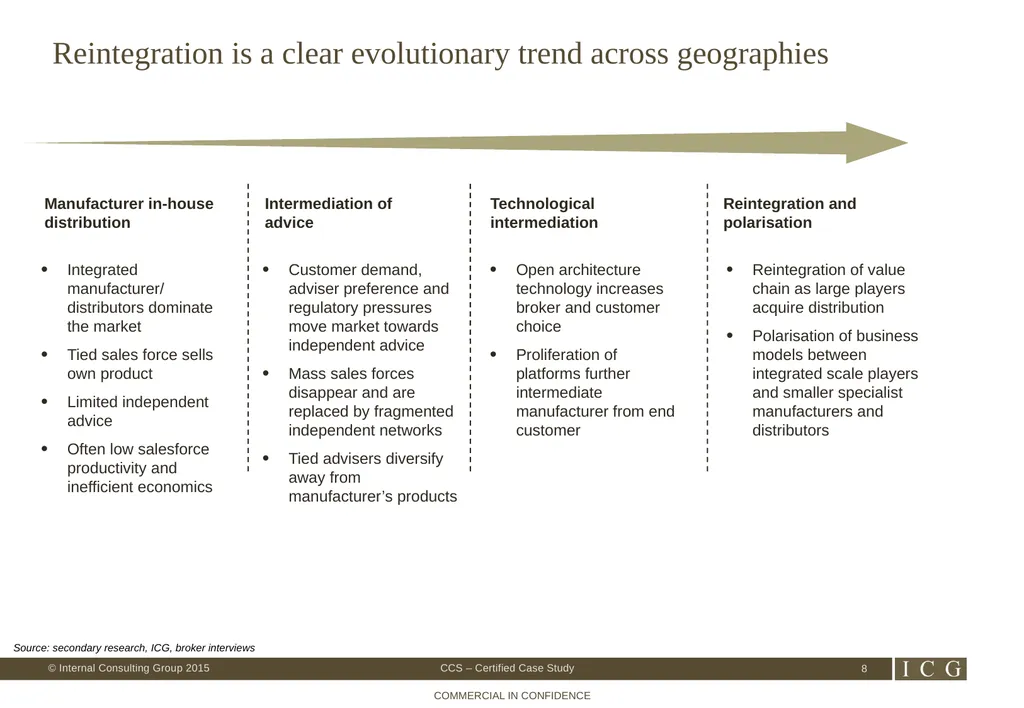
Reintegration is a clear evolutionary trend across geographies 8 Manufacturer in-house distribution Intermediation of advice Technological intermediation Reintegration and polarisation Integrated manufacturer/ distributors dominate the market
Tied sales force sells own product
Limited independent advice
Often low salesforce productivity and inefficient economics Customer demand, adviser preference and regulatory pressures move market towards independent advice
Mass sales forces disappear and are replaced by fragmented independent networks
Tied advisers diversify away from manufacturer’s products Open architecture technology increases broker and customer choice
Proliferation of platforms further intermediate manufacturer from end customer Reintegration of value chain as large players acquire distribution
Polarisation of business models between integrated scale players and smaller specialist manufacturers and distributors Source: secondary research, ICG, broker interviews<br>
09
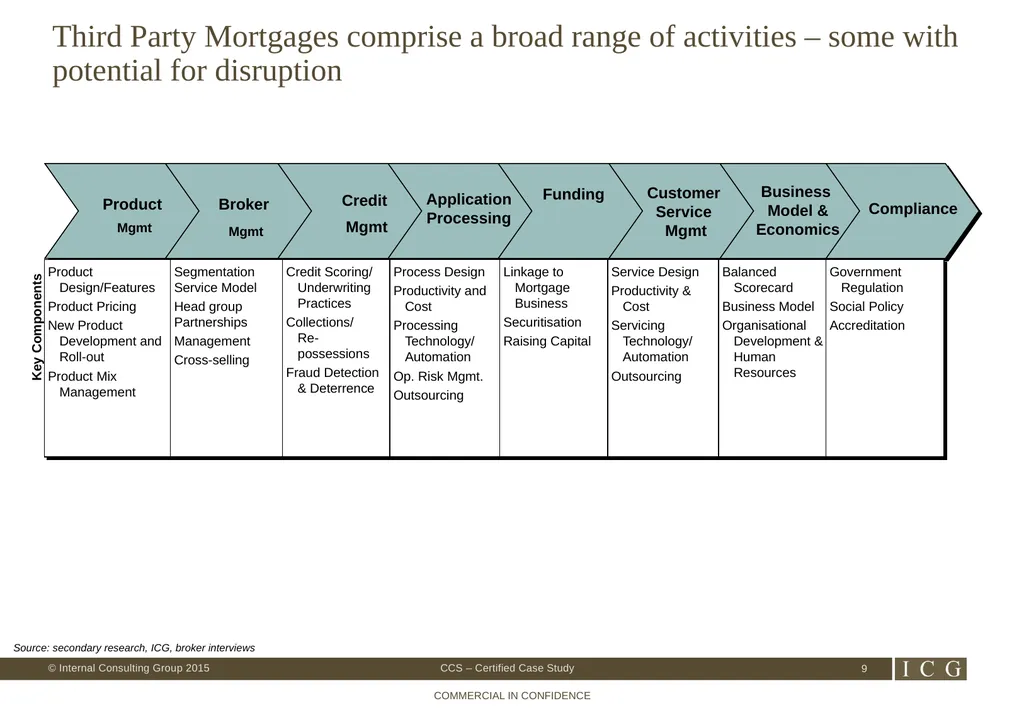
Third Party Mortgages comprise a broad range of activities – some with potential for disruption 9 Product
Mgmt Credit
Mgmt Broker
Mgmt Application
Processing Funding Customer
Service
Mgmt Business Model & Economics Compliance Key Components Product Design/Features
Product Pricing
New Product Development and Roll-out
Product Mix Management Segmentation Service Model
Head group Partnerships
Management
Cross-selling Credit Scoring/ Underwriting Practices
Collections/ Re-possessions
Fraud Detection & Deterrence Process Design
Productivity and Cost
Processing Technology/ Automation
Op. Risk Mgmt.
Outsourcing Linkage to Mortgage Business
Securitisation
Raising Capital Service Design
Productivity & Cost
Servicing Technology/ Automation
Outsourcing Balanced Scorecard
Business Model
Organisational Development & Human Resources Government Regulation
Social Policy
Accreditation Source: secondary research, ICG, broker interviews<br>
10
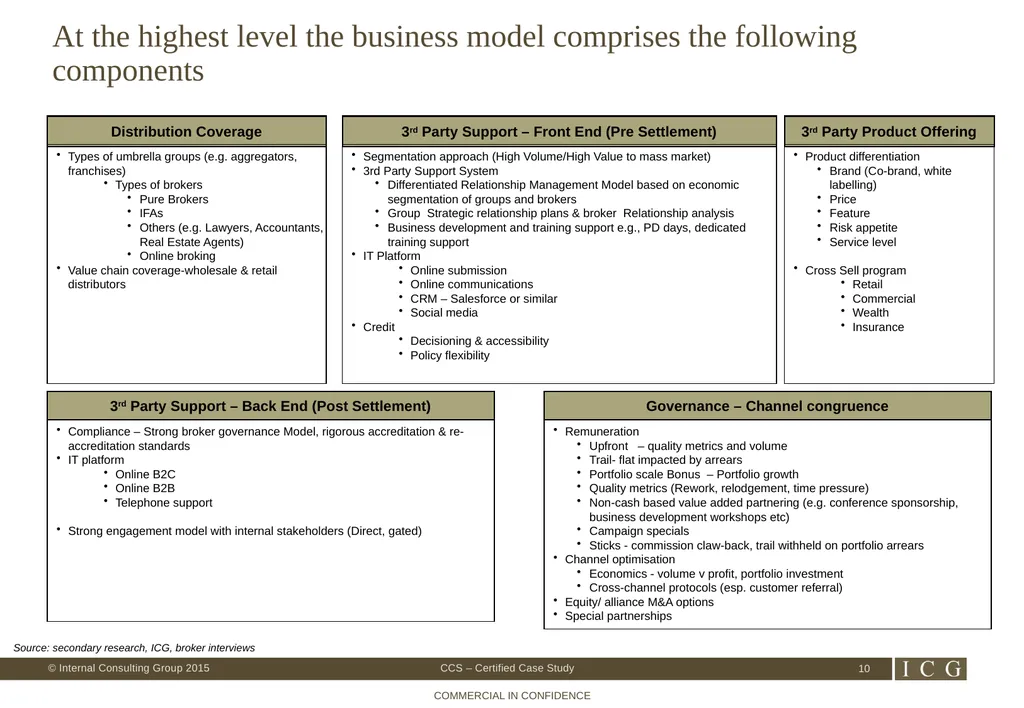
At the highest level the business model comprises the following components 10 Distribution Coverage Types of umbrella groups (e.g. aggregators, franchises)
Types of brokers
Pure Brokers
IFAs
Others (e.g. Lawyers, Accountants, Real Estate Agents)
Online broking
Value chain coverage-wholesale & retail distributors 3rd Party Product Offering Product differentiation
Brand (Co-brand, white labelling)
Price
Feature
Risk appetite
Service level
Cross Sell program
Retail
Commercial
Wealth
Insurance 3rd Party Support – Front End (Pre Settlement) Segmentation approach (High Volume/High Value to mass market)
3rd Party Support System
Differentiated Relationship Management Model based on economic segmentation of groups and brokers
Group Strategic relationship plans & broker Relationship analysis
Business development and training support e.g., PD days, dedicated training support
IT Platform
Online submission
Online communications
CRM – Salesforce or similar
Social media
Credit
Decisioning & accessibility
Policy flexibility 3rd Party Support – Back End (Post Settlement) Compliance – Strong broker governance Model, rigorous accreditation & re-accreditation standards
IT platform
Online B2C
Online B2B
Telephone support
Strong engagement model with internal stakeholders (Direct, gated) Governance – Channel congruence Remuneration
Upfront – quality metrics and volume
Trail- flat impacted by arrears
Portfolio scale Bonus – Portfolio growth
Quality metrics (Rework, relodgement, time pressure)
Non-cash based value added partnering (e.g. conference sponsorship, business development workshops etc)
Campaign specials
Sticks - commission claw-back, trail withheld on portfolio arrears
Channel optimisation
Economics - volume v profit, portfolio investment
Cross-channel protocols (esp. customer referral)
Equity/ alliance M&A options
Special partnerships Source: secondary research, ICG, broker interviews<br>
11
Lenders have adopted vastly differing levels of broker coverage and support to develop business 11 B2B B2C Developer model Relationship manager for brokers
Support for intermediaries: Products, marketing material, training etc.
Size, volume determine intensity of service / visits / contacts
Gearing on business due to multiplying effects
No direct control of business Sales agent model Intermediary introduces customers to sales agent
Responsibility for completion of sales with customers
Minimum support for intermediary
Control of quality of business
Intense resources required Combined model Flexible role definition based on business needs
Pragmatic allocation of resources
Flexibility for business development without losing contact to end customer
Danger of unclear tasks, difficult leadership functions Coverage models for lenders in the intermediary market Source: secondary research, ICG, broker interviews<br>
12
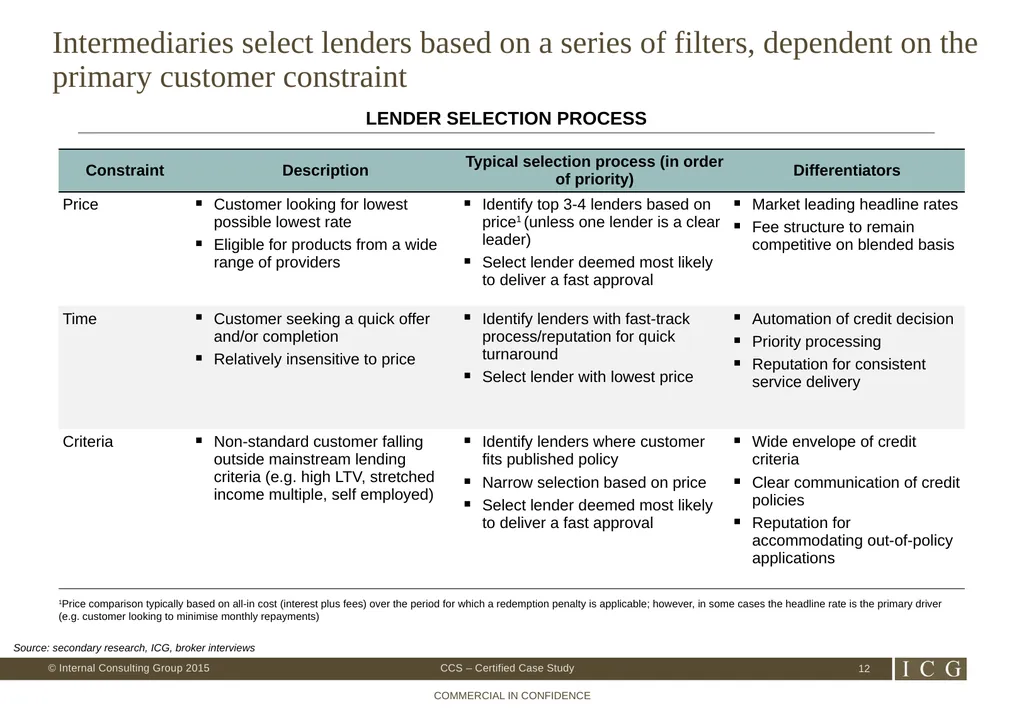
Intermediaries select lenders based on a series of filters, dependent on the primary customer constraint 12 1Price comparison typically based on all-in cost (interest plus fees) over the period for which a redemption penalty is applicable; however, in some cases the headline rate is the primary driver (e.g. customer looking to minimise monthly repayments) Lender selection process Source: secondary research, ICG, broker interviews<br>
13
Lender share of broker market volume Sources:
JP Morgan Fujitsu Mar 2012
Comparator Home Loan Benchmarking, December 2012
FAST new funding data, 2011
APRA Approvals, May 2012 Total Broker Settlements
$23.2b Total Broker Settlements
$18.5b Total Broker Settlements
$19.2b Broker channel continues to increase its importance for most banks Broker settlement as % of market, FY10-12 Broker settlement as % of loans by major, FY09-12 13<br>
14
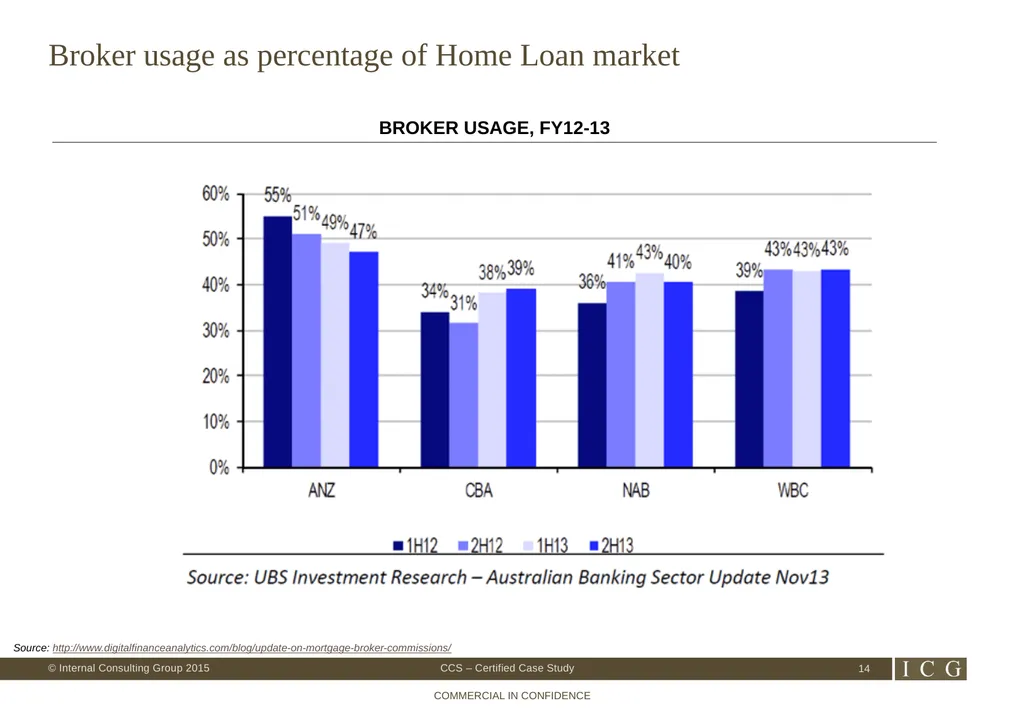
Broker usage as percentage of Home Loan market Source: http://www.digitalfinanceanalytics.com/blog/update-on-mortgage-broker-commissions/ Broker usage, FY12-13 14<br>
15
Agenda 15<br>
16
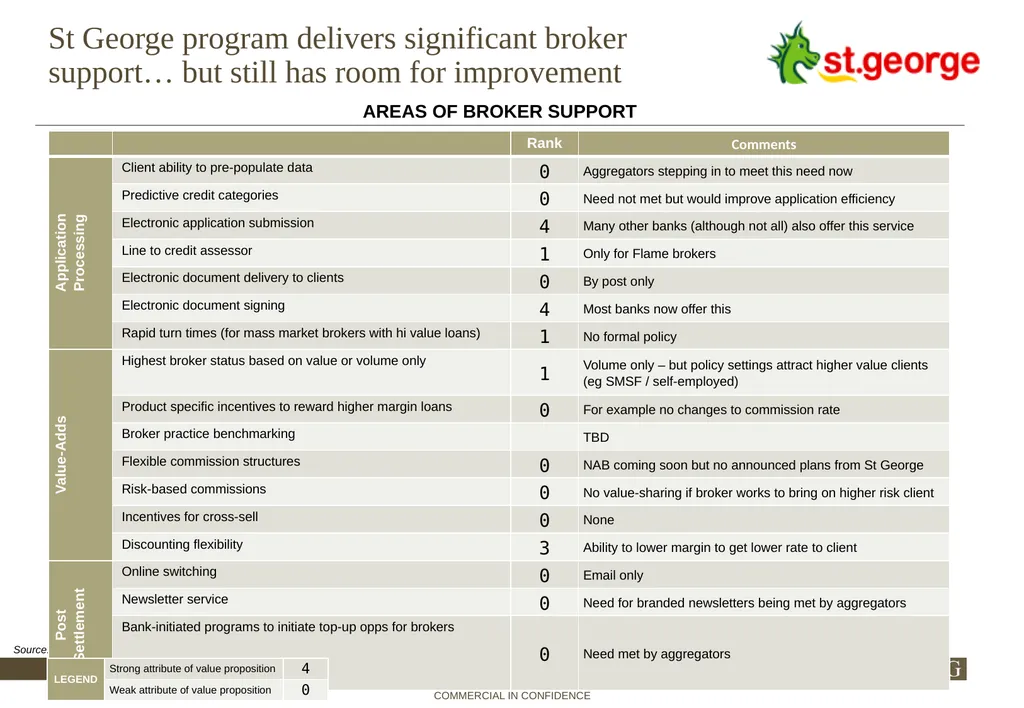
Source: primary ICG research interviews 16 St George program delivers significant broker support… but still has room for improvement Areas of broker support<br>
17
Agenda 17<br>
18
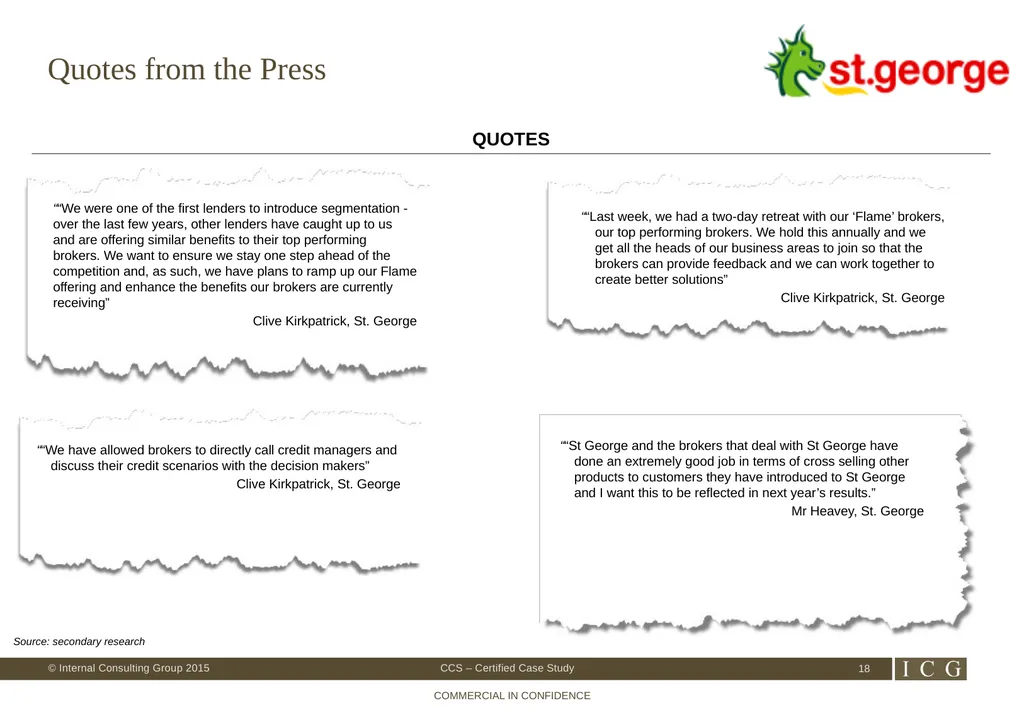
Quotes from the Press quotes Source: secondary research ““St George and the brokers that deal with St George have done an extremely good job in terms of cross selling other products to customers they have introduced to St George and I want this to be reflected in next year’s results.”
Mr Heavey, St. George 18 ““Last week, we had a two-day retreat with our ‘Flame’ brokers, our top performing brokers. We hold this annually and we get all the heads of our business areas to join so that the brokers can provide feedback and we can work together to create better solutions”
Clive Kirkpatrick, St. George ““We have allowed brokers to directly call credit managers and discuss their credit scenarios with the decision makers”
Clive Kirkpatrick, St. George ““We were one of the first lenders to introduce segmentation - over the last few years, other lenders have caught up to us and are offering similar benefits to their top performing brokers. We want to ensure we stay one step ahead of the competition and, as such, we have plans to ramp up our Flame offering and enhance the benefits our brokers are currently receiving”
Clive Kirkpatrick, St. George<br>
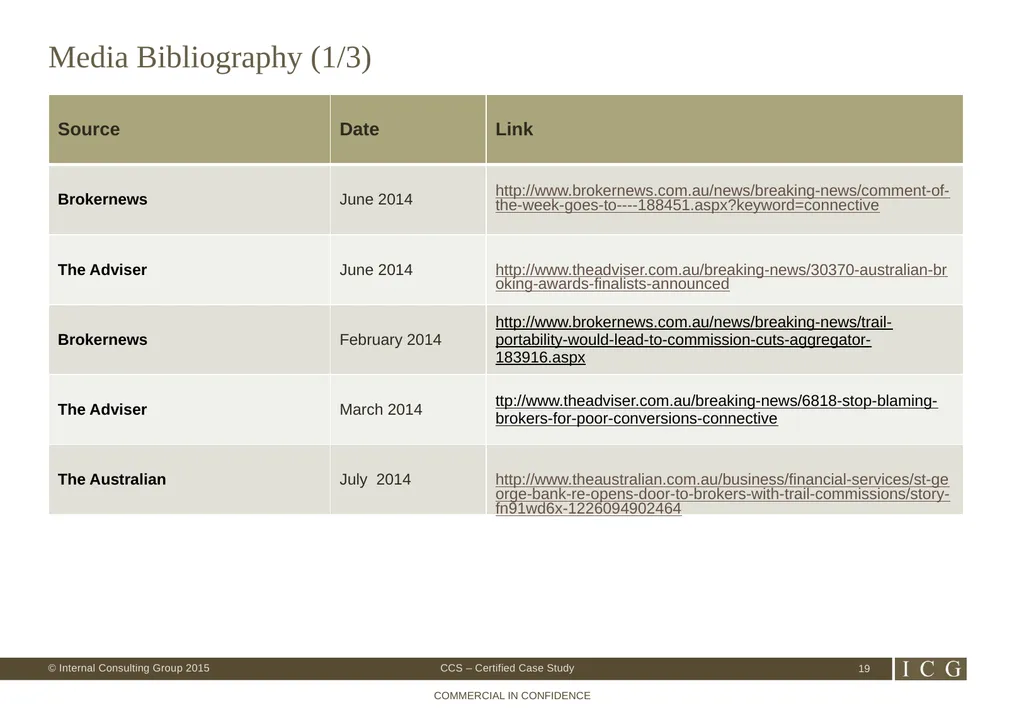
19
19 Media Bibliography (1/3)<br>
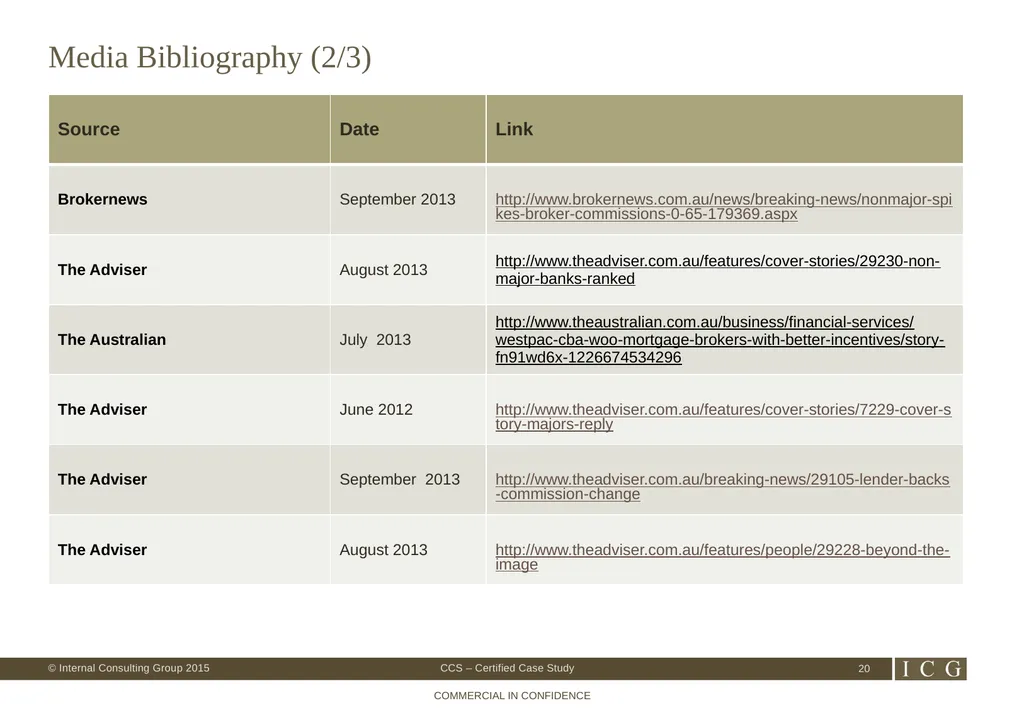
20
20 Media Bibliography (2/3)<br>
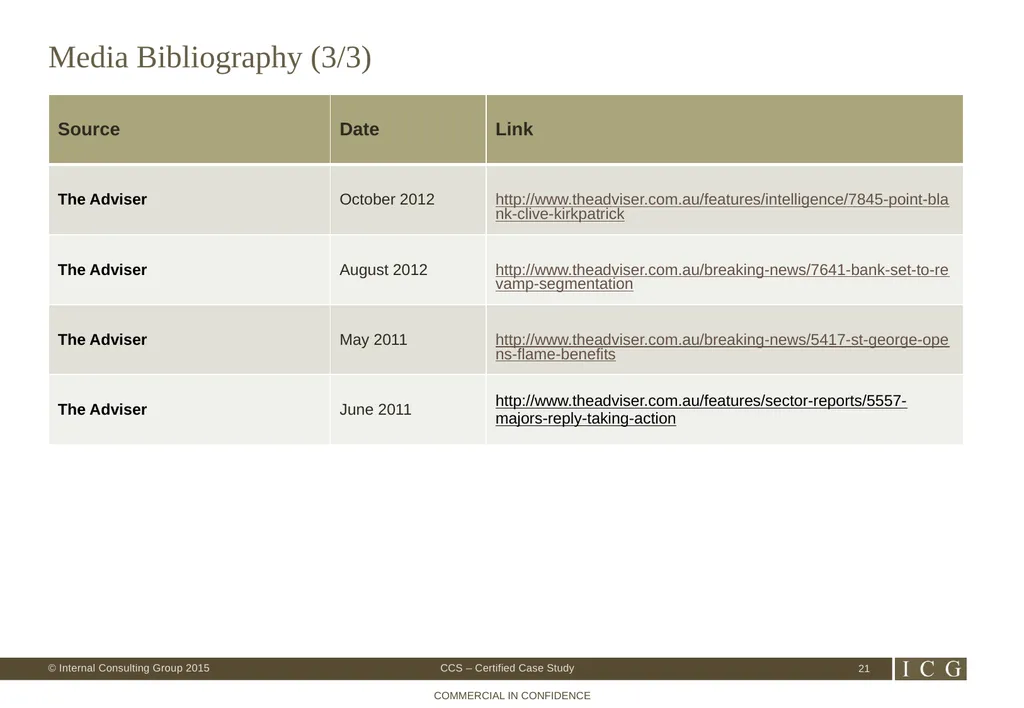
21
21 Media Bibliography (3/3)<br>
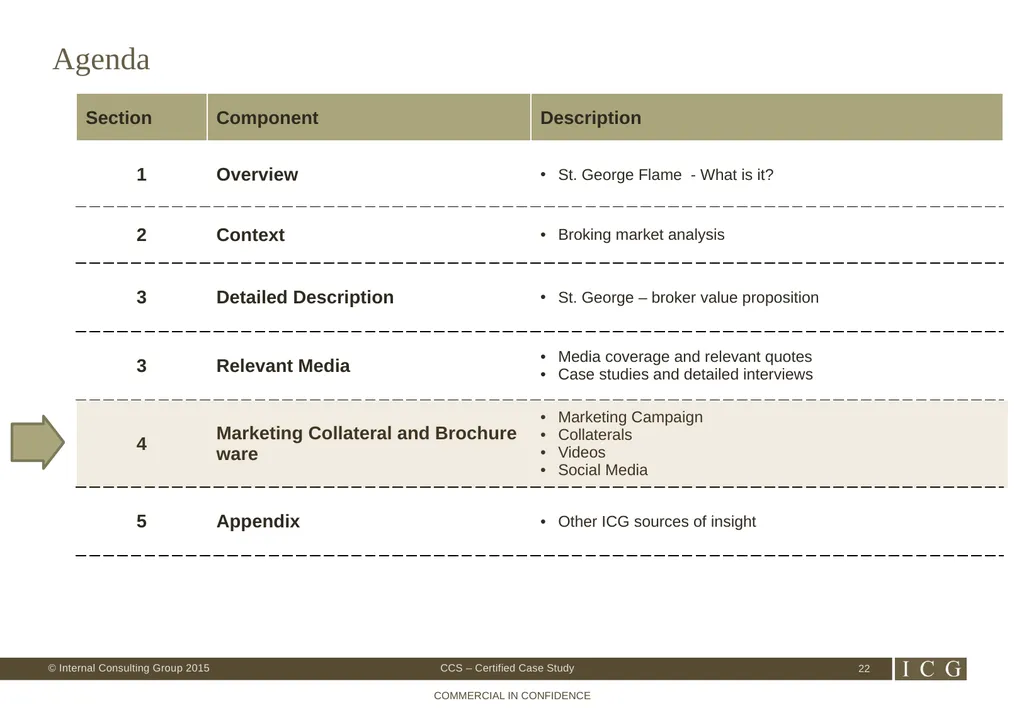
22
Agenda 22<br>
23
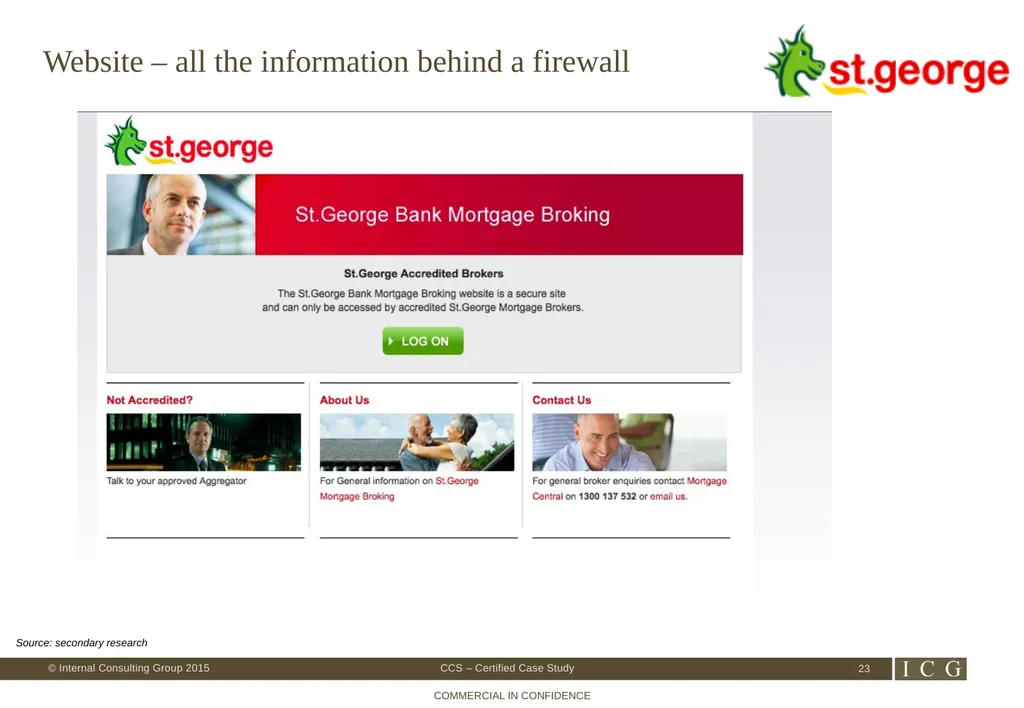
Website – all the information behind a firewall Source: secondary research 23<br>
24
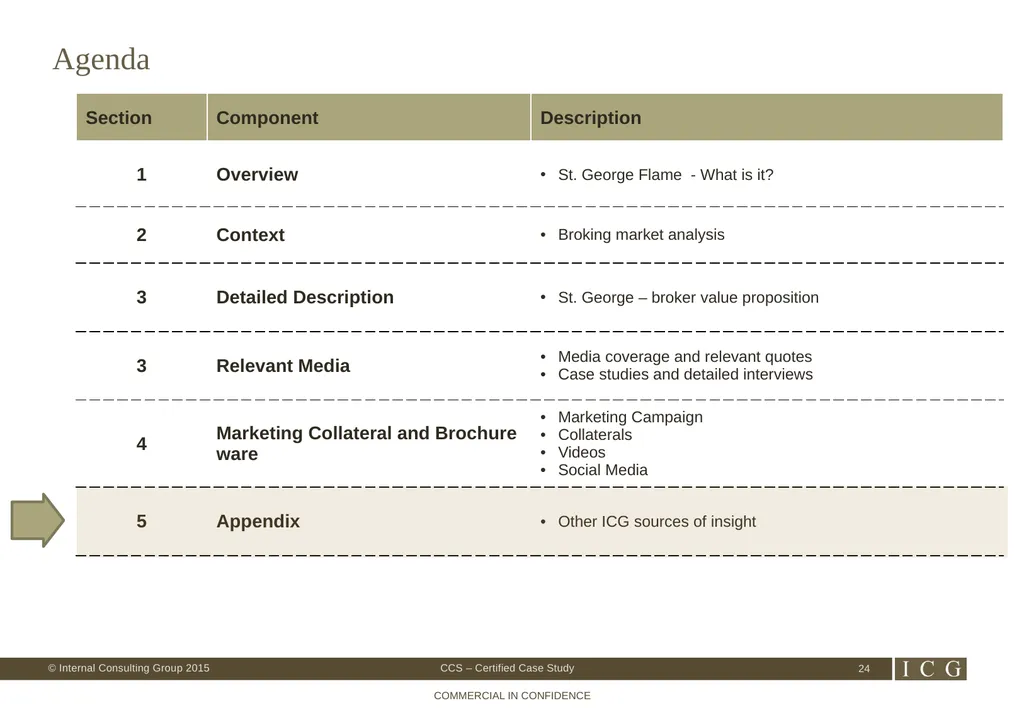
Agenda 24<br>
25
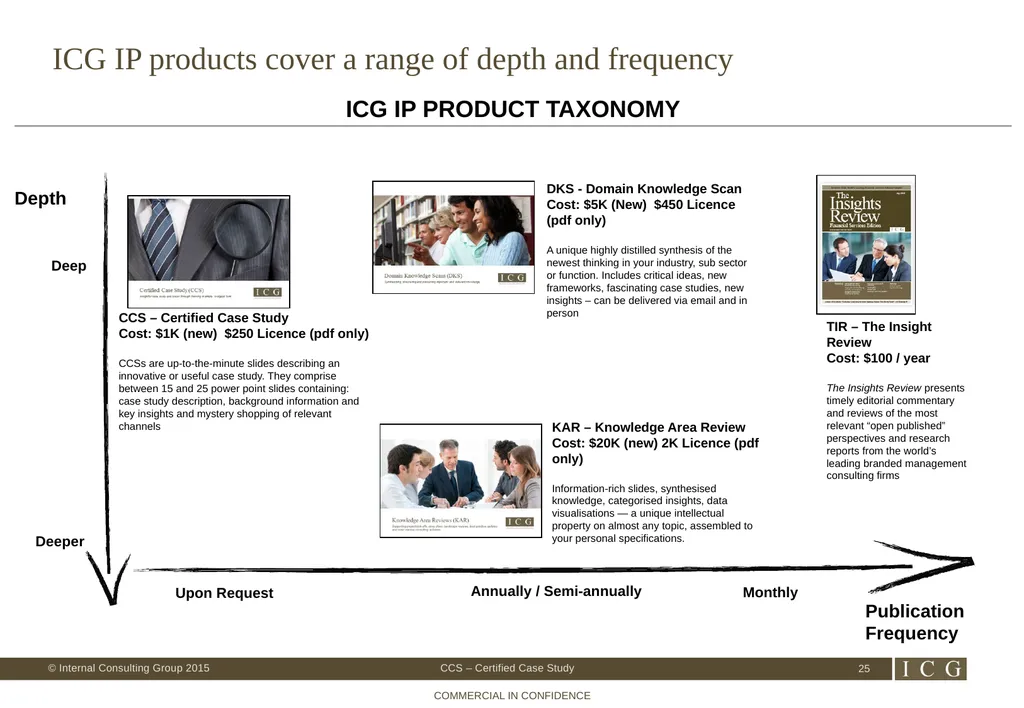
ICG IP products cover a range of depth and frequency DKS - Domain Knowledge Scan
Cost: $5K (New) $450 Licence (pdf only)
A unique highly distilled synthesis of the newest thinking in your industry, sub sector or function. Includes critical ideas, new frameworks, fascinating case studies, new insights – can be delivered via email and in person KAR – Knowledge Area Review
Cost: $20K (new) 2K Licence (pdf only)
Information-rich slides, synthesised knowledge, categorised insights, data visualisations — a unique intellectual property on almost any topic, assembled to your personal specifications. TIR – The Insight Review
Cost: $100 / year
The Insights Review presents timely editorial commentary and reviews of the most relevant “open published” perspectives and research reports from the world’s leading branded management consulting firms CCS – Certified Case Study
Cost: $1K (new) $250 Licence (pdf only)
CCSs are up-to-the-minute slides describing an innovative or useful case study. They comprise between 15 and 25 power point slides containing: case study description, background information and key insights and mystery shopping of relevant channels Deep Deeper Depth Publication
Frequency Upon Request Annually / Semi-annually Monthly Icg IP PRODUCT TAXONOMY 25<br>