
Stakeholder Buy-In Template MDM Business Case
TD
Published · 39 slides · 0 views

1 / 1


Description
Stakeholder Buy-In Template MDM Business Case Presentation Editing Notes This template is used to provide the structure of a presentable version of your MDM business case to stakeholders within your business. The following slides will help
Related Topics
Share
Embed code
Download this presentation From Below
"Stakeholder Buy-In Template MDM Business Case" is the property of its rightful owner. Permission is granted to download and print the materials on this website for personal, non-commercial use only, and to display it on your personal computer provided you do not modify the materials and that you retain all copyright notices contained in the materials. By downloading content from our website, you accept the terms of this agreement.
Presentation Transcript
01
Stakeholder Buy-In Template MDM Business Case Presentation<br>
02
Editing Notes This template is used to provide the structure of a presentable version of your MDM business case to stakeholders within your business.
The following slides will help guide you through the most methodical approach to presenting the case and supporting information.
We recommend using it as a guide, but ultimately building out your own presentation using this for reference.<br>
The following slides will help guide you through the most methodical approach to presenting the case and supporting information.
We recommend using it as a guide, but ultimately building out your own presentation using this for reference.<br>
03
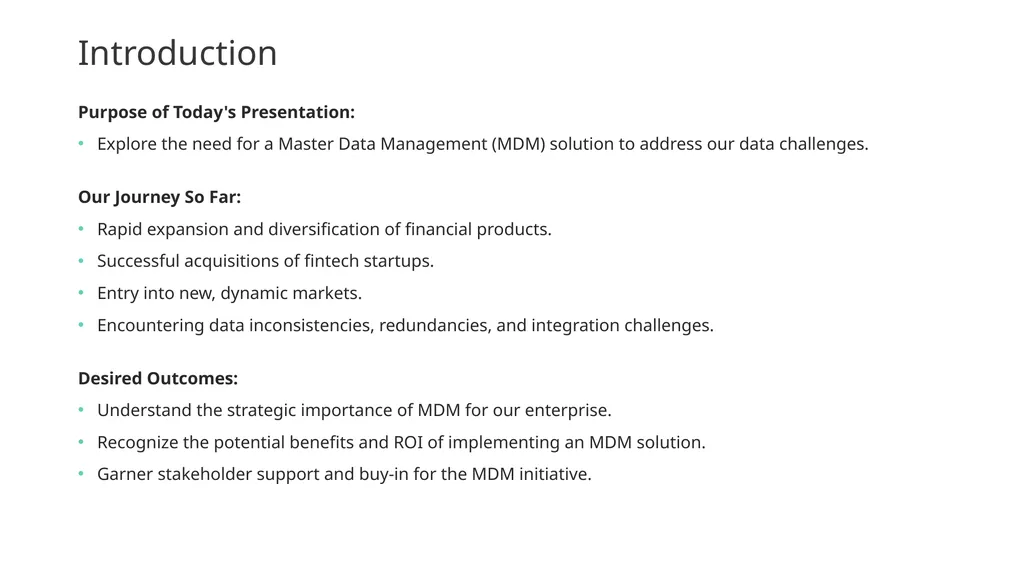
Introduction Purpose of Today's Presentation:
Explore the need for a Master Data Management (MDM) solution to address our data challenges.
Our Journey So Far:
Rapid expansion and diversification of financial products.
Successful acquisitions of fintech startups.
Entry into new, dynamic markets.
Encountering data inconsistencies, redundancies, and integration challenges.
Desired Outcomes:
Understand the strategic importance of MDM for our enterprise.
Recognize the potential benefits and ROI of implementing an MDM solution.
Garner stakeholder support and buy-in for the MDM initiative.<br>
04
Introduction Notes Emphasize the significance of data in your industry and how it's central to your operations, decision-making, and customer experience.
Highlight the challenges faced due to rapid growth and how they've impacted business operations.
Convey the urgency and importance of addressing these data challenges to ensure continued growth, efficiency, and customer satisfaction.
Set the stage for the subsequent slides, which will delve deeper into the specifics of the MDM solution and its benefits.<br>
05
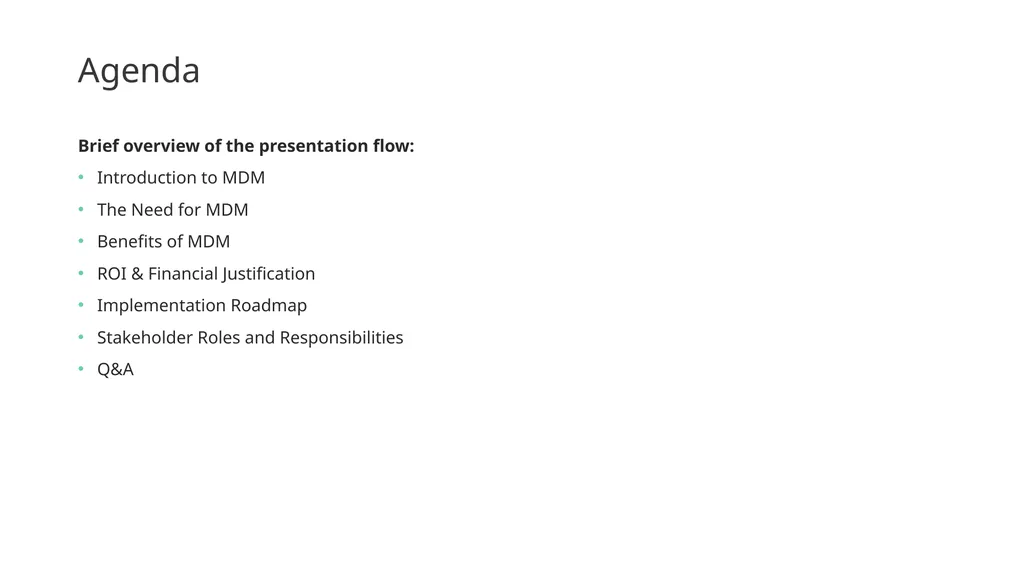
Agenda Brief overview of the presentation flow:
Introduction to MDM
The Need for MDM
Benefits of MDM
ROI & Financial Justification
Implementation Roadmap
Stakeholder Roles and Responsibilities
Q&A<br>
Introduction to MDM
The Need for MDM
Benefits of MDM
ROI & Financial Justification
Implementation Roadmap
Stakeholder Roles and Responsibilities
Q&A<br>
06
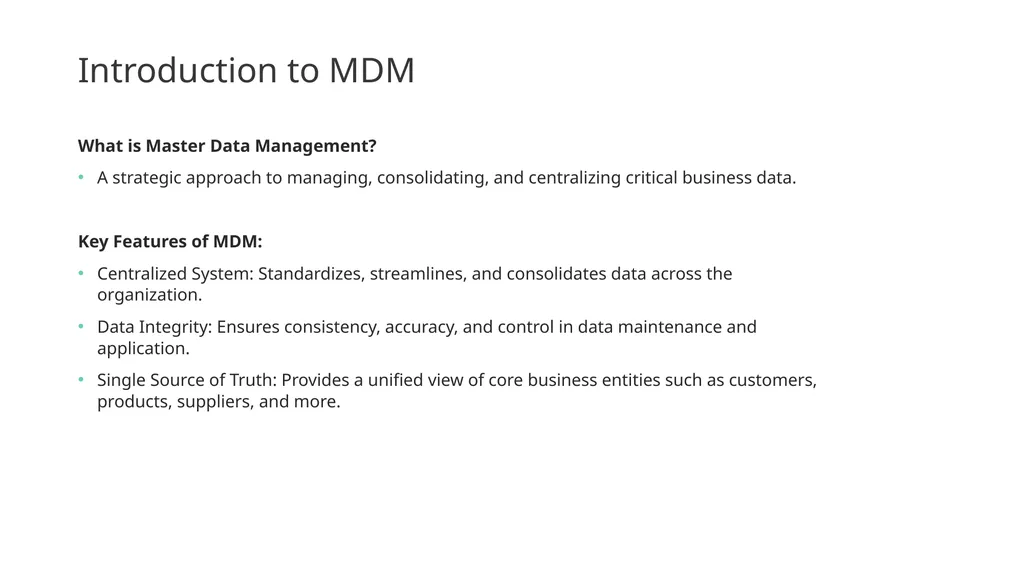
Introduction to MDM What is Master Data Management?
A strategic approach to managing, consolidating, and centralizing critical business data.
Key Features of MDM:
Centralized System: Standardizes, streamlines, and consolidates data across the organization.
Data Integrity: Ensures consistency, accuracy, and control in data maintenance and application.
Single Source of Truth: Provides a unified view of core business entities such as customers, products, suppliers, and more.<br>
07
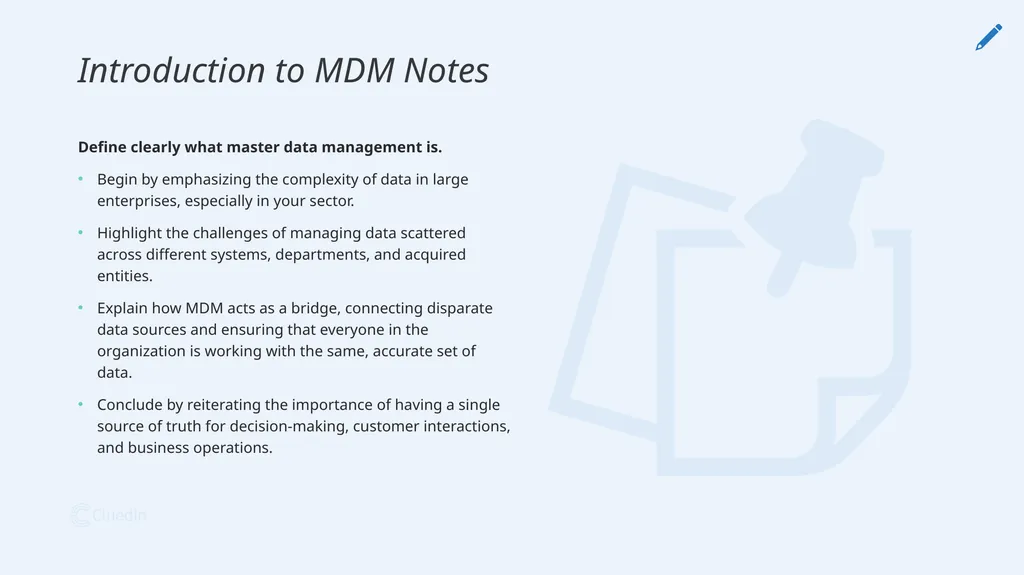
Introduction to MDM Notes Define clearly what master data management is.
Begin by emphasizing the complexity of data in large enterprises, especially in your sector.
Highlight the challenges of managing data scattered across different systems, departments, and acquired entities.
Explain how MDM acts as a bridge, connecting disparate data sources and ensuring that everyone in the organization is working with the same, accurate set of data.
Conclude by reiterating the importance of having a single source of truth for decision-making, customer interactions, and business operations.<br>
08
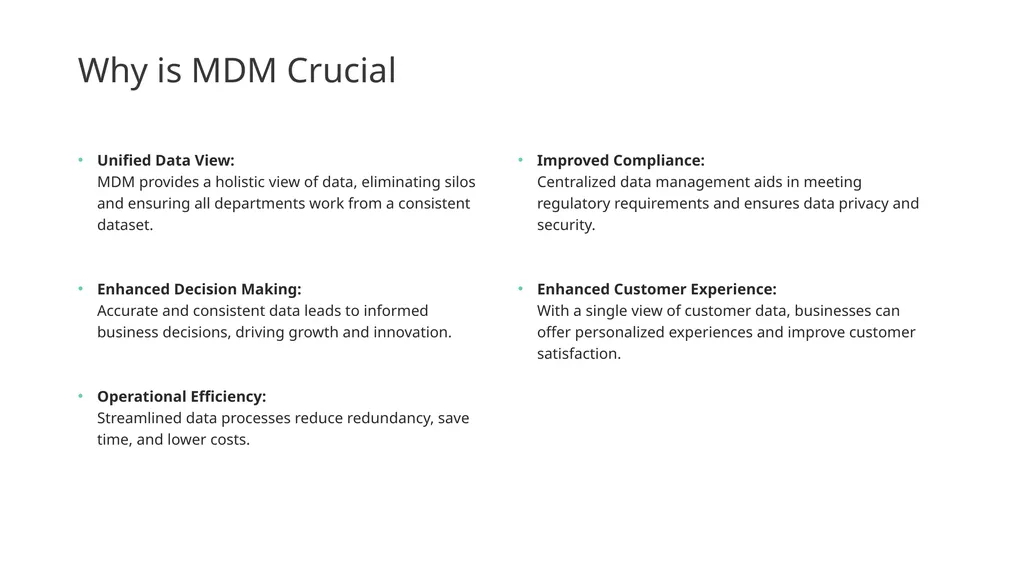
Why is MDM Crucial Unified Data View:
MDM provides a holistic view of data, eliminating silos and ensuring all departments work from a consistent dataset.
Enhanced Decision Making: Accurate and consistent data leads to informed business decisions, driving growth and innovation.
Operational Efficiency: Streamlined data processes reduce redundancy, save time, and lower costs.
Improved Compliance: Centralized data management aids in meeting regulatory requirements and ensures data privacy and security.
Enhanced Customer Experience: With a single view of customer data, businesses can offer personalized experiences and improve customer satisfaction.<br>
09
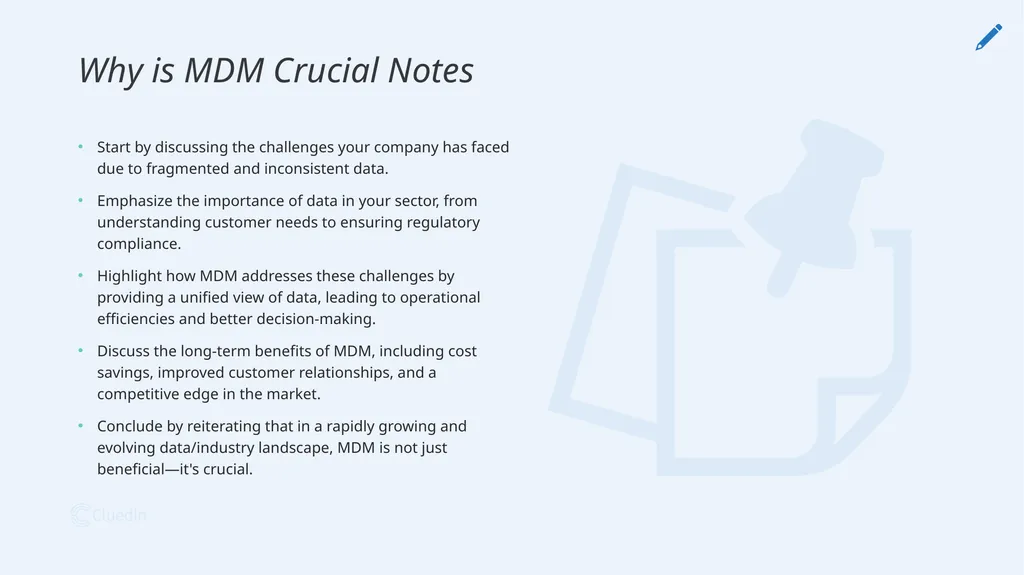
Why is MDM Crucial Notes Start by discussing the challenges your company has faced due to fragmented and inconsistent data.
Emphasize the importance of data in your sector, from understanding customer needs to ensuring regulatory compliance.
Highlight how MDM addresses these challenges by providing a unified view of data, leading to operational efficiencies and better decision-making.
Discuss the long-term benefits of MDM, including cost savings, improved customer relationships, and a competitive edge in the market.
Conclude by reiterating that in a rapidly growing and evolving data/industry landscape, MDM is not just beneficial—it's crucial.<br>
10
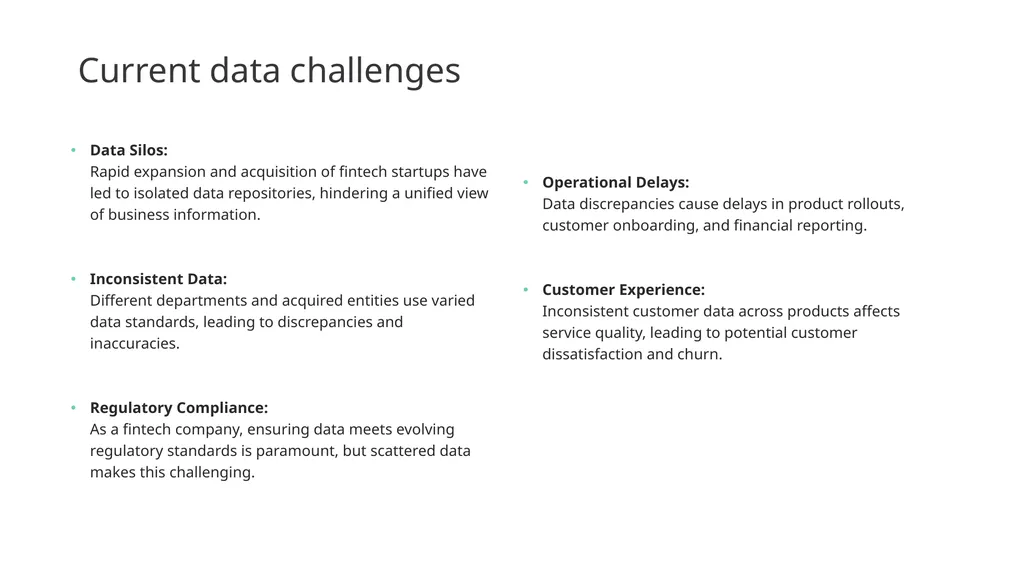
Current data challenges Data Silos:
Rapid expansion and acquisition of fintech startups have led to isolated data repositories, hindering a unified view of business information.
Inconsistent Data: Different departments and acquired entities use varied data standards, leading to discrepancies and inaccuracies.
Regulatory Compliance: As a fintech company, ensuring data meets evolving regulatory standards is paramount, but scattered data makes this challenging.
Operational Delays: Data discrepancies cause delays in product rollouts, customer onboarding, and financial reporting.
Customer Experience: Inconsistent customer data across products affects service quality, leading to potential customer dissatisfaction and churn.<br>
11
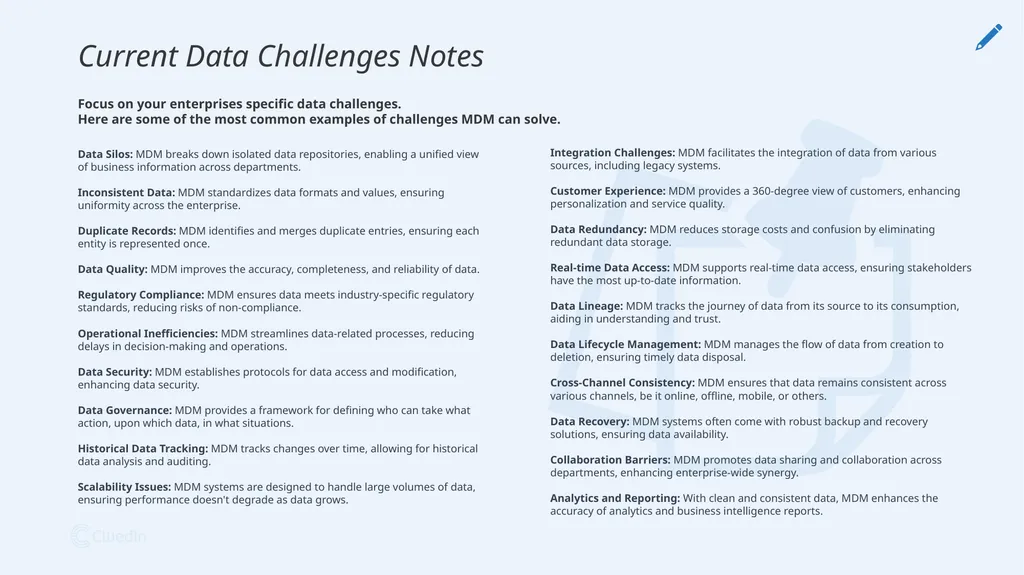
Integration Challenges: MDM facilitates the integration of data from various sources, including legacy systems.
Customer Experience: MDM provides a 360-degree view of customers, enhancing personalization and service quality.
Data Redundancy: MDM reduces storage costs and confusion by eliminating redundant data storage.
Real-time Data Access: MDM supports real-time data access, ensuring stakeholders have the most up-to-date information.
Data Lineage: MDM tracks the journey of data from its source to its consumption, aiding in understanding and trust.
Data Lifecycle Management: MDM manages the flow of data from creation to deletion, ensuring timely data disposal.
Cross-Channel Consistency: MDM ensures that data remains consistent across various channels, be it online, offline, mobile, or others.
Data Recovery: MDM systems often come with robust backup and recovery solutions, ensuring data availability.
Collaboration Barriers: MDM promotes data sharing and collaboration across departments, enhancing enterprise-wide synergy.
Analytics and Reporting: With clean and consistent data, MDM enhances the accuracy of analytics and business intelligence reports. Current Data Challenges Notes Data Silos: MDM breaks down isolated data repositories, enabling a unified view of business information across departments.
Inconsistent Data: MDM standardizes data formats and values, ensuring uniformity across the enterprise.
Duplicate Records: MDM identifies and merges duplicate entries, ensuring each entity is represented once.
Data Quality: MDM improves the accuracy, completeness, and reliability of data.
Regulatory Compliance: MDM ensures data meets industry-specific regulatory standards, reducing risks of non-compliance.
Operational Inefficiencies: MDM streamlines data-related processes, reducing delays in decision-making and operations.
Data Security: MDM establishes protocols for data access and modification, enhancing data security.
Data Governance: MDM provides a framework for defining who can take what action, upon which data, in what situations.
Historical Data Tracking: MDM tracks changes over time, allowing for historical data analysis and auditing.
Scalability Issues: MDM systems are designed to handle large volumes of data, ensuring performance doesn't degrade as data grows. Focus on your enterprises specific data challenges.
Here are some of the most common examples of challenges MDM can solve.<br>
12
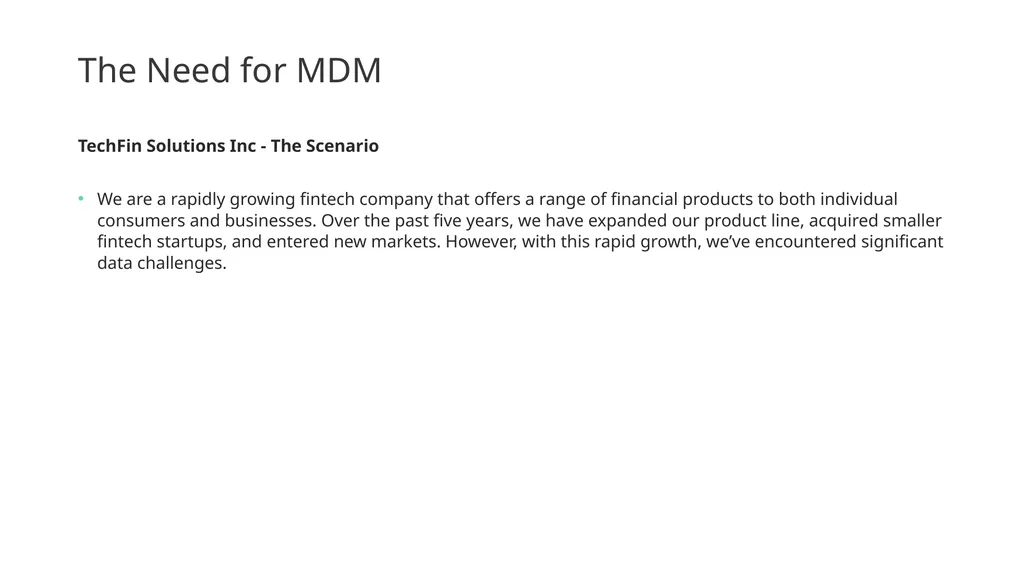
The Need for MDM TechFin Solutions Inc - The Scenario
We are a rapidly growing fintech company that offers a range of financial products to both individual consumers and businesses. Over the past five years, we have expanded our product line, acquired smaller fintech startups, and entered new markets. However, with this rapid growth, we’ve encountered significant data challenges.<br>
We are a rapidly growing fintech company that offers a range of financial products to both individual consumers and businesses. Over the past five years, we have expanded our product line, acquired smaller fintech startups, and entered new markets. However, with this rapid growth, we’ve encountered significant data challenges.<br>
13
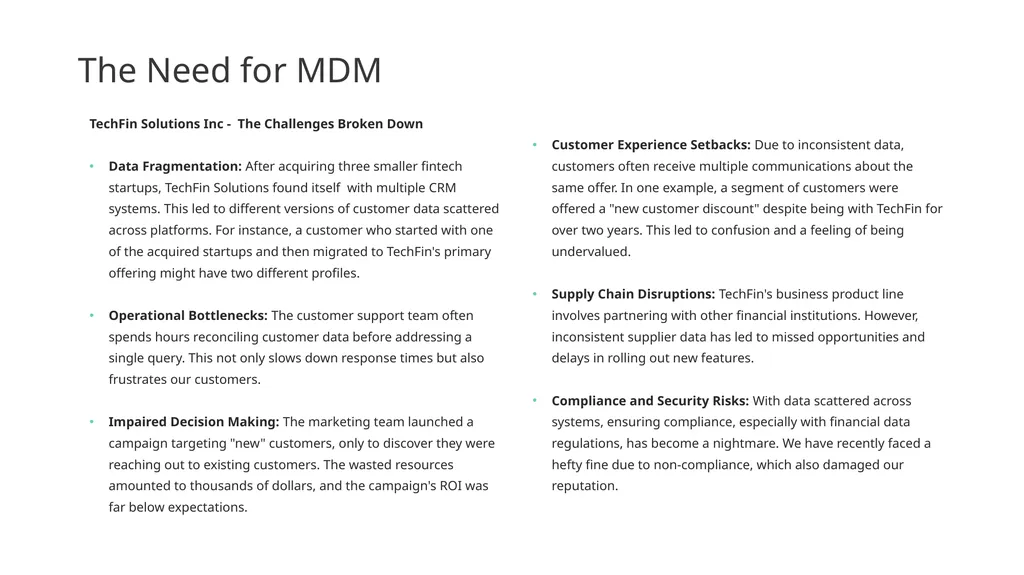
The Need for MDM TechFin Solutions Inc - The Challenges Broken Down
Data Fragmentation: After acquiring three smaller fintech startups, TechFin Solutions found itself with multiple CRM systems. This led to different versions of customer data scattered across platforms. For instance, a customer who started with one of the acquired startups and then migrated to TechFin's primary offering might have two different profiles.
Operational Bottlenecks: The customer support team often spends hours reconciling customer data before addressing a single query. This not only slows down response times but also frustrates our customers.
Impaired Decision Making: The marketing team launched a campaign targeting "new" customers, only to discover they were reaching out to existing customers. The wasted resources amounted to thousands of dollars, and the campaign's ROI was far below expectations.
Customer Experience Setbacks: Due to inconsistent data, customers often receive multiple communications about the same offer. In one example, a segment of customers were offered a "new customer discount" despite being with TechFin for over two years. This led to confusion and a feeling of being undervalued.
Supply Chain Disruptions: TechFin's business product line involves partnering with other financial institutions. However, inconsistent supplier data has led to missed opportunities and delays in rolling out new features.
Compliance and Security Risks: With data scattered across systems, ensuring compliance, especially with financial data regulations, has become a nightmare. We have recently faced a hefty fine due to non-compliance, which also damaged our reputation.<br>
14
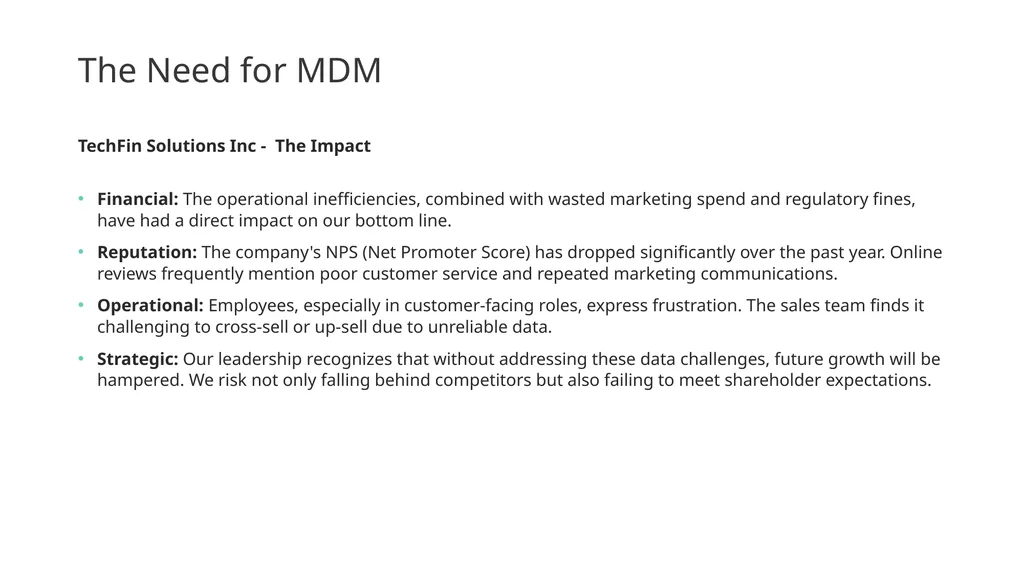
The Need for MDM TechFin Solutions Inc - The Impact
Financial: The operational inefficiencies, combined with wasted marketing spend and regulatory fines, have had a direct impact on our bottom line.
Reputation: The company's NPS (Net Promoter Score) has dropped significantly over the past year. Online reviews frequently mention poor customer service and repeated marketing communications.
Operational: Employees, especially in customer-facing roles, express frustration. The sales team finds it challenging to cross-sell or up-sell due to unreliable data.
Strategic: Our leadership recognizes that without addressing these data challenges, future growth will be hampered. We risk not only falling behind competitors but also failing to meet shareholder expectations.<br>
15
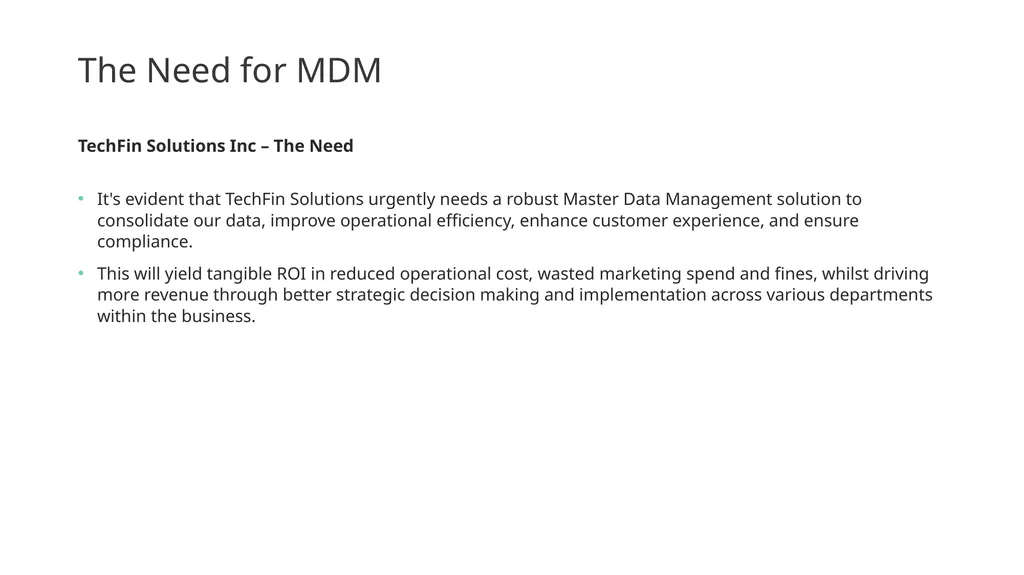
The Need for MDM TechFin Solutions Inc – The Need
It's evident that TechFin Solutions urgently needs a robust Master Data Management solution to consolidate our data, improve operational efficiency, enhance customer experience, and ensure compliance.
This will yield tangible ROI in reduced operational cost, wasted marketing spend and fines, whilst driving more revenue through better strategic decision making and implementation across various departments within the business.<br>
16
The Need for MDM Notes Your real-world examples of issues due to poor data management
Impact on business operations, decision-making, and customer experience<br>
Impact on business operations, decision-making, and customer experience<br>
17
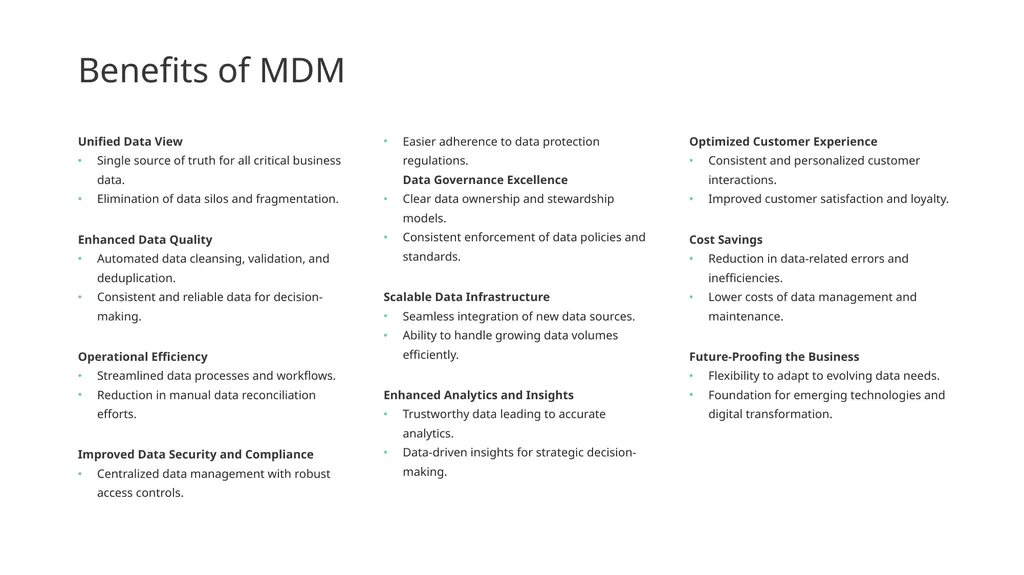
Benefits of MDM Unified Data View
Single source of truth for all critical business data.
Elimination of data silos and fragmentation.
Enhanced Data Quality
Automated data cleansing, validation, and deduplication.
Consistent and reliable data for decision-making.
Operational Efficiency
Streamlined data processes and workflows.
Reduction in manual data reconciliation efforts.
Improved Data Security and Compliance
Centralized data management with robust access controls.
Easier adherence to data protection regulations. Data Governance Excellence
Clear data ownership and stewardship models.
Consistent enforcement of data policies and standards.
Scalable Data Infrastructure
Seamless integration of new data sources.
Ability to handle growing data volumes efficiently.
Enhanced Analytics and Insights
Trustworthy data leading to accurate analytics.
Data-driven insights for strategic decision-making.
Optimized Customer Experience
Consistent and personalized customer interactions.
Improved customer satisfaction and loyalty.
Cost Savings
Reduction in data-related errors and inefficiencies.
Lower costs of data management and maintenance.
Future-Proofing the Business
Flexibility to adapt to evolving data needs.
Foundation for emerging technologies and digital transformation.<br>
18
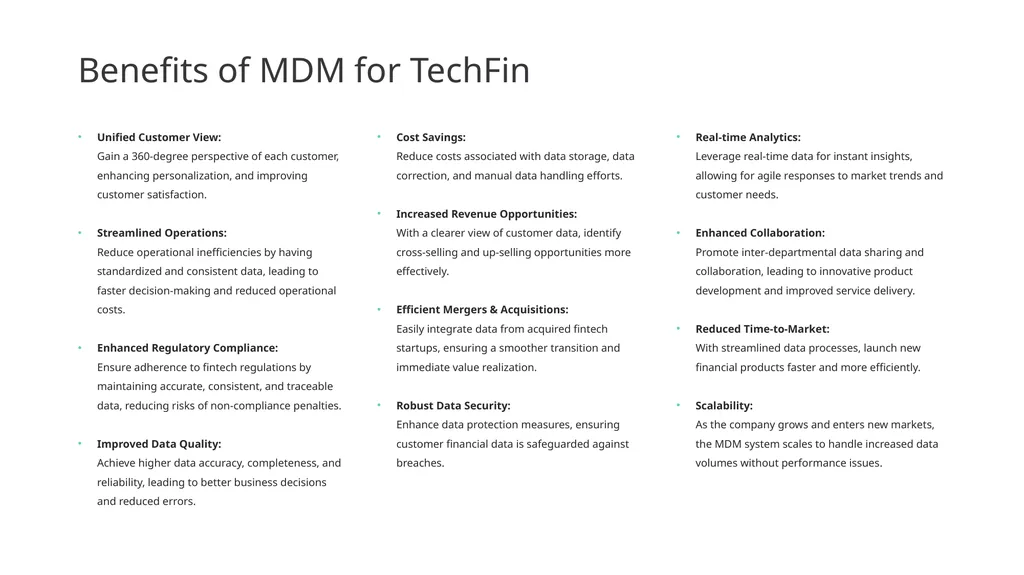
Benefits of MDM for TechFin Unified Customer View:
Gain a 360-degree perspective of each customer, enhancing personalization, and improving customer satisfaction.
Streamlined Operations: Reduce operational inefficiencies by having standardized and consistent data, leading to faster decision-making and reduced operational costs.
Enhanced Regulatory Compliance: Ensure adherence to fintech regulations by maintaining accurate, consistent, and traceable data, reducing risks of non-compliance penalties.
Improved Data Quality: Achieve higher data accuracy, completeness, and reliability, leading to better business decisions and reduced errors.
Cost Savings: Reduce costs associated with data storage, data correction, and manual data handling efforts.
Increased Revenue Opportunities: With a clearer view of customer data, identify cross-selling and up-selling opportunities more effectively.
Efficient Mergers & Acquisitions: Easily integrate data from acquired fintech startups, ensuring a smoother transition and immediate value realization.
Robust Data Security: Enhance data protection measures, ensuring customer financial data is safeguarded against breaches.
Real-time Analytics: Leverage real-time data for instant insights, allowing for agile responses to market trends and customer needs.
Enhanced Collaboration: Promote inter-departmental data sharing and collaboration, leading to innovative product development and improved service delivery.
Reduced Time-to-Market: With streamlined data processes, launch new financial products faster and more efficiently.
Scalability: As the company grows and enters new markets, the MDM system scales to handle increased data volumes without performance issues.<br>
19
Benefits of MDM Notes These benefits should be specific to your business and ones that the stakeholders in the room can relate to.
Highlight the importance of data in your sector.
Emphasize how an MDM solution directly translates to improved customer experiences, operational efficiencies, and bottom-line growth.
Use real-life examples from our company's journey, such as challenges faced during acquisitions or when launching a new product, to illustrate the tangible benefits of MDM.<br>
20
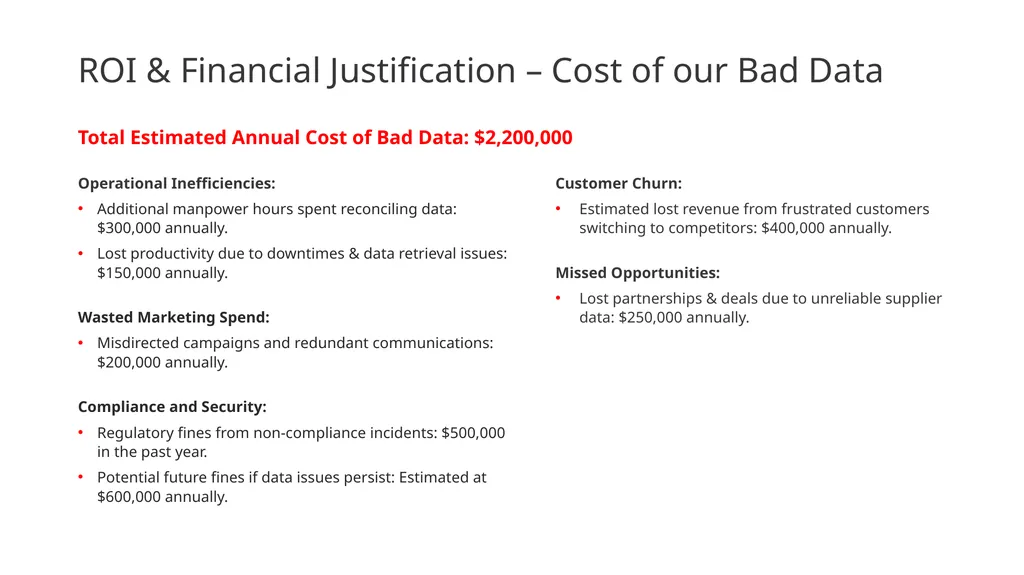
ROI & Financial Justification – Cost of our Bad Data Operational Inefficiencies:
Additional manpower hours spent reconciling data: $300,000 annually.
Lost productivity due to downtimes & data retrieval issues: $150,000 annually.
Wasted Marketing Spend:
Misdirected campaigns and redundant communications: $200,000 annually.
Compliance and Security:
Regulatory fines from non-compliance incidents: $500,000 in the past year.
Potential future fines if data issues persist: Estimated at $600,000 annually. Total Estimated Annual Cost of Bad Data: $2,200,000 Customer Churn:
Estimated lost revenue from frustrated customers switching to competitors: $400,000 annually.
Missed Opportunities:
Lost partnerships & deals due to unreliable supplier data: $250,000 annually.<br>
21
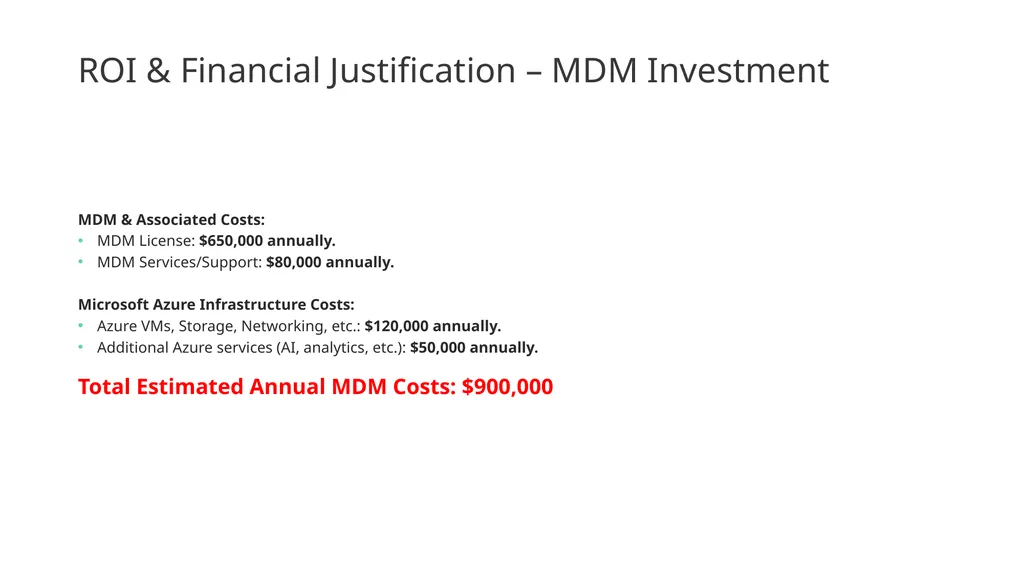
ROI & Financial Justification – MDM Investment MDM & Associated Costs:
MDM License: $650,000 annually.
MDM Services/Support: $80,000 annually.
Microsoft Azure Infrastructure Costs:
Azure VMs, Storage, Networking, etc.: $120,000 annually.
Additional Azure services (AI, analytics, etc.): $50,000 annually.
Total Estimated Annual MDM Costs: $900,000<br>
MDM License: $650,000 annually.
MDM Services/Support: $80,000 annually.
Microsoft Azure Infrastructure Costs:
Azure VMs, Storage, Networking, etc.: $120,000 annually.
Additional Azure services (AI, analytics, etc.): $50,000 annually.
Total Estimated Annual MDM Costs: $900,000<br>
22
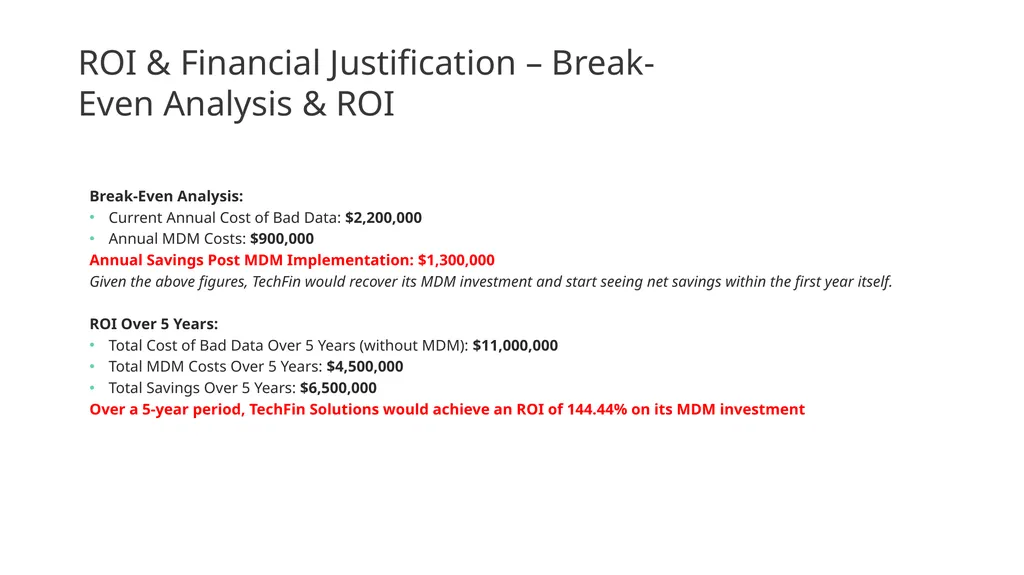
ROI & Financial Justification – Break-Even Analysis & ROI Break-Even Analysis:
Current Annual Cost of Bad Data: $2,200,000
Annual MDM Costs: $900,000
Annual Savings Post MDM Implementation: $1,300,000
Given the above figures, TechFin would recover its MDM investment and start seeing net savings within the first year itself.
ROI Over 5 Years:
Total Cost of Bad Data Over 5 Years (without MDM): $11,000,000
Total MDM Costs Over 5 Years: $4,500,000
Total Savings Over 5 Years: $6,500,000
Over a 5-year period, TechFin Solutions would achieve an ROI of 144.44% on its MDM investment<br>
23
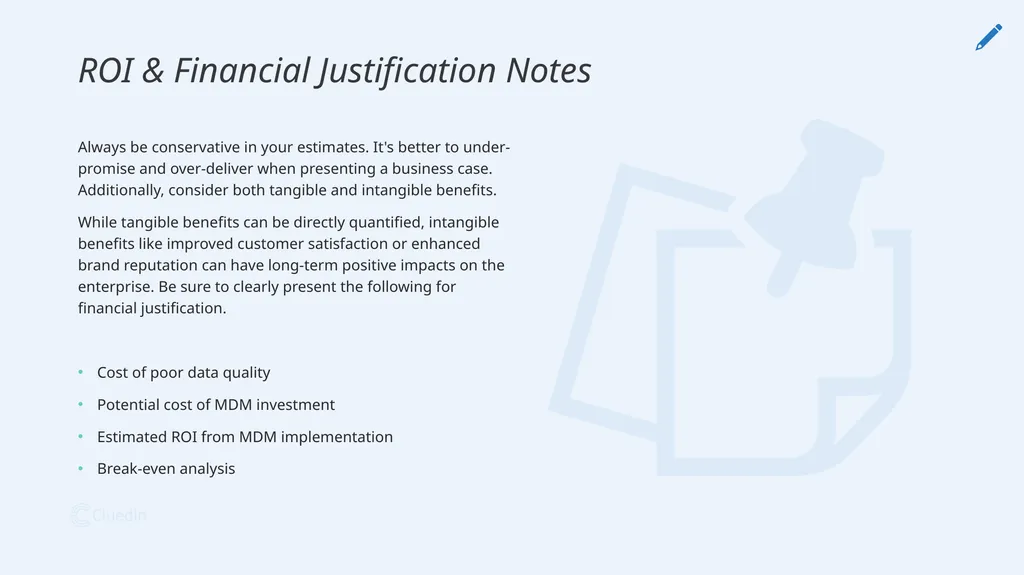
ROI & Financial Justification Notes Always be conservative in your estimates. It's better to under-promise and over-deliver when presenting a business case. Additionally, consider both tangible and intangible benefits.
While tangible benefits can be directly quantified, intangible benefits like improved customer satisfaction or enhanced brand reputation can have long-term positive impacts on the enterprise. Be sure to clearly present the following for financial justification.
Cost of poor data quality
Potential cost of MDM investment
Estimated ROI from MDM implementation
Break-even analysis<br>
24
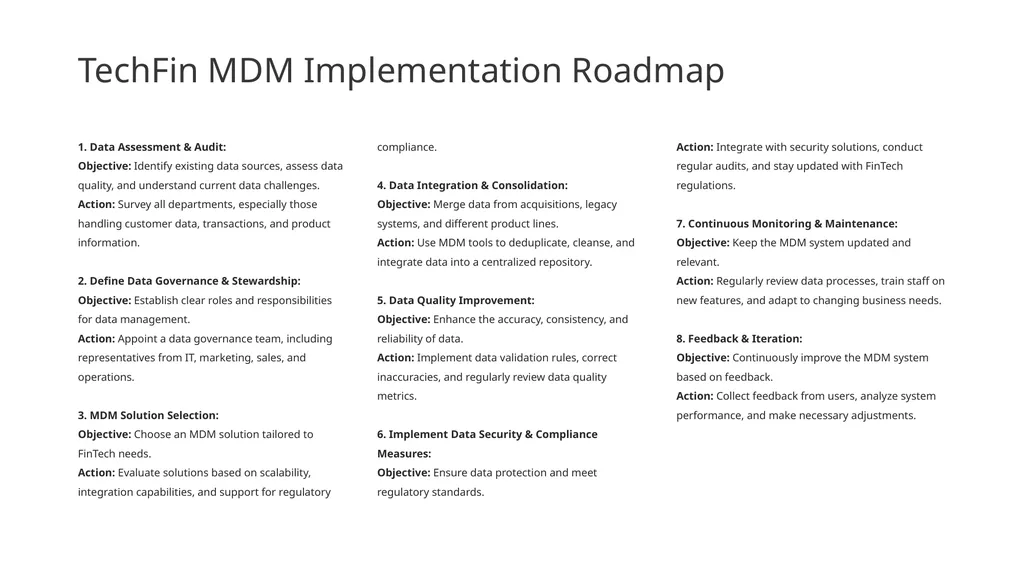
TechFin MDM Implementation Roadmap 1. Data Assessment & Audit:
Objective: Identify existing data sources, assess data quality, and understand current data challenges.
Action: Survey all departments, especially those handling customer data, transactions, and product information.
2. Define Data Governance & Stewardship:
Objective: Establish clear roles and responsibilities for data management.
Action: Appoint a data governance team, including representatives from IT, marketing, sales, and operations.
3. MDM Solution Selection:
Objective: Choose an MDM solution tailored to FinTech needs.
Action: Evaluate solutions based on scalability, integration capabilities, and support for regulatory compliance.
4. Data Integration & Consolidation:
Objective: Merge data from acquisitions, legacy systems, and different product lines.
Action: Use MDM tools to deduplicate, cleanse, and integrate data into a centralized repository.
5. Data Quality Improvement:
Objective: Enhance the accuracy, consistency, and reliability of data.
Action: Implement data validation rules, correct inaccuracies, and regularly review data quality metrics.
6. Implement Data Security & Compliance Measures:
Objective: Ensure data protection and meet regulatory standards.
Action: Integrate with security solutions, conduct regular audits, and stay updated with FinTech regulations.
7. Continuous Monitoring & Maintenance:
Objective: Keep the MDM system updated and relevant.
Action: Regularly review data processes, train staff on new features, and adapt to changing business needs.
8. Feedback & Iteration:
Objective: Continuously improve the MDM system based on feedback.
Action: Collect feedback from users, analyze system performance, and make necessary adjustments.<br>
25
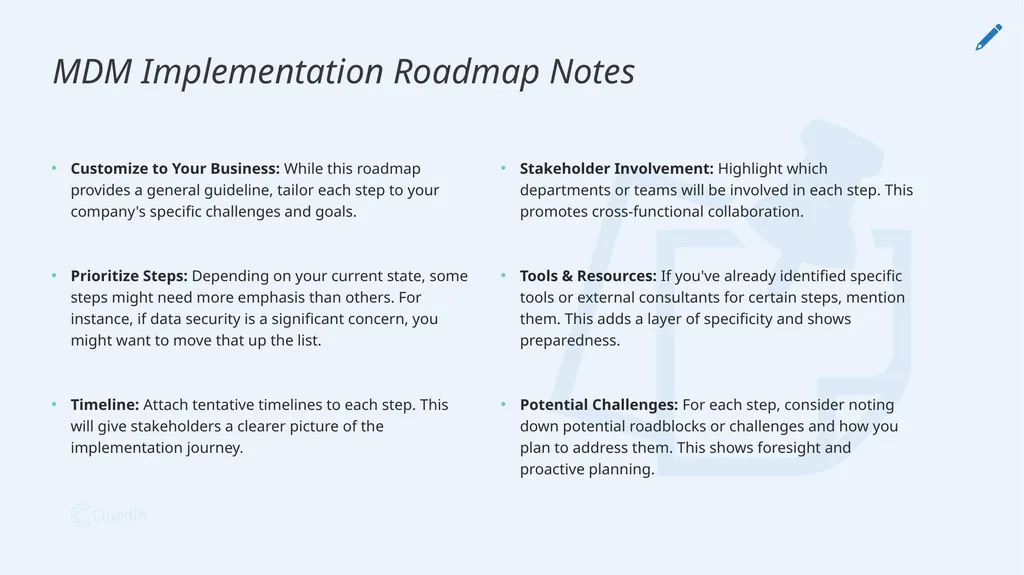
MDM Implementation Roadmap Notes Customize to Your Business: While this roadmap provides a general guideline, tailor each step to your company's specific challenges and goals.
Prioritize Steps: Depending on your current state, some steps might need more emphasis than others. For instance, if data security is a significant concern, you might want to move that up the list.
Timeline: Attach tentative timelines to each step. This will give stakeholders a clearer picture of the implementation journey.
Stakeholder Involvement: Highlight which departments or teams will be involved in each step. This promotes cross-functional collaboration.
Tools & Resources: If you've already identified specific tools or external consultants for certain steps, mention them. This adds a layer of specificity and shows preparedness.
Potential Challenges: For each step, consider noting down potential roadblocks or challenges and how you plan to address them. This shows foresight and proactive planning.<br>
26
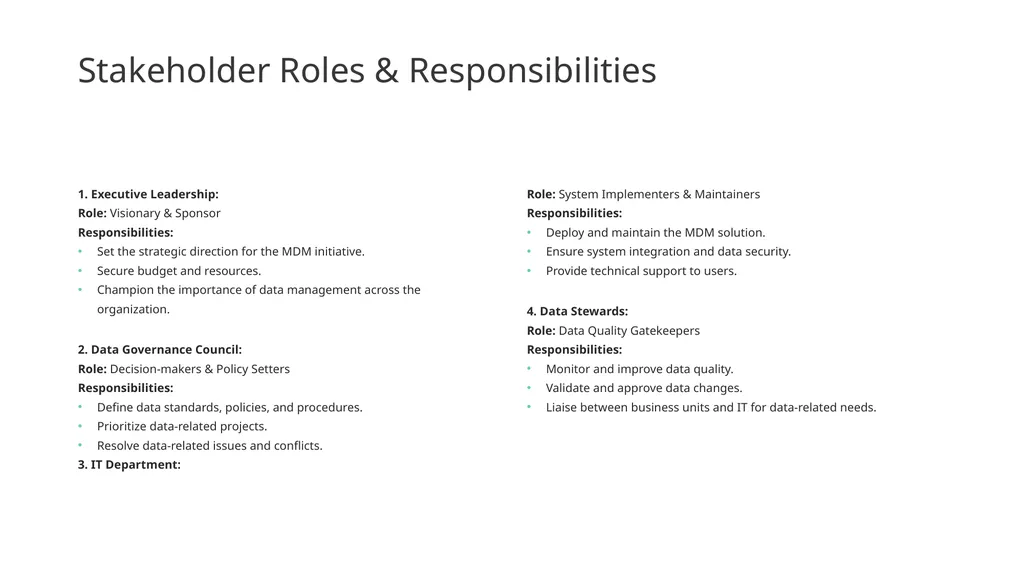
Stakeholder Roles & Responsibilities 1. Executive Leadership:
Role: Visionary & Sponsor
Responsibilities:
Set the strategic direction for the MDM initiative.
Secure budget and resources.
Champion the importance of data management across the organization.
2. Data Governance Council:
Role: Decision-makers & Policy Setters
Responsibilities:
Define data standards, policies, and procedures.
Prioritize data-related projects.
Resolve data-related issues and conflicts.
3. IT Department:
Role: System Implementers & Maintainers
Responsibilities:
Deploy and maintain the MDM solution.
Ensure system integration and data security.
Provide technical support to users.
4. Data Stewards:
Role: Data Quality Gatekeepers
Responsibilities:
Monitor and improve data quality.
Validate and approve data changes.
Liaise between business units and IT for data-related needs.<br>
27
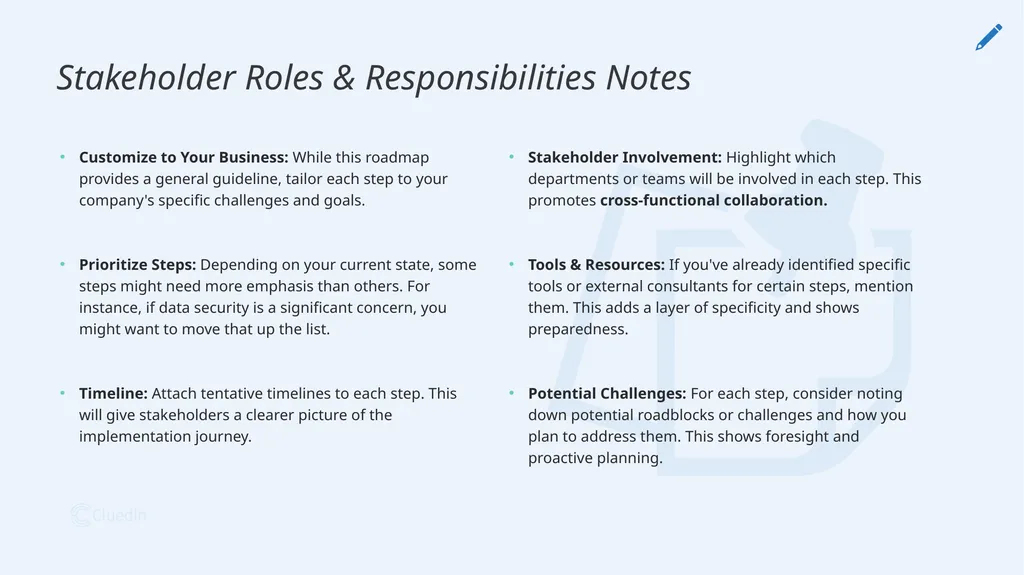
Stakeholder Roles & Responsibilities Notes Customize to Your Business: While this roadmap provides a general guideline, tailor each step to your company's specific challenges and goals.
Prioritize Steps: Depending on your current state, some steps might need more emphasis than others. For instance, if data security is a significant concern, you might want to move that up the list.
Timeline: Attach tentative timelines to each step. This will give stakeholders a clearer picture of the implementation journey.
Stakeholder Involvement: Highlight which departments or teams will be involved in each step. This promotes cross-functional collaboration.
Tools & Resources: If you've already identified specific tools or external consultants for certain steps, mention them. This adds a layer of specificity and shows preparedness.
Potential Challenges: For each step, consider noting down potential roadblocks or challenges and how you plan to address them. This shows foresight and proactive planning.<br>
28
MDM Success Stories (optional) Add success stories here<br>
29
MDM Success Stories Notes (optional) Brief case studies or testimonials from other companies that have successfully implemented MDM<br>
30
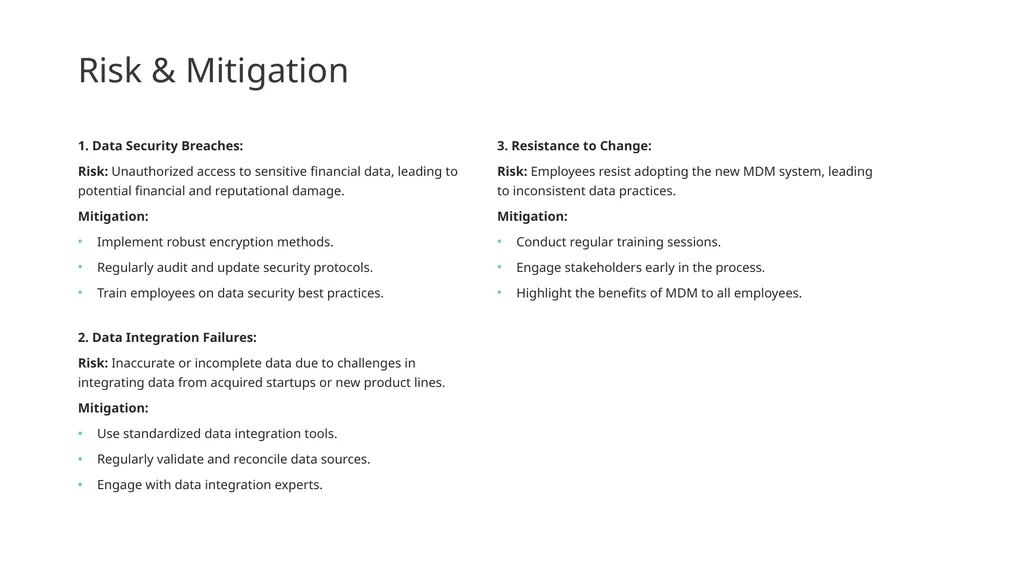
Risk & Mitigation 1. Data Security Breaches:
Risk: Unauthorized access to sensitive financial data, leading to potential financial and reputational damage.
Mitigation:
Implement robust encryption methods.
Regularly audit and update security protocols.
Train employees on data security best practices.
2. Data Integration Failures:
Risk: Inaccurate or incomplete data due to challenges in integrating data from acquired startups or new product lines.
Mitigation:
Use standardized data integration tools.
Regularly validate and reconcile data sources.
Engage with data integration experts.
3. Resistance to Change:
Risk: Employees resist adopting the new MDM system, leading to inconsistent data practices.
Mitigation:
Conduct regular training sessions.
Engage stakeholders early in the process.
Highlight the benefits of MDM to all employees.<br>
31
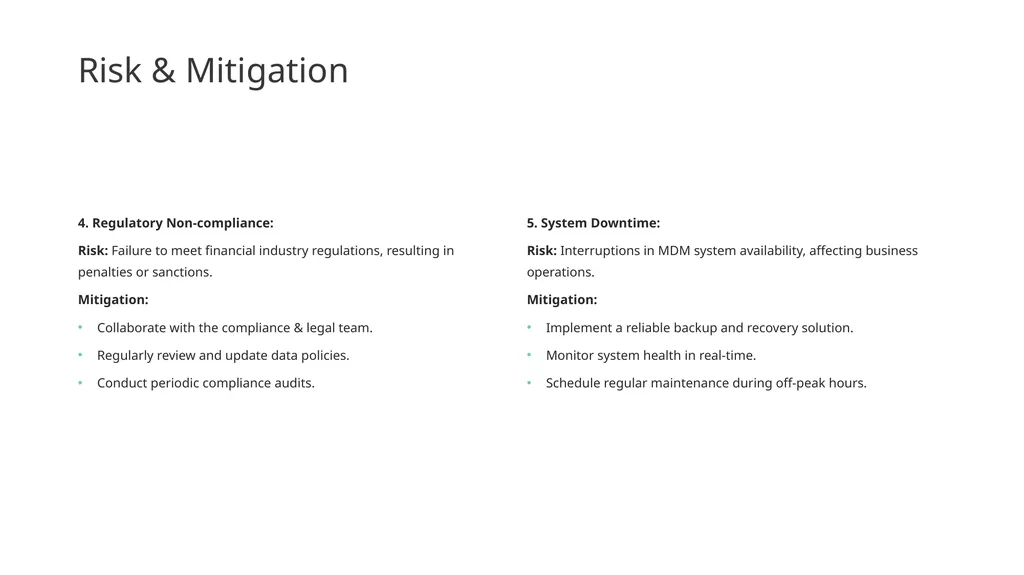
Risk & Mitigation 4. Regulatory Non-compliance:
Risk: Failure to meet financial industry regulations, resulting in penalties or sanctions.
Mitigation:
Collaborate with the compliance & legal team.
Regularly review and update data policies.
Conduct periodic compliance audits.
5. System Downtime:
Risk: Interruptions in MDM system availability, affecting business operations.
Mitigation:
Implement a reliable backup and recovery solution.
Monitor system health in real-time.
Schedule regular maintenance during off-peak hours.<br>
32
Risk & Mitigation Notes Focus on potential challenges in MDM implementation and strategies to mitigate these risks
Tailor to Your Industry: While the risks listed are specific to FinTech, you should adapt for your industry. Consider the unique challenges your industry faces and adjust accordingly.
Quantify Risks: If possible, provide statistics or figures that quantify the potential impact of each risk. This can make the risks more tangible and underscore their importance.
Expand on Mitigation: For each risk, list the most effective mitigation strategies. If a strategy has multiple steps or components, consider using bullet points for clarity.
Stakeholder Involvement: Highlight which stakeholders are responsible for addressing each risk. This can clarify roles and ensure accountability.
Feedback & Review: Emphasize the importance of regularly reviewing and updating the risk & mitigation strategies. As the MDM implementation progresses, new risks may emerge, and strategies may need to be adjusted.
External Factors: Consider external factors, such as changes in the industry landscape, technological advancements, or shifts in regulations, that might introduce new risks.<br>
33
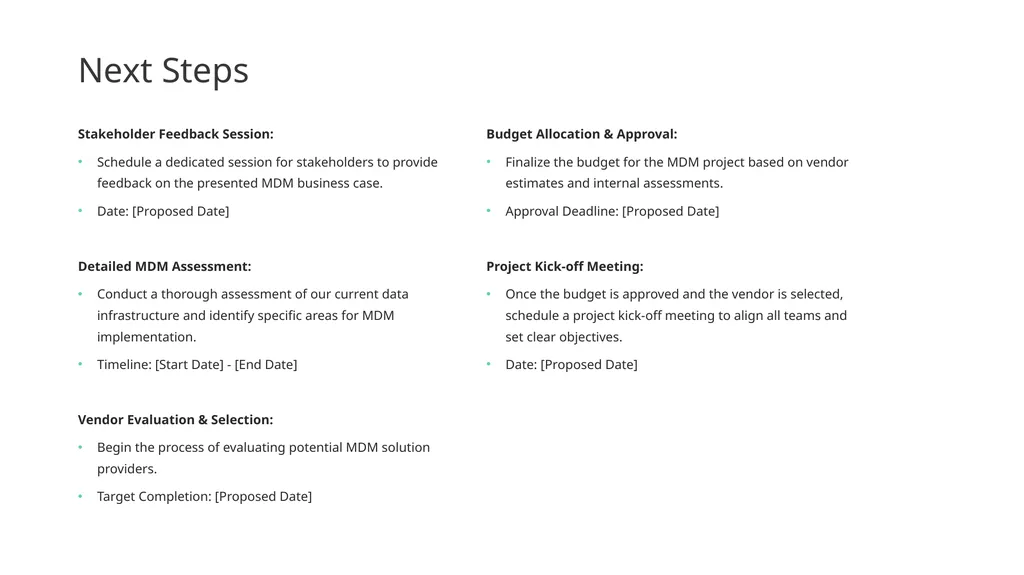
Next Steps Stakeholder Feedback Session:
Schedule a dedicated session for stakeholders to provide feedback on the presented MDM business case.
Date: [Proposed Date]
Detailed MDM Assessment:
Conduct a thorough assessment of our current data infrastructure and identify specific areas for MDM implementation.
Timeline: [Start Date] - [End Date]
Vendor Evaluation & Selection:
Begin the process of evaluating potential MDM solution providers.
Target Completion: [Proposed Date]
Budget Allocation & Approval:
Finalize the budget for the MDM project based on vendor estimates and internal assessments.
Approval Deadline: [Proposed Date]
Project Kick-off Meeting:
Once the budget is approved and the vendor is selected, schedule a project kick-off meeting to align all teams and set clear objectives.
Date: [Proposed Date]<br>
34
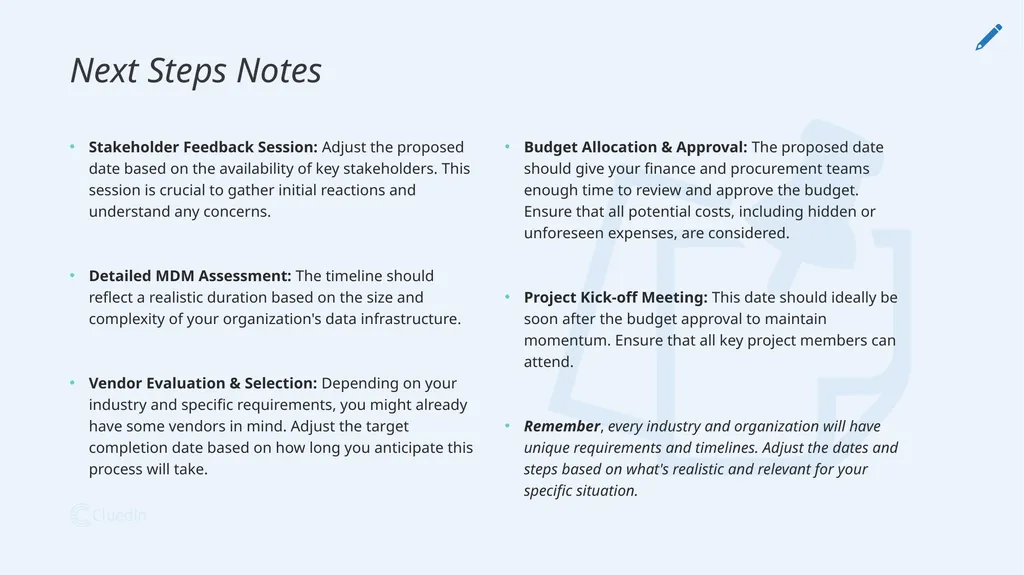
Next Steps Notes Stakeholder Feedback Session: Adjust the proposed date based on the availability of key stakeholders. This session is crucial to gather initial reactions and understand any concerns.
Detailed MDM Assessment: The timeline should reflect a realistic duration based on the size and complexity of your organization's data infrastructure.
Vendor Evaluation & Selection: Depending on your industry and specific requirements, you might already have some vendors in mind. Adjust the target completion date based on how long you anticipate this process will take.
Budget Allocation & Approval: The proposed date should give your finance and procurement teams enough time to review and approve the budget. Ensure that all potential costs, including hidden or unforeseen expenses, are considered.
Project Kick-off Meeting: This date should ideally be soon after the budget approval to maintain momentum. Ensure that all key project members can attend.
Remember, every industry and organization will have unique requirements and timelines. Adjust the dates and steps based on what's realistic and relevant for your specific situation.<br>
35
TechFin Solutions Inc – Closing Remarks In the fast-paced world faced by TechFin solutions, where data drives innovation and growth, the importance of a robust Master Data Management system cannot be overstated.
Our journey over the past five years has seen exponential growth, diversification, and expansion. Yet, with these milestones, we've faced significant data challenges that have the potential to hinder our future trajectory.<br>
Our journey over the past five years has seen exponential growth, diversification, and expansion. Yet, with these milestones, we've faced significant data challenges that have the potential to hinder our future trajectory.<br>
36
TechFin Solutions Inc – Closing Remarks Implementing MDM is not just a strategic move—it's a pivotal step towards ensuring data accuracy, streamlining operations, and delivering unparalleled value to our customers.
As stakeholders, your support in this initiative is not just an investment in a system, but a commitment to the very foundation of our enterprise's success.
Together, let's champion a data-driven future, where clarity, consistency, and innovation are at the heart of everything we do.<br>
As stakeholders, your support in this initiative is not just an investment in a system, but a commitment to the very foundation of our enterprise's success.
Together, let's champion a data-driven future, where clarity, consistency, and innovation are at the heart of everything we do.<br>
37
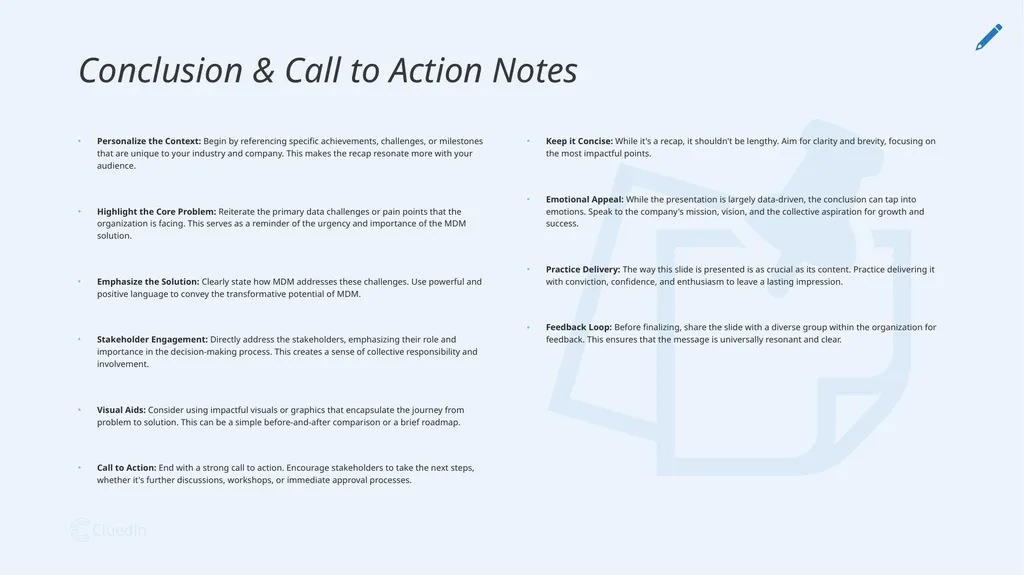
Conclusion & Call to Action Notes Personalize the Context: Begin by referencing specific achievements, challenges, or milestones that are unique to your industry and company. This makes the recap resonate more with your audience.
Highlight the Core Problem: Reiterate the primary data challenges or pain points that the organization is facing. This serves as a reminder of the urgency and importance of the MDM solution.
Emphasize the Solution: Clearly state how MDM addresses these challenges. Use powerful and positive language to convey the transformative potential of MDM.
Stakeholder Engagement: Directly address the stakeholders, emphasizing their role and importance in the decision-making process. This creates a sense of collective responsibility and involvement.
Visual Aids: Consider using impactful visuals or graphics that encapsulate the journey from problem to solution. This can be a simple before-and-after comparison or a brief roadmap.
Call to Action: End with a strong call to action. Encourage stakeholders to take the next steps, whether it's further discussions, workshops, or immediate approval processes.
Keep it Concise: While it's a recap, it shouldn't be lengthy. Aim for clarity and brevity, focusing on the most impactful points.
Emotional Appeal: While the presentation is largely data-driven, the conclusion can tap into emotions. Speak to the company's mission, vision, and the collective aspiration for growth and success.
Practice Delivery: The way this slide is presented is as crucial as its content. Practice delivering it with conviction, confidence, and enthusiasm to leave a lasting impression.
Feedback Loop: Before finalizing, share the slide with a diverse group within the organization for feedback. This ensures that the message is universally resonant and clear.<br>
38
Q&A We invite you to share your questions
and and engage in discussion.<br>