
Standardized Baselines 7th CDM Joint Coordination
LO
Published · 17 slides · 0 views
1 / 1


Description
Standardized Baselines 7th CDM Joint Coordination Workshop, Bonn, 12th 13th March 2011 13032011 1 www.cmia.net Who we are CMIA is an international trade association representing firms that finance, invest in, and provide enabling
Related Topics
Share
Embed code
Download this presentation From Below
"Standardized Baselines 7th CDM Joint Coordination" is the property of its rightful owner. Permission is granted to download and print the materials on this website for personal, non-commercial use only, and to display it on your personal computer provided you do not modify the materials and that you retain all copyright notices contained in the materials. By downloading content from our website, you accept the terms of this agreement.
Presentation Transcript
01
Standardized Baselines 7th CDM Joint Coordination Workshop, Bonn, 12th – 13th March 2011 13/03/2011 1 www.cmia.net<br>
02
Who we are CMIA is an international trade association representing firms that finance, invest in, and provide enabling support to activities that reduce emissions. Our international membership accounts for an estimated 75% of the global carbon market, valued at USD 130 billion in 2009.
Our effectiveness and credibility as a voice in the policy-making arena is founded on our unique profile - an international, emitter-free association, representing the entire value chain of climate finance. This results in a unique advocacy platform with emphasis on the environmental integrity of market mechanisms and climate change policies. 13/03/2011 www.cmia.net 2<br>
Our effectiveness and credibility as a voice in the policy-making arena is founded on our unique profile - an international, emitter-free association, representing the entire value chain of climate finance. This results in a unique advocacy platform with emphasis on the environmental integrity of market mechanisms and climate change policies. 13/03/2011 www.cmia.net 2<br>
03
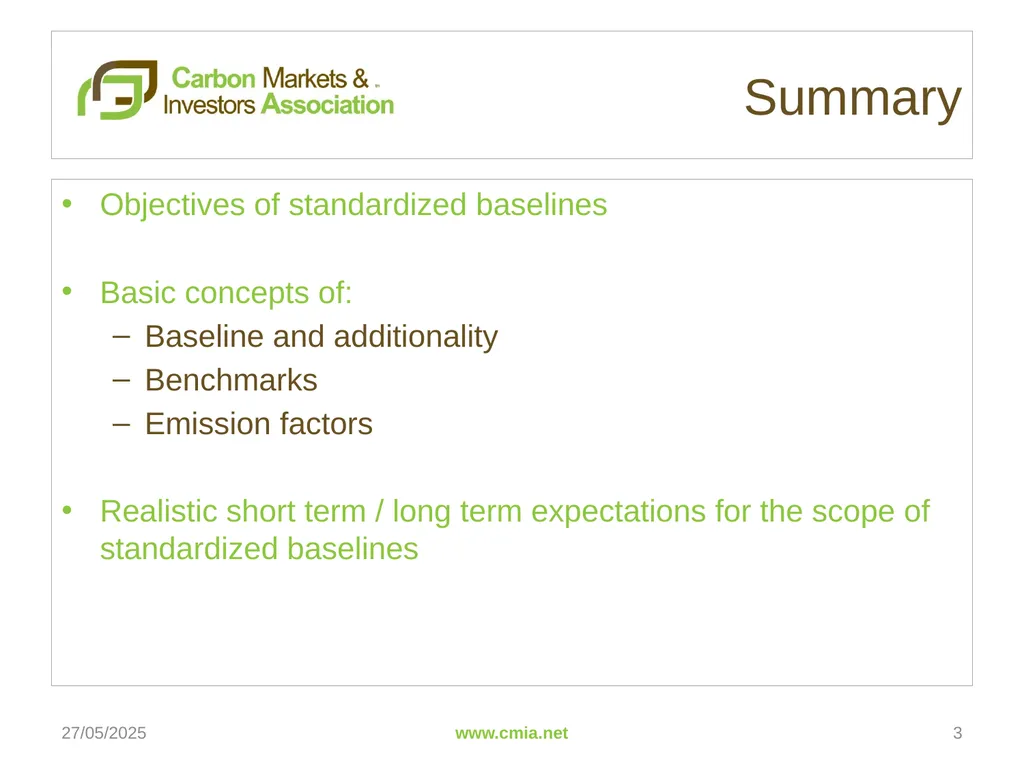
Summary Objectives of standardized baselines
Basic concepts of:
Baseline and additionality
Benchmarks
Emission factors
Realistic short term / long term expectations for the scope of standardized baselines 13/03/2011 www.cmia.net 3<br>
Basic concepts of:
Baseline and additionality
Benchmarks
Emission factors
Realistic short term / long term expectations for the scope of standardized baselines 13/03/2011 www.cmia.net 3<br>
04
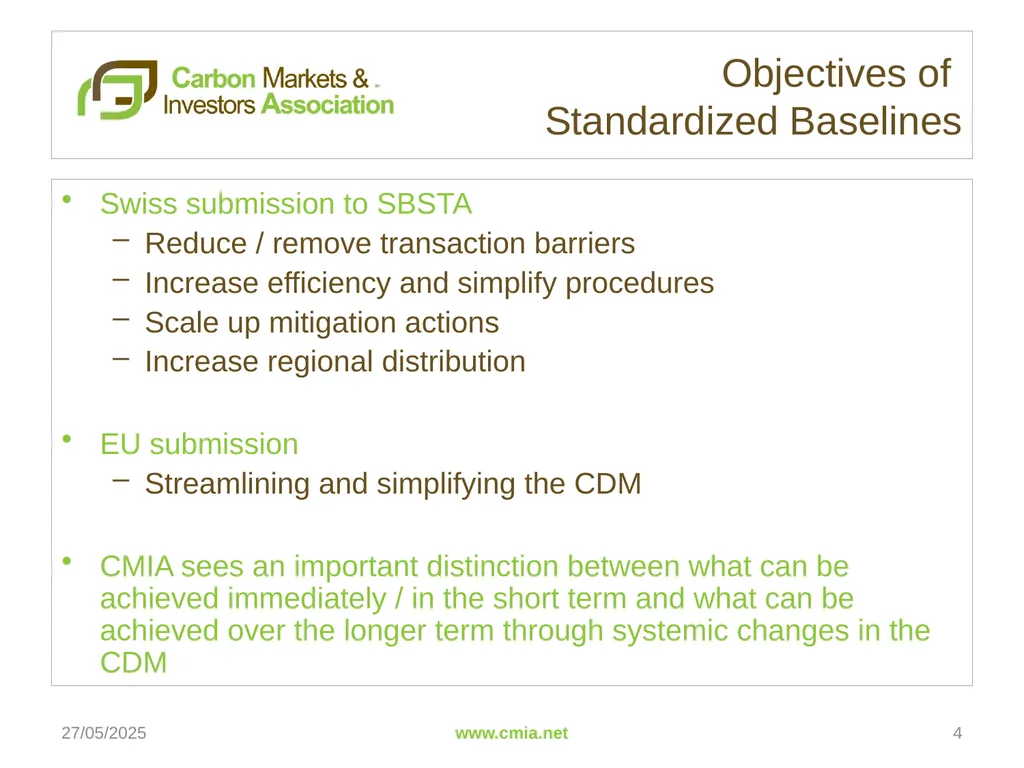
Objectives of
Standardized Baselines Swiss submission to SBSTA
Reduce / remove transaction barriers
Increase efficiency and simplify procedures
Scale up mitigation actions
Increase regional distribution
EU submission
Streamlining and simplifying the CDM
CMIA sees an important distinction between what can be achieved immediately / in the short term and what can be achieved over the longer term through systemic changes in the CDM 13/03/2011 www.cmia.net 4<br>
Reduce / remove transaction barriers
Increase efficiency and simplify procedures
Scale up mitigation actions
Increase regional distribution
EU submission
Streamlining and simplifying the CDM
CMIA sees an important distinction between what can be achieved immediately / in the short term and what can be achieved over the longer term through systemic changes in the CDM 13/03/2011 www.cmia.net 4<br>
05
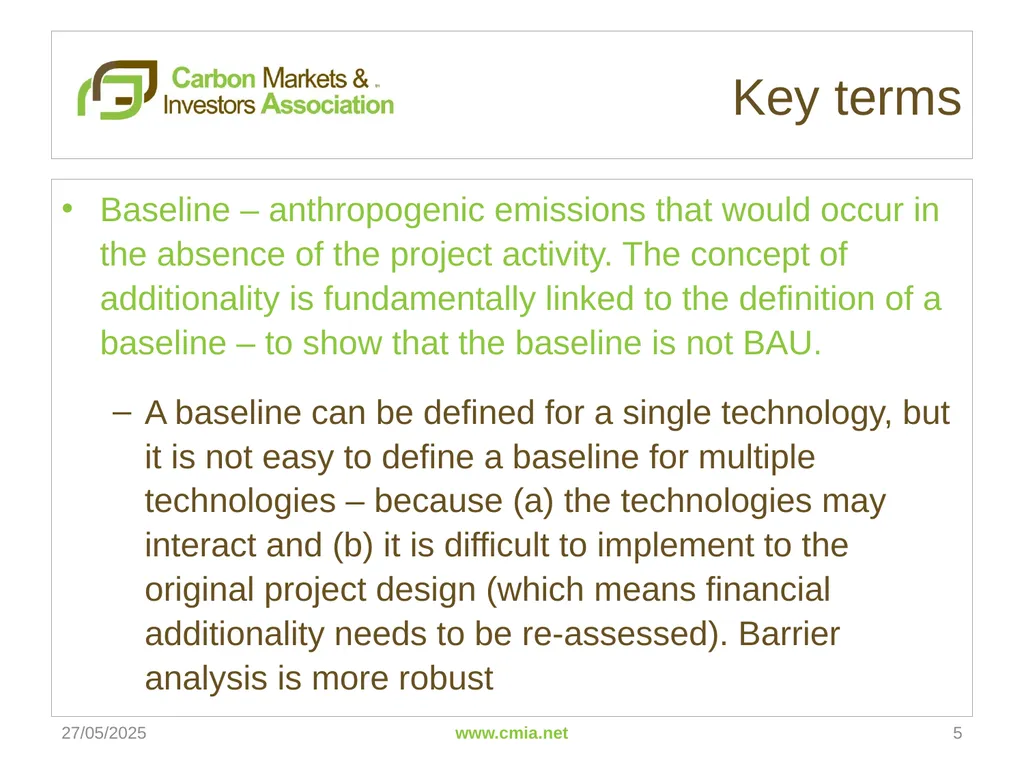
Key terms Baseline – anthropogenic emissions that would occur in the absence of the project activity. The concept of additionality is fundamentally linked to the definition of a baseline – to show that the baseline is not BAU.
A baseline can be defined for a single technology, but it is not easy to define a baseline for multiple technologies – because (a) the technologies may interact and (b) it is difficult to implement to the original project design (which means financial additionality needs to be re-assessed). Barrier analysis is more robust 13/03/2011 www.cmia.net 5<br>
A baseline can be defined for a single technology, but it is not easy to define a baseline for multiple technologies – because (a) the technologies may interact and (b) it is difficult to implement to the original project design (which means financial additionality needs to be re-assessed). Barrier analysis is more robust 13/03/2011 www.cmia.net 5<br>
06
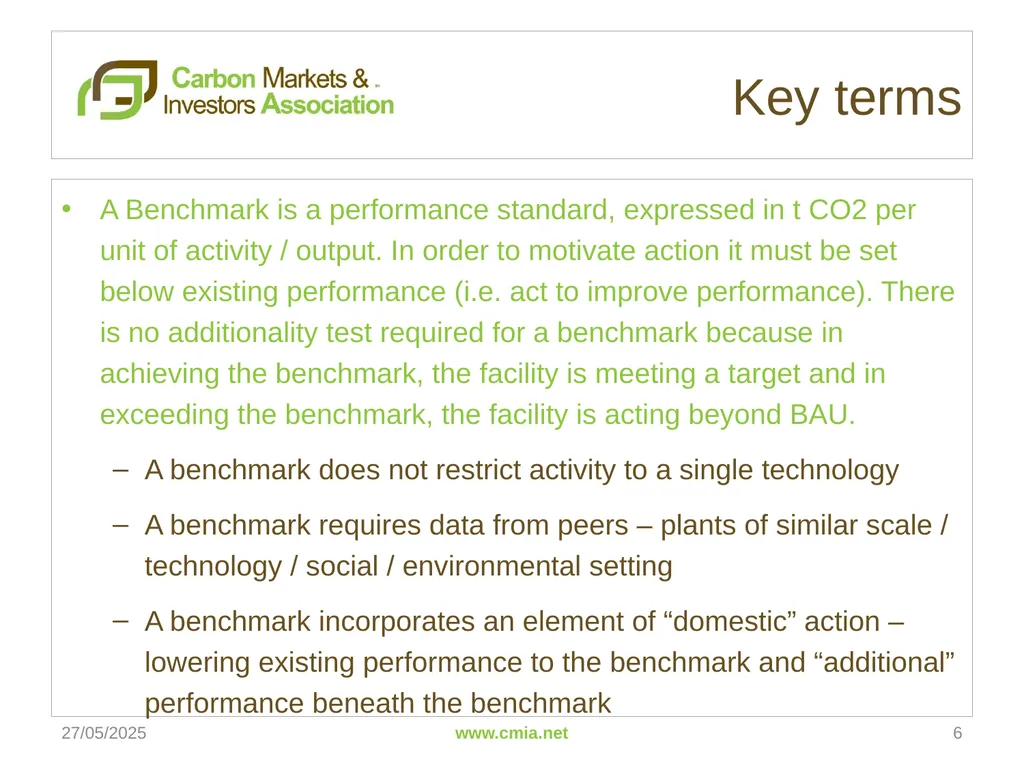
Key terms A Benchmark is a performance standard, expressed in t CO2 per unit of activity / output. In order to motivate action it must be set below existing performance (i.e. act to improve performance). There is no additionality test required for a benchmark because in achieving the benchmark, the facility is meeting a target and in exceeding the benchmark, the facility is acting beyond BAU.
A benchmark does not restrict activity to a single technology
A benchmark requires data from peers – plants of similar scale / technology / social / environmental setting
A benchmark incorporates an element of “domestic” action – lowering existing performance to the benchmark and “additional” performance beneath the benchmark 13/03/2011 www.cmia.net 6<br>
A benchmark does not restrict activity to a single technology
A benchmark requires data from peers – plants of similar scale / technology / social / environmental setting
A benchmark incorporates an element of “domestic” action – lowering existing performance to the benchmark and “additional” performance beneath the benchmark 13/03/2011 www.cmia.net 6<br>
07
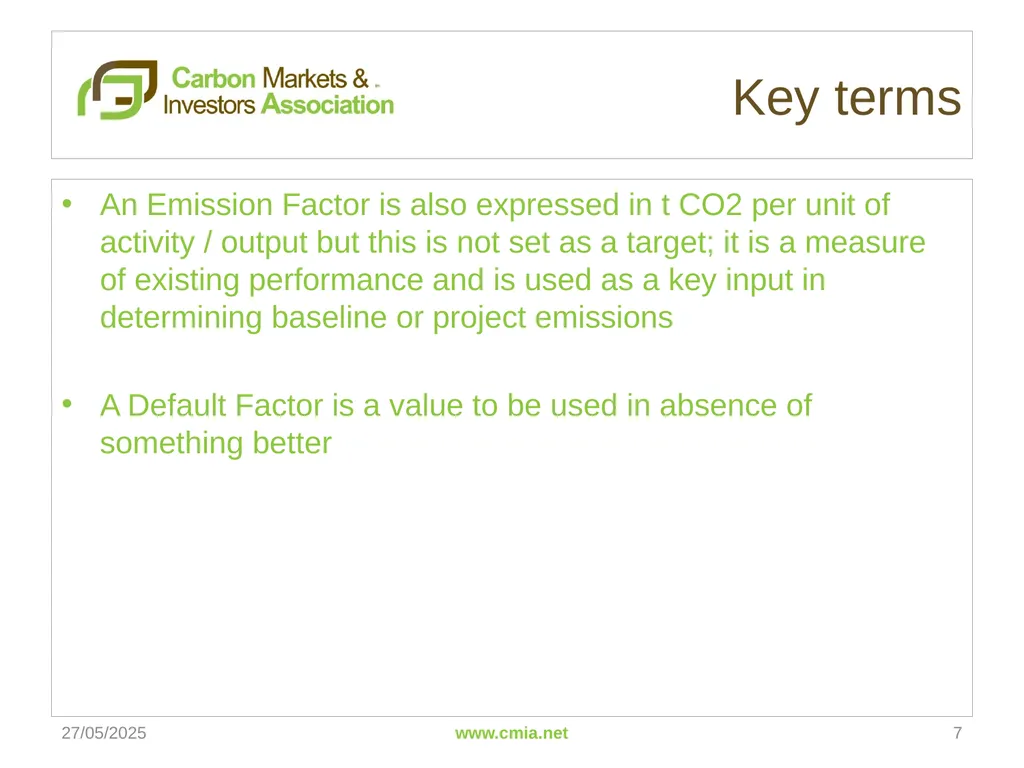
Key terms An Emission Factor is also expressed in t CO2 per unit of activity / output but this is not set as a target; it is a measure of existing performance and is used as a key input in determining baseline or project emissions
A Default Factor is a value to be used in absence of something better 13/03/2011 www.cmia.net 7<br>
A Default Factor is a value to be used in absence of something better 13/03/2011 www.cmia.net 7<br>
08
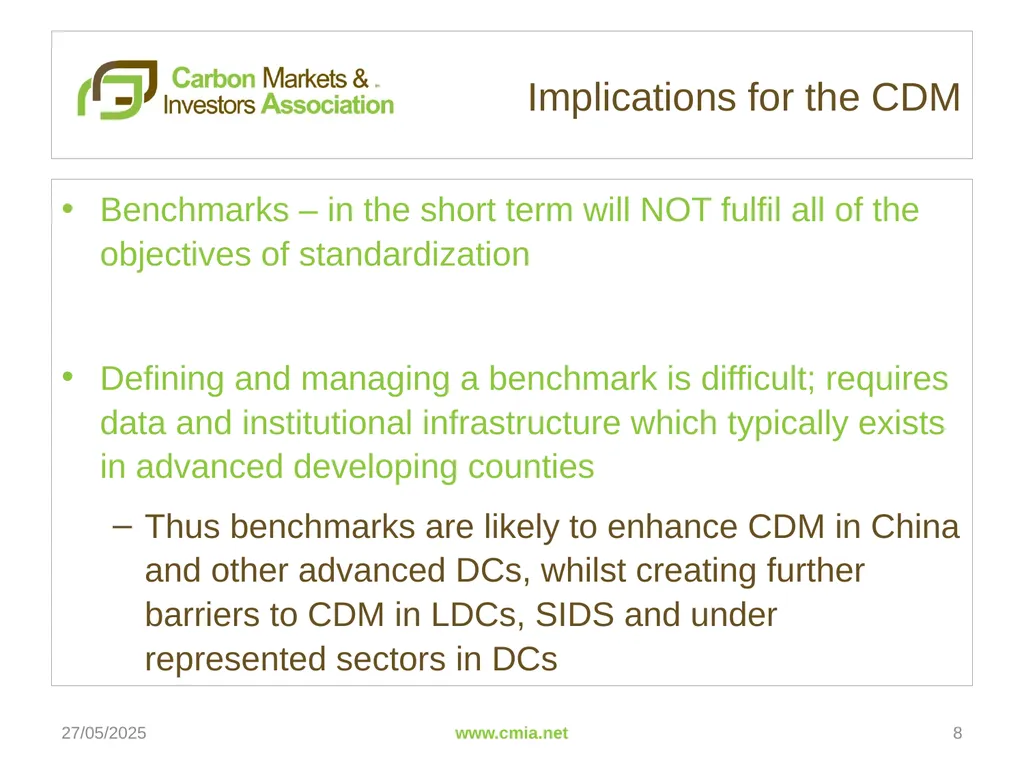
Implications for the CDM Benchmarks – in the short term will NOT fulfil all of the objectives of standardization
Defining and managing a benchmark is difficult; requires data and institutional infrastructure which typically exists in advanced developing counties
Thus benchmarks are likely to enhance CDM in China and other advanced DCs, whilst creating further barriers to CDM in LDCs, SIDS and under represented sectors in DCs 13/03/2011 www.cmia.net 8<br>
Defining and managing a benchmark is difficult; requires data and institutional infrastructure which typically exists in advanced developing counties
Thus benchmarks are likely to enhance CDM in China and other advanced DCs, whilst creating further barriers to CDM in LDCs, SIDS and under represented sectors in DCs 13/03/2011 www.cmia.net 8<br>
09
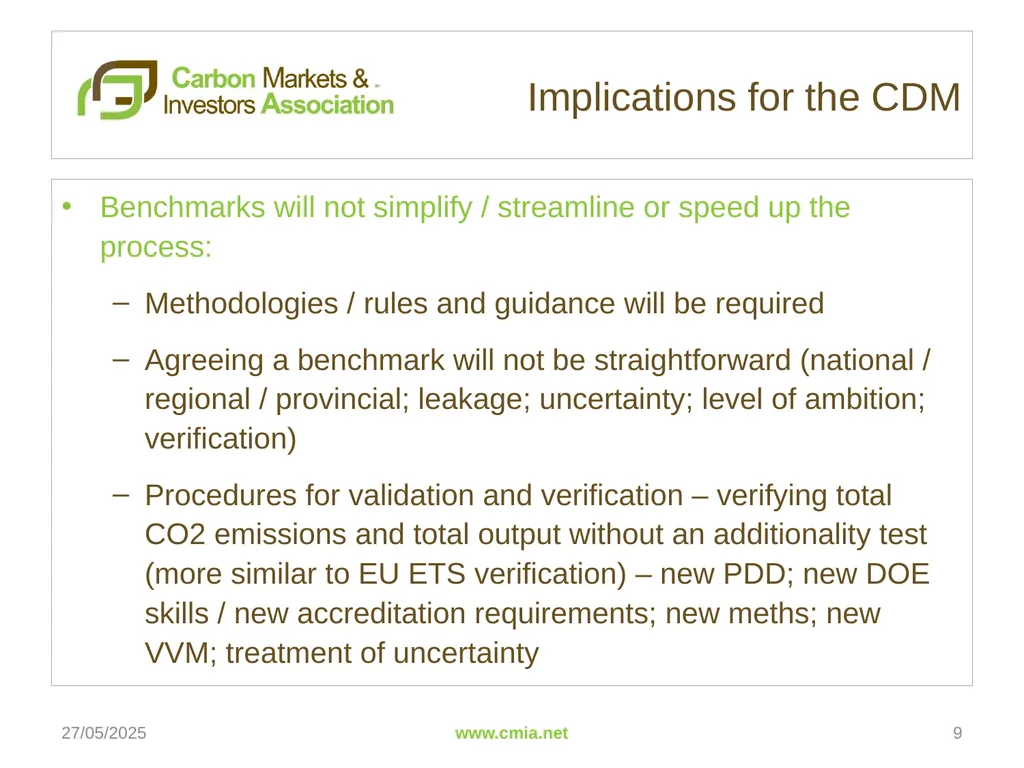
Implications for the CDM Benchmarks will not simplify / streamline or speed up the process:
Methodologies / rules and guidance will be required
Agreeing a benchmark will not be straightforward (national / regional / provincial; leakage; uncertainty; level of ambition; verification)
Procedures for validation and verification – verifying total CO2 emissions and total output without an additionality test (more similar to EU ETS verification) – new PDD; new DOE skills / new accreditation requirements; new meths; new VVM; treatment of uncertainty 13/03/2011 www.cmia.net 9<br>
Methodologies / rules and guidance will be required
Agreeing a benchmark will not be straightforward (national / regional / provincial; leakage; uncertainty; level of ambition; verification)
Procedures for validation and verification – verifying total CO2 emissions and total output without an additionality test (more similar to EU ETS verification) – new PDD; new DOE skills / new accreditation requirements; new meths; new VVM; treatment of uncertainty 13/03/2011 www.cmia.net 9<br>
10
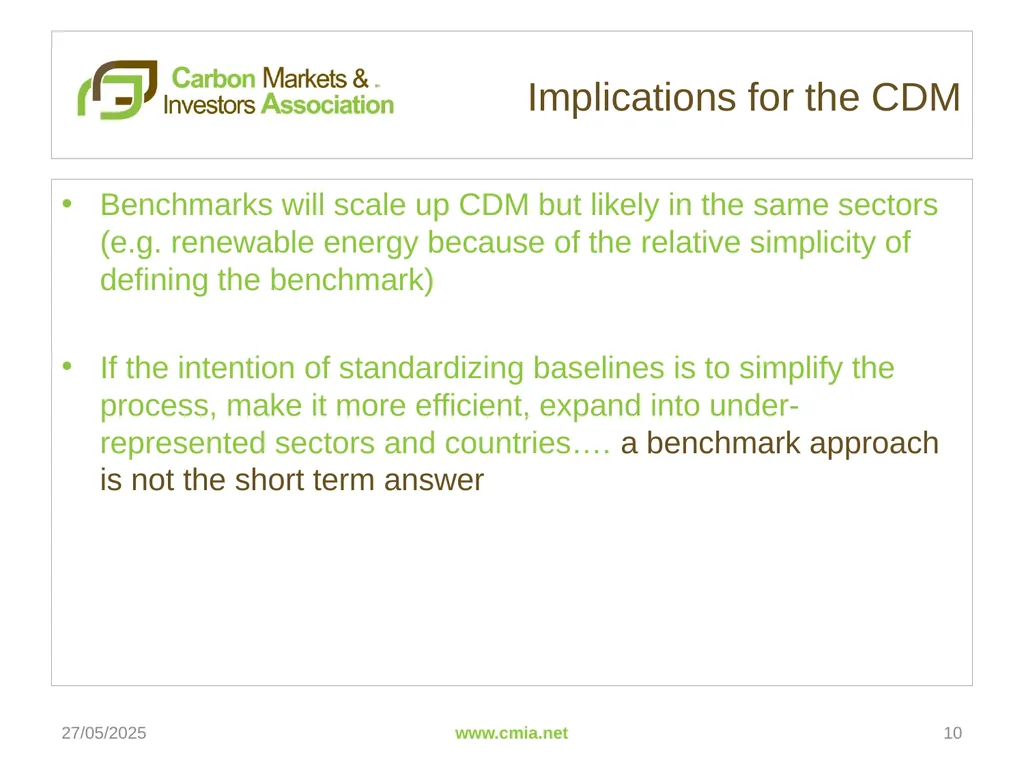
Implications for the CDM Benchmarks will scale up CDM but likely in the same sectors (e.g. renewable energy because of the relative simplicity of defining the benchmark)
If the intention of standardizing baselines is to simplify the process, make it more efficient, expand into under-represented sectors and countries…. a benchmark approach is not the short term answer 13/03/2011 www.cmia.net 10<br>
If the intention of standardizing baselines is to simplify the process, make it more efficient, expand into under-represented sectors and countries…. a benchmark approach is not the short term answer 13/03/2011 www.cmia.net 10<br>
11
What should a standardized
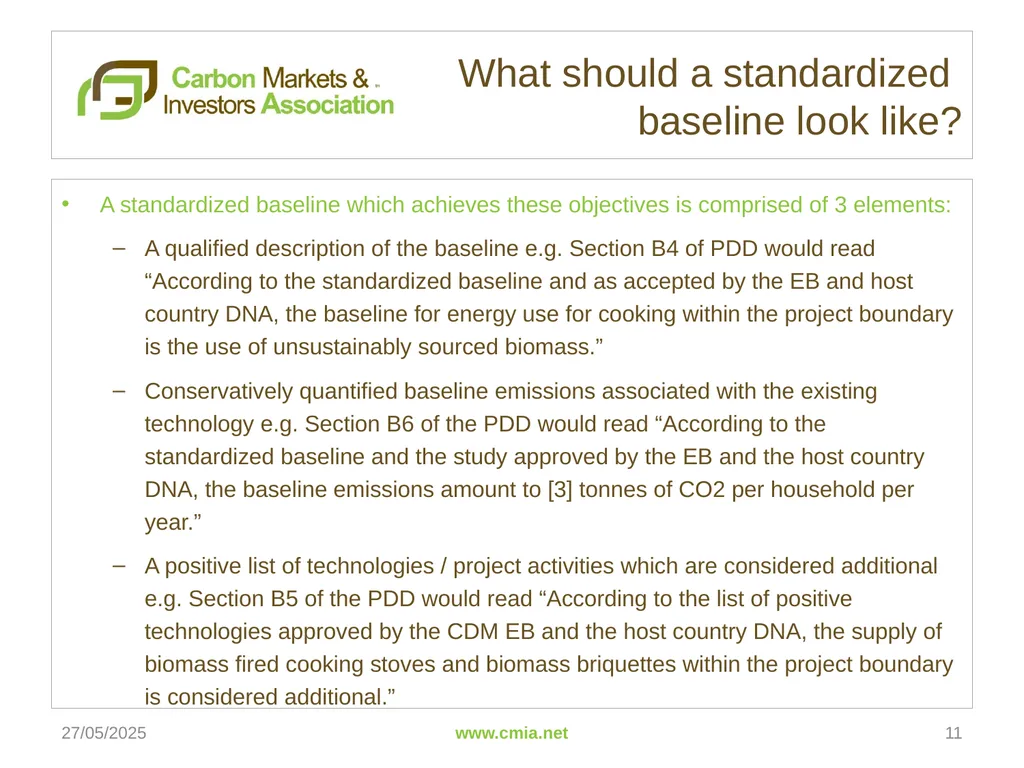
baseline look like? A standardized baseline which achieves these objectives is comprised of 3 elements:
A qualified description of the baseline e.g. Section B4 of PDD would read “According to the standardized baseline and as accepted by the EB and host country DNA, the baseline for energy use for cooking within the project boundary is the use of unsustainably sourced biomass.”
Conservatively quantified baseline emissions associated with the existing technology e.g. Section B6 of the PDD would read “According to the standardized baseline and the study approved by the EB and the host country DNA, the baseline emissions amount to [3] tonnes of CO2 per household per year.”
A positive list of technologies / project activities which are considered additional e.g. Section B5 of the PDD would read “According to the list of positive technologies approved by the CDM EB and the host country DNA, the supply of biomass fired cooking stoves and biomass briquettes within the project boundary is considered additional.” 13/03/2011 www.cmia.net 11<br>
A qualified description of the baseline e.g. Section B4 of PDD would read “According to the standardized baseline and as accepted by the EB and host country DNA, the baseline for energy use for cooking within the project boundary is the use of unsustainably sourced biomass.”
Conservatively quantified baseline emissions associated with the existing technology e.g. Section B6 of the PDD would read “According to the standardized baseline and the study approved by the EB and the host country DNA, the baseline emissions amount to [3] tonnes of CO2 per household per year.”
A positive list of technologies / project activities which are considered additional e.g. Section B5 of the PDD would read “According to the list of positive technologies approved by the CDM EB and the host country DNA, the supply of biomass fired cooking stoves and biomass briquettes within the project boundary is considered additional.” 13/03/2011 www.cmia.net 11<br>
12
What should a standardized
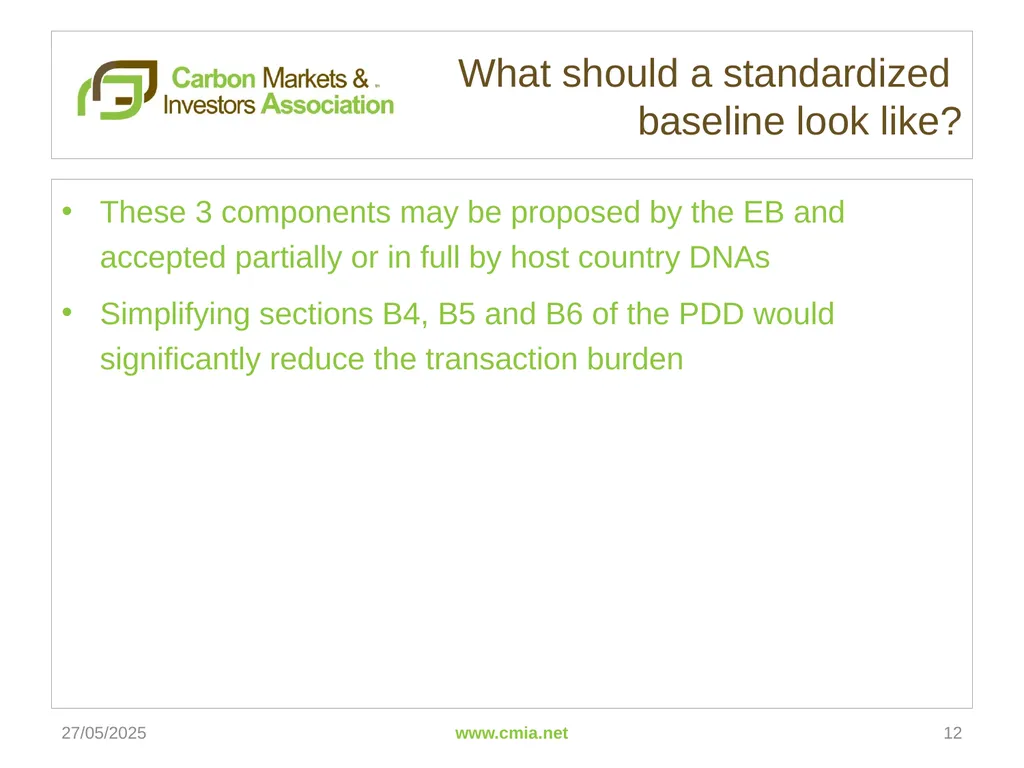
baseline look like? These 3 components may be proposed by the EB and accepted partially or in full by host country DNAs
Simplifying sections B4, B5 and B6 of the PDD would significantly reduce the transaction burden 13/03/2011 www.cmia.net 12<br>
Simplifying sections B4, B5 and B6 of the PDD would significantly reduce the transaction burden 13/03/2011 www.cmia.net 12<br>
13
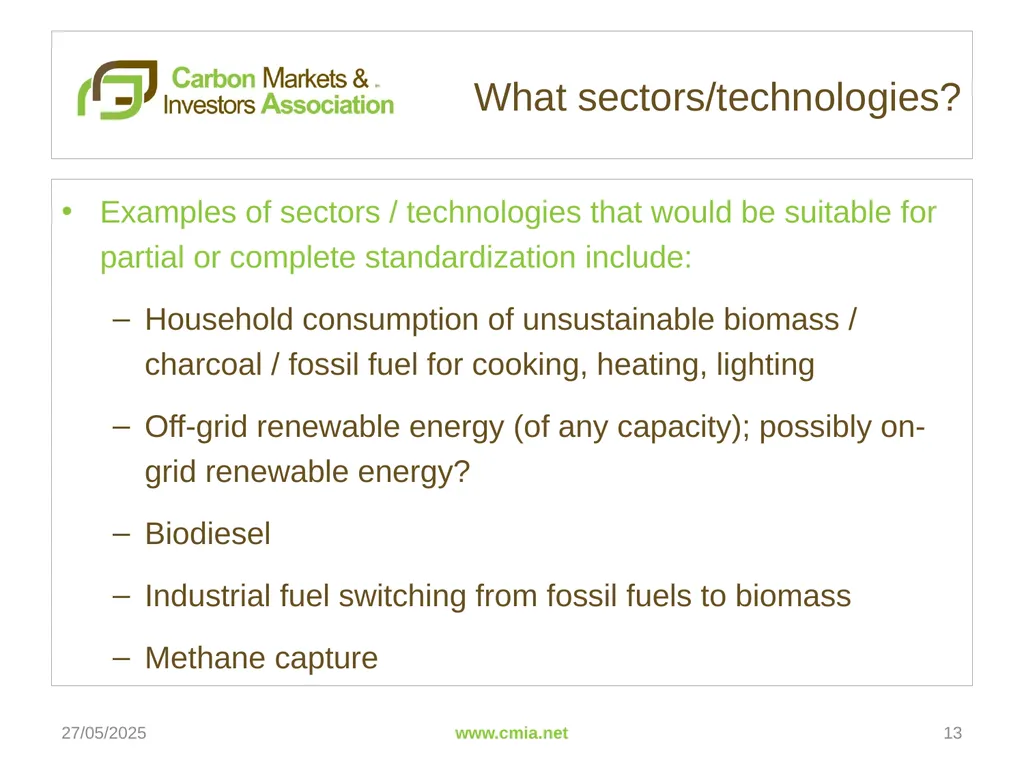
What sectors/technologies? Examples of sectors / technologies that would be suitable for partial or complete standardization include:
Household consumption of unsustainable biomass / charcoal / fossil fuel for cooking, heating, lighting
Off-grid renewable energy (of any capacity); possibly on-grid renewable energy?
Biodiesel
Industrial fuel switching from fossil fuels to biomass
Methane capture 13/03/2011 www.cmia.net 13<br>
Household consumption of unsustainable biomass / charcoal / fossil fuel for cooking, heating, lighting
Off-grid renewable energy (of any capacity); possibly on-grid renewable energy?
Biodiesel
Industrial fuel switching from fossil fuels to biomass
Methane capture 13/03/2011 www.cmia.net 13<br>
14
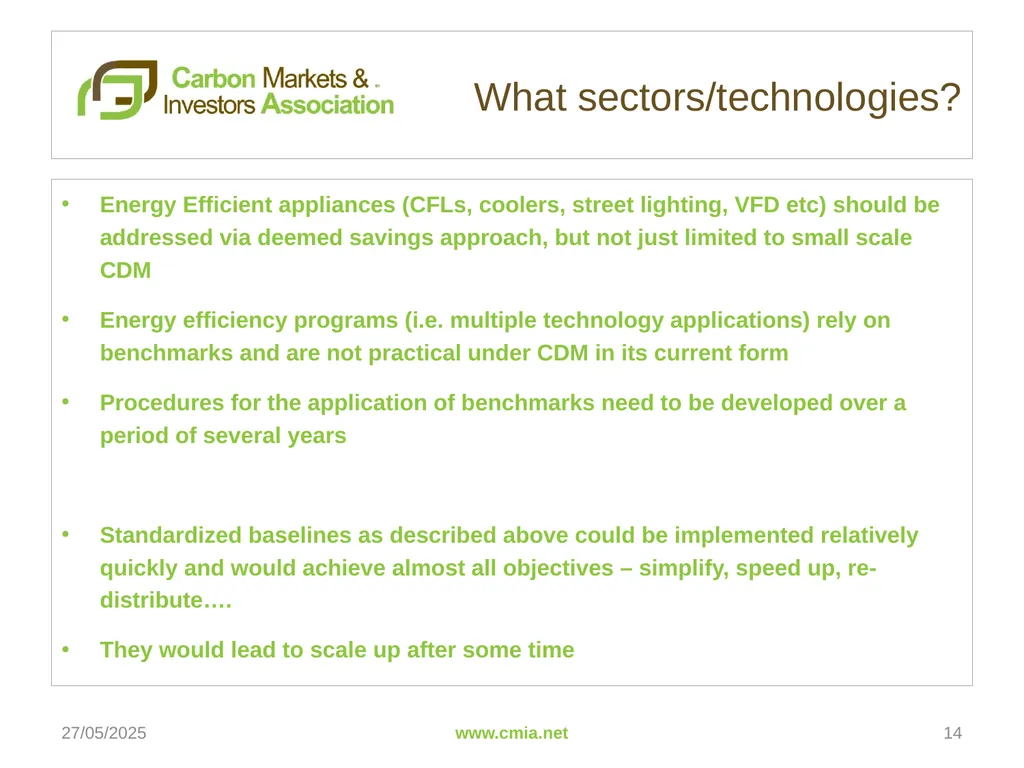
What sectors/technologies? Energy Efficient appliances (CFLs, coolers, street lighting, VFD etc) should be addressed via deemed savings approach, but not just limited to small scale CDM
Energy efficiency programs (i.e. multiple technology applications) rely on benchmarks and are not practical under CDM in its current form
Procedures for the application of benchmarks need to be developed over a period of several years
Standardized baselines as described above could be implemented relatively quickly and would achieve almost all objectives – simplify, speed up, re-distribute….
They would lead to scale up after some time 13/03/2011 www.cmia.net 14<br>
Energy efficiency programs (i.e. multiple technology applications) rely on benchmarks and are not practical under CDM in its current form
Procedures for the application of benchmarks need to be developed over a period of several years
Standardized baselines as described above could be implemented relatively quickly and would achieve almost all objectives – simplify, speed up, re-distribute….
They would lead to scale up after some time 13/03/2011 www.cmia.net 14<br>
15
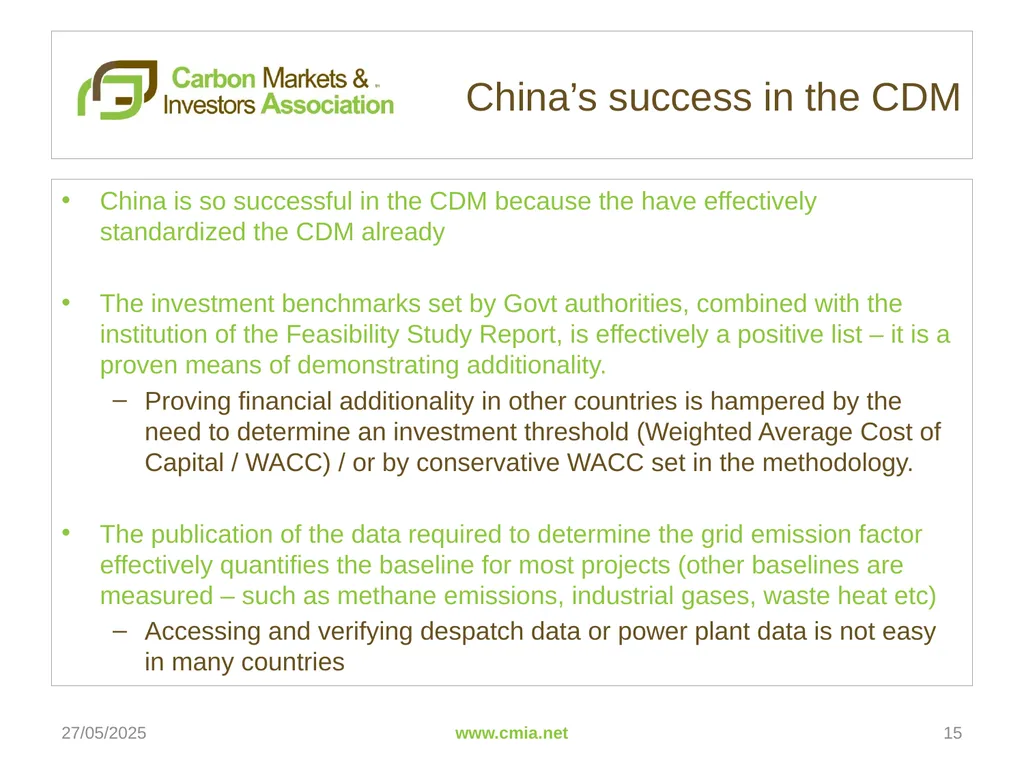
China’s success in the CDM China is so successful in the CDM because the have effectively standardized the CDM already
The investment benchmarks set by Govt authorities, combined with the institution of the Feasibility Study Report, is effectively a positive list – it is a proven means of demonstrating additionality.
Proving financial additionality in other countries is hampered by the need to determine an investment threshold (Weighted Average Cost of Capital / WACC) / or by conservative WACC set in the methodology.
The publication of the data required to determine the grid emission factor effectively quantifies the baseline for most projects (other baselines are measured – such as methane emissions, industrial gases, waste heat etc)
Accessing and verifying despatch data or power plant data is not easy in many countries 13/03/2011 www.cmia.net 15<br>
The investment benchmarks set by Govt authorities, combined with the institution of the Feasibility Study Report, is effectively a positive list – it is a proven means of demonstrating additionality.
Proving financial additionality in other countries is hampered by the need to determine an investment threshold (Weighted Average Cost of Capital / WACC) / or by conservative WACC set in the methodology.
The publication of the data required to determine the grid emission factor effectively quantifies the baseline for most projects (other baselines are measured – such as methane emissions, industrial gases, waste heat etc)
Accessing and verifying despatch data or power plant data is not easy in many countries 13/03/2011 www.cmia.net 15<br>
16
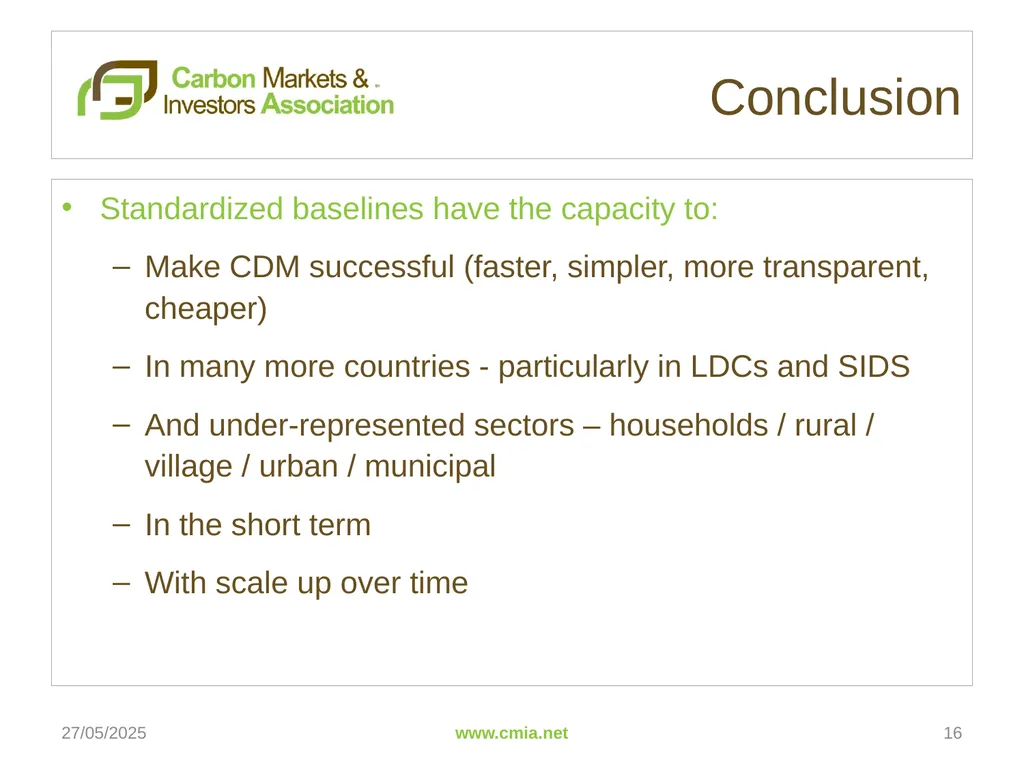
Conclusion Standardized baselines have the capacity to:
Make CDM successful (faster, simpler, more transparent, cheaper)
In many more countries - particularly in LDCs and SIDS
And under-represented sectors – households / rural / village / urban / municipal
In the short term
With scale up over time 13/03/2011 www.cmia.net 16<br>
Make CDM successful (faster, simpler, more transparent, cheaper)
In many more countries - particularly in LDCs and SIDS
And under-represented sectors – households / rural / village / urban / municipal
In the short term
With scale up over time 13/03/2011 www.cmia.net 16<br>
17
Conclusion THANK YOU! 13/03/2011 www.cmia.net 17<br>