
Standing Committee on Appropriations on the on the
A
Published · 32 slides · 0 views

1 / 1


Description
Standing Committee on Appropriations on the on the Adjustments Appropriation Bill B23 2022 18 November 2022 PURPOSE To brief the Standing Committee on Appropriations on the Adjustments Appropriation Bill B23-2022 related to the
Related Topics
Share
Embed code
Download this presentation From Below
"Standing Committee on Appropriations on the on the" is the property of its rightful owner. Permission is granted to download and print the materials on this website for personal, non-commercial use only, and to display it on your personal computer provided you do not modify the materials and that you retain all copyright notices contained in the materials. By downloading content from our website, you accept the terms of this agreement.
Presentation Transcript
01
Standing Committee on Appropriations on the
on the Adjustments Appropriation Bill [B23 – 2022] 18 November 2022<br>
02
PURPOSE To brief the Standing Committee on Appropriations on the Adjustments Appropriation Bill [B23-2022] related to the National Department of Social Development 2<br>
03
OUTLINE Purpose
Department of Social Development’s Adjustments Appropriation Bill [B23-2022]
Report on the total of R1.7 billion declared unspent funds on the Social Relief of Distressed (SRD) grant;
Report on both financial and non-financial performance of the SRD Grant and challenged faced by SASSA in distributing the SRD Grant;
Report on the proposed reprioritization of R3.7 billion to Transnet SOC Limited and the Department of Defence;
Summary of financial and non-financial performance as at end of the 2nd Quarter of the 2022/23 financial year as well as reasons and actions taken to prevent possible under/over expenditure and under performance at the end of the financial year.
Recommendations
End 3<br>
04
CONTEXTUAL ANALYSIS DSD is mandated to provide care and support services to vulnerable groups through the implementation of welfare services, community development and social security programmes. This is largely done by forging partnerships through which vulnerable individuals, groups and communities become capable and self-reliant participants in their own development.
In response to changes in operating environment brought by COVID-19, the DSD and its entities, SASSA and the NDA, had to adapt and innovate their programmes for enhanced visibility, relevance and responsiveness to peoples lived realities and felt needs during these extraordinary times.
The increase in social ills, poverty levels and slow economic growth as a consequence of unemployment, is exacerbated by a loss of livelihoods for millions of people.
The inclement weather conditions experience in April 2022 that resulted to flooding in different areas of KwaZulu-Natal, some parts of North-West and Eastern Cape provinces also affected our operating environment and resulted in increased demand for our services.
The Department has requested funding for “Unforeseen and Unavoidable Expenditure” to ensure the continued care and protection for the Flood Disaster Victims who are placed in the shelters in KZN;
Cabinet has approved an amount of R48.5 million to be allocated to the Provincial Department of Social Development as part of the “Provincial Equitable share” for the medium-term budget allocation for 2022/23 financial year 4 4<br>
05
CONTEXTUAL ANALYSIS Whilst we have certainly faced hard conditions, a lot of wins and insights were equally recorded through the new normal which forced us to think innovatively, more imaginatively and pushed us to be more agile in the execution of our mandate.
The extension of the Special COVID-19 Social Relief of Distress Grant of R350, has provided us with an opportunity to elevate the proposals for Basic Income Support for those without income between the ages of 18-59.
The Department is finalising the policy proposals in this regard, and will be launching the revised Expert Panel Report which provides macroeconomic modelling to strengthen the evidence basis for the consideration of a basic income grant (BIG) in South Africa.
Furthermore, the DSD Sector recommits itself to increase its investments and interventions in response to the challenges of poverty, inequality and job creation, including recent threats and challenges of climate change, rising social ills including such as GBVF, substance abuse, gangsterism, that are drastically affecting ordinary people’s lives, particularly the most vulnerable in society. In pursuit of creating a better life for all and improving the wellbeing of all peoples – particularly the most vulnerable.
The Department will continue to strengthen its interventions in terms of systems, capacity, response and preventative measures, especially with rising social ills.
In addition, the department is working on improving its disaster management responsiveness systems and enhancing coordination working with relevant stakeholders across the government, privates sector and civil society spectrum. 5 5<br>
06
Part A: Adjusted Appropriation 6 6<br>
07
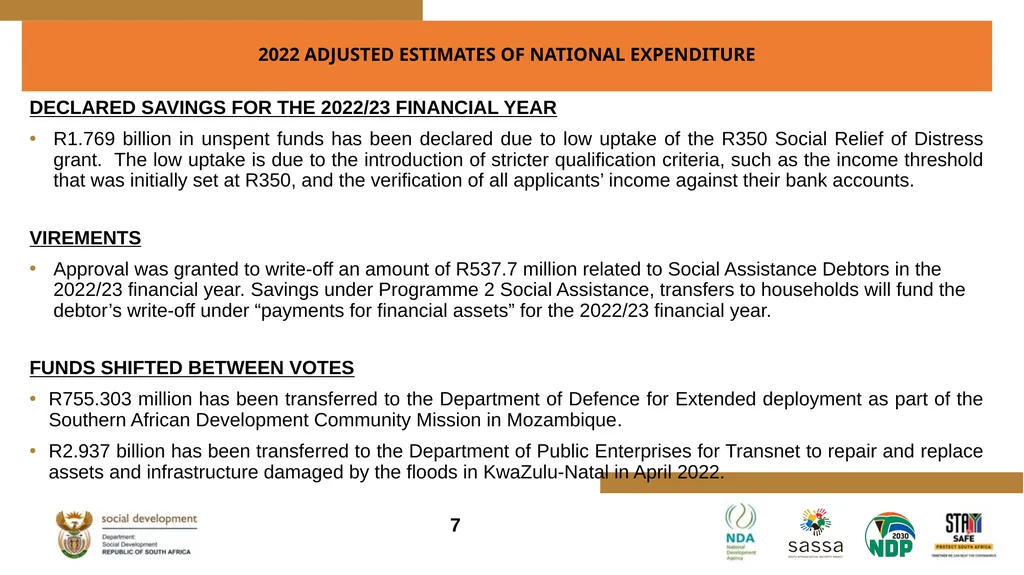
2022 ADJUSTED ESTIMATES OF NATIONAL EXPENDITURE DECLARED SAVINGS FOR THE 2022/23 FINANCIAL YEAR
R1.769 billion in unspent funds has been declared due to low uptake of the R350 Social Relief of Distress grant. The low uptake is due to the introduction of stricter qualification criteria, such as the income threshold that was initially set at R350, and the verification of all applicants’ income against their bank accounts.
VIREMENTS
Approval was granted to write-off an amount of R537.7 million related to Social Assistance Debtors in the 2022/23 financial year. Savings under Programme 2 Social Assistance, transfers to households will fund the debtor’s write-off under “payments for financial assets” for the 2022/23 financial year.
FUNDS SHIFTED BETWEEN VOTES
R755.303 million has been transferred to the Department of Defence for Extended deployment as part of the Southern African Development Community Mission in Mozambique.
R2.937 billion has been transferred to the Department of Public Enterprises for Transnet to repair and replace assets and infrastructure damaged by the floods in KwaZulu-Natal in April 2022. 7<br>
08
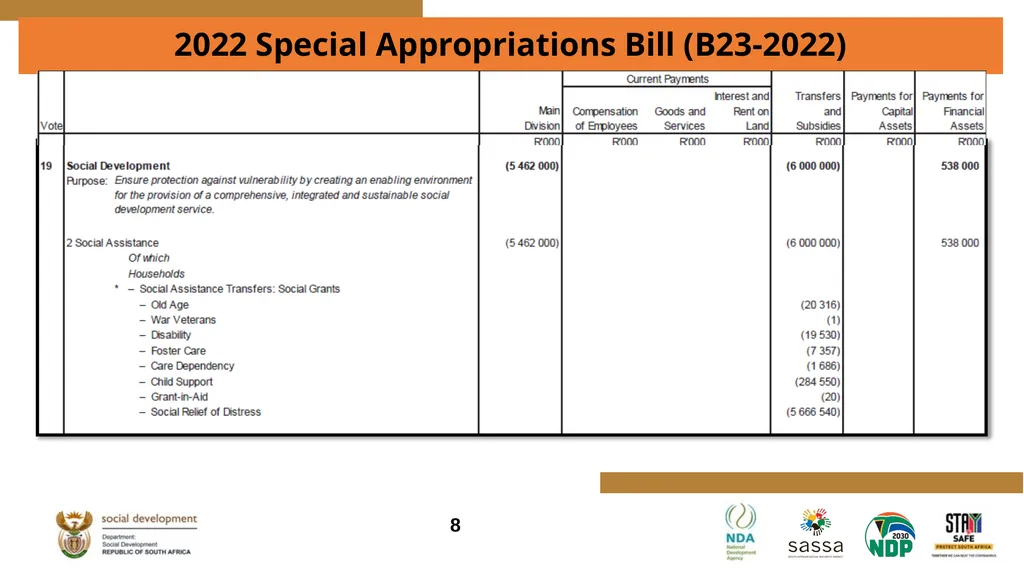
2022 Special Appropriations Bill (B23-2022) 8<br>
09
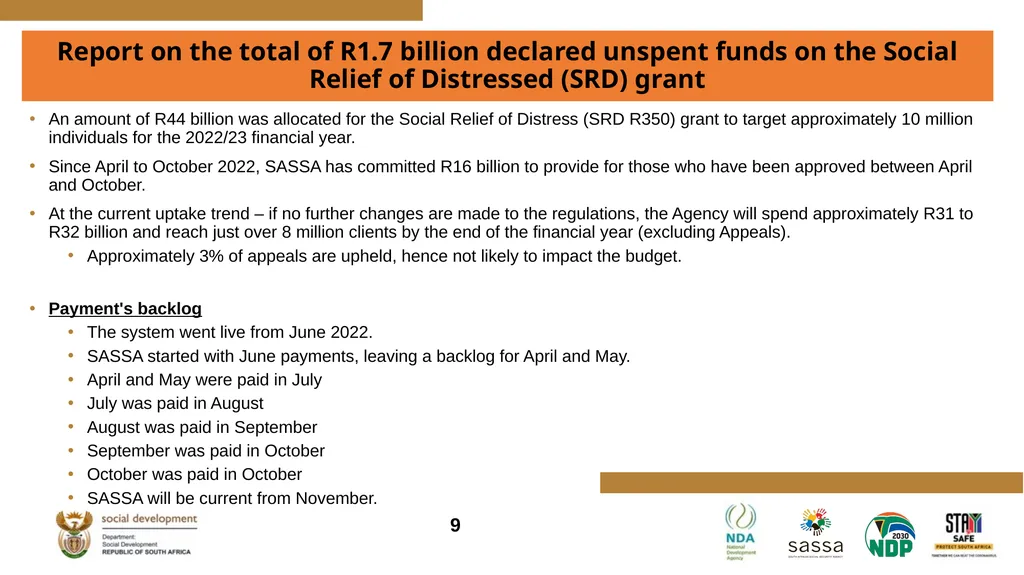
Report on the total of R1.7 billion declared unspent funds on the Social Relief of Distressed (SRD) grant An amount of R44 billion was allocated for the Social Relief of Distress (SRD R350) grant to target approximately 10 million individuals for the 2022/23 financial year.
Since April to October 2022, SASSA has committed R16 billion to provide for those who have been approved between April and October.
At the current uptake trend – if no further changes are made to the regulations, the Agency will spend approximately R31 to R32 billion and reach just over 8 million clients by the end of the financial year (excluding Appeals).
Approximately 3% of appeals are upheld, hence not likely to impact the budget.
Payment's backlog
The system went live from June 2022.
SASSA started with June payments, leaving a backlog for April and May.
April and May were paid in July
July was paid in August
August was paid in September
September was paid in October
October was paid in October
SASSA will be current from November. 9<br>
10
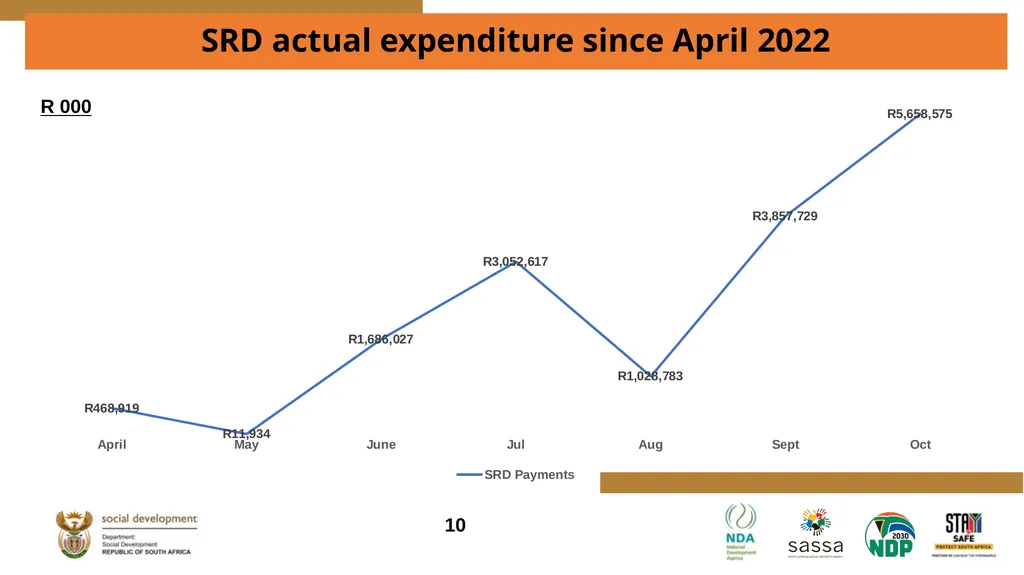
SRD actual expenditure since April 2022 10 R 000<br>
11
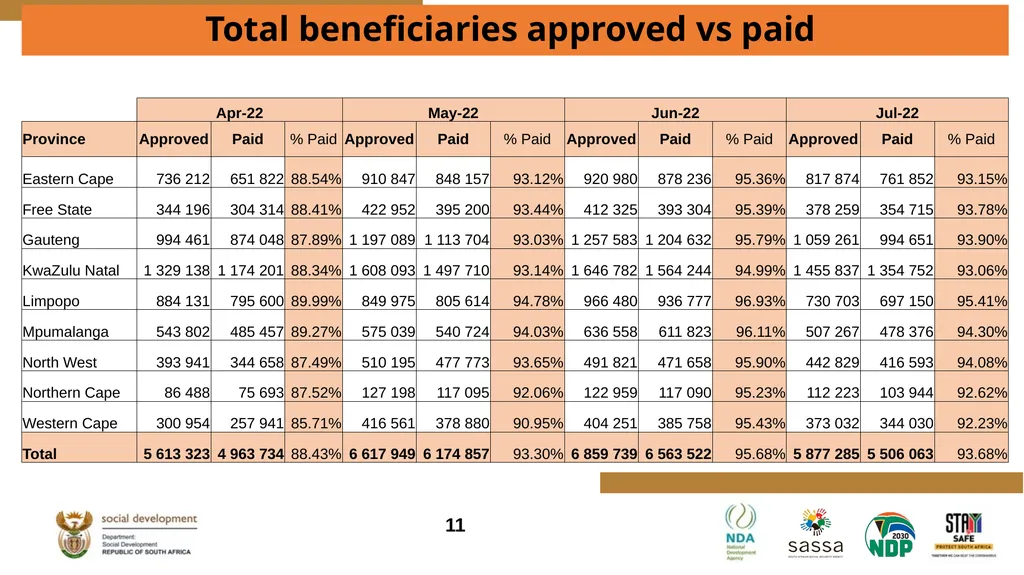
11 Total beneficiaries approved vs paid<br>
12
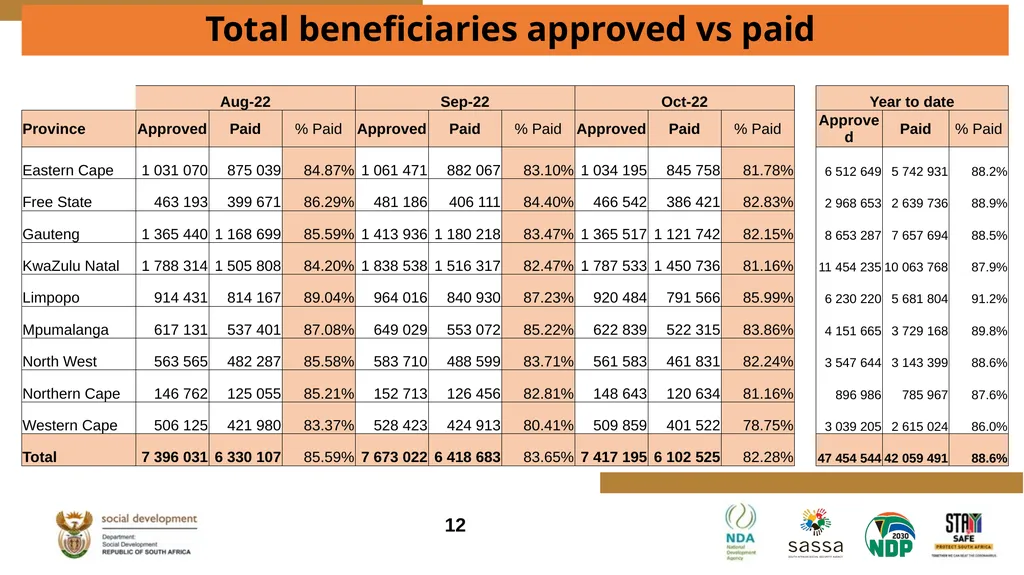
12 Total beneficiaries approved vs paid<br>
13
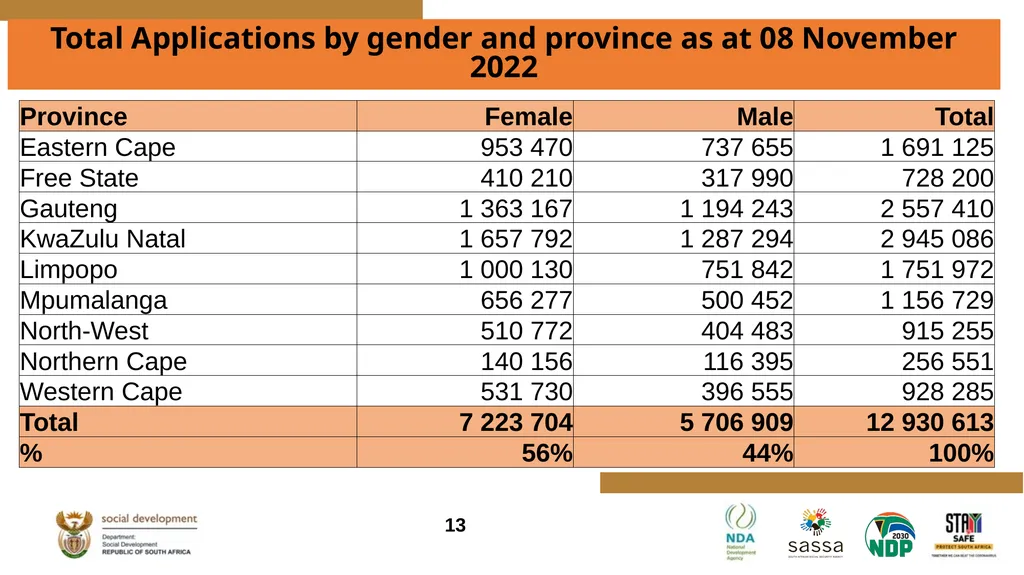
Total Applications by gender and province as at 08 November 2022 13<br>
14
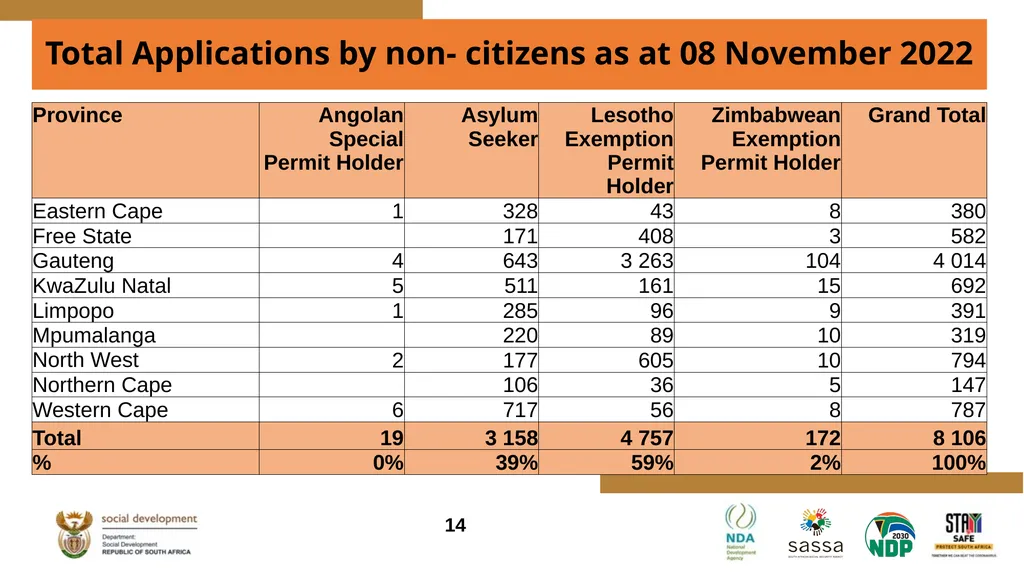
Total Applications by non- citizens as at 08 November 2022 14<br>
15
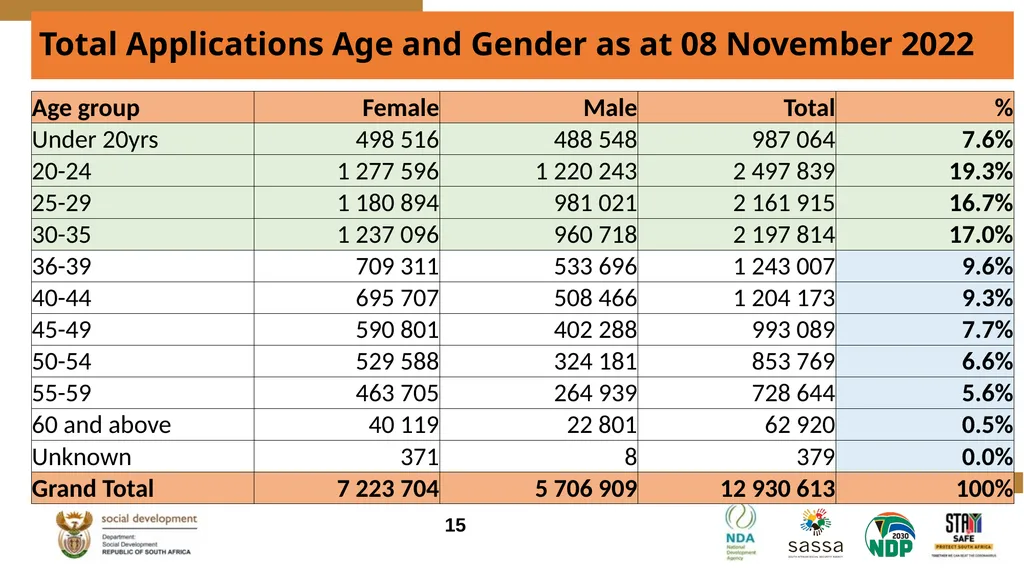
Total Applications Age and Gender as at 08 November 2022 15<br>
16
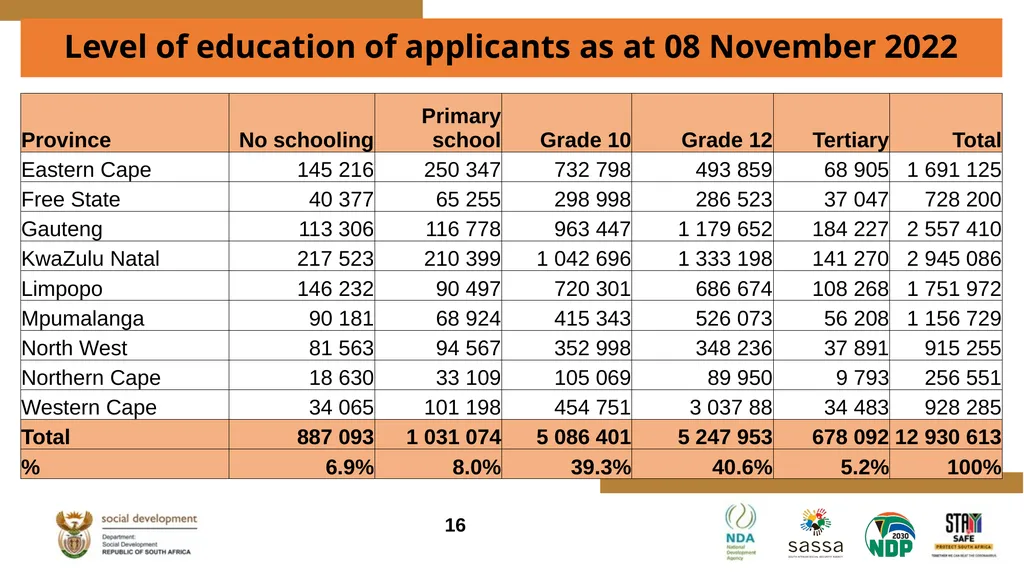
Level of education of applicants as at 08 November 2022 16<br>
17
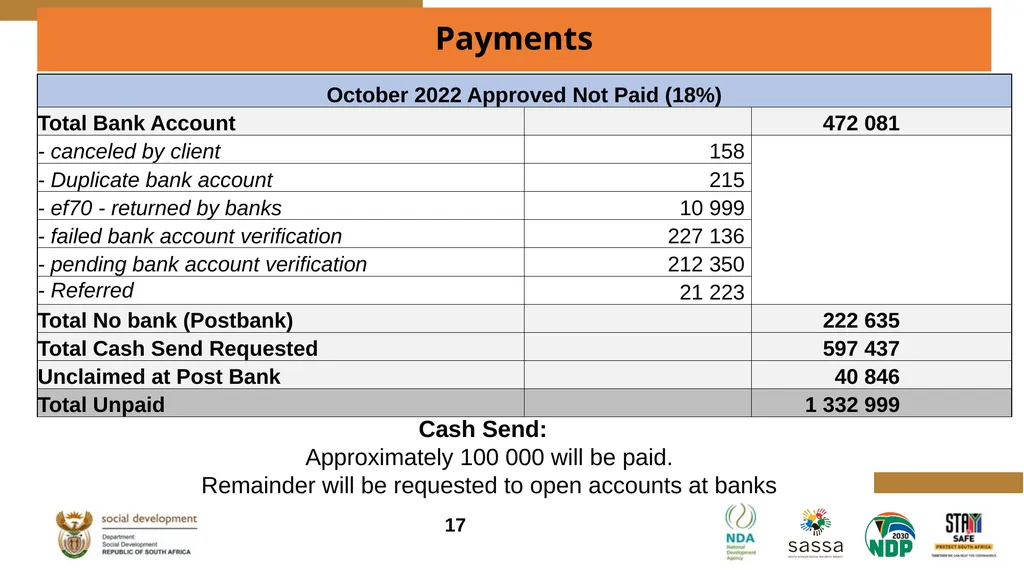
Payments Cash Send:
Approximately 100 000 will be paid.
Remainder will be requested to open accounts at banks 17<br>
Approximately 100 000 will be paid.
Remainder will be requested to open accounts at banks 17<br>
18
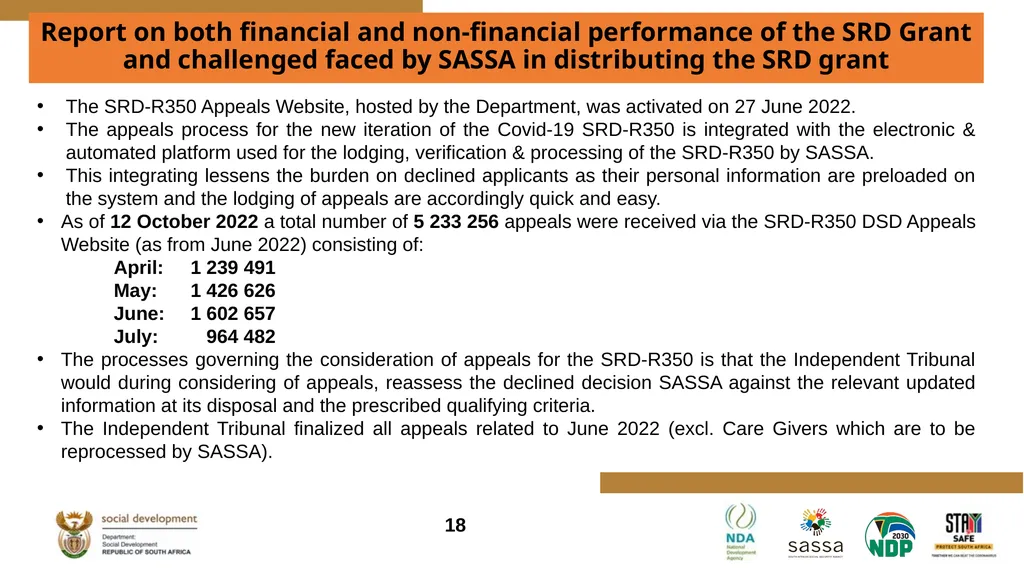
Report on both financial and non-financial performance of the SRD Grant and challenged faced by SASSA in distributing the SRD grant The SRD-R350 Appeals Website, hosted by the Department, was activated on 27 June 2022.
The appeals process for the new iteration of the Covid-19 SRD-R350 is integrated with the electronic & automated platform used for the lodging, verification & processing of the SRD-R350 by SASSA.
This integrating lessens the burden on declined applicants as their personal information are preloaded on the system and the lodging of appeals are accordingly quick and easy.
As of 12 October 2022 a total number of 5 233 256 appeals were received via the SRD-R350 DSD Appeals Website (as from June 2022) consisting of:
April: 1 239 491
May: 1 426 626
June: 1 602 657
July: 964 482
The processes governing the consideration of appeals for the SRD-R350 is that the Independent Tribunal would during considering of appeals, reassess the declined decision SASSA against the relevant updated information at its disposal and the prescribed qualifying criteria.
The Independent Tribunal finalized all appeals related to June 2022 (excl. Care Givers which are to be reprocessed by SASSA). 18<br>
19
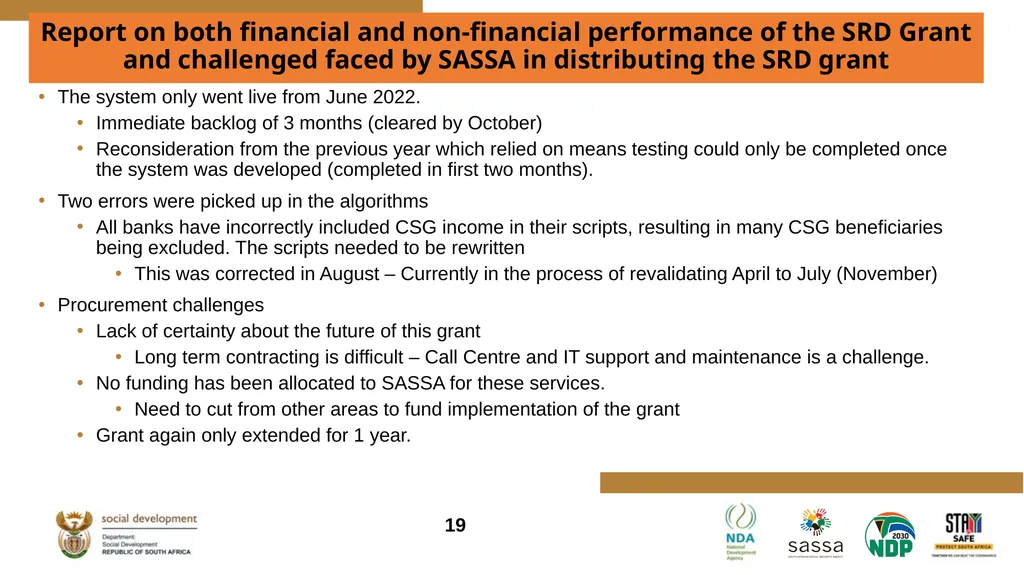
The system only went live from June 2022.
Immediate backlog of 3 months (cleared by October)
Reconsideration from the previous year which relied on means testing could only be completed once the system was developed (completed in first two months).
Two errors were picked up in the algorithms
All banks have incorrectly included CSG income in their scripts, resulting in many CSG beneficiaries being excluded. The scripts needed to be rewritten
This was corrected in August – Currently in the process of revalidating April to July (November)
Procurement challenges
Lack of certainty about the future of this grant
Long term contracting is difficult – Call Centre and IT support and maintenance is a challenge.
No funding has been allocated to SASSA for these services.
Need to cut from other areas to fund implementation of the grant
Grant again only extended for 1 year. Report on both financial and non-financial performance of the SRD Grant and challenged faced by SASSA in distributing the SRD grant 19<br>
20
Report on the proposed reprioritization of R3.7 billion to Transnet Soc Limited and the Department of Defence The reprioritization was a result of the initial declared saving of R6 billion on the Social Relief of Distress grants budget for the 2022/23 financial year.
National Treasury has shifted part funding in terms of section 30 (2)(e) of the PFMA to the Department of Defence (R755.303 million) to cover the shortfall on Operation VIKELA and to the Department of Public Enterprises for Transnet (R2.937 billion) to repair and replace assets and infrastructure damaged by the floods in April 2022. This was a decision taken by the National Treasury as part of the 2022 Medium Terms Budget Process.
These shifting of funds was included in the National Department of Social Development’s Adjusted Estimates as “shifting between votes”.
R537.7 million was approved as “social grant debt write-off”; and
The remaining balance of R1.7 billion has been reflected in the 2022 AENE for Social Development as “declared unspent funds” for the 2022/23 financial year. 20<br>
21
Summary of financial and non-financial performance as at end of the 2nd quarter of the 2022/23 financial year as well as reasons and actions taken to prevent possible under/over expenditure and under performance at the end of the financial year 21<br>
22
Part B: Summary of Performance Information 22 22<br>
23
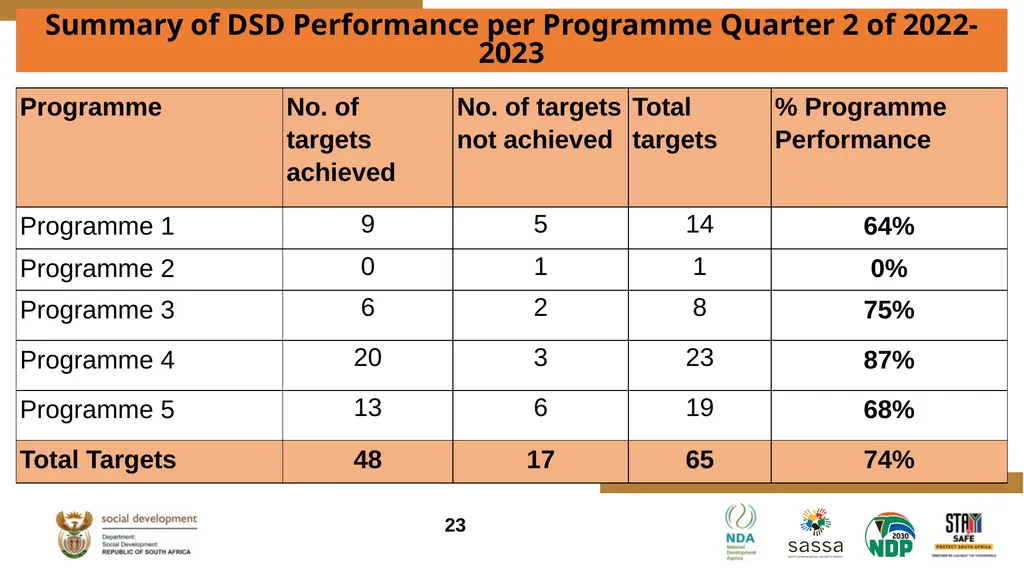
Summary of DSD Performance per Programme Quarter 2 of 2022-2023 23<br>
24
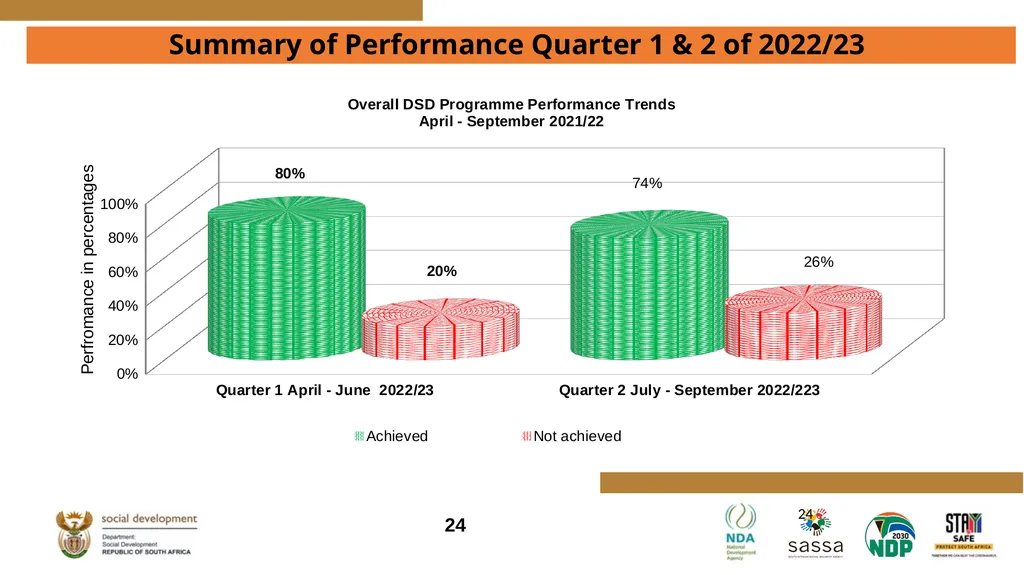
Summary of Performance Quarter 1 & 2 of 2022/23 24 24<br>
25
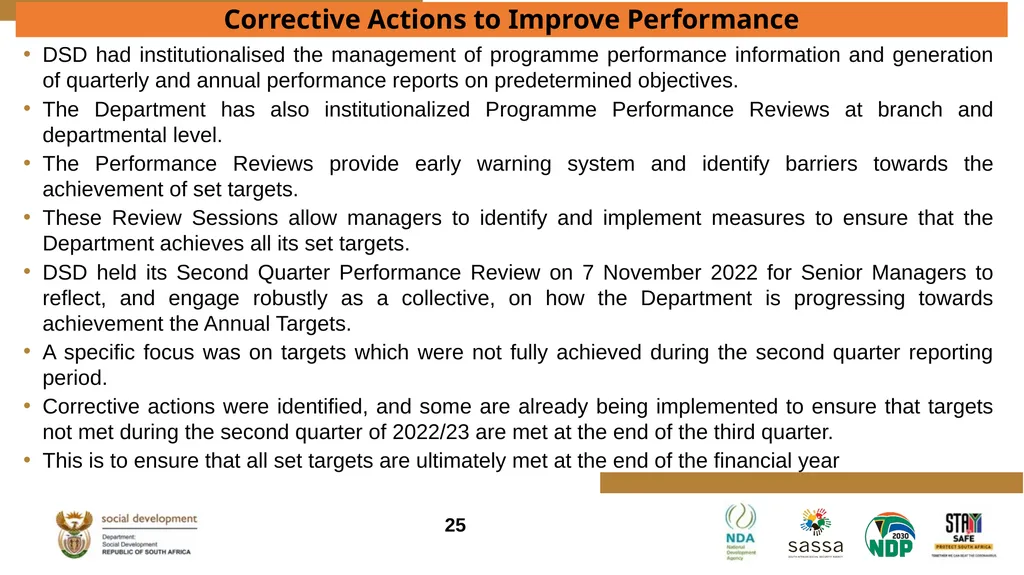
Corrective Actions to Improve Performance DSD had institutionalised the management of programme performance information and generation of quarterly and annual performance reports on predetermined objectives.
The Department has also institutionalized Programme Performance Reviews at branch and departmental level.
The Performance Reviews provide early warning system and identify barriers towards the achievement of set targets.
These Review Sessions allow managers to identify and implement measures to ensure that the Department achieves all its set targets.
DSD held its Second Quarter Performance Review on 7 November 2022 for Senior Managers to reflect, and engage robustly as a collective, on how the Department is progressing towards achievement the Annual Targets.
A specific focus was on targets which were not fully achieved during the second quarter reporting period.
Corrective actions were identified, and some are already being implemented to ensure that targets not met during the second quarter of 2022/23 are met at the end of the third quarter.
This is to ensure that all set targets are ultimately met at the end of the financial year 25<br>
26
Part C: Financial Information 26 26<br>
27
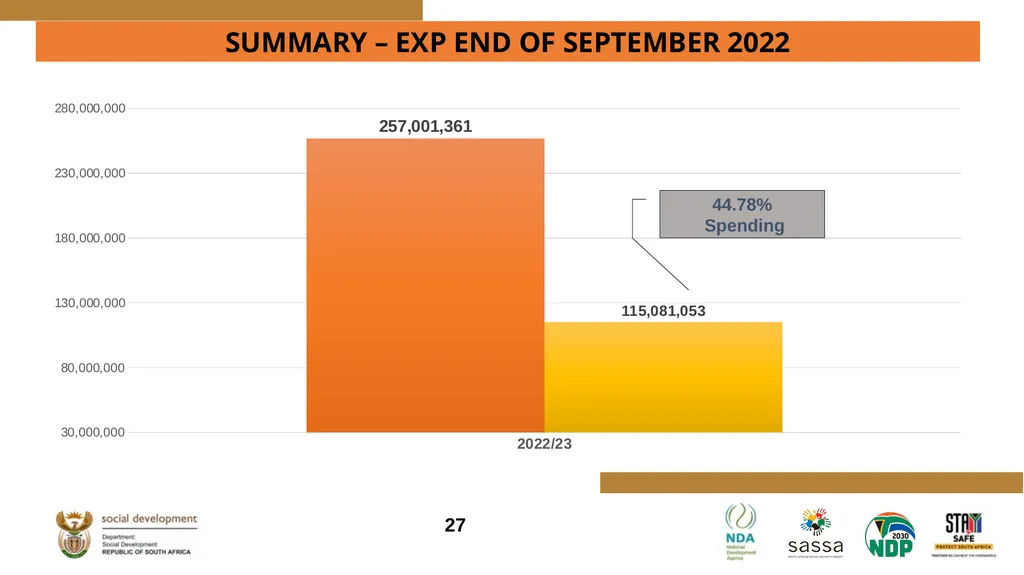
44.78%
Spending SUMMARY – EXP END OF SEPTEMBER 2022 27<br>
Spending SUMMARY – EXP END OF SEPTEMBER 2022 27<br>
28
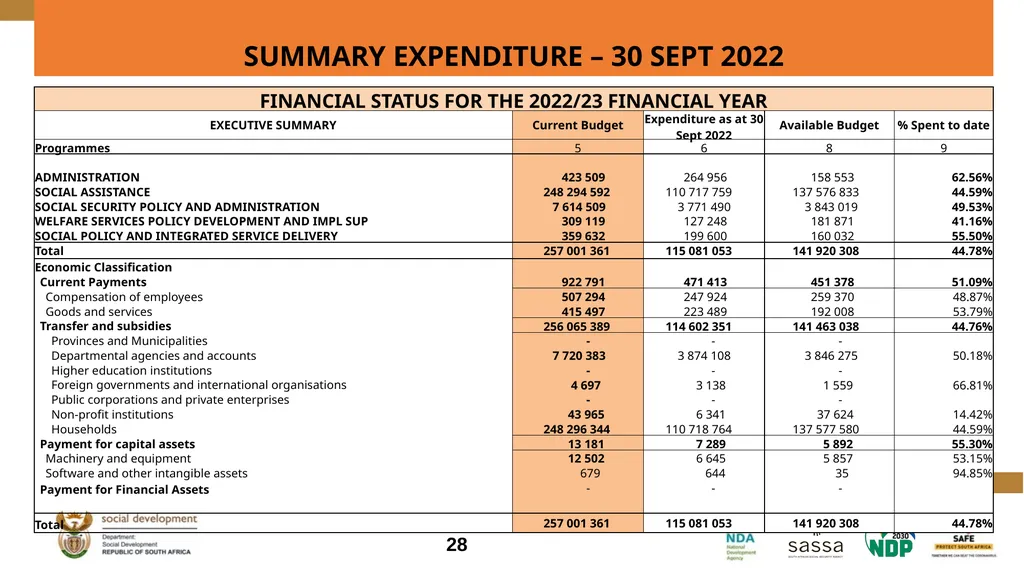
SUMMARY EXPENDITURE – 30 SEPT 2022 28<br>
29
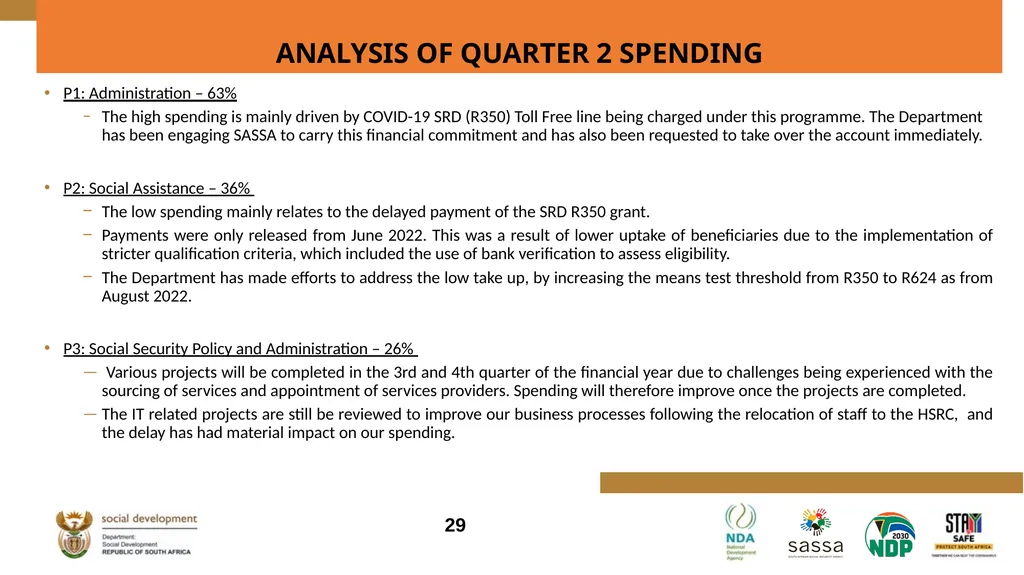
ANALYSIS OF QUARTER 2 SPENDING P1: Administration – 63%
The high spending is mainly driven by COVID-19 SRD (R350) Toll Free line being charged under this programme. The Department has been engaging SASSA to carry this financial commitment and has also been requested to take over the account immediately.
P2: Social Assistance – 36%
The low spending mainly relates to the delayed payment of the SRD R350 grant.
Payments were only released from June 2022. This was a result of lower uptake of beneficiaries due to the implementation of stricter qualification criteria, which included the use of bank verification to assess eligibility.
The Department has made efforts to address the low take up, by increasing the means test threshold from R350 to R624 as from August 2022.
P3: Social Security Policy and Administration – 26%
Various projects will be completed in the 3rd and 4th quarter of the financial year due to challenges being experienced with the sourcing of services and appointment of services providers. Spending will therefore improve once the projects are completed.
The IT related projects are still be reviewed to improve our business processes following the relocation of staff to the HSRC, and the delay has had material impact on our spending. 29<br>
30
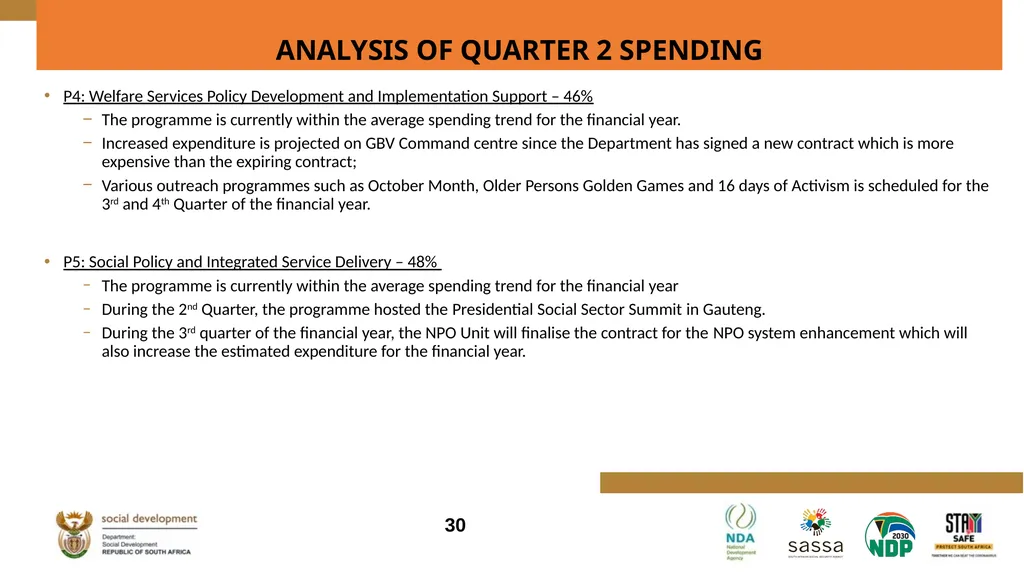
P4: Welfare Services Policy Development and Implementation Support – 46%
The programme is currently within the average spending trend for the financial year.
Increased expenditure is projected on GBV Command centre since the Department has signed a new contract which is more expensive than the expiring contract;
Various outreach programmes such as October Month, Older Persons Golden Games and 16 days of Activism is scheduled for the 3rd and 4th Quarter of the financial year.
P5: Social Policy and Integrated Service Delivery – 48%
The programme is currently within the average spending trend for the financial year
During the 2nd Quarter, the programme hosted the Presidential Social Sector Summit in Gauteng.
During the 3rd quarter of the financial year, the NPO Unit will finalise the contract for the NPO system enhancement which will also increase the estimated expenditure for the financial year. ANALYSIS OF QUARTER 2 SPENDING 30<br>
31
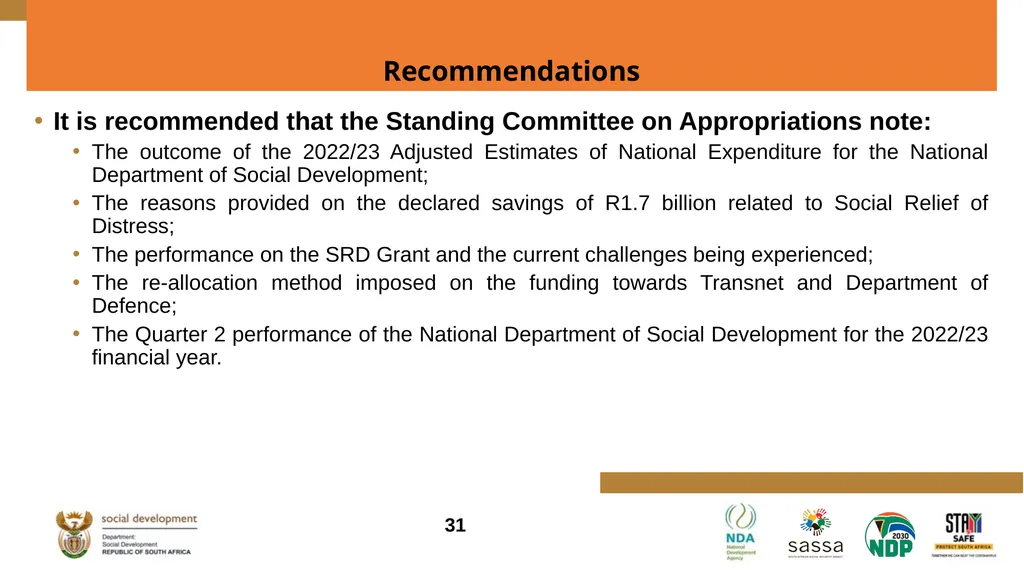
Recommendations It is recommended that the Standing Committee on Appropriations note:
The outcome of the 2022/23 Adjusted Estimates of National Expenditure for the National Department of Social Development;
The reasons provided on the declared savings of R1.7 billion related to Social Relief of Distress;
The performance on the SRD Grant and the current challenges being experienced;
The re-allocation method imposed on the funding towards Transnet and Department of Defence;
The Quarter 2 performance of the National Department of Social Development for the 2022/23 financial year. 31<br>
32
THANK YOU 32<br>