04
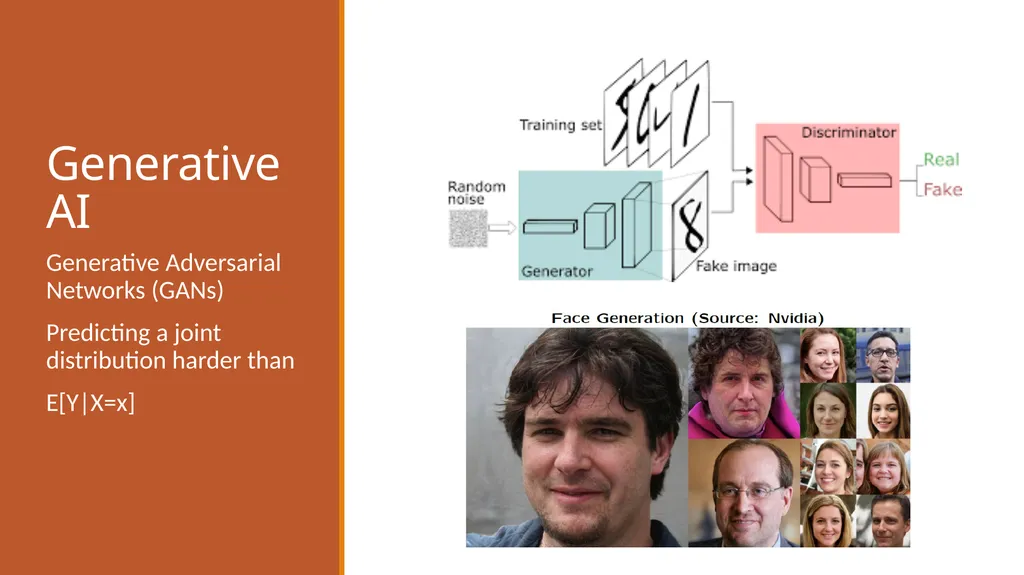
Generative AI Generative Adversarial Networks (GANs)
Predicting a joint distribution harder than
E[Y|X=x]<br>
05
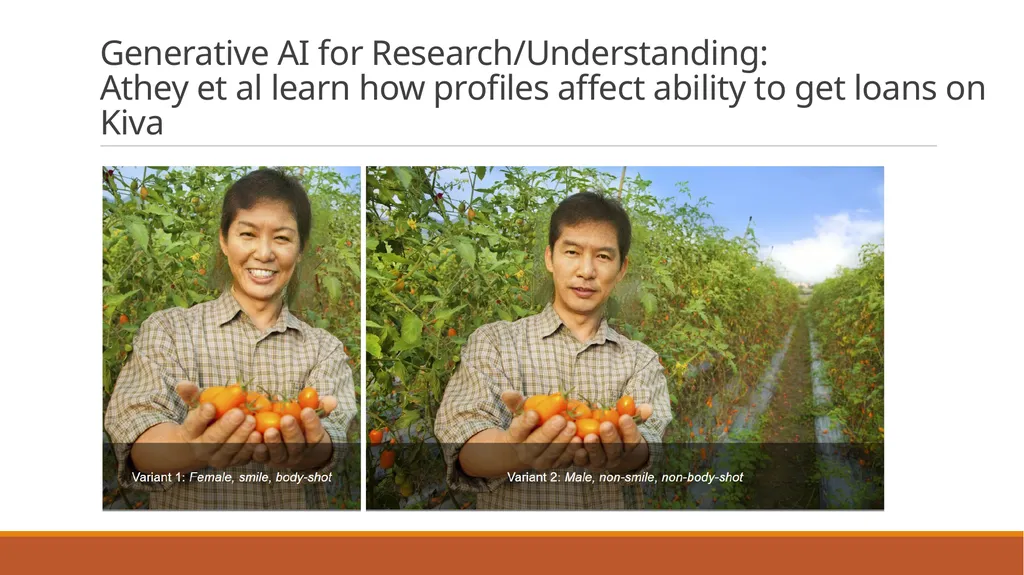
Generative AI for Research/Understanding:�Athey et al learn how profiles affect ability to get loans on Kiva<br>
06
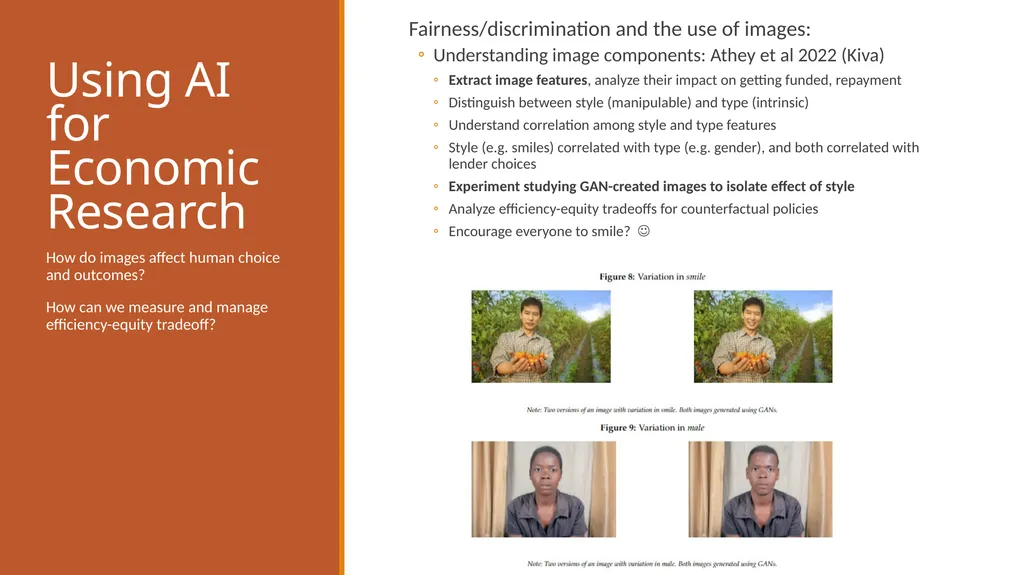
Using AI for Economic Research Fairness/discrimination and the use of images:
Understanding image components: Athey et al 2022 (Kiva)
Extract image features, analyze their impact on getting funded, repayment
Distinguish between style (manipulable) and type (intrinsic)
Understand correlation among style and type features
Style (e.g. smiles) correlated with type (e.g. gender), and both correlated with lender choices
Experiment studying GAN-created images to isolate effect of style
Analyze efficiency-equity tradeoffs for counterfactual policies
Encourage everyone to smile? How do images affect human choice and outcomes?
How can we measure and manage efficiency-equity tradeoff?<br>
07
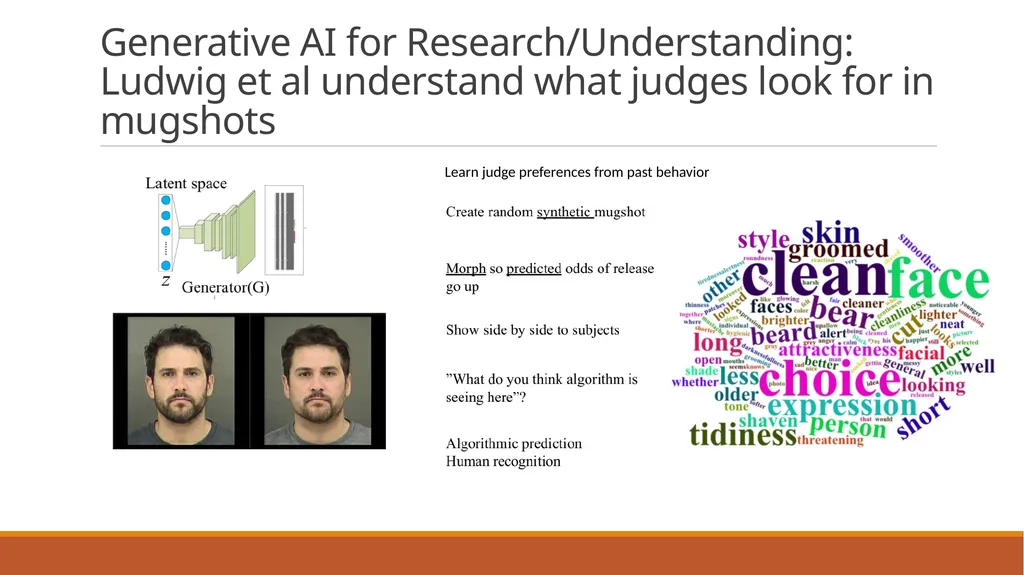
Generative AI for Research/Understanding: �Ludwig et al understand what judges look for in mugshots Learn judge preferences from past behavior<br>
08
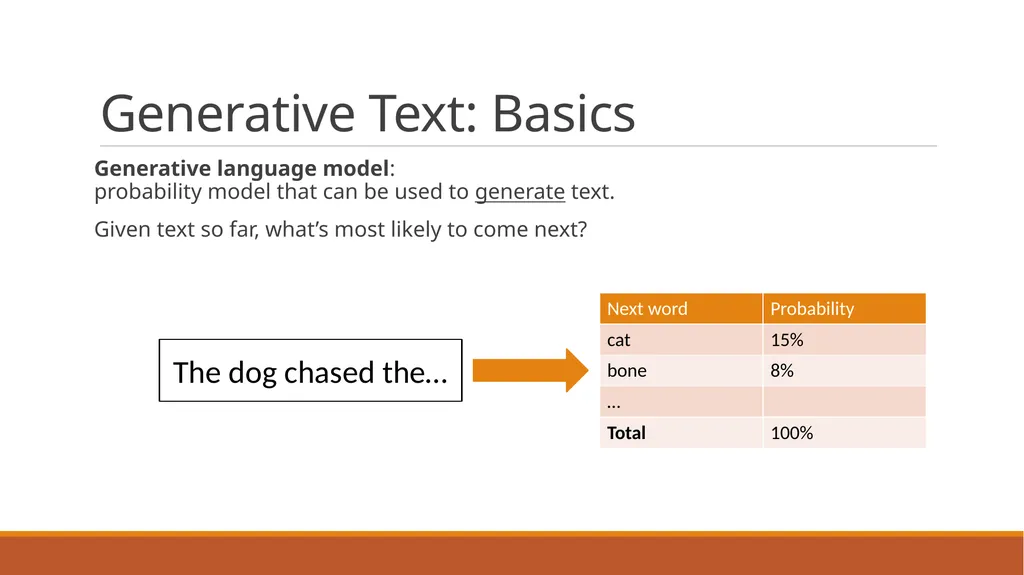
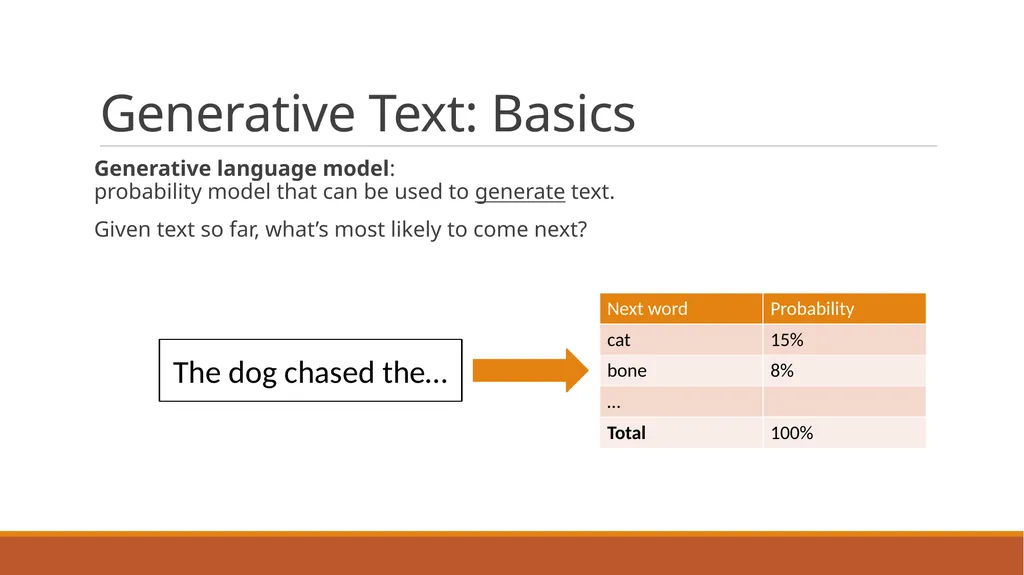
Generative Text: Basics Generative language model:�probability model that can be used to generate text.
Given text so far, what’s most likely to come next? The dog chased the…<br>
09
Generative Text: Basics Generative language model:�probability model that can be used to generate text.
Given text so far, what’s most likely to come next? The dog chased the…<br>
10
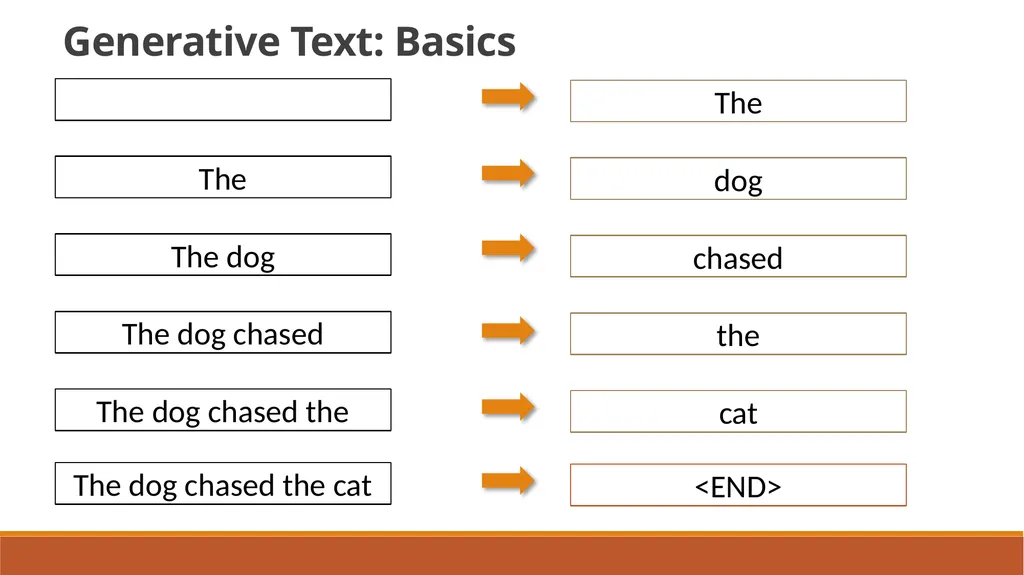
Generative Text: Basics The The dog The dog chased The dog chased the The dog chased the cat The dog chased the cat <END><br>
11
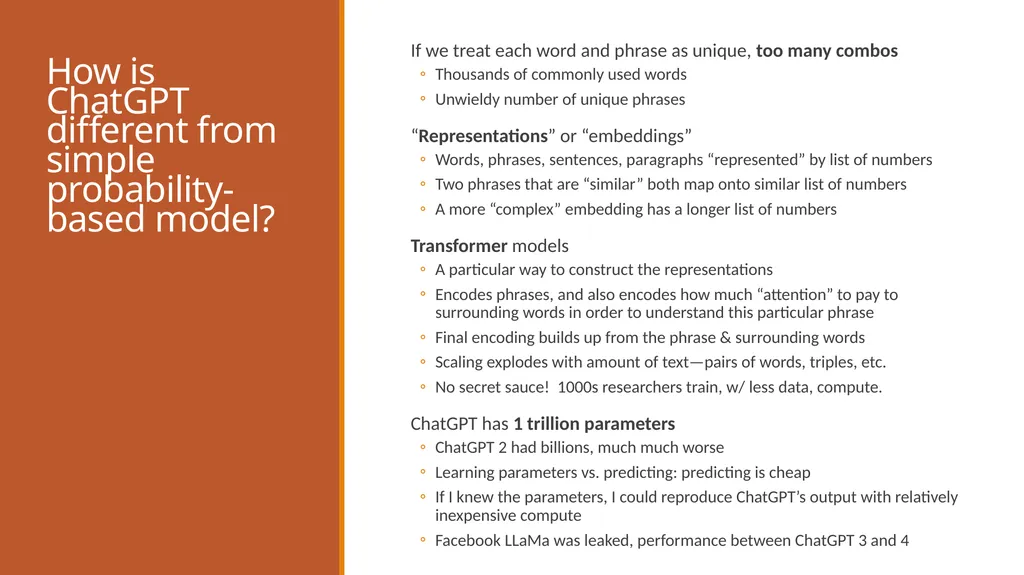
How is ChatGPT different from simple probability-based model? If we treat each word and phrase as unique, too many combos
Thousands of commonly used words
Unwieldy number of unique phrases
“Representations” or “embeddings”
Words, phrases, sentences, paragraphs “represented” by list of numbers
Two phrases that are “similar” both map onto similar list of numbers
A more “complex” embedding has a longer list of numbers
Transformer models
A particular way to construct the representations
Encodes phrases, and also encodes how much “attention” to pay to surrounding words in order to understand this particular phrase
Final encoding builds up from the phrase & surrounding words
Scaling explodes with amount of text—pairs of words, triples, etc.
No secret sauce! 1000s researchers train, w/ less data, compute.
ChatGPT has 1 trillion parameters
ChatGPT 2 had billions, much much worse
Learning parameters vs. predicting: predicting is cheap
If I knew the parameters, I could reproduce ChatGPT’s output with relatively inexpensive compute
Facebook LLaMa was leaked, performance between ChatGPT 3 and 4<br>
12
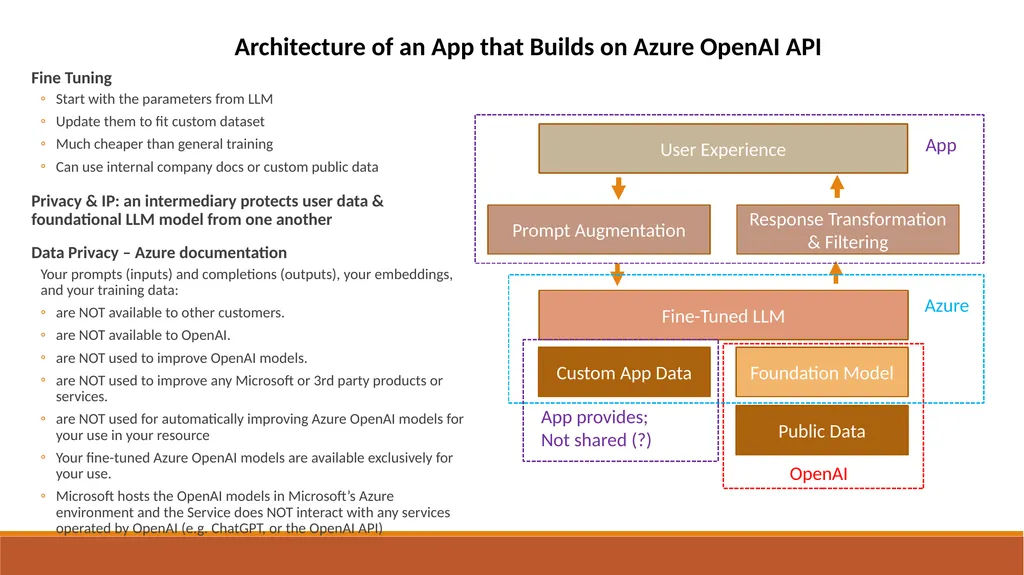
Fine Tuning
Start with the parameters from LLM
Update them to fit custom dataset
Much cheaper than general training
Can use internal company docs or custom public data
Privacy & IP: an intermediary protects user data & foundational LLM model from one another
Data Privacy – Azure documentation
Your prompts (inputs) and completions (outputs), your embeddings, and your training data:
are NOT available to other customers.
are NOT available to OpenAI.
are NOT used to improve OpenAI models.
are NOT used to improve any Microsoft or 3rd party products or services.
are NOT used for automatically improving Azure OpenAI models for your use in your resource
Your fine-tuned Azure OpenAI models are available exclusively for your use.
Microsoft hosts the OpenAI models in Microsoft’s Azure environment and the Service does NOT interact with any services operated by OpenAI (e.g. ChatGPT, or the OpenAI API) Architecture of an App that Builds on Azure OpenAI API<br>
13
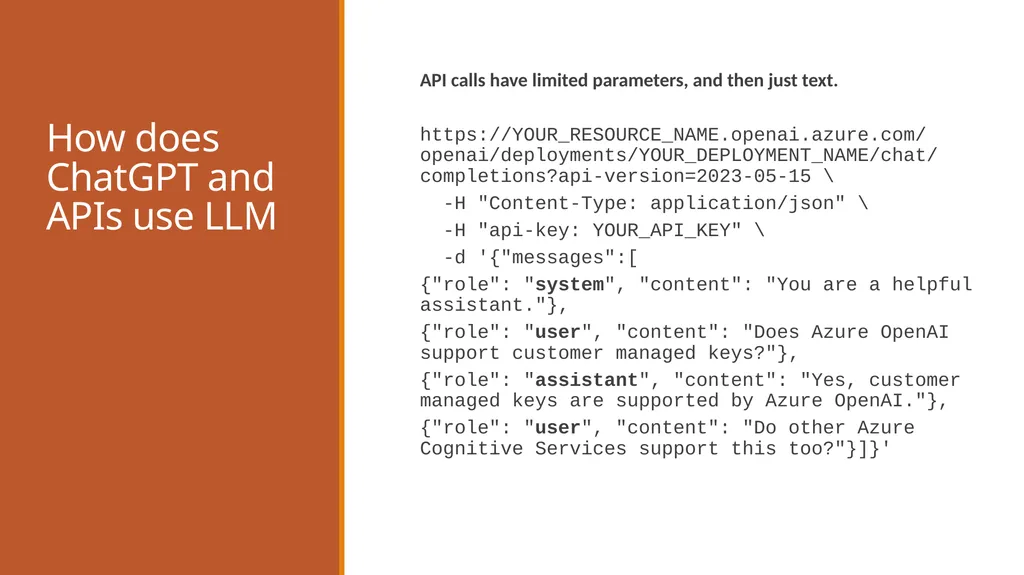
How does ChatGPT and APIs use LLM API calls have limited parameters, and then just text.
https://YOUR_RESOURCE_NAME.openai.azure.com/openai/deployments/YOUR_DEPLOYMENT_NAME/chat/completions?api-version=2023-05-15 \
-H "Content-Type: application/json" \
-H "api-key: YOUR_API_KEY" \
-d '{"messages":[
{"role": "system", "content": "You are a helpful assistant."},
{"role": "user", "content": "Does Azure OpenAI support customer managed keys?"},
{"role": "assistant", "content": "Yes, customer managed keys are supported by Azure OpenAI."},
{"role": "user", "content": "Do other Azure Cognitive Services support this too?"}]}'<br>
14
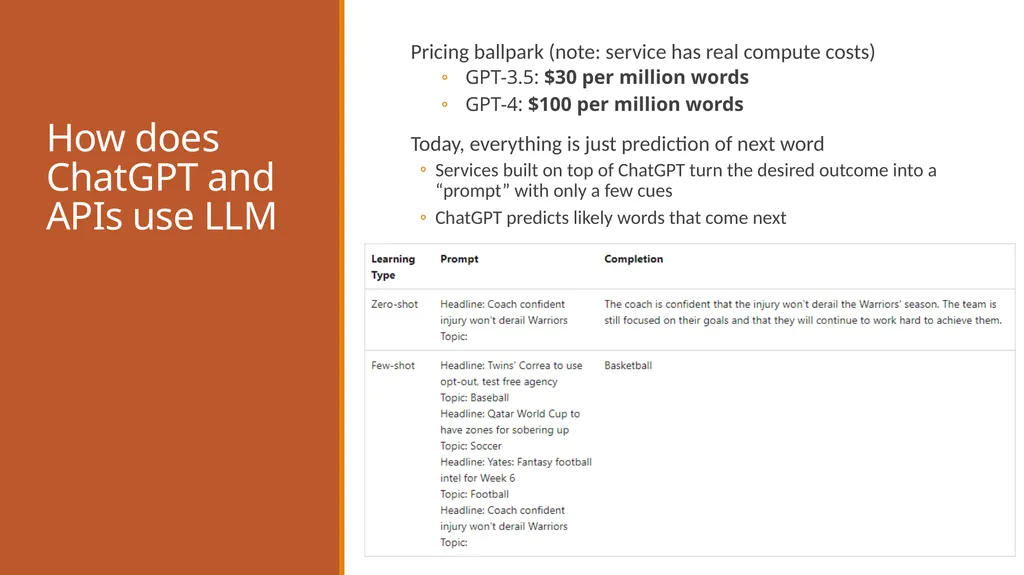
How does ChatGPT and APIs use LLM Pricing ballpark (note: service has real compute costs)
GPT-3.5: $30 per million words
GPT-4: $100 per million words
Today, everything is just prediction of next word
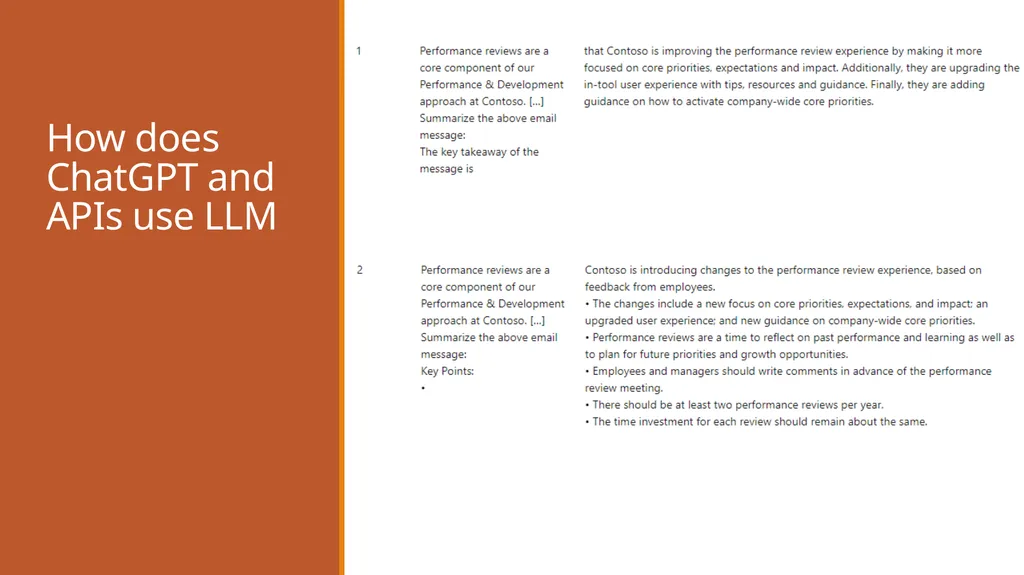
Services built on top of ChatGPT turn the desired outcome into a “prompt” with only a few cues
ChatGPT predicts likely words that come next<br>
15
How does ChatGPT and APIs use LLM<br>
16
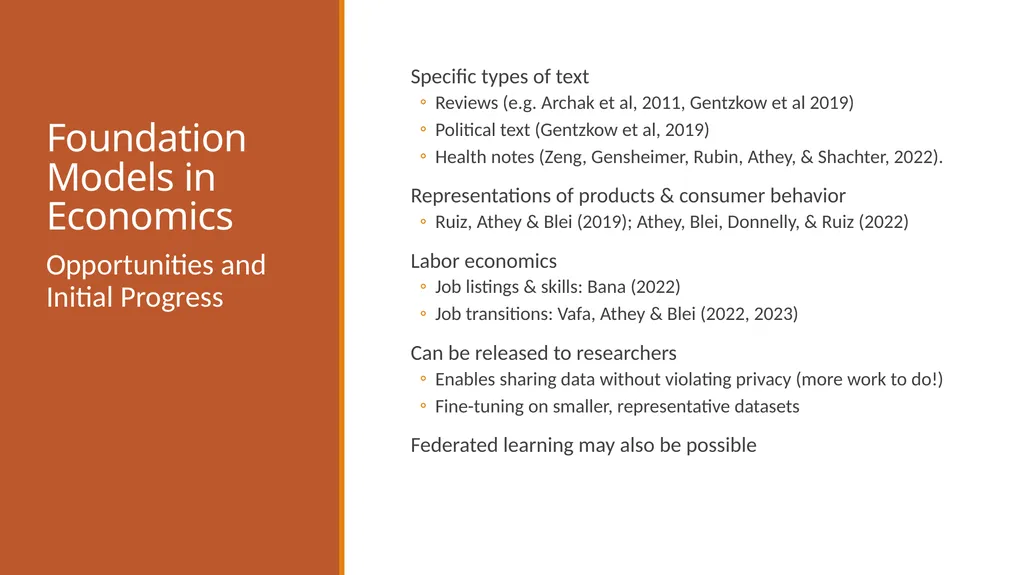
Foundation Models in Economics Specific types of text
Reviews (e.g. Archak et al, 2011, Gentzkow et al 2019)
Political text (Gentzkow et al, 2019)
Health notes (Zeng, Gensheimer, Rubin, Athey, & Shachter, 2022).
Representations of products & consumer behavior
Ruiz, Athey & Blei (2019); Athey, Blei, Donnelly, & Ruiz (2022)
Labor economics
Job listings & skills: Bana (2022)
Job transitions: Vafa, Athey & Blei (2022, 2023)
Can be released to researchers
Enables sharing data without violating privacy (more work to do!)
Fine-tuning on smaller, representative datasets
Federated learning may also be possible Opportunities and Initial Progress<br>
17
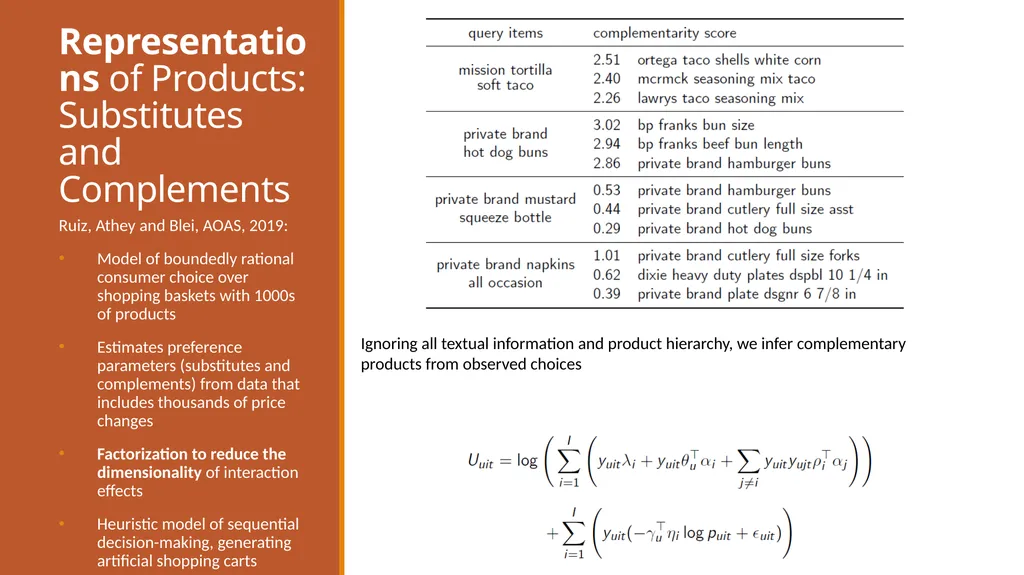
Representations of Products: Substitutes and Complements Ruiz, Athey and Blei, AOAS, 2019:
Model of boundedly rational consumer choice over shopping baskets with 1000s of products
Estimates preference parameters (substitutes and complements) from data that includes thousands of price changes
Factorization to reduce the dimensionality of interaction effects
Heuristic model of sequential decision-making, generating artificial shopping carts Ignoring all textual information and product hierarchy, we infer complementary products from observed choices<br>
18
Decomposing Changes in the Gender Wage Gap over Worker Careers Keyon Vafa
Harvard University
(incoming postdoctoral fellow) David Blei
Columbia University
Dept. of Computer Science Susan Athey
Stanford University
Graduate School of Business<br>
19
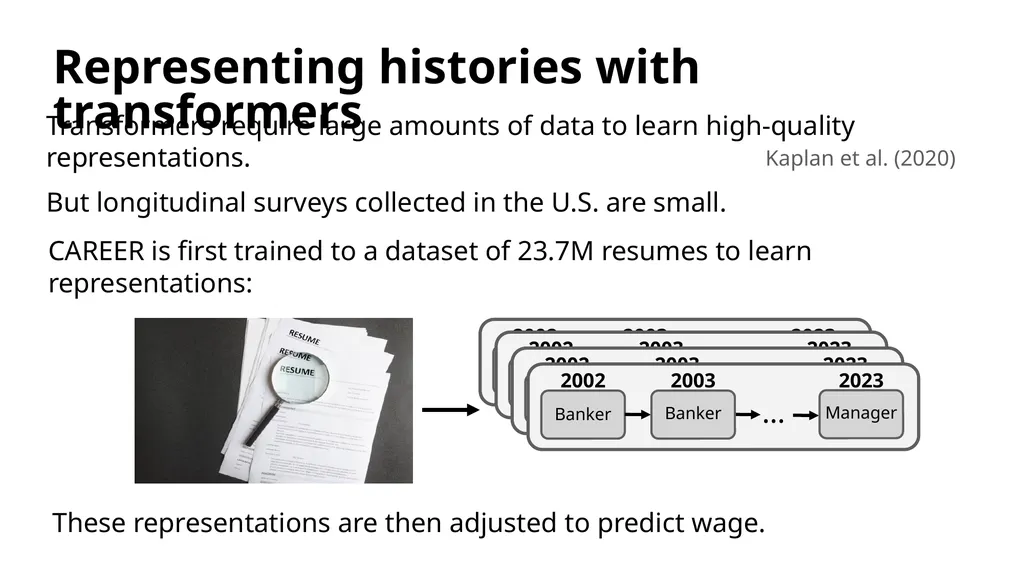
Representing histories with transformers But longitudinal surveys collected in the U.S. are small.<br>
20
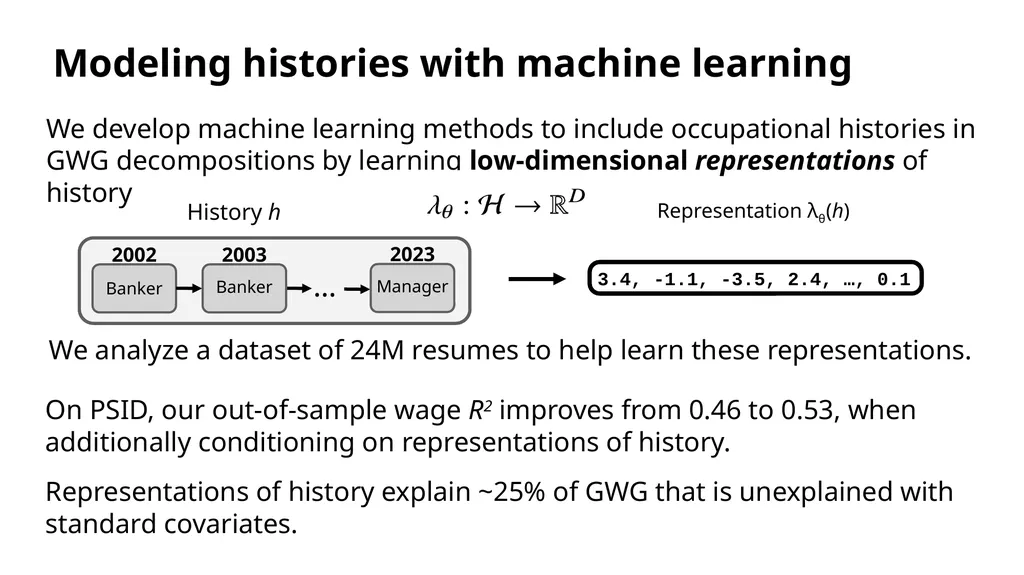
Modeling histories with machine learning We develop machine learning methods to include occupational histories in GWG decompositions by learning low-dimensional representations of history<br>
21
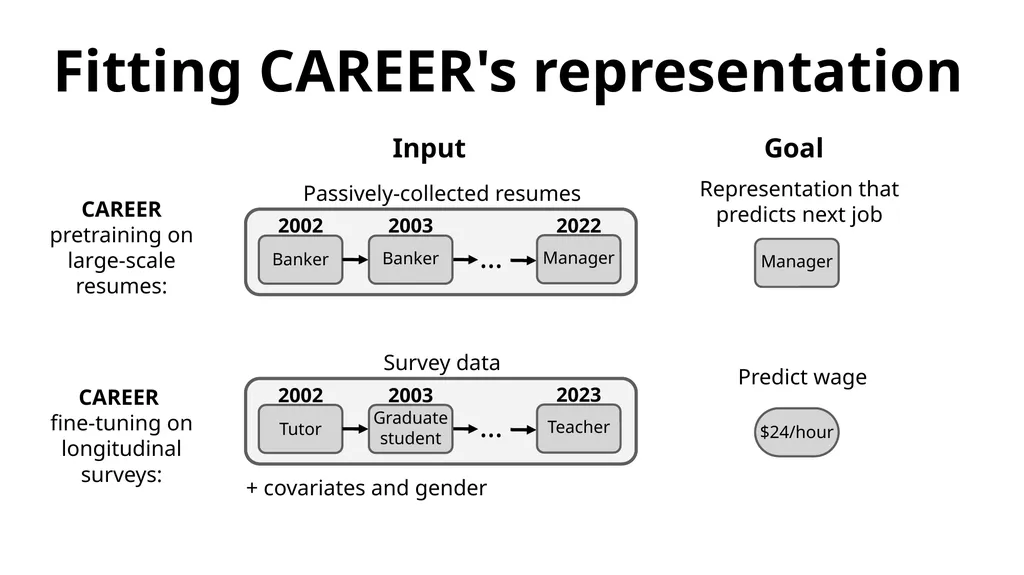
Fitting CAREER's representation Manager Passively-collected resumes … Manager Banker 2003 Representation that predicts next job Input Goal CAREER
pretraining on large-scale resumes:<br>
22
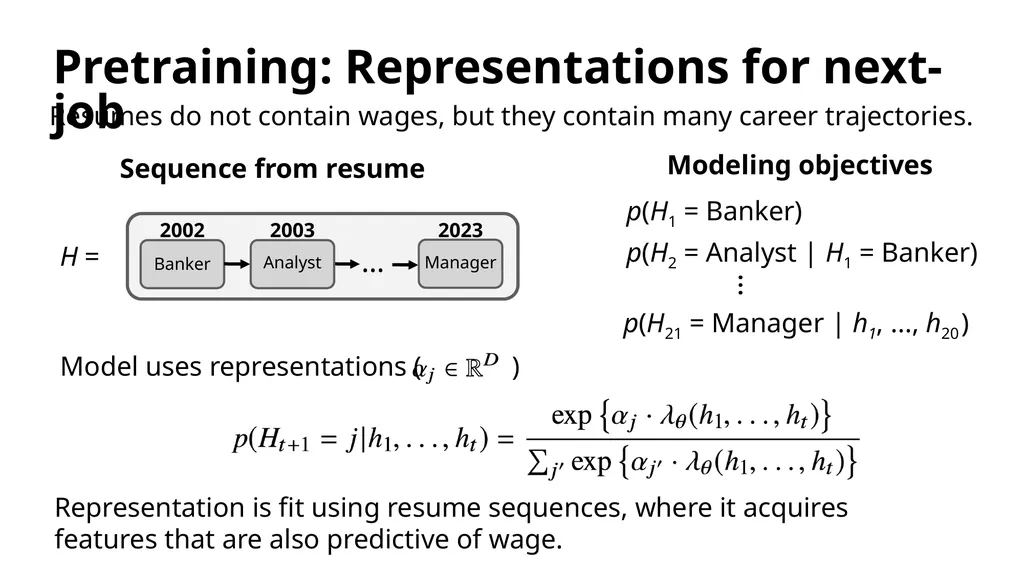
Pretraining: Representations for next-job Resumes do not contain wages, but they contain many career trajectories. Modeling objectives p(H1 = Banker) p(H2 = Analyst | H1 = Banker)<br>
23
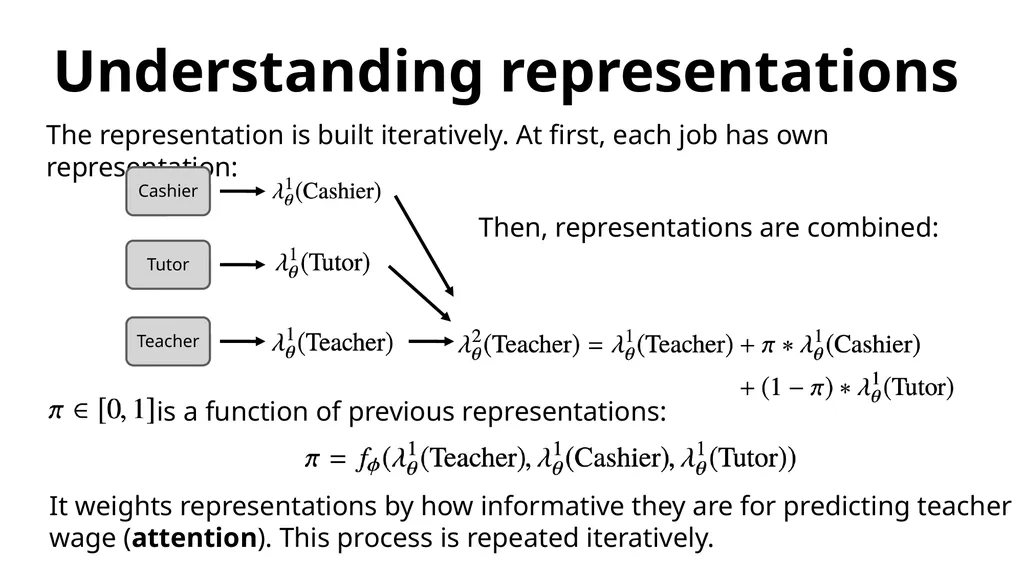
Understanding representations The representation is built iteratively. At first, each job has own representation: Then, representations are combined: It weights representations by how informative they are for predicting teacher wage (attention). This process is repeated iteratively.<br>
24
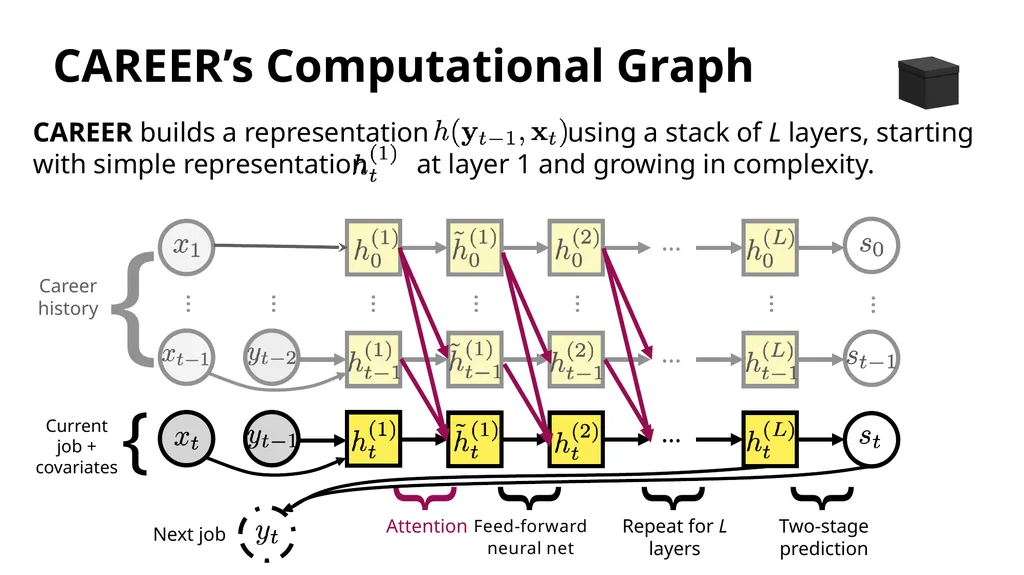
CAREER’s Computational Graph … … … … { Repeat for L layers …<br>
25
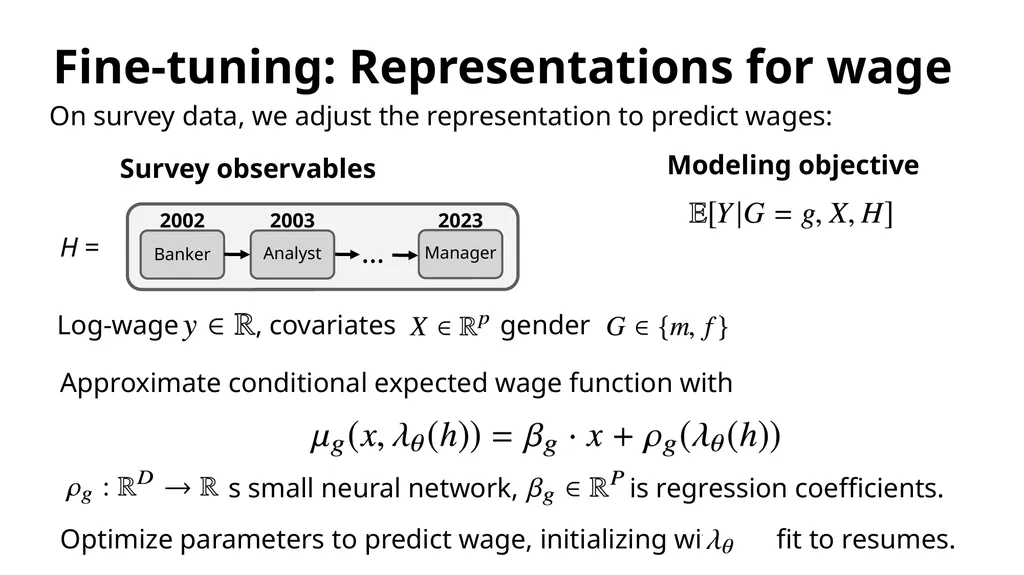
Fine-tuning: Representations for wage On survey data, we adjust the representation to predict wages:<br>
26
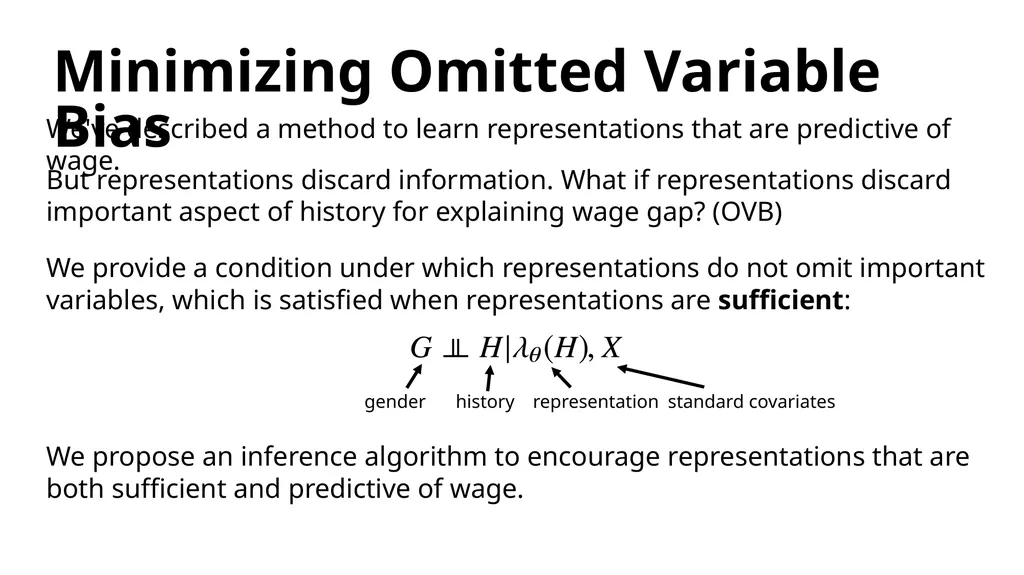
Minimizing Omitted Variable Bias We've described a method to learn representations that are predictive of wage. But representations discard information. What if representations discard important aspect of history for explaining wage gap? (OVB) We propose an inference algorithm to encourage representations that are both sufficient and predictive of wage.<br>
27
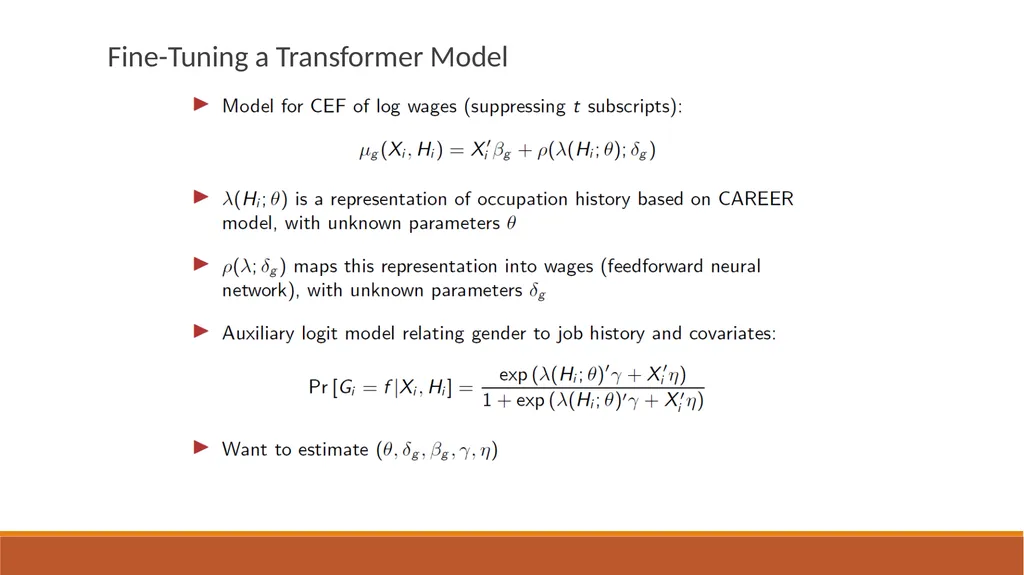
Fine-Tuning a Transformer Model<br>
28
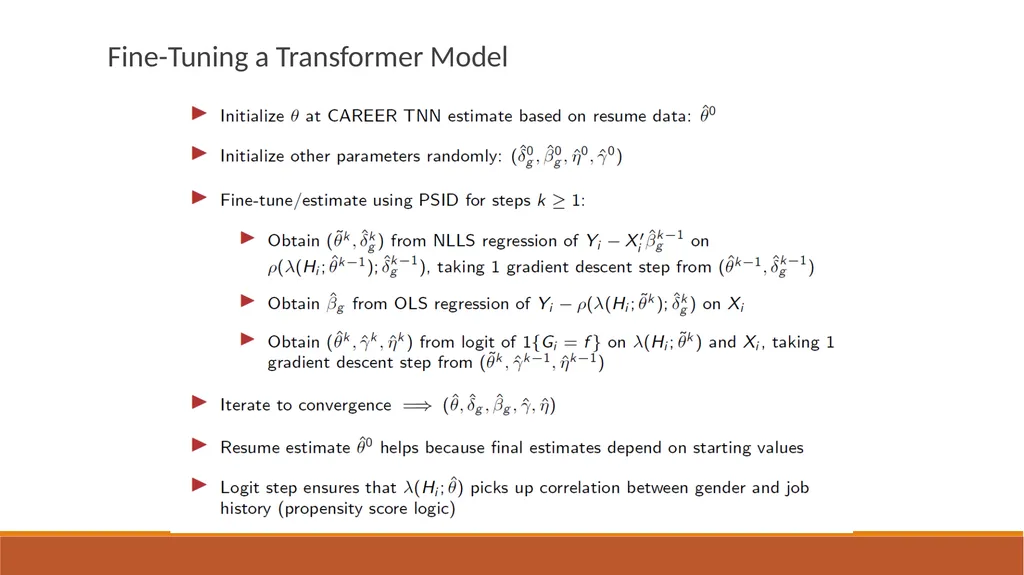
Fine-Tuning a Transformer Model<br>
29
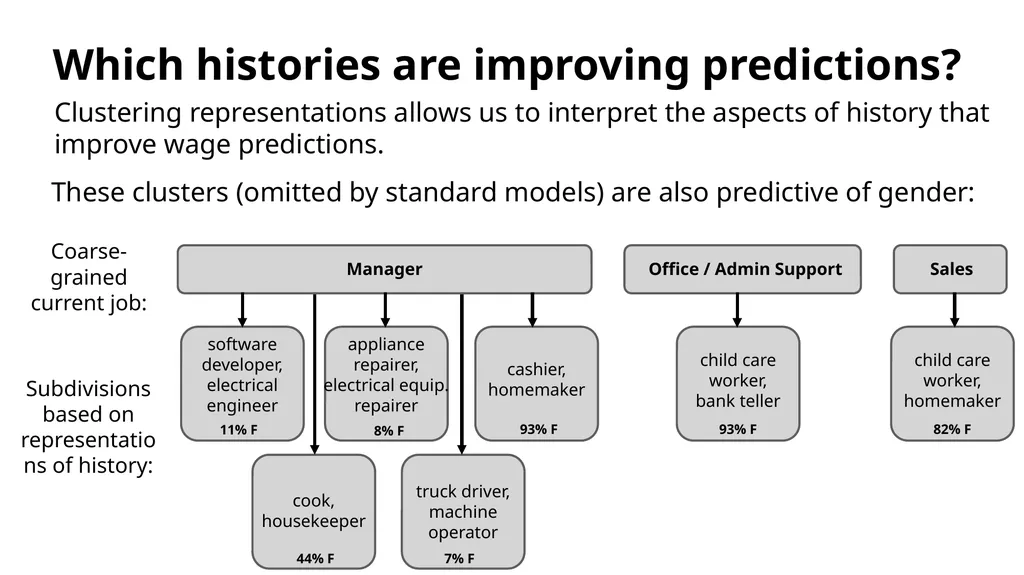
Which histories are improving predictions? Clustering representations allows us to interpret the aspects of history that improve wage predictions.<br>
30
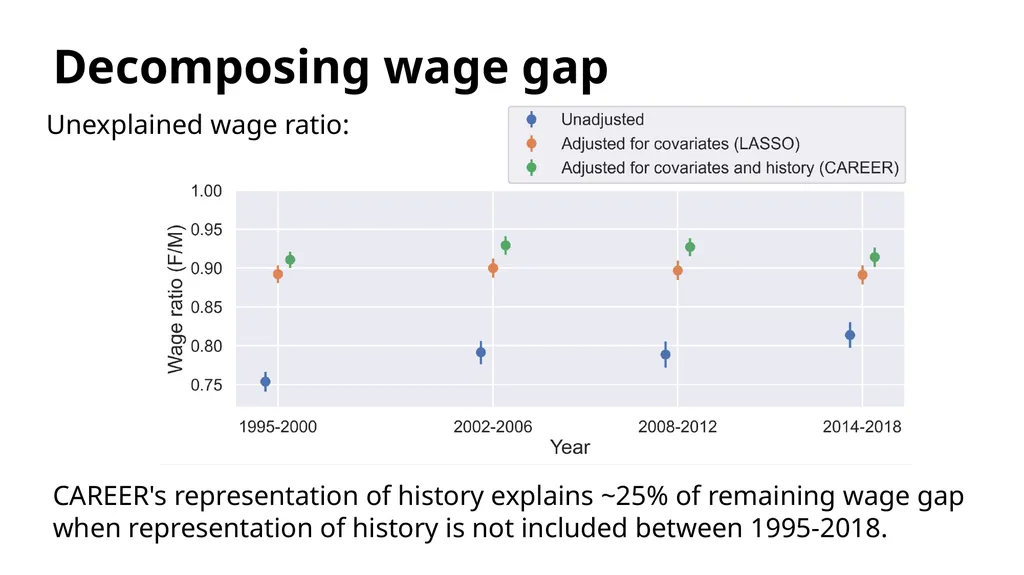
Decomposing wage gap Unexplained wage ratio: CAREER's representation of history explains ~25% of remaining wage gap when representation of history is not included between 1995-2018.<br>