
Star Class Cost Accounting Standards and Costing
TD
Published · 82 slides · 0 views

1 / 1

Description
Star Class Cost Accounting Standards and Costing Principles Tyler Clark Manager, Extramural Funds Accounting October 2019 Agenda Quick Basic Award Financial Overview Cost Accounting Standards OMB Uniform Guidance Business Finance Bulletin
Related Topics
Share
Embed code
Download this presentation From Below
"Star Class Cost Accounting Standards and Costing" is the property of its rightful owner. Permission is granted to download and print the materials on this website for personal, non-commercial use only, and to display it on your personal computer provided you do not modify the materials and that you retain all copyright notices contained in the materials. By downloading content from our website, you accept the terms of this agreement.
Presentation Transcript
01
Star Class
Cost Accounting Standards and Costing Principles Tyler Clark
Manager, Extramural Funds Accounting
October 2019<br>
Manager, Extramural Funds Accounting
October 2019<br>
02
Agenda Quick Basic Award Financial Overview
Cost Accounting Standards
OMB Uniform Guidance
Business & Finance Bulletin A-47
UCSB Departmental Costing Guidelines
Costing Principles
National Science Foundation Audit<br>
Cost Accounting Standards
OMB Uniform Guidance
Business & Finance Bulletin A-47
UCSB Departmental Costing Guidelines
Costing Principles
National Science Foundation Audit<br>
03
Quick Review – The Challenge of this Class How Many of You Work with UCSB’s General Ledger?
How many of you work with Contracts & Grants?
How many of you are familiar with Direct Costs vs. Indirect Costs?
How many of you work on Award Proposals?
How many of you work on Post-Award administration?<br>
How many of you work with Contracts & Grants?
How many of you are familiar with Direct Costs vs. Indirect Costs?
How many of you work on Award Proposals?
How many of you work on Post-Award administration?<br>
04
Roles of Specific Units for C&G Award Administration Sponsored Projects Office – part of Office of Research.
Responsible for the handling of faculty research proposals, specifically for preparing, interpreting, negotiating, and accepting agreements on behalf of the Regents for projects funded by federal and state agencies, foundations, and other public and private sources.
Responsible for accepting and processing all extramural contracts and grants awarded to UCSB for the conduct of sponsored projects, including modifications, amendments, continuations, renewals, and extensions of existing contracts and grants
As general guidance , OR will also provide a general summary of the award terms and conditions to assist the Principal Investigator and Department in the administration of the award; however, the award summary will not address every contract or grant term.
The principal investigator and the department are responsible for reading, understanding and adhering to each term of the award document.
https://www.research.ucsb.edu/spo<br>
Responsible for the handling of faculty research proposals, specifically for preparing, interpreting, negotiating, and accepting agreements on behalf of the Regents for projects funded by federal and state agencies, foundations, and other public and private sources.
Responsible for accepting and processing all extramural contracts and grants awarded to UCSB for the conduct of sponsored projects, including modifications, amendments, continuations, renewals, and extensions of existing contracts and grants
As general guidance , OR will also provide a general summary of the award terms and conditions to assist the Principal Investigator and Department in the administration of the award; however, the award summary will not address every contract or grant term.
The principal investigator and the department are responsible for reading, understanding and adhering to each term of the award document.
https://www.research.ucsb.edu/spo<br>
05
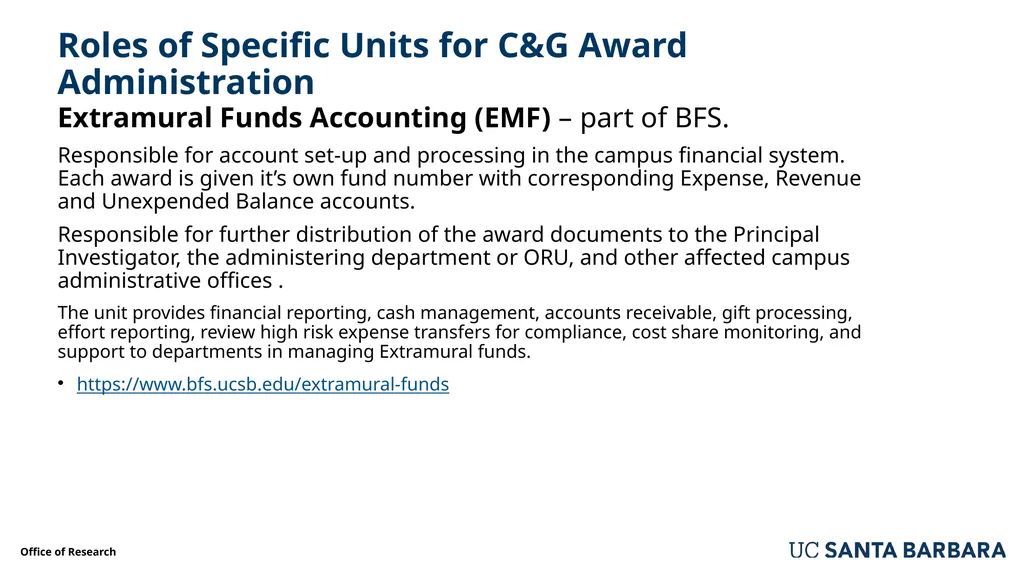
Roles of Specific Units for C&G Award Administration Extramural Funds Accounting (EMF) – part of BFS.
Responsible for account set-up and processing in the campus financial system. Each award is given it’s own fund number with corresponding Expense, Revenue and Unexpended Balance accounts.
Responsible for further distribution of the award documents to the Principal Investigator, the administering department or ORU, and other affected campus administrative offices .
The unit provides financial reporting, cash management, accounts receivable, gift processing, effort reporting, review high risk expense transfers for compliance, cost share monitoring, and support to departments in managing Extramural funds.
https://www.bfs.ucsb.edu/extramural-funds<br>
Responsible for account set-up and processing in the campus financial system. Each award is given it’s own fund number with corresponding Expense, Revenue and Unexpended Balance accounts.
Responsible for further distribution of the award documents to the Principal Investigator, the administering department or ORU, and other affected campus administrative offices .
The unit provides financial reporting, cash management, accounts receivable, gift processing, effort reporting, review high risk expense transfers for compliance, cost share monitoring, and support to departments in managing Extramural funds.
https://www.bfs.ucsb.edu/extramural-funds<br>
06
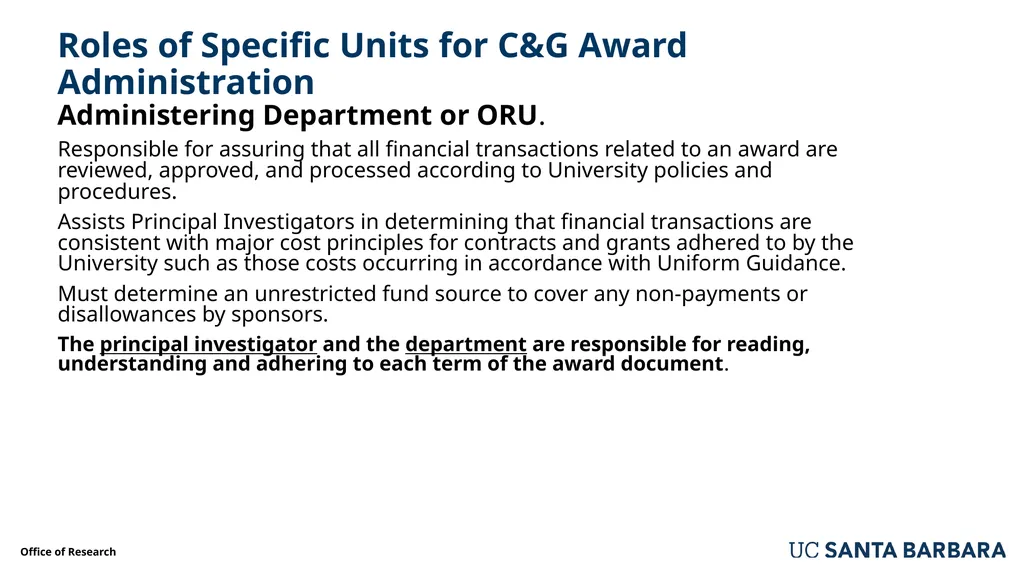
Roles of Specific Units for C&G Award Administration Administering Department or ORU.
Responsible for assuring that all financial transactions related to an award are reviewed, approved, and processed according to University policies and procedures.
Assists Principal Investigators in determining that financial transactions are consistent with major cost principles for contracts and grants adhered to by the University such as those costs occurring in accordance with Uniform Guidance.
Must determine an unrestricted fund source to cover any non-payments or disallowances by sponsors.
The principal investigator and the department are responsible for reading, understanding and adhering to each term of the award document.<br>
Responsible for assuring that all financial transactions related to an award are reviewed, approved, and processed according to University policies and procedures.
Assists Principal Investigators in determining that financial transactions are consistent with major cost principles for contracts and grants adhered to by the University such as those costs occurring in accordance with Uniform Guidance.
Must determine an unrestricted fund source to cover any non-payments or disallowances by sponsors.
The principal investigator and the department are responsible for reading, understanding and adhering to each term of the award document.<br>
07
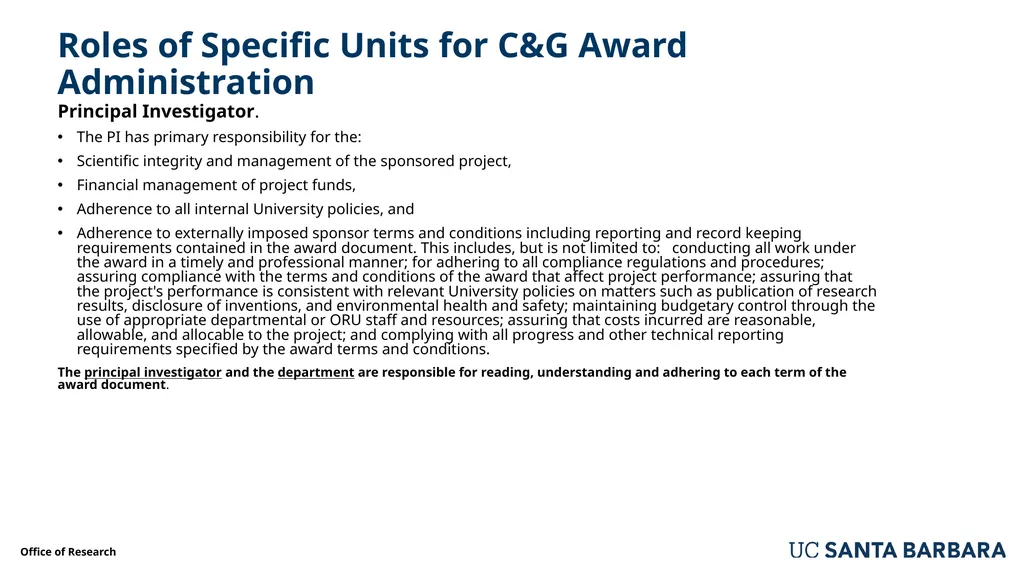
Roles of Specific Units for C&G Award Administration Principal Investigator.
The PI has primary responsibility for the:
Scientific integrity and management of the sponsored project,
Financial management of project funds,
Adherence to all internal University policies, and
Adherence to externally imposed sponsor terms and conditions including reporting and record keeping requirements contained in the award document. This includes, but is not limited to: conducting all work under the award in a timely and professional manner; for adhering to all compliance regulations and procedures; assuring compliance with the terms and conditions of the award that affect project performance; assuring that the project's performance is consistent with relevant University policies on matters such as publication of research results, disclosure of inventions, and environmental health and safety; maintaining budgetary control through the use of appropriate departmental or ORU staff and resources; assuring that costs incurred are reasonable, allowable, and allocable to the project; and complying with all progress and other technical reporting requirements specified by the award terms and conditions.
The principal investigator and the department are responsible for reading, understanding and adhering to each term of the award document.<br>
The PI has primary responsibility for the:
Scientific integrity and management of the sponsored project,
Financial management of project funds,
Adherence to all internal University policies, and
Adherence to externally imposed sponsor terms and conditions including reporting and record keeping requirements contained in the award document. This includes, but is not limited to: conducting all work under the award in a timely and professional manner; for adhering to all compliance regulations and procedures; assuring compliance with the terms and conditions of the award that affect project performance; assuring that the project's performance is consistent with relevant University policies on matters such as publication of research results, disclosure of inventions, and environmental health and safety; maintaining budgetary control through the use of appropriate departmental or ORU staff and resources; assuring that costs incurred are reasonable, allowable, and allocable to the project; and complying with all progress and other technical reporting requirements specified by the award terms and conditions.
The principal investigator and the department are responsible for reading, understanding and adhering to each term of the award document.<br>
08
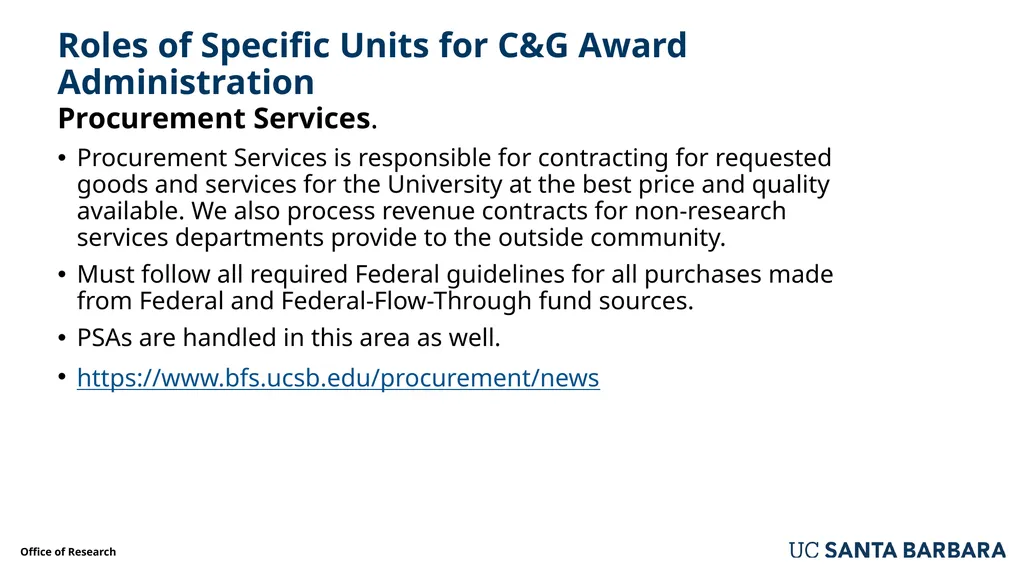
Roles of Specific Units for C&G Award Administration Procurement Services.
Procurement Services is responsible for contracting for requested goods and services for the University at the best price and quality available. We also process revenue contracts for non-research services departments provide to the outside community.
Must follow all required Federal guidelines for all purchases made from Federal and Federal-Flow-Through fund sources.
PSAs are handled in this area as well.
https://www.bfs.ucsb.edu/procurement/news<br>
Procurement Services is responsible for contracting for requested goods and services for the University at the best price and quality available. We also process revenue contracts for non-research services departments provide to the outside community.
Must follow all required Federal guidelines for all purchases made from Federal and Federal-Flow-Through fund sources.
PSAs are handled in this area as well.
https://www.bfs.ucsb.edu/procurement/news<br>
09
Roles of Specific Units for C&G Award Administration Human Resources
https://www.hr.ucsb.edu/
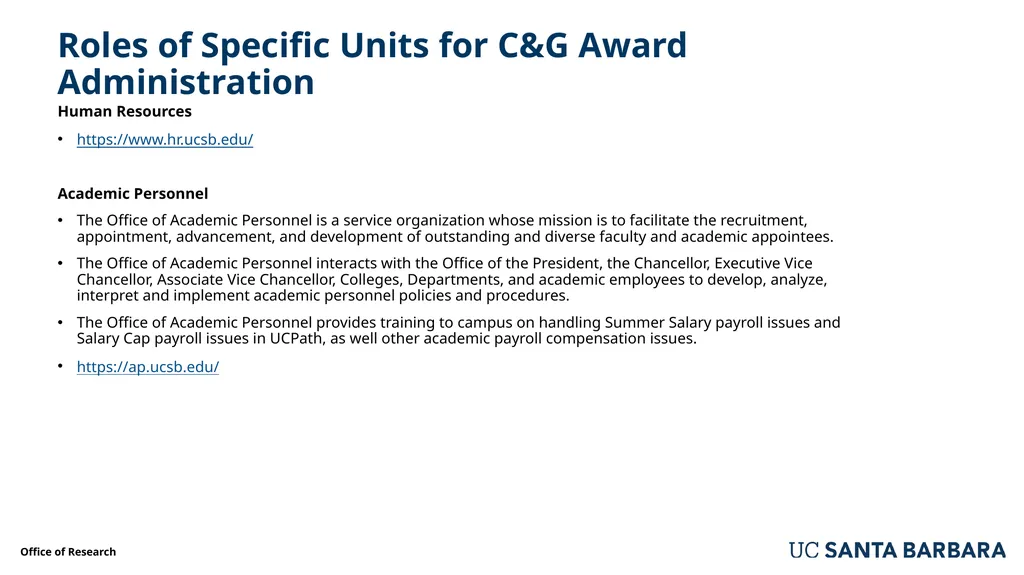
Academic Personnel
The Office of Academic Personnel is a service organization whose mission is to facilitate the recruitment, appointment, advancement, and development of outstanding and diverse faculty and academic appointees.
The Office of Academic Personnel interacts with the Office of the President, the Chancellor, Executive Vice Chancellor, Associate Vice Chancellor, Colleges, Departments, and academic employees to develop, analyze, interpret and implement academic personnel policies and procedures.
The Office of Academic Personnel provides training to campus on handling Summer Salary payroll issues and Salary Cap payroll issues in UCPath, as well other academic payroll compensation issues.
https://ap.ucsb.edu/<br>
https://www.hr.ucsb.edu/
Academic Personnel
The Office of Academic Personnel is a service organization whose mission is to facilitate the recruitment, appointment, advancement, and development of outstanding and diverse faculty and academic appointees.
The Office of Academic Personnel interacts with the Office of the President, the Chancellor, Executive Vice Chancellor, Associate Vice Chancellor, Colleges, Departments, and academic employees to develop, analyze, interpret and implement academic personnel policies and procedures.
The Office of Academic Personnel provides training to campus on handling Summer Salary payroll issues and Salary Cap payroll issues in UCPath, as well other academic payroll compensation issues.
https://ap.ucsb.edu/<br>
10
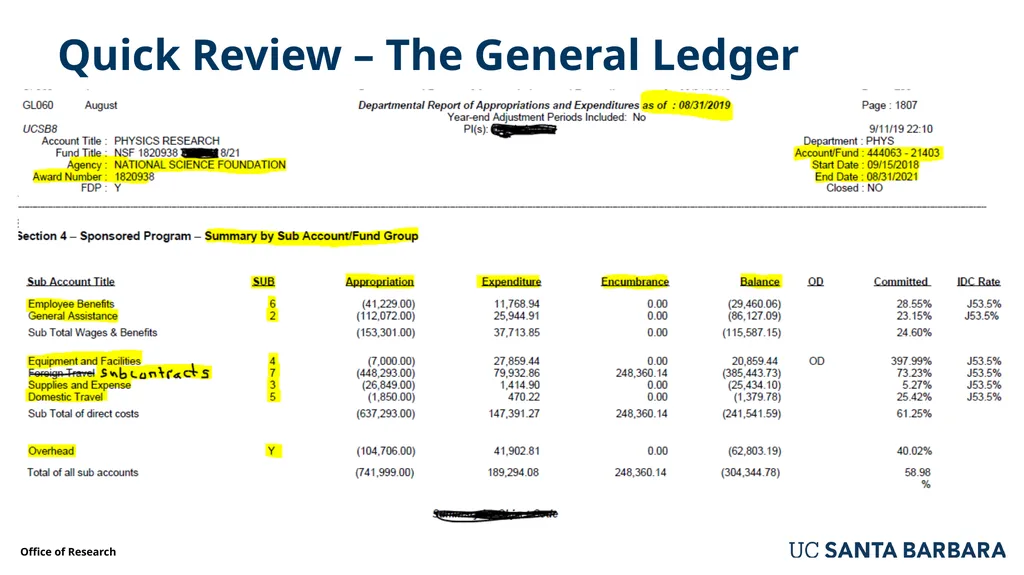
Quick Review – The General Ledger<br>
11
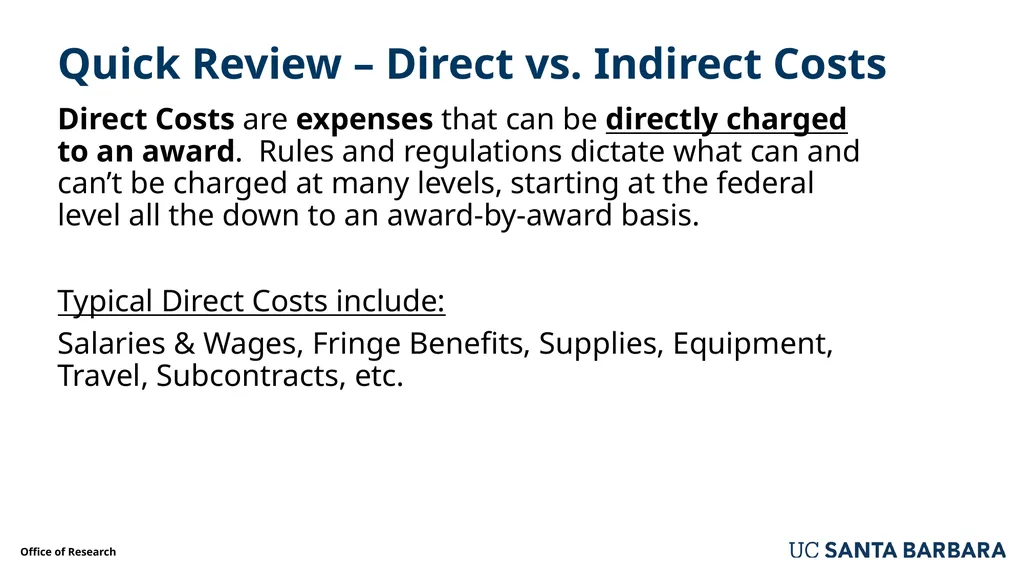
Quick Review – Direct vs. Indirect Costs Direct Costs are expenses that can be directly charged to an award. Rules and regulations dictate what can and can’t be charged at many levels, starting at the federal level all the down to an award-by-award basis.
Typical Direct Costs include:
Salaries & Wages, Fringe Benefits, Supplies, Equipment, Travel, Subcontracts, etc.<br>
Typical Direct Costs include:
Salaries & Wages, Fringe Benefits, Supplies, Equipment, Travel, Subcontracts, etc.<br>
12
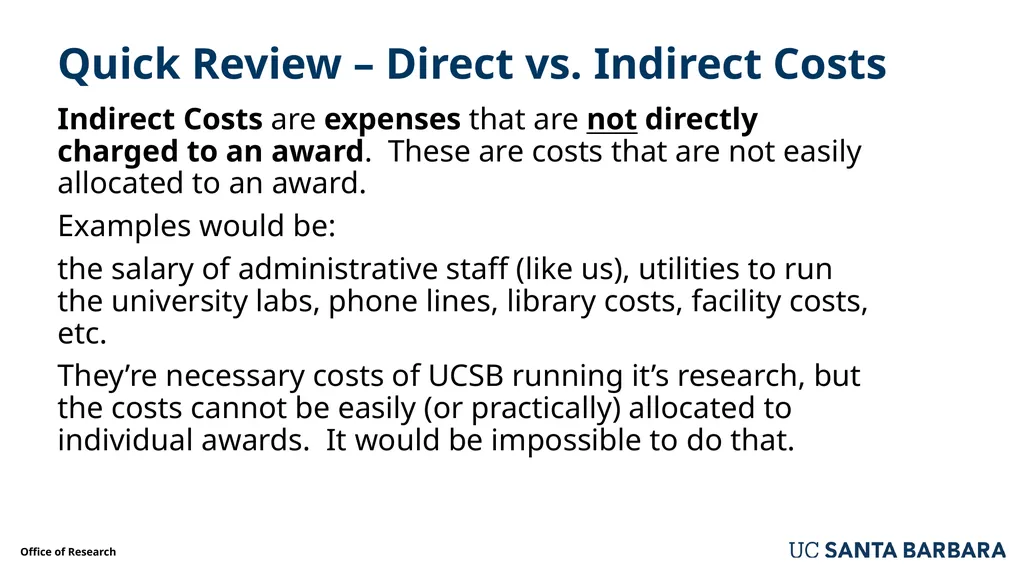
Quick Review – Direct vs. Indirect Costs Indirect Costs are expenses that are not directly charged to an award. These are costs that are not easily allocated to an award.
Examples would be:
the salary of administrative staff (like us), utilities to run the university labs, phone lines, library costs, facility costs, etc.
They’re necessary costs of UCSB running it’s research, but the costs cannot be easily (or practically) allocated to individual awards. It would be impossible to do that.<br>
Examples would be:
the salary of administrative staff (like us), utilities to run the university labs, phone lines, library costs, facility costs, etc.
They’re necessary costs of UCSB running it’s research, but the costs cannot be easily (or practically) allocated to individual awards. It would be impossible to do that.<br>
13
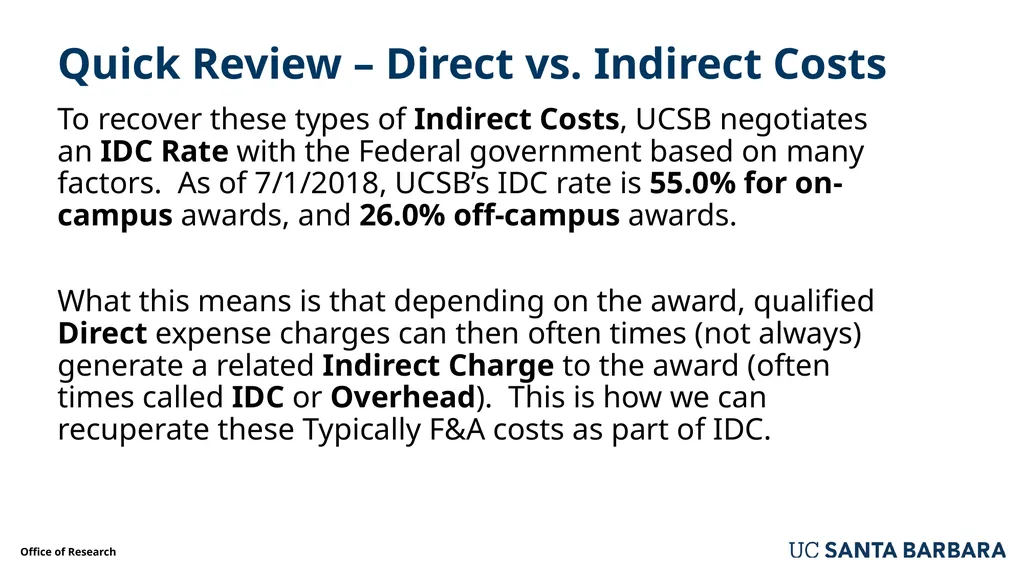
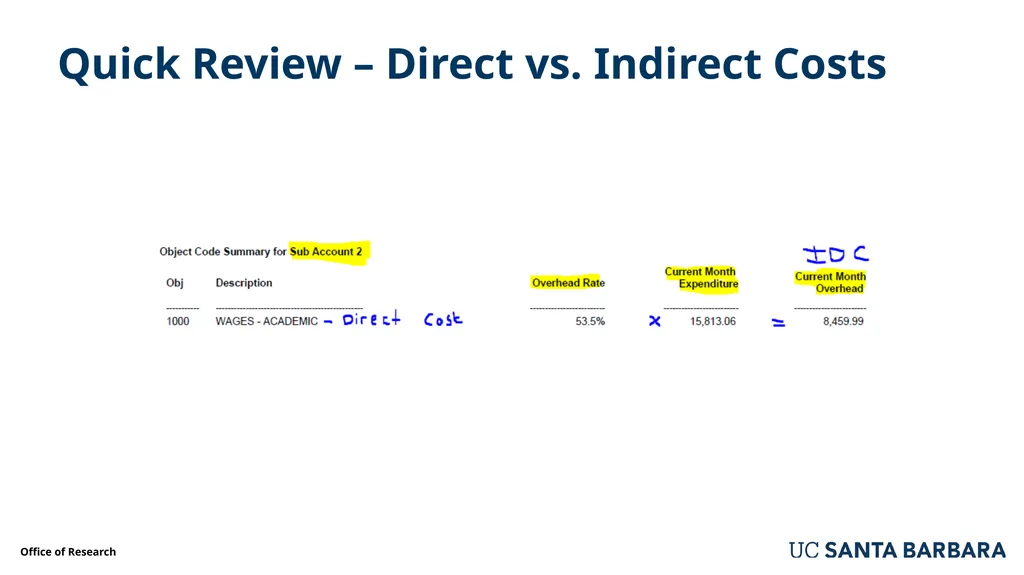
Quick Review – Direct vs. Indirect Costs To recover these types of Indirect Costs, UCSB negotiates an IDC Rate with the Federal government based on many factors. As of 7/1/2018, UCSB’s IDC rate is 55.0% for on-campus awards, and 26.0% off-campus awards.
What this means is that depending on the award, qualified Direct expense charges can then often times (not always) generate a related Indirect Charge to the award (often times called IDC or Overhead). This is how we can recuperate these Typically F&A costs as part of IDC.<br>
What this means is that depending on the award, qualified Direct expense charges can then often times (not always) generate a related Indirect Charge to the award (often times called IDC or Overhead). This is how we can recuperate these Typically F&A costs as part of IDC.<br>
14
Quick Review – Direct vs. Indirect Costs<br>
15
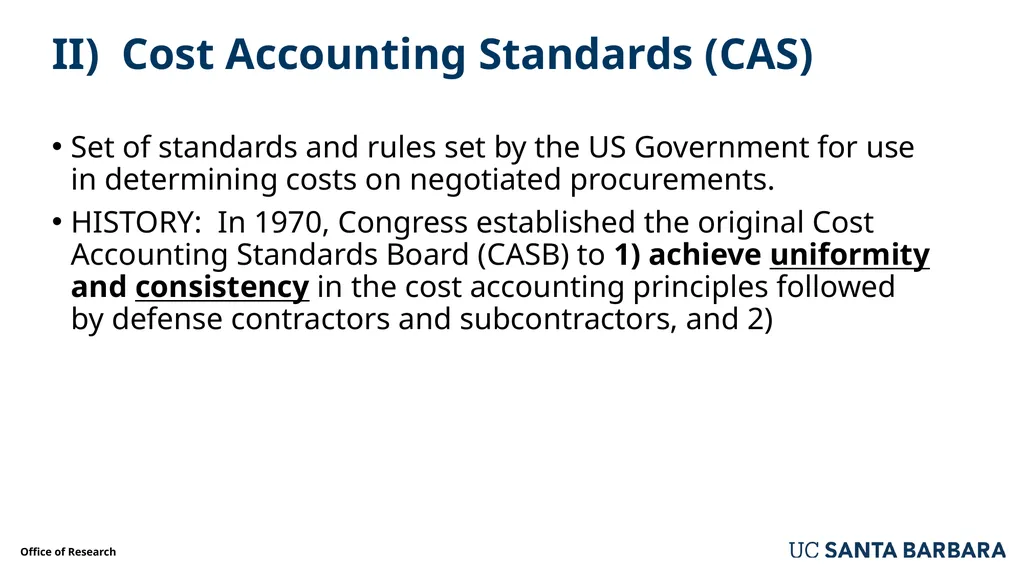
II) Cost Accounting Standards (CAS) Set of standards and rules set by the US Government for use in determining costs on negotiated procurements.
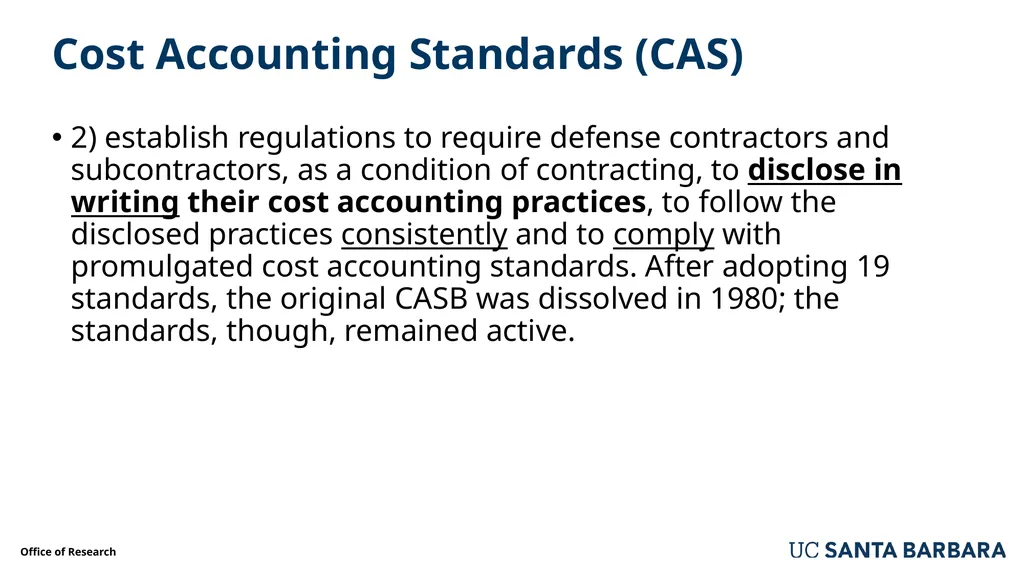
HISTORY: In 1970, Congress established the original Cost Accounting Standards Board (CASB) to 1) achieve uniformity and consistency in the cost accounting principles followed by defense contractors and subcontractors, and 2)<br>
HISTORY: In 1970, Congress established the original Cost Accounting Standards Board (CASB) to 1) achieve uniformity and consistency in the cost accounting principles followed by defense contractors and subcontractors, and 2)<br>
16
Cost Accounting Standards (CAS) 2) establish regulations to require defense contractors and subcontractors, as a condition of contracting, to disclose in writing their cost accounting practices, to follow the disclosed practices consistently and to comply with promulgated cost accounting standards. After adopting 19 standards, the original CASB was dissolved in 1980; the standards, though, remained active.<br>
17
Cost Accounting Standards (CAS) CASB was revived in 1988 within the Office of Federal Procurement Policy (OFPP). The current CASB consists of five members: the OFPP Administrator (who serves as Chairman) and one member from the United States Department of Defense (this position is held by the Director of the Defense Contract Audit Agency), the General Services Administration, industry, and the private sector.<br>
18
Cost Accounting Standards Cost Accounting Standards Board published regulations on cost accounting standards for educational institutions. The standards set forth principles for determining direct, indirect, allowable, and unallowable costs applicable to federal sponsored projects.<br>
19
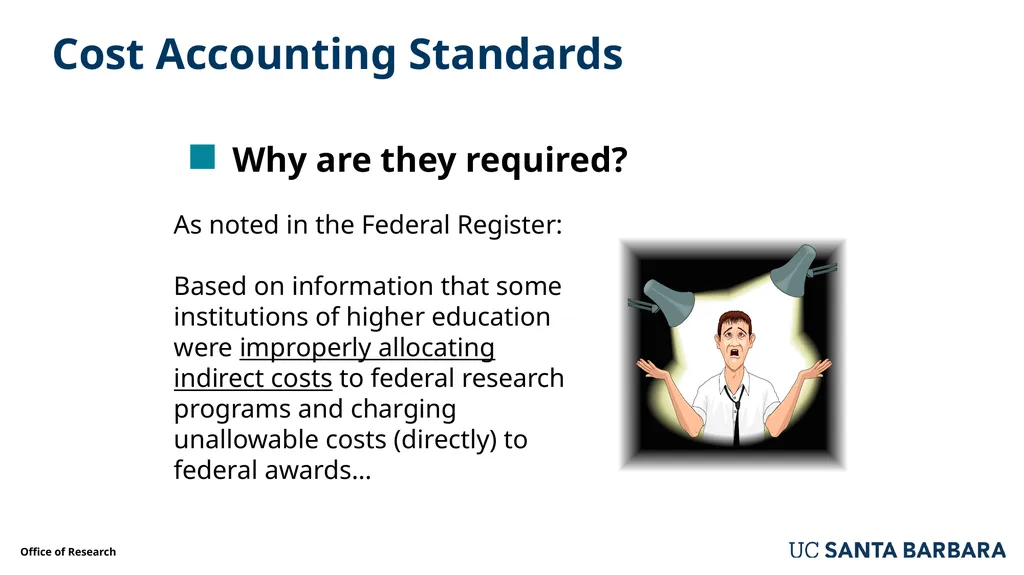
Cost Accounting Standards Why are they required? As noted in the Federal Register:
Based on information that some institutions of higher education were improperly allocating indirect costs to federal research programs and charging unallowable costs (directly) to federal awards...<br>
Based on information that some institutions of higher education were improperly allocating indirect costs to federal research programs and charging unallowable costs (directly) to federal awards...<br>
20
Four Cost Accounting Standards Apply to Colleges and Universities 501: Consistency in Estimating, Accumulating, and Reporting Costs
502: Consistency in Allocating Costs Incurred for the Same Purpose
505: Accounting for Unallowable Costs
506: Cost Accounting Period<br>
502: Consistency in Allocating Costs Incurred for the Same Purpose
505: Accounting for Unallowable Costs
506: Cost Accounting Period<br>
21
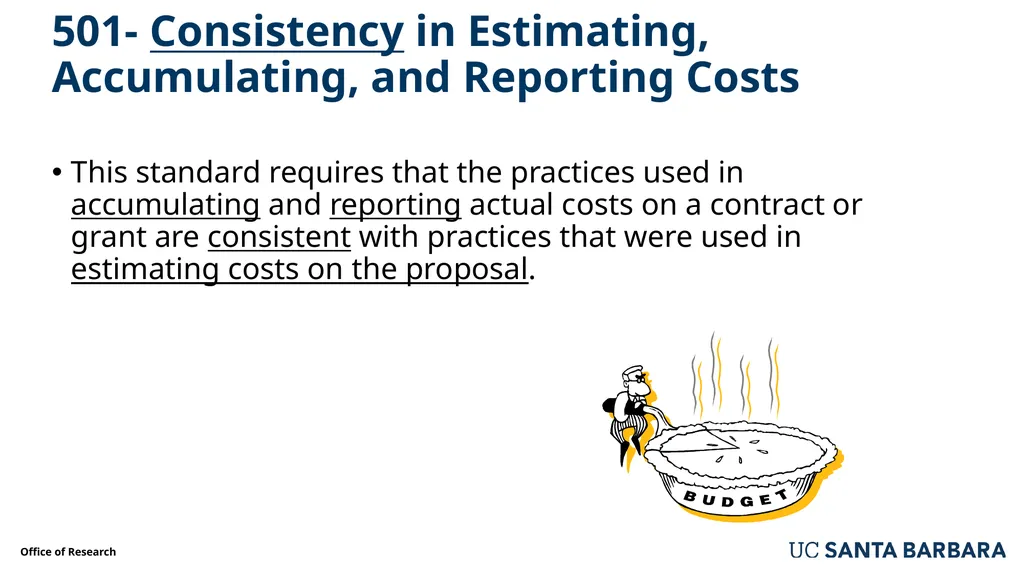
501- Consistency in Estimating, Accumulating, and Reporting Costs This standard requires that the practices used in accumulating and reporting actual costs on a contract or grant are consistent with practices that were used in estimating costs on the proposal.<br>
22
501 Requires that: UCSB’s practices used for estimating costs in pricing a proposal (i.e., cost included in the proposal budget) shall be consistent with UCSB’s cost accounting practices used in accumulating and reporting costs (i.e., costs charged to a contract or grant award)<br>
23
502- Consistency in Allocating Costs Incurred for the Same Purpose This standard requires that costs incurred for the same purpose, in like circumstances, be treated consistently as either direct or indirect costs. This standard applies to all costs regardless of funding source.<br>
24
502-Requires that: Costs incurred in like circumstances should be consistently charged as direct or indirect.
For example:
If long distance telephone charges are direct charged to a sponsored project, then all other remaining long distance charges should be charged to Instruction, or Departmental Administration, and be identified to the appropriate account/fund and object code.<br>
For example:
If long distance telephone charges are direct charged to a sponsored project, then all other remaining long distance charges should be charged to Instruction, or Departmental Administration, and be identified to the appropriate account/fund and object code.<br>
25
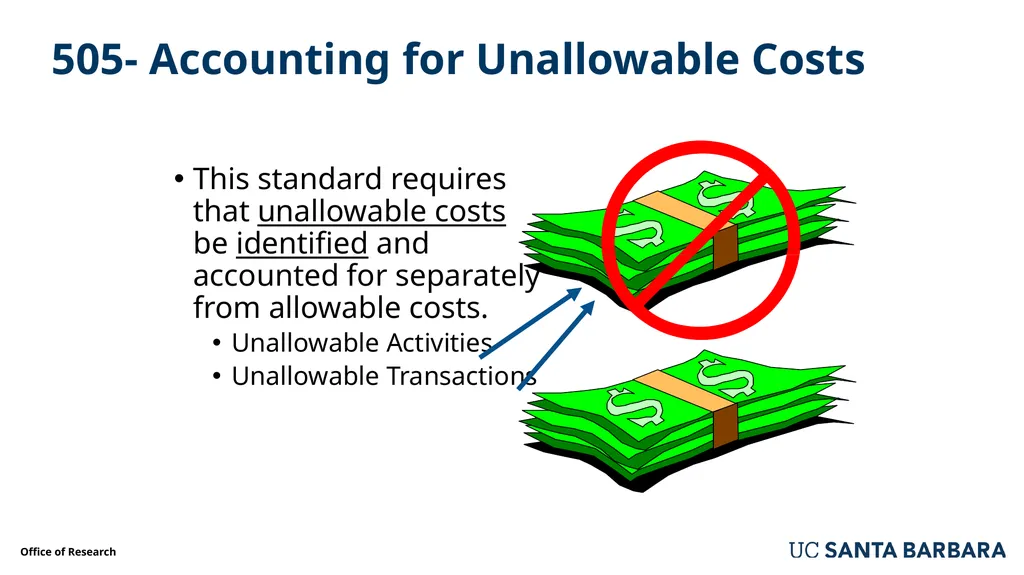
505- Accounting for Unallowable Costs This standard requires that unallowable costs be identified and accounted for separately from allowable costs.
Unallowable Activities
Unallowable Transactions<br>
Unallowable Activities
Unallowable Transactions<br>
26
Unallowable Activities Unallowable Activities may not be allocated to sponsored projects, either as direct or indirect costs.<br>
27
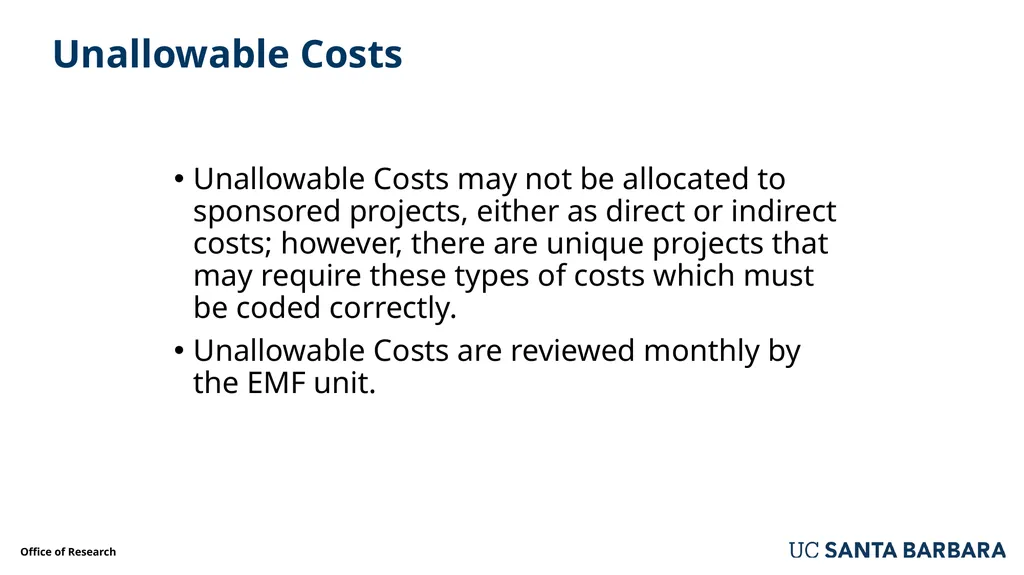
Unallowable Costs Unallowable Costs may not be allocated to sponsored projects, either as direct or indirect costs; however, there are unique projects that may require these types of costs which must be coded correctly.
Unallowable Costs are reviewed monthly by the EMF unit.<br>
Unallowable Costs are reviewed monthly by the EMF unit.<br>
28
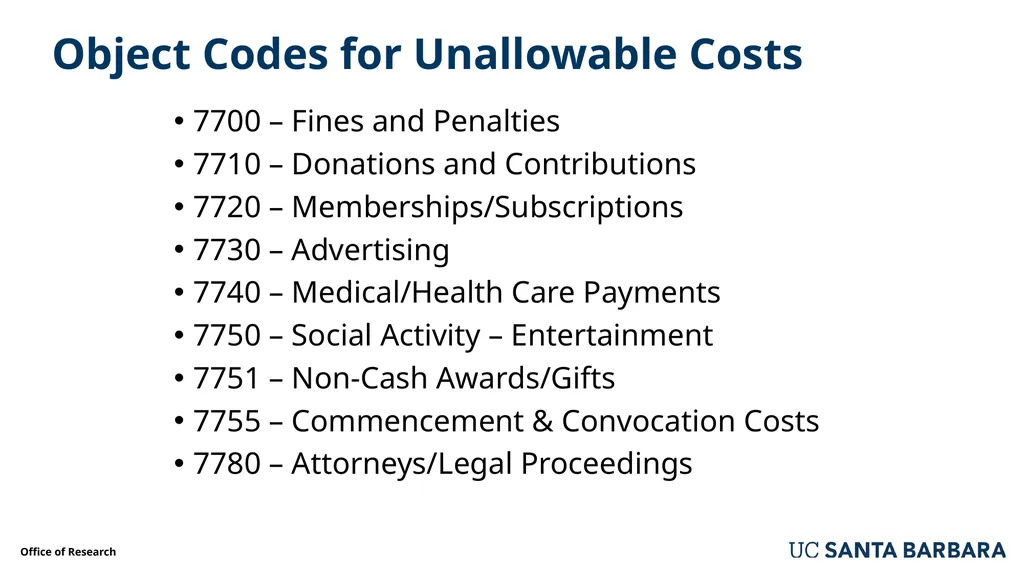
Object Codes for Unallowable Costs 7700 – Fines and Penalties
7710 – Donations and Contributions
7720 – Memberships/Subscriptions
7730 – Advertising
7740 – Medical/Health Care Payments
7750 – Social Activity – Entertainment
7751 – Non-Cash Awards/Gifts
7755 – Commencement & Convocation Costs
7780 – Attorneys/Legal Proceedings<br>
7710 – Donations and Contributions
7720 – Memberships/Subscriptions
7730 – Advertising
7740 – Medical/Health Care Payments
7750 – Social Activity – Entertainment
7751 – Non-Cash Awards/Gifts
7755 – Commencement & Convocation Costs
7780 – Attorneys/Legal Proceedings<br>
29
506- Cost Accounting Period This standard requires the consistent use of the same cost accounting period for purposes of estimating, accumulating, and reporting costs. The institution shall use their fiscal year as their cost accounting period for establishing an allocation basis in an indirect cost pool.<br>
30
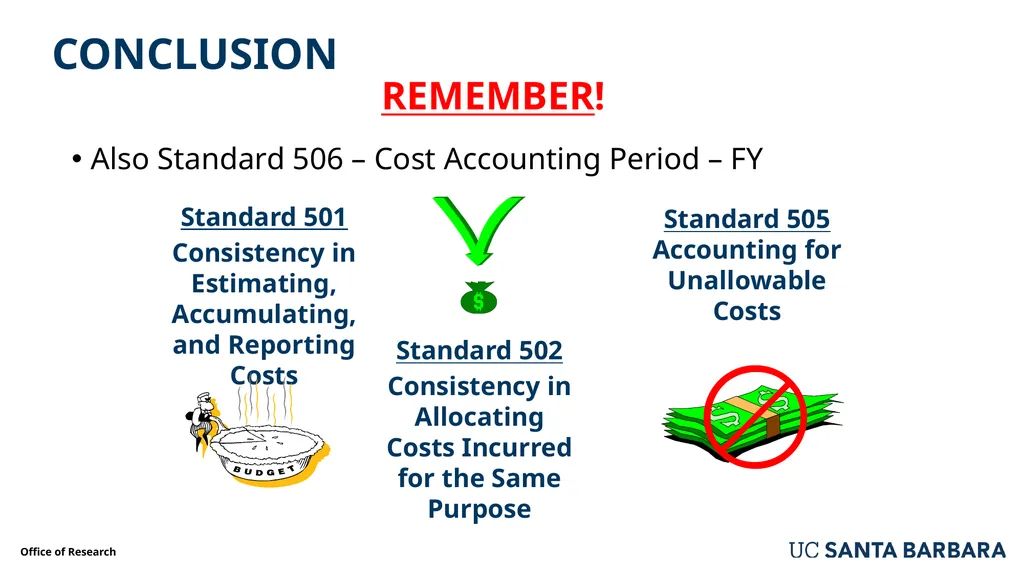
CONCLUSION Also Standard 506 – Cost Accounting Period – FY REMEMBER! Standard 501
Consistency in Estimating, Accumulating, and Reporting Costs Standard 502
Consistency in Allocating Costs Incurred for the Same Purpose Standard 505 Accounting for Unallowable Costs<br>
Consistency in Estimating, Accumulating, and Reporting Costs Standard 502
Consistency in Allocating Costs Incurred for the Same Purpose Standard 505 Accounting for Unallowable Costs<br>
31
Disclosure Statement (Form DS-2) This Disclosure Statement has been designed to meet the requirements of Public Law 100-679, and
persons completing it are to describe the educational institution and its cost accounting practices.<br>
persons completing it are to describe the educational institution and its cost accounting practices.<br>
32
Disclosure Statement (Form DS-2) Disclosure Statements must be amended when disclosed practices are changed to comply with a new Cost Accounting Standard or when practices are changed with or without agreement of the Government.
Amended Disclosure Statements are required when the F&A rate is negotiated.<br>
Amended Disclosure Statements are required when the F&A rate is negotiated.<br>
33
III. - OMB Uniform Guidance Replaces A-21
Cost Principles for Educational Institutions Establishes principles for determining costs applicable to agreements with educational institutions
It requires that:
All Federal agencies that sponsor research and development, training, and other work at educational institutions apply the provisions of the Circular in determining the costs incurred for such work.<br>
It requires that:
All Federal agencies that sponsor research and development, training, and other work at educational institutions apply the provisions of the Circular in determining the costs incurred for such work.<br>
34
How to Determine if a Cost is: Reasonable, Allocable, and Allowable<br>
35
Reasonable “A cost may be considered reasonable if the nature of the goods or services acquired or applied, and the amount involved, reflect the action that a prudent person would have taken under the circumstances prevailing at the time the decision to incur the cost was made.”<br>
36
Questions to Determine Reasonableness Did the individual act with due prudence under the circumstances?
Are the actions consistent with established institutional policies and practices?
Is the cost generally recognized as necessary for the operation of the institution or the performance of the agreement?<br>
Are the actions consistent with established institutional policies and practices?
Is the cost generally recognized as necessary for the operation of the institution or the performance of the agreement?<br>
37
Allocable “A cost is allocable to a particular cost objective if the goods or services involved are chargeable or assignable to such cost objective in accordance with relative benefits received or other equitable relationship.”<br>
38
Questions to Determine if Costs are Allocable Can costs be easily allocated in proportion to the benefits derived by a specific project?
Is the cost incurred solely to advance the work under the sponsored agreement?
Does the cost benefit both the sponsored agreement and other work of the institution in proportions that can be approximated through the use of reasonable methods?<br>
Is the cost incurred solely to advance the work under the sponsored agreement?
Does the cost benefit both the sponsored agreement and other work of the institution in proportions that can be approximated through the use of reasonable methods?<br>
39
Allowable Costs must be:
Reasonable.
Allocable.
Given consistent treatment through application of generally accepted accounting practices appropriate to the circumstances.
In conformance with the limitations or exclusions for individual cost set forth in Uniform Guidance.
Individual award terms not restrict the charge.
Follow UC Policy guidelines.<br>
Reasonable.
Allocable.
Given consistent treatment through application of generally accepted accounting practices appropriate to the circumstances.
In conformance with the limitations or exclusions for individual cost set forth in Uniform Guidance.
Individual award terms not restrict the charge.
Follow UC Policy guidelines.<br>
40
Questions to Determine Allowability Is it consistent with UC policy & practices?
Is the cost in compliance with Uniform Guidance?
Does the individual contract or grant terms indicate restrictions or not allowable?
Is it easy to allocate for the cost as a direct expense?
Does the cost benefit the project?
Is the cost consistently treated?<br>
Is the cost in compliance with Uniform Guidance?
Does the individual contract or grant terms indicate restrictions or not allowable?
Is it easy to allocate for the cost as a direct expense?
Does the cost benefit the project?
Is the cost consistently treated?<br>
41
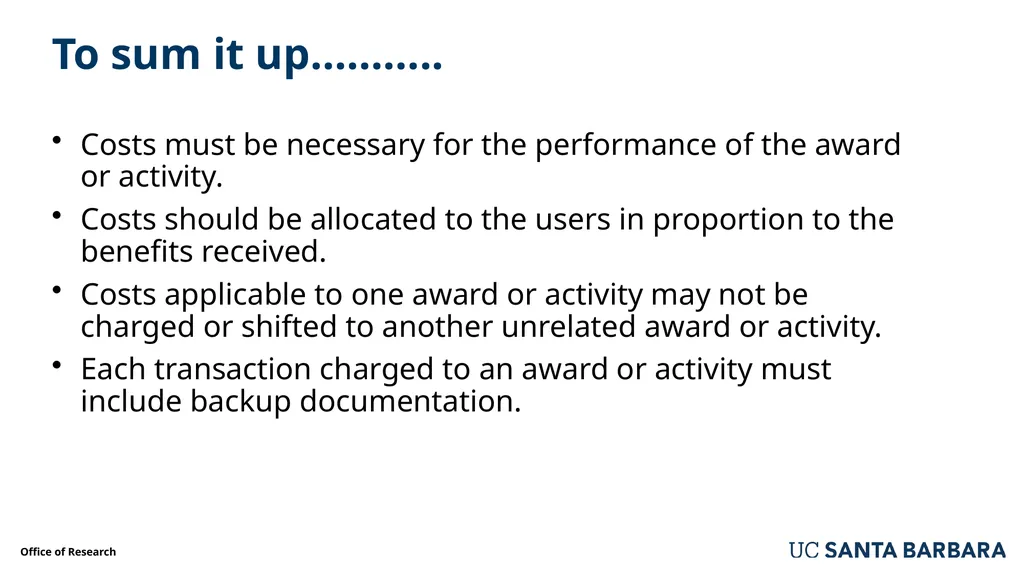
To sum it up……….. Costs must be necessary for the performance of the award or activity.
Costs should be allocated to the users in proportion to the benefits received.
Costs applicable to one award or activity may not be charged or shifted to another unrelated award or activity.
Each transaction charged to an award or activity must include backup documentation.<br>
Costs should be allocated to the users in proportion to the benefits received.
Costs applicable to one award or activity may not be charged or shifted to another unrelated award or activity.
Each transaction charged to an award or activity must include backup documentation.<br>
42
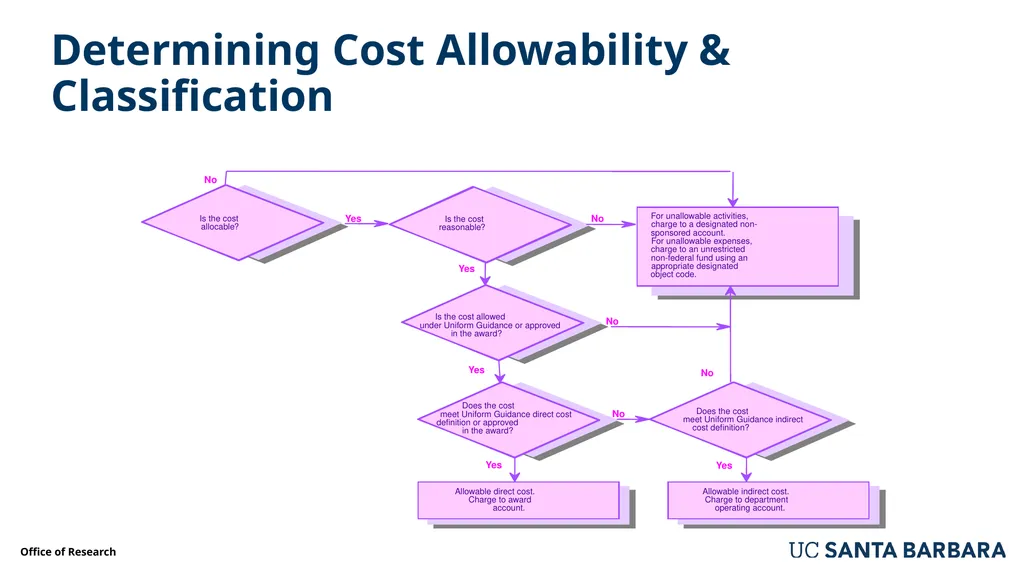
Determining Cost Allowability & Classification<br>
43
BREAK!<br>
44
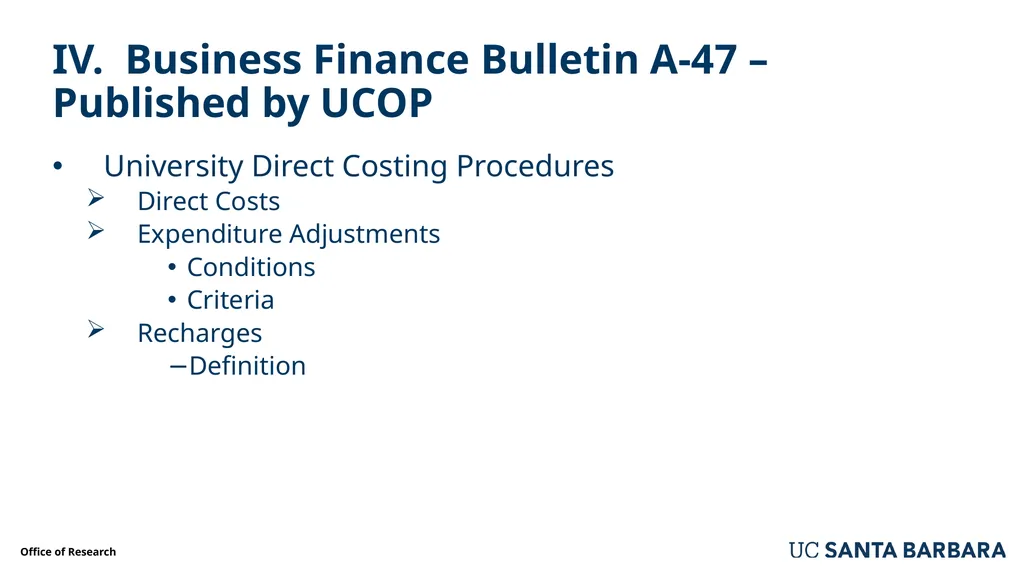
IV. Business Finance Bulletin A-47 – Published by UCOP University Direct Costing Procedures
Direct Costs
Expenditure Adjustments
Conditions
Criteria
Recharges
Definition<br>
Direct Costs
Expenditure Adjustments
Conditions
Criteria
Recharges
Definition<br>
45
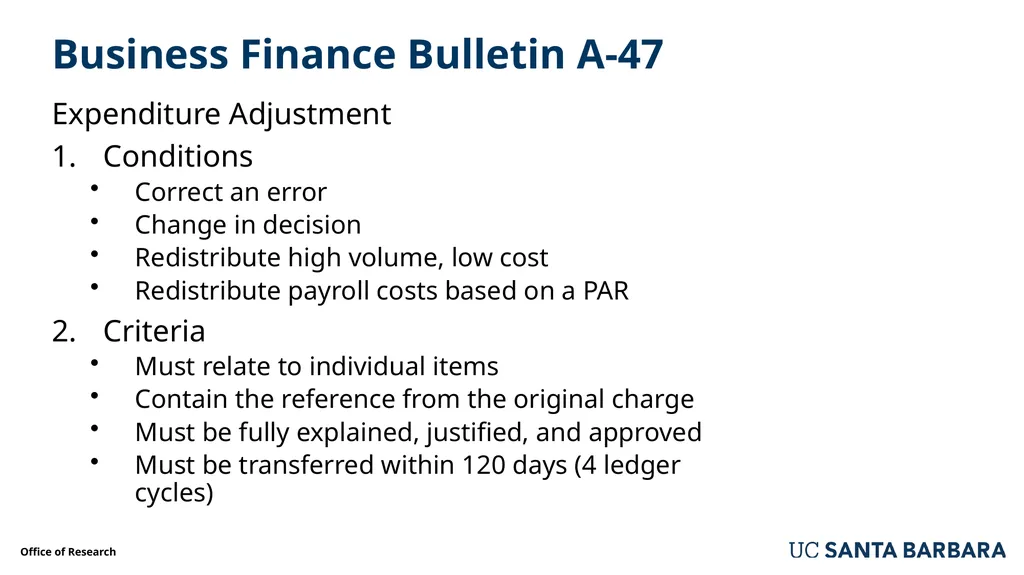
Expenditure Adjustment
Conditions
Correct an error
Change in decision
Redistribute high volume, low cost
Redistribute payroll costs based on a PAR
Criteria
Must relate to individual items
Contain the reference from the original charge
Must be fully explained, justified, and approved
Must be transferred within 120 days (4 ledger cycles) Business Finance Bulletin A-47<br>
Conditions
Correct an error
Change in decision
Redistribute high volume, low cost
Redistribute payroll costs based on a PAR
Criteria
Must relate to individual items
Contain the reference from the original charge
Must be fully explained, justified, and approved
Must be transferred within 120 days (4 ledger cycles) Business Finance Bulletin A-47<br>
46
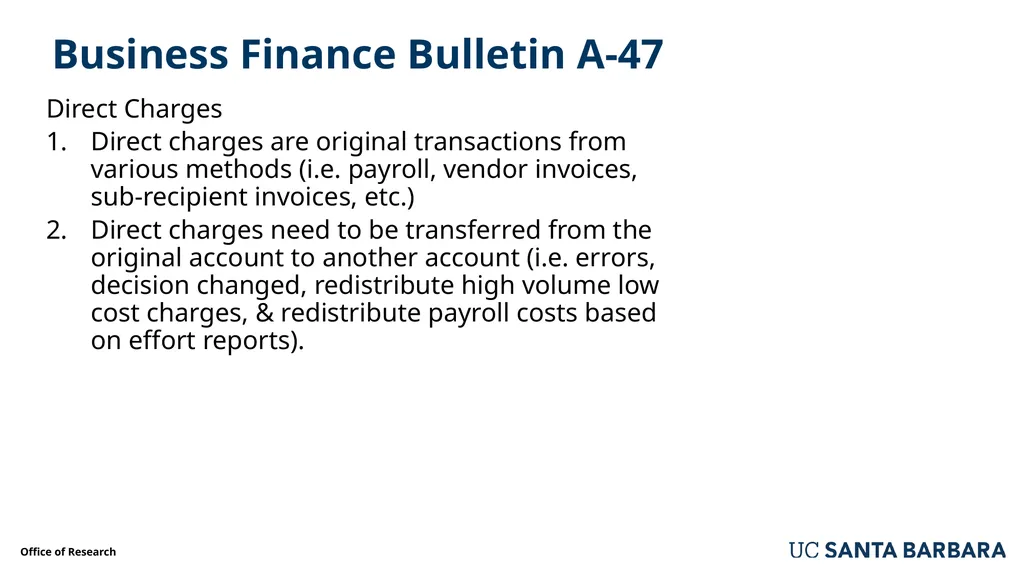
Business Finance Bulletin A-47 Direct Charges
Direct charges are original transactions from various methods (i.e. payroll, vendor invoices, sub-recipient invoices, etc.)
Direct charges need to be transferred from the original account to another account (i.e. errors, decision changed, redistribute high volume low cost charges, & redistribute payroll costs based on effort reports).<br>
Direct charges are original transactions from various methods (i.e. payroll, vendor invoices, sub-recipient invoices, etc.)
Direct charges need to be transferred from the original account to another account (i.e. errors, decision changed, redistribute high volume low cost charges, & redistribute payroll costs based on effort reports).<br>
47
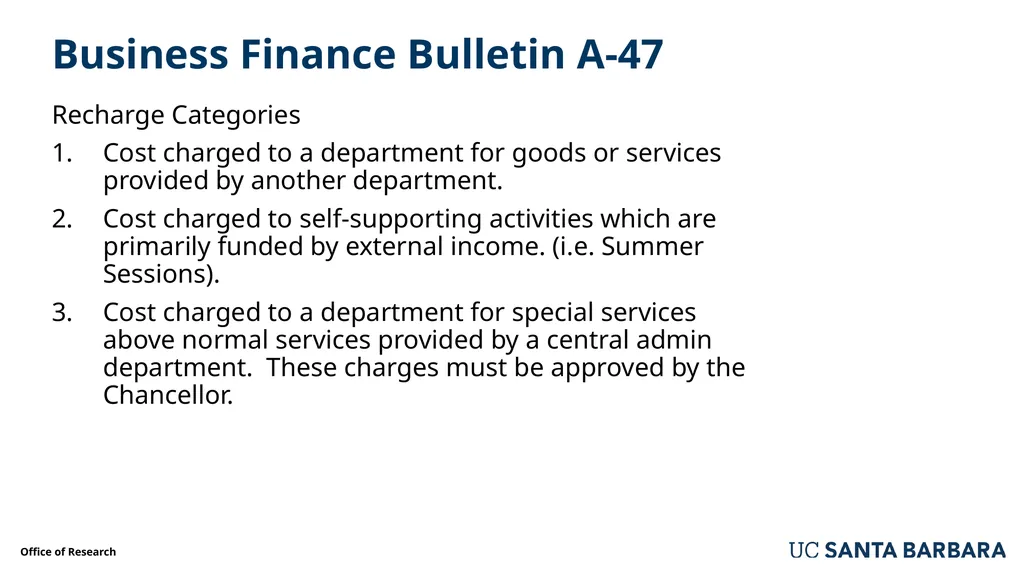
Recharge Categories
Cost charged to a department for goods or services provided by another department.
Cost charged to self-supporting activities which are primarily funded by external income. (i.e. Summer Sessions).
Cost charged to a department for special services above normal services provided by a central admin department. These charges must be approved by the Chancellor. Business Finance Bulletin A-47<br>
Cost charged to a department for goods or services provided by another department.
Cost charged to self-supporting activities which are primarily funded by external income. (i.e. Summer Sessions).
Cost charged to a department for special services above normal services provided by a central admin department. These charges must be approved by the Chancellor. Business Finance Bulletin A-47<br>
48
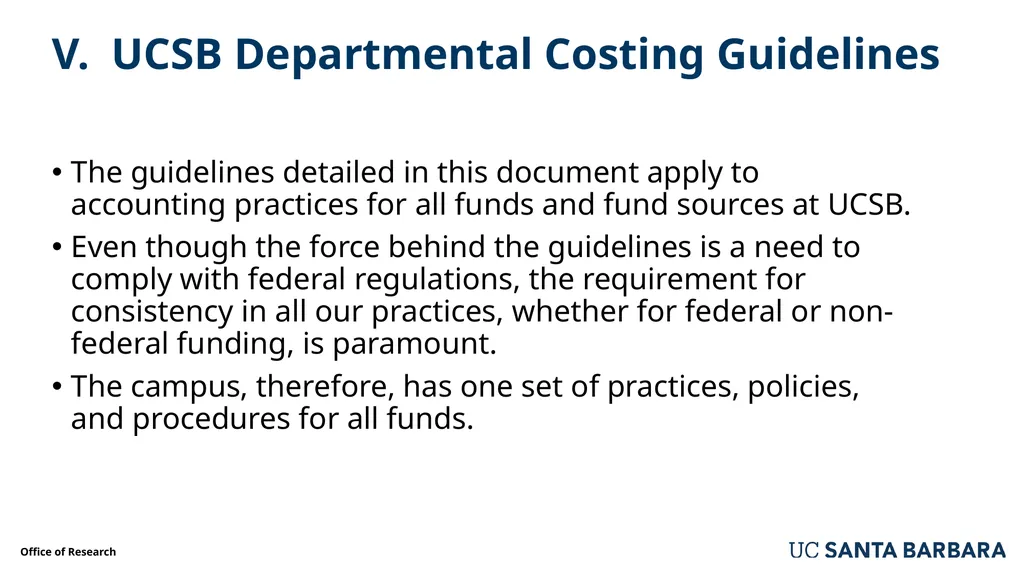
V. UCSB Departmental Costing Guidelines The guidelines detailed in this document apply to accounting practices for all funds and fund sources at UCSB.
Even though the force behind the guidelines is a need to comply with federal regulations, the requirement for consistency in all our practices, whether for federal or non-federal funding, is paramount.
The campus, therefore, has one set of practices, policies, and procedures for all funds.<br>
Even though the force behind the guidelines is a need to comply with federal regulations, the requirement for consistency in all our practices, whether for federal or non-federal funding, is paramount.
The campus, therefore, has one set of practices, policies, and procedures for all funds.<br>
49
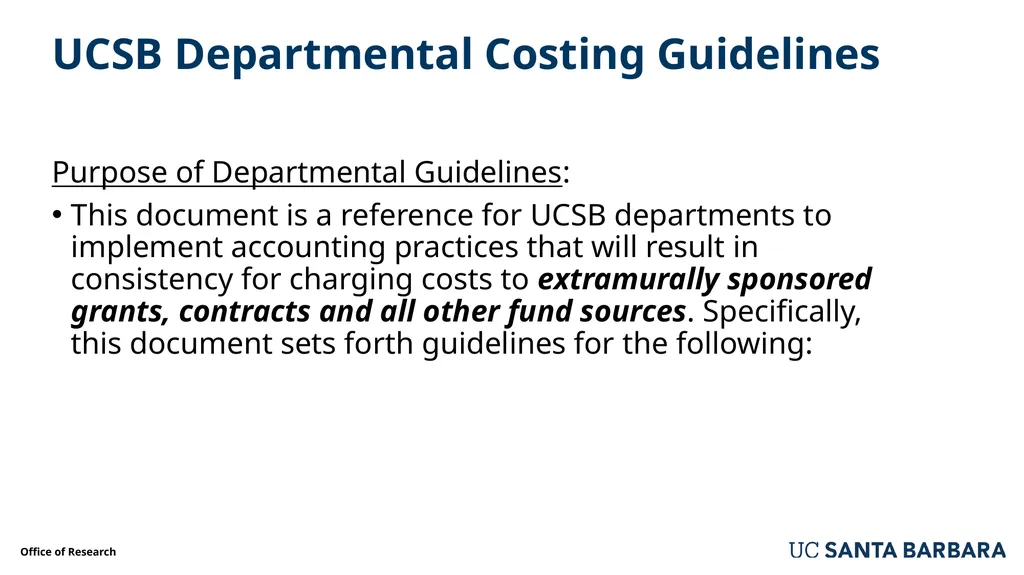
UCSB Departmental Costing Guidelines Purpose of Departmental Guidelines:
This document is a reference for UCSB departments to implement accounting practices that will result in consistency for charging costs to extramurally sponsored grants, contracts and all other fund sources. Specifically, this document sets forth guidelines for the following:<br>
This document is a reference for UCSB departments to implement accounting practices that will result in consistency for charging costs to extramurally sponsored grants, contracts and all other fund sources. Specifically, this document sets forth guidelines for the following:<br>
50
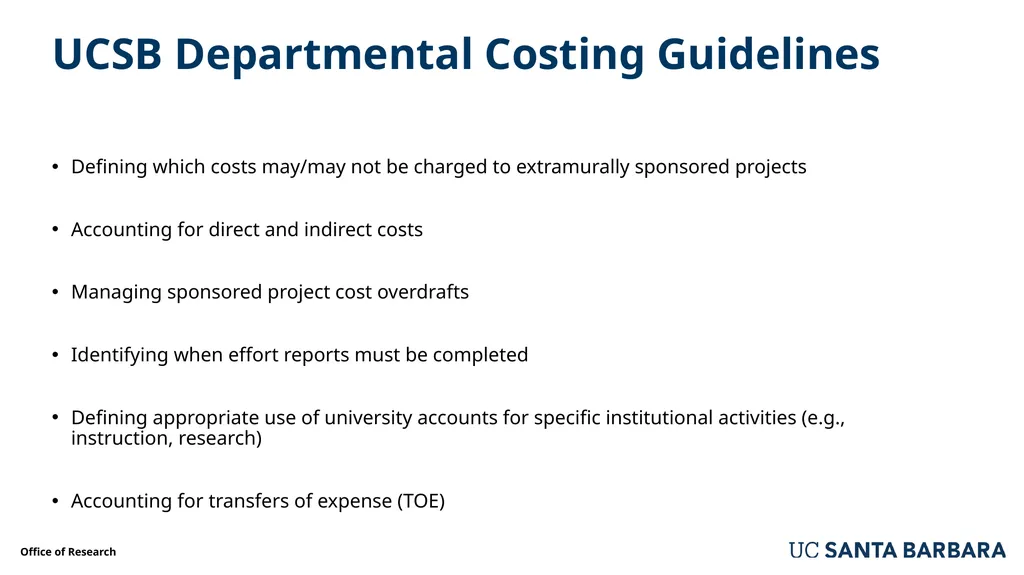
UCSB Departmental Costing Guidelines Defining which costs may/may not be charged to extramurally sponsored projects
Accounting for direct and indirect costs
Managing sponsored project cost overdrafts
Identifying when effort reports must be completed
Defining appropriate use of university accounts for specific institutional activities (e.g., instruction, research)
Accounting for transfers of expense (TOE)<br>
Accounting for direct and indirect costs
Managing sponsored project cost overdrafts
Identifying when effort reports must be completed
Defining appropriate use of university accounts for specific institutional activities (e.g., instruction, research)
Accounting for transfers of expense (TOE)<br>
51
VI. Costing Principles Direct Costs
F&A Costs
Major Projects
Object Code Listing<br>
F&A Costs
Major Projects
Object Code Listing<br>
52
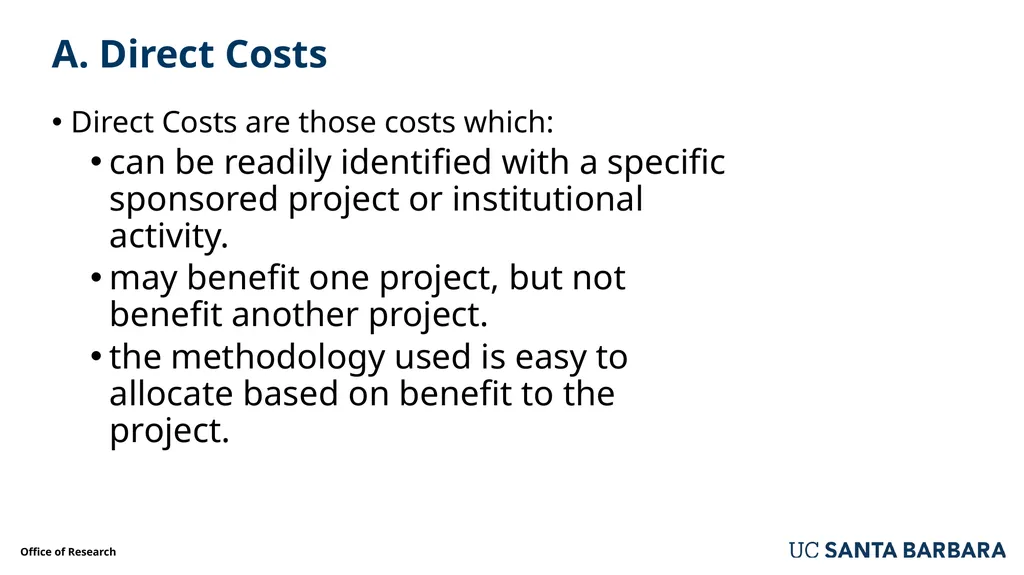
A. Direct Costs Direct Costs are those costs which:
can be readily identified with a specific sponsored project or institutional activity.
may benefit one project, but not benefit another project.
the methodology used is easy to allocate based on benefit to the project.<br>
can be readily identified with a specific sponsored project or institutional activity.
may benefit one project, but not benefit another project.
the methodology used is easy to allocate based on benefit to the project.<br>
53
Examples of Direct Costs Salaries and benefits (readily identifiable with a sponsored project or other institutional activity)
Travel
Scientific equipment<br>
Travel
Scientific equipment<br>
54
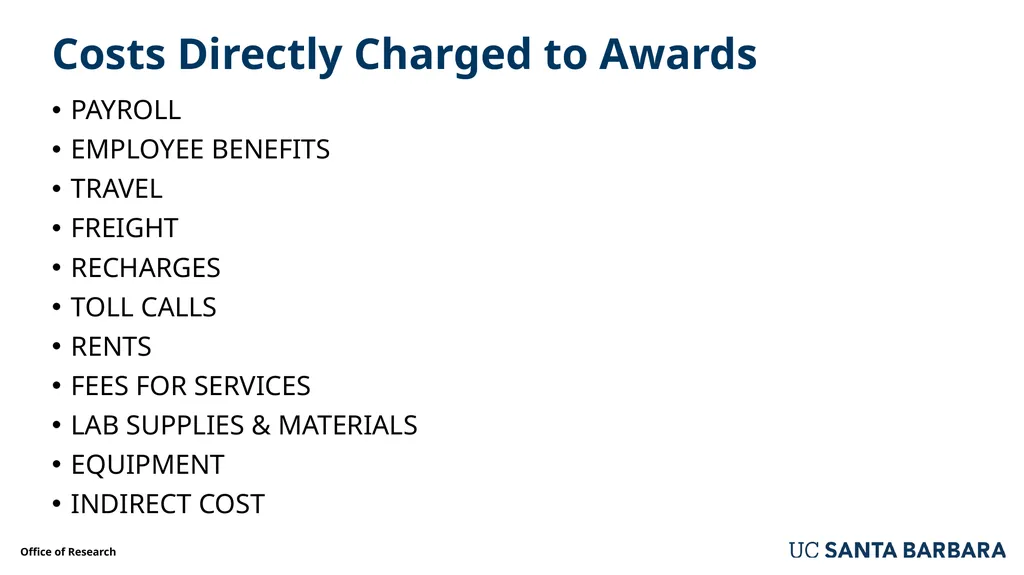
Costs Directly Charged to Awards PAYROLL
EMPLOYEE BENEFITS
TRAVEL
FREIGHT
RECHARGES
TOLL CALLS
RENTS
FEES FOR SERVICES
LAB SUPPLIES & MATERIALS
EQUIPMENT
INDIRECT COST<br>
EMPLOYEE BENEFITS
TRAVEL
FREIGHT
RECHARGES
TOLL CALLS
RENTS
FEES FOR SERVICES
LAB SUPPLIES & MATERIALS
EQUIPMENT
INDIRECT COST<br>
55
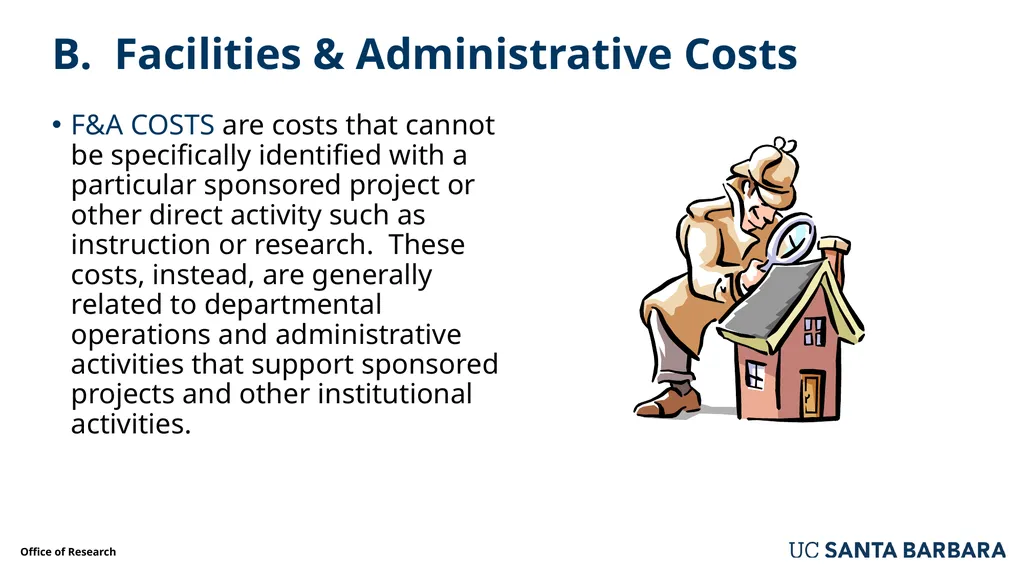
B. Facilities & Administrative Costs F&A COSTS are costs that cannot be specifically identified with a particular sponsored project or other direct activity such as instruction or research. These costs, instead, are generally related to departmental operations and administrative activities that support sponsored projects and other institutional activities.<br>
56
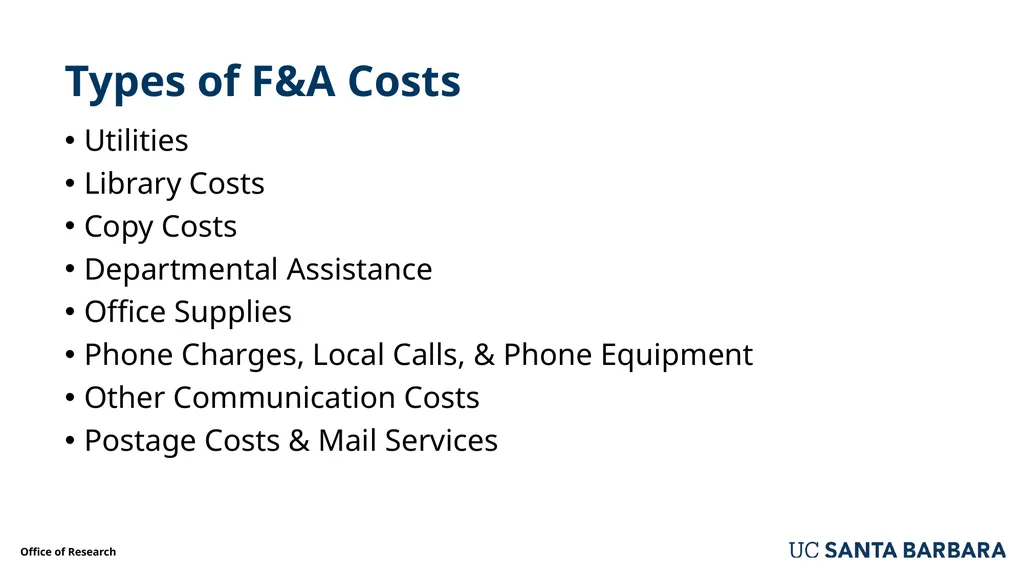
Types of F&A Costs Utilities
Library Costs
Copy Costs
Departmental Assistance
Office Supplies
Phone Charges, Local Calls, & Phone Equipment
Other Communication Costs
Postage Costs & Mail Services<br>
Library Costs
Copy Costs
Departmental Assistance
Office Supplies
Phone Charges, Local Calls, & Phone Equipment
Other Communication Costs
Postage Costs & Mail Services<br>
57
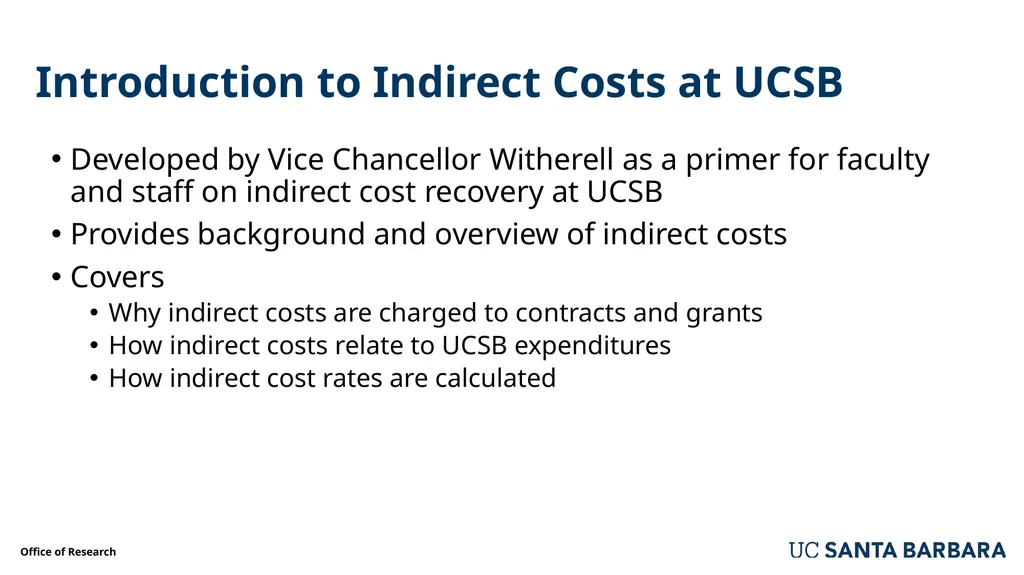
Introduction to Indirect Costs at UCSB Developed by Vice Chancellor Witherell as a primer for faculty and staff on indirect cost recovery at UCSB
Provides background and overview of indirect costs
Covers
Why indirect costs are charged to contracts and grants
How indirect costs relate to UCSB expenditures
How indirect cost rates are calculated<br>
Provides background and overview of indirect costs
Covers
Why indirect costs are charged to contracts and grants
How indirect costs relate to UCSB expenditures
How indirect cost rates are calculated<br>
58
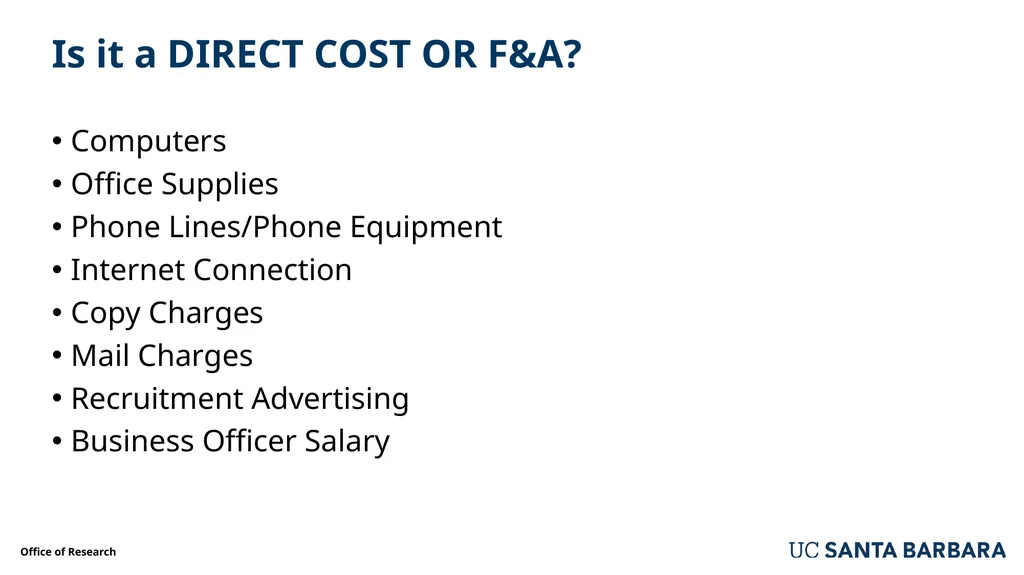
Is it a DIRECT COST OR F&A? Computers
Office Supplies
Phone Lines/Phone Equipment
Internet Connection
Copy Charges
Mail Charges
Recruitment Advertising
Business Officer Salary<br>
Office Supplies
Phone Lines/Phone Equipment
Internet Connection
Copy Charges
Mail Charges
Recruitment Advertising
Business Officer Salary<br>
59
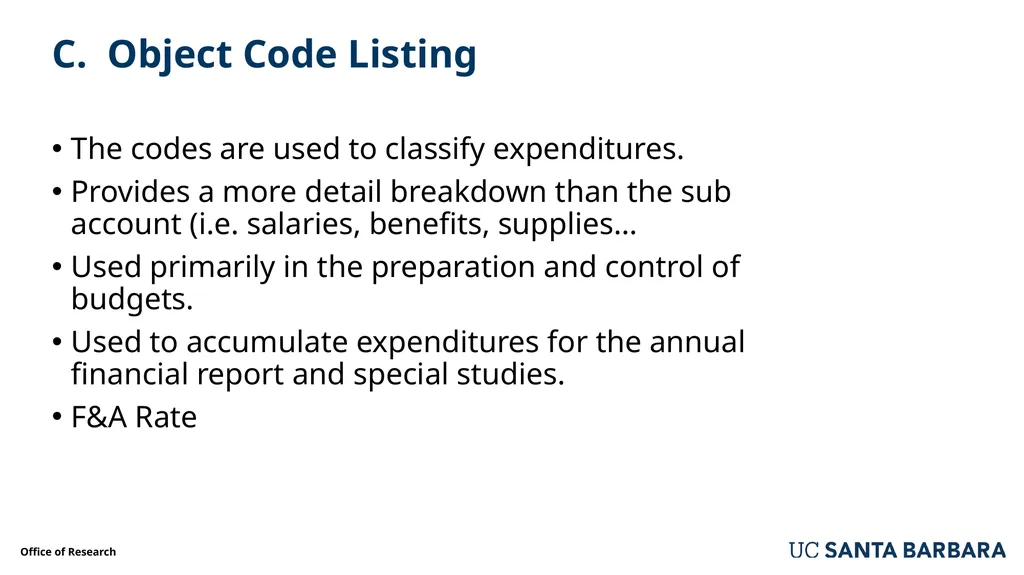
C. Object Code Listing The codes are used to classify expenditures.
Provides a more detail breakdown than the sub account (i.e. salaries, benefits, supplies…
Used primarily in the preparation and control of budgets.
Used to accumulate expenditures for the annual financial report and special studies.
F&A Rate<br>
Provides a more detail breakdown than the sub account (i.e. salaries, benefits, supplies…
Used primarily in the preparation and control of budgets.
Used to accumulate expenditures for the annual financial report and special studies.
F&A Rate<br>
60
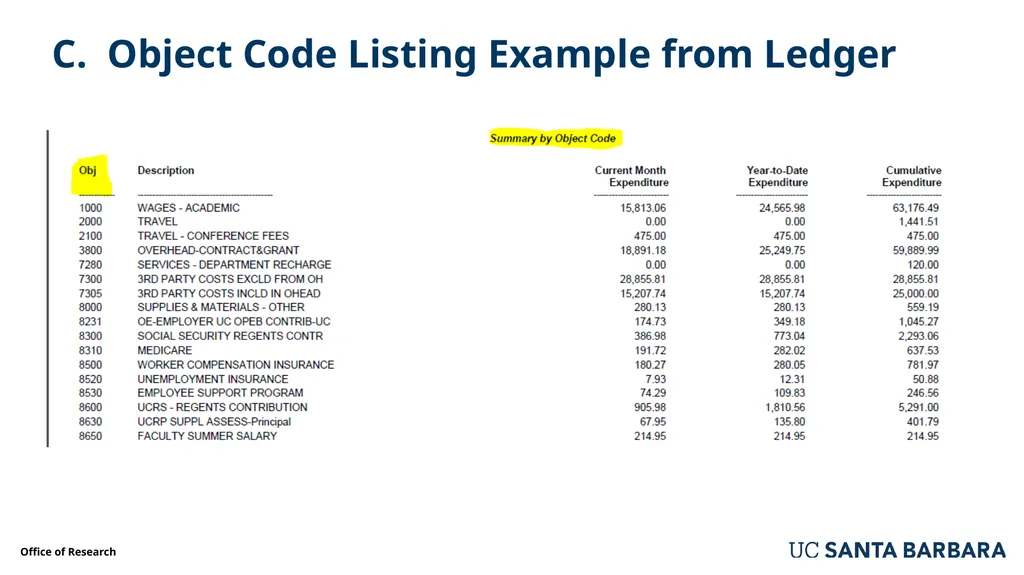
C. Object Code Listing Example from Ledger<br>
61
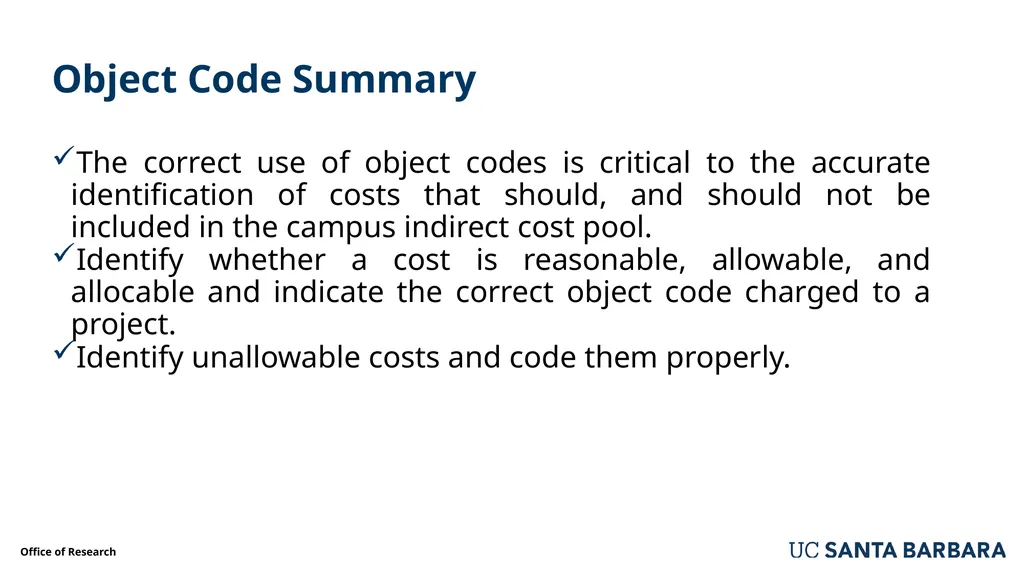
Object Code Summary The correct use of object codes is critical to the accurate identification of costs that should, and should not be included in the campus indirect cost pool.
Identify whether a cost is reasonable, allowable, and allocable and indicate the correct object code charged to a project.
Identify unallowable costs and code them properly.<br>
Identify whether a cost is reasonable, allowable, and allocable and indicate the correct object code charged to a project.
Identify unallowable costs and code them properly.<br>
62
Subcontracts/Subgrants Subcontract is an award made to a third party outside the University to perform a portion of the scope of work on a project.
Subcontracts are given a unique KK number by Office of Research.
Expenditures of $25,000 or less will be charged F&A at the negotiated rate(7305).
Subcontract expenditures over $25,000 for the same third party will be excluded from additional F&A charges (7300).<br>
Subcontracts are given a unique KK number by Office of Research.
Expenditures of $25,000 or less will be charged F&A at the negotiated rate(7305).
Subcontract expenditures over $25,000 for the same third party will be excluded from additional F&A charges (7300).<br>
63
September 2010 Audit Initiation - The University was notified regarding the audit.
3-Year Audit Period – 2008-2010
Fieldwork 2010-2011
Final Audit report September 28, 2012 VII. – National Science Foundation Audit<br>
3-Year Audit Period – 2008-2010
Fieldwork 2010-2011
Final Audit report September 28, 2012 VII. – National Science Foundation Audit<br>
64
September 2012 NSF-OIG Audit Report Findings Audit Results – $6.3 Million Is Questioned Because UCSB Did Not Comply with Federal and NSF Award Requirements<br>
65
Finding 1 Over $1.9 Million of Overcharged Summer Salaries<br>
66
Finding 2 Over $2.8 Million of Excess Federal Cash Disbursements Resulted From Not Fulfilling Grant Cost Share Requirements<br>
67
Finding 3 Approximately $500,000 of Inappropriate Cost Transfers Into NSF Awards<br>
68
Finding 4 Over $473,000 of Indirect Cost Overcharges to NSF Grants<br>
69
Finding 5 $440,000 of Unallowable Costs Charged to NSF Grants<br>
70
Finding 6 UCSB Used $180,000 of Remaining Fellowship Funds for Non-Award Purposes<br>
71
Final Resolution:
UCSB returned $43,000 of disallowed costs<br>
UCSB returned $43,000 of disallowed costs<br>
72
August 21, 2015
In the NSF's Priciest Grant-Fraud Settlement, Northeastern University Will Pay $2.7 Million<br>
In the NSF's Priciest Grant-Fraud Settlement, Northeastern University Will Pay $2.7 Million<br>
73
The case stems from the management of NSF grant money awarded to Northeastern for work at CERN, the European Organization for Nuclear Research, from 2001 to 2010. The work was led by a professor of physics, Stephen Reucroft.<br>
74
The university issued a written statement that put the blame largely on the PI, who retired from Northeastern in 2010.
"The conduct in question related to accounting and grant oversight," Northeastern said in a written statement. "The university self-reported the discrepancies to the funding agency, the National Science Foundation, as soon as they were discovered and fully cooperated with the agency’s review."<br>
"The conduct in question related to accounting and grant oversight," Northeastern said in a written statement. "The university self-reported the discrepancies to the funding agency, the National Science Foundation, as soon as they were discovered and fully cooperated with the agency’s review."<br>
75
But the terms of the $2.7-million settlement suggested that Northeastern bore substantial responsibility. According to the agreement, the university failed to provide necessary oversight, failed to pay interest due, paid salaries without required documentation, and paid expense money based on inadequate or fraudulent documentation submitted by the PI.
Northeastern "continued to engage in these practices when it knew or should have known in 2006, if not before, that Professor Reucroft had violated NSF requirements when he submitted fraudulent claims for personal expenses," said the settlement.<br>
Northeastern "continued to engage in these practices when it knew or should have known in 2006, if not before, that Professor Reucroft had violated NSF requirements when he submitted fraudulent claims for personal expenses," said the settlement.<br>
76
Altogether the university "approved and disbursed at least 26 advances, totaling approximately $8.4 million in NSF funds, to CERN team accounts without required verification of need and sufficient oversight," the settlement said.
The PI denied authorizing any improper expenses, and said he has not been contacted since his 2010 retirement by anyone at Northeastern, the NSF, or the U.S. DoE. "I am at a loss to understand it," he said of the complaint and settlement. "I am also a bit surprised that I have not been involved in the process."<br>
The PI denied authorizing any improper expenses, and said he has not been contacted since his 2010 retirement by anyone at Northeastern, the NSF, or the U.S. DoE. "I am at a loss to understand it," he said of the complaint and settlement. "I am also a bit surprised that I have not been involved in the process."<br>
77
The NSF’s Office of Inspector General handled the investigation. A spokeswoman with the office said she had no comment on the case, which she described as the OIG’s largest civil investigative recovery of NSF award funds<br>
78
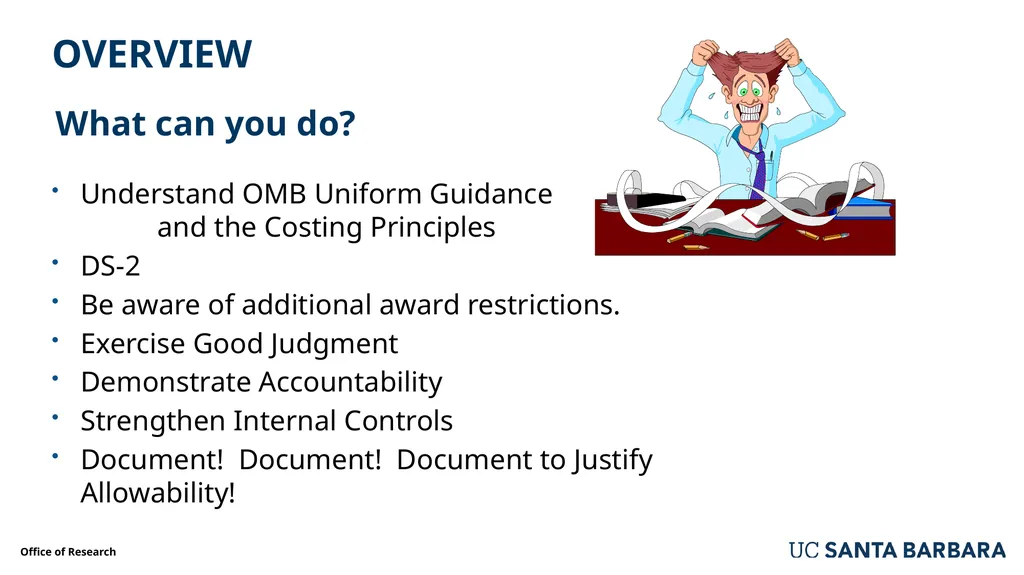
Understand OMB Uniform Guidance
and the Costing Principles
DS-2
Be aware of additional award restrictions.
Exercise Good Judgment
Demonstrate Accountability
Strengthen Internal Controls
Document! Document! Document to Justify Allowability! What can you do? OVERVIEW<br>
DS-2
Be aware of additional award restrictions.
Exercise Good Judgment
Demonstrate Accountability
Strengthen Internal Controls
Document! Document! Document to Justify Allowability! What can you do? OVERVIEW<br>
79
Resources OMB Uniform Guidance
http://www.bfs.ucsb.edu/omb/omb-uniform-guidance
Business Finance Bulletin A-47
http://policy.ucop.edu/doc/3420326/BFB-A-47
Departmental Costing Guidelines
http://www.bfs.ucsb.edu/sites/www.bfs.ucsb.edu/files/docs/extramural_funds/Guide%20to%20Allowable%20Costs%20%28final%29.pdf
Object Code Listing
https://www.bfs.ucsb.edu/sites/www.bfs.ucsb.edu/files/docs/accounting/Object-Code-Listing-Basic.pdf
Disclosure Statement (Form DS-2)
http://www.bfs.ucsb.edu/files/docs/extramural_funds/efm-disclosure-statement.pdf<br>
http://www.bfs.ucsb.edu/omb/omb-uniform-guidance
Business Finance Bulletin A-47
http://policy.ucop.edu/doc/3420326/BFB-A-47
Departmental Costing Guidelines
http://www.bfs.ucsb.edu/sites/www.bfs.ucsb.edu/files/docs/extramural_funds/Guide%20to%20Allowable%20Costs%20%28final%29.pdf
Object Code Listing
https://www.bfs.ucsb.edu/sites/www.bfs.ucsb.edu/files/docs/accounting/Object-Code-Listing-Basic.pdf
Disclosure Statement (Form DS-2)
http://www.bfs.ucsb.edu/files/docs/extramural_funds/efm-disclosure-statement.pdf<br>
80
F&A Resources IDC Rate Agreement https://www.bfs.ucsb.edu/sites/www.bfs.ucsb.edu/files/docs/extramural_funds/Federal_Indirect_Cost_Rate_Agreement_Signed_2017-10-04.pdf
Introduction to IDC by V.C. Witherell
https://www.research.ucsb.edu/media/199439/introduction_to_indirect_costs.pdf
Typically F&A Listing
http://www.bfs.ucsb.edu/extramural-funds/awards/typically-fa-unallowables-object-codes<br>
Introduction to IDC by V.C. Witherell
https://www.research.ucsb.edu/media/199439/introduction_to_indirect_costs.pdf
Typically F&A Listing
http://www.bfs.ucsb.edu/extramural-funds/awards/typically-fa-unallowables-object-codes<br>
81
Additional Resources Equipment Management-Vaughn Boyle
vaughn.boyle@purc.ucsb.edu (ext.7377)
Travel-Annette Gonzales (ext.7037)
annette.gonzales@bfs.ucsb.edu<br>
vaughn.boyle@purc.ucsb.edu (ext.7377)
Travel-Annette Gonzales (ext.7037)
annette.gonzales@bfs.ucsb.edu<br>
82
QUESTIONS??<br>