
Starter EXTRA: WRITE THE SENTENCES IN ENGLISH.

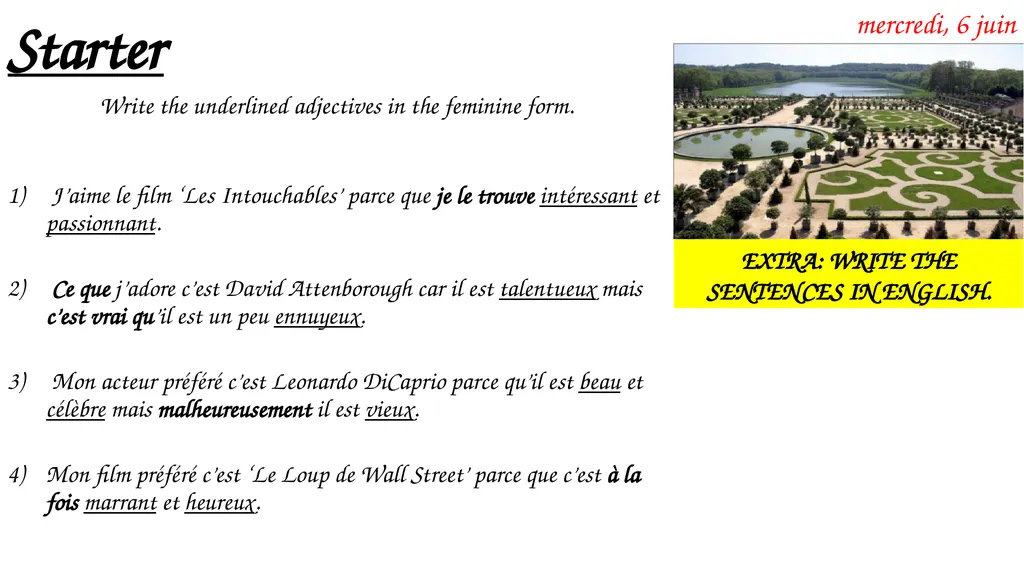

Description: Starter EXTRA: WRITE THE SENTENCES IN ENGLISH. mercredi, 6 juin Jaime le film Les Intouchables parce que je le trouve intéressant et passionnant. Ce que jadore cest David Attenborough car il est talentueux mais cest vrai quil est un
Related Topics
Download Presentation
"Starter EXTRA: WRITE THE SENTENCES IN ENGLISH." is the property of its rightful owner. Permission is granted to download and print the materials on this website for personal, non-commercial use only, and to display it on your personal computer provided you do not modify the materials and that you retain all copyright notices contained in the materials. By downloading content from our website, you accept the terms of this agreement.
Presentation Transcript
slide1. Starter EXTRA: WRITE THE SENTENCES IN ENGLISH. mercredi, 6 juin J’aime le film ‘Les Intouchables’ parce que je le trouve intéressant et passionnant.
Ce que j’adore c’est David Attenborough car il est talentueux mais c’est vrai qu’il est un peu ennuyeux.
Mon acteur préféré c’est Leonardo DiCaprio parce qu’il est beau et célèbre mais malheureusement il est vieux.
Mon film préféré c’est ‘Le Loup de Wall Street’ parce que c’est à la fois marrant et heureux. Write the underlined adjectives in the feminine form.<br>
slide2. mercredi, 6 juin Il fait beau We will have revised what we already know about adjectives in French.
We will know how to place adjectives and be able to spot masculine and feminine nouns.
We will learn all of the adjective agreement rules and revise these for homework. To be able to use adjectives effectively in French. Objectif: Résultat:<br>
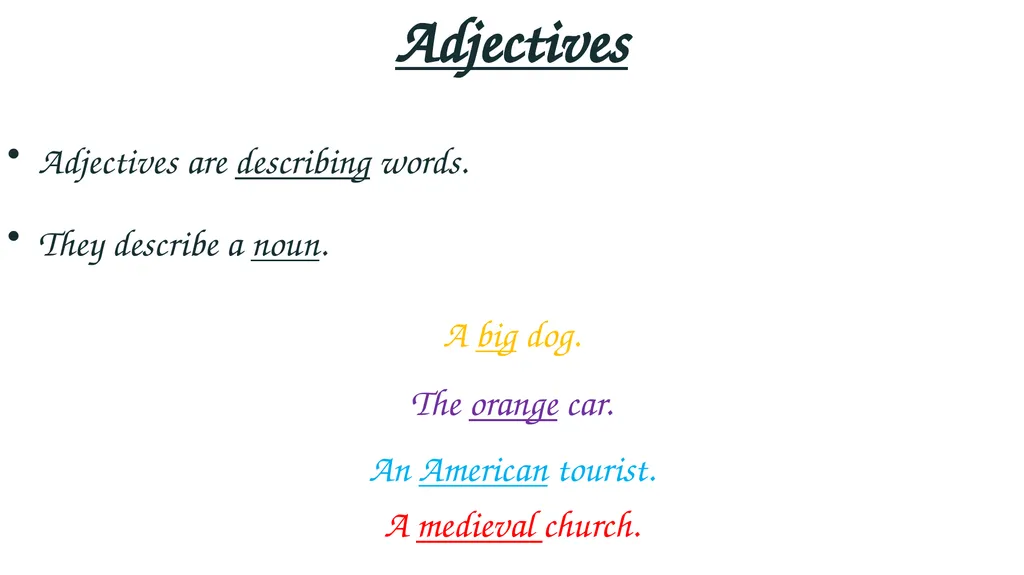
slide3. 3 A big dog. Adjectives Adjectives are describing words. They describe a noun. The orange car. An American tourist. A medieval church.<br>
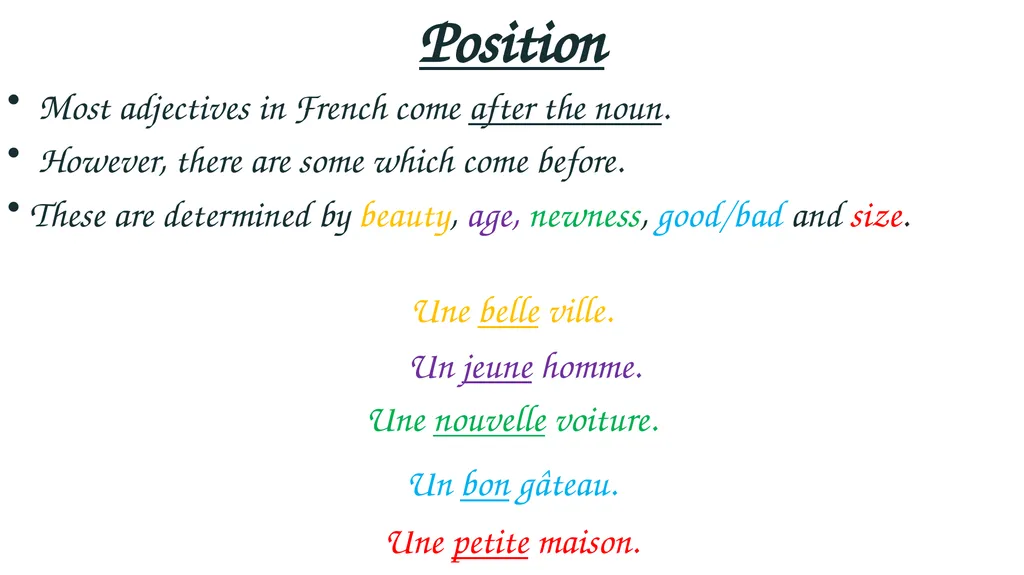
slide4. 4 Une belle ville. Position Most adjectives in French come after the noun. However, there are some which come before. Une nouvelle voiture. Un bon gâteau. Une petite maison. These are determined by beauty, age, newness, good/bad and size. Un jeune homme.<br>
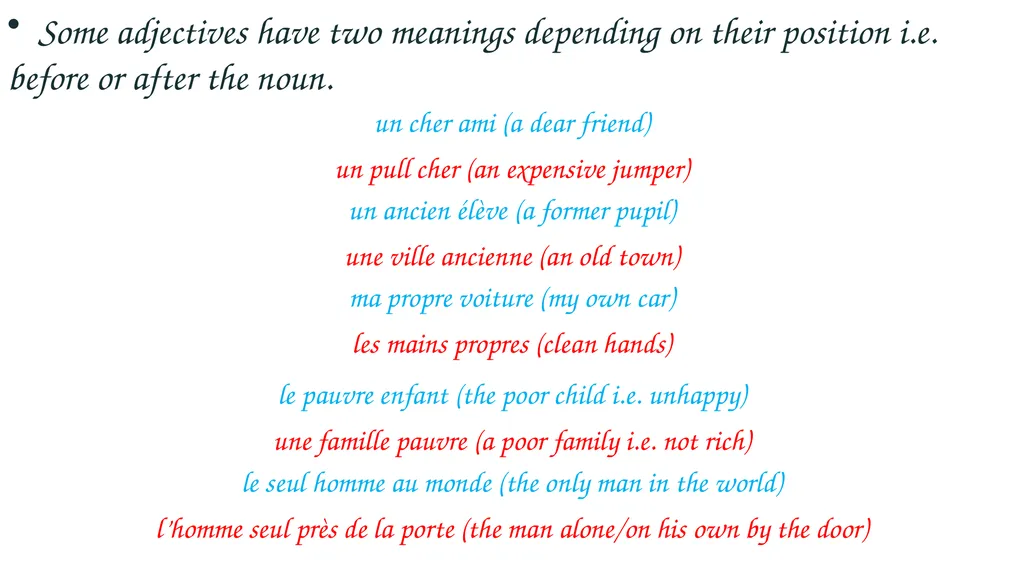
slide5. 5 Some adjectives have two meanings depending on their position i.e. before or after the noun. un cher ami (a dear friend)
un pull cher (an expensive jumper) un ancien élève (a former pupil)
une ville ancienne (an old town) ma propre voiture (my own car)
les mains propres (clean hands) le pauvre enfant (the poor child i.e. unhappy)
une famille pauvre (a poor family i.e. not rich) le seul homme au monde (the only man in the world)
l’homme seul près de la porte (the man alone/on his own by the door)<br>
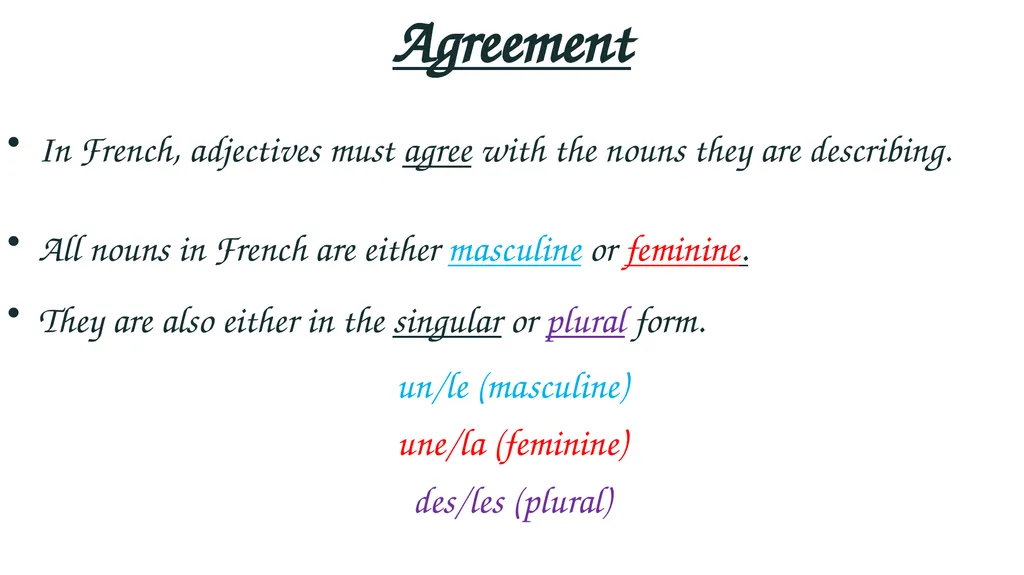
slide6. 6 Agreement In French, adjectives must agree with the nouns they are describing. des/les (plural) un/le (masculine) une/la (feminine) All nouns in French are either masculine or feminine. They are also either in the singular or plural form.<br>
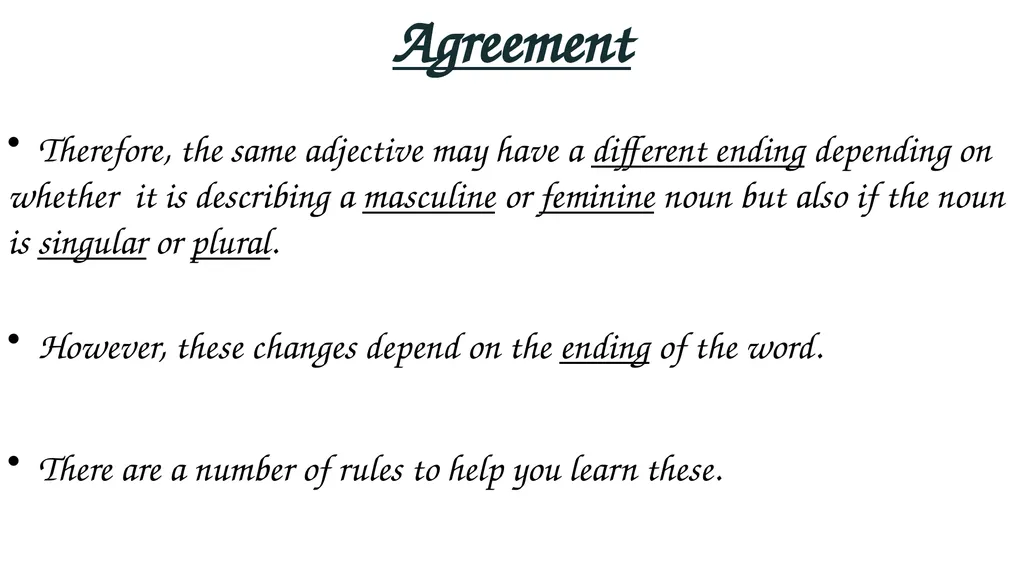
slide7. 7 Agreement Therefore, the same adjective may have a different ending depending on whether it is describing a masculine or feminine noun but also if the noun is singular or plural. However, these changes depend on the ending of the word. There are a number of rules to help you learn these.<br>
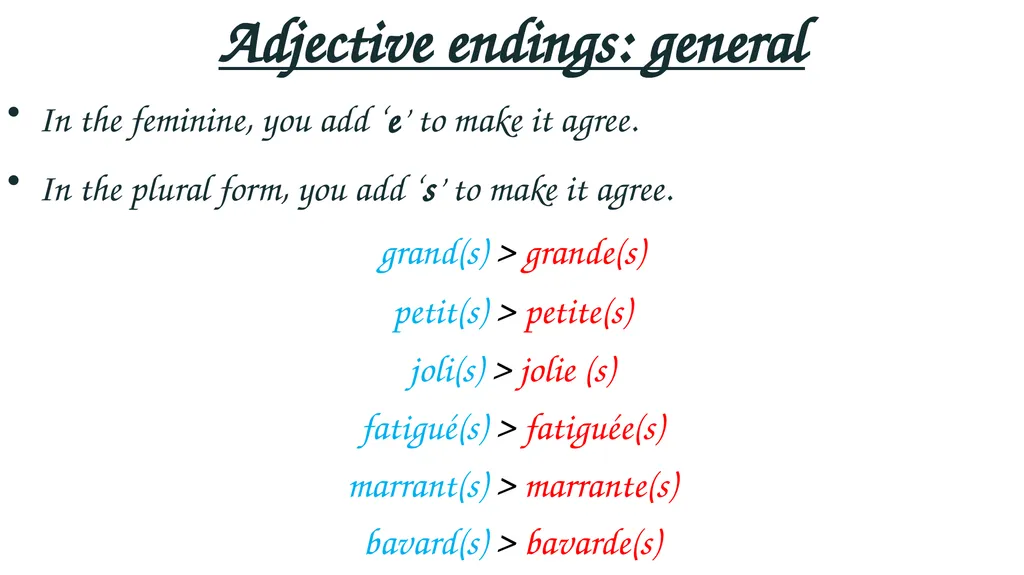
slide8. 8 grand(s) > grande(s) Adjective endings: general In the feminine, you add ‘e’ to make it agree. In the plural form, you add ‘s’ to make it agree. fatigué(s) > fatiguée(s) marrant(s) > marrante(s) bavard(s) > bavarde(s) petit(s) > petite(s) joli(s) > jolie (s)<br>
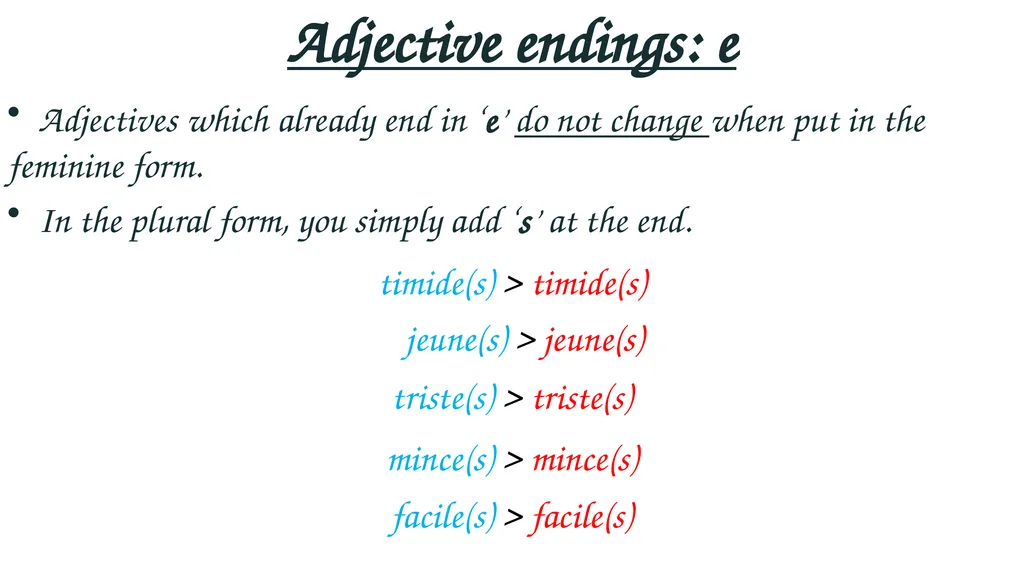
slide9. 9 timide(s) > timide(s) Adjective endings: e Adjectives which already end in ‘e’ do not change when put in the feminine form. In the plural form, you simply add ‘s’ at the end. triste(s) > triste(s) mince(s) > mince(s) facile(s) > facile(s) jeune(s) > jeune(s)<br>
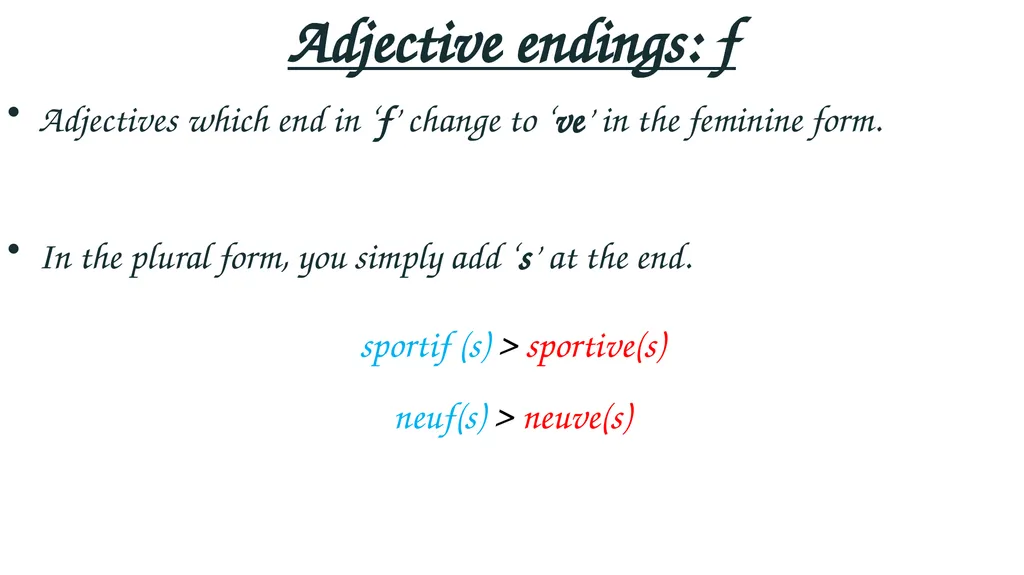
slide10. 10 sportif (s) > sportive(s) Adjective endings: f Adjectives which end in ‘f’ change to ‘ve’ in the feminine form. In the plural form, you simply add ‘s’ at the end. neuf(s) > neuve(s)<br>
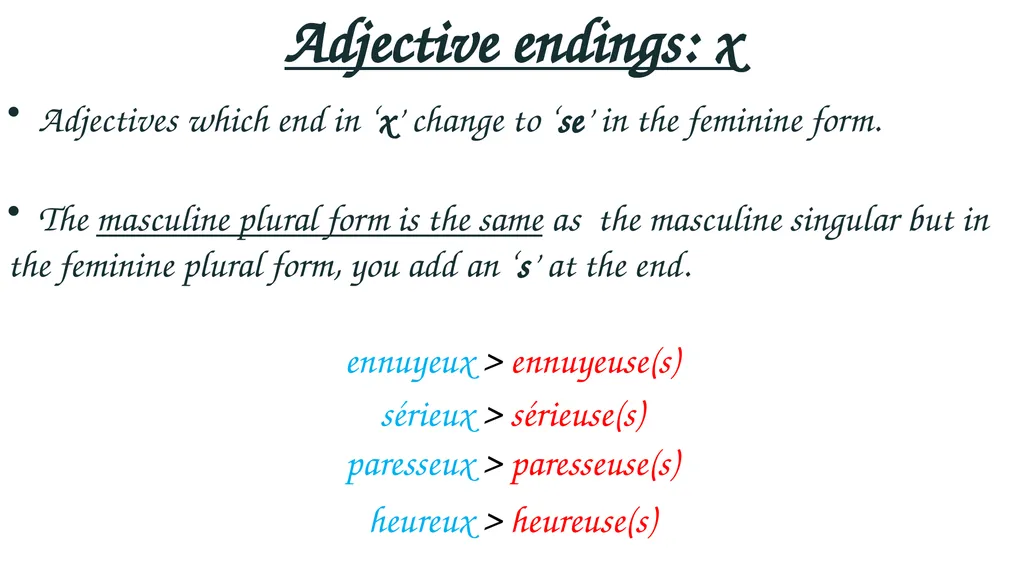
slide11. 11 ennuyeux > ennuyeuse(s) Adjective endings: x Adjectives which end in ‘x’ change to ‘se’ in the feminine form. The masculine plural form is the same as the masculine singular but in the feminine plural form, you add an ‘s’ at the end. sérieux > sérieuse(s) paresseux > paresseuse(s) heureux > heureuse(s)<br>
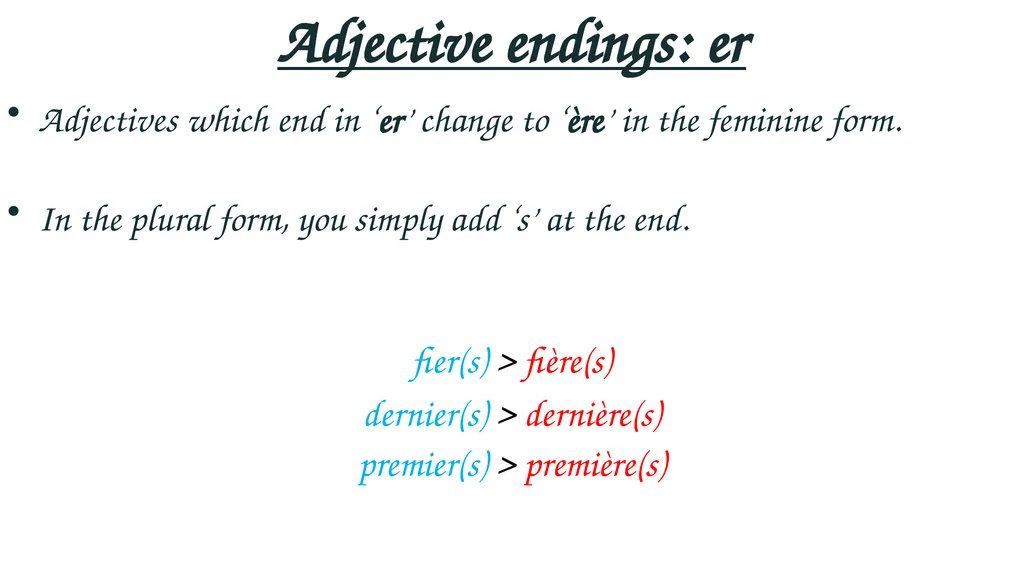
slide12. 12 fier(s) > fière(s) Adjective endings: er Adjectives which end in ‘er’ change to ‘ère’ in the feminine form. In the plural form, you simply add ‘s’ at the end. dernier(s) > dernière(s) premier(s) > première(s)<br>
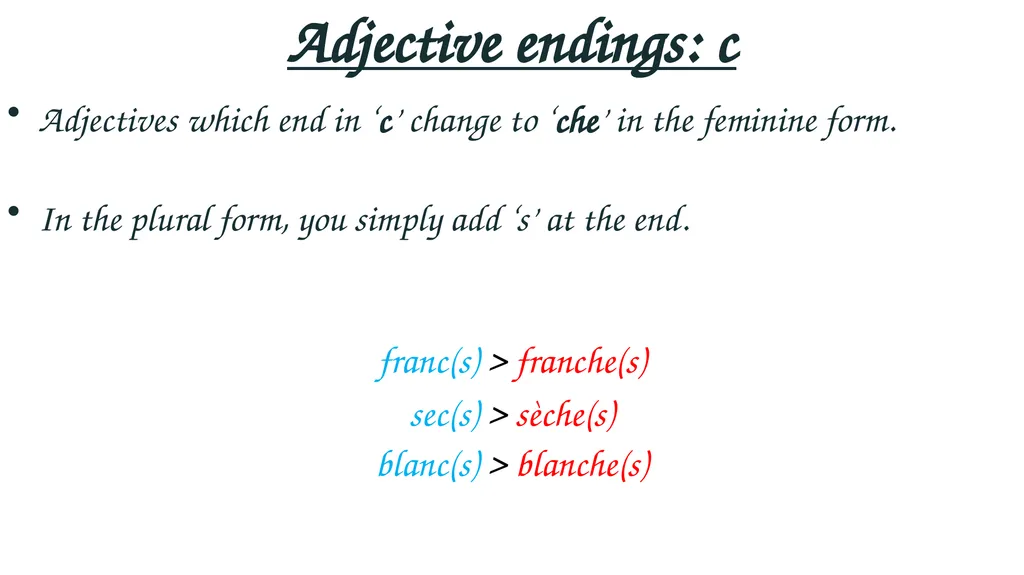
slide13. 13 franc(s) > franche(s) Adjective endings: c Adjectives which end in ‘c’ change to ‘che’ in the feminine form. In the plural form, you simply add ‘s’ at the end. sec(s) > sèche(s) blanc(s) > blanche(s)<br>
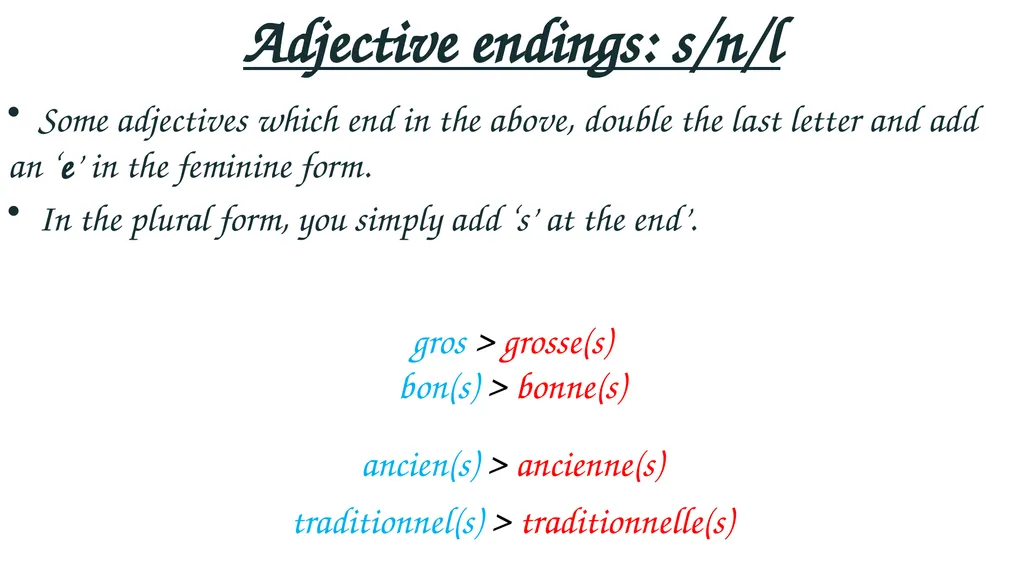
slide14. 14 gros > grosse(s) Adjective endings: s/n/l Some adjectives which end in the above, double the last letter and add an ‘e’ in the feminine form. In the plural form, you simply add ‘s’ at the end’. bon(s) > bonne(s) traditionnel(s) > traditionnelle(s) ancien(s) > ancienne(s)<br>
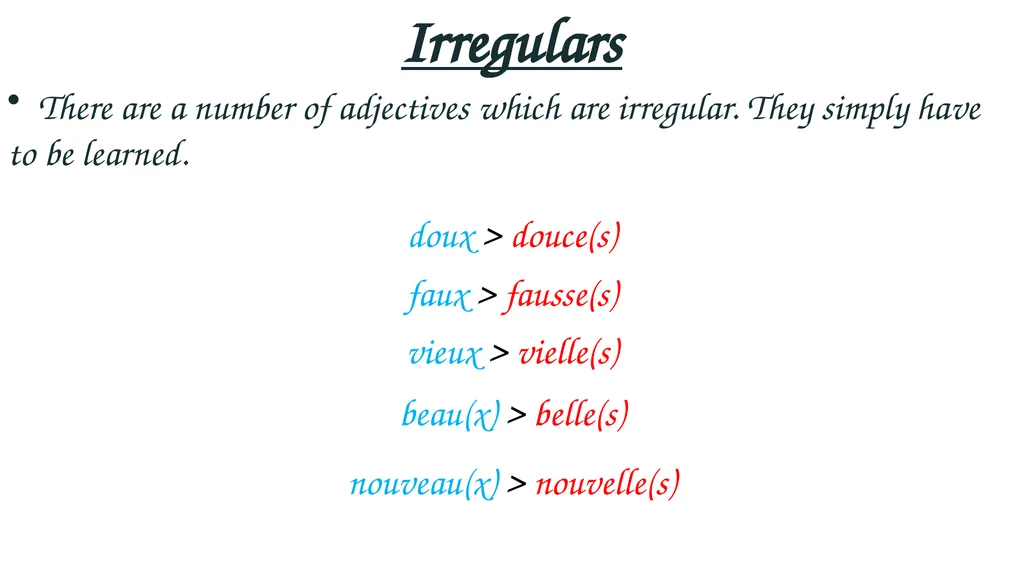
slide15. 15 beau(x) > belle(s) Irregulars There are a number of adjectives which are irregular. They simply have to be learned. nouveau(x) > nouvelle(s) doux > douce(s) faux > fausse(s) vieux > vielle(s)<br>
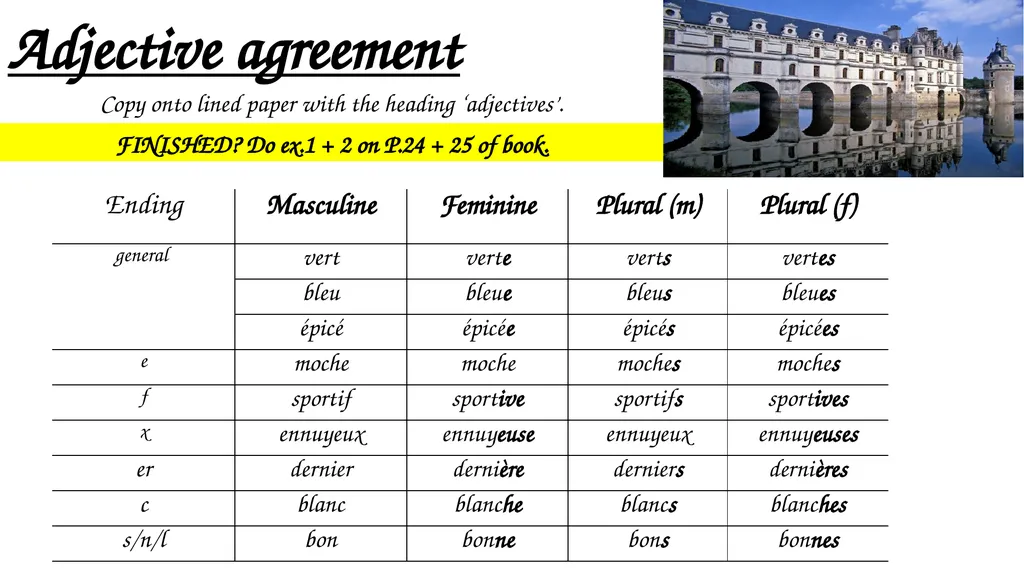
slide16. Copy onto lined paper with the heading ‘adjectives’. Adjective agreement FINISHED? Do ex.1 + 2 on P.24 + 25 of book.<br>
slide17. Show me boards.<br>
Ce que j’adore c’est David Attenborough car il est talentueux mais c’est vrai qu’il est un peu ennuyeux.
Mon acteur préféré c’est Leonardo DiCaprio parce qu’il est beau et célèbre mais malheureusement il est vieux.
Mon film préféré c’est ‘Le Loup de Wall Street’ parce que c’est à la fois marrant et heureux. Write the underlined adjectives in the feminine form.<br>
slide2. mercredi, 6 juin Il fait beau We will have revised what we already know about adjectives in French.
We will know how to place adjectives and be able to spot masculine and feminine nouns.
We will learn all of the adjective agreement rules and revise these for homework. To be able to use adjectives effectively in French. Objectif: Résultat:<br>
slide3. 3 A big dog. Adjectives Adjectives are describing words. They describe a noun. The orange car. An American tourist. A medieval church.<br>
slide4. 4 Une belle ville. Position Most adjectives in French come after the noun. However, there are some which come before. Une nouvelle voiture. Un bon gâteau. Une petite maison. These are determined by beauty, age, newness, good/bad and size. Un jeune homme.<br>
slide5. 5 Some adjectives have two meanings depending on their position i.e. before or after the noun. un cher ami (a dear friend)
un pull cher (an expensive jumper) un ancien élève (a former pupil)
une ville ancienne (an old town) ma propre voiture (my own car)
les mains propres (clean hands) le pauvre enfant (the poor child i.e. unhappy)
une famille pauvre (a poor family i.e. not rich) le seul homme au monde (the only man in the world)
l’homme seul près de la porte (the man alone/on his own by the door)<br>
slide6. 6 Agreement In French, adjectives must agree with the nouns they are describing. des/les (plural) un/le (masculine) une/la (feminine) All nouns in French are either masculine or feminine. They are also either in the singular or plural form.<br>
slide7. 7 Agreement Therefore, the same adjective may have a different ending depending on whether it is describing a masculine or feminine noun but also if the noun is singular or plural. However, these changes depend on the ending of the word. There are a number of rules to help you learn these.<br>
slide8. 8 grand(s) > grande(s) Adjective endings: general In the feminine, you add ‘e’ to make it agree. In the plural form, you add ‘s’ to make it agree. fatigué(s) > fatiguée(s) marrant(s) > marrante(s) bavard(s) > bavarde(s) petit(s) > petite(s) joli(s) > jolie (s)<br>
slide9. 9 timide(s) > timide(s) Adjective endings: e Adjectives which already end in ‘e’ do not change when put in the feminine form. In the plural form, you simply add ‘s’ at the end. triste(s) > triste(s) mince(s) > mince(s) facile(s) > facile(s) jeune(s) > jeune(s)<br>
slide10. 10 sportif (s) > sportive(s) Adjective endings: f Adjectives which end in ‘f’ change to ‘ve’ in the feminine form. In the plural form, you simply add ‘s’ at the end. neuf(s) > neuve(s)<br>
slide11. 11 ennuyeux > ennuyeuse(s) Adjective endings: x Adjectives which end in ‘x’ change to ‘se’ in the feminine form. The masculine plural form is the same as the masculine singular but in the feminine plural form, you add an ‘s’ at the end. sérieux > sérieuse(s) paresseux > paresseuse(s) heureux > heureuse(s)<br>
slide12. 12 fier(s) > fière(s) Adjective endings: er Adjectives which end in ‘er’ change to ‘ère’ in the feminine form. In the plural form, you simply add ‘s’ at the end. dernier(s) > dernière(s) premier(s) > première(s)<br>
slide13. 13 franc(s) > franche(s) Adjective endings: c Adjectives which end in ‘c’ change to ‘che’ in the feminine form. In the plural form, you simply add ‘s’ at the end. sec(s) > sèche(s) blanc(s) > blanche(s)<br>
slide14. 14 gros > grosse(s) Adjective endings: s/n/l Some adjectives which end in the above, double the last letter and add an ‘e’ in the feminine form. In the plural form, you simply add ‘s’ at the end’. bon(s) > bonne(s) traditionnel(s) > traditionnelle(s) ancien(s) > ancienne(s)<br>
slide15. 15 beau(x) > belle(s) Irregulars There are a number of adjectives which are irregular. They simply have to be learned. nouveau(x) > nouvelle(s) doux > douce(s) faux > fausse(s) vieux > vielle(s)<br>
slide16. Copy onto lined paper with the heading ‘adjectives’. Adjective agreement FINISHED? Do ex.1 + 2 on P.24 + 25 of book.<br>
slide17. Show me boards.<br>