starter Mallets mallet Player A states an aid
Description: starter Mallets mallet Player A states an aid Player B states benefit Player A states an negative Player B states an aid. Player C (Buzz if you stall or say erm) ABC based on confidence. Exercise Physiology DTA training Exercise
Related Topics
Download Presentation
"starter Mallets mallet Player A states an aid" is the property of its rightful owner. Permission is granted to download and print the materials on this website for personal, non-commercial use only, and to display it on your personal computer provided you do not modify the materials and that you retain all copyright notices contained in the materials. By downloading content from our website, you accept the terms of this agreement.
Presentation Transcript
slide1. starter Mallets mallet
Player A states an aid
Player B states benefit
Player A states an negative
Player B states an aid.
Player C (Buzz if you stall or say ‘erm’) ABC based on confidence.<br>
slide2. Exercise Physiology DTA<br>
slide3. training Exercise physiology is the response of the body’s anatomy to exercise.
Training is concerned with how you can maximise the performance and maintain a active healthy lifestyle.
One method is to have an effective training programme<br>
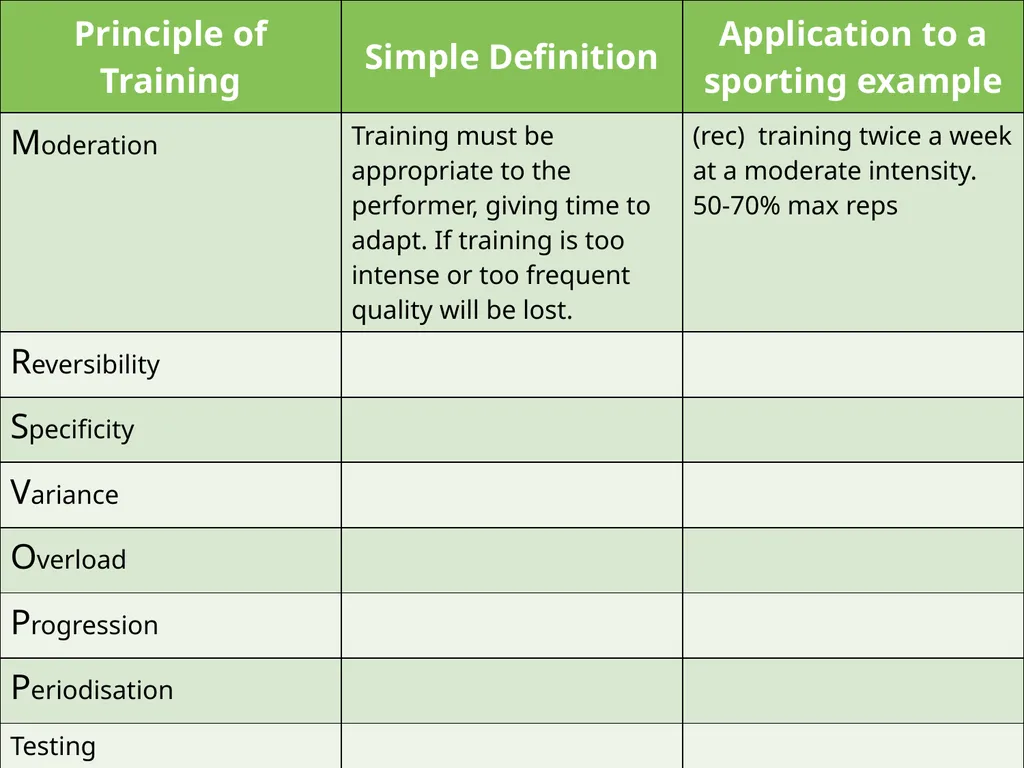
slide4. Principles of Training The principles of training are rules that must be followed for the training to be beneficial and effective for the performer.
Easy to remember as:
MRS VOPP Testing WC<br>
slide5. Task A – Jigsaw Task When planning a training programme, what is meant by each word in MRS VOPP Testing WC?
Using each letter, provide a simple explanation of what is meant and a supporting example using a weight-training or exercise programme.<br>
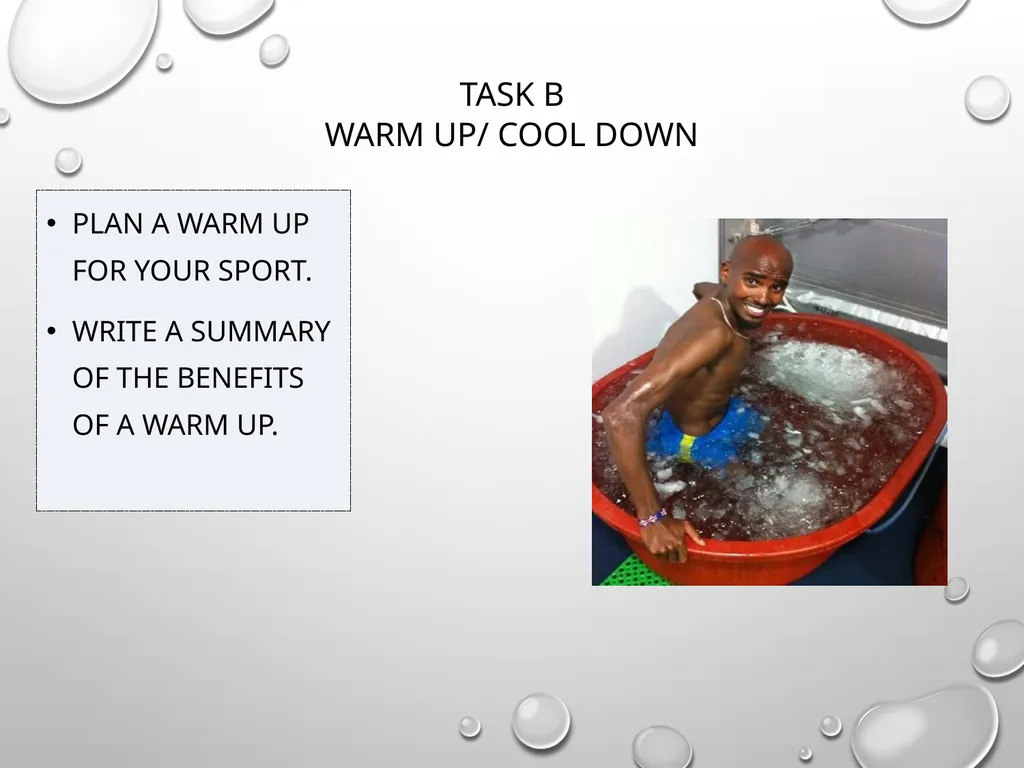
slide7. Task bWarm up/ cool down Plan a warm up for your sport.
Write a summary of the benefits of a warm up.<br>
slide8. Periodisation Periodisation is an organised approach to training that involves progressive cycling of various aspects of a training program during a specific period of time.
The definition of periodisation is an organised division of training into a number of blocks, periods or phases to help an athlete reach their peak performance at a certain time.
It is a way of alternating training to its peak during season.<br>
slide9. Task c Complete a chronological overview of your years training.
How do you break up your season or is it all training?<br>
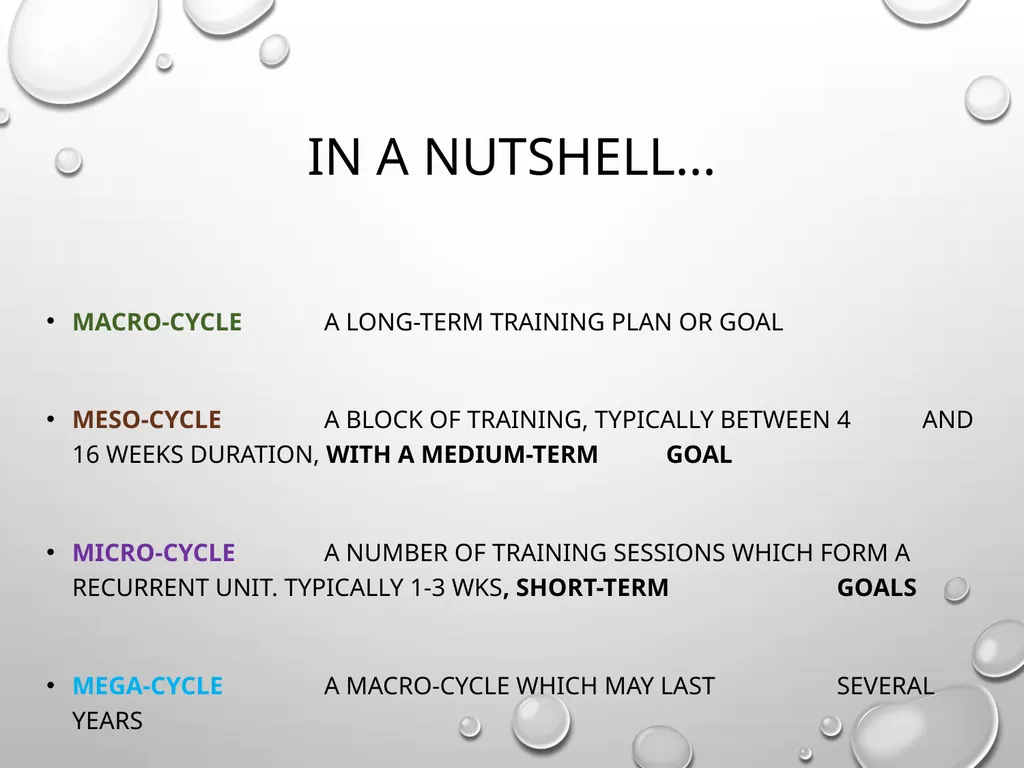
slide10. In a nutshell... Macro-cycle A long-term training plan or goal
Meso-cycle A block of training, typically between 4 and 16 weeks duration, with a medium-term goal
Micro-cycle A number of training sessions which form a recurrent unit. Typically 1-3 wks, short-term goals
Mega-cycle A macro-cycle which may last several years<br>
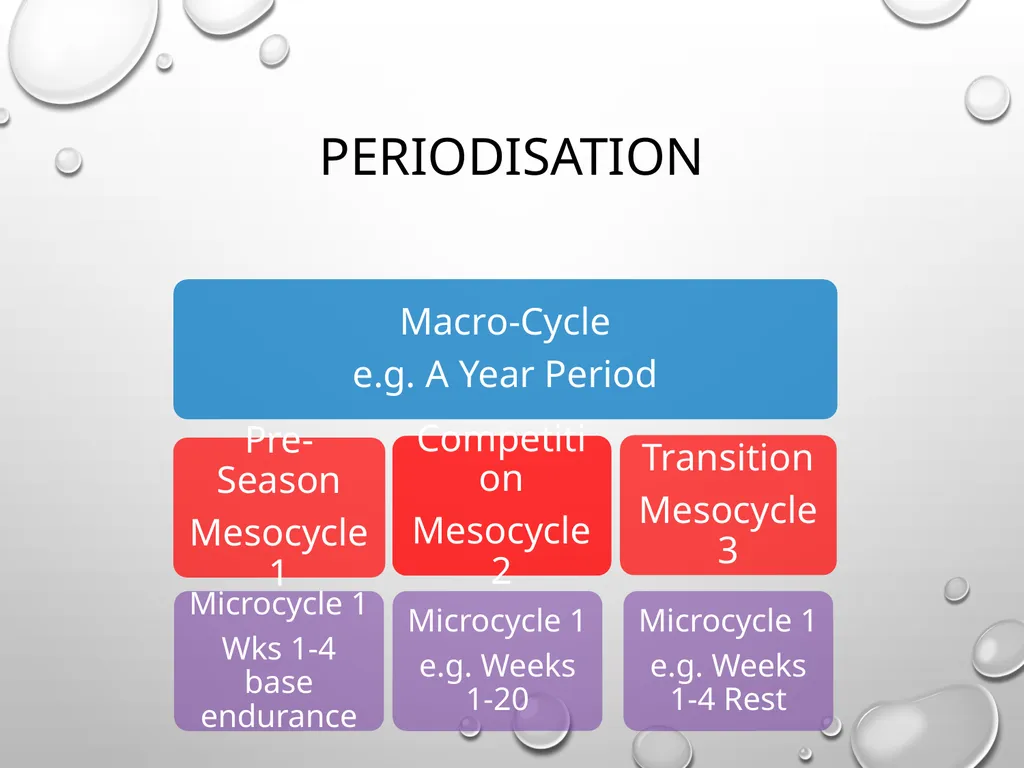
slide11. Periodisation<br>
slide12. Task D Complete a macro cycle
Choose one of the meso-cycles and note what is involved in that element.
What activity?
How long for?
What intensity?<br>
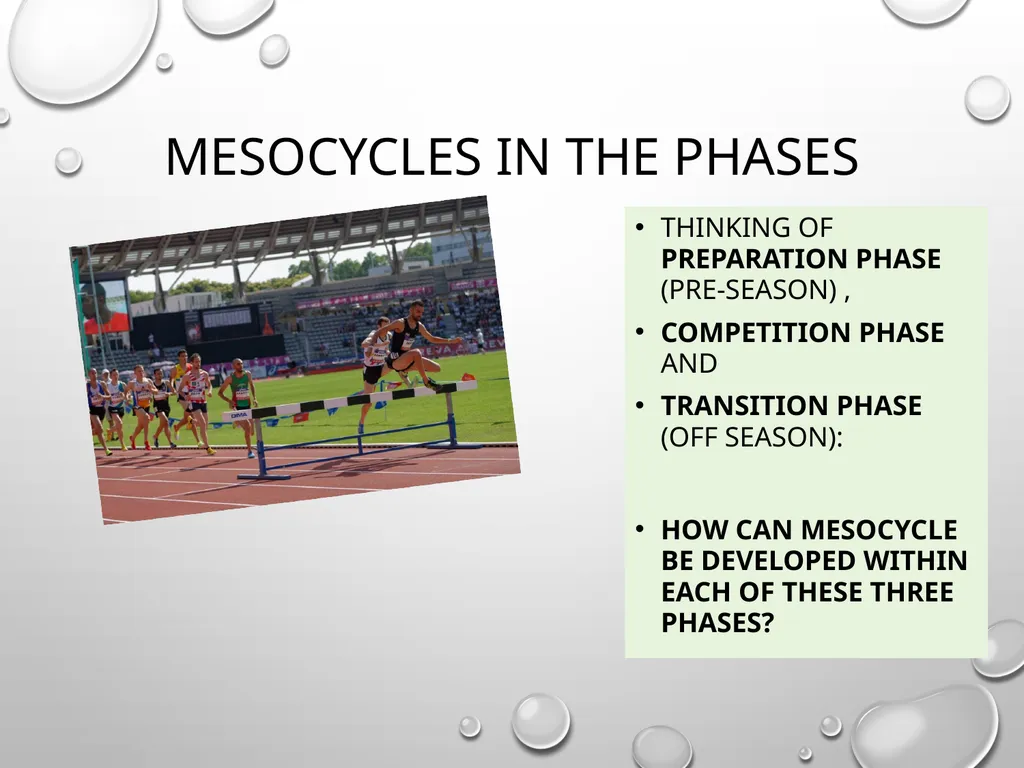
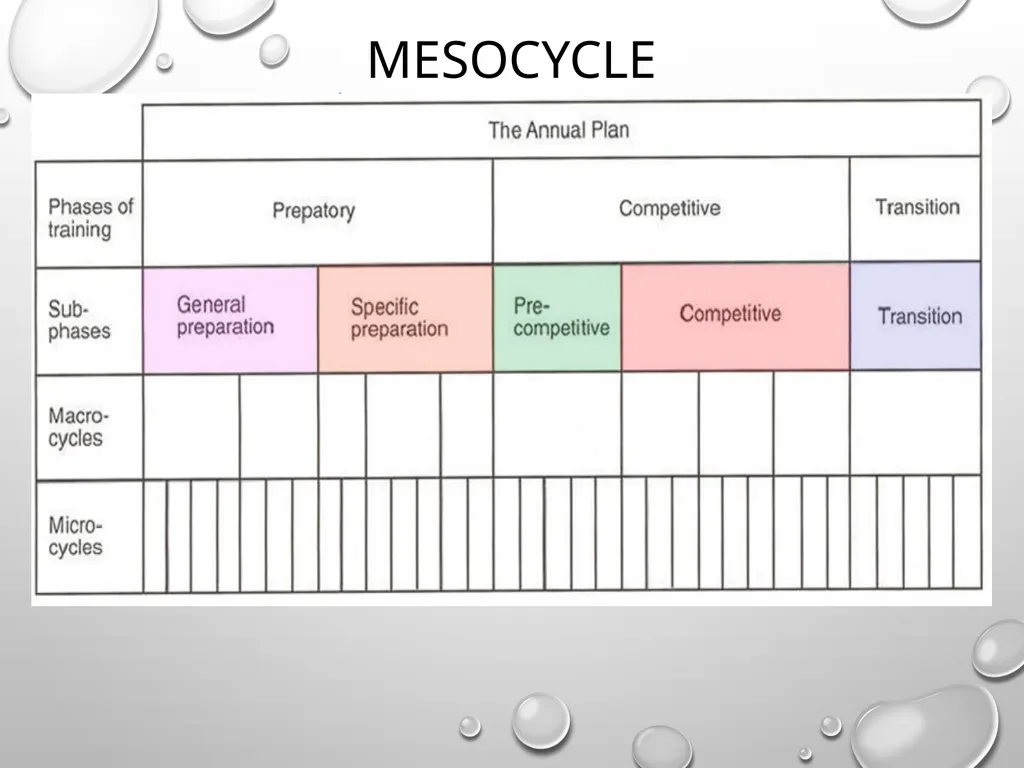
slide13. Mesocycles in the Phases Thinking of Preparation phase (pre-season) ,
competition phase and
transition phase (off season):
How can mesocycle be developed within each of these three phases?<br>
slide14. mesocycle Mesocycle in a Mesocycle<br>
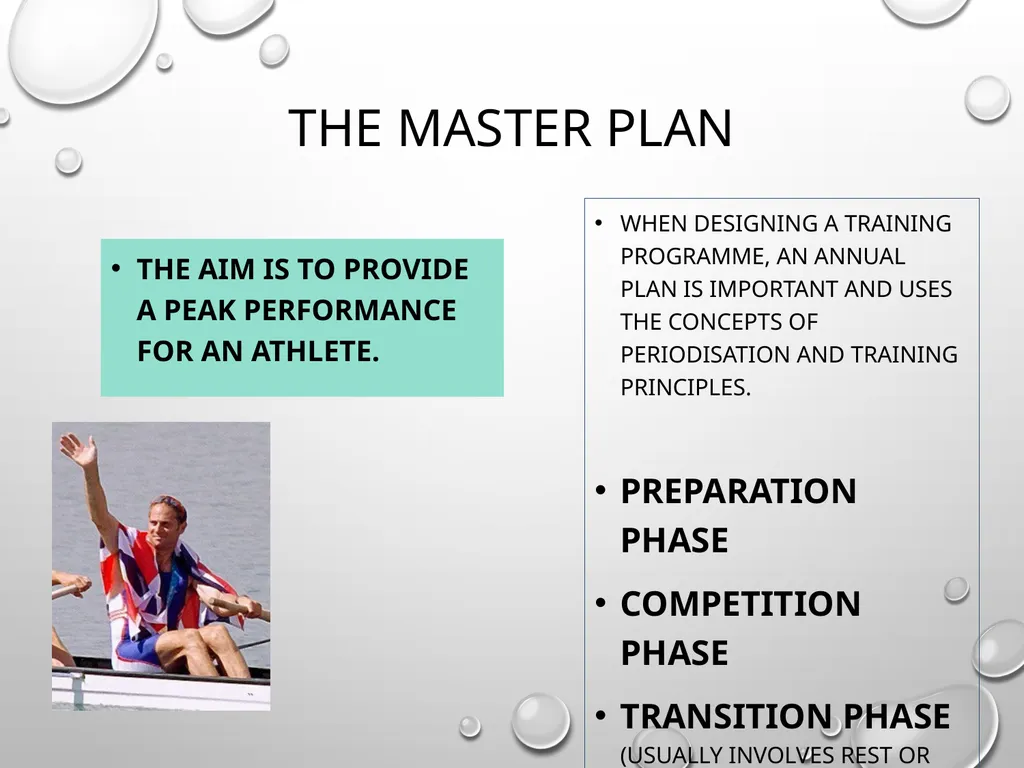
slide15. The Master Plan The aim is to provide a peak performance for an athlete. When designing a training programme, an annual plan is important and uses the concepts of periodisation and training principles.
Preparation Phase
Competition Phase
Transition Phase (usually involves rest or recovery)<br>
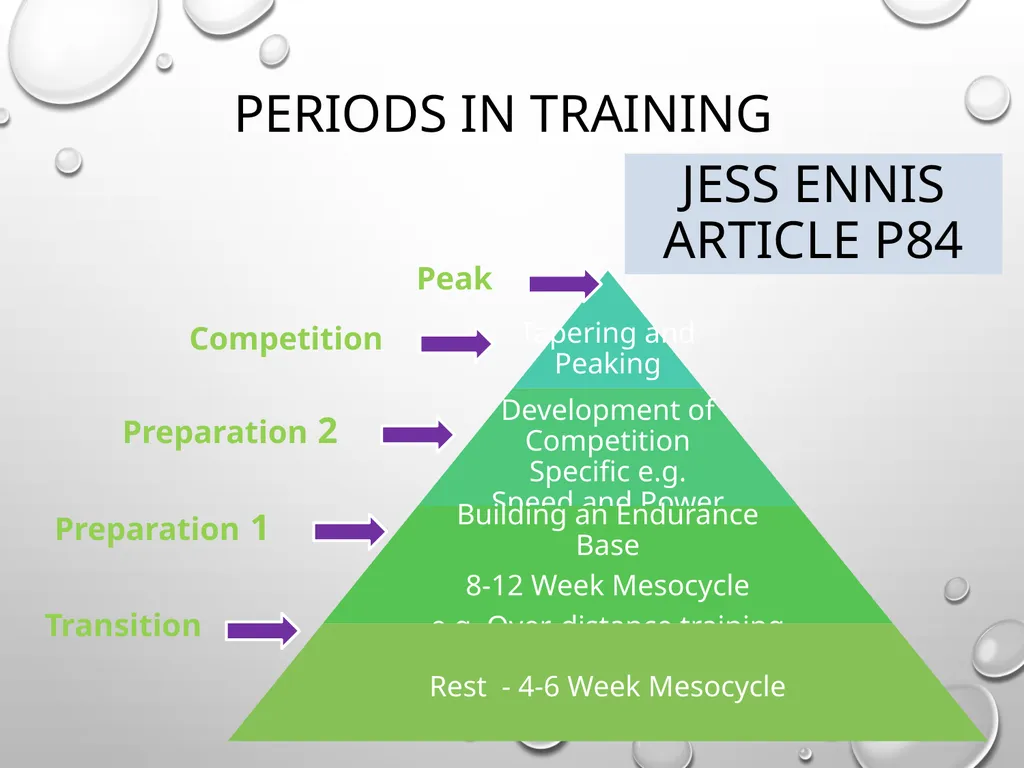
slide16. Periods in Training Jess Ennis article P84<br>
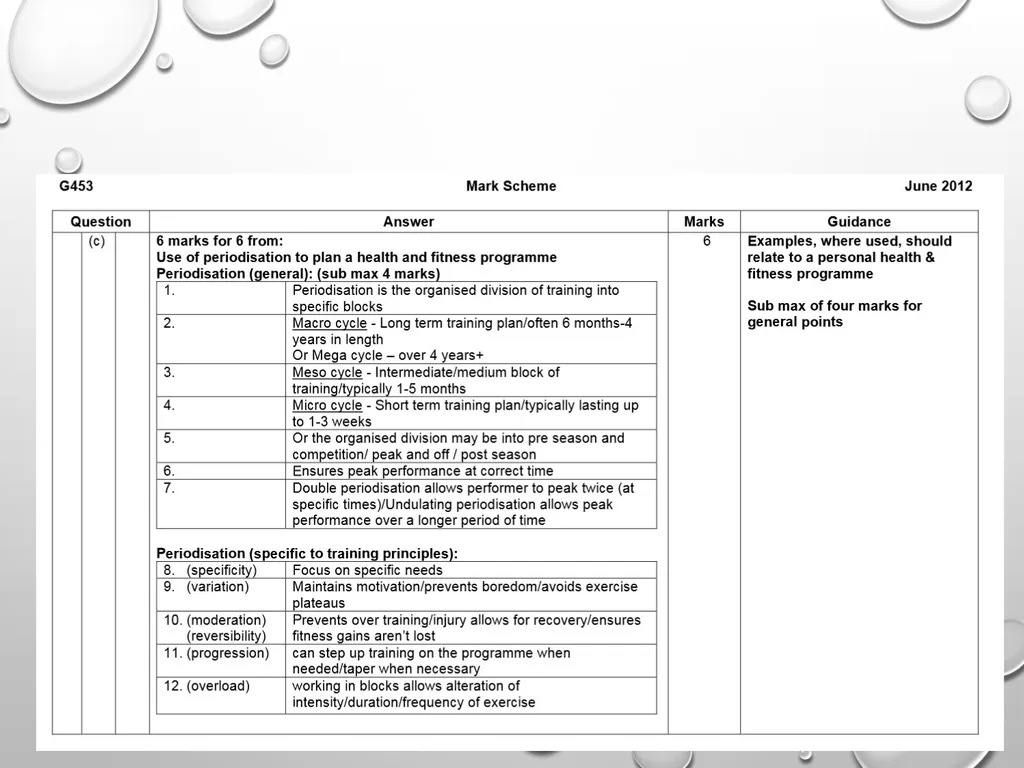
slide18. Benefits of Periodisation Ensures the athlete reaches a peak performance at the correct time for their target
Ensures that the following principles of training are applied:
Specificity, Moderation / Reversibility, Variance / Tedium, Overload, Progression, Warm-Up / Cool-Down, Frequency<br>
slide19. G453 June 2012 Explain the use of periodisation when planning a personal health and fitness programme.
[6 Marks]<br>
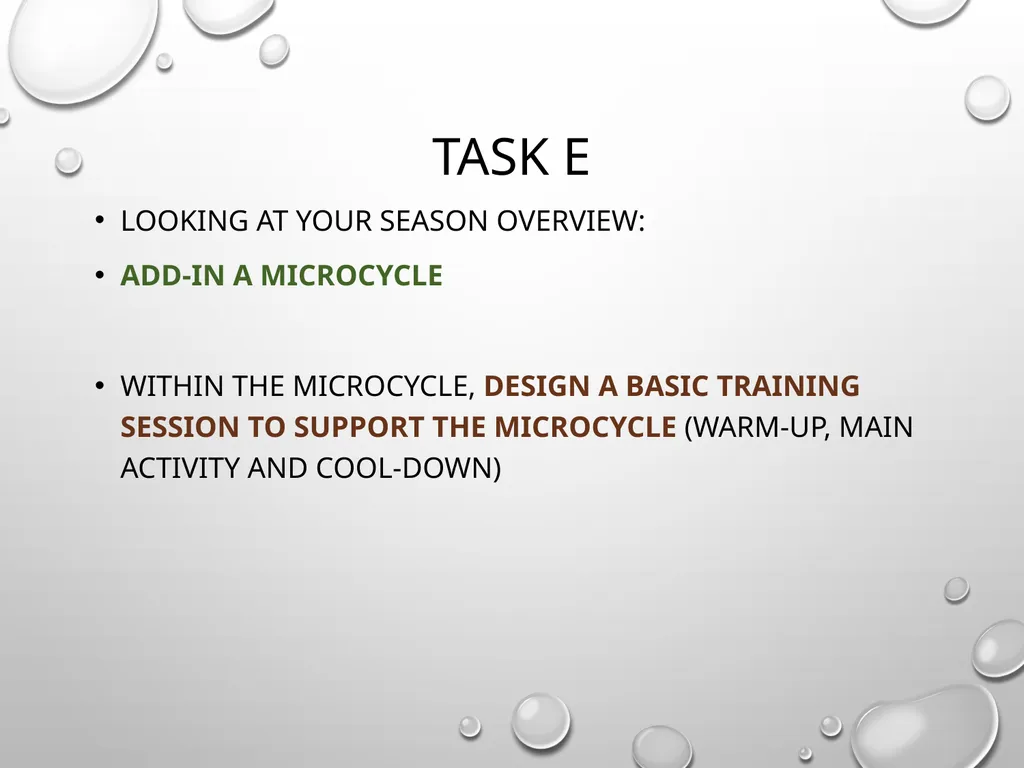
slide21. Task e Looking at your season overview:
Add-in a microcycle
Within the microcycle, design a basic training session to support the microcycle (warm-up, main activity and cool-down)<br>
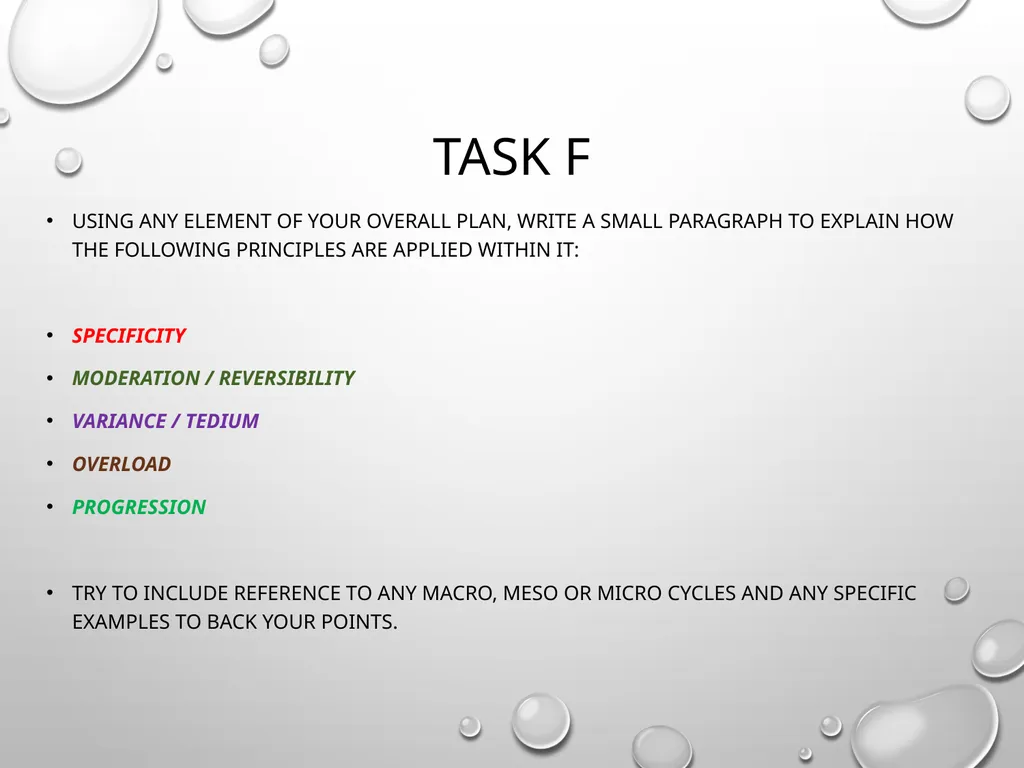
slide22. Task F Using any element of your overall plan, write a small paragraph to explain how the following principles are applied within it:
Specificity
Moderation / Reversibility
Variance / Tedium
Overload
Progression
Try to include reference to any macro, meso or micro cycles and any specific examples to back your points.<br>
slide23. 20 Mark Possibilities... Plan a personal health and fitness programme that will promote sustained involvement in a balanced, healthy and active lifestyle; the plan should include the principles of training.<br>
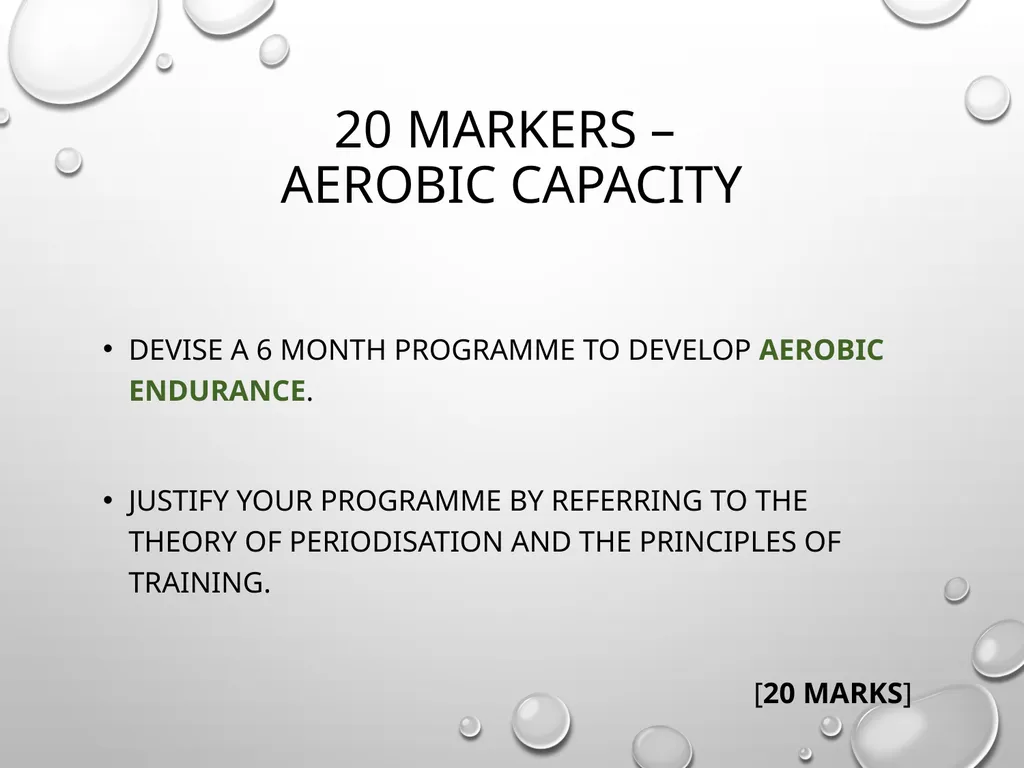
slide24. 20 Markers – Aerobic Capacity Devise a 6 month programme to develop aerobic endurance.
Justify your programme by referring to the theory of periodisation and the principles of training.
[20 marks]<br>
slide25. 20 Markers – Aerobic Capacity Interval training is a versatile type of training in which periods of work are interspaced with periods of recovery.
Outline a series of interval training sessions that are designed to stress the lactic acid system. Explain how you would apply the training principles of overload, specificity and reversibility to ensure your sessions remain effective throughout the training programme.
[20 marks]<br>
slide26. 20 Markers – Aerobic Capacity Identify, define and give a method of evaluation for aerobic capacity.
A carefully planned training programme is required to improve a specific component of fitness.
Using the following terms: macrocycles, mesocycles, microcycles (alongside principles of training) design a training programme to improve cardiovascular endurance for a sedentary adult.
[20 Marks]<br>

Player A states an aid
Player B states benefit
Player A states an negative
Player B states an aid.
Player C (Buzz if you stall or say ‘erm’) ABC based on confidence.<br>
slide2. Exercise Physiology DTA<br>
slide3. training Exercise physiology is the response of the body’s anatomy to exercise.
Training is concerned with how you can maximise the performance and maintain a active healthy lifestyle.
One method is to have an effective training programme<br>
slide4. Principles of Training The principles of training are rules that must be followed for the training to be beneficial and effective for the performer.
Easy to remember as:
MRS VOPP Testing WC<br>
slide5. Task A – Jigsaw Task When planning a training programme, what is meant by each word in MRS VOPP Testing WC?
Using each letter, provide a simple explanation of what is meant and a supporting example using a weight-training or exercise programme.<br>
slide7. Task bWarm up/ cool down Plan a warm up for your sport.
Write a summary of the benefits of a warm up.<br>
slide8. Periodisation Periodisation is an organised approach to training that involves progressive cycling of various aspects of a training program during a specific period of time.
The definition of periodisation is an organised division of training into a number of blocks, periods or phases to help an athlete reach their peak performance at a certain time.
It is a way of alternating training to its peak during season.<br>
slide9. Task c Complete a chronological overview of your years training.
How do you break up your season or is it all training?<br>
slide10. In a nutshell... Macro-cycle A long-term training plan or goal
Meso-cycle A block of training, typically between 4 and 16 weeks duration, with a medium-term goal
Micro-cycle A number of training sessions which form a recurrent unit. Typically 1-3 wks, short-term goals
Mega-cycle A macro-cycle which may last several years<br>
slide11. Periodisation<br>
slide12. Task D Complete a macro cycle
Choose one of the meso-cycles and note what is involved in that element.
What activity?
How long for?
What intensity?<br>
slide13. Mesocycles in the Phases Thinking of Preparation phase (pre-season) ,
competition phase and
transition phase (off season):
How can mesocycle be developed within each of these three phases?<br>
slide14. mesocycle Mesocycle in a Mesocycle<br>
slide15. The Master Plan The aim is to provide a peak performance for an athlete. When designing a training programme, an annual plan is important and uses the concepts of periodisation and training principles.
Preparation Phase
Competition Phase
Transition Phase (usually involves rest or recovery)<br>
slide16. Periods in Training Jess Ennis article P84<br>
slide18. Benefits of Periodisation Ensures the athlete reaches a peak performance at the correct time for their target
Ensures that the following principles of training are applied:
Specificity, Moderation / Reversibility, Variance / Tedium, Overload, Progression, Warm-Up / Cool-Down, Frequency<br>
slide19. G453 June 2012 Explain the use of periodisation when planning a personal health and fitness programme.
[6 Marks]<br>
slide21. Task e Looking at your season overview:
Add-in a microcycle
Within the microcycle, design a basic training session to support the microcycle (warm-up, main activity and cool-down)<br>
slide22. Task F Using any element of your overall plan, write a small paragraph to explain how the following principles are applied within it:
Specificity
Moderation / Reversibility
Variance / Tedium
Overload
Progression
Try to include reference to any macro, meso or micro cycles and any specific examples to back your points.<br>
slide23. 20 Mark Possibilities... Plan a personal health and fitness programme that will promote sustained involvement in a balanced, healthy and active lifestyle; the plan should include the principles of training.<br>
slide24. 20 Markers – Aerobic Capacity Devise a 6 month programme to develop aerobic endurance.
Justify your programme by referring to the theory of periodisation and the principles of training.
[20 marks]<br>
slide25. 20 Markers – Aerobic Capacity Interval training is a versatile type of training in which periods of work are interspaced with periods of recovery.
Outline a series of interval training sessions that are designed to stress the lactic acid system. Explain how you would apply the training principles of overload, specificity and reversibility to ensure your sessions remain effective throughout the training programme.
[20 marks]<br>
slide26. 20 Markers – Aerobic Capacity Identify, define and give a method of evaluation for aerobic capacity.
A carefully planned training programme is required to improve a specific component of fitness.
Using the following terms: macrocycles, mesocycles, microcycles (alongside principles of training) design a training programme to improve cardiovascular endurance for a sedentary adult.
[20 Marks]<br>