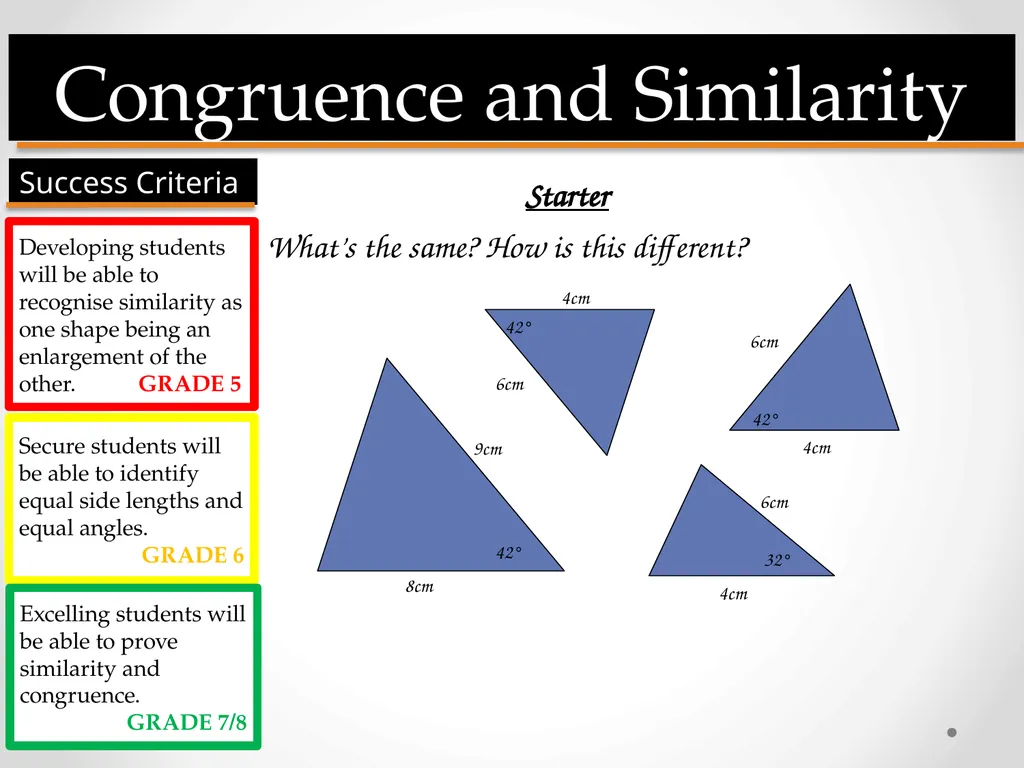
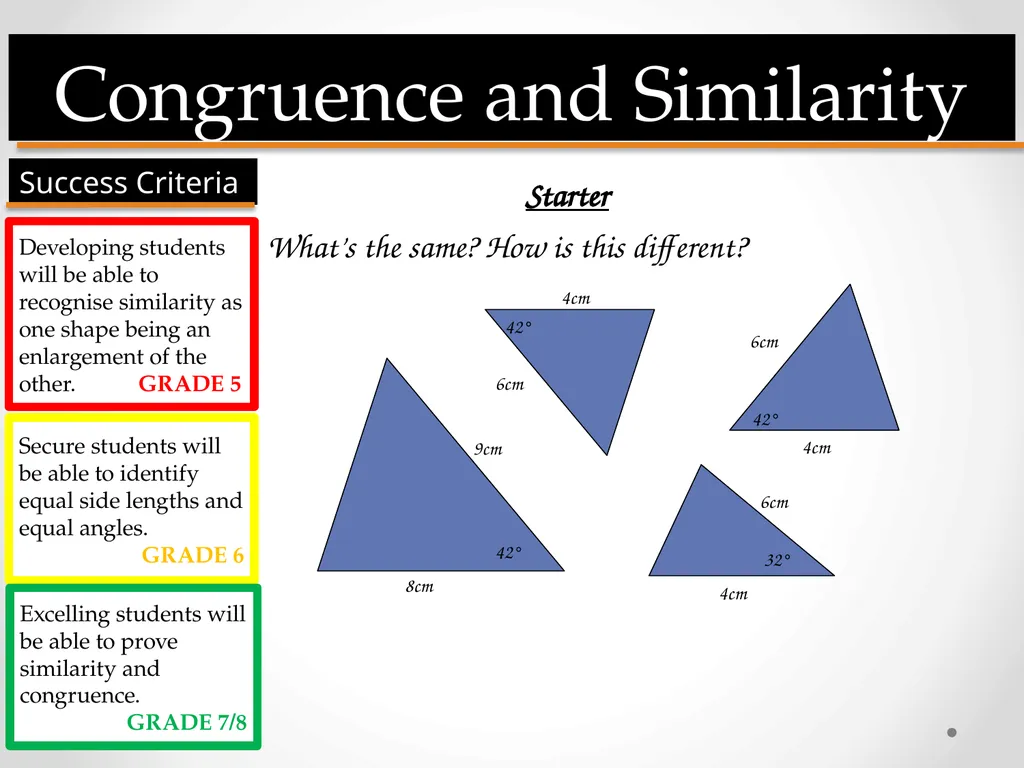
Starter Whats the same? How is this different? 42 42 42 32 6cm 6cm 6cm 9cm 4cm 4cm 4cm 8cm Congruence and Similarity Success Criteria Developing students will be able to recognise similarity as one shape being an enlargement of the
"Starter What’s the same? How is this different?" is the property of its rightful owner. Permission is granted to
download and print the materials on this website for personal, non-commercial use only, and to display it
on your personal computer provided you do not modify the materials and that you retain all copyright
notices contained in the materials. By downloading content from our website, you accept the terms of this
agreement.
Presentation Transcript
01
Starter What’s the same? How is this different? 42° 42° 42° 32° 6cm 6cm 6cm 9cm 4cm 4cm 4cm 8cm Congruence and Similarity Success Criteria Developing students will be able to recognise similarity as one shape being an enlargement of the other. GRADE 5 Secure students will be able to identify equal side lengths and equal angles.
GRADE 6 Excelling students will be able to prove similarity and congruence.
GRADE 7/8<br>
02
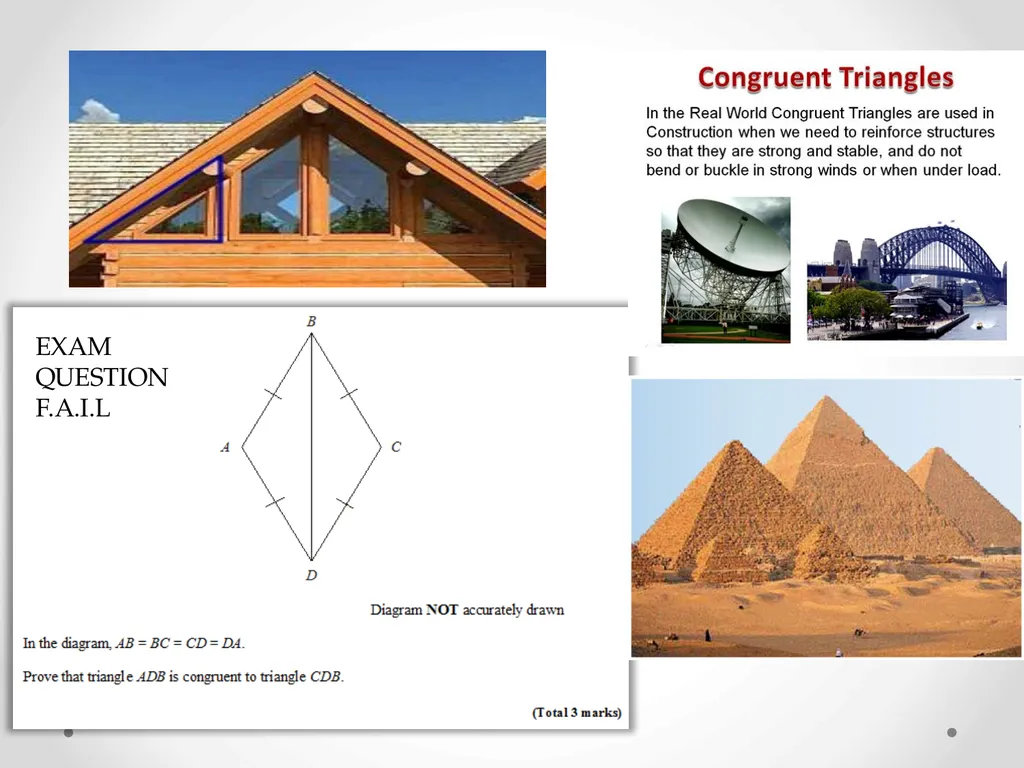
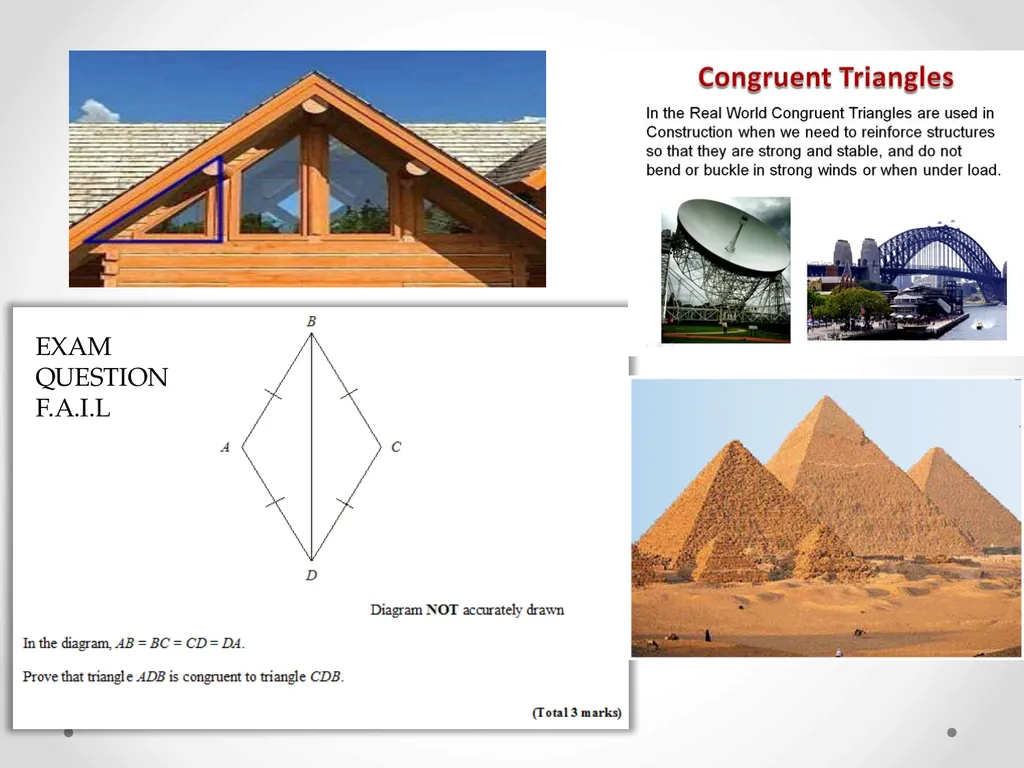
EXAM QUESTION
F.A.I.L<br>
03
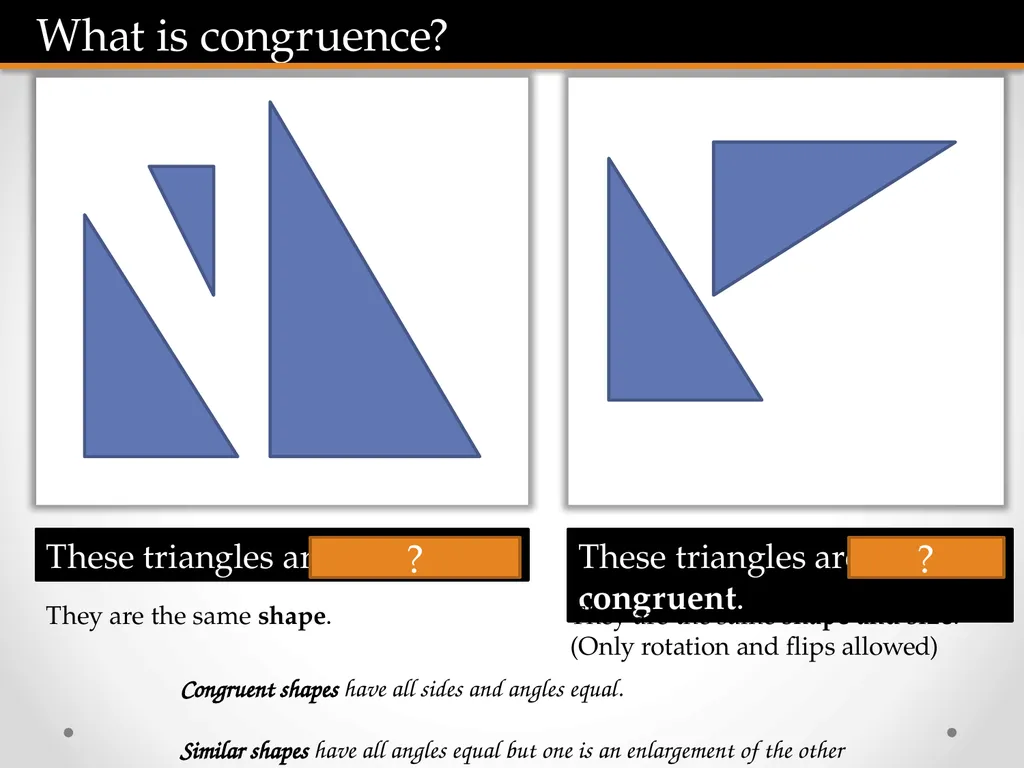
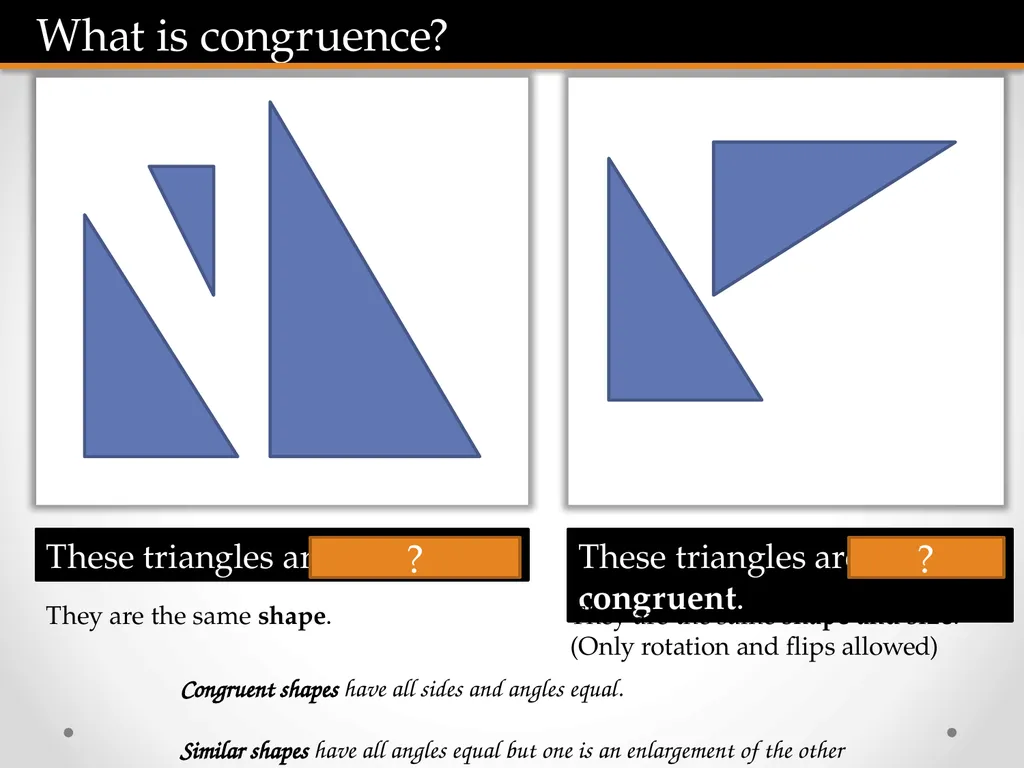
These triangles are similar. These triangles are congruent. They are the same shape. They are the same shape and size.
(Only rotation and flips allowed) ? ? Congruent shapes have all sides and angles equal.
Similar shapes have all angles equal but one is an enlargement of the other<br>
04
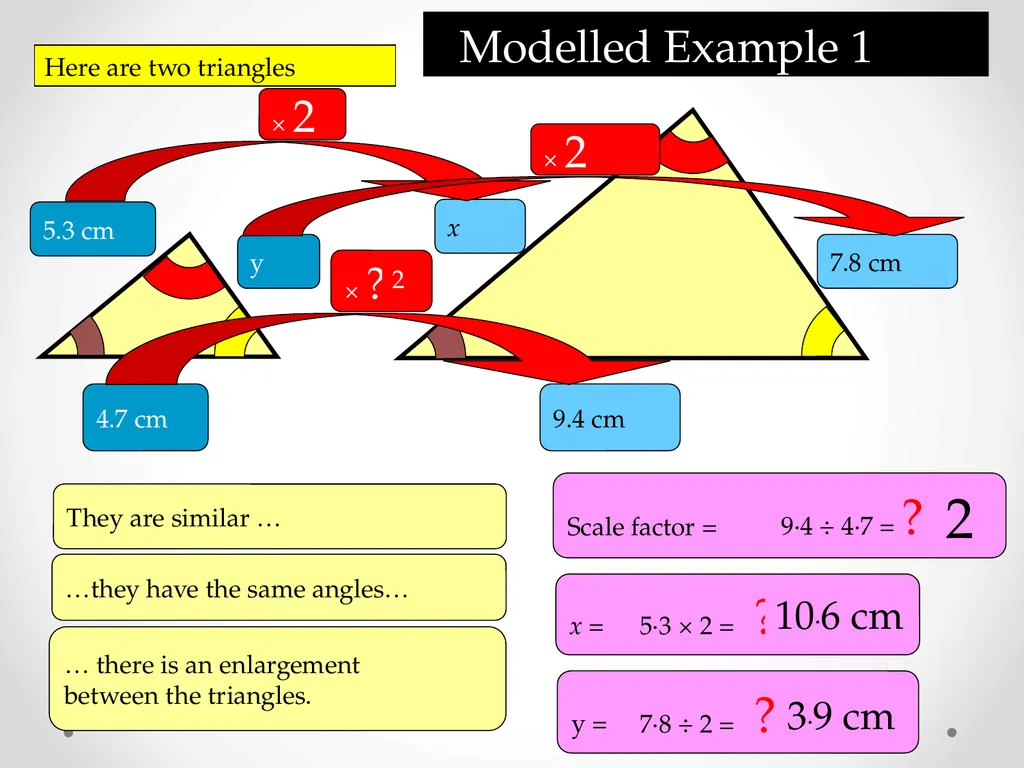
4 Here are two triangles x 5.3 cm 7.8 cm y They are similar … … there is an enlargement
between the triangles. …they have the same angles… Scale factor = ? 9·4 ÷ 4·7 = ? 2 x = ? 5·3 × 2 = ? 10·6 cm y = ? 7·8 ÷ 2 = ? 3·9 cm 2 Modelled Example 1<br>
05
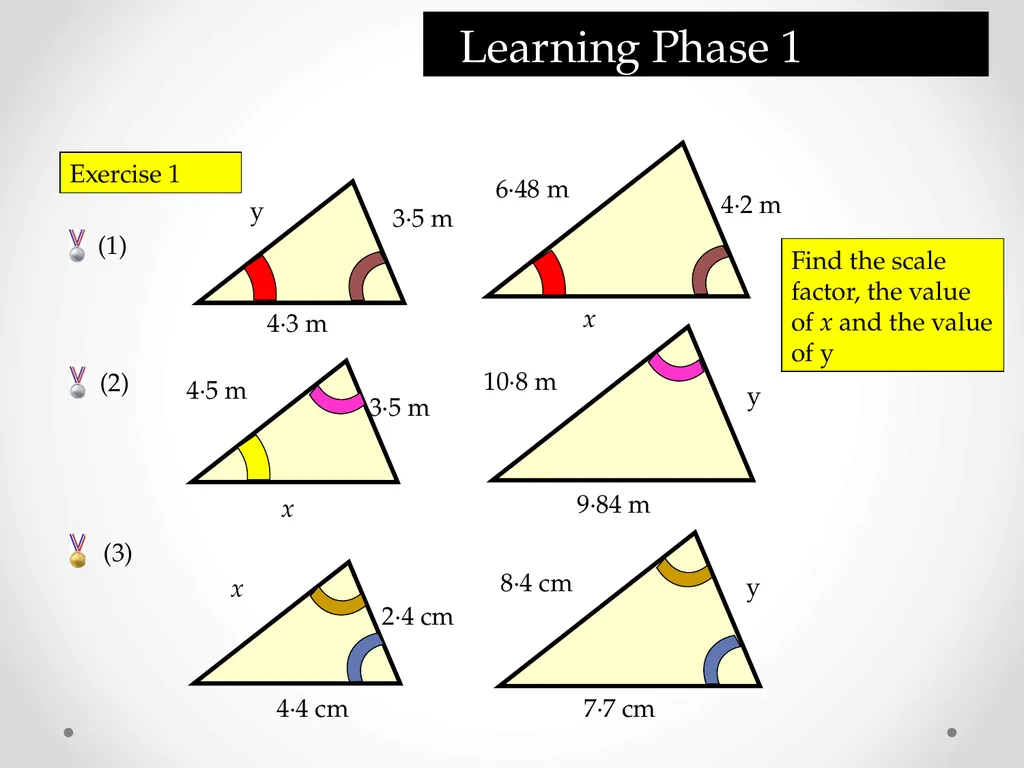
5 Exercise 1 (1) 3·5 m 4·2 m 4·3 m x y 6·48 m (2) x y 4·5 m 10·8 m 3·5 m 9·84 m (3) 2·4 cm 8·4 cm 7·7 cm y 4·4 cm x Find the scale factor, the value of x and the value of y Learning Phase 1<br>
06
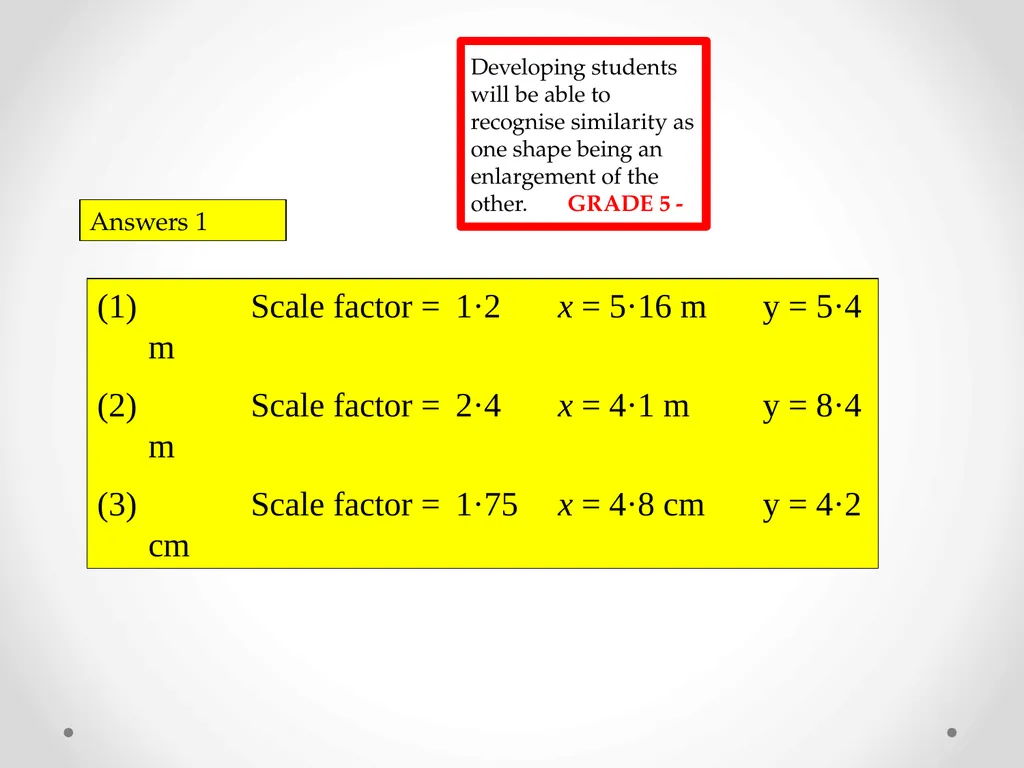
6 Answers 1 Scale factor = 1·2 x = 5·16 m y = 5·4 m
Scale factor = 2·4 x = 4·1 m y = 8·4 m
Scale factor = 1·75 x = 4·8 cm y = 4·2 cm Developing students will be able to recognise similarity as one shape being an enlargement of the other. GRADE 5 -<br>
07
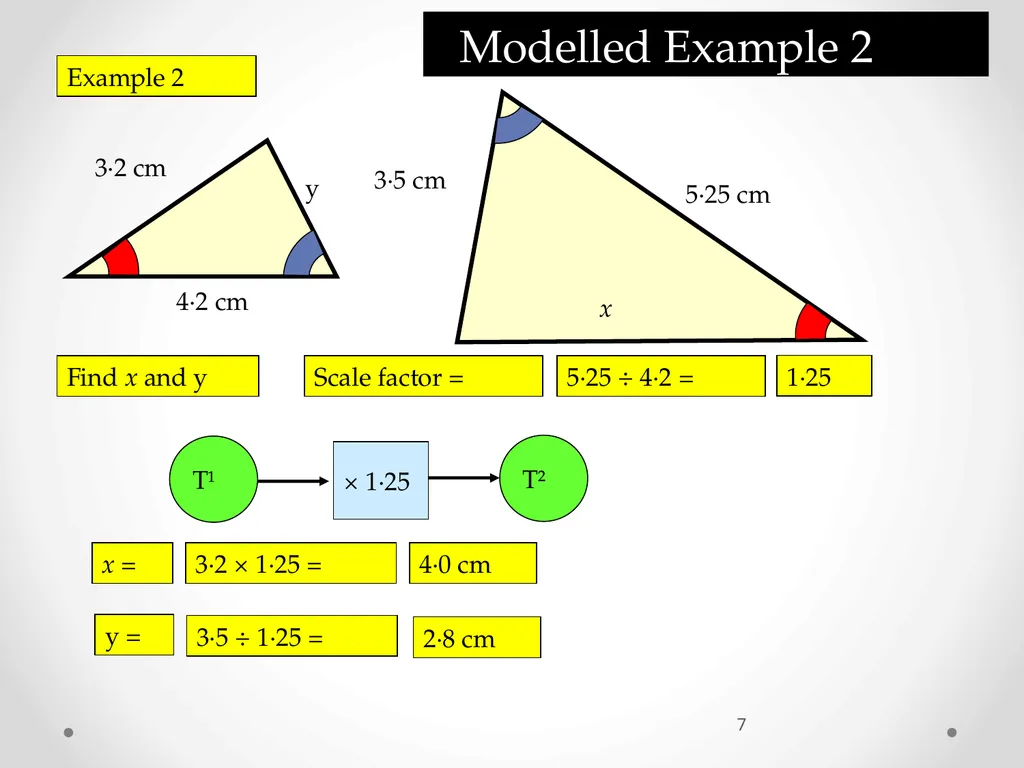
7 3·2 cm 5·25 cm 4·2 cm x 3·5 cm y Find x and y Scale factor = 5·25 ÷ 4·2 = 1·25 T¹ × 1·25 T² Example 2 x = 3·2 × 1·25 = 4·0 cm y = 3·5 ÷ 1·25 = 2·8 cm Modelled Example 2<br>
08
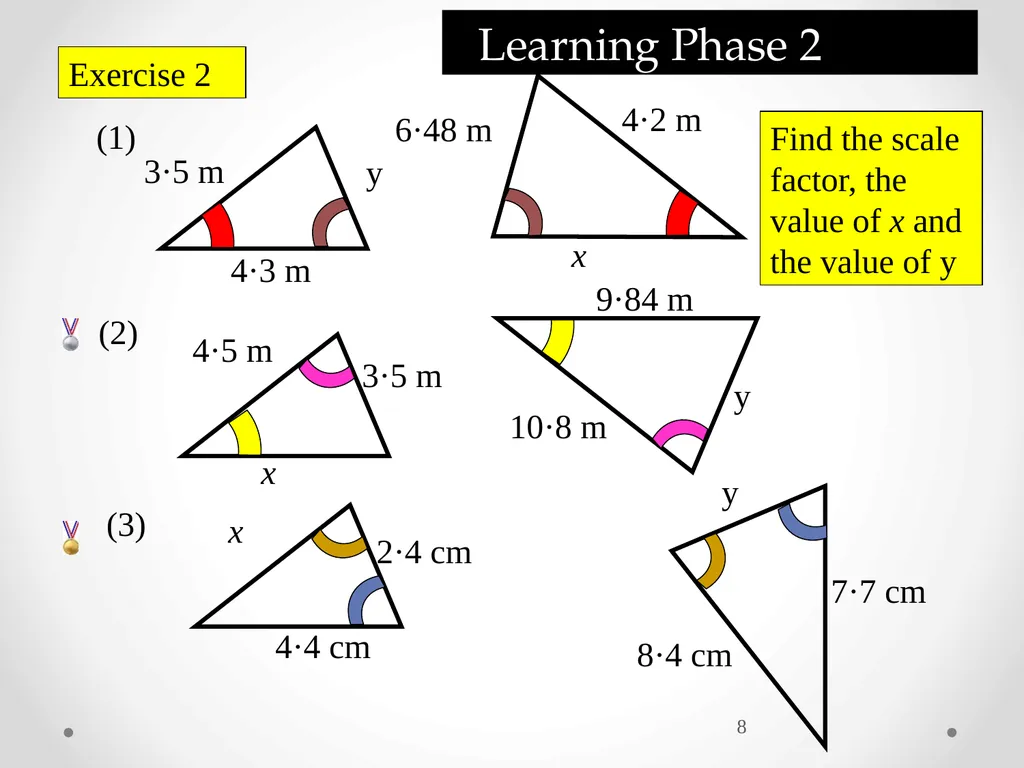
Learning Phase 2 8 Exercise 2 (1) 3·5 m 4·2 m 4·3 m x y 6·48 m (2) x y 4·5 m 10·8 m 3·5 m 9·84 m (3) 2·4 cm 8·4 cm 7·7 cm y 4·4 cm x Find the scale factor, the value of x and the value of y<br>
09
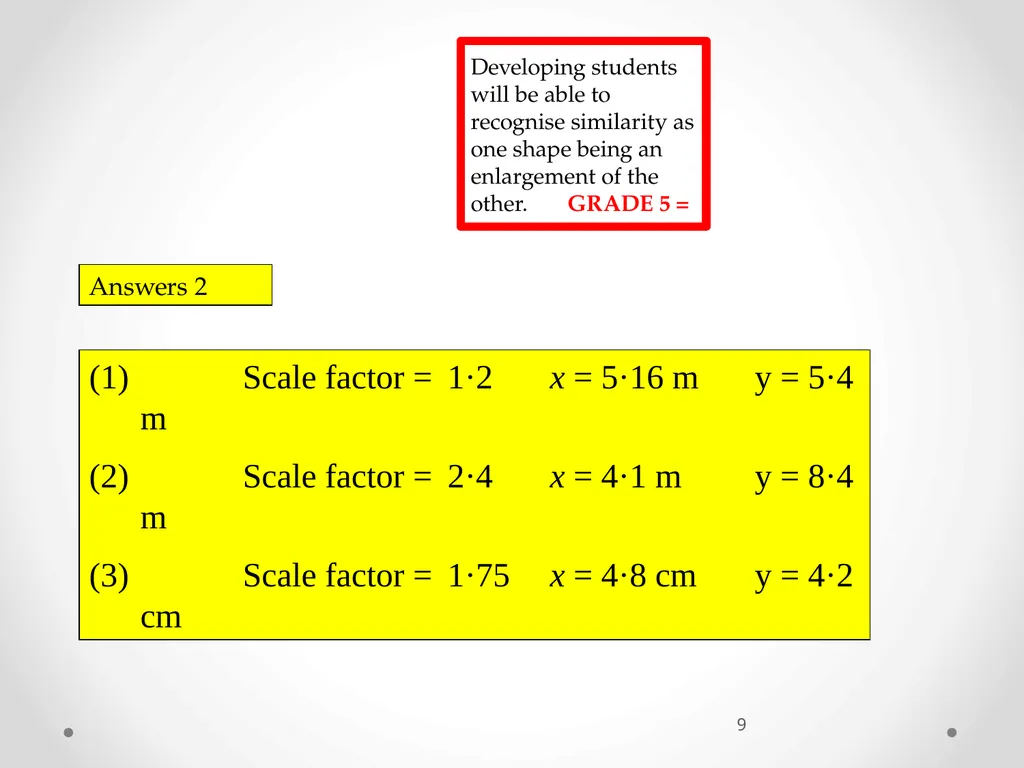
9 Answers 2 Scale factor = 1·2 x = 5·16 m y = 5·4 m
Scale factor = 2·4 x = 4·1 m y = 8·4 m
Scale factor = 1·75 x = 4·8 cm y = 4·2 cm Developing students will be able to recognise similarity as one shape being an enlargement of the other. GRADE 5 =<br>
10
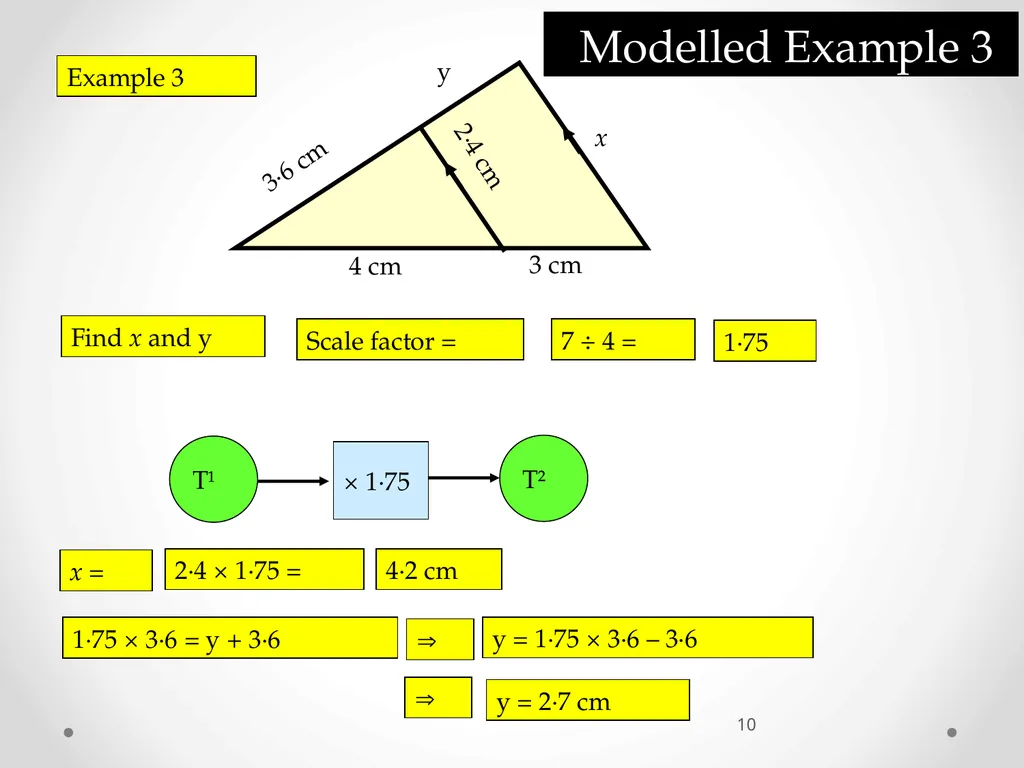
10 Example 3 4 cm 3 cm 2·4 cm x 3·6 cm y Find x and y Scale factor = 7 ÷ 4 = 1·75 T¹ × 1·75 T² x = 2·4 × 1·75 = 4·2 cm 1·75 × 3·6 = y + 3·6 y = 1·75 × 3·6 – 3·6 y = 2·7 cm Modelled Example 3<br>
11
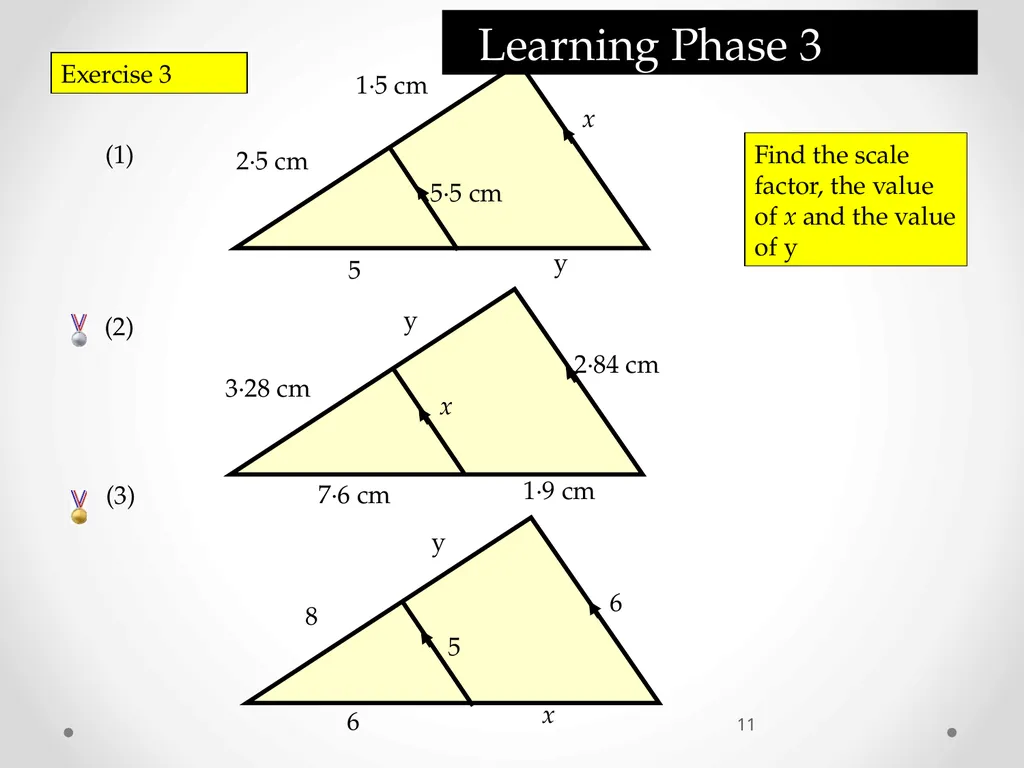
11 Exercise 3 (1) Find the scale factor, the value of x and the value of y (2) (3) y 5 5·5 cm x 2·5 cm 1·5 cm 7·6 cm 1·9 cm x 2·84 cm 3·28 cm y 6 x 8 y 5 6 Learning Phase 3<br>
12
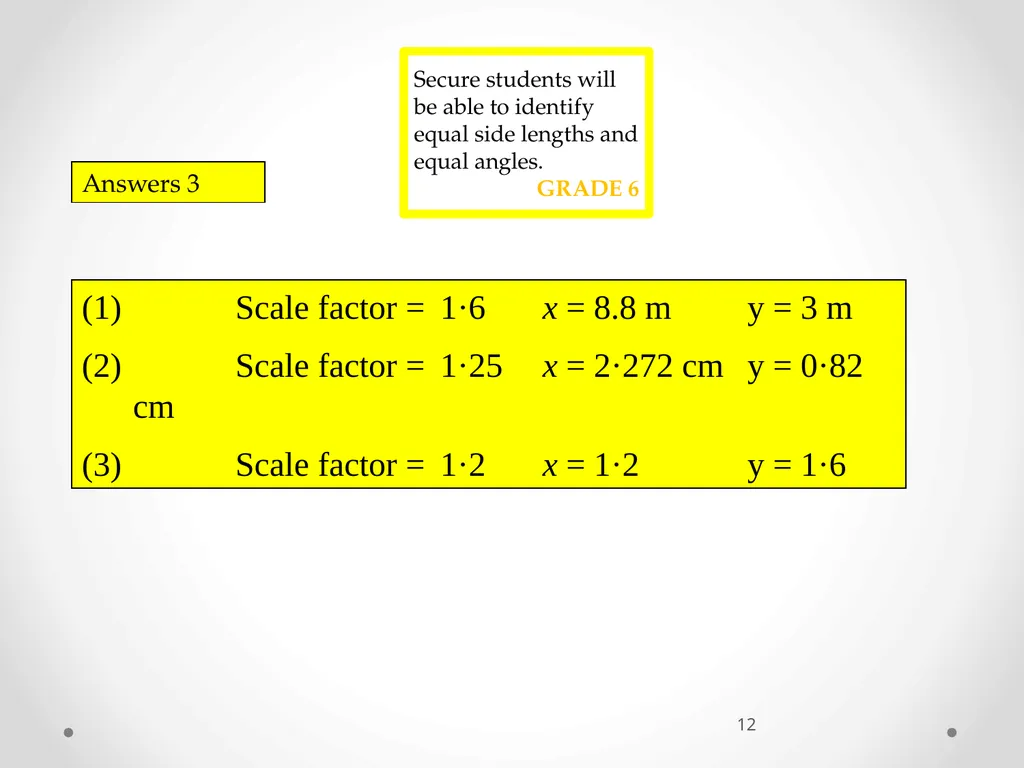
12 Answers 3 Scale factor = 1·6 x = 8.8 m y = 3 m
Scale factor = 1·25 x = 2·272 cm y = 0·82 cm
Scale factor = 1·2 x = 1·2 y = 1·6 Secure students will be able to identify equal side lengths and equal angles.
GRADE 6<br>
13
EXAM QUESTION
F.A.I.L<br>
14
These triangles are similar. These triangles are congruent. They are the same shape. They are the same shape and size.
(Only rotation and flips allowed) ? ? Congruent shapes have all sides and angles equal.
Similar shapes have all angles equal but one is an enlargement of the other<br>
15
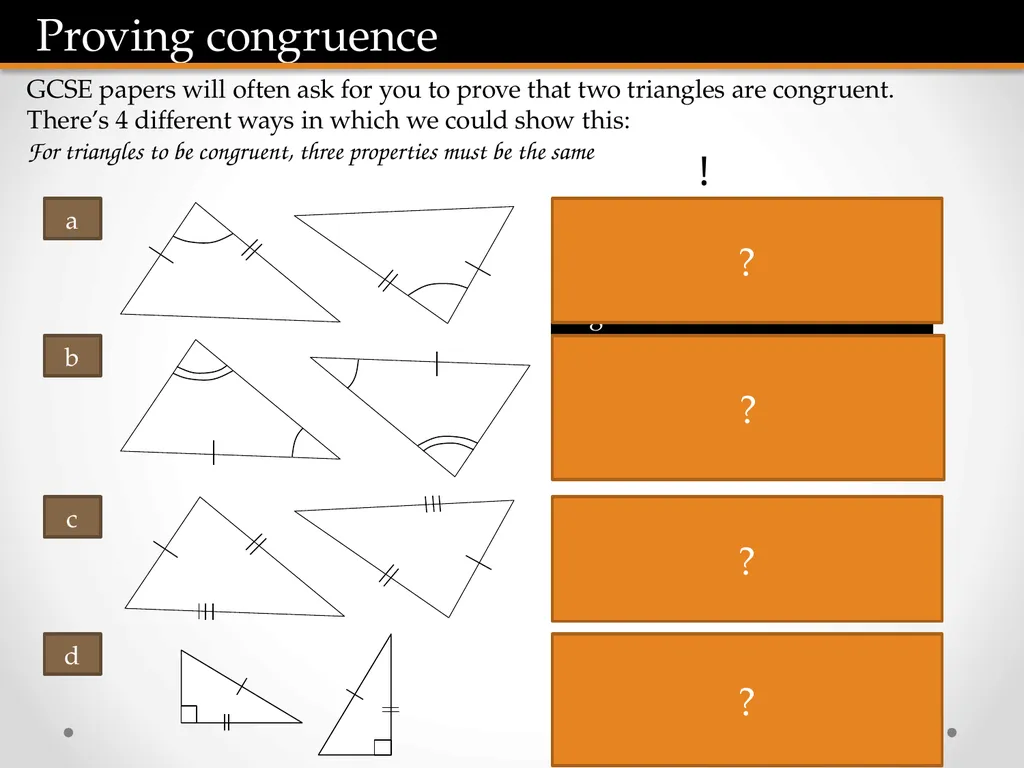
GCSE papers will often ask for you to prove that two triangles are congruent.
There’s 4 different ways in which we could show this:
For triangles to be congruent, three properties must be the same a SAS
Two sides and the included angle. b ASA
Two angles and a side. c SSS
Three sides. d RHS
Right-angle, hypotenuse and another side. ? ? ? ? !<br>
16
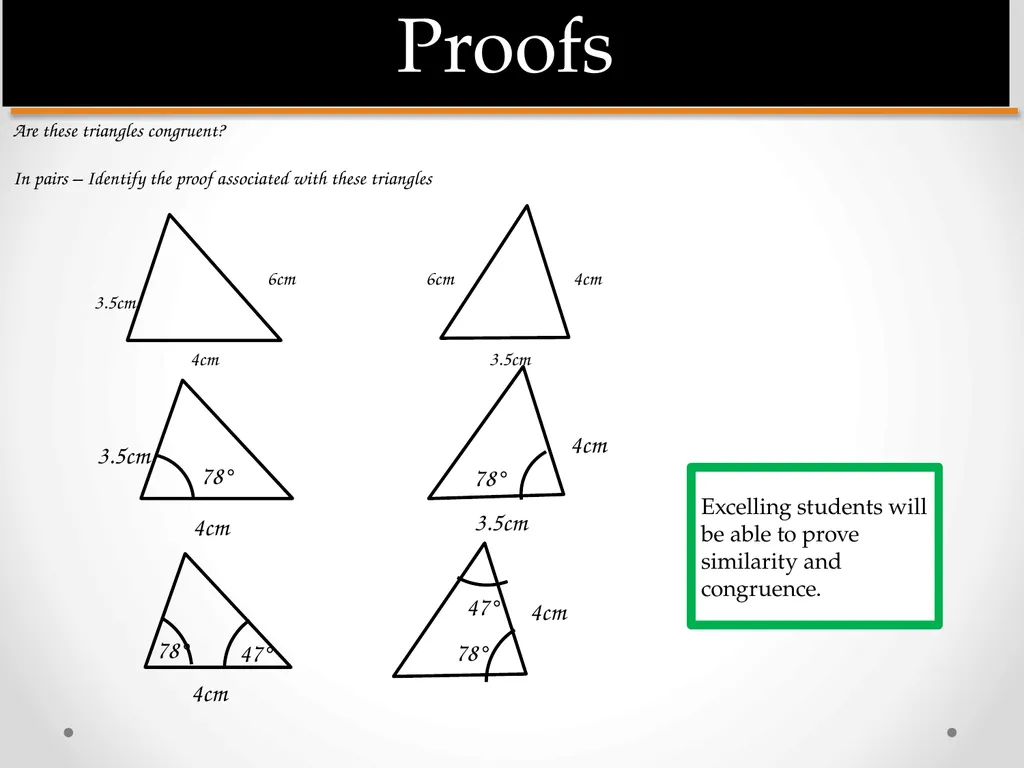
Are these triangles congruent?
In pairs – Identify the proof associated with these triangles 4cm 4cm 6cm 6cm 3.5cm 3.5cm 4cm 4cm 3.5cm 3.5cm 78° 78° 4cm 4cm 78° 78° 47° 47° Proofs Excelling students will be able to prove similarity and congruence.<br>
17
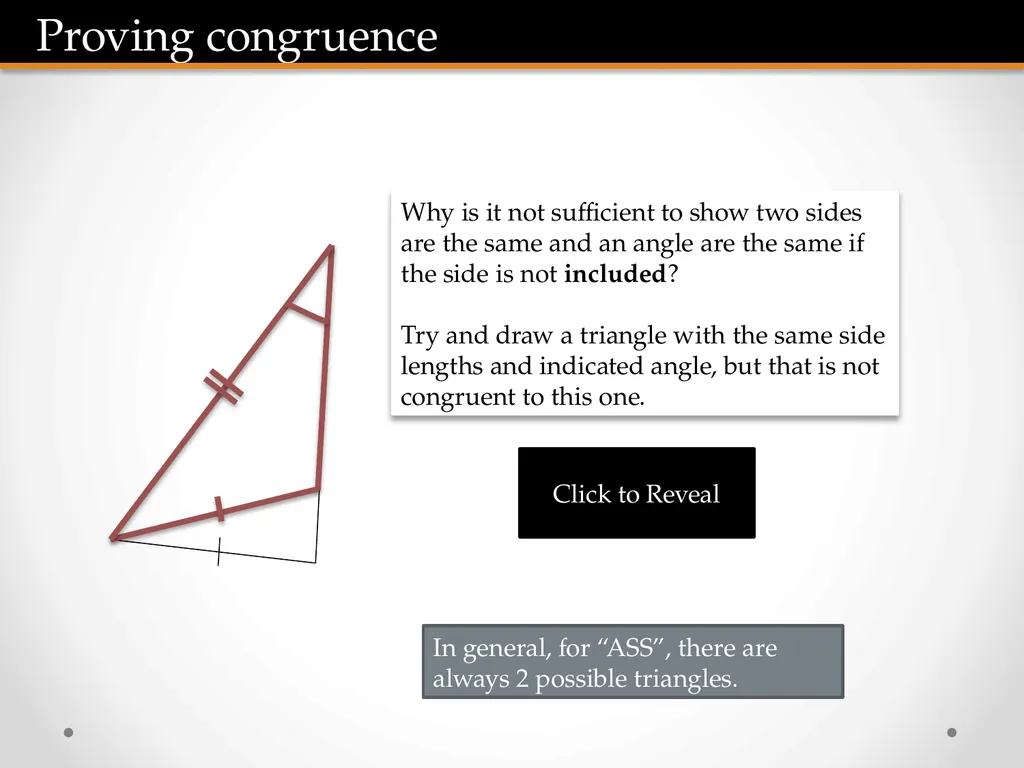
Why is it not sufficient to show two sides are the same and an angle are the same if the side is not included?
Try and draw a triangle with the same side lengths and indicated angle, but that is not congruent to this one. Click to Reveal In general, for “ASS”, there are always 2 possible triangles.<br>
18
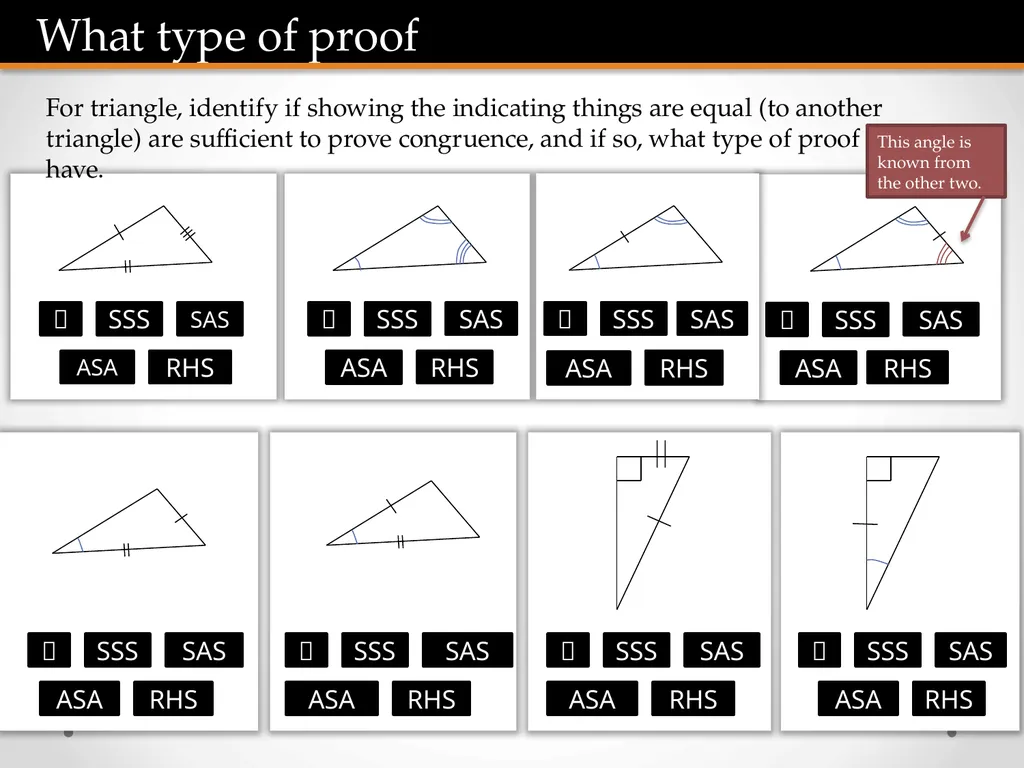
For triangle, identify if showing the indicating things are equal (to another triangle) are sufficient to prove congruence, and if so, what type of proof we have. SSS SAS ASA RHS SSS SAS ASA RHS SSS SAS ASA RHS SSS SAS ASA RHS SSS SAS ASA RHS SSS SAS ASA RHS SSS SAS ASA RHS SSS SAS ASA RHS<br>
19
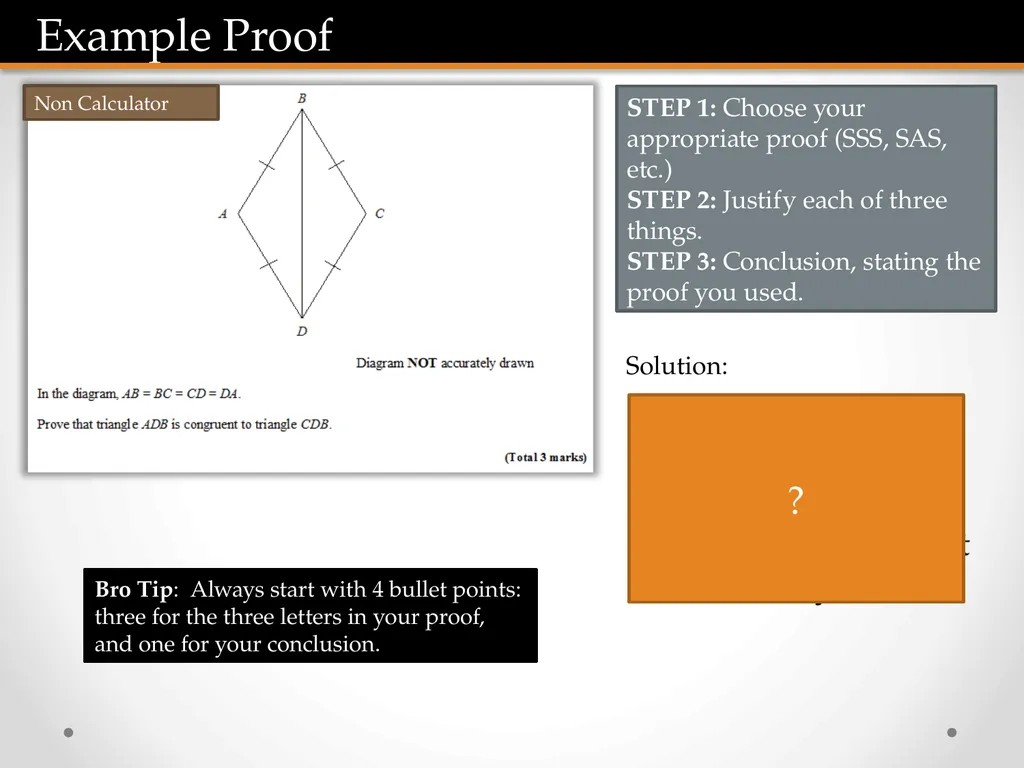
Bro Tip: Always start with 4 bullet points: three for the three letters in your proof, and one for your conclusion. STEP 1: Choose your appropriate proof (SSS, SAS, etc.)
STEP 2: Justify each of three things.
STEP 3: Conclusion, stating the proof you used. ? Solution: Non Calculator<br>
20
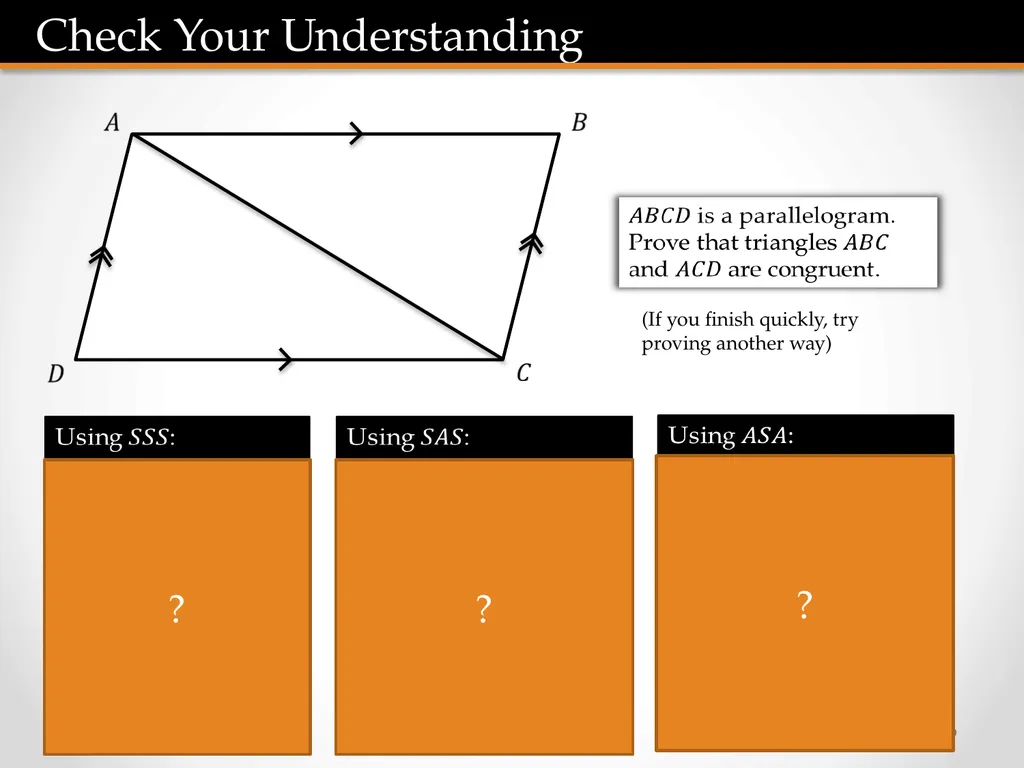
? ? ? (If you finish quickly, try proving another way)<br>
21
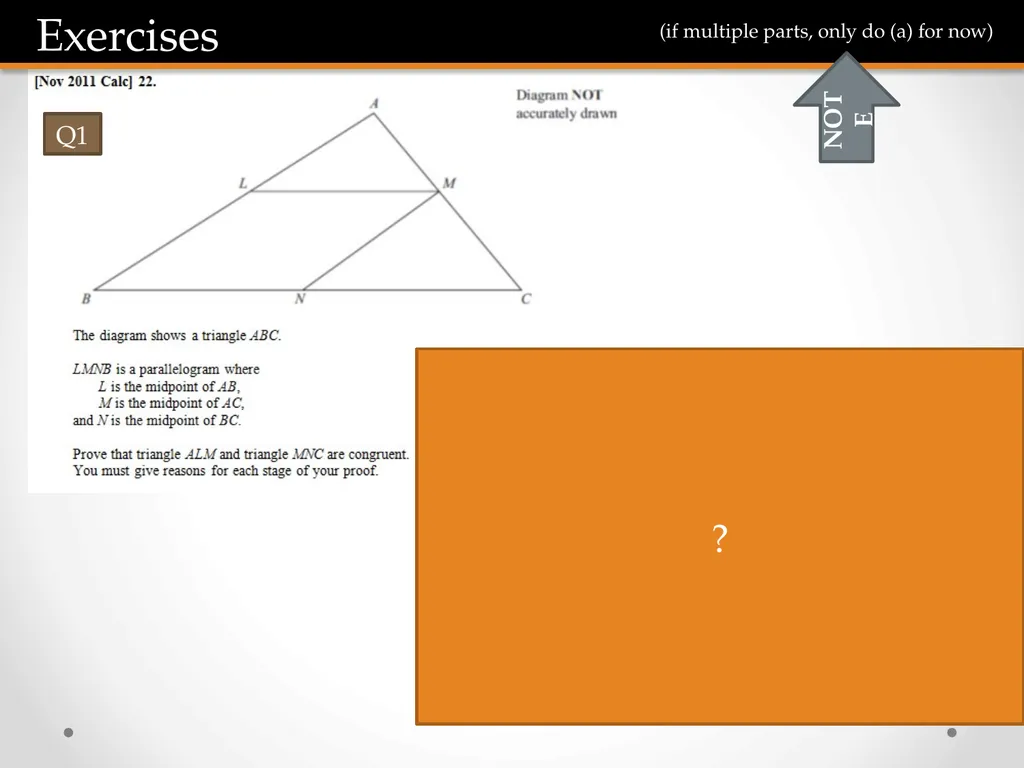
? (if multiple parts, only do (a) for now) Q1 NOTE<br>
22
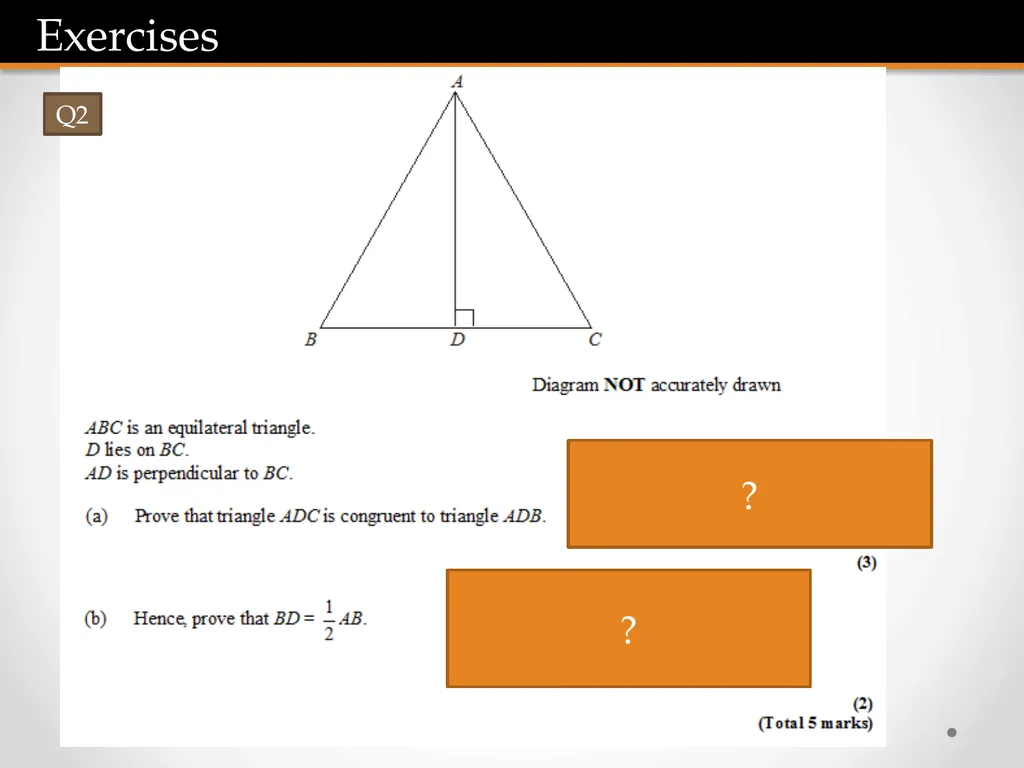
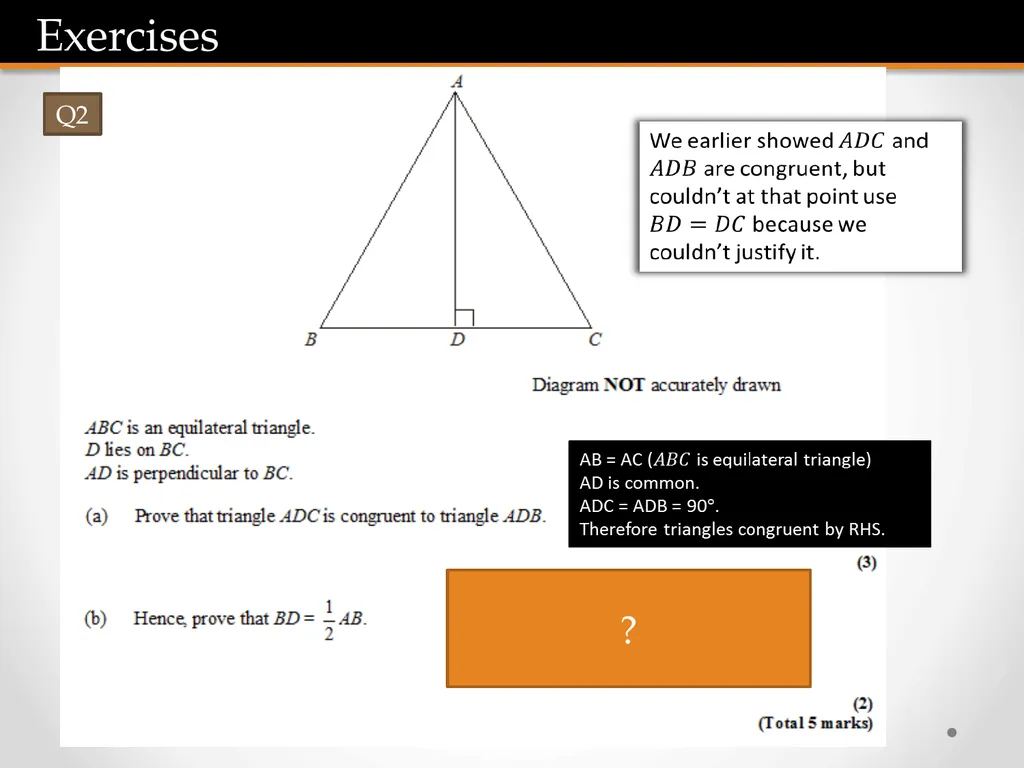
? Q2 ?<br>
23
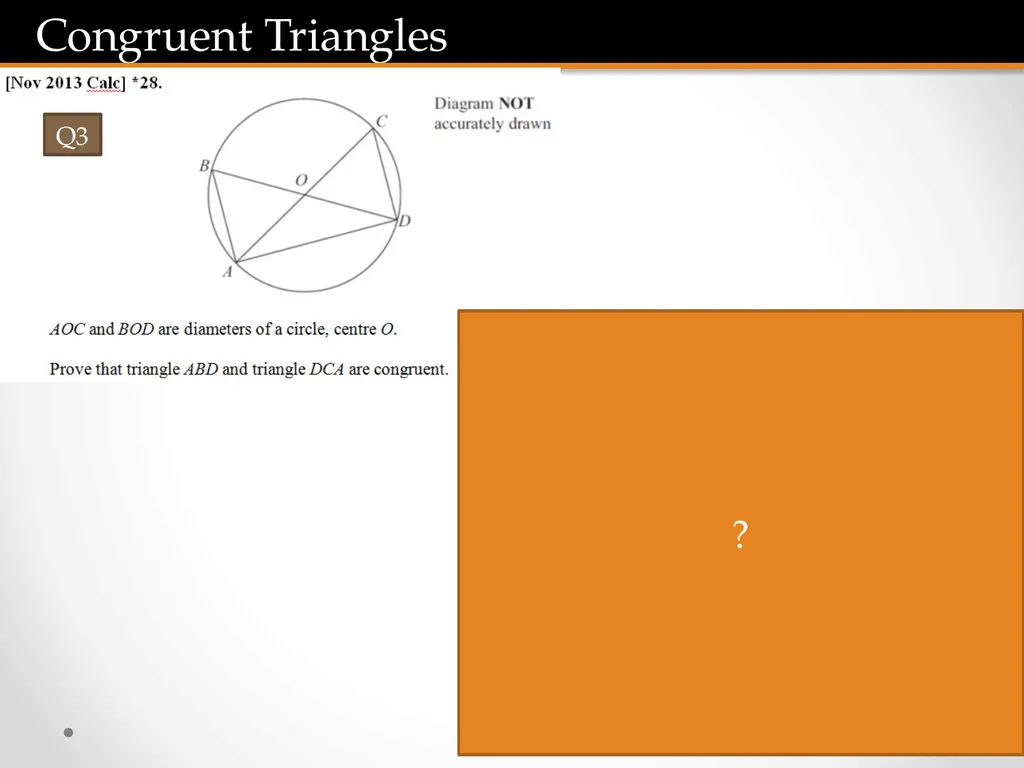
? Q3<br>
24
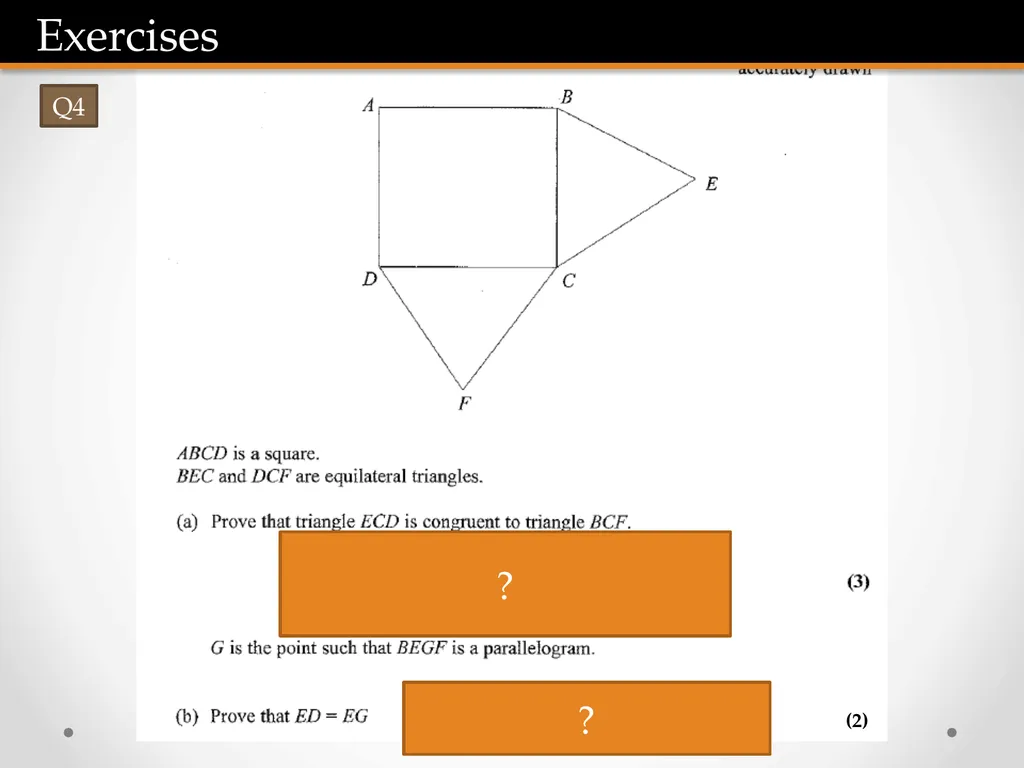
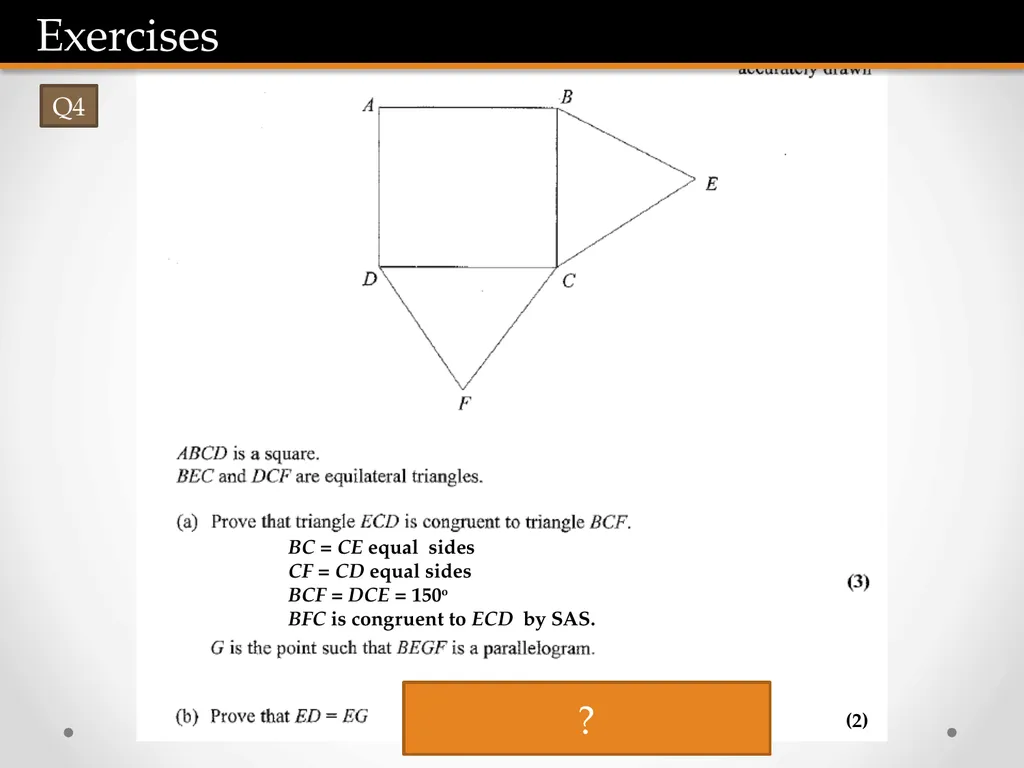
Q4 BC = CE equal sides
CF = CD equal sides
BCF = DCE = 150o
BFC is congruent to ECD by SAS. So BF=ED (congruent triangles)
BF = EG ( opp sides of parallelogram) (2) ? ?<br>
25
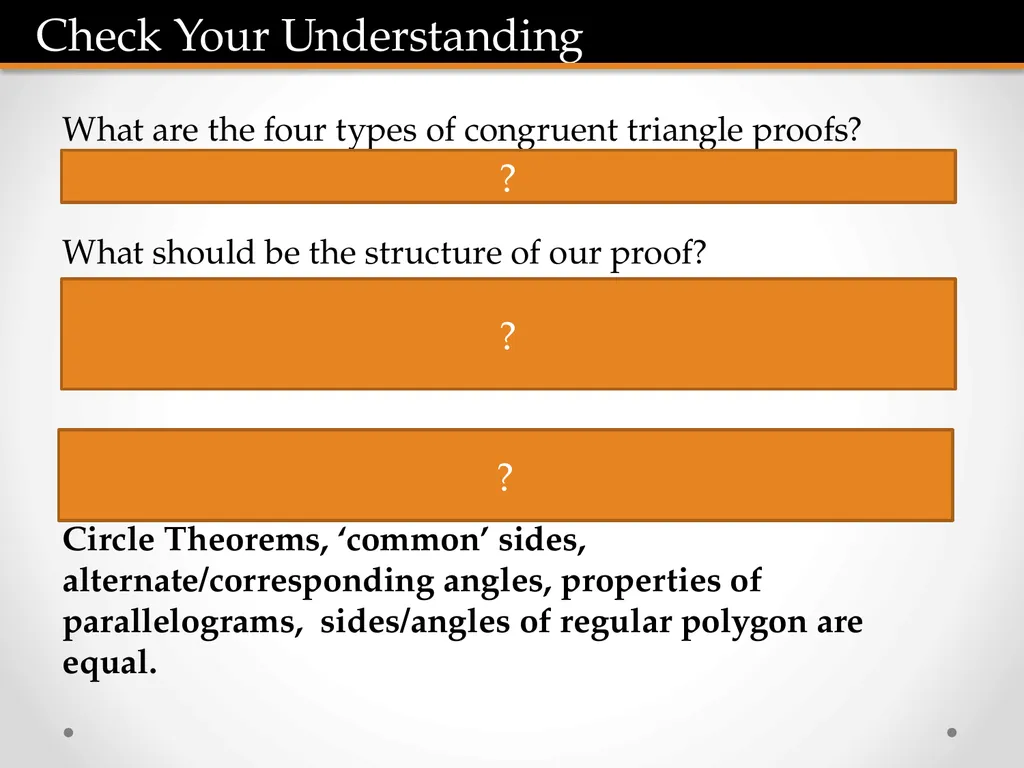
What are the four types of congruent triangle proofs?
SSS, SAS, ASA (equivalent to AAS) and RHS.
What should be the structure of our proof?
Justification of each of the three letters, followed by conclusion in which we state which proof type we used.
What kinds of justifications can be used for sides and angles?
Circle Theorems, ‘common’ sides, alternate/corresponding angles, properties of parallelograms, sides/angles of regular polygon are equal. ? ? ?<br>
26
? Q2<br>
27
Q4 BC = CE equal sides
CF = CD equal sides
BCF = DCE = 150o
BFC is congruent to ECD by SAS. So BF=ED (congruent triangles)
BF = EG ( opp sides of parallelogram) (2) ?<br>