
State Long-Term Care Ombudsman Program (LTCOP)
MJ
Published · 44 slides · 0 views
1 / 1




Description
State Long-Term Care Ombudsman Program (LTCOP) Final Rule (2015) Overview 45 CFR 1321 and 1327 Effective July 1, 2016 Administration for Community Living Administration on Aging 4202015 Program Description The Older Americans Act (OAA)
Related Topics
Share
Embed code
Download this presentation From Below
"State Long-Term Care Ombudsman Program (LTCOP)" is the property of its rightful owner. Permission is granted to download and print the materials on this website for personal, non-commercial use only, and to display it on your personal computer provided you do not modify the materials and that you retain all copyright notices contained in the materials. By downloading content from our website, you accept the terms of this agreement.
Presentation Transcript
01
State Long-Term Care
Ombudsman Program (LTCOP) Final Rule (2015) Overview
45 CFR 1321 and 1327
Effective July 1, 2016
Administration for Community Living/ Administration on Aging 4/20/2015<br>
45 CFR 1321 and 1327
Effective July 1, 2016
Administration for Community Living/ Administration on Aging 4/20/2015<br>
02
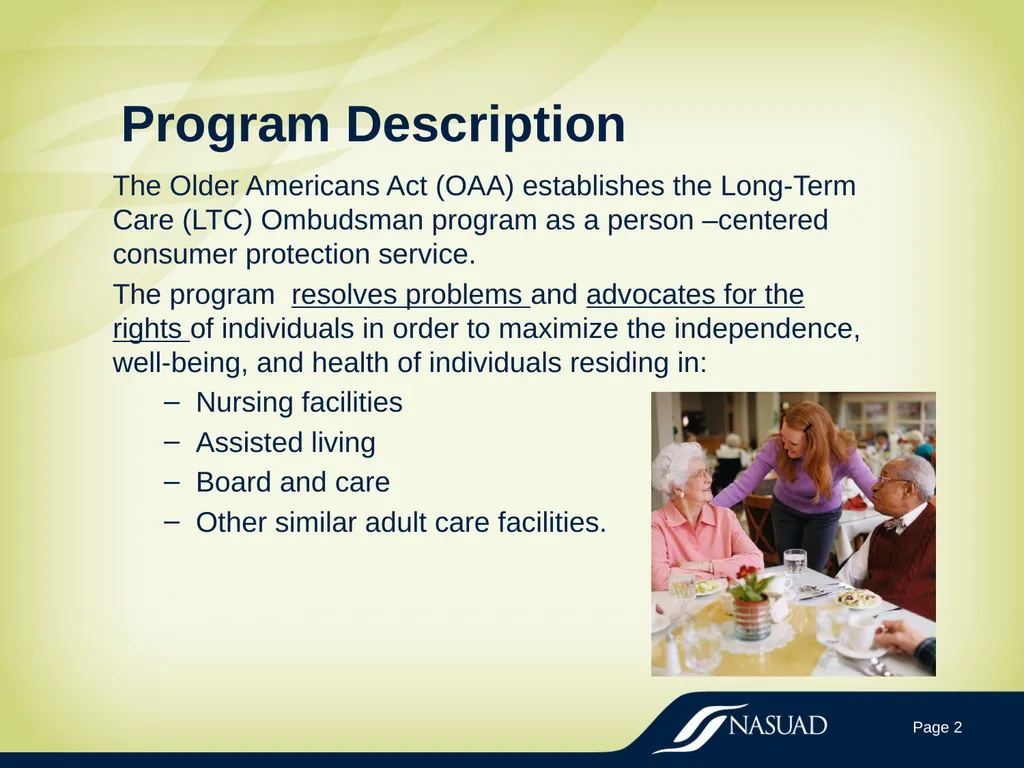
Program Description The Older Americans Act (OAA) establishes the Long-Term Care (LTC) Ombudsman program as a person –centered consumer protection service.
The program resolves problems and advocates for the rights of individuals in order to maximize the independence, well-being, and health of individuals residing in:
Nursing facilities
Assisted living
Board and care
Other similar adult care facilities. Page 2<br>
The program resolves problems and advocates for the rights of individuals in order to maximize the independence, well-being, and health of individuals residing in:
Nursing facilities
Assisted living
Board and care
Other similar adult care facilities. Page 2<br>
03
Negligible Burden Some states already in compliance with Final Rule
For others, it will require change in :
Organizational structure and/or
State practices, policies, regulations or laws.
States need to evaluate and update state statutes, regulations, policies and/or practices in order to operate the program consistent with federal law and this rule.
Collaboration between the State agency and the State LTC Ombudsman will be needed to determine compliance Page 3<br>
For others, it will require change in :
Organizational structure and/or
State practices, policies, regulations or laws.
States need to evaluate and update state statutes, regulations, policies and/or practices in order to operate the program consistent with federal law and this rule.
Collaboration between the State agency and the State LTC Ombudsman will be needed to determine compliance Page 3<br>
04
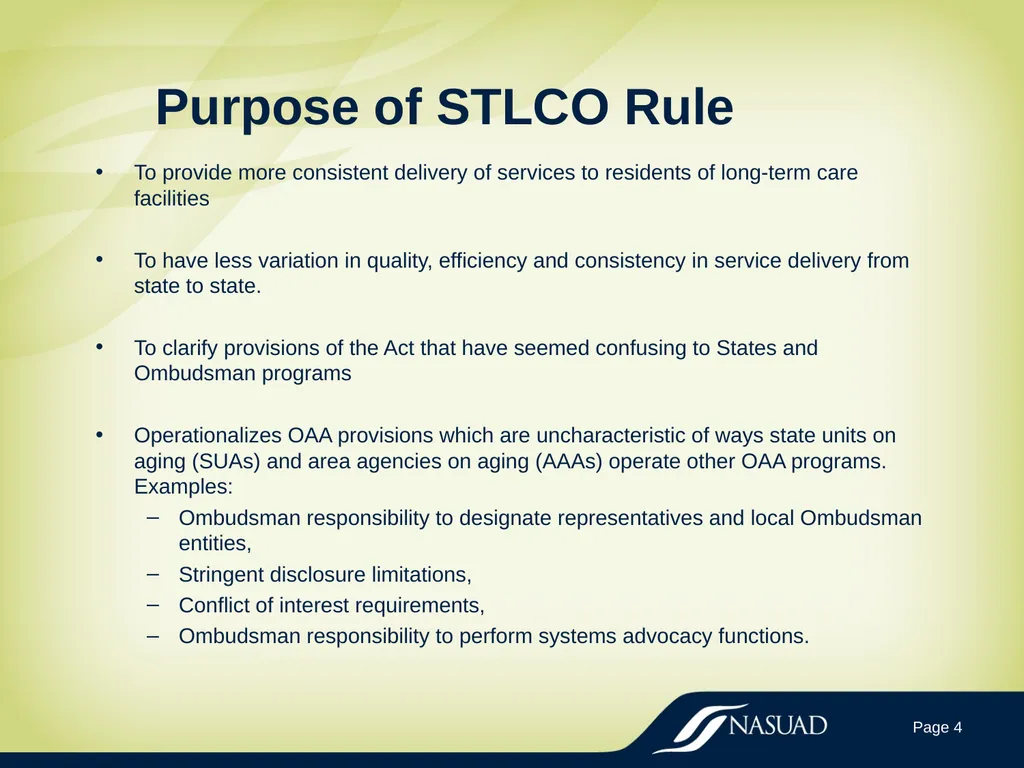
Purpose of STLCO Rule To provide more consistent delivery of services to residents of long-term care facilities
To have less variation in quality, efficiency and consistency in service delivery from state to state.
To clarify provisions of the Act that have seemed confusing to States and Ombudsman programs
Operationalizes OAA provisions which are uncharacteristic of ways state units on aging (SUAs) and area agencies on aging (AAAs) operate other OAA programs. Examples:
Ombudsman responsibility to designate representatives and local Ombudsman entities,
Stringent disclosure limitations,
Conflict of interest requirements,
Ombudsman responsibility to perform systems advocacy functions. Page 4<br>
To have less variation in quality, efficiency and consistency in service delivery from state to state.
To clarify provisions of the Act that have seemed confusing to States and Ombudsman programs
Operationalizes OAA provisions which are uncharacteristic of ways state units on aging (SUAs) and area agencies on aging (AAAs) operate other OAA programs. Examples:
Ombudsman responsibility to designate representatives and local Ombudsman entities,
Stringent disclosure limitations,
Conflict of interest requirements,
Ombudsman responsibility to perform systems advocacy functions. Page 4<br>
05
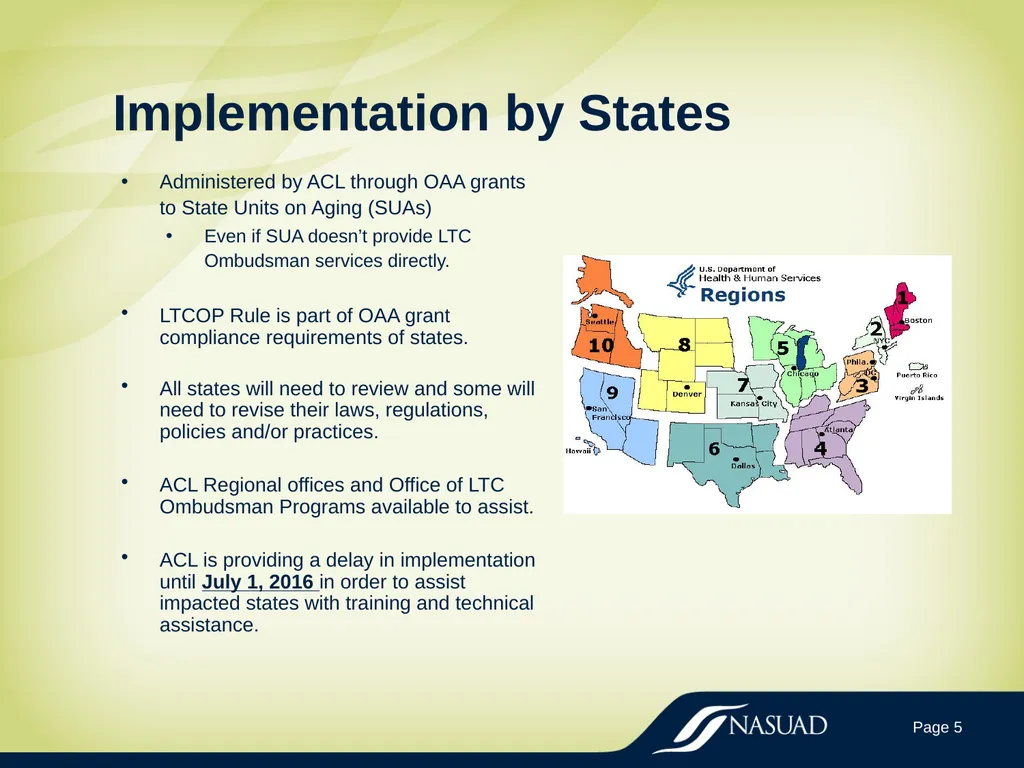
Implementation by States Administered by ACL through OAA grants to State Units on Aging (SUAs)
Even if SUA doesn’t provide LTC Ombudsman services directly.
LTCOP Rule is part of OAA grant compliance requirements of states.
All states will need to review and some will need to revise their laws, regulations, policies and/or practices.
ACL Regional offices and Office of LTC Ombudsman Programs available to assist.
ACL is providing a delay in implementation until July 1, 2016 in order to assist impacted states with training and technical assistance. Page 5<br>
Even if SUA doesn’t provide LTC Ombudsman services directly.
LTCOP Rule is part of OAA grant compliance requirements of states.
All states will need to review and some will need to revise their laws, regulations, policies and/or practices.
ACL Regional offices and Office of LTC Ombudsman Programs available to assist.
ACL is providing a delay in implementation until July 1, 2016 in order to assist impacted states with training and technical assistance. Page 5<br>
06
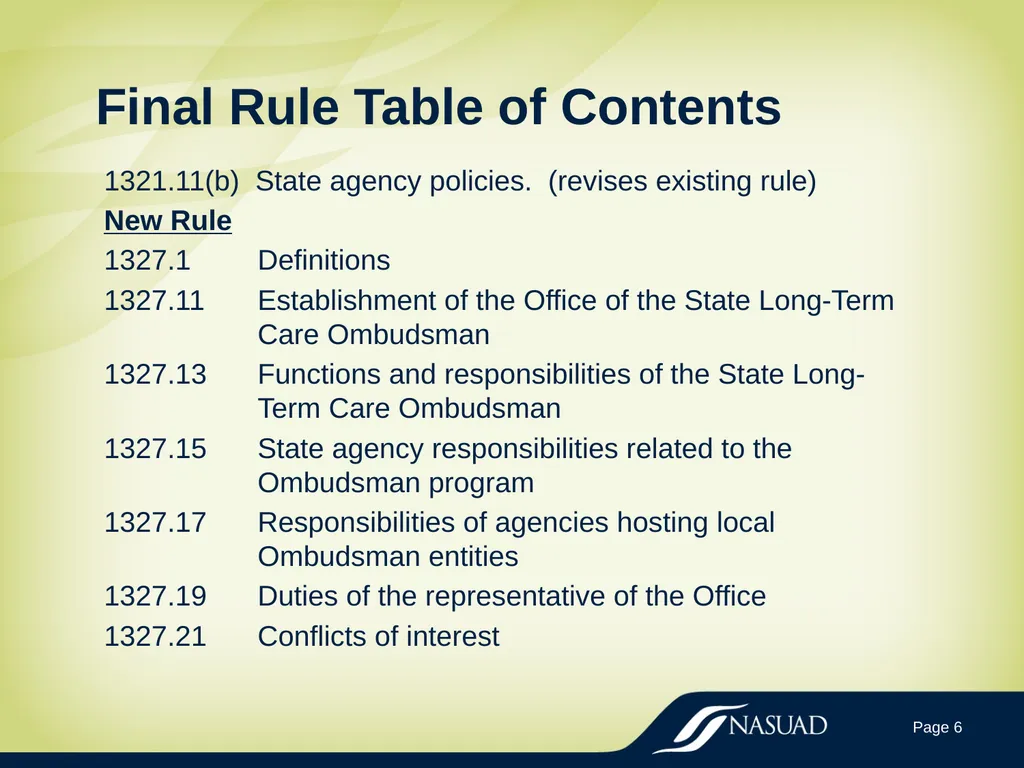
Final Rule Table of Contents 1321.11(b) State agency policies. (revises existing rule)
New Rule
1327.1 Definitions
1327.11 Establishment of the Office of the State Long-Term Care Ombudsman
1327.13 Functions and responsibilities of the State Long- Term Care Ombudsman
1327.15 State agency responsibilities related to the Ombudsman program
1327.17 Responsibilities of agencies hosting local Ombudsman entities
1327.19 Duties of the representative of the Office
1327.21 Conflicts of interest Page 6<br>
New Rule
1327.1 Definitions
1327.11 Establishment of the Office of the State Long-Term Care Ombudsman
1327.13 Functions and responsibilities of the State Long- Term Care Ombudsman
1327.15 State agency responsibilities related to the Ombudsman program
1327.17 Responsibilities of agencies hosting local Ombudsman entities
1327.19 Duties of the representative of the Office
1327.21 Conflicts of interest Page 6<br>
07
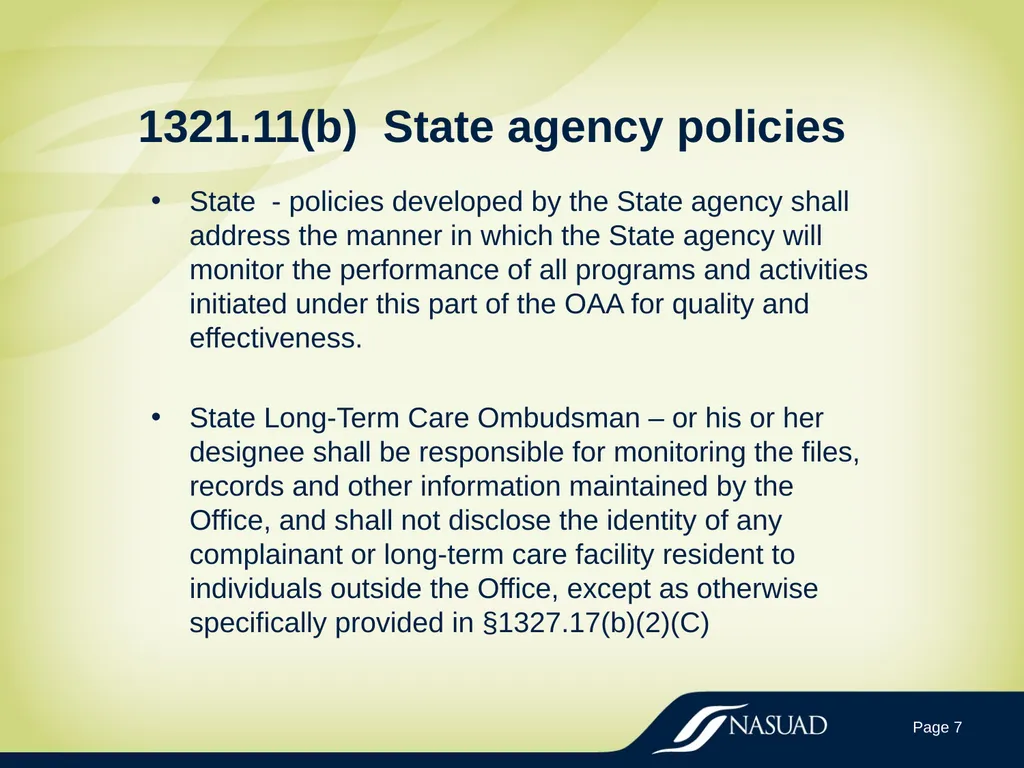
State - policies developed by the State agency shall address the manner in which the State agency will monitor the performance of all programs and activities initiated under this part of the OAA for quality and effectiveness.
State Long-Term Care Ombudsman – or his or her designee shall be responsible for monitoring the files, records and other information maintained by the Office, and shall not disclose the identity of any complainant or long-term care facility resident to individuals outside the Office, except as otherwise specifically provided in §1327.17(b)(2)(C) Page 7 1321.11(b) State agency policies<br>
State Long-Term Care Ombudsman – or his or her designee shall be responsible for monitoring the files, records and other information maintained by the Office, and shall not disclose the identity of any complainant or long-term care facility resident to individuals outside the Office, except as otherwise specifically provided in §1327.17(b)(2)(C) Page 7 1321.11(b) State agency policies<br>
08
45 CFR 1327 State Long-Term Care Ombudsman Final Rule Page 8<br>
09
§1327.1 Definitions Immediate Family – means a member of the household or a relative with whom there is a close personal or significant financial relationship
Office - Office of the State Long-Term Care Ombudsman – means the organizational unit in a State or territory which is headed by a State Long-Term Care Ombudsman
Representatives of the Office – of the State Long-Term Care Ombudsman – means the employees or volunteers designated by the Ombudsman to fulfill the duties set forth in §1327.19(a), whether personnel supervision is provided by the Ombudsman or his/her designees or by an agency hosting a local Ombudsman entity …
Resident representative – a person chosen to act on behalf of the resident either by the resident, authorized by State or Federal law (DPOA), legal representative, or court-appointed guardian or conservator Page 9<br>
Office - Office of the State Long-Term Care Ombudsman – means the organizational unit in a State or territory which is headed by a State Long-Term Care Ombudsman
Representatives of the Office – of the State Long-Term Care Ombudsman – means the employees or volunteers designated by the Ombudsman to fulfill the duties set forth in §1327.19(a), whether personnel supervision is provided by the Ombudsman or his/her designees or by an agency hosting a local Ombudsman entity …
Resident representative – a person chosen to act on behalf of the resident either by the resident, authorized by State or Federal law (DPOA), legal representative, or court-appointed guardian or conservator Page 9<br>
10
Definitions continued Ombudsman – means the individual who heads the Office and is responsible to personally, or through representative of the Office, fulfill the functions, responsibilities and duties set forth in the rule.
Ombudsman Program – means the program through which the functions and duties of the Office are carried out, consisting of the Ombudsman, the Office headed by the Ombudsman, and the representatives of the Office
Willful Interference – means actions or inactions taken by an individual in an attempt to intentionally prevent, interfere with, or attempt to impede the Ombudsman from performing any of the functions or responsibilities set forth in §1327.13, or the Ombudsman or a representative of the Office from performing any of the duties set forth in §1327.19. Page 10<br>
Ombudsman Program – means the program through which the functions and duties of the Office are carried out, consisting of the Ombudsman, the Office headed by the Ombudsman, and the representatives of the Office
Willful Interference – means actions or inactions taken by an individual in an attempt to intentionally prevent, interfere with, or attempt to impede the Ombudsman from performing any of the functions or responsibilities set forth in §1327.13, or the Ombudsman or a representative of the Office from performing any of the duties set forth in §1327.19. Page 10<br>
11
§1327.11
Establishment of the Office of the State Long-Term Care Ombudsman Page 11<br>
12
1327.11 Establishment of the Office of the State Long-Term Care Ombudsman Office is a “distinct entity, separately identifiable”
SUA must require that the Ombudsman serve on a full-time basis (100% time as Ombudsman)
Requires minimum qualification in hiring the Ombudsman with demonstrated expertise in:
Long-term services and supports or other direct services for older persons or individuals with disabilities;
Consumer-oriented public policy advocacy;
Leadership and program management skills; and
Negotiation and problem resolution skills. Page 12<br>
SUA must require that the Ombudsman serve on a full-time basis (100% time as Ombudsman)
Requires minimum qualification in hiring the Ombudsman with demonstrated expertise in:
Long-term services and supports or other direct services for older persons or individuals with disabilities;
Consumer-oriented public policy advocacy;
Leadership and program management skills; and
Negotiation and problem resolution skills. Page 12<br>
13
Establishment of Office cont. Policies and Procedures
Program policies and procedures are to be established by the Ombudsman if he/she has appropriate legal authority
Otherwise, Ombudsman recommends policies and procedures to the SUA or other agency in which Office is located
Requires input of agencies in which local Ombudsman entities are housed
Policies and procedures must include provisions related to:
Program administration
Procedures for access
Disclosure
Conflict of interest
Systems advocacy
Designation
Grievance process
Determination of the Office Page 13<br>
Program policies and procedures are to be established by the Ombudsman if he/she has appropriate legal authority
Otherwise, Ombudsman recommends policies and procedures to the SUA or other agency in which Office is located
Requires input of agencies in which local Ombudsman entities are housed
Policies and procedures must include provisions related to:
Program administration
Procedures for access
Disclosure
Conflict of interest
Systems advocacy
Designation
Grievance process
Determination of the Office Page 13<br>
14
§1327.13
Functions and Responsibilities of the Office of the
State Long-Term Care Ombudsman “Office” = The State Long-Term Care Ombudsman and representatives of the Office
“Ombudsman” = The State Long-Term Care Ombudsman Page 14<br>
“Ombudsman” = The State Long-Term Care Ombudsman Page 14<br>
15
1327.13 Functions & Responsibilities of the State LTC Ombudsman Ombudsman - serves on a fulltime basis
Ombudsman - Head of a unified statewide program
Designation and de-designation of representatives of the Office
Monitoring of local Ombudsman entities and involvement in area plan reviews, where applicable
Management and disclosure of Ombudsman program information; information is the property of the Office
Propose Ombudsman program policies, procedures, and standards
Leadership of statewide systems advocacy efforts of the Office
Fiscal Management: Determining the use of fiscal resources of the Office
Development and approval of an annual report
Coordination with other entities for the protection of vulnerable adults Page 15<br>
Ombudsman - Head of a unified statewide program
Designation and de-designation of representatives of the Office
Monitoring of local Ombudsman entities and involvement in area plan reviews, where applicable
Management and disclosure of Ombudsman program information; information is the property of the Office
Propose Ombudsman program policies, procedures, and standards
Leadership of statewide systems advocacy efforts of the Office
Fiscal Management: Determining the use of fiscal resources of the Office
Development and approval of an annual report
Coordination with other entities for the protection of vulnerable adults Page 15<br>
16
Functions and Responsibilities of the Office Continued Complaint Processing – a required function of the Ombudsman [OAA Sec 712(a)(93)(A)] and the Office [OAA Sec 712(a)(5)(B)(iii)]
Ombudsman and Office serve the resident
Resolve complaint to residents satisfaction
Assist residents in protecting their health, safety, welfare and rights
Abuse reporting (Section 1327.17(b)(3) is limited to circumstances in which disclosure is permitted if resident is unable to consent and is at risk Page 16<br>
Ombudsman and Office serve the resident
Resolve complaint to residents satisfaction
Assist residents in protecting their health, safety, welfare and rights
Abuse reporting (Section 1327.17(b)(3) is limited to circumstances in which disclosure is permitted if resident is unable to consent and is at risk Page 16<br>
17
Functions and Responsibilities of the Office Continued Lobbying activities §1327.15 (a)(2)(v)(A) and 1327.17(d)
The Ombudsman’s provision of information, recommendations of changes of laws to legislators, and recommendations of changes to regulations and policies to government agencies, do not constitute lobbying activities as defined by 45 CFR Part 93 Page 17<br>
The Ombudsman’s provision of information, recommendations of changes of laws to legislators, and recommendations of changes to regulations and policies to government agencies, do not constitute lobbying activities as defined by 45 CFR Part 93 Page 17<br>
18
§1327.15
State Agency Responsibilities related to the Ombudsman program Page 18<br>
19
1327.15 State Agency responsibilities related to the Ombudsman program
SUA shall ensure that:
The Ombudsman comply with the OAA and the Rule
Program has sufficient authority and access to facilities, residents, and information needed to perform the functions, responsibilities and duties of the Office.
SUA shall provide:
Training opportunities; can utilize Title IIIB and Title VII funding for this purpose.
Personnel supervision and management for the Ombudsman and representatives of the Office who are employees of the state agency including assessment of Office fulfillment of functions.
Contract monitoring, including fiscal monitoring , where applicable; and may request reports of program aggregated data for this purpose Page 19<br>
SUA shall ensure that:
The Ombudsman comply with the OAA and the Rule
Program has sufficient authority and access to facilities, residents, and information needed to perform the functions, responsibilities and duties of the Office.
SUA shall provide:
Training opportunities; can utilize Title IIIB and Title VII funding for this purpose.
Personnel supervision and management for the Ombudsman and representatives of the Office who are employees of the state agency including assessment of Office fulfillment of functions.
Contract monitoring, including fiscal monitoring , where applicable; and may request reports of program aggregated data for this purpose Page 19<br>
20
State Agency Responsibilities Continued SUA shall:
Integrate the goals and objectives of the Office into the state plan on aging
Provide elder rights leadership through coordination of goals and objectives with other Title VII programs and other state elder rights, disability rights, and elder justice programs.
Prohibit and investigate allegations of interference, retaliation and reprisals and provide for sanctions. It is unlawful to interfere with official duties of the Office including by facilities or third parties or the State office itself.
Provide for adequate legal counsel for the program that has competencies relevant to the legal needs of the program and of residents and is without conflict of interest Page 20<br>
Integrate the goals and objectives of the Office into the state plan on aging
Provide elder rights leadership through coordination of goals and objectives with other Title VII programs and other state elder rights, disability rights, and elder justice programs.
Prohibit and investigate allegations of interference, retaliation and reprisals and provide for sanctions. It is unlawful to interfere with official duties of the Office including by facilities or third parties or the State office itself.
Provide for adequate legal counsel for the program that has competencies relevant to the legal needs of the program and of residents and is without conflict of interest Page 20<br>
21
State Agency Responsibilities Continued SUA shall require the Office to
Develop and approve an annual report
Fulfill systems advocacy responsibilities
Provide communications regarding problems and concerns of individuals residing in long-term care facilities and Ombudsman program recommendations for improvements
Establish procedures for training of representatives of the Office - Utilize funds to meet training needs. Adequate training is a reasonable cost (1327.15(a)(3)
Coordinate with other relevant entities Page 21<br>
Develop and approve an annual report
Fulfill systems advocacy responsibilities
Provide communications regarding problems and concerns of individuals residing in long-term care facilities and Ombudsman program recommendations for improvements
Establish procedures for training of representatives of the Office - Utilize funds to meet training needs. Adequate training is a reasonable cost (1327.15(a)(3)
Coordinate with other relevant entities Page 21<br>
22
State Agency Responsibilities Continued No prohibition from consultations between Ombudsman and SUA.
Ombudsman makes independent determinations. (1327.15(a)(2)(v)(B)
Can not require advanced communications
Monitor contract or other arrangement when the Ombudsman Program is outside the State agency to ensure that Ombudsman program requirements are carried out. Page 22<br>
Ombudsman makes independent determinations. (1327.15(a)(2)(v)(B)
Can not require advanced communications
Monitor contract or other arrangement when the Ombudsman Program is outside the State agency to ensure that Ombudsman program requirements are carried out. Page 22<br>
23
State Agency Responsibilities Continued Limit for the State on access to files, records, and other information (including electronic files, records and information) of the Ombudsman program to aggregate information
Ombudsman access to resident records does not fall under the HIPAA Privacy Rule. State needs to establish policies and procedures to address HIPAA guidance Page 23<br>
Ombudsman access to resident records does not fall under the HIPAA Privacy Rule. State needs to establish policies and procedures to address HIPAA guidance Page 23<br>
24
State Agency Responsibilities Continued Establish mechanisms to identify and remove or remedy conflicts of interest pursuant to section 712(f) of the OAA. §1327.15(a)(2)(iv)
Consider both organizational and individual conflicts that may impact the effectiveness and credibility of the work of the Office
Where an actual or potential conflict has been identified, the State agency shall remove or remedy such conflict Page 24<br>
Consider both organizational and individual conflicts that may impact the effectiveness and credibility of the work of the Office
Where an actual or potential conflict has been identified, the State agency shall remove or remedy such conflict Page 24<br>
25
§1327.17
Responsibilities of agencies hosting local Ombudsman entities Page 25 *Decentralized model<br>
26
1327.17 Responsibilities of agencies hosting local Ombudsman entities Agencies hosting local Ombudsman entities can be responsible for the personnel management, but not the programmatic oversight of representative of the Office
Including employees and volunteer representative of the Office in addressing situations in which representatives of the Office have multiple (and sometimes conflicting) requirements.
Agencies hosting local Ombudsman entities may not have a conflict of interest as set forth in the rule. Page 26<br>
Including employees and volunteer representative of the Office in addressing situations in which representatives of the Office have multiple (and sometimes conflicting) requirements.
Agencies hosting local Ombudsman entities may not have a conflict of interest as set forth in the rule. Page 26<br>
27
§1327.19
Duties of the Representatives of the Office Page 27<br>
28
1327.19 Duties of the Representatives of the Office Duties set forth in the Older Americans Act
Complaint processing
Investigate for the purposes of resolving the complaint to the resident’s satisfaction and of protecting the health, welfare, and rights of the resident.
Person-centered complaint processing approach
“Unbefriended” residents – Clarifies authority to work to resolve complaint where the resident is unale to communicate informed consent, and has no resident representative Page 28<br>
Complaint processing
Investigate for the purposes of resolving the complaint to the resident’s satisfaction and of protecting the health, welfare, and rights of the resident.
Person-centered complaint processing approach
“Unbefriended” residents – Clarifies authority to work to resolve complaint where the resident is unale to communicate informed consent, and has no resident representative Page 28<br>
29
Duties of the Representative of the Office continued Requires program to assist resident in contacting and/or disclosing information when resident goal is for regulatory, protective services or law enforcement action.
Prohibits program for reporting suspected abuse, neglect or exploitation of a resident without informed consent. Page 29<br>
Prohibits program for reporting suspected abuse, neglect or exploitation of a resident without informed consent. Page 29<br>
30
§1327.21
Conflicts of Interest Organizational & Individual Page 30<br>
31
Organizational Conflicts of interest, include but are not limited to placement in an organization that :
Is responsible for licensing, surveying, or certifying LTC facilities
Is an association of LTC facilities or any other residential facilities
Has an ownership or investment interest in , or receives grants or donations from, a LTC facility
Has governing board members with ownership, investment or employment interest in LTC facilities
Provides LTC services, including the provision of personnel for LTC facilities or the operation of programs which control access to or services for LTC facilities
Provides LTC coordination or case management
Sets reimbursement rates for LTC services
Provides Adult Protective Services
Is responsible for Medicaid eligibility determinations
Conducts preadmission screening for LTC residential placements (PASARR)
Makes decisions regarding admission or discharge of individuals to or from LTC facilities
Provides guardianship, conservatorship or other fiduciary or surrogate decision-making services for LTC facilities Page 31 1327.21(a) Conflicts of Interest - Organizational<br>
Is responsible for licensing, surveying, or certifying LTC facilities
Is an association of LTC facilities or any other residential facilities
Has an ownership or investment interest in , or receives grants or donations from, a LTC facility
Has governing board members with ownership, investment or employment interest in LTC facilities
Provides LTC services, including the provision of personnel for LTC facilities or the operation of programs which control access to or services for LTC facilities
Provides LTC coordination or case management
Sets reimbursement rates for LTC services
Provides Adult Protective Services
Is responsible for Medicaid eligibility determinations
Conducts preadmission screening for LTC residential placements (PASARR)
Makes decisions regarding admission or discharge of individuals to or from LTC facilities
Provides guardianship, conservatorship or other fiduciary or surrogate decision-making services for LTC facilities Page 31 1327.21(a) Conflicts of Interest - Organizational<br>
32
§1327.21(b)The State agency shall identify and remove or remedy conflicts of interest between the Office and the State agency or other agency carrying out the Ombudsman program
Both the SUA and Ombudsman have duty to identify and remove/remedy the Conflict of Interest
(1) Where Office is within or attached to the State agency
Take steps to avoid internal conflicts of interest
Establish a process to review and identify internal conflicts
Take steps to remove or remedy conflicts
Ensure that no person who designates, appoints or selects or terminates the Ombudsman is subject to a conflict of interest
Report disclosed conflicts and describe steps to remove or remedy in the annual Ombudsman report to the Assistant Secretary Page 32 1327.(b)Removing/Remedying Organizational Conflicts<br>
Both the SUA and Ombudsman have duty to identify and remove/remedy the Conflict of Interest
(1) Where Office is within or attached to the State agency
Take steps to avoid internal conflicts of interest
Establish a process to review and identify internal conflicts
Take steps to remove or remedy conflicts
Ensure that no person who designates, appoints or selects or terminates the Ombudsman is subject to a conflict of interest
Report disclosed conflicts and describe steps to remove or remedy in the annual Ombudsman report to the Assistant Secretary Page 32 1327.(b)Removing/Remedying Organizational Conflicts<br>
33
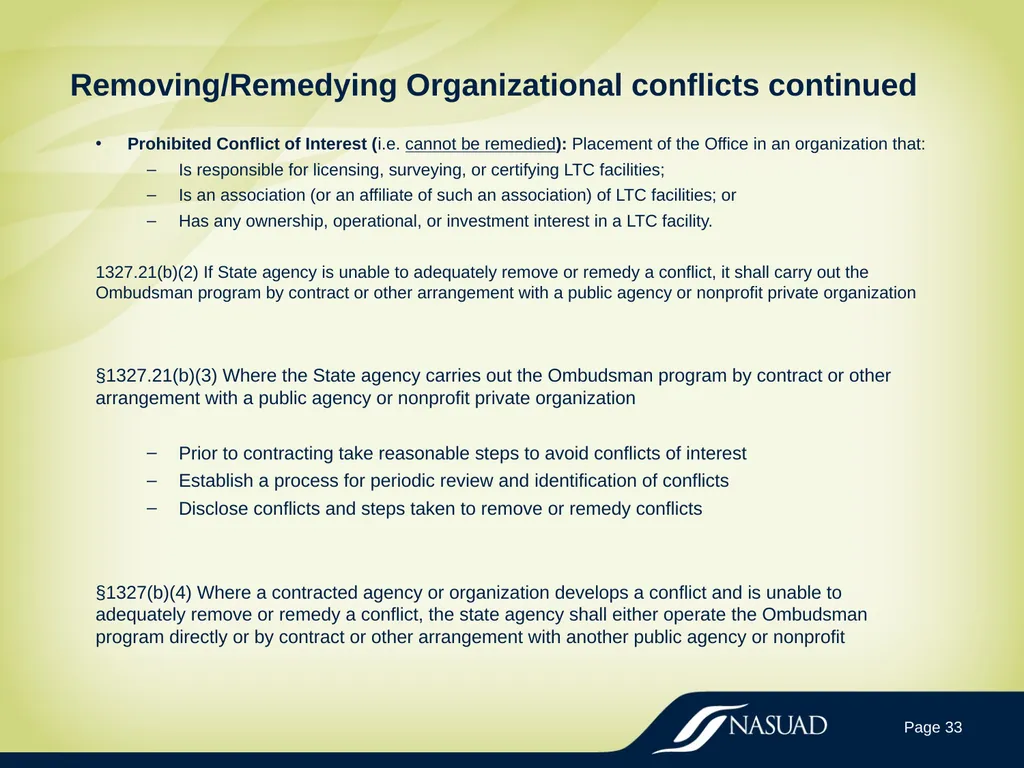
Removing/Remedying Organizational conflicts continued Prohibited Conflict of Interest (i.e. cannot be remedied): Placement of the Office in an organization that:
Is responsible for licensing, surveying, or certifying LTC facilities;
Is an association (or an affiliate of such an association) of LTC facilities; or
Has any ownership, operational, or investment interest in a LTC facility.
1327.21(b)(2) If State agency is unable to adequately remove or remedy a conflict, it shall carry out the Ombudsman program by contract or other arrangement with a public agency or nonprofit private organization
§1327.21(b)(3) Where the State agency carries out the Ombudsman program by contract or other arrangement with a public agency or nonprofit private organization
Prior to contracting take reasonable steps to avoid conflicts of interest
Establish a process for periodic review and identification of conflicts
Disclose conflicts and steps taken to remove or remedy conflicts
§1327(b)(4) Where a contracted agency or organization develops a conflict and is unable to adequately remove or remedy a conflict, the state agency shall either operate the Ombudsman program directly or by contract or other arrangement with another public agency or nonprofit Page 33<br>
Is responsible for licensing, surveying, or certifying LTC facilities;
Is an association (or an affiliate of such an association) of LTC facilities; or
Has any ownership, operational, or investment interest in a LTC facility.
1327.21(b)(2) If State agency is unable to adequately remove or remedy a conflict, it shall carry out the Ombudsman program by contract or other arrangement with a public agency or nonprofit private organization
§1327.21(b)(3) Where the State agency carries out the Ombudsman program by contract or other arrangement with a public agency or nonprofit private organization
Prior to contracting take reasonable steps to avoid conflicts of interest
Establish a process for periodic review and identification of conflicts
Disclose conflicts and steps taken to remove or remedy conflicts
§1327(b)(4) Where a contracted agency or organization develops a conflict and is unable to adequately remove or remedy a conflict, the state agency shall either operate the Ombudsman program directly or by contract or other arrangement with another public agency or nonprofit Page 33<br>
34
1327.21(b) Removing or remedying organizational conflicts Office is located within or otherwise organizationally attached to the State agency
Take steps to avoid internal conflicts of interest
Establish a process for review and identification of internal conflicts
Take steps to remove or remedy conflicts
Ensure that no individual or immediate family member is involved in the designating, appointing or terminating the Ombudsman is subject to conflict of interest
Assure that the Ombudsman has disclosed conflicts and described steps to remove or remedy conflicts within the annual report submitted to AoA Page 34<br>
Take steps to avoid internal conflicts of interest
Establish a process for review and identification of internal conflicts
Take steps to remove or remedy conflicts
Ensure that no individual or immediate family member is involved in the designating, appointing or terminating the Ombudsman is subject to conflict of interest
Assure that the Ombudsman has disclosed conflicts and described steps to remove or remedy conflicts within the annual report submitted to AoA Page 34<br>
35
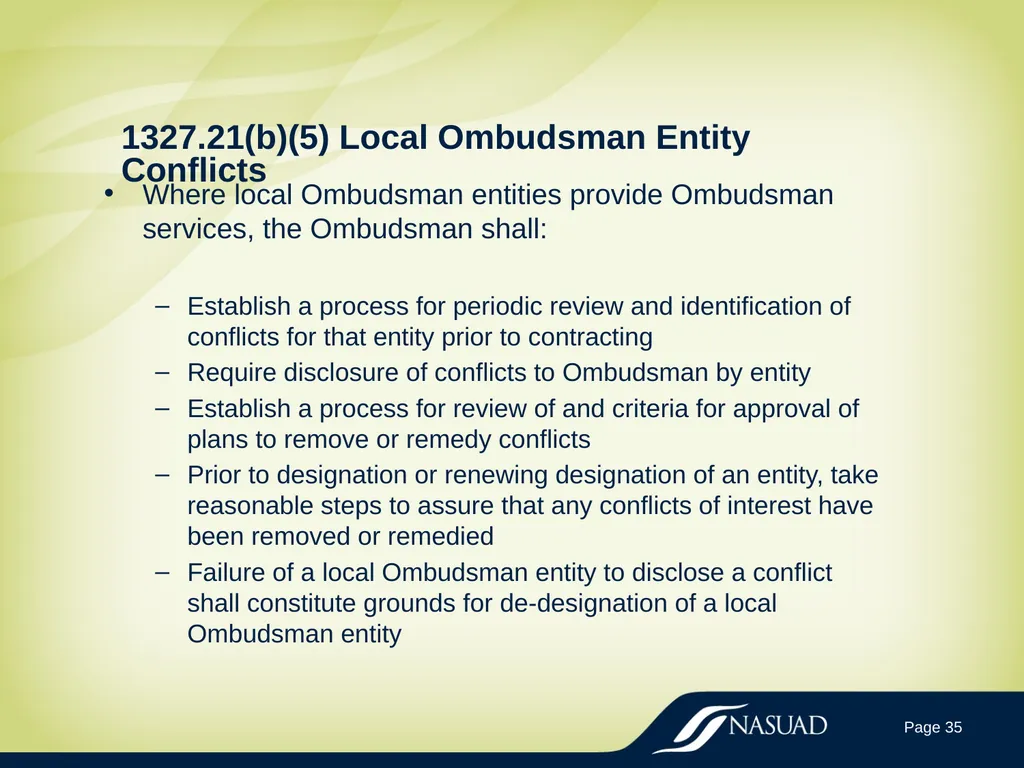
1327.21(b)(5) Local Ombudsman Entity Conflicts Where local Ombudsman entities provide Ombudsman services, the Ombudsman shall:
Establish a process for periodic review and identification of conflicts for that entity prior to contracting
Require disclosure of conflicts to Ombudsman by entity
Establish a process for review of and criteria for approval of plans to remove or remedy conflicts
Prior to designation or renewing designation of an entity, take reasonable steps to assure that any conflicts of interest have been removed or remedied
Failure of a local Ombudsman entity to disclose a conflict shall constitute grounds for de-designation of a local Ombudsman entity Page 35<br>
Establish a process for periodic review and identification of conflicts for that entity prior to contracting
Require disclosure of conflicts to Ombudsman by entity
Establish a process for review of and criteria for approval of plans to remove or remedy conflicts
Prior to designation or renewing designation of an entity, take reasonable steps to assure that any conflicts of interest have been removed or remedied
Failure of a local Ombudsman entity to disclose a conflict shall constitute grounds for de-designation of a local Ombudsman entity Page 35<br>
36
§ 1327.21
Conflicts of Interest - Page 36 Individual<br>
37
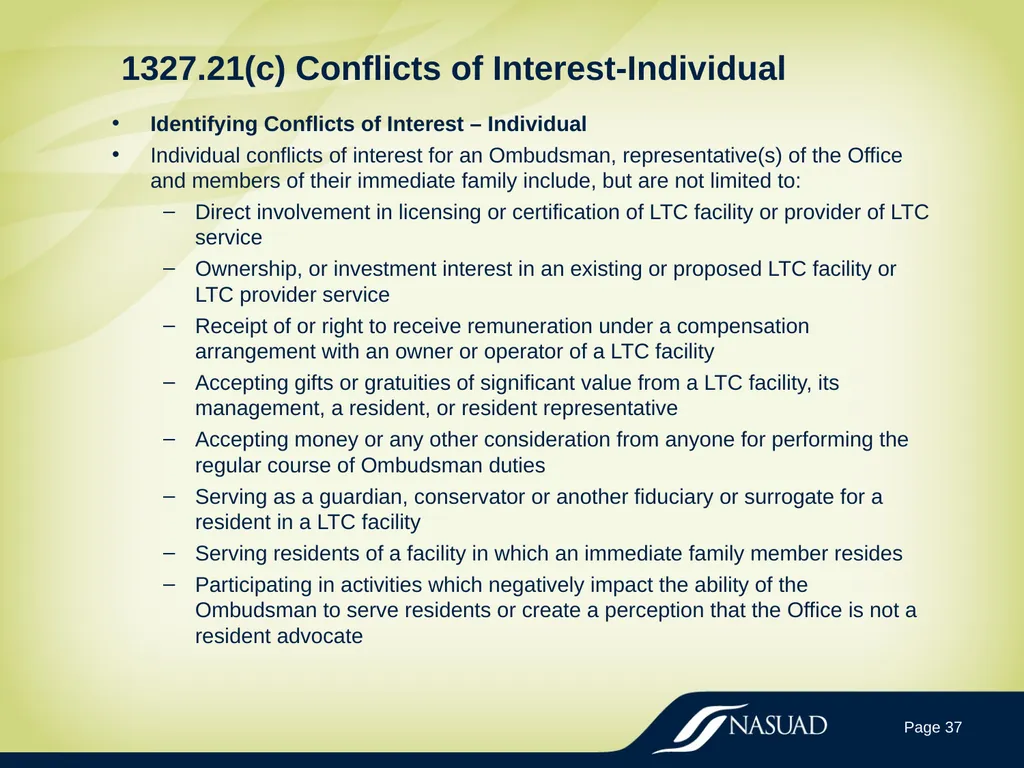
Identifying Conflicts of Interest – Individual
Individual conflicts of interest for an Ombudsman, representative(s) of the Office and members of their immediate family include, but are not limited to:
Direct involvement in licensing or certification of LTC facility or provider of LTC service
Ownership, or investment interest in an existing or proposed LTC facility or LTC provider service
Receipt of or right to receive remuneration under a compensation arrangement with an owner or operator of a LTC facility
Accepting gifts or gratuities of significant value from a LTC facility, its management, a resident, or resident representative
Accepting money or any other consideration from anyone for performing the regular course of Ombudsman duties
Serving as a guardian, conservator or another fiduciary or surrogate for a resident in a LTC facility
Serving residents of a facility in which an immediate family member resides
Participating in activities which negatively impact the ability of the Ombudsman to serve residents or create a perception that the Office is not a resident advocate Page 37 1327.21(c) Conflicts of Interest-Individual<br>
Individual conflicts of interest for an Ombudsman, representative(s) of the Office and members of their immediate family include, but are not limited to:
Direct involvement in licensing or certification of LTC facility or provider of LTC service
Ownership, or investment interest in an existing or proposed LTC facility or LTC provider service
Receipt of or right to receive remuneration under a compensation arrangement with an owner or operator of a LTC facility
Accepting gifts or gratuities of significant value from a LTC facility, its management, a resident, or resident representative
Accepting money or any other consideration from anyone for performing the regular course of Ombudsman duties
Serving as a guardian, conservator or another fiduciary or surrogate for a resident in a LTC facility
Serving residents of a facility in which an immediate family member resides
Participating in activities which negatively impact the ability of the Ombudsman to serve residents or create a perception that the Office is not a resident advocate Page 37 1327.21(c) Conflicts of Interest-Individual<br>
38
1327.21(d) Removing or Remedying Individual Conflicts State agency shall develop and implement policies and procedures to ensure that no Ombudsman or representative of the Office are not required to perform duties that would constitute a conflict of interest as set forth in §1327.19(c )
When considering employment of an individual as the Ombudsman or a representative of the Office, the State agency, or operating public or nonprofit agency should:
Take reasonable steps to avoid hiring someone with a conflict
Establish a process for periodic review and identification of conflicts
Take steps to remove or remedy conflicts
If a conflict can not be adequately removed or remedied the agency may not employ such candidate
The state agency shall ensure that the local Ombudsman entities that employ representatives of the Office has policies in place to prohibit hiring of an Ombudsman or representatives with a conflict that cannot be adequately removed or remedied Page 38<br>
When considering employment of an individual as the Ombudsman or a representative of the Office, the State agency, or operating public or nonprofit agency should:
Take reasonable steps to avoid hiring someone with a conflict
Establish a process for periodic review and identification of conflicts
Take steps to remove or remedy conflicts
If a conflict can not be adequately removed or remedied the agency may not employ such candidate
The state agency shall ensure that the local Ombudsman entities that employ representatives of the Office has policies in place to prohibit hiring of an Ombudsman or representatives with a conflict that cannot be adequately removed or remedied Page 38<br>
39
1327.21(d) Removing/Remedying Individual Conflicts Continued 1327.19(d)(5) In no circumstances may the State agency; where applicable, the public agency or non-profit private organization which carries out the program or a local Ombudsman entity employ an individual as the Ombudsman or representatives of the Office who:
Has had direct involvement in licensing or certification of a LTC facility or of a provider of LTC services within the previous year
Has an ownership or investment interest in a LTC facility or LTC service. Divestment within a reasonable period may be considered an adequate remedy to this conflict
Has been employed by or participating in the management of a LTC facility within the previous year; or
Receives, or has the right to receive, directly or indirectly, remuneration (in cash or in kind) under a compensation arrangement with an owner or operator of a LTC facility Page 39<br>
Has had direct involvement in licensing or certification of a LTC facility or of a provider of LTC services within the previous year
Has an ownership or investment interest in a LTC facility or LTC service. Divestment within a reasonable period may be considered an adequate remedy to this conflict
Has been employed by or participating in the management of a LTC facility within the previous year; or
Receives, or has the right to receive, directly or indirectly, remuneration (in cash or in kind) under a compensation arrangement with an owner or operator of a LTC facility Page 39<br>
40
1327.21(d)(6) Removing or Remedying Individual Conflicts Continued Where the Ombudsman or representative of the Office acquires a conflict that cannot be adequately removed or remedied, the operating agency may not continue to employ the individual as the Ombudsman or representative of the Office. Page 40<br>
41
Questions from the All-state Calls Q: Regarding full time State Ombudsman – Can a State Ombudsman be a full time employee that is the SLTCO but also oversees another function in the state like the Elder Rights Division?
A: The SLTCO is to be full time - meaning a full time employee devoting 100% of their time to the SLTCO program. The intent of the OAA was for the SLTC Ombudsman to be focused on statewide Ombudsman activities full time. They can be assigned other duties if those duties are of a temporary nature and for only a brief period of time.
Q: In screening for Conflict of Interest for Legal Counsel- Can an attorney represent both the Ombudsman program and the State Unit on Aging?
A: Each state has ethical standards for attorneys in their state. For a lot of issues there would probably be no conflict, it would only arise if the SUA program was the topic of a legal action represented by the Ombudsman for or with a resident. Page 41<br>
A: The SLTCO is to be full time - meaning a full time employee devoting 100% of their time to the SLTCO program. The intent of the OAA was for the SLTC Ombudsman to be focused on statewide Ombudsman activities full time. They can be assigned other duties if those duties are of a temporary nature and for only a brief period of time.
Q: In screening for Conflict of Interest for Legal Counsel- Can an attorney represent both the Ombudsman program and the State Unit on Aging?
A: Each state has ethical standards for attorneys in their state. For a lot of issues there would probably be no conflict, it would only arise if the SUA program was the topic of a legal action represented by the Ombudsman for or with a resident. Page 41<br>
42
Questions from All-state Calls continued Q: Regarding Organizational structure – If you could design a program for the perfect Ombudsman program, what would it look like?
A: It would seem that there is probably no perfect organizational structure. States need to evaluate their programs and may possibly need to make some changes in order to be in compliance with the law/rule. Three ACL staff have worked in SLTCO programs as State Ombudsman and each feel that their program worked for their states. (Note: NASUAD, in coordination with the National Ombudsman Resource Center, will be publishing a white paper showing the organizational structure of each state which could provide assistance when states are looking at options. The white paper should be available in a few months.
Q: Regarding Abuse Reporting - Could you make this section more clear for when a resident does not give consent with or without a representative and Ombudsman witnesses abuse?
A: First the state needs to have a process in place to guide the response in these cases. The basis of the Long-Term Care Ombudsman Program is to stand in the shoes of the resident. The residents’ trust of the Ombudsman is at the core of the work that the Ombudsman does. If the resident does not trust the Ombudsman the work will fail. The abuse reporting guidance is found in the Final Rule at 1327.11 (e )(3)(iv) and at 1327.19 (b)(5-8). Page 42<br>
A: It would seem that there is probably no perfect organizational structure. States need to evaluate their programs and may possibly need to make some changes in order to be in compliance with the law/rule. Three ACL staff have worked in SLTCO programs as State Ombudsman and each feel that their program worked for their states. (Note: NASUAD, in coordination with the National Ombudsman Resource Center, will be publishing a white paper showing the organizational structure of each state which could provide assistance when states are looking at options. The white paper should be available in a few months.
Q: Regarding Abuse Reporting - Could you make this section more clear for when a resident does not give consent with or without a representative and Ombudsman witnesses abuse?
A: First the state needs to have a process in place to guide the response in these cases. The basis of the Long-Term Care Ombudsman Program is to stand in the shoes of the resident. The residents’ trust of the Ombudsman is at the core of the work that the Ombudsman does. If the resident does not trust the Ombudsman the work will fail. The abuse reporting guidance is found in the Final Rule at 1327.11 (e )(3)(iv) and at 1327.19 (b)(5-8). Page 42<br>
43
Questions from All-state Calls continued Q: Regarding conflict of interest – Where can the SLTCO program be housed?
A: It is important to house the program and have policies in place that assure a resident and their family know that the ombudsman does not represent another entity. To residents, a perceived conflict is a real conflict.
Q: Regarding Legal Counsel – Can the Legal Services Developer provide the legal services to the Ombudsman program? Generally it would be that the legal services developer could be part of a team of legal services. The purpose of the legal council is to provide residents with legal council, address victim rights issues, provide general legal services and likely be an attorney. The Legal Services Developer may be able to address issues depending on the state’s individual needs.
Q: How can the SUA have a mechanism in place to prevent reprisals against a resident or ombudsman? What would this look like?
A: Under the OAA grant to the state, the SUA has a duty to make sure that procedures and policies are in place to present reprisals. The SUA needs to ensure but not necessarily do the enforcement themselves. Page 43<br>
A: It is important to house the program and have policies in place that assure a resident and their family know that the ombudsman does not represent another entity. To residents, a perceived conflict is a real conflict.
Q: Regarding Legal Counsel – Can the Legal Services Developer provide the legal services to the Ombudsman program? Generally it would be that the legal services developer could be part of a team of legal services. The purpose of the legal council is to provide residents with legal council, address victim rights issues, provide general legal services and likely be an attorney. The Legal Services Developer may be able to address issues depending on the state’s individual needs.
Q: How can the SUA have a mechanism in place to prevent reprisals against a resident or ombudsman? What would this look like?
A: Under the OAA grant to the state, the SUA has a duty to make sure that procedures and policies are in place to present reprisals. The SUA needs to ensure but not necessarily do the enforcement themselves. Page 43<br>
44
For more information, please contact: Dmerrill@nasuad.org
www.nasuad.org
Or call us at: 202-898-2578 4/20/2015<br>